2016
Assistant teacher, Candidate of Engineering Sciences
Belinskaya Nataliya Segeevna
PROFESSIONAL COURSE IN ENGLISH
“FUNDAMENTALS OF PETROLEUM REFINING”
Unit 6. Atmospheric Distillation of Crude
PROFESSIONAL COURSE IN ENGLISH
“FUNDAMENTALS OF PETROLEUM REFINING”
Unit 6. Atmospheric Distillation of Crude
Introduction
 Crude distillation unit is at the front-end of
the refinery, also known as topping unit, or
atmospheric distillation unit.
 Many crude distillation units are designed to
handle a variety of crude oil types.
 The design of the unit is based on a light
crude scenario and a heavy crude scenario.
2
PROFESSIONAL COURSE IN ENGLISH
“FUNDAMENTALS OF PETROLEUM REFINING”
Unit 6. Atmospheric Distillation of Crude
Introduction
The unit produces raw products which have to
be processed in downstream unit to produce
products of certain specifications.
3
PROFESSIONAL COURSE IN ENGLISH
“FUNDAMENTALS OF PETROLEUM REFINING”
Unit 6. Atmospheric Distillation of Crude
Process Description
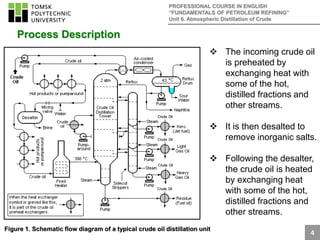
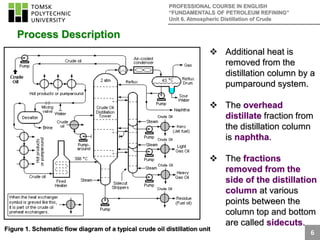
 The incoming crude oil
is preheated by
exchanging heat with
some of the hot,
distilled fractions and
other streams.
 It is then desalted to
remove inorganic salts.
 Following the desalter,
the crude oil is heated
by exchanging heat
with some of the hot,
distilled fractions and
other streams.
4
Figure 1. Schematic flow diagram of a typical crude oil distillation unit
PROFESSIONAL COURSE IN ENGLISH
“FUNDAMENTALS OF PETROLEUM REFINING”
Unit 6. Atmospheric Distillation of Crude
Process Description
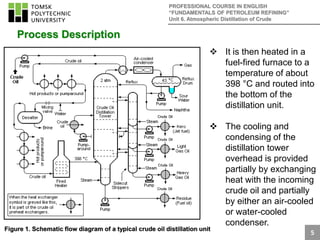
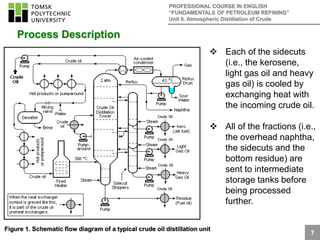
 It is then heated in a
fuel-fired furnace to a
temperature of about
398 °C and routed into
the bottom of the
distillation unit.
 The cooling and
condensing of the
distillation tower
overhead is provided
partially by exchanging
heat with the incoming
crude oil and partially
by either an air-cooled
or water-cooled
condenser.
5
Figure 1. Schematic flow diagram of a typical crude oil distillation unit
PROFESSIONAL COURSE IN ENGLISH
“FUNDAMENTALS OF PETROLEUM REFINING”
Unit 6. Atmospheric Distillation of Crude
Process Description
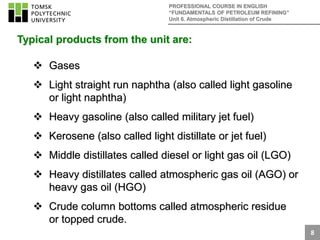
 Additional heat is
removed from the
distillation column by a
pumparound system.
 The overhead
distillate fraction from
the distillation column
is naphtha.
 The fractions
removed from the
side of the distillation
column at various
points between the
column top and bottom
are called sidecuts.
6
Figure 1. Schematic flow diagram of a typical crude oil distillation unit
PROFESSIONAL COURSE IN ENGLISH
“FUNDAMENTALS OF PETROLEUM REFINING”
Unit 6. Atmospheric Distillation of Crude
Process Description
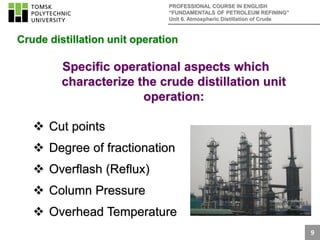
 Each of the sidecuts
(i.e., the kerosene,
light gas oil and heavy
gas oil) is cooled by
exchanging heat with
the incoming crude oil.
 All of the fractions (i.e.,
the overhead naphtha,
the sidecuts and the
bottom residue) are
sent to intermediate
storage tanks before
being processed
further.
7
Figure 1. Schematic flow diagram of a typical crude oil distillation unit
PROFESSIONAL COURSE IN ENGLISH
“FUNDAMENTALS OF PETROLEUM REFINING”
Unit 6. Atmospheric Distillation of Crude
Typical products from the unit are:
 Gases
 Light straight run naphtha (also called light gasoline
or light naphtha)
 Heavy gasoline (also called military jet fuel)
 Kerosene (also called light distillate or jet fuel)
 Middle distillates called diesel or light gas oil (LGO)
 Heavy distillates called atmospheric gas oil (AGO) or
heavy gas oil (HGO)
 Crude column bottoms called atmospheric residue
or topped crude.
8
PROFESSIONAL COURSE IN ENGLISH
“FUNDAMENTALS OF PETROLEUM REFINING”
Unit 6. Atmospheric Distillation of Crude
Crude distillation unit operation
Specific operational aspects which
characterize the crude distillation unit
operation:
 Cut points
 Degree of fractionation
 Overflash (Reflux)
 Column Pressure
 Overhead Temperature
9
PROFESSIONAL COURSE IN ENGLISH
“FUNDAMENTALS OF PETROLEUM REFINING”
Unit 6. Atmospheric Distillation of Crude
Cut points
10
PROFESSIONAL COURSE IN ENGLISH
“FUNDAMENTALS OF PETROLEUM REFINING”
Unit 6. Atmospheric Distillation of Crude
Cut points
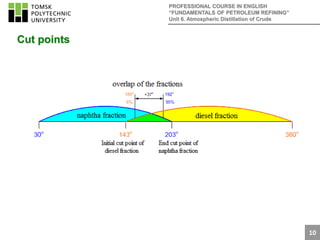
 The cut points in the crude distillation unit
are controlled by the overhead vapour
temperature which determines how much
vapour goes to the condensers to produce
light naphtha.
 The cut points are also controlled by the flow
rate of the various products straight from the
column or the side stream strippers.
11
PROFESSIONAL COURSE IN ENGLISH
“FUNDAMENTALS OF PETROLEUM REFINING”
Unit 6. Atmospheric Distillation of Crude
Cut points
 The atmospheric residue level control inside
the column determines its flow rate and thus
its initial cut point.
 The amount of light naphtha is determined
by the dew point of the naphtha at its partial
pressure, which is close to the overhead
temperature.
12
PROFESSIONAL COURSE IN ENGLISH
“FUNDAMENTALS OF PETROLEUM REFINING”
Unit 6. Atmospheric Distillation of Crude
Cut points
The residue flow rate, the internal reflux rate, and the
pumparounds are also affected.
 The internal reflux rate affects the degree of
fractionation.
 It can be increased by increasing the heater outlet
temperature, and by lowering the pumparound duty
in the lower section of the column.
 When less heat is removed by the lower
pumparound, more vapours will be available up the
column and more internal reflux is produced as the
vapours are condensed.
13
PROFESSIONAL COURSE IN ENGLISH
“FUNDAMENTALS OF PETROLEUM REFINING”
Unit 6. Atmospheric Distillation of Crude
Degree of Fractionation
The fractionation quality between two
consecutive streams is affected by several
factors such as
 the vapour and liquid flow rates in the
column zone between these two streams
 the number of trays
 the heat extracted by the pumparound.
14
PROFESSIONAL COURSE IN ENGLISH
“FUNDAMENTALS OF PETROLEUM REFINING”
Unit 6. Atmospheric Distillation of Crude
Degree of Fractionation
 Fractionation quality is formulated in terms
of gap or overlap of the products.
 For perfect fractionation, zero gap and
overlap are required.
 This means that the end boiling point of the
light cut would be the initial boiling point of
the heavier cut and so on.
15
PROFESSIONAL COURSE IN ENGLISH
“FUNDAMENTALS OF PETROLEUM REFINING”
Unit 6. Atmospheric Distillation of Crude
Overflash (Reflux)
 In order to fractionate the crude oil into the
various products, it has to be heated to a
temperature between 330 and 385 ºC,
depending on the crude composition.
 The partially vaporized crude is transferred
to the flash zone of the column located at a
point lower down the column.
16
PROFESSIONAL COURSE IN ENGLISH
“FUNDAMENTALS OF PETROLEUM REFINING”
Unit 6. Atmospheric Distillation of Crude
Overflash (Reflux)
 The furnace outlet temperature should be enough to
vaporize all products withdrawn above the flash
zone plus about 3–5 vol % of the bottom product.
 This overflash has the function of providing liquid
wash to the vapours going up the column from the
flash zone, and improving fractionation on the trays
above the flash zone, thereby improving the quality
of the heavy gas oil and reducing the overlap with
the bottom products below the flash zone.
17
PROFESSIONAL COURSE IN ENGLISH
“FUNDAMENTALS OF PETROLEUM REFINING”
Unit 6. Atmospheric Distillation of Crude
Overflash (Reflux)
 The overflash provides heat input to the
column in excess to that needed to distill the
overhead products.
 It also prevents coke deposition on the trays
in the wash zone.
18
PROFESSIONAL COURSE IN ENGLISH
“FUNDAMENTALS OF PETROLEUM REFINING”
Unit 6. Atmospheric Distillation of Crude
Column Pressure
 The pressure inside the distillation column is
controlled by the back pressure of the
overhead reflux drum at about 0.2–0.34 bar
gauge.
 The top tray pressure is 0.4–0.7 bar gauge
higher than the reflux drum.
 The flash zone pressure is usually 0.34–0.54
bar higher than the top tray.
19
PROFESSIONAL COURSE IN ENGLISH
“FUNDAMENTALS OF PETROLEUM REFINING”
Unit 6. Atmospheric Distillation of Crude
Overhead Temperature
 The overhead temperature must be
controlled to be 14–17 ºC higher than the
dew point temperature for the water at the
column overhead pressure so that no liquid
water is condensed in the column.
 This is to prevent corrosion due to the
hydrogen chloride dissolved in liquid water
(hydrochloric acid).
20

Unit6_AtmosphericDistillationOfCrude_Lecture.pdf

  • 1.
    2016 Assistant teacher, Candidateof Engineering Sciences Belinskaya Nataliya Segeevna PROFESSIONAL COURSE IN ENGLISH “FUNDAMENTALS OF PETROLEUM REFINING” Unit 6. Atmospheric Distillation of Crude
  • 2.
    PROFESSIONAL COURSE INENGLISH “FUNDAMENTALS OF PETROLEUM REFINING” Unit 6. Atmospheric Distillation of Crude Introduction  Crude distillation unit is at the front-end of the refinery, also known as topping unit, or atmospheric distillation unit.  Many crude distillation units are designed to handle a variety of crude oil types.  The design of the unit is based on a light crude scenario and a heavy crude scenario. 2
  • 3.
    PROFESSIONAL COURSE INENGLISH “FUNDAMENTALS OF PETROLEUM REFINING” Unit 6. Atmospheric Distillation of Crude Introduction The unit produces raw products which have to be processed in downstream unit to produce products of certain specifications. 3
  • 4.
    PROFESSIONAL COURSE INENGLISH “FUNDAMENTALS OF PETROLEUM REFINING” Unit 6. Atmospheric Distillation of Crude Process Description  The incoming crude oil is preheated by exchanging heat with some of the hot, distilled fractions and other streams.  It is then desalted to remove inorganic salts.  Following the desalter, the crude oil is heated by exchanging heat with some of the hot, distilled fractions and other streams. 4 Figure 1. Schematic flow diagram of a typical crude oil distillation unit
  • 5.
    PROFESSIONAL COURSE INENGLISH “FUNDAMENTALS OF PETROLEUM REFINING” Unit 6. Atmospheric Distillation of Crude Process Description  It is then heated in a fuel-fired furnace to a temperature of about 398 °C and routed into the bottom of the distillation unit.  The cooling and condensing of the distillation tower overhead is provided partially by exchanging heat with the incoming crude oil and partially by either an air-cooled or water-cooled condenser. 5 Figure 1. Schematic flow diagram of a typical crude oil distillation unit
  • 6.
    PROFESSIONAL COURSE INENGLISH “FUNDAMENTALS OF PETROLEUM REFINING” Unit 6. Atmospheric Distillation of Crude Process Description  Additional heat is removed from the distillation column by a pumparound system.  The overhead distillate fraction from the distillation column is naphtha.  The fractions removed from the side of the distillation column at various points between the column top and bottom are called sidecuts. 6 Figure 1. Schematic flow diagram of a typical crude oil distillation unit
  • 7.
    PROFESSIONAL COURSE INENGLISH “FUNDAMENTALS OF PETROLEUM REFINING” Unit 6. Atmospheric Distillation of Crude Process Description  Each of the sidecuts (i.e., the kerosene, light gas oil and heavy gas oil) is cooled by exchanging heat with the incoming crude oil.  All of the fractions (i.e., the overhead naphtha, the sidecuts and the bottom residue) are sent to intermediate storage tanks before being processed further. 7 Figure 1. Schematic flow diagram of a typical crude oil distillation unit
  • 8.
    PROFESSIONAL COURSE INENGLISH “FUNDAMENTALS OF PETROLEUM REFINING” Unit 6. Atmospheric Distillation of Crude Typical products from the unit are:  Gases  Light straight run naphtha (also called light gasoline or light naphtha)  Heavy gasoline (also called military jet fuel)  Kerosene (also called light distillate or jet fuel)  Middle distillates called diesel or light gas oil (LGO)  Heavy distillates called atmospheric gas oil (AGO) or heavy gas oil (HGO)  Crude column bottoms called atmospheric residue or topped crude. 8
  • 9.
    PROFESSIONAL COURSE INENGLISH “FUNDAMENTALS OF PETROLEUM REFINING” Unit 6. Atmospheric Distillation of Crude Crude distillation unit operation Specific operational aspects which characterize the crude distillation unit operation:  Cut points  Degree of fractionation  Overflash (Reflux)  Column Pressure  Overhead Temperature 9
  • 10.
    PROFESSIONAL COURSE INENGLISH “FUNDAMENTALS OF PETROLEUM REFINING” Unit 6. Atmospheric Distillation of Crude Cut points 10
  • 11.
    PROFESSIONAL COURSE INENGLISH “FUNDAMENTALS OF PETROLEUM REFINING” Unit 6. Atmospheric Distillation of Crude Cut points  The cut points in the crude distillation unit are controlled by the overhead vapour temperature which determines how much vapour goes to the condensers to produce light naphtha.  The cut points are also controlled by the flow rate of the various products straight from the column or the side stream strippers. 11
  • 12.
    PROFESSIONAL COURSE INENGLISH “FUNDAMENTALS OF PETROLEUM REFINING” Unit 6. Atmospheric Distillation of Crude Cut points  The atmospheric residue level control inside the column determines its flow rate and thus its initial cut point.  The amount of light naphtha is determined by the dew point of the naphtha at its partial pressure, which is close to the overhead temperature. 12
  • 13.
    PROFESSIONAL COURSE INENGLISH “FUNDAMENTALS OF PETROLEUM REFINING” Unit 6. Atmospheric Distillation of Crude Cut points The residue flow rate, the internal reflux rate, and the pumparounds are also affected.  The internal reflux rate affects the degree of fractionation.  It can be increased by increasing the heater outlet temperature, and by lowering the pumparound duty in the lower section of the column.  When less heat is removed by the lower pumparound, more vapours will be available up the column and more internal reflux is produced as the vapours are condensed. 13
  • 14.
    PROFESSIONAL COURSE INENGLISH “FUNDAMENTALS OF PETROLEUM REFINING” Unit 6. Atmospheric Distillation of Crude Degree of Fractionation The fractionation quality between two consecutive streams is affected by several factors such as  the vapour and liquid flow rates in the column zone between these two streams  the number of trays  the heat extracted by the pumparound. 14
  • 15.
    PROFESSIONAL COURSE INENGLISH “FUNDAMENTALS OF PETROLEUM REFINING” Unit 6. Atmospheric Distillation of Crude Degree of Fractionation  Fractionation quality is formulated in terms of gap or overlap of the products.  For perfect fractionation, zero gap and overlap are required.  This means that the end boiling point of the light cut would be the initial boiling point of the heavier cut and so on. 15
  • 16.
    PROFESSIONAL COURSE INENGLISH “FUNDAMENTALS OF PETROLEUM REFINING” Unit 6. Atmospheric Distillation of Crude Overflash (Reflux)  In order to fractionate the crude oil into the various products, it has to be heated to a temperature between 330 and 385 ºC, depending on the crude composition.  The partially vaporized crude is transferred to the flash zone of the column located at a point lower down the column. 16
  • 17.
    PROFESSIONAL COURSE INENGLISH “FUNDAMENTALS OF PETROLEUM REFINING” Unit 6. Atmospheric Distillation of Crude Overflash (Reflux)  The furnace outlet temperature should be enough to vaporize all products withdrawn above the flash zone plus about 3–5 vol % of the bottom product.  This overflash has the function of providing liquid wash to the vapours going up the column from the flash zone, and improving fractionation on the trays above the flash zone, thereby improving the quality of the heavy gas oil and reducing the overlap with the bottom products below the flash zone. 17
  • 18.
    PROFESSIONAL COURSE INENGLISH “FUNDAMENTALS OF PETROLEUM REFINING” Unit 6. Atmospheric Distillation of Crude Overflash (Reflux)  The overflash provides heat input to the column in excess to that needed to distill the overhead products.  It also prevents coke deposition on the trays in the wash zone. 18
  • 19.
    PROFESSIONAL COURSE INENGLISH “FUNDAMENTALS OF PETROLEUM REFINING” Unit 6. Atmospheric Distillation of Crude Column Pressure  The pressure inside the distillation column is controlled by the back pressure of the overhead reflux drum at about 0.2–0.34 bar gauge.  The top tray pressure is 0.4–0.7 bar gauge higher than the reflux drum.  The flash zone pressure is usually 0.34–0.54 bar higher than the top tray. 19
  • 20.
    PROFESSIONAL COURSE INENGLISH “FUNDAMENTALS OF PETROLEUM REFINING” Unit 6. Atmospheric Distillation of Crude Overhead Temperature  The overhead temperature must be controlled to be 14–17 ºC higher than the dew point temperature for the water at the column overhead pressure so that no liquid water is condensed in the column.  This is to prevent corrosion due to the hydrogen chloride dissolved in liquid water (hydrochloric acid). 20