“Physics is defined as the study of energy and
matter”
Physics is the study of how matter and energy
interact with each other and how they affect
each other over time and through space.
Physics functions in an exciting dimension.
What we mean by this is that things keep
changing in the world of physics with every
discovery. As theories progress and
discoveries are made, not only the answer but
the whole question changes. Due to this, many
individuals define physics by what it was
rather than what it is and will be.
Physics is the natural science that
studies matter,its motion and
behavior through space and time,
and the related
entitiesof energy and force.Physics
is one of the most fundamental
scientific disciplines, and its main
goal is to understand how
the universe behaves.
Physics is one of the oldest academic disciplines and,
through its inclusion of astronomy,
perhaps the oldest. Over much of the past two millennia,
physics, chemistry, biology, and certain branches
of mathematics were a part of natural philosophy, but
during the Scientific Revolution in the 17th century these
natural sciences emerged as unique research endeavors in
their own right. Physics intersects with
many interdisciplinary areas of research, such
as biophysics and quantum chemistry, and the
boundaries of physics are not rigidly defined. New ideas
in physics often explain the fundamental mechanisms
studied by other sciences and suggest new avenues of
research in academic disciplines such as mathematics
and philosophy.
Advances in physics often enable advances in
new technologies. For example, advances in the
understanding of electromagnetism, solid-state
physics, and nuclear physics led directly to the
development of new products that have
dramatically transformed modern-day society,
such as television, computers, domestic
appliances, and nuclear weapons;[6] advances
in thermodynamics led to the development
of industrialization; and advances
in mechanics inspired the development
of calculus.
HISTORY
OF
PHYSICS
Ancient astronomy
Astronomy is one of the oldest natural sciences. Early
civilizations dating back before 3000 BCE, such as
the Sumerians, ancient Egyptians, and the Indus Valley
Civilisation, had a predictive knowledge and a basic
understanding of the motions of the Sun, Moon, and stars.
The stars and planets, believed to represent gods, were
often worshipped. While the explanations for the observed
positions of the stars were often unscientific and lacking in
evidence, these early observations laid the foundation for
later astronomy, as the stars were found to traverse great
circles across the sky, which however did not explain the
positions of the planets.
According to Asger Aaboe, the origins
of Western astronomy can be found in Mesopotamia, and
all Western efforts in the exact sciences are descended
from late Babylonian astronomy. Egyptian
astronomers left monuments showing knowledge of the
constellations and the motions of the celestial
bodies,[12] while Greek poet Homer wrote of various
celestial objects in his Iliad and Odyssey; later Greek
astronomers provided names, which are still used today,
for most constellations visible from the Northern
Hemisphere.
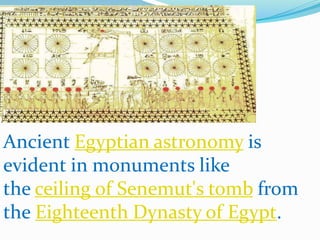
Ancient Egyptian astronomy is
evident in monuments like
the ceiling of Senemut's tomb from
the Eighteenth Dynasty of Egypt.
Natural philosophy
Natural philosophy has its origins in Greece during
the Archaic period (650 BCE – 480 BCE), when pre-
Socratic philosophers like Thales rejected non-
naturalistic explanations for natural phenomena and
proclaimed that every event had a natural cause. They
proposed ideas verified by reason and observation, and
many of their hypotheses proved successful in
experiment; for example, atomism was found to be correct
approximately 2000 years after it was proposed
by Leucippus and his pupil Democritus.
NEXT WE ARE GOING
TO LEARN ABOUT THE
DISCOVERIES AND
THE SCIENTISTS
NAME
SO LISTEN
ON TO
DISCOVER
MORE
Year Discoveries Scientist Name
1905 Photon Albert Einstein
1897 Electron J.J. Thomson
1919 Proton Ernest Rutherford
1808 Atom John Dalton
1932 Neutron James Chadwick
1687 Law of Motion Isaac Newton
1779 Coulomb Charles-Augustin de Coulomb
1827 Ohm’s Law Georg Simon Ohm
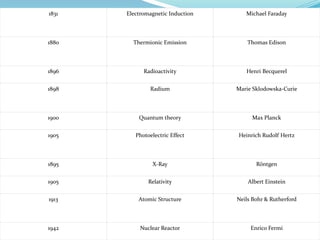
1831 Electromagnetic Induction Michael Faraday
1880 Thermionic Emission Thomas Edison
1896 Radioactivity Henri Becquerel
1898 Radium Marie Sklodowska-Curie
1900 Quantum theory Max Planck
1905 Photoelectric Effect Heinrich Rudolf Hertz
1895 X-Ray Röntgen
1905 Relativity Albert Einstein
1913 Atomic Structure Neils Bohr & Rutherford
1942 Nuclear Reactor Enrico Fermi
NOW WE HAVE COME TO THE END OF THE CLASS
 BUT DON’T THINK THIS IS THE END OF
KNOWING PHYSICS THERE IS LOTS AND LOTS TO
EXPLORE ABOUT PHYSICS .
Physics

Physics

  • 2.
    “Physics is definedas the study of energy and matter” Physics is the study of how matter and energy interact with each other and how they affect each other over time and through space. Physics functions in an exciting dimension. What we mean by this is that things keep changing in the world of physics with every discovery. As theories progress and discoveries are made, not only the answer but the whole question changes. Due to this, many individuals define physics by what it was rather than what it is and will be.
  • 3.
    Physics is thenatural science that studies matter,its motion and behavior through space and time, and the related entitiesof energy and force.Physics is one of the most fundamental scientific disciplines, and its main goal is to understand how the universe behaves.
  • 4.
    Physics is oneof the oldest academic disciplines and, through its inclusion of astronomy, perhaps the oldest. Over much of the past two millennia, physics, chemistry, biology, and certain branches of mathematics were a part of natural philosophy, but during the Scientific Revolution in the 17th century these natural sciences emerged as unique research endeavors in their own right. Physics intersects with many interdisciplinary areas of research, such as biophysics and quantum chemistry, and the boundaries of physics are not rigidly defined. New ideas in physics often explain the fundamental mechanisms studied by other sciences and suggest new avenues of research in academic disciplines such as mathematics and philosophy.
  • 5.
    Advances in physicsoften enable advances in new technologies. For example, advances in the understanding of electromagnetism, solid-state physics, and nuclear physics led directly to the development of new products that have dramatically transformed modern-day society, such as television, computers, domestic appliances, and nuclear weapons;[6] advances in thermodynamics led to the development of industrialization; and advances in mechanics inspired the development of calculus.
  • 6.
  • 7.
    Ancient astronomy Astronomy isone of the oldest natural sciences. Early civilizations dating back before 3000 BCE, such as the Sumerians, ancient Egyptians, and the Indus Valley Civilisation, had a predictive knowledge and a basic understanding of the motions of the Sun, Moon, and stars. The stars and planets, believed to represent gods, were often worshipped. While the explanations for the observed positions of the stars were often unscientific and lacking in evidence, these early observations laid the foundation for later astronomy, as the stars were found to traverse great circles across the sky, which however did not explain the positions of the planets.
  • 8.
    According to AsgerAaboe, the origins of Western astronomy can be found in Mesopotamia, and all Western efforts in the exact sciences are descended from late Babylonian astronomy. Egyptian astronomers left monuments showing knowledge of the constellations and the motions of the celestial bodies,[12] while Greek poet Homer wrote of various celestial objects in his Iliad and Odyssey; later Greek astronomers provided names, which are still used today, for most constellations visible from the Northern Hemisphere.
  • 9.
    Ancient Egyptian astronomyis evident in monuments like the ceiling of Senemut's tomb from the Eighteenth Dynasty of Egypt.
  • 10.
    Natural philosophy Natural philosophyhas its origins in Greece during the Archaic period (650 BCE – 480 BCE), when pre- Socratic philosophers like Thales rejected non- naturalistic explanations for natural phenomena and proclaimed that every event had a natural cause. They proposed ideas verified by reason and observation, and many of their hypotheses proved successful in experiment; for example, atomism was found to be correct approximately 2000 years after it was proposed by Leucippus and his pupil Democritus.
  • 11.
    NEXT WE AREGOING TO LEARN ABOUT THE DISCOVERIES AND THE SCIENTISTS NAME SO LISTEN ON TO DISCOVER MORE
  • 12.
    Year Discoveries ScientistName 1905 Photon Albert Einstein 1897 Electron J.J. Thomson 1919 Proton Ernest Rutherford 1808 Atom John Dalton 1932 Neutron James Chadwick 1687 Law of Motion Isaac Newton 1779 Coulomb Charles-Augustin de Coulomb 1827 Ohm’s Law Georg Simon Ohm
  • 13.
    1831 Electromagnetic InductionMichael Faraday 1880 Thermionic Emission Thomas Edison 1896 Radioactivity Henri Becquerel 1898 Radium Marie Sklodowska-Curie 1900 Quantum theory Max Planck 1905 Photoelectric Effect Heinrich Rudolf Hertz 1895 X-Ray Röntgen 1905 Relativity Albert Einstein 1913 Atomic Structure Neils Bohr & Rutherford 1942 Nuclear Reactor Enrico Fermi
  • 14.
    NOW WE HAVECOME TO THE END OF THE CLASS  BUT DON’T THINK THIS IS THE END OF KNOWING PHYSICS THERE IS LOTS AND LOTS TO EXPLORE ABOUT PHYSICS .