Physics helps you to
understand the world
around you, and satisfy
your curiosity.
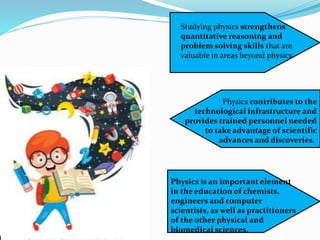
Studying physics strengthens
quantitative reasoning and
problem solving skills that are
valuable in areas beyond physics.
Physics contributes to the
technological infrastructure and
provides trained personnel needed
to take advantage of scientific
advances and discoveries.
Physics is an important element
in the education of chemists,
engineers and computer
scientists, as well as practitioners
of the other physical and
biomedical sciences.
Why do we need
physics?
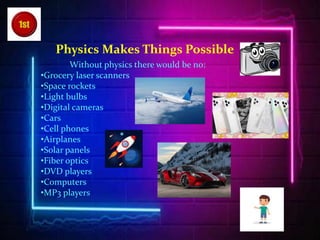
Physics Makes Things Possible
Without physics there would be no:
•Grocery laser scanners
•Space rockets
•Light bulbs
•Digital cameras
•Cars
•Cell phones
•Airplanes
•Solar panels
•Fiber optics
•DVD players
•Computers
•MP3 players
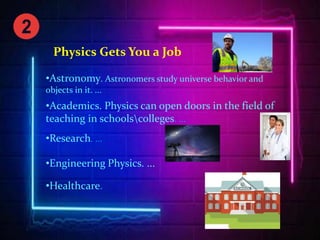
Physics Gets You a Job
•Astronomy. Astronomers study universe behavior and
objects in it. ...
•Academics. Physics can open doors in the field of
teaching in schoolscolleges. ...
•Research. ...
•Engineering Physics. ...
•Healthcare.
Physics Explains
•Learn why the sky is blue
•Why the world goes round
•Why global warming will have the Alaskans
trading in their snow boots for flip-flops
•Why we fall downwards
Physics Teaches You to Think
Many people who have studied physics
report it helps them develop critical
thinking and problem-solving skills.
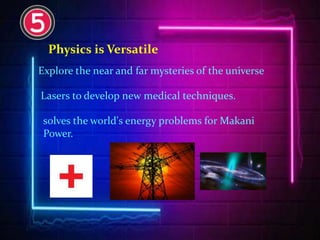
Physics is Versatile
Explore the near and far mysteries of the universe
Lasers to develop new medical techniques.
solves the world's energy problems for Makani
Power.
Physics Puts Your Math to Use
Mathematics provide the tools physicists use to
understand the world we live in.
Nobel Prize winner Eugene Wigner explored this
theme in a famous essay:
 THE UNREASONABLE EFFECTIVENESS OF
MATHEMATICS IN THE NATURAL SCIENCES
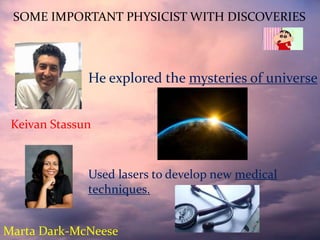
SOME IMPORTANT PHYSICIST WITH DISCOVERIES
He explored the mysteries of universe
Marta Dark-McNeese
Keivan Stassun
Used lasers to develop new medical
techniques.
DONE BY:
SANTHIYA.S
XI-A__S1

Physics

  • 3.
    Physics helps youto understand the world around you, and satisfy your curiosity.
  • 5.
    Studying physics strengthens quantitativereasoning and problem solving skills that are valuable in areas beyond physics. Physics contributes to the technological infrastructure and provides trained personnel needed to take advantage of scientific advances and discoveries. Physics is an important element in the education of chemists, engineers and computer scientists, as well as practitioners of the other physical and biomedical sciences.
  • 6.
    Why do weneed physics?
  • 8.
    Physics Makes ThingsPossible Without physics there would be no: •Grocery laser scanners •Space rockets •Light bulbs •Digital cameras •Cars •Cell phones •Airplanes •Solar panels •Fiber optics •DVD players •Computers •MP3 players
  • 9.
    Physics Gets Youa Job •Astronomy. Astronomers study universe behavior and objects in it. ... •Academics. Physics can open doors in the field of teaching in schoolscolleges. ... •Research. ... •Engineering Physics. ... •Healthcare.
  • 10.
    Physics Explains •Learn whythe sky is blue •Why the world goes round •Why global warming will have the Alaskans trading in their snow boots for flip-flops •Why we fall downwards
  • 11.
    Physics Teaches Youto Think Many people who have studied physics report it helps them develop critical thinking and problem-solving skills.
  • 12.
    Physics is Versatile Explorethe near and far mysteries of the universe Lasers to develop new medical techniques. solves the world's energy problems for Makani Power.
  • 13.
    Physics Puts YourMath to Use Mathematics provide the tools physicists use to understand the world we live in. Nobel Prize winner Eugene Wigner explored this theme in a famous essay:  THE UNREASONABLE EFFECTIVENESS OF MATHEMATICS IN THE NATURAL SCIENCES
  • 14.
    SOME IMPORTANT PHYSICISTWITH DISCOVERIES He explored the mysteries of universe Marta Dark-McNeese Keivan Stassun Used lasers to develop new medical techniques.
  • 15.