it’s really difficult to define exactly what physics is. For one, physics
keeps changing as we progress and make new discoveries. New
theories don't just bring new answers. They also create new
questions that might not have even made sense when viewed from
within the previous theory of physics.
This makes physics exciting and interesting, but it also forces
attempts at defining physics into generalizations about what physics
has been rather than what it might be at some point in the future.
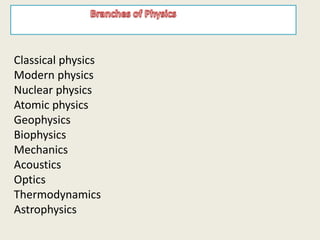
Classical physics
Modern physics
Nuclear physics
Atomic physics
Geophysics
Biophysics
Mechanics
Acoustics
Optics
Thermodynamics
Astrophysics
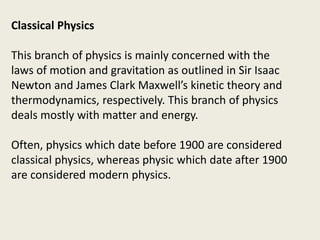
Classical Physics
This branch of physics is mainly concerned with the
laws of motion and gravitation as outlined in Sir Isaac
Newton and James Clark Maxwell’s kinetic theory and
thermodynamics, respectively. This branch of physics
deals mostly with matter and energy.
Often, physics which date before 1900 are considered
classical physics, whereas physic which date after 1900
are considered modern physics.
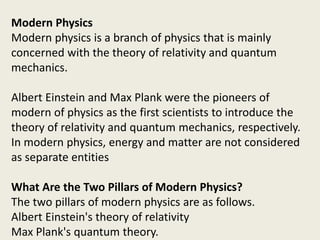
Modern Physics
Modern physics is a branch of physics that is mainly
concerned with the theory of relativity and quantum
mechanics.
Albert Einstein and Max Plank were the pioneers of
modern of physics as the first scientists to introduce the
theory of relativity and quantum mechanics, respectively.
In modern physics, energy and matter are not considered
as separate entities
What Are the Two Pillars of Modern Physics?
The two pillars of modern physics are as follows.
Albert Einstein's theory of relativity
Max Plank's quantum theory.
Nuclear Physics
Nuclear physics is a branch of physics that deals with the
constituents, structure, behaviour and interactions of
atomic nuclei. This branch of physics should not be
confused with atomic physics, which studies the atom as
a whole, including its electrons.
According to the Microsoft Encarta encyclopedia, nuclear
physics is defined as:
“The branch of physics in which the structure, forces,
and behaviour of the atomic nucleus are studied.”
Atomic Physics
Atomic physics is a branch of physics that deals with the
composition of the atom apart from the nucleus. It is
mainly concerned with the arrangement and behaviour of
electrons in the shells around the nucleus. Thus, atomic
physics mostly examines electrons, ions, and neutral atoms.
One of the earliest steps towards atomic physics was
recognizing that all matter is comprised of atoms.
The true beginning of atomic physics is marked by the
discovery of spectral lines and the attempt to explain them.
This resulted in an entirely new understanding of the
structure of atoms and how they behave.
Geophysics
Geophysics is a branch of physics that deals with the
study of the Earth. It is mainly concerned with the
shape, structure and composition of the Earth, but
geophysicists also study gravitational force, magnetic
fields, earthquakes, magma, and more.
Geophysics was only recognized as a separate discipline
in the 19th century, but its origins date back to ancient
times.
Biophysics
According to the Microsoft Encarta encyclopedia,
biophysics is defined as:
“the interdisciplinary study of biological phenomena and
problems, using the principles and techniques of physics.”
Biophysics studies biological problems and the structure of
molecules in living organisms using techniques derived
from physics.
One of the most groundbreaking achievements of
biophysics is the discovery of the structure of DNA
(Deoxyribonucleic Acid) by James Watson and Francis Crick.
Mechanical Physics
Mechanical physics is a branch of physics that deals with
the motion of material objects under the influence of
forces.
Often called just mechanics, mechanical physics falls
under two main branches:
Classical mechanics
Quantum mechanics
Acoustics
The word "acoustics" is derived from a Greek
word akouen, meaning "to hear."
Hence, we can define acoustics as a branch of physics that
studies how sound is produced, transmitted, received and
controlled. Acoustics also deals with the effects of sounds
in various mediums (i.e. gas, liquid, and solids).
Optics
Optics is a branch of physics that studies electromagnetic
radiation (for example, light and infrared radiation), its
interactions with matter, and instruments used to gather
information due to these interactions. Optics includes the
study of sight.
Thermodynamics
Thermodynamics is a branch of physics that deals with heat
and temperature and their relation to energy and work.
The behaviour of these quantities is governed by the four
laws of thermodynamics.
Astrophysics
The word "astrophysics" is a combination of two Latin-
derived words: astro, which means "star," and phisis,
which means "nature."
Thus, astrophysics can be defined as a branch of astronomy
which is concerned with the study of universe (i.e., stars,
galaxies, and planets) using the laws of physics.
A reputed online tutor, Maja
Kazazic has working as a teacher
for a number of years now. He
provides tutorship mainly in
subjects like accounting, finance,
management and marketing. His
teaching methods are unique
and innovative. He works hard to
make sure every student excels
under her tutelage. He has also
written several academic blogs
at https://helpmeinhomework.c
om/

Physics helpmeinhomework

  • 1.
    it’s really difficultto define exactly what physics is. For one, physics keeps changing as we progress and make new discoveries. New theories don't just bring new answers. They also create new questions that might not have even made sense when viewed from within the previous theory of physics. This makes physics exciting and interesting, but it also forces attempts at defining physics into generalizations about what physics has been rather than what it might be at some point in the future.
  • 3.
    Classical physics Modern physics Nuclearphysics Atomic physics Geophysics Biophysics Mechanics Acoustics Optics Thermodynamics Astrophysics
  • 4.
    Classical Physics This branchof physics is mainly concerned with the laws of motion and gravitation as outlined in Sir Isaac Newton and James Clark Maxwell’s kinetic theory and thermodynamics, respectively. This branch of physics deals mostly with matter and energy. Often, physics which date before 1900 are considered classical physics, whereas physic which date after 1900 are considered modern physics.
  • 5.
    Modern Physics Modern physicsis a branch of physics that is mainly concerned with the theory of relativity and quantum mechanics. Albert Einstein and Max Plank were the pioneers of modern of physics as the first scientists to introduce the theory of relativity and quantum mechanics, respectively. In modern physics, energy and matter are not considered as separate entities What Are the Two Pillars of Modern Physics? The two pillars of modern physics are as follows. Albert Einstein's theory of relativity Max Plank's quantum theory.
  • 6.
    Nuclear Physics Nuclear physicsis a branch of physics that deals with the constituents, structure, behaviour and interactions of atomic nuclei. This branch of physics should not be confused with atomic physics, which studies the atom as a whole, including its electrons. According to the Microsoft Encarta encyclopedia, nuclear physics is defined as: “The branch of physics in which the structure, forces, and behaviour of the atomic nucleus are studied.”
  • 7.
    Atomic Physics Atomic physicsis a branch of physics that deals with the composition of the atom apart from the nucleus. It is mainly concerned with the arrangement and behaviour of electrons in the shells around the nucleus. Thus, atomic physics mostly examines electrons, ions, and neutral atoms. One of the earliest steps towards atomic physics was recognizing that all matter is comprised of atoms. The true beginning of atomic physics is marked by the discovery of spectral lines and the attempt to explain them. This resulted in an entirely new understanding of the structure of atoms and how they behave.
  • 8.
    Geophysics Geophysics is abranch of physics that deals with the study of the Earth. It is mainly concerned with the shape, structure and composition of the Earth, but geophysicists also study gravitational force, magnetic fields, earthquakes, magma, and more. Geophysics was only recognized as a separate discipline in the 19th century, but its origins date back to ancient times.
  • 9.
    Biophysics According to theMicrosoft Encarta encyclopedia, biophysics is defined as: “the interdisciplinary study of biological phenomena and problems, using the principles and techniques of physics.” Biophysics studies biological problems and the structure of molecules in living organisms using techniques derived from physics. One of the most groundbreaking achievements of biophysics is the discovery of the structure of DNA (Deoxyribonucleic Acid) by James Watson and Francis Crick.
  • 10.
    Mechanical Physics Mechanical physicsis a branch of physics that deals with the motion of material objects under the influence of forces. Often called just mechanics, mechanical physics falls under two main branches: Classical mechanics Quantum mechanics
  • 11.
    Acoustics The word "acoustics"is derived from a Greek word akouen, meaning "to hear." Hence, we can define acoustics as a branch of physics that studies how sound is produced, transmitted, received and controlled. Acoustics also deals with the effects of sounds in various mediums (i.e. gas, liquid, and solids). Optics Optics is a branch of physics that studies electromagnetic radiation (for example, light and infrared radiation), its interactions with matter, and instruments used to gather information due to these interactions. Optics includes the study of sight.
  • 12.
    Thermodynamics Thermodynamics is abranch of physics that deals with heat and temperature and their relation to energy and work. The behaviour of these quantities is governed by the four laws of thermodynamics. Astrophysics The word "astrophysics" is a combination of two Latin- derived words: astro, which means "star," and phisis, which means "nature." Thus, astrophysics can be defined as a branch of astronomy which is concerned with the study of universe (i.e., stars, galaxies, and planets) using the laws of physics.
  • 13.
    A reputed onlinetutor, Maja Kazazic has working as a teacher for a number of years now. He provides tutorship mainly in subjects like accounting, finance, management and marketing. His teaching methods are unique and innovative. He works hard to make sure every student excels under her tutelage. He has also written several academic blogs at https://helpmeinhomework.c om/