QUANTUM THEORY
Frederick Nti
The Uncertainty Principle
• In the world of very small particles, one cannot measure any
property of a particle without interacting with it in some way
• This introduces an unavoidable uncertainty into the result
• One can never measure all the properties exactly
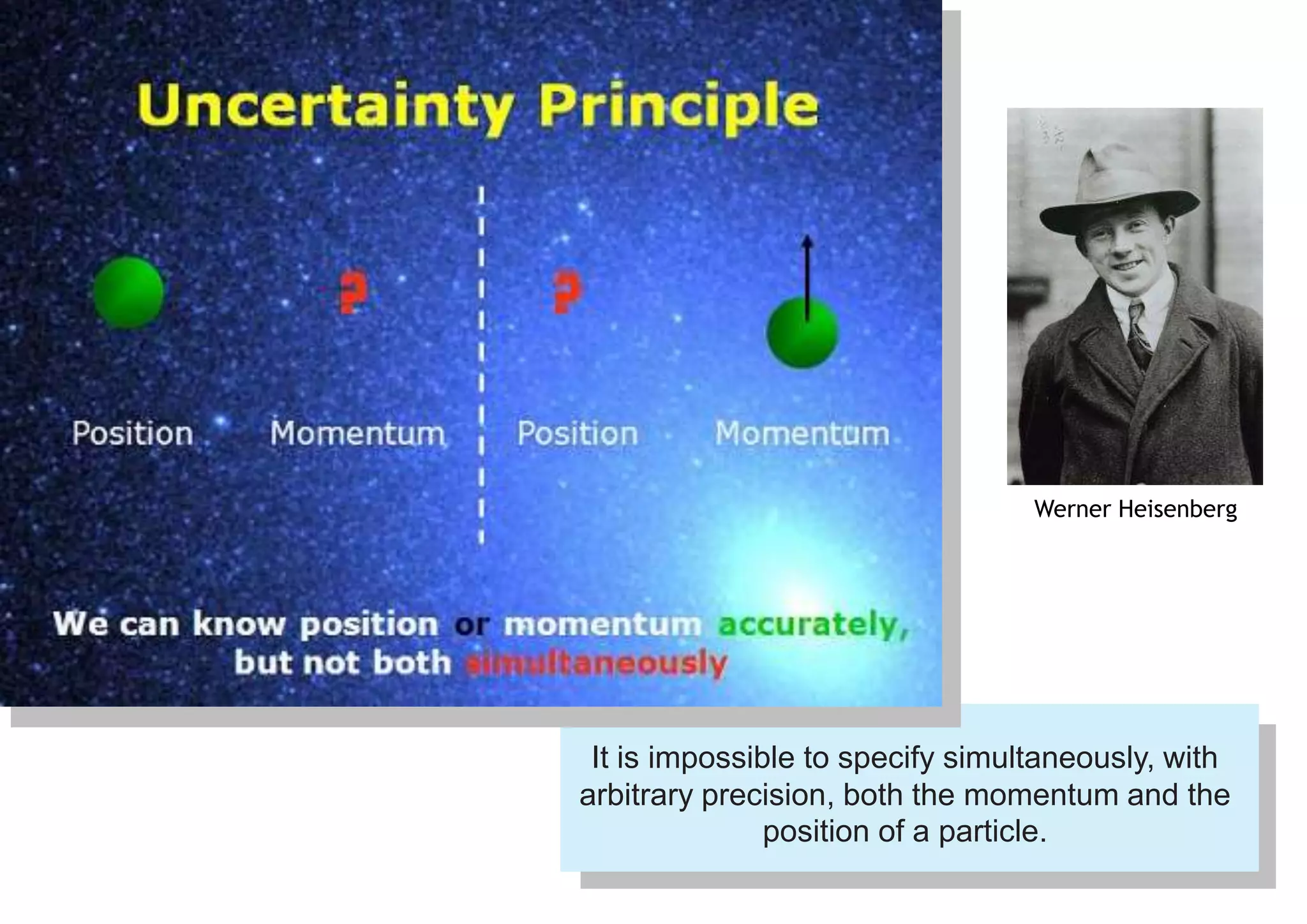
It is impossible to specify simultaneously, with
arbitrary precision, both the momentum and the
position of a particle.
Werner Heisenberg
The Uncertainty Principle
• If the wavefunction is Aeikx, then the particle it describes has a definite state of
linear momentum px = +kh.
• The position of the particle described by this wavefunction is completely
unpredictable.
• In other words, if the momentum is specified precisely, it is impossible to predict
the location of the particle.
• This statement is one-half of a special case of the Heisenberg uncertainty principle,
one of the most celebrated results of quantum mechanics:
If the momentum is specified precisely, it is
impossible to predict the location of the particle
The Uncertainty Principle
• The argument draws on the idea of regarding a wavefunction as a
superposition of eigenfunctions
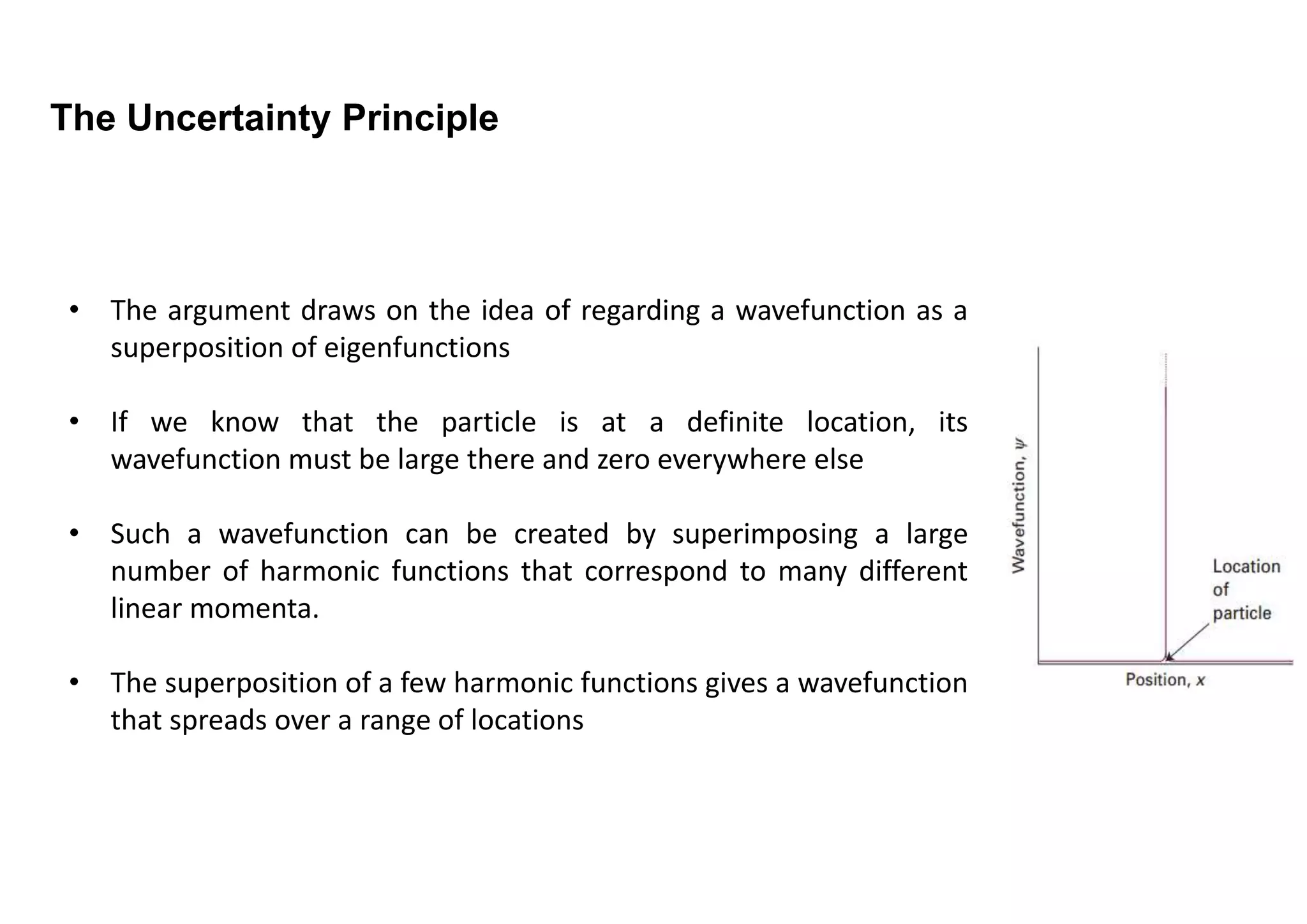
• If we know that the particle is at a definite location, its
wavefunction must be large there and zero everywhere else
• Such a wavefunction can be created by superimposing a large
number of harmonic functions that correspond to many different
linear momenta.
• The superposition of a few harmonic functions gives a wavefunction
that spreads over a range of locations
The Uncertainty Principle
If we know the position of a particle exactly, then
we can say nothing about its momentum
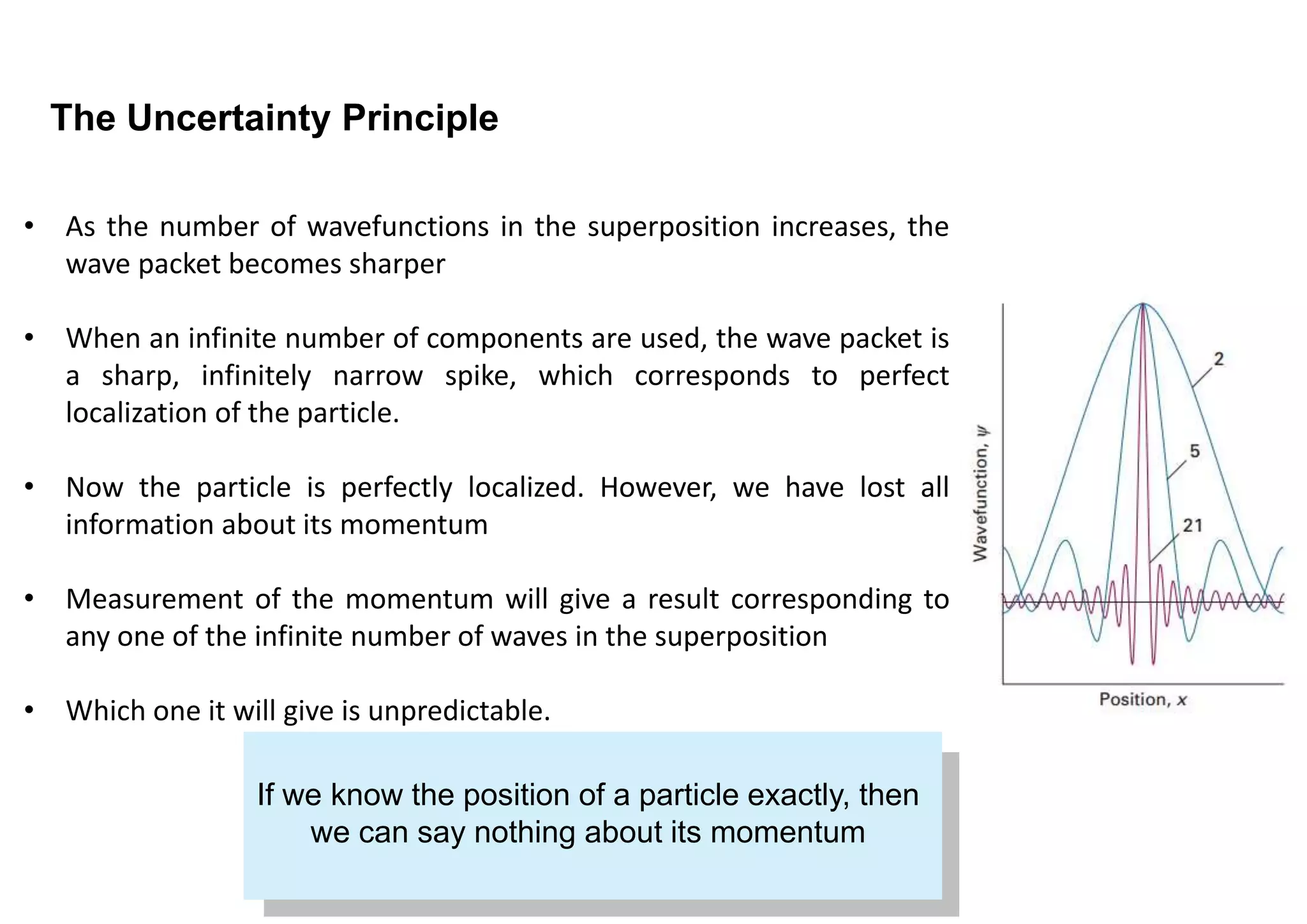
• As the number of wavefunctions in the superposition increases, the
wave packet becomes sharper
• When an infinite number of components are used, the wave packet is
a sharp, infinitely narrow spike, which corresponds to perfect
localization of the particle.
• Now the particle is perfectly localized. However, we have lost all
information about its momentum
• Measurement of the momentum will give a result corresponding to
any one of the infinite number of waves in the superposition
• Which one it will give is unpredictable.
• The Heisenberg uncertainty principle applies to any pair of observables called
complementary observables
• Complementary observables are defined in terms of the properties of their
operators.
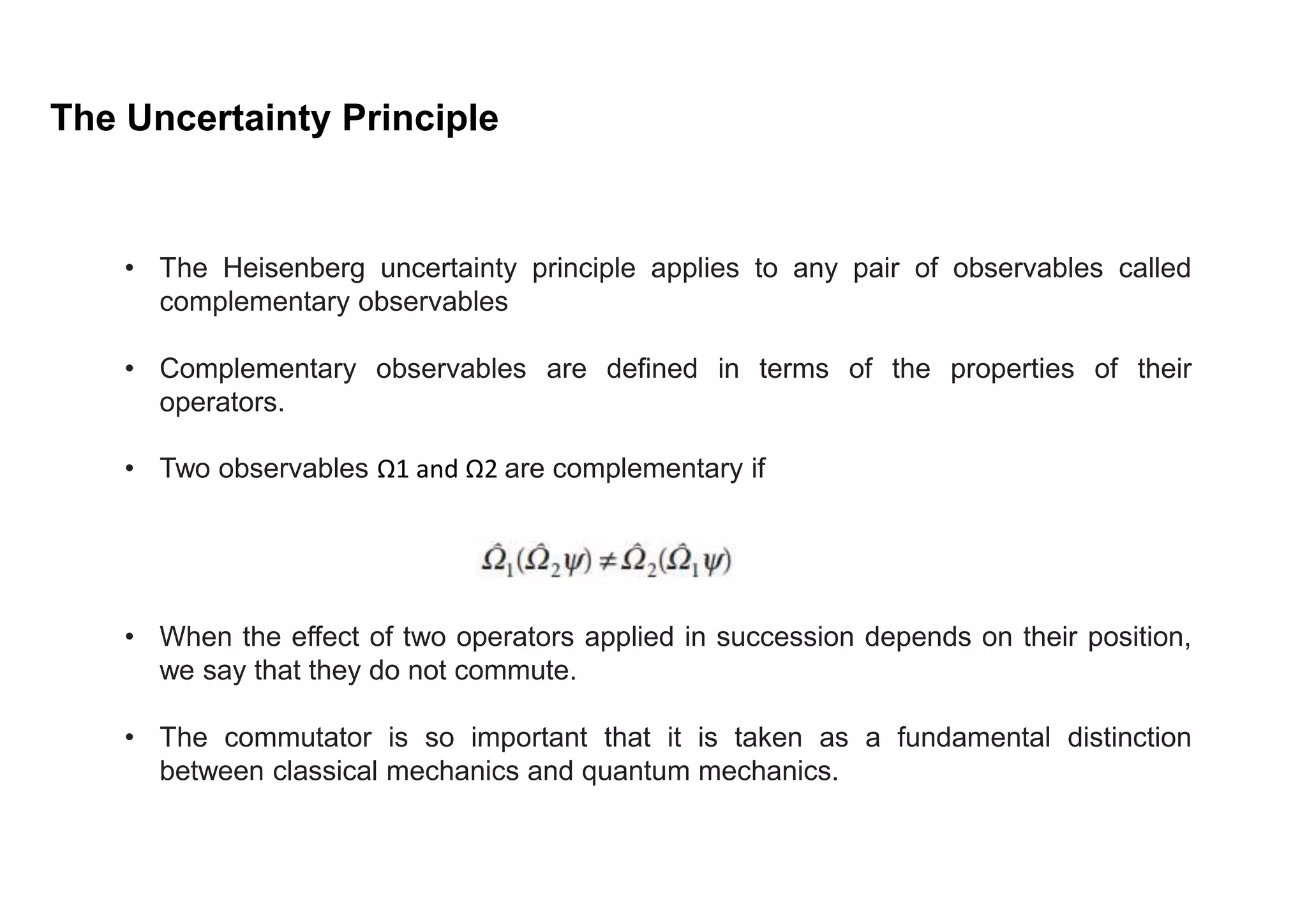
• Two observables Ω1 and Ω2 are complementary if
• When the effect of two operators applied in succession depends on their position,
we say that they do not commute.
• The commutator is so important that it is taken as a fundamental distinction
between classical mechanics and quantum mechanics.
The Uncertainty Principle
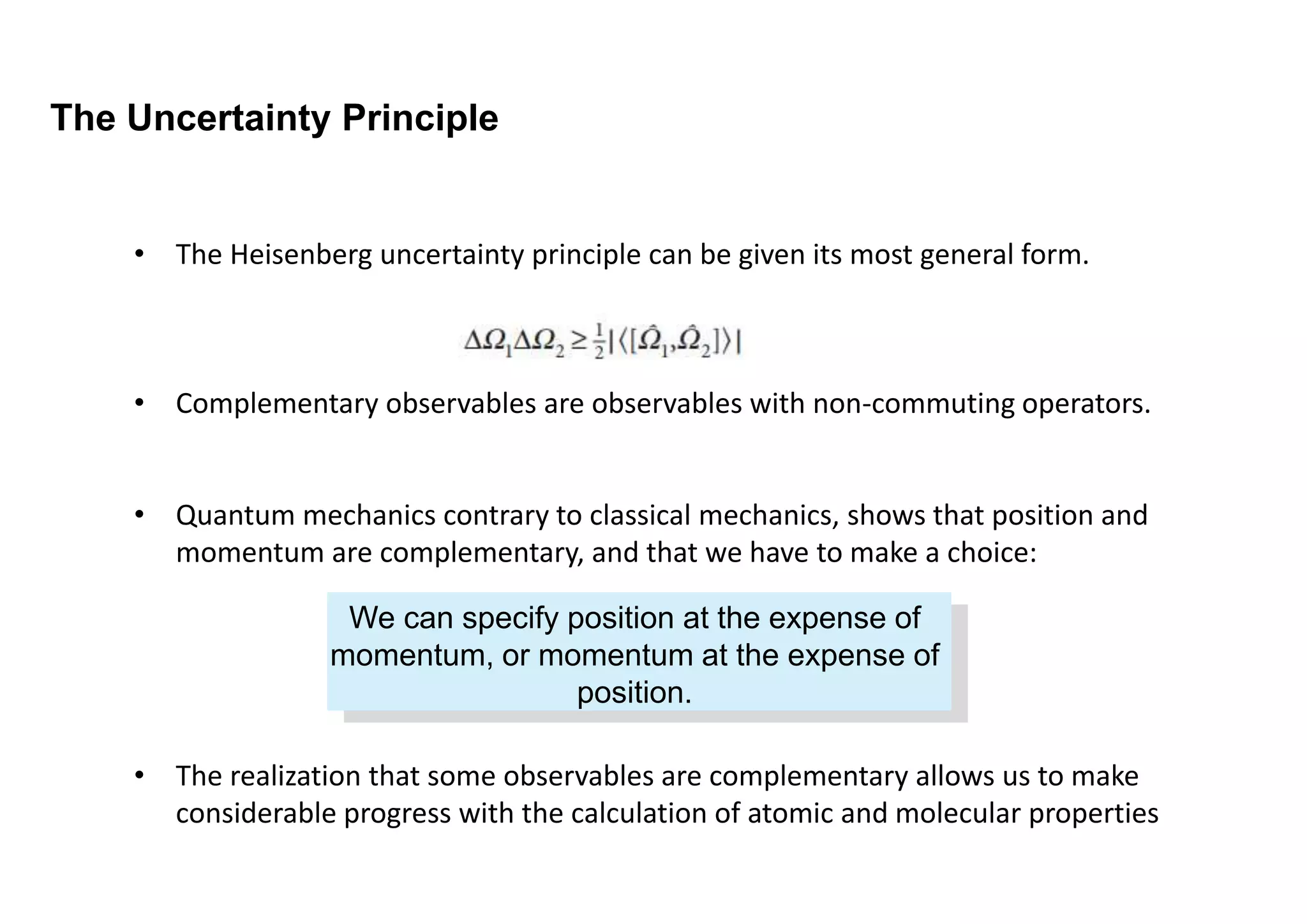
• The Heisenberg uncertainty principle can be given its most general form.
• Complementary observables are observables with non-commuting operators.
• Quantum mechanics contrary to classical mechanics, shows that position and
momentum are complementary, and that we have to make a choice:
• The realization that some observables are complementary allows us to make
considerable progress with the calculation of atomic and molecular properties
We can specify position at the expense of
momentum, or momentum at the expense of
position.
The postulates of quantum mechanics
• Here is a collection of the postulates on which quantum mechanics is based
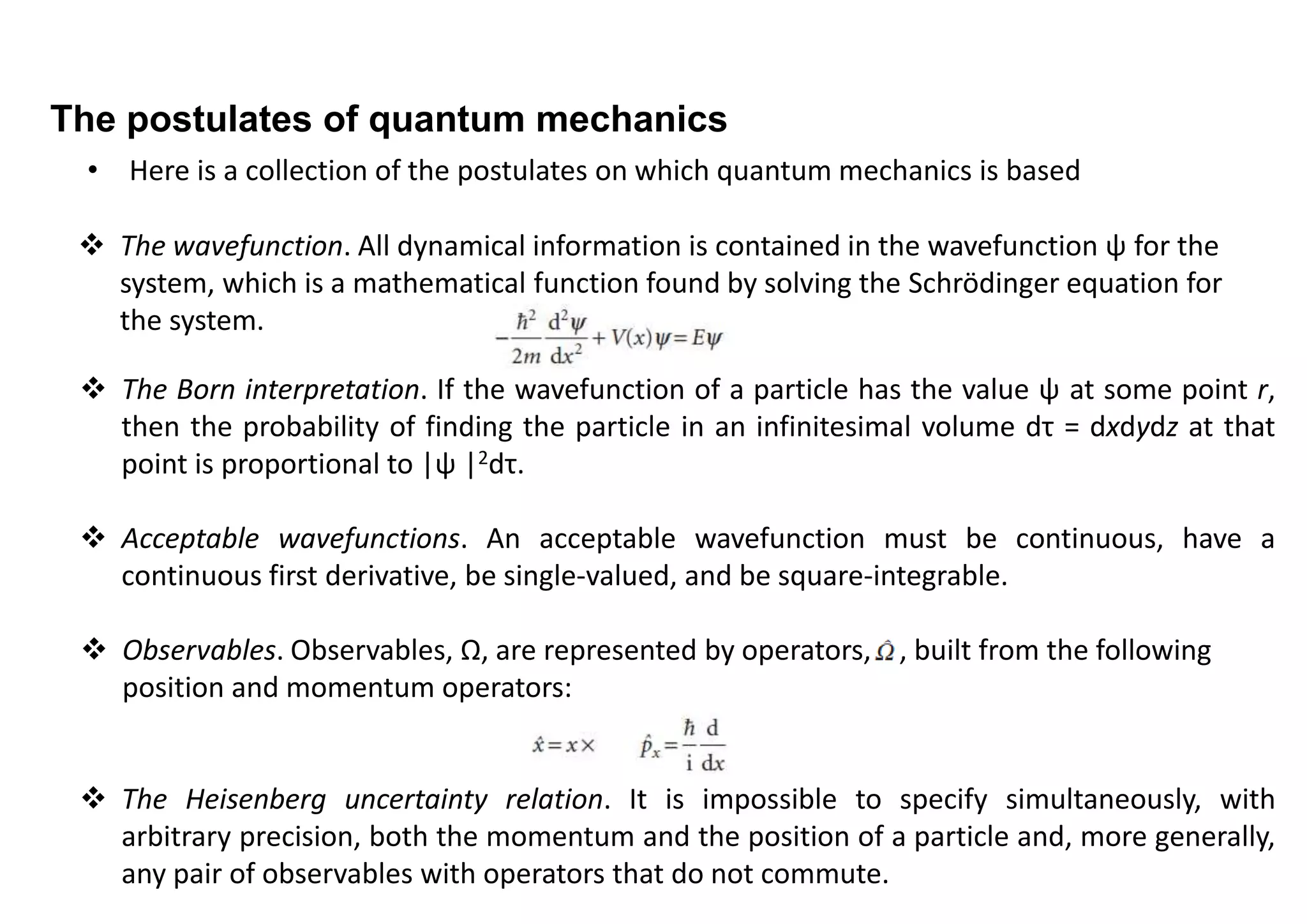
 The wavefunction. All dynamical information is contained in the wavefunction ψ for the
system, which is a mathematical function found by solving the Schrödinger equation for
the system.
 The Born interpretation. If the wavefunction of a particle has the value ψ at some point r,
then the probability of finding the particle in an infinitesimal volume dτ = dxdydz at that
point is proportional to |ψ |2dτ.
 Acceptable wavefunctions. An acceptable wavefunction must be continuous, have a
continuous first derivative, be single-valued, and be square-integrable.
 The Heisenberg uncertainty relation. It is impossible to specify simultaneously, with
arbitrary precision, both the momentum and the position of a particle and, more generally,
any pair of observables with operators that do not commute.
 Observables. Observables, Ω, are represented by operators, , built from the following
position and momentum operators:
THANK YOU !

The Uncertainty principle

  • 1.
    QUANTUM THEORY Frederick Nti TheUncertainty Principle
  • 2.
    • In theworld of very small particles, one cannot measure any property of a particle without interacting with it in some way • This introduces an unavoidable uncertainty into the result • One can never measure all the properties exactly It is impossible to specify simultaneously, with arbitrary precision, both the momentum and the position of a particle. Werner Heisenberg
  • 3.
    The Uncertainty Principle •If the wavefunction is Aeikx, then the particle it describes has a definite state of linear momentum px = +kh. • The position of the particle described by this wavefunction is completely unpredictable. • In other words, if the momentum is specified precisely, it is impossible to predict the location of the particle. • This statement is one-half of a special case of the Heisenberg uncertainty principle, one of the most celebrated results of quantum mechanics: If the momentum is specified precisely, it is impossible to predict the location of the particle
  • 4.
    The Uncertainty Principle •The argument draws on the idea of regarding a wavefunction as a superposition of eigenfunctions • If we know that the particle is at a definite location, its wavefunction must be large there and zero everywhere else • Such a wavefunction can be created by superimposing a large number of harmonic functions that correspond to many different linear momenta. • The superposition of a few harmonic functions gives a wavefunction that spreads over a range of locations
  • 5.
    The Uncertainty Principle Ifwe know the position of a particle exactly, then we can say nothing about its momentum • As the number of wavefunctions in the superposition increases, the wave packet becomes sharper • When an infinite number of components are used, the wave packet is a sharp, infinitely narrow spike, which corresponds to perfect localization of the particle. • Now the particle is perfectly localized. However, we have lost all information about its momentum • Measurement of the momentum will give a result corresponding to any one of the infinite number of waves in the superposition • Which one it will give is unpredictable.
  • 6.
    • The Heisenberguncertainty principle applies to any pair of observables called complementary observables • Complementary observables are defined in terms of the properties of their operators. • Two observables Ω1 and Ω2 are complementary if • When the effect of two operators applied in succession depends on their position, we say that they do not commute. • The commutator is so important that it is taken as a fundamental distinction between classical mechanics and quantum mechanics. The Uncertainty Principle
  • 7.
    The Uncertainty Principle •The Heisenberg uncertainty principle can be given its most general form. • Complementary observables are observables with non-commuting operators. • Quantum mechanics contrary to classical mechanics, shows that position and momentum are complementary, and that we have to make a choice: • The realization that some observables are complementary allows us to make considerable progress with the calculation of atomic and molecular properties We can specify position at the expense of momentum, or momentum at the expense of position.
  • 8.
    The postulates ofquantum mechanics • Here is a collection of the postulates on which quantum mechanics is based  The wavefunction. All dynamical information is contained in the wavefunction ψ for the system, which is a mathematical function found by solving the Schrödinger equation for the system.  The Born interpretation. If the wavefunction of a particle has the value ψ at some point r, then the probability of finding the particle in an infinitesimal volume dτ = dxdydz at that point is proportional to |ψ |2dτ.  Acceptable wavefunctions. An acceptable wavefunction must be continuous, have a continuous first derivative, be single-valued, and be square-integrable.  The Heisenberg uncertainty relation. It is impossible to specify simultaneously, with arbitrary precision, both the momentum and the position of a particle and, more generally, any pair of observables with operators that do not commute.  Observables. Observables, Ω, are represented by operators, , built from the following position and momentum operators:
  • 9.

Editor's Notes

  • #6 As the number of wavefunctions in the superposition increases, the wave packet becomes sharper on account of the more complete interference between the positive and negative regions of the individual waves.
  • #7 Where the term on the left implies that acts first, then acts on the result, and the term on the right implies that the operations are performed in the opposite order. In fact, this commutator may be taken as a postulate of quantum mechanics, and is used to justify the choice of the operators for position and linear momentum
  • #8 For any two pairs of observables, Ω1 and Ω2, the uncertainties (to be precise, the root mean square deviations of their values from the mean) in simultaneous determinations are related by