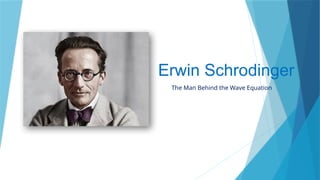
Erwin Schrodinger
The Man Behind the Wave Equation
Early Life and Education
 Erwin Schrödinger was born on August 12, 1887, in
Vienna, Austria.
 He grew up in an well educated family; his father was a
botanist and oil cloth manufacturer.
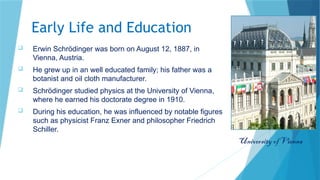
 Schrödinger studied physics at the University of Vienna,
where he earned his doctorate degree in 1910.
 During his education, he was influenced by notable figures
such as physicist Franz Exner and philosopher Friedrich
Schiller.
University of Vienna
Scientific Career
 Academic Positions: He held professorships at the
University of Zurich, the University of Berlin, and the
University of Oxford.
Key Contributions:
 Wave Equation
 Quantum Mechanics
 Other Research: Contributions to statistical mechanics
and color theory.
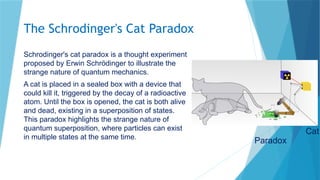
The Schrodinger's Cat Paradox
Schrodinger's cat paradox is a thought experiment
proposed by Erwin Schrödinger to illustrate the
strange nature of quantum mechanics.
A cat is placed in a sealed box with a device that
could kill it, triggered by the decay of a radioactive
atom. Until the box is opened, the cat is both alive
and dead, existing in a superposition of states.
This paradox highlights the strange nature of
quantum superposition, where particles can exist
in multiple states at the same time.
Cat
Paradox
Nobel Prize and Later Life
Erwin Schrodinger won the Nobel Prize for Physics in
1933. He won it for his work on the wave equation,
which is a very important idea in quantum mechanics.
He shared this award with Paul Dirac.
Later in his life, Schrödinger studied theoretical biology
and philosophy of science. He wrote a famous book
called "What is Life?", which made people think a lot
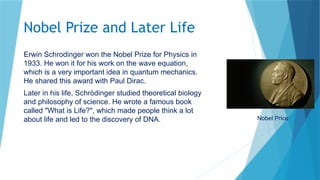
about life and led to the discovery of DNA. Nobel Price
Legacy and Impact
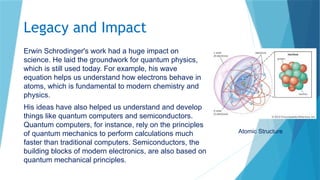
Erwin Schrodinger's work had a huge impact on
science. He laid the groundwork for quantum physics,
which is still used today. For example, his wave
equation helps us understand how electrons behave in
atoms, which is fundamental to modern chemistry and
physics.
His ideas have also helped us understand and develop
things like quantum computers and semiconductors.
Quantum computers, for instance, rely on the principles
of quantum mechanics to perform calculations much
faster than traditional computers. Semiconductors, the
building blocks of modern electronics, are also based on
quantum mechanical principles.
Atomic Structure
Legacy and Impact
Most importantly, he completely changed how we think
about tiny particles and energy. Before Schrodinger,
we thought of particles as solid objects with fixed
properties. Schrödinger showed us that particles can
be in multiple states at the same time with a concept
known as superposition. This idea has deeply
impacted how we view the universe at the smallest
level.
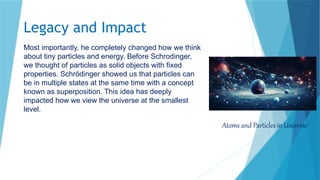
Atoms and Particles in Universe
Interest in Color
Erwin Schrödinger was very interested in psychology,
especially in understanding how we see and measure
colors. He spent many years studying color perception
and wrote several research papers on the topic, such
as:
• Theory of Pigments with Highest Luminosity
• Outline of a Theory of Color Measurement for Daylight Vision
• On the Relationship of Four-Color Theory to Three-Color
Theory
• Thresholds of Color Differences
Schrödinger’s work built on ideas from famous
scientists like Isaac Newton, James Clerk Maxwell.
Atoms and Particles in Universe
Conclusion
Erwin Schrodinger is a known as the quantum pioneer
for his contribution. His work remains central to modern
physics and technological innovation. The great
scientist died in January 4, 1961 for tuberculosis. Lets
finish the presentation with his beautiful quote
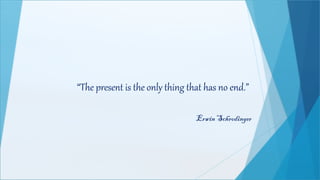
“The present is the only thing that has no end.”
Erwin Schrodinger
Thank You

Erwin Schrodinger The Man Behind the Wave Equation

  • 1.
    Erwin Schrodinger The ManBehind the Wave Equation
  • 2.
    Early Life andEducation  Erwin Schrödinger was born on August 12, 1887, in Vienna, Austria.  He grew up in an well educated family; his father was a botanist and oil cloth manufacturer.  Schrödinger studied physics at the University of Vienna, where he earned his doctorate degree in 1910.  During his education, he was influenced by notable figures such as physicist Franz Exner and philosopher Friedrich Schiller. University of Vienna
  • 3.
    Scientific Career  AcademicPositions: He held professorships at the University of Zurich, the University of Berlin, and the University of Oxford. Key Contributions:  Wave Equation  Quantum Mechanics  Other Research: Contributions to statistical mechanics and color theory.
  • 4.
    The Schrodinger's CatParadox Schrodinger's cat paradox is a thought experiment proposed by Erwin Schrödinger to illustrate the strange nature of quantum mechanics. A cat is placed in a sealed box with a device that could kill it, triggered by the decay of a radioactive atom. Until the box is opened, the cat is both alive and dead, existing in a superposition of states. This paradox highlights the strange nature of quantum superposition, where particles can exist in multiple states at the same time. Cat Paradox
  • 5.
    Nobel Prize andLater Life Erwin Schrodinger won the Nobel Prize for Physics in 1933. He won it for his work on the wave equation, which is a very important idea in quantum mechanics. He shared this award with Paul Dirac. Later in his life, Schrödinger studied theoretical biology and philosophy of science. He wrote a famous book called "What is Life?", which made people think a lot about life and led to the discovery of DNA. Nobel Price
  • 6.
    Legacy and Impact ErwinSchrodinger's work had a huge impact on science. He laid the groundwork for quantum physics, which is still used today. For example, his wave equation helps us understand how electrons behave in atoms, which is fundamental to modern chemistry and physics. His ideas have also helped us understand and develop things like quantum computers and semiconductors. Quantum computers, for instance, rely on the principles of quantum mechanics to perform calculations much faster than traditional computers. Semiconductors, the building blocks of modern electronics, are also based on quantum mechanical principles. Atomic Structure
  • 7.
    Legacy and Impact Mostimportantly, he completely changed how we think about tiny particles and energy. Before Schrodinger, we thought of particles as solid objects with fixed properties. Schrödinger showed us that particles can be in multiple states at the same time with a concept known as superposition. This idea has deeply impacted how we view the universe at the smallest level. Atoms and Particles in Universe
  • 8.
    Interest in Color ErwinSchrödinger was very interested in psychology, especially in understanding how we see and measure colors. He spent many years studying color perception and wrote several research papers on the topic, such as: • Theory of Pigments with Highest Luminosity • Outline of a Theory of Color Measurement for Daylight Vision • On the Relationship of Four-Color Theory to Three-Color Theory • Thresholds of Color Differences Schrödinger’s work built on ideas from famous scientists like Isaac Newton, James Clerk Maxwell. Atoms and Particles in Universe
  • 9.
    Conclusion Erwin Schrodinger isa known as the quantum pioneer for his contribution. His work remains central to modern physics and technological innovation. The great scientist died in January 4, 1961 for tuberculosis. Lets finish the presentation with his beautiful quote
  • 10.
    “The present isthe only thing that has no end.” Erwin Schrodinger
  • 11.