Communication skills
As a Doctor
Dr. Smita Pakhmode
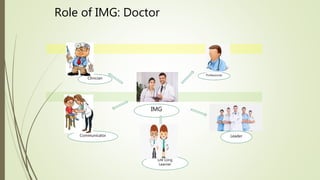
Role of IMG: Doctor
IMG
Professional
Communicator
Clinician
Life Long
Learner
Leader
Communication Skill
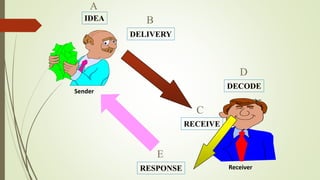
A
B
IDEA
DELIVERY
RECEIVE
C
DECODE
D
RESPONSE
E
Sender
Receiver
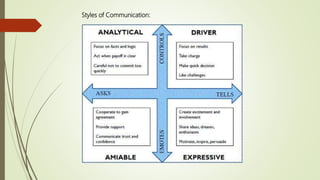
Styles of Communication:
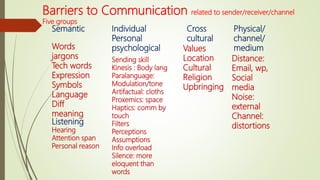
Barriers to Communication related to sender/receiver/channel
Five groups
Semantic Individual
Personal
psychological
Cross
cultural
Physical/
channel/
medium
Words
jargons
Tech words
Expression
Symbols
Language
Diff
meaning
Sending skill
Kinesis : Body lang
Paralanguage:
Modulation/tone
Artifactual: cloths
Proxemics: space
Haptics: comm by
touch
Filters
Perceptions
Assumptions
Info overload
Silence: more
eloquent than
words
Values
Location
Cultural
Religion
Upbringing
Distance:
Email, wp,
Social
media
Noise:
external
Channel:
distortions
Listening
Hearing
Attention span
Personal reason
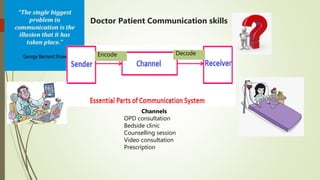
Encode Decode
Channels
OPD consultation
Bedside clinic
Counselling session
Video consultation
Prescription
Doctor Patient Communication skills
Health care team
Doctor Patient
Relationship
Community
Approach
Administrator
Leader
Counselors
Healer
Educator
Motivator
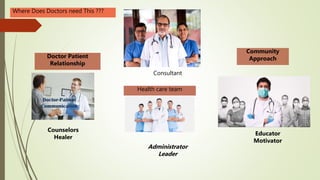
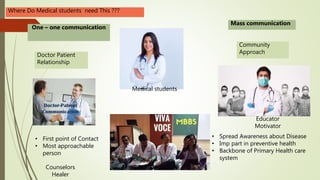
Where Does Doctors need This ???
Consultant
Doctor Patient
Relationship
Community
Approach
Counselors
Healer
Educator
Motivator
• First point of Contact
• Most approachable
person
• Spread Awareness about Disease
• Imp part in preventive health
• Backbone of Primary Health care
system
Medical students
Mass communication
One – one communication
Where Do Medical students need This ???
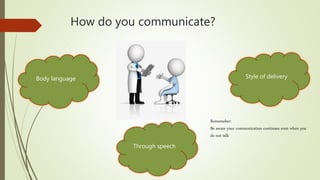
How do you communicate?
Through speech
Body language Style of delivery
Rememeber:
Be aware your communication continues even when you
do not talk
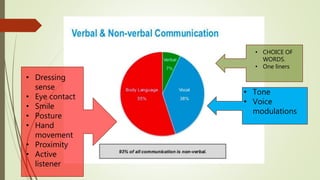
• CHOICE OF
WORDS.
• One liners
• Tone
• Voice
modulations
• Dressing
sense
• Eye contact
• Smile
• Posture
• Hand
movement
• Proximity
• Active
listener
Role Plays
Can You portray picture of your favorite Doctor?
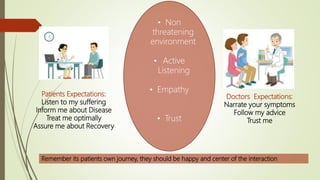
Patients Expectations:
Listen to my suffering
Inform me about Disease
Treat me optimally
Assure me about Recovery
Doctors Expectations:
Narrate your symptoms
Follow my advice
Trust me
• Non
threatening
environment
• Active
Listening
• Empathy
• Trust
Remember its patients own journey, they should be happy and center of the interaction
Communication as a Doctor : Creating Non
threatening Environment
 Make welcoming statement
 Use friendly words and tone of voice
 Address by name.
 Make proper connect .
 Question about themselves.
 No physical barrier
Communication as a Doctor : Active Listening
 Listen with open eyes and open ear
 Listen for feeling and Information as well.
 Show your interest in conversation
 Wait before responding, do not formulate
your response
 While speaker is delivering the message.
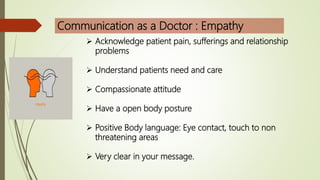
Communication as a Doctor : Empathy
 Acknowledge patient pain, sufferings and relationship
problems
 Understand patients need and care
 Compassionate attitude
 Have a open body posture
 Positive Body language: Eye contact, touch to non
threatening areas
 Very clear in your message.
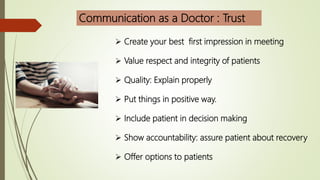
Communication as a Doctor : Trust
 Create your best first impression in meeting
 Value respect and integrity of patients
 Quality: Explain properly
 Put things in positive way.
 Include patient in decision making
 Show accountability: assure patient about recovery
 Offer options to patients
Revised Role Plays
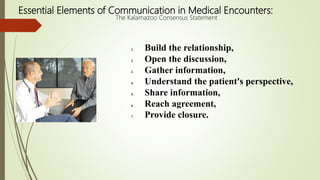
Essential Elements of Communication in Medical Encounters:
The Kalamazoo Consensus Statement
1. Build the relationship,
2. Open the discussion,
3. Gather information,
4. Understand the patient's perspective,
5. Share information,
6. Reach agreement,
7. Provide closure.
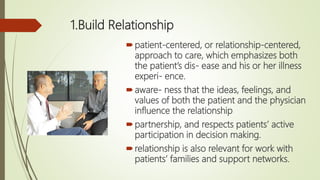
1.Build Relationship
patient-centered, or relationship-centered,
approach to care, which emphasizes both
the patient’s dis- ease and his or her illness
experi- ence.
aware- ness that the ideas, feelings, and
values of both the patient and the physician
influence the relationship
partnership, and respects patients’ active
participation in decision making.
relationship is also relevant for work with
patients’ families and support networks.
Allow the patient to complete his or her opening
statement
 Elicit the patient’s full set of concerns
 Establish/maintain a personal connection
2.Open the Discussion
3. Gather Information
 Use open-ended and closed-ended questions
appropriately
 Structure, clarify, and summarize in- formation
 Actively listen using nonverbal (e.g., eye contact)
and verbal (e.g., words of encouragement)
techniques
4.Understand the Patient’s Perspective
Explore contextual factors (e.g., fam- ily, culture,
gender, age, socioeco- nomic status, spirituality)
Explore beliefs, concerns, and expec- tations about
health and illness
 Acknowledge and respond to the pa- tient’s ideas,
feelings, and values
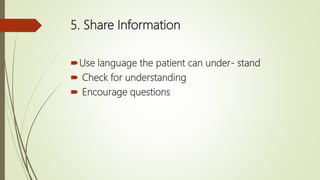
5. Share Information
Use language the patient can under- stand
 Check for understanding
 Encourage questions
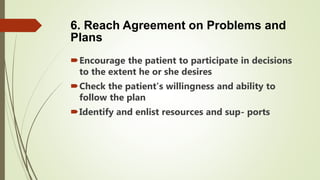
6. Reach Agreement on Problems and
Plans
Encourage the patient to participate in decisions
to the extent he or she desires
Check the patient’s willingness and ability to
follow the plan
Identify and enlist resources and sup- ports
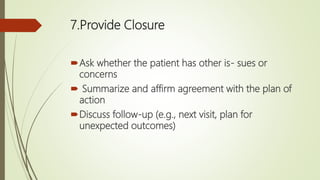
7.Provide Closure
Ask whether the patient has other is- sues or
concerns
 Summarize and affirm agreement with the plan of
action
Discuss follow-up (e.g., next visit, plan for
unexpected outcomes)
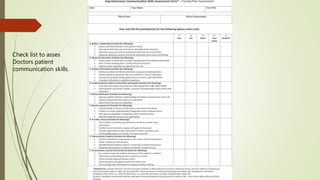
Check list to asses
Doctors patient
communication skills.
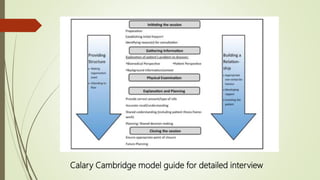
Calary Cambridge model guide for detailed interview
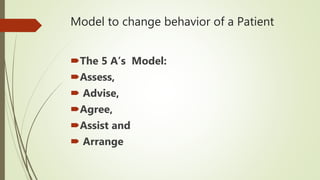
Model to change behavior of a Patient
The 5 A’s Model:
Assess,
 Advise,
Agree,
Assist and
 Arrange
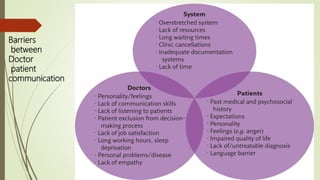
Barriers
between
Doctor
patient
communication
Good relationship starts with
good communication
Effective communication is 20%
what you know, and 80% what
you feel about what you know.
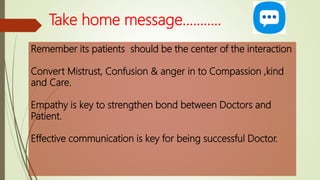
Take home message………..
Remember its patients should be the center of the interaction
Convert Mistrust, Confusion & anger in to Compassion ,kind
and Care.
Empathy is key to strengthen bond between Doctors and
Patient.
Effective communication is key for being successful Doctor.
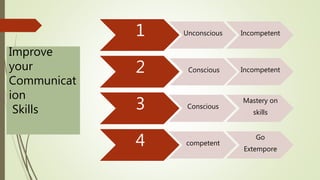
1 Unconscious Incompetent
2 Conscious Incompetent
3 Conscious
Mastery on
skills
4 competent
Go
Extempore
Improve
your
Communicat
ion
Skills

Communication skills doctor

  • 1.
    Communication skills As aDoctor Dr. Smita Pakhmode
  • 2.
    Role of IMG:Doctor IMG Professional Communicator Clinician Life Long Learner Leader
  • 3.
  • 4.
  • 5.
  • 6.
    Barriers to Communicationrelated to sender/receiver/channel Five groups Semantic Individual Personal psychological Cross cultural Physical/ channel/ medium Words jargons Tech words Expression Symbols Language Diff meaning Sending skill Kinesis : Body lang Paralanguage: Modulation/tone Artifactual: cloths Proxemics: space Haptics: comm by touch Filters Perceptions Assumptions Info overload Silence: more eloquent than words Values Location Cultural Religion Upbringing Distance: Email, wp, Social media Noise: external Channel: distortions Listening Hearing Attention span Personal reason
  • 7.
    Encode Decode Channels OPD consultation Bedsideclinic Counselling session Video consultation Prescription Doctor Patient Communication skills
  • 8.
    Health care team DoctorPatient Relationship Community Approach Administrator Leader Counselors Healer Educator Motivator Where Does Doctors need This ??? Consultant
  • 9.
    Doctor Patient Relationship Community Approach Counselors Healer Educator Motivator • Firstpoint of Contact • Most approachable person • Spread Awareness about Disease • Imp part in preventive health • Backbone of Primary Health care system Medical students Mass communication One – one communication Where Do Medical students need This ???
  • 10.
    How do youcommunicate? Through speech Body language Style of delivery Rememeber: Be aware your communication continues even when you do not talk
  • 11.
    • CHOICE OF WORDS. •One liners • Tone • Voice modulations • Dressing sense • Eye contact • Smile • Posture • Hand movement • Proximity • Active listener
  • 12.
  • 13.
    Can You portraypicture of your favorite Doctor?
  • 14.
    Patients Expectations: Listen tomy suffering Inform me about Disease Treat me optimally Assure me about Recovery Doctors Expectations: Narrate your symptoms Follow my advice Trust me • Non threatening environment • Active Listening • Empathy • Trust Remember its patients own journey, they should be happy and center of the interaction
  • 15.
    Communication as aDoctor : Creating Non threatening Environment  Make welcoming statement  Use friendly words and tone of voice  Address by name.  Make proper connect .  Question about themselves.  No physical barrier
  • 16.
    Communication as aDoctor : Active Listening  Listen with open eyes and open ear  Listen for feeling and Information as well.  Show your interest in conversation  Wait before responding, do not formulate your response  While speaker is delivering the message.
  • 17.
    Communication as aDoctor : Empathy  Acknowledge patient pain, sufferings and relationship problems  Understand patients need and care  Compassionate attitude  Have a open body posture  Positive Body language: Eye contact, touch to non threatening areas  Very clear in your message.
  • 18.
    Communication as aDoctor : Trust  Create your best first impression in meeting  Value respect and integrity of patients  Quality: Explain properly  Put things in positive way.  Include patient in decision making  Show accountability: assure patient about recovery  Offer options to patients
  • 19.
  • 20.
    Essential Elements ofCommunication in Medical Encounters: The Kalamazoo Consensus Statement 1. Build the relationship, 2. Open the discussion, 3. Gather information, 4. Understand the patient's perspective, 5. Share information, 6. Reach agreement, 7. Provide closure.
  • 21.
    1.Build Relationship patient-centered, orrelationship-centered, approach to care, which emphasizes both the patient’s dis- ease and his or her illness experi- ence. aware- ness that the ideas, feelings, and values of both the patient and the physician influence the relationship partnership, and respects patients’ active participation in decision making. relationship is also relevant for work with patients’ families and support networks.
  • 22.
    Allow the patientto complete his or her opening statement  Elicit the patient’s full set of concerns  Establish/maintain a personal connection 2.Open the Discussion
  • 23.
    3. Gather Information Use open-ended and closed-ended questions appropriately  Structure, clarify, and summarize in- formation  Actively listen using nonverbal (e.g., eye contact) and verbal (e.g., words of encouragement) techniques
  • 24.
    4.Understand the Patient’sPerspective Explore contextual factors (e.g., fam- ily, culture, gender, age, socioeco- nomic status, spirituality) Explore beliefs, concerns, and expec- tations about health and illness  Acknowledge and respond to the pa- tient’s ideas, feelings, and values
  • 25.
    5. Share Information Uselanguage the patient can under- stand  Check for understanding  Encourage questions
  • 26.
    6. Reach Agreementon Problems and Plans Encourage the patient to participate in decisions to the extent he or she desires Check the patient’s willingness and ability to follow the plan Identify and enlist resources and sup- ports
  • 27.
    7.Provide Closure Ask whetherthe patient has other is- sues or concerns  Summarize and affirm agreement with the plan of action Discuss follow-up (e.g., next visit, plan for unexpected outcomes)
  • 28.
    Check list toasses Doctors patient communication skills.
  • 29.
    Calary Cambridge modelguide for detailed interview
  • 30.
    Model to changebehavior of a Patient The 5 A’s Model: Assess,  Advise, Agree, Assist and  Arrange
  • 31.
  • 32.
    Good relationship startswith good communication Effective communication is 20% what you know, and 80% what you feel about what you know. Take home message………..
  • 33.
    Take home message……….. Rememberits patients should be the center of the interaction Convert Mistrust, Confusion & anger in to Compassion ,kind and Care. Empathy is key to strengthen bond between Doctors and Patient. Effective communication is key for being successful Doctor.
  • 34.
    1 Unconscious Incompetent 2Conscious Incompetent 3 Conscious Mastery on skills 4 competent Go Extempore Improve your Communicat ion Skills

Editor's Notes

  • #3 Use Elbow, foot, knee, shoulders, buttocks and finally voice.
  • #5 Imparting or interchanging of thoughts, opinion or information amongst people by speech, writing or signs.
  • #7 Imparting or interchanging of thoughts, opinion or information amongst people by speech, writing or signs.
  • #8 Imparting or interchanging of thoughts, opinion or information amongst people by speech, writing or signs.
  • #18 Acknowledge patient suffering about pain, I am sorry to here that, I hope you feel better. It would be tough for you.
  • #19 This treatment is not avaible but we can do that We do not treatment avaible but we can do that