PHYSICA
L
SCIENCE
DID YOU KNOW?
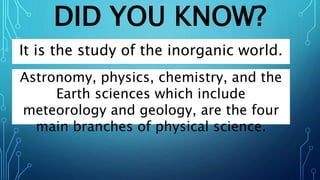
It is the study of the inorganic world.
Astronomy, physics, chemistry, and the
Earth sciences which include
meteorology and geology, are the four
main branches of physical science.
DID YOU KNOW?
The nucleus (protons and neutrons)
of an atom contribute more than
99.97% of its mass.You are radioactive because your
body contains carbon-14.
A nuclear reactor used to generate
electricity cannot explode like an atomic
or nuclear bomb.
PREVIEW
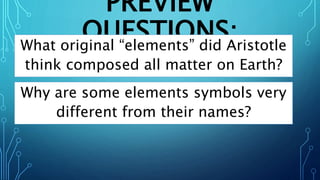
QUESTIONS:What original “elements” did Aristotle
think composed all matter on Earth?
Why are some elements symbols very
different from their names?
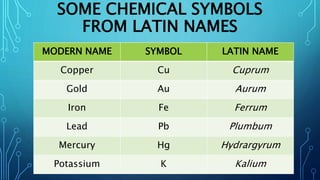
SOME CHEMICAL SYMBOLS
FROM LATIN NAMES
MODERN NAME SYMBOL LATIN NAME
Copper Cu Cuprum
Gold Au Aurum
Iron Fe Ferrum
Lead Pb Plumbum
Mercury Hg Hydrargyrum
Potassium K Kalium
NAMES AND SYMBOLS OF SOME COMMON
ELEMENTS
NAME SYMBOL NAME SYMBOL NAME SYMBOL
Alumin
um
Al Carbon C Gold Au
Argon Ar
Chlorin
e
Cl Helium He
Barium Ba
Chromi
um
Cr
Hydrog
en
H
Boron B Cobalt Co Iodine I
Bromin
e
Br Copper Cu Iron Fe
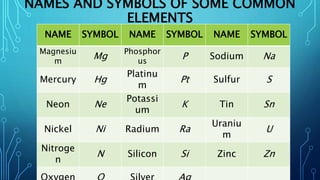
NAMES AND SYMBOLS OF SOME COMMON
ELEMENTS
NAME SYMBOL NAME SYMBOL NAME SYMBOL
Magnesiu
m
Mg
Phosphor
us
P Sodium Na
Mercury Hg
Platinu
m
Pt Sulfur S
Neon Ne
Potassi
um
K Tin Sn
Nickel Ni Radium Ra
Uraniu
m
U
Nitroge
n
N Silicon Si Zinc Zn
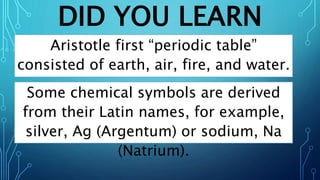
DID YOU LEARN
Aristotle first “periodic table”
consisted of earth, air, fire, and water.
Some chemical symbols are derived
from their Latin names, for example,
silver, Ag (Argentum) or sodium, Na
(Natrium).
THE
ATOMIC
NUCEUS
PREVIEW
QUESTIONS:How was it determined that atoms
have nuclei?
What is the atomic number, and how
is it related to an element?
DID YOU KNOW?
Electrons – negatively charged
particlesNucleus – central core of
an atomProtons – positively charged
particlesNeutrons – neutral charged
particlesNucleons – collection of nuclear protons
and neutrons
DID YOU KNOW?
Ernest Rutherford – atom consists of a nucleus
surrounded by circulating
electrons.J. J. Thomson – plum
pudding model
Rutherford’s Alpha Scattering
Experiment
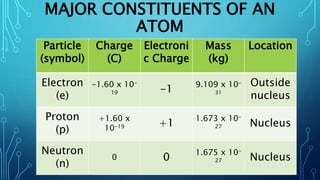
MAJOR CONSTITUENTS OF AN
ATOM
Particle
(symbol)
Charge
(C)
Electroni
c Charge
Mass
(kg)
Location
Electron
(e)
-1.60 x 10-
19 -1
9.109 x 10-
31
Outside
nucleus
Proton
(p)
+1.60 x
10-19 +1
1.673 x 10-
27 Nucleus
Neutron
(n)
0 0
1.675 x 10-
27 Nucleus
DID YOU KNOW?
Rutherford’s Alpha Scattering
Experiment
DID YOU KNOW?
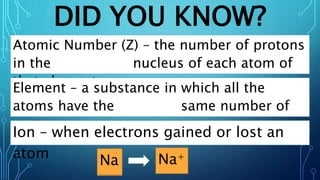
Atomic Number (Z) – the number of protons
in the nucleus of each atom of
that element.Element – a substance in which all the
atoms have the same number of
protons.
Ion – when electrons gained or lost an
atom
Na Na+
Na
DID YOU KNOW?
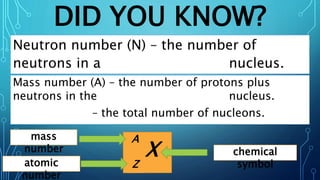
Neutron number (N) – the number of
neutrons in a nucleus.
Mass number (A) – the number of protons plus
neutrons in the nucleus.
– the total number of nucleons.
A
Z
X
mass
number
atomic
number
chemical
symbol
DID YOU KNOW?
Why are the letters Z and A
used?
A
Z
X
mass
number
atomic
number
chemical
symbol
DID YOU KNOW?
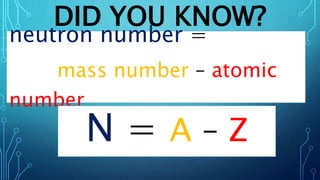
neutron number =
mass number – atomic
number
N = A – Z
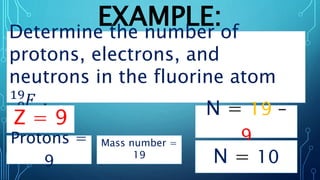
EXAMPLE:Determine the number of
protons, electrons, and
neutrons in the fluorine atom
9
19
𝐹 .
Z = 9
Protons =
9
Mass number =
19
N = 19 –
9
N = 10
DO THIS!!!
Determine the number of
protons, electrons, neutrons in
the carbon atom Iodine-131, a
radioactive nucleus used in the
treatment of thyroid cancer.
DO THIS!!!
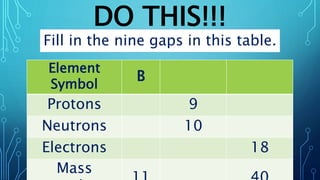
Fill in the nine gaps in this table.
Element
Symbol
B
Protons 9
Neutrons 10
Electrons 18
Mass
DO THIS!!!
Fill in the nine gaps in this table.
Element
Symbol
Ga
Protons 15
Neutrons 39 20
Electrons 17
Mass
DO THIS!!!
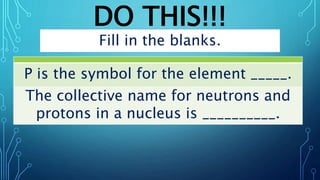
Fill in the blanks.
P is the symbol for the element _____.
The collective name for neutrons and
protons in a nucleus is __________.
DO THIS!!!
Short Answers!!!
1. What are the chemical symbols for (a) carbon, (b)
chlorine, and (c) lead?
2. What are the three names of the elements with the
symbols (a) N, (b) He, and (c) Fe?
3. Why is the symbol for the transuranic element
Rutherfordium Rf instead of Ru?
4. Why is the neutron number N equal to the mass
number A minus the atomic number Z?
DO THIS!!!
Short Answers!!!
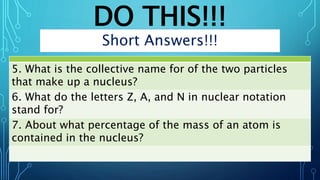
5. What is the collective name for of the two particles
that make up a nucleus?
6. What do the letters Z, A, and N in nuclear notation
stand for?
7. About what percentage of the mass of an atom is
contained in the nucleus?

Physical science intro

  • 1.
  • 2.
    DID YOU KNOW? Itis the study of the inorganic world. Astronomy, physics, chemistry, and the Earth sciences which include meteorology and geology, are the four main branches of physical science.
  • 3.
    DID YOU KNOW? Thenucleus (protons and neutrons) of an atom contribute more than 99.97% of its mass.You are radioactive because your body contains carbon-14. A nuclear reactor used to generate electricity cannot explode like an atomic or nuclear bomb.
  • 4.
    PREVIEW QUESTIONS:What original “elements”did Aristotle think composed all matter on Earth? Why are some elements symbols very different from their names?
  • 5.
    SOME CHEMICAL SYMBOLS FROMLATIN NAMES MODERN NAME SYMBOL LATIN NAME Copper Cu Cuprum Gold Au Aurum Iron Fe Ferrum Lead Pb Plumbum Mercury Hg Hydrargyrum Potassium K Kalium
  • 6.
    NAMES AND SYMBOLSOF SOME COMMON ELEMENTS NAME SYMBOL NAME SYMBOL NAME SYMBOL Alumin um Al Carbon C Gold Au Argon Ar Chlorin e Cl Helium He Barium Ba Chromi um Cr Hydrog en H Boron B Cobalt Co Iodine I Bromin e Br Copper Cu Iron Fe
  • 7.
    NAMES AND SYMBOLSOF SOME COMMON ELEMENTS NAME SYMBOL NAME SYMBOL NAME SYMBOL Magnesiu m Mg Phosphor us P Sodium Na Mercury Hg Platinu m Pt Sulfur S Neon Ne Potassi um K Tin Sn Nickel Ni Radium Ra Uraniu m U Nitroge n N Silicon Si Zinc Zn
  • 8.
    DID YOU LEARN Aristotlefirst “periodic table” consisted of earth, air, fire, and water. Some chemical symbols are derived from their Latin names, for example, silver, Ag (Argentum) or sodium, Na (Natrium).
  • 9.
  • 10.
    PREVIEW QUESTIONS:How was itdetermined that atoms have nuclei? What is the atomic number, and how is it related to an element?
  • 11.
    DID YOU KNOW? Electrons– negatively charged particlesNucleus – central core of an atomProtons – positively charged particlesNeutrons – neutral charged particlesNucleons – collection of nuclear protons and neutrons
  • 12.
    DID YOU KNOW? ErnestRutherford – atom consists of a nucleus surrounded by circulating electrons.J. J. Thomson – plum pudding model Rutherford’s Alpha Scattering Experiment
  • 13.
    MAJOR CONSTITUENTS OFAN ATOM Particle (symbol) Charge (C) Electroni c Charge Mass (kg) Location Electron (e) -1.60 x 10- 19 -1 9.109 x 10- 31 Outside nucleus Proton (p) +1.60 x 10⁻¹⁹ +1 1.673 x 10- 27 Nucleus Neutron (n) 0 0 1.675 x 10- 27 Nucleus
  • 14.
    DID YOU KNOW? Rutherford’sAlpha Scattering Experiment
  • 15.
    DID YOU KNOW? AtomicNumber (Z) – the number of protons in the nucleus of each atom of that element.Element – a substance in which all the atoms have the same number of protons. Ion – when electrons gained or lost an atom Na Na+ Na
  • 16.
    DID YOU KNOW? Neutronnumber (N) – the number of neutrons in a nucleus. Mass number (A) – the number of protons plus neutrons in the nucleus. – the total number of nucleons. A Z X mass number atomic number chemical symbol
  • 17.
    DID YOU KNOW? Whyare the letters Z and A used? A Z X mass number atomic number chemical symbol
  • 18.
    DID YOU KNOW? neutronnumber = mass number – atomic number N = A – Z
  • 19.
    EXAMPLE:Determine the numberof protons, electrons, and neutrons in the fluorine atom 9 19 𝐹 . Z = 9 Protons = 9 Mass number = 19 N = 19 – 9 N = 10
  • 20.
    DO THIS!!! Determine thenumber of protons, electrons, neutrons in the carbon atom Iodine-131, a radioactive nucleus used in the treatment of thyroid cancer.
  • 21.
    DO THIS!!! Fill inthe nine gaps in this table. Element Symbol B Protons 9 Neutrons 10 Electrons 18 Mass
  • 22.
    DO THIS!!! Fill inthe nine gaps in this table. Element Symbol Ga Protons 15 Neutrons 39 20 Electrons 17 Mass
  • 23.
    DO THIS!!! Fill inthe blanks. P is the symbol for the element _____. The collective name for neutrons and protons in a nucleus is __________.
  • 24.
    DO THIS!!! Short Answers!!! 1.What are the chemical symbols for (a) carbon, (b) chlorine, and (c) lead? 2. What are the three names of the elements with the symbols (a) N, (b) He, and (c) Fe? 3. Why is the symbol for the transuranic element Rutherfordium Rf instead of Ru? 4. Why is the neutron number N equal to the mass number A minus the atomic number Z?
  • 25.
    DO THIS!!! Short Answers!!! 5.What is the collective name for of the two particles that make up a nucleus? 6. What do the letters Z, A, and N in nuclear notation stand for? 7. About what percentage of the mass of an atom is contained in the nucleus?

Editor's Notes

  • #3 It does not study living things. Those are studied in biological, or life, science. The four main branches of physical science