Landforms And Life
Mountains
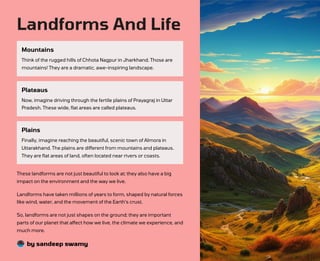
Think of the rugged hills of Chhota Nagpur in Jharkhand. Those are
mountains! They are a dramatic, awe-inspiring landscape.
Plateaus
Now, imagine driving through the fertile plains of Prayagraj in Uttar
Pradesh. These wide, flat areas are called plateaus.
Plains
Finally, imagine reaching the beautiful, scenic town of Almora in
Uttarakhand. The plains are different from mountains and plateaus.
They are flat areas of land, often located near rivers or coasts.
These landforms are not just beautiful to look at; they also have a big
impact on the environment and the way we live.
Landforms have taken millions of years to form, shaped by natural forces
like wind, water, and the movement of the Earth's crust.
So, landforms are not just shapes on the ground; they are important
parts of our planet that affect how we live, the climate we experience, and
much more.
by sandeep swamy
Mountains
Definition
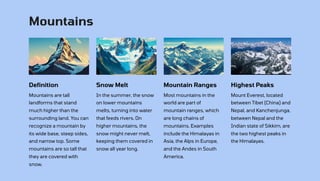
Mountains are tall
landforms that stand
much higher than the
surrounding land. You can
recognize a mountain by
its wide base, steep sides,
and narrow top. Some
mountains are so tall that
they are covered with
snow.
Snow Melt
In the summer, the snow
on lower mountains
melts, turning into water
that feeds rivers. On
higher mountains, the
snow might never melt,
keeping them covered in
snow all year long.
Mountain Ranges
Most mountains in the
world are part of
mountain ranges, which
are long chains of
mountains. Examples
include the Himalayas in
Asia, the Alps in Europe,
and the Andes in South
America.
Highest Peaks
Mount Everest, located
between Tibet (China) and
Nepal, and Kanchenjunga,
between Nepal and the
Indian state of Sikkim, are
the two highest peaks in
the Himalayas.
Notable Mountains Around the World
Mount Aconcagua
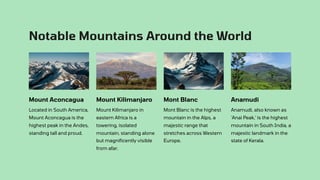
Located in South America,
Mount Aconcagua is the
highest peak in the Andes,
standing tall and proud.
Mount Kilimanjaro
Mount Kilimanjaro in
eastern Africa is a
towering, isolated
mountain, standing alone
but magnificently visible
from afar.
Mont Blanc
Mont Blanc is the highest
mountain in the Alps, a
majestic range that
stretches across Western
Europe.
Anamudi
Anamudi, also known as
'Anai Peak,' is the highest
mountain in South India, a
majestic landmark in the
state of Kerala.
Mountain Formation and Age
Young Mountains
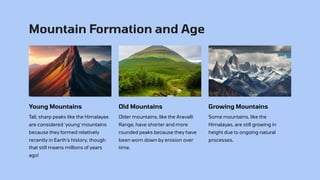
Tall, sharp peaks like the Himalayas
are considered 'young' mountains
because they formed relatively
recently in Earth's history, though
that still means millions of years
ago!
Old Mountains
Older mountains, like the Aravalli
Range, have shorter and more
rounded peaks because they have
been worn down by erosion over
time.
Growing Mountains
Some mountains, like the
Himalayas, are still growing in
height due to ongoing natural
processes.
Mountain Ecosystems
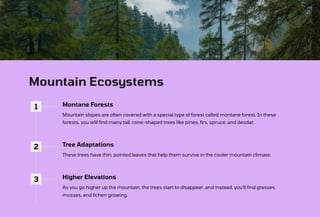
1 Montane Forests
Mountain slopes are often covered with a special type of forest called montane forest. In these
forests, you will find many tall, cone-shaped trees like pines, firs, spruce, and deodar.
2 Tree Adaptations
These trees have thin, pointed leaves that help them survive in the cooler mountain climate.
3 Higher Elevations
As you go higher up the mountain, the trees start to disappear, and instead, you'll find grasses,
mosses, and lichen growing.
Mountain Wildlife
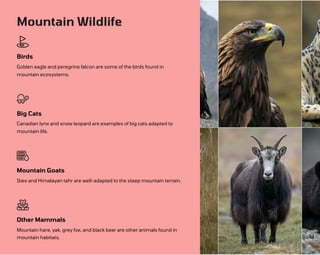
Birds
Golden eagle and peregrine falcon are some of the birds found in
mountain ecosystems.
Big Cats
Canadian lynx and snow leopard are examples of big cats adapted to
mountain life.
Mountain Goats
Ibex and Himalayan tahr are well-adapted to the steep mountain terrain.
Other Mammals
Mountain hare, yak, grey fox, and black bear are other animals found in
mountain habitats.
The Himalayas In Ancient Poetry
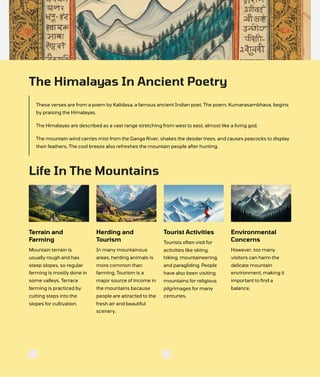
These verses are from a poem by Kalidasa, a famous ancient Indian poet. The poem, Kumarasambhava, begins
by praising the Himalayas.
The Himalayas are described as a vast range stretching from west to east, almost like a living god.
The mountain wind carries mist from the Ganga River, shakes the deodar trees, and causes peacocks to display
their feathers. The cool breeze also refreshes the mountain people after hunting.
Life In The Mountains
Terrain and
Farming
Mountain terrain is
usually rough and has
steep slopes, so regular
farming is mostly done in
some valleys. Terrace
farming is practiced by
cutting steps into the
slopes for cultivation.
Herding and
Tourism
In many mountainous
areas, herding animals is
more common than
farming. Tourism is a
major source of income in
the mountains because
people are attracted to the
fresh air and beautiful
scenery.
Tourist Activities
Tourists often visit for
activities like skiing,
hiking, mountaineering,
and paragliding. People
have also been visiting
mountains for religious
pilgrimages for many
centuries.
Environmental
Concerns
However, too many
visitors can harm the
delicate mountain
environment, making it
important to find a
balance.
Sacred Mountains Around The World
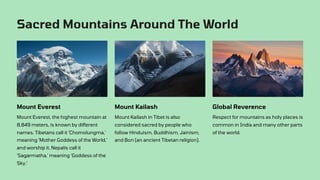
Mount Everest
Mount Everest, the highest mountain at
8,849 meters, is known by different
names. Tibetans call it 'Chomolungma,'
meaning 'Mother Goddess of the World,'
and worship it. Nepalis call it
'Sagarmatha,' meaning 'Goddess of the
Sky.'
Mount Kailash
Mount Kailash in Tibet is also
considered sacred by people who
follow Hinduism, Buddhism, Jainism,
and Bon (an ancient Tibetan religion).
Global Reverence
Respect for mountains as holy places is
common in India and many other parts
of the world.
Bachendri Pal
Pioneering Mountaineer
Bachendri Pal made history in 1984 by becoming the first
Indian woman to summit Mount Everest.
National Recognition
Her remarkable achievement was recognized with the
Padma Shri in 1984. She later received the Padma Bhushan
in 2019.
Arunima Sinha
Overcoming adversity
At 31, Arunima Sinha lost her leg in a tragic accident.
Encouraged by Bachendri Pal, she became the first
Indian woman with a disability to climb Mount Everest
in 2013, showing her incredible strength of spirit.
She was awarded the Padma Sri in 2015.
Plateaus
Definition
A plateau is a landform
that stands higher than
the surrounding land and
has a flat top. Some of its
sides are steep. Like
mountains, plateaus can
be old or young in the
Earth's history.
Notable Examples
The Tibetan Plateau is the
largest and highest
plateau in the world, and
the Deccan Plateau is
another well-known
example. Plateaus can
vary in height from a few
hundred meters to
several thousand meters.
Mineral Wealth
Plateaus are rich in
minerals, which is why
mining is a major activity
in these areas. For
example, the East African
Plateau is famous for gold
and diamond mining, and
in India, the Chhota
Nagpur Plateau has large
reserves of iron, coal, and
manganese.
Diverse
Environments
The environment on
plateaus is diverse. Many
plateaus have rocky soil,
which makes farming
difficult. However, lava
plateaus (formed by
volcanic activity) often
have rich black soil that is
good for farming.
Waterfalls on Plateaus
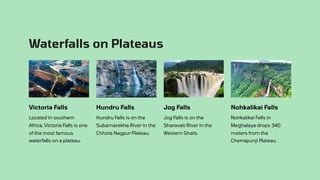
Victoria Falls
Located in southern
Africa, Victoria Falls is one
of the most famous
waterfalls on a plateau.
Hundru Falls
Hundru Falls is on the
Subarnarekha River in the
Chhota Nagpur Plateau.
Jog Falls
Jog Falls is on the
Sharavati River in the
Western Ghats.
Nohkalikai Falls
Nohkalikai Falls in
Meghalaya drops 340
meters from the
Cherrapunji Plateau.
The Tibetan And Deccan Plateaus
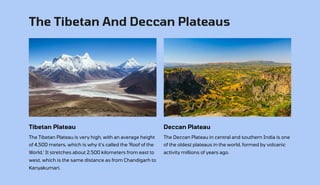
Tibetan Plateau
The Tibetan Plateau is very high, with an average height
of 4,500 meters, which is why it's called the 'Roof of the
World.' It stretches about 2,500 kilometers from east to
west, which is the same distance as from Chandigarh to
Kanyakumari.
Deccan Plateau
The Deccan Plateau in central and southern India is one
of the oldest plateaus in the world, formed by volcanic
activity millions of years ago.
Plains
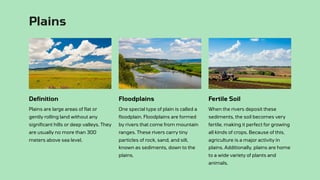
Definition
Plains are large areas of flat or
gently rolling land without any
significant hills or deep valleys. They
are usually no more than 300
meters above sea level.
Floodplains
One special type of plain is called a
floodplain. Floodplains are formed
by rivers that come from mountain
ranges. These rivers carry tiny
particles of rock, sand, and silt,
known as sediments, down to the
plains.
Fertile Soil
When the rivers deposit these
sediments, the soil becomes very
fertile, making it perfect for growing
all kinds of crops. Because of this,
agriculture is a major activity in
plains. Additionally, plains are home
to a wide variety of plants and
animals.
Life In The Plains
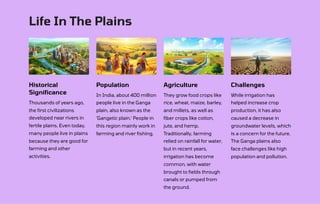
Historical
Significance
Thousands of years ago,
the first civilizations
developed near rivers in
fertile plains. Even today,
many people live in plains
because they are good for
farming and other
activities.
Population
In India, about 400 million
people live in the Ganga
plain, also known as the
'Gangetic plain.' People in
this region mainly work in
farming and river fishing.
Agriculture
They grow food crops like
rice, wheat, maize, barley,
and millets, as well as
fiber crops like cotton,
jute, and hemp.
Traditionally, farming
relied on rainfall for water,
but in recent years,
irrigation has become
common, with water
brought to fields through
canals or pumped from
the ground.
Challenges
While irrigation has
helped increase crop
production, it has also
caused a decrease in
groundwater levels, which
is a concern for the future.
The Ganga plains also
face challenges like high
population and pollution.