Group 01 | Facility Design
What is
Physical Ergonomics?
“Physical ergonomics is about the human body's
responses to physical and physiological work demands.
Repetitive strain injuries from repetition, vibration, force,
and posture are the most common types of issues, and
thus have design implications.”
Physical Ergonomics is concerned with the impact of,
Anatomy
Anthropometry
Biomechanics
Physiology
Physical environment & Physical activity
What is
Anatomy?
“anatomy is the scientific study of the structure
of organisms including their systems, organs
and tissues. It includes the appearance and position of
the various parts, the materials from which they are
composed, their locations and their relationships with
other parts.”
Macroscopic Anatomy
(Study of large body structure)
Regional anatomy – All
Structures in one particular
region
Systematic anatomy - System
by system
Surface anatomy - Study of
internal body structure
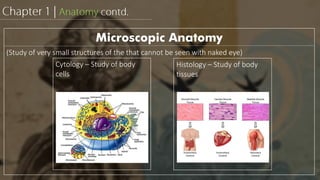
Microscopic Anatomy
(Study of very small structures of the that cannot be seen with naked eye)
Cytology – Study of body
cells
Histology – Study of body
tissues
Applications of anatomy
Anatomical planes
Elbow extension against a resistance
Sagittal plane - is a plane parallel to
the sagittal suture. It divides the
body into left and right.
Horizontal plane - divides the body
into head and tail portions.
Frontal plane - divides the body into
back and front, or posterior and
anterior portions.
“Biomechanics has been defined as the study of the
movement of living things using the science of
mechanics. Necessary to study the body’s mechanical
characteristics & principles to understand its
movements”
What is
Biomechanics?
There are two major parts.
Kinematics Kinetics
examines the causes of motion, the
internal and external forces that cause
motion or cause a body to remain at
rest, and the interactions between these
forces. There are two branches of
kinetics; STATICS & DYNAMICS
Describes the motion of a body without
reference to the forces causing it.
Kinematics examines how, when, and
where a body moves. Movement may
be LINEAR, ANGULAR, or a combination
of the two (GENARAL).
Linear
The movement of a body in a straight line or along a straight pathway.
General
General motion is a combination of Angular and Linear motion.
Angular
When a body or part of a body moves in a circle or part of a circle about a point.
Kinematics
Statics
Statics refers to situations where the body or object remains at rest, or is moving
at a constant speed in a state of equilibrium. Equilibrium is a balanced state in
which there is no acceleration.
Dynamics
Dynamics deals with the changes in motion brought on by unbalanced forces.
Kinetics
Human applications
First class leaver
Elbow extension against a resistance
Second class leaver
Forces acting on leg
Human applications
Third class leaver
Elbow flexion
“Human physiology is the study of how the human
body functions. This includes the mechanical,
physical, bioelectrical, and biochemical functions of
humans in good health, from organs to the cells of
which they are composed”
What is
Physiology?
Physiological systems of the body
Circulatory system
Respiratory system
Nervous system
Musculoskeletal system
Digestive system
Reproductive system
Urinary system
Circulatory system and
Ergonomics
The circulatory system comprises
the heart and blood vessels (arteries, veins,
and capillaries).
Physical inactivity is a risk factor for
cardiovascular disease.
Sitting can be good for the circulatory
system.
Respiratory system and
ergonomics
The respiratory system consists of
the nose, nasopharynx, trachea, and lungs. It
brings oxygen from the air and
excretes carbon dioxide and water back into
the air.
Nervous system and
ergonomics
The nervous system consists of the central
nervous system (the brain and spinal cord)
and the peripheral nervous system.
The special senses consist
of vision, hearing, taste, and smell.
The eyes, ears, tongue, and nose gather
information about the body's environment.
Musculoskeletal system
and ergonomics
The musculoskeletal system consists of
the human skeleton and attached muscles. It
gives the body basic structure and the ability
for movement.
“Anthropometry refers measurements and proportions
of the human body. Anthropometry plays an important
role where, statistical data about the distribution of
body dimensions in the population are used to
optimize products.”
What is
Anthropometry?
Dimension, In
Body dimension Sex 5th 50th 95th
1. Stature (height) Male 63.7 68.3 72.6
Female 58.9 63.2 67.4
2. Eye height Male 59.5 63.9 68.0
Female 54.4 58.6 62.7
3. Shoulder height Male 52.1 56.2 60.0
Female 47.7 51.6 55.9
4. Elbow height Male 39.4 43.3 46.9
Female 36.9 39.8 42.8
5. Knuckle height Male 27.5 29.7 31.7
Female 25.3 27.6 29.9
13.Chest depth Male 8.4 9.5 10.9
Female 8.4 9.5 11.7
Anthropometric data
Anthropometric data
Dimension, In
Body dimension Sex 5th 50th 95th
6. Height, sitting Male 33.1 35.7 38.1
Female 30.9 33.5 35.7
7. Eye height, sitting Male 28.6 30.9 33.2
Female 26.6 28.9 30.9
8. Elbow rest height, Male 7.5 9.6 11.6
sitting Female 7.1 9.2 11.1
9. Thigh clearance Male 4.5 5.7 7.
height Female 4.2 5.4 6.9
10.Knee height, sitting Male 19.4 21.4 23.3
Female 17.8 19.6 21.5
11.Buttock-knee Male 21.3 23.4 25.3
distance, sitting Female 20.4 22.4 24.6
12.Popliteal height, Male 15.4 17.4 19.2
sitting Female 14.0 15.7 17.4
Design guidelines
Acceptable/Unacceptable work positions
Design guidelines
Effects of design on posture
Design guidelines
Reach work/envelops
Design guidelines
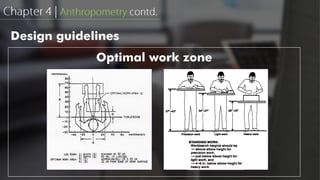
Optimal work zone
Measuring instruments
3D body scanner
to calculate volumes and segmental volumes of an individual body scan.
Measuring instruments
Baropodographic devices
Generated data in form of 2D image or a 2D image time series of the
pressures acting under the plantar surface of the foot. From these data
other variables may be calculated
Measuring instruments
Neuroimaging devices
Direct measurements involve examinations of brains from corpses, or
imaging techniques such as MRI, which can be used on living persons.
“Physical activity works within the environment
designed accordingly.
Ergonomics is so much more than just how we sit by
the computer.
The surrounding environment affects the work more
than you think.”
What is
Physical environment
& Physical activity?
There are five major parts.
Light
Sound
Vibration
Air
Temperature
Light
Infections can cause to eyes by external exercises
Dry eyes
Head ache
‘Vulture’ neck
Things to think
Distance to the eye
Screen settings
Light settings
Solutions to Improve
Ceiling lights, usage of daylight
Wear Glasses
Good Ventilation
Sound
What affects?
Traffic noise
Machine, work noises
Health Affects?
Degraded hearing
Sleep Disorder
Ringing in the ears
How to prevent?
Hearing protectors
Fabrics
Materials
Vibration
Hand and Arm
Drilling machine, chainsaw
Total Body
Truck, bus
Sea Sickness
To Prevent
Use back support
Damping in the seat
Air
Harming Particles
Exotic substances
Dust
How to Prevent
Nasal protectors
Inhalers
Temperature
36.2’C
Heat comes by
Convection
Conduction
Radiation
Evaporation
How to Prevent
Knowledge
Hydration
Adaption of behavior
“Musculoskeletal Disorders or MSDs are injuries and
disorders that affect the human body’s movement or
musculoskeletal system.”
What is
Musculoskeletal
Disorders?
There are two categories of risk factors lead to MSD.
Ergonomic risk factors
Force, Repetition, Posture
Individual risk factors
Poor work, Practices, Poor fitness, Poor health habits
Common MSDs include: Carpal Tunnel Syndrome, Tendonitis, Ligament Sprain, Tension Neck
Syndrome . . .
The Cause of
Musculoskeletal
Disorders
When a person is exposed to MSD risk
factors, they begin to fatigue. When fatigue
outruns their body’s recovery system, they
develop a musculoskeletal imbalance. Over
time, as fatigue continues to outrun
recovery and the musculoskeletal imbalance
persists, a musculoskeletal disorder
develops.
Treatments for
Musculoskeletal
Disorders
Injections with anesthetic or anti-
inflammatory medications in or around the
painful sites
Exercise that includes muscle strengthening
and stretching
Physical or occupational therapy
Relaxation/biofeedback techniques
Group 01 | Facility Design
Group 01
151448J
151422B
151412U
151440D
151411P
151431C
151418T
151455D
151426P
151452P

Physical ergonomics

  • 1.
    Group 01 |Facility Design
  • 2.
    What is Physical Ergonomics? “Physicalergonomics is about the human body's responses to physical and physiological work demands. Repetitive strain injuries from repetition, vibration, force, and posture are the most common types of issues, and thus have design implications.”
  • 3.
    Physical Ergonomics isconcerned with the impact of, Anatomy Anthropometry Biomechanics Physiology Physical environment & Physical activity
  • 4.
    What is Anatomy? “anatomy isthe scientific study of the structure of organisms including their systems, organs and tissues. It includes the appearance and position of the various parts, the materials from which they are composed, their locations and their relationships with other parts.”
  • 5.
    Macroscopic Anatomy (Study oflarge body structure) Regional anatomy – All Structures in one particular region Systematic anatomy - System by system Surface anatomy - Study of internal body structure
  • 6.
    Microscopic Anatomy (Study ofvery small structures of the that cannot be seen with naked eye) Cytology – Study of body cells Histology – Study of body tissues
  • 7.
    Applications of anatomy Anatomicalplanes Elbow extension against a resistance Sagittal plane - is a plane parallel to the sagittal suture. It divides the body into left and right. Horizontal plane - divides the body into head and tail portions. Frontal plane - divides the body into back and front, or posterior and anterior portions.
  • 8.
    “Biomechanics has beendefined as the study of the movement of living things using the science of mechanics. Necessary to study the body’s mechanical characteristics & principles to understand its movements” What is Biomechanics?
  • 9.
    There are twomajor parts. Kinematics Kinetics examines the causes of motion, the internal and external forces that cause motion or cause a body to remain at rest, and the interactions between these forces. There are two branches of kinetics; STATICS & DYNAMICS Describes the motion of a body without reference to the forces causing it. Kinematics examines how, when, and where a body moves. Movement may be LINEAR, ANGULAR, or a combination of the two (GENARAL).
  • 10.
    Linear The movement ofa body in a straight line or along a straight pathway. General General motion is a combination of Angular and Linear motion. Angular When a body or part of a body moves in a circle or part of a circle about a point. Kinematics
  • 11.
    Statics Statics refers tosituations where the body or object remains at rest, or is moving at a constant speed in a state of equilibrium. Equilibrium is a balanced state in which there is no acceleration. Dynamics Dynamics deals with the changes in motion brought on by unbalanced forces. Kinetics
  • 12.
    Human applications First classleaver Elbow extension against a resistance Second class leaver Forces acting on leg
  • 13.
    Human applications Third classleaver Elbow flexion
  • 14.
    “Human physiology isthe study of how the human body functions. This includes the mechanical, physical, bioelectrical, and biochemical functions of humans in good health, from organs to the cells of which they are composed” What is Physiology?
  • 15.
    Physiological systems ofthe body Circulatory system Respiratory system Nervous system Musculoskeletal system Digestive system Reproductive system Urinary system
  • 16.
    Circulatory system and Ergonomics Thecirculatory system comprises the heart and blood vessels (arteries, veins, and capillaries). Physical inactivity is a risk factor for cardiovascular disease. Sitting can be good for the circulatory system.
  • 17.
    Respiratory system and ergonomics Therespiratory system consists of the nose, nasopharynx, trachea, and lungs. It brings oxygen from the air and excretes carbon dioxide and water back into the air.
  • 18.
    Nervous system and ergonomics Thenervous system consists of the central nervous system (the brain and spinal cord) and the peripheral nervous system. The special senses consist of vision, hearing, taste, and smell. The eyes, ears, tongue, and nose gather information about the body's environment.
  • 19.
    Musculoskeletal system and ergonomics Themusculoskeletal system consists of the human skeleton and attached muscles. It gives the body basic structure and the ability for movement.
  • 20.
    “Anthropometry refers measurementsand proportions of the human body. Anthropometry plays an important role where, statistical data about the distribution of body dimensions in the population are used to optimize products.” What is Anthropometry?
  • 21.
    Dimension, In Body dimensionSex 5th 50th 95th 1. Stature (height) Male 63.7 68.3 72.6 Female 58.9 63.2 67.4 2. Eye height Male 59.5 63.9 68.0 Female 54.4 58.6 62.7 3. Shoulder height Male 52.1 56.2 60.0 Female 47.7 51.6 55.9 4. Elbow height Male 39.4 43.3 46.9 Female 36.9 39.8 42.8 5. Knuckle height Male 27.5 29.7 31.7 Female 25.3 27.6 29.9 13.Chest depth Male 8.4 9.5 10.9 Female 8.4 9.5 11.7 Anthropometric data
  • 22.
    Anthropometric data Dimension, In Bodydimension Sex 5th 50th 95th 6. Height, sitting Male 33.1 35.7 38.1 Female 30.9 33.5 35.7 7. Eye height, sitting Male 28.6 30.9 33.2 Female 26.6 28.9 30.9 8. Elbow rest height, Male 7.5 9.6 11.6 sitting Female 7.1 9.2 11.1 9. Thigh clearance Male 4.5 5.7 7. height Female 4.2 5.4 6.9 10.Knee height, sitting Male 19.4 21.4 23.3 Female 17.8 19.6 21.5 11.Buttock-knee Male 21.3 23.4 25.3 distance, sitting Female 20.4 22.4 24.6 12.Popliteal height, Male 15.4 17.4 19.2 sitting Female 14.0 15.7 17.4
  • 23.
  • 24.
  • 25.
  • 26.
  • 27.
    Measuring instruments 3D bodyscanner to calculate volumes and segmental volumes of an individual body scan.
  • 28.
    Measuring instruments Baropodographic devices Generateddata in form of 2D image or a 2D image time series of the pressures acting under the plantar surface of the foot. From these data other variables may be calculated
  • 29.
    Measuring instruments Neuroimaging devices Directmeasurements involve examinations of brains from corpses, or imaging techniques such as MRI, which can be used on living persons.
  • 30.
    “Physical activity workswithin the environment designed accordingly. Ergonomics is so much more than just how we sit by the computer. The surrounding environment affects the work more than you think.” What is Physical environment & Physical activity?
  • 31.
    There are fivemajor parts. Light Sound Vibration Air Temperature
  • 32.
    Light Infections can causeto eyes by external exercises Dry eyes Head ache ‘Vulture’ neck Things to think Distance to the eye Screen settings Light settings Solutions to Improve Ceiling lights, usage of daylight Wear Glasses Good Ventilation
  • 33.
    Sound What affects? Traffic noise Machine,work noises Health Affects? Degraded hearing Sleep Disorder Ringing in the ears How to prevent? Hearing protectors Fabrics Materials
  • 34.
    Vibration Hand and Arm Drillingmachine, chainsaw Total Body Truck, bus Sea Sickness To Prevent Use back support Damping in the seat
  • 35.
    Air Harming Particles Exotic substances Dust Howto Prevent Nasal protectors Inhalers
  • 36.
  • 37.
    “Musculoskeletal Disorders orMSDs are injuries and disorders that affect the human body’s movement or musculoskeletal system.” What is Musculoskeletal Disorders?
  • 38.
    There are twocategories of risk factors lead to MSD. Ergonomic risk factors Force, Repetition, Posture Individual risk factors Poor work, Practices, Poor fitness, Poor health habits Common MSDs include: Carpal Tunnel Syndrome, Tendonitis, Ligament Sprain, Tension Neck Syndrome . . .
  • 39.
    The Cause of Musculoskeletal Disorders Whena person is exposed to MSD risk factors, they begin to fatigue. When fatigue outruns their body’s recovery system, they develop a musculoskeletal imbalance. Over time, as fatigue continues to outrun recovery and the musculoskeletal imbalance persists, a musculoskeletal disorder develops.
  • 40.
    Treatments for Musculoskeletal Disorders Injections withanesthetic or anti- inflammatory medications in or around the painful sites Exercise that includes muscle strengthening and stretching Physical or occupational therapy Relaxation/biofeedback techniques
  • 41.
    Group 01 |Facility Design
  • 42.
    Group 01 |Facility Design Group 01 151448J 151422B 151412U 151440D 151411P 151431C 151418T 151455D 151426P 151452P