Module 4
Introduction to Ergonomics
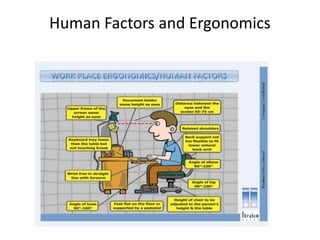
Human Factors and Ergonomics
Key Elements
Human Factors and Ergonomics
What is “Ergonomics”?
Ergonomic principles adapt work to a specific person by designing tasks & tools
or equipment to fit the individual to prevent injuries to the musculoskeletal
system.
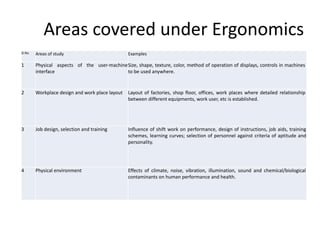
Areas covered under Ergonomics
Sl.No Areas of study Examples
1 Physical aspects of the user-machine
interface
Size, shape, texture, color, method of operation of displays, controls in machines
to be used anywhere.
2 Workplace design and work place layout Layout of factories, shop floor, offices, work places where detailed relationship
between different equipments, work user, etc is established.
3 Job design, selection and training Influence of shift work on performance, design of instructions, job aids, training
schemes, learning curves; selection of personnel against criteria of aptitude and
personality.
4 Physical environment Effects of climate, noise, vibration, illumination, sound and chemical/biological
contaminants on human performance and health.
• An “MSD” is an illness or injury that affects one or more parts
of the musculoskeletal system
– Bones
– Muscles
– Tendons
– Ligaments
– Cartilage
– Nerves
– Blood vessels
• Other common terms for “MSDs”are:
– Cumulative trauma disorder (CTD’s)
– Repetitive strain injures (RSI’s)
– Repetitive motion injuries (RMI’s)
When not diagnosed and treated these can cause
inconvenience permanent pain and disability.
What are the risks
of ignoring ergonomic principles?
MSD
MusculoSkeletal Disorders
What are MSD’S?
• MSD’s are injuries caused by sustained exposure to
stressors or repetitive motion.
• They may affect muscles, tendons, ligaments, bones,
circulation, or nerves.
• Some well-known MSD’s are:
– Carpel tunnel syndrome
– Guyner’s syndrome
– Trigger finger
– Tennis elbow CONTINUE
CARPAL TUNNEL SYNDROME
One of the best known MSDs
The median nerve does not work properly due to pressure on the nerve as
it runs through an opening called the carpel tunnel
Numbness is usually first symptom.
Pain & tingling, can go up the arm to the
shoulder and neck, causing waking to
pain in middle of night
OUCH!
10
Physical ergonomics
Human anatomical, anthropometric, physiological and biomechanical
characteristics as they relate to physical activity
Cognitive ergonomics
Mental processes (perception, memory, reasoning, motor response) as they
affect interactions among humans and other elements of a system
Organizational ergonomics
Optimization of sociotechnical systems, including their organizational
structures, policies and processes
Environmental Ergonomics
Types of Ergonomics
Physical Ergonomics Vs Cognitive
Ergonomics
• Physical ergonomics focuses on our bodies
• Cognitive ergonomics is interested in what
goes on in our brains: –
the way our senses perceive information
the way in which we understand and interpret it
COGNITIVE ERGONOMICS
• Studies cognition in work settings, in order to
optimize human well-being and system
performance .
• Focuses on the fit between human cognitive
abilities and limitations and the machine, task,
environment.
• Cognitive ergonomics, defined by the International
Ergonomics Association "is concerned with mental
processes, such as perception, memory, reasoning,
and motor response, as they affect interactions
among humans and other elements of a system”. The
relevant topics include:
• mental workload decision-making
• skilled performance
• human-computer interaction, human reliability
• work stress
• training as these may relate to human-system design.
Goals of Cognitive Function
Aims at enhancing performance of cognitive tasks by:
• User-centered design of human machine interaction
and human computer interaction.
• Design of information technology systems that
support cognitive tasks e.g., cognitive artifacts)
• Development of training programs
• Work redesign to manage cognitive workload and
increase human reliability
• The way people perceive and act has direct
implications for the design of the artefacts and
environment that they use
• Mind is as comfortable at work as the body
• If physical surroundings reflect and support
their natural cognitive tendencies,
• Less errors
• performance & productivity -positive boost
Models Of Cognitive Ergonomics:
Recent models of cognitive ergonomics involve
three dimensions:
• Usefulness
• usability
• acceptance
Usability:
• The degree to which a product or service is easy
to use, easy to learn, and optimized for efficiency
• ISO 9241-11 “Guidance on Usability”
• Extent to which a product can be used by
specified users to achieve specified goals with
effectiveness, efficiency and satisfaction.
Perception
• The top down way our brain organizes and interprets
that information and puts it into context.
Perceptual set :
• The psychological factor that determines how you
perceive your environment.
Factors affecting perception:
1. Context
2. Culture
3. Emotions or moods
4. Position
Social Perception
Perception
Perception
Topics under Cognitive ergonomics
Physical Ergonomics and Work Related
Musculoskeletal Disorder (WRMSD)
• Physical Ergonomics is concerned with human anatomy,
anthropometry, physiology and bio mechanical
characteristics as they relate to physical activity in work or
daily life.
• Certain jobs or work conditions cause a higher rate worker
complaints of undue strain, localized fatigue, discomfort,
or pain that does not go away after overnight rest.
• Every year 1.8 million U.S. workers experience WRMSDs
and nearly 600,000 of the injuries
Physical Ergonomics
Anthropometry
• Introduction: Anthropos "man" and Metron "measurement”
• A branch of anthropology that involves the quantitative
measurement of the human body.
• It is the single most portable, universally applicable, inexpensive and non
invasive technique for assessing the size,
proportions and composition of the human body.
• It is used to evaluate both under & over nutrition.
• The measured values reflects the current nutritional status &
don’t differentiate between acute & chronic changes
Parameters of anthropometry
• Age dependent factors:-
a) Weight b) Height c) Head circumference d
• Age independent factors:-
a)Mid-arm circumference (1-5 years)
b) Weight for height
c) Skinfold thickness
Weight
• Weight
The measurement of weight is most reliable criteria of
assessment of health and nutritional status of children.
The weight can be recorded using a :
• Beam type weighing balance
• Electronic weighing scales for infants and children
• Salter spring machine (in field conditions)
Periodic recording of weight
• Growth Velocity :
• 0-4 months 1.0kg/month(30g/day)
• 5-8 months 0.75kg/month(20gm/day)
• 9-12 months 0.50kg/month(15g/day)
• 1-3 years 2.25kg/yr
• 4-9 years 2.75 kg/yr
• 10-18 years 5.06.0kg/yr
Length or Height/Stature Measurement
Technique
• Upto 2 years of age Recumbent Length is measured w
ith the help of an Infantometer .
• In older children Standing Height or Stature is recorde
d. It is convenient to
use an Inbuilt Stadiometer affixed on the wall which pr
ovides a direct read
out of height with an accuracy of +/- 0.1cm.
• Nutritional deprivation over a period of time affects th
e stature or linear growth of the child .
Organizational Ergonomics
Organizational ergonomic works on complete
optimization of the workplace, right from
quality management to teamwork. It includes
managing everything in the organization to
make it a better place to work.
Environmental Ergonomics

Ergonomics.pptx.pdf

  • 1.
  • 2.
  • 3.
  • 4.
  • 5.
    What is “Ergonomics”? Ergonomicprinciples adapt work to a specific person by designing tasks & tools or equipment to fit the individual to prevent injuries to the musculoskeletal system.
  • 6.
    Areas covered underErgonomics Sl.No Areas of study Examples 1 Physical aspects of the user-machine interface Size, shape, texture, color, method of operation of displays, controls in machines to be used anywhere. 2 Workplace design and work place layout Layout of factories, shop floor, offices, work places where detailed relationship between different equipments, work user, etc is established. 3 Job design, selection and training Influence of shift work on performance, design of instructions, job aids, training schemes, learning curves; selection of personnel against criteria of aptitude and personality. 4 Physical environment Effects of climate, noise, vibration, illumination, sound and chemical/biological contaminants on human performance and health.
  • 7.
    • An “MSD”is an illness or injury that affects one or more parts of the musculoskeletal system – Bones – Muscles – Tendons – Ligaments – Cartilage – Nerves – Blood vessels • Other common terms for “MSDs”are: – Cumulative trauma disorder (CTD’s) – Repetitive strain injures (RSI’s) – Repetitive motion injuries (RMI’s) When not diagnosed and treated these can cause inconvenience permanent pain and disability. What are the risks of ignoring ergonomic principles? MSD MusculoSkeletal Disorders
  • 8.
    What are MSD’S? •MSD’s are injuries caused by sustained exposure to stressors or repetitive motion. • They may affect muscles, tendons, ligaments, bones, circulation, or nerves. • Some well-known MSD’s are: – Carpel tunnel syndrome – Guyner’s syndrome – Trigger finger – Tennis elbow CONTINUE
  • 9.
    CARPAL TUNNEL SYNDROME Oneof the best known MSDs The median nerve does not work properly due to pressure on the nerve as it runs through an opening called the carpel tunnel Numbness is usually first symptom. Pain & tingling, can go up the arm to the shoulder and neck, causing waking to pain in middle of night OUCH!
  • 10.
    10 Physical ergonomics Human anatomical,anthropometric, physiological and biomechanical characteristics as they relate to physical activity Cognitive ergonomics Mental processes (perception, memory, reasoning, motor response) as they affect interactions among humans and other elements of a system Organizational ergonomics Optimization of sociotechnical systems, including their organizational structures, policies and processes Environmental Ergonomics Types of Ergonomics
  • 11.
    Physical Ergonomics VsCognitive Ergonomics • Physical ergonomics focuses on our bodies • Cognitive ergonomics is interested in what goes on in our brains: – the way our senses perceive information the way in which we understand and interpret it
  • 12.
    COGNITIVE ERGONOMICS • Studiescognition in work settings, in order to optimize human well-being and system performance . • Focuses on the fit between human cognitive abilities and limitations and the machine, task, environment.
  • 13.
    • Cognitive ergonomics,defined by the International Ergonomics Association "is concerned with mental processes, such as perception, memory, reasoning, and motor response, as they affect interactions among humans and other elements of a system”. The relevant topics include: • mental workload decision-making • skilled performance • human-computer interaction, human reliability • work stress • training as these may relate to human-system design.
  • 14.
    Goals of CognitiveFunction Aims at enhancing performance of cognitive tasks by: • User-centered design of human machine interaction and human computer interaction. • Design of information technology systems that support cognitive tasks e.g., cognitive artifacts) • Development of training programs • Work redesign to manage cognitive workload and increase human reliability
  • 15.
    • The waypeople perceive and act has direct implications for the design of the artefacts and environment that they use • Mind is as comfortable at work as the body • If physical surroundings reflect and support their natural cognitive tendencies, • Less errors • performance & productivity -positive boost
  • 16.
    Models Of CognitiveErgonomics: Recent models of cognitive ergonomics involve three dimensions: • Usefulness • usability • acceptance
  • 19.
    Usability: • The degreeto which a product or service is easy to use, easy to learn, and optimized for efficiency • ISO 9241-11 “Guidance on Usability” • Extent to which a product can be used by specified users to achieve specified goals with effectiveness, efficiency and satisfaction.
  • 20.
    Perception • The topdown way our brain organizes and interprets that information and puts it into context. Perceptual set : • The psychological factor that determines how you perceive your environment. Factors affecting perception: 1. Context 2. Culture 3. Emotions or moods 4. Position
  • 21.
  • 22.
  • 23.
  • 24.
  • 33.
    Physical Ergonomics andWork Related Musculoskeletal Disorder (WRMSD) • Physical Ergonomics is concerned with human anatomy, anthropometry, physiology and bio mechanical characteristics as they relate to physical activity in work or daily life. • Certain jobs or work conditions cause a higher rate worker complaints of undue strain, localized fatigue, discomfort, or pain that does not go away after overnight rest. • Every year 1.8 million U.S. workers experience WRMSDs and nearly 600,000 of the injuries
  • 35.
  • 36.
    Anthropometry • Introduction: Anthropos"man" and Metron "measurement” • A branch of anthropology that involves the quantitative measurement of the human body. • It is the single most portable, universally applicable, inexpensive and non invasive technique for assessing the size, proportions and composition of the human body. • It is used to evaluate both under & over nutrition. • The measured values reflects the current nutritional status & don’t differentiate between acute & chronic changes
  • 37.
    Parameters of anthropometry •Age dependent factors:- a) Weight b) Height c) Head circumference d • Age independent factors:- a)Mid-arm circumference (1-5 years) b) Weight for height c) Skinfold thickness
  • 38.
    Weight • Weight The measurementof weight is most reliable criteria of assessment of health and nutritional status of children. The weight can be recorded using a : • Beam type weighing balance • Electronic weighing scales for infants and children • Salter spring machine (in field conditions)
  • 39.
    Periodic recording ofweight • Growth Velocity : • 0-4 months 1.0kg/month(30g/day) • 5-8 months 0.75kg/month(20gm/day) • 9-12 months 0.50kg/month(15g/day) • 1-3 years 2.25kg/yr • 4-9 years 2.75 kg/yr • 10-18 years 5.06.0kg/yr
  • 40.
    Length or Height/StatureMeasurement Technique • Upto 2 years of age Recumbent Length is measured w ith the help of an Infantometer . • In older children Standing Height or Stature is recorde d. It is convenient to use an Inbuilt Stadiometer affixed on the wall which pr ovides a direct read out of height with an accuracy of +/- 0.1cm. • Nutritional deprivation over a period of time affects th e stature or linear growth of the child .
  • 41.
    Organizational Ergonomics Organizational ergonomicworks on complete optimization of the workplace, right from quality management to teamwork. It includes managing everything in the organization to make it a better place to work.
  • 42.