COLLEGE OF MEDICINE AND
ALLIED HEALTH SCIENCES-
COMAHS UNIVERSITY OF
SIERRA LEONE
FACULTY OF BASIC MEDICAL SCIENCES
DEPARTMENT OF PHYSICS
PREMED/PRE-PHARMACY PROGRAMME
PHYSICS
LECTURE NOTES
FOR
PRE-MED 1 & PRE-PHARMACY
NEWTON'S LAWS OF MOTION
Newton’s laws of motion are three basic laws of classical mechanics
which describes the relationship between motion of an object and the
force acting on it.
In 1686, Sir Isaac Newton established his three laws of motion . For
the scope of this course we are going to look at the first two laws.
Newton's First Law
Experience suggests that an object at rest remains at rest if left alone and that an
object in motion tends to slow down and stop unless some effort is made to keep it
moving. However, Newton’s first law gives a deeper explanation of this observation.
It states that an object at rest will remain at rest and an object in motion will
remain in motion with a constant velocity unless acted on by a net external force.
We can conclude that any isolated object is either at rest or moving
at a constant velocity.
The First Law also allows the definition of force as that which
causes a change in the motion of an object.
The tendency of an object to resist any attempt to change its
velocity is called inertia.
Mass is that property of an object that specifies how much resistance an object
exhibits to changes in its velocity. Therefore, directly influence the inertia property
of an object.
Mass is a scalar quantity. The SI unit of mass is kg.
Mass and weight are two different quantities.
Weight is equal to the magnitude of the gravitational force exerted on the object
Examples of Newton’s First Law of Motion
There are several examples of newton’s first law in everyday life.
i. A driver of a car brakes sharply and, due to inertia, shoots forward.
ii. A stone on the ground is in a state of rest. If nothing disturbs it, it will
remain at rest.
iii. A bicycle stored five years ago in an attic comes out of its resting
state when a child decides to use it.
iv. A cycle moving even after peddling is stopped.
Newton's Second Law
Newton’s second law is closely related to his first law. It mathematically gives
the cause-and-effect relationship between force and changes in motion.
Newton’s second law is quantitative and is used extensively to calculate what
happens in situations involving a force. Before we can write down Newton’s
second law as a simple equation that gives the exact relationship of force, mass,
and acceleration, we need to sharpen some ideas we mentioned earlier.
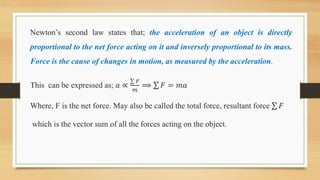
Newton’s second law states that; the acceleration of an object is directly
proportional to the net force acting on it and inversely proportional to its mass.
Force is the cause of changes in motion, as measured by the acceleration.
This can be expressed as; 𝑎 ∝
𝐹
𝑚
⟹ 𝐹 = 𝑚𝑎
Where, F is the net force. May also be called the total force, resultant force 𝐹
which is the vector sum of all the forces acting on the object.
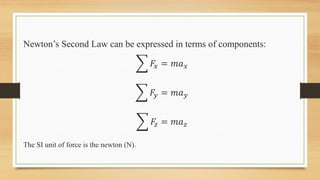
Newton’s Second Law can be expressed in terms of components:
𝐹𝑥 = 𝑚𝑎𝑥
𝐹𝑦 = 𝑚𝑎𝑦
𝐹𝑧 = 𝑚𝑎𝑧
The SI unit of force is the newton (N).
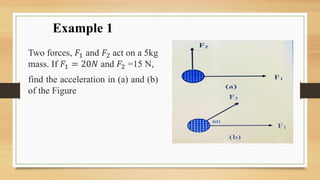
Two forces, 𝐹1 and 𝐹2 act on a 5kg
mass. If 𝐹1 = 20𝑁 and 𝐹2 =15 N,
find the acceleration in (a) and (b)
of the Figure
Example 1
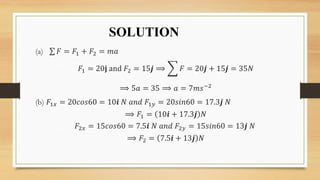
SOLUTION
(a) 𝐹 = 𝐹1 + 𝐹2 = 𝑚𝑎
𝐹1 = 20𝐣 and 𝐹2 = 15𝒋 ⟹ 𝐹 = 20𝒋 + 15𝒋 = 35𝑁
⟹ 5𝑎 = 35 ⟹ 𝑎 = 7𝑚𝑠−2
(b) 𝐹1𝑥 = 20𝑐𝑜𝑠60 = 10𝒊 𝑁 𝑎𝑛𝑑 𝐹1𝑦 = 20𝑠𝑖𝑛60 = 17.3𝒋 𝑁
⟹ 𝐹1 = 10𝒊 + 17.3𝒋 𝑁
𝐹2𝑥 = 15𝑐𝑜𝑠60 = 7.5𝒊 𝑁 𝑎𝑛𝑑 𝐹2𝑦 = 15𝑠𝑖𝑛60 = 13𝒋 𝑁
⟹ 𝐹2 = 7.5𝒊 + 13𝒋 𝑁
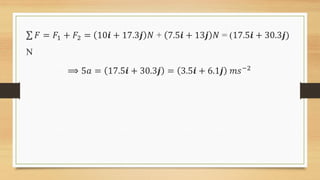
𝐹 = 𝐹1 + 𝐹2 = 10𝒊 + 17.3𝒋 𝑁 + 7.5𝒊 + 13𝒋 𝑁 = (17.5𝒊 + 30.3𝒋)
N
⟹ 5𝑎 = 17.5𝒊 + 30.3𝒋 = 3.5𝒊 + 6.1𝒋 𝑚𝑠−2
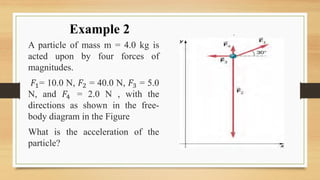
A particle of mass m = 4.0 kg is
acted upon by four forces of
magnitudes.
𝐹1= 10.0 N, 𝐹2 = 40.0 N, 𝐹3 = 5.0
N, and 𝐹4 = 2.0 N , with the
directions as shown in the free-
body diagram in the Figure
What is the acceleration of the
particle?
Example 2
Solution
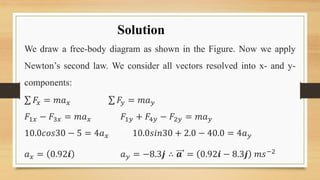
We draw a free-body diagram as shown in the Figure. Now we apply
Newton’s second law. We consider all vectors resolved into x- and y-
components:
𝐹𝑥 = 𝑚𝑎𝑥 𝐹𝑦 = 𝑚𝑎𝑦
𝐹1𝑥 − 𝐹3𝑥 = 𝑚𝑎𝑥 𝐹1𝑦 + 𝐹4𝑦 − 𝐹2𝑦 = 𝑚𝑎𝑦
10.0𝑐𝑜𝑠30 − 5 = 4𝑎𝑥 10.0𝑠𝑖𝑛30 + 2.0 − 40.0 = 4𝑎𝑦
𝑎𝑥 = 0.92𝒊 𝑎𝑦 = −8.3𝒋 ∴ 𝒂 = 0.92𝒊 − 8.3𝒋 𝑚𝑠−2
Examples of Newton’s Second Law of Motion
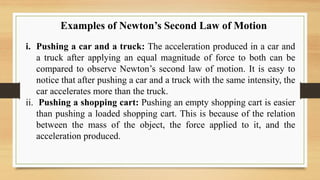
i. Pushing a car and a truck: The acceleration produced in a car and
a truck after applying an equal magnitude of force to both can be
compared to observe Newton’s second law of motion. It is easy to
notice that after pushing a car and a truck with the same intensity, the
car accelerates more than the truck.
ii. Pushing a shopping cart: Pushing an empty shopping cart is easier
than pushing a loaded shopping cart. This is because of the relation
between the mass of the object, the force applied to it, and the
acceleration produced.
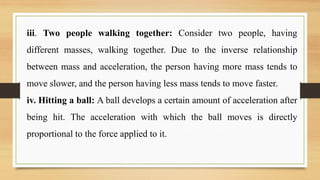
iii. Two people walking together: Consider two people, having
different masses, walking together. Due to the inverse relationship
between mass and acceleration, the person having more mass tends to
move slower, and the person having less mass tends to move faster.
iv. Hitting a ball: A ball develops a certain amount of acceleration after
being hit. The acceleration with which the ball moves is directly
proportional to the force applied to it.
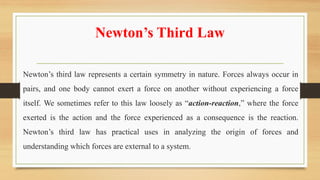
Newton’s Third Law
Newton’s third law represents a certain symmetry in nature. Forces always occur in
pairs, and one body cannot exert a force on another without experiencing a force
itself. We sometimes refer to this law loosely as “action-reaction,” where the force
exerted is the action and the force experienced as a consequence is the reaction.
Newton’s third law has practical uses in analyzing the origin of forces and
understanding which forces are external to a system.
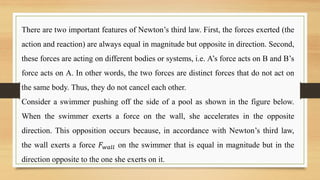
There are two important features of Newton’s third law. First, the forces exerted (the
action and reaction) are always equal in magnitude but opposite in direction. Second,
these forces are acting on different bodies or systems, i.e. A’s force acts on B and B’s
force acts on A. In other words, the two forces are distinct forces that do not act on
the same body. Thus, they do not cancel each other.
Consider a swimmer pushing off the side of a pool as shown in the figure below.
When the swimmer exerts a force on the wall, she accelerates in the opposite
direction. This opposition occurs because, in accordance with Newton’s third law,
the wall exerts a force 𝐹𝑤𝑎𝑙𝑙 on the swimmer that is equal in magnitude but in the
direction opposite to the one she exerts on it.
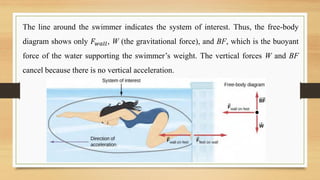
The line around the swimmer indicates the system of interest. Thus, the free-body
diagram shows only 𝐹𝑤𝑎𝑙𝑙, W (the gravitational force), and BF, which is the buoyant
force of the water supporting the swimmer’s weight. The vertical forces W and BF
cancel because there is no vertical acceleration.
Newton’s third law of motion states that; whenever one body exerts a force on a
second body, the first body experiences a force that is equal in magnitude and
opposite in direction to the force that it exerts.
Mathematically, if a body A exerts a force 𝐹 on body B, then B simultaneously
exerts a force −𝐹 on A, we have;
𝐹 𝐴𝐵 = −𝐹𝐵𝐴
Example 3
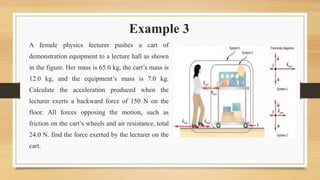
A female physics lecturer pushes a cart of
demonstration equipment to a lecture hall as shown
in the figure. Her mass is 65.0 kg, the cart’s mass is
12.0 kg, and the equipment’s mass is 7.0 kg.
Calculate the acceleration produced when the
lecturer exerts a backward force of 150 N on the
floor. All forces opposing the motion, such as
friction on the cart’s wheels and air resistance, total
24.0 N. find the force exerted by the lecturer on the
cart.
solution
We define the system to be the lecturer, cart, and equipment. This is System 1 in
the figure. The lecturer pushes backward with a force 𝐹𝑓𝑜𝑜𝑡 of 150 N. According
to Newton’s third law, the floor exerts a forward reaction force 𝐹𝑓𝑙𝑜𝑜𝑟 of 150 N
on System 1. Because all motion is horizontal, we can assume there is no net
force in the vertical direction. Therefore, the problem is one-dimensional along
the horizontal direction. As noted, friction f opposes the motion and is thus in the
opposite direction of 𝐹𝑓𝑜𝑜𝑟. There are no other significant forces acting on
System 1. If the net external force can be found from all this information, we can
use Newton’s second law to find the acceleration as requested.
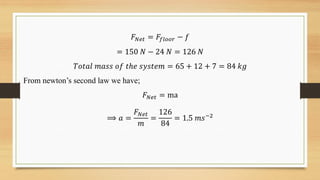
𝐹𝑁𝑒𝑡 = 𝐹𝑓𝑙𝑜𝑜𝑟 − 𝑓
= 150 𝑁 − 24 𝑁 = 126 𝑁
𝑇𝑜𝑡𝑎𝑙 𝑚𝑎𝑠𝑠 𝑜𝑓 𝑡ℎ𝑒 𝑠𝑦𝑠𝑡𝑒𝑚 = 65 + 12 + 7 = 84 𝑘𝑔
From newton’s second law we have;
𝐹𝑁𝑒𝑡 = ma
⟹ 𝑎 =
𝐹𝑁𝑒𝑡
𝑚
=
126
84
= 1.5 𝑚𝑠−2
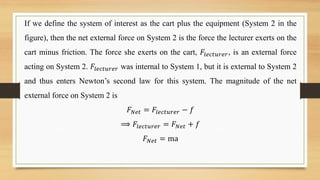
If we define the system of interest as the cart plus the equipment (System 2 in the
figure), then the net external force on System 2 is the force the lecturer exerts on the
cart minus friction. The force she exerts on the cart, 𝐹𝑙𝑒𝑐𝑡𝑢𝑟𝑒𝑟, is an external force
acting on System 2. 𝐹𝑙𝑒𝑐𝑡𝑢𝑟𝑒𝑟 was internal to System 1, but it is external to System 2
and thus enters Newton’s second law for this system. The magnitude of the net
external force on System 2 is
𝐹𝑁𝑒𝑡 = 𝐹𝑙𝑒𝑐𝑡𝑢𝑟𝑒𝑟 − 𝑓
⟹ 𝐹𝑙𝑒𝑐𝑡𝑢𝑟𝑒𝑟 = 𝐹𝑁𝑒𝑡 + 𝑓
𝐹𝑁𝑒𝑡 = ma
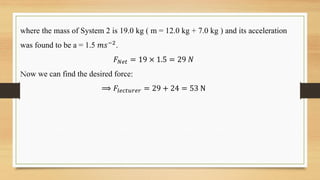
where the mass of System 2 is 19.0 kg ( m = 12.0 kg + 7.0 kg ) and its acceleration
was found to be a = 1.5 𝑚𝑠−2.
𝐹𝑁𝑒𝑡 = 19 × 1.5 = 29 𝑁
Now we can find the desired force:
⟹ 𝐹𝑙𝑒𝑐𝑡𝑢𝑟𝑒𝑟 = 29 + 24 = 53 N
Examples of Newton’s Third Law of Motion
i. Helicopters create lift by pushing air down, thereby experiencing an upward
reaction force.
ii. Birds and airplanes also fly by exerting force on the air in a direction opposite
that of whatever force they need. For example, the wings of a bird force air
downward and backward to get lift and move forward.
iii. An octopus propels itself in the water by ejecting water through a funnel from its
body, similar to a jet ski.
iv. When a person pulls down on a vertical rope, the rope pulls up on the person
APPLICATIONS OF NEWTON'S LAWS
Success in problem solving is necessary to understand and apply physical
principles. We developed a pattern of analyzing and setting up the
solutions to problems involving Newton’s laws in Newton’s Laws of
Motion; in this chapter, we continue to discuss these strategies and apply
a step-by-step process.
Problem-Solving Strategies
1. Identify the physical principles involved by listing the givens and the quantities to be
calculated.
2. Sketch the situation, using arrows to represent all forces.
3. Determine the system of interest. The result is a free-body diagram that is essential to solving
the problem.
4. Apply Newton’s second law to solve the problem. If necessary, apply appropriate kinematic
equations from the motion along a straight line.
5. Check the solution to see whether it is reasonable
Problem-Solving Strategies
Let us apply this problem-solving strategy to the challenge of
lifting a grand piano into a second-story apartment. Once we have
determined that Newton’s laws of motion are involved (if the
problem involves forces), it is particularly important to draw a
careful sketch of the situation.
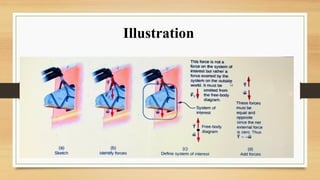
Illustration
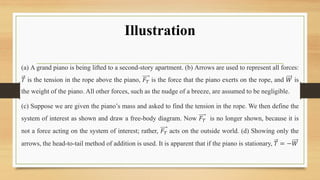
Illustration
(a) A grand piano is being lifted to a second-story apartment. (b) Arrows are used to represent all forces:
𝑇 is the tension in the rope above the piano, 𝐹𝑇 is the force that the piano exerts on the rope, and 𝑊 is
the weight of the piano. All other forces, such as the nudge of a breeze, are assumed to be negligible.
(c) Suppose we are given the piano’s mass and asked to find the tension in the rope. We then define the
system of interest as shown and draw a free-body diagram. Now 𝐹𝑇 is no longer shown, because it is
not a force acting on the system of interest; rather, 𝐹𝑇 acts on the outside world. (d) Showing only the
arrows, the head-to-tail method of addition is used. It is apparent that if the piano is stationary, 𝑇 = −𝑊
Particle Equilibrium
Recall that a particle in equilibrium is one for which the external forces are balanced. Static
equilibrium involves objects at rest, and dynamic equilibrium involves objects in motion without
acceleration, but it is important to remember that these conditions are relative. For example, an object
may be at rest when viewed from our frame of reference, but the same object would appear to be in
motion when viewed by someone moving at a constant velocity. We now make use of the knowledge
attained in Newton’s Laws of Motion, regarding the different types of forces and the use of free-body
diagrams, to solve additional problems in particle equilibrium.
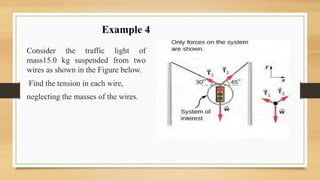
Example 4
Consider the traffic light of
mass15.0 kg suspended from two
wires as shown in the Figure below.
Find the tension in each wire,
neglecting the masses of the wires.
Solution
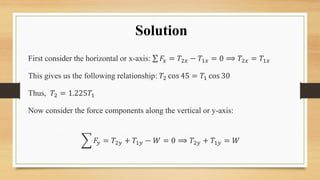
First consider the horizontal or x-axis: 𝐹𝑥 = 𝑇2𝑥 − 𝑇1𝑥 = 0 ⟹ 𝑇2𝑥 = 𝑇1𝑥
This gives us the following relationship: 𝑇2 cos 45 = 𝑇1 cos 30
Thus, 𝑇2 = 1.225𝑇1
Now consider the force components along the vertical or y-axis:
𝐹𝑦 = 𝑇2𝑦 + 𝑇1𝑦 − 𝑊 = 0 ⟹ 𝑇2𝑦 + 𝑇1𝑦 = 𝑊
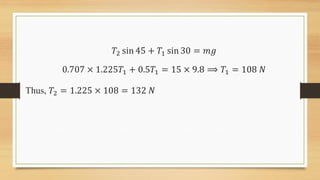
𝑇2 sin 45 + 𝑇1 sin 30 = 𝑚𝑔
0.707 × 1.225𝑇1 + 0.5𝑇1 = 15 × 9.8 ⟹ 𝑇1 = 108 𝑁
Thus, 𝑇2 = 1.225 × 108 = 132 𝑁
Particle Acceleration
We have taken a look at particles in equilibrium and how to apply
Newton’s second law to solve problems. We now turn our attention to
particle acceleration problems, which are the result of a non-zero net
force.
Refer again to the steps given on problem-solving strategy, and notice
how they are applied to the following examples.
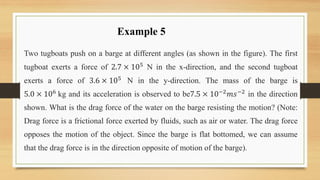
Example 5
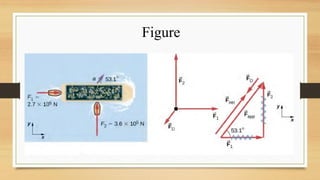
Two tugboats push on a barge at different angles (as shown in the figure). The first
tugboat exerts a force of 2.7 × 10⁵ N in the x-direction, and the second tugboat
exerts a force of 3.6 × 10⁵
N in the y-direction. The mass of the barge is
5.0 × 10⁶ kg and its acceleration is observed to be7.5 × 10−2𝑚𝑠−2 in the direction
shown. What is the drag force of the water on the barge resisting the motion? (Note:
Drag force is a frictional force exerted by fluids, such as air or water. The drag force
opposes the motion of the object. Since the barge is flat bottomed, we can assume
that the drag force is in the direction opposite of motion of the barge).
Figure
Solution
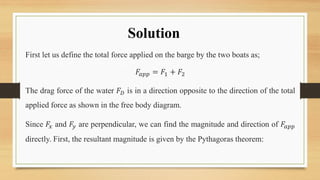
First let us define the total force applied on the barge by the two boats as;
𝐹𝑎𝑝𝑝 = 𝐹1 + 𝐹2
The drag force of the water 𝐹𝐷 is in a direction opposite to the direction of the total
applied force as shown in the free body diagram.
Since 𝐹𝑥 and 𝐹𝑦 are perpendicular, we can find the magnitude and direction of 𝐹𝑎𝑝𝑝
directly. First, the resultant magnitude is given by the Pythagoras theorem:
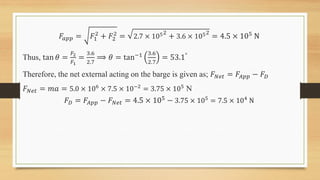
𝐹𝑎𝑝𝑝 = 𝐹1
2
+ 𝐹2
2
= 2.7 × 1052
+ 3.6 × 1052
= 4.5 × 10⁵ N
Thus, tan 𝜃 =
𝐹2
𝐹1
=
3.6
2.7
⟹ 𝜃 = tan−1 3.6
2.7
= 53.1°
Therefore, the net external acting on the barge is given as; 𝐹𝑁𝑒𝑡 = 𝐹𝐴𝑝𝑝 − 𝐹𝐷
𝐹𝑁𝑒𝑡 = 𝑚𝑎 = 5.0 × 106
× 7.5 × 10−2
= 3.75 × 10⁵
N
𝐹𝐷 = 𝐹𝐴𝑝𝑝 − 𝐹𝑁𝑒𝑡 = 4.5 × 10⁵ − 3.75 × 105
= 7.5 × 10⁴
N
Assignment 1
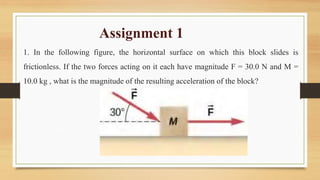
1. In the following figure, the horizontal surface on which this block slides is
frictionless. If the two forces acting on it each have magnitude F = 30.0 N and M =
10.0 kg , what is the magnitude of the resulting acceleration of the block?
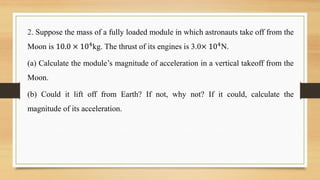
2. Suppose the mass of a fully loaded module in which astronauts take off from the
Moon is 10.0 × 10⁴
kg. The thrust of its engines is 3.0× 10⁴
N.
(a) Calculate the module’s magnitude of acceleration in a vertical takeoff from the
Moon.
(b) Could it lift off from Earth? If not, why not? If it could, calculate the
magnitude of its acceleration.
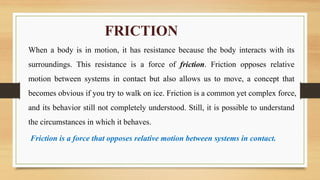
FRICTION
When a body is in motion, it has resistance because the body interacts with its
surroundings. This resistance is a force of friction. Friction opposes relative
motion between systems in contact but also allows us to move, a concept that
becomes obvious if you try to walk on ice. Friction is a common yet complex force,
and its behavior still not completely understood. Still, it is possible to understand
the circumstances in which it behaves.
Friction is a force that opposes relative motion between systems in contact.
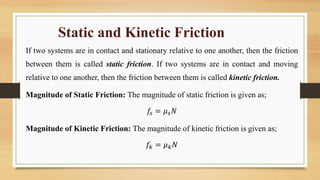
Static and Kinetic Friction
If two systems are in contact and stationary relative to one another, then the friction
between them is called static friction. If two systems are in contact and moving
relative to one another, then the friction between them is called kinetic friction.
Magnitude of Static Friction: The magnitude of static friction is given as;
𝑓𝑠 = 𝜇𝑠𝑁
Magnitude of Kinetic Friction: The magnitude of kinetic friction is given as;
𝑓𝑘 = 𝜇𝑘𝑁
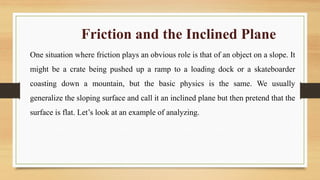
Friction and the Inclined Plane
One situation where friction plays an obvious role is that of an object on a slope. It
might be a crate being pushed up a ramp to a loading dock or a skateboarder
coasting down a mountain, but the basic physics is the same. We usually
generalize the sloping surface and call it an inclined plane but then pretend that the
surface is flat. Let’s look at an example of analyzing.
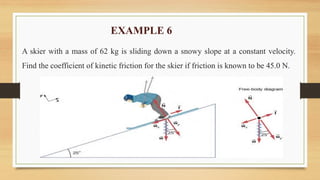
EXAMPLE 6
A skier with a mass of 62 kg is sliding down a snowy slope at a constant velocity.
Find the coefficient of kinetic friction for the skier if friction is known to be 45.0 N.
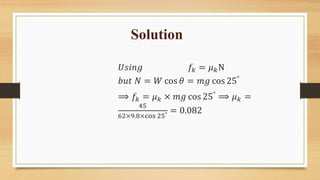
Solution
𝑈𝑠𝑖𝑛𝑔 𝑓𝑘 = 𝜇𝑘N
𝑏𝑢𝑡 𝑁 = 𝑊 cos 𝜃 = 𝑚𝑔 cos 25°
⟹ 𝑓𝑘 = 𝜇𝑘 × 𝑚𝑔 cos 25°
⟹ 𝜇𝑘 =
45
62×9.8×cos 25° = 0.082
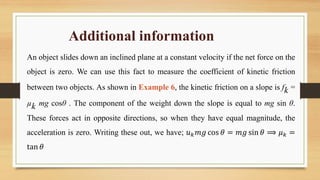
Additional information
An object slides down an inclined plane at a constant velocity if the net force on the
object is zero. We can use this fact to measure the coefficient of kinetic friction
between two objects. As shown in Example 6, the kinetic friction on a slope is fk =
µk mg cosθ . The component of the weight down the slope is equal to mg sin θ.
These forces act in opposite directions, so when they have equal magnitude, the
acceleration is zero. Writing these out, we have; 𝑢𝑘𝑚𝑔 cos 𝜃 = 𝑚𝑔 sin 𝜃 ⟹ 𝜇𝑘 =
tan 𝜃
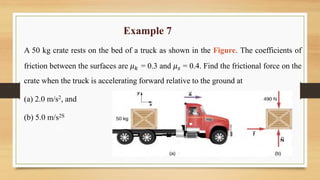
Example 7
A 50 kg crate rests on the bed of a truck as shown in the Figure. The coefficients of
friction between the surfaces are 𝜇𝑘 = 0.3 and 𝜇𝑠 = 0.4. Find the frictional force on the
crate when the truck is accelerating forward relative to the ground at
(a) 2.0 m/s2, and
(b) 5.0 m/s2S
Solution
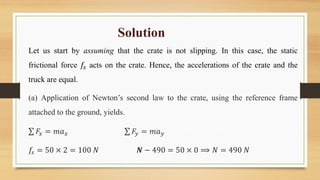
Let us start by assuming that the crate is not slipping. In this case, the static
frictional force 𝑓𝑠 acts on the crate. Hence, the accelerations of the crate and the
truck are equal.
(a) Application of Newton’s second law to the crate, using the reference frame
attached to the ground, yields.
𝐹𝑥 = 𝑚𝑎𝑥 𝐹𝑦 = 𝑚𝑎𝑦
𝑓𝑠 = 50 × 2 = 100 𝑁 𝑵 − 490 = 50 × 0 ⟹ 𝑁 = 490 𝑁
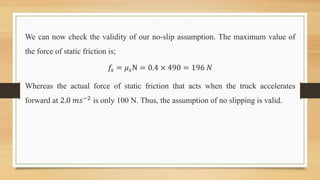
We can now check the validity of our no-slip assumption. The maximum value of
the force of static friction is;
𝑓𝑠 = 𝜇𝑠N = 0.4 × 490 = 196 𝑁
Whereas the actual force of static friction that acts when the truck accelerates
forward at 2.0 𝑚𝑠−2 is only 100 N. Thus, the assumption of no slipping is valid.
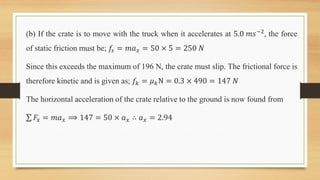
(b) If the crate is to move with the truck when it accelerates at 5.0 𝑚𝑠−2, the force
of static friction must be; 𝑓𝑠 = 𝑚𝑎𝑥 = 50 × 5 = 250 𝑁
Since this exceeds the maximum of 196 N, the crate must slip. The frictional force is
therefore kinetic and is given as; 𝑓𝑘 = 𝜇𝑘N = 0.3 × 490 = 147 𝑁
The horizontal acceleration of the crate relative to the ground is now found from
𝐹𝑥 = 𝑚𝑎𝑥 ⟹ 147 = 50 × 𝑎𝑥 ∴ 𝑎𝑥 = 2.94
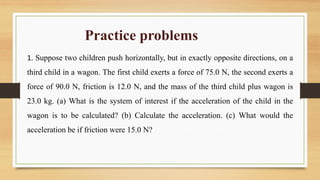
Practice problems
1. Suppose two children push horizontally, but in exactly opposite directions, on a
third child in a wagon. The first child exerts a force of 75.0 N, the second exerts a
force of 90.0 N, friction is 12.0 N, and the mass of the third child plus wagon is
23.0 kg. (a) What is the system of interest if the acceleration of the child in the
wagon is to be calculated? (b) Calculate the acceleration. (c) What would the
acceleration be if friction were 15.0 N?
2. A powerful motorcycle can produce an acceleration of 3.50 m/s2 while traveling
at 90.0 km/h. At that speed, the forces resisting motion, including friction and air
resistance, total 400.0 N. (Air resistance is analogous to air friction. It always
opposes the motion of an object.) What is the magnitude of the force that
motorcycle exerts backward on the ground to produce its acceleration if the mass
of the motorcycle with rider is 245 kg?
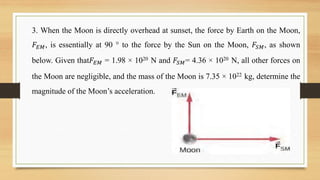
3. When the Moon is directly overhead at sunset, the force by Earth on the Moon,
𝐹𝐸𝑀, is essentially at 90 ° to the force by the Sun on the Moon, 𝐹𝑆𝑀, as shown
below. Given that𝐹𝐸𝑀 = 1.98 × 10²⁰ N and 𝐹𝑆𝑀= 4.36 × 10²⁰ N, all other forces on
the Moon are negligible, and the mass of the Moon is 7.35 × 10²² kg, determine the
magnitude of the Moon’s acceleration.


NEWTON'S LAWS.Faculty of Basic Medical sciences

  • 1.
    COLLEGE OF MEDICINEAND ALLIED HEALTH SCIENCES- COMAHS UNIVERSITY OF SIERRA LEONE FACULTY OF BASIC MEDICAL SCIENCES DEPARTMENT OF PHYSICS PREMED/PRE-PHARMACY PROGRAMME
  • 2.
  • 3.
    NEWTON'S LAWS OFMOTION Newton’s laws of motion are three basic laws of classical mechanics which describes the relationship between motion of an object and the force acting on it. In 1686, Sir Isaac Newton established his three laws of motion . For the scope of this course we are going to look at the first two laws.
  • 4.
    Newton's First Law Experiencesuggests that an object at rest remains at rest if left alone and that an object in motion tends to slow down and stop unless some effort is made to keep it moving. However, Newton’s first law gives a deeper explanation of this observation. It states that an object at rest will remain at rest and an object in motion will remain in motion with a constant velocity unless acted on by a net external force.
  • 5.
    We can concludethat any isolated object is either at rest or moving at a constant velocity. The First Law also allows the definition of force as that which causes a change in the motion of an object. The tendency of an object to resist any attempt to change its velocity is called inertia.
  • 6.
    Mass is thatproperty of an object that specifies how much resistance an object exhibits to changes in its velocity. Therefore, directly influence the inertia property of an object. Mass is a scalar quantity. The SI unit of mass is kg. Mass and weight are two different quantities. Weight is equal to the magnitude of the gravitational force exerted on the object
  • 7.
    Examples of Newton’sFirst Law of Motion There are several examples of newton’s first law in everyday life. i. A driver of a car brakes sharply and, due to inertia, shoots forward. ii. A stone on the ground is in a state of rest. If nothing disturbs it, it will remain at rest. iii. A bicycle stored five years ago in an attic comes out of its resting state when a child decides to use it. iv. A cycle moving even after peddling is stopped.
  • 8.
    Newton's Second Law Newton’ssecond law is closely related to his first law. It mathematically gives the cause-and-effect relationship between force and changes in motion. Newton’s second law is quantitative and is used extensively to calculate what happens in situations involving a force. Before we can write down Newton’s second law as a simple equation that gives the exact relationship of force, mass, and acceleration, we need to sharpen some ideas we mentioned earlier.
  • 9.
    Newton’s second lawstates that; the acceleration of an object is directly proportional to the net force acting on it and inversely proportional to its mass. Force is the cause of changes in motion, as measured by the acceleration. This can be expressed as; 𝑎 ∝ 𝐹 𝑚 ⟹ 𝐹 = 𝑚𝑎 Where, F is the net force. May also be called the total force, resultant force 𝐹 which is the vector sum of all the forces acting on the object.
  • 10.
    Newton’s Second Lawcan be expressed in terms of components: 𝐹𝑥 = 𝑚𝑎𝑥 𝐹𝑦 = 𝑚𝑎𝑦 𝐹𝑧 = 𝑚𝑎𝑧 The SI unit of force is the newton (N).
  • 11.
    Two forces, 𝐹1and 𝐹2 act on a 5kg mass. If 𝐹1 = 20𝑁 and 𝐹2 =15 N, find the acceleration in (a) and (b) of the Figure Example 1
  • 12.
    SOLUTION (a) 𝐹 =𝐹1 + 𝐹2 = 𝑚𝑎 𝐹1 = 20𝐣 and 𝐹2 = 15𝒋 ⟹ 𝐹 = 20𝒋 + 15𝒋 = 35𝑁 ⟹ 5𝑎 = 35 ⟹ 𝑎 = 7𝑚𝑠−2 (b) 𝐹1𝑥 = 20𝑐𝑜𝑠60 = 10𝒊 𝑁 𝑎𝑛𝑑 𝐹1𝑦 = 20𝑠𝑖𝑛60 = 17.3𝒋 𝑁 ⟹ 𝐹1 = 10𝒊 + 17.3𝒋 𝑁 𝐹2𝑥 = 15𝑐𝑜𝑠60 = 7.5𝒊 𝑁 𝑎𝑛𝑑 𝐹2𝑦 = 15𝑠𝑖𝑛60 = 13𝒋 𝑁 ⟹ 𝐹2 = 7.5𝒊 + 13𝒋 𝑁
  • 13.
    𝐹 = 𝐹1+ 𝐹2 = 10𝒊 + 17.3𝒋 𝑁 + 7.5𝒊 + 13𝒋 𝑁 = (17.5𝒊 + 30.3𝒋) N ⟹ 5𝑎 = 17.5𝒊 + 30.3𝒋 = 3.5𝒊 + 6.1𝒋 𝑚𝑠−2
  • 14.
    A particle ofmass m = 4.0 kg is acted upon by four forces of magnitudes. 𝐹1= 10.0 N, 𝐹2 = 40.0 N, 𝐹3 = 5.0 N, and 𝐹4 = 2.0 N , with the directions as shown in the free- body diagram in the Figure What is the acceleration of the particle? Example 2
  • 15.
    Solution We draw afree-body diagram as shown in the Figure. Now we apply Newton’s second law. We consider all vectors resolved into x- and y- components: 𝐹𝑥 = 𝑚𝑎𝑥 𝐹𝑦 = 𝑚𝑎𝑦 𝐹1𝑥 − 𝐹3𝑥 = 𝑚𝑎𝑥 𝐹1𝑦 + 𝐹4𝑦 − 𝐹2𝑦 = 𝑚𝑎𝑦 10.0𝑐𝑜𝑠30 − 5 = 4𝑎𝑥 10.0𝑠𝑖𝑛30 + 2.0 − 40.0 = 4𝑎𝑦 𝑎𝑥 = 0.92𝒊 𝑎𝑦 = −8.3𝒋 ∴ 𝒂 = 0.92𝒊 − 8.3𝒋 𝑚𝑠−2
  • 16.
    Examples of Newton’sSecond Law of Motion i. Pushing a car and a truck: The acceleration produced in a car and a truck after applying an equal magnitude of force to both can be compared to observe Newton’s second law of motion. It is easy to notice that after pushing a car and a truck with the same intensity, the car accelerates more than the truck. ii. Pushing a shopping cart: Pushing an empty shopping cart is easier than pushing a loaded shopping cart. This is because of the relation between the mass of the object, the force applied to it, and the acceleration produced.
  • 17.
    iii. Two peoplewalking together: Consider two people, having different masses, walking together. Due to the inverse relationship between mass and acceleration, the person having more mass tends to move slower, and the person having less mass tends to move faster. iv. Hitting a ball: A ball develops a certain amount of acceleration after being hit. The acceleration with which the ball moves is directly proportional to the force applied to it.
  • 18.
    Newton’s Third Law Newton’sthird law represents a certain symmetry in nature. Forces always occur in pairs, and one body cannot exert a force on another without experiencing a force itself. We sometimes refer to this law loosely as “action-reaction,” where the force exerted is the action and the force experienced as a consequence is the reaction. Newton’s third law has practical uses in analyzing the origin of forces and understanding which forces are external to a system.
  • 19.
    There are twoimportant features of Newton’s third law. First, the forces exerted (the action and reaction) are always equal in magnitude but opposite in direction. Second, these forces are acting on different bodies or systems, i.e. A’s force acts on B and B’s force acts on A. In other words, the two forces are distinct forces that do not act on the same body. Thus, they do not cancel each other. Consider a swimmer pushing off the side of a pool as shown in the figure below. When the swimmer exerts a force on the wall, she accelerates in the opposite direction. This opposition occurs because, in accordance with Newton’s third law, the wall exerts a force 𝐹𝑤𝑎𝑙𝑙 on the swimmer that is equal in magnitude but in the direction opposite to the one she exerts on it.
  • 20.
    The line aroundthe swimmer indicates the system of interest. Thus, the free-body diagram shows only 𝐹𝑤𝑎𝑙𝑙, W (the gravitational force), and BF, which is the buoyant force of the water supporting the swimmer’s weight. The vertical forces W and BF cancel because there is no vertical acceleration.
  • 21.
    Newton’s third lawof motion states that; whenever one body exerts a force on a second body, the first body experiences a force that is equal in magnitude and opposite in direction to the force that it exerts. Mathematically, if a body A exerts a force 𝐹 on body B, then B simultaneously exerts a force −𝐹 on A, we have; 𝐹 𝐴𝐵 = −𝐹𝐵𝐴
  • 22.
    Example 3 A femalephysics lecturer pushes a cart of demonstration equipment to a lecture hall as shown in the figure. Her mass is 65.0 kg, the cart’s mass is 12.0 kg, and the equipment’s mass is 7.0 kg. Calculate the acceleration produced when the lecturer exerts a backward force of 150 N on the floor. All forces opposing the motion, such as friction on the cart’s wheels and air resistance, total 24.0 N. find the force exerted by the lecturer on the cart.
  • 23.
    solution We define thesystem to be the lecturer, cart, and equipment. This is System 1 in the figure. The lecturer pushes backward with a force 𝐹𝑓𝑜𝑜𝑡 of 150 N. According to Newton’s third law, the floor exerts a forward reaction force 𝐹𝑓𝑙𝑜𝑜𝑟 of 150 N on System 1. Because all motion is horizontal, we can assume there is no net force in the vertical direction. Therefore, the problem is one-dimensional along the horizontal direction. As noted, friction f opposes the motion and is thus in the opposite direction of 𝐹𝑓𝑜𝑜𝑟. There are no other significant forces acting on System 1. If the net external force can be found from all this information, we can use Newton’s second law to find the acceleration as requested.
  • 24.
    𝐹𝑁𝑒𝑡 = 𝐹𝑓𝑙𝑜𝑜𝑟− 𝑓 = 150 𝑁 − 24 𝑁 = 126 𝑁 𝑇𝑜𝑡𝑎𝑙 𝑚𝑎𝑠𝑠 𝑜𝑓 𝑡ℎ𝑒 𝑠𝑦𝑠𝑡𝑒𝑚 = 65 + 12 + 7 = 84 𝑘𝑔 From newton’s second law we have; 𝐹𝑁𝑒𝑡 = ma ⟹ 𝑎 = 𝐹𝑁𝑒𝑡 𝑚 = 126 84 = 1.5 𝑚𝑠−2
  • 25.
    If we definethe system of interest as the cart plus the equipment (System 2 in the figure), then the net external force on System 2 is the force the lecturer exerts on the cart minus friction. The force she exerts on the cart, 𝐹𝑙𝑒𝑐𝑡𝑢𝑟𝑒𝑟, is an external force acting on System 2. 𝐹𝑙𝑒𝑐𝑡𝑢𝑟𝑒𝑟 was internal to System 1, but it is external to System 2 and thus enters Newton’s second law for this system. The magnitude of the net external force on System 2 is 𝐹𝑁𝑒𝑡 = 𝐹𝑙𝑒𝑐𝑡𝑢𝑟𝑒𝑟 − 𝑓 ⟹ 𝐹𝑙𝑒𝑐𝑡𝑢𝑟𝑒𝑟 = 𝐹𝑁𝑒𝑡 + 𝑓 𝐹𝑁𝑒𝑡 = ma
  • 26.
    where the massof System 2 is 19.0 kg ( m = 12.0 kg + 7.0 kg ) and its acceleration was found to be a = 1.5 𝑚𝑠−2. 𝐹𝑁𝑒𝑡 = 19 × 1.5 = 29 𝑁 Now we can find the desired force: ⟹ 𝐹𝑙𝑒𝑐𝑡𝑢𝑟𝑒𝑟 = 29 + 24 = 53 N
  • 27.
    Examples of Newton’sThird Law of Motion i. Helicopters create lift by pushing air down, thereby experiencing an upward reaction force. ii. Birds and airplanes also fly by exerting force on the air in a direction opposite that of whatever force they need. For example, the wings of a bird force air downward and backward to get lift and move forward. iii. An octopus propels itself in the water by ejecting water through a funnel from its body, similar to a jet ski. iv. When a person pulls down on a vertical rope, the rope pulls up on the person
  • 28.
    APPLICATIONS OF NEWTON'SLAWS Success in problem solving is necessary to understand and apply physical principles. We developed a pattern of analyzing and setting up the solutions to problems involving Newton’s laws in Newton’s Laws of Motion; in this chapter, we continue to discuss these strategies and apply a step-by-step process.
  • 29.
    Problem-Solving Strategies 1. Identifythe physical principles involved by listing the givens and the quantities to be calculated. 2. Sketch the situation, using arrows to represent all forces. 3. Determine the system of interest. The result is a free-body diagram that is essential to solving the problem. 4. Apply Newton’s second law to solve the problem. If necessary, apply appropriate kinematic equations from the motion along a straight line. 5. Check the solution to see whether it is reasonable
  • 30.
    Problem-Solving Strategies Let usapply this problem-solving strategy to the challenge of lifting a grand piano into a second-story apartment. Once we have determined that Newton’s laws of motion are involved (if the problem involves forces), it is particularly important to draw a careful sketch of the situation.
  • 31.
  • 32.
    Illustration (a) A grandpiano is being lifted to a second-story apartment. (b) Arrows are used to represent all forces: 𝑇 is the tension in the rope above the piano, 𝐹𝑇 is the force that the piano exerts on the rope, and 𝑊 is the weight of the piano. All other forces, such as the nudge of a breeze, are assumed to be negligible. (c) Suppose we are given the piano’s mass and asked to find the tension in the rope. We then define the system of interest as shown and draw a free-body diagram. Now 𝐹𝑇 is no longer shown, because it is not a force acting on the system of interest; rather, 𝐹𝑇 acts on the outside world. (d) Showing only the arrows, the head-to-tail method of addition is used. It is apparent that if the piano is stationary, 𝑇 = −𝑊
  • 33.
    Particle Equilibrium Recall thata particle in equilibrium is one for which the external forces are balanced. Static equilibrium involves objects at rest, and dynamic equilibrium involves objects in motion without acceleration, but it is important to remember that these conditions are relative. For example, an object may be at rest when viewed from our frame of reference, but the same object would appear to be in motion when viewed by someone moving at a constant velocity. We now make use of the knowledge attained in Newton’s Laws of Motion, regarding the different types of forces and the use of free-body diagrams, to solve additional problems in particle equilibrium.
  • 34.
    Example 4 Consider thetraffic light of mass15.0 kg suspended from two wires as shown in the Figure below. Find the tension in each wire, neglecting the masses of the wires.
  • 35.
    Solution First consider thehorizontal or x-axis: 𝐹𝑥 = 𝑇2𝑥 − 𝑇1𝑥 = 0 ⟹ 𝑇2𝑥 = 𝑇1𝑥 This gives us the following relationship: 𝑇2 cos 45 = 𝑇1 cos 30 Thus, 𝑇2 = 1.225𝑇1 Now consider the force components along the vertical or y-axis: 𝐹𝑦 = 𝑇2𝑦 + 𝑇1𝑦 − 𝑊 = 0 ⟹ 𝑇2𝑦 + 𝑇1𝑦 = 𝑊
  • 36.
    𝑇2 sin 45+ 𝑇1 sin 30 = 𝑚𝑔 0.707 × 1.225𝑇1 + 0.5𝑇1 = 15 × 9.8 ⟹ 𝑇1 = 108 𝑁 Thus, 𝑇2 = 1.225 × 108 = 132 𝑁
  • 37.
    Particle Acceleration We havetaken a look at particles in equilibrium and how to apply Newton’s second law to solve problems. We now turn our attention to particle acceleration problems, which are the result of a non-zero net force. Refer again to the steps given on problem-solving strategy, and notice how they are applied to the following examples.
  • 38.
    Example 5 Two tugboatspush on a barge at different angles (as shown in the figure). The first tugboat exerts a force of 2.7 × 10⁵ N in the x-direction, and the second tugboat exerts a force of 3.6 × 10⁵ N in the y-direction. The mass of the barge is 5.0 × 10⁶ kg and its acceleration is observed to be7.5 × 10−2𝑚𝑠−2 in the direction shown. What is the drag force of the water on the barge resisting the motion? (Note: Drag force is a frictional force exerted by fluids, such as air or water. The drag force opposes the motion of the object. Since the barge is flat bottomed, we can assume that the drag force is in the direction opposite of motion of the barge).
  • 39.
  • 40.
    Solution First let usdefine the total force applied on the barge by the two boats as; 𝐹𝑎𝑝𝑝 = 𝐹1 + 𝐹2 The drag force of the water 𝐹𝐷 is in a direction opposite to the direction of the total applied force as shown in the free body diagram. Since 𝐹𝑥 and 𝐹𝑦 are perpendicular, we can find the magnitude and direction of 𝐹𝑎𝑝𝑝 directly. First, the resultant magnitude is given by the Pythagoras theorem:
  • 41.
    𝐹𝑎𝑝𝑝 = 𝐹1 2 +𝐹2 2 = 2.7 × 1052 + 3.6 × 1052 = 4.5 × 10⁵ N Thus, tan 𝜃 = 𝐹2 𝐹1 = 3.6 2.7 ⟹ 𝜃 = tan−1 3.6 2.7 = 53.1° Therefore, the net external acting on the barge is given as; 𝐹𝑁𝑒𝑡 = 𝐹𝐴𝑝𝑝 − 𝐹𝐷 𝐹𝑁𝑒𝑡 = 𝑚𝑎 = 5.0 × 106 × 7.5 × 10−2 = 3.75 × 10⁵ N 𝐹𝐷 = 𝐹𝐴𝑝𝑝 − 𝐹𝑁𝑒𝑡 = 4.5 × 10⁵ − 3.75 × 105 = 7.5 × 10⁴ N
  • 42.
    Assignment 1 1. Inthe following figure, the horizontal surface on which this block slides is frictionless. If the two forces acting on it each have magnitude F = 30.0 N and M = 10.0 kg , what is the magnitude of the resulting acceleration of the block?
  • 43.
    2. Suppose themass of a fully loaded module in which astronauts take off from the Moon is 10.0 × 10⁴ kg. The thrust of its engines is 3.0× 10⁴ N. (a) Calculate the module’s magnitude of acceleration in a vertical takeoff from the Moon. (b) Could it lift off from Earth? If not, why not? If it could, calculate the magnitude of its acceleration.
  • 44.
    FRICTION When a bodyis in motion, it has resistance because the body interacts with its surroundings. This resistance is a force of friction. Friction opposes relative motion between systems in contact but also allows us to move, a concept that becomes obvious if you try to walk on ice. Friction is a common yet complex force, and its behavior still not completely understood. Still, it is possible to understand the circumstances in which it behaves. Friction is a force that opposes relative motion between systems in contact.
  • 45.
    Static and KineticFriction If two systems are in contact and stationary relative to one another, then the friction between them is called static friction. If two systems are in contact and moving relative to one another, then the friction between them is called kinetic friction. Magnitude of Static Friction: The magnitude of static friction is given as; 𝑓𝑠 = 𝜇𝑠𝑁 Magnitude of Kinetic Friction: The magnitude of kinetic friction is given as; 𝑓𝑘 = 𝜇𝑘𝑁
  • 46.
    Friction and theInclined Plane One situation where friction plays an obvious role is that of an object on a slope. It might be a crate being pushed up a ramp to a loading dock or a skateboarder coasting down a mountain, but the basic physics is the same. We usually generalize the sloping surface and call it an inclined plane but then pretend that the surface is flat. Let’s look at an example of analyzing.
  • 47.
    EXAMPLE 6 A skierwith a mass of 62 kg is sliding down a snowy slope at a constant velocity. Find the coefficient of kinetic friction for the skier if friction is known to be 45.0 N.
  • 48.
    Solution 𝑈𝑠𝑖𝑛𝑔 𝑓𝑘 =𝜇𝑘N 𝑏𝑢𝑡 𝑁 = 𝑊 cos 𝜃 = 𝑚𝑔 cos 25° ⟹ 𝑓𝑘 = 𝜇𝑘 × 𝑚𝑔 cos 25° ⟹ 𝜇𝑘 = 45 62×9.8×cos 25° = 0.082
  • 49.
    Additional information An objectslides down an inclined plane at a constant velocity if the net force on the object is zero. We can use this fact to measure the coefficient of kinetic friction between two objects. As shown in Example 6, the kinetic friction on a slope is fk = µk mg cosθ . The component of the weight down the slope is equal to mg sin θ. These forces act in opposite directions, so when they have equal magnitude, the acceleration is zero. Writing these out, we have; 𝑢𝑘𝑚𝑔 cos 𝜃 = 𝑚𝑔 sin 𝜃 ⟹ 𝜇𝑘 = tan 𝜃
  • 50.
    Example 7 A 50kg crate rests on the bed of a truck as shown in the Figure. The coefficients of friction between the surfaces are 𝜇𝑘 = 0.3 and 𝜇𝑠 = 0.4. Find the frictional force on the crate when the truck is accelerating forward relative to the ground at (a) 2.0 m/s2, and (b) 5.0 m/s2S
  • 51.
    Solution Let us startby assuming that the crate is not slipping. In this case, the static frictional force 𝑓𝑠 acts on the crate. Hence, the accelerations of the crate and the truck are equal. (a) Application of Newton’s second law to the crate, using the reference frame attached to the ground, yields. 𝐹𝑥 = 𝑚𝑎𝑥 𝐹𝑦 = 𝑚𝑎𝑦 𝑓𝑠 = 50 × 2 = 100 𝑁 𝑵 − 490 = 50 × 0 ⟹ 𝑁 = 490 𝑁
  • 52.
    We can nowcheck the validity of our no-slip assumption. The maximum value of the force of static friction is; 𝑓𝑠 = 𝜇𝑠N = 0.4 × 490 = 196 𝑁 Whereas the actual force of static friction that acts when the truck accelerates forward at 2.0 𝑚𝑠−2 is only 100 N. Thus, the assumption of no slipping is valid.
  • 53.
    (b) If thecrate is to move with the truck when it accelerates at 5.0 𝑚𝑠−2, the force of static friction must be; 𝑓𝑠 = 𝑚𝑎𝑥 = 50 × 5 = 250 𝑁 Since this exceeds the maximum of 196 N, the crate must slip. The frictional force is therefore kinetic and is given as; 𝑓𝑘 = 𝜇𝑘N = 0.3 × 490 = 147 𝑁 The horizontal acceleration of the crate relative to the ground is now found from 𝐹𝑥 = 𝑚𝑎𝑥 ⟹ 147 = 50 × 𝑎𝑥 ∴ 𝑎𝑥 = 2.94
  • 54.
    Practice problems 1. Supposetwo children push horizontally, but in exactly opposite directions, on a third child in a wagon. The first child exerts a force of 75.0 N, the second exerts a force of 90.0 N, friction is 12.0 N, and the mass of the third child plus wagon is 23.0 kg. (a) What is the system of interest if the acceleration of the child in the wagon is to be calculated? (b) Calculate the acceleration. (c) What would the acceleration be if friction were 15.0 N?
  • 55.
    2. A powerfulmotorcycle can produce an acceleration of 3.50 m/s2 while traveling at 90.0 km/h. At that speed, the forces resisting motion, including friction and air resistance, total 400.0 N. (Air resistance is analogous to air friction. It always opposes the motion of an object.) What is the magnitude of the force that motorcycle exerts backward on the ground to produce its acceleration if the mass of the motorcycle with rider is 245 kg?
  • 56.
    3. When theMoon is directly overhead at sunset, the force by Earth on the Moon, 𝐹𝐸𝑀, is essentially at 90 ° to the force by the Sun on the Moon, 𝐹𝑆𝑀, as shown below. Given that𝐹𝐸𝑀 = 1.98 × 10²⁰ N and 𝐹𝑆𝑀= 4.36 × 10²⁰ N, all other forces on the Moon are negligible, and the mass of the Moon is 7.35 × 10²² kg, determine the magnitude of the Moon’s acceleration.