NEWTON’S LAWS OF
MOTION
NEWTON’S FIRST LAW
An object at rest tend to stay at rest and an
object in motion tends to stay in motion unless
unless acted upon by an unbalanced force.
SOME EXAPLES FROM REAL LIFE
A soccer ball is sitting at rest.
It takes an unbalanced force
of a kick to change its
motion.
Two teams are playing tug of
war. They are both exerting
equal force on the rope in
opposite directions. This
balanced force results in no
change of motion.
Newton’s First Law is also called
the Law of Inertia:
Inertia: the tendency of an object to resist changes
in its state of motion
The First Law states that all objects have inertia.
The more mass an object has, the more inertia it
has (and the harder it is to change its motion).
• Inertia explains many
common events, such as why
you move forward in your
seat when a car stops
suddenly.
• When the car stops, inertia
keeps you moving forward.
• A force, such as the pull of a
seat belt, is required to
change your motion.
NEWTON’S SECOND LAW
Force equals mass times acceleration.
F = ma
Acceleration: a measurement of how
quickly an object is changing speed.
BalancedVersus Unbalanced
Unbalanced forces cause
acceleration.
Balanced forces cause no
acceleration.
WHAT DOES F = MA MEAN?
• Force is directly proportional to mass and
acceleration. Imagine a ball of a certain
mass moving at a certain acceleration. This
ball has a certain force.
• Now imagine we make the ball twice as big
(double the mass) but keep the
acceleration constant. F = ma says that
this new ball has twice the force of the old
ball.
NEWTON’S THIRD LAW
For every action there is an equal and
opposite reaction.
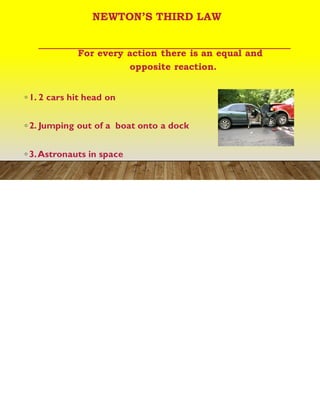
◦ 1. 2 cars hit head on
◦ 2. Jumping out of a boat onto a dock
◦ 3.Astronauts in space
EXAMPLE:
According to Newton,
whenever objects A and B
interact with each other,
they exert forces upon each
other.When you sit in your
chair, your body exerts a
downward force on the chair
and the chair exerts an
upward force on your body.
Thank
You

Newton's laws

  • 1.
  • 3.
    NEWTON’S FIRST LAW Anobject at rest tend to stay at rest and an object in motion tends to stay in motion unless unless acted upon by an unbalanced force.
  • 4.
    SOME EXAPLES FROMREAL LIFE A soccer ball is sitting at rest. It takes an unbalanced force of a kick to change its motion. Two teams are playing tug of war. They are both exerting equal force on the rope in opposite directions. This balanced force results in no change of motion.
  • 5.
    Newton’s First Lawis also called the Law of Inertia: Inertia: the tendency of an object to resist changes in its state of motion The First Law states that all objects have inertia. The more mass an object has, the more inertia it has (and the harder it is to change its motion).
  • 6.
    • Inertia explainsmany common events, such as why you move forward in your seat when a car stops suddenly. • When the car stops, inertia keeps you moving forward. • A force, such as the pull of a seat belt, is required to change your motion.
  • 7.
    NEWTON’S SECOND LAW Forceequals mass times acceleration. F = ma Acceleration: a measurement of how quickly an object is changing speed.
  • 8.
    BalancedVersus Unbalanced Unbalanced forcescause acceleration. Balanced forces cause no acceleration.
  • 9.
    WHAT DOES F= MA MEAN? • Force is directly proportional to mass and acceleration. Imagine a ball of a certain mass moving at a certain acceleration. This ball has a certain force. • Now imagine we make the ball twice as big (double the mass) but keep the acceleration constant. F = ma says that this new ball has twice the force of the old ball.
  • 10.
    NEWTON’S THIRD LAW Forevery action there is an equal and opposite reaction. ◦ 1. 2 cars hit head on ◦ 2. Jumping out of a boat onto a dock ◦ 3.Astronauts in space
  • 11.
    EXAMPLE: According to Newton, wheneverobjects A and B interact with each other, they exert forces upon each other.When you sit in your chair, your body exerts a downward force on the chair and the chair exerts an upward force on your body.
  • 12.