Manipulated 
photography 
for mass media
Ethical beginnings 
ď‚— Photojournalism is defined as non-fiction photography: 
people doing thing in a natural setting. 
 We don’t pose people. 
 We don’t control the situation. 
ď‚— We attend an event, photograph what is there, try to 
portray fairly what we see.
Ethical control 
ď‚— But even within this ideal, we consider some control 
over the image to be acceptable. 
ď‚— We choose to photograph something in a certain way 
that we think fairly reflects the event. This is as a 
journalist writes using a certain angle. 
ď‚— We control a photograph by what we include and leave 
out, either in the camera or later cropping. 
ď‚— We control exposure, darkening, lightening, 
sharpening.
Ethical control 
ď‚— Is this manipulation of the image? Yes. 
ď‚— But it is passive manipulation: we are cropping and 
choosing angles, but we are not controlling the action 
of a scene. 
 But what if you need to take a photo that’s not part of a 
news story, or not even journalism? 
ď‚— Then we move into the area of controlled, or 
manipulated images.
Controlled images 
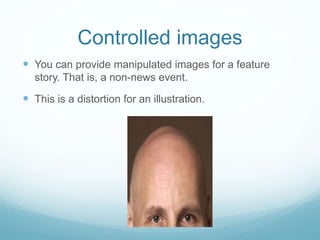
ď‚— You can provide manipulated images for a feature 
story. That is, a non-news event. 
ď‚— This is a distortion for an illustration.
Two ways to manipulate 
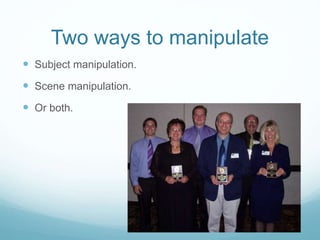
ď‚— Subject manipulation. 
ď‚— Scene manipulation. 
ď‚— Or both.
Subject manipulation 
ď‚— You control your subject by asking that person to do 
something. 
 The control may be casual: “Just walk down the street 
as you usually do and I’ll take your picture.” 
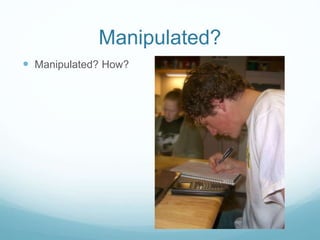
 Or the control may be more formal: “Sit here, straight 
back, fingers on the keyboard, turn slightly my way, 
look toward the screen.”
Scene manipulation 
ď‚— You control the environment, including the background, 
objects and people in the scene, lighting of the scene. 
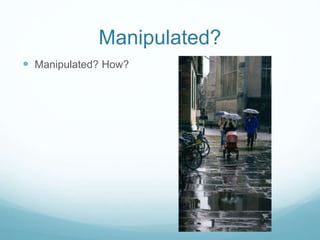
ď‚— You may add an umbrella or hat for color, or an 
interesting background object to give context. 
ď‚— You move things around.
Illustrations 
ď‚— When you control the subject or environment, you 
create a photo illustration. That is, a photo to show a 
story, advertising or public relations concept. 
ď‚— This does not mean the subject is formally posed. But it 
could. 
ď‚— Within this idea we can make three separations: 
editorial photography, public relations photography 
and advertising photography.
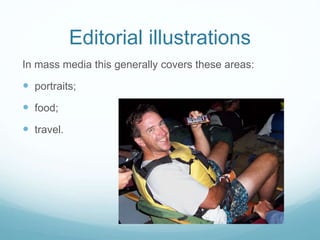
Editorial illustrations 
In mass media this generally covers these areas: 
ď‚— portraits; 
ď‚— food; 
ď‚— travel.
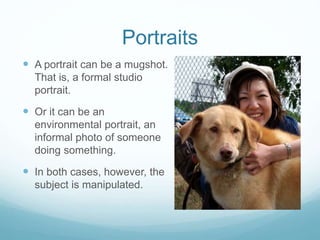
Portraits 
ď‚— A portrait can be a mugshot. 
That is, a formal studio 
portrait. 
ď‚— Or it can be an 
environmental portrait, an 
informal photo of someone 
doing something. 
ď‚— In both cases, however, the 
subject is manipulated.
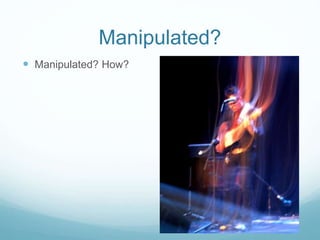
Lighting manipulation 
ď‚— Usually in a manipulated portrait the lighting is also 
manipulated. 
ď‚— Back light or fill light will give more uniform lighting than 
is usually available in the real world. 
ď‚— In straight photojournalism we look for this lighting in 
our environment, and choose an angle to use it. 
ď‚— In manipulated photography we can set up lights and 
use flash.
Manipulated portraits 
ď‚— Usually we try to pose people so they appear natural. 
They don’t necessarily look at the camera. 
ď‚— Often, though, in an environmental portrait we feature a 
subject doing something he wouldn’t really do very 
often. 
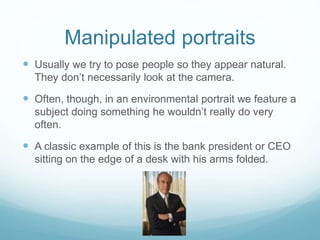
ď‚— A classic example of this is the bank president or CEO 
sitting on the edge of a desk with his arms folded.
Food and travel 
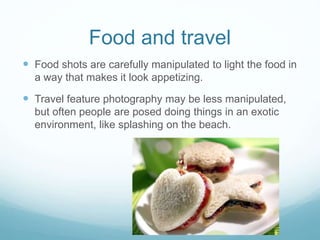
ď‚— Food shots are carefully manipulated to light the food in 
a way that makes it look appetizing. 
ď‚— Travel feature photography may be less manipulated, 
but often people are posed doing things in an exotic 
environment, like splashing on the beach.
Public relations 
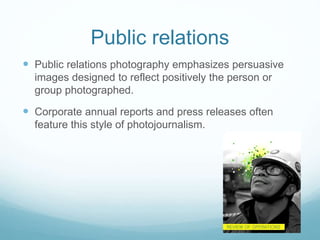
ď‚— Public relations photography emphasizes persuasive 
images designed to reflect positively the person or 
group photographed. 
ď‚— Corporate annual reports and press releases often 
feature this style of photojournalism.
Public relations 
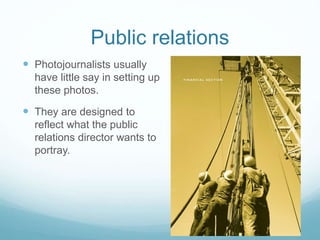
ď‚— Photojournalists usually 
have little say in setting up 
these photos. 
ď‚— They are designed to 
reflect what the public 
relations director wants to 
portray.
Advertising 
ď‚— Advertising photography is tightly controlled, and paid 
for by a client. 
 It’s usually not simple product photography. 
ď‚— Most advertising photography tries to attach a lifestyle 
ideal to a product.
Advertising photography 
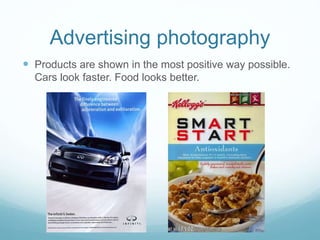
ď‚— Products are shown in the most positive way possible. 
Cars look faster. Food looks better.
Control of advertising 
ď‚— Advertising does have limits set by U.S. Trade Law. 
Beyond that, it’s a question of ethics. 
ď‚— How far can you go manipulating mass media 
photography for illustrations? 
ď‚— The answer depends....
Boundaries 
ď‚— You could do an illustration for, say, a story on 
meditation showing a composite image of someone in 
a dream world. 
ď‚— But could you do an illustration for a story on politics 
using a composite image of a politician surrounded by 
starving children? 
ď‚— Manipulation has ethical boundaries.
Good taste 
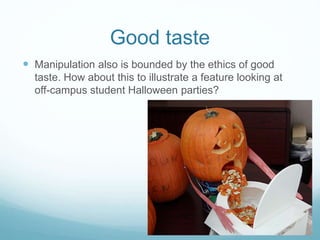
ď‚— Manipulation also is bounded by the ethics of good 
taste. How about this to illustrate a feature looking at 
off-campus student Halloween parties?
Everyday manipulation 
ď‚— The truth is most photography is manipulated to some 
extent. 
 When we say “smile” in snaps we are manipulating our 
subject. 
ď‚— When we turn on our flash we are manipulating the 
scene. 
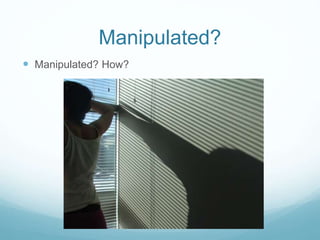
ď‚— How about some of the photos below. Manipulated? 
And if so, how?
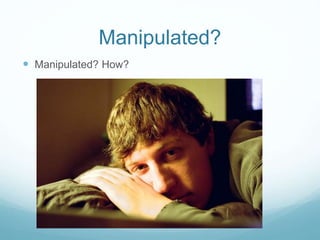
Manipulated? 
ď‚— Manipulated? How?
Manipulated? 
ď‚— Manipulated? How?
Manipulated? 
ď‚— Manipulated? How?
Manipulated? 
ď‚— Manipulated? How?
Manipulated? 
ď‚— Manipulated? How?
Manipulation 
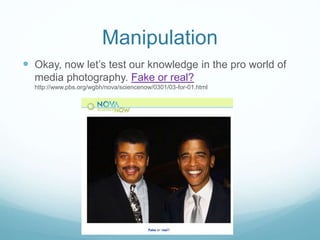
 Okay, now let’s test our knowledge in the pro world of 
media photography. Fake or real? 
http://www.pbs.org/wgbh/nova/sciencenow/0301/03-for-01.html

Photomanipulation copy

  • 1.
  • 2.
    Ethical beginnings Photojournalism is defined as non-fiction photography: people doing thing in a natural setting.  We don’t pose people.  We don’t control the situation.  We attend an event, photograph what is there, try to portray fairly what we see.
  • 3.
    Ethical control ď‚—But even within this ideal, we consider some control over the image to be acceptable. ď‚— We choose to photograph something in a certain way that we think fairly reflects the event. This is as a journalist writes using a certain angle. ď‚— We control a photograph by what we include and leave out, either in the camera or later cropping. ď‚— We control exposure, darkening, lightening, sharpening.
  • 4.
    Ethical control Is this manipulation of the image? Yes.  But it is passive manipulation: we are cropping and choosing angles, but we are not controlling the action of a scene.  But what if you need to take a photo that’s not part of a news story, or not even journalism?  Then we move into the area of controlled, or manipulated images.
  • 5.
    Controlled images ď‚—You can provide manipulated images for a feature story. That is, a non-news event. ď‚— This is a distortion for an illustration.
  • 6.
    Two ways tomanipulate ď‚— Subject manipulation. ď‚— Scene manipulation. ď‚— Or both.
  • 7.
    Subject manipulation You control your subject by asking that person to do something.  The control may be casual: “Just walk down the street as you usually do and I’ll take your picture.”  Or the control may be more formal: “Sit here, straight back, fingers on the keyboard, turn slightly my way, look toward the screen.”
  • 8.
    Scene manipulation ď‚—You control the environment, including the background, objects and people in the scene, lighting of the scene. ď‚— You may add an umbrella or hat for color, or an interesting background object to give context. ď‚— You move things around.
  • 9.
    Illustrations ď‚— Whenyou control the subject or environment, you create a photo illustration. That is, a photo to show a story, advertising or public relations concept. ď‚— This does not mean the subject is formally posed. But it could. ď‚— Within this idea we can make three separations: editorial photography, public relations photography and advertising photography.
  • 10.
    Editorial illustrations Inmass media this generally covers these areas: ď‚— portraits; ď‚— food; ď‚— travel.
  • 11.
    Portraits ď‚— Aportrait can be a mugshot. That is, a formal studio portrait. ď‚— Or it can be an environmental portrait, an informal photo of someone doing something. ď‚— In both cases, however, the subject is manipulated.
  • 12.
    Lighting manipulation ď‚—Usually in a manipulated portrait the lighting is also manipulated. ď‚— Back light or fill light will give more uniform lighting than is usually available in the real world. ď‚— In straight photojournalism we look for this lighting in our environment, and choose an angle to use it. ď‚— In manipulated photography we can set up lights and use flash.
  • 13.
    Manipulated portraits Usually we try to pose people so they appear natural. They don’t necessarily look at the camera.  Often, though, in an environmental portrait we feature a subject doing something he wouldn’t really do very often.  A classic example of this is the bank president or CEO sitting on the edge of a desk with his arms folded.
  • 14.
    Food and travel ď‚— Food shots are carefully manipulated to light the food in a way that makes it look appetizing. ď‚— Travel feature photography may be less manipulated, but often people are posed doing things in an exotic environment, like splashing on the beach.
  • 15.
    Public relations ď‚—Public relations photography emphasizes persuasive images designed to reflect positively the person or group photographed. ď‚— Corporate annual reports and press releases often feature this style of photojournalism.
  • 16.
    Public relations ď‚—Photojournalists usually have little say in setting up these photos. ď‚— They are designed to reflect what the public relations director wants to portray.
  • 17.
    Advertising  Advertisingphotography is tightly controlled, and paid for by a client.  It’s usually not simple product photography.  Most advertising photography tries to attach a lifestyle ideal to a product.
  • 18.
    Advertising photography ď‚—Products are shown in the most positive way possible. Cars look faster. Food looks better.
  • 19.
    Control of advertising  Advertising does have limits set by U.S. Trade Law. Beyond that, it’s a question of ethics.  How far can you go manipulating mass media photography for illustrations?  The answer depends....
  • 20.
    Boundaries ď‚— Youcould do an illustration for, say, a story on meditation showing a composite image of someone in a dream world. ď‚— But could you do an illustration for a story on politics using a composite image of a politician surrounded by starving children? ď‚— Manipulation has ethical boundaries.
  • 21.
    Good taste ď‚—Manipulation also is bounded by the ethics of good taste. How about this to illustrate a feature looking at off-campus student Halloween parties?
  • 22.
    Everyday manipulation The truth is most photography is manipulated to some extent.  When we say “smile” in snaps we are manipulating our subject.  When we turn on our flash we are manipulating the scene.  How about some of the photos below. Manipulated? And if so, how?
  • 23.
  • 24.
  • 25.
  • 26.
  • 27.
  • 28.
    Manipulation  Okay,now let’s test our knowledge in the pro world of media photography. Fake or real? http://www.pbs.org/wgbh/nova/sciencenow/0301/03-for-01.html