Bahria Foundation College
F-11/3 Islamabad
Teachers Training Workshop on
Phonics
Presented by: Sumaira Aamir
PHONICS
Introduction to phonics
• Phonics is the study of the relationship
between letters and the sounds they
represents.
• Phonics are essential for a child who is
learning to read and write.
• Words are like codes and phonics teaches
children how to crack reading codes.
What is phonics?
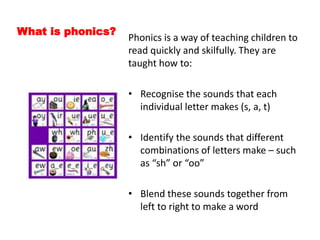
Phonics is a way of teaching children to
read quickly and skilfully. They are
taught how to:
• Recognise the sounds that each
individual letter makes (s, a, t)
• Identify the sounds that different
combinations of letters make – such
as “sh” or “oo”
• Blend these sounds together from
left to right to make a word
Phonics is all about using …
skills for
reading and
spelling
knowledge
of the
alphabet
+
Learning phonics will help child to become
a good reader and writer.
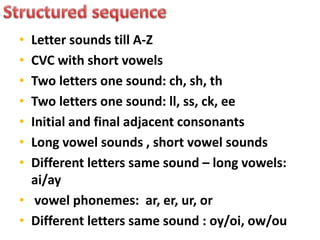
• Letter sounds till A-Z
• CVC with short vowels
• Two letters one sound: ch, sh, th
• Two letters one sound: ll, ss, ck, ee
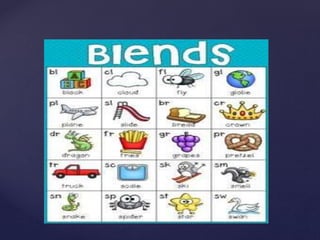
• Initial and final adjacent consonants
• Long vowel sounds , short vowel sounds
• Different letters same sound – long vowels:
ai/ay
• vowel phonemes: ar, er, ur, or
• Different letters same sound : oy/oi, ow/ou
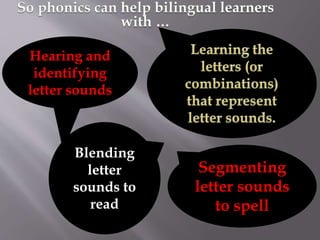
Blending
letter
sounds to
read
Hearing and
identifying
letter sounds
Segmenting
letter sounds
to spell
Getting Ready for Phonics
• tuning into sounds (auditory
discrimination)
• listening and remembering sounds
• (auditory memory and sequencing)
• talking about sounds
• (developing vocabulary and language
comprehension)
• Aspect 1: Environmental sounds
Stories – Walk around local area
• Aspect 2: Instrumental sounds
Bag of instruments – Add sound effects
• Aspect 3: Body percussion
Action songs and rhymes
• Aspect 4: Rhythm and rhyme
Rhyming stories – What rhymes with…?
• Aspect 5: Alliteration
Having fun with names – Story characters
• Aspect 6: Voice sounds
Adding different voices to stories
• Aspect 7: Oral blending and segmenting
Robot speech c-a-t and Put it together
How to teach phonics
 Gradually move on to the more
complicated ones(/ph/, /th/,/-th /, /sh/)
 Forget about the traditional approach
(the alphabet)
 When we start teaching phonics, we start
with one sound only. We start with the
most common sounds (eg. /a/, /t/, /s/, /d/,
/e/, /i/, /p/)
 When you have given them the first basic
sounds, you can start building with them the first
simple words (transparent) through simple
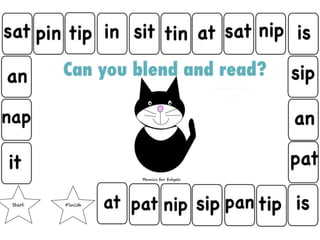
sound combinations. (sit, sat, tin, pin, pen, ten,
set etc.)
 Let your students create their own nonsense
(or silly) words (testint, piten, satiapata….)
and later their own nonsense (or silly)
sentences (a mat in the tub, the cat sits on
the hat……) and even short stories.
Cracking the Code
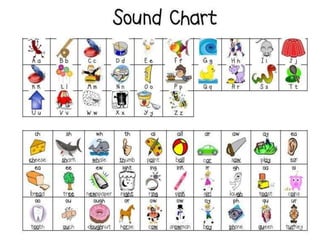
 26 letters of the alphabet
 44 sounds in the English Language (Jolly
Phonic Letter Sound British English)
 144 different ways we put letters together to
represent the sounds
Using TPR in teaching phonics
Invite pupils to:
 Touch and feel the new letter-sound
A multi-sensory method
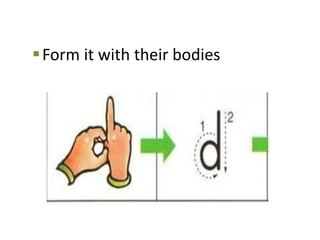
Form it with their bodies
Sing and dance it (‘h’ can be hop’, ‘t’
is playing tennis and ‘d’ is drum.
Each sound has its own action and
song
This fun way helps the pupil learn
the sounds more easily
Reading EYFS 2014
Make Phonics fun!
• Keep them active!
• ICT
• Range or resources in school
• Use sand/ play dough
• Inside/outside
• Sing
• Use letter cards/picture cards linked
to the phonic focus
– Is this /g/ or /d/?
• Use sound talk – Get me a /r/ /e//d/
pen please.
• Say it/write it
Activities
Phonemes
Blending
Segmenting
Sound
talk
Consonants
and vowels
Trigraphs :
three letters
one sound
Graphemes
Digraphs :
two letters
one sound
23
i
a
e o
u
vowels
Phonics Words
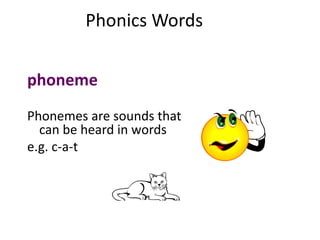
phoneme
Phonemes are sounds that
can be heard in words
e.g. c-a-t
Phonics Words
grapheme
This is how a phoneme
is written down
Phonics Words
Blending
• Children need to be able to hear the separate sounds
in a word and then blend them together to say the
whole word .
Blending
/b/ /e/ /d/ = bed
/t/ /i/ /n/ = tin
/m/ /u/ /g/= mug
Phonics Words
Segmenting
• Children need to be able to hear a whole word and
sayevery sound that they hear.
Segmenting
bed = /b/ /e/ /d/
tin= /t/ /i/ /n/
mug= /m/ /u/ /g/
Phonics Words
digraph
This means that the phoneme
comprises of two letters
e.g. ll, ff, ck, ss, ow
Phonics Words
trigraph
This means that the phoneme
comprises of three letters
eg: air igh ure
Phonics words
Phoneme frame and
sound buttons
f i sh
c a t
. . .
. . _
Building Word Families
ot
cot
dot
hot
og
log
jog
dog
ap
cap
nap
map
Building Word Families
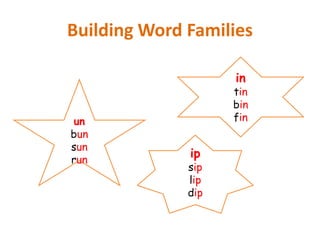
un
bun
sun
run
in
tin
bin
fin
ip
sip
lip
dip
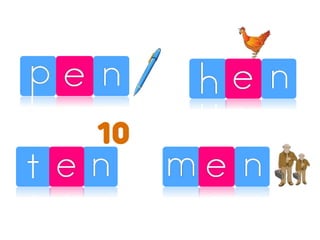
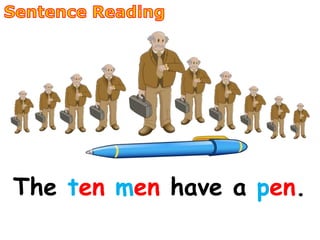
The ten men have a pen.
The cat sat on a hat.
Help with reading
•Dots are used to show how many
sounds in each word
•Pupils can put their finger on each
dot
… ..
More complicated sounds
 Later on start introducing the different and
more complicated vowel sounds and vowel
combinations (/ai/, /ee/, /oo/, /ow/, /i-e/, /o-
e/ etc).
 This needs lots of practice and need to
employ different approaches and Montessori
exercises for language /methods such as
games, songs colouring, matching etc
Rhyming
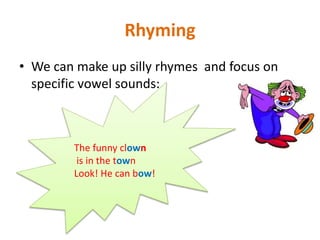
• We can make up silly rhymes and focus on
specific vowel sounds:
The funny clown
is in the town
Look! He can bow!
Language and Phonics Exercises
Three Period Lesson
• We can use the three period lesson to directly
teach specific vocabulary, sounds.
1. Touch object or letter and clearly make its sound.
2. Ask the child to identify objects/ letter sounds
3. Point to each sound and ask “What is this?”
• I spy (letter sounds)
Sandpaper Letters
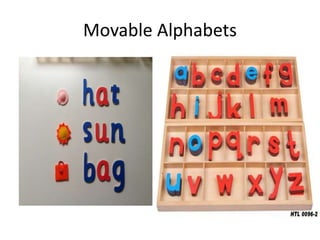
Movable Alphabets
Some tips
 Phonics-based instruction is an ongoing
process. We don’t teach all the phonemes till
we come to the end.
 After 6-7 phonemes we do other activities and
projects giving pupils time to assimilate their
new knowledge
Why learning with phonics?
It helps learners acquire accurate
pronunciation
It helps them make associations between
spelling and pronunciation
 It helps them recognize and read patterns
(e.g., if they know how to read ‘leaf’ it will be
easier for them to read the words ‘bean’,
‘eat’, etc.)
phonics.pptx

phonics.pptx

  • 1.
    Bahria Foundation College F-11/3Islamabad Teachers Training Workshop on Phonics Presented by: Sumaira Aamir
  • 2.
    Presented by: SumairaAamir PHONICS
  • 4.
    Introduction to phonics •Phonics is the study of the relationship between letters and the sounds they represents. • Phonics are essential for a child who is learning to read and write. • Words are like codes and phonics teaches children how to crack reading codes.
  • 5.
    What is phonics? Phonicsis a way of teaching children to read quickly and skilfully. They are taught how to: • Recognise the sounds that each individual letter makes (s, a, t) • Identify the sounds that different combinations of letters make – such as “sh” or “oo” • Blend these sounds together from left to right to make a word
  • 6.
    Phonics is allabout using … skills for reading and spelling knowledge of the alphabet + Learning phonics will help child to become a good reader and writer.
  • 7.
    • Letter soundstill A-Z • CVC with short vowels • Two letters one sound: ch, sh, th • Two letters one sound: ll, ss, ck, ee • Initial and final adjacent consonants • Long vowel sounds , short vowel sounds • Different letters same sound – long vowels: ai/ay • vowel phonemes: ar, er, ur, or • Different letters same sound : oy/oi, ow/ou
  • 8.
    Blending letter sounds to read Hearing and identifying lettersounds Segmenting letter sounds to spell
  • 9.
    Getting Ready forPhonics • tuning into sounds (auditory discrimination) • listening and remembering sounds • (auditory memory and sequencing) • talking about sounds • (developing vocabulary and language comprehension)
  • 10.
    • Aspect 1:Environmental sounds Stories – Walk around local area • Aspect 2: Instrumental sounds Bag of instruments – Add sound effects • Aspect 3: Body percussion Action songs and rhymes • Aspect 4: Rhythm and rhyme Rhyming stories – What rhymes with…? • Aspect 5: Alliteration Having fun with names – Story characters • Aspect 6: Voice sounds Adding different voices to stories • Aspect 7: Oral blending and segmenting Robot speech c-a-t and Put it together
  • 11.
    How to teachphonics  Gradually move on to the more complicated ones(/ph/, /th/,/-th /, /sh/)  Forget about the traditional approach (the alphabet)  When we start teaching phonics, we start with one sound only. We start with the most common sounds (eg. /a/, /t/, /s/, /d/, /e/, /i/, /p/)
  • 12.
     When youhave given them the first basic sounds, you can start building with them the first simple words (transparent) through simple sound combinations. (sit, sat, tin, pin, pen, ten, set etc.)  Let your students create their own nonsense (or silly) words (testint, piten, satiapata….) and later their own nonsense (or silly) sentences (a mat in the tub, the cat sits on the hat……) and even short stories.
  • 13.
    Cracking the Code 26 letters of the alphabet  44 sounds in the English Language (Jolly Phonic Letter Sound British English)  144 different ways we put letters together to represent the sounds
  • 15.
    Using TPR inteaching phonics Invite pupils to:  Touch and feel the new letter-sound A multi-sensory method
  • 16.
    Form it withtheir bodies
  • 17.
    Sing and danceit (‘h’ can be hop’, ‘t’ is playing tennis and ‘d’ is drum. Each sound has its own action and song This fun way helps the pupil learn the sounds more easily
  • 18.
  • 20.
    Make Phonics fun! •Keep them active! • ICT • Range or resources in school • Use sand/ play dough • Inside/outside
  • 21.
    • Sing • Useletter cards/picture cards linked to the phonic focus – Is this /g/ or /d/? • Use sound talk – Get me a /r/ /e//d/ pen please. • Say it/write it Activities
  • 22.
    Phonemes Blending Segmenting Sound talk Consonants and vowels Trigraphs : threeletters one sound Graphemes Digraphs : two letters one sound
  • 23.
  • 24.
    Phonics Words phoneme Phonemes aresounds that can be heard in words e.g. c-a-t
  • 25.
    Phonics Words grapheme This ishow a phoneme is written down
  • 26.
    Phonics Words Blending • Childrenneed to be able to hear the separate sounds in a word and then blend them together to say the whole word .
  • 27.
    Blending /b/ /e/ /d/= bed /t/ /i/ /n/ = tin /m/ /u/ /g/= mug
  • 28.
    Phonics Words Segmenting • Childrenneed to be able to hear a whole word and sayevery sound that they hear.
  • 29.
    Segmenting bed = /b//e/ /d/ tin= /t/ /i/ /n/ mug= /m/ /u/ /g/
  • 30.
    Phonics Words digraph This meansthat the phoneme comprises of two letters e.g. ll, ff, ck, ss, ow
  • 31.
    Phonics Words trigraph This meansthat the phoneme comprises of three letters eg: air igh ure
  • 32.
    Phonics words Phoneme frameand sound buttons f i sh c a t . . . . . _
  • 33.
  • 34.
  • 37.
    The ten menhave a pen.
  • 40.
    The cat saton a hat.
  • 41.
    Help with reading •Dotsare used to show how many sounds in each word •Pupils can put their finger on each dot … ..
  • 43.
    More complicated sounds Later on start introducing the different and more complicated vowel sounds and vowel combinations (/ai/, /ee/, /oo/, /ow/, /i-e/, /o- e/ etc).  This needs lots of practice and need to employ different approaches and Montessori exercises for language /methods such as games, songs colouring, matching etc
  • 44.
    Rhyming • We canmake up silly rhymes and focus on specific vowel sounds: The funny clown is in the town Look! He can bow!
  • 48.
    Language and PhonicsExercises Three Period Lesson • We can use the three period lesson to directly teach specific vocabulary, sounds. 1. Touch object or letter and clearly make its sound. 2. Ask the child to identify objects/ letter sounds 3. Point to each sound and ask “What is this?” • I spy (letter sounds)
  • 49.
  • 50.
  • 52.
    Some tips  Phonics-basedinstruction is an ongoing process. We don’t teach all the phonemes till we come to the end.  After 6-7 phonemes we do other activities and projects giving pupils time to assimilate their new knowledge
  • 53.
    Why learning withphonics? It helps learners acquire accurate pronunciation It helps them make associations between spelling and pronunciation  It helps them recognize and read patterns (e.g., if they know how to read ‘leaf’ it will be easier for them to read the words ‘bean’, ‘eat’, etc.)