UGC Sponsored Online Course on
ACADEMIC WRITING
Dr. T .Jeevan Kumar
K.H. Govt. Degree College, Dharmavaram, Andhra Pradesh
Student ID: 6bfee5bdea6b11e98dc93fa2fcc8e709
Acknowledgement
 I would like to the Mentors of “Academic Writing”, a
course designed by H.N.B. Garhwal University (A Central
University), Srinagar Garhwal (Uttarakhand) under
SWAYAM, a UGC platform of Online Courses.
Phonetics
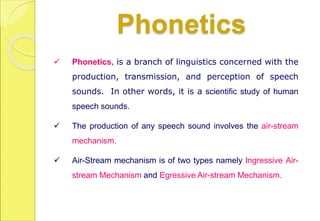
 Phonetics, is a branch of linguistics concerned with the
production, transmission, and perception of speech
sounds. In other words, it is a scientific study of human
speech sounds.
 The production of any speech sound involves the air-stream
mechanism.
 Air-Stream mechanism is of two types namely Ingressive Air-
stream Mechanism and Egressive Air-stream Mechanism.
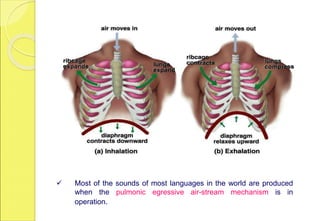
 Most of the sounds of most languages in the world are produced
when the pulmonic egressive air-stream mechanism is in
operation.
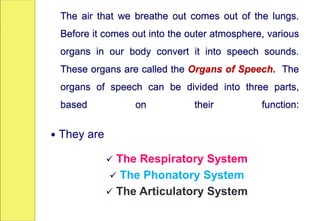
The air that we breathe out comes out of the lungs.
Before it comes out into the outer atmosphere, various
organs in our body convert it into speech sounds.
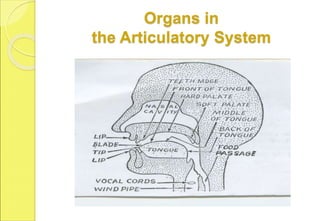
These organs are called the Organs of Speech. The
organs of speech can be divided into three parts,
based on their function:
 They are
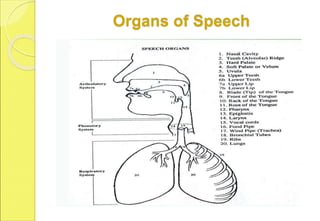
 The Respiratory System
 The Phonatory System
 The Articulatory System
Organs of Speech
Organs in the Respiratory
System
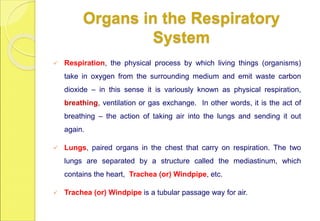
 Respiration, the physical process by which living things (organisms)
take in oxygen from the surrounding medium and emit waste carbon
dioxide – in this sense it is variously known as physical respiration,
breathing, ventilation or gas exchange. In other words, it is the act of
breathing – the action of taking air into the lungs and sending it out
again.
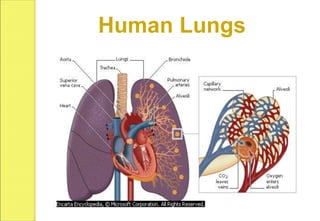
 Lungs, paired organs in the chest that carry on respiration. The two
lungs are separated by a structure called the mediastinum, which
contains the heart, Trachea (or) Windpipe, etc.
 Trachea (or) Windpipe is a tubular passage way for air.
Human Lungs
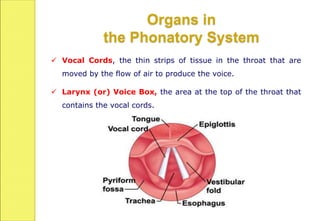
 Vocal Cords, the thin strips of tissue in the throat that are
moved by the flow of air to produce the voice.
 Larynx (or) Voice Box, the area at the top of the throat that
contains the vocal cords.
Organs in
the Phonatory System
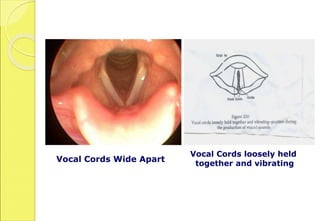
Vocal Cords Wide Apart
Vocal Cords loosely held
together and vibrating
Organs in
the Articulatory System
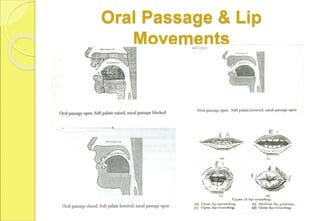
Oral Passage & Lip
Movements
Consonants
 Speech sounds are classified into two categories namely,
Vowels and Consonants.
 If we utter the English word ‘shoe’, we realize that the word is
made up of two sounds ‘sh’ and ‘oe’. When we produce the
sound represented by the letters ‘sh’ slowly, we see that the
air escaping through the mouth with friction. Such sounds are
called Consonants.
 A consonant is usually described, taking into account whether
it is voiceless or voiced, its place of articulation and its manner
of articulation. Manner of articulation refers to the ‘stricture’,
that is the way the passage of air is restricted by the various
organs of speech, while place of articulation just means the
two articulators involved in the production of a consonant.
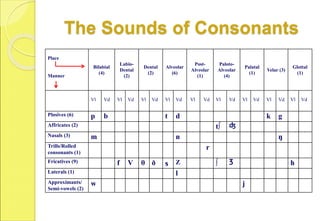
The Sounds of Consonants
Place
Manner
Bilabial
(4)
Labio-
Dental
(2)
Dental
(2)
Alveolar
(6)
Post-
Alveolar
(1)
Paloto-
Alveolar
(4)
Palatal
(1)
Velar (3)
Glottal
(1)
Vl Vd Vl Vd Vl Vd Vl Vd Vl Vd Vl Vd Vl Vd Vl Vd Vl Vd
Plosives (6) p b t d k g
Affricates (2) t∫ ʤ
Nasals (3) m n ŋ
Trills/Rolled
consonants (1)
r
Fricatives (9) f V θ ð s Z ∫ Ʒ h
Laterals (1) l
Approximants/
Semi-vowels (2)
w j
Vowels
 A vowel is a speech sound in which the mouth is open and the
tongue does not touch the top of the mouth, the teeth, etc.
 In English language, the vowels are five viz. ‘a’, ‘e’, ‘i’, ‘o’, ‘u’,
and sometimes ‘y’. This statement is based on spelling rather
than on the fundamental nature of sounds. There are in fact
twenty vowel sounds in English.
 In general, vowels are long and short.
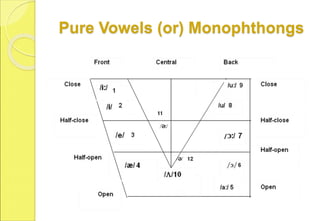
 Of these twenty vowels sounds, twelve are pure vowels (or)
monophthongs (or) cardinal vowels, and eight are diphthongs
(or) gliding vowels.
Pure Vowels (or) Monophthongs
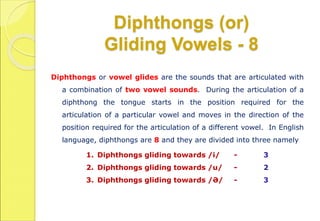
Diphthongs (or)
Gliding Vowels - 8
Diphthongs or vowel glides are the sounds that are articulated with
a combination of two vowel sounds. During the articulation of a
diphthong the tongue starts in the position required for the
articulation of a particular vowel and moves in the direction of the
position required for the articulation of a different vowel. In English
language, diphthongs are 8 and they are divided into three namely
1. Diphthongs gliding towards /i/ - 3
2. Diphthongs gliding towards /u/ - 2
3. Diphthongs gliding towards /Ə/ - 3
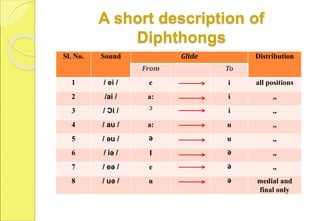
A short description of
Diphthongs
Sl. No. Sound Glide Distribution
From To
1 / ei / e i all positions
2 /ai / a: i ,,
3 / Ɔi / Ɔ
i ,,
4 / au / a: u ,,
5 / əu / ə u ,,
6 / iə / I ə ,,
7 / eə / e ə ,,
8 / uə / u ə medial and
final only
Feedback on the Course
 Academic Writing is the most important skill that every
researcher, teacher, and student should acquire.
 Keeping this in mind, the Mentors have designed this
Course that immensely helps all the writers. The
Content chosen during each week is well-organized
and very well-explained through videos and
documents.
 It would be no exaggeration to say that all the
candidates, after undergoing this Course will definitely
become masters in writing meaningfully, cohesively,
qualitatively, besides following all the stylistic nuances
referred in MLA, APA, CMS, etc.
References (MLA Format)
1. Balasubramanyam, T. English Phonetics for Indian
Students. 3rd Edition. New Delhi: Laxmi Publications,
2012.
2. Sethi, J. and P.V. Dhamija. A Course in Phonetics and
Spoken English. 2nd Edition. New Delhi: Prentice India
Learning Private Limited, 1999.
Further Reading
1. Jones, Daniel. An Outline of English Phonetics. 9th Edition.
Cambridge: Cambridge University Press, 1976.
2. Roach, Peter. English Phonetics and Phonology: A Practical
Course. 4th Edition. Cambridge: Cambridge University
Press, 2009.

Phonetics - Part 1

  • 1.
    UGC Sponsored OnlineCourse on ACADEMIC WRITING Dr. T .Jeevan Kumar K.H. Govt. Degree College, Dharmavaram, Andhra Pradesh Student ID: 6bfee5bdea6b11e98dc93fa2fcc8e709
  • 2.
    Acknowledgement  I wouldlike to the Mentors of “Academic Writing”, a course designed by H.N.B. Garhwal University (A Central University), Srinagar Garhwal (Uttarakhand) under SWAYAM, a UGC platform of Online Courses.
  • 3.
    Phonetics  Phonetics, isa branch of linguistics concerned with the production, transmission, and perception of speech sounds. In other words, it is a scientific study of human speech sounds.  The production of any speech sound involves the air-stream mechanism.  Air-Stream mechanism is of two types namely Ingressive Air- stream Mechanism and Egressive Air-stream Mechanism.
  • 4.
     Most ofthe sounds of most languages in the world are produced when the pulmonic egressive air-stream mechanism is in operation.
  • 5.
    The air thatwe breathe out comes out of the lungs. Before it comes out into the outer atmosphere, various organs in our body convert it into speech sounds. These organs are called the Organs of Speech. The organs of speech can be divided into three parts, based on their function:  They are  The Respiratory System  The Phonatory System  The Articulatory System
  • 6.
  • 7.
    Organs in theRespiratory System  Respiration, the physical process by which living things (organisms) take in oxygen from the surrounding medium and emit waste carbon dioxide – in this sense it is variously known as physical respiration, breathing, ventilation or gas exchange. In other words, it is the act of breathing – the action of taking air into the lungs and sending it out again.  Lungs, paired organs in the chest that carry on respiration. The two lungs are separated by a structure called the mediastinum, which contains the heart, Trachea (or) Windpipe, etc.  Trachea (or) Windpipe is a tubular passage way for air.
  • 8.
  • 9.
     Vocal Cords,the thin strips of tissue in the throat that are moved by the flow of air to produce the voice.  Larynx (or) Voice Box, the area at the top of the throat that contains the vocal cords. Organs in the Phonatory System
  • 10.
    Vocal Cords WideApart Vocal Cords loosely held together and vibrating
  • 11.
  • 12.
    Oral Passage &Lip Movements
  • 13.
    Consonants  Speech soundsare classified into two categories namely, Vowels and Consonants.  If we utter the English word ‘shoe’, we realize that the word is made up of two sounds ‘sh’ and ‘oe’. When we produce the sound represented by the letters ‘sh’ slowly, we see that the air escaping through the mouth with friction. Such sounds are called Consonants.  A consonant is usually described, taking into account whether it is voiceless or voiced, its place of articulation and its manner of articulation. Manner of articulation refers to the ‘stricture’, that is the way the passage of air is restricted by the various organs of speech, while place of articulation just means the two articulators involved in the production of a consonant.
  • 14.
    The Sounds ofConsonants Place Manner Bilabial (4) Labio- Dental (2) Dental (2) Alveolar (6) Post- Alveolar (1) Paloto- Alveolar (4) Palatal (1) Velar (3) Glottal (1) Vl Vd Vl Vd Vl Vd Vl Vd Vl Vd Vl Vd Vl Vd Vl Vd Vl Vd Plosives (6) p b t d k g Affricates (2) t∫ ʤ Nasals (3) m n ŋ Trills/Rolled consonants (1) r Fricatives (9) f V θ ð s Z ∫ Ʒ h Laterals (1) l Approximants/ Semi-vowels (2) w j
  • 15.
    Vowels  A vowelis a speech sound in which the mouth is open and the tongue does not touch the top of the mouth, the teeth, etc.  In English language, the vowels are five viz. ‘a’, ‘e’, ‘i’, ‘o’, ‘u’, and sometimes ‘y’. This statement is based on spelling rather than on the fundamental nature of sounds. There are in fact twenty vowel sounds in English.  In general, vowels are long and short.  Of these twenty vowels sounds, twelve are pure vowels (or) monophthongs (or) cardinal vowels, and eight are diphthongs (or) gliding vowels.
  • 16.
    Pure Vowels (or)Monophthongs
  • 17.
    Diphthongs (or) Gliding Vowels- 8 Diphthongs or vowel glides are the sounds that are articulated with a combination of two vowel sounds. During the articulation of a diphthong the tongue starts in the position required for the articulation of a particular vowel and moves in the direction of the position required for the articulation of a different vowel. In English language, diphthongs are 8 and they are divided into three namely 1. Diphthongs gliding towards /i/ - 3 2. Diphthongs gliding towards /u/ - 2 3. Diphthongs gliding towards /Ə/ - 3
  • 18.
    A short descriptionof Diphthongs Sl. No. Sound Glide Distribution From To 1 / ei / e i all positions 2 /ai / a: i ,, 3 / Ɔi / Ɔ i ,, 4 / au / a: u ,, 5 / əu / ə u ,, 6 / iə / I ə ,, 7 / eə / e ə ,, 8 / uə / u ə medial and final only
  • 19.
    Feedback on theCourse  Academic Writing is the most important skill that every researcher, teacher, and student should acquire.  Keeping this in mind, the Mentors have designed this Course that immensely helps all the writers. The Content chosen during each week is well-organized and very well-explained through videos and documents.  It would be no exaggeration to say that all the candidates, after undergoing this Course will definitely become masters in writing meaningfully, cohesively, qualitatively, besides following all the stylistic nuances referred in MLA, APA, CMS, etc.
  • 20.
    References (MLA Format) 1.Balasubramanyam, T. English Phonetics for Indian Students. 3rd Edition. New Delhi: Laxmi Publications, 2012. 2. Sethi, J. and P.V. Dhamija. A Course in Phonetics and Spoken English. 2nd Edition. New Delhi: Prentice India Learning Private Limited, 1999. Further Reading 1. Jones, Daniel. An Outline of English Phonetics. 9th Edition. Cambridge: Cambridge University Press, 1976. 2. Roach, Peter. English Phonetics and Phonology: A Practical Course. 4th Edition. Cambridge: Cambridge University Press, 2009.