PRESENTED BY
Dr. ADIL FAYAZ
PG 1ST YEAR
CONTENTS
 INTRODUCTION
 GROWTH AND DEVELOPMENT
 GROSS ANATOMY OF TONGUE
 ---- MUSCLES OF TONGUE
 ---- BLOOD SUPPLY
 ---- INNERVATION OF TONGUE
 ---- TASTE BUDS
 HISTOLOGICAL FEATURES
 AGE CHANGES
 APPLIED ANATOMY
 PROSTHETIC CONSIDERATIONS
 SUMMARY AND CONCLUSION
 REFERENCES
Tongue is barely
three inches
long , but it can
kill a person six
feet tall
INTRODUCTION
 A highly mobile muscular organ situated in the floor
of mouth.
 Associated with functions of stomato-gnathic system
like taste, speech, mastication and deglutition.
ANATOMY OF TONGUE
DIVIDED INTO TWO PARTS
 SUPERIOR (DORSAL)
 INFERIOR (VENTRAL)
EXTERNAL FEATURES
 TIP
 BODY
 ROOT
The four types of papilla are :
 FILIFORM
 FUNGIFORM
 FOLIATE
 CIRCUMVALLATE
 All except the filiform papillae bear taste buds.
 Papillae are best observed when the tongue is dry
MUSCLES OF TONGUE
DIVIDED INTO TWO GROUPS:
 EXTRINSIC GROUP
 INTRINSIC GROUP
INTRINSIC MUSCLES
 Superior longitudinal: It shortens the tongue and
makes the dorsum concave.
 Inferior longitudinal: It shortens the tongue and
makes the dorsum convex.
 Transverse: It helps in narrowing and elongation of
tongue (increase in height of tongue).
 Verticalis: It broadens the tongue and causes
flattening of tongue.
EXTRINSIC GROUP
The extrinsic musculature consists of four pairs of
muscles, namely
 Genioglossus
 Hyoglossus
 Styloglossus
 Palatoglossus.
BLOOD SUPPLY OF TONGUE
ARTERIAL SUPPLY:
 from lingual artery, which is branch of External
Carotid Artery.
VENOUS DRAINAGE
 By Deep Lingual Vein.
LYMPHATIC DRAINAGE:
 Tips drain bilaterally to submental nodes
 Anterior 2/3rd drains unilaterally into right and left
Submandibular nodes.
 Posterior 1/3rd drains bilaterally to Jugulo omohyoid
nodes
 .Lymphatics do not accompany the blood vessels.
 Tip of the tongue presents richest lymph drainage. A
cancer affecting the tip spreads to all cervical lymph
nodes of both sides.
NERVE SUPPLY
 MOTOR :
 SENSORY :
 General sensory
 Special sensory
TASTE BUDS
Distributed in
 Inner wall of trough surrounding vallate papillae
 Folds of foliate papillae
 Posterior surface of fungiform papillae
 Tip and lateral borders of tongue.
“Prosthodontic
considerations”
APPLIED ANATOMY
 CHANGES ASSOCIATED WITH PARTIAL AND
COMPLETE EDENTULISM
 CLASSIFICATION OF TONGUE
 TONGUE AND STABILITY OF COMPLETE
DENTURES
 NEUTRAL ZONE
 TONGUE PROSTHESIS
CHANGES ASSOCIATED WITH PARTIAL &
COMPLETE EDENTULISM
 Tongue size and position.
 If patient has been without teeth or prostheses for a
long time or has worn maxillary denture against lower
anterior teeth only, then the tongue can become
enlarged and powerful causing instability of dentures.
CLASSIFICATION OF TONGUE
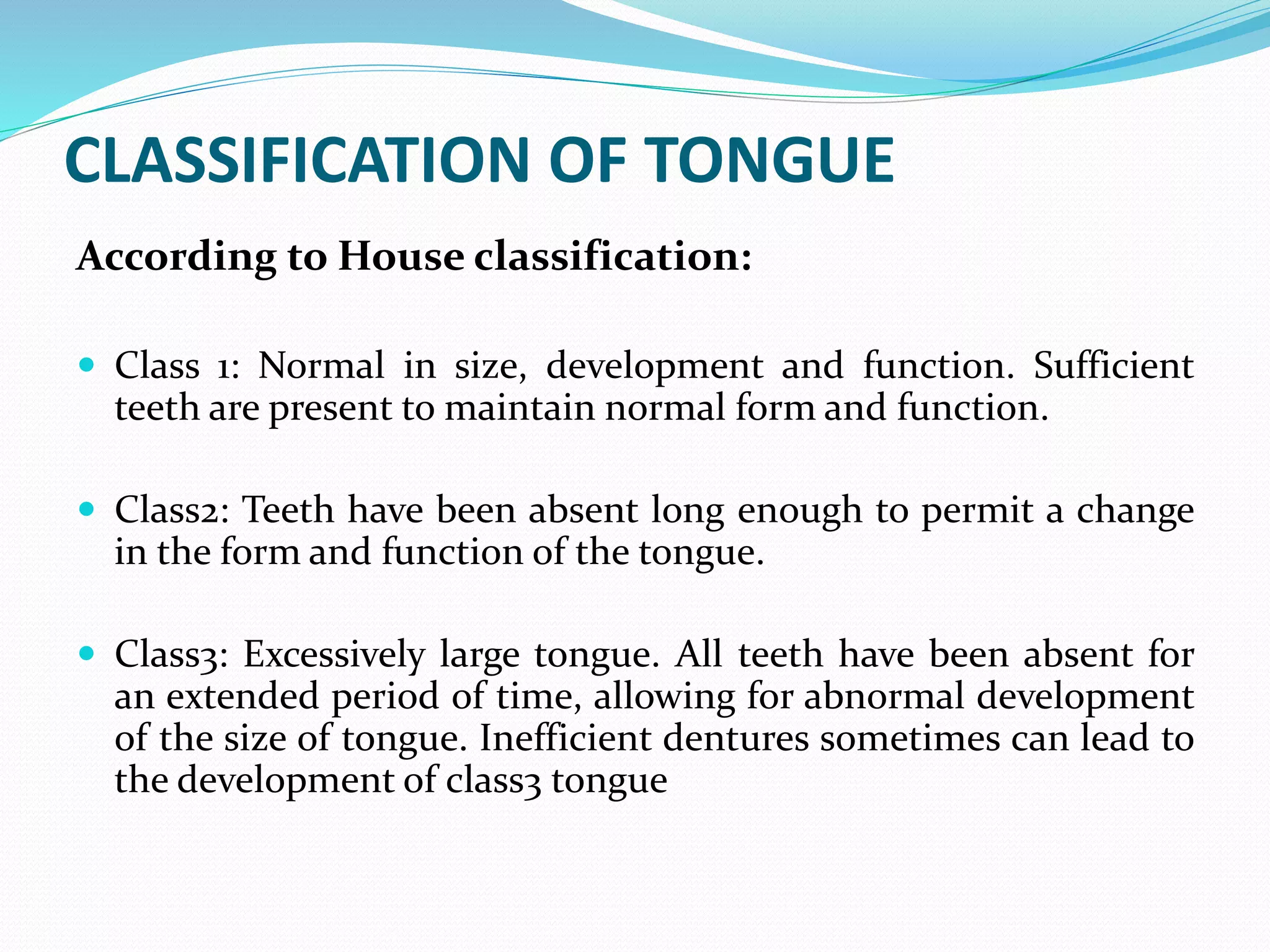
According to House classification:
 Class 1: Normal in size, development and function. Sufficient
teeth are present to maintain normal form and function.
 Class2: Teeth have been absent long enough to permit a change
in the form and function of the tongue.
 Class3: Excessively large tongue. All teeth have been absent for
an extended period of time, allowing for abnormal development
of the size of tongue. Inefficient dentures sometimes can lead to
the development of class3 tongue
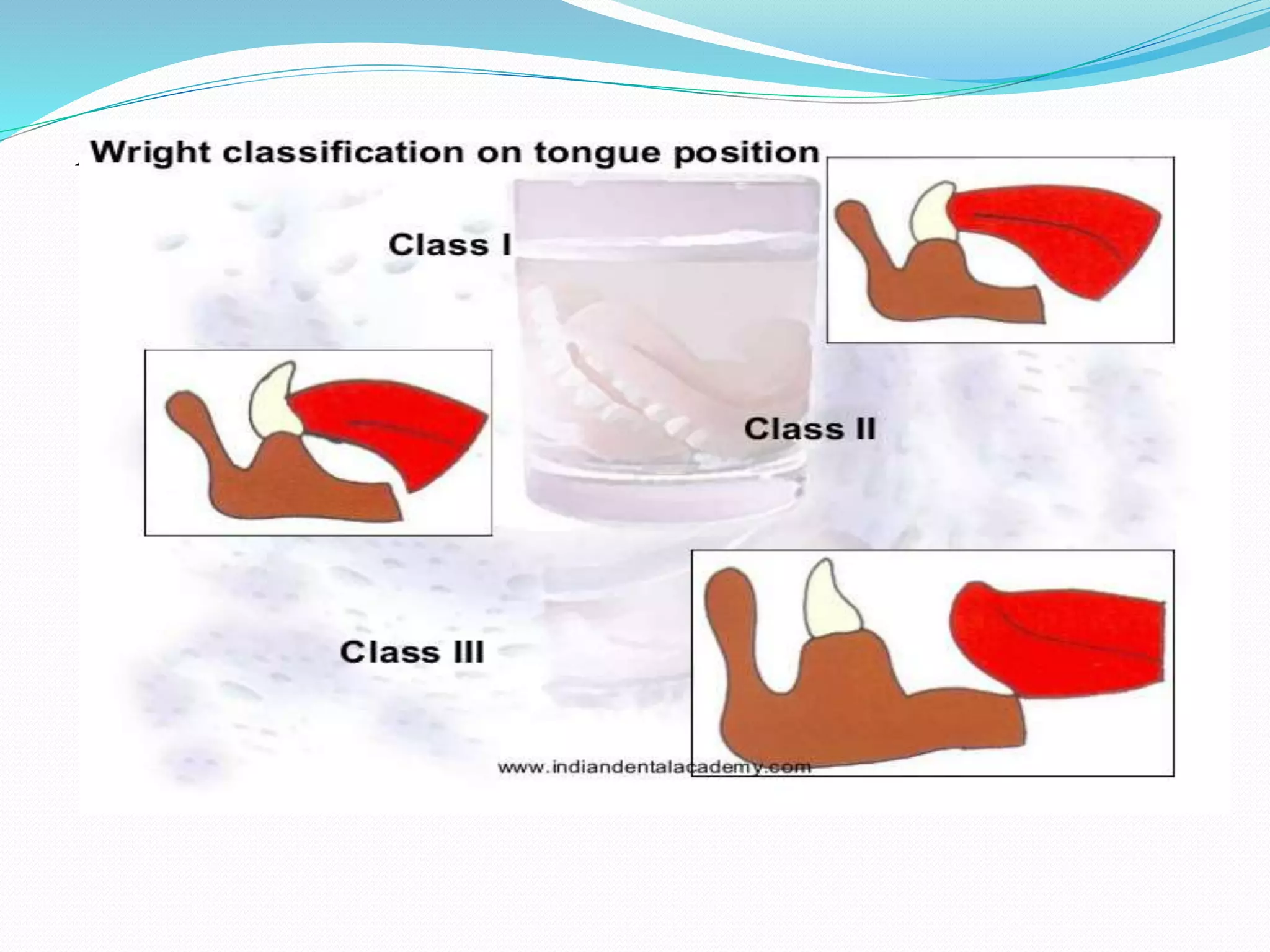
According to Wright's classification:
 Class1 : The tongue lies in the floor of mouth with tip
forward and slightly below the incisal edges of the
mandibular anterior teeth
 Class2 : The tongue is flattened and broadened, but the tip
is in normal position.
 Class3 : The tongue is retracted and depressed into the
floor of mouth with the tip curled upwards, downwards or
assimilated into body of tongue.
ROLE OF TONGUE DURING
FABRICATION AND SUCCESS OF
PROSTHESIS
 Small tongue = easy impression making but
compromised lingual seal.
 Relatively large tongue = hindrance while making
impression, but a good lingual seal is always expected
out of it.
 Tongue position is important to the prognosis of
mandibular denture.
 Suprahyoid muscles are the digastric, stylohyoid,
mylohyoid and the geniohyoid. Accessory muscles of
mastication.
 The mylohyoid and geniohyoid may influence the borders
of the mandibular denture.
 The right and left mylohyoid muscles together form the
floor of the mouth.
INFLUENCE AND ACTION OF FLOOR OF THE MOUTH
The mylohyoid muscle
• Origin:
From the whole length of mylohyoid line.
• Insertion:
Posterior fibers to the body of the hyoid bone.
Middle and anterior fibers to the median raphae.
• Nerve supply: mylohyoid nerve.
• Actions :
Elevates the floor of the mouth during swallowing.
Depress the mandible and elevate the hyoid bone.
If the denture flange is extended below and under the
mylohyoid line, it will impinge on mylohyoid muscle
and the action of the muscle can unseat the denture.
The distal-lingual extension should
extend over the retro-molar pad
and about 3 mm below the
mylohyoid ridge.
The mylohyoid muscle affects mid
& ant. Portion of the inferior
border of lingual flange.
Alveololingual sulcus
 The space between the residual ridge and the tongue which
extends from lingual frenum to the retro-mylohyoid curtain.
Anterior region
 1. Anterior region :
The middle region
 Extends from the Pre-mylohyoid fossa to the distal end
of mylohyoid ridge curving medially from body of the
mandible. The curvature is caused by prominence of
mylohyoid ridge.
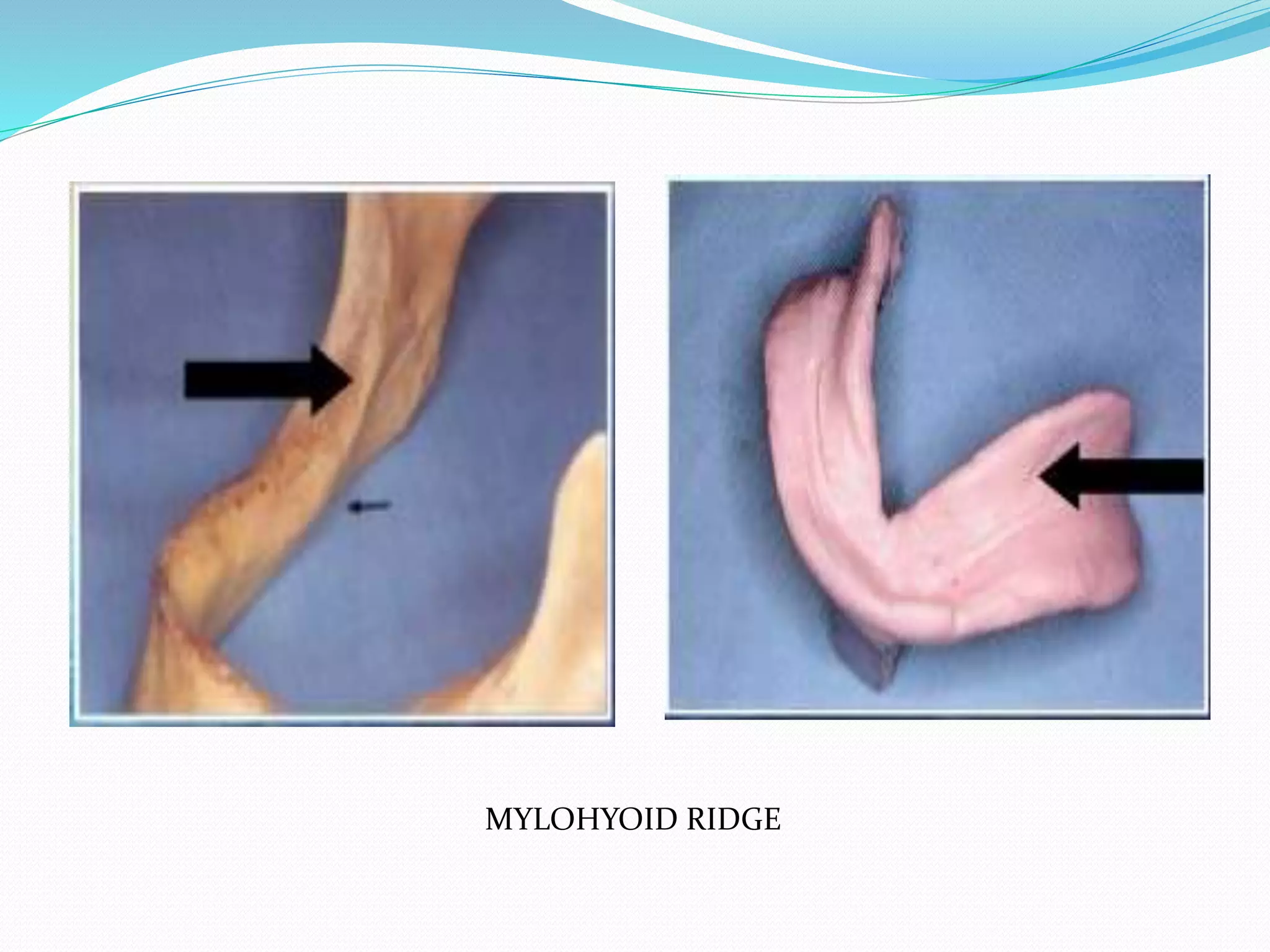
MYLOHYOID RIDGE
A slope of the lingual flange towards the tongue in the
molar region allows the mylohyoid muscle to contract
and raise the floor of the mouth without displacing the
denture.
The posterior region
 This part is the retromylohyoid space or fossa. Also
known as Lateral throat form.
 It extends from the end of the mylohyoid ridge to the
retro-mylohyoid curtain (glossopalatine and superior
constrictor muscles).
The denture border should extend posteriorly to contact the
retro-mylohyoid curtain (the posterior limit of alveololingual sulcus).
 The distal end of the
lingual flange turns
buccally to fill the
retromylohyoid fossa.
 When the lingual flange is
developed in this manner
the border has a typical ‘s’
shaped curve
 If the floor is too low, so the dentist tends to over
extend the denture flange, which leads to loss of
retention because the denture flange impinges on the
tissues.
Lateral Throat Form
LATERAL THROAT FORM
Effect of Dental prosthesis on Taste
perception( J. Pros Dent Jan.1952 vol.2 No.01)
 The sense of taste may be interrupted by the
interjection of an outside stimulus such as a denture.
 Thickness of denture, lack of rugae, insulation against
heat & cold.
 Irritation, pressure or substance on the surface of
lower denture
TONGUE SPACE
 Artificial teeth must be arranged in neutral zone.
If tongue is cramped by denture
lateral pressure exerted
Producing
instability in denture when tongue moves
How to check lack of tongue space
 Ask patient to raise tongue
If cramped
Denture rise immediately, as tongue moves
 But in lingual flange overextension
Denture movement occurs, as tongue rises
some distance
EFFECT OF TONGUE ON SPEECH
 Linguo-Dental sounds (th)
 Tip of tongue slightly bw upper & lower anterior
teeth.
 3mm space – Normal
 <3mm - Anterior teeth too far forward
- Excessive vertical overlap
 >6mm -Anterior teeth too far lingual
 Linguo-Alveolar Sounds (t, d, n, s, z)
Contact of tip of tongue with the anterior most part
of palate.
 t d if teeth far lingual
 d t if teeth far anterior
Post-insertion Speech Adaptation
 New prosthesis Difficulty in learning new motor
acts Obstruct adaptation.
 Speech adaptation to new Prosthesis 2-4 weeks
post-insertion.
 Old dentures act as a guidance.
 Bilabial, labio-dental, linguo-dental & linguo-alveolar
sounds most affected.
 Lingual flange of the mandibular denture too thick in
anterior region, faulty S sound.
 Patient must practice opening & closing while the
tongue assumes a normal position.
OCCLUSAL PLANE
According to Fenn, to obtain maximum stability of lower
denture, the occlusal plane of the lower teeth should be
very slightly below the bulk of tongue, so that tongue
performs the majority of its movements above the denture
and thus keep the denture down.
NEUTRAL ZONE
 The soft tissue that form
internal and external
boundaries of denture
base influences the
denture stability. It is to
understand and
determine the peripheral
borders, tooth position
and external contours of
denture.
EFFECT OF LINGUAL FRENUM
 In case of hypertrophic frenum: lingual frenectomy is done.
 In case ankyloglossia exist with a heavy alveolar
attachment, then detachment of fibers may be necessary to
ensure clearance.
 In patients of lingual frenectomy, the denture should be
made before the surgery, to prevent relapse, as this denture
acts as a stent.
 Careful clearance is needed, as lingual frenum is attached
to tongue and inadequate clearance may result in LOSS OF
SEAL and a loose UNSTABLE denture.
USE OF TONGUE FOR RECORDING CENTRIC
RELATION IN EDENTULOUS PATIENTS
J Prosthet Dent 1999; 82: 369-70.
PROSTHETIC RECONSTRUCTION OF
MANDIBULAR TONGUE
 A total glossectomy or laryngectomy results in loss of basic
vital functions and loss of speech.
 In these patients fabrication of a mandibular tongue prosthesis
can be done.
1. Edentulous maxilla. 2. Edentulous mandible, floor of mouth, surgical defect. 3. Final impressions using
impression wax. 4. Mandibular denture showing elliptical acrylic retention button and posterior platforms for posterior
support of the tongue prosthesis. 5. Final tongue prosthesis with mandibular denture. 6. Tongue prosthesis attached to
mandibular denture. 7. Prosthesis inserted. 8. Dentures in occlusion.
Journal of Prosthodontic , Vol 1, No. 2 (December: 1992: p 171-173
 The tongue prosthesis is not mobile, but articulation is
improved by the fact that the prosthesis takes up space, thus
changing resonance of the oral cavity with certain sounds.
 Besides improving speech, the patient is able to crush food
against the palate, aiding mastication.
 The posterior channeled shape of the tongue assists in
deglutition.
 In this case, the patient was highly motivated, which helped
prognosis considerably.
.
SUMMARY AND CONCLUSION
 Knowledge of anatomy, physiology and functions of tongue is an
essence to understand the complex morphological and
functional changes in the tongue with aging or with complete
and partial edentulism.
 This knowledge will help us to reach optimal prosthetic success,
as tongue plays significant and perhaps the dictating role in
affecting stability and retention of prosthesis.
 So we can conclude that a proper diagnose of tongue is must
before proceeding and planning any type of dental procedures.
REFRENCES
 CUNNINGHAM’S manual of practical anatomy, Oxford.
 INDERBIR SINGH, Textbook of Human Embryology, 6th edition.1996,
Macmillan India ltd.
 ORBAN’S, Oral Histology & Embryology, 10th edition, C.B.S Publishers
& Distributors.
 JOHN J. SHARRY Complete Denture Prosthodontics 3rd edition, Mc
Graw Hill Book Company.
 ZARB-BOLENDER Prosthodontics Treatment For Edentulous Patients
12th edition, Elsevier.
 BERNARD LEVIN Impressions for Complete Dentures, Quintessence
Publishing Company.
 SHELDON WINKLER Essentials of Complete Denture Prosthodontics 3rd
edition, A.I.T.B.S Publishers
 FENN, LIDDELOW & GIMSON’S Clinical Dental Prosthetics. Mosby.
 JOHN BEUMER, Maxillofacial rehabilitation. Mosby
 JEROME C. STRAIN: Complete Dentures & taste perception,
J.Prosthet Dent: vol.2 No. 01, Jan 1952
 MAJID BISSASU: Use of tongue for recording centric relation for
edentulous patients: J.Prosthet Dent 82:369-70, 1999.
 MAURICE W. BELSKY: Prosthetic reconstruction of mandibular Tongue
prosthesis: J. Prosthet Dent , Vol 1, No. 2 December: 1992: p 171-173
THANK YOU

Tongue & its prosthetic coniderations seminar

  • 1.
    PRESENTED BY Dr. ADILFAYAZ PG 1ST YEAR
  • 2.
    CONTENTS  INTRODUCTION  GROWTHAND DEVELOPMENT  GROSS ANATOMY OF TONGUE  ---- MUSCLES OF TONGUE  ---- BLOOD SUPPLY  ---- INNERVATION OF TONGUE  ---- TASTE BUDS  HISTOLOGICAL FEATURES  AGE CHANGES  APPLIED ANATOMY  PROSTHETIC CONSIDERATIONS  SUMMARY AND CONCLUSION  REFERENCES
  • 3.
    Tongue is barely threeinches long , but it can kill a person six feet tall
  • 4.
    INTRODUCTION  A highlymobile muscular organ situated in the floor of mouth.  Associated with functions of stomato-gnathic system like taste, speech, mastication and deglutition.
  • 7.
    ANATOMY OF TONGUE DIVIDEDINTO TWO PARTS  SUPERIOR (DORSAL)  INFERIOR (VENTRAL)
  • 8.
  • 11.
    The four typesof papilla are :  FILIFORM  FUNGIFORM  FOLIATE  CIRCUMVALLATE
  • 13.
     All exceptthe filiform papillae bear taste buds.  Papillae are best observed when the tongue is dry
  • 14.
    MUSCLES OF TONGUE DIVIDEDINTO TWO GROUPS:  EXTRINSIC GROUP  INTRINSIC GROUP
  • 15.
    INTRINSIC MUSCLES  Superiorlongitudinal: It shortens the tongue and makes the dorsum concave.  Inferior longitudinal: It shortens the tongue and makes the dorsum convex.  Transverse: It helps in narrowing and elongation of tongue (increase in height of tongue).  Verticalis: It broadens the tongue and causes flattening of tongue.
  • 17.
    EXTRINSIC GROUP The extrinsicmusculature consists of four pairs of muscles, namely  Genioglossus  Hyoglossus  Styloglossus  Palatoglossus.
  • 19.
    BLOOD SUPPLY OFTONGUE ARTERIAL SUPPLY:  from lingual artery, which is branch of External Carotid Artery.
  • 21.
    VENOUS DRAINAGE  ByDeep Lingual Vein.
  • 22.
    LYMPHATIC DRAINAGE:  Tipsdrain bilaterally to submental nodes  Anterior 2/3rd drains unilaterally into right and left Submandibular nodes.  Posterior 1/3rd drains bilaterally to Jugulo omohyoid nodes
  • 24.
     .Lymphatics donot accompany the blood vessels.  Tip of the tongue presents richest lymph drainage. A cancer affecting the tip spreads to all cervical lymph nodes of both sides.
  • 25.
    NERVE SUPPLY  MOTOR:  SENSORY :  General sensory  Special sensory
  • 27.
    TASTE BUDS Distributed in Inner wall of trough surrounding vallate papillae  Folds of foliate papillae  Posterior surface of fungiform papillae  Tip and lateral borders of tongue.
  • 30.
  • 31.
    APPLIED ANATOMY  CHANGESASSOCIATED WITH PARTIAL AND COMPLETE EDENTULISM  CLASSIFICATION OF TONGUE  TONGUE AND STABILITY OF COMPLETE DENTURES  NEUTRAL ZONE  TONGUE PROSTHESIS
  • 32.
    CHANGES ASSOCIATED WITHPARTIAL & COMPLETE EDENTULISM  Tongue size and position.  If patient has been without teeth or prostheses for a long time or has worn maxillary denture against lower anterior teeth only, then the tongue can become enlarged and powerful causing instability of dentures.
  • 33.
    CLASSIFICATION OF TONGUE Accordingto House classification:  Class 1: Normal in size, development and function. Sufficient teeth are present to maintain normal form and function.  Class2: Teeth have been absent long enough to permit a change in the form and function of the tongue.  Class3: Excessively large tongue. All teeth have been absent for an extended period of time, allowing for abnormal development of the size of tongue. Inefficient dentures sometimes can lead to the development of class3 tongue
  • 34.
    According to Wright'sclassification:  Class1 : The tongue lies in the floor of mouth with tip forward and slightly below the incisal edges of the mandibular anterior teeth  Class2 : The tongue is flattened and broadened, but the tip is in normal position.  Class3 : The tongue is retracted and depressed into the floor of mouth with the tip curled upwards, downwards or assimilated into body of tongue.
  • 35.
    ROLE OF TONGUEDURING FABRICATION AND SUCCESS OF PROSTHESIS
  • 36.
     Small tongue= easy impression making but compromised lingual seal.  Relatively large tongue = hindrance while making impression, but a good lingual seal is always expected out of it.
  • 37.
     Tongue positionis important to the prognosis of mandibular denture.
  • 38.
     Suprahyoid musclesare the digastric, stylohyoid, mylohyoid and the geniohyoid. Accessory muscles of mastication.  The mylohyoid and geniohyoid may influence the borders of the mandibular denture.  The right and left mylohyoid muscles together form the floor of the mouth. INFLUENCE AND ACTION OF FLOOR OF THE MOUTH
  • 39.
    The mylohyoid muscle •Origin: From the whole length of mylohyoid line. • Insertion: Posterior fibers to the body of the hyoid bone. Middle and anterior fibers to the median raphae. • Nerve supply: mylohyoid nerve. • Actions : Elevates the floor of the mouth during swallowing. Depress the mandible and elevate the hyoid bone.
  • 40.
    If the dentureflange is extended below and under the mylohyoid line, it will impinge on mylohyoid muscle and the action of the muscle can unseat the denture.
  • 41.
    The distal-lingual extensionshould extend over the retro-molar pad and about 3 mm below the mylohyoid ridge. The mylohyoid muscle affects mid & ant. Portion of the inferior border of lingual flange.
  • 42.
    Alveololingual sulcus  Thespace between the residual ridge and the tongue which extends from lingual frenum to the retro-mylohyoid curtain.
  • 44.
    Anterior region  1.Anterior region :
  • 45.
    The middle region Extends from the Pre-mylohyoid fossa to the distal end of mylohyoid ridge curving medially from body of the mandible. The curvature is caused by prominence of mylohyoid ridge.
  • 46.
  • 47.
    A slope ofthe lingual flange towards the tongue in the molar region allows the mylohyoid muscle to contract and raise the floor of the mouth without displacing the denture.
  • 48.
    The posterior region This part is the retromylohyoid space or fossa. Also known as Lateral throat form.  It extends from the end of the mylohyoid ridge to the retro-mylohyoid curtain (glossopalatine and superior constrictor muscles).
  • 49.
    The denture bordershould extend posteriorly to contact the retro-mylohyoid curtain (the posterior limit of alveololingual sulcus).
  • 50.
     The distalend of the lingual flange turns buccally to fill the retromylohyoid fossa.  When the lingual flange is developed in this manner the border has a typical ‘s’ shaped curve
  • 51.
     If thefloor is too low, so the dentist tends to over extend the denture flange, which leads to loss of retention because the denture flange impinges on the tissues.
  • 52.
  • 54.
  • 56.
    Effect of Dentalprosthesis on Taste perception( J. Pros Dent Jan.1952 vol.2 No.01)  The sense of taste may be interrupted by the interjection of an outside stimulus such as a denture.  Thickness of denture, lack of rugae, insulation against heat & cold.  Irritation, pressure or substance on the surface of lower denture
  • 57.
    TONGUE SPACE  Artificialteeth must be arranged in neutral zone. If tongue is cramped by denture lateral pressure exerted Producing instability in denture when tongue moves
  • 58.
    How to checklack of tongue space  Ask patient to raise tongue If cramped Denture rise immediately, as tongue moves  But in lingual flange overextension Denture movement occurs, as tongue rises some distance
  • 59.
    EFFECT OF TONGUEON SPEECH  Linguo-Dental sounds (th)  Tip of tongue slightly bw upper & lower anterior teeth.  3mm space – Normal  <3mm - Anterior teeth too far forward - Excessive vertical overlap  >6mm -Anterior teeth too far lingual
  • 61.
     Linguo-Alveolar Sounds(t, d, n, s, z) Contact of tip of tongue with the anterior most part of palate.  t d if teeth far lingual  d t if teeth far anterior
  • 62.
    Post-insertion Speech Adaptation New prosthesis Difficulty in learning new motor acts Obstruct adaptation.  Speech adaptation to new Prosthesis 2-4 weeks post-insertion.  Old dentures act as a guidance.
  • 63.
     Bilabial, labio-dental,linguo-dental & linguo-alveolar sounds most affected.  Lingual flange of the mandibular denture too thick in anterior region, faulty S sound.  Patient must practice opening & closing while the tongue assumes a normal position.
  • 64.
    OCCLUSAL PLANE According toFenn, to obtain maximum stability of lower denture, the occlusal plane of the lower teeth should be very slightly below the bulk of tongue, so that tongue performs the majority of its movements above the denture and thus keep the denture down.
  • 65.
    NEUTRAL ZONE  Thesoft tissue that form internal and external boundaries of denture base influences the denture stability. It is to understand and determine the peripheral borders, tooth position and external contours of denture.
  • 66.
    EFFECT OF LINGUALFRENUM  In case of hypertrophic frenum: lingual frenectomy is done.  In case ankyloglossia exist with a heavy alveolar attachment, then detachment of fibers may be necessary to ensure clearance.  In patients of lingual frenectomy, the denture should be made before the surgery, to prevent relapse, as this denture acts as a stent.
  • 67.
     Careful clearanceis needed, as lingual frenum is attached to tongue and inadequate clearance may result in LOSS OF SEAL and a loose UNSTABLE denture.
  • 68.
    USE OF TONGUEFOR RECORDING CENTRIC RELATION IN EDENTULOUS PATIENTS J Prosthet Dent 1999; 82: 369-70.
  • 69.
    J Prosthet Dent1999; 82: 369-70.
  • 70.
    PROSTHETIC RECONSTRUCTION OF MANDIBULARTONGUE  A total glossectomy or laryngectomy results in loss of basic vital functions and loss of speech.  In these patients fabrication of a mandibular tongue prosthesis can be done.
  • 71.
    1. Edentulous maxilla.2. Edentulous mandible, floor of mouth, surgical defect. 3. Final impressions using impression wax. 4. Mandibular denture showing elliptical acrylic retention button and posterior platforms for posterior support of the tongue prosthesis. 5. Final tongue prosthesis with mandibular denture. 6. Tongue prosthesis attached to mandibular denture. 7. Prosthesis inserted. 8. Dentures in occlusion. Journal of Prosthodontic , Vol 1, No. 2 (December: 1992: p 171-173
  • 72.
     The tongueprosthesis is not mobile, but articulation is improved by the fact that the prosthesis takes up space, thus changing resonance of the oral cavity with certain sounds.  Besides improving speech, the patient is able to crush food against the palate, aiding mastication.  The posterior channeled shape of the tongue assists in deglutition.  In this case, the patient was highly motivated, which helped prognosis considerably.
  • 73.
  • 74.
    SUMMARY AND CONCLUSION Knowledge of anatomy, physiology and functions of tongue is an essence to understand the complex morphological and functional changes in the tongue with aging or with complete and partial edentulism.  This knowledge will help us to reach optimal prosthetic success, as tongue plays significant and perhaps the dictating role in affecting stability and retention of prosthesis.  So we can conclude that a proper diagnose of tongue is must before proceeding and planning any type of dental procedures.
  • 75.
    REFRENCES  CUNNINGHAM’S manualof practical anatomy, Oxford.  INDERBIR SINGH, Textbook of Human Embryology, 6th edition.1996, Macmillan India ltd.  ORBAN’S, Oral Histology & Embryology, 10th edition, C.B.S Publishers & Distributors.  JOHN J. SHARRY Complete Denture Prosthodontics 3rd edition, Mc Graw Hill Book Company.  ZARB-BOLENDER Prosthodontics Treatment For Edentulous Patients 12th edition, Elsevier.
  • 76.
     BERNARD LEVINImpressions for Complete Dentures, Quintessence Publishing Company.  SHELDON WINKLER Essentials of Complete Denture Prosthodontics 3rd edition, A.I.T.B.S Publishers  FENN, LIDDELOW & GIMSON’S Clinical Dental Prosthetics. Mosby.  JOHN BEUMER, Maxillofacial rehabilitation. Mosby  JEROME C. STRAIN: Complete Dentures & taste perception, J.Prosthet Dent: vol.2 No. 01, Jan 1952  MAJID BISSASU: Use of tongue for recording centric relation for edentulous patients: J.Prosthet Dent 82:369-70, 1999.  MAURICE W. BELSKY: Prosthetic reconstruction of mandibular Tongue prosthesis: J. Prosthet Dent , Vol 1, No. 2 December: 1992: p 171-173
  • 77.

Editor's Notes

  • #60 Voice principally produced—larynx, while tongue by constantly changing its shape & position of contact with teeth, alveolar process—gives its sound form & its qualities