Airstream Mechanisms Mechanism
By
Saad basim Dhannoon
Airstream Mechanisms Mechanism
The airstream mechanism is the method by which airflow is
created in the vocal tract . Air coming out of the lungs is the
source of power in nearly all speech sounds. The lungs are
sponge-like tissues within a cavity formed by the rib cage and
the diaphragm (a dome-shaped muscle ). When the diaphragm
contracts, it enlarges the lung cavity so that air flows into the
lungs. The lung cavity can also be enlarged by raising the rib
cage, a normal way of taking a deep breath in. Air can be pushed
out of the lungs by pulling the rib cage down, or by pushing the
diaphragm upward by contracting the abdominal muscles.
Types of Air Stream Mechanism
1- Pulmonic Airstream Mechanism:
The pulmonic air-stream mechanism is the one which must
be considered first; it consists of the lungs and the
respiratory muscles. The latter move the walls of the lungs,
which form the initiator,
A-egressive pulmonic air-stream: When lung air is
pushed out, we say that there is a an egressive pulmonic
airstream mechanism. It is this air-stream mechanism
which is the basis of almost all human speech and it is the
normal way of talking or singing
B-The ingressive pulmonic air-stream : the air is drawn into
the lungs which can be observed to occur in various non-
linguistic acts of the organs of speech, such as a yawn, or most
kinds of snoring. Linguistic use of an ingressive pulmonic air-
stream is certainly not common, but it can nevertheless be
found in many parts of the world in a variety of circumstances.
Thus in English the first part of the word yes, spoken in a
somewhat off-hand manner, is often pronounced by many
people with an ingressive pulmonic air-stream, the final -s
being egressive.
2- Glottalic Airstream Mechanism.
The larynx itself, with the glottis firmly closed, is the
initiator. The larynx is provided with muscles by means of
which it can be moved up or down in the throat in which
the larynx will act exactly as a plunger in a syringe, it has
two types:
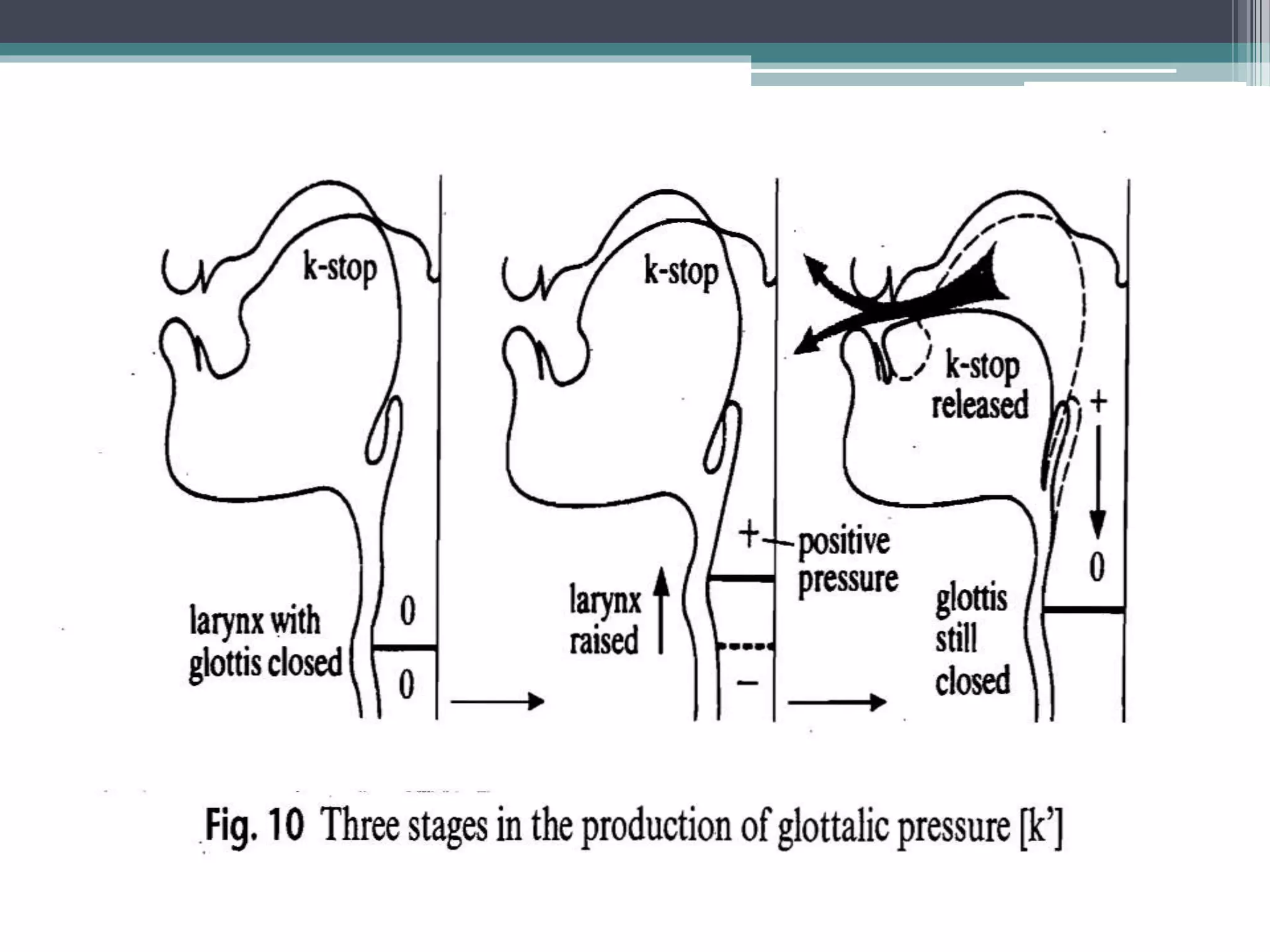
A- egressive glottalic Airstream :
The glottis is closed, the larynx will move upwards it will
push air out producing ejectives , An egressive glottalic
airstream mechanism occurs in many languages. Such as
Native American languages, African languages, and
languages spoken in the Caucasus and Hausa. In Hausa,
stops made with a glottalic egressive airstream mechanism
are called ejectives. The diacritic indicating an ejective is an
apostrophe [ ' ] placed after a symbol. As the velaric ejective
/k'/.
In Hausa, the velar closure and the glottal closure are
formed at about the same time. Then, when the vocal folds
are tightly together, the larynx is pulled upward, about 1
cm. In this way it acts like a piston, compressing the air in
the pharynx. The compressed air is released by lowering
the back of the tongue while the glottal stop is maintained,
producing a sound with a quality different from that in an
English [ k ]. Very shortly after the release of the velar
closure, the glottal stop is released and the voicing for the
following vowel begins.
Some people make ejectives at the ends of words in
English, particularly in sentence final position. You might
notice this in words such as bike with a glottal stop
accompanying the final [ k ]. If the velar stop is released
while the glottal stop is still being held, a weak ejective
may be heard.
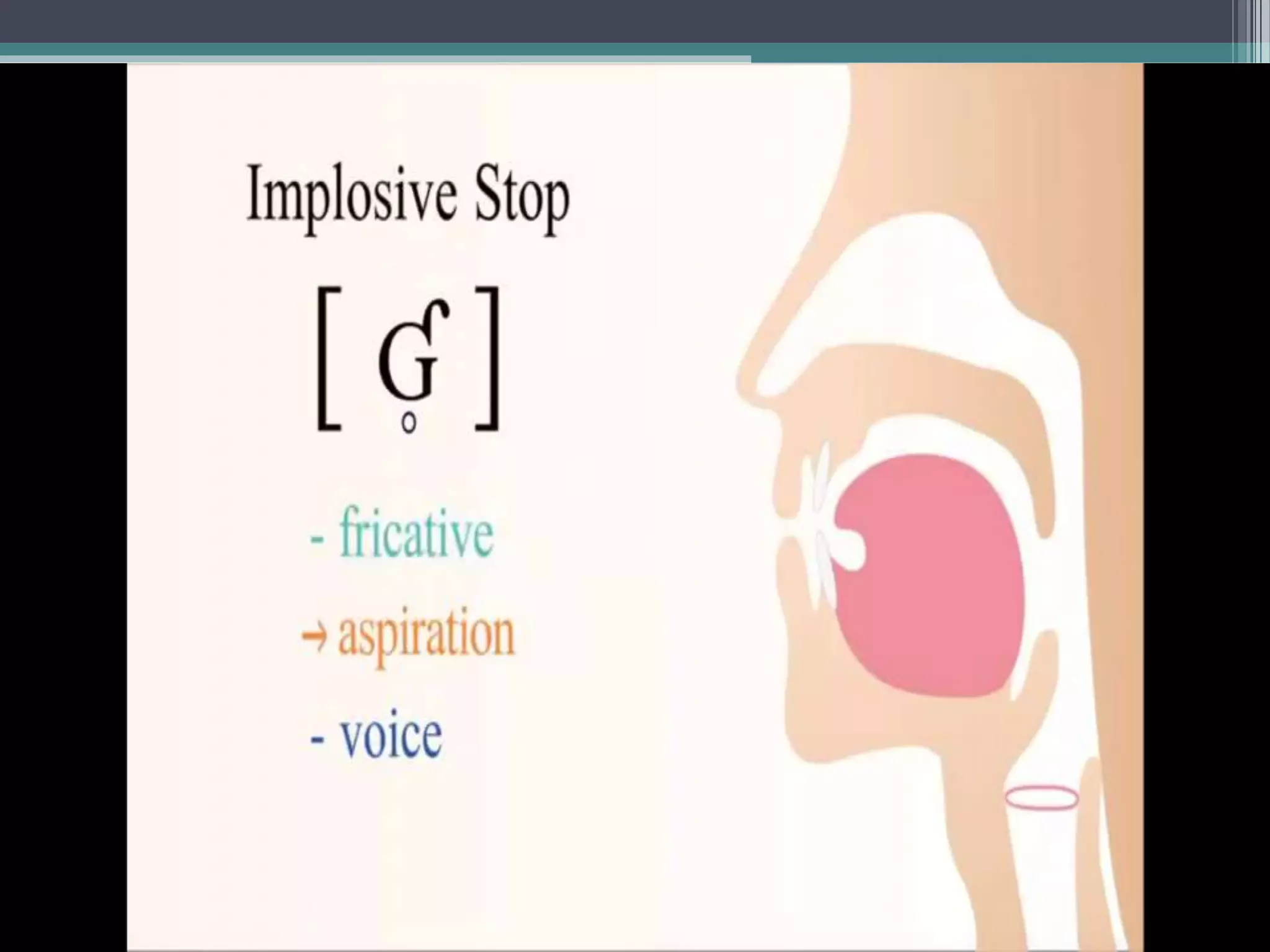
B- An ingressive glottalic airstream mechanism: It is also
possible to use a downward movement of the larynx to suck air
inward. Stops made with an ingressive glottalic airstream
mechanism are called implosives. In the production of
implosives, the downward-moving larynx is not usually
completely closed. The air in the lungs is still being pushed out,
and some of it passes between the vocal folds, keeping them in
motion so that the sound is voiced. The movements in a voiced
bilabial implosive of this kind occurs in Sindhi (an Indo-Aryan
language spoken in India and Pakistan). Implosives sometimes
occur as allophones in English, particularly in emphatic
articulations of bilabial stops, as in absolutely billions and
billions.
In all the implosives we have measured, the articulatory
closure—in this case, the lips coming together—occurs
first. The downward movement of the glottis, which
occurs next, is like that of a piston that would cause a
reduction in the pressure of the air in the oral tract. But
it is a leaky piston in that the air in the lungs continues
to flow through the glottis. As a result, the pressure of
the air in the oral tract is not affected very much.
3-The Velaric Air-Stream Mechanism
Its initiator is constituted by the back part of the
tongue lifted up so that it comes firmly into contact with
the velum , and it is then pushed forward in the mouth
(still keeping it in contact with the velum) to make an
egressive velaric air-stream, an egressive velaric
mechanism does not seem to be used to produce any part
of human speech.
or pulled back to make an ingressive velaric air-
stream which produces clicks . Because the initiator
is this closure of the tongue against the velum, the
mechanism is called the velaric air-stream
mechanism.
‘Clicks’ occur commonly in many parts of the World,
however, as interjections and they are found, in certain
languages in Africa, the best known of which are perhaps
Zulu, Hottentot, and Bushman.
The sound that English-speakers use to express
annoyance, and represent in writing as tut tut or tsk
tsk, is made by an ingressive velaric air-stream,
and so also is the sound made to encourage horses (the
‘gee-up’ click).
airstream mechanism.pptx

airstream mechanism.pptx

  • 1.
  • 2.
    Airstream Mechanisms Mechanism Theairstream mechanism is the method by which airflow is created in the vocal tract . Air coming out of the lungs is the source of power in nearly all speech sounds. The lungs are sponge-like tissues within a cavity formed by the rib cage and the diaphragm (a dome-shaped muscle ). When the diaphragm contracts, it enlarges the lung cavity so that air flows into the lungs. The lung cavity can also be enlarged by raising the rib cage, a normal way of taking a deep breath in. Air can be pushed out of the lungs by pulling the rib cage down, or by pushing the diaphragm upward by contracting the abdominal muscles.
  • 3.
    Types of AirStream Mechanism 1- Pulmonic Airstream Mechanism: The pulmonic air-stream mechanism is the one which must be considered first; it consists of the lungs and the respiratory muscles. The latter move the walls of the lungs, which form the initiator, A-egressive pulmonic air-stream: When lung air is pushed out, we say that there is a an egressive pulmonic airstream mechanism. It is this air-stream mechanism which is the basis of almost all human speech and it is the normal way of talking or singing
  • 4.
    B-The ingressive pulmonicair-stream : the air is drawn into the lungs which can be observed to occur in various non- linguistic acts of the organs of speech, such as a yawn, or most kinds of snoring. Linguistic use of an ingressive pulmonic air- stream is certainly not common, but it can nevertheless be found in many parts of the world in a variety of circumstances. Thus in English the first part of the word yes, spoken in a somewhat off-hand manner, is often pronounced by many people with an ingressive pulmonic air-stream, the final -s being egressive.
  • 7.
    2- Glottalic AirstreamMechanism. The larynx itself, with the glottis firmly closed, is the initiator. The larynx is provided with muscles by means of which it can be moved up or down in the throat in which the larynx will act exactly as a plunger in a syringe, it has two types: A- egressive glottalic Airstream : The glottis is closed, the larynx will move upwards it will push air out producing ejectives , An egressive glottalic airstream mechanism occurs in many languages. Such as Native American languages, African languages, and languages spoken in the Caucasus and Hausa. In Hausa, stops made with a glottalic egressive airstream mechanism are called ejectives. The diacritic indicating an ejective is an apostrophe [ ' ] placed after a symbol. As the velaric ejective /k'/.
  • 10.
    In Hausa, thevelar closure and the glottal closure are formed at about the same time. Then, when the vocal folds are tightly together, the larynx is pulled upward, about 1 cm. In this way it acts like a piston, compressing the air in the pharynx. The compressed air is released by lowering the back of the tongue while the glottal stop is maintained, producing a sound with a quality different from that in an English [ k ]. Very shortly after the release of the velar closure, the glottal stop is released and the voicing for the following vowel begins. Some people make ejectives at the ends of words in English, particularly in sentence final position. You might notice this in words such as bike with a glottal stop accompanying the final [ k ]. If the velar stop is released while the glottal stop is still being held, a weak ejective may be heard.
  • 12.
    B- An ingressiveglottalic airstream mechanism: It is also possible to use a downward movement of the larynx to suck air inward. Stops made with an ingressive glottalic airstream mechanism are called implosives. In the production of implosives, the downward-moving larynx is not usually completely closed. The air in the lungs is still being pushed out, and some of it passes between the vocal folds, keeping them in motion so that the sound is voiced. The movements in a voiced bilabial implosive of this kind occurs in Sindhi (an Indo-Aryan language spoken in India and Pakistan). Implosives sometimes occur as allophones in English, particularly in emphatic articulations of bilabial stops, as in absolutely billions and billions.
  • 14.
    In all theimplosives we have measured, the articulatory closure—in this case, the lips coming together—occurs first. The downward movement of the glottis, which occurs next, is like that of a piston that would cause a reduction in the pressure of the air in the oral tract. But it is a leaky piston in that the air in the lungs continues to flow through the glottis. As a result, the pressure of the air in the oral tract is not affected very much.
  • 16.
    3-The Velaric Air-StreamMechanism Its initiator is constituted by the back part of the tongue lifted up so that it comes firmly into contact with the velum , and it is then pushed forward in the mouth (still keeping it in contact with the velum) to make an egressive velaric air-stream, an egressive velaric mechanism does not seem to be used to produce any part of human speech. or pulled back to make an ingressive velaric air- stream which produces clicks . Because the initiator is this closure of the tongue against the velum, the mechanism is called the velaric air-stream mechanism.
  • 17.
    ‘Clicks’ occur commonlyin many parts of the World, however, as interjections and they are found, in certain languages in Africa, the best known of which are perhaps Zulu, Hottentot, and Bushman. The sound that English-speakers use to express annoyance, and represent in writing as tut tut or tsk tsk, is made by an ingressive velaric air-stream, and so also is the sound made to encourage horses (the ‘gee-up’ click).