
Created By :
UzlifatFatmawati, S.Pd
Riki Hidayatullah
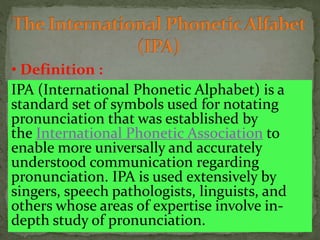
IPA (International Phonetic Alphabet) is a
standard set of symbols used for notating
pronunciation that was established by
the International Phonetic Association to
enable more universally and accurately
understood communication regarding
pronunciation. IPA is used extensively by
singers, speech pathologists, linguists, and
others whose areas of expertise involve in-
depth study of pronunciation.
• Definition :
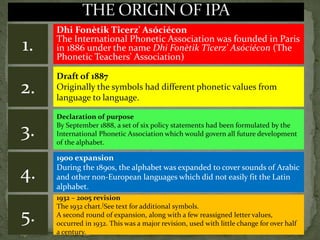
Dhi Fonètik Tîcerz' Asóciécon
The International Phonetic Association was founded in Paris
in 1886 under the name Dhi Fonètik Tîcerz' Asóciécon (The
Phonetic Teachers' Association)
1.
2.
Draft of 1887
Originally the symbols had different phonetic values from
language to language.
Declaration of purpose
By September 1888, a set of six policy statements had been formulated by the
International Phonetic Association which would govern all future development
of the alphabet.
3.
1900 expansion
During the 1890s, the alphabet was expanded to cover sounds of Arabic
and other non-European languages which did not easily fit the Latin
alphabet.
4.
1932 – 2005 revision
The 1932 chart.[See text for additional symbols.
A second round of expansion, along with a few reassigned letter values,
occurred in 1932. This was a major revision, used with little change for over half
a century.
5.
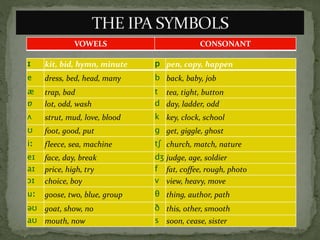
ɪ kit, bid, hymn, minute p pen, copy, happen
e dress, bed, head, many b back, baby, job
æ trap, bad t tea, tight, button
ɒ lot, odd, wash d day, ladder, odd
ʌ strut, mud, love, blood k key, clock, school
ʊ foot, good, put g get, giggle, ghost
iː fleece, sea, machine tʃ church, match, nature
eɪ face, day, break dʒ judge, age, soldier
aɪ price, high, try f fat, coffee, rough, photo
ɔɪ choice, boy v view, heavy, move
uː goose, two, blue, group θ thing, author, path
əʊ goat, show, no ð this, other, smooth
aʊ mouth, now s soon, cease, sister
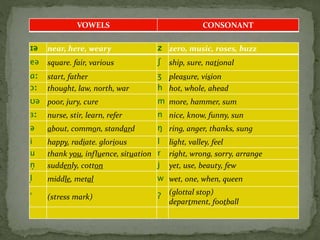
VOWELS CONSONANT
ɪə near, here, weary z zero, music, roses, buzz
eə square. fair, various ʃ ship, sure, national
ɑː start, father ʒ pleasure, vision
ɔː thought, law, north, war h hot, whole, ahead
ʊə poor, jury, cure m more, hammer, sum
ɜː nurse, stir, learn, refer n nice, know, funny, sun
ə about, common, standard ŋ ring, anger, thanks, sung
i happy, radiate. glorious l light, valley, feel
u thank you, influence, situation r right, wrong, sorry, arrange
n̩ suddenly, cotton j yet, use, beauty, few
l̩ middle, metal w wet, one, when, queen
ˈ (stress mark) ʔ
(glottal stop)
department, football
VOWELS CONSONANT
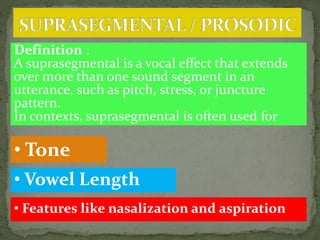
Definition :
A suprasegmental is a vocal effect that extends
over more than one sound segment in an
utterance, such as pitch, stress, or juncture
pattern.
In contexts, suprasegmental is often used for
• Tone
• Vowel Length
• Features like nasalization and aspiration
Definition :
A syllable is the sound of a vowel (a, e, i, o, u) that is created
when pronouncing a word.
The letter 'y' can be counted as a vowel, only if it creates the sound of a
vowel (a, e, i, o, u). For example: fry, try, cry, & dry
Some words have two (or more) vowels next to each other. Other words
have vowels that are silent.
The number of times that you hear the sound of a vowel (a, e, i, o, u) is
equal to the number of syllables the word has.
•
•
•
•
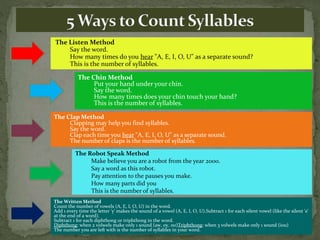
The Listen Method
Say the word.
How many times do you hear "A, E, I, O, U" as a separate sound?
This is the number of syllables.
The Chin Method
Put your hand under your chin.
Say the word.
How many times does your chin touch your hand?
This is the number of syllables.
The Clap Method
Clapping may help you find syllables.
Say the word.
Clap each time you hear "A, E, I, O, U" as a separate sound.
The number of claps is the number of syllables.
The Robot Speak Method
Make believe you are a robot from the year 2000.
Say a word as this robot.
Pay attention to the pauses you make.
How many parts did you
This is the number of syllables.
The Written Method
Count the number of vowels (A, E, I, O, U) in the word.
Add 1 every time the letter 'y' makes the sound of a vowel (A, E, I, O, U).Subtract 1 for each silent vowel (like the silent 'e'
at the end of a word).
Subtract 1 for each diphthong or triphthong in the word.
Diphthong: when 2 volwels make only 1 sound (aw, oy, oo)Triphthong: when 3 volwels make only 1 sound (iou)
The number you are left with is the number of syllables in your word.
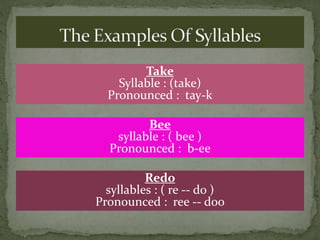
Take
Syllable : (take)
Pronounced : tay-k
Bee
syllable : ( bee )
Pronounced : b-ee
Redo
syllables : ( re -- do )
Pronounced : ree -- doo
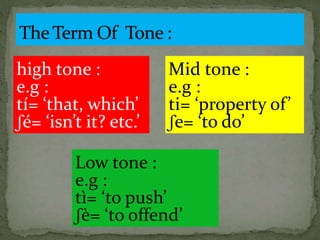
Tone is Pressure is high or low
tone pronunciation of a word.
high tone :
e.g :
tí= ‘that, which’
ʃé= ‘isn’t it? etc.’
Mid tone :
e.g :
ti= ‘property of’
ʃe= ‘to do’
Low tone :
e.g :
tì= ‘to push’
ʃè= ‘to offend’
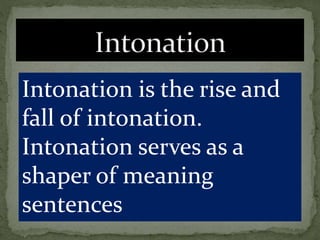
Intonation is the rise and
fall of intonation.
Intonation serves as a
shaper of meaning
sentences
Example :
-Go (let me know)
-Go (shoo)
Phonetic 2

Phonetic 2

  • 1.
    Created By : UzlifatFatmawati,S.Pd Riki Hidayatullah
  • 2.
    IPA (International PhoneticAlphabet) is a standard set of symbols used for notating pronunciation that was established by the International Phonetic Association to enable more universally and accurately understood communication regarding pronunciation. IPA is used extensively by singers, speech pathologists, linguists, and others whose areas of expertise involve in- depth study of pronunciation. • Definition :
  • 3.
    Dhi Fonètik Tîcerz'Asóciécon The International Phonetic Association was founded in Paris in 1886 under the name Dhi Fonètik Tîcerz' Asóciécon (The Phonetic Teachers' Association) 1. 2. Draft of 1887 Originally the symbols had different phonetic values from language to language. Declaration of purpose By September 1888, a set of six policy statements had been formulated by the International Phonetic Association which would govern all future development of the alphabet. 3. 1900 expansion During the 1890s, the alphabet was expanded to cover sounds of Arabic and other non-European languages which did not easily fit the Latin alphabet. 4. 1932 – 2005 revision The 1932 chart.[See text for additional symbols. A second round of expansion, along with a few reassigned letter values, occurred in 1932. This was a major revision, used with little change for over half a century. 5.
  • 4.
    ɪ kit, bid,hymn, minute p pen, copy, happen e dress, bed, head, many b back, baby, job æ trap, bad t tea, tight, button ɒ lot, odd, wash d day, ladder, odd ʌ strut, mud, love, blood k key, clock, school ʊ foot, good, put g get, giggle, ghost iː fleece, sea, machine tʃ church, match, nature eɪ face, day, break dʒ judge, age, soldier aɪ price, high, try f fat, coffee, rough, photo ɔɪ choice, boy v view, heavy, move uː goose, two, blue, group θ thing, author, path əʊ goat, show, no ð this, other, smooth aʊ mouth, now s soon, cease, sister VOWELS CONSONANT
  • 5.
    ɪə near, here,weary z zero, music, roses, buzz eə square. fair, various ʃ ship, sure, national ɑː start, father ʒ pleasure, vision ɔː thought, law, north, war h hot, whole, ahead ʊə poor, jury, cure m more, hammer, sum ɜː nurse, stir, learn, refer n nice, know, funny, sun ə about, common, standard ŋ ring, anger, thanks, sung i happy, radiate. glorious l light, valley, feel u thank you, influence, situation r right, wrong, sorry, arrange n̩ suddenly, cotton j yet, use, beauty, few l̩ middle, metal w wet, one, when, queen ˈ (stress mark) ʔ (glottal stop) department, football VOWELS CONSONANT
  • 6.
    Definition : A suprasegmentalis a vocal effect that extends over more than one sound segment in an utterance, such as pitch, stress, or juncture pattern. In contexts, suprasegmental is often used for • Tone • Vowel Length • Features like nasalization and aspiration
  • 7.
    Definition : A syllableis the sound of a vowel (a, e, i, o, u) that is created when pronouncing a word. The letter 'y' can be counted as a vowel, only if it creates the sound of a vowel (a, e, i, o, u). For example: fry, try, cry, & dry Some words have two (or more) vowels next to each other. Other words have vowels that are silent. The number of times that you hear the sound of a vowel (a, e, i, o, u) is equal to the number of syllables the word has. • • • •
  • 8.
    The Listen Method Saythe word. How many times do you hear "A, E, I, O, U" as a separate sound? This is the number of syllables. The Chin Method Put your hand under your chin. Say the word. How many times does your chin touch your hand? This is the number of syllables. The Clap Method Clapping may help you find syllables. Say the word. Clap each time you hear "A, E, I, O, U" as a separate sound. The number of claps is the number of syllables. The Robot Speak Method Make believe you are a robot from the year 2000. Say a word as this robot. Pay attention to the pauses you make. How many parts did you This is the number of syllables. The Written Method Count the number of vowels (A, E, I, O, U) in the word. Add 1 every time the letter 'y' makes the sound of a vowel (A, E, I, O, U).Subtract 1 for each silent vowel (like the silent 'e' at the end of a word). Subtract 1 for each diphthong or triphthong in the word. Diphthong: when 2 volwels make only 1 sound (aw, oy, oo)Triphthong: when 3 volwels make only 1 sound (iou) The number you are left with is the number of syllables in your word.
  • 9.
    Take Syllable : (take) Pronounced: tay-k Bee syllable : ( bee ) Pronounced : b-ee Redo syllables : ( re -- do ) Pronounced : ree -- doo
  • 11.
    Tone is Pressureis high or low tone pronunciation of a word.
  • 12.
    high tone : e.g: tí= ‘that, which’ ʃé= ‘isn’t it? etc.’ Mid tone : e.g : ti= ‘property of’ ʃe= ‘to do’ Low tone : e.g : tì= ‘to push’ ʃè= ‘to offend’
  • 14.
    Intonation is therise and fall of intonation. Intonation serves as a shaper of meaning sentences
  • 15.
    Example : -Go (letme know) -Go (shoo)