1
THIS CD HAS BEEN PRODUCED FOR TEACHERS TO USE IN THE CLASSROOM. IT IS A CONDITION OF
THE USE OF THIS CD THAT IT BE USED ONLY BY THE PEOPLE FROM SCHOOLS THAT HAVE
PURCHASED THE CD ROM FROM DIALOGUE EDUCATION. (THIS DOES NOT PROHIBIT ITS USE ON A
SCHOOL’S INTRANET).
Dialogue Education
Update 3
 Page 3 - Fling the Teacher- Intro to Philosophy of Science
 Page 4 - Video Presentation on Science Religion and the Cosmos
 Pages 5 to 6 - Definitions of terms
 Page 7 - Demarcation
 Page 8 – Why Study Philosophy of Science?
 Pages 9 –15 The central questions in science.
 Page 16 - Induction
 Page 17 – 19 Coherentism
 Page 20 - 21 Ockhams Razor –
 Pages 23 to 28 - Theory-dependence of observation
 Pages 31 The Scientific Method
 Pages 32 - Video Interview with John Polkinghorne
 Pages 33 to 34 - Bibliography
2
 Click on the image above for a game of
“Fling the Teacher”. Try playing the game
with your students at the start and the end
of the unit. Make sure you have started the
slide show and are connected to the
internet. 3
 INDUCTION
 REALISTS
 ANTIREALISTS
 FOUNDATIONALISM
 COHERENTISM
 EMPIRICISM
 DEMARCATION
 PARADIGM
 OCKHAM’S RAZOR
4
 The philosophy of science is concerned with
the assumptions, foundations, and
implications of science.
5
Philosophy of science
focuses on metaphysical,
epistemic and semantic
aspects of science.
6
Two central questions
about science are (1)
what are the aims of
science and (2) how ought
one to interpret the
results of science?
7
Philosophy in Science
is important in the
debate regarding
evolution and
intelligent design.
8
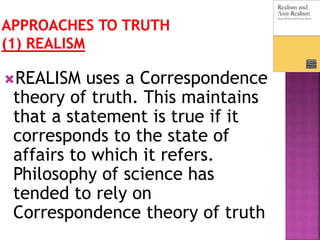
REALISM uses a Correspondence
theory of truth. This maintains
that a statement is true if it
corresponds to the state of
affairs to which it refers.
Philosophy of science has
tended to rely on
Correspondence theory of truth
Non Realists maintain that
statements are true because
they cohere or fit in with
other true statements within
a particular ‘form of life’.
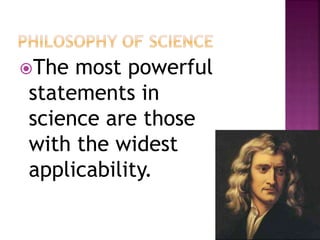
The most powerful
statements in
science are those
with the widest
applicability.
11
It is not possible for
scientists to have tested
every incidence of an
action, and found a
reaction.
12
Induction
One solution to this
problem is to rely on
the notion of
induction.
13
Explaining why
induction commonly
works has been
somewhat problematic.
14
The problem of induction is one
of considerable debate and
importance in the philosophy of
science: is induction indeed
justified, and if so, how?
15
One answer has been to
conceive of a different
form of rational argument,
one that relies on
deduction.
16
Foundationalism
Induction attempts to
justify scientific
statements by reference
to other specific
scientific statements.
17
The way in which
basic statements are
derived from
observation
complicates the
problem. 18
Coherence
Coherentism offers an
alternative by claiming that
statements can be justified
by their being a part of a
coherent system.
19
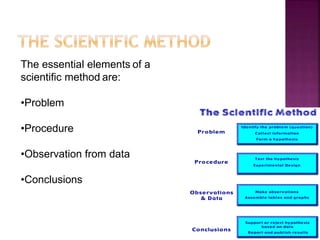
The essential elements of a
scientific method are:
•Problem
•Procedure
•Observation from data
•Conclusions
20
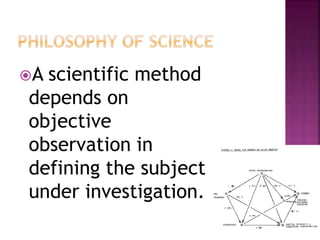
A scientific method
depends on
objective
observation in
defining the subject
under investigation.
21
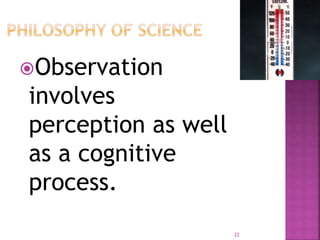
Observation
involves
perception as well
as a cognitive
process.
22
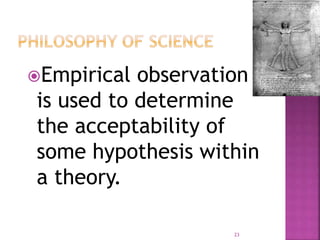
Empirical observation
is used to determine
the acceptability of
some hypothesis within
a theory.
23
Thomas Kuhn denied that
it is ever possible to
isolate the hypothesis
being tested from the
influence of the theory in
which the observations are
grounded.
24
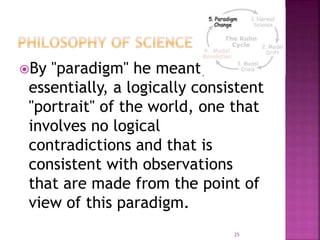
By "paradigm" he meant,
essentially, a logically consistent
"portrait" of the world, one that
involves no logical
contradictions and that is
consistent with observations
that are made from the point of
view of this paradigm.
25
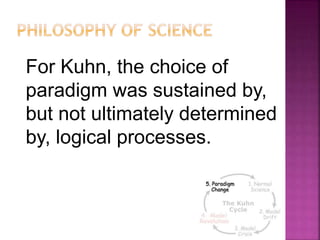
For Kuhn, the choice of
paradigm was sustained by,
but not ultimately determined
by, logical processes.
26
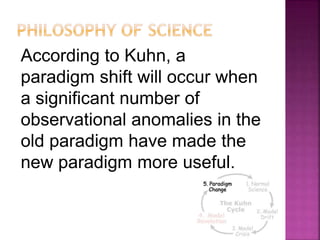
According to Kuhn, a
paradigm shift will occur when
a significant number of
observational anomalies in the
old paradigm have made the
new paradigm more useful.
27
That observation is
embedded in theory does
not mean that
observations are irrelevant
to science.
28
Ockham's razor
The motto is most commonly
cited in the form "entities should
not be multiplied beyond
necessity", generally taken to
suggest that the simplest
explanation tends to be the
correct one.
29
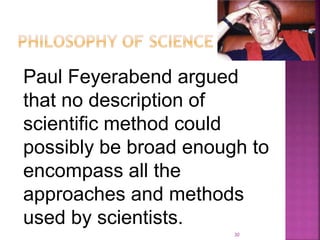
Paul Feyerabend argued
that no description of
scientific method could
possibly be broad enough to
encompass all the
approaches and methods
used by scientists.
30
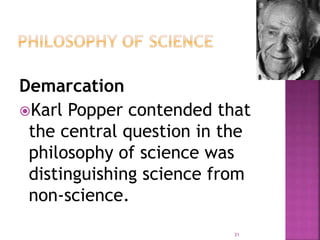
Demarcation
Karl Popper contended that
the central question in the
philosophy of science was
distinguishing science from
non-science.
31
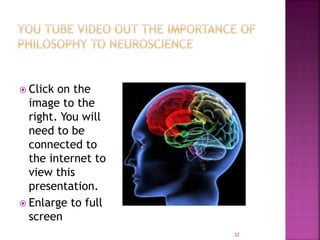
 Click on the
image to the
right. You will
need to be
connected to
the internet to
view this
presentation.
 Enlarge to full
screen
32
 Agassi, J., (1975), Science in Flux, Reidel, Dordrecht.
 Agassi, J. and Jarvie, I. C. (1987), Rationality: The Critical View, Kluwer, Dordrecht.
 Augros, Robert M., Stanciu, George N., The New Story of Science: mind and the universe, Lake Bluff, Ill.: Regnery
Gateway, c1984. ISBN 0895268337
 Ben-Ari, M. (2005) Just a theory: exploring the nature of science, Prometheus Books, Amherst, N.Y.
 Bovens, L. and Hartmann, S. (2003), Bayesian Epistemology, Oxford University Press, Oxford.
 Boyd, R., Gasper, P., and Trout, J.D. (eds., 1991), The Philosophy of Science, Blackwell Publishers, Cambridge, MA.
 Feyerabend, Paul K. 2005. Science, history of the philosophy of. Oxford Companion to Philosophy. Oxford.
 Glazebrook, Trish (2000), Heidegger's Philosophy of Science, Fordham University Press.
 Godfrey-Smith, P. (2003) Theory and reality: an introduction to the philosophy of science, The University of Chicago
Press, Chicago and London
 Gutting, Gary (2004), Continental Philosophy of Science, Blackwell Publishers, Cambridge, MA.
 Harris, Errol E. (1965), The Foundations of Metaphysics in Science , George Allen and Unwin, London, Reprinted by
Routledge, London (2002).
 Harris, Errol E. (1991), Cosmos and Anthropos, Humanities Press, New Jersey.
 Hawking, Stephen. (2001), The Universe in a Nutshell, Bantam Press. ISBN 0-553-80202-X
 Harré, R. (1972), The Philosophies of Science: An Introductory Survey, Oxford University Press, London, UK.
 Heelan, Patrick A. (1983), Space-Perception and the Philosophy of Science, University of California Press, Berkeley,
CA.
 Honderich, Ted (Ed.) (2005) The Oxford Companion to Philosophy. Oxford University Press. New York, NY.
 Kearney, R. (1994), Routledge History of Philosophy, Routledge Press. See Vol. 8.
 Klemke, E., et al. (eds., 1998), Introductory Readings in The Philosophy of Science, Prometheus Books, Amherst, New
York, NY.
 Kneale, William, and Kneale, Martha (1962), The Development of Logic, Oxford University Press, London, UK.
 Kuipers, T.A.F. (2001), Structures in Science, An Advanced Textbook in Neo-Classical Philosophy of Science, Synthese
Library, Springer
33
 Ladyman, J. (2002), Understanding Philosophy of Science, Routledge, London, UK.
 Losee, J. (1998), A Historical Introduction to the Philosophy of Science, Oxford University Press, Oxford, UK.
 Newton-Smith, W.H. (ed., 2001), A Companion to the Philosophy of Science, Blackwell Publishers, Malden, MA.
 Newall Paul (2004) The Gallilean Library- http://www.galilean-library.org/manuscript.php?postid=43784
 Niiniluoto, I. (2002), Critical Scientific Realism, Oxford University Press, Oxford, UK.
 Pap, A. (1962), An Introduction to the Philosophy of Science, The Free Press, New York, NY.
 Papineau, D. (ed., 1997), The Philosophy of Science, Oxford University Press, Oxford, UK.
 Papineau, David. 2005. Science, problems of the philosophy of. Oxford Companion to Philosophy. Oxford.
 Piattelli-Palmarini, Massimo (ed., 1980), Language and Learning, The Debate between Jean Piaget and Noam
Chomsky, Harvard University Press, Cambridge, MA.
 Alexander Rosenberg, (2000), Philosophy of Science: A Contemporary Introduction, Routledge, London, UK.
 Runes, D.D. (ed.), Dictionary of Philosophy, Littlefield, Adams, and Company, Totowa, NJ, 1962.
 Salmon, M.H., et al. (1999), Introduction to the Philosophy of Science: A Text By Members of the Department of the
History and Philosophy of Science of the University of Pittsburgh, Hacket Publishing Company, Indianapolis, IN.
 Snyder, Paul (1977), Toward One Science: The Convergence of Traditions, St Martin's Press.
 van Fraassen, Bas C. (1980), The Scientific Image, Oxford University Press, Oxford, UK.
 van Luik, James, The Energy of Ideas, Crow Hill Press, Cambridge, MA. 2000
 Walker, Benjamin, Caesar's Church: The Irrational in Science & Philosophy, Book Guild, Lewes, Sussex, 2001, ISBN 1-
85776-625-3
 Wikipedia-Philosophy of Science- http://en.wikipedia.org/wiki/Philosophy_of_science
 Ziman, John (2000). Real Science: what it is, and what it means. Cambridge, Uk: Cambridge University Press.
34

1605036123-introduction-to-philosophy-of-science.ppt

  • 1.
    1 THIS CD HASBEEN PRODUCED FOR TEACHERS TO USE IN THE CLASSROOM. IT IS A CONDITION OF THE USE OF THIS CD THAT IT BE USED ONLY BY THE PEOPLE FROM SCHOOLS THAT HAVE PURCHASED THE CD ROM FROM DIALOGUE EDUCATION. (THIS DOES NOT PROHIBIT ITS USE ON A SCHOOL’S INTRANET). Dialogue Education Update 3
  • 2.
     Page 3- Fling the Teacher- Intro to Philosophy of Science  Page 4 - Video Presentation on Science Religion and the Cosmos  Pages 5 to 6 - Definitions of terms  Page 7 - Demarcation  Page 8 – Why Study Philosophy of Science?  Pages 9 –15 The central questions in science.  Page 16 - Induction  Page 17 – 19 Coherentism  Page 20 - 21 Ockhams Razor –  Pages 23 to 28 - Theory-dependence of observation  Pages 31 The Scientific Method  Pages 32 - Video Interview with John Polkinghorne  Pages 33 to 34 - Bibliography 2
  • 3.
     Click onthe image above for a game of “Fling the Teacher”. Try playing the game with your students at the start and the end of the unit. Make sure you have started the slide show and are connected to the internet. 3
  • 4.
     INDUCTION  REALISTS ANTIREALISTS  FOUNDATIONALISM  COHERENTISM  EMPIRICISM  DEMARCATION  PARADIGM  OCKHAM’S RAZOR 4
  • 5.
     The philosophyof science is concerned with the assumptions, foundations, and implications of science. 5
  • 6.
    Philosophy of science focuseson metaphysical, epistemic and semantic aspects of science. 6
  • 7.
    Two central questions aboutscience are (1) what are the aims of science and (2) how ought one to interpret the results of science? 7
  • 8.
    Philosophy in Science isimportant in the debate regarding evolution and intelligent design. 8
  • 9.
    REALISM uses aCorrespondence theory of truth. This maintains that a statement is true if it corresponds to the state of affairs to which it refers. Philosophy of science has tended to rely on Correspondence theory of truth
  • 10.
    Non Realists maintainthat statements are true because they cohere or fit in with other true statements within a particular ‘form of life’.
  • 11.
    The most powerful statementsin science are those with the widest applicability. 11
  • 12.
    It is notpossible for scientists to have tested every incidence of an action, and found a reaction. 12
  • 13.
    Induction One solution tothis problem is to rely on the notion of induction. 13
  • 14.
    Explaining why induction commonly workshas been somewhat problematic. 14
  • 15.
    The problem ofinduction is one of considerable debate and importance in the philosophy of science: is induction indeed justified, and if so, how? 15
  • 16.
    One answer hasbeen to conceive of a different form of rational argument, one that relies on deduction. 16
  • 17.
    Foundationalism Induction attempts to justifyscientific statements by reference to other specific scientific statements. 17
  • 18.
    The way inwhich basic statements are derived from observation complicates the problem. 18
  • 19.
    Coherence Coherentism offers an alternativeby claiming that statements can be justified by their being a part of a coherent system. 19
  • 20.
    The essential elementsof a scientific method are: •Problem •Procedure •Observation from data •Conclusions 20
  • 21.
    A scientific method dependson objective observation in defining the subject under investigation. 21
  • 22.
  • 23.
    Empirical observation is usedto determine the acceptability of some hypothesis within a theory. 23
  • 24.
    Thomas Kuhn deniedthat it is ever possible to isolate the hypothesis being tested from the influence of the theory in which the observations are grounded. 24
  • 25.
    By "paradigm" hemeant, essentially, a logically consistent "portrait" of the world, one that involves no logical contradictions and that is consistent with observations that are made from the point of view of this paradigm. 25
  • 26.
    For Kuhn, thechoice of paradigm was sustained by, but not ultimately determined by, logical processes. 26
  • 27.
    According to Kuhn,a paradigm shift will occur when a significant number of observational anomalies in the old paradigm have made the new paradigm more useful. 27
  • 28.
    That observation is embeddedin theory does not mean that observations are irrelevant to science. 28
  • 29.
    Ockham's razor The mottois most commonly cited in the form "entities should not be multiplied beyond necessity", generally taken to suggest that the simplest explanation tends to be the correct one. 29
  • 30.
    Paul Feyerabend argued thatno description of scientific method could possibly be broad enough to encompass all the approaches and methods used by scientists. 30
  • 31.
    Demarcation Karl Popper contendedthat the central question in the philosophy of science was distinguishing science from non-science. 31
  • 32.
     Click onthe image to the right. You will need to be connected to the internet to view this presentation.  Enlarge to full screen 32
  • 33.
     Agassi, J.,(1975), Science in Flux, Reidel, Dordrecht.  Agassi, J. and Jarvie, I. C. (1987), Rationality: The Critical View, Kluwer, Dordrecht.  Augros, Robert M., Stanciu, George N., The New Story of Science: mind and the universe, Lake Bluff, Ill.: Regnery Gateway, c1984. ISBN 0895268337  Ben-Ari, M. (2005) Just a theory: exploring the nature of science, Prometheus Books, Amherst, N.Y.  Bovens, L. and Hartmann, S. (2003), Bayesian Epistemology, Oxford University Press, Oxford.  Boyd, R., Gasper, P., and Trout, J.D. (eds., 1991), The Philosophy of Science, Blackwell Publishers, Cambridge, MA.  Feyerabend, Paul K. 2005. Science, history of the philosophy of. Oxford Companion to Philosophy. Oxford.  Glazebrook, Trish (2000), Heidegger's Philosophy of Science, Fordham University Press.  Godfrey-Smith, P. (2003) Theory and reality: an introduction to the philosophy of science, The University of Chicago Press, Chicago and London  Gutting, Gary (2004), Continental Philosophy of Science, Blackwell Publishers, Cambridge, MA.  Harris, Errol E. (1965), The Foundations of Metaphysics in Science , George Allen and Unwin, London, Reprinted by Routledge, London (2002).  Harris, Errol E. (1991), Cosmos and Anthropos, Humanities Press, New Jersey.  Hawking, Stephen. (2001), The Universe in a Nutshell, Bantam Press. ISBN 0-553-80202-X  Harré, R. (1972), The Philosophies of Science: An Introductory Survey, Oxford University Press, London, UK.  Heelan, Patrick A. (1983), Space-Perception and the Philosophy of Science, University of California Press, Berkeley, CA.  Honderich, Ted (Ed.) (2005) The Oxford Companion to Philosophy. Oxford University Press. New York, NY.  Kearney, R. (1994), Routledge History of Philosophy, Routledge Press. See Vol. 8.  Klemke, E., et al. (eds., 1998), Introductory Readings in The Philosophy of Science, Prometheus Books, Amherst, New York, NY.  Kneale, William, and Kneale, Martha (1962), The Development of Logic, Oxford University Press, London, UK.  Kuipers, T.A.F. (2001), Structures in Science, An Advanced Textbook in Neo-Classical Philosophy of Science, Synthese Library, Springer 33
  • 34.
     Ladyman, J.(2002), Understanding Philosophy of Science, Routledge, London, UK.  Losee, J. (1998), A Historical Introduction to the Philosophy of Science, Oxford University Press, Oxford, UK.  Newton-Smith, W.H. (ed., 2001), A Companion to the Philosophy of Science, Blackwell Publishers, Malden, MA.  Newall Paul (2004) The Gallilean Library- http://www.galilean-library.org/manuscript.php?postid=43784  Niiniluoto, I. (2002), Critical Scientific Realism, Oxford University Press, Oxford, UK.  Pap, A. (1962), An Introduction to the Philosophy of Science, The Free Press, New York, NY.  Papineau, D. (ed., 1997), The Philosophy of Science, Oxford University Press, Oxford, UK.  Papineau, David. 2005. Science, problems of the philosophy of. Oxford Companion to Philosophy. Oxford.  Piattelli-Palmarini, Massimo (ed., 1980), Language and Learning, The Debate between Jean Piaget and Noam Chomsky, Harvard University Press, Cambridge, MA.  Alexander Rosenberg, (2000), Philosophy of Science: A Contemporary Introduction, Routledge, London, UK.  Runes, D.D. (ed.), Dictionary of Philosophy, Littlefield, Adams, and Company, Totowa, NJ, 1962.  Salmon, M.H., et al. (1999), Introduction to the Philosophy of Science: A Text By Members of the Department of the History and Philosophy of Science of the University of Pittsburgh, Hacket Publishing Company, Indianapolis, IN.  Snyder, Paul (1977), Toward One Science: The Convergence of Traditions, St Martin's Press.  van Fraassen, Bas C. (1980), The Scientific Image, Oxford University Press, Oxford, UK.  van Luik, James, The Energy of Ideas, Crow Hill Press, Cambridge, MA. 2000  Walker, Benjamin, Caesar's Church: The Irrational in Science & Philosophy, Book Guild, Lewes, Sussex, 2001, ISBN 1- 85776-625-3  Wikipedia-Philosophy of Science- http://en.wikipedia.org/wiki/Philosophy_of_science  Ziman, John (2000). Real Science: what it is, and what it means. Cambridge, Uk: Cambridge University Press. 34

Editor's Notes

  • #8 Two central questions about science are (1) what are the aims of science and (2) how ought one to interpret the results of science? Scientific realists claim that science aims at truth and that one ought to regard scientific theories as true, approximately true, or likely true. Conversely, a scientific antirealist argues that science does not aim (or at least does not succeed) at truth and that we should not regard scientific theories as true. Some antirealists claim that scientific theories aim at being instrumentally useful and should only be regarded as useful, but not true, descriptions of the world. More radical antirealists, like Thomas Kuhn and Paul Feyerabend, have argued that scientific theories do not even succeed at this goal, and that later, more accurate scientific theories are not "typically approximately true" as Popper contended.
  • #9 Many opponents of intelligent design claim that it does not meet the criteria of science and should thus not be treated on equal footing as evolution. Those who defend intelligent design either defend the view as meeting the criteria of science or challenge the coherence of this distinction. We will come back to this later.
  • #10 REALISM uses a Correspondence theory of truth. This maintains that a statement is true if it corresponds to the state of affairs to which it refers. Thus ‘There is a cat on the mat’ is true if (this means ‘if and only if’) there is a cat and the cat sits on the mat. Realists maintain BIVALENCE – this means that a statement is EITHER true OR false depending on whether or not it corresponds to the state of affairs to which it refers. NOTE that truth does not depend on evidence or proof but rather on the state of affairs to which correspondence is claimed…
  • #11 Non-realists point out that there is no way of establishing reference and that realists claims to truth therefore fail. They, therefore, reject claims to reference and instead use a COHERENCE theory of truth. This maintains that statements are true because they cohere or fit in with other true statements within a particular ‘form of life’. In non-realist terms, each major religion can be regarded as a ‘form of life’, although ‘form of life’ can be more narrowly defined as well – for instance Hasidic Judaism can be a distinct form of life. One form of life can overlap others……
  • #12 The most powerful statements in science are those with the widest applicability. Newton's Third Law — "for every action there is an opposite and equal reaction" — is a powerful statement because it applies to every action, anywhere, and at any time.
  • #13 However, It is not possible for scientists to have tested every incidence of an action, and found a reaction. How is it, then, that they can assert that the Third Law is in some sense true? They have, of course, tested many, many actions, and in each one have been able to find the corresponding reaction. But can we be sure that the next time we test the Third Law, it will be found to hold true?
  • #14 Induction One solution to this problem is to rely on the notion of induction. Inductive reasoning maintains that if a situation holds in all observed cases, then the situation holds in all cases. So, after completing a series of experiments that support the Third Law, one is justified in maintaining that the Law holds in all cases.
  • #15 Explaining why induction commonly works has been somewhat problematic. One cannot use deduction, the usual process of moving logically from premise to conclusion, because there is simply no framework that will allow such a move. No matter how many times 17th century biologists observed white swans, and in how many different locations, there is no deductive path that can lead them to the conclusion that all swans are white. This is just as well, since, as it turned out, that conclusion would have been wrong. Similarly, it is at least possible that an observation will be made tomorrow that shows an occasion in which an action is not accompanied by a reaction; the same is true of any scientific law.
  • #17 One solution has been to conceive of a different form of rational argument, one that relies on deduction. Deduction allows one to formulate a specific truth from a general truth: all crows are black; this is a crow; therefore this is black. Induction somehow allows one to formulate a general truth from some series of specific observations: this is a crow and it is black; that is a crow and it is black; therefore all crows are black.
  • #18 Foundationalism Induction attempts to justify scientific statements by reference to other specific scientific statements. It must avoid the problem of the criterion, in which any justification must in turn be justified, resulting in an infinite regress. The regress argument has been used to justify one way out of the infinite regress, foundationalism. Foundationalism claims that there are some basic statements that do not require justification. Both induction and falsification are forms of foundationalism in that they rely on basic statements that derive directly from immediate sensory experience.
  • #19 The way in which basic statements are derived from observation complicates the problem. Observation is a cognitive act; that is, it relies on our existing understanding, our set of beliefs. An observation of a transit of Venus requires a huge range of auxiliary beliefs, such as those that describe the optics of telescopes, the mechanics of the telescope mount, and an understanding of celestial mechanics. At first sight, the observation does not appear to be 'basic'.
  • #20 Coherentism offers an alternative by claiming that statements can be justified by their being a part of a coherent system. In the case of science, the system is usually taken to be the complete set of beliefs of an individual scientist or, more broadly, of the community of scientists. W. V. Quine argued for a Coherentist approach to science, as does E O Wilson, though he uses the term consilience (notably in his book of that name). An observation of a transit of Venus is justified by its being coherent with our beliefs about optics, telescope mounts and celestial mechanics. Where this observation is at odds with one of these auxiliary beliefs, an adjustment in the system will be required to remove the contradiction..
  • #21 The essential elements of a scientific method are: Problem (observations, definitions, and measurements of the subject of inquiry) Procedure (theoretical, hypothetical explanations of observations and measurements of the subject) Observation from data (reasoning including logical deduction from the hypothesis or theory) Conclusions (tests of all of the above)
  • #22 A scientific method depends on objective observation in defining the subject under investigation. However, most observations are theory-laden – that is, they depend in part on an underlying theory that is used to frame the observations.
  • #23 Observation involves perception as well as a cognitive process. That is, one does not make an observation passively, but is actively involved in distinguishing the thing being observed from surrounding sensory data. Therefore, observations depend on some underlying understanding of the way in which the world functions, and that understanding may influence what is perceived, noticed, or deemed worthy of consideration. More importantly, most scientific observation must be done within a theoretical context in order to be useful. For example, when one observes a measured increase in temperature, that observation is based on assumptions about the nature of temperature and measurement, as well as assumptions about how the thermometer that is used to measure the temperature functions. Such assumptions are necessary in order to obtain scientifically useful observations (such as, "the temperature increased by two degrees"), but they make the observations dependent on these assumptions.
  • #24 Empirical observation is used to determine the acceptability of some hypothesis within a theory. When someone claims to have made an observation, it is reasonable to ask them to justify their claim. Such a justification must make reference to the theory – operational definitions and hypotheses – in which the observation is embedded. That is, the observation is framed in terms of the theory that also contains the hypothesis it is meant to verify or falsify (though of course the observation should not be based on an assumption of the truth or falsity of the hypothesis being tested). This means that the observation cannot serve as an entirely neutral arbiter between competing hypotheses, but can only arbitrate between the hypotheses within the context of the underlying theory.
  • #25 Thomas Kuhn denied that it is ever possible to isolate the hypothesis being tested from the influence of the theory in which the observations are grounded. He argued that observations always rely on a specific paradigm, and that it is not possible to evaluate competing paradigms independently.
  • #26 By "paradigm" he meant, essentially, a logically consistent "portrait" of the world, one that involves no logical contradictions and that is consistent with observations that are made from the point of view of this paradigm. More than one such logically consistent construct can paint a usable likeness of the world, but there is no common ground from which to pit two against each other, theory against theory. Neither is a standard by which the other can be judged. Instead, the question is which "portrait" is judged by some set of people to promise the most in terms of scientific “puzzle solving”.
  • #27 For Kuhn, the choice of paradigm was sustained by, but not ultimately determined by, logical processes. The individual's choice between paradigms involves setting two or more “portraits" against the world and deciding which likeness is most promising. In the case of a general acceptance of one paradigm or another, Kuhn believed that it represented the consensus of the community of scientists. Acceptance or rejection of some paradigm is, he argued, a social process as much as a logical process. Kuhn's position, however, is not one of relativism.
  • #28 That is, the choice of a new paradigm is based on observations, even though those observations are made against the background of the old paradigm. A new paradigm is chosen because it does a better job of solving scientific problems than the old one. Some of the "classical cases" of Kuhnian paradigm shifts in science are: * The transition in cosmology from a Ptolemaic cosmology to a Copernican one. * The transition in mechanics from Aristotelian mechanics to classical mechanics. * The acceptance of the theory of biogenesis, that all life comes from life, as opposed to the theory of spontaneous generation, which began in the 17th century and was not complete until the 19th century with Pasteur. * The acceptance of the work of Andreas Vesalius, whose work De Humani Corporis Fabrica corrected the numerous errors in the previously-held system created by Galen. * The acceptance of non-Euclidean geometry as equally valid with Euclidean geometry. * The transition between the Maxwellian Electromagnetic worldview and the Einsteinian Relativistic worldview. * The transition between the worldview of Newtonian physics and the Einsteinian Relativistic worldview. * The development of quantum mechanics, which redefined Classical mechanics. * The acceptance of plate tectonics as the explanation for large-scale geologic changes. * The development of absolute dating * The acceptance of Lavoisier's theory of chemical reactions and combustion in place of phlogiston theory, known as the Chemical Revolution. * The acceptance of Mendelian inheritance, as opposed to pangenesis in the early 20th century Social Sciences In Kuhn's view, the existence of a single reigning paradigm is characteristic of the sciences, while philosophy and much of social science were characterized by a "tradition of claims, counterclaims, and debates over fundamentals."[3] Others have applied Kuhn's concept of paradigm shift to the social sciences. * The movement, known as the Cognitive revolution, away from Behaviourist approaches to psychological study and the acceptance of cognition as central to studying human behaviour. * The Keynesian Revolution is typically viewed as a major shift in macroeconomics.[4] According to John Kenneth Galbraith, Say's Law dominated economic thought prior to Keynes for over a century, and the shift to Keynesianism was difficult. Economists who contradicted the law, which inferred that underemployment and underinvestment (coupled with oversaving) were virtually impossible, risked losing their careers.[5] In his magnum opus, Keynes cited one of his predecessors, J. A. Hobson,[6] who was repeatedly denied positions at universities for his heretical theory. * Later, the movement for Monetarism over Keynesianism marked a second divisive shift. Monetarists held that fiscal policy was not effective for stabilizing inflation, that it was solely a monetary phenomenon, in contrast to the Keynesian view of the time was that both fiscal and monetary policy were important. Keynesians later adopted much of the Monetarists view of the quantity theory of money and shifting Philips curve, theories they initially rejected.
  • #29 That observation is embedded in theory does not mean that observations are irrelevant to science. Scientific understanding derives from observation, but the acceptance of scientific statements is dependent on the related theoretical background or paradigm as well as on observation. Coherentism, skepticism, and foundationalism are alternatives for dealing with the difficulty of grounding scientific theories in something more than observations.
  • #30 Ockham's razor The motto is most commonly cited in the form "entities should not be multiplied beyond necessity", generally taken to suggest that the simplest explanation tends to be the correct one. As interpreted in contemporary scientific practice, it advises opting for the simplest theory among a set of competing theories that have a comparable explanatory power, discarding assumptions that do not improve the explanation. The "other things being equal" clause is a critical qualification, which rather severely limits the utility of Ockham's razor in real practice, as theorists rarely if ever find themselves presented with competent theories of exactly equal explanatory adequacy.
  • #31 Paul Feyerabend argued that no description of scientific method could possibly be broad enough to encompass all the approaches and methods used by scientists. Feyerabend objected to prescriptive scientific method on the grounds that any such method would stifle and cramp scientific progress. Feyerabend claimed, "the only principle that does not inhibit progress is: anything goes.“ However there have been many opponents to his theory. Alan Sokal and Jean Bricmont wrote the essay "Feyerabend: Anything Goes" about his belief that science is of little use to society.
  • #32 Demarcation Karl Popper contended that the central question in the philosophy of science was distinguishing science from non-science. Early attempts by the logical positivists grounded science in observation while non-science (e.g. metaphysics) was non-observational and hence nonsense. Popper claimed that the central feature of science was that science aims at falsifiable claims (i.e. claims that can be proven false, at least in principle). No single unified account of the difference between science and non-science has been widely accepted by philosophers, and some regard the problem as unsolvable or uninteresting. Is intelligent design non science or a paradigm shift?