Philosophies in Education
What is PHILOSOPHY?

guiding or underlying principles: a set of basic
principles or concepts underlying a particular
sphere of knowledge

set of beliefs or aims: a precept, or set of
precepts, beliefs, principles, or aims, underlying
somebody's practice or conduct
Importance of Philosophy in
          Education

The philosophy advocated by a
particular school and its officials
influences its goals, as well as the
organization of its curriculum.
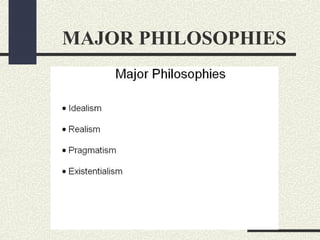
MAJOR PHILOSOPHIES
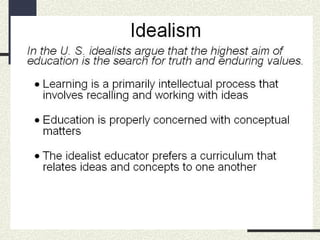
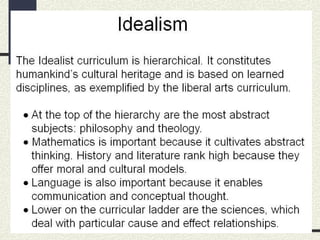
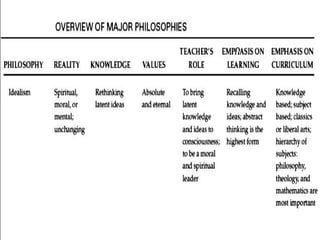
IDEALISM
IDEALISM
BEHAVIORISM
 behavior of students in the society.
 modification and shaping students
  behavior.
 stimuli – response relationship
SOCIALISM

         “ No man is an island”

-Man is a social creature.
-Develops personality
-Can change standards of society
A society transmits its cultural
 values to individuals in order that
 they can function properly as its
 members.
FUNCTIONALISM


   “It’s not the structure that should be of
  prime importance but the function of the
                    matter”

 emphasized    on individual Differences
 (capacity) in mental abilities (Darwin
 theory of variation)
PURPOSIVISM

       Hormic Psychology

  “ Behavior cannot be understood
adequately without understanding his
               goals”
STRUCTURALISM

Experiments on sensation,
perception, thought-processes.
   Structure  of the mind
   (analyze consciousness into its
  component elements)
    Method     of introspection (mental
     self-analysis)
ASSOCIATIONISM

the mind is composed of elements --
usually referred to as sensations and
ideas -- which are organized by means
of various associations. .
Items are associated in the mind
through experience (derive from
experience and combine to form
thought)
UTILITARIANISM

The moral worth of an action is
determined only by its resulting
outcomes
In general usage, it could be
described as something or someone's
value can be measured by it's
usefulness.

Philosophies in Education

  • 1.
  • 2.
    What is PHILOSOPHY? guidingor underlying principles: a set of basic principles or concepts underlying a particular sphere of knowledge set of beliefs or aims: a precept, or set of precepts, beliefs, principles, or aims, underlying somebody's practice or conduct
  • 3.
    Importance of Philosophyin Education The philosophy advocated by a particular school and its officials influences its goals, as well as the organization of its curriculum.
  • 4.
  • 5.
  • 6.
  • 25.
    BEHAVIORISM  behavior ofstudents in the society.  modification and shaping students behavior.  stimuli – response relationship
  • 26.
    SOCIALISM “ No man is an island” -Man is a social creature. -Develops personality -Can change standards of society
  • 27.
    A society transmitsits cultural values to individuals in order that they can function properly as its members.
  • 28.
    FUNCTIONALISM “It’s not the structure that should be of prime importance but the function of the matter”  emphasized on individual Differences (capacity) in mental abilities (Darwin theory of variation)
  • 29.
    PURPOSIVISM Hormic Psychology “ Behavior cannot be understood adequately without understanding his goals”
  • 30.
    STRUCTURALISM Experiments on sensation, perception,thought-processes.  Structure of the mind (analyze consciousness into its component elements)  Method of introspection (mental self-analysis)
  • 31.
    ASSOCIATIONISM the mind iscomposed of elements -- usually referred to as sensations and ideas -- which are organized by means of various associations. . Items are associated in the mind through experience (derive from experience and combine to form thought)
  • 32.
    UTILITARIANISM The moral worthof an action is determined only by its resulting outcomes In general usage, it could be described as something or someone's value can be measured by it's usefulness.