GROUP 3:
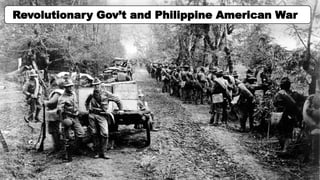
RevolutionaryGov’t and Philippine American War
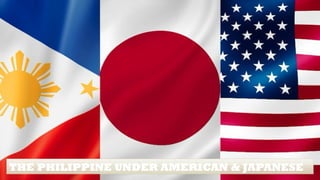
THE PHILIPPINE UNDER AMERICAN & JAPANESE
The American government
The American Influences-
The Commonwealth Government
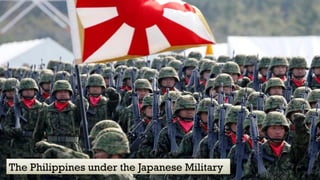
The Philippines under the Japanese Military
The battle against Oppressors
TOPICS
REVOLUTIONARY GOVERNMENT OFTHE
PHILIPPINES
• The Revolutionary Government of the Philippines (Spanish: Gobierno
Revolucionario de Filipinas) was a revolutionary government established in
the Spanish East Indies on June 23, 1898, during the Spanish–American War,
by Emilio Aguinaldo, its initial and only president. The government
succeeded a dictatorial government that had been established by
Aguinaldo on June 18 and was dissolved and replaced by this government
upon its establishment.[5][6]
This government endured until January 23, 1899,
when the proclamation of the Malolos Constitution established an insurgent
Philippine Republic government that replaced it.
5.
PHILIPPINE–AMERICANWAR
• The Philippine–AmericanWar,known alternatively as the Philippine
Insurrection, Filipino–AmericanWar, or Tagalog Insurgency, emerged
following the conclusion of the Spanish–American War in December 1898
when the United States annexed the Philippine Islands under the
Treaty of Paris. Philippine nationalists constituted the
First Philippine Republic in January 1899, seven months after signing the
Philippine Declaration of Independence.The United States did not
recognize either event as legitimate, and tensions escalated until fighting
commenced on February 4, 1899 in the Battle of Manila.
PHILIPPINES UNDER AMERICAN
•The history of the Philippines from 1898 to 1946 is known as the American
colonial period, and began with the outbreak of the Spanish–American War
in April 1898, when the Philippines was still a colony of the
Spanish East Indies, and concluded when the United States
formally recognized the independence of the Republic of the Philippines on
July 4, 1946.
8.
PHILIPPINES UNDER JAPANESE
TheJapanese occupation of the Philippines (Filipino: Pananakop ng mga Hapones sa
Pilipinas; occurred between 1942 and 1945, when the Japanese Empire occupied the
Commonwealth of the Philippines during World War II.
The invasion of the Philippines started on 8 December 1941, ten hours after the attack on Pearl Harbor. As
at Pearl Harbor, American aircraft were severely damaged in the initial Japanese attack. Lacking air cover,
the American Asiatic Fleet in the Philippines withdrew to Java on 12 December 1941. General
Douglas MacArthur was ordered out, leaving his men at Corregidor on the night of 11 March 1942 for
Australia, 4,000 km away. The 76,000 starving and sick American and Filipino defenders in Bataan
surrendered on 9 April 1942, and were forced to endure the infamous Bataan Death March on which
7,000–10,000 died or were murdered. The 13,000 survivors on Corregidor surrendered on 6 May.
AMERICAN GOVERNMENT
• TheAmerican government played a significant role in the history of the Philippines, especially during the late 19th and early 20th
centuries. Here’s a summary of the key phases of American influence in the Philippines:
1.The Spanish-American War (1898)
• The United States became involved in the Philippines during the Spanish-American War. After defeating Spain, the U.S. gained control of
the Philippines through the Treaty of Paris in December 1898, marking the end of over 300 years of Spanish colonial rule.
2. Philippine-American War (1899–1902)
• After Spain ceded the Philippines to the U.S., tensions rose between Filipino nationalists, who sought independence, and the U.S.
government, which sought to establish control.This led to the Philippine-American War, a brutal conflict that lasted until 1902,
although some resistance continued until 1913.
3. Establishment of American Colonial Rule (1902–1935)
• After the war, the United States formally established a colonial government in the Philippines under the Philippine Organic Act of
1902.
4. Philippine Independence (1946)
• On July 4, 1946, following the post-war recovery period, the Philippines was granted full independence by the United States, marking
the end of American colonial rule.This was in line with the earlier promise of independence following the Commonwealth period.
12.
AMERICAN INFLUENCE
1. PoliticalInfluence
The U.S. established democratic institutions in the Philippines, transitioning from Spanish colonial rule.The U.S. implemented a
presidential system, similar to its own, with checks and balances and a separation of powers.This has remained the foundation
of the Philippine political system, with regular national and local elections.
2. Education
The U.S. established a modern public education system, accessible to the broader population.This initiative aimed to increase
literacy and promote American ideals like democracy and self-governance. Education became a major tool for Americanization,
fostering a shared national identity.
3. Language
English Language: English was made the medium of instruction in schools, and it became one of the official languages of the
Philippines.Today, English proficiency remains high, and it is widely used in business, government, and education.
4. Cultural Influence
The U.S. brought elements of its culture to the Philippines, which have been adopted and localized. Basketball is one of the
most popular sports in the country, a direct result of American influence. Similarly, American films, music, and TV shows have
become deeply embedded in Filipino culture.
THE COMMONWEALTH GOVERNMENTOF THE PHILIPPINES
• The Commonwealth of the Philippines (1935–1946) was an important transitional period in
Philippine history, marking the bridge between U.S. colonial rule and full independence.The
Commonwealth was designed to give Filipinos greater self-governance as they prepared for
complete sovereignty after a 10-year transition period. Here are 3 aspects of the Commonwealth
government:
1. *Political Structure* - The Commonwealth government was designed as a democratic republic, modeled
after the U.S. system. It had a *presidential system* with a *bicameral legislature* (Senate and House of
Representatives) and an independent *judiciary*.
2. *Preparation for Independence* - A primary objective of the Commonwealth was to prepare the
Philippines for full independence from the United States. Programs were launched to strengthen governance,
infrastructure, the economy, and national defense.
3. *Limited Sovereignty* - Although the Philippines had autonomy in domestic affairs, key aspects like
*foreign policy and military defense* were still controlled by the United States.
15.
THE PHILIPPINES UNDERTHE JAPANESE
MILITARY
The Philippines under the Japanese Military
16.
THE PHILIPPINES UNDERTHE JAPANESE MILITARY
Attack on Pearl Harbor and the Philippines:
Hours after the attack on Pearl Harbor on December 7, 1941, Japanese forces began bombing key military and economic targets in the
Philippines.
Massacres and Executions:
The Japanese occupation was marked by widespread atrocities. Civilians suspected of being part of the resistance or collaborating with
American forces were summarily executed.
Comfort Women:
The Japanese military established brothels where Filipino women, often referred to as comfort women, were forced into sexual slavery.
Bataan Death March:
After the fall of Bataan, the Japanese forced 60,000–80,000 Filipino and American prisoners of war on a grueling 65-mile march to prison
camps. Known as the Bataan Death March, thousands died along the way from starvation, disease, or execution.
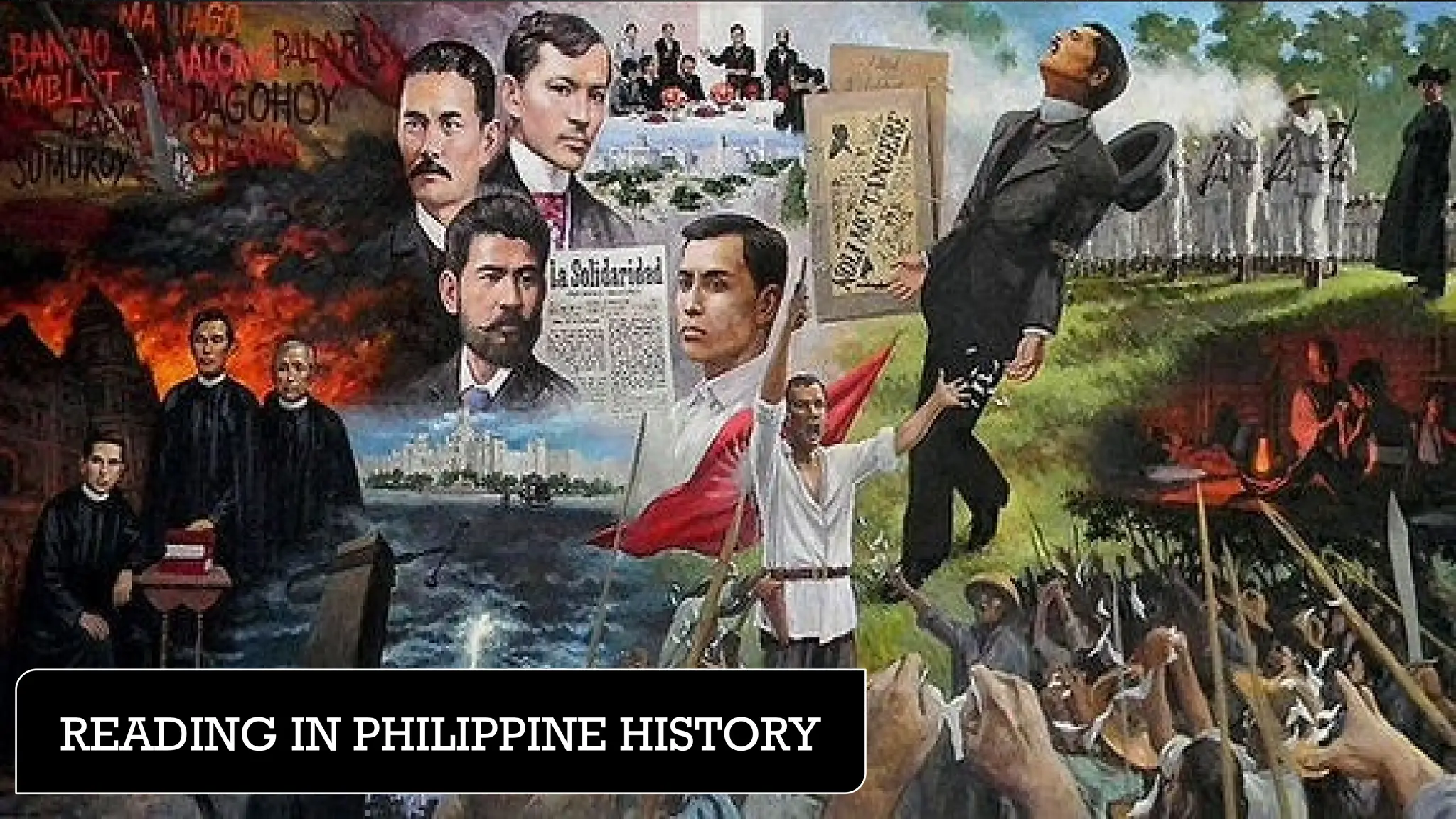
THE BATTLE AGAINSTOPPRESSORS
• 1.The Philippine Revolution (1896–1898)
This was a fight for independence from Spanish colonial rule, which had lasted for over three centuries. Led by figures like
Andrés Bonifacio and Emilio Aguinaldo, the revolution began after years of economic and social injustices imposed by the
Spanish government and the friars. 2. Philippine-American War (1899–1902)
• 2. Spanish-American War
ended in 1898, the Philippines found itself in conflict with the United States, which had taken control of the islands through the
Treaty of Paris. Filipino revolutionaries, initially fighting for independence from Spain, resisted the new American colonial
regime.
• 3.WorldWar II and the Japanese Occupation (1942–1945)
During World War II, the Philippines was invaded and occupied by Imperial Japan. Filipino forces, along with American allies,
fought against the Japanese occupiers.The Battle of Bataan and the Death March were significant events during this time.The
Hukbalahap (Hukbo ng Bayan Laban sa Hapon), a guerrilla movement composed of Filipino peasants and soldiers, also fought
against the Japanese occupation. Liberation came in 1945, with heavy casualties and destruction.
19.
• 4.The MartialLaw Era (1972–1986)
Under President Ferdinand Marcos, the Philippines experienced an era of domestic oppression
with the declaration of Martial Law in 1972. Marcos suspended civil liberties, controlled the media,
and arrested political opponents.The period was marked by widespread human rights abuses,
corruption, and economic decline. However, resistance to the dictatorship grew, leading to the
People Power Revolution in 1986, a peaceful uprising that ousted Marcos and restored democracy.
• 5. Current Struggles Against Social and Political Oppression
Various groups in the Philippines continue to fight against what they perceive as modern forms of
oppression. Indigenous peoples, labor unions, peasant movements, and human rights organizations
push back against economic inequality, land dispossession, extrajudicial killings, and other forms of
state violence.The ongoing conflict between the government and communist insurgents like the
New People’s Army (NPA) is also part of the broader struggle against oppression.

![REVOLUTIONARY GOVERNMENT OF THE
PHILIPPINES
• The Revolutionary Government of the Philippines (Spanish: Gobierno
Revolucionario de Filipinas) was a revolutionary government established in
the Spanish East Indies on June 23, 1898, during the Spanish–American War,
by Emilio Aguinaldo, its initial and only president. The government
succeeded a dictatorial government that had been established by
Aguinaldo on June 18 and was dissolved and replaced by this government
upon its establishment.[5][6]
This government endured until January 23, 1899,
when the proclamation of the Malolos Constitution established an insurgent
Philippine Republic government that replaced it.](https://image.slidesharecdn.com/rphgroup3-reporting-250226131146-139fd282/85/RPH-GROUP-3-REPORTING-hahahahahahah-pptx-4-320.jpg)