BADMINTON
1) Badminton history and origins.
2) Regulations (rules):
- The court. - The net.
- The shuttlecock. - Game modes.
- Racket and grip. - Scoring system.
3) Basic position and footwork.
4) Badminton technique (strokes):
a) Overhead strokes:- Clear (defensive and offensive clear).
- Drop (offensive).
- Smash (offensive stroke).
b) Medium strokes: - Drive (offensive).
c) Underarm strokes: - Lob (underarm clear).
- Net shot.
5) The serve.
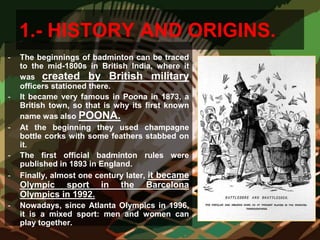
1.- HISTORY AND ORIGINS.
- The beginnings of badminton can be traced
to the mid-1800s in British India, where it
was created by British military
officers stationed there.
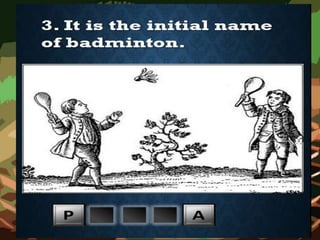
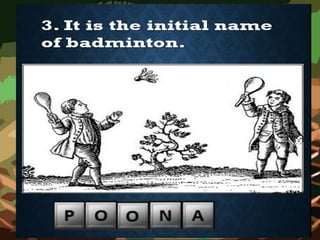
- It became very famous in Poona in 1873, a
British town, so that is why its first known
name was also POONA.
- At the beginning they used champagne
bottle corks with some feathers stabbed on
it.
- The first official badminton rules were
published in 1893 in England.
- Finally, almost one century later, it became
Olympic sport in the Barcelona
Olympics in 1992.
- Nowadays, since Atlanta Olympics in 1996,
it is a mixed sport: men and women can
play together.
WHAT DO WE NEED?
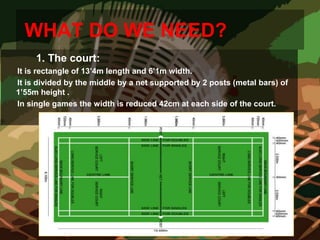
1. The court:
It is rectangle of 13’4m length and 6’1m width.
It is divided by the middle by a net supported by 2 posts (metal bars) of
1’55m height .
In single games the width is reduced 42cm at each side of the court.
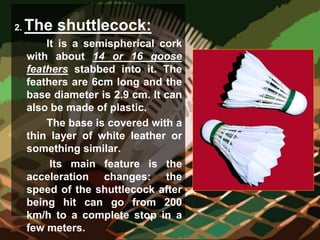
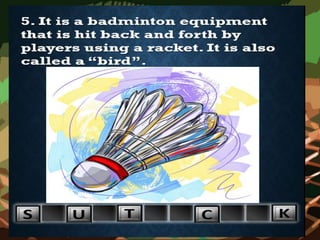
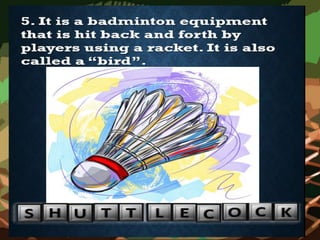
2. The shuttlecock:
It is a semispherical cork
with about 14 or 16 goose
feathers stabbed into it. The
feathers are 6cm long and the
base diameter is 2.9 cm. It can
also be made of plastic.
The base is covered with a
thin layer of white leather or
something similar.
Its main feature is the
acceleration changes: the
speed of the shuttlecock after
being hit can go from 200
km/h to a complete stop in a
few meters.
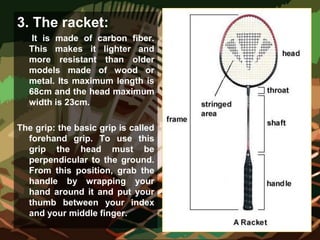
3. The racket:
It is made of carbon fiber.
This makes it lighter and
more resistant than older
models made of wood or
metal. Its maximum length is
68cm and the head maximum
width is 23cm.
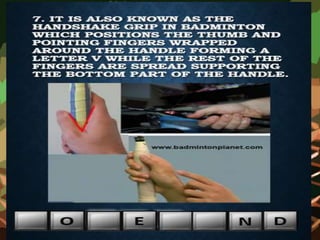
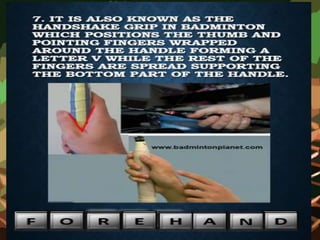
The grip: the basic grip is called
forehand grip. To use this
grip the head must be
perpendicular to the ground.
From this position, grab the
handle by wrapping your
hand around it and put your
thumb between your index
and your middle finger.
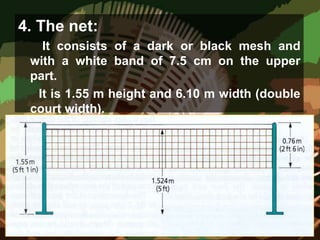
4. The net:
It consists of a dark or black mesh and
with a white band of 7.5 cm on the upper
part.
It is 1.55 m height and 6.10 m width (double
court width).
• Game mode:
Singles: 1vs1. Each player must be on opposite sides
of the net.
Doubles: 2vs2. Each pair of players must be on
opposite sides of the net, and each player must be on
opposite sides of the center line.
Mixed double: 1 man and 1 woman can form a couple
together.
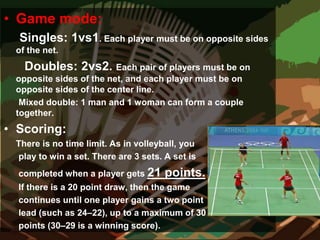
• Scoring:
There is no time limit. As in volleyball, you
play to win a set. There are 3 sets. A set is
completed when a player gets 21 points.
If there is a 20 point draw, then the game
continues until one player gains a two point
lead (such as 24–22), up to a maximum of 30
points (30–29 is a winning score).
BASIC POSITION AND FOOTWORK.
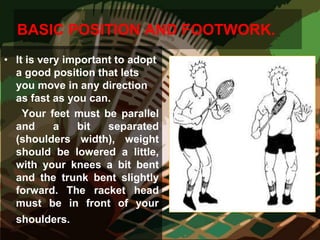
• It is very important to adopt
a good position that lets
you move in any direction
as fast as you can.
Your feet must be parallel
and a bit separated
(shoulders width), weight
should be lowered a little,
with your knees a bit bent
and the trunk bent slightly
forward. The racket head
must be in front of your
shoulders.
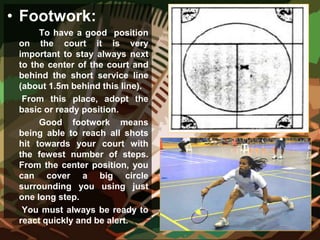
• Footwork:
To have a good position
on the court it is very
important to stay always next
to the center of the court and
behind the short service line
(about 1.5m behind this line).
From this place, adopt the
basic or ready position.
Good footwork means
being able to reach all shots
hit towards your court with
the fewest number of steps.
From the center position, you
can cover a big circle
surrounding you using just
one long step.
You must always be ready to
react quickly and be alert.
STROKES.
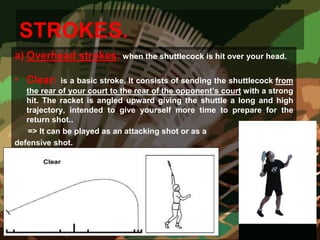
a) Overhead strokes: when the shuttlecock is hit over your head.
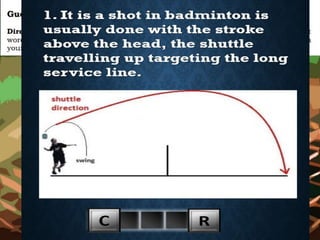
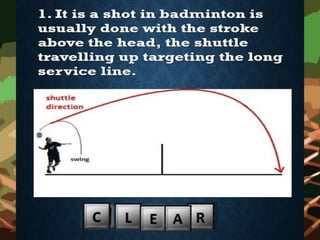
• Clear: is a basic stroke. It consists of sending the shuttlecock from
the rear of your court to the rear of the opponent’s court with a strong
hit. The racket is angled upward giving the shuttle a long and high
trajectory, intended to give yourself more time to prepare for the
return shot..
=> It can be played as an attacking shot or as a
defensive shot.
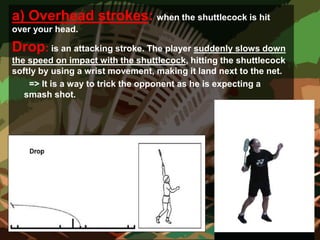
a) Overhead strokes: when the shuttlecock is hit
over your head.
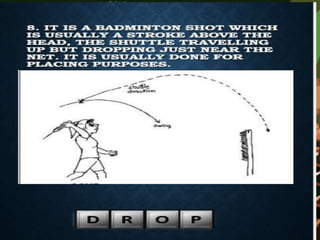
Drop: is an attacking stroke. The player suddenly slows down
the speed on impact with the shuttlecock, hitting the shuttlecock
softly by using a wrist movement, making it land next to the net.
=> It is a way to trick the opponent as he is expecting a
smash shot.
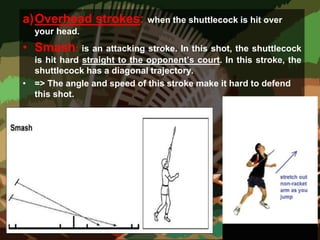
a)Overhead strokes: when the shuttlecock is hit over
your head.
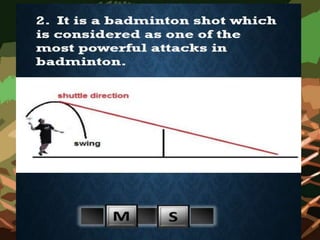
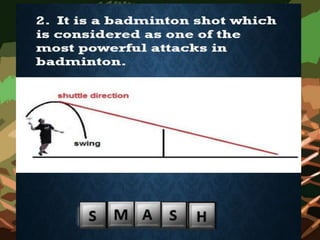
• Smash: is an attacking stroke. In this shot, the shuttlecock
is hit hard straight to the opponent’s court. In this stroke, the
shuttlecock has a diagonal trajectory.
• => The angle and speed of this stroke make it hard to defend
this shot.
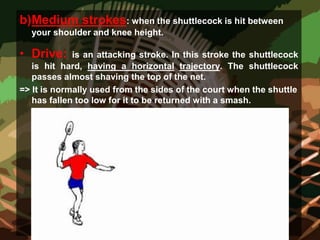
b)Medium strokes: when the shuttlecock is hit between
your shoulder and knee height.
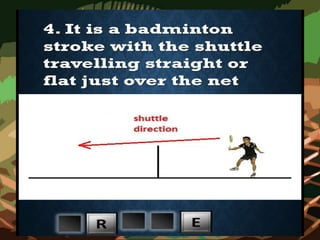
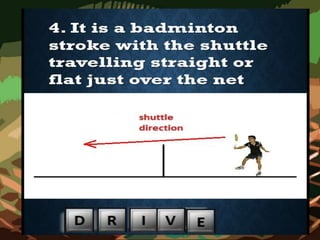
• Drive: is an attacking stroke. In this stroke the shuttlecock
is hit hard, having a horizontal trajectory. The shuttlecock
passes almost shaving the top of the net.
=> It is normally used from the sides of the court when the shuttle
has fallen too low for it to be returned with a smash.
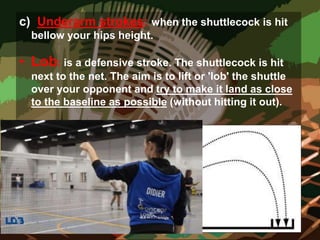
c) Underarm strokes: when the shuttlecock is hit
bellow your hips height.
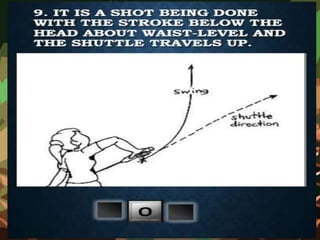
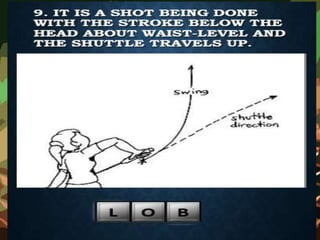
• Lob: is a defensive stroke. The shuttlecock is hit
next to the net. The aim is to lift or 'lob' the shuttle
over your opponent and try to make it land as close
to the baseline as possible (without hitting it out).
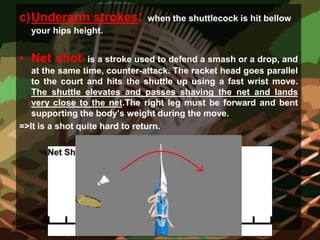
c)Underarm strokes: when the shuttlecock is hit bellow
your hips height.
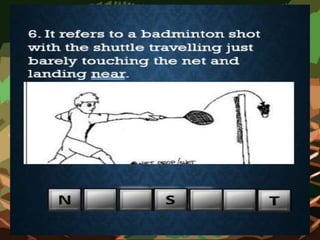
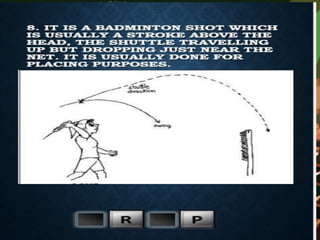
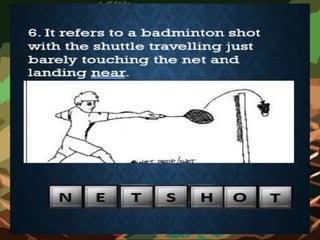
• Net shot: is a stroke used to defend a smash or a drop, and
at the same time, counter-attack. The racket head goes parallel
to the court and hits the shuttle up using a fast wrist move.
The shuttle elevates and passes shaving the net and lands
very close to the net.The right leg must be forward and bent
supporting the body’s weight during the move.
=>It is a shot quite hard to return.
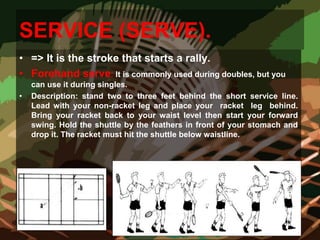
SERVICE (SERVE).
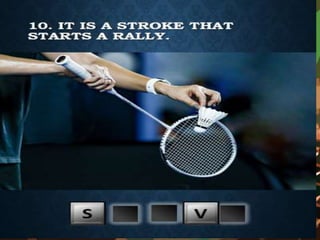
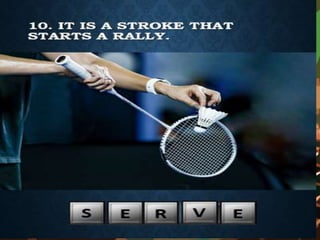
• => It is the stroke that starts a rally.
• Forehand serve: It is commonly used during doubles, but you
can use it during singles.
• Description: stand two to three feet behind the short service line.
Lead with your non-racket leg and place your racket leg behind.
Bring your racket back to your waist level then start your forward
swing. Hold the shuttle by the feathers in front of your stomach and
drop it. The racket must hit the shuttle below waistline.
Check your
Understanding
Time to Exchange
papers!
APPLICATION
2nd Quarter PE- Badminton g7.ppt

2nd Quarter PE- Badminton g7.ppt

  • 1.
    BADMINTON 1) Badminton historyand origins. 2) Regulations (rules): - The court. - The net. - The shuttlecock. - Game modes. - Racket and grip. - Scoring system. 3) Basic position and footwork. 4) Badminton technique (strokes): a) Overhead strokes:- Clear (defensive and offensive clear). - Drop (offensive). - Smash (offensive stroke). b) Medium strokes: - Drive (offensive). c) Underarm strokes: - Lob (underarm clear). - Net shot. 5) The serve.
  • 2.
    1.- HISTORY ANDORIGINS. - The beginnings of badminton can be traced to the mid-1800s in British India, where it was created by British military officers stationed there. - It became very famous in Poona in 1873, a British town, so that is why its first known name was also POONA. - At the beginning they used champagne bottle corks with some feathers stabbed on it. - The first official badminton rules were published in 1893 in England. - Finally, almost one century later, it became Olympic sport in the Barcelona Olympics in 1992. - Nowadays, since Atlanta Olympics in 1996, it is a mixed sport: men and women can play together.
  • 3.
    WHAT DO WENEED? 1. The court: It is rectangle of 13’4m length and 6’1m width. It is divided by the middle by a net supported by 2 posts (metal bars) of 1’55m height . In single games the width is reduced 42cm at each side of the court.
  • 4.
    2. The shuttlecock: Itis a semispherical cork with about 14 or 16 goose feathers stabbed into it. The feathers are 6cm long and the base diameter is 2.9 cm. It can also be made of plastic. The base is covered with a thin layer of white leather or something similar. Its main feature is the acceleration changes: the speed of the shuttlecock after being hit can go from 200 km/h to a complete stop in a few meters.
  • 5.
    3. The racket: Itis made of carbon fiber. This makes it lighter and more resistant than older models made of wood or metal. Its maximum length is 68cm and the head maximum width is 23cm. The grip: the basic grip is called forehand grip. To use this grip the head must be perpendicular to the ground. From this position, grab the handle by wrapping your hand around it and put your thumb between your index and your middle finger.
  • 6.
    4. The net: Itconsists of a dark or black mesh and with a white band of 7.5 cm on the upper part. It is 1.55 m height and 6.10 m width (double court width).
  • 7.
    • Game mode: Singles:1vs1. Each player must be on opposite sides of the net. Doubles: 2vs2. Each pair of players must be on opposite sides of the net, and each player must be on opposite sides of the center line. Mixed double: 1 man and 1 woman can form a couple together. • Scoring: There is no time limit. As in volleyball, you play to win a set. There are 3 sets. A set is completed when a player gets 21 points. If there is a 20 point draw, then the game continues until one player gains a two point lead (such as 24–22), up to a maximum of 30 points (30–29 is a winning score).
  • 8.
    BASIC POSITION ANDFOOTWORK. • It is very important to adopt a good position that lets you move in any direction as fast as you can. Your feet must be parallel and a bit separated (shoulders width), weight should be lowered a little, with your knees a bit bent and the trunk bent slightly forward. The racket head must be in front of your shoulders.
  • 9.
    • Footwork: To havea good position on the court it is very important to stay always next to the center of the court and behind the short service line (about 1.5m behind this line). From this place, adopt the basic or ready position. Good footwork means being able to reach all shots hit towards your court with the fewest number of steps. From the center position, you can cover a big circle surrounding you using just one long step. You must always be ready to react quickly and be alert.
  • 10.
    STROKES. a) Overhead strokes:when the shuttlecock is hit over your head. • Clear: is a basic stroke. It consists of sending the shuttlecock from the rear of your court to the rear of the opponent’s court with a strong hit. The racket is angled upward giving the shuttle a long and high trajectory, intended to give yourself more time to prepare for the return shot.. => It can be played as an attacking shot or as a defensive shot.
  • 11.
    a) Overhead strokes:when the shuttlecock is hit over your head. Drop: is an attacking stroke. The player suddenly slows down the speed on impact with the shuttlecock, hitting the shuttlecock softly by using a wrist movement, making it land next to the net. => It is a way to trick the opponent as he is expecting a smash shot.
  • 12.
    a)Overhead strokes: whenthe shuttlecock is hit over your head. • Smash: is an attacking stroke. In this shot, the shuttlecock is hit hard straight to the opponent’s court. In this stroke, the shuttlecock has a diagonal trajectory. • => The angle and speed of this stroke make it hard to defend this shot.
  • 13.
    b)Medium strokes: whenthe shuttlecock is hit between your shoulder and knee height. • Drive: is an attacking stroke. In this stroke the shuttlecock is hit hard, having a horizontal trajectory. The shuttlecock passes almost shaving the top of the net. => It is normally used from the sides of the court when the shuttle has fallen too low for it to be returned with a smash.
  • 14.
    c) Underarm strokes:when the shuttlecock is hit bellow your hips height. • Lob: is a defensive stroke. The shuttlecock is hit next to the net. The aim is to lift or 'lob' the shuttle over your opponent and try to make it land as close to the baseline as possible (without hitting it out).
  • 15.
    c)Underarm strokes: whenthe shuttlecock is hit bellow your hips height. • Net shot: is a stroke used to defend a smash or a drop, and at the same time, counter-attack. The racket head goes parallel to the court and hits the shuttle up using a fast wrist move. The shuttle elevates and passes shaving the net and lands very close to the net.The right leg must be forward and bent supporting the body’s weight during the move. =>It is a shot quite hard to return.
  • 16.
    SERVICE (SERVE). • =>It is the stroke that starts a rally. • Forehand serve: It is commonly used during doubles, but you can use it during singles. • Description: stand two to three feet behind the short service line. Lead with your non-racket leg and place your racket leg behind. Bring your racket back to your waist level then start your forward swing. Hold the shuttle by the feathers in front of your stomach and drop it. The racket must hit the shuttle below waistline.
  • 17.
  • 28.
  • 39.

Editor's Notes