THE 26TH INTERNATIONAL
CONFERENCE ON
COMPUTATIONAL LINGUISTICS
DECEMBER 11-16, 2016
OSAKA, JAPAN
COLING 2016
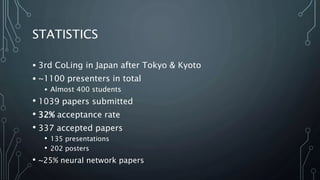
STATISTICS
• 3rd CoLing in Japan after Tokyo & Kyoto
• ~1100 presenters in total
• Almost 400 students
• 1039 papers submitted
• 32% acceptance rate
• 337 accepted papers
• 135 presentations
• 202 posters
• ~25% neural network papers
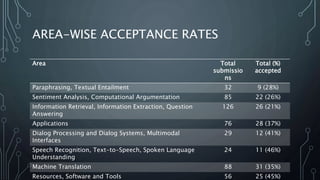
AREA-WISE ACCEPTANCE RATES
Area Total
submissio
ns
Total (%)
accepted
Paraphrasing, Textual Entailment 32 9 (28%)
Sentiment Analysis, Computational Argumentation 85 22 (26%)
Information Retrieval, Information Extraction, Question
Answering
126 26 (21%)
Applications 76 28 (37%)
Dialog Processing and Dialog Systems, Multimodal
Interfaces
29 12 (41%)
Speech Recognition, Text-to-Speech, Spoken Language
Understanding
24 11 (46%)
Machine Translation 88 31 (35%)
Resources, Software and Tools 56 25 (45%)
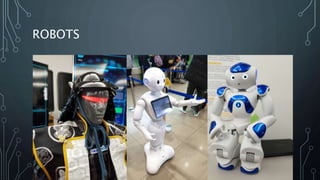
ROBOTS
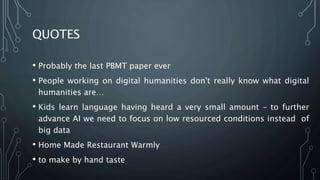
QUOTES
• Probably the last PBMT paper ever
• People working on digital humanities don't really know what digital
humanities are…
• Kids learn language having heard a very small amount – to further
advance AI we need to focus on low resourced conditions instead of
big data
• Home Made Restaurant Warmly
• to make by hand taste
HYTRA 6
SIXTH WORKSHOP ON HYBRID APPROACHES TO TRANSLATION
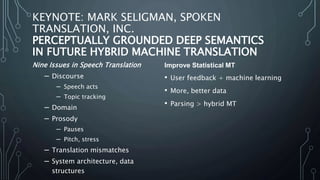
KEYNOTE: MARK SELIGMAN, SPOKEN
TRANSLATION, INC.
PERCEPTUALLY GROUNDED DEEP SEMANTICS
IN FUTURE HYBRID MACHINE TRANSLATION
Nine Issues in Speech Translation
– Discourse
– Speech acts
– Topic tracking
– Domain
– Prosody
– Pauses
– Pitch, stress
– Translation mismatches
– System architecture, data
structures
Improve Statistical MT
• User feedback + machine learning
• More, better data
• Parsing > hybrid MT
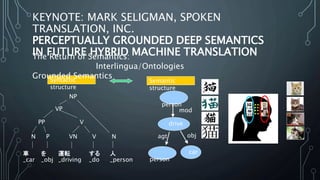
KEYNOTE: MARK SELIGMAN, SPOKEN
TRANSLATION, INC.
PERCEPTUALLY GROUNDED DEEP SEMANTICS
IN FUTURE HYBRID MACHINE TRANSLATION
車
_car
を
_obj
運転
_driving
する
_do
人
_person
Syntactic
structure
NP
VP
Semantic
structure
PP V
N NP VN V
drive
person
person
car
mod
agt obj
The Return of Semantics:
Interlingua/Ontologies
Grounded Semantics
MAIN CONFERENCE
KEYNOTES:
JOAKIM NIVRE, REIKO MAZUKA, DINA DEMNER-FUSHMAN, SIMONE
TEUFEL
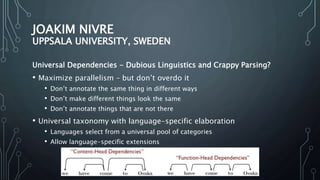
JOAKIM NIVRE
UPPSALA UNIVERSITY, SWEDEN
Universal Dependencies - Dubious Linguistics and Crappy Parsing?
• Maximize parallelism – but don’t overdo it
• Don’t annotate the same thing in different ways
• Don’t make different things look the same
• Don’t annotate things that are not there
• Universal taxonomy with language-specific elaboration
• Languages select from a universal pool of categories
• Allow language-specific extensions
JOAKIM NIVRE
UPPSALA UNIVERSITY, SWEDEN
Manning's law
1. UD needs to be satisfactory on linguistic analysis grounds for individual languages.
2. UD needs to be good for linguistic typology, i.e., providing a suitable basis for bringing
out cross-linguistic parallelism across languages and language families.
3. UD must be suitable for rapid, consistent annotation by a human annotator.
4. UD must be suitable for computer parsing with high accuracy.
5. UD must be easily comprehended and used by a non-linguist, whether a language
learner or an engineer with prosaic needs for language processing.
6. UD must support well downstream language understanding tasks (relation extraction,
reading comprehension, machine translation, …).
JOAKIM NIVRE
UPPSALA UNIVERSITY, SWEDEN
Dubious linguistics?
• Lexical dependencies and functional relations encoded in a
single tree
• Grounded in linguistic typology and dependency grammar
traditions
Crappy parsing?
• Not so bad with existing parsers, especially for cross-lingual
parsing
• Learn richer parsing models grounded in linguistic typology
REIKO MAZUKA
RIKEN BRAIN SCIENCE INSTITUTE, JAPAN
• 12month old babies are called 'old babies‘
• Medical stuff has lots of data, lots of problems
• … let alone …
DINA DEMNER-FUSHMAN
U.S. NATIONAL LIBRARY OF MEDICINE, U.S.A.
SIMONE TEUFEL
UNIVERSITY OF CAMBRIDGE, U.K.
PRESENTATIONS
MAIN CONFERENCE
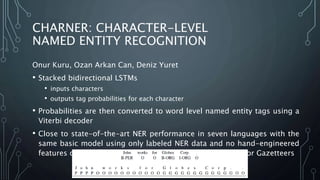
CHARNER: CHARACTER-LEVEL
NAMED ENTITY RECOGNITION
Onur Kuru, Ozan Arkan Can, Deniz Yuret
• Stacked bidirectional LSTMs
• inputs characters
• outputs tag probabilities for each character
• Probabilities are then converted to word level named entity tags using a
Viterbi decoder
• Close to state-of-the-art NER performance in seven languages with the
same basic model using only labeled NER data and no hand-engineered
features or other external resources like syntactic taggers or Gazetteers
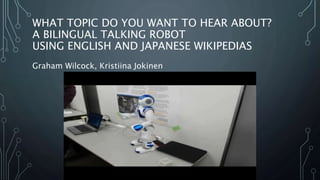
WHAT TOPIC DO YOU WANT TO HEAR ABOUT?
A BILINGUAL TALKING ROBOT
USING ENGLISH AND JAPANESE WIKIPEDIAS
Graham Wilcock, Kristiina Jokinen
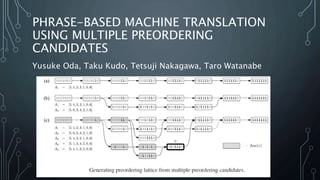
PHRASE-BASED MACHINE TRANSLATION
USING MULTIPLE PREORDERING
CANDIDATES
Yusuke Oda, Taku Kudo, Tetsuji Nakagawa, Taro Watanabe
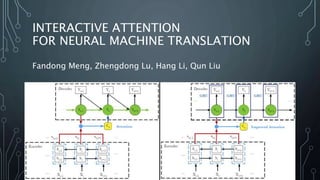
INTERACTIVE ATTENTION
FOR NEURAL MACHINE TRANSLATION
Fandong Meng, Zhengdong Lu, Hang Li, Qun Liu
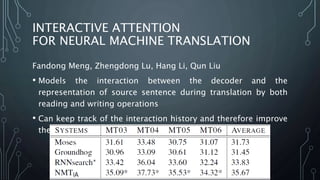
INTERACTIVE ATTENTION
FOR NEURAL MACHINE TRANSLATION
Fandong Meng, Zhengdong Lu, Hang Li, Qun Liu
• Models the interaction between the decoder and the
representation of source sentence during translation by both
reading and writing operations
• Can keep track of the interaction history and therefore improve
the translation performance
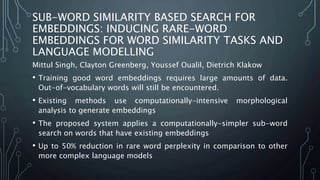
SUB-WORD SIMILARITY BASED SEARCH FOR
EMBEDDINGS: INDUCING RARE-WORD
EMBEDDINGS FOR WORD SIMILARITY TASKS AND
LANGUAGE MODELLING
Mittul Singh, Clayton Greenberg, Youssef Oualil, Dietrich Klakow
• Training good word embeddings requires large amounts of data.
Out-of-vocabulary words will still be encountered.
• Existing methods use computationally-intensive morphological
analysis to generate embeddings
• The proposed system applies a computationally-simpler sub-word
search on words that have existing embeddings
• Up to 50% reduction in rare word perplexity in comparison to other
more complex language models
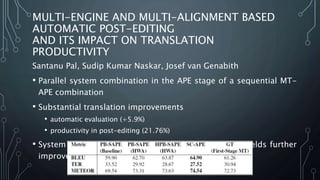
MULTI-ENGINE AND MULTI-ALIGNMENT BASED
AUTOMATIC POST-EDITING
AND ITS IMPACT ON TRANSLATION
PRODUCTIVITY
Santanu Pal, Sudip Kumar Naskar, Josef van Genabith
• Parallel system combination in the APE stage of a sequential MT-
APE combination
• Substantial translation improvements
• automatic evaluation (+5.9%)
• productivity in post-editing (21.76%)
• System combination on the level of APE alignments yields further
improvements
POSTERS
MAIN CONFERENCE
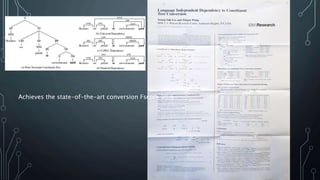
Achieves the state-of-the-art conversion Fscore 95.6
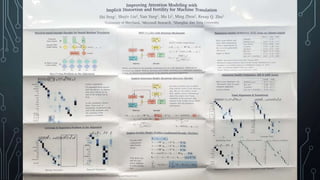
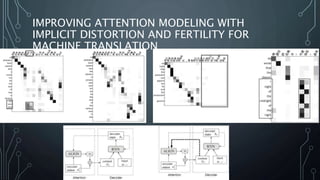
IMPROVING ATTENTION MODELING WITH
IMPLICIT DISTORTION AND FERTILITY FOR
MACHINE TRANSLATION
BEST PAPERS
2+1
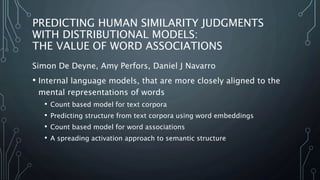
PREDICTING HUMAN SIMILARITY JUDGMENTS
WITH DISTRIBUTIONAL MODELS:
THE VALUE OF WORD ASSOCIATIONS
Simon De Deyne, Amy Perfors, Daniel J Navarro
• Internal language models, that are more closely aligned to the
mental representations of words
• Count based model for text corpora
• Predicting structure from text corpora using word embeddings
• Count based model for word associations
• A spreading activation approach to semantic structure
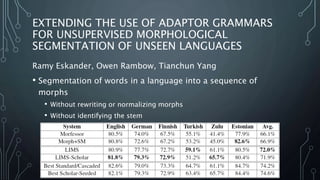
EXTENDING THE USE OF ADAPTOR GRAMMARS
FOR UNSUPERVISED MORPHOLOGICAL
SEGMENTATION OF UNSEEN LANGUAGES
Ramy Eskander, Owen Rambow, Tianchun Yang
• Segmentation of words in a language into a sequence of
morphs
• Without rewriting or normalizing morphs
• Without identifying the stem
• Without identifying morphological features
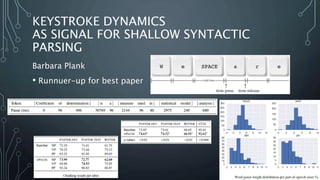
KEYSTROKE DYNAMICS
AS SIGNAL FOR SHALLOW SYNTACTIC
PARSING
Barbara Plank
• Runnuer-up for best paper
WHAT’S NEXT
FUTURE COLING
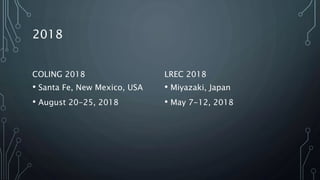
2018
COLING 2018
• Santa Fe, New Mexico, USA
• August 20-25, 2018
LREC 2018
• Miyazaki, Japan
• May 7-12, 2018
LESS COLING & MORE OSAKA
HTTP://LIELAKEDA.LV HTTP://EJ.UZ/COLING2016

CoLing 2016

  • 1.
    THE 26TH INTERNATIONAL CONFERENCEON COMPUTATIONAL LINGUISTICS DECEMBER 11-16, 2016 OSAKA, JAPAN
  • 2.
  • 3.
    STATISTICS • 3rd CoLingin Japan after Tokyo & Kyoto • ~1100 presenters in total • Almost 400 students • 1039 papers submitted • 32% acceptance rate • 337 accepted papers • 135 presentations • 202 posters • ~25% neural network papers
  • 4.
    AREA-WISE ACCEPTANCE RATES AreaTotal submissio ns Total (%) accepted Paraphrasing, Textual Entailment 32 9 (28%) Sentiment Analysis, Computational Argumentation 85 22 (26%) Information Retrieval, Information Extraction, Question Answering 126 26 (21%) Applications 76 28 (37%) Dialog Processing and Dialog Systems, Multimodal Interfaces 29 12 (41%) Speech Recognition, Text-to-Speech, Spoken Language Understanding 24 11 (46%) Machine Translation 88 31 (35%) Resources, Software and Tools 56 25 (45%)
  • 5.
  • 6.
    QUOTES • Probably thelast PBMT paper ever • People working on digital humanities don't really know what digital humanities are… • Kids learn language having heard a very small amount – to further advance AI we need to focus on low resourced conditions instead of big data • Home Made Restaurant Warmly • to make by hand taste
  • 8.
    HYTRA 6 SIXTH WORKSHOPON HYBRID APPROACHES TO TRANSLATION
  • 9.
    KEYNOTE: MARK SELIGMAN,SPOKEN TRANSLATION, INC. PERCEPTUALLY GROUNDED DEEP SEMANTICS IN FUTURE HYBRID MACHINE TRANSLATION Nine Issues in Speech Translation – Discourse – Speech acts – Topic tracking – Domain – Prosody – Pauses – Pitch, stress – Translation mismatches – System architecture, data structures Improve Statistical MT • User feedback + machine learning • More, better data • Parsing > hybrid MT
  • 10.
    KEYNOTE: MARK SELIGMAN,SPOKEN TRANSLATION, INC. PERCEPTUALLY GROUNDED DEEP SEMANTICS IN FUTURE HYBRID MACHINE TRANSLATION 車 _car を _obj 運転 _driving する _do 人 _person Syntactic structure NP VP Semantic structure PP V N NP VN V drive person person car mod agt obj The Return of Semantics: Interlingua/Ontologies Grounded Semantics
  • 11.
    MAIN CONFERENCE KEYNOTES: JOAKIM NIVRE,REIKO MAZUKA, DINA DEMNER-FUSHMAN, SIMONE TEUFEL
  • 12.
    JOAKIM NIVRE UPPSALA UNIVERSITY,SWEDEN Universal Dependencies - Dubious Linguistics and Crappy Parsing? • Maximize parallelism – but don’t overdo it • Don’t annotate the same thing in different ways • Don’t make different things look the same • Don’t annotate things that are not there • Universal taxonomy with language-specific elaboration • Languages select from a universal pool of categories • Allow language-specific extensions
  • 13.
    JOAKIM NIVRE UPPSALA UNIVERSITY,SWEDEN Manning's law 1. UD needs to be satisfactory on linguistic analysis grounds for individual languages. 2. UD needs to be good for linguistic typology, i.e., providing a suitable basis for bringing out cross-linguistic parallelism across languages and language families. 3. UD must be suitable for rapid, consistent annotation by a human annotator. 4. UD must be suitable for computer parsing with high accuracy. 5. UD must be easily comprehended and used by a non-linguist, whether a language learner or an engineer with prosaic needs for language processing. 6. UD must support well downstream language understanding tasks (relation extraction, reading comprehension, machine translation, …).
  • 14.
    JOAKIM NIVRE UPPSALA UNIVERSITY,SWEDEN Dubious linguistics? • Lexical dependencies and functional relations encoded in a single tree • Grounded in linguistic typology and dependency grammar traditions Crappy parsing? • Not so bad with existing parsers, especially for cross-lingual parsing • Learn richer parsing models grounded in linguistic typology
  • 15.
    REIKO MAZUKA RIKEN BRAINSCIENCE INSTITUTE, JAPAN • 12month old babies are called 'old babies‘ • Medical stuff has lots of data, lots of problems • … let alone … DINA DEMNER-FUSHMAN U.S. NATIONAL LIBRARY OF MEDICINE, U.S.A. SIMONE TEUFEL UNIVERSITY OF CAMBRIDGE, U.K.
  • 16.
  • 17.
    CHARNER: CHARACTER-LEVEL NAMED ENTITYRECOGNITION Onur Kuru, Ozan Arkan Can, Deniz Yuret • Stacked bidirectional LSTMs • inputs characters • outputs tag probabilities for each character • Probabilities are then converted to word level named entity tags using a Viterbi decoder • Close to state-of-the-art NER performance in seven languages with the same basic model using only labeled NER data and no hand-engineered features or other external resources like syntactic taggers or Gazetteers
  • 18.
    WHAT TOPIC DOYOU WANT TO HEAR ABOUT? A BILINGUAL TALKING ROBOT USING ENGLISH AND JAPANESE WIKIPEDIAS Graham Wilcock, Kristiina Jokinen
  • 19.
    PHRASE-BASED MACHINE TRANSLATION USINGMULTIPLE PREORDERING CANDIDATES Yusuke Oda, Taku Kudo, Tetsuji Nakagawa, Taro Watanabe
  • 20.
    INTERACTIVE ATTENTION FOR NEURALMACHINE TRANSLATION Fandong Meng, Zhengdong Lu, Hang Li, Qun Liu
  • 21.
    INTERACTIVE ATTENTION FOR NEURALMACHINE TRANSLATION Fandong Meng, Zhengdong Lu, Hang Li, Qun Liu • Models the interaction between the decoder and the representation of source sentence during translation by both reading and writing operations • Can keep track of the interaction history and therefore improve the translation performance
  • 22.
    SUB-WORD SIMILARITY BASEDSEARCH FOR EMBEDDINGS: INDUCING RARE-WORD EMBEDDINGS FOR WORD SIMILARITY TASKS AND LANGUAGE MODELLING Mittul Singh, Clayton Greenberg, Youssef Oualil, Dietrich Klakow • Training good word embeddings requires large amounts of data. Out-of-vocabulary words will still be encountered. • Existing methods use computationally-intensive morphological analysis to generate embeddings • The proposed system applies a computationally-simpler sub-word search on words that have existing embeddings • Up to 50% reduction in rare word perplexity in comparison to other more complex language models
  • 23.
    MULTI-ENGINE AND MULTI-ALIGNMENTBASED AUTOMATIC POST-EDITING AND ITS IMPACT ON TRANSLATION PRODUCTIVITY Santanu Pal, Sudip Kumar Naskar, Josef van Genabith • Parallel system combination in the APE stage of a sequential MT- APE combination • Substantial translation improvements • automatic evaluation (+5.9%) • productivity in post-editing (21.76%) • System combination on the level of APE alignments yields further improvements
  • 24.
  • 25.
    Achieves the state-of-the-artconversion Fscore 95.6
  • 31.
    IMPROVING ATTENTION MODELINGWITH IMPLICIT DISTORTION AND FERTILITY FOR MACHINE TRANSLATION
  • 32.
  • 33.
    PREDICTING HUMAN SIMILARITYJUDGMENTS WITH DISTRIBUTIONAL MODELS: THE VALUE OF WORD ASSOCIATIONS Simon De Deyne, Amy Perfors, Daniel J Navarro • Internal language models, that are more closely aligned to the mental representations of words • Count based model for text corpora • Predicting structure from text corpora using word embeddings • Count based model for word associations • A spreading activation approach to semantic structure
  • 34.
    EXTENDING THE USEOF ADAPTOR GRAMMARS FOR UNSUPERVISED MORPHOLOGICAL SEGMENTATION OF UNSEEN LANGUAGES Ramy Eskander, Owen Rambow, Tianchun Yang • Segmentation of words in a language into a sequence of morphs • Without rewriting or normalizing morphs • Without identifying the stem • Without identifying morphological features
  • 35.
    KEYSTROKE DYNAMICS AS SIGNALFOR SHALLOW SYNTACTIC PARSING Barbara Plank • Runnuer-up for best paper
  • 36.
  • 37.
    2018 COLING 2018 • SantaFe, New Mexico, USA • August 20-25, 2018 LREC 2018 • Miyazaki, Japan • May 7-12, 2018
  • 38.
    LESS COLING &MORE OSAKA HTTP://LIELAKEDA.LV HTTP://EJ.UZ/COLING2016