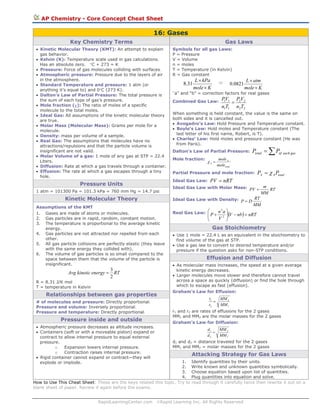
AP Chemistry - Core Concept Cheat Sheet

16: Gases
Key Chemistry Terms

Gas Laws

• Kinetic Molecular Theory (KMT): An attempt to explain
gas behavior.
• Kelvin (K): Temperature scale used in gas calculations.
Has an absolute zero. °C + 273 = K
• Pressure: Force of gas molecules colliding with surfaces.
• Atmospheric pressure: Pressure due to the layers of air
in the atmosphere.
• Standard Temperature and pressure: 1 atm (or
anything it’s equal to) and 0°C (273 K).
• Dalton’s Law of Partial Pressure: The total pressure is
the sum of each type of gas’s pressure.
• Mole fraction (χ): The ratio of moles of a specific
molecule to the total moles.
• Ideal Gas: All assumptions of the kinetic molecular theory
are true.
• Molar Mass (Molecular Mass): Grams per mole for a
molecule.
• Density: mass per volume of a sample.
• Real Gas: The assumptions that molecules have no
attractions/repulsions and that the particle volume is
insignificant are not valid.
• Molar Volume of a gas: 1 mole of any gas at STP = 22.4
Liters.
• Diffusion: Rate at which a gas travels through a container.
• Effusion: The rate at which a gas escapes through a tiny
hole.

Pressure Units
1 atm = 101300 Pa = 101.3 kPa = 760 mm Hg = 14.7 psi

Kinetic Molecular Theory
Assumptions of the KMT
1. Gases are made of atoms or molecules.
2. Gas particles are in rapid, random, constant motion.
3. The temperature is proportional to the average kinetic
energy.
4. Gas particles are not attracted nor repelled from each
other.
5. All gas particle collisions are perfectly elastic (they leave
with the same energy they collided with).
6. The volume of gas particles is so small compared to the
space between them that the volume of the particle is
insignificant.

Avg kinetic energy =

3
RT
2

R = 8.31 J/K mol
T = temperature in Kelvin

Relationships between gas properties
# of molecules and pressure: Directly proportional.
Pressure and volume: Inversely proportional.
Pressure and temperature: Directly proportional.

Pressure inside and outside
• Atmospheric pressure decreases as altitude increases.
• Containers (soft or with a moveable piston) expand or
contract to allow internal pressure to equal external
pressure.
o
Expansion lowers internal pressure.
o
Contraction raises internal pressure.
• Rigid container cannot expand or contract—they will
explode or implode.

Symbols for all gas Laws:
P = Pressure
V = Volume
n = moles
T = Temperature (in Kelvin)
R = Gas constant

8.31

or

0.0821

L × atm
mole × K

“a” and “b” = correction factors for real gases
Combined Gas Law:

P1V1 P2V2
=
n1T1 n2T2

When something is held constant, the value is the same on
both sides and it is cancelled out.
• Avogadro’s Law: Hold Pressure and Temperature constant.
• Boyle’s Law: Hold moles and Temperature constant (The
last letter of his first name, Robert, is T).
• Charles’ Law: Hold moles and pressure constant (He was
from Paris).
Dalton’s Law of Partial Pressure:
Mole fraction:

Ptotal = ∑ Pof each gas

mole A
χA =
moletotal

Partial Pressure and mole fraction:

PA = χ A Ptotal

Ideal Gas Law: PV = nRT
Ideal Gas Law with Molar Mass: PV = m RT

MM
RT
Ideal Gas Law with Density: P = D
MM
⎛
n2a ⎞
Real Gas Law: ⎜ P +
⎟(V − nb ) = nRT
⎜
V2 ⎟
⎝
⎠

Gas Stoichiometry
• Use 1 mole = 22.4 L as an equivalent in the stoichiometry to
find volume of the gas at STP.
• Use a gas law to convert to desired temperature and/or
pressure if the question asks for non-STP conditions.

Effusion and Diffusion
• As molecular mass increases, the speed at a given average
kinetic energy decreases.
• Larger molecules move slower and therefore cannot travel
across a space as quickly (diffusion) or find the hole through
which to escape as fast (effusion).
Graham’s Law for Effusion:

r1
=
r2

MM 2
MM 1

r1 and r2 are rates of effusions for the 2 gases
MM1 and MM2 are the molar masses for the 2 gases
Graham’s Law for Diffusion:
d1
=
d2

MM 2
MM 1

d1 and d2 = distance traveled for the 2 gases
MM1 and MM2 = molar masses for the 2 gases

Attacking Strategy for Gas Laws

1.
2.
3.
4.
How to Use This Cheat Sheet: These are the keys related this topic. Try to
blank sheet of paper. Review it again before the exams.
RapidLearningCenter.com

L × kPa
mole × K

Identify quantities by their units.
Write known and unknown quantities symbolically.
Choose equation based upon list of quantities.
Plug quantities into equation and solve.
read through it carefully twice then rewrite it out on a

©Rapid Learning Inc. All Rights Reserved

Gases cheat sheet

  • 1.
    AP Chemistry -Core Concept Cheat Sheet 16: Gases Key Chemistry Terms Gas Laws • Kinetic Molecular Theory (KMT): An attempt to explain gas behavior. • Kelvin (K): Temperature scale used in gas calculations. Has an absolute zero. °C + 273 = K • Pressure: Force of gas molecules colliding with surfaces. • Atmospheric pressure: Pressure due to the layers of air in the atmosphere. • Standard Temperature and pressure: 1 atm (or anything it’s equal to) and 0°C (273 K). • Dalton’s Law of Partial Pressure: The total pressure is the sum of each type of gas’s pressure. • Mole fraction (χ): The ratio of moles of a specific molecule to the total moles. • Ideal Gas: All assumptions of the kinetic molecular theory are true. • Molar Mass (Molecular Mass): Grams per mole for a molecule. • Density: mass per volume of a sample. • Real Gas: The assumptions that molecules have no attractions/repulsions and that the particle volume is insignificant are not valid. • Molar Volume of a gas: 1 mole of any gas at STP = 22.4 Liters. • Diffusion: Rate at which a gas travels through a container. • Effusion: The rate at which a gas escapes through a tiny hole. Pressure Units 1 atm = 101300 Pa = 101.3 kPa = 760 mm Hg = 14.7 psi Kinetic Molecular Theory Assumptions of the KMT 1. Gases are made of atoms or molecules. 2. Gas particles are in rapid, random, constant motion. 3. The temperature is proportional to the average kinetic energy. 4. Gas particles are not attracted nor repelled from each other. 5. All gas particle collisions are perfectly elastic (they leave with the same energy they collided with). 6. The volume of gas particles is so small compared to the space between them that the volume of the particle is insignificant. Avg kinetic energy = 3 RT 2 R = 8.31 J/K mol T = temperature in Kelvin Relationships between gas properties # of molecules and pressure: Directly proportional. Pressure and volume: Inversely proportional. Pressure and temperature: Directly proportional. Pressure inside and outside • Atmospheric pressure decreases as altitude increases. • Containers (soft or with a moveable piston) expand or contract to allow internal pressure to equal external pressure. o Expansion lowers internal pressure. o Contraction raises internal pressure. • Rigid container cannot expand or contract—they will explode or implode. Symbols for all gas Laws: P = Pressure V = Volume n = moles T = Temperature (in Kelvin) R = Gas constant 8.31 or 0.0821 L × atm mole × K “a” and “b” = correction factors for real gases Combined Gas Law: P1V1 P2V2 = n1T1 n2T2 When something is held constant, the value is the same on both sides and it is cancelled out. • Avogadro’s Law: Hold Pressure and Temperature constant. • Boyle’s Law: Hold moles and Temperature constant (The last letter of his first name, Robert, is T). • Charles’ Law: Hold moles and pressure constant (He was from Paris). Dalton’s Law of Partial Pressure: Mole fraction: Ptotal = ∑ Pof each gas mole A χA = moletotal Partial Pressure and mole fraction: PA = χ A Ptotal Ideal Gas Law: PV = nRT Ideal Gas Law with Molar Mass: PV = m RT MM RT Ideal Gas Law with Density: P = D MM ⎛ n2a ⎞ Real Gas Law: ⎜ P + ⎟(V − nb ) = nRT ⎜ V2 ⎟ ⎝ ⎠ Gas Stoichiometry • Use 1 mole = 22.4 L as an equivalent in the stoichiometry to find volume of the gas at STP. • Use a gas law to convert to desired temperature and/or pressure if the question asks for non-STP conditions. Effusion and Diffusion • As molecular mass increases, the speed at a given average kinetic energy decreases. • Larger molecules move slower and therefore cannot travel across a space as quickly (diffusion) or find the hole through which to escape as fast (effusion). Graham’s Law for Effusion: r1 = r2 MM 2 MM 1 r1 and r2 are rates of effusions for the 2 gases MM1 and MM2 are the molar masses for the 2 gases Graham’s Law for Diffusion: d1 = d2 MM 2 MM 1 d1 and d2 = distance traveled for the 2 gases MM1 and MM2 = molar masses for the 2 gases Attacking Strategy for Gas Laws 1. 2. 3. 4. How to Use This Cheat Sheet: These are the keys related this topic. Try to blank sheet of paper. Review it again before the exams. RapidLearningCenter.com L × kPa mole × K Identify quantities by their units. Write known and unknown quantities symbolically. Choose equation based upon list of quantities. Plug quantities into equation and solve. read through it carefully twice then rewrite it out on a ©Rapid Learning Inc. All Rights Reserved