
FBH
Seminor topic on qualitative microscopy of crude drugs
Qualitative microscopy of
crude drugs
Crude drug:-
Crude drugs are defined as the drugs which are obtained
from natural sources like plants, animals , minerals and
they are used as such as they occur in nature without any
processing except drying and size reduction.
Importance of evaluation of crude drugs:-
Determination of biochemical variation in the drugs.
Identification of degradation due to treatment and storage.
Reporting the substitution (or) adulteration.
Quantitative microscopy of crude drugs
This is an important technique employed in
identification of crude drug when chemical and
physical methods are in applicable.
Using this, one can determine the proportions of
the substances present by means of the microscope.
And these microscopic assay can be done by
using the
“lycopodium spore method”
Lycopodium spore method
Lycopodium spore method is used when
especially chemical and other methods of
evaluation of drugs fails to determine quality.
Lycopodium spores are very characterized in
shape and appearance and uniform in size(25µm)
Where, 1 mg of lycopodium powder have avg:-
94000 spores.
It consist of,
1) Well defined particles which may be counted.
2) Single layered cells or tissues which can be easily
identified under suitable magnification.
3) Objects of uniform thickness, the length of which
can be measured and actual area calculated.
Lycopodium spore method
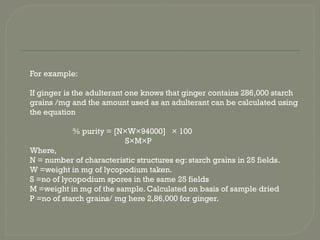
For example:
If ginger is the adulterant one knows that ginger contains 286,000 starch
grains /mg and the amount used as an adulterant can be calculated using
the equation
% purity = [N×W×94000] × 100
S×M×P
Where,
N = number of characteristic structures eg: starch grains in 25 fields.
W =weight in mg of lycopodium taken.
S =no of lycopodium spores in the same 25 fields
M =weight in mg of the sample. Calculated on basis of sample dried
P =no of starch grains/ mg here 2,86,000 for ginger.
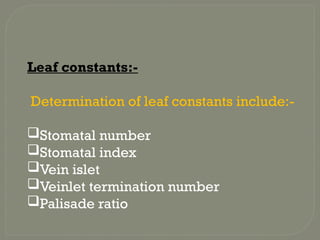
Leaf constants:-
Determination of leaf constants include:-
Stomatal number
Stomatal index
Vein islet
Veinlet termination number
Palisade ratio
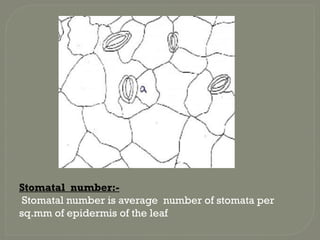
Stomatal number:-
Stomatal number is average number of stomata per
sq.mm of epidermis of the leaf
Stomatal index: -
It is the % which the no of stomata form to the total no of
epidermal cells each stomata is counted as one cell.
Stomatal index calculated by;
SI = S ×100
E+S
Where
S= no of stomata per unit area.
E= no of epidermal cells in the same unit area.
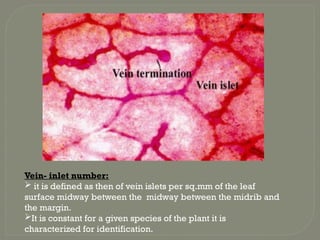
Vein- inlet number:
 it is defined as then of vein islets per sq.mm of the leaf
surface midway between the midway between the midrib and
the margin.
It is constant for a given species of the plant it is
characterized for identification.
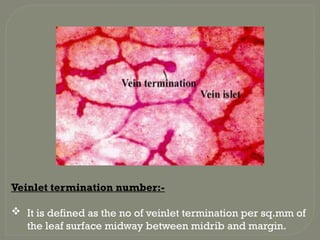
Veinlet termination number:-
 It is defined as the no of veinlet termination per sq.mm of
the leaf surface midway between midrib and margin.
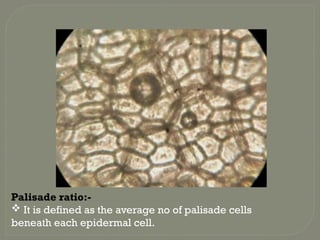
Palisade ratio:-
 It is defined as the average no of palisade cells
beneath each epidermal cell.
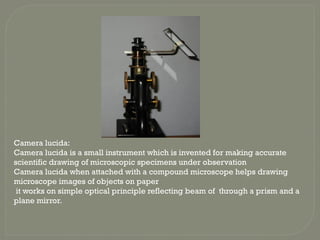
Camera lucida:
Camera lucida is a small instrument which is invented for making accurate
scientific drawing of microscopic specimens under observation
Camera lucida when attached with a compound microscope helps drawing
microscope images of objects on paper
it works on simple optical principle reflecting beam of through a prism and a
plane mirror.
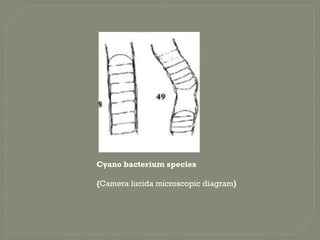
Cyano bacterium species
{Camera lucida microscopic diagram}