Pharmacodynamics-III
Dr. Pravin Prasad
M.B.B.S., MD Clinical Pharmacology
Lecturer, Lumbini Medical College & TH
13 December, 2018 (27 Mangsir, 2075),
Thursday
Pre-test
What factors do you think
can modify the affect of a
drug?
Can you categorize them?
What will be the clinical
implication of this topic?
By the end of the class, MBBS
Ist year students will be able
to:
List the factors that can modify the action of a
drug
Describe the basis of modification of drug
action by various factors
Apply the information to modify the drug
prescription in clinical setting
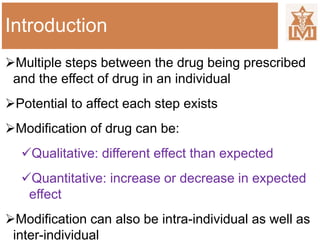
Introduction
Multiple steps between the drug being prescribed
and the effect of drug in an individual
Potential to affect each step exists
Modification of drug can be:
Qualitative: different effect than expected
Quantitative: increase or decrease in expected
effect
Modification can also be intra-individual as well as
inter-individual
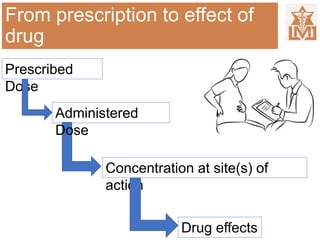
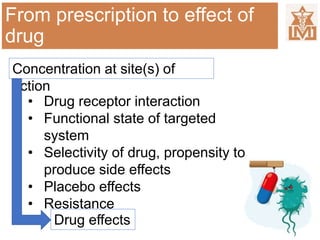
From prescription to effect of
drug
Prescribed
Dose
Concentration at site(s) of
action
Drug effects
Administered
Dose
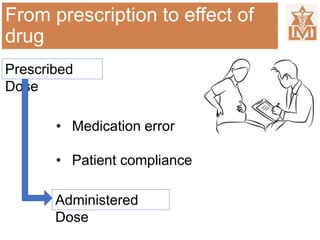
From prescription to effect of
drug
Prescribed
Dose
• Medication error
• Patient compliance
Administered
Dose
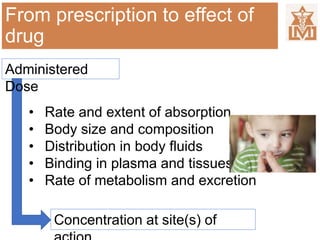
From prescription to effect of
drug
Concentration at site(s) of
Administered
Dose
• Rate and extent of absorption
• Body size and composition
• Distribution in body fluids
• Binding in plasma and tissues
• Rate of metabolism and excretion
From prescription to effect of
drug
Concentration at site(s) of
action
Drug effects
• Drug receptor interaction
• Functional state of targeted
system
• Selectivity of drug, propensity to
produce side effects
• Placebo effects
• Resistance
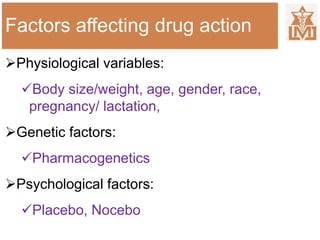
Factors affecting drug action
Physiological variables:
Body size/weight, age, gender, race,
pregnancy/ lactation,
Genetic factors:
Pharmacogenetics
Psychological factors:
Placebo, Nocebo
Factors affecting drug action
Environmental factors:
Environmental exposure, timing of drug
administration
Pharmacological variables:
Route of administration, tolerance and
desensitization, drug interaction, cumulation
Pathological variables:
Gastrointestinal, renal, cardiac, thyroid disease
conditions
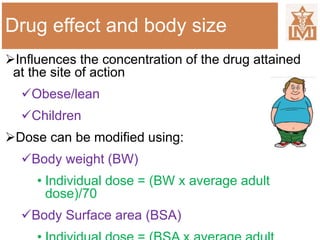
Drug effect and body size
Influences the concentration of the drug attained
at the site of action
Obese/lean
Children
Dose can be modified using:
Body weight (BW)
• Individual dose = (BW x average adult
dose)/70
Body Surface area (BSA)
Drug effect and Age
Infant/Children vs Adult
Low g.f.r and tubular transport – Gentamicin
and Penicillin
Low hepatic drug metabolizing systems in
newborns – gray baby syndrome
Blood brain barrier (BBB) is more permeable
– Kernicterus
Drug effect and Age
Infant/Children vs Adult
lower gastric acidity ad slow intestinal
transit- altered absorption of drugs
Faster transdermal absorption and faster
rectal absorption – Diazepam
After one year age, faster metabolism than
adults – phenytoin, carbamazepine
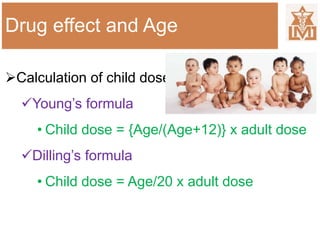
Drug effect and Age
Calculation of child dose
Young’s formula
• Child dose = {Age/(Age+12)} x adult dose
Dilling’s formula
• Child dose = Age/20 x adult dose
Drug effect and Age
Elderly
Decreased gut motility and blood flow to
intestines  slower absorption
Decreased hepatic microsomal enzyme activity
• Decreased first pass metabolism
• Overall effect on drug metabolism: not
uniform
Lower plasma protein  lesser plasma protein
binding
Drug effect and Age
Elderly
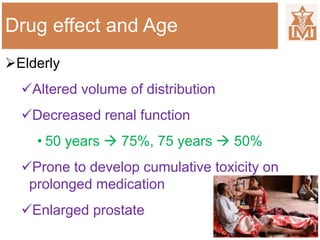
Altered volume of distribution
Decreased renal function
• 50 years  75%, 75 years  50%
Prone to develop cumulative toxicity on
prolonged medication
Enlarged prostate
Drug effect and Age
Elderly
Intolerant to digitalis
Decreased responsiveness to β adrenergic
drugs
Likely to be on multiple drugs  Drug
interaction
More Likely to develop adverse drug
reactions
• Postural hypotension, giddiness, mental
Drug effects and Gender
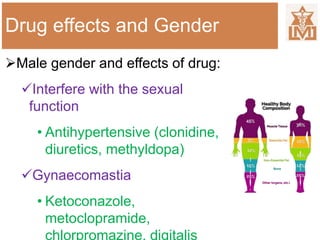
Male gender and effects of drug:
Interfere with the sexual
function
• Antihypertensive (clonidine,
diuretics, methyldopa)
Gynaecomastia
• Ketoconazole,
metoclopramide,
chlorpromazine, digitalis
Drug effects and Gender
Female gender and effects of drugs:
Smaller body size  lower dose
Subjective effects may differ
Digoxin for heart failure in women  higher
mortality
Androgen in women  not acceptable
Physiological states: menstruation,
pregnancy, lactation
Conclusion
Modification of drug action can occur due to
multitude of reasons affecting each step from
the drug being prescribed to the effects of
drugs on the patient
Factors can be physiological, psychological,
genetic, pathological, environmental,
pharmacological
Choice of drug and the dose of drug needs to
be modified if any of these factors are present
in an individual
Next class…
Tuesday, 18 December (10-11 am)
Topics:
Factors modifying drug action- remaining
portion
Combined effects of drugs
Any queries?
Thank you!

Pharmacodynamics part 3

  • 1.
    Pharmacodynamics-III Dr. Pravin Prasad M.B.B.S.,MD Clinical Pharmacology Lecturer, Lumbini Medical College & TH 13 December, 2018 (27 Mangsir, 2075), Thursday
  • 2.
    Pre-test What factors doyou think can modify the affect of a drug? Can you categorize them? What will be the clinical implication of this topic?
  • 3.
    By the endof the class, MBBS Ist year students will be able to: List the factors that can modify the action of a drug Describe the basis of modification of drug action by various factors Apply the information to modify the drug prescription in clinical setting
  • 4.
    Introduction Multiple steps betweenthe drug being prescribed and the effect of drug in an individual Potential to affect each step exists Modification of drug can be: Qualitative: different effect than expected Quantitative: increase or decrease in expected effect Modification can also be intra-individual as well as inter-individual
  • 5.
    From prescription toeffect of drug Prescribed Dose Concentration at site(s) of action Drug effects Administered Dose
  • 6.
    From prescription toeffect of drug Prescribed Dose • Medication error • Patient compliance Administered Dose
  • 7.
    From prescription toeffect of drug Concentration at site(s) of Administered Dose • Rate and extent of absorption • Body size and composition • Distribution in body fluids • Binding in plasma and tissues • Rate of metabolism and excretion
  • 8.
    From prescription toeffect of drug Concentration at site(s) of action Drug effects • Drug receptor interaction • Functional state of targeted system • Selectivity of drug, propensity to produce side effects • Placebo effects • Resistance
  • 9.
    Factors affecting drugaction Physiological variables: Body size/weight, age, gender, race, pregnancy/ lactation, Genetic factors: Pharmacogenetics Psychological factors: Placebo, Nocebo
  • 10.
    Factors affecting drugaction Environmental factors: Environmental exposure, timing of drug administration Pharmacological variables: Route of administration, tolerance and desensitization, drug interaction, cumulation Pathological variables: Gastrointestinal, renal, cardiac, thyroid disease conditions
  • 11.
    Drug effect andbody size Influences the concentration of the drug attained at the site of action Obese/lean Children Dose can be modified using: Body weight (BW) • Individual dose = (BW x average adult dose)/70 Body Surface area (BSA)
  • 12.
    Drug effect andAge Infant/Children vs Adult Low g.f.r and tubular transport – Gentamicin and Penicillin Low hepatic drug metabolizing systems in newborns – gray baby syndrome Blood brain barrier (BBB) is more permeable – Kernicterus
  • 13.
    Drug effect andAge Infant/Children vs Adult lower gastric acidity ad slow intestinal transit- altered absorption of drugs Faster transdermal absorption and faster rectal absorption – Diazepam After one year age, faster metabolism than adults – phenytoin, carbamazepine
  • 14.
    Drug effect andAge Calculation of child dose Young’s formula • Child dose = {Age/(Age+12)} x adult dose Dilling’s formula • Child dose = Age/20 x adult dose
  • 15.
    Drug effect andAge Elderly Decreased gut motility and blood flow to intestines  slower absorption Decreased hepatic microsomal enzyme activity • Decreased first pass metabolism • Overall effect on drug metabolism: not uniform Lower plasma protein  lesser plasma protein binding
  • 16.
    Drug effect andAge Elderly Altered volume of distribution Decreased renal function • 50 years  75%, 75 years  50% Prone to develop cumulative toxicity on prolonged medication Enlarged prostate
  • 17.
    Drug effect andAge Elderly Intolerant to digitalis Decreased responsiveness to β adrenergic drugs Likely to be on multiple drugs  Drug interaction More Likely to develop adverse drug reactions • Postural hypotension, giddiness, mental
  • 18.
    Drug effects andGender Male gender and effects of drug: Interfere with the sexual function • Antihypertensive (clonidine, diuretics, methyldopa) Gynaecomastia • Ketoconazole, metoclopramide, chlorpromazine, digitalis
  • 19.
    Drug effects andGender Female gender and effects of drugs: Smaller body size  lower dose Subjective effects may differ Digoxin for heart failure in women  higher mortality Androgen in women  not acceptable Physiological states: menstruation, pregnancy, lactation
  • 20.
    Conclusion Modification of drugaction can occur due to multitude of reasons affecting each step from the drug being prescribed to the effects of drugs on the patient Factors can be physiological, psychological, genetic, pathological, environmental, pharmacological Choice of drug and the dose of drug needs to be modified if any of these factors are present in an individual
  • 21.
    Next class… Tuesday, 18December (10-11 am) Topics: Factors modifying drug action- remaining portion Combined effects of drugs Any queries? Thank you!

Editor's Notes

  • #12 BSA (m2) = BW (kg)0.425 x Height (cm)0.725 X 0.007184
  • #17 Lipophilic drug  increased Vd Hydrophilic drug  decreased Vd
  • #18 Lipophilic drug  increased Vd Hydrophilic drug  decreased Vd
  • #20 Physiological changes during pregnancy: Decreased GIT motility Plasma and ECF volume expands Decreased plasma albumin, increased acid alpha glycoprotein Increased renal blood flow Enzyme induction