SUPPOSITORIES
Definition
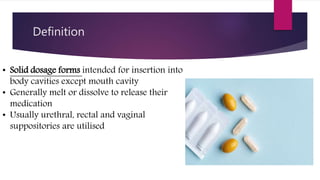
• Solid dosage forms intended for insertion into
body cavities except mouth cavity
• Generally melt or dissolve to release their
medication
• Usually urethral, rectal and vaginal
suppositories are utilised
Types of suppositories
1. Rectal suppositories
2. Urethral suppositories:- cylindrical in shape (6cm long)
- also called urethral bougies
3. Vaginal suppositories
4. Nasal suppositories/bougies:- prepared with glycerogelatin base
- length more than 8 cm
5. Ear cones:- prepared with cocoa butter
- also called Aurinaria
- rarely used
Advantages
• It passes first pass metabolism
• Melt at body temperature
• It gives localised and systemic action
• It can be given to unconscious patients
• Easy to use for paediatric and getriatric patients
• Useful for rapid and direct effect on rectum
• Useful to promote evacuation of bowels
Disadvantages
• Produces irritant effect
• Embarrassment to patients
• Cost expensive
• Need to be stored at low temperature
• Can’t easily prepared
• Some drugs might be degraded due to the microbial growth
Suppositories consists of:-
1. Suppositories bases
2. Lubricating agents:- liquid paraffin (should be applied using camel brush)
IDEAL PROPERTIES OF SUPPOSITORIES BASES
1. Easily melt at body temperature
2. Should shrink sufficiently to remove from mould
3. Should be compatible with various drugs
4. Physically stable on storage
5. Should not get soften or harden on storage
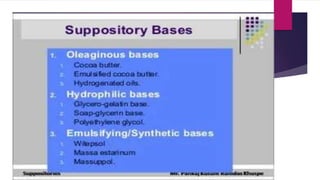
Suppositories Bases
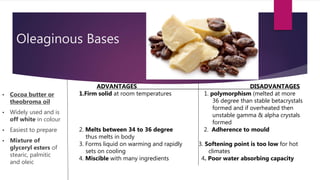
Oleaginous Bases
• Cocoa butter or
theobroma oil
• Widely used and is
off white in colour
• Easiest to prepare
• Mixture of
glyceryl esters of
stearic, palmitic
and oleic
ADVANTAGES DISADVANTAGES
1.Firm solid at room temperatures 1. polymorphism (melted at more
36 degree than stable betacrystals
formed and if overheated then
unstable gamma & alpha crystals
formed
2. Melts between 34 to 36 degree 2. Adherence to mould
thus melts in body
3. Forms liquid on warming and rapidly 3. Softening point is too low for hot
sets on cooling climates
4. Miscible with many ingredients 4. Poor water absorbing capacity
Water soluble and water miscible
bases
1) GLYCEROGELATIN BASES
• Mixture of glycerol and water with gelatine
• Glycerogelatin B.P :-14% w/w glycerol & 70% glycerol
• Glycerogelatin U.S.P:- 20% w/w glycerol & 70% glycerol
ADVANTAGES
1. Dissolves in body secretions
2. Soften slowly than cocoa butter
DISADVANTAGES
1. Difficult to prepare and handle
2. Highly hygroscopic
3. Gelatine is incompatible with drugs e.g., tannic acid
MACROGOL BASE
• Also called carbowaxes
• Melting point above 42 degree
• Found suitable in hot climate
• Brand names include :- Movicol, glycoprep
SOAP GLYCERIN BASES
• Soap is used as hardening material
• Water soluble
• Require lubricating agents e.g., arachis oil
• Dissolve in body fluid but does not melt at body temperature
Emulsifying Bases
• Proprietary synthetic bases
• Not rancid
• Do not adhere
• Non irritant
• Good water absorbing capacity
• Difference between melting and settling point is hardly 1-5 to 2 degree
• Brands :- witepsol, Massa estarinum, Massuppol
Preparation of glycerogelatin
suppositories
• STEP:1
Clean all the glasswares
• STEP:2
Take a beaker and add sufficient quantity of gelatin In it, pour some water and keep it aside for 1-2 min
(the gelatin will soak the water)
• STEP:3
Take a porcelain dish and pour some quantity of glycerine in it. Keep it on the water bath and let it melt
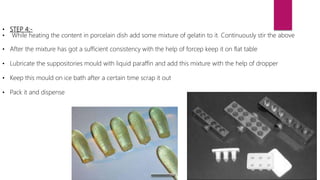
• STEP 4:-
• While heating the content in porcelain dish add some mixture of gelatin to it. Continuously stir the above
• After the mixture has got a sufficient consistency with the help of forcep keep it on flat table
• Lubricate the suppositories mould with liquid paraffin and add this mixture with the help of dropper
• Keep this mould on ice bath after a certain time scrap it out
• Pack it and dispense
Preparation of Boric acid suppositories
• STEP 1:-
Wash and clean suppository mould and lubricate it with liquid paraffin
• STEP 2:-
Weigh required quantity of cocoa butter and transfer it to porcelain dish
• STEP 3:-
Heat porcelain dish on water bath until 2/3 portion of cocoa butter is melt ( avoid overheating)
• STEP 4:-
Remove porcelain dish containing molten cocoa butter & stir
• STEP 5:-
Transfer required quantity of boric acid and dispense boric acid in cocoa butter and pour this dispersion in mould in excess
quantity
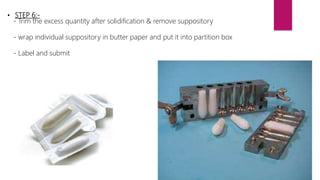
• STEP 6:-
- Trim the excess quantity after solidification & remove suppository
- wrap individual suppository in butter paper and put it into partition box
- Label and submit
THANK YOU
-BY ARCHA AND JANHAVI

SUPPOSITORIES.pptx

  • 1.
  • 2.
    Definition • Solid dosageforms intended for insertion into body cavities except mouth cavity • Generally melt or dissolve to release their medication • Usually urethral, rectal and vaginal suppositories are utilised
  • 3.
    Types of suppositories 1.Rectal suppositories 2. Urethral suppositories:- cylindrical in shape (6cm long) - also called urethral bougies 3. Vaginal suppositories 4. Nasal suppositories/bougies:- prepared with glycerogelatin base - length more than 8 cm 5. Ear cones:- prepared with cocoa butter - also called Aurinaria - rarely used
  • 4.
    Advantages • It passesfirst pass metabolism • Melt at body temperature • It gives localised and systemic action • It can be given to unconscious patients • Easy to use for paediatric and getriatric patients • Useful for rapid and direct effect on rectum • Useful to promote evacuation of bowels
  • 6.
    Disadvantages • Produces irritanteffect • Embarrassment to patients • Cost expensive • Need to be stored at low temperature • Can’t easily prepared • Some drugs might be degraded due to the microbial growth
  • 7.
    Suppositories consists of:- 1.Suppositories bases 2. Lubricating agents:- liquid paraffin (should be applied using camel brush) IDEAL PROPERTIES OF SUPPOSITORIES BASES 1. Easily melt at body temperature 2. Should shrink sufficiently to remove from mould 3. Should be compatible with various drugs 4. Physically stable on storage 5. Should not get soften or harden on storage
  • 8.
  • 9.
    Oleaginous Bases • Cocoabutter or theobroma oil • Widely used and is off white in colour • Easiest to prepare • Mixture of glyceryl esters of stearic, palmitic and oleic ADVANTAGES DISADVANTAGES 1.Firm solid at room temperatures 1. polymorphism (melted at more 36 degree than stable betacrystals formed and if overheated then unstable gamma & alpha crystals formed 2. Melts between 34 to 36 degree 2. Adherence to mould thus melts in body 3. Forms liquid on warming and rapidly 3. Softening point is too low for hot sets on cooling climates 4. Miscible with many ingredients 4. Poor water absorbing capacity
  • 10.
    Water soluble andwater miscible bases 1) GLYCEROGELATIN BASES • Mixture of glycerol and water with gelatine • Glycerogelatin B.P :-14% w/w glycerol & 70% glycerol • Glycerogelatin U.S.P:- 20% w/w glycerol & 70% glycerol ADVANTAGES 1. Dissolves in body secretions 2. Soften slowly than cocoa butter DISADVANTAGES 1. Difficult to prepare and handle 2. Highly hygroscopic 3. Gelatine is incompatible with drugs e.g., tannic acid
  • 11.
    MACROGOL BASE • Alsocalled carbowaxes • Melting point above 42 degree • Found suitable in hot climate • Brand names include :- Movicol, glycoprep SOAP GLYCERIN BASES • Soap is used as hardening material • Water soluble • Require lubricating agents e.g., arachis oil • Dissolve in body fluid but does not melt at body temperature
  • 12.
    Emulsifying Bases • Proprietarysynthetic bases • Not rancid • Do not adhere • Non irritant • Good water absorbing capacity • Difference between melting and settling point is hardly 1-5 to 2 degree • Brands :- witepsol, Massa estarinum, Massuppol
  • 13.
    Preparation of glycerogelatin suppositories •STEP:1 Clean all the glasswares • STEP:2 Take a beaker and add sufficient quantity of gelatin In it, pour some water and keep it aside for 1-2 min (the gelatin will soak the water) • STEP:3 Take a porcelain dish and pour some quantity of glycerine in it. Keep it on the water bath and let it melt
  • 14.
    • STEP 4:- •While heating the content in porcelain dish add some mixture of gelatin to it. Continuously stir the above • After the mixture has got a sufficient consistency with the help of forcep keep it on flat table • Lubricate the suppositories mould with liquid paraffin and add this mixture with the help of dropper • Keep this mould on ice bath after a certain time scrap it out • Pack it and dispense
  • 15.
    Preparation of Boricacid suppositories • STEP 1:- Wash and clean suppository mould and lubricate it with liquid paraffin • STEP 2:- Weigh required quantity of cocoa butter and transfer it to porcelain dish • STEP 3:- Heat porcelain dish on water bath until 2/3 portion of cocoa butter is melt ( avoid overheating) • STEP 4:- Remove porcelain dish containing molten cocoa butter & stir • STEP 5:- Transfer required quantity of boric acid and dispense boric acid in cocoa butter and pour this dispersion in mould in excess quantity
  • 16.
    • STEP 6:- -Trim the excess quantity after solidification & remove suppository - wrap individual suppository in butter paper and put it into partition box - Label and submit
  • 17.