By:Prof.Miss Kalamkar Chaitali .S
Arihant COP, Ahmadnagar
 Introduction
 History
 Branches of microbiology
 Scope and importance
 Introduction to prokaryotes and Eukaryotes
 The word Microbiology was derived from Greek:mikros (“small”)
+bios(“life”)
 It is the branch of science that is concerned primarily with the biology
of microorganisms and their effect on other living organisms.
e.g Bacteria,Protozoa,Algae,Fungus and viruses.
 Microbiology may be Pure and Applied
 Pure Microbiology-
Includes
bacteriology,mycology,protozoology,phycology,parasitology,
virology,nematology,cellular microbiology,evolutionary
microbiology,molecular microbiology,etc.
 Applied Microbiology-
Includes medical microbiology-,pharmaceutical
microbiology,industrial microbiology,food microbiology,Soil
microbiology,water microbiology,air microbiology, microbial
biotechnology.
when microbiology concept ,processes and techniques are applied to
pharmaceutical operations,the subject is then called “Pharmaceutical
microbiology”
 Objective of pharmaceutical microbiology to ensure
safety and efficacy of pharmaceutical products.
 It embrances to validation of disinfectants,evalution of
the efficacy of disinfectants in suspension ,on surfaces
and through field trials.
 It offers protocols and tecniques associated with the
operation and assurance of clean room ,aseptic –room
and controlled envirnoment for preventing any possible
micriobial contamination,and introdues risk assessments
and practical contamination control strategies.
 Louis pasteur is regarded as the father of microbiology
wheres Robert koch is the father of medical
microbiology
 1673-1723,Antony van
Leeuwenhoek(Dutch)descri
bed live microorganisms
that he observed in teeth
scrapings and rain water.
 First person to actually see
living microorganism
 1822-1895,Louis Pasteur
 A french organic chemist
 Considered as father of modern
microbiology
 Fermentation process:beer/wine not
produced without microbes.
 Microbes causes spoilage
 Demonstrated guncotton experiment
 Diffrenet places/ Diffrenent conc.of
microbes
 Disproved spontaneous generation
 Developed Pasteurisation process (50-
60℃)
 Virulence power
 Developed Rabies/Anthrax
 1843-1910 Robert Koch
 German Physician
 First to demonstration the role of bacteria in causing
diseases
 First isolated Bacillus anthracis
 Discovered Mycobacterium tuberculosis,1882 and
Vibrio cholera,1883 awarded aNobal prize in 1905
 Developed reationship b/t microorganism and
diseases
 Koch’s Postulates consist of the following four
rules:
1. The microorganism must be identified in all
individuals affected by the disease, but not in
healthy individuals.
2. The microorganism can be isolated from the
diseased individual and grown in culture.
3. When introduced into a healthy individual, the
cultured microorganism should cause disease.
4. The microorganism must then be re-isolated from
the experimental host, and found to be identical to
the original microorganism.
1.Production of antibiotics:
2/3rd of antibiotics are produced
from microorganisms
pharmaceutical or industrial
microbiology concerned with
isolation of antibiotics producing
microorganisms from natural
environment.e.g Soil,water
Many antibiotic isolated from
natural microorganisms by process
of fermentation e.g Penicillin from
penicillium species
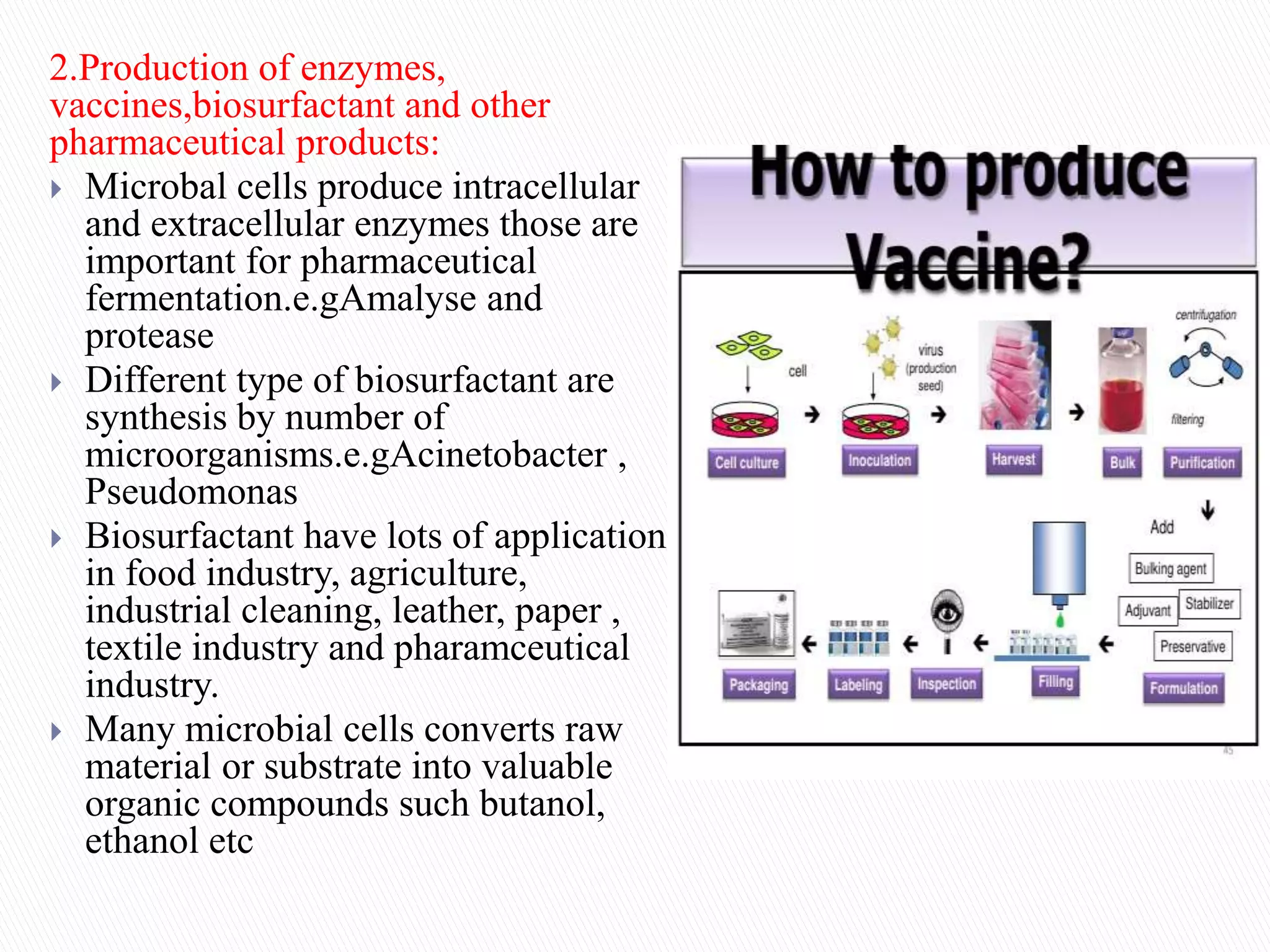
2.Production of enzymes,
vaccines,biosurfactant and other
pharmaceutical products:
 Microbal cells produce intracellular
and extracellular enzymes those are
important for pharmaceutical
fermentation.e.gAmalyse and
protease
 Different type of biosurfactant are
synthesis by number of
microorganisms.e.gAcinetobacter ,
Pseudomonas
 Biosurfactant have lots of application
in food industry, agriculture,
industrial cleaning, leather, paper ,
textile industry and pharamceutical
industry.
 Many microbial cells converts raw
material or substrate into valuable
organic compounds such butanol,
ethanol etc
3.Dignosis of disease and treatment:
 Different test are use to detect
infectious microorganisms.e.g
ELISA test and wadal test
 Antimicrobial sustibility testing is
mainly used for selection of
antibiotics for treatment of
microbial infection.
4.Treatment of industrial waste
material:
 Microbial species are used for
decomposition of industrial waste
material and organic components
e.gActinomycetes,fungi
 Anaerobic Bacteria decomposes
of organic matter by yielding
simple organic molecules such as
acid alcohol, glycerol and amines.
5.Plant growth promotion:
 Many microbial cells present in
soils play and important role in
soil fertility, herbicidal resist,
change in protein and oil content
and entrance the quality of plant
product e.gRhizobium species,
Azotobacter species
 Many nitrogen fixing soil
Microorganisms are useful for
providing nitrogen from growth
of plants germenation of seed ,
flavouring and fruiting of
medicinal plant.
6.Sterile product preparation.
It deals with the preparation Of
sterile rooms aspectic techniques,
detection of microbes by sampling
and sterility testing of different
sterile preparation.
7.Sterilization :
 Different pharmaceutical
products are sterilised by
killing of microorganisms.
 The process of killing of
microorganisms is known as
sterilisation
 All the sterilisation process
may be validation by using
biological indicator.
Thank you

Pharmaceutical microbiology introduction

  • 1.
    By:Prof.Miss Kalamkar Chaitali.S Arihant COP, Ahmadnagar
  • 2.
     Introduction  History Branches of microbiology  Scope and importance  Introduction to prokaryotes and Eukaryotes
  • 3.
     The wordMicrobiology was derived from Greek:mikros (“small”) +bios(“life”)  It is the branch of science that is concerned primarily with the biology of microorganisms and their effect on other living organisms. e.g Bacteria,Protozoa,Algae,Fungus and viruses.  Microbiology may be Pure and Applied  Pure Microbiology- Includes bacteriology,mycology,protozoology,phycology,parasitology, virology,nematology,cellular microbiology,evolutionary microbiology,molecular microbiology,etc.  Applied Microbiology- Includes medical microbiology-,pharmaceutical microbiology,industrial microbiology,food microbiology,Soil microbiology,water microbiology,air microbiology, microbial biotechnology. when microbiology concept ,processes and techniques are applied to pharmaceutical operations,the subject is then called “Pharmaceutical microbiology”
  • 4.
     Objective ofpharmaceutical microbiology to ensure safety and efficacy of pharmaceutical products.  It embrances to validation of disinfectants,evalution of the efficacy of disinfectants in suspension ,on surfaces and through field trials.  It offers protocols and tecniques associated with the operation and assurance of clean room ,aseptic –room and controlled envirnoment for preventing any possible micriobial contamination,and introdues risk assessments and practical contamination control strategies.  Louis pasteur is regarded as the father of microbiology wheres Robert koch is the father of medical microbiology
  • 5.
     1673-1723,Antony van Leeuwenhoek(Dutch)descri bedlive microorganisms that he observed in teeth scrapings and rain water.  First person to actually see living microorganism
  • 6.
     1822-1895,Louis Pasteur A french organic chemist  Considered as father of modern microbiology  Fermentation process:beer/wine not produced without microbes.  Microbes causes spoilage  Demonstrated guncotton experiment  Diffrenet places/ Diffrenent conc.of microbes  Disproved spontaneous generation  Developed Pasteurisation process (50- 60℃)  Virulence power  Developed Rabies/Anthrax
  • 7.
     1843-1910 RobertKoch  German Physician  First to demonstration the role of bacteria in causing diseases  First isolated Bacillus anthracis  Discovered Mycobacterium tuberculosis,1882 and Vibrio cholera,1883 awarded aNobal prize in 1905  Developed reationship b/t microorganism and diseases  Koch’s Postulates consist of the following four rules: 1. The microorganism must be identified in all individuals affected by the disease, but not in healthy individuals. 2. The microorganism can be isolated from the diseased individual and grown in culture. 3. When introduced into a healthy individual, the cultured microorganism should cause disease. 4. The microorganism must then be re-isolated from the experimental host, and found to be identical to the original microorganism.
  • 9.
    1.Production of antibiotics: 2/3rdof antibiotics are produced from microorganisms pharmaceutical or industrial microbiology concerned with isolation of antibiotics producing microorganisms from natural environment.e.g Soil,water Many antibiotic isolated from natural microorganisms by process of fermentation e.g Penicillin from penicillium species
  • 10.
    2.Production of enzymes, vaccines,biosurfactantand other pharmaceutical products:  Microbal cells produce intracellular and extracellular enzymes those are important for pharmaceutical fermentation.e.gAmalyse and protease  Different type of biosurfactant are synthesis by number of microorganisms.e.gAcinetobacter , Pseudomonas  Biosurfactant have lots of application in food industry, agriculture, industrial cleaning, leather, paper , textile industry and pharamceutical industry.  Many microbial cells converts raw material or substrate into valuable organic compounds such butanol, ethanol etc
  • 11.
    3.Dignosis of diseaseand treatment:  Different test are use to detect infectious microorganisms.e.g ELISA test and wadal test  Antimicrobial sustibility testing is mainly used for selection of antibiotics for treatment of microbial infection. 4.Treatment of industrial waste material:  Microbial species are used for decomposition of industrial waste material and organic components e.gActinomycetes,fungi  Anaerobic Bacteria decomposes of organic matter by yielding simple organic molecules such as acid alcohol, glycerol and amines.
  • 12.
    5.Plant growth promotion: Many microbial cells present in soils play and important role in soil fertility, herbicidal resist, change in protein and oil content and entrance the quality of plant product e.gRhizobium species, Azotobacter species  Many nitrogen fixing soil Microorganisms are useful for providing nitrogen from growth of plants germenation of seed , flavouring and fruiting of medicinal plant. 6.Sterile product preparation. It deals with the preparation Of sterile rooms aspectic techniques, detection of microbes by sampling and sterility testing of different sterile preparation.
  • 13.
    7.Sterilization :  Differentpharmaceutical products are sterilised by killing of microorganisms.  The process of killing of microorganisms is known as sterilisation  All the sterilisation process may be validation by using biological indicator.
  • 24.