Amoxil vs. Augmentin


                  3/16/2012
                              1
Stephanie Doran
Anna Mastenbrook
    HLTH 220
   Winter 2012


                   3/16/2012
                               2
Amoxicillin Background
            Information
 Amoxicillin is a penicillin antibiotic, meaning it fights harmful
   bacteria found within the body.
 It can treat bacterial infections such as ear
   infections, pneumonia, gonorrhea, bladder infections, and E.
   coli.
 It can also be combined with certain medications such as
   clarithromycin to treat stomach ulcers caused by the H.
   Pylori infection.
 Antibiotics may reduce the effectiveness of birth control
   pills, so use non-hormonal forms of birth control
   (condoms, diaphragm, spermicide) to avoid unplanned
   pregnancy.
                                                       3/16/2012
                                                                      3
Amoxil vs. Augmentin
              Amoxil                            Augmentin

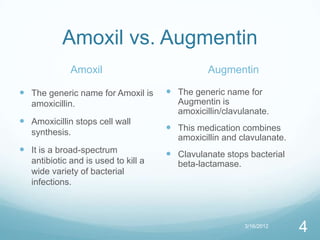
 The generic name for Amoxil is       The generic name for
   amoxicillin.                         Augmentin is
                                        amoxicillin/clavulanate.
 Amoxicillin stops cell wall
   synthesis.                          This medication combines
                                        amoxicillin and clavulanate.
 It is a broad-spectrum               Clavulanate stops bacterial
   antibiotic and is used to kill a     beta-lactamase.
   wide variety of bacterial
   infections.


                                                          3/16/2012
                                                                       4
Amoxil                    Drug Availability

 •Amoxil is available in a
   capsule, chewable
 tablet, and a liquid 0ral
       suspension.

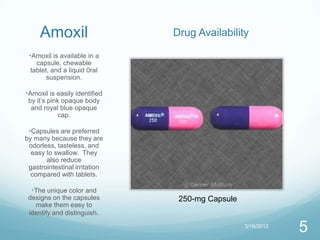
•Amoxil is easily identified
 by it’s pink opaque body
  and royal blue opaque
             cap.

 •Capsules are preferred
by many because they are
 odorless, tasteless, and
  easy to swallow. They
       also reduce
 gastrointestinal irritation
  compared with tablets.

  •The unique color and
 designs on the capsules        250-mg Capsule
   make them easy to
 identify and distinguish.
                                                 3/16/2012
                                                             5
Augmentin                                Drug Availability

•Augmentin is available in
a chewable tablet, liquid
suspension or extended-
     release tablet.

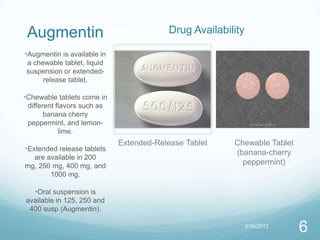
•Chewable tablets come in
 different flavors such as
       banana cherry
 peppermint, and lemon-
            lime.
                             Extended-Release Tablet    Chewable Tablet
•Extended release tablets                               (banana-cherry
  are available in 200
mg, 250 mg, 400 mg, and
                                                          peppermint)
       1000 mg.

   •Oral suspension is
available in 125, 250 and
 400 susp (Augmentin).

                                                              3/16/2012
                                                                          6
ClarithromycinvsClavulinate
 Amoxicillin/clavulanate (Augmentin) and
   Amoxicillin/clarithromycins (Amoxil/Biaxin) are both first-line
   antibiotics when treating acute rhinosinusitis. The clarithromycin
   produces a faster and more effective improvement in symptoms.
 When combining clarithromycin with Amoxil, the clarithromycin is
   better tolerated than the Augmentin.


                                                         3/16/2012
                                                                        7
Allergies
    Do not take Amoxicillin Products if you are allergic to the
                            following:
 Amoxicillin
 Any penicillin products such as ampicillin
   (Omnipen,Principen), dicloxacillin (Dycill, Dynapen), oxacillin
   (Bactocill), penicillin (Ledercillin VK, Pen-V, Pen-Vee K, Beepen-
   VK, Pfitzerpen, V-Cillin K, or Veetids).
 Tell your doctor if you are allergic to any Cephalosporins such as
   Omnicef, Keflex, Cefzil, and Ceftin. They may recommend that you
   do not take Amoxil.


                                                          3/16/2012
                                                                        8
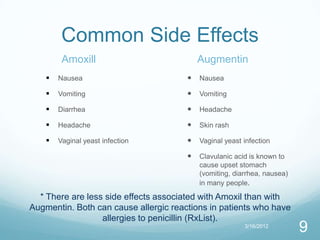
Common Side Effects
         Amoxill                           Augmentin
       Nausea                            Nausea

       Vomiting                          Vomiting

       Diarrhea                          Headache

       Headache                          Skin rash

       Vaginal yeast infection           Vaginal yeast infection

                                          Clavulanic acid is known to
                                           cause upset stomach
                                           (vomiting, diarrhea, nausea)
                                           in many people.

  * There are less side effects associated with Amoxil than with
Augmentin. Both can cause allergic reactions in patients who have
                  allergies to penicillin (RxList).
                                                         3/16/2012
                                                                          9
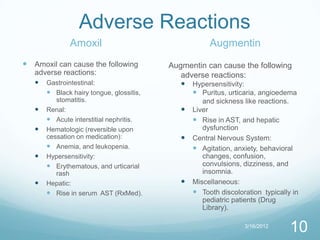
Adverse Reactions
              Amoxil                                 Augmentin
 Amoxil can cause the following         Augmentin can cause the following
   adverse reactions:                       adverse reactions:
    Gastrointestinal:                       Hypersensitivity:
       Black hairy tongue, glossitis,          Puritus, urticaria, angioedema
          stomatitis.                              and sickness like reactions.
      Renal:                                  Liver
        Acute interstitial nephritis.           Rise in AST, and hepatic
      Hematologic (reversible upon                dysfunction
       cessation on medication):               Central Nervous System:
        Anemia, and leukopenia.                 Agitation, anxiety, behavioral
      Hypersensitivity:                           changes, confusion,
        Erythematous, and urticarial              convulsions, dizziness, and
          rash                                     insomnia.
      Hepatic:                                Miscellaneous:
        Rise in serum AST (RxMed).              Tooth discoloration typically in
                                                   pediatric patients (Drug
                                                   Library).

                                                                3/16/2012
                                                                               10
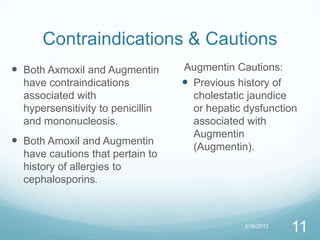
Contraindications & Cautions
 Both Axmoxil and Augmentin       Augmentin Cautions:
  have contraindications            Previous history of
  associated with                    cholestatic jaundice
  hypersensitivity to penicillin     or hepatic dysfunction
  and mononucleosis.                 associated with
                                     Augmentin
 Both Amoxil and Augmentin          (Augmentin).
  have cautions that pertain to
  history of allergies to
  cephalosporins.


                                                3/16/2012
                                                            11
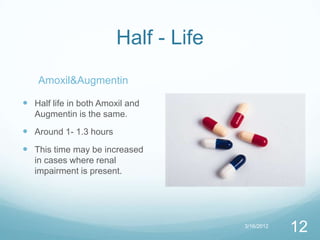
Half - Life
    Amoxil&Augmentin

 Half life in both Amoxil and
   Augmentin is the same.
 Around 1- 1.3 hours
 This time may be increased
   in cases where renal
   impairment is present.


                                      3/16/2012
                                                  12
Cost Effectiveness
            Amoxil                         Augmentin
 For 63 pills, the average        For 63 pills, the average
   price is around $52               price is around $125.
 Cost per pill is around $0.82    Cost per pill is around $1.98
                                   Augmentin is more than
                                     double the cost of Amoxil.


                                                     3/16/2012
                                                                  13
Dose Convenience
            Amoxill                           Augmentin
 For adults with moderate            Adults taking this medication
   severity of infection take 500-
   mg ever 12 hours, or 250 mg          usually take one 500-mg
   every 8 hours.                       every 12 hours
 For children with moderate          Children weighing less than
   severity of infection take 25
   mg/kg/day every 12 hours or          40 kg take a 250-mg
   20 mg/kg/day every 8 hours.          chewable tablet.
 The Children’s dosage is
   recommended for those 40 kg
   or less.


                                                       3/16/2012
                                                                   14
Pharmacodynamics
 “This drug acts by inhibiting the synthesis of bacterial cell walls. It
   inhibits cross-linkage between the linear peptidoglycan polymer
   chains that make up a major component of the cell walls of both
   Gram-positive and Gram-negative bacteria,” (Wikipedia).
 Amoxicillin stops bacteria from multiplying and forming walls that
   surround the bacteria. These walls are in charge of protecting the
   bacteria. Without the wall, bacteria cannot survive, so by eliminating
   the wall, the bacteria themselves are eliminated as well.


                                                            3/16/2012
                                                                            15
Pharmacokinetics
 Both drugs are well absorbed from the GI tract. These drug’s
  protein binding is around twenty percent. Both are partially
  metabolized in the liver and mainly excreted through the urine. It is
  removed by hemodialysis.
 “Approximately 50% to 70% of the amoxicillin and approximately
  25% to 40% of the clavulanic acid are excreted unchanged in urine
  during the first 6 hours after administration of a single Augmentin
  250 mg or 500 mg tablet. Concurrent administration of probenecid
  delays amoxicillin excretion but does not delay renal excretion of
  clavulanic acid” (Drug Library).


                                                         3/16/2012
                                                                     16
Pharmacotherapeutics
              Amoxil
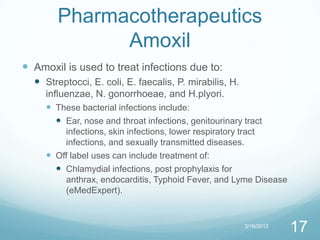
 Amoxil is used to treat infections due to:
   Streptocci, E. coli, E. faecalis, P. mirabilis, H.
     influenzae, N. gonorrhoeae, and H.plyori.
      These bacterial infections include:
         Ear, nose and throat infections, genitourinary tract
         infections, skin infections, lower respiratory tract
         infections, and sexually transmitted diseases.
      Off label uses can include treatment of:
        Chlamydial infections, post prophylaxis for
         anthrax, endocarditis, Typhoid Fever, and Lyme Disease
         (eMedExpert).


                                                         3/16/2012
                                                                     17
Pharmacotherapeutics
                Augmentin
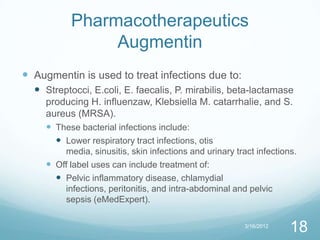
 Augmentin is used to treat infections due to:
   Streptocci, E.coli, E. faecalis, P. mirabilis, beta-lactamase
     producing H. influenzaw, Klebsiella M. catarrhalie, and S.
     aureus (MRSA).
      These bacterial infections include:
        Lower respiratory tract infections, otis
         media, sinusitis, skin infections and urinary tract infections.
      Off label uses can include treatment of:
        Pelvic inflammatory disease, chlamydial
         infections, peritonitis, and intra-abdominal and pelvic
         sepsis (eMedExpert).

                                                          3/16/2012
                                                                      18
Pros & Cons
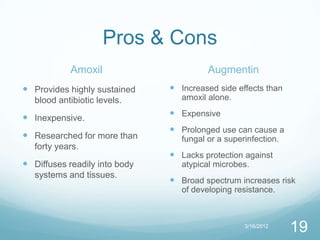
            Amoxil                       Augmentin
 Provides highly sustained     Increased side effects than
   blood antibiotic levels.       amoxil alone.

 Inexpensive.                  Expensive
                                Prolonged use can cause a
 Researched for more than        fungal or a superinfection.
   forty years.
                                Lacks protection against
 Diffuses readily into body      atypical microbes.
   systems and tissues.
                                Broad spectrum increases risk
                                  of developing resistance.


                                                   3/16/2012
                                                                19
Why is Amoxil Better?
 Capsule availability is a huge plus.
 Amoxil is more tolerable than Augmentin because
  Augmentin contains clavulanic acid.

 Amoxil is less than half the price of Augmentin.


                                               3/16/2012
                                                           20
References
   Amoxil 250. Retrieved February 12, 2012 from:
    http://www.drugs.com/imprints/amoxil-250-amoxil-250-667.html

   Capsugel. Retrieved February 4 ,2012. The Hard Gelatin Capsule Advantage.
    http://capsugel.com/media/library/the-hard-gelatin-capsule-advantage.pdf

   Drugs.com Retrieved February 6, 2012. Amoxicillin.
    http://www.drugs.com/amoxicillin.html

   Drugs.com Retrieved February 3, 2012. Amoxil Dosage.
    http://www.drugs.com/dosage/amoxil.html

   Drugs.com. Retrieved February 3, 2012. Augmentin Dosage.
    http://www.drugs.com/dosage/augmentin.html

   Drug Library. Augmentin. Health Central. Retrieved on February 14, 2012 from:
    http://www.healthcentral.com/druglibrary/408/augmentin-clinical_pharmacology.html


                                                                     3/16/2012
                                                                                   21
References Continued:
   eDrugSearch. Retrieved February 7, 2012. Amoxil and
    Augmentinhttp://www.edrugsearch.com/compare-drug-prices-buy-online/amoxil

   eMedExpert. Retrieved February 8, 2012. Augmentin (Amoxicillin/clavulanate) versus…
    http://www.emedexpert.com/compare-meds/amoxicillin-clavulanate.shtml

   eMedExpert. Amoxicillin. Retrieved on February 14, 2012 from:
    http://www.emedexpert.com/facts/amoxicillin-facts.shtml

   Hodgson, B., &Kizior, R. (2012). Saunders Nursing Drug Handbook 2012. St. Louis, Mo.
    Elsevier Saunders.

   PharmacyChecker.com. Retrieved February 7, 2012. http://www.pharmacychecker.com/

   RxMed. Amoxicillin. Retrieved on February 12, 2012 from:
    http://www.rxmed.com/b.main/b2.pharmaceutical/b2.prescribe.html

   RxList. Retrieved February 1, 2012. Augmentin. http://www.rxlist.com/augmentin-
    drug/patient-images-side-effects.htm

   Wikipedia. Retrieved February 4, 2012. Amoxicillin. http://en.wikipedia.org/wiki/Amoxicillin


                                                                              3/16/2012
                                                                                              22

Pharm power point_ final

  • 1.
  • 2.
    Stephanie Doran Anna Mastenbrook HLTH 220 Winter 2012 3/16/2012 2
  • 3.
    Amoxicillin Background Information  Amoxicillin is a penicillin antibiotic, meaning it fights harmful bacteria found within the body.  It can treat bacterial infections such as ear infections, pneumonia, gonorrhea, bladder infections, and E. coli.  It can also be combined with certain medications such as clarithromycin to treat stomach ulcers caused by the H. Pylori infection.  Antibiotics may reduce the effectiveness of birth control pills, so use non-hormonal forms of birth control (condoms, diaphragm, spermicide) to avoid unplanned pregnancy. 3/16/2012 3
  • 4.
    Amoxil vs. Augmentin Amoxil Augmentin  The generic name for Amoxil is  The generic name for amoxicillin. Augmentin is amoxicillin/clavulanate.  Amoxicillin stops cell wall synthesis.  This medication combines amoxicillin and clavulanate.  It is a broad-spectrum  Clavulanate stops bacterial antibiotic and is used to kill a beta-lactamase. wide variety of bacterial infections. 3/16/2012 4
  • 5.
    Amoxil Drug Availability •Amoxil is available in a capsule, chewable tablet, and a liquid 0ral suspension. •Amoxil is easily identified by it’s pink opaque body and royal blue opaque cap. •Capsules are preferred by many because they are odorless, tasteless, and easy to swallow. They also reduce gastrointestinal irritation compared with tablets. •The unique color and designs on the capsules 250-mg Capsule make them easy to identify and distinguish. 3/16/2012 5
  • 6.
    Augmentin Drug Availability •Augmentin is available in a chewable tablet, liquid suspension or extended- release tablet. •Chewable tablets come in different flavors such as banana cherry peppermint, and lemon- lime. Extended-Release Tablet Chewable Tablet •Extended release tablets (banana-cherry are available in 200 mg, 250 mg, 400 mg, and peppermint) 1000 mg. •Oral suspension is available in 125, 250 and 400 susp (Augmentin). 3/16/2012 6
  • 7.
    ClarithromycinvsClavulinate  Amoxicillin/clavulanate (Augmentin)and Amoxicillin/clarithromycins (Amoxil/Biaxin) are both first-line antibiotics when treating acute rhinosinusitis. The clarithromycin produces a faster and more effective improvement in symptoms.  When combining clarithromycin with Amoxil, the clarithromycin is better tolerated than the Augmentin. 3/16/2012 7
  • 8.
    Allergies Do not take Amoxicillin Products if you are allergic to the following:  Amoxicillin  Any penicillin products such as ampicillin (Omnipen,Principen), dicloxacillin (Dycill, Dynapen), oxacillin (Bactocill), penicillin (Ledercillin VK, Pen-V, Pen-Vee K, Beepen- VK, Pfitzerpen, V-Cillin K, or Veetids).  Tell your doctor if you are allergic to any Cephalosporins such as Omnicef, Keflex, Cefzil, and Ceftin. They may recommend that you do not take Amoxil. 3/16/2012 8
  • 9.
    Common Side Effects Amoxill Augmentin  Nausea  Nausea  Vomiting  Vomiting  Diarrhea  Headache  Headache  Skin rash  Vaginal yeast infection  Vaginal yeast infection  Clavulanic acid is known to cause upset stomach (vomiting, diarrhea, nausea) in many people. * There are less side effects associated with Amoxil than with Augmentin. Both can cause allergic reactions in patients who have allergies to penicillin (RxList). 3/16/2012 9
  • 10.
    Adverse Reactions Amoxil Augmentin  Amoxil can cause the following Augmentin can cause the following adverse reactions: adverse reactions:  Gastrointestinal:  Hypersensitivity:  Black hairy tongue, glossitis,  Puritus, urticaria, angioedema stomatitis. and sickness like reactions.  Renal:  Liver  Acute interstitial nephritis.  Rise in AST, and hepatic  Hematologic (reversible upon dysfunction cessation on medication):  Central Nervous System:  Anemia, and leukopenia.  Agitation, anxiety, behavioral  Hypersensitivity: changes, confusion,  Erythematous, and urticarial convulsions, dizziness, and rash insomnia.  Hepatic:  Miscellaneous:  Rise in serum AST (RxMed).  Tooth discoloration typically in pediatric patients (Drug Library). 3/16/2012 10
  • 11.
    Contraindications & Cautions Both Axmoxil and Augmentin Augmentin Cautions: have contraindications  Previous history of associated with cholestatic jaundice hypersensitivity to penicillin or hepatic dysfunction and mononucleosis. associated with Augmentin  Both Amoxil and Augmentin (Augmentin). have cautions that pertain to history of allergies to cephalosporins. 3/16/2012 11
  • 12.
    Half - Life Amoxil&Augmentin  Half life in both Amoxil and Augmentin is the same.  Around 1- 1.3 hours  This time may be increased in cases where renal impairment is present. 3/16/2012 12
  • 13.
    Cost Effectiveness Amoxil Augmentin  For 63 pills, the average  For 63 pills, the average price is around $52 price is around $125.  Cost per pill is around $0.82  Cost per pill is around $1.98  Augmentin is more than double the cost of Amoxil. 3/16/2012 13
  • 14.
    Dose Convenience Amoxill Augmentin  For adults with moderate  Adults taking this medication severity of infection take 500- mg ever 12 hours, or 250 mg usually take one 500-mg every 8 hours. every 12 hours  For children with moderate  Children weighing less than severity of infection take 25 mg/kg/day every 12 hours or 40 kg take a 250-mg 20 mg/kg/day every 8 hours. chewable tablet.  The Children’s dosage is recommended for those 40 kg or less. 3/16/2012 14
  • 15.
    Pharmacodynamics  “This drugacts by inhibiting the synthesis of bacterial cell walls. It inhibits cross-linkage between the linear peptidoglycan polymer chains that make up a major component of the cell walls of both Gram-positive and Gram-negative bacteria,” (Wikipedia).  Amoxicillin stops bacteria from multiplying and forming walls that surround the bacteria. These walls are in charge of protecting the bacteria. Without the wall, bacteria cannot survive, so by eliminating the wall, the bacteria themselves are eliminated as well. 3/16/2012 15
  • 16.
    Pharmacokinetics  Both drugsare well absorbed from the GI tract. These drug’s protein binding is around twenty percent. Both are partially metabolized in the liver and mainly excreted through the urine. It is removed by hemodialysis.  “Approximately 50% to 70% of the amoxicillin and approximately 25% to 40% of the clavulanic acid are excreted unchanged in urine during the first 6 hours after administration of a single Augmentin 250 mg or 500 mg tablet. Concurrent administration of probenecid delays amoxicillin excretion but does not delay renal excretion of clavulanic acid” (Drug Library). 3/16/2012 16
  • 17.
    Pharmacotherapeutics Amoxil  Amoxil is used to treat infections due to:  Streptocci, E. coli, E. faecalis, P. mirabilis, H. influenzae, N. gonorrhoeae, and H.plyori.  These bacterial infections include:  Ear, nose and throat infections, genitourinary tract infections, skin infections, lower respiratory tract infections, and sexually transmitted diseases.  Off label uses can include treatment of:  Chlamydial infections, post prophylaxis for anthrax, endocarditis, Typhoid Fever, and Lyme Disease (eMedExpert). 3/16/2012 17
  • 18.
    Pharmacotherapeutics Augmentin  Augmentin is used to treat infections due to:  Streptocci, E.coli, E. faecalis, P. mirabilis, beta-lactamase producing H. influenzaw, Klebsiella M. catarrhalie, and S. aureus (MRSA).  These bacterial infections include:  Lower respiratory tract infections, otis media, sinusitis, skin infections and urinary tract infections.  Off label uses can include treatment of:  Pelvic inflammatory disease, chlamydial infections, peritonitis, and intra-abdominal and pelvic sepsis (eMedExpert). 3/16/2012 18
  • 19.
    Pros & Cons Amoxil Augmentin  Provides highly sustained  Increased side effects than blood antibiotic levels. amoxil alone.  Inexpensive.  Expensive  Prolonged use can cause a  Researched for more than fungal or a superinfection. forty years.  Lacks protection against  Diffuses readily into body atypical microbes. systems and tissues.  Broad spectrum increases risk of developing resistance. 3/16/2012 19
  • 20.
    Why is AmoxilBetter?  Capsule availability is a huge plus.  Amoxil is more tolerable than Augmentin because Augmentin contains clavulanic acid.  Amoxil is less than half the price of Augmentin. 3/16/2012 20
  • 21.
    References  Amoxil 250. Retrieved February 12, 2012 from: http://www.drugs.com/imprints/amoxil-250-amoxil-250-667.html  Capsugel. Retrieved February 4 ,2012. The Hard Gelatin Capsule Advantage. http://capsugel.com/media/library/the-hard-gelatin-capsule-advantage.pdf  Drugs.com Retrieved February 6, 2012. Amoxicillin. http://www.drugs.com/amoxicillin.html  Drugs.com Retrieved February 3, 2012. Amoxil Dosage. http://www.drugs.com/dosage/amoxil.html  Drugs.com. Retrieved February 3, 2012. Augmentin Dosage. http://www.drugs.com/dosage/augmentin.html  Drug Library. Augmentin. Health Central. Retrieved on February 14, 2012 from: http://www.healthcentral.com/druglibrary/408/augmentin-clinical_pharmacology.html 3/16/2012 21
  • 22.
    References Continued:  eDrugSearch. Retrieved February 7, 2012. Amoxil and Augmentinhttp://www.edrugsearch.com/compare-drug-prices-buy-online/amoxil  eMedExpert. Retrieved February 8, 2012. Augmentin (Amoxicillin/clavulanate) versus… http://www.emedexpert.com/compare-meds/amoxicillin-clavulanate.shtml  eMedExpert. Amoxicillin. Retrieved on February 14, 2012 from: http://www.emedexpert.com/facts/amoxicillin-facts.shtml  Hodgson, B., &Kizior, R. (2012). Saunders Nursing Drug Handbook 2012. St. Louis, Mo. Elsevier Saunders.  PharmacyChecker.com. Retrieved February 7, 2012. http://www.pharmacychecker.com/  RxMed. Amoxicillin. Retrieved on February 12, 2012 from: http://www.rxmed.com/b.main/b2.pharmaceutical/b2.prescribe.html  RxList. Retrieved February 1, 2012. Augmentin. http://www.rxlist.com/augmentin- drug/patient-images-side-effects.htm  Wikipedia. Retrieved February 4, 2012. Amoxicillin. http://en.wikipedia.org/wiki/Amoxicillin 3/16/2012 22

Editor's Notes

  • #6 Picture taken from: Amoxil 250. Retrieved on February 12, 2012 from: http://www.drugs.com/imprints/amoxil-250-amoxil-250-667.html
  • #7 Pictures taken from: Augmentin. WebMD. Retrieved on February 12, 2012 from: http://www.rxlist.com/augmentin-drug/patient-images-side-effects.htm#sideeffects
  • #13 Hodgson, B., & Kizior, R. (2012). Saunders Nursing Drug Handbook 2012. St. Louis, Mo. Elsevier Saunders.
  • #17 Drug Library. Augmentin. Health Centeral. Retrieved on February 14, 2012 from: http://www.healthcentral.com/druglibrary/408/augmentin-clinical_pharmacology.html
  • #18 eMedExpert. Retrieved February 8, 2012. Augmentin (Amoxicillin/clavulanate) versus… http://www.emedexpert.com/compare-meds/amoxicillin-clavulanate.shtmleMedExpert. Amocicillin. Retrieved on February 14, 2012 from: http://www.emedexpert.com/facts/amoxicillin-facts.shtml