






TRAINING
DIRECTORY
COMPETENCY
DEVELOPMENT FOR THE
OIL & GAS INDUSTRY
“Extremely relevant and helpful training,
thanks to a knowledgeable trainer, great
teaching aids and course material.”
—
Environmental Executive for Wells,
PETRONAS Carigali
“From registration to trainer’s ability to
engage the classroom, I am very satisfied
and would like to attend other training by
PetroEdge.”
—
Manager- Sarawak Project,
Petroliam Nasional
“This is one of the best training I have ever
attended. Venue, materials, trainer and
facilitation was excellent.”
—
Production Technologist,
PC Myanmar (Hong Kong)
“I really enjoyed the training course. It was
interactive and knowledge and information
was provided in a simple way.”
—
Consultant,
Exprosoft
“The quality of the presenter is astounding.
Amazing wealth of knowledge, answering
questions deep and wide, making this course
truly invaluable.”
—
Logistics Trainee,
Sarawak Shell
“I made the right choice choosing PetroEdge
for this particular training.”
—
Drilling Finance Assistant,
KPOC
“Short, on time, on schedule, covers
everything I need. An eye opener. Glad to join
the training.”
—
CMMS Engineer,
Lundin Malaysia B.V.
“Coming from the non-technical background,
it was very hard for me to understand the
technical jargons in oil and gas industry.
However, this course managed to enhance
my knowledge.”
—
Executive, Business Planning &
Performance,
Petroliam Nasional
“Spot on. Met all the expectations. Good
breadth. Adequate depth. Fits nicely in the 3
days course.”
—
Senior Manager, Commercial &
Marketing,
Dialog E & C Sdn Bhd
“Amazingly, the course covers everything you
want to know about LNG in just 3 days’ time.”
—
Manager,
Mitsubishi Corporation
CONTACT US
+65 67419927 (SG) • 1800817423 (MY) • 1800791808 (AUS) • 0018030160036 (ID) • 800035703841 (UAE) • www.petroedgeasia.net
PetroEdge Technical Director
Gordon has over 30 years of experience in upstream oil & gas industry. He is a recognised subject matter expert in well
intervention, completions and integrity. He started off his career working for oil field service companies before joining
Shell as a well service supervisor.In his role with Shell, he was responsible for planning, programming and organising
of all the well engineering and intervention work on a number of fields in the Middle East as well as for the day to day
supervision of all well intervention work on Shell’s Persian and Arabian Gulf platforms. This included completion running,
coil tubing, e-line, slickline, hydraulic workovers, well testing and stimulation operations. An office based role as a senior
well engineer followed.
MESSAGE FROM MANAGEMENT
Gordon Duncan
PetroEdge Technical Director
THE STRENGTH BEHIND PETROEDGE® IS OUR CONTINUOUS ENGAGEMENT WITH YOU. WE ARE
BETTER POSITIONED TO UNDERSTAND THE LEARNING JOURNEY OF YOUR CRITICAL TALENTS
AND ORGANIZATIONAL NEEDS. OUR UNDERSTANDING OF YOUR BUSINESS TRANSLATES TO
BETTER TARGETED TRAINING INTERVENTIONS AND SUSTAINABLE LONG TERM LEARNING."
PetroEdge is the leading provider of Oil & Gas training in the Asia Pacific region. Established in 2007, we now offer over 150
in-house and public courses in several training disciplines; right from the upstream to the midstream and downstream
sector. In collaboration with our international subject matter partners and experts, we bring you world-class training that
is either approved or accredited by industry bodies. With quality training more accessible to the region, we have had the
privilege of training over 9000 professionals from international oil companies and national oil companies since inception. In
2010, we expanded our reach in the Energy industry with the establishment of PowerEdge, covering the Power & Utilities
sector including renewable energy. Whether you work with a refinery, a trading house or on an offshore platform you will
find targeted training courses through our several training hubs located in Malaysia, Singapore, United Arab Emirates and
Australia.
To maintain our relevance in the continuously changing
Energy industry, we are committed to address current
skills challenges and latest technological developments
in the industry. Our course content, faculty of experts
and delivery methods will continue to form our key
strength in our engagements with you.
This training directory has been developed with you in
mind. We hope that this directory will be your reference
point for current and future training needs. Your learning
journey in the Oil & Gas industry starts here!
Malina Raman
Director Strategic Learning &
Development
Co-Founder
He had a brief spell as a Site Representative for Santos in Australia before joining
Petro-Canada as Completions Superintendent in Syria. He later returned to Australia
as Completions Operations Superintendent for Santos. Prior to his appointment in
PetroEdge, he was the Field Supervisor Completions and Well Interventions for Shell
in Iraq.
In his current role as PetroEdge Technical Director, Gordon regularly teaches
Completion Practices, Well Intervention, Well Integrity and Reporting & Planning
courses all over the world. He also oversees the development of new engineering
and leadership courses for technical professionals in the upstream sector.
Easwaran Kanason
Chief Executive
Co-Founder Tuesday, 11 August 2015 4:45 PM
Quick Notes Page 1
Tuesday, 11 August 2015 4:45 PM
Quick Notes Page 1
CONTACT US
+65 67419927 (SG) • 1800817423 (MY) • 1800791808 (AUS) • 0018030160036 (ID) • 800035703841 (UAE) • www.petroedgeasia.net
ABOUT PETROEDGE
From our work and research with professionals in pivotal Oil & Gas corporations, we pride ourselves in developing
targeted training courses for the industry. Annually PetroEdge runs over 300 training courses across the world.
Besides our scheduled open enrolment courses, we are also able to meet specific training needs of organisations
through in-house training. In short, we can go broad and deep to uncover the most urgent organisational skills and
strategy challenges.
By aligning training interventions to focus on your specific business needs and objectives, we are able to deliver
results beyond what can be achieved through conventional training approaches. Our clients have come to rely on
our robust, integrated and action learning approach as a fundamental component of their talent development and
performance improvement strategy.
The following is our portfolio of courses that we can deliver for you:
For latest updates and course schedules, please visit www.petroedgeasia.net.
INDUSTRY
FUNDAMENTALS
PROCESS
FACILITIES &
MAINTENANCE
MARINE &
OFFSHORE
OIL & GAS
EXECUTIVE
DEVELOPMENT
TRADING &
SUPPLY CHAIN
PETROCHEMICAL
& REFINING
ECONOMICS,
FINANCE &
ACCOUNTING,
LEGAL
POWER &
UTILITIES
PETROLEUM
GEOSCIENCES
RESERVOIR
ENGINEERING
WELL
ENGINEERING
& DRILLING
PRODUCTION &
COMPLETIONS
CONTACT US
+65 67419927 (SG) • 1800817423 (MY) • 1800791808 (AUS) • 0018030160036 (ID) • 800035703841 (UAE) • www.petroedgeasia.net
PETROEDGE TRAINING SOLUTIONS
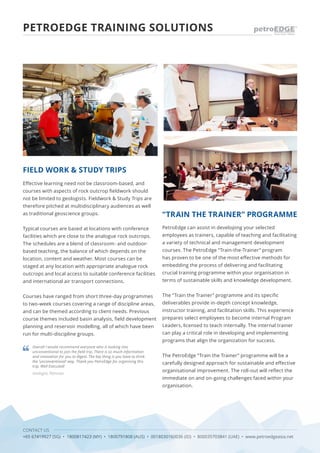
Effective learning need not be classroom-based, and
courses with aspects of rock outcrop fieldwork should
not be limited to geologists. Fieldwork & Study Trips are
therefore pitched at multidisciplinary audiences as well
as traditional geoscience groups.
Typical courses are based at locations with conference
facilities which are close to the analogue rock outcrops.
The schedules are a blend of classroom- and outdoor-
based teaching, the balance of which depends on the
location, content and weather. Most courses can be
staged at any location with appropriate analogue rock
outcrops and local access to suitable conference facilities
and international air transport connections.
Courses have ranged from short three-day programmes
to two-week courses covering a range of discipline areas,
and can be themed according to client needs. Previous
course themes included basin analysis, field development
planning and reservoir modelling, all of which have been
run for multi-discipline groups.
PetroEdge can assist in developing your selected
employees as trainers, capable of teaching and facilitating
a variety of technical and management development
courses. The PetroEdge “Train-the-Trainer” program
has proven to be one of the most effective methods for
embedding the process of delivering and facilitating
crucial training programme within your organisation in
terms of sustainable skills and knowledge development.
The “Train the Trainer” programme and its specific
deliverables provide in-depth concept knowledge,
instructor training, and facilitation skills. This experience
prepares select employees to become internal Program
Leaders, licensed to teach internally. The internal trainer
can play a critical role in developing and implementing
programs that align the organization for success.
The PetroEdge “Train the Trainer” programme will be a
carefully designed approach for sustainable and effective
organisational improvement. The roll-out will reflect the
immediate on and on-going challenges faced within your
organisation.
FIELD WORK & STUDY TRIPS
“TRAIN THE TRAINER” PROGRAMME
Overall I would recommend everyone who is looking into
unconventional to join the field trip. There is so much information
and innovation for you to digest. The key thing is you have to think
the ‘unconventional’ way. Thank you PetroEdge for organising this
trip. Well Executed!
Geologist, Petronas
CONTACT US
+65 67419927 (SG) • 1800817423 (MY) • 1800791808 (AUS) • 0018030160036 (ID) • 800035703841 (UAE) • www.petroedgeasia.net
PETROEDGE TRAINING SOLUTIONS
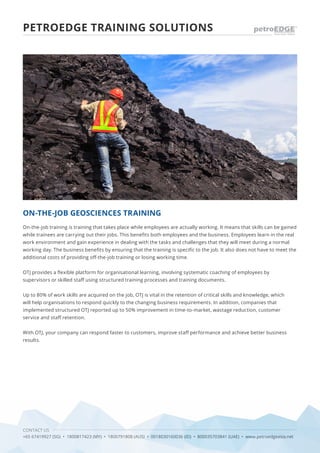
On-the-job training is training that takes place while employees are actually working. It means that skills can be gained
while trainees are carrying out their jobs. This benefits both employees and the business. Employees learn in the real
work environment and gain experience in dealing with the tasks and challenges that they will meet during a normal
working day. The business benefits by ensuring that the training is specific to the job. It also does not have to meet the
additional costs of providing off-the-job training or losing working time.
OTJ provides a flexible platform for organisational learning, involving systematic coaching of employees by
supervisors or skilled staff using structured training processes and training documents.
Up to 80% of work skills are acquired on the job, OTJ is vital in the retention of critical skills and knowledge, which
will help organisations to respond quickly to the changing business requirements. In addition, companies that
implemented structured OTJ reported up to 50% improvement in time-to-market, wastage reduction, customer
service and staff retention.
With OTJ, your company can respond faster to customers, improve staff performance and achieve better business
results.
ON-THE-JOB GEOSCIENCES TRAINING
CONTACT US
+65 67419927 (SG) • 1800817423 (MY) • 1800791808 (AUS) • 0018030160036 (ID) • 800035703841 (UAE) • www.petroedgeasia.net
PETROEDGE TRAINING SOLUTIONS
The PetroEdge Management Skills Accelerator (MSA) programme offers an intensive and dynamic opportunity for oil
and gas industry professionals to refine their knowledge and skills in management by taking in key elements of a full-
blown management development course but with an industry specific business, financial and leadership focus.
With this industry specific management program, learners will discover how winning contracts are devised
and understand how to negotiate and, critically, how to sustain them; learners will understand how financial
management techniques underpin commercial success; learners will see how to use and write management reports
and communication skills to help achieve internal and external results; learners will acquire the people skills that
ultimately define a manager’s performance.
This comprehensive programme will give the technical engineers the right set of skills and techniques to achieve
outstanding success in their own right to deliver a real return on investment for their employer.
MANAGEMENT SKILLS ACCELERATOR
Transitioning Oil & Gas Professionals to World-Class Team Leaders
COMMUNICATION SKILLS FOR OIL
& GAS PROFESSIONALS
Oil and Gas professionals increasingly need to
translate complex findings, analyses, conclusions
and recommendations for effective decision making.
Engineers and technical professionals need to acquire
the crucial competency to write and present clear &
technically accurate reports.
If your team faces challenges in getting their findings into
paper and presenting it thereafter, they will benefit from
communication skills training.
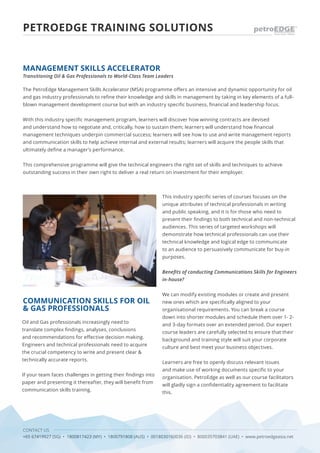
This industry specific series of courses focuses on the
unique attributes of technical professionals in writing
and public speaking, and it is for those who need to
present their findings to both technical and non-technical
audiences. This series of targeted workshops will
demonstrate how technical professionals can use their
technical knowledge and logical edge to communicate
to an audience to persuasively communicate for buy-in
purposes.
Benefits of conducting Communications Skills for Engineers
in-house?
We can modify existing modules or create and present
new ones which are specifically aligned to your
organisational requirements. You can break a course
down into shorter modules and schedule them over 1- 2-
and 3-day formats over an extended period. Our expert
course leaders are carefully selected to ensure that their
background and training style will suit your corporate
culture and best meet your business objectives.
Learners are free to openly discuss relevant issues
and make use of working documents specific to your
organisation. PetroEdge as well as our course facilitators
will gladly sign a confidentiality agreement to facilitate
this.
CONTACT US
+65 67419927 (SG) • 1800817423 (MY) • 1800791808 (AUS) • 0018030160036 (ID) • 800035703841 (UAE) • www.petroedgeasia.net
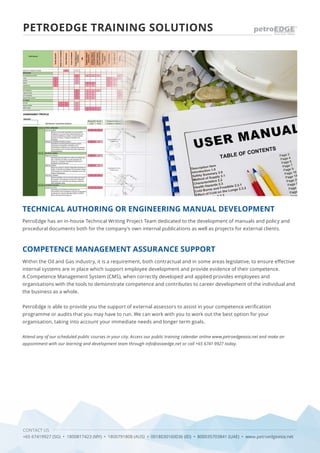
PetroEdge has an in-house Technical Writing Project Team dedicated to the development of manuals and policy and
procedural documents both for the company’s own internal publications as well as projects for external clients.
Attend any of our scheduled public courses in your city. Access our public training calendar online www.petroedgeasia.net and make an
appointment with our learning and development team through info@asiaedge.net or call +65 6741 9927 today.
Within the Oil and Gas industry, it is a requirement, both contractual and in some areas legislative, to ensure effective
internal systems are in place which support employee development and provide evidence of their competence.
A Competence Management System (CMS), when correctly developed and applied provides employees and
organisations with the tools to demonstrate competence and contributes to career development of the individual and
the business as a whole.
PetroEdge is able to provide you the support of external assessors to assist in your competence verification
programme or audits that you may have to run. We can work with you to work out the best option for your
organisation, taking into account your immediate needs and longer term goals.
TECHNICAL AUTHORING OR ENGINEERING MANUAL DEVELOPMENT
COMPETENCE MANAGEMENT ASSURANCE SUPPORT
PETROEDGE TRAINING SOLUTIONS
CONTACT US
+65 67419927 (SG) • 1800817423 (MY) • 1800791808 (AUS) • 0018030160036 (ID) • 800035703841 (UAE) • www.petroedgeasia.net
6
CONTINENTS
25
COUNTRIES
1500+
TRAINING SESSIONS
9000+
LEARNERS
PetroEdge delivers energy industry skills-based training courses in major cities, catering for every stage of your
organisation’s development path. Since our inception, we have provided a wide range of management development
training, business strategy and technical skills training courses to over 100 leading international corporations and
government establishments.
OUR CLIENTS
“Exceeded my expectation in terms of knowledge gained on the subject.
Excellent training leader with proven track records. Overall, very enriching
programme and one of the best training programmes that I have ever
attended.”
Human Capital Executive, Petroleum Brunei
Attended Human Competency & Capability Development In Oil & Gas
“A very strong course empowering representatives from both owners and
charterers with facts and case study on which to manage future charter
party negotiations.”
General Manager, Standford Marine
Attended Osv Chartering And Charterparty Management With
Essential Elements Of Maritime Laws
“Very knowledgeable session, well presented and good combination of
classmates & instructor which really enhancing my skills & knowledge in
contractual terms offshore support vessel (OSV).”
Drilling Engineer, Medco Energi
Attended Managing Commercial And Technical Operations Of
Offshore E & P Support Vessels
“The course would be suitable for people with zero or little knowledge
on amine treating and sulphur recovery because within 3 days,
you will be able to cover the basic knowledge. As for me, the case
studies relating to the industry would be a good example for better
understanding and exposure of the industry.”
Executive, PETRONAS Penapisan (Melaka)
Attended Amine Treating & Sulphur Recovery
“The training was so empowering and provided good clues &
techniques that are so applicable to daily management of the customer
issues and provide good future to excellence. Also applying these
knowledge would be certainly produce successful organizations.
I appreciate this very much. This is rated 9 out of 10!”
Mech Scheduler, Brunei Shell Petroleum Company Sdn Bhd
Attended Advanced Turnaround, Shutdown & Outage Management
“Thanks to PetroEdge and Mr. David Challis for leaving me highly
motivated and with a clearer picture of what I need to do to build value
for my company.”
Quality Management Director, Welltec
Attended Root Cause Analysis
© Company, product & service names are properties of their respective owners.
CONTACT US
+65 67419927 (SG) • 1800817423 (MY) • 1800791808 (AUS) • 0018030160036 (ID) • 800035703841 (UAE) • www.petroedgeasia.net
OUR PARTNERS
PetroEdge boasts an unrivalled teaching faculty. All of our partners and training associates have extensive management
and technology experience coupled with a track record in delivering high quality courses to professionals in leading oil
majors globally. In addition to our faculty of associate trainers, PetroEdge also partners with the following world-class
training organisations.
PETRONAS LEADERSHIP CENTRE (PLC), started as an
internal training department in 1979. Over the years,
we have established ourselves as a top corporate learning
hub for industry leaders, serving the Oil & Gas sector in
Malaysia and beyond.
THE ROBERTSON TRAINING CENTRE was established
in 1990 to provide a comprehensive range of upstream
training programmes for the international petroleum
industry. With a portfolio of over 70 courses, training has
been given to personnel from over 120 companies and
delivered in more than 45 countries.
THE CPD CERTIFICATION SERVICE helps organisation
provide certified CPD and acts as a point of contact
for those seeking to obtain certified CPD material. It
supports further learning initiatives being undertaken by
Government, professional institutions, trade associations,
individual organisations, training providers, suppliers and
so on.
CGG Data Management Solutions has developed a range of
technology solutions aimed at supporting Data Managers
in oil & gas companies, whatever the size and scope of the
requirement. Solutions have also been developed, to meet
the needs of National Regulatory Organizations, and those
seeking a Data Room to support license rounds, or the sale
of E&P data assets.
OGSC (The Oil & Gas Safety Council) was first initiated
in early 2011 and officially incorporated in late 2012 as a
non-profit, member driven organisation with the aim to
provide a platform for Organizations and Individuals in the
Oil and Gas industry to have access to new review, reports,
regulations, latest happening and career options in the
industry free of cost.
AGR TRACS Training was established in 1993 in Aberdeen,
UK. AGR TRACS has trained over 25,000 people in 45
countries in the upstream sector. The team delivers both
classroom and open air courses for over 50 technical
and commercial disciplines in the fields of reservoir
engineering, economics, field development, well
management and geosciences.
THE INSTITUTE OF LEADERSHIP AND MANAGEMENT
(ILM) is Europe’s foremost leadership and management
body. At ILM, we are passionate about the power of
leadership and management to transform people
and businesses. We believe that good leadership and
management creates effective organisations, which builds
social and economic prosperity.
ESD Simulation Training was established over 25
years ago in Aberdeen, UK. ESD Simulation Training
dynamic simulation models deliver hands-on training
to professionals in the oil and gas and other process
industries. The capacity to create real scenarios in real
time provides an engaging learning environment and
measurable results.
THE ENERGY INSTITUTE (EI) is the professional body
for the energy industry, delivery good practice and
professionalism across the depth and breadth of the
sector. The purpose of the EI is to develop and disseminate
knowledge, skills and good practice towards
a safer, more secure and sustainable energy system.
CONTACT US
+65 67419927 (SG) • 1800817423 (MY) • 1800791808 (AUS) • 0018030160036 (ID) • 800035703841 (UAE) • www.petroedgeasia.net
POWEREDGE IS A SPECIALIST POWER & UTILITIES TRAINING PROVIDER HEADQUARTERED IN SINGAPORE.
WE DEVELOP AND EXECUTE TARGETED TECHNOLOGY AND STRATEGY COURSES FOR POWER GENERATION,
TRANSMISSION & DISTRIBUTION SECTORS AND THIS ENCOMPASSES BOTH FOSSIL FUEL AND RENEWABLE
ENERGY SOURCES.
PowerEdge training courses are designed and delivered by industry practitioners to ensure immediate relevance,
enabling learners to make a positive difference in their workplace. PowerEdge also provides end to end human resource
development solutions on competency management that enable companies to monitor, evaluate and understand
their workforce capability. With our assistance, companies are better enabled to manage their workforce competency
development through targeted training interventions that are linked to business objectives.
Portfolio of courses provided by PowerEdge
• 	4 Pillars of Transformer Condition
• 	Advanced Project Finance for Power
• 	Advanced Technical Report Writing & 	
	 Presentation Skills
•	 Best Practice Renewable Energy Capital & 	
	 Project Management
•	 Biomass Power Generation
•	 CFB Combustion for Boiler Operations
•	 Combined Cycle Power Plants Operation
•	 Competency Management System for the 	
	 Power Industry
•	 Design & Operations of Circulating 		
	 Fluidized Bed Boiler
•	 Effective Tender Process Management for 	
	 Power & Utilities
•	 Electrical Hazop (eHazop) Studies for the 	
	 Power Industry
•	 Energy Efficiency
•	 EPC Contract Management for Power & 	
	Utilities
•	 Feed-In Tariffs for PV Systems
•	 Finance for Non-Finance Professionals in 	
	 Power & Utilities
•	 Fundamentals of Geothermal Energy
•	 Fundamentals of Power Generation
•	 Gas & LNG Contract Negotiation
•	 Gas Turbine Hot Gas Paths, Rotors & 		
	 Failure Analysis
•	 HRSG Design, Operations & 		
	 Understanding, Controlling of HRSG 		
	 Damage Mechanisms
•	 HV Substation Design & Construction
	 IEC for Utilities
•	 Integration of Distributed Generation
•	 Introduction to Carbon Capture & Storage
•	 Keeping Electrical Switchgear Safe
•	 LNG Fundamentals
•	 LNG Markets & SPOT Trading
•	 Maintenance Planning & Scheduling
•	 MKV Speedtronic Control System
•	 Offshore Platforms Electrical Systems 	
	 Design & Illustrations
•	 Operations of Coal Fired Power Plants
•	 Power Generation Commissioning, 		
	 Operations & Maintenance
•	 Power Generation Operation, Protection 	
	 & Excitation Control
•	 Relay Protection in Power Systems
•	 Reliability Centered Maintenance 		
	Masterclass
•	 Risk Management in Power Markets
•	 SCADA & Power Systems
•	 Smart Grid
•	 Solar Energy & Photovoltaic Power
•	 Technical Report Writing & Presentation 	
	 Skills for Power & Utilities Professionals
•	 Ultra Low NOx Gas Turbine Combustion
•	 Uninterruptible Power Supply
•	 Vibration Analysis & Condition Monitoring
•	 Waste to Energy Plant Operations
For more information, contact us at poweredgeasia.com.
CONTACT US
+65 67419927 (SG) • 1800817423 (MY) • 1800791808 (AUS) • 0018030160036 (ID) • 800035703841 (UAE) • www.petroedgeasia.net
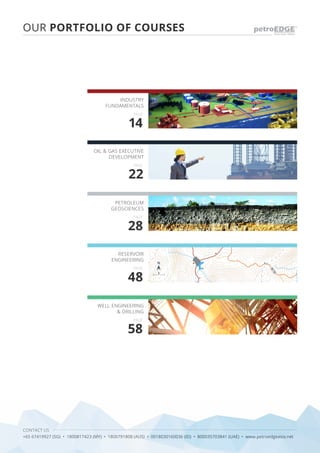
OUR PORTFOLIO OF COURSES
14
28
22
48
58
PAGE
PAGE
PAGE
PAGE
PAGE
INDUSTRY
FUNDAMENTALS
PETROLEUM
GEOSCIENCES
OIL & GAS EXECUTIVE
DEVELOPMENT
RESERVOIR
ENGINEERING
WELL ENGINEERING
& DRILLING
70
108
84
118
126
132
PAGE
PAGE
PAGE
PAGE
PAGE
PAGE
PRODUCTION &
COMPLETIONS
MARINE &
OFFSHORE
PROCESS FACILITIES &
MAINTENANCE
TRADING &
SUPPLY CHAIN
PETROCHEMICAL &
REFINING
ECONOMICS, FINANCE
& ACCOUNTING, LEGAL
CONTACT US
+65 67419927 (SG) • 1800817423 (MY) • 1800791808 (AUS) • 0018030160036 (ID) • 800035703841 (UAE) • www.petroedgeasia.net
CONTACT US
+65 67419927 (SG) • 1800817423 (MY) • 1800791808 (AUS) • 0018030160036 (ID) • 800035703841 (UAE) • www.petroedgeasia.net
INDUSTRY
FUNDAMENTALS
Coalbed Methane (CBM) Technical Fundamentals
Drilling Essentials For New Engineers And Non-Technical
Professionals
Finance For Non-Finance Professionals In Oil & Gas And
Petroleum Fiscal Regimes And Applied Finance For Non-Finance
Professionals
Fundamentals Of E & P Data Management
Fundamentals Of Geosciences
Introduction To Exploration Production For New Engineers And
Non Technical Professionals
Introduction To Unconventional Oil Gas
Petroleum Geology For Non-Geologists
Mechanical Engineering For Non-Mechanical Engineers
Shale Gas Technical Fundamentals
LNG Fundamentals
Production Technology For Other Disciplines
15
15
16
16
17
17
18
18
19
19
20
21
CONTACT US
+65 67419927 (SG) • 1800817423 (MY) • 1800791808 (AUS) • 0018030160036 (ID) • 800035703841 (UAE) • www.petroedgeasia.net
INDUSTRYFUNDAMENTALS
15
COALBED METHANE (CBM) TECHNICAL
FUNDAMENTALS
Why You Should Attend
The purpose of this course is to provide delegates with practical
insights and tools that can be used to efficiently identify, appraise,
and develop these types of reservoirs. The course will review the
origin and mechanisms of CBM production, discuss the various
techniques used to analyze reservoir parameters and performance,
and understand how these have been applied to numerous projects.
Exercises in rock description, log correlation, and resource estimation
will emphasize key points. Participants will analyze case histories to
determine the effectiveness of different appraisal and development
strategies and why projects succeeded or failed.
Who Should Attend
Engineers, geologists, geophysicists, researchers, managers,
government officials, planners, and technical support staff wanting
a detailed review of the data, techniques and strategies needed for
evaluating and developing Coalbed Methane projects. Participants
are assumed to have an understanding of general engineering and
geologic terms.
What You Will Learn
•	 Recognize the factors controlling gas-in-place, reserves, and
productivity
•	 Understand how to collect, quality-check, and interpret critical
data
•	 Determine how to select the optimum well completion and
stimulation methods
•	 Outline practical steps for calculating reserve volumes and
forecasting production
•	 Recognize why various successful projects have required different
development techniques
•	 Review the CBM development steps, costs, and timelines
•	 Apply techniques for performing due diligence
•	 Understand the global CBM activities, technologies, and future
opportunities
As conventional sources of oil and natural gas are getting harder
to find, leading energy companies are seeking out unconventional
sources of gas. Coalbed Methane (CBM) is seen to be one of the most
viable options. Interest is turning to CBM as a potential energy source
for Asian countries as the economics improve with other energy
costs soaring with the region’s appetite for gas growing annually at
about 2% per annum.
Gain an overview of drilling procedures, the terminology used, its
cost components and the latest technological developments driving
this activity.
Drilling Essentials will help you de-mystify activities around the rig
and well planning. It will explain the fundamentals of drilling with
an emphasis on key areas such as logistical considerations, costing,
and analysis of drilling contracts. Understand the urgency of drilling
requests, know more about the cost implications of drilling-related
problems, and understand the risks involved in a drilling contract.
With Franz’s drilling knowledge and skills, this is your opportunity
to explore and understand important drilling concepts, principles,
and technology which are presented in a reader-friendly format and
illustrated with examples. As a non-drilling professio+B18nal, you
too can grow with the drilling industry with a deeper understanding
of the critical role you play in contributing to its success!
DRILLING ESSENTIALS FOR NEW ENGINEERS AND
NON-TECHNICAL PROFESSIONALS
Why You Should Attend
Who Should Attend
What You Will Learn
Unique features of this training course:
•	 Multi-media presentation methodology to enable better
understanding and appreciation technical jargon and equipment
applied in the field
•	 A pre-course questionnaire to help us focus on your key learning
objectives
•	 Detailed reference manual for continuous learning and sharing
•	 Limited class size to ensure one to one interactivity
New engineers and forward-looking executives in the following fields
who are interested in enhancing their knowledge and awareness of the
drilling process for increased productivity & contribution to the team
they’re supporting:
•	 Accounting
•	 Administration
•	 Business Development
•	 Commercial
•	 E & P IT
•	 Estimation & Proposal
•	 Finance & Administration
•	 Finance
•	 HSE
•	 General Management
•	 Joint Ventures
By attending this 2-day industry fundamentals training course, you will
better able to:
•	 Understand drilling terminology & drilling processes for completing
onshore & offshore wells
•	 Appreciate major cost components of drilling operations and its
impact for better project planning and management
•	 Better visualise major drilling equipment and their technical
functions to promote a deeper understanding of the logistical and
technical considerations
•	 Gain valuable insights on the drilling industry with a synopsis of
recent technology developments that impact the drilling process
Complex subject made easy by the trainer! Highly
recommended to all Oil & Gas professionals to
appreciate and understand drilling activities
Executive - Project Engineering, Petroliam Nasional
•	 Legal
•	 Logistics
•	 Materials Planning
•	 Planning & Budgeting
•	 Procurement
•	 Sourcing
•	 Supply Chain
•	 Tender Contract
•	 Training
•	 Drilling Fluids
CONTACT US
+65 67419927 (SG) • 1800817423 (MY) • 1800791808 (AUS) • 0018030160036 (ID) • 800035703841 (UAE) • www.petroedgeasia.net
INDUSTRYFUNDAMENTALS
16
FUNDAMENTALS OF E&P DATA MANAGEMENTFINANCE FOR NON-FINANCE PROFESSIONALS
IN OIL & GAS AND PETROLEUM FISCAL REGIMES
AND APPLIED FINANCE FOR NON-FINANCE
PROFESSIONALS
In collaboration with CGG DMS, this 4-days training course is developed
as a series of modules to present the fundamental principles of
efficient management of E & P Data.
This 4-day separately book-able course is not designed to skill Oil & Gas
engineers to be accountants, but to give participants the confidence
and ability to communicate with accountants and finance managers
and to improve their own financial decision making.
For engineering professionals, a high level of technical expertise
is no longer sufficient for superior management performance.
Oil & Gas engineering professionals who wish to succeed in the
resources industry are required to develop skills beyond their core
functional knowledge. An understanding of financial information and
management, together with an awareness of the economic theory that
drives value creation are an integral part of the managers required
suite of skills.
Who Should Attend
Who Should Attend
The course is essential for those with a role, responsibility or interest in
E & P data management, including technical managers, administrators
and geoscientists.
This training course has been researched and developed for Managers,
Superintendents, Supervisors, Engineers, Planners, Team Leaders and
Project Coordinators in the technical and non-technical departments in
the Oil and Gas industry.
Why You Should Attend
Each module will address a separate topic of E & P Data Management
and also highlight the links between the various aspects that are
considered. The course is led with data management specialist who
is also a qualified trainer and taught by modern training techniques,
combining informative discussions and practical exercises.
The performance of organisations is increasingly judged by the
investment community according to a number of key financial criteria. A
rapidly changing and increasingly competitive global resource industry
has resulted in a focus on efficient financial management and astute
financial decision making. For the technical managers, a high level of
technical expertise is no longer sufficient for superior management
performance. If you are required in your line of work to manage assets,
analyse investment proposals, justify or approve expenditure, then
attending this masterclass will equip you with the essential skills you
need.
What You Will Learn
What You Will Learn
•	 The value of effective E & P Data Management and the sources and
formats of E & P data
•	 To recognize the Lifecycle Stages of E & P Data starting with Data
receipt
•	 Accurate cataloguing, recognition of significant metadata and
compliance to standards
•	 Best practices for physical data handling and digital Data
Management
•	 To appreciate key technology solutions for E & P Data Management
•	 Importance of Data Security and Data Quality
•	 How to create operational workflows and procedures, and business
continuity
•	 Management of data archives effectively, retention and destruction
strategies
•	 Awareness of legislative data retention requirements
Attend industry specific training course and benefit from the following:
•	 Demystify financial jargon and fully interpret financial statements
•	 Understand Balance Sheets and Profit & Loss statements of Oil &
Gas companies
•	 Discover the crucial distinction between cash flow and profit
•	 Understand how to make correct investment decisions using Net
present Value and Internal Rate of Return
•	 Interpret oil and gas company financial reports using ratio analysis
•	 Learn the difference between cash costs and full costing of energy
products
•	 Learn how to manage working capital for increased shareholder
value
•	 Gain an awareness of the different valuation methods for
producing properties and undeveloped acreage
•	 Learn the industry specific accounting issues that apply when
interpreting oil and gas company financial statements
•	 Understand how the physical characteristics of energy assets (e.g.
reserves, reservoir quality) are translated into project valuations
•	 Learn how the investment analysts value oil and gas stocks and
make buy/sell recommendations
•	 Gain a “toolbox” of methods to analyse specific project issues such
as lease versus buy analysis and make or buy analysis
Very interesting training – I got to learn about drilling and
logging as well as data standards.
Finance & accounting made easy
Librarian, National Data Repository
Carigali HESS
CONTACT US
+65 67419927 (SG) • 1800817423 (MY) • 1800791808 (AUS) • 0018030160036 (ID) • 800035703841 (UAE) • www.petroedgeasia.net
INDUSTRYFUNDAMENTALS
17
Explore the multi-disciplinary nature of Oil & Gas exploration by
examining the process, technology and technical terminology used
during the exploration and production operations in an upstream
business.
INTRODUCTION TO EXPLORATION &
PRODUCTION FOR NEW ENGINEERS AND NON-
TECHNICAL PROFESSIONALS
Why You Should Attend
Who Should Attend
What You Will Learn
As exploration and production activities in Asia continue to grow,
new engineers and supporting professionals like yourself must
grasp the language and technology of exploration and production.
Exploration and production technology, equipment specification
and processes have a unique language that must be conquered by
executives such as you. Through our video presentations, you can
better visualise the various exploration equipment/technologies and
understand the major cost components. A confident understanding
of the technical jargon used and a visual appreciation of the various
pieces of exploration equipment provides an overall knowledge
of the “big picture” of exploration and production. This serves as
an excellent foundation for smooth communication and increased
efficiency in inter-department project team efforts.
•	 Accounting Administration
•	 Business Development
•	 Commercial
•	 E & P IT
•	 Estimation & Proposal
•	 Finance & Administration
•	 Finance
•	 HSE
•	 General Management
•	 Joint Ventures
•	 Legal
•	 Appreciate the dynamics of world energy demand & supply and its
impact on pricing
•	 Understand the formation of petroleum reservoirs and basic
geological considerations
•	 Examine the exploration process to gain an overview of the
technical processes involved
•	 Gain a comprehensive overview of drilling activities - from pre-
drilling preparation, through to well drilling, well evaluations and
post drilling activities
•	 Get familiarised with the common production methods and the
different stages of its processes
•	 Integrate your understanding of asset maintenance and
downstream supply chain activities
•	 Logistics
•	 Materials Planning
•	 Planning & Budgeting
•	 Procurement
•	 Sourcing
•	 Supply Chain
•	 Tender Contract
•	 Training
“Good overview for the basic knowledge on Oil & Gas
industry especially for new engineers and non-technical
staff. The lecture will explain how the process works”
Sales & Proposal Admin, Germanischer Lloyd Industrial
Services Asia
This 3-day course will introduce the key concepts and principles of
geology and geophysics currently used in the oil and gas industry.
Emphasis will be placed on explaining how and why various techniques
and technologies are used and how the two disciplines interact and
complement each other. Case studies, demonstrations, videos and
hands-on exercises will be used as appropriate to clarify concepts and
reinforce learning.
FUNDAMENTALS OF GEOSCIENCE
What You Will Learn
•	 A clear understanding of the terminology and jargon used by
petroleum geoscientists (geologists and geophysicists)
•	 Knowledge of the processes and procedures used by geos in their
everyday work as they explore for and develop oil and gas fields
•	 An understanding of the sources and reliability of various types of
G&G data
•	 Confidence to carry on a basic technical conversation with a
petroleum geologist
•	 Hints about where to look to continue to increase your geoscience
learning
•	 Ability to critically read press releases and simple geological and
seismic reports
Who Should Attend
This course will benefit those who work with, and/or need to
communicate effectively with, geologists and geophysicists and need
to understand the terminology, tools and processes they use for
exploration, development and resource estimation. That includes
technical directors and managers, investment brokers and advisors,
petroleum engineers and other industry professionals with a non-
geoscience background, IT managers and technical support staff.
Why You Should Attend
This is an excellent introductory level course to the geoscience
disciplines, as it will provide a good working knowledge of the
techniques and applications that are commonly applied within oil
companies.
Course Highlights
•	 Course facilitator is an active exploration consultant with almost 35
years industry experience
•	 He is also a professionally trained teacher who is able to effectively
communicate with all participants - regardless of their current
knowledge level
•	 Hands-on exercises are used to clarify and reinforce important
concepts
•	 Videos and demonstrations provide added interest and simple
illustration of complex processes
•	 Current case studies are discussed to show how newfound
knowledge can be applied on the job
CONTACT US
+65 67419927 (SG) • 1800817423 (MY) • 1800791808 (AUS) • 0018030160036 (ID) • 800035703841 (UAE) • www.petroedgeasia.net
INDUSTRYFUNDAMENTALS
18
Historically, conventional natural gas deposits have been the most
practical and easiest deposits to drill. However, as technology
and geological expertise advance, unconventional natural gas
deposits are beginning to make up an increasingly large percent
of the supply picture. Studies predict that domestic Chinese
unconventional production will account for over a quarter of total
gas supply by 2030. Development of indigenous unconventional
gas is currently slow but significant volumes of coalbed methane,
coal-based synthetic gas and shale gas are forecasted to enter the
market, reaching over 11 billion cubic feet per day by 2030. This will
meet much of China’s incremental demand by this time.
Why You Should Attend
This 2-day course is intended for technical professionals requiring
an introduction and overview of how Shale Gas, Coalbed Methane,
Tight Gas are evaluated and developed. Common and unique
features of each type of reservoir will be presented along with
an explanation of some of the key terminology used in the gas
industry. The course is intended for those who are not familiar
with one or more of the four types of natural gas plays or who
are interested in learning more about the overall evaluation and
development for natural gas.
Who Should Attend
•	 Geoscientists, engineers, and managers with experience in
conventional reservoirs who want to develop unconventional gas
expertise
•	 Unconventional gas industry employees who want to refresh
their knowledge of industry basics
•	 Sales/marketers and consultants working on unconventional gas
projects or accounts
•	 Employees of organizations providing services to the gas
industry—and anyone who wants to learn about unconventional
gas
What You Will Learn
•	 Review the origin and mechanisms of unconventional gas
production, discuss various techniques to analyze reservoir
parameters and performance, and assess their value and
limitations
•	 Learn from case histories how to compare and contrast different
play types, appraisal activities, and development strategies
•	 Understand the increasingly sensitive technologies that are
making the production of unconventional gas economically viable,
efficient and environmentally safe
•	 Reinforce your knowledge of the unconventional gas industry
with latest developments taking place in technology & markets
Good! It has presented up-to-date and relevant
information.
Principal Structural Engineering
INTRODUCTION TO UNCONVENTIONAL OIL &
GAS
PETROLEUM GEOLOGY FOR NON GEOLOGISTS
Why You Should Attend
•	 Course facilitator is a currently active exploration consultant with
over 30 years industry experience
•	 Facilitator is also a professionally trained teacher who is able to
effectively communicate with all participants - regardless of their
current knowledge level
•	 Hands-on exercises are used to clarify and reinforce important
concepts
•	 Videos and demonstrations provide added interest and simple
illustration of complex processes
•	 Current case studies are discussed to show how newfound
knowledge can be applied on the job
Who Should Attend
•	 Petroleum engineers (reservoir, drilling, production) who work with
geological input data
•	 Geophysicists with little geological background
•	 Project managers whose teams include petroleum geologists
•	 Investment managers, brokers, analysts wanting to better interpret
oil company press
•	 releases and other public documents
•	 Government data managers who handle petroleum geological data
and need to understand
•	 the sources of different types of data
•	 Small-Company Directors who have picked up a large amount of
geological information over the years but need a bit of ‘time out’ to
put it all together in a systematic format
What You Will Learn
•	 A clear understanding of the terminology and jargon used by
petroleum geologists
•	 An understanding of the sources and reliability of various types of
geological information
•	 Knowledge of what geological questions to ask in order to gain an
understanding of the cost and analyse risk critical elements of a
petroleum project
•	 Confidence to carry on a basic technical conversation with a
petroleum geologist
•	 Hints about where to look to continue to increase their geological
understanding
•	 Ability to critically read press releases and simple geological reports
Participants will acquire an understanding of the geological principles
employed to find, develop and produce oil and gas reservoirs, the type
of data required to build a model of the subsurface, and the different
methods used to display information. The value and limitations of
different data sources will be discussed. Emphasis is placed on the
operational and applied aspects of petroleum geology. The course will
demonstrate how appropriate use of geological information can lead
to better management decisions and thus improve the value of oil and
gas projects.
Substantially increased my knowledge. The exercises were
indeed very helpful.
Senior Manager, PETRONAS
CONTACT US
+65 67419927 (SG) • 1800817423 (MY) • 1800791808 (AUS) • 0018030160036 (ID) • 800035703841 (UAE) • www.petroedgeasia.net
INDUSTRYFUNDAMENTALS
19
This 5 day training course is developed for engineers who need to gain
an understanding of the principles of mechanical engineering from
an overview perspective. This modular based course covers the basic
mechanical equipment and components within the Oil & Gas and
Power Plant industries.
MECHANICAL ENGINEERING FOR NON-
MECHANICAL ENGINEERS
Why You Should Attend
This course will provide a foundation for understanding mechanical
engineering concepts that will help non-mechanical engineers better
understand the safe and reliable operation of facility components and
systems. The course will be taught in an easy to understand manner,
each module has an introduction, general description, detailed
drawings and nomenclature together with a summary of the important
information provided. Where mathematical equations, formulae and
relationship expressions are used; these have been simplified to assist
in the learning process. Each module has in-built terminal and enabling
objectives which quantify the specific points to be learned.
Who Should Attend
This course is intended for non-mechanical engineers, technicians,
operators, maintenance personnel and planners working in the Oil &
Gas and Power Plant Sectors.
What You Will Learn
State, List, Classify, Identify, Explain and Describe the Design, Selection,
Function, Purpose and Application, Construction and Individual
Components, Support Systems, Operating Principles and where
applicable the Control and Protection of:
•	 Rotating Equipment
•	 Gas Turbines – Aero Derivative and Heavy Duty
•	 Compressors – Axial and Centrifugal
•	 Centrifugal Pumps
•	 Bearings And Lubrication, Seals And Couplings
•	 Reciprocating Equipment
•	 Diesels Engines and Pumps
•	 Hydraulics And Pneumatics
•	 Static Plant
•	 Heat Exchangers
•	 Valves
•	 Filters and Strainers
“The course and materials were great!”
Onshore Repair Supervisor,
ExxonMobil Exploration & Production Malaysia, Inc
This 1-day course reviews the distinct shale properties needed for
commercial development and the required technology for defining and
developing this major gas resource.
What You Will Learn
Participants will gain the following from this course:
•	 Identify the specific shales required for commercial development
•	 Understand why and where these shales exist
•	 Review the technology developed for evaluating and developing
shale
•	 Recognize the factors controlling gas-in-place and productivity
•	 Understand what techniques are used to evaluate a prospective
shale
•	 Review the steps for calculating reserve volumes and forecasting
production
•	 Gain practical insight and techniques for quality-control and due
diligence
It is recommended that each participant bring a laptop to
solve basic problems.
SHALE GAS TECHNICAL FUNDAMENTALS
Who Should Attend
Why You Should Attend
The target audience includes engineers, geologists, investors,
managers, government representatives, service providers, planners,
and technical support staff.
To learn more and understand the technicalfundamentals of Shale
Gas. Also, to be able to evaluate and be in a better position of the
development of Shale Gas.
CONTACT US
+65 67419927 (SG) • 1800817423 (MY) • 1800791808 (AUS) • 0018030160036 (ID) • 800035703841 (UAE) • www.petroedgeasia.net
INDUSTRYFUNDAMENTALS
20
The 21st century has been coined the century of gas. The course
will address the fundamental technical and economic factors that
have driven and will drive the successful development of natural
gas reserves by means of an integrated liquefied natural gas (LNG)
project. The current exponential growth in the use of natural gas
through international trade in LNG is explored.
LNG FUNDAMENTALS
Why You Should Attend
The course contrasts the technical and commercial differences
between LNG and natural gas to point out benefits and constraints
that arise from the LNG option. A description is given of the elements
in the “gas chain” which apply to LNG and of drivers that would lead
to optimisation of design and commercial operation. The range and
role of relevant parties to a successful LNG project are described.
Regulatory authorities are also concerned with LNG safety, which
is covered in detail. Ways and means by which a new entrant to
a proposed LNG project may ensure an investment that meets
expectations.
Who Should Attend
LNG project development executives are drawn from both technical
(E&P geoscience and engineering) and non-technical (commercial,
finance and legal) backgrounds. Participants who have recently
joined an LNG market development team, perhaps with expertise
in one area of gas development, will benefit from the course by
obtaining a good grounding of all other areas.
You will meet the following professionals from the LNG industry:
•	 Sales & Marketing
•	 Economist
•	 Risk Management
•	 Finance & Accounting
•	 Project Financiers
•	 Investment Analyst
•	 Energy Lawyers
•	 Strategic Planners
•	 Gas Engineers
•	 Asset Managers
What You Will Learn
•	 Understand the special characteristics of LNG which both broaden
and yet constrain the commercial and technical links in the “gas
chain”
•	 Generate options for market development proposals
•	 Understand risks and their mitigation
•	 Negotiate more effectively the terms of LNG sales agreements
•	 Understand the perspectives of the investor, the operator, the
customer and government towards the LNG project
•	 Recognise political and diplomatic implications of international
trade in LNG
Well developed course to give around of understanding step
by step. Visualise process & real construction. Tons of sample
cases excellent as an introduction to be aware of all aspects
and disciplines related to the subject.
PTTEP
CONTACT US
+65 67419927 (SG) • 1800817423 (MY) • 1800791808 (AUS) • 0018030160036 (ID) • 800035703841 (UAE) • www.petroedgeasia.net
INDUSTRYFUNDAMENTALS
21
PRODUCTION TECHNOLOGY FOR OTHER
DISCIPLINES
The Production Technology (PT) discipline is responsible for the
conceptual design and maintenance of oil & gas wells, its completion
and performance & integrity over the entire life cycle. This discipline
is part of the Production Engineering (PE) function such as Reservoir
Engineering, Well Engineering, Surface Engineering and Production
Operations. Production Technologists play a unique and vital role in
the interface and co-ordination within this multidisciplinary PE function.
Production technologists are involved in a wide number of processes
throughout the complete lifecycle of a well. Their tasks are focused on
maximising short-term production and long-term recovery from the
assets.
Who Should Attend
Reservoir engineers, geologists, petrophysicists, production
programmers, production chemists, process and facility engineers, well
engineers, and any discipline who needs to communicate effectively
with production technologists namely reservoir engineers and well
engineers. This course is also suited for those who want to learn more
about the discipline of Production Technology.
Why You Should Attend
•	 The technical aspects such as reservoir drive mechanisms, drilling
methods, well and completion types, hydrocarbon in- and outflow
performance, formation damage and cleaning mechanisms, well
life-cycle, production surveillance, production chemistry and the
latest state of the art technologies.
•	 The organizational aspects of the roles and responsibilities in the
interface and co-ordination of the multidisciplinary functional
Petroleum Engineering environment.
This course is aimed at gaining a better understanding and
appreciation of the Production Technology discipline to achieve better
inter-departmental or functional co-operation.
Course Highlights
•	 Course leader is both a technical expert and a workshop facilitator
which are beneficial for the interactive dialogue and efficacy of the
course.
•	 Interactive hands-on exercises are used to better understand the
content.
•	 Video films are used to illustrate concepts.
What You Will Learn
•	 Understand and appreciate how and why Production Technologists:
•	 Execute their roles and responsibilities in E&P’s Business Process
Model
•	 Design wells and their completions, including gravelpack,
perforations, artificial lift systems
•	 Establish the inflow and outflow performance
•	 Optimise production performance, including well intervention,
stimulation, fracking
•	 Understand the terminology and jargon used in Production
Technology to improve communication and understanding within
inter-disciplined teams.
It’s a good brief course to give more awareness & to a
certain degree of knowledge on PT & the related materials/
matters with PT.
Senior Production Engineer, Sarawak Shell Berhad
CONTACT US
+65 67419927 (SG) • 1800817423 (MY) • 1800791808 (AUS) • 0018030160036 (ID) • 800035703841 (UAE) • www.petroedgeasia.net
OIL & GAS
EXECUTIVE
DEVELOPMENT
Competency Management Systems In Oil Gas
Corporate Governance In The Oil Gas Industry
Exploration Production Business Simulation Technical
Commercial Business Management
Human Competency Capability Development In Oil Gas
Leadership and Team Dynamics In Oil Gas
National Oil Companies: Strategies To Sustain Growth In A
Competitive Market
Negotiation Skills Technique For Engineers And Technical
Professionals
Offshore Project Management
Technical Report Writing And Presentation Skills For Oil Gas
Engineers And Technical Professionals
Well Site Leadership
23
23
24
24
25
25
26
26
27
27
CONTACT US
+65 67419927 (SG) • 1800817423 (MY) • 1800791808 (AUS) • 0018030160036 (ID) • 800035703841 (UAE) • www.petroedgeasia.net
OIL&GASEXECUTIVEDEVELOPMENT
23
The regulatory and reporting landscape is particularly complex for oil
and gas companies. Not only do companies have to conduct operations
in a variety of regulatory and tax regimes but they also have big upfront
investment needs, which often go hand in hand with great uncertainty
about long-term outcomes. The geopolitical, environmental, energy
and natural resource supply and trading environment, combined with
often complex stakeholder and business relationships, adds to the
complexities oil and gas companies face. This 3-Day training course
aims to describe the requirements for good governance in the Oil &
Gas Industry.
Why You Should Attend
By participating in this training course, you will learn the following:
•	 Basis on which a Model Governance Framework is built - ‘The
company’
•	 Requirements for control of the company - ‘How we control the
company’
•	 Range of assets that are essential for managing the business -
‘What we have’
•	 Roles, responsibilities, accountabilities and required behavior - ‘How
we are structured and behave’
•	 Mechanisms for getting things done - ‘How we do things’.
Key Corporate Governance concepts covered include the following:
•	 Vertical and horizontal alignment of the Business Unit
•	 The 8 principles on which ISO certification is based
•	 The 3 Elements of a Business Control Framework
•	 The 6 General Principles of Good Business Control/ Governance
•	 The 3 Risk Control Mechanisms (3 Ps)
•	 The 4 Strategies for Risk Control (4 Ts)
•	 Affiliate company relationships
•	 Types of assets and how they are managed
•	 Physical asset management and the effect on production
•	 Competency assessment and performance improvement
•	 The distinction between systems and processes
•	 The 3 levels of systems: Strategic, Core & Support.
What You Will Learn
•	 Assess the level of maturity of Governance in your organization
•	 Review and update an existing Governance Manual and Framework
based on best-practices reviewing during the training
CORPORATE GOVERNANCE IN THE OIL & GAS
INDUSTRY
COMPETENCY MANAGEMENT SYSTEMS IN OIL &
GAS
The Competency Management System program is a
great asset for everyone who takes care of competency
management and capability development in Oil & Gas
Head – Learning Delivery & Competence Management,
Brunei Shell Petroleum
Why You Should Attend
Within the Oil and Gas industry it is a requirement, both contractual
and in some areas legislative, to ensure effective internal systems are
in place which support employee development and provide evidence
of their competence. A Competence Management System (CMS),
correctly developed and applied provides employees and organisations
with the tools to demonstrate competence and contributes to career
development of the individual and the business as a whole.
The 3-Day course focuses on Competence Management Systems
(CMS) which are typically in use within the Oil and Gas Industry, their
structure and process development requirements. In addition, the
course details the assessment process, the role of the competence
assessors within the organisation and the relationship between
competence management and training provision.
What You Will Learn
•	 Understand the role of competencies in the Oil & Gas industry
•	 Know the benefits of Competency Management System to the
organisation
•	 Understand the components of a Competency of Competency
Management System
•	 Know how to implement the Competency Management System
•	 Know the Roles & Responsibilities within the Competency
Management System
•	 Know how to ensure Competency Assurance Management
•	 Know how to develop Competency Models
•	 Understand the relationship between of Competency Management
and Capability Development
•	 Know how to conduct Organisational Analysis
•	 Know how to conduct Job Analysis and Task Analysis
•	 Know how to develop Competency Standards and Development
Guides using the 70:20:10 principle
•	 Know competency assessment process, tools and methodologies
•	 Know how to package and communicate the Competency
Assessment Reports
•	 Understand Competency Management Case Studies in the Oil &
Gas
Overall a fruitful training course that strengthens my
understanding of CMS & provide inspiration’s develop my own
systems
Head of Competency Development Department Field
Operations
Total E & P Indonesia
CONTACT US
+65 67419927 (SG) • 1800817423 (MY) • 1800791808 (AUS) • 0018030160036 (ID) • 800035703841 (UAE) • www.petroedgeasia.net
OIL&GASEXECUTIVEDEVELOPMENT
24
HUMAN COMPETENCY CAPABILITY
DEVELOPMENT IN OIL GAS
Competition for the best and brightest is reaching fever pitch in the Oil
& Gas industry. Leading operators and contractors are fighting to hold-
on to top talent, often lured away by unmatchable offers. Furthermore
retiring senior professionals leave your organisation, taking with them
years of experience and knowledge. You need to have a sustainable
capacity building solution in place to protect your organisation’s skill
pool and capability. Losing valuable skills without the ability to replace
or develop them will have a significant impact on the bottom line.
This 4-Day course provides an excellent opportunity for learning
& development professionals in the oil & gas sector to learn from
strategic learning & development practitioners with extensive
experience in the oil & gas sector and from each other. This is an ILM
approved course.
Who Should Attend
Line Managers, Team Managers, Supervisors, Learning &
Development Executives, Talent Development, Competency and
Capability Development Executives from International and National
Oil & Gas Operators, Contractors and Service Providers from across
Asia.
Why You Should Attend
This course utilizes a wide variety of learning approaches:
•	 Inputs from the facilitators who have extensive global experience
in the oil & gas sector
•	 Theoretical models, practical tools & templates, and company
examples
•	 A case study, based on oil & gas majors, cuts across key sessions
over the 4 days
•	 Exercises in groups or pairs with fellow oil & gas, learning &
development professionals
•	 A soft copy manual for future reference, containing all of the
material covered (including the models, tools & templates) plus
additional content
•	 The facilitators will be available at the end of each day for 1:1
questions
What You Will Learn
•	 Align and develop effective learning & development strategy to
the business strategy
•	 Leverage the effective use of competencies in their organisations
•	 Understand and apply a series of key steps for successful
performance management
•	 Design and implement effective learning approaches to address
competency needs
•	 Optimise the added value of the learning & development function
•	 Measure the improvements resulting from enhanced capability
within their organization
•	 Build effective internal & external partnerships
•	 Audit learning & development activities and make comparisons
with best practices
This 3-Dvay E&P Business Simulation training course is designed for
groups working within the E&P sector to experience the process of
formulating a medium term E&P Business Plan. The course will draw
on technical, commercial and management skills as the teams work
on building a 5-year plan for a business comprising of producing
assets, appraised and unapprised discoveries, several exploration
opportunities, and limited infrastructure. The portfolio includes
both Gas and Oil assets and the plan encompasses not only the
commercial issues of exploration & production but also the social
and infrastructural issues of progressing E&P projects.
This course is run as a business simulation, with groups of attendees
working in teams, supported and guided by two experienced tutors.
The groups spend the three days working through the portfolio
and formulating their business plans against an evolving series of
technical, commercial and social in-country issues, and at the end of
the course present the business plan to the group.
EXPLORATION PRODUCTION BUSINESS
SIMULATION TECHNICAL COMMERCIAL
BUSINESS MANAGEMENT
Why You Should Attend
The course has previously been of benefit both to commercial
staff, who have an interest in understanding the linkages between
subsurface and surface engineering issues, and also to geosciences
and engineering professionals seeking a deeper understanding of
commercial issues surrounding E&P projects.
Who Should Attend
The course is designed for a mixture of mid-level experienced Petro
Technical (professionals from Exploration, Development, Drilling,
Production) and Business staff who are seeking to develop portfolio
management skills. Attend as a multi-disciplinary team to maximise
your learning experience. Special team discounts apply for this course!
What You Will Learn
On completion, course participants will be able to:
•	 Apply a systematic approach to the analysis and valuation of assets
at each stages of the Field Life Cycle (FLC)
•	 Define activity plans for assets throughout the Field Life Cycle
•	 Identify, quantify and mitigate risk and uncertainty
•	 Incorporate technical, commercial and other uncertainties into
business decision making.
•	 Optimise a technical plan for the company’s assets, trading off high
value activities against low value activities.
•	 Develop a commercial case for the chosen technical plan and path.
CONTACT US
+65 67419927 (SG) • 1800817423 (MY) • 1800791808 (AUS) • 0018030160036 (ID) • 800035703841 (UAE) • www.petroedgeasia.net
OIL&GASEXECUTIVEDEVELOPMENT
25
Do you face the following in your work?
•	 Creating a team with the various stakeholder representatives.
Different agendas and expectations can divide the parties involved;
they can see themselves as ‘us’ and ‘them’ rather than ‘we’
•	 Developing a sense of shared purpose and an agreed future
project success vision. These are the first steps to delivering your
project on time and on budget.
•	 Overcoming the difficulties caused by individuals, with diverse
personalities and cultural backgrounds, who need to be
understood and motivated to perform at their best as a team. It
can be particularly challenging to work with staff from different
companies or in remote locations.
•	 Developing strength and determination in your project team,
especially when under pressure and facing big challenges. Common
issues such as lack of empowerment, lack of trust, ‘partner drag’
and alienation of non-operator partners can undermine the
partnership team and eventually the whole venture.
This uniquely designed 3-Day training course will help you overcome
the challenges that you face, enabling you to optimise your success
strategies.
LEADERSHIP AND TEAM DYNAMICS IN OIL & GAS
This course is very helpful to distinguish the difference
between Leadership & Management.
Director Business Development, Timor Gao, E.P.
What You Will Learn
•	 Enhance your personal effectiveness and decision making
•	 Learn how to build your influencing capability
•	 Inspire enthusiasm, motivation and commitment
•	 Communicate effectively across a multi-cultural team
•	 Nurture your relationships and strengthen your team
•	 Develop an empowering partnership team culture
Who Should Attend
Anyone involved in leading a business unit or a project team can
attend. It covers relationships with host governments, contractors,
suppliers and local communities which constitute critical alliances for
the development of a project.
This course is essential for team leaders, supervisors or managers from
the following functions:
•	 Project management engineers from various technical disciplines
•	 Ad-hoc or special project team leaders in legal, technical & financial
disciplines
•	 Country managers or business development officers of contractors
•	 JV management executives or officers
•	 Government officials or industry liaison officers
•	 Procurement or contracts executives or officers
The current strategies, policies and requirements of National Oil
Companies (NOCs) are having a substantial impact on the direction and
dynamics of the present-day petroleum sector. Many of the national
oil companies are moving away from their previous more nationalistic
role as licensing agency and passive partner to the international oil
companies. They are becoming active in developing and acquiring
equity positions and resources in the international arena, both
upstream and downstream. They are winning blocks and taking over
companies. Several NOCs are now present in 20-30 countries. They
are taking more of the economic rent in their own countries. They are
dealing more with one another on a government to government basis
and are actively competing with IOCs in bidding situations outside their
own borders. They are, in effect, becoming international national oil
companies, a challenge in itself.
Why You Should Attend
By attending this 3-Day strategic course, participants will be able to
draw lessons from industry best practices and learn how NOCs and
governments can work together in empowering their workforce,
fostering local content and promoting industrial development around
your oil and gas resources.
What You Will Learn
By attending this course, you will:
•	 Assess the objectives and current strategies NOC’s today
•	 Review leading examples from NOCs and select best practices
•	 Examine the basis for the NOC/IOC relationships
•	 Look into the leading NOCs’ strategies and motivations
•	 Weigh up the advantages and disadvantages of different models of
NOCs ownership
•	 Analyse key strategies technology and R&D development
•	 Uncovering the potential in the exploitation of Natural Gas
•	 Receive regional updates on what NOCx are doing around the
world
NATIONAL OIL COMPANIES: STRATEGIES TO
SUSTAIN GROWTH IN A COMPETITIVE MARKET
Very comprehensive materials, excellence presentation and
can be concluded as the best course I have attended so far.
Splendid!
Business Accountant, Petrofac Malaysia
Who Should Attend
Professionals from oil industry who need to make strategic planning
and investment decisions and need to understand the dynamics of the
market. This includes:
•	 Directors, General Managers and Senior managers
•	 Strategic Planners
•	 Business and Corporate Planning managers
•	 Government officials
•	 Joint Venture Managers and Advisors
•	 Commercial managers
•	 Finance Managers
•	 Government relations and country representative executives
This course will also offer IOCs & service company executives practical
and insightful information about their business partners.
CONTACT US
+65 67419927 (SG) • 1800817423 (MY) • 1800791808 (AUS) • 0018030160036 (ID) • 800035703841 (UAE) • www.petroedgeasia.net
OIL&GASEXECUTIVEDEVELOPMENT
26
OFFSHORE PROJECT MANAGEMENT
Why You Should Attend
Day 1
•	 Introduction, principles and elements
•	 Phases, organisation and teamwork
•	 Execution plan, VIPs and pre-feasibility checklist
•	 Example of feasibility study and basis of design
•	 Group exercise: checklists for various phases
Day 2
•	 Costs, schedules and control
•	 Project review processes, examples and learning
•	 Contracts and tendering process, agreements
•	 Government relationships and requirements
•	 Group exercise: offshore oil development
Day 3
•	 Interface management
•	 Joint venture relationships
•	 Implementation and facilities risk examples
•	 Group exercise: offshore oil development cont’d
Day 4
•	 Risk Analysis and Management
•	 Case history of major disaster
•	 Detailed case history I
•	 Group exercise: offshore gas development
Day 5
•	 Safety systems and management
•	 Environmental impact assessment
•	 Detailed case history II
•	 Group exercise: offshore gas development cont’d
Who Should Attend
Engineers, technical supervisors and managers, project and general
managers, and those individuals, either current or future, with
significant roles in major projects, or those that have a stake in
the development of major oil and gas developments, for example
government officials. It is presumed that participants will have a general
knowledge of concepts in exploration and production (development),
i.e. the upstream part of the petroleum business.
What You Will Learn
This course will give participants an understanding of all major aspects
of project management, dealing with internal (company) and external
requirements (government, partners, contractors etc.). In particular,
the course emphasizes the core requirements for major projects,
from planning to scheduling and control, including management
of uncertainty and risk. Participants will be introduced to the large
diversity of jargon and terms, covering such important areas as the
engineering Basis of Design (BoD), and project processes such as
“Tollgating” and Project Implementation Reviews (PIRs). Guidelines and
standards, as well as “best practice” will be demonstrated by numerous
examples and case histories will be used throughout to demonstrate
important learning, particularly where projects have fallen short from
expectations. Course participants will engage in a number of group
exercises.
Project Management deals with major projects, setting out principles,
phases and processes for studying and implementing offshore oil and
gas development projects, from secondary appraisal to commissioning.
NEGOTIATION SKILLS & TECHNIQUE FOR
ENGINEERS AND TECHNICAL PROFESSIONALS
This is a thoroughly enjoyable and informative course.  It has
introduced and consolidated a number of PBE concepts.
Geologist, Santos
Why You Should Attend
A mixture of theory, examples and practical exercises are used, so that
participants understand the principles and get an opportunity to try
them out. The case studies used are real cases encountered in the oil
and gas industry.
Day 1
•	 Introductions and admin matters
•	 Identification of the typical negotiations seen in industry
•	 Preparing for the negotiation
Day 2
What we have learnt so far?
•	 Managing specific aspects of the meeting
•	 Bargaining
•	 Impact of different cultures on international negotiations
•	 Managing the close
•	 The agreement
Who Should Attend
This is a course specially prepared for, and aimed at, middle-managers
and technical and other staff who let contracts, but with limited
previous exposure to negotiations, and who will need these skills in the
near future.
What You Will Learn
Many technical experts find it difficult to move out of their expertise
areas and deal with commercial matters. Negotiating to optimise
business value is a step further from their comfort zones. All too
often negotiations are then left to finance personnel. They bring many
strengths to the table but an understanding of engineering trade-offs is
not one of them.
By attending this course participants will add to their technical know-
how a core competence in negotiation skills. They will thus become
formidable negotiating opponents.
This is a 2-Day training course that is aimed at providing professionals
in the oil & gas business with a comprehensive set of core negotiating
skills. Negotiations take place in many situations e.g. between peers,
manager and subordinate, company and trade unions, company and
government. The skills learnt on this course will be useful in all of
these situations. However the course puts a focus on the skills needed
in commercial negotiations. A particular emphasis is placed on the
relationship and negotiations typically carried out between client and
contractor, vendor or the provider of services.
A mixture of theory, examples and practical exercises are used, so that
participants understand the principles and get an opportunity to try
them out. The case studies used are real cases encountered in the oil
and gas industry.
CONTACT US
+65 67419927 (SG) • 1800817423 (MY) • 1800791808 (AUS) • 0018030160036 (ID) • 800035703841 (UAE) • www.petroedgeasia.net
OIL&GASEXECUTIVEDEVELOPMENT
27
Oil & Gas professionals increasingly need to translate complex findings,
analysis and recommendations for effective decision making. If you
face challenges in getting your findings into paper and presenting it
effectively, you will benefit from this 3-Day training course.
Technical Report Writing and Presentations Skills for Oil & Gas
Professionals focuses on unique needs of technical professionals
who write and present for both technical and non-technical readers.
This 3-day separately book-able workshop will demonstrate on how
technical professionals can use their technical knowledge and logical
edge to write in a reader-friendly, grammatically accurate way reports
and persuasively communicate for buy-in purposes.
In your mission to deliver safe, compliant and reliable wells, the
capabilities of the wellsite leader is crucial. How do you know if your
wellsite leader has the relevant competencies to be successful, and are
they “equipped” to do their jobs?
An inexperienced or ill-equipped wellsite leader can result in poor
productivity and unsafe conditions. In reality this is a very high cost
to the operator, contractor and the service industry as a whole.
Better leadership and management would have identified the risks at
Macondo and prevented the technical failures that led to the blowout.
Investigations confirm that the lack of leadership was associated with
each technical failure experienced in Macondo.
TECHNICAL REPORT WRITING AND
PRESENTATION SKILLS FOR OIL & GAS
ENGINEERS AND TECHNICAL PROFESSIONALS
What You Will Learn
Effective technical report writing for oil & gas professionals
•	 Write and turn-around accurate technical documents quickly to
meet deadlines and
•	 Productivity goals
•	 Understand how technical reports should be structured by applying
a systematic approach to the writing task, involving planning,
drafting, revision and production
•	 Use clear & powerful language to target and persuade readers for
positive results
•	 Use tried and tested proof reading techniques to check and review
documents more effectively
•	 Identify and avoid common pitfalls in technical report writing
Technical presentation skills for oil & gas professionals
•	 Present and sell your technical presentation more effectively both
internally and externally
•	 Plan and structure your meetings and presentations for maximum
effect
•	 Capture your technical and non-technical audience by delivering
your presentation with power and authority
•	 Handle questions, interruptions and objections with confidence
Why You Should Attend
Unique features of this training course:
•	 Detailed Course & Reference Manual for Continuous Learning and
Sharing
•	 Practical Exercises and Video Playback to better understand and
appreciate the concepts
•	 Limited class size to ensure One-to-One Interactivity
•	 Assessment at the end of the course to help you develop a
Personal Action Plan
This is a good training for people to improve
their writing skills and technique
PG Subsurface Data Analyst , Sarawak Shell
Why You Should Attend
This 3-Day training course is designed to enable current and future
wellsite leaders to fully understand their roles and responsibilities
and the impact they can have in delivering top quartile performance.
•	 To enhance the performance leadership capability of field based
operational staff.
•	 To reinforce the impact an effective Wellsite Supervisor can have
with regards to HSE & Operational Performance
•	 To provide clarity about key systems, processes & procedures
related to effective Wellsite Leadership
•	 Why “old school” leadership style is ineffective in today’s
environment
•	 Skills for building trust and influence with others
•	 The most effective way to define a team’s purpose and the “job
to be done”
What You Will Learn
•	 Enhanced performance leadership capability of field based
operational staff.
•	 Reinforced impact an effective Well Site Supervisor can have with
regards to HSE & Operational Performance
•	 Clarity about key systems, processes & procedures related to
effective Well Site Leadership
•	 Why “old school” leadership style is ineffective in today’s business
environment
•	 Skills for building trust and influence with others
•	 The most effective way to define a team’s purpose and the “job
to be done”
WELL SITE LEADERSHIP
Who Should Attend
Invaluable for any personnel that are involved in Well Site Supervision
during operations ranging from Interventions, Completions,
Workovers, Maintenance or acting as the “Company Representative”
during complex multi-discipline operations.
•	 Well Intervention Supervisors
•	 Well Services Supervisors
•	 Completion Supervisors
•	 Workover Supervisors
•	 Drilling Supervisors
•	 Well Maintenance Supervisors
28 CONTACT US
+65 67419927 (SG) • 1800817423 (MY) • 1800791808 (AUS) • 0018030160036 (ID) • 800035703841 (UAE) • www.petroedgeasia.net
PETROLEUM
GEOSCIENCES
Advanced Pressure Concepts
Advanced Seismic Data Processing And Interpretation
Analysis Prediction Of Natural Fracture Systems
Application Of Structural Geology In Seismic Interpretation
Applied Petroleum Geostatistics
AVO Attributes Inversion
Basin Analysis
Carbonate Reservoir Geology
Clastic Exploration Reservoir Sedimentology
Coalbed Methane (CBM) Technical Fundamentals
Deepwater Turbidites
Depositional Systems and Reservoir Distribution
30
30
31
31
32
32
33
33
34
34
35
35
CONTACT US
+65 67419927 (SG) • 1800817423 (MY) • 1800791808 (AUS) • 0018030160036 (ID) • 800035703841 (UAE) • www.petroedgeasia.net
PETROLEUMGEOSCIENCES
29
Exploration For Tight Gas Systems
Fractured Reservoir Characterisation
Fundamental Of Seismic For Non Geophysicists
Fundamentals Of E&P Data Management
Fundamentals Of Geoscience
Geomechanics
How To Interpret Multi Well Pressure Vs Depth Plots Pressure
Maps From DST Wire Line Formation Test Data Including
Hydrodynamics
Image Log Interpretation
Integrated Sequence Stratigraphy For Carbonates
Integrated Sequence Stratigraphy In Clastic Reservoir
Introduction To Petrophysics Log Analysis LWD Wireline
On The Job (OTJ) Gesociences Training
Operations Geology
Petroleum Geology For Non Geologists
Play Based Exploration
Prospect Maturation
Subsurface Mapping In Exploration Development
Shale Gas Technical Fundamentals
Planning & Managing Marine Seismic Operations Management
And Technical Perspectives
Velocities, Migration, DMO and Velocity Model Building
36
36
37
37
38
38
39
39
40
40
41
41
42
42
43
43
44
44
45
46
CONTACT US
+65 67419927 (SG) • 1800817423 (MY) • 1800791808 (AUS) • 0018030160036 (ID) • 800035703841 (UAE) • www.petroedgeasia.net
PETROLEUMGEOSCIENCES
30
With the presence of new data acquisition techniques, like e.g. VSP,
hole-to-hole, multi-component, and ocean bottom cable, also new
processing methods have to be developed.
New developments in data acquisition offer also new challenges in
processing and new possibilities in interpretation. Such developments
are a.o. longer offsets, multi-azimuth for marine data, broadband
acquisition, multi-component streamer, passive seismic (seismic
interferometry) and simultaneous shooting (blended seismic).
Existing and new data sets will be exploited for optimal information
retrieval: in addition to the conventional P-waves also the S-waves
will be investigated and in addition to the kinematic properties, i.e.
travel times, for velocity and structural determination also the dynamic
properties, i.e. phase and amplitudes, for lithology and/or direct
hydrocarbon indication will be investigated. Anisotropy, where present,
should be taken into account and can be exploited for a.o. fracture
orientation and density and time-to-depth conversion. The availability
of other types of data like geological data and well data, in a production
environment, should be properly integrated in inversion studies to
initialize and constrain the results.
This course deals with the advanced processing methods that are often
carried out as part of a special study and may involve the integration of
data acquisition, processing and interpretation as well as petrophysics,
production geology and reservoir engineering. The topics that will be
discussed cover the whole spectrum of what has become feasible
nowadays. This includes a discussion of the new developments in
acquisition as these have matured over the last couple of years.
Why You Should Attend
The following topics will be discussed:
•	 Developments in acquisition geometries and hardware
•	 Stress-strain relationships and elastic constants
•	 The wave equation, wave phenomena, rock physics and the
Gassmann equation
•	 Overview of seismic data processing
•	 Migration or imaging
•	 Velocity model building
•	 Multi-component seismic and OBC/OBN seismic
•	 Anisotropy
•	 Borehole seismic – VSP
•	 AVO/AVA
•	 Seismic inversion
•	 4D seismic
•	 Seismic attributes
ADVANCED SEISMIC DATA PROCESSING AND
INTERPRETATION
ADVANCED PRESSURE CONCEPTS
Good technical materials; great technical
discussions
Geophysicist, Newfield Sarawak Malaysia Inc.
Why You Should Attend
It is strongly recommended for those wishing to attend this course to
have sufficient experience of working with pressure data and pressure
prediction or have attended the Ikon GeoPressure Pressures and
Overpressure in the Sub-surface course or a similar course or have
attended the 1-Day foundation course immediately preceding this
course.
The principal objective of this course is to teach participants how
pressure can be predicted in complex geological settings as well
as being used for seal breach analysis and the understanding of
hydrodynamic plays. The course employs a mix of lectures and
practical exercises to help students to gain a greater understanding
into the complexities of pressure prediction and the effects of pressure
on the hydrocarbon system.
Who Should Attend
This advance training course is designed for experienced geologists,
geophysicists, petrophysicists and reservoir/drilling engineers with
an interest in overpressure and high-pressure reservoirs, who wish
to deepen their knowledge and understanding of pore pressure
prediction and study advanced techniques for handling complex
setting. Each participant is required to bring a laptop with MS Excel
installed. The maximum number of participants for this course is 16
delegates.
“This course is very good in providing wide aspects of
advanced seismic processing with well management &
sequential training modules. A complete set of training
materials is also provided which is very usable for
reference in my daily work.”
Geoscientist, PCSB
What You Will Learn
•	 Displaying pressure data
•	 Units, Gradients, Equivalent Mudweights
•	 Hydrostatic Gradients
•	 Lithostatic Gradients
•	 Leak–Off tests and Fracture Gradients
•	 Data types Afternoon
•	 Overpressure Mechanisms
•	 Disequilibrium Compaction
•	 Secondary Mechanisms
•	 Overpressure Prediction
•	 Eaton Ratio Method
•	 Equivalent Depth Method
•	 Bowers Effective Stress
CONTACT US
+65 67419927 (SG) • 1800817423 (MY) • 1800791808 (AUS) • 0018030160036 (ID) • 800035703841 (UAE) • www.petroedgeasia.net
PETROLEUMGEOSCIENCES
31
APPLICATION OF STRUCTURAL GEOLOGY IN
SEISMIC INTERPRETATION
Seismic interpretation requires understanding of structural
development and its interrelation with the stratigraphic system. Bias
and misunderstanding have unfortunately resulted in countless dry
holes. So go beyond tracing horizons and understand their context
within the structural system by extracting key information from
seismic surveys and other datasets.
Course is designed from an applied standpoint, with numerous
examples and hands-on exercises from the petroleum industry.
A very good course covered structural analysis in
great details. Best structural course I have done and
also a very good description of seismic attributes
Pangaea Resources
Who Should Attend
Geologists, Petrophysicists, Geophysicists, Reservoir Engineers, and
Exploration & Production Managers.
Why You Should Attend
You will learn a variety of modern structural concepts and techniques
and their role in the interpretation of seismic data. Using an applied
“hands-on” approach, participants will be exposed to a diversity of
worldwide case examples with complementary exercises, both of an
individual and group nature.
What You Will Learn
•	 Go beyond tracing horizons and marking faults and truly
understand the structural and stratigraphic system
•	 Understand the role of tectonics and deformation in the
formation of various types and orientations of geologic
structures.
•	 Understand the interaction of the structural system with the
stratigraphic and sedimentologic environment for better
prediction of reservoir formation.
•	 Integrate data from the large seismic scale to subseismic scale,
including seismic anisotropy, to understand better the overall
petroleum system.
•	 Be aware of the common pitfalls of interpretation.
An integrated training course with a focus on analysis and prediction
of sealing faults and natural open fracture systems.This 5 day training
course is focused on application issues in a work environment.
Theory is kept to a minimum but an introduction to geo-mechanics
is essential. Basic elements of this course are the integrated and
multidisciplinary character of geology and fracture/fault systems.
Prediction is only possible if the geo-mechanics of tectonic processes
is understood.
Why You Should Attend
A critical examination of fracture detection tools and techniques
forms an essential part of the course. Exercises and case
histories are integrated with lectures and in-class analogue model
experiments, emphasizing the pragmatic and practical nature of the
course. Technical aspects of data acquisition and processing are
briefly discussed, but do not form part of the curriculum.
In addition to open fractures, sealing fractures and faults form
also part of the course. Exercises based on real data and realistic
examples form an important element of the sessions.
What You Will Learn
At the end of the course, guidelines for fractured reservoir
management will be discussed. A course summary will be handed out
with one page on each of the following topics:
•	 Fracture mechanics
•	 Fracture detection
•	 Fracture prediction and Fractured reservoir management
•	 Basic drilling strategies
•	 Generic fracture study workflow
•	 Management of reservoirs with sealing faults and/or fractures
ANALYSIS PREDICTION OF NATURAL FRACTURE
SYSTEMS
Who Should Attend
The course is intended for geoscientists and subsurface engineers
who deal with geological problems such as complex structural
geometries in relation to fractured reservoirs. This theoretically
sound but also pragmatic course will enable participants to use
the acquired skills to predict location and orientation of open and
sealing fractures where software will often fail due to insufficient data
volume and/or quality.
CONTACT US
+65 67419927 (SG) • 1800817423 (MY) • 1800791808 (AUS) • 0018030160036 (ID) • 800035703841 (UAE) • www.petroedgeasia.net
PETROLEUMGEOSCIENCES
32
This 5-Day training course provides an understanding of the evolving
role of seismic petrophysics through the use of amplitude variations
with offset or angle (AVO/AVA), attributes, and inversion techniques.
Understanding rock physics and the behavior of the propagating
seismic waves represents an integral part of the course, especially
in the context of specific applications including enhanced seismic
interpretation, rock and fluid characterization, including hydrocarbon
identification and quantification, fracture identification, and stress/
geomechanical analysis.
Course concepts are enhanced by numerous practical exercises and
case studies.
AVO, ATTRIBUTES & INVERSION
This course was very informative.  I received great insight
to the theory behind different log measurements.
Drilling Engineer, Apache Corporation
Why You Should Attend
James has been an active researcher, receiving several million dollars
in grants from federal, state and industry sources. In addition, he
has presented numerous talks, and has published on a diversity of
geoscience topics. In particular, as an undergraduate student he
developed a 4D quantitative well bore guidance theory, including the
concept of positive versus negative thickness (sign indicating direction
of drilling section), that predated availability of key real-time data. As
an independent trainer and consultant for Baker Hughes INTEQ for the
last year and a half, it has been particularly exciting to see just how far
the reality of LWD technology, especially azimuthal imaging, has since
advanced.
What You Will Learn
By attending this 5-Day training course, you will learn the following:
•	 The fundamentals of seismic wave propagation and specific
attributes of seismic measurements toward enhanced
interpretation and petrophysics
•	 The pros and cons of various attributes in various facets of
investigation, including stratigraphy/sedimentology, structural
geology and geomechanics, and seismic petrophysics
•	 Determine elastic properties from AVO/AVA analysis for fluid and
lithologic discrimination
•	 Integrate well data through seismic inversion techniques
•	 The role of seismic attribute analysis and related techniques
in understanding risk elements from exploration, drilling and
completion, and development stages
An appreciation of what geostatistics can achieve is now essential in
nearly all important aspects of exploration and production: gridding
and contouring for making maps, upscaling for reservoir simulation and
basin modelling, as well as the analysis of spatially referenced data of
all kinds. Without needing to know the details of the algorithms and the
mathematics behind them, being able to choose the most appropriate
techniques and apply them correctly is fundamental to best practice
throughout E&P. The course aims to provide knowledge of how to
apply the various tools known as geostatistics, using both readily
available software and more specialist packages.
APPLIED PETROLEUM GEOSTATISTICS
Why You Should Attend
The emphasis is on practical application and understanding of context
over a consideration of the mathematics. The course includes using
software for worked exercises, which give a practical introduction to
what is available as well as providing useful tools to take back to the
workplace. All participants will be required to bring a laptop for this
course.
Course overall goals: Establish why stochastic and geostatistical
methods are useful in reservoir characterisation. Hence look at what
tools and techniques can be used to construct models which better
characterise uncertainty and which include more of the available
geological knowledge, through information on spatial trends and
continuity.
Who Should Attend
Before attending the course it is expected that participants will have
been working as a geologist, petrophysicist, geophysicist or engineer,
following successful completion of at least an undergraduate course.
Whilst no prior knowledge is assumed, even those with a basic
knowledge of statistics and geostatistics will find the majority of the
course content to be new, very useful and interesting.
What You Will Learn
•	 Examining the application of geostatistics, and how does it change
our appreciation of familiar tasks and tools?
•	 How geostatistics aids in understanding trends in spatial data-sets:
•	 Classical multivariate statistics
•	 Conditional distributions
•	 Direct simulations
•	 Variogram analysis
•	 Modelling anisotropy
•	 Understanding the effects of scale
•	 Heterogeneity and discontinuity
•	 Data scale versus modelling scale
•	 Upscaling for efficient modelling
•	 Allowing for spatial trends in gridding & contouring
•	 Honouring data or minimising errors
•	 Using kriging to make better maps
•	 Making use of new data
•	 Bayesian and geo- statistics
•	 History matching
•	 Sequential / Indicator simulation
•	 Quantifying uncertainty
•	 How geostatistics includes methods for uncertainty quantification
•	 Using Monte Carlo and other stochastic simulations
CONTACT US
+65 67419927 (SG) • 1800817423 (MY) • 1800791808 (AUS) • 0018030160036 (ID) • 800035703841 (UAE) • www.petroedgeasia.net
PETROLEUMGEOSCIENCES
33
The workshop course is emphasizes the practical geological
applications of basin analysis studies to petroleum exploration. This
course takes the trainee up to just below the level of full play fairway
and petroleum systems analysis. However, it stresses the importance of
basin evolution to petroleum generation, migration and accumulation.
It will include worked examples in rift basins, foreland basins and
wrench basins and will emphasise the combined roles of tectonics and
eustasy, palaeoclimate and biotic evolution. The course also represents
an excellent precursor to the Sequence Stratigraphy courses. The
course will concentrate on the practical uses of integrated datasets and
how to apply these tools for basin analysis.
Why You Should Attend
To have a better understanding of basin-forming, basin architecture
and better evaluate controls on sediment generation, transport
and deposition and use sequence stratigraphy to predict sediment
distribution. It will also review key analytical techniques with a focus
on burial history analysis as well as integrating datasets to model
basin evolution.
What You Will Learn
Day 1: Part I – Basin Formation
•	 Basins and their plate tectonic setting
•	 Basin Classifications
•	 Divergent plate margins
•	 Wrench margins
•	 Convergent plate margins
Day 2: Part II – Basin Fills
•	 Extrabasinal controls on sediment
•	 Depositional environments
•	 Megasequences
•	 Sequence stratigraphy
Day 3: Part III – Techniques
•	 Overview of analytical techniques
•	 Geohistory analysis
Day 4: Part IV – Petroleum Geology
•	 Petroleum systems and play fairway analysis
Day 5: Worked examples, including:
•	 East African rift structure
•	 East African rift sedimentology
•	 Gulf of Suez – megasequences
•	 Angola Passive Margin – salt tectonics
•	 South America – Foreland Basin
BASIN ANALYSIS
Who Should Attend
Geologists and geophysicists involved in new ventures or explorers
who require the skills to evaluate petroleum systems and their
hydrocarbon potential.
CARBONATE RESERVOIR GEOLOGY
Why You Should Attend
5-Day Course Content:
•	 Carbonate reservoirs:
•	 Basic principles; depositional concepts; grain types; textures and
fabrics; environmental reconstruction.
•	 The reservoir model - depositional and diagenetic characteristics:
•	 Sabkha/tidal flat; lagoon; shelf; reef (rudist and coral/algal);
barrier/shoal; slope and redeposited; aeolian and lacustrine; karst
plays.
•	 Carbonate diagenesis: Primary and secondary porosity;
compaction; pressure solution; cementation; dolomitisation;
porosity generation and destruction; fractures.
•	 Carbonate sequence stratigraphy
•	 Log response in carbonate rocks:
•	 Gamma; sonic; neutron; density; FMS.
•	 Reservoir assessment:
•	 Fracture reservoirs; reservoir modelling; volumetric assessment
in correlation and mapping; effects of capillary pressure; interface
with engineering.
Who Should Attend
Petroleum geologists, explorationists, petrophysicists, geophysicists
and engineers involved with exploration of carbonate plays and
development of carbonate reservoirs. Previous knowledge of
carbonate sedimentology is not required.
What You Will Learn
•	 Understand carbonate depositional systems and controls
•	 Recognise and model controls on reservoir quality and pore
systems, including diagenesis and fracturing
•	 Understand and apply carbonate seismic stratigraphy and
sequence stratigraphy.
•	 Interpret log responses
This course is designed to develop skills in understanding the
geometry and petrophysical characteristics of carbonate reservoirs.
Depositional fabric, grain type and size and subsequent diagenetic
modifications are the major controls on carbonate reservoir
behaviour. The complex inter-relationship of the depositional and
burial history can be unravelled to allow prediction of reservoir facies
and reconstruction of three-dimensional reservoir models. The
course demonstrates the value of the reservoir model in volumetric
assessment and development of carbonate reservoirs. Extensive
practical sessions can utilise your own data or Robertson CGG
Company’s extensive non-exclusive data.
Very good covering of a broad range of topics related
to carbonate reservoir, with a high technical quality
and enjoyable presentations and exercises.
Geoscientist, Maersk Oil Qatar
CONTACT US
+65 67419927 (SG) • 1800817423 (MY) • 1800791808 (AUS) • 0018030160036 (ID) • 800035703841 (UAE) • www.petroedgeasia.net
PETROLEUMGEOSCIENCES
34
COALBED METHANE (CBM) TECHNICAL
FUNDAMENTALS
Why You Should Attend
The purpose of this course is to provide delegates with practical
insights and tools that can be used to efficiently identify, appraise,
and develop these types of reservoirs. The course will review the
origin and mechanisms of CBM production, discuss the various
techniques used to analyze reservoir parameters and performance,
and understand how these have been applied to numerous projects.
Exercises in rock description, log correlation, and resource estimation
will emphasize key points. Participants will analyze case histories to
determine the effectiveness of different appraisal and development
strategies and why projects succeeded or failed.
Who Should Attend
Engineers, geologists, geophysicists, researchers, managers,
government officials, planners, and technical support staff wanting
a detailed review of the data, techniques and strategies needed for
evaluating and developing Coalbed Methane projects. Participants
are assumed to have an understanding of general engineering and
geologic terms.
What You Will Learn
•	 Recognize the factors controlling gas-in-place, reserves, and
productivity
•	 Understand how to collect, quality-check, and interpret critical data
•	 Determine how to select the optimum well completion and
stimulation methods
•	 Outline practical steps for calculating reserve volumes and
forecasting production
•	 Recognize why various successful projects have required different
development techniques
•	 Review the CBM development steps, costs, and timelines
•	 Apply techniques for performing due diligence
•	 Understand the global CBM activities, technologies, and future
opportunities
As conventional sources of oil and natural gas are getting harder
to find, leading energy companies are seeking out unconventional
sources of gas. Coalbed Methane (CBM) is seen to be one of the most
viable options. Interest is turning to CBM as a potential energy source
for Asian countries as the economics improve with other energy
costs soaring with the region’s appetite for gas growing annually at
about 2% per annum.
This course has been developed to provide an understanding of the
geometry and hydrocarbon potential of clastic depositional systems
and facies, and how they are affected by such important features as
basin configuration, tectonics and eustasy. Each of the major clastic
environments is covered in terms of lithology, facies, log response
and reservoir quality and the depositional models related to seismic
sequences. Important basin scale diagenetic changes are examined to
illustrate the effect on reservoir quality. The course includes extensive
practical exercises.
Why You Should Attend
•	 Interpret clastic depositional environments using data from cores
images, cutting images and wireline logs
•	 Apply new sequence stratigraphic concepts to clastic reservoirs
•	 Correlate wells using knowledge of depositional environment
•	 Predict reservoir size, shape, trend and quality
What You Will Learn
•	 Clastic facies analysis and depositional environments
•	 Log response in Clastic Squences
•	 Clastic Petrography and diagenesis
•	 Exploration sedimentology in play fairway mapping and basin
analysis
•	 Assessment in clastic reservoirs Volumetric
CLASTIC EXPLORATION RESERVOIR
SEDIMENTOLOGY
It was overall a nice experience. Detailed explanations
were given by the instruction and there were hands-on
exercises on samples, processes etc.
Petrographer-Sedimentologis, Core Laboratories Int BV
Who Should Attend
The explorationist searching for sandstone reservoirs must have a
good understanding of the controls on sand distribution and geometry
within various depositional settings. The course is aimed at exploration
geologists and geophysicists involved in clastic exploration studies.
CONTACT US
+65 67419927 (SG) • 1800817423 (MY) • 1800791808 (AUS) • 0018030160036 (ID) • 800035703841 (UAE) • www.petroedgeasia.net
PETROLEUMGEOSCIENCES
35
DEEPWATER TURBIDITES
The course provides an opportunity to examine analogue data from
turbidite reservoirs. The 2-Day course will review the depositional
setting, sequences that are associated with clastic deepwater systems,
review the geological controls on reservoir quality and architecture, and
put the environment into context of the petroleum system.
Who Should Attend
Exploration and production geologists and geophysicists,
stratigraphers, reservoir engineers and petrophysicists.
What You Will Learn
•	 Review of Deepwater Depositional Systems
•	 Sequence Stratigraphy of Deepwater Clastic Systems
•	 Petroleum Systems
•	 Geological Controls on Reservoir Quality and Architecture
•	 Modern Deepwater Systems
•	 Subsurface and Outcrop Analogues
•	 Uncertainties and Exploration Risk
•	 Implications for Production from Deepwater Reservoirs
Why You Should Attend
•	 Gain an understanding of deepwater depositional systems, how
they form and how they are identified using different data sets
•	 Identify reservoir quality and the geological controls
•	 Understand the risks and uncertainties in deepwater exploration
The course aims at improving the conceptual geological understanding
of the presence and quality distribution of potential reservoir systems.
The training material is derived from a variety of geological settings
and comprises a mix of petroleum geology case histories and textbook
material including seismic, log, core and outcrop data.
DEPOSITIONAL SYSTEMS AND RESERVOIR
DISTRIBUTION
Who Should Attend
Geologist, explorationist, reservoir analyst, geology modeller and
development geologist.
Why You Should Attend
5-Day Course Content:
•	 Resolution, dimensionality and integration of different types of
geological data.
•	 Understand stratigraphic surfaces and hierarchy.
•	 Depositional sequences and systems tracts.
•	 Stratigraphic diagrams.
•	 Deltaic depositional systems and reservoirs.
•	 Deep Water depositional systems and reservoirs.
•	 Alluvial depositional systems and reservoirs.
•	 PoroPerm systems.
•	 Carbonate depositional systems and reservoirs.
•	 Regional seismic line seismo-stratigraphic interpretation.
•	 Stratigraphic traps.
•	 Case histories – China, Madagascar, Egypt, NW Borneo, Niger Delta
and the North Sea.
What You Will Learn
•	 Sound depositional geology concepts underpinning the evaluation
of reservoir geometry and quality distribution.
•	 Increased evaluation skills when assessing gross reservoir and
reservoir quality distribution, based on the analysis of seismic, log,
core and outcrop.
•	 Awareness of the interplay between structural deformation and
depositional architecture in clastic reservoir settings.
CONTACT US
+65 67419927 (SG) • 1800817423 (MY) • 1800791808 (AUS) • 0018030160036 (ID) • 800035703841 (UAE) • www.petroedgeasia.net
PETROLEUMGEOSCIENCES
36
The information presented will be useful for work at various scales:
regional mapping, prospect generation or field development work.
Why You Should Attend
This 5-Day course is designed to train explorationists to efficiently
identify and map pervasive, large opportunities in Tight Gas Systems.
They occur in both clastics and carbonates, and examples of each will
be provided. In as much as these resource plays will be a main focus of
future gas exploration, it is critical to understand the occurrence and
characteristics of these huge unconventional accumulations. They will
also become increasingly important in worldwide exploration as a large
source for future gas supplies and reserves.
What You Will Learn
•	 Historical Perspective - how we got to where we are today.
•	 Main Characteristics of these accumulations.
•	 Current Working Model - why these large accumulations occur.
•	 Important Geochemical Parameters that are required for a play.
•	 Critical Pressure, Fluid, and Reservoir attributes - how to evaluate
and map.
•	 Sweet Spots - the various types that have made these plays even
more economic.
•	 Examples and Case Histories in the U.S. and Canada - what criteria
were used to make the important initial discoveries.
•	 Exploration Approach - a step-by-step approach outlining how to
use basic rock, log, pressure, and test data to develop and evaluate
these opportunities.
EXPLORATION FOR TIGHT GAS SYSTEMS
This course was extremely well organised. Mr Meckel
was extremely knowledgeable and able to answer all
our questions
Exploration Team Leader, Origin Energy
Who Should Attend
The course will be very useful for any person trying to correlate, map
and interpret clastic reservoirs in the subsurface in order to predict
geometries and anticipate hetergeneities.
This course provides a practical & integrated approach to
characterising and modelling natural fractures where they are
important for hydrocarbon delivery.
Fractured reservoirs often display highly heterogeneous dynamic
behaviour that is difficult to capture using standard reservoir
modelling workflows. This course addresses all the relevant aspects
of characterising and modelling fractured reservoirs to allow robust
definitions of likely behaviour during production. Early analysis and
integration of all available data, including dynamic data, are vital for the
geologist and reservoir engineer to define the relationships between
fracture and matrix parameters. Likely fracture distribution concepts
(fold related, layer bound joints or fault related) can be defined and
simple dynamic models built to test against well test or production
data. In addition, first pass estimates of fracture porosity, fracture
permeability and fracture sigma (fracture-matrix exchange factor) can
be calibrated against available data. Fluid type is also important as gas
reservoirs often only need simple modelling approaches compared
with multiphase reservoirs. If the concepts and initial parameter
estimates prove robust, more sophisticated techniques can be
employed to produce more accurate models with greater control on
parameter sensitivities. Parameters in these models can be defined
from heterogeneous properties in geomodelling software or upscaled
from Discrete Fracture
Network packages. Sector models can then be taken and run in
reservoir simulators in dual porosity or dual permeability modes.
Further upscaling may be required to define useable full field dual
porosity or dual permeability models. Throughout this process,
iteration of the modelling workflow is key to provide tight integration of
all the available data and constrain parameter estimates.
FRACTURED RESERVOIR CHARACTERISATION
Why You Should Attend
The course goes through the entire process of project definition, data
gathering and analysis, concept definition and static and dynamic
modelling iterations. This will help participants to understand fractured
reservoirs and define the most efficient way to model them for a given
set of objectives.
Who Should Attend
This 3–Day course is designed for practising mid to senior level
geologists and reservoir engineers. Geophysicists and petrophysicists
aware of reservoir modelling techniques would also benefit.
What You Will Learn
•	 Define what is a fracture reservoir
•	 Appreciate the economic importance of fractured reservoirs
•	 Identify and quantify the characterisation of fractured reservoirs
•	 Understand reservoir modelling of fractured reservoirs
•	 Discover the typical behaviour of fractured reservoirs
•	 Improve the management of fractured reservoirs
Great place to start thought process around fractured
reservoir.
HESS
CONTACT US
+65 67419927 (SG) • 1800817423 (MY) • 1800791808 (AUS) • 0018030160036 (ID) • 800035703841 (UAE) • www.petroedgeasia.net
PETROLEUMGEOSCIENCES
37
FUNDAMENTAL OF SEISMIC FOR NON
GEOPHYSICISTS
Why You Should Attend
Course Highlights
•	 Covers the entire seismic process from acquisition, through
processing to interpretation and in doing so shows how each
relates to and impacts the other
•	 Presenter is actively consulting to one of the world’s largest
seismic companies
•	 Course is essentially non-mathematical and makes wide use of
diagrams, pictures, demonstrations and short videos to explain
complex concepts
•	 Numerous hands-on exercises and case studies are used to
clarify and reinforce learnings. As much as possible, students will
learn by doing rather than just listening
Who Should Attend
•	 Geologists with limited geophysics training or background
•	 Supervisors and managers who need to communicate effectively
with geophysicists
•	 Supply chain and support personnel who wants to more
effectively support their seismic crews
•	 Management, technical and support personnel who want
understand the jargon
•	 Reservoir engineers who liaise with geophysicists and/or work
with seismic maps and other inputs
•	 Seismic interpreters with no processing background, processors
with no acquisition background, etc.
What You Will Learn
•	 Obtain an understanding of the strengths and limitations of the
seismic method, and the costs and risks involved, and how to
reduce these
•	 Be able to communicate more effectively with petroleum
geophysicists
•	 Understand the meaning of seismic maps and sections and
know how to judge the quality and limitations of these important
exploration tools.
•	 Gain an overview of the latest developments in seismic
technology.
•	 Apply new-found knowledge to a series of simple illustrative
exercises to aid understanding and gain confidence in use
•	 Know what types of questions to ask in order to assess the
quality of a seismic project
This 3-Day course provides an introduction to seismic surveys, how
they are justified, acquired, processed and interpreted. Through
a combination of lectures, videos, case-studies and hands-on
exercises the participants will gain an understanding of the strengths
and limitations of the seismic method, the meaning of seismic
sections, maps and other products, and an overview of the latest
developments in seismic technology.
This is very useful and good course which can help
non–technical individuals to know more about the
workflow of seismic
BSM, Halliburton
FUNDAMENTALS OF E&P DATA MANAGEMENT
In collaboration with CGG DMS, this 4-Day training course is developed
as a series of modules to present the fundamental principles of
efficient management of E & P Data.
Who Should Attend
The course is essential for those with a role, responsibility or interest in
E & P data management, including technical managers, administrators
and geoscientists.
Why You Should Attend
Each module will address a separate topic of E & P Data Management
and also highlight the links between the various aspects that are
considered. The course is led with data management specialist who
is also a qualified trainer and taught by modern training techniques,
combining informative discussions and practical exercises.
What You Will Learn
•	 The value of effective E & P Data Management and the sources and
formats of E & P data
•	 To recognize the Lifecycle Stages of E & P Data starting with Data
receipt
•	 Accurate cataloguing, recognition of significant metadata and
compliance to standards
•	 Best practices for physical data handling and digital Data
Management
•	 To appreciate key technology solutions for E & P Data Management
•	 Importance of Data Security and Data Quality
•	 How to create operational workflows and procedures, and business
continuity
•	 Management data archives effectively, retention and destruction
strategies
•	 Awareness of legislative data retention requirements
Very interesting training – I got to learn about drilling and
logging as well as data standards.
Librarian, National Data Repository
CONTACT US
+65 67419927 (SG) • 1800817423 (MY) • 1800791808 (AUS) • 0018030160036 (ID) • 800035703841 (UAE) • www.petroedgeasia.net
PETROLEUMGEOSCIENCES
38
This 3-Day course will introduce the key concepts and principles of
geology and geophysics currently used in the oil and gas industry.
Emphasis will be placed on explaining how and why various techniques
and technologies are used and how the two disciplines interact and
complement each other. Case histories and examples, demonstrations,
videos and hands-on exercises will be used as appropriate to clarify
concepts and reinforce learning.
This is an excellent introductory level course to the geoscience
disciplines, and will provide a good working knowledge of the
techniques and applications that are commonly applied within oil
companies.
FUNDAMENTALS OF GEOSCIENCE
What You Will Learn
•	 A clear understanding of the terminology and jargon used by
petroleum geoscientists (geologists and geophysicists)
•	 Knowledge of the processes and procedures used by geos in their
everyday work as they explore for and develop oil and gas fields
•	 An understanding of the sources and reliability of various types of
G&G data
•	 Confidence to carry on a basic technical conversation with a
petroleum geo
•	 Hints about where to look to continue to increase your geoscience
learning
•	 Ability to critically read press releases and simple geological and
seismic reports
Who Should Attend
This course will benefit those who work with, and/or need to
communicate effectively with, geologists and geophysicists and need
to understand the terminology, tools and processes they use for
exploration, development and resource estimation. That includes
technical directors and managers, investment brokers and advisors,
petroleum engineers and other industry professionals with a non-
geoscience background, IT managers and technical support staff.
Why You Should Attend
This is an excellent introductory level course to the geoscience
disciplines, and will provide a good working knowledge of the
techniques and applications that are commonly applied within oil
companies.
Course Highlights
•	 Course facilitator is an active exploration consultant with almost 35
years industry experience
•	 He is also a professionally trained teacher who is able to effectively
communicate with all participants - regardless of their current
knowledge level
•	 Hands-on exercises are used to clarify and reinforce important
concepts
•	 Videos and demonstrations provide added interest and simple
illustration of complex processes
•	 Current case studies are discussed to show how newfound
knowledge can be applied on the job
This 5-Day course provides an intermediate level of understanding
of the geomechanical factors that affect wellbore instability, sand
production and hydraulic fracture design. The course is structured
such that participants will understand the value that geomechanics
can bring to drilling, completion and production operations and
hence be able to leverage this value wherever applicable. The course
emphasis will be on integrating the topics presented through a
combination of lectures, case-studies and hands-on exercises. A
special focus will be on how geomechanics knowledge is extracted
from routinely acquired well data and how it is applied in the
prediction and prevention of formation instability.
Why You Should Attend
The course is essentially non-mathematical and makes wide use of
diagrams, pictures and exercises to illustrate the essential concepts of
geomechanics.
•	 Essential Rock Mechanics Principles
•	 Wellbore Stability Analysis
•	 Anisotropic Rock Properties for unconventional projects
•	 Lost Circulation and Wellbore Strengthening applications
•	 Sand Production Management
•	 Input to Hydraulic Fracture design
•	 Salt instability
What You Will Learn
•	 Application of the basic concepts of geomechanics to identify,
predict and mitigate against formation instability during drilling,
completion and production
GEOMECHANICS
Excellent Course on fundamental understanding of
Geomechanics and trainer is knowledgeable of the subject.
Drilling Engineer, JX Nippon Oil & Gas
Who Should Attend
This course is intended for Drilling Engineers, Well Engineers,
Production Technologists, Completion Engineers, Well Superintendents,
Directional Drillers, Wellsite Supervisors and others, who wish to
further their understanding in rock mechanics and its application to
drilling and completion.
There is no pre-requisite for this course but attendees should have
prior experience to drilling completions and production operations
in their positions and minimum of 3 years of field experience is
recommended.
CONTACT US
+65 67419927 (SG) • 1800817423 (MY) • 1800791808 (AUS) • 0018030160036 (ID) • 800035703841 (UAE) • www.petroedgeasia.net
PETROLEUMGEOSCIENCES
39
HOW TO INTERPRET MULTI-WELL PRESSURE VS
DEPTH PLOTS & PRESSURE MAPS FROM DST &
WIRE-LINE FORMATION TEST DATA INCLUDING
HYDRODYNAMICS
This 5-Day intensive training course will show participants how to use
pressure data from DST’s, Wire-line Tests (such as RFT’s & MDT’s) &
production Tests ( from many different wells) to make Pressure/Depth
Plots which reveal permeability barriers such as pinch-outs, sealing
faults & any barrier which can trap hydrocarbons.
It will also examine how pressures can be used to help correlations
between wells & determine if sands are separate or connected.
Additionaly, the course will also cover how to find fluid contacts from
limited single hydrocarbon pressure points by independently finding
the fluid gradients from lab fluid analyses & correcting to subsurface
conditions.
This course provides excellent materials methods to extract
maximum information from datasets of highly variable
quality. The delivery and presentation was excellent using
real world examples to illustrate concepts and theory. All
hydrogeologist working in Oil & Gas should attend this
course and it is also very beneficial for reservoir engineers
and geologists to introduce holistic approaches to solving
geological problems.
Principal Hydrogeologist, QBC – A BG Group Business
Who Should Attend
Production & Development Geologists , Engineers, Petro-physicists
& operations people working to extend existing fields. This course
will also benefit exploration geologists who are involved in looking for
permeability barriers & subtle traps missed by others in well drilled
basins where most of the structural traps have already been found
using seismic but stratigraphic traps are still not all discovered.
Why You Should Attend
Six class projects give hands-on experience. Students practice skills
using data before each pool was discovered & then assess how big the
pool is using the discovery well pressure data.
What You Will Learn
•	 Introduction and history of use of pressure data in exploration
•	 Sources of pressure and salinity data: DST’s – Drillstem Tests,
Production Tests, RFT’s – Wireline Tests
•	 Screening the data
- How to obtain valid stable pressures from the data
- How to distinguish mud filtrate from true formation water
- How to determine correct subsurface fluid gradients
•	 Using pressure/depth graphs to correlate reservoirs (Are zones
continuous or separate?)
- How to predict gas/oil/water contacts downdip from new
discovery wells
- How to make potentiometric surface and pressure maps
- How to find permeability barriers (stratigraphic) traps from
pressure drops in the reservoir
•	 Identifying areas of updip and downdip flow
•	 Tilted oil/water contacts
•	 Capillary pressures
•	 Identifying ‘flushed’ areas
•	 Hydrodynamic traps (accumulations without any apparent seal)
•	 Causes of pressure anomalies – underpressure and geopressure
•	 Using chemical water analysis to correlate zones – Stiff diagrams
•	 Modern concepts – pressure compartments
The dipmeter is unfortunately one of the least utilized interpretation
tools available to the geoscientist, despite widespread structural and
stratigraphic applications. Thus, this course is designed to provide
participants with a detailed understanding of dipmeter and bore hole
image acquisition, interpretation techniques, and data integration into
geologic and geophysical models. Applications of both wireline images
(e.g., FMI/FMS-type images and ultrasonic acoustic) and modern LWD
images (e.g., electrical, density, PEF, acoustic, gamma ray, etc.) form
the primary backbone of the course. Using an applied “hands-on”
approach, participants will be exposed to a diversity of world-wide case
examples with complementary exercises, both of an individual and
group nature.
Course is designed from an applied standpoint, with numerous
examples and hands-on exercises from the petroleum industry.
Why You Should Attend
Course content in Summary:
•	 Image Log Types – Stuck on wireline FMI? Try full 360° LWD high-
resolution electrical, azimuthal resistivity, gamma ray, density,
acoustic, and photoelectric logs.
•	 Visualization – Simple manipulations to advanced 4D visualization
maximizes interpretation and understanding, from the technical
analysts to managerial levels.
•	 Structure and stratigraphy – Get the most of those dipmeter
logs and image logs, including advanced structural analysis and
stratigraphic/sedimentalogical investigation.
•	 Wellbore Stability – Understand the pressure system and borehole
response to safely guide the bit to the target.
•	 Geosteering and Reservoir Navigation – Take the guess work out
of reservoir navigation by understanding the full capabilities of
modern full 360° LWD image logs.
•	 Data Integration – Incorporation of both modern LWD image logs
and wireline images into the overall data stream of other geological,
geophysical, petrophysical and engineering data sets is a must for
truly understanding the petroleum system.
What You Will Learn
•	 Explore the available image log types and current state of
technology
•	 Exploit the fundamentals of dip determination and analysis
•	 Understand the application of image logs in structural and
stratigraphic studies
•	 Appreciate the role of image logs in geomechanical and wellbore
stability analysis
•	 Integrate image log data into multidisciplinary studies
IMAGE LOG INTERPRETATION
Who Should Attend
Geologists, Petrophysicists, Geophysicists, Reservoir Engineers, and
Exploration & Production Managers
CONTACT US
+65 67419927 (SG) • 1800817423 (MY) • 1800791808 (AUS) • 0018030160036 (ID) • 800035703841 (UAE) • www.petroedgeasia.net
PETROLEUMGEOSCIENCES
40
INTEGRATED SEQUENCE STRATIGRAPHY FOR
CARBONATES
Why You Should Attend
•	 Understand the concepts of carbonate sequence stratigraphy at
different scales.
•	 Be able to apply sequence stratigraphic interpretation for well and
seismic data in carbonate environments.
•	 Be able to use a sequence stratigraphic approach to predict seal
and reservoir quality.
The course will include practical exercises throughout.
Who Should Attend
The course is aimed at petroleum geologists, explorationists,
petrophysicists, geophysicists and engineers who are involved with
exploration in carbonate provinces or the development of carbonate
reservoirs. Attendees should have previous knowledge of carbonate
sedimentology.
What You Will Learn
•	 Basic concepts of carbonate deposition: The carbonate factory,
climatic and tectonic controls, environmental reconstruction.
•	 Sequence Stratigraphy: Basic concepts, historical development,
chronostratigraphy, seismic stratigraphy, sequence stratigraphy.
•	 Integrated sequence stratigraphy: Main controls on sequence
development, tectonism, eustacy, accommodation space.
•	 Parasequences: Carbonate sedimentary cycles. Identification of
surfaces. Significance of sedimentary patterns: coarsening upward/
fining upward.
•	 Parasequence sets: Concepts of progradation, retrogradation,
aggradation. Types of bounding discontinuities.
•	 Sequences and systems tracts: Types of sequence boundary and
their significance. Unravelling a package of sequences in time and
space.
•	 Orders of cyclicity: Time and controls at different scales.
Superposition of cycles. ‘Haq’ curves and long term relative sea-
level changes.
•	 Integrating well data: Key data types for sequence identification.
Typical work flow in carbonate sequences identification.
•	 Sequence Stratigraphy: Identification of boundaries and stacking
patterns in carbonate sequences. Attribute analysis and ‘stratal
slices’.
•	 Carbonate sequences in Sabkha and Marginal Marine
Environments: shelf and barrier margin environments; reefs;
deeper water and redeposited sequences.
•	 Mixed carbonate siliciclastic sequences.
•	 Mixed carbonate evaporate sequences
•	 Systems tracts and petroleum exploration.
This course will examine the importance of sequence stratigraphy in
helping us to understand the sedimentary record and reconstruct
past depositional history. It will focus on the different approach
required when studying carbonate (as opposed to clastic) systems.
Using examples from various parts of the world, but in particular the
Middle East, participants will learn to identify sequence boundaries
at different scales in well data (cores, logs, cuttings) and on seismic
and will study the importance of each type for prediction of reservoir
and seal horizons in carbonate sequences.
INTEGRATED SEQUENCE STRATIGRAPHY IN
CLASTIC RESERVOIR
This course will follow a workshop format. The workshop will
emphasise the underlying geological principles, processes and
terminology related to the interpretation and use of seismic
sequence stratigraphy and its integration with well log sequence
stratigraphy and biostratigraphy. It will also provide attendees with
the opportunity to interpret the sequence stratigraphy of part of a
selected sedimentary basin.
Who Should Attend
Explorationists, geologists, stratigraphers and geophysicists who wish
to extend their knowledge through integration of seismic sequence
stratigraphy with well log sequence stratigraphy.
Why You Should Attend
5-Day Course Content:
•	 Introduction to seismic sequence stratigraphy concepts; eustatic
controls; assumptions; definition of key terms
•	 Eustatic controls on depositional stratal patterns ->
Accommodation and equilibrium types; systems tract boundaries
•	 Seismic expression of sequence -> Criteria and approach for
picking sequence boundaries
•	 Interpretation of seismic reflections in depositional sequences ->
Definition of seismic sequence; seismic facies
•	 Sequence and systems tracts -> Highstand; falling stage; lowstand;
transgressive; shelf margin systems tracts
•	 Sequence expression in well logs -> Log characters of
parasequences, maximum flooding surfaces and criteria for picking
sequence boundaries
•	 Interpretation of systems tracts from well log character ->
Integration of well log sequence stratigraphy with seismic sequence
stratigraphy
•	 Clastic and carbonate depositional environments -> Depositional
responses to changes in relative sea level
•	 Variation on the model: Application and exploration significance ->
Use of global sea level curve
What You Will Learn
•	 Understand sequence stratigraphic concepts and controls.
•	 Identify systems tracts and stratigraphic sequences from
depositional facies, well logs and seismic facies.
•	 Construct a sequence stratigraphic model by integrating lithological,
seismic and well data.
I have obtained thorough knowledge from the course.
Comfortably learnt due to good organisation. Well done.
Thanks!
Sedimentologist, Core Laboratories International
CONTACT US
+65 67419927 (SG) • 1800817423 (MY) • 1800791808 (AUS) • 0018030160036 (ID) • 800035703841 (UAE) • www.petroedgeasia.net
PETROLEUMGEOSCIENCES
41
Petrophysics remains a vital component to many facets of the
petroleum industry, from quantification of hydrocarbon reserves,
developmental strategies to real-time decision making for reservoir
navigation. This 5-Day course addresses the fundamental tenets of
petrophysics and formation evaluation, using integrative perspective
of multiple datasets, including geological, geophysical, logging and
core data. Significant worldwide case histories are included, as well as
several exercises designed to provide hands-on experience.
Why You Should Attend
You will learn the latest geological, geophysical and logging/core
technologies to better understand their role in petrophysical analysis,
formation evaluation, and reservoir characterization. Pros & cons of
key datasets will be addressed, with the emphasis on the need for
integrative studies and selection of tool combinations to resolve key
issues. You will learn to apply quick-look qualitative techniques as
well as quantitative aspects such as volume of shale/clay, porosity,
permeability, and water saturation determinations.
What You Will Learn
•	 Understand better the latest geological, geophysical, and logging/
core technologies and their role in petrophysical analysis, formation
evaluation, and reservoir characterization.
•	 Address the pros and cons of key datasets, with emphasis on need
for integrative studies and calibration of datasets.
•	 Apply quick-look qualitative techniques as well as quantitative
aspects to understand vital aspects such as volume of shale/clay,
porosity, permeability, and water saturation determinations.
•	 Select tool combinations to resolve key issues and for specific
applications.
•	 Assess uncertainty in petrophysical measurements and techniques
and its influence on reserve estimation.
INTRODUCTION TO PETROPHYSICS LOG
ANALYSIS LWD WIRELINE
Very good course. Very detailed with the fundamental
aspects of Petrophysics.
Senior Geologist, Lundin Oil & Gas
Who Should Attend
This 5-Day course is recommended for Geologists, Geophysicists,
Log and/or Core Analysts, Exploration & Production Managers, and
Reservoir Engineers
On-the-job training (OTJ), is an attachment training that takes place at
Robertson offices utilising the expertise and facilities located there.
The OTJ programmes can be on any subject that can be supported
at Robertson offices and can employ a range of analysis techniques
available. OTJ provides a flexible platform for organisational learning,
involving systematic coaching of employees by skilled staff using
structured training processes and training documents. Depending on
the programme content and duration, trainees may bring their own
data and work this up into a fully QC’d project. This proves very cost
effective for our clients as their employees are receiving training while
the data is being analysed and interpreted. Trainees will work alongside
Robertson specialists who employ a variety of teaching techniques.
Programmes are intended to be cost effective as OTJ usually involves
part contact time with instructors and part self-guided practical
work. As the training is conducted at Robertson offices, trainees have
access to a range of subject specialists, and Robertson laboratories
can provide a range of sedimentological and geochemical analysis
techniques.
The programmes may be shorter term intensive training of a small
group of trainees, or extended programmes of highly focussed, high
level training of 1 or 2 participants. The data used may be the clients’
own data or Robertson non-exclusive data.
Up to 80% of work skills are acquired on the job, OTJ is vital in the
retention of critical skills and knowledge, which will help organisations
respond quickly to the changing business requirements. In addition,
companies that implemented structured OTJ reported up to 50%
improvement in time-to-market, wastage reduction, customer service
and staff retention, customer service and staff retention.
With OTJ, your company can respond faster to customers, improve staff
performance and achieve better business results.
ON THE JOB (OTJ) GEOSCIENCES TRAINING
Why You Should Attend
Thin Section Preparation Training
Duration: 4 Weeks
•	 Sequence and Seismic Stratigraphy
Duration: 4 weeks
•	 Carbonate Sedimentology
Duration: 6 months
•	 Nanofossil, Palynology and Palynofacies
Duration: 4 Weeks
•	 Image Log Interpretation
Duration: 6 weeks
•	 Petrophysics
Duration: 12 weeks
•	 Prospect Generation
Duration: 18 weeks
•	 Reservoir & Geosciences
Duration: 24 weeks
•	 Structural Geology
•	 Mapping Subsurface Structures
•	 Seismic Interpretation
•	 3D Interpretation
In collaboration with
ROBERTSON
A CGG Company
CONTACT US
+65 67419927 (SG) • 1800817423 (MY) • 1800791808 (AUS) • 0018030160036 (ID) • 800035703841 (UAE) • www.petroedgeasia.net
PETROLEUMGEOSCIENCES
42
Participants will acquire an understanding of the geological challenges
that accompany drilling and how to combat them to succeed. The
course will look at what information is gathered during drilling from
wellsite geology, mud logging and petrophysical (“wireline”) logs, and
how it is used. The measurement and prediction of formation pressure
are covered in detail, and there are also modules on coring and well
testing. The course concludes with an in-depth look at the deep water
drilling environment, including recent case histories. Attendees are
expected to have an understanding of how petroleum is formed, how
it migrates and how it is trapped, and of the principles of rotary drilling
and the mud circulation system. Paper based exercises will be carried
out during each module.
Why You Should Attend
•	 The Instructor is a currently active exploration consultant with 40
years of international industry experience, including training and
mentoring.
•	 The course covers concepts and case histories that are at the
forefront of the modern offshore petroleum industry.
•	 Hands-on exercises are used to reinforce the theoretical
concepts.
What You Will Learn
•	 The information that is obtained during the drilling of a well, its
purpose and limitations.
•	 How that information is used to monitor well progress, make
decisions during drilling, and mitigate risks, thereby maximising
company’s return on its investment.
•	 How formation pressure is generated, how it can be predicted,
and what can go wrong if it is not properly understood and
managed.
•	 Why and how coring and testing programmes are carried out
in wells and how the information thus obtained is used in
determining whether or not a discovery is commercial, and in
formulating the Field Development Programme.
•	 The conditions peculiar to the deep water offshore oil and gas
exploration and production theatre.
OPERATIONS GEOLOGY
This is a very brief, but complete course that I have never
participated and was surprised with details of topic in coring &
testing. There is also a complete description on the entire task
of an operation geologist.
Lead Operation Geologist, Pertamina Hulu Energy (PHE) WMO
Who Should Attend
•	 Exploration, Development, Wellsite and Operations Geologists
•	 Petrophysicists
•	 Drilling Project Managers
PETROLEUM GEOLOGY FOR NON-GEOLOGISTS
Why You Should Attend
•	 Course facilitator is a currently active exploration consultant with
over 30 years industry experience
•	 Facilitator is also a professionally trained teacher who is able to
effectively communicate with all participants - regardless of their
current knowledge level
•	 Hands-on exercises are used to clarify and reinforce important
concepts
•	 Videos and demonstrations provide added interest and simple
illustration of complex processes
•	 Current case studies are discussed to show how newfound
knowledge can be applied on the job
Who Should Attend
•	 Petroleum engineers (reservoir, drilling, production) who work with
geological input data
•	 Geophysicists with little geological background
•	 Project managers whose teams include petroleum geologists
•	 Investment managers, brokers, analysts wanting to better interpret
oil company press
•	 releases and other public documents
•	 Government data managers who handle petroleum geological data
and need to understand
•	 the sources of different types of data
•	 Small-Company Directors who have picked up a large amount of
geological information over the years but need a bit of ‘time out’ to
put it all together in a systematic format
What You Will Learn
•	 A clear understanding of the terminology and jargon used by
petroleum geologists
•	 An understanding of the sources and reliability of various types of
geological information
•	 Knowledge of what geological questions to ask in order to gain an
understanding of the cost and analyse risk critical elements of a
petroleum project
•	 Confidence to carry on a basic technical conversation with a
petroleum geologist
•	 Hints about where to look to continue to increase their geological
understand
•	 Ability to critically read press releases and simple geological reports
Participants will acquire an understanding of the geological principles
employed to find, develop and produce oil and gas reservoirs, the type
of data required to build a model of the subsurface, and the different
methods used to display information. The value and limitations of
different data sources will be discussed. Emphasis is placed on the
operational and applied aspects of petroleum geology. The course will
demonstrate how appropriate use of geological information can lead
to better management decisions and thus improve the value of oil and
gas projects.
Substantially increased my knowledge. The exercises were
indeed very helpful.
Senior Manager, PETRONAS
CONTACT US
+65 67419927 (SG) • 1800817423 (MY) • 1800791808 (AUS) • 0018030160036 (ID) • 800035703841 (UAE) • www.petroedgeasia.net
PETROLEUMGEOSCIENCES
43
Today’s technology allows us to zoom into the details of the
subsurface in a manner that was not possible some time ago.
While this provides much valuable insight into prospect-specific
details, it may also result in us neglecting the regional aspects of
the geology. In a Play-Based Exploration approach the ‘play’ is the
main focus of evaluation. Considering prospects in a context of
regional basin development and play understanding will results in
a better understanding of risks and opportunities, as well as in a
greater consistency of prospect assessments.
PLAY-BASED EXPLORATION
This course has been very insightful about how exploration
can be successfully done.
Senior Geoscientist, PEYRONAS Carigali
What You Will Learn
•	 Have a clear understanding on why and how evaluating prospects
in the context of a play can help the overall soundness and
consistency.
•	 Provide participants with a practical Play-Based Exploration
workflow
•	 Explain how play statistics can be used to further improve our
assessment of prospects and remaining potential
•	 Demonstrate that evaluating prospects in the context of plays is
both rewarding and fun
Who Should Attend
This course is designed primarily for geoscientists working in
exploration and their direct supervisors. The course is also very
applicable and useful for staff from other disciplines working closely
with exploration staff, such as reservoir engineers, petrophysicists
and prospect portfolio analysts.
Why You Should Attend
This 3-Day training course will introduce participants to the Play-
Based Exploration workflow through many individual and group
exercises and discussions. The core of the course is a large
group exercise based on a real data set. Based on data provided,
participants will make reservoir, seal, charge and structural maps,
followed by Play maps and CRS maps. The difference in and use
of prospect-specific and play-based probabilities will be explained
by examples and exercises. The course will also explain how play
statistics can serve as a guide for prospect assessment and for
assessing the (remaining) potential of a basin.
The prospect maturation process, from a lead to a drillable prospect,
is at the heart of the exploration business. This course will cover all
aspects of the prospect maturation process: play understanding in
the context of regional geological understanding; detailed prospect
evaluation; realistic risk & volume assessment consistent with the
play understanding and prospect details, and an introduction to
exploration economics. Throughout the course there is a strong focus
on pragmatic (geo)logical approach for assessing those aspects that
are input parameters for a meaningful assessment of prospect risks
and volumes, with emphasis on a balanced integration of contributions
from different sub-surface disciplines.
Why You Should Attend
This course describes the various aspects that need to be considered
in the prospect maturation process, including:
•	 Play development in the context of a sound understanding of the
regional geology
•	 Detailed prospect evaluation and understanding of the critical
aspects of traps, reservoirs, seals and charge
•	 Examples from plays and prospects in different basin settings from
around the globe
•	 Realistic and pragmatic risk and volume assessment, based on the
geological understanding of plays and prospects
•	 An introduction to Unconventional Gas resources, highlighting
the main differences between conventional and unconventional
exploration.
Examples of plays, oil and gas fields and prospects from basins from
around the world, including from Australia, will be given.
What You Will Learn
Specifics topics that will be discussed include the following:
•	 The statistical fundamentals for risk and volume assessment will be
presented, with practical exercises for understanding the results of
a risk & volume assessment displayed in expectation curves.
•	 The difference between risk and uncertainty.
•	 A full discussion of the essential requirements for a working
petroleum system: trap, reservoir, seal and charge.
•	 Examples of how traps, reservoirs, seals and charge work in
different basin types around the globe and in Australian basins.
•	 Exercises and guidelines for estimating uncertainties for prospect
parameters, including practical advice for meaningful distributions
for uncertainty ranges. Particular emphasis will be given to
estimating hydrocarbon column lengths with their associated
uncertainties in undrilled prospects.
•	 Prospects and plays; the value of play maps and how these should
be used for assessment of prospect risks and for ranking of
prospects within a play.
•	 Calculating volumes for groups of prospects; how to add risked
prospect volumes for a statistically correct representation of the
volume promise of a portfolio of prospects.
•	 Geophysical evidence: incorporating geophysical evidence
(DHIs) consistently and realistically in a risk assessment. An
understandable and geology-based workflow, consistent with Bayes
theorem, will be presented
PROSPECT MATURATION
Highly recommend this course. Its an excellent integration of
prospect and play analysis.
Senior Geophysicist, Santos
Who Should Attend
Geoscientists who have been working for several years in exploration
and who want to improve their expertise of the prospect maturation
process, risk and volume assessment, as well as for their direct
supervisors. It is also a very applicable course for staff from disciplines
working closely with exploration staff: prospect portfolio analysts,
reservoir engineers, petrophysicists and geophysicists.
CONTACT US
+65 67419927 (SG) • 1800817423 (MY) • 1800791808 (AUS) • 0018030160036 (ID) • 800035703841 (UAE) • www.petroedgeasia.net
PETROLEUMGEOSCIENCES
44
This 1-Day course reviews the distinct shale properties needed for
commercial development and the required technology for defining and
developing this major gas resource.
What You Will Learn
Participants will gain the following from this course:
•	 Identify the specific shales required for commercial development.
•	 Understand why and where these shales exist.
•	 Review the technology developed for evaluating and developing
shale
•	 Recognize the factors controlling gas-in-place and productivity
•	 Understand what techniques are used to evaluate a prospective
shale
•	 Review the steps for calculating reserve volumes and forecasting
production
•	 Gain practical insight and techniques for quality-control and due
diligence
It is recommended that each participant bring a laptop to
solve basic problems.
SHALE GAS TECHNICAL FUNDAMENTALS
Who Should Attend
Why You Should Attend
The target audience includes engineers, geologists, investors,
managers, government representatives, service providers, planners,
and technical support staff.
To learn more and understand the technicalfundamentals of Shale
Gas. Also, to be able to evaluate and be in a better position of the
development of Shale Gas.
SUBSURFACE MAPPING IN EXPLORATION
DEVELOPMENT
Subsurface geologic maps are the most important and widely used
document in petroleum exploration and development. Geoscientists
and engineers are expected to understand and be able to efficiently
and accurately generate many types of subsurface maps. Nevertheless,
many geoscientists have not had sufficient formal training in the
fundamental principles and methods that accurately underlie
constructed subsurface maps, whether the data source is a seismic
interpretation, well log correlation or both.
During the exploration and development process, understanding of the
subsurface geometry, incorporating both structural and stratigraphic
framework, are essential to understanding the 4D development of
potential reservoirs. Subsurface maps represent the cornerstone of
data presentation and information transfer in oil & gas exploration
& development, whether well log based, seismic based, or both. We
focus on the fundamental principles and methodologies of accurately
conveying critical data and information via subsurface mapping.
Who Should Attend
Geologists, Geophysicists, Exploration/Production Managers, Reservoir
Engineers
What You Will Learn
•	 Review and integrate various data types (well and seismic, and
other data types)
•	 Well log analysis, including log types, correlation of well logs,
and extraction of relevant subsurface data, including thickness
corrections and logs
•	 Seismic analysis, including 3D, time-lapse, and attribute analysis
•	 Fundamentals of contouring
•	 Construction and interpretation of fault plane, structure contour,
and thickness maps
•	 Integrated mapping and cross-section construction, and other data
presentation forms
•	 Fault juxtaposition and seal analysis
•	 Integration of LWD data for geosteering and reservoir navigation
applications
Why You Should Attend
Course is practically based, including integrating multiple datasets,
quick-look and advanced techniques for critically analyzing/reviewing
key maps (including your own and those of others), and benefits or
drawbacks of modern computing.
CONTACT US
+65 67419927 (SG) • 1800817423 (MY) • 1800791808 (AUS) • 0018030160036 (ID) • 800035703841 (UAE) • www.petroedgeasia.net
PETROLEUMGEOSCIENCES
45
PLANNING & MANAGING MARINE SEISMIC
OPERATIONS MANAGEMENT AND TECHNICAL
PERSPECTIVES
The aim of this 5-Day training course is to give the attendees current
best practice in seismic operations planning for marine seismic surveys.
This course looks at the managerial side of planning and operating
surveys and technical issues surrounding this area. It deals with this
subject in the increasingly complex HSSE environment and refers to
current state-of-the art technical methodology in its management
context.
Who Should Attend
Geophysicists with limited experience of seismic acquisition, or more
experienced staff including Interpreters and Operational Geophysicists
who need to keep up with the rapidly developing field of modern
seismic acquisition techniques.
Why You Should Attend
The course is aimed at giving attendees an insight into planning,
mobilising and operating a seismic survey in an international
environment. The course material will provide a good starting point
for future seismic project planning and its management. The technical
content looks at the marine seismic source, the seismic streamer, dual
sensor and other broadband methods and goes into the technical side
of 3D and 4D survey design and planning. It finishes with suggestions
for the content of a tender document and how to analyse the tenders
received. The course includes attendee exercises which can be
conducted as small groups and involves also group discussion of
exercise results and course information.
What You Will Learn
5 Day course agenda
Day 1
•	 Pre planning: the basics first
•	 Early knowledge
•	 What do you need to know to plan and carry out the survey?
•	 Hsse influence on planning
Day 2
•	 Survey design (marine)
•	 Exercise
•	 Survey design (tz)
•	 Main planning
•	 Exercise
•	 Marine survey main planning
•	 Exercise
Day 3
•	 Tendering
•	 Operations (marine)
•	 Exercise
•	 Deliverables
•	 Exercise
Day 4
•	 Technical training main module.
•	 The seismic airgun array
•	 The rayleigh-willis equation and its
•	 Significance
•	 Airgun array ‘tuning’
•	 Air gun array signature recording / synthetic signatures
•	 Air gun synchronization (analog) and air gun synchronization
(digital)
•	 Cross line air gun array signal characteristics
•	 Wide bandwidth methods
•	 Streamer noise – noise vs frequency
•	 Streamer group interval
•	 Exercise
•	 Streamer length
•	 Exercise
Day 4
•	 Broad band methods and dual sensor recording
•	 Exercise
•	 Bin size
•	 Exercise
•	 Em, magnetic and gravity?
•	 Rig & platform etc undershoots
•	 Discussion
Day 5
•	Completion of technical training and the tender checklist
•	Migration aperture and fresnel zone
•	Typical dual source multiple cable towing overview
•	In water positioning
•	The latest great advance in towed streamer seismic acquisition
•	The adcp current profiler
•	Feather angle
•	An example of a feather angle situation
•	A real life feather angle situation
•	The 3d shooting plan
•	3D infill
•	The tender – a suggested checklist with explanations
•	 Final exercise
CONTACT US
+65 67419927 (SG) • 1800817423 (MY) • 1800791808 (AUS) • 0018030160036 (ID) • 800035703841 (UAE) • www.petroedgeasia.net
PETROLEUMGEOSCIENCES
46
VELOCITIES, MIGRATION, DMO AND VELOCITY
MODEL BUILDING
Who Should Attend
Geologists and petrophysicists who need to understand how the
various types of velocity information can be derived from seismic data
and who need to understand how subsurface images are generated.
Velocity is one of the most important parameter that can be
derived from seismic data. Velocity values are indicative for layer
identification and thus convey rock properties. Moreover, velocities
relate the seismic measurements that are in (two-way) traveltime to
the end product of seismic data processing, i.e. the depth picture
of the subsurface that can be obtained via migration or seismic
imaging. This course gives an overview of all aspects of velocity that
one encounters during seismic data processing, of the migration
principles, methods and algorithms, of the velocity model building
principles and methods as well as of the different DMO algorithms.
In addition VSP data acquisition and processing will be discussed.
During and at the end of the course, a number of representative case
studies and examples will be shown to illustrate the material covered
during this course.
Why You Should Attend
The following topics will be discussed in this 5-Day training course:
•	 Developments in acquisition geometries and their impact on
seismic data processing
•	 Elastic constants, rock physics and wave propagation velocities
•	 The wave equation and its applications
•	 Anisotropy, specifically velocity anisotropy
•	 Overview of the seismic data processing practice
•	 Velocity analysis, stacking and stacking velocities
•	 Migration or seismic imaging: methods and algorithms 8. DMO:
principle and applications
•	 Velocity model building: methods and algorithms
•	 VSP: acquisition, processing and application for velocity
determination
•	 Case studies/Examples:
- Tomography
- Full wave inversion
- Velocity model building
- Parametric velocity estimation
What You Will Learn
By participating in this 5 day training course, participants will get a full
understanding and appreciation of:
•	 The different types of velocity and corresponding methods for their
measurement, especially interval velocities and their relationship
with rock properties and prestack depth migration.
•	 Become familiar with the different methods of migration and their
subsequent implementation.
•	 Judge the strong and weak points of each algorithm and select their
proper parameters.
•	 Select and apply the method that is most appropriate for velocity
model building based on the data, pre-processing results,
geological information and stated objectives.
I was introduced to many important theoretical
concepts through this training
Managing Director, Farcape Pte Ltd
CONTACT US
+65 67419927 (SG) • 1800817423 (MY) • 1800791808 (AUS) • 0018030160036 (ID) • 800035703841 (UAE) • www.petroedgeasia.net
RESERVOIRENGINEERING
47
AD
CONTACT US
+65 67419927 (SG) • 1800817423 (MY) • 1800791808 (AUS) • 0018030160036 (ID) • 800035703841 (UAE) • www.petroedgeasia.net
RESERVOIR
ENGINEERING
Advanced Carbonate Reservoir Engineering
Advanced Well Stimulation Strategies
Analysis & Prediction Of Natural Fracture Systems
Applied EOR Technology Project Management
Applied Reservoir Engineering
Basin Analysis
Chemical Enhanced Oil Recovery (EOR)
Coring & Core Analysis
Enhanced Oil Recovery (EOR) Screening Field Testing
Plan Considerations
Fractured Reservoir Characterisation
Heavy Oil Fields Development & Production
Integrated Field Development Planning For Offshore Fields
50
50
51
51
52
52
53
53
54
54
55
55
CONTACT US
+65 67419927 (SG) • 1800817423 (MY) • 1800791808 (AUS) • 0018030160036 (ID) • 800035703841 (UAE) • www.petroedgeasia.net
PETROLEUMGEOSCIENCES
49
Offshore Project Management
Reservoir Engineering Aspects Of Waterflooding
Practical Aspects of Coalbed Methane Field Development
Well Test Analysis
56
56
57
57
CONTACT US
+65 67419927 (SG) • 1800817423 (MY) • 1800791808 (AUS) • 0018030160036 (ID) • 800035703841 (UAE) • www.petroedgeasia.net
RESERVOIRENGINEERING
50
Optimal drainage of a reservoir, both physically and economically,
is not as straightforward as it used to be. Different well paths are
available for different geological structures: conventional vertical,
vertical, slanted and horizontal wells. Next to that various types
of multi-lateral, multiple horizontal wells, complete the picture.
The question is: How do we clean, stimulate or otherwise optimize
the inflow into these fancy completions? In the drive towards
more technically challenging completions and the development
of unconventional reservoirs, such as shale gas, heavy oil or coal
bed methane not enough attention is paid to the details of inflow
performance optimization. This can result in poor or less than
optimum production. Asset managers, advisors and engineers
involved in the planning, execution, and evaluation of well
completions need to have the background in what is possible using
modern well stimulation techniques and tools.
Reservoir engineering methods as practised in carbonate fields will
be addressed in this 5-Day training course. The course is made up
of practical and actual carbonate reservoir problems & examples
to illustrate the relevant subjects. Specific reservoir engineering
problems related to the heterogeneity, fluid-rock interaction and
often fractured nature of carbonate rocks will be addressed.
ADVANCED WELL STIMULATION STRATEGIESADVANCED CARBONATE RESERVOIR
ENGINEERING
This course combined several years of expertise from two
very knowledgeable professionals and renown experts in
the oil & gas industry
I would highly recommended this course to both geologists
and engineers as it is a logical presentation with real- life
examples.
PE, ZADW
NOPTA, Australia
Why You Should Attend
This course is designed for those involved in all aspects of well
completion design and has the emphasis on well stimulation. Each
topic is introduced by a concise lecture followed by one or two
exercises. The course concludes with a comprehensive exercise
in which the students, with the aid of state of the art acidizing and
hydraulic fracturing simulators, will:
•	 Select candidates from group of wells
•	 Make a proposal for the selection of a treatment for each candidate
•	 Design of the selected treatment
•	 Make a comparison with alternative treatment(s)
Participants with a field or a cluster of wells for which they want to
select candidates and to design treatments, are encouraged to bring
them to the course.
This course will emphasize Reservoir Engineering applications in
Carbonate fields in topic such as:
•	 Rock properties of carbonate and fractured reservoirs
•	 Reservoir fluid behaviour
•	 Identification of main production mechanisms
•	 Well behaviour and well testing
•	 Application of Decline Curve Analysis
•	 Detailed modelling of wells and reservoirs
•	 Water flooding
•	 Application of EOR methods in carbonate reservoirs
•	 Production forecasting and scenario methods
•	 Reserves and resource estimation
•	 Aspects of simulation model selection, construction and well,
aquifer and fluid modelling
Who Should Attend
Who Should Attend
Senior technologists and middle management, those involved in
development planning, economics and production operations,
production chemists, well stimulation specialists and well completions
design engineers, in conventional as well as unconventional plays
including shale gas, coal bed methane, etc. This includes completion,
production, reservoir and drilling engineers; economists, asset
managers and geologists.
The course is designed for experienced reservoir engineers with prior
technical or engineering exposure to production activities in carbonate
reservoirs. Petroleum engineers and geoscientists who require more
than general knowledge of carbonate reservoir engineering will also
find this course useful.
What You Will Learn
What You Will Learn
•	 Identify The Best And Most Economical, Method To Enhance And
Optimize The Inflow Performance In The Various Completion
Configurations And Formation Types
•	 Select Candidates For Acidizing Treatments
•	 Select Candidates For Hydraulic Fracturing Treatments, Both
Propped And Acid Fracturing
•	 Understand The Design And Execution Of And Evaluate Acidizing
Treatments
•	 Understand The Design And Execution Of And Evaluate Hydraulic
Fracturing Treatments
•	 Understand And Work With State Of The Art Acidizing And Hydraulic
Fracturing Simulators
•	 Understand The Nature And Environmental Impact Of Fluids Used
In Production Enhancement Treatments To Develop A Disposal
Strategy
By the end of this course, you will have a deeper knowledge of modern
reservoir engineering practices for carbonate reservoir development
and production, including the construction and use of reservoir
models.
CONTACT US
+65 67419927 (SG) • 1800817423 (MY) • 1800791808 (AUS) • 0018030160036 (ID) • 800035703841 (UAE) • www.petroedgeasia.net
RESERVOIRENGINEERING
51
An integrated training course with a focus on analysis and prediction
of sealing faults and natural open fracture systems.This 5-Day training
course is focused on application issues in a work environment. Theory
is kept to a minimum but an introduction to geo-mechanics is essential.
Basic elements of this course are the integrated and multidisciplinary
character of geology and fracture/fault systems. Prediction is only
possible if the geo-mechanics of tectonic processes are understood.
Why You Should Attend
A critical examination of fracture detection tools and techniques
forms an essential part of the course. Exercises and case histories are
integrated with lectures and in-class analogue model experiments,
emphasizing the pragmatic and practical nature of the course.
Technical aspects of data acquisition and processing are briefly
discussed, but do not form part of the curriculum.
In addition to open fractures, sealing fractures and faults form are also
part of the course. Exercises based on real data and realistic examples
form an important element of the sessions.
What You Will Learn
•	 Fracture mechanics
•	 Fracture detection, prediction and reservoir management
•	 Basic drilling strategies
•	 Generic fracture study workflow
•	 Management of reservoirs with sealing faults and/or fractures
ANALYSIS & PREDICTION OF NATURAL
FRACTURE SYSTEMS
Who Should Attend
The course is intended for geoscientists and subsurface engineers who
deal with geological problems such as complex structural geometries
in relation to fractured reservoirs. This theoretically sound but also
pragmatic course will enable participants to use the acquired skills to
predict location and orientation of open and sealing fractures where
software will often fail due to insufficient data volume and/or quality.
This 5-Day training course addresses the relevance and basic
concepts of various EOR techniques. It will explain how any EOR
technology can be integrated in the full life cycle planning, starting
from the current development concept, through appropriate testing
to field implementation of a EOR Scheme. The application of EOR
technology demands strong coordination between many disciplines
and the challenges faced can only be overcome through multi-
disciplinary teamwork.
Why You Should Attend
The choice for specific EOR techniques often depends upon on
the proper understanding of the distribution of remaining oil. This
distribution will be the result of the interplay between displacement
processes and geological settings of a specific reservoir. EOR
techniques are often grouped in three main areas: Thermal EOR (e.g.
steam soak and SAGD), Chemical EOR (e.g. low-salinity waterflooding,
polymer and surfactant flooding) and Gas EOR (like HC gas and
CO2 injection). The fundamentals of each of these areas will be
discussed and simple exercises enables course participants to get
an understanding for the relevance of various parameters. But
more importantly, participants will also understand and appreciate
the short comings of various techniques and how these could be
addressed in a specific field application or via ongoing research
activities. Based on the key characteristics of various EOR techniques,
the most relevant screening criteria will be explained. Key high level
field implementation aspects will be addressed including project
management considerations.
What You Will Learn
•	 Understand key EOR techniques and their application in mature
fields and current innovations today
•	 Appreciate the strength and weaknesses of each technique and
how EOR can be optimized through specific activities and actions
•	 Acquire an understanding of how EOR techniques are applied
in field development planning and how to overcome arising
complexities
•	 Understand critical management aspects of an EOR project
through various strategies with key stakeholders
APPLIED EOR TECHNOLOGY PROJECT
MANAGEMENT
Who Should Attend
•	 Petroleum and Reservoir Engineers who are involved in
studies to define EOR projects, and those who require a better
understanding of the technology and a broader view of EOR
projects in terms of planning and execution.
•	 Supervisors and development managers who want a better
understanding of current EOR techniques, so as to better
discuss with their experienced staff and make informed business
decisions.
•	 Experienced operators and engineers who want to better
understand the relevance of choices to be made in field
development plans.
You need this course before screening EOR projects.
PETRONAS EPTC
CONTACT US
+65 67419927 (SG) • 1800817423 (MY) • 1800791808 (AUS) • 0018030160036 (ID) • 800035703841 (UAE) • www.petroedgeasia.net
RESERVOIRENGINEERING
52
The workshop course emphasizes on the practical geological
applications of basin analysis studies to petroleum exploration.
This course takes the trainee up to just below the level of full play
fairway and petroleum systems analysis. However, it stresses the
importance of basin evolution to petroleum generation, migration
and accumulation. It will include worked examples in rift basins,
foreland basins and wrench basins and will emphasise the combined
roles of tectonics and eustasy, palaeoclimate and biotic evolution.
The course also represents an excellent precursor to the Sequence
Stratigraphy courses. The course will concentrate on the practical
uses of integrated datasets and how to apply these tools for basin
analysis.
Why You Should Attend
To have a better understanding of basin-forming, basin architecture
and better evaluate controls on sediment generation, transport
and deposition and use sequence stratigraphy to predict sediment
distribution. It will also review key analytical techniques with a focus
on burial history analysis as well as integrating datasets to model
basin evolution.
What You Will Learn
Day 1: Part I – Basin Formation
•	 Basins and their plate tectonic setting
•	 Basin Classifications
•	 Divergent plate margins
•	 Wrench margins
•	 Convergent plate margins
Day 2: Part II – Basin Fills
•	 Extrabasinal controls on sediment
•	 Depositional environments
•	 Megasequences
•	 Sequence stratigraphy
Day 3: Part III – Techniques
•	 Overview of analytical techniques
•	 Geohistory analysis
Day 4: Part IV – Petroleum Geology
•	 Petroleum systems and play fairway analysis
Day 5: Worked examples, including:
•	 East African rift structure
•	 East African rift sedimentology
•	 Gulf of Suez – megasequences
•	 Angola Passive Margin – salt tectonics
•	 South America – Foreland Basin
BASIN ANALYSIS
Who Should Attend
Geologists and geophysicists involved in new ventures or explorers
who require the skills to evaluate petroleum systems and their
hydrocarbon potential.
This course will emphasize on Reservoir Engineering Applications in
mature & marginal fields topics such as:
•	 Identification of main production mechanisms
•	 Application of Decline Curve Analysis
•	 Detailed modeling of wells and reservoirs
•	 Water flooding
•	 Screening for EOR methods
•	 Production forecasting and scenario methods
We will also address simulation topics including:
•	 Model construction and upscaling
•	 Modeling of wells and aquifers
•	 History matching and QA/QC
•	 Fluid sampling and modeling
This 5-Day course will be conducted through lectures and discussion.
Active participation is encouraged through small classroom exercises
throughout the training.
Participants are invited to bring a short description of practical
problems encountered during projects, which will be examined and
discussed during the class.
Why You Should Attend
5-Days course outline
Day 1
•	 Reservoir fluids
Day 2
•	 Reservoir dynamics
Day 3
•	 Displacement and wells
Day 4
•	 Further simulation topics
Day 5
•	 Field development
What You Will Learn
This 5-day course will address the practical methods used in Reservoir
Engineering practice. Emphasis will be on mature & marginal fields
and simulation approaches. Use is made of practical and actual field
problems to illustrate relevant subjects.
Course topics include reservoir fluid behavior, material balance, various
reservoir simulation topics, enhanced recovery, well behavior and well
testing, reserves estimation, production forecasting in mature fields,
fluid displacement and EOR principles.
At the end of the course, participants will have a deeper knowledge of
modern reservoir engineering practices for reservoir development and
production, including the construction and use of reservoir models.
APPLIED RESERVOIR ENGINEERING
Who Should Attend
This training course will be useful for Reservoir Engineers who have
prior technical or engineering exposure to exploration and production
activities. Targeted participants include new Reservoir Engineers,
Petroleum Engineers and Geoscientists who seeks more than just
general knowledge of Reservoir Engineering.
CONTACT US
+65 67419927 (SG) • 1800817423 (MY) • 1800791808 (AUS) • 0018030160036 (ID) • 800035703841 (UAE) • www.petroedgeasia.net
RESERVOIRENGINEERING
53
This 5 day training course addresses the Subsurface concepts of
Chemical EOR. It will explain the displacement characteristics and
design criteria for a Chemical EOR process. This includes laboratory
measurements, basic tools to predict the displacement and the
character of produced fluids.
The main chemical EOR processes which will be discussed are low-
salinity waterflooding, polymer, surfactant flooding, ASP flooding and
a short introduction in microbial EOR. Through simple exercises, the
course participants will develop an understanding of the relevance
of various parameters and appreciate the shortcomings of various
techniques and how these could be addressed in a specific field
application. Some of the main aspects of surface engineering will be
highlighted, but this course does not discuss detailed aspects for
separator design, material specification or facility lay-out solutions.
Field cases will indicate the current state of affairs. Simple exercises will
help to understand the various aspects.
Key high level field implementation aspects will be addressed including
project management considerations.
Why You Should Attend
The global demand for oil continues to rise annually. However, with
depleting reserves worldwide, operators are searching for new ways
to produce their existing matured assets. With the current average
recovery factor of around 35% there is still a lot of oil left in these
reservoirs. This demand to recover more oil from existing assets and
the recent high oil prices have trigged renewed economic interest in
applying Enhanced Oil Recovery (EOR) techniques in Asia and across
the world.
What You Will Learn
•	 Understand key subsurface aspects of chemical EOR, their
application in mature fields and current innovations today.
•	 Appreciate the strengths and weaknesses and how chemical EOR
can be optimized through specific activities and actions.
•	 Acquire an understanding of how chemical EOR techniques are
applied in field development planning and project management
aspects.
CHEMICAL ENHANCED OIL RECOVERY (EOR)
Who Should Attend
•	 Petroleum and Reservoir Engineers who are involved in studies
to define chemical EOR projects, and who require a better
understanding of the technology.
•	 Supervisors and development managers who want a better
understanding of current chemical EOR techniques, to be able to
discuss these with their experienced staff and make more informed
business decisions.
•	 Experienced operators and engineers who want to better
understand the relevance of choices to be made in field
development plans as proposed by the subsurface teams.
You need this course before screening EOR projects.
PETRONAS
More than three-quarters of current additions to the world’s
reserves come from better management of existing reserves. Core-
based measurements offer the most tangible and direct means of
determining critical reservoir parameters. Core analysis can play a
vital role in field equity or unitization and is often considered to be the
ground truth to which other measurements are compared, e.g. wireline
logging. Using a multidisciplinary approach, participants are taken
through the steps necessary to obtain reliable core analysis data and
solve formation evaluation problems.
Why You Should Attend
4 Day Course Outline
•	 Introduction
•	 Define the coring objectives and consider the optimum handling
and special core analysis programme.
•	 Coring
•	 Wellsite Core Handling and Preservation
•	 Laboratory Core Handling and Preparation
•	 Designing the Analysis Program
•	 Sample Preparation for Optimum Results
•	 Fluid Saturations
•	 Porosity
•	 Pore Volume Compressibility
•	 Permeability
•	 Integration of Reservoir Geology and Core Analysis Data
•	 Special Core Analysis Program Design
•	 Wettability
•	 Capillary Pressure
•	 Electrical Properties
•	 Fluid Flow Tests/Relative Permeability
•	 Quality Assurance and Quality Control of Core Analysis Data
•	 Planning a Core Analysis Programme
What You Will Learn
•	 Design coring programmes and maximize recovery
•	 Preserve core to minimize rock alteration
•	 Take and analyze sidewall cores
•	 Use cores to estimate porosity, permeability, and fluid saturation
(basic core analysis)
•	 Understand special core analysis, e.g., wettabililty, relative
permeability, capillary pressure, and reservoir fluid distribution for
reservoir engineering and petrophysical evaluation
•	 Prevent/spot errors in core analysis vendor reports (quality control)
•	 Select samples for special core studies
•	 Correlate core and log data
CORING & CORE ANALYSIS
Who Should Attend
Reservoir engineers, exploration and development geologists, core and
log analysts, geophysicists, drilling and completion engineers, and oil
company research and development staff.
CONTACT US
+65 67419927 (SG) • 1800817423 (MY) • 1800791808 (AUS) • 0018030160036 (ID) • 800035703841 (UAE) • www.petroedgeasia.net
RESERVOIRENGINEERING
54
This course provides a practical & integrated approach to
characterising and modelling natural fractures where they are
important for hydrocarbon delivery.
Fractured reservoirs often display highly heterogeneous dynamic
behaviour that is difficult to capture using standard reservoir
modelling workflows. This course addresses all the relevant aspects
of characterising and modelling fractured reservoirs to allow robust
definitions of likely behaviour during production. Early analysis and
integration of all available data, including dynamic data, are vital for the
geologist and reservoir engineer to define the relationships between
fracture and matrix parameters. Likely fracture distribution concepts
(fold related, layer bound joints or fault related) can be defined and
simple dynamic models built to test against well test or production
data. In addition, first pass estimates of fracture porosity, fracture
permeability and fracture sigma (fracture-matrix exchange factor) can
be calibrated against available data. Fluid type is also important as gas
reservoirs often only need simple modelling approaches compared
with multiphase reservoirs. If the concepts and initial parameter
estimates prove robust, more sophisticated techniques can be
employed to produce more accurate models with greater control on
parameter sensitivities. Parameters in these models can be defined
from heterogeneous properties in geomodelling software or upscaled
from Discrete Fracture
Network packages. Sector models can then be taken and run in
reservoir simulators in dual porosity or dual permeability modes.
Further upscaling may be required to define useable full field dual
porosity or dual permeability models. Throughout this process,
iteration of the modelling workflow is key to provide tight integration of
all the available data and constrain parameter estimates.
FRACTURED RESERVOIR CHARACTERISATION
Why You Should Attend
The course goes through the entire process of project definition, data
gathering and analysis, concept definition and static and dynamic
modelling iterations. This will help participants understand fractured
reservoirs and define the most efficient way to model them for a given
set of objectives.
Who Should Attend
This 3-Day course is designed for practising mid to senior level
geologists and reservoir engineers. Geophysicists and petrophysicists
aware of reservoir modelling techniques would also benefit.
What You Will Learn
•	 Define what is a fracture reservoir
•	 Appreciate the economic importance of fractured reservoirs
•	 Identify and quantify the characterisation of fractured reservoirs
•	 Understand reservoir modelling of fractured reservoirs
•	 Discover the typical behaviour of fractured reservoirs
•	 Improve the management of fractured reservoirs
Great place to start thought process around fractured
reservoir.
HESS
Enhanced Oil Recovery (EOR) projects involve significant risks due to
requirements of additional capital and operating costs for new wells,
equipment, injectant and fluid handling or treatment. It follows that
they may be optimally screened, designed and operated to reduce the
overall risks.
This 5-Day course will discuss the various steps involved in the
development of an EOR project. These steps include screening,
laboratory and field testing, simulation, design, interpretation and
follow up of EOR field pilots including appropriate monitoring /
surveillance, and critical reviews of unresolved issues in the emerging
EOR projects.
This course will include case studies, exercises and active class
discussion in order to reinforce various concepts.
Why You Should Attend
•	 Overview of various steps involved in EOR project development
•	 In-depth discussion of screening of prospects for different EOR
processes
•	 Review of field tests and laboratory investigations for developing an
EOR project
•	 Field piloting of EOR and interpretation
•	 Monitoring and surveillance
•	 Overall scrutiny of EOR schemes
What You Will Learn
Day 1: EOR Fundamentals
Day 2: Screening of Reservoirs for EOR / IOR
Day 3: Field Piloting for EOR / IOR Schemes
Day 4: Reservoir Surveillance and Monitoring
Day 5: Workshop
ENHANCED OIL RECOVERY (EOR) SCREENING
FIELD TESTING PLANNING CONSIDERATIONS
CONTACT US
+65 67419927 (SG) • 1800817423 (MY) • 1800791808 (AUS) • 0018030160036 (ID) • 800035703841 (UAE) • www.petroedgeasia.net
RESERVOIRENGINEERING
55
Heavy oil is now seen as 50% of the world’s future energy source from
oil. As conventional oil resources deplete heavy oil looks to be the next
target for onshore and offshore energy supplies. As the extraction
technologies improve, heavy oil is becoming more feasible to meet the
increasing global demand with the fast depletion of conventional oil
resources.
HEAVY OIL FIELDS DEVELOPMENT &
PRODUCTION
Why You Should Attend
This 5-Day training course provides a comprehensive insight into the
considerations when developing and producing heavy oil from offshore
and onshore fields. During the course, there will be 2 case studies
presented for the offshore and onshore sectors respectively. The
course will cover the following modules:
•	 The Industry outlook and financial feasibility of heavy oil fields
development.
•	 Economic and technological challenges faced in current
development designs
•	 The current technologies available and associated risks involved
with projects
•	 Evaluating flow assurance technologies and operations for heavy
oil projects
•	 Overcoming the environmental challenges and the development of
the production infrastructure
•	 Critical review of the commercial production methods
•	 Modelling and simulation methods with design workshops each day
through-out the course
Who Should Attend
Engineering graduates & technologists are involved with the
supervision, design and operations of heavy oil fields in their projects:
R&D engineers and researchers, reservoir engineers, petroleum
production engineers, flow assurance specialists and drilling engineers.
All participants will be required to bring a laptop for this course.
What You Will Learn
Daily workshops will consist of the following:
•	 Develop a field development plan.
•	 Identify the flow assurance issues.
•	 Preliminary system infrastructure sizing.
•	 Development of an operating strategy.
•	 Evaluation of technologies.
•	 Selection of the appropriate technology.
•	 Assessment of the risks of the technology.
This course is designed with the aim of showing the degree of
integration necessary in developing an offshore petroleum discovery,
from field appraisal to development. The course gives a comprehensive
account of the methodology, processes and techniques utilized in
developing an offshore oil or gas discovery.
Technically, integration of expected reservoir behavior, well planning
and design, facilities concepts and selection are exemplified through
detailed case histories, group discussions and exercises. Commercial
aspects related to overall project evaluation are also covered.
INTEGRATED FIELD DEVELOPMENT PLANNING
FOR OFFSHORE FIELDS
Why You Should Attend
This course is designed with the aim of showing the degree of
integration necessary in developing an offshore petroleum discovery,
from field appraisal to development.
Who Should Attend
This course is designed for project managers, field development and
planning engineers, asset managers, petroleum engineers, reservoir
engineers as well as field geoscientists and managers who have an
interest in or are involved in field development feasibility and planning.
In particular, this course would be of interest to managers leading
multidisciplinary and diverse functional teams.
What You Will Learn
•	 Course participants will obtain a comprehensive understanding of
key aspects of offshore field development, from appraisal through
to development planning and leading up to sanction.
•	 The course covers the three key elements: reservoirs, wells and
facilities, and covers the integration of these with commercial
aspects, and the required management aspects, including
uncertainty and risk.
The course is rich in case studies and covers multiple
disciplines. The trainer has vast experience and deep
knowledge in subsurface, surface to project management.
Good course.
Production Geology, SKK Migas
CONTACT US
+65 67419927 (SG) • 1800817423 (MY) • 1800791808 (AUS) • 0018030160036 (ID) • 800035703841 (UAE) • www.petroedgeasia.net
RESERVOIRENGINEERING
56
This 5-Day training course addresses the basic Reservoir Engineering
concepts of waterflooding. It will assume that the participants have
basic knowledge of the Darcy equation and will build on it to explain
the key aspects of oil or water flow inside a reservoir. The course will
explain to participants on the key analytical techniques that a reservoir
engineer can apply to understand and manage their waterfloods
optimally, such as the Buckley Leverett analysis, the Welge analysis,
Dykstra Parson analysis, Dietz displacements, stability criteria and
stream line analysis.
Attention will be given to the impact of wettability and complex
geological structures, especially the impact of well architecture and
pattern effects will be explained. Various options for production
optimization will be discussed. Furthermore a brief outline of
waterflood EOR options will be discussed which should be taken into
account to ensure that the waterflood is compatible with long term
EOR options. Finally, key elements of waterflood screening tools and
project management will be explained.
The course will not discuss the fundamentals of flow through porous
media, the workings of numerical modeling of subsurface flow or
detailed surface engineering aspects, except for those related to
reservoir management.
RESERVOIR ENGINEERING ASPECTS OF
WATERFLOODING
Why You Should Attend
One of the key challenges for oil companies to maximize recovery is
from existing waterfloods. Besides water availability and quality, the
subsurface displacement process is of key importance to understand
field performance and maximizing waterflood reserves.
Who Should Attend
•	 Petroleum and Reservoir Engineers who are involved in
waterflooding studies and operations
•	 Supervisors who want a better understanding of current Reservoir
Engineering techniques, to be able to discuss these with their
experienced staff and make more informed decisions.
What You Will Learn
•	 Understand key Reservoir Engineering techniques to design and
analyze waterfloods
•	 Appreciate the strengths and weaknesses of each technique
•	 Be in a position to discuss waterflood operations in a multi-
disciplinary team
•	 Understand how to optimize subsurface waterflood designs,
considering the full life cycle
•	 Have an insight into waterflood screening and project management
aspects.
OFFSHORE PROJECT MANAGEMENT
Why You Should Attend
Day 1
•	 Introduction, principles and elements
•	 Phases, organisation and teamwork
•	 Execution plan, VIPs and pre-feasibility checklist
•	 Example of feasibility study and basis of design
•	 Group exercise: checklists for various phases
Day 2
•	 Costs, schedules and control
•	 Project review processes, examples and learning
•	 Contracts and tendering process, agreements
•	 Government relationships and requirements
•	 Group exercise: offshore oil development
Day 3
•	 Interface management
•	 Joint venture relationships
•	 Implementation and facilities risk examples
•	 Group exercise: offshore oil development cont’d
Day 4
•	 Risk Analysis and Management
•	 Case history of major disaster
•	 Detailed case history I
•	 Group exercise: offshore gas development
Day 5
•	 Safety systems and management
•	 Environmental impact assessment
•	 Detailed case history II
•	 Group exercise: offshore gas development cont’d
Who Should Attend
Engineers, technical supervisors and managers, project and general
managers, and those individuals, either current or future, with
significant roles in major projects, or those that have a stake in
the development of major oil and gas developments, for example
government officials. It is presumed that participants will have a general
knowledge of concepts in exploration and production (development),
i.e. the upstream part of the petroleum business.
What You Will Learn
This course will give participants an understanding of all major aspects
of project management, dealing with internal (company) and external
requirements (government, partners, contractors etc.). In particular,
the course emphasizes the core requirements for major projects,
from planning to scheduling and control, including management
of uncertainty and risk. Participants will be introduced to the large
diversity of jargon and terms, covering such important areas as the
engineering Basis of Design (BoD), and project processes such as
“Tollgating” and Project Implementation Reviews (PIRs). Guidelines and
standards, as well as “best practice” will be demonstrated by numerous
examples and case histories will be used throughout to demonstrate
important learning, particularly where projects have fallen short from
expectations. Course participants will engage in a number of group
exercises.
Project Management deals with major projects, setting out principles,
phases and processes for studying and implementing offshore oil and
gas development projects, from secondary appraisal to commissioning.
CONTACT US
+65 67419927 (SG) • 1800817423 (MY) • 1800791808 (AUS) • 0018030160036 (ID) • 800035703841 (UAE) • www.petroedgeasia.net
RESERVOIRENGINEERING
57
This course is based on technical elements of Coalbed Methane (CBM)
and how they relate to production. The focus is on the practical aspects
of developing the CBM resource. The course begins with comparing
CBM with conventional oil and gas. It is critical in understanding
where the differences lie and what is important. Fundamentals are
explained and how they relate to developing the resource. The course
is interlaced with the instructor’s practical experiences enabling the
participants to understand the practical aspects in unlocking the
resource.
PRACTICAL ASPECTS OF COALBED METHANE
FIELD DEVELOPMENT
Why You Should Attend
Discussions during the training
•	 How do we identify “sweetspots”?
•	 Can we make low gas content & saturation work?
•	 Commissioning methodology matter?
•	 Fracture stimulation: How delivery techniques impact on
production performance
CBM is a minefield for the conventional and, with an appreciation of its
unconventional nature, the participant’s judgment will greatly improve.
Who Should Attend
Geoscientists, geologists, engineers and managers who are looking to
increase their knowledge of the technical and commercial realities of
CBM projects. The participants ought to have a strong foundation in
the oil and gas industry and are seeking to understand the intricacies
and pitfalls of CBM projects.
What You Will Learn
CBM versus conventional (Differences and recognising risk)
Background to resource (Geology)
•	 Coalification, Coal classification, Cleat formation
•	 Young’s modulus, Gas content
•	 Measurement: (methodology & limitations)
•	 Gas content, Composition, Isotherms
•	 Permeability, Techniques, Limitations
•	 Role of stress, GIIP estimation
•	 Σhmax vs σhmin vs σvert
Deliverability
•	 Stress environment
•	 Effect of production interruption
•	 Production cycles & operations
•	 Role of relative permeability gas vs water
•	 Measurement, Drainage patterns
Resource & reserves
•	 In-depth analysis
•	 Identification of problems with the prms
Drilling & artificial lift
•	 Bowen basin experience
•	 Verticals, Frac stim, Cavitation
•	 Horizontals, Barefoots
•	 Surat basin experience
Pilots
•	 Goals & objectives
•	 Failure analysis
What is shale gas?
•	 Quick overview of shale gas
This 5-Day training course is designed to give you a comprehensive
account of methods and techniques used in modern well testing
and analysis. Subsequently to outlining well test objectives and general
methodologies applied, the course will provide real case
studies and practice using modern software for Pressure Transient
Analysis. These exercises will demonstrate clearly the limitations,
assumptions and applicability of various techniques applied in the field.
WELL TEST ANALYSIS
Why You Should Attend
•	 Brief Re-Cap To Well Testing
•	 Basic Equations. Typical Flowregimes.
•	 The Method
•	 Wellbore Reponses
•	 Well Test Analysis Software
•	 Introduction & Methodology
•	 Reservoir Models
•	 Boundary Models
•	 Gas Wells: Theoretical Review And Applications
•	 Interference Test
•	 Test Design – Practical Session
Who Should Attend
Reservoir engineers and well test technicians requiring practical
training on Well Test Analysis and production geoscientists and
engineers moving towards reservoir engineering.
What You Will Learn
•	 Understand Pressure Transient Analysis in theory and practice
•	 Acquire comprehensive and practical knowledge of the available
models in Well Test Analysis
•	 Experience using software to perform a Well Test Interpretation
exercise
Recommend a well testing training with famous software
such as Saphire.
Petroleum Engineer / Dialog Services Sdn Bhd
58 CONTACT US
+65 67419927 (SG) • 1800817423 (MY) • 1800791808 (AUS) • 0018030160036 (ID) • 800035703841 (UAE) • www.petroedgeasia.net
WELL
ENGINEERING &
DRILLING
Advanced Casing Design
Advanced Well Control
Coal Seam Gas & Shale Hydraulic Fracturing
Deepwater Drilling Operations
Directional, Horizontal And Multilateral Drilling Simulator
Assisted
Drilling And Completion Fluids
Drilling Essentials For New Engineers And Non-Technical
Professionals
Geomechanics
High Angle, Extended Reach Drilling (ERD) & Complex Wells
High Pressure High Temperature Well Control
High Pressure High Temperature Well Engineering
Managed Pressure Drilling Operations
Managing Hole Problems
60
60
61
61
62
62
63
63
64
64
65
65
66
CONTACT US
+65 67419927 (SG) • 1800817423 (MY) • 1800791808 (AUS) • 0018030160036 (ID) • 800035703841 (UAE) • www.petroedgeasia.net
WELLENGINEERING&DRILLING
59
Stuck Pipe Prevention & Fishing
Training To Reduce Unscheduled Events (T.R.U.E)
Well Design & Construction School
Well Integrity Management
Advanced Well Integrity Management
66
67
67
68
69
CONTACT US
+65 67419927 (SG) • 1800817423 (MY) • 1800791808 (AUS) • 0018030160036 (ID) • 800035703841 (UAE) • www.petroedgeasia.net
WELLENGINEERING&DRILLING
60
Who Should Attend
This course is designed for both office based and wellsite personnel
associated with the planning and delivery of wells. As it goes beyond
conventional well control, participants would be expected to already
hold an OGP Level 4 well control certificate or equivalent.
OGP Level 4 Well Control training and competence assessment
as provided by the IADC WellCap and IWCF programs focuses on
primary and secondary well control in conventional pressure and
temperature wells.Practical assessments focus on the detection
and control of kicks taken with the bit on bottom.
This Advanced Well Control course takes the participant well
beyond the scope of OGP Level 4, examining advanced elements of
well control planning and practise. Conventional, Extended Reach,
HPHT and Deepwater operations are addressed.
The course relies extensively on up-to-date case studies,
connected to relevant topics for today’s Oil & Gas industry,
including recent developments and best practice from today’s
most successful organisations. The course is presented in an
interactive manner using presentations, case studies and group
work.
ADVANCED WELL CONTROL
This 5-Day training course reviews the fundamentals of Casing
Design and builds on them to address well design challenges
associated with deep, extended reach, HPHT and deepwater wells.
Why You Should Attend
Participants will review the theories of both uniaxial and triaxial pipe
strength as per API Bulletin 5C3 and ISO/TR 10400, the implications of
manufacturing standards and tolerances as per API Specification 5CT
and the impact of downhole environmental conditions.
Participants will learn how to optimise preliminary casing design;
performing casing seat selection to satisfy a range of well performance
parameters and barrier standards, select suitable casing sizes to meet
well completion objectives and produce a workable casing scheme
utilising casing strings, liners and expandable tubulars. The impact on
casing scheme and cementing program on well abandonment
Participants will master the process of detailed casing design,
identifying relevant load conditions for the lifetime of the well and
producing an optimised casing scheme that can withstand triaxial burst
and biaxial collapse loading under downhole conditions.
Service Load design challenges such as buckling and trapped annular
pressures will be addressed as well as managing the impact of
corrosion and casing wear.
Participants will develop an understanding of how connections are
tested using ISO 13679 and how to select suitably pre-qualified
connections for use in a well.
The use and limitations of spreadsheets for routine design will be
reviewed. The capabilities and limitations of casing design software for
advanced casing design will be addressed.
What You Will Learn
What You Will Learn
•	 Overview of Casing Classifications and definitions
•	 Data required for Casing Design
•	 Industry Standards and Specifications
•	 Formation strength, Kick Tolerance and Casing seat selection
•	 Pipe performance, tolerances and properties
•	 Casing Connection qualification and selection
•	 Installation, Drilling and Service Loads for Casing
•	 Casing design and safety factors
•	 Wellhead Selection
•	 Special Design Considerations
•	 Well Control Planning
•	 Well Control Standards
•	 Well Control Equipment Capabiligy
•	 Deepwater & Hpht Bop Requirement
•	 Fingerprinting
•	 Maintaining Primary Well Control
•	 On Bottom Well Control
•	 Off Bottom Well Control
•	 Kicks And Losses
•	 Gas Solubility In Oil
•	 Workover Well Control
•	 Hydrates
•	 Teamworl & Training
ADVANCED CASING DESIGN
Course was very interesting and principles presented were very
relevant my work. Definitely worthwhile training.
Drilling Engineer, Origin Energy Limited
Who Should Attend
Drilling Engineers seeking to develop an advanced understanding
of casing design. While the content will best suit an engineer who
is already familiar with the fundamentals of casing design, there is
sufficient review of these principles and practices to make the course
manageable for a Drilling engineer new to the subject.
CONTACT US
+65 67419927 (SG) • 1800817423 (MY) • 1800791808 (AUS) • 0018030160036 (ID) • 800035703841 (UAE) • www.petroedgeasia.net
WELLENGINEERING&DRILLING
61
COAL SEAM GAS & SHALE HYDRAULIC
FRACTURING
Through the development of hydraulic fracturing techniques, vital
sources of energy have been unlocked in various coal and shale
plays throughout the world. These technical breakthroughs have
been a game changer for the coal and natural gas industry. With
operators in Asia-Pacific region taking more interest and moving
into unconventional gas development, this course is the perfect
opportunity to be ahead of the game, and develop the vital skills
needed for tomorrow’s energy sources.
Real situations were discussed to provide a clearer picture.
A lot of misconceptions cleared
Drilling Engineer, Reliance
Who Should Attend
Managers, engineers and technical staff who are looking to expand
their knowledge and seek fresh insights into advanced hydraulic
fracturing techniques which they can implement into their shale gas
drilling and fracturing operations.
Why You Should Attend
This 3-Day course focuses on advanced hydraulic fracturing techniques
and the skills required to best release gas reserves. Attending the
course will drive your hydraulic fracturing skills to the next level
to better deliver operational success. Case histories of advanced
hydraulic fracturing operations will be examined in order to provide
unparalleled insights, covering everything from planning, diagnostics,
mechanics and fluids through to job execution and quality control. The
course delivers a truly interactive experience through lectures, visual
presentations and team based exercises. Attendees will also have the
opportunity to bring in their own well logs and work with the trainer for
specific advice and recommendations
This course provides participants with a wealth of practical and
operationally focused knowledge. It builds critical skills in well
delivery with an emphasis on the operational aspects of well delivery
in deepwater. The course addresses:
•	 Operational Planning
•	 Rig Operations
•	 Performance Optimisation
•	 High Reliability Drilling Practises
•	 Deepwater Well Control
Why You Should Attend
•	 The deepwater drilling environment
•	 Operational planning
•	 Deepwater drilling rigs
•	 Dp operations
•	 Drilling fluids and cement
•	 Deepwater drilling practices
•	 Primary well control
•	 Fingerprinting
•	 Secondary well control
•	 Gas solubility in oil
•	 Kicks & losses
•	 Hydrates
•	 Teamwork and training
What You Will Learn
What You Will Learn •	 Explain the differences in pore pressure and formation strength
characteristics associated with deepwater environments
•	 Explain and describe the challenges of well control in deepwater
environments from pressure prediction, detection and well control
procedures
•	 Recognise the operational challenges associated with shallow water
flow and shallow gas in deepwater
•	 Understand the different classes of DP vessel and how they can
mitigate the risks associated with “Drive Off”
•	 Can explain equipment requirements, roles and responsibilities
associated with Emergency Disconnect systems
•	 Understand the differences in well design between Deepwater
and conventional wells and how technologies such as expandable
tubulars, Surface BOP systems, Managed Pressure Drilling and
Riserless Mud Recovery can help to close the gap
•	 Explain the impact of large temperature gradients on casing loads
including trapped annular pressures and techniques for mitigating
trapped annular pressure
•	 Identify rig equipment critical to deepwater well delivery and select
rigs suitable for deepwater drilling operations
•	 Explain how ballooning / wellbore breathing can be identified and
managed
•	 Describe what is meant by fingerprinting and develop rig
procedures to use fingerprinting effectively
•	 Explain the importance of Cement Placement for shallow water flow
control
•	 Describe what hydrates are, where they can form, what problems
they can cause and how they can be prevented and cleared
•	 Appreciate why crew training and communication are critical
aspects in successful deepwater well delivery
•	 Develop an overall understanding of advanced drilling and hydraulic
fracturing techniques
•	 Learn about the importance of the correct fluid and proppant
selection for the specific play you operate on
•	 Treatment of high permeability reservoir using ‘frac packs’
•	 How best to rig up and operate on location
•	 Develop an excellent understanding of the various shale plays and
how water frac applications can be applied to each. This will be fully
developed using case histories
•	 Take away and implement expert recommendations and advice for
your specific well or project
DEEPWATER DRILLING OPERATIONS
Who Should Attend
Personnel directly or indirectly involved in the design and delivery of
deepwater exploration and development wells:
•	 Office based planning and delivery Well Engineers
•	 Drilling Superintendents
•	 Wellsite Drilling Supervisors
•	 Drillers, Tour Pushers, Toolpushers and Rig Superintendents
•	 Rig Managers and OIMs
CONTACT US
+65 67419927 (SG) • 1800817423 (MY) • 1800791808 (AUS) • 0018030160036 (ID) • 800035703841 (UAE) • www.petroedgeasia.net
WELLENGINEERING&DRILLING
62
This 5 day course covers all aspects of drilling and completion fluids,
including drilling fluid functions, different drilling fluid systems,
testing and reporting, trend analysis, fluid related challenges and
their prevention.
DRILLING AND COMPLETION FLUIDS
Who Should Attend
What You Will Learn
Drilling & Completions fluids Engineer, Muds Engineer, Drilling Engineer,
Completion Engineer, Intervention Engineer, Well Site Supervisor and
Cross-discipline Training.
•	 Define the basic components of a drilling fluid
•	 Discuss the functions and fundamentals of fluid design, additives,
and application considerations
•	 Explain the role of rheology and how viscosity can be engineered to
benefit operations
•	 Describe how fluids impact critical well bore issues such as lost
circulation, instability, differential sticking, and their mitigation
•	 Outline the fluid planning process to incorporate design
methodology, task based risk assessments, including completion
fluid selection
•	 Discuss the segments of the mud report form and how to interpret
trends
•	 Describe mud testing equipment and conduct mud tests in a
laboratory
•	 Identify the components of reservoir drilling and completion fluids
•	 Discuss the potential challenges present during mud displacement
DIRECTIONAL, HORIZONTAL AND MULTILATERAL
DRILLING (SIMULATOR ASSISTED)
Almost 99% of the wells drilled in the field today are directional
wells. This 5 day training course covers the principles and practices
of directional drilling, calculations and planning for directional and
horizontal wells. Specific problems associated with directional and
horizontal drilling such as torque, drag, hole cleaning, logging and
bottom hole assembly design are included. The use of downhole
motors, rotating and non-rotating steerable systems as well as the
conventional rotary applications will be explained. Students will learn
to design and evaluate a horizontal well based on the objectives for
that well. Furthermore the students will get the basics of multilateral
wells.
Additionally the participants will become familiar with tools and
techniques used in surveying a directional or horizontal well. The last
part of the course includes an exercise where students will have to
drill a pre-planned well on a computer simulator. Students will have
to make up the correct BHA, drill and steer the well according to plan,
take surveys and plot the results for evaluation. Major topic areas
covered within this course include the following:
Survey Calculations, Dogleg Severity, Planning a directional well,
Methods of deflecting a wellbore, Horizontal and Multilateral drilling,
Survey Instruments, Torque and drag, Horizontal drilling with air.
It was a good training with much to learn about Directional
Drilling & Planning. I had good interaction with experienced
people.
Drilling Engineer, Cairn India
Who Should Attend
Drilling, Completion, Intervention, Well Site Leaders, Drill Site
Manager, Well Site Manager and related Industry Personnel.
What You Will Learn
•	 Make survey calculations
•	 Interpret measured and true vertical depth, polar and rectangular
coordinates and vertical section
•	 Interpret dogleg severity and problems associated with DLS
•	 Plan a two-dimensional directional and horizontal well
•	 Determine the best multi-lateral for a given application
•	 Determine declination, grid correction, coordinate systems
•	 Interpret torque and drag and determine the factors that affect T/D
•	 Cementing requirements for directional wells
•	 Drill a directional well with the assistance of a simulator
CONTACT US
+65 67419927 (SG) • 1800817423 (MY) • 1800791808 (AUS) • 0018030160036 (ID) • 800035703841 (UAE) • www.petroedgeasia.net
WELLENGINEERING&DRILLING
63
This 5-day course provides an intermediate level of understanding
of the geomechanical factors that affect wellbore instability, sand
production and hydraulic fracture design. The course is structured
such that participants will understand the value that geomechanics
can bring to drilling, completion and production operations and
hence be able to leverage this value wherever applicable. The course
emphasis will be on integrating the topics presented through a
combination of lectures, case-studies and hands-on exercises. A
special focus will be on how geomechanics knowledge is extracted
from routinely acquired well data and how it is applied in the
prediction and prevention of formation instability.
Why You Should Attend
The course is essentially non-mathematical and makes wide use of
diagrams, pictures and exercises to illustrate the essential concepts of
geomechanics.
•	 Essential Rock Mechanics Principles
•	 Wellbore Stability Analysis
•	 Anisotropic Rock Properties for unconventional projects
•	 Lost Circulation and Wellbore Strengthening applications
•	 Sand Production Management
•	 Input to Hydraulic Fracture design
•	 Salt instability
What You Will Learn
•	 Application of the basic concepts of geomechanics to identify,
predict and mitigate against formation instability during drilling,
completion and production
GEOMECHANICS
Excellent Course on fundamental understanding of
Geomechanics and trainer is knowledgeable of the subject.
Drilling Engineer, JX Nippon Oil & Gas
Who Should Attend
This course is intended for Drilling Engineers, Well Engineers,
Production Technologists, Completion Engineers, Well Superintendents,
Directional Drillers, Wellsite Supervisors and others, who wish to
further their understanding in rock mechanics and its application to
drilling and completion.
There is no pre-requisite for this course but attendees should have
prior experience to drilling completions and production operations
in their positions and minimum of 3 years of field experience is
recommended.
Gain an overview of drilling procedures, the terminology used, its
cost components and the latest technological developments driving
this activity.
Drilling Essentials will help you to de-mystify activities around the
rig and well planning. It will explain the fundamentals of drilling with
an emphasis on key areas such as logistical considerations, costing,
and analysis of drilling contracts. Understand the urgency of drilling
requests, know more about the cost implications of drilling-related
problems, and understand the risks involved in a drilling contract.
With Franz’s drilling knowledge and skills, this is your opportunity to
explore and understand the important drilling concepts, principles,
and technology which are presented in a reader-friendly format and
illustrated with examples. As a non-drilling professional, you too can
grow with the drilling industry with a deeper understanding of the
critical role you play in contributing to its success!
DRILLING ESSENTIALS FOR NEW ENGINEERS AND
NON-TECHNICAL PROFESSIONALS
Why You Should Attend
Who Should Attend
What You Will Learn
Unique features of this training course:
•	 Multi-media presentation methodology to enable better
understanding and appreciation technical jargon and equipment
applied in the field
•	 A pre-course questionnaire to help us focus on your key learning
objectives
•	 Detailed reference manual for continuous learning and sharing
•	 Limited class size to ensure one to one interactivity
New engineers and forward-looking executives in the following fields
who are interested in enhancing their knowledge and awareness of the
drilling process for increased productivity & contribution to the team
they’re supporting:
•	 Accounting
•	 Administration
•	 Business Development
•	 Commercial
•	 E & P IT
•	 Estimation & Proposal
•	 Finance & Administration
•	 Finance
•	 HSE
•	 General Management
•	 Joint Ventures
By attending this 2-day industry fundamentals training course, you will
better able to:
•	 Understand drilling terminology & drilling processes for completing
onshore & offshore wells
•	 Appreciate major cost components of drilling operations and its
impact for better project planning and management
•	 Better visualise major drilling equipment and their technical
functions to promote a deeper understanding of the logistical and
technical considerations
•	 Gain valuable insights on the drilling industry with a synopsis of
recent technology developments that impact the drilling process
Complex subject made easy by the trainer! Highly
recommended to all Oil & Gas professionals to
appreciate and understand drilling activities
Executive - Project Engineering, Petroliam Nasional
•	 Legal
•	 Logistics
•	 Materials Planning
•	 Planning & Budgeting
•	 Procurement
•	 Sourcing
•	 Supply Chain
•	 Tender Contract
•	 Training
•	 Drilling Fluids
CONTACT US
+65 67419927 (SG) • 1800817423 (MY) • 1800791808 (AUS) • 0018030160036 (ID) • 800035703841 (UAE) • www.petroedgeasia.net
WELLENGINEERING&DRILLING
64
HIGH ANGLE, EXTENDED REACH DRILLING (ERD)
& COMPLEX WELLS
Michael Anderson
Michael is an engineering professional with a background founded in directional
Drilling and Engineering Optimisation. He is a capable trainer delivering Back-to-
Basics Engineering courses focused on developing Drilling Operations Team.
Meet The Trainer
Who Should Attend
Drilling professionals involved with high angle (>30 deg inc) drilling
operations (Drilling Engineers, Superintendents, Supervisors, Senior
Service personnel)
What You Will Learn
•	 How to determine the maximum reach from existing
infrastructure
•	 Planning aspects key to delivering trouble free high angle, ERD
and complex wells
•	 How to identify the minimum equipment specification for specific
ERD projects
•	 Causes of 80% of the problems in high angle wells
•	 Critical techniques to avoid these problems
•	 What other operators are doing around the world to assure
success
•	 The latest tools and techniques being used to reliably deliver ERD
projects
•	 How to minimise downtime due to 3rd party tools.
Why You Should Attend
Reduce your directional and ERD project drilling risks, time and
cost through techniques developed during the planning of some
of the world’s most demanding ERD and complex wells. Show how
to accurately determine if a prospect is within reach of existing
infrastructure, allowing fast track development or the minimum
specification of drilling equipment required to achieve this. Challenge
drilling myths on wellbore stability and parameters that limit
performance or introduce unnecessary risk. Introduce practices
applicable to all directional wells, which can prevent 80% of stuck
pipe events and latest ERD technology in use around the world.
HPHT (High Pressure - High Temperature) wells have a downhole
environment of more than 10,000psi (690 bar) and/or 300 deg
F(140 deg C). These conditions are increasingly encountered in
many basins worldwide, as exploration and production examine
deeper and hotter objectives. Operating in these environments
take drill crews, wellsite supervisors and Operator and Drilling
Contractor management well beyond the scope of IWCF or IADC
Wellcap Well Control Certification.
HIGH PRESSURE HIGH TEMPERATURE WELL
CONTROL
Why You Should Attend
By attending this course, participants will gain knowledge and
develop skills relating to HPHT Well Control. The course focuses on
key characteristics and challenges of HPHT well control. It covers a
range of topics including:
•	 Well barriers – the impact of temperature and pressure on
primary and secondary well barriers
•	 Operational Planning - Rig selection, BOP equipment issues,
•	 Well Design – Kick tolerance, Pore pressure prediction
•	 Well Delivery - fingerprinting, well bore breathing, high-reliability
drilling practices
•	 Well Control – practical well control for on bottom, off bottom
and out of hole well control, kicks and losses
Who Should Attend
Personnel directly or indirectly involved in the delivery of HPHT
wells: Office based planning and delivery Well Engineers; Drilling
Superintendents; Wellsite Drilling Supervisors; Drilling Contractors;
Drillers, Tour Pushers, Toolpushers and Rig Superintendents; Rig
Managers and OIMs.
The course content presumes participants will have significant
experience in drilling operations. As such it is unlikely to be suitable
for personnel with less than 5 years of relevant industry experience
What You Will Learn
•	 Understand the differences in well design between HPHT and
conventional wells
•	 Explain and describe the challenges of well control in HPHT
environments
•	 Identify rig equipment critical to HPHT well delivery and select rigs
suitable for HPHT drilling operations
•	 Explain how MPD can assist in the safe drilling of HPHT wells
•	 Evaluate the gas handling capacity of a poor-boy degasser
and calculate potential gas loading rates during well control
operations
•	 Explain HPHT specific drilling practices including the use of a
drilling stand
•	 Explain how ballooning / wellbore breathing can be identified and
managed
•	 Describe what is meant by fingerprinting and develop rig
procedures to use fingerprinting effectively
•	 Describe how thermal effects compromise traditional kick
detection techniques and how this can be mitigated
•	 Manage tripping operations and reliably use trip sheets
•	 Implement well control procedures to manage on-bottom, off-
bottom and out of hole well control events and deal with plugged
drillstring and loss of circulation
•	 Describe the development and symptoms of formation
breakdown during a kick leading to an underground blowout and
the change in emphasis once this has occurred
•	 Explain why crew training and communication are critical aspects
in successful HPHT well delivery
CONTACT US
+65 67419927 (SG) • 1800817423 (MY) • 1800791808 (AUS) • 0018030160036 (ID) • 800035703841 (UAE) • www.petroedgeasia.net
WELLENGINEERING&DRILLING
65
HIGH PRESSURE HIGH TEMPERATURE WELL
ENGINEERING
Projections of continued hydrocarbon are driving the oil & gas
industry to explore new or under-explored areas. With the
advancement of technology and capability to drill in a high pressure,
high temperature (HPHT) environments, more reservoirs can now
be accessed for development. As a result of this, the proportion of
HPHT wells drilled each year is increasing worldwide. This course
was developed to help experienced drilling engineers build the
confidence and technical capability they require to start planning
and drilling HPHT wells.
This was a good introduction to some complexity of HPHT
Wells and made me realise the time effort it take to plan
these wells.
Drilling Engineer, Oil Search
Who Should Attend
Experienced drilling engineers with no previous HPHT experience,
who want to work in HPHT fields. They will learn to identify the areas
of complexity for this type of reservoir, and ultimately, how to design
HPHT wells.
What You Will Learn
This course is designed to take you through the design process step
by step whilst highlighting the unique issues related to the HPHT
environment. HPHT drilling practices and lessons learned by the
industry, as well as relevant case studies will be reviewed. The lesson
modules will be reinforced with group discussions and exercises. At
the end of the course, attendees will be able to identify and assess
the risks in drilling HPHT wells and engineer a solution or mitigations
to these risks.
The course presents a mixture of lectures and group discussions with
exercises to reinforce the issues. There will also be time to address
local challenges faced by participants in their HPHT projects.
Why You Should Attend
•	 Introduction
•	 Planning Issues
•	 Rig Issues
•	 Well Control
•	 Well Management
•	 Mud System
•	 Casing
•	 Cementing
•	 Evaluation
•	 Completion
•	 Review
MANAGED PRESSURE DRILLING OPERATIONS
The course, which follows the structure of the Gulf Publishing
Company’s textbook “Managed Pressure Drilling”, supplemented
with latest technology developments and case studies, will,
amongst others, cover the following important topics:
•	 The basic principles of MPD – how it works
•	 How MPD addresses NPT problems
•	 Overview of MPD methods
•	 Selection of the appropriate MPD method
•	 MPD well design, including mud system and mud weight selection
•	 MPD Equipment and equipment selection
•	 MPD control systems
•	 Application of screening criteria for MPD and candidate selection
•	 Risk analysis
•	 Project economics
Managed Pressure Drilling (MPD) is a drilling tool that is increasingly
recognised by operators and regulators, to offer opportunities to
improve safety, improve efficiency and cost effectively resolve chronic
drilling problems that contribute to non-productive time.
These problems include:
•	 Well Stability
•	 Stuck Pipe
•	 Lost Circulation
•	 Well Control Incidents
MPD, when properly applied, is as safe as, or safer than, current
conventional drilling techniques. The objectives of this 5-day course
are to help participants understand and apply the fundamentals of
MPD, starting from candidate assessment and selection through
to implementation. Our aim is to provide participants with the
knowledge required to identify prospective MPD candidate wells in
their operations through a rigorous candidate screening process,
evaluate the appropriate approach to most economically and safely
drill the well, and, if the approach selected is MPD, to ensure that the
appropriate equipment, procedures, assessment and mitigation of
risks are applied.
Why You Should Attend
During the course, current MPD methods are described, highlighting
advantages and disadvantages of each. By the end of the course,
participants will be able to determine which MPD method is most
suitable for a particular application or well section.
Participants will be in a position to do the following:
•	 Screen their own candidate wells using criteria for MPD candidate
selection
•	 Apply specific design principles for selected MPD wells/methods
•	 Determine operating parameters for safe MPD operations
•	 Prepare a MPD based drilling program
•	 Evaluate project risks
•	 Evaluate project economics
We will use case studies and worked exercises to reinforce learning.
What You Will Learn
CONTACT US
+65 67419927 (SG) • 1800817423 (MY) • 1800791808 (AUS) • 0018030160036 (ID) • 800035703841 (UAE) • www.petroedgeasia.net
WELLENGINEERING&DRILLING
66
The 3-Day training course on Stuck Pipe Prevention focuses upon
the key mechanisms involving stuck pipes and how the sticking
mechanisms can be prevented through proper planning and
operational procedures. It also covers the Driller’s First Actions, i.e.
what the Driller should do when the pipe becomes stuck in order to
maximise the possibility of becoming free.
STUCK PIPE PREVENTION & FISHING
This course should be made mandatory from Drillers to Rig
Support, much like IWCF Well Control training required every
2 years.
Drilling, MTR-2 Ltd
Why You Should Attend
To maximise learning, delegates work through actual Stuck Pipe case
histories, identifying the sticking mechanisms, prevention measures
and what to do to get it free. Presentation material is through the use
of PowerPoint, case histories and video.
Typically, Fishing is the last chance for the Operator to recover
the stuck BHA / fish from the hole. Thus, it is vital that Fishing is a
success. And yet there is an estimated 85% failure rate.
The 2 day session on Fishing focuses upon how it can be a
success first time. To maximise learning, delegates work through
actual fishing case histories and follow proven procedures and
methodologies. Presentation material is through the use of
PowerPoint, case histories and videos.
Who Should Attend
Well and Drilling Engineers, Supervisors & Superintendents from
Operating Companies, Field Contractors and Service Company
personnel.
What You Will Learn
•	 Understand how drill pipe become stuck & what they can do to
prevent the situation from occurring.
•	 What the driller should do regarding his “First Actions” upon
becoming stuck.
•	 Fully understand the contents of the Driller’s Stuck Pipe
Prevention Handbook.
•	 How to successfully fish for the first time – i.e. what information,
tools, techniques, practices and procedures are required.
•	 Fully understand the contents of the Driller’s Fishing Handbook
This course covers a broad selection of operational problems that
typically disrupt normal drilling operations. Prevention, detection,
and control techniques are presented to provide best practice
solutions. Class exercises emphasize detailed rig team planning and
record keeping.
What You Will Learn
•	 Identify causes of wellbore instability and propose mitigating
measures
•	 Explain the impact drilling fluids have on hole stability
•	 Interpret causes of lost circulation and apply methods to resolve
various lost circulation problems
•	 Describe the critical aspects of drilling fluid hydraulics and hole
cleaning
•	 Analyse trip sheets and hole maps to address torque and drag
•	 Explain the causes and mechanisms of stuck pipe
•	 Prepare well site action plans to address lost circulation and stuck
pipe
•	 Provide detailed handover notes and incident forms to report
unscheduled events
MANAGING HOLE PROBLEMS
The sample problems we worked through on the last day.
This allowed us to see how a mud engineer would react to
a given set of data.
Who Should Attend
Drilling Engineer, Well Site Leader and Cross-discipline Training.
CONTACT US
+65 67419927 (SG) • 1800817423 (MY) • 1800791808 (AUS) • 0018030160036 (ID) • 800035703841 (UAE) • www.petroedgeasia.net
WELLENGINEERING&DRILLING
67
Maximise your drilling dollars today by reducing expensive
unscheduled events and hazards in your drilling operations!
T.R.U.E. course modules in summary
•	 Well plan
•	 Stuck pipe
•	 Lost circulation
•	 Rig repair
•	 Down hole equipment failure
•	 Drill string failure
•	 Drilling jars
•	 Well control
•	 Casing and cementing
•	 Horizontal drilling
TRAINING TO REDUCE UNSCHEDULED EVENTS
(T.R.U.E)
Why You Should Attend
This highly acknowledged 5 day training course promotes the
reduction of downtime in rig operations. It aspires to increase the
understanding of this occurrence and the causes behind it. The
course examines in detail how to develop a well and its rig specific
action plan in order to create a clear plan to control escalating costs.
Who Should Attend
All office-based and rig-based drilling personnel: oil company
personnel (drilling supervisors, engineers, superintendents); drilling
contractor drill crew personnel (drillers, tool-pushers, rig managers);
service company engineers (mud, cementing, directional, and related
disciplines).
What You Will Learn
•	 Causes & concerns of non-productive time.
•	 Presenting well and rig specific challenges and how to meet them.
•	 The power of team work, brain-storming & action planning.
•	 How other team members can support your operation and how
you can add value to others
This course was the most beneficial course I’ve ever
attended because it gave me a summary of almost all
drilling aspects.
From this course, I have understood the basic level of well
engineering construction and control. It has triggered my
interest to further enhance my knowledge on the subjects.
Drilling Engineer, BP Migas
WELL DESIGN & CONSTRUCTION SCHOOL
The key objectives of the course are to provide participants with a
sound grounding in well design and construction processes and to
provide understanding of the multi discipline influences that lead to
delivering wells that will economically and safely perform throughout
their life cycle, from initial construction to final abandonment. The
course will help participants develop safe and cost effective well
designs by raising their awareness of sources of non-productive time,
drilling hazards, and in particular, threats to containment with the
subsequent requirement for adequate barriers and safety systems.
The course is divided in two separate modules. The first module
includes formal instruction and worked examples. It will provide
broadbased knowledge about well construction and drilling and
completion operations; the second module enables participants, in
syndicate teams, to put learning into practice, by developing a basic
drilling program. Course material is presented in a way that, both
during and after the course, participants are able to readily reference
subject matter and reinforce their learning in their own time and at
their own pace. Conclude with team presentations and peer review of
their developed drilling programs.
Why You Should Attend
•	 Identify the critical steps in well design
•	 Prepare a preliminary well design
•	 Extract relevant information from offset well data
•	 Identify potential hazards and address these within their well
design
•	 Use hazard and effects methodology to identify and mitigate risks
and propose suitable barriers to prevent escalation
•	 Reference company policies, procedures and guidelines in
combination with Industry best practices to optimize their drilling
program
•	 Prepare a drilling program
•	 Organize and implement a high level Drill the Well On Paper
(DWOP) exercise
What You Will Learn
Who Should Attend
•	 New drilling engineers, supervisors and managers moving into in
drilling engineering and well construction
•	 New service personnel involved in developing well planning
•	 Production and completions engineers interested in learning the
well design process
•	 Wellsite geologists, geophysicists and related technical
professionals from a cross functional perspective
CONTACT US
+65 67419927 (SG) • 1800817423 (MY) • 1800791808 (AUS) • 0018030160036 (ID) • 800035703841 (UAE) • www.petroedgeasia.net
WELLENGINEERING&DRILLING
68
This intensive 4-Day course is designed to provide participants
with a thorough knowledge of well integrity management and
risk assessment in producing assets. Based on the regulatory
requirements and using real examples and exercises from around
the world, this represents best practice integrity management within
the oil and gas industry. This course is IADC accredited.
Why You Should Attend
To enable participants to understand the well integrity management
principles and risk management processes that have to be applied
for assurance of well integrity within a hydrocarbon production
environment.
•	 Define the building blocks of a successful well integrity
management programme, annulus pressure management, the
equipment items, their performance standards, field data collection
requirements, and methodology for data analysis
•	 Demonstrate the benefits of risk analysis, and share methods
applied across the industry
•	 Develop an approach to risk management
•	 Understand the New ISO Standard
•	 How do we “Make Wells Safer”. Learn about emerging technologies
for well integrity problem diagnosis and new techniques tried for
well repair
•	 Define the basic elements of well integrity management training for
field operators
•	 Focus on well design elements that enhance or hinder well integrity
status definition during the operating phase of the well life-cycle
•	 Illustrate the demonstrable benefits of well integrity management
from field experience
Who Should Attend
Invaluable for production, operations, and integrity professionals
involved in implementing and managing well integrity, and seeking
to improve performance. It is also essential for those who need to
develop and implement such systems, or who have a general need
to know and understand more about well integrity management. The
course will also provide a fresh approach for senior professionals and
managers.
Designed for professionals in the oil and gas industry who are involved
in the design, construction and operation of wells from the following
disciplines:
•	 Production Maintenance
•	 Production Operations
•	 Drilling Engineering
•	 Safety engineering
•	 Well Intervention
•	 Well Integrity Engineering
•	 Asset Management
Well Engineers, Drilling Engineers, Production Engineers and
Intervention Engineers can improve their skill levels and
really contribute to achieving company goals by attending
this course.
Drilling Engineer, ENI Pakistan
What You Will Learn
•	 Well integrity management fundamentals
•	 Risk assessment and control
•	 Well integrity and production risk management
•	 Well integrity and flow assurance risks
•	 Overview of new iso standard for well integrity
•	 Exercise based on actual case studies
•	 Operational well integrity issues & risks
•	 Recovery, suspension or abandonment
•	 The importance of jip’s and the management of information
competency of well integrity professionals
•	 Exercises/discussions on actual cases
•	 “Making wells safer”
WELL INTEGRITY MANAGEMENT
CONTACT US
+65 67419927 (SG) • 1800817423 (MY) • 1800791808 (AUS) • 0018030160036 (ID) • 800035703841 (UAE) • www.petroedgeasia.net
WELLENGINEERING&DRILLING
69
It has been estimated that poor well integrity has cost operators
around the world over US$75 billion since 2009. As oil prices continue
to plummet and margins remain low, operators are becoming
increasingly sensitive to such risks.
ADVANCED WELL INTEGRITY MANAGEMENT
Why You Should Attend
This intensive five-day course is designed to deepen your knowledge
of well integrity management, and skills for designing, operating,
and maintaining well equipment. The ultimate goal is to optimize
productivity at the lowest Unit Operating Cost (UOC) and to maintain
mechanical integrity throughout well life cycle. Well Integrity
management is looked at in three distinct stages. The first stage is
during the well design which includes material selection, engineering
design, cement design, coating and inhibitors and cathodic protection.
The second stage is monitoring the well during the life of the well
locating possible leaks and/or loss of metal. The last stage is to manage
and control any well integrity issues using specialized products, services
and techniques.
Who Should Attend
Personnel directly responsible and or involved in Well Integrity, its
design, verification and intervention should attend. Examples of who
may be required to have this training are as follows: Completion
Engineers, Well Services Engineers, Well Integrity Management
Engineers, Drilling engineers (including drilling supervisor and drilling
superintendent), Production Technologists and Production Operation
personnel (including OIM, Area Production supervisors), HSE personnel.
What You Will Learn
To enable participants to understand the well integrity management
principles and well integrity components during the lifecycle of the well
and acquire the tools and methods to eliminate and/or mitigate the
loss the well integrity during design, construction, and well operations.
The participants will also learn how to manage a well within its
operating envelope which has lost it integrity.
•	 	Understand the Well Integrity ISO Standard
•	 	Well barriers and their verification
•	 	Define the building blocks of a successful well integrity
management programme
•	 	Define well integrity well categorization based on compliance to the
barrier policy outlined in the regulations and develop an approach
to risk management
•	 	Discuss well-completion design and construction to create a
“integer” well with lowest life cycle maintenance cost from a WIM
prospective	
•	 	Monitoring and surveillance of well integrity (focus on cementing)
•	 	Monitoring and surveillance of well integrity (focus on corrosion)
•	 	Investigate and manage well integrity issues, causes & potential
solutions
•	 	Understand repairs to address “Loss of Well Operating Envelope”
•	 	Understand Well Suspension & Well Abandonment
CONTACT US
+65 67419927 (SG) • 1800817423 (MY) • 1800791808 (AUS) • 0018030160036 (ID) • 800035703841 (UAE) • www.petroedgeasia.net
PRODUCTION &
COMPLETIONS
Advanced Well Stimulation Strategies
Advanced Well Control For Completions & Well Intervention
Professionals
Coal Seam Gas & Shale Hydraulic Fracturing
Completion Design School
Rigless Interventions, Slickline, Coiled Tubing, Hydraulic,
Workover & New Technologies
Deepwater Completions Operations
Engineering Of Subsea Production Systems – Level 1
Engineering Of Subsea Production Systems – Level 2
Gaslift Design, Operations & Troubleshooting
Heavy Oil Fields Development & Production
High Pressure High Temperature Completions
Offshore Project Management
72
72
73
73
74
74
75
75
76
76
77
77
CONTACT US
+65 67419927 (SG) • 1800817423 (MY) • 1800791808 (AUS) • 0018030160036 (ID) • 800035703841 (UAE) • www.petroedgeasia.net
PRODUCTION&COMPLETIONS
71
Sand Control Modern Sandface Complation Practices
Production Technology For Other Disciplines
Completions "Made Clearer" Equipment, Applications, Types,
Installation & Workovers
Subsea Control Systems & Umbilicals Level 2
Surface Production Operations
Well Integrity Management
Well Test Analysis
Well Intervention And Productivity School
Practical Aspects of Coalbed Methane Field Development
Advanced Well Integrity Management
78
78
79
80
80
81
81
82
82
83
CONTACT US
+65 67419927 (SG) • 1800817423 (MY) • 1800791808 (AUS) • 0018030160036 (ID) • 800035703841 (UAE) • www.petroedgeasia.net
PRODUCTION&COMPLETIONS
72
In the aftermath of the Macondo blowout, most operating companies
across the globe are reviewing on how they manage well control. In
most cases, the focus of attention has been directed towards drilling
operations. However, many well control incidents occur during
completion, workover and intervention operations. This 5-Day course
covers all of the important aspects of well control during dead (killed)
well completion and workover operations. Also covered are live
well intervention operations (wireline, coiled tubing and hydraulic
workover). With the inclusion of subsea intervention riser systems,
riserless subsea interventions, pumping and stimulation operations
and well testing operations the syllabus goes beyond that currently
covered by the IWCF well intervention pressure control course.
ADVANCED WELL CONTROL FOR COMPLETIONS
& WELL INTERVENTION PROFESSIONALS
This is one of the best training I have ever attended. Venue,
materials, trainer and facilitation were excellent.
Production Technologist, PC Myanmar (Hong Kong) Limited
Why You Should Attend
Day 1
•	 Case histories
•	 Recognising potential
•	 Command and control
•	 Well control fundamentals
•	 Well control and well integrity barriers
Day 2
•	 Completion and intervention fluids
•	 Well control during live well interventions- wireline
•	 Recognising kicks and shutting in the well
•	 Killing a live well - bullhead
Day 3
•	 Well control during live well interventions - coiled tubing
•	 Well control during well test operations
•	 Killing a live well - reverse circulation
Day 4
•	 Well control during live well interventions - hydraulic workover
•	 Well control during pumping and stimulation operations
•	 Procedures for dealing with gas migration
•	 Well kill - lubricate and bleed
Day 5
•	 Well control during subsea (floating unit) completions, workovers
and interventions
•	 Riserless subsea interventions
•	 Workover problem
Who Should Attend
This is an important course for anyone who is responsible for planning
completion, workover or intervention operations. It is especially
relevant those with a supervisory role at the well site.
What You Will Learn
•	 You will be able to identify the necessary well control requirements
for completion, workover and intervention operations on both live
and killed wells.
•	 You will understand the consequences of a loss of well control and
therefore the importance of ensuring that the correct control are in
place, and maintained throughout the operation.
•	 You will have the necessary skills to enable you to properly identify
the risks associated with working on live wells and to further
ensure that the necessary mitigation is in place to reduce risk to an
acceptable level.
•	 You will understand the importance of crew competence with
respect to well control and well integrity during completion and
intervention operations.
•	 Should a well control incident arise, you will have the necessary skill
to minimise the loss of containment and make restore control.
Optimal drainage of a reservoir, both physically and economically,
is not as straightforward as it used to be. Different well paths are
available for different geological structures: conventional vertical,
vertical, slanted and horizontal wells. Next to that various types
of multi-lateral, multiple horizontal wells, complete the picture.
The question is: How do we clean, stimulate or otherwise optimize
the inflow into these fancy completions? In the drive towards
more technically challenging completions and the development
of unconventional reservoirs, such as shale gas, heavy oil or coal
bed methane not enough attention is paid to the details of inflow
performance optimization. This can result in poor or less than
optimum production. Asset managers, advisors and engineers
involved in the planning, execution, and evaluation of well
completions need to have the background in what is possible using
modern well stimulation techniques and tools.
ADVANCED WELL STIMULATION STRATEGIES
This course combined several years of expertise from two
very knowledgeable professionals and renown experts in
the oil & gas industry
PE, ZADW
Why You Should Attend
This course is designed for those involved in all aspects of well
completion design and has the emphasis on well stimulation. Each
topic is introduced by a concise lecture followed by one or two
exercises. The course concludes with a comprehensive exercise
in which the students, with the aid of state of the art acidizing and
hydraulic fracturing simulators, will:
•	 Select candidates from group of wells
•	 Make a proposal for the selection of a treatment for each candidate
•	 Design of the selected treatment
•	 Make a comparison with alternative treatment(s)
Participants with a field or a cluster of wells for which they want to
select candidates and to design treatments, are encouraged to bring
them to the course.
Who Should Attend
Senior technologists and middle management, those involved in
development planning, economics and production operations,
production chemists, well stimulation specialists and well completions
design engineers, in conventional as well as unconventional plays
including shale gas, coal bed methane, etc. This includes completion,
production, reservoir and drilling engineers; economists, asset
managers and geologists.
What You Will Learn
•	 Identify The Best And Most Economical, Method To Enhance And
Optimize The Inflow Performance In The Various Completion
Configurations And Formation Types:
•	 Select Candidates For Acidizing Treatments
•	 Select Candidates For Hydraulic Fracturing Treatments, Both
Propped And Acid Fracturing
•	 Understand The Design And Execution Of And Evaluate Acidizing
Treatments
•	 Understand The Design And Execution Of And Evaluate Hydraulic
Fracturing Treatments
•	 Understand And Work With State Of The Art Acidizing And Hydraulic
Fracturing Simulators
•	 Understand The Nature And Environmental Impact Of Fluids Used
In Production Enhancement Treatments To Develop A Disposal
Strategy
CONTACT US
+65 67419927 (SG) • 1800817423 (MY) • 1800791808 (AUS) • 0018030160036 (ID) • 800035703841 (UAE) • www.petroedgeasia.net
PRODUCTION&COMPLETIONS
73
COAL SEAM GAS & SHALE HYDRAULIC
FRACTURING
COMPLETION DESIGN SCHOOL
Through the development of hydraulic fracturing techniques, vital
sources of energy have been unlocked in various coal and shale
plays throughout the world. These technical breakthroughs have
been a game changer for the coal and natural gas industry. With
operators in Asia – Pacific region taking more interest and moving
into unconventional gas development, this course is the perfect
opportunity to be ahead of the game, and develop the vital skills
needed for tomorrow’s energy sources.
This 5-Day school is aimed at engineers and supervisors who already
have an understanding of well construction methods but who would
benefit from a more detailed knowledge of completion design. The
course will concentrate on the important aspects of completion
design and what makes a safe and efficient well.
A common thread of practical examples are used through-out the
course. The exercises are based around data all taken from a single
field, where those attending will work through all the basic issues
of a completion design. The whole exercise will be handed out after
the introduction. At the end of the course the teams will present
their completion designs to a ‘management committee’. There is no
‘right’ answer to the exercise - producing interesting discussions! The
purpose of the course is not to go over specific equipment in detail.
Teaching methods include presentations, videos, and animations.
Real situations were discussed to provide a clearer picture.
A lot of misconceptions cleared.
It was a great experience and good technical enhancement.
I personally feel benefitted by this course.
Drilling Engineer, Reliance
Senior Petroleum Engineer, Cairn India
Who Should Attend
Managers, engineers and technical staff who are looking to expand
their knowledge and seek fresh insights into advanced hydraulic
fracturing techniques which they can implement into their shale gas
drilling and fracturing operations.
Why You Should Attend
This 3-Day School focuses on advanced hydraulic fracturing techniques
and the skills required to best release gas reserves. Attending the
course will drive your hydraulic fracturing skills to the next level
to better deliver operational success. Case histories of advanced
hydraulic fracturing operations will be examined in order to provide
unparalleled insights, covering everything from planning, diagnostics,
mechanics and fluids through to job execution and quality control. The
course delivers a truly interactive experience through lectures, visual
presentations and team based exercises. Attendees will also have the
opportunity to bring in their own well logs and work with the trainer for
specific advice and recommendations
Introduction to completion design philosophy
Reservoir completion:
•	 Perforating, fracturing
•	 Sand control
•	 Tubing performance / sizing
•	 Artificial lift
•	 Production chemistry
•	 Materials
•	 Tubing stress analysis
•	 Completion components
•	 Running a completion
•	 Alternative completions
•	 New technology
What You Will Learn
What You Will Learn
•	 Develop an overall understanding of advanced drilling and hydraulic
fraccing techniques
•	 Learn about the importance of the correct fluid and proppant
selection for the specific play you operate on
•	 Treatment of high permeability reservoir using ‘frac packs’
•	 How best to rig up and operate on location
•	 Develop an excellent understanding of the various shale plays and
how water frac applications can be applied to each. This will be fully
developed using case histories
•	 Take away and implement expert recommendations and advice for
your specific well or project
•	 A good understanding of the completion design process and what
makes a good completion design.
•	 The importance of the installation process (completion running) in
the design process.
•	 An appreciation of new and developing completion techniques
(intelligent wells).
CONTACT US
+65 67419927 (SG) • 1800817423 (MY) • 1800791808 (AUS) • 0018030160036 (ID) • 800035703841 (UAE) • www.petroedgeasia.net
PRODUCTION&COMPLETIONS
74
DEEPWATER COMPLETIONS OPERATIONS
This 5-Day training course provides participants with knowledge
of critical well completion processes, completion equipment and
operations associated with deepwater completions and available
intelligent well and completion architecture used for both platform
and subsea completions.
Who Should Attend
Production, completions and drilling engineers moving into
deepwater fields that require a fundamental understanding of the
completion process and design considerations for well integrity in a
deepwater environment. This coure is also relevant for technical or
service support personnel who collaborate with operators in their
respective deepwater projects.
Why You Should Attend
This comprehensive course is designed to provide participants with an
overview of various aspects of planning and the challenges associated
with deepwater completion operations from pore to production. To
reinforce understanding of the completion process, participants will
be assigned to teams to develop a basis of design for a deepwater
completion and various completion options to achieve the completion
objectives.
What You Will Learn
•	 Deepwater completion overview – evolution of deepwater
developments and production systems.
•	 Sandface Completion
•	 Upper Completion
•	 Critical Pre Completion Activities
•	 Completion Deployment
•	 Artificial Lift Options
•	 Well Intervention Challenges
RIGLESS INTERVENTIONS: SLICKLINE, COILED
TUBING, HYDRAULIC, WORKOVER & NEW
TECHNOLOGIES
This 3-Day course is designed to provide participants with a
thorough knowledge and understanding of the surface equipment,
downhole tools, applications and operational contingencies for
the most Rigless Interventions techniques used in Oil & Gas wells
worldwide. This 3-Day course will use real examples and exercises
from around the world. Participants will be provided with first-
hand knowledge of what can be achieved without a rig on site.
Participants will further be provided with the advantages that a
Rigless Intervention can offer in terms of cost effectiveness, minimal
deferment, real time data and the ability to perform these operations
on a live well.
This training provides a good way to have clear
understanding on intervention issues and problems. Lesson
learnt on priority on all operations.
Well Intervention Supervisor, Talisman Malaysia
Who Should Attend
Invaluable for all personnel that are involved in the “Well Life Cycle”
and require to have a working knowledge of Rigless Interventions.
Designed for professionals in the oil & gas industry who are involved
in the design, construction and operation of wells from the following
disciplines:
•	 Production Technology
•	 Drilling Engineering
•	 Completion Engineering
•	 Well Intervention
•	 Subsurface Engineering
•	 Production Operations
•	 Well Integrity Engineering
Why You Should Attend
3 Day course agenda
•	 Slickline
•	 Coiled tubing
•	 Hydraulic workover (hwo)
•	 New technologies
•	 Class discussion on well repairs
What You Will Learn
•	 Understand the common applications of Slickline, non-conductive
braided cable and e-line (logging cable).
•	 Learn the configuration of a basic wireline toolstring and how it is
manipulated.
•	 Understand the common applications of coil tubing and gain an
understanding of basic coil tubing BHAs
•	 Acquire an appreciation for the types of operations that can be
carried out with coil tubing.
•	 Understand the common applications of HWO and explore the
types of operations that can be carried out with HWO.
•	 Exploit new technologies in overcoming well integrity challenges
CONTACT US
+65 67419927 (SG) • 1800817423 (MY) • 1800791808 (AUS) • 0018030160036 (ID) • 800035703841 (UAE) • www.petroedgeasia.net
PRODUCTION&COMPLETIONS
75
ENGINEERING OF SUBSEA PRODUCTION
SYSTEMS – LEVEL 1
ENGINEERING OF SUBSEA PRODUCTION
SYSTEMS – LEVEL 2
This concise course is well-balanced and based on more than 30
years of true project experience in Shallow and Deep Water fields
around the world, from concept evaluation to first production. It
is designed for Project Managers, Project Engineers, experienced
or new to Subsea & highly suitable for Cost, Planning, Offshore
Installation and Offshore Operation Engineers.
This concise course is well balanced and based on more than 30
years of true project experience in Shallow and Deep Water fields
around the world, from concept evaluation to first production. It is
designed for Project Managers, Project Engineers, experienced
or new to Subsea & highly suitable for Cost, Planning, Offshore
Installation and Offshore Operation Engineers.
The course is very good, useful and can be used as a
supported knowledge for me to run my recent project.
An excellent training session with extended subsea technical
consultation post training class.
Development Engineer, ConocoPhillips Indonesia
Operations Assurance Advisor, Chevron
Who Should Attend Who Should Attend
Engineers and Project Engineers who have recently come into the
oil and gas industry or who have transferred from another discipline
with only a basic knowledge of this key energy sector.
Industry personnel who will become a part of, or need to have
knowledge of multidisciplinary teams involved in Asian FPSO and
Subsea projects: the managerial, engineering and financial specialists
who determine project engineering priorities.
Engineers and Project Engineers who have recently come into
the oil and gas industry or who have transferred from another
discipline with only a basic knowledge of this key energy sector.
Industry personnel who will become part of, or need to have
knowledge of multidisciplinary teams involved in Asian FPSO
and Subsea projects: the managerial, engineering and financial
specialists who determine project engineering priorities.
Why You Should Attend Why You Should Attend
All the Lectures (up-dated on a regular basis) are presented with text,
figures and DVDs with videos and detailed animations, used to illustrate
many key points of Subsea Technologies. The objective of the course
is to equip Engineers and Technicians with a good understanding on
the Engineering of Subsea Production Systems (SPS) together with
Umbilicals, Risers and Flowlines (SURF) required to link and operate it
from the Host.
All the Lectures (up-dated on a regular basis) are presented with
text, figures and DVDs with videos and detailed animations, used
to illustrate many key points of Subsea Technologies. The objective of
the course is to equip Engineers and Technicians with a good
understanding on the Engineering of Subsea Production Systems
(SPS) together with Umbilicals, Risers and Flowlines (SURF) required to
link and operate it from the Host.
What You Will Learn What You Will Learn
•	 Definition of Subsea Engineering for Field Developments / Floaters
requirements
•	 Field Lay-out and System Design
•	 Flow Assurance Issues, Mitigation and Hydraulic Analysis
•	 Well Heads and Xmas Trees
•	 Templates, Manifolds and Subsea Hardware
•	 Subsea Wells Operations and Work Overs
•	 Inter Field Flowlines & Small Export Pipelines
•	 Production Riser Systems for Floaters
•	 Subsea Production Control Systems & Chemical Injection (including
Umbilicals)
•	 Reliability Engineering and Risk Analysis
•	 Underwater Inspection, Maintenance & Repair
•	 New technologies for S.P.S
•	 3 Major case studies for Oil, Gas and Heavy Oil Production including
updates from Total, Shell and BP
•	 Definition of Subsea Engineering for Field Developments / Floaters
requirements
•	 Field Lay-out and System Design
•	 Flow Assurance Issues, Mitigation and Hydraulic Analysis
•	 Well Heads and Xmas Trees
•	 Templates, Manifolds and Subsea Hardware
•	 Subsea Wells Operations and Work Overs
•	 Inter Field Flowlines & Small Export Pipelines
•	 Production Riser Systems for Floaters
•	 Subsea Production Control Systems & Chemical Injection (including
Umbilicals)
•	 Reliability Engineering and Risk Analysis
•	 Underwater Inspection, Maintenance & Repair
•	 New technologies for S.P.S
•	 3 Major case studies for Oil, Gas and Heavy Oil Production including
updates from Total, Shell and BP
CONTACT US
+65 67419927 (SG) • 1800817423 (MY) • 1800791808 (AUS) • 0018030160036 (ID) • 800035703841 (UAE) • www.petroedgeasia.net
PRODUCTION&COMPLETIONS
76
GASLIFT DESIGN, OPERATIONS &
TROUBLESHOOTING
Gaslifting oil wells is one of the most flexible and cost effective
artificial lift techniques, the success of any gaslift system depends on
an adequate and reliable source of lift gas. Deviated completions or
sand production can be handled by gaslift completions, surveillance
operations (PLTs, perforations) can be handled through tubing. Well
entries to replace gaslift valves are relatively cheap compared to
other forms of artificial lift. The objective of this course is to provide
a comprehensive understanding of the gas lift system, design
and operation. The course will prove valuable to production and
completion engineers who are involved in artificial lift selection and
the design and troubleshooting of gaslift completions.
This 3-Day training overall was very good, giving me more
exposure about Gas lift as well as the manual was well
structured.
Petroleum Engineer, Uzma Engineering
Who Should Attend
Mid-level managers in Operating Companies who are responsible for
fields and staff associated with artificial lift
•	 Field supervisors in fields where gas-lift is or may be used
•	 Artificial lift engineers who are or may be associated with gas-lift
and responsible for equipment and/or software selection and
gas-lift design
•	 Facility engineers who are associated with fields that use or may
use gas-lift
•	 Well analysts who are or may be involved in gas-lift surveillance
and troubleshooting
Why You Should Attend
Day 1
Basics of well perfomance & gas laws
•	 Course introduction
•	 Inflow performance
•	 Multiphase flow
•	 Gas properties
Day 2
Gaslift components
•	 Types of gas-lift
•	 Gaslift completions and maintenance
•	 Gas-lift valve mechanics
Day 3
Design & troubleshooting
•	 Gas-lift design
•	 Gas-lift surveillance and troubleshooting
•	 Liftgas allocation
What You Will Learn
•	 The fundamentals of the gas-lift completion and the lift process
•	 Understanding inflow and well outflow performance
•	 How gas-lift valves work and gas-lift valve mechanics
•	 How to design a gaslift completion (including a hands-on manual
design exercise)
•	 Gaslift troubleshooting and surveillance
•	 Liftgas allocation to multiple wells
Heavy oil is now seen as 50% of the world’s future energy source from
oil. As conventional oil resources deplete heavy oil looks to be the
next target for onshore and offshore energy supplies. As extraction
technologies improve, heavy oil is becoming more feasible to meet the
increasing global demand with the fast depletion of conventional oil
resources.
HEAVY OIL FIELDS DEVELOPMENT &
PRODUCTION
Why You Should Attend
This 5-Day training course provides a comprehensive insight into the
considerations when developing and producing heavy oil from offshore
and onshore fields. During the course, there will be 2 case studies
presented for the offshore and onshore sectors respectively. The
course will cover the following modules:
•	 The Industry outlook and financial feasibility of heavy oil fields
development
•	 Economic and technological challenges faced in current
development designs
•	 The current technologies available and associated risks involved
with projects
•	 Evaluating flow assurance technologies and operations for heavy
oil projects
•	 Overcoming the environmental challenges and the development of
the production infrastructure
•	 Critical review of the commercial production methods
•	 Modelling and simulation methods with design workshops each day
through-out the course
Who Should Attend
Engineering graduates & technologists are involved with the
supervision, design and operations of heavy oil fields in their projects:
R&D engineers and researchers, reservoir engineers, petroleum
production engineers, flow assurance specialists and drilling engineers.
All participants will be required to bring a laptop for this course.
What You Will Learn
•	 Develop a field development plan.
•	 Identify the flow assurance issues.
•	 Preliminary system infrastructure sizing.
•	 Development of an operating strategy.
•	 Evaluation of technologies.
•	 Selection of the appropriate technology.
•	 Assessment of the risks of the technology.
CONTACT US
+65 67419927 (SG) • 1800817423 (MY) • 1800791808 (AUS) • 0018030160036 (ID) • 800035703841 (UAE) • www.petroedgeasia.net
PRODUCTION&COMPLETIONS
77
HIGH PRESSURE HIGH TEMPERATURE
COMPLETIONS
The completion of high-pressure/high-temperature (HPHT)
wells involves high-risk and high-cost operations with exposure
levels among the highest in the completion sector. The risks and
demanding performance requirements for HPHT completions dictate
special engineering considerations and investments. To ensure
that completion equipment will perform safely and productively in
specific HPHT environments, it is important to accurately define a set
of operational parameters and performance rating requirements for
any new equipment, set approved design specifications “in stone”
as soon as possible and ensure that engineering feasibility work is
accurate so equipment can be delivered as designed.
Very good course. It has provided me with essential
information on issue specific to completion of HPHT Wells.
Principal Well Engineer, AWT International
Who Should Attend
This course is aimed primarily at completions and drilling engineers.
It is also aimed at those that are influenced by HPHT issues (e.g.
reservoir engineers, project managers, subsea and facility engineers).
The course will benefit vendors, service companies and other
specialists. The course assumes basic knowledge of completions.
Why You Should Attend
•	 Definition of HPHT and where the HPHT developments are
occurring.
•	 The reservoir completion challenges – HPHT sand control,
perforating and stimulation.
•	 Fluid behaviour and well performance – why HPHT reservoirs are
often condensates and the issues inherent with modelling the well
performance of these fluids.
•	 Do we need artificial lift on HPHT wells? Surprisingly often but
difficult to design.
•	 Production chemistry challenges exacerbated by high pressures
and temperatures – specifically hydrates and salt deposition.
•	 Metallurgy solutions for HPHT reservoirs – are HPHT conditions
always more severe – how can we design cost-effective tubing and
casing. The specific concerns with stress corrosion cracking.
•	 Tubing and casing stress analysis for HPHT reservoir – specific
issues and solutions – temperature dependent yield, thermal
expansion, annulus pressure build up (and contraction) and
wellhead growth.
•	 Equipment for HPHT completions.
•	 HPHT installation issues and completion fluids – the challenges with
kill-weight brines.
What You Will Learn
•	 Be able to define the specific completion issues that every HPHT
development will need to account for during the design phase.
•	 Can select an appropriate perforating, stimulation or sand control
strategy within the limitations of well interventions under pressure.
•	 Be able to model the flow performance of HPHT completions.
•	 Be able to select the appropriate materials and metallurgy for HPHT
conditions.
•	 Be able to include HPHT specifics (such as anisotropy) in the tubing
and casing stress analysis.
•	 Be able to produce a well design and associated outline procedure
that is safe to install and operate – adequate barriers, addresses
flow assurance issues etc.
•	 Can define an appropriate completion fluid and address the
difficulties with operating with kill weight brines.
OFFSHORE PROJECT MANAGEMENT
Why You Should Attend
Day 1
•	 Introduction, principles and elements
•	 Phases, organisation and teamwork
•	 Execution plan, VIPs and pre-feasibility checklist
•	 Example of feasibility study and basis of design
•	 Group exercise: checklists for various phases
Day 2
•	 Costs, schedules and control
•	 Project review processes, examples and learning
•	 Contracts and tendering process, agreements
•	 Government relationships and requirements
•	 Group exercise: offshore oil development
Day 3
•	 Interface management
•	 Joint venture relationships
•	 Implementation and facilities risk examples
•	 Group exercise: offshore oil development cont’d
Day 4
•	 Risk Analysis and Management
•	 Case history of major disaster
•	 Detailed case history I
•	 Group exercise: offshore gas development
Day 5
•	 Safety systems and management
•	 Environmental impact assessment
•	 Detailed case history II
•	 Group exercise: offshore gas development cont’d
Who Should Attend
Engineers, technical supervisors and managers, project and general
managers, and those individuals, either current or future, with
significant roles in major projects, or those that have a stake in
the development of major oil and gas developments, for example
government officials. It is presumed that participants will have a general
knowledge of concepts in exploration and production (development),
i.e. the upstream part of the petroleum business.
What You Will Learn
This course will give participants an understanding of all major aspects
of project management, dealing with internal (company) and external
requirements (government, partners, contractors etc.). In particular,
the course emphasizes the core requirements for major projects,
from planning to scheduling and control, including management
of uncertainty and risk. Participants will be introduced to the large
diversity of jargon and terms, covering such important areas as the
engineering Basis of Design (BoD), and project processes such as
“Tollgating” and Project Implementation Reviews (PIRs). Guidelines and
standards, as well as “best practice” will be demonstrated by numerous
examples and case histories will be used throughout to demonstrate
important learning, particularly where projects have fallen short from
expectations. Course participants will engage in a number of group
exercises.
Project Management deals with major projects, setting out principles,
phases and processes for studying and implementing offshore oil and
gas development projects, from secondary appraisal to commissioning.
CONTACT US
+65 67419927 (SG) • 1800817423 (MY) • 1800791808 (AUS) • 0018030160036 (ID) • 800035703841 (UAE) • www.petroedgeasia.net
PRODUCTION&COMPLETIONS
78
SAND CONTROL MODERN SANDFACE
COMPLETION PRACTICES
The business of fueling the world through hydrocarbon production
must be carried out with optimum profitability. Participants will learn
how sand production and inadvertent formation damage can erode
these profits. Methods and procedures will be presented to guide
the participants in decision making with regard to completing a well
with optimum control of formation sand while incurring minimal
damage to the well or production zone. Extensive theory will be
presented, illustrating why certain practices should either be
employed or strictly avoided. The very latest in the use of forecasting
methods, tools, techniques, and personal experiences will be
presented.
Excellent new course! Learnt a lot about sand control and
how it will contribute to my work.
Production Technologist, Shell
Who Should Attend
Completion, production and research engineers; field supervisors
and production foremen; technical personnel who supply services
and equipment.
Why You Should Attend
By attending the 5-Day training course, you will be able to:
•	 Understand the nature of sandface and its behaviour
•	 Know the causes of sand production and formation damage
•	 Learn the techniques and practices of formation damage treatment
•	 Know how to predict formation behaviour
•	 Able to choose the best sandface completion that maximizes flow
•	 Learn the well completion practices that give you the highest
productivity
•	 Understand the various sand control techniques
What You Will Learn
•	 Introduction to the causes and effect of sand production
•	 Prediction of formation behavior
•	 Productivity and flow efficiency
•	 Formation damage and issues that contribute to it.
•	 Continuation of formation damage issues:
•	 Evolution of Sand Management Techniques
•	 Cased -Hole Sandface Completions
•	 Planning a Gravel pack to avoid failures
•	 Continuation of cased-hole sandface completions
•	 Perforating
•	 Types of Gravel packs
•	 Gravel placement techniques
•	 Tool designs to achieve void-free packing
•	 Introduction to Frac Packing in cased completions (overcoming
damage)
•	 Fracturing Fluid Systems (Gel mixing and real fluid comparisons)
•	 Sand Control in Open-hole Completions
•	 Chemical Consolidation Methods
•	 Combination packing/consolidation systems
•	 Application of packing/consolidation systems in fracpacking
•	 Chapter 4; Surface Operations & Equipment
PRODUCTION TECHNOLOGY FOR OTHER
DISCIPLINES
The Production Technology (PT) discipline is responsible for the
conceptual design and maintenance of oil & gas wells, its completion
and performance & integrity over the entire life cycle. This discipline
is part of the Production Engineering (PE) function such as Reservoir
Engineering, Well Engineering, Surface Engineering and Production
Operations. Production Technologists play a unique and vital role in
the interface and co-ordination within this multidisciplinary PE function.
Production technologists are involved in a wide number of processes
throughout the complete lifecycle of a well. Their tasks are focused on
maximising short-term production and long-term recovery from the
assets.
Who Should Attend
Reservoir engineers, geologists, petrophysicists, production
programmers, production chemists, process and facility engineers, well
engineers, and any discipline who needs to communicate effectively
with production technologists namely reservoir engineers and well
engineers. This course is also suited for those who want to learn more
about the discipline of Production Technology.
Why You Should Attend
•	 The technical aspects such as reservoir drive mechanisms, drilling
methods, well and completion types, hydrocarbon in- and outflow
performance, formation damage and cleaning mechanisms, well
life-cycle, production surveillance, production chemistry and the
latest state of the art technologies.
•	 The organizational aspects of the roles and responsibilities in the
interface and co-ordination of the multidisciplinary functional
Petroleum Engineering environment.
This course is aimed at gaining a better understanding and
appreciation of the Production Technology discipline to achieve better
inter-departmental or functional co-operation.
Course Highlights
•	 Course leader is both a technical expert and a workshop facilitator
which are beneficial for the interactive dialogue and efficacy of the
course.
•	 Interactive hands-on exercises are used to better understand the
content.
•	 Video films are used to illustrate concepts.
What You Will Learn
•	 Understand and appreciate how and why Production Technologists:
•	 Execute their roles and responsibilities in E&P’s Business Process
Model
•	 Design wells and their completions, including gravelpack,
perforations, artificial lift systems
•	 Establish the inflow and outflow performance
•	 Optimise production performance, including well intervention,
stimulation, fracking
•	 Understand the terminology and jargon used in Production
Technology to improve communication and understanding within
inter-disciplined teams.
It’s a good brief course to give more awareness and to a
certain degree of knowledge on PT & the related materials/
matters with PT.
Senior Production Engineer, Sarawak Shell Berhad
CONTACT US
+65 67419927 (SG) • 1800817423 (MY) • 1800791808 (AUS) • 0018030160036 (ID) • 800035703841 (UAE) • www.petroedgeasia.net
PRODUCTION&COMPLETIONS
79
COMPLETIONS “MADE CLEARER” EQUIPMENT,
APPLICATIONS, TYPES, INSTALLATION &
WORKOVERS
This intensive 5-Day course is designed to provide participants with
a thorough knowledge of completion equipment and operational
procedures required for converting a drilled well into an efficient
and safe producer. It follows a practical approach for the various
completion types, specific applications, completion installation and
workovers.
Attending this course made things clearer for me. Able to
understand the basics in offshore drilling technology and
concepts
Keppel Fels
Who Should Attend
Drilling, Completion, Intervention, Well Site Leaders, Drill Site
Manager, Well Site Manager and related Industry Personnel.
Why You Should Attend
To enable participants to understand the different types of completions
as well as the applications for specific completion equipment including
installation and workover methods. After completing this course you
should be able to:
•	 List well data needed for well completion activities
•	 Illustrate different types of completions
•	 Describe the application of different completion fluids
•	 Prepare a list of down hole and surface completion equipment
•	 Describe the procedure for running a completion
•	 Describe different methods of well workovers
•	 Identify wellheads, trees, valves and chokes
•	 Illustrate subsurface safety valve design, selection and operation
•	 Explain packer selection and forces on packers
•	 Describe landing nipples and plug
What You Will Learn
This session will cover completion types:
•	 Upper and lower completions
•	 Definitions
•	 Tubing architecture
•	 Sand control completions
•	 Horizontal completions
•	 Multi-lateral & intelligent completions
Types of downhole completion equipment
This session will cover all of the common types of equipment used in
completions:
•	 What is the function of each equipment?
•	 Why it is ran?
•	 Is it essential?
•	 Is it safely critical?
•	 What problems might be encountered during the installation of
each item of equipment?
•	 Reliability / operability concerns
Types of surface completion equipment
During this session, we will cover surface equipment that is used during
well completions
•	 Wellheads, tubing hangers and trees
•	 Chokes
•	 Surface safety valves
•	 Remote shut down systems
•	 Flange and gasket classification
Running the completion (installation)
During this session, we will look in detail at the processes and practices
used when running a completion
•	 Off site preparation
•	 Rig site preparation
•	 Running the completion
Workovers
This session will give an understanding of workover operations and you
will:
•	 Be able to describe the common applications for workovers
•	 Understand workover well control issues
•	 Understand the main problems associated with workover
CONTACT US
+65 67419927 (SG) • 1800817423 (MY) • 1800791808 (AUS) • 0018030160036 (ID) • 800035703841 (UAE) • www.petroedgeasia.net
PRODUCTION&COMPLETIONS
80
SURFACE PRODUCTION OPERATIONSSUBSEA CONTROL SYSTEMS & UMBILICALS
LEVEL 2
This 5-Day training course is designed to provide an understanding
of the wide range of surface production handling and treatment
equipment. Participants will not only learn “what” but “how” field
fluid treating equipment works. Participants will be introduced to
the fundamental principles of fluid behavior and how it applies to
all of the various equipment and systems comprised in production
operations. Emphasis is on understanding the internal workings
inside the piping, valves and vessels.
This training course will look into how subsea operators can better
leverage on their systems to change their game for difficult fields.
The course is designed to meet the harshest subsea challenges and
to help engineers provide flexibility, expandability and upgradeability
throughout the life of the field.
Very informative excellent course and it accelerated my
knowledge of subsea control system and umbilicals.
Offshore Manager, SKK Migas
Who Should Attend
Who Should Attend
Production, operations, facilities and petroleum engineers;
production managers and field production supervisors; surface
equipment technicians; and technical or supervisory personnel who
interact with field facility engineers and operators.
Engineers and technical professionals working in subsea projects
who want a full understanding of the different types of control and
umbilical systems applied, including:
•	 Subsea Wellhead and Xmas tree / Manifold Engineers
•	 Subsea and flowline/pipeline engineers
•	 Riser and Umbilical engineers
•	 System Design engineers
•	 Process engineers
•	 Engineering team managers, leaders and supervisors
•	 Technical specialists and engineers from manufacturer and
supplier companies
Why You Should Attend
Why You Should Attend A significant outcome from participating in this course is, improved
team work and communication among the related technical disciplines
in the field and office in order to enhance operational efficiencies,
lower costs and improve production economics. Together with lectures,
exercises are also worked-in together with the instructor to drive home
the important learning points from the course.
The course is designed to meet the harshest subsea challenges and
to help engineers provide flexibility, expandability and upgradeability
throughout the life of the field. Featured Case Study:
TOTAL Angola DALIA Field- The SPCS & Chemical Injections system
Topside equipment & FPSO ICSS interfaces. Umbilicals for Production
control, water injection & Gas injection controls (total of 71 subsea
wells). Subsea control modules, Multiphase meters & chemical
injections. Intelligent well completions & control interfaces via the
DTHXTree Tubing hanger. Underwater maintenance & repair.
Design Application Exercise
Based on a specific Field development requirement, the participants
will be guided to design a complex Control System. This will cover
the main considerations of control requirements & monitoring
requirements.
What You Will Learn
What You Will Learn
•	 The physical properties and phase behavior of crude oil and natural
gas that govern production operations
•	 Field processes for treating and conditioning full wellstream
production for sales or final disposition
•	 An introduction to the wide range of equipment used to process,
treat, transport, and store oilfield produced fluids
•	 The basics of oilfield corrosion prevention, detection and treatment
•	 How to determine and minimize pressure drop in pipelines, valves
and pressured vessels Internal workings of separators, pumps,
compressors, valves and other treating equipment
•	 An overview of the processes and equipment used to handle acid
gases
•	 An understanding of a wide range of produced fluid volume
measurement and metering devices
•	 A description of treating equipment whether located downhole, on
the surface, offshore platform or sea floor
By attending this 3-Day training course, you will be able to:
•	 Recognize the integrated nature of field architecture, system design
and component selection
•	 Identify the appropriate application for subsea control systems,
chemical injections and its mode of operation
•	 Examine the main subsea control system requirements, their
functions, strengths, weaknesses and interfaces
•	 Learn subsea control modules, connections, interface with topside
equipment and umbilicals
•	 Understand key design and installation issues through case studies
•	 Understand subsea control equipment procurement, maintenance,
failures and safeguarding measures
•	 Explore new state of the art technologies for subsea production
systems
CONTACT US
+65 67419927 (SG) • 1800817423 (MY) • 1800791808 (AUS) • 0018030160036 (ID) • 800035703841 (UAE) • www.petroedgeasia.net
PRODUCTION&COMPLETIONS
81
This intensive 4-Day course is designed to provide participants
with a thorough knowledge of well integrity management and
risk assessment in producing assets. Based on the regulatory
requirements and using real examples and exercises from around
the world, this represents best practice integrity management within
the oil and gas industry. This course is IADC accredited.
Why You Should Attend
To enable participants to understand the well integrity management
principles and risk management processes that have to be applied
for assurance of well integrity within a hydrocarbon production
environment.
•	 Define the building blocks of a successful well integrity
management programme, annulus pressure management, the
equipment items, their performance standards, field data collection
requirements, and methodology for data analysis
•	 Demonstrate the benefits of risk analysis, and share methods
applied across the industry
•	 Develop an approach to risk management
•	 Understand the New ISO Standard
•	 How do we “Make Wells Safer”. Learn about emerging technologies
for well integrity problem diagnosis and new techniques tried for
well repair
•	 Define the basic elements of well integrity management training for
field operators
•	 Focus on well design elements that enhance or hinder well integrity
status definition during the operating phase of the well life-cycle
•	 Illustrate the demonstrable benefits of well integrity management
from field experience
Who Should Attend
Invaluable for production, operations, and integrity professionals
involved in implementing & managing well integrity and seeking
to improve performance. It is also essential for those who need to
develop and implement such systems, or who have a general need
to know and understand more about well integrity management. The
course will also provide a fresh approach for senior professionals and
managers.
Designed for professionals in the oil and gas industry who are involved
in the design, construction and operation of wells from the following
disciplines:
•	 Production Maintenance
•	 Production Operations
•	 Drilling Engineering
•	 Safety engineering
•	 Well Intervention
•	 Well Integrity Engineering
•	 Asset Management
Well Engineers, Drilling Engineers, Production Engineers and
Intervention Engineers can improve their skill levels and
really contribute to achieving company goals by attending
this course.
Drilling Engineer, ENI Pakistan
What You Will Learn
•	 Well integrity management fundamentals
•	 Risk assessment and control
•	 Well integrity and production risk management
•	 Well integrity and flow assurance risks
•	 Overview of new iso standard for well integrity
•	 Exercise based on actual case studies
•	 Operational well integrity issues & risks
•	 Recovery, suspension or abandonment
•	 The importance of jip’s and the management of information
competency of well integrity professionals
•	 Exercises/discussions on actual cases
•	 “Making wells safer”
WELL INTEGRITY MANAGEMENT
This 5-Day training course is designed to give you a comprehensive
account of methods and techniques used in modern well testing
and analysis. Subsequently to outlining well test objectives and general
methodologies applied, the course will provide real case
studies and practice using modern software for Pressure Transient
Analysis. These exercises will demonstrate clearly the limitations,
assumptions and applicability of various techniques applied in the field.
WELL TEST ANALYSIS
Why You Should Attend
5-Day Course Agenda
•	 Brief Re-Cap To Well Testing
•	 Basic Equations. Typical Flowregimes
•	 The Method
•	 Wellbore Reponses
•	 Well Test Analysis Software:
•	 Introduction & Methodology
•	 Reservoir Models
•	 Boundary Models
•	 Gas Wells: Theoretical Review And Applications
•	 Interference Test
•	 Test Design – Practical Session
Who Should Attend
Reservoir engineers and well test technicians requiring practical
training on Well Test Analysis and production geoscientists and
engineers moving towards reservoir engineering.
What You Will Learn
•	 Understand Pressure Transient Analysis in theory and practice
•	 Acquire comprehensive and practical knowledge of the available
models in Well Test Analysis
•	 Experience using software to perform a Well Test Interpretation
exercise
Recommend a well testing training with famous software
such as Saphire.
Petroleum Engineer / Dialog Services Sdn Bhd
CONTACT US
+65 67419927 (SG) • 1800817423 (MY) • 1800791808 (AUS) • 0018030160036 (ID) • 800035703841 (UAE) • www.petroedgeasia.net
PRODUCTION&COMPLETIONS
82
Well interventions have a large opportunity to enhance well production
if correctly designed and implemented. Conversely they can have a
large negative impact on production if they’re not. The Well Intervention
& Productivity School (WIPS) is designed to help well intervention
specialists, well service supervisors, and petroleum engineers become
more aware of the problems that can arise in the planning and
execution of well interventions.
Why You Should Attend
This course is designed to make those that attend aware of how
their job can directly impact the productivity. Early identification of
problems in wells and effective interventions to fix problems can have a
significant impact by minimising lost oil through formation damage and
non productive time. As well as discussing best practice, time will be
made available for discussion relating to specific problems that may be
affecting fields operated by members of the class.
The course is a mixture of informal teaching and lectures. In addition,
group exercises are used to reinforce the subjects covered during the
lectures. This encourages cross discipline awareness, communication
and motivates team building. The course has recently been updated in
the areas of Subsea and HPHT interventions.
Very good presentation materials and the training could
improve our well intervention alert, especially the risk and
productivity aspects.
Well Operation Engineer, PETRONAS Carigali
Who Should Attend
The course is aimed at all engineers and contractors involved in the
planning and execution of well interventions.
This course is where engineers and supervisors can hone their skills,
especially at a time when increased production is a high priority. In the
past, course attendees have been a mix of Petroleum engineers, Well
Intervention engineers, Reservoir and Drilling engineers, Production
Operators, Wellsite supervisors, as well as Geologists.
In recent years delegates have come from a wide range of disciplines
and backgrounds. Experience before coming on the course has
varied from no field experience and no experience of planning and
programming well interventions through to many years working in well
interventions.
What You Will Learn
•	 The economic importance of well productivity
•	 An overview of well production – how well produce
•	 The impact of formation damage
•	 Fluids (drilling and workover fluids)
•	 Completion architecture and the impact of completion design on
interventions
•	 Production problems and how they are identified
•	 Water and gas influx
•	 Wax, Hydrates, H2S, Fines migration
•	 Phase related permeability changes
•	 Scales, Operations, Artificial lift
•	 Cementing and cement evaluation.
•	 Perforating, Remedial sand control
•	 Acid stimulation, Fracturing
•	 Side tracks and laterals
•	 Well Intervention methods
•	 Rig based workovers, Coiled tubing
•	 Hydraulic workoverWireline (slickline & e-line)
•	 Intervention in sub-sea wells (Rig and mono-hull vessel techniques)
with horizontal and conventional trees
WELL INTERVENTION AND PRODUCTIVITY
SCHOOL
This course is based on technical elements of Coalbed Methane (CBM)
and how they relate to production. The focus is on the practical aspects
of developing the CBM resource. The course begins with comparing
CBM with conventional oil and gas. It is critical in understanding
where the differences lie and what is important. Fundamentals are
explained and how they relate to developing the resource. The course
is interlaced with the instructor’s practical experiences enabling the
participants to understand the practical aspects in unlocking the
resource.
PRACTICAL ASPECTS OF COALBED METHANE
FIELD DEVELOPMENT
Why You Should Attend
Discussions during the training
•	 How do we identify “sweetspots”?
•	 Can we make low gas content & saturation work?
•	 Commissioning methodology matter?
•	 Fracture stimulation: How delivery techniques impact on
production performance
CBM is a minefield for the conventional and, with an appreciation of its
unconventional nature, the participant’s judgment will greatly improve.
Who Should Attend
Geoscientists, geologists, engineers and managers who are looking to
increase their knowledge of the technical and commercial realities of
CBM projects. The participants ought to have a strong foundation in
the oil and gas industry and are seeking to understand the intricacies
and pitfalls of CBM projects.
What You Will Learn
CBM versus conventional (Differences and recognising risk)
Background to resource (Geology)
•	 Coalification, Coal classification, Cleat formation
•	 Young’s modulus, Gas content
•	 Measurement: (methodology & limitations)
•	 Gas content, Composition, Isotherms
•	 Permeability, Techniques, Limitations
•	 Role of stress, GIIP estimation
•	 Σhmax vs σhmin vs σvert
Deliverability
•	 Stress environment
•	 Effect of production interruption
•	 Production cycles & operations
•	 Role of relative permeability gas vs water
•	 Measurement, Drainage patterns
Resource & reserves
•	 In-depth analysis
•	 Identification of problems with the prms
Drilling & artificial lift
•	 Bowen basin experience
•	 Verticals, Frac stim, Cavitation
•	 Horizontals, Barefoots
•	 Surat basin experience
Pilots
•	 Goals & objectives
•	 Failure analysis
What is shale gas?
•	 Quick overview of shale gas
CONTACT US
+65 67419927 (SG) • 1800817423 (MY) • 1800791808 (AUS) • 0018030160036 (ID) • 800035703841 (UAE) • www.petroedgeasia.net
PRODUCTION&COMPLETIONS
83
It has been estimated that poor well integrity has cost operators
around the world over US$75 billion since 2009. As oil prices continue
to plummet and margins remain low, operators are becoming
increasingly sensitive to such risks.
ADVANCED WELL INTEGRITY MANAGEMENT
Why You Should Attend
This intensive five-day course is designed to deepen your knowledge
of well integrity management, and skills for designing, operating,
and maintaining well equipment. The ultimate goal is to optimize
productivity at the lowest Unit Operating Cost (UOC) and to maintain
mechanical integrity throughout well life cycle. Well Integrity
management is looked at in three distinct stages. The first stage is
during the well design which includes material selection, engineering
design, cement design, coating and inhibitors and cathodic protection.
The second stage is monitoring the well during the life of the well
locating possible leaks and/or loss of metal. The last stage is to manage
and control any well integrity issues using specialized products, services
and techniques.
Who Should Attend
Personnel directly responsible and or involved in Well Integrity, its
design, verification and intervention should attend. Examples of who
may be required to have this training are as follows: Completion
Engineers, Well Services Engineers, Well Integrity Management
Engineers, Drilling engineers (including drilling supervisor and drilling
superintendent), Production Technologists and Production Operation
personnel (including OIM, Area Production supervisors), HSE personnel.
What You Will Learn
To enable participants to understand the well integrity management
principles and well integrity components during the lifecycle of the well
and acquire the tools and methods to eliminate and/or mitigate the
loss the well integrity during design, construction, and well operations.
The participants will also learn how to manage a well within its
operating envelope which has lost it integrity.
•	 	Understand the Well Integrity ISO Standard
•	 	Well barriers and their verification
•	 	Define the building blocks of a successful well integrity
management programme
•	 	Define well integrity well categorization based on compliance to the
barrier policy outlined in the regulations and develop an approach
to risk management
•	 	Discuss well-completion design and construction to create a
“integer” well with lowest life cycle maintenance cost from a WIM
prospective	
•	 	Monitoring and surveillance of well integrity (focus on cementing)
•	 	Monitoring and surveillance of well integrity (focus on corrosion)
•	 	Investigate and manage well integrity issues, causes & potential
solutions
•	 	Understand repairs to address “Loss of Well Operating Envelope”
•	 	Understand Well Suspension & Well Abandonment
CONTACT US
+65 67419927 (SG) • 1800817423 (MY) • 1800791808 (AUS) • 0018030160036 (ID) • 800035703841 (UAE) • www.petroedgeasia.net
PROCESS
FACILITIES &
MAINTENANCE
Advanced Turnaround, Shutdown & Outage Management
Advanced Upstream Asset Integrity Management
Asset Integrity Management
Control And Operation Of Centrifugal Gas Compressors
Designing For Transient Operations In Oil, Gas & Water Pipelines
Effective Plant Turnaround Management
FPSO & FLNG Design & Technology – Level 2
Gas (Sweet & Sour) Processing
Gas Processing
HAZOP Team Leader Training
Integrated Field Development Planning For Offshore Fields
Introduction To Offshore Drilling And Production Facilities
Introduction To Subsea Inspection, Maintenance & Repair
87
87
88
88
89
89
90
90
91
91
92
92
93
CONTACT US
+65 67419927 (SG) • 1800817423 (MY) • 1800791808 (AUS) • 0018030160036 (ID) • 800035703841 (UAE) • www.petroedgeasia.net
PROCESSFACILITIES&MAINTENANCE
85
LNG Processing
Maintenance Masterclass
LPG Fundamentals
Subsea Pipeline Engineering
Mechanical Engineering For Non-Mechanical Engineers
Maintenance Planning & Scheduling
Risk & Safety In Oil & Gas Terminals
Offshore Project Management
Offshore Production Facilities Design & Selection Criteria For Field
Development
Oil Marine Terminals Operations
Pipeline Defect Assessment
Pipeline Integrity Management
Pipeline Risk Management & Assessment
Process Control Methods
Reliability Centered Maintenance
Reliability Engineering
Topsides Processing Systems
Root Cause Analysis For The Energy Industry
Small Scale LNG Operations
LPG Operations In Port
LNG Terminal Operation
93
94
94
95
95
96
96
97
97
98
98
99
99
100
100
101
101
102
103
104
104
105
Life Cycle Optimisation For Above Ground Atmospheric Storage Tanks
CONTACT US
+65 67419927 (SG) • 1800817423 (MY) • 1800791808 (AUS) • 0018030160036 (ID) • 800035703841 (UAE) • www.petroedgeasia.net
PROCESSFACILITIES&MAINTENANCE
86
Control And Operation Of Centrifugal Gas Compressors
Offshore Platform Decommisioning
Safety in Process Design
106
107
107
CONTACT US
+65 67419927 (SG) • 1800817423 (MY) • 1800791808 (AUS) • 0018030160036 (ID) • 800035703841 (UAE) • www.petroedgeasia.net
PROCESSFACILITIES&MAINTENANCE
87
A 3-Day training course derived from the Turnaround Model of
Excellence and developed by practitioners that guarantee the reliability
of your operations. Through 6 modules, the course develop and
expand the basic ideas of the Model of excellence and introduce some
new concepts to further enhance performance. The aim of the course
is to expand the knowledge and give new insights on Turnaround
Management to practitioners who already have a basic knowledge of
Turnarounds.
ADVANCED TURNAROUND, SHUTDOWN &
OUTAGE MANAGEMENT
The training was so empowering and provided good clues
and techniques that are so applicable for daily management
of the customer issues. This provide good future to
excellence. By applying these knowledge, we would certainly
produce successful organizations. I appreciate this very
much. This is rated 9 out of 10!
Mech Scheduler, Brunei Shell Petroleum Company
Why You Should Attend
Turnarounds are complex projects that have a substantial impact on
business performance. It is therefore imperative that the people who
plan, prepare and execute Turnaround have the in-depth skill and
knowledge necessary to produce a successful outcome. They would
also have an understanding of how Turnarounds work, why they
sometimes don’t and what to do if they start going wrong.
The purpose of the course is to use the Model of Excellence for
Turnarounds and the principles of Challenge Planning to equip
attendees with an advanced approach to Turnaround Management.
The course will consist of direct teaching of principles, case studies of
real situations, free discussion of issues and workshops to give hands
on experience of the elements of Turnarounds.
Who Should Attend
This 3-Day training has been researched and developed for
Experienced Managers, Superintendents, Supervisors, Engineers,
Planners, Team Leaders and Coordinators of:
•	 Shutdowns/Turnarounds
•	 Maintenance
•	 Engineering
•	 Reliability
•	 Plant
•	 Outage
•	 Asset Management
•	 Operations/Audit
•	 Safety
What You Will Learn What You Will Learn
Master the critical skills in managing a world-class plant Turnaround
project by acquiring the following:
•	 A reprise of basic plant Turnaround – just like a refresher course
•	 The ability to fine tune the approach to Turnarounds
•	 A fundamental understanding of excellent Turnaround Team design
•	 Experience in the latest cutting edge approach to planning and
scheduling
•	 Understanding of the “Centre of Excellence” concept to improve
future performance.
This practically focused master class will teach you the practical skills to:
•	 Build the best Turnaround team possible from available resources
•	 Educate senior management in there Turnaround roles and
responsibilities
•	 Use the Model of Excellence to maximise the benefits of planning
and preparation
•	 Develop an improved process based on the most powerful
question in planning
•	 The business objectives of AIM and the importance of major
accident prevention.
•	 How the industry’s major players apply management systems to
AIM.
•	 People, process and plant requirements for successful AIM.
•	 How hazards are identified, risks assessed and management plans
developed.
•	 Management of safety critical equipment systems.
•	 Requirements for other AIM important processes and procedures.
•	 How facilities AIM strategies and programs are developed,
implemented and monitored.
This 3-Day course will provide a deeper view into Asset Integrity
Management (AIM) strategy development, program planning and
implementation in production operations. The course attendees will
learn the importance of:
•	 AIM systems, industry and major operators’ approaches.
•	 Critical AIM requirements for leadership and staff / contractor
competency.
•	 AIM hazard identification; HAZOPS, HAZIDS, QRAs, Safety Case, and
risk assessment / management.
•	 Identification of safety critical equipment (SCE) systems,
performance standards and their verification.
•	 AIM essential aspects of practices / procedures, change
management, incident investigation, emergency response and
performance management.
•	 Development of specific AIM strategies from wells to export,
program planning, implementation and monitoring.
•	 Requirements for corrosion management, chemical treatment,
inspection and repair / replacement programs; critical roles of the
maintenance management system.
•	 Protective system fundamentals, maintenance and dispensation,
over-ride and deviation management.
•	 Where important AIM gaps are often found and ways to fill these
gaps.
Why You Should Attend
3-Day course details:
•	 Welcome & introduction
•	 Asset integrity management (aim)
•	 Aim systems (aim)
•	 Essential aim components
•	 People aspects of aim
•	 Process aspects of aim
•	 Plant aspects of aim
•	 Aim gaps & corrective actions
•	 Class & instructor evaluation course wrap-up
Who Should Attend
Moderately experienced engineers with the exception of those doing
reservoir / subsurface engineering. Technicians in a supervisory role
as well as front-line ops supervisors. Mid-level ops and engineering
managers and team leaders.
These staff may be involved in: Operations; Maintenance; Production /
Drilling Engineering; Pipeline Operations and Engineering; Operations
Engineering and Safety engineering.
ADVANCED UPSTREAM ASSET INTEGRITY
MANAGEMENT
CONTACT US
+65 67419927 (SG) • 1800817423 (MY) • 1800791808 (AUS) • 0018030160036 (ID) • 800035703841 (UAE) • www.petroedgeasia.net
PROCESSFACILITIES&MAINTENANCE
88
Process plant asset integrity can no longer be considered as an
optional extra by plant directors and managers. It is a key element in
ensuring a licence to operate and also a vital element in the delivery
of profit. Asset integrity has historically been relatively unmanaged.
A variety of different tools will focus on specific aspects leading to
overlaps and gaps.
By participating in this 4-Day course, participants will understand
that Asset Integrity Management (AIM) is a holistic management
system which comprehensively addresses all issues that could lead
to significant integrity problems. It achieves this in a low cost, non-
bureaucratic way, through the complete asset life cycle of a facility.
Design, construction, commissioning, maintenance, management
of turnarounds, operations, are all scrutinized and optimized in a
coherent manner.
Participants will learn that AIM delivers sustainable business benefits
because it ensures that the assets stay fit for purpose – safe and
operational under all circumstances.
ASSET INTEGRITY MANAGEMENT
This is an exciting training to improve knowledge in
maintenance perspective and what best practices to be
implemented.
Maintenance Planning Coordinator, Saka Indonesia
Pangkah Limited
Who Should Attend
•	 Asset Integrity Managers and specialist engineers
•	 Reliability Engineering Managers and specialist engineers
•	 Maintenance and Operations engineers and supervisors
•	 Maintenance Planners and Schedulers
•	 Engineers responsible for Facility Design or Upgrading
•	 Process Safety professionals
Why You Should Attend
Participants will take away real knowledge of the tools and
techniques that make up AIM eg. Safety Life Cycle, HAZOP,
Process Safety Analysis, Safety Instrumented Systems, Reliability
Centred Maintenance, Risk Based Inspection, Root Cause Analysis,
Computerised Maintenance Management System. Participants
will also know when and how to use them, all underpinned by an
understanding of context and the basics that drive a high reliability,
safe and profitable operation.
What You Will Learn
At the end of the course participants will be able to:
•	 Understand the concepts that underpin Asset Integrity
Management in a holistic approach
•	 Uncover the key business benefits of AIM e.g. sustainable safety,
reliability, integrity and profitability
•	 Learn the current approaches and concepts to Maintenance and
Inspection
•	 How effectively use the AIM Toolkit and techniques, including
Criticality, Prioritisation, Reliability Centred Maintenance
(RCM), Risk Based Inspection (RBI), Root Cause Analysis (RCA),
Computerised Maintenance Management System (CMMS)
•	 How to measure success and drive performance improvement
further
This training course provides an introduction into the subject of
Gas and Liquids Transients in pipeline operations and an in-depth
understanding of the mathematical modelling required for the
solution of the wave equations.
DESIGNING FOR TRANSIENT OPERATIONS IN
OIL, GAS & WATER PIPELINES
Why You Should Attend
The theme throughout this training course is operational Flow
Assurance for Liquids and Gas piplelines. Participants will learn to
use mathematical models developed from first principles along with
their solution techniques.
Who Should Attend
Engineering graduates & technologists who will be involved with the
management, supervision, design and operating oil & gas fields in
their work: R&D engineers and researchers, Reservoir engineers,
Petroleum engineers, Subsea engineers and Drilling engineers,
addressing drilling problems in deep off-shore environments.
Engineers and Managers from the water and gas industries will also
benefit from this training.
What You Will Learn
Each day consists of lectures in the morning and a hands-on
workshop in the afternoon. The workshop allows the participants to
appreciate the design process associated with pipeline operations.
Various software will be available during the workshop to predict
Surge and Gas Transients through pipelines.
As part of a continuous progress and hence the transfer of
technology of this type of specialised training will be software
provided to the attendees so that they can appreciate the design
process and enable them to understand and nature of transients in
pipeline systems.
The participants will have a total appreciation of the methodology
required to develop pipeline operating strategies for Gas and Liquids
pipelines and have an understanding of the pipeline Flow Assurance
issues and technology requirements.
CONTACT US
+65 67419927 (SG) • 1800817423 (MY) • 1800791808 (AUS) • 0018030160036 (ID) • 800035703841 (UAE) • www.petroedgeasia.net
PROCESSFACILITIES&MAINTENANCE
89
Turnarounds are complex projects that have a substantial impact
on business performance. It is imperative that Turnarounds are
effectively planned and executed, especially in continuous process
industries such as Oil, Gas and Chemicals. Turnarounds are more
than merely technical events carried out by the maintenance
function. They are an integral part of any company’s business
strategy.
This highly complex, hazardous and, at times, technically difficult
undertaking that affects so many companies and engages so many
people at all levels of the company, is one critical activity within
the life-cycle of a plant. Compared with the wealth of information
available on general maintenance subjects, much of what does exist
seems to be built around planning and scheduling and tend to ignore
the business approach to Turnarounds.
EFFECTIVE PLANT TURNAROUND MANAGEMENT
This training had given me more clearer understanding
on TA planning and preparation as compared before
attending this training.
Executive Maintenance Contract / TAPP, PETRONAS Carigali
Why You Should Attend
The purpose of the course is to present a Model of Excellence for
Turnarounds that has been developed and refined over a 30 year
period by many hundreds of people working in different industries
around the world. The course will consist of direct teaching of
principles, case studies of real situations, free discussion of issues
and workshops to give hands on experience of the elements of
Turnarounds.
Who Should Attend
This Workshop has been researched and developed for Managers,
Superintendents, Supervisors, Engineers, Planners, Team Leaders
and Coordinators of:
•	 Shutdown & Turnarounds
•	 Maintenance
•	 Engineering
•	 Operations
•	 Health & Safety
•	 Reliability
•	 Plant Outage
•	 Asset Management
What You Will Learn
Master the critical skills in managing a world-class plant Turnaround
project by acquiring the following:
•	 Acquire the critical elements of plant turnaround management
within the Turnaround Model of Excellence
•	 Assessment and engagement models to effectively manage your
contractors
•	 Strategies to drive quality and ensure reliability during the
turnaround process
•	 Practical co-ordination strategies to ensure effective logistical
planning and to ensure reliability post shutdown
•	 A safe system of work that aligns appropriately with the risk
This practical-focused master class will teach you the practical skills
to:
•	 Justify and execute a strategic and structured plant turnaround
plan
•	 Create a maintenance contracting model that ensure continuous
commitment to project goals and timelines
•	 Implement key strategies to ensure safety, quality and reliability
throughout the shutdown
Risk Based Inspection (RBI) is a proven method used to optimize
inspection activities based on risk analysis. RBI improves plant
Integrity, reliability and safety whilst reducing unplanned outages and
repair costs. Once the RBI program is operational, inspection learning
are fed back to help lower the risk profile of the asset. RBI is just one
component of an overall integrated Asset Management Process.
RISK BASED INSPECTION
Who Should Attend
RBI is primarily a team activity and as such benefits from a cross
functional team participation. This course is aimed at Managers,
Engineers, Inspectors Technicians and Operators (at all levels)
who are responsible for the operation and maintenance of static
equipment who will benefit from, understanding the risks on their
unit, mitigation of this risk and ensuring resources are more
effectively utilized, thus ensuring the integrity of plant and equipment
and the safety of personal.
What You Will Learn
•	 Understand the business case for RBI implementation.
•	 Awareness & understanding of the RBI process & the benefits
obtained.
•	 Understanding of the steps in implementing and sustaining an
RBI program.
•	 Understanding of how RBI fits into an integrated Asset
Management Program.
•	 Understanding of the differences between qualitative and
quantitative approaches to RBI.
•	 Understanding of equipment damage/degradation
Competencies developed from attending this course
•	 Be aware of our changing business environment and the need
for Continuous improvement, in particular the need to improve
safety, and reduce cost, by focusing on Risk Management.
•	 Have an appreciation of a holistic “Asset Management” program,
and know where the RBI process fits in, and of course the
benefits it will deliver.
•	 Have the competency to carry out successful RBI’s and introduce
the RBI process in a sustainable manner into their companies
Asset Management Process.
•	 Understand the importance of Teams and having an appreciation
of each other roles and responsibilities.
Well done! This course will be beneficial to my future
development career advancement.
Mechanical Maintenance – Equipment & Inspection Engineer,
Toray Group
Why You Should Attend
Key Benefits of Risk Based Inspection:
•	 A more cost-effective alternative to traditional inspection.
•	 More reliable equipment and plant operation.
•	 Identification of the operational risks associated with equipment
via material degradation
•	 Adherence to codes of compliance resulting in increased safety
•	 Reduction in plant downtime
CONTACT US
+65 67419927 (SG) • 1800817423 (MY) • 1800791808 (AUS) • 0018030160036 (ID) • 800035703841 (UAE) • www.petroedgeasia.net
PROCESSFACILITIES&MAINTENANCE
90
This 4-Day training course will focus on the key technical questions
that an FPSO and/or FLNG project team need to address as part of the
overall design project. The course has been exclusively designed to
equip participants with the key tools needed to find answers to these
questions and to make the appropriate decisions to advance future
projects.
A practical intermediate level course focused on gas quality
requirements, processing techniques & equipment and operational
trouble-shooting.
FPSO & FLNG DESIGN & TECHNOLOGY – LEVEL 2 GAS (SWEET & SOUR) PROCESSING
Very good, informative and helpful.
E & P Lead - Lloyd’s Register Technical Services
Who Should Attend Who Should Attend
This course is recommended for personnel involved in FPSO projects
who require specific knowledge on FPSO design and technology:
Current and future Offshore Installation Managers, Conceptual
Design Engineers, Development Engineers , Engineering & Integration
Managers, Naval Architects, FPSO Project Managers, Process
Engineers, Operations Managers
Production and processing personnel involved with natural gas and
associated liquids to acquaint or reacquaint themselves with gas
roduction conditioning and processing unit operations. This course is
for Production Operations Engineers, Operations Field Supervisors,
Facility Engineers, Process Engineers, Design Engineers, operations
personnel and others that select, design, install, evaluate or operate
gas processing plants and related facilities.
Why You Should Attend
The course will cover the full spectrum of issues relating to FPSO
and/or FLNG design projects which will allow technical personnel
to obtain a better understanding of challenges and risk areas
associated with this. This course has also been recently updated
2013 to include the latest developments in FLNG technology and
market developments.
This 5-Day course covers the systems for natural gas production
handling and treatment from the wellhead to the Gas Processing
Plant and Custody Transfer Point (Sales point) to achieve marketable
products that meet desired and contractual product specifications.
The course will emphasise on field handling equipment and separation
systems, sour gas removal, dehydration, fluid measurement,
sampling and analysis, introduction into reciprocating and centrifugal
compressors.
The 5-Day course consists of interactive presentations including two
case studies.
What You Will Learn
What You Will Learn•	 Understand the floating production market by geography and
their design types & characteristics
•	 Examine the key design and technology considerations for FPSO
construction today
•	 Identify the critical design requirements, codes and standards
which govern FPSO design
•	 Review the main functions of topside process systems, its typical
production capabilities and related disciplines
•	 Understand key design considerations for Hull, Mooring, Swivels
& Fluid Transfers Systems and Risers
•	 Learn Oil export and offshore offloading requirements and
systems
•	 Gain an overview of FPSO design development projects and the
key factors for success
•	 Review the introduction of FLNG technology and current projects
in Asia and Europe
•	 Sour Gas removal and the various process used. Sulphur recovery
and tail gas treatment
•	 Gas processing principles of dehydration (water removal) by
absorption, adsorption, refrigeration and low temperature
separation (JT effect) and basic associated equipment.
•	 Gas Processing e.g. water and condensate removal by Low
Temperature (LTS) and hydrate issues (JT, Mechanical Cooling and
Absorption)
•	 Gas processing e.g. dehydration in-depth by absorption using glycol
and glycol properties. (Pre- Cooling, sour gas issues requirements,
Dew Point control and related processes). Glycol regeneration
including principles of stripping, DRIZO and Coldfinger.
•	 Process equipment involved for water and condensate removal by
absorption. (Knock out drums; Contactor - absorber and internals,
heat exchangers, re-boilers, pumps, filters and glycol storage)
•	 Principles of gas metering and types of meter (Measurement Units
(MJ, BTU, nM3, scf and conversions)
•	 Typical gas contracts & sales specifications.
•	 Gas pipeline operations (Liquid Inventory Management and
Corrosion mitigation), move gas pipeline operations to above
principles of gas metering etc.
CONTACT US
+65 67419927 (SG) • 1800817423 (MY) • 1800791808 (AUS) • 0018030160036 (ID) • 800035703841 (UAE) • www.petroedgeasia.net
PROCESSFACILITIES&MAINTENANCE
91
This 5-Day course covers the design of systems for natural gas handling
and treatment from the wellhead to the gas processing plant to achieve
marketable products that meet desired product specifications.
The course will emphasise on field handling equipment and separation
systems, dehydration, fluid measurement, sampling and analysis,
introduction into reciprocating and centrifugal compressors.
The course consists of interactive presentations including 2 case
studies.
An intensely participative 3-Day training course that will explain both
the key facets of the HAZOP technique as well as provide ample
opportunities for delegates to practice and become familiar with the
technique using generic and real life examples.
GAS PROCESSING HAZOP TEAM LEADER TRAINING
The training gave us a basic/fundamental understanding
of Gas Processing with its operational issue. A very
good opportunity to learn across companies as well as
internationally.
I really enjoyed this training. My understanding of this
improves after each day of training.The presentation is clear.
Mech Scheduler, Brunei Shell Petroleum Company
QHSE Executive, UMW Offshore Drilling
Who Should Attend
Who Should Attend
Production and processing personnel involved with natural gas
and associated liquids to acquaint or reacquaint themselves with
gas conditioning and processing unit operations. This course is for
Production Operations Engineers, Operations Field Supervisors,
Facility Engineers, Process Engineers, Design Engineers, operations
personnel and others that select, design, install, evaluate or operate
gas processing plants and related facilities.
All key personnel in the organisation, who by their discipline and/or
position are likely to be called on to initiate, participate or review a
HAZOP study.
All who have responsibility for the management and supervision of
process & safety including but not limited to Senior Management, Plant
Managers, Process and Maintenance engineers (all disciplines), Line
Supervisors, Team Leaders, Safety Specialists, and Process Training
Instructors.
What You Will Learn
What You Will Learn
•	 Gas processing principles of dehydration (water removal) by
absorption, adsorption, refrigeration and low temperature
separation (JT effect) and basic associated equipment.
•	 Gas processing in-depth by absorption using glycol and glycol
properties. (Pre- Cooling requirements, Dew Point control and
related processes). Glycol regeneration including principles of
stripping, DRIZO and Coldfinger.
•	 Process equipment involved for water removal by absorption.
(Knock out drums; Contactor - absorber and internals, heat
exchangers, re-boilers, pumps, filters and glycol storage)
•	 Principles of gas metering and types of meter (Measurement Units
(MJ, BTU, nM3, scf and conversions)
•	 Typical gas contracts & sales specifications.
•	 Gas pipeline operations
•	 Understand the basic HAZOP Technique
•	 Fulfiling roles as competent HAZOP Team Members
•	 Competently use a Risk Ranking Matrix
•	 Understand how Hazard Identification can predict accidents and
incidents
•	 Understand how HAZOP complements other hazard identification
tools.
Why You Should Attend
Course Agenda in Summary
•	 The forseeability of process accidents.
•	 Overview of hazard identification techniques
•	 Background to HAZOP
•	 HAZOP guidewords and parameters
•	 The basic HAZOP methodology
•	 Selection of the study node.
•	 Recording the study
•	 HAZOP recommendations follow up and sign off
•	 Risk ranking methods
•	 The HAZOP team and its members, team selection
•	 Setting up a HAZOP study, planning, resources and duration.
•	 Additional features of batch processes
•	 Other forms of the HAZOP study, Procedural, Control System
CONTACT US
+65 67419927 (SG) • 1800817423 (MY) • 1800791808 (AUS) • 0018030160036 (ID) • 800035703841 (UAE) • www.petroedgeasia.net
PROCESSFACILITIES&MAINTENANCE
92
This course is designed with the aim of showing the degree of
integration necessary in developing an offshore petroleum discovery
from field appraisal to development. The course gives a comprehensive
account of the methodology, processes and techniques utilized in
developing an offshore oil or gas discovery.
Technically, integration of expected reservoir behavior, well planning
and design, and facilities concepts and selection are exemplified
through detailed case histories, group discussions and exercises.
Commercial aspects related to overall project evaluation are also
covered.
This 4-Day intensive training course will cover the details of drilling
rigs and how they operate, especially for deepwater activities. Current
drilling rigs are highly automated and efficient. These advances will
be illustrated with animations and videos. The relationship between
drilling and production will be explored with examples of current field
developments.
INTEGRATED FIELD DEVELOPMENT PLANNING
FOR OFFSHORE FIELDS
INTRODUCTION TO OFFSHORE DRILLING AND
PRODUCTION FACILITIES
Why You Should Attend
This course is designed with the aim of showing the degree of
integration necessary in developing an offshore petroleum discovery,
from field appraisal to development.
The course also covers offshore production hosts, their technical
components and systems will be described together will examples of
the floater as part of the field development concept. Current safety and
environmental issues will also be addressed.
Who Should Attend
Who Should Attend
This course is designed for project managers, field development and
planning engineers, asset managers, petroleum engineers, reservoir
engineers as well as field geoscientists and managers who have an
interest in or are involved in field development feasibility and planning.
In particular, this course would be of interest to managers leading
multidisciplinary and diverse functional teams.
This course is intended for Oil & Gas professionals who wish to learn
how offshore technology is integrated into a successful full field
development. The course is also suitable for both new engineers
or management moving into offshore field development areas as it
provides the basics of drilling and production technologies.
What You Will Learn
What You Will Learn
•	 Course participants will obtain a comprehensive understanding of
key aspects of offshore field development, from appraisal through
to development planning and leading up to sanction.
•	 The course covers the three key elements: reservoirs, wells and
facilities, and covers the integration of these with commercial
aspects, and the required management aspects, including
uncertainty and risk.
•	 Types and Functions of Drilling Rigs
•	 How Drilling Rigs Operate
•	 How Wells are Drilled from Platforms and Subsea
•	 Latest Advances in Deepwater Drilling
•	 Deepwater Floating Production Systems
•	 The FPSO Equipment and How it Operates
•	 The Requirements of the full Deepwater Field Development
•	 Safety and Environmental Issues
The course is rich in case studies and covers multiple
disciplines. The trainer has vast experience and deep
knowledge in subsurface, surface to project management.
Good course.
Very comprehensive and worth the investment.
Production Geology, SKK Migas
Senior Account Executive, JX Nippon Oil & Gas Exploration
CONTACT US
+65 67419927 (SG) • 1800817423 (MY) • 1800791808 (AUS) • 0018030160036 (ID) • 800035703841 (UAE) • www.petroedgeasia.net
PROCESSFACILITIES&MAINTENANCE
93
This 3-Day course will give an introduction to Subsea Inspection,
Maintenance and Repair (IMR) as it is practiced in the offshore oil
and gas industry. It will include IMR fundamentals, planning and
implementation.
INTRODUCTION TO SUBSEA INSPECTION,
MAINTENANCE & REPAIR
Why You Should Attend
•	 The business objectives of Subsea IMR and importance in incident
prevention and production reliability.
•	 Mechanisms of subsea deterioration and their detection /
measurement.
•	 Corrosion fundamentals and subsea equipment protection.
•	 Inspection finding processing, fitness-for-service evaluation and
follow-up planning.
•	 General subsea maintenance and repair activities.
•	 Subsea IMR execution options including safety, efficiency and cost
considerations.
•	 Contracting methods and contractor management.
•	 Special issues of concern.
Who Should Attend
Newly hired to moderately experienced engineers involved with
offshore and marine operations, with the exception of those doing
reservoir / subsurface engineering. Technicians in a supervisory role
as well as front-line ops supervisors. Mid-level ops and engineering
managers and team leaders. These staff may be involved in:
Operations; Maintenance; Production / Drilling Engineering; Pipeline
Operations and Engineering; Operations Engineering and small
projects; Safety engineering and QA / QC.
What You Will Learn
•	 Subsea structural, pipeline and export system purposes and
general layouts.
•	 Subsea threats, including mechanical, marine and corrosion.
•	 Corrosion fundamentals and protection schemes.
•	 Inspection purposes and deployment methods.
•	 Subsea anomaly logging, sorting, processing and evaluation.
•	 Maintenance and repairs such as clamps, replacements, welding
and others.
•	 Subsea execution techniques including sonar, ROVs, diving, spreads
and deployment vessels.
•	 Contract tendering and performance management.
•	 Other issues including splash zones, shore approaches and
deepwater considerations.
Leaks, spills or fire of stored hydrocarbon products can have significant
consequences, both financial and environmental. Not only are there
clean-up costs involved, there can also be fines from the local regulator,
and in some cases, a loss of operating licenses. It is vital that adequate
operating and maintenance strategies for atmospheric storage tanks
be in place, to mitigate the likelihood of such incidences occurring.
The maintenance strategy for your aboveground atmospheric storage
tanks is crucial to optimising the tank’s life and reducing its operational
costs.
To have an effective maintenance strategy, you need to understand
how the tanks were designed, as well as how to ensure worker safety
and how to clean and prepare your tanks for inspection. You also need
to have a detailed understanding of current technologies available for
safe tank entry, how to recover valuable hydrocarbon from hazardous
waste, minimise offsite disposal and maintain tank integrity while
complying with environmental rules. This highly practical and interactive
3-Day training course will give you the knowledge and expertise to
ensure your maintenance and operating strategies are effective.
LIFECYCLE OPTIMISATION FOR ABOVE GROUND
ATMOSPHERIC STORAGE TANKS
Why You Should Attend
The course will outline the key challenges you face and provide best
practice knowledge of techniques and strategies to overcome them.
You will gain an understanding of:
•	 The latest developments in Tank Design and Construction
•	 Cost-Effective Maintenance Strategies
•	 Techniques which can extend the in-service period between
inspections of your tanks
•	 Better Health and Safety of personnel engaged in your Tank
Refurbishment and Cleaning Projects
•	 Optimal Desludging and Cleaning Techniques
The course is packed with essential information including the
most recent best-practice maintenance trends, a comparison of
commercially available desludging technologies as well as the latest
worker safety rules.
Who Should Attend
•	 Maintenance Operatives and Managers
•	 Health, Safety and Environmental Professionals
•	 Oil Movement Personnel
•	 Operational, Planning, Plant and Tank Farm Managers
•	 NDT Inspectors
•	 Mechanical and Inspection Engineers
What You Will Learn
•	 Develop and implement a Cost Effective Tank Maintenance strategy
•	 Understand the technical specifications of API 650 storage tank
design
•	 Ensure compliance with Tank Farm firefighting requirements
•	 Review sludge disposal options
•	 Optimise oil recovery from sludge
•	 Find out how to prevent internal corrosion of tanks
•	 Discover how to implement non destructive testing techniques
•	 Implement API 653 storage tank maintenance
•	 Understand how to maximize non-invasive condition monitoring
•	 Ensure worker safety in hazardous spaces
CONTACT US
+65 67419927 (SG) • 1800817423 (MY) • 1800791808 (AUS) • 0018030160036 (ID) • 800035703841 (UAE) • www.petroedgeasia.net
PROCESSFACILITIES&MAINTENANCE
94
With gas consumers often too far from production sites to allow
pipeline developments in a globalised energy market, LNG may
represent the only solution that is economically viable for new gas
projects. Additionally, in such a context the focus, on Floating LNG
(both for export as well as for import terminals) is fast growing and is
now at the forefront of the global LNG industry.
LNG PROCESSING
Why You Should Attend
This course addresses the technology constraints and challenges in
Gas treatment and LNG processing in production and regasification
terminals, both on onshore and marine applications.
Who Should Attend
This 3-Day training course will be useful and applicable for the following
professionals:
•	 Mid management: Managers and Team Leaders in design
& technical development of an LNG project, Maintenance
Management working within an LNG producer.
•	 Engineering/Technical staff: Process engineers and technical staff
involved in design / technical development, maintenance and
operations working within an LNG producer.
What You Will Learn
•	 Learn about safety and layout constraints in LNG plants,
•	 Explore the different process schemes used in LNG export and
import terminals,
•	 Understand the technical challenges related to gas processing (pre-
treatment, NGL extraction), LNG production and LNG regasification
for onshore and near-shore / offshore applications,
•	 Know the technical features of the different equipment
technologies for gas processing, LNG production and LNG
regasification available on the market,
•	 Learn about LNG storage and loading systems, LNG Carriers,
Marine operations, Emergency Shutdown Systems, Water
Hammering,
•	 Know the design codes and design parameters of LNG equipment,
•	 Acquire the basis for performing the selection of the most
appropriate process schemes relative to a specific project.
This is an excellent course covering all aspects of LNG
Production and Distribution.
Project Management, Foster Wheeler
The 3-Day course will compare the performance of average
performers and the best, and provide a good understanding of
the issues which need to be addressed to bring business success.
Practical recipes, based on the best practices of the top performers
will be given for each significant issue. Business models and
frameworks will be provided to give clarity and to enable a holistic
and integrated approach. Modern, well proven, approaches, tools
and techniques available to achieve this desirable end result will be
discussed in depth in small group exercises and via case studies.
An end of course deliverable will be a route map which will provide a
realistic path to excellence.
Why You Should Attend
To provide professionals with the comprehensive set of core skills
needed to deal with all significant aspects of the management of
maintenance. A framework of proven effectiveness in which to
position these will also be given.
Who Should Attend
This is a course specially prepared for, and aimed at but not limited to:
•	 Asset and Maintenance Managers and specialist engineers
•	 Reliability Engineering Managers and specialist engineers
•	 Maintenance and Operations engineers and supervisors
•	 Maintenance Planners and Schedulers
•	 Engineers responsible for Facility Design or Upgrading
This course is targeted at, and will be highly valuable to all
professionals who make decisions, or manage activities, in this
area whether technical, managerial or economic. For other support
personnel involved in plant maintenance and operation the course
will produce useful insights and put into perspective the key issues
and approaches that need to be effectively managed to bring business
success.
A reasonable basic knowledge of maintenance from the learners is
assumed.
MAINTENANCE MASTERCLASS
What You Will Learn
Key aims of maintenance
•	 A look at top maintenance performers
•	 Regulations and regulators
•	 Managing risk
•	 Evolution of maintenance activities over the years
•	 Introduction to reliability concepts
•	 Reliability calculations
•	 Managing change
•	 Effective delivery of new equipment
•	 Making the most of current best practices
•	 Root cause analysis
•	 Reliability centred maintenance
•	 Failure modes effects and criticality analysis (fmeca)
•	 Risk based inspection
•	 Instrumented Protective Functions (IPF)
•	 Some practical aspects of condition monitoring
•	 A best practice model for maintenance work cycle, shutdown
activities and maintenance management system
•	 A best practice computerised Document management
•	 Budget control
•	 Performance management
CONTACT US
+65 67419927 (SG) • 1800817423 (MY) • 1800791808 (AUS) • 0018030160036 (ID) • 800035703841 (UAE) • www.petroedgeasia.net
PROCESSFACILITIES&MAINTENANCE
95
The LPG industry is well established but continuously undergoes
changes depending on market demands. To ensure the industry
remains safe, secure, efficient, and in-line with international and
national environmental policies, parties working at all levels should
first be aware of what LPG is and where it comes from. Once this is
known and understood, there can be a better understanding of what is
necessary to mitigate risks whilst at the same time improve safety and
enhance efficiency during LPG shipment and operations.
When things do go wrong it is equally beneficial to understand how
to tackle the emergency, but this can only be effectively achieved if
you first know the characteristics and peculiarities of the commodity
you are handling. LPG lies between natural gas (NG), transported as
Liquefied Natural Gas (LNG) and oil (whether crude or refined oil), and
therefore knowing how it reacts under extreme heat and/or pressure
is something everyone handling it should be made aware of.
LPG FUNDAMENTALS
PetroEdge offers expert trainers to give presentation
and for follow up contacts after the course.
Who Should Attend
Any new comer to the LPG industry would be an obvious choice, but
over the years it has been found beneficial to those already in the
industry in need of a refresher. This 2-Day course has been compiled
to provide an insight into where LPG comes from, how it is used
and distributed with some emphasis on shipping LPG in bulk. This
course has been kept as low-tech as possible in order to allow the
both none technically inclined and technical personnel to understand
the contents. There is plenty to interest those who are engaged in
key roles within the oil and gas industry such as directors, managers,
ship owners, ship managers, charterers, brokers, and the essential
supporting staff such as those in HR, safety, legal, commercial,
trading, insurance and other similar roles.
Why You Should Attend
The objectives of this course is to provide the participants with:
•	 An understanding of the main two sources of LPG, how it burns
in domestic and industrial use, and its use as feed stock
•	 An appreciation of how LPG is traded
•	 An overview of the different types of LPG Carriers
•	 Knowledge on the characteristics of LPG, and the associated
hazards if not contained or transported correctly
•	 An insight on how LPG is quantified, and the instruments used
•	 A unique opportunity for direct interaction with one of the
industry’s most experienced authorities on LPG terminal design,
transportation and measurement.
What You Will Learn
•	 History of Liquefied Petroleum Gas (LPG)
•	 Liquefied Petroleum Gas (LPG)
•	 LPG in Air, Wobbe Index, Flame Speed
•	 Ideal Flame, Burn Black, Lift Off
•	 World Markets, LPG Trading, Logistics
•	 Distribution of LPG
•	 LPG Operational Safety Issues
•	 Incoterms
•	 Commercial and Operational Importance of Ship/Shore Interface
•	 Supporting Organisations
•	 Comparison of LPGC with Other Ships
•	 Security Measures and Restrictions Relating to LPG Terminals
•	 LPG Design, Materials and Equipment, LPG Fire Fighting
•	 Personal Protective Equipment and First aid
Subsea pipelines are the arteries of the offshore industry and more
than 18,000km are in service all around the world. Part of almost
every project, they often form a large component of project cost. This
course will provide a complete and up-to-date overview of the area of
Subsea Pipeline Engineering, taking delegates through the pre-design
phase, design, construction, installation, operation and maintenance.
Who Should Attend
Engineers from oil & gas companies, construction companies, pipe
and service suppliers and regulatory authorities, who are newly
qualified, have recently moved into pipeline engineering or hold
broad responsibilities that include pipelines.
SUBSEA PIPELINE ENGINEERING
What You Will Learn
5-Day Course Syllabus
•	 Overview – Marine Pipeline System Configuration (Palmer)
•	 Route Selection (Palmer)
•	 Shore Approaches (Palmer)
•	 Marine Pipeline Construction (Palmer)
•	 Hydraulics and Flow Assurance (Palmer)
•	 Introduction to Design Exercise (Palmer/King)
•	 Design exercise phase 1
•	 Presentations of conclusions of design exercise phase 1
•	 Materials Selection (King)
•	 Increasing Corrosion Resistance (King)
•	 Flexible Pipe (King)
•	 Pipeline Structural Analysis (Palmer)
•	 Pipeline Materials for Sour Service (King)
•	 Design for Stability (Palmer)
•	 Internal Corrosion and Its Prevention (King)
•	 Project History: Design and Installation of the Mardi Gras
Transportation System
•	 External Corrosion and Its Prevention (King)
Highly beneficial, educative and well organised. I would like to
attend more of the courses in the future.
Project Engineer, Brunei Shell Petroleum
Why You Should Attend
It will give a complete picture of the work of design engineers and
pipeline construction companies, using case studies from around the
world to highlight the topics discussed. While the course requires no
previous experience, this is not a superficial overview. The lecturers
bring to the course a long experience of industry projects, in many
parts of the world and under varied conditions. The technology is far
from being static, and the trainers will discuss new developments and
ideas for the future.
CONTACT US
+65 67419927 (SG) • 1800817423 (MY) • 1800791808 (AUS) • 0018030160036 (ID) • 800035703841 (UAE) • www.petroedgeasia.net
PROCESSFACILITIES&MAINTENANCE
96
What You Will Learn
•	 Develop the ability to produce logical and comprehensive
maintenance plans using a systematic and structured approach.
•	 Produce work schedules that optimize Plant Availability.
•	 Enable high productivity and effectiveness of the workforce by
proper work preparation.
•	 Plan the ‘unexpected’; managing trips, breakdowns and other
unwanted incidents, smoothly and efficiently.
A key component of production cost is maintenance and the key
role of maintenance is to guarantee the reliability of the production.
The crucial element for ensuring that maintenance is cost effectively
delivered is the planning and scheduling of maintenance tasks.
Given the huge impact maintenance management can have
on production output, as well as the increasing tendency for
maintenance departments to be asked to do “more with less”, it
is essential that maintenance professionals strive towards the
implementation of best practices in maintenance planning.
Ron Moore, author of Making Common Sense Common Practice,
quotes benchmarking studies that show that reactive maintenance
correlates strongly with poor plant or facility performance. Yet many
companies are still operating in this fire-fighting mode.
A proactive approach means that we regain control of the work we
do and it’s timing. This leads to improved safety and availability.
This course provides a methodology for: pre-planning routine
maintenance tasks generated by predictive and preventive
maintenance programs, planning tasks to recover from malfunction
or breakdown and a strategy to allow us to cope with random failure.
The course will cover the essential steps we need to take to plan and
schedule our maintenance work properly. That will help maximize
the proactive content and further our goal of achieving best-in-class
performance.
MAINTENANCE PLANNING & SCHEDULING
The 3-Day course has been excellent, more details and
explanation given by the lecturer, better understanding
and can be applied to my job.
WPSE - Planner WOP/23, Brunei Shell Petroleum
Who Should Attend
Maintenance Managers, Engineers, Planners, Schedulers, Supervisors
and Senior Technicians.
Why You Should Attend
3-Day Course Agenda
•	 Work identification
•	 Maintenance planning
•	 Priority setting
•	 Maintenance scheduling
•	 Emergency response
•	 Data and CMMS
•	 Review of training course
This 5-Day training course is developed for engineers who need to
gain an understanding of the principles of mechanical engineering
from an overview perspective. This modular based course covers the
basic mechanical equipment and components within the Oil & Gas and
Power Plant industries.
MECHANICAL ENGINEERING FOR NON-
MECHANICAL ENGINEERS
Why You Should Attend
This course will provide a foundation for understanding mechanical
engineering concepts that will help non-mechanical engineers better
understand the safe and reliable operation of facility components and
systems. The course will be taught in an easy to understand manner,
each module has an introduction, general description, detailed
drawings and nomenclature together with a summary of the important
information provided. Where mathematical equations, formulae and
relationship expressions are used; these have been simplified to assist
in the learning process. Each module has in-built terminal and enabling
objectives which quantify the specific points to be learned.
Who Should Attend
This course is intended for non-mechanical engineers, technicians,
operators, maintenance personnel and planners working in the Oil &
Gas and Power Plant Sectors.
What You Will Learn
State, List, Classify, Identify, Explain and Describe the Design, Selection,
Function, Purpose and Application, Construction and Individual
Components, Support Systems, Operating Principles and where
applicable the Control and Protection of:
•	 Rotating Equipment
•	 Gas Turbines – Aero Derivative and Heavy Duty
•	 Compressors – Axial and Centrifugal
•	 Centrifugal Pumps
•	 Bearings And Lubrication, Seals And Couplings
•	 Reciprocating Equipment
•	 Diesels Engines and Pumps
•	 Hydraulics And Pneumatics
•	 Static Plant
•	 Heat Exchangers
•	 Valves
•	 Filters and Strainers
“The course and materials were great!”
Onshore Repair Supervisor,
ExxonMobil Exploration & Production Malaysia, Inc
CONTACT US
+65 67419927 (SG) • 1800817423 (MY) • 1800791808 (AUS) • 0018030160036 (ID) • 800035703841 (UAE) • www.petroedgeasia.net
PROCESSFACILITIES&MAINTENANCE
97
OFFSHORE PROJECT MANAGEMENT
What You Will Learn
Day 1
•	 Introduction, principles and elements
•	 Phases, organisation and teamwork
•	 Execution plan, VIPs and pre-feasibility checklist
•	 Example of feasibility study and basis of design
•	 Group exercise: checklists for various phases
Day 2
•	 Costs, schedules and control
•	 Project review processes, examples and learning
•	 Contracts and tendering process, agreements
•	 Government relationships and requirements
•	 Group exercise: offshore oil development
Day 3
•	 Interface management
•	 Joint venture relationships
•	 Implementation and facilities risk examples
•	 Group exercise: offshore oil development cont’d
Day 4
•	 Risk Analysis and Management
•	 Case history of major disaster
•	 Detailed case history I
•	 Group exercise: offshore gas development
Day 5
•	 Safety systems and management
•	 Environmental impact assessment
•	 Detailed case history II
•	 Group exercise: offshore gas development cont’d
Who Should Attend
Engineers, technical supervisors and managers, project and general
managers, and those individuals, either current or future, with
significant roles in major projects, or those that have a stake in
the development of major oil and gas developments, for example
government officials. It is presumed that participants will have a general
knowledge of concepts in exploration and production (development),
i.e. the upstream part of the petroleum business.
Why You Should Attend
This course will give participants an understanding of all major aspects
of project management, dealing with internal (company) and external
requirements (government, partners, contractors etc.). In particular,
the course emphasizes the core requirements for major projects,
from planning to scheduling and control, including management
of uncertainty and risk. Participants will be introduced to the large
diversity of jargon and terms, covering such important areas as the
engineering Basis of Design (BoD), and project processes such as
“Tollgating” and Project Implementation Reviews (PIRs). Guidelines and
standards, as well as “best practice” will be demonstrated by numerous
examples and case histories will be used throughout to demonstrate
important learning, particularly where projects have fallen short from
expectations. Course participants will engage in a number of group
exercises.
Project Management deals with major projects, setting out principles,
phases and processes for studying and implementing offshore oil and
gas development projects, from secondary appraisal to commissioning.
The course serves as an extensive guide for delegates from
management levels to onsite operational staff, and is aimed at a
wider audience of stakeholders; oil and gas operators, terminal
and tank operators, off-shore and ship operators, bunker providers
and agents, port and terminal authorities, safety, security and
environmental agencies, intermodal transport and logistics
operators, shipping agents and freight forwarders, risk and safety
consultants, risk and insurance professionals, students and academic
researchers, etc. The course will include practical exercises and case
study sessions to provide delegates with the necessary confidence
and experience to work on the key issues for assessing and
managing risks in oil and gas terminals.
RISK & SAFETY IN OIL & GAS TERMINALS
Who Should Attend
•	 Oil and Gas Safety Managers
•	 Port and Terminal Managers
•	 Ship and Offshore Managers
•	 Storage and Tank Managers
•	 Ship Bunkering and Station Managers
•	 HSE Managers, Engineers and Supervisors
•	 Safety and Security Managers
•	 Shipping and Transport Managers
•	 Logistics and Distribution Professionals
•	 Terminal and Shipping Agents
•	 Business Continuity Managers
•	 Risk and Insurance Professionals
•	 Transport Safety and Risk Consultants
•	 Regulatory and Policy Experts
•	 Academic and Research Faculty
•	 Research and Postgraduate Students
What You Will Learn
•	 Oil and gas markets and terminals
•	 HAZMAT cargoes and port operations
•	 Risks types and components
•	 Vulnerability assessment and management
•	 Reliability methods and risk modelling
•	 Human factors and accidents
•	 Economic appraisal of safety and risks
•	 OHS procedures and terminal safety
•	 Port and terminal security
•	 Environmental risks and management in ports
•	 Port legislation and technical regulations
•	 Risk and safety accidents and oil spills
•	 Emergency response and contingency plans
•	 Contingency plans and procedures
•	 Quality assurance and control
CONTACT US
+65 67419927 (SG) • 1800817423 (MY) • 1800791808 (AUS) • 0018030160036 (ID) • 800035703841 (UAE) • www.petroedgeasia.net
PROCESSFACILITIES&MAINTENANCE
98
OIL MARINE TERMINALS OPERATIONS
Why You Should Attend
This training course provides a unique, holistic understanding of
marine terminal operations that will contribute to improving your
commercial understanding of the business. Attending will help you
to improve your risk management. It will also provide insight into
international best practice. Furthermore you will gain an insight as to
how to handle stakeholders both within your own company as well as
external stakeholders including regulators, environmental groups and
local residents.
Who Should Attend
Dave’s course has been widely attended by the following people over
the last few years:
•	 Port Captain
•	 Superintendents
•	 Operations and Terminal Manager
•	 Transfer Supervisors
•	 Terminal Shipping Coordinator
•	 Marine Terminal Engineers
•	 Risk and& Environmental Managers
•	 Risk Consultants
•	 Terminal Operations and Dock Maintenance Planners
•	 Spill Management Professionals
•	 Harbour and Non-Technical Senior Masters
•	 Regulator
•	 Marine Regulators
•	 3 PLs
•	 Managers responsible for terminal operations
•	 Oil Traders looking to develop a broader understanding of the
industry
What You Will Learn
•	 Gain an understanding on how to develop, manage and operate a
liquid bulk terminal
•	 Learn best operating practices across the world and assimilate
them into your firm
•	 Develop and broaden your skillset to that you can review and
mitigate the risks in your terminal operations
•	 Discover the interrelationship between technical factors and
commercial factors in terminal operations
•	 Adopt new strategies to manage stakeholders in the terminal value
chain
The operation of marine terminals has become more socially and
environmentally sensitive.The potential for accidents and the
extreme consequence that can result for operating companies has
heightened the need not only for effective operations but a need to
be able to show that operations meet international best practice.
This and the move towards the personal liability of Directors are
driving a need to improve risk management. Terminal managers need
to be able to identify the risks being taken, and demonstrate that
they have mitigated those risks in an effective manner. At the same
time, commercial pressure on operations is increasing with more
independent terminal operators offering terminal services for profit to
an expanding market.
This 5-Day training course is designed with the aim of identifying
optimum offshore facilities in field development. Depending on a
number of criteria, in addition to cost and schedule, the four key
criteria are - water depth, reserves, number of wells and distance to
infrastructure.
OFFSHORE PRODUCTION FACILITIES DESIGN &
SELECTION CRITERIA FOR FIELD DEVELOPMENT
Why You Should Attend
The course discusses the basis of design and sea-state conditions
and various marine aspects are considered in optimally selecting
facilities. All types of facilities are addressed including fixed
structures, mobile units and subsea systems, including deepwater.
In addition to marine aspects, topsides or process aspects are also
covered. Commercial aspects related to the overall project evaluation
are also discussed.
The course gives a comprehensive account of various facility types
and their optimal use in various field situations and environmental
conditions.
Who Should Attend
The course deals with offshore facilities from a basic to intermediate
level. The course is well suited for facilities engineers, asset
managers, field development engineers, subsurface engineers and
offshore project manager involved in offshore field development.
What You Will Learn
•	 Obtain a comprehensive understanding of the types of offshore
facilities and their key characteristics
•	 Understand key selection criteria of offshore assets for specific
field development projects and related project management
challenges
Excellent course for management to get an overview of
oil field development from exploration to production. It
is an eye-opener on what to look for in an otherwise risky
venture.
Vice President & Chief Corporate Officer,
Barakah Offshore Petroleum
CONTACT US
+65 67419927 (SG) • 1800817423 (MY) • 1800791808 (AUS) • 0018030160036 (ID) • 800035703841 (UAE) • www.petroedgeasia.net
PROCESSFACILITIES&MAINTENANCE
99
The seminar provides a sound review of Pipeline Integrity
Management strategies, in compliance with regulatory requirements,
including self-assessment. It is highly interactive and takes the form
of lectures and case studies.
PIPELINE INTEGRITY MANAGEMENT
Who Should Attend
Supervisors, engineers and technicians responsible for ensuring
the adequate protection of pipeline assets; maintenance planners,
regulators and service-providers to the pipeline industry will also
benefit from attending the course.
Why You Should Attend
To provide attendees with the latest techniques used to develop
a comprehensive integrity management program covering both
pipelines and their associated facilities. The necessary elements
of such a program are described in detail with examples of typical
program content including an overarching view of where detailed risk
analysis and defect assessment fits in the program.
What You Will Learn
•	 Codes used in developing Integrity Management Plans
•	 The elements of an Integrity Management Plan
•	 Threat assessment
•	 Critical aspects of risk assessment.
•	 Prevention and mitigation measures
•	 Characteristics and limitations of different inspection methods
•	 A risk- based approach to maintenance.
Many transmission pipelines are over 40 years old. This is middle
aged in pipeline terms, and even the best designed and maintained
pipeline will become defective as it progresses through it's design
life. Therefore, operators need to be aware of the effect that these
defects will have on their pipeline, and more importantly be able to
assess their significance in terms of the continuing integrity of the
pipeline. The increasing use of high-technology maintenance (i.e,
intelligent pigs) is helping pipeline owners to assess the condition
of their lines, and if these modern maintenance methods are
combined with modern defect-assessment methods, they can
provide a very powerful, and cost-effective, tool.
Why You Should Attend
The course will cover methods available to assess the significance of
defects detected in onshore and offshore pipelines. It will introduce
simple analytical methods used to assess internal and external
corrosion, dents and gouges, cracks (for example, SCC), weld defects,
and fatigue. The course is unique as it is a holistic approach to defect
assessment, and it ensures the student appreciates all aspects of the
subject, including repair and risk management.
Who Should Attend
Pipeline engineers, designers and service professionals who are
involved with the maintenance, inspection, and repair of pipelines.
The course will be fully documented with all slides and related
documents printed in a durable binder for reference during and after
the course, providing an invaluable reference document.
PIPELINE DEFECT ASSESSMENT
What You Will Learn
This course will present the latest defect-assessment methods to
pipeline engineers and managers. These methods will range from
simple, quick, assessment methods, to the more-detailed fitness-for-
purpose analysis.
CONTACT US
+65 67419927 (SG) • 1800817423 (MY) • 1800791808 (AUS) • 0018030160036 (ID) • 800035703841 (UAE) • www.petroedgeasia.net
PROCESSFACILITIES&MAINTENANCE
100
Risk management has been embraced by both the pipeline industry
and regulatory agencies as a way to not only increase public safety
but also to optimise all aspects of pipeline design, operations, and
maintenance.
This course describes the main elements of a control system in
proportional only, proportional plus integral and proportional plus
integral plus derivative control. The advantages and disadvantages
of each are discussed. Describes the principle behind the selection
of controller types and controller actions. We aim to both improve
and impress development of each delegate to achieve a standard
whereby a company will take some advantage from the technicians
work based role.
PIPELINE RISK MANAGEMENT & ASSESSMENT PROCESS CONTROL METHODS
Why You Should Attend
This course begins with a review of risk management concepts
and risk assessment methodologies and then focuses on the most
practical risk assessment technique available to the pipeline industry.
The emphasis throughout is on practical, ready-to-apply techniques
that yield immediate and cost-effective benefits.
Participants will leave with the necessary tools to begin or strengthen
risk assessment practice leading to a formalized risk management
program. As much as possible, course content will be directed to
specific audience needs.
The amount of financial loss due to poorly tuned control loops is
said to be vast and represents a massive loss to the industry. If you
can understand and apply process control and specifically advanced
control techniques, you can dramatically increase performance and
profitability.
This course helps you by providing the reasoning behind the theory
and giving you a standard procedure for tuning each type of loop. A
section of this also provides details to the delegate on environmental
requirements which govern our practices for the foreseeable future.
We examine the four main process control variables followed by
taking an in-depth analytical look at complex control systems such as
ratio control, and cascade control.
Who Should Attend
Who Should Attend
Anyone requiring a working knowledge of pipeline risk concepts and
how they can be efficiently employed to enhance pipeline operations,
maintenance, design, and regulatory compliance. Attendees should
be prepared to engage in hands-on team and individual exercises
designed to solidify theoretical concepts into practical applications.
All those employed on a process plant that is familiar with general
day to day operations and maintenance of plant equipment.
Specifically, instrument and electrical technicians filed and control
room operations personnel and supervisors and managers with a
“need to know”.
Further, the course may be of value to engineering staff and others
with a requirement to update their knowledge or fill in gaps. Process
engineers, control engineers, instrument engineers and mechanical
engineers will benefit from attending, as will plant supervisors and
instrument technicians. Refineries, petrochemical facilities, power
plants – in fact anyone working in a process plant.
What You Will Learn
What You Will Learn
This workshop is designed to equip attendees with the information
and the know-how to set up and implement a comprehensive risk
management program for pipelines. It will go into considerable depth
in explaining the latest methods for risk profiling. The focus will be
on the establishment of a program that not only fulfills regulatory
requirements, but also gives the pipeline owner/operator a long-term
decision support tool.
•	 Specify a controller action for various situations.
•	 Describe the need for feedback control and explain it imposition.
•	 Describe open and closed loop methods of controller tuning
•	 Calculate steady state gain for a single loop controller
•	 Describe dynamic gains for a single loop controller.
•	 Describe process dead-time.
•	 Describe the gain and phase of dead-time.
•	 Implement control loops for each type of controller; P, P+I and
P+I+D
•	 Describe the limits for each type of control.
•	 Describe the tuning of a cascade control loop.
•	 Describe feedforward and ratio control
CONTACT US
+65 67419927 (SG) • 1800817423 (MY) • 1800791808 (AUS) • 0018030160036 (ID) • 800035703841 (UAE) • www.petroedgeasia.net
PROCESSFACILITIES&MAINTENANCE
101
The reliability of a Plant or Facility determines it's performance –
process safety, environmental and cost performance all depend on
it. It is thus a pivotal driver, which we can use to make significant
business gains. Unfortunately it is often seen as a black art, best left
to mathematicians or other specialists.
This practical training course will show you that it is easy to
understand and explains how to use data from operating and
maintenance records and get the results.
RELIABILITY ENGINEERING
Who Should Attend
Engineers from industries including Oil & Gas (Upstream and
Downstream), Power Generation, Chemicals, Pharmaceuticals and
Manufacturing can apply the learning to their advantage. They can
be from Production, Maintenance, Projects, Design and Inventory
Management teams.
For optimal results, a University degree in Science or Engineering
is desirable, as some mathematical background knowledge is
necessary. Managers, supervisors or support staffs from different
disciplines are all suitable.
The American Society of Mechanical Engineers conducts two courses
every year on Risk & Reliability Strategies based entirely on the book
“Effective Maintenance Management: Risk and Reliability Strategies
for Optimal Performance” by V. Narayan.
A copy of this book will be issued free to all participants at this course
and will be utilised during the training conducted by the author.
What You Will Learn
•	 Learn reliability terms, their definitions and its use.
•	 Practice exercises to determine e.g., MTBF, MTTR, Scale and
Shape factors etc. and learn how to use these to determine
maintenance strategies and operating philosophies.
•	 Find out how Plant availability depends on reliability and see how
configuration affects the outcome.
•	 Study different failure distributions and see why these matter.
Exercises on spares holdings will show them how to optimize
these to meet service level and cost considerations.
A number of tools including RCM, RBI, FMECA, IPF, RBD, FTA, ETA,
and Modelling will be covered briefly, so that you know what to use
where. Failure analysis using RCA will be discussed. The Business
Process to manage Reliability Improvement and a roadmap to
achieve high performance will be included.
This course is a MUST for anyone who is keen to improve the
reliability of their plants / facilities.
Inspection & Fixed Equipment Reliability Supervisor,
Saudi Aramco Mobil Refinery
Why You Should Attend
The links between maintenance and reliability, and the effect of
Reliability on Process & Environmental Safety, Production volumes
and maintenance costs will become clear.
Business success depends on how well we manage risks. A plan to
determine what to do and when to do it is a good starting point.
Maintenance, which helps us safely manage productive capacity,
is no exception to this principle. We need risk-based tools such as
Reliability Centered Maintenance (RCM) to do this successfully. It is
not enough to understand how to analyse; we need to implement
our plans well, as the fruits only come with the execution of work.
This 5-Day masterclass will discuss implementation hurdles and how
to overcome them. Participants must be equipped with the basic
theory, simplified maths and a real understanding of the terminology,
calculation methods and application of the science.
RELIABILITY CENTERED MAINTENANCE
Who Should Attend
RCM is best done in teams; therefore we invite multi-disciplinary
teams representing Operations, Maintenance Disciplines (Mechanical,
Electrical and Instrumentation) from the Oil & Gas, Power Generation,
Petrochemical and related Process Industries. You will benefit
whether you are a supervisor, manager or specialist.
What You Will Learn
There is a separately book-able introductory 2-Day workshop where
the RCM process will be discussed in sufficient depth to gain a good
working knowledge. There will be a number of short exercises and
one brief RCM exercise.
Those who seek a higher level of proficiency will continue into
the 3rd day masterclass. The 3 days will feature a detailed case
study on a plant sub-system. This is a simulated exercise, giving
participants hands-on experience. Participants will then learn about
implementation and measurement of results. From here participants
should be able to justify RCM to senior management and get an RCM
initiative started in their Company.
Very good course and useful to me. Now I know how to do RCM
and what other departments are doing. The course leader is
very knowledgeable.
Central Service Planner, Brunei LNG
Why You Should Attend
Special features of this 5-Day course:
Examine Implementation Challenges of RCM
•	 Analysis is always the easy part. Many RCM projects fail because 	
there is not enough thought given to implementation and
change management. In this workshop, we will spend time to
discuss the soft issues that can affect effort to implement RCM
results. Success criteria and pitfalls need to be well understood,
so that will get attention
Measurement and Justification of RCM projects
•	 Engineers measure many things, but are usually poor at
measuring their own performance. They seem unable to speak
the language of the Board Room and put their case to senior
management. Delegates will get guidance on these ‘tough’
topics.
CONTACT US
+65 67419927 (SG) • 1800817423 (MY) • 1800791808 (AUS) • 0018030160036 (ID) • 800035703841 (UAE) • www.petroedgeasia.net
PROCESSFACILITIES&MAINTENANCE
102
Worldwide, the offshore oil and gas industry gears up to meet the
increasing energy demands. As global E&P moves to increasingly
deeper waters and more remote locations, the FPSO vessel has
become integral to field development considerations.
Hence, the number of floating production projects under study has
increased globally this year, and this momentum is set to remain strong
in the near-term. Topside facilities provide onsite processing to convert
raw production into marketable products and manageable by-products.
The fluids from deepwater reservoirs hold a myriad of potential
problems and often require complex treating facilities. The FPSO
topside facilities are designed specifically to process the crude to meet
the product specifications required for transportation and refining.
Safety is most important in the topsides layout. The facility must work
safely and effectively in all weather and sea conditions, field location
and at all stages of the field life.
Successful topsides design requires effective decision making in
five areas: process optimization and module, piping, electrical and
structural designs. The key to success is experienced engineers and
designers who understand best practices for the structural interface
between hull and topsides modules and for optimized equipment
location, safety, maintenance and operability. The result is improved
quality and consistency. Cost and schedule are reduced through
efficient engineering and design that minimizes equipment and
simplifies fabrication, installation and commissioning.
Who Should Attend
Any person involved in the offshore oil and gas industry who wishes to
learn more about topsides processing. This could include:
•	 Exploration Personnel
•	 Drilling Personnel
•	 Field Development Engineers
•	 Oil Field Engineers
•	 FPSO Construction Personnel
•	 Offshore Equipment suppliers
•	 Topsides Fabrication personnel
•	 Offshore Operational staff
•	 Oil Industry Management
•	 Oil Industry Finance and Insurance personnel
•	 New Graduates to the Oil Industry
TOPSIDES PROCESSING SYSTEMS
What You Will Learn
Upon completion of the training, learners will be able to:
•	 Understand the different types of Reservoir Fluids and their typical
properties
•	 Provide examples of processing specifications of the reservoir fluids
for export or disposal
•	 Give full overview of the topsides processing plant
•	 Provide an understanding of the functions of the main topsides
processing and supporting utility system and the different process
modules
•	 Discuss the differences of the particular needs of a processing plant
on a fixed platforms and moving deck
•	 Examine the stages in commissioning the topsides equipment
•	 Gain insight on a number of existing topsides facilities
The course was very well helped , as an introduction to the
topsides processing system the various other enviroments on
the construction & engineering of on FPSO
General Manager, Drydocks Worlds – Dubai
Why You Should Attend
This 2-Day training course will cover the various components of
topsides processing – their function, operation & equipment examples
and how all of these come together in the layout on the facility deck.
CONTACT US
+65 67419927 (SG) • 1800817423 (MY) • 1800791808 (AUS) • 0018030160036 (ID) • 800035703841 (UAE) • www.petroedgeasia.net
PROCESSFACILITIES&MAINTENANCE
103
To ensure targets are met and continuous improvements made,
many organizations have institutionalized the proactive Asset
Management process but are still to address the reactive/ breakdown
process. The RCA process is a problem-solving methodology aimed
at identifying the root causes of problems or events and eliminating
reoccurrence.
The practice of RCA is predicated on the belief that problems are
best solved by attempting to address, correct or eliminate root
causes, as opposed to merely addressing the immediately obvious
symptoms. By directing corrective measures at root causes, it is more
probable that reoccurring problems will be prevented. This saves
time, money, and resources and will break the fire-fighting nexus and
free up more time for proactive maintenance.
Who Should Attend
This course is aimed at Managers, Engineers, Technicians and
Operators who are responsible for safety, reliability, asset integrity,
operations and maintenance and will benefit from the elimination of
bad actors (recurring equipment failure) and continuous improvement
in the areas of safety, environmental impact, reliability, and integrity.
RCA is primarily a team activity and as such benefits from a cross
functional team participation.
ROOT CAUSE ANALYSIS FOR THE ENERGY
INDUSTRY
What You Will Learn
•	 Introduction to RCA
•	 Overview RCA methodologies
•	 Cause and effect Principles
•	 Triggering The RCA & communicating the problem
•	 Cause and Effect Analysis Charting
•	 Solution Development
•	 RCA Facilitation and working as a Team
•	 Insights into Human Reliability
•	 Implementing & Institutionalizing RCA
•	 Consolidation Exercise “Major RCA”
Why You Should Attend
Learning Outcomes
•	 Understand the business case for RCA implementation.
•	 Learn how to solve problems systematically by using a proven
structured approach.
•	 Understand the various RCA tools and techniques and their
respective benefits.
•	 Learn how to establish, and the benefits of an effective team
environment and the required skills to facilitate the RCA process.
•	 Learn how to clarify what the Problem is and what it isn’t.
•	 How to Map an auditable trail from the problem system to the Root
causes.
•	 The ability to identify critical-based solutions for any charted event.
•	 How to monitor and control the RCA process and ensure actions
are delivered.
•	 Recognize common barriers to RCA and apply techniques to
overcome those barriers.
•	 Understand Human Reliability and various techniques to improve/
manage.
•	 How to implement measures to ensure gains are implemented and
held (continuous improvement).
•	 Manage Change and how to implement
Competencies Developed
•	 To carry out successful RCA’s and introduce the RCA process into
their own and their company’s daily activities.
•	 Be aware of our changing business environment and the need for
how to apply RCA to drive continuous improvement, in safety, cost
reduction, and minimize their environmental footprint
•	 Understand the impact of human reliability and the various
methods used to improve this important area.
•	 Understand the basics of Change Management and the methods
used to securely anchor this process and make it routine.
•	 Have appreciation for an holistic “Asset Management” program, and
know where the RCA process fits in, and of course the benefits it
will deliver.
CONTACT US
+65 67419927 (SG) • 1800817423 (MY) • 1800791808 (AUS) • 0018030160036 (ID) • 800035703841 (UAE) • www.petroedgeasia.net
PROCESSFACILITIES&MAINTENANCE
104
This training course has been designed so as to give the interested
parties an introduction to small scale LNG design and operation.
Who Should Attend
The course is designed for professionals from a large range of
operational, technical, commercial and management backgrounds
looking to gain in-depth insights into the broad range of LNG
operations and management skills required throughout the LNG
industry Specialists. This comprehensive course will benefit all those
involved in oil, gas and LNG production, processes, operations and
transportation, including but not limited to:
•	 Operations Directors
•	 Managers
•	 Project and Planning Engineers
•	 Project Owners
•	 Process Control Professionals
•	 Business Development and Commercial Managers
•	 Technical and E&P Professionals
•	 Managers Transportation and Energy Professionals
•	 Government Officials
•	 Economic Analysts
•	 Sellers & Distributors Commercial and Finance Managers
•	 Corporate & Administration Professionals
•	 Lawyers, Accountants/Auditors
•	 Contract Agreements Specialists
•	 LNG terminal Operators
•	 Shoreside facility Operators
SMALL SCALE LNG OPERATIONS
What You Will Learn
3-Day course outline
Day 1
•	 Introduction session
•	 Characteristics of natural gas and lng session
•	 An introduction to the LNG chain session
•	 Small scale lng liquefaction cycles session
Day 2
•	 LNG import terminals session
•	 LNG shipping and lng transfer session
•	 LNG safety issues session
•	 Commercial issues session
Day 3
•	 Syndicate exercise session
•	 LNG terminal operating issues session
•	 LNG projects session
•	 Small scale LNG and transportation session
•	 Floating lng session
•	 Review of training course
•	 End of training.
Why You Should Attend
•	 Understand the sources and nature of LNG supplies
•	 Grasp the significance of key technical facts
•	 Acquire in depth knowledge of the elements in the LNG Chain
•	 Develop deep understanding of small scale Liquefaction cycles
•	 Understand how small scale shipping operates
•	 Appreciate the different market segments for small scale LNG
including Marine, Road, Mining & Construction and Power
•	 Learn how to develop a small scale LNG business
•	 Appreciate the commercial aspects of the LNG business
What You Will Learn
•	 Liquefied Petroleum Gas (LPG)
•	 Location of LPG Berth within Restricted Waters
•	 Transit of a LPGC through Restricted Waters
•	 Commercial and Operational Importance of Ship/Shore Interface
•	 Comparison of LPGC with Other Ships, LPG Carriers
•	 Terminal Design, Studies and Jetty Layout
•	 Adherence to the Design Berth Mooring Layout
•	 Security Measures and Restrictions Relating to LPG Terminals
•	 LPG Design Materials and Equipment
•	 Berthing and Unberthing Equipment * LPG Fire Fighting
•	 Personal Protective Equipment and First aid
•	 Pre-Arrival and Pre-Berthing Events
•	 Berthing Operations
•	 Authorities and Clearance
•	 Pre Cargo Transfer Cargo Measurement and Preparations
•	 Cargo Transfer and emergencies During Cargo Transfer
•	 Post Cargo Transfer Cargo Measurement and Operation Events
•	 Stoppages and Delays
•	 LPG Contingency Measures
Like many commodities, LPG originates usually away from suitable
markets, and is therefore customarily shipped in bulk on purpose
built LPG Carriers (LPGC) of various sizes depending on the needs of a
particular market.
Keeping pace with recent events requires understanding of LPG
operations from its origins to its distribution. Shipping operations are a
complicated matter, and for the non-mariner can be bewildering in its
language and complexity. In open waters, all ships are relatively safe if
they follow international regulations, but when within confined waters,
as when entering and leaving port, their manoeuvrability is hampered
by design and the closeness of bathymetry, topography, structures and
other shipping.
LPG OPERATIONS IN PORT
Who Should Attend
Whether you are a newcomer to the LPG industry, or already in the
industry in need of a refresher, this 2-Day course has been compiled
to provide an overview of the most critical parts of the shipping and
distribution of LPG, especially the ship/shore interface and associated
operations. There is ample to interest those who are just as key
in running the oil and gas industry such as directors, managers,
ship owners, ship managers, charterers, brokers, and the essential
supporting staff such as those in HR, safety, legal, commercial, trading,
insurance and other similar roles.
Why You Should Attend
The objectives of this course is to provide the participants with:
•	 An insight on where LPG comes from, handled and stored, and its
shipping and handling within port areas and at the berth
•	 An understanding on the different types of LPG storage on LPGCs
•	 The opportunity to learn and understand the advanced modus
operandi of LPG operations alongside a LPG terminal
•	 Safety issues that often get overlooked during design and
construction, that impact operational safety and port time
•	 Knowledge of various studies that should be undertaken to
enhance safety and efficiency both during building and longer
term operations
•	 A unique opportunity for direct interaction with one of the
industry’s most experienced authorities on LPG terminal design,
transportation and measurement.
CONTACT US
+65 67419927 (SG) • 1800817423 (MY) • 1800791808 (AUS) • 0018030160036 (ID) • 800035703841 (UAE) • www.petroedgeasia.net
PROCESSFACILITIES&MAINTENANCE
105
The course is intended to familiarise LNG terminal and shoreside
personnel with liquefied gas tanker safety and cargo operations. LNG
tanker types, design, equipment and operations will be described.
Terminal equipment such as pumps, hard arms, gas compressors,
vaporizers, heat exchangers, and shore storage tanks will also be
covered.
Why You Should Attend
Upon successful completion of this course, participant should be able
to understand and carry out specific tasks in connection with LNG
cargo and related equipment. Participants will also gain a thorough
understanding of the properties and hazards of liquefied gas, cargo
containment systems, terminal equipment, cargo equipment and
instrumentation, safety precautions and measures, ship/shore interface
and emergency procedures.
Who Should Attend
The course is designed for professionals from a large range of
operational, technical, commercial and management backgrounds
looking to gain in-depth insights into the broad range of LNG
operations and management skills required throughout the LNG
industry. Specialists directly involved in the development and
operation of LNG projects and the LNG value chain will find this course
particularly valuable. This comprehensive course will benefit all those
involved in oil, gas and LNG production, processes, operations and
transportation, including but not limited to:
•	 Operations Directors
•	 Managers
•	 Project and Planning Engineers
•	 Project Owners
•	 Process Control Professionals
•	 Business Development Managers
•	 Technical and Managers Transportation Professionals
•	 Commercial Managers
•	 Government Officials
•	 Economic Analysts
•	 E&P and Energy Professionals
•	 Negotiators Buyers
•	 Sellers & Distributors Commercial and Finance Managers
•	 Corporate & Administration Professionals
•	 Contract Agreements Specialists
•	 Accountants/Auditors and Lawyers
•	 LNG terminal Operators
•	 Shoreside facility Operators and office staff
•	 Personnel Managers
What You Will Learn
Cargo Containment Systems
•	 Independent, Membrane and Spherical Tanks
•	 Gas Detection Systems
•	 Nitrogen Generators
The Liquefied Gas Tanker
•	 Types and General Layout of a Gas Tanker
•	 Survival Capability and Tank Location
Storage Tanks
•	 Overview and Design
•	 Types
•	 Containment Systems and Construction
LNG Pumps
•	 Characteristics and Applications
Compressors & Vaporizers
•	 Applications and Types
Instrumentation
•	 Pressure and Flow Control
•	 Level Measurement
•	 Temperature Indicators
LNG TERMINAL OPERATION
Hazardous Situations
•	 LNG Releases
•	 Density & Rollover
Safety Basics
•	 Safety Equipment
•	 Procedures
Operations & Security
•	 Start-Up Procedures
•	 Emergency Shutdowns
•	 Plant Security
Codes & Standards
•	 Types
•	 Primary and Secondary
Tank Environmental Control
•	 Aerating and Drying
•	 Inerting and Cool Down
Ship / Shore Interface
•	 Communication
•	 Cargo Transfer Systems
•	 Trip Tests
CONTACT US
+65 67419927 (SG) • 1800817423 (MY) • 1800791808 (AUS) • 0018030160036 (ID) • 800035703841 (UAE) • www.petroedgeasia.net
PROCESSFACILITIES&MAINTENANCE
106
Intensive 3-Day hands-on course using dynamic simulation models
to give a practical introduction to centrifugal gas compressors, their
performance characteristics and their operation within a process
plant. Topics will include compressor performance and selection,
control strategies for capacity and surge protection and compressor
operations.
CONTROL AND OPERATION OF CENTRIFUGAL
GAS COMPRESSORS
Who Should Attend
This course is designed for participants with no prior knowledge of
centrifugal gas compressors, and for those with experience who want
to learn more.
Participant profile: Engineers, operations and maintenance personnel
who are either supervisors or who are responsible for the daily
operation or maintenance of centrifugal compressors. Other
professions which may be interested in this course include process
operators, technicians and engineers, including those responsible
for the design or modification of a process plant, as well as rotating
machinery engineers seeking a deeper understanding of the
principles of operation and control of centrifugal compressors.
Why You Should Attend
This course will cover compressor performance and selection,
instrumentation and control, surge protection and compressor
operation within the following sessions:
•	 Compression Principles
•	 Compressor Performance
•	 Capacity Control
•	 Simple and Complex Anti-Surge Control
•	 Recycle Valve Sizing
•	 Compressor Operations
•	 Compressor Protection
•	 Performance and Efficiency Monitoring
What You Will Learn
At the end of this course, delegates will:
•	 Be able to identify the most common types of compressors in
use today
•	 Understand the thermodynamic and physical principles of
compression systems
•	 Be able to explain the purpose and function of the main
compressor components
•	 Appreciate the impact of suction condition variations
(molecular weight/composition, pressure, temperature) on
compressor performance
•	 Be familiar with the most commonly used capacity control
systems
•	 Appreciate how the design of an overall plant control scheme
relates to the compression system
•	 Have a thorough understanding of surge and its consequences
for the machine
•	 Understand the principles of more complex anti-surge control
systems
•	 Be able to set-up simple anti-surge control systems for both fixed
and variable speed compressors
•	 Be able to explore typical compressor operating scenarios
(including start up) and identify commonly encountered problems
•	 Appreciate how to prevent a compressor surging on trip and the
use of hot-gas bypass valves
CONTACT US
+65 67419927 (SG) • 1800817423 (MY) • 1800791808 (AUS) • 0018030160036 (ID) • 800035703841 (UAE) • www.petroedgeasia.net
Each offshore platform reaches the end of its lifetime at some
point, and this necessitates decommissioning. This activity must
be done safely, cost effectively and with as little environmental
pollution as possible. While the life spans of these installations
cover decades, they have not generally been designed with efficient
decommissioning in mind. Moreover, the places where the facilities
have been constructed are pivotal in defining the safest and most
sustainable decommissioning method.
OFFSHORE PLATFORM DECOMMISSIONING
Who Should Attend
•	 Project managers and engineers
•	 Supply chain managers
•	 Finance & tax managers
•	 HSE managers
•	 Operational managers
•	 Well work-over specialists
Why You Should Attend
This 3 day training course will address the key issues surrounding
an offshore decommissioning project. You will be exposed to key
lessons learnt from Frigg, NW Hutton and Ekofisk, as well as lesson
specifically derived from projects in based in Asia. The course will
also assist in understanding the planning and decision analysis in
decommissioning projects and costs involved.
What You Will Learn
By attending this training, participants will be able to:
•	 Review the standard supply chain and decommissioning plan
•	 Get to grips with the financial and organizational implication
•	 Evaluate the various methodologies for well P&A, platform
removal, transport and onshore recycling
•	 Examine the environmental regimes for handling of hazardous
waste
•	 Identify key risks, market situation and supply chain opportunities
•	 Learn how to other oil companies have executed recent projects
•	 Analyse key issues in planning a decommissioning project
•	 Understand implication of the decommissioning supply chain and
Management of Change
•	 Compare best practice with colleagues from across global
industry
Safety in Process Design includes a wide range of subjects with many
applications in Oil & Gas, Chemical and Process industries, related to
hydrocarbons and chemical processing.
SAFETY IN DESIGN PROCESS
Why You Should Attend
This course provides an overview of important elements of process
safety as they are often encountered in today’s industrial practice.
The emphasis is on engineering design aspects of Process Safety
Management and it will highlight the safeguarding aspects of
processing equipment inside the plant. Techniques for analysing and
mitigating process safety hazards applicable to oil and gas processing
What You Will Learn
•	 	Comprehensive understanding of different aspects of process
design that influence process safety
•	 	Ability to select an “inherently safer design” for the entire process
plant operation
•	 	Knowledge on the mechanical structure integrity of process
equipment
•	 	Familiarity with hazards associated with process fluids regarding
material degradation
•	 	Experience with the Code requirements for sizing relief valves,
methodology for determining the relief flows and handling the
relief streams
•	 	Knowledge of how to operate with emergency depressuring
systems (EDP) system for prevention of fire and gas explosions
CONTACT US
+65 67419927 (SG) • 1800817423 (MY) • 1800791808 (AUS) • 0018030160036 (ID) • 800035703841 (UAE) • www.petroedgeasia.net
MARINE &
OFFSHORES
Bunker Quality And Claims Management
Bunker Trading, Price Risk Management & Operations
Charterparty Management For Liquefied Petroleum Gas (LPG) Tankers
Tanker Shipping, Bunkering and Terminals
LNG Bunkering Principles, Processes And Procedures
Introduction To Offshore Drilling And Production Facilities
LPG Operations In Port
Managing Charterparty For Oil & Gas Tankers
Managing Commercial & Technical Operations Of Offshore E & P Support
Services Vehicles
Offshore & Marine Projects & Risk Management with Contractual
Perspectives
Offshore & Marine Supply Base Management
110
110
111
111
112
112
113
113
114
114
115
CONTACT US
+65 67419927 (SG) • 1800817423 (MY) • 1800791808 (AUS) • 0018030160036 (ID) • 800035703841 (UAE) • www.petroedgeasia.net
MARINE&OFFSHORES
109
Port Pricing & Tariff Charging For Oil & Gas Terminals
Tanker Operations: Oil & Liquefied Gas
Interpreting & Managing Charterparty For Supply Vessels
115
116
116
117
OSV Chartering & Charterparty Management With Essentials Elements
Of Maritime Laws
CONTACT US
+65 67419927 (SG) • 1800817423 (MY) • 1800791808 (AUS) • 0018030160036 (ID) • 800035703841 (UAE) • www.petroedgeasia.net
MARINE&OFFSHORES
110
Marine fuel producers and suppliers strive to meet lower sulphur
limits in a very competitive global market. However bunkers
represent more than 50% of the operating costs of a ship, marine
fuel buyers seek to obtain the lowest possible price.
These two factors seem to put pressure on quality, and claims
appear to be increasing. Not only do engines suffer damage but
ships are delayed on voyages to effect emergency repairs and further
time and costs are usually involved with unscheduled port visits for
de-bunkering and additional repairs. Occasionally,v waste products
are found in bunker fuel and these are not immediately detected by
routine analysis. Obtaining technical evidence to support damage
claims resulting from such incidents is complex and costly and if this
process is not handled carefully, all parties in the supply chain can be
stranded with high costs and little chance of recovery.
This course is designed to address all the aspects of bunker fuel
production, markets, supply chain logistics, delivery procedures,
measurement, specifications, sampling, fuel treatment on board,
routine and advanced analysis and claims management.
BUNKER QUALITY AND CLAIMS MANAGEMENT
Why You Should Attend
This intensive and highly interactive course is structured to introduce
delegates to the complex world of bunkering from production
through to consumption and claims management. They will certainly
leave the course with a good knowledge and understanding of:
•	 Bunker Markets, supply and demand
•	 Specifications and Regulations
•	 Delivery Procedures, measurement and documentation
•	 Test methods and quality evaluation
•	 Handling and treatment of fuel on board ship
•	 Claims Management
What You Will Learn
•	 Key issues in quality and quantity management
•	 Practical aspects of legislation governing the industry
•	 ISO 8217 and its impact on bunkering
•	 Sampling and Testing
•	 Supply Agreement terms and conditions
•	 Dealing with Disputes and Off Spec bunkers
•	 Claims management
Who Should Attend
The course is designed for those involved across the whole bunker
industry from production through consumption and of course the
support industries. It is aimed at those with a basic knowledge
gained from a few years in the industry and in particular senior
management.
•	 Producers, Traders, Brokers and Suppliers
•	 Purchasers and Technical Managers and Superintendents, Chief
Engineers
•	 Service providers, Surveyors, Inspectors, Analysts, Insurers and
members of the legal profession
•	 Claims handlers, Technical advisers
This course has provided a greater insight to the
Bunkering landscape and is relevant/updated. I will
encourage everyone to come for a refresher/better
introduction
Trader, Chemoil International Pte Ltd
Players in the global shipping industry are constantly grappling with
ways to retool their business in a constantly changing business
environment. Fuel is a major cost component for shipping companies,
and it is the most volatile component within the business model.
Fuel price and key risk management strategies can have a profound
influence on everything from short term cash flow to overall financial
performance. Managing exposure requires an in-depth knowledge
of the complexities of the energy and financial markets and access
to all the right information. This comprehensive 3-Day course in
collaboration with Channoil will provide you with a sound working
knowledge of international bunker trading, applied risk management
and related business activities.
BUNKER TRADING, PRICE RISK MANAGEMENT &
OPERATIONS
Who Should Attend
•	 Ship’s Chief Engineers and bunker barge operators
•	 Bunker buyers at shipping companies
•	 Bunker terminal operators and managers
•	 Port Authority staff
•	 Bunker traders
•	 Financial officers, corporate risk managers and accounting staff
What You Will Learn
•	 The process of converting crude oil into bunker fuels
•	 Pricing of bunker fuels
•	 Trading techniques and understanding contracts
•	 Price risk management for bunker fuels suppliers and users.
•	 Measurement and quality control of bunker fuels
•	 Bunker fuels trading simulation
CONTACT US
+65 67419927 (SG) • 1800817423 (MY) • 1800791808 (AUS) • 0018030160036 (ID) • 800035703841 (UAE) • www.petroedgeasia.net
MARINE&OFFSHORES
111
CHARTERPARTY MANAGEMENT FOR LIQUEFIED
PETROLEUM GAS (LPG) TANKERS
Who Should Attend
LPG gas trader, LPG tanker owner, charterer, broker, terminal
operator, LPG producer, buyer, port or facility owner.
The respective key personnel who should attend are:
General Manager, Commercial Manager, Business Development
Manager, Legal Counsel, Supply Chain, Marketing, Post-Fixtures
Manager, Fleet Manager, Marine & Technical Superintendent, Senior
Engineer or Middle Level Manager as part of succession planning.
Why You Should Attend
This course is developed to meet the needs of the hour of the LPG
industry fraternity, encompassing the following underlying objectives:
•	 Enhance the interpretation and applicability of clauses in a
Charterparty in context of the available commercial proposition,
market forces and economics of demand and supply;
•	 Evaluate types of Charterparty Forms for Voyage and Time
Charter and comprehend the key features of each Form in
context of use for LPG;
•	 Interpret terms and conditions of a Charterparty in context of
international maritime conventions, competition and economic
factors;
•	 Evaluate current and future trends in LPG transportation and
the influence of regulatory regimes and strategies of Oil & Gas
Majors, Spot Traders and Storage Terminals;
•	 Recognize the avenues of collaboration, contentions, conflicts
and manage disputes to avoid losses;
•	 Manage operations towards ensuring delivery of performance
obligations under the Charterparty; and
•	 Create a Charterparty Management System (CMS) in the company
to ensure profitability for each voyage and term.
What You Will Learn
•	 Restructure the Charterparty agreements with alternative clauses
to avoid pitfalls and surprises during execution;
•	 Evaluate impact of uncertainties and identify undefined
parameters with cost considerations;
•	 Appraise potential risks in Bill of Ladings and develop risk
mitigation strategies;
•	 Enhanced consciousness about the rider clauses and commercial
impact of each such addition;
•	 Ability to deal with breakdowns, contaminations and delays in an
appropriate and timely manner, with an objective of avoiding loss
of time and deviations, from the desired monetary projections;
•	 Recognize the appropriate Standard Form to be used for each
type of assignment; and
•	 Manage contentious situations through alternative dispute
resolution channels and litigation effectively.
This 2-Day training course with built-in workshops is exclusively
developed “by and for” the professionals, engaged in niche segments
of LPG Tankers (Ship Owners, Charterers and Ship Operators).
Whether freight rates are high or inadequate to meet daily running
costs of a vessel, the terms of engagement or the Charter Party must
be reviewed microscopically. The operator has to ensure that all
risks are well apportioned and appropriately mitigated. The number
of intermediaries and multi-party transactions impose new and
unknown risks for LPG Tanker Owners.
 
In this 2-Day training course, the participants will be able to acquire
expertise from real life experiences enabling them to deal better
with the contemporary challenges facing Gas Export, Import and
transportation by LPG Tankers today.
This 3-Day course will expose participants to the markets and
economics behind tanker shipping, bunkering and liquid bulk
terminal operations. Participants will learn how to apply best in-
class techniques and practices in oil and gas shipping and terminal
operations while taking into consideration both commercial
objectives, regulatory and environmental constraints. Several
aspects will be covered in this course with a special focus on tanker
shipping and productivity, terminal planning and operations, tank
storage and distribution, and bunkering operations and supply.
The workshop is delivered through formal lectures, case studies,
business games, several group exercises, and a simulation modelling
exercise.
TANKER SHIPPING, BUNKERING AND
TERMINALS
Why You Should Attend
By attending this course, participants will gain a detail understanding
of:
•	 Supply and demand dynamics of global oil & gas markets
•	 Tanker shipping, chartering, and operations
•	 Planning and design for oil and gas terminals and tank farms
•	 Downstream oil & gas transfer, storage and distribution
•	 Vessel and terminal support operations
•	 Tariff and pricing regimes for terminal and storage operations
•	 KPIs for terminal performance and productivity
•	 Bunkering markets and economics
•	 Bunkering fuels, standards and safe practices
•	 Bunkering operations, storage and delivery procedures
•	 Future and impact of LNG bunkering
•	 Environmental regulation and impact on tanker, terminal and
bunkering operations
What You Will Learn
•	 Oil & gas market
•	 Introduction to maritime transport
•	 Tanker fleet and productivity
•	 The economics of tanker operations
•	 Types and design of liquid bulk terminals
•	 Liquid bulk terminal operations, performance and productivity
•	 Terminal and storage charges
•	 Bunkering markets and operations
•	 The economics of bunkering
•	 Environmental and regulatory framework
Who Should Attend
•	 Management Executives
•	 Port and Terminal Managers
•	 Traders and Trading Agents
•	 Marine and Terminal Planners
•	 Operations Managers
•	 Shipping and Transport Managers
•	 Logistics and Supply Chain Professionals
•	 Freight Forwarders, Charterers and Shipping Agents
•	 Commercial and Business Development Managers
•	 Investor Relations Managers
•	 Procurement and Sourcing
•	 Sales and Distribution Managers
•	 Management and Transport Consultants
•	 Regulatory, Policy Experts and Government agencies
•	 Carriers, ship, terminal and port operators and authorities
•	 Ship management and charters
•	 3PLs and transport operators
•	 Tank farms and storage operators
•	 Bunker agents, providers and operators
CONTACT US
+65 67419927 (SG) • 1800817423 (MY) • 1800791808 (AUS) • 0018030160036 (ID) • 800035703841 (UAE) • www.petroedgeasia.net
MARINE&OFFSHORES
112
This 4-Day intensive training course will cover the details of drilling
rigs and how they operate, especially for deepwater activities. Current
drilling rigs are highly automated and efficient. These advances will
be illustrated with animations and videos. The relationship between
drilling and production will be explored with examples of current field
developments.
INTRODUCTION TO OFFSHORE DRILLING AND
PRODUCTION FACILITIES
Why You Should Attend
The course also covers offshore production hosts, their technical
components and systems will be described together will examples of
the floater as part of the field development concept. Current safety and
environmental issues will also be addressed.
Who Should Attend
This course is intended for Oil & Gas professionals who wish to learn
how offshore technology is integrated into a successful full field
development. The course is also suitable for both new engineers
or management moving into offshore field development areas as it
provides the basics of drilling and production technologies.
What You Will Learn
•	 Types and Functions of Drilling Rigs
•	 How Drilling Rigs Operate
•	 How Wells are Drilled from Platforms and Subsea
•	 Latest Advances in Deepwater Drilling
•	 Deepwater Floating Production Systems
•	 The FPSO Equipment and How it Operates
•	 The Requirements of the full Deepwater Field Development
•	 Safety and Environmental Issues
Very comprehensive and worth the investment.
Senior Account Executive, JX Nippon Oil & Gas Exploration
LNG BUNKERING PRINCIPLES, PROCESSES AND
PROCEDURES
The use of LNG as a marine fuel is increasing seen as an option to
address future environmental and commercial challenges within the
shipping industry. However, this can only be realized with the offer
of attractive paybacks on investment, availability of infrastructure
and addressing of safety issues to progress the development of LNG
bunkering.
Why You Should Attend
This 3-Day course will guide participants through relevant LNG
fundamentals including the LNG value chain, commercial aspects
of trading LNG, bunkering procedures and technical guidelines,
delivery logistics as well as risk and safety considerations. In addition,
participants will get to learn how to plan and develop LNG bunkering
facilities to accommodate the use LNG as a marine fuel. Also there
will be a table top Case study and practical exercise included for
participants to achieve first-hand experience to assess the economic
viability, design, build and operate a LNG bunkering facility with
profitable success!
Who Should Attend
•	 Ship owners, charterers, operators and managers
•	 LNG traders and distributors
•	 LNG suppliers – IOCs, NOCs and independent suppliers
•	 LNG ports and terminals
•	 Marine fuel service and surveyors
•	 LNG technology vendors
•	 Shipyards and ship designers
•	 Ship and gas equipment and service providers
What You Will Learn
•	 Understand the LNG value sequence, market valuation and how it
can be used in bunkering
•	 Assess the economic viability of LNG as a bunker fuel
•	 Study regulatory and environmental updates on the use of LNG as
marine fuel
•	 Obtain an overview of the techniques and methodological
guidelines for bunkering LNG fuel
•	 Pinpoint suitable means and logistics for LNG delivery
•	 Learn to deal with LNG pricing, readiness and source agreements
•	 Implement risk charges, safety controls and simulate functioning
scenarios required for LNG bunkering facilities
•	 Design, plan and develop cost effective LNG bunkering facilities
CONTACT US
+65 67419927 (SG) • 1800817423 (MY) • 1800791808 (AUS) • 0018030160036 (ID) • 800035703841 (UAE) • www.petroedgeasia.net
MARINE&OFFSHORES
113
Despite integrated global markets, high oil prices, increasing demand
for energy and stringent standards for construction and operation
of tankers, the charter rates remain depressed. What options are
left for the Owners to ride new wave patterns? This training course
is exclusively developed “by and for” the professionals, engaged in
multiple disciplines across wide segments of SOCSO (Ship Owners,
Charterers and Ship Operators) for petroleum cargoes. When freight
rates are inadequate to meet daily running costs of a vessel, then
the terms of engagement or the Charterparty must be reviewed
microscopically. One has to ensure that all risks are well apportioned
and appropriately mitigated.
Why You Should Attend
•	 Enhance the interpretation and applicability of clauses in a
Charterparty in context of the available commercial proposition
•	 Evaluate commonly used types of Charterparty Forms for Voyage
and Time Charter and comprehend the key features of each Form in
context of use
•	 Interpret terms and conditions of a Charterparty in context of
international maritime conventions, competition and economic
factors
•	 Evaluate current and future trends in petroleum transportation and
the influence of regulatory regimes and strategies of Oil Majors
•	 Recognize the avenues of collaboration, contentions, conflicts and
manage disputes to avoid losses
•	 Manage operations towards ensuring delivery of performance
obligations under the Charterparty
•	 Create a Charterparty Management System (CMS) in the company to
ensure profitability for each voyage and term.
MANAGING CHARTERPARTY FOR OIL & GAS
TANKERS
Who Should Attend
If you are: Tanker Owner, Charterer, General Manager, Commercial
Manager, Business Development Manager, Legal Counsel, Post-Fixtures
Manager, Fleet Manager, Marine & Technical Superintendent, Senior
Engineer or Middle Level Manager as part of succession planning.
What You Will Learn
In this 5-Day course, participants will be able to acquire skills from real-
life experiences enabling them to deal better with the contemporary
challenges facing Oil & Gas Tankers today. Some of the key challenges
addressed in this intensive course are:
•	 Making a Choice of the Charterparty Form (SHELLTIME4, BPVOY,
ASBATANKVOY, GASVOY, GASTIME, BPTIME) in context of type of
Cargo, Vessel Type, terminals and duration
•	 Comprehensive Risks Identification, Evaluation and Mitigation
Strategies
•	 Termination of Time Charters for Cause and for Convenience
- Can the delays in damage repairs be considered as a breach?
- Fall in Market Prices and Restructuring of the existing Time
Charterparty
•	 Tank Cleaning Costs and Risk of Contaminants
- How much time and cost can a Charterer pay for tank cleaning
and slops
- Liabilities of Charterers for cargo tank debris / damage
- Liability of Terminal Operators and service providers in causing
contaminations
•	 Performance Obligations of the Parties as per the Charterparty
Agreement
- Charterer’s Obligations, Bunkers and Boil-off Gas Usage Limits
- Owner’s Obligations and Liabilities, ROB, Limits of Boil-off and
Cargo Loss
- Bills of Lading and Responsibility Assignment Matrix
What You Will Learn
•	 Liquefied Petroleum Gas (LPG)
•	 Location of LPG Berth within Restricted Waters
•	 Transit of a LPGC through Restricted Waters
•	 Commercial/Operational Importance of Ship/Shore Interface
•	 Supporting Organisations
•	 Comparison of LPGC with Other Ships
•	 LPG Carriers
•	 Terminal Design, Studies and Jetty Layout
•	 Adherence to the Design Berth Mooring Layout
•	 Security Measures and Restrictions Relating to LPG Terminals
•	 LPG Design Materials and Equipment
•	 Berthing and Unberthing Equipment * LPG Fire Fighting
•	 Personal Protective Equipment and First aid
•	 Pre-Arrival, Pre-Berthing, Berthing Events and Operations
•	 Pre Cargo Transfer Cargo Measurement and Preparations
•	 Emergencies During Cargo Transfer
•	 Post Cargo Transfer Cargo Measurement
•	 Post Cargo Operation Events
•	 Stoppages and Delays
•	 LPG Contingency Measures
Like many commodities, LPG originates usually away from suitable
markets, and is therefore customarily shipped in bulk on purpose
built LPG Carriers (LPGC) of various sizes depending on the needs of
a particular market.
Keeping pace with relatively recent events requires a good
understanding of LPG operations from its origins to its distribution.
Shipping operations are a complicated matter, and for the non-
mariner can be bewildering in its language and complexity. In
open waters all ships are relatively safe if they follow international
regulations, but when within confined waters, as when entering and
leaving port, their manoeuvrability is hampered by design and the
closeness of bathymetry, topography, structures and other shipping.
LPG OPERATIONS IN PORT
Who Should Attend
Whether you are a newcomer to the LPG industry, or already in the
industry in need of a refresher, this 2-Day course has been compiled
to provide an overview of the most critical parts of the shipping and
distribution of LPG, especially the ship/shore interface and associated
operations. This course can interest those who are in oil and gas
industry such as directors, managers, ship owners, ship managers,
charterers, brokers, and the essential supporting staff.
Why You Should Attend
The objectives of this course is to provide the participants with:
•	 An insight where LPG comes from, handled and stored, and how
it is shipped within port areas and at the berth
•	 An understanding on the different types of LPG storage on LPGCs
•	 The opportunity to learn and understand the advanced modus
operandi of LPG operations alongside a LPG terminal
•	 The numerous simple safety issues that often get overlooked
during design and construction, that impact operational safety
and port time
•	 Knowledge of various studies that should be undertaken to
enhance safety and efficiency both during building and longer
term operations
•	 A unique opportunity for direct interaction with one of the
industry’s most experienced authorities on LPG terminal design,
transportation and measurement.
CONTACT US
+65 67419927 (SG) • 1800817423 (MY) • 1800791808 (AUS) • 0018030160036 (ID) • 800035703841 (UAE) • www.petroedgeasia.net
MARINE&OFFSHORES
114
This 5-Day separately bookable training course targets to provide
critical pre-requisite knowledge for executives managing offshore
vessel commercial and technical operations.
Why You Should Attend
Gain an in-depth overview of the diverse range of OSVs:
•	 The participants will be equipped with knowledge of daily, weekly,
monthly and periodic requirements of the Charterers from the
OSV operators. These are in addition to the vessel management
requirements.
•	 A detailed guide authored by the Course Director, with selected
range of reference materials and resource links will be available
for each participant, for ensuring long term benefits of attending
this workshop.
MANAGING COMMERCIAL & TECHNICAL
OPERATIONS OF OFFSHORE E & P SUPPORT
SERVICES VEHICLES
Who Should Attend
•	 Entry level Executives of Offshore Support Services Vessels
•	 Management Members responsible for OSV Technical Operations
and Commercial Engagements
•	 E & P Projects Managers, Coordinators and Planners
•	 Chief Engineers and Masters selected for succession planning
•	 Technical Superintendents, Port Engineers and Port Captains
•	 Commercial and QHSE and Security Managers
After attending this course, I can add the knowledge
and learning about shorebase management. Thank
you!
Shorebase Superintendent, Pertamina Hulu Energy
Offshore North West Java
What You Will Learn
•	 Gain Working Knowledge of the Quality, Safety, Security, Health
and Environment Protection regulations essential for operations
of the Offshore Support Services Vessels.
•	 Manage Operations of multiple OSVs by understanding
the functional features of each vessel type, Charterparty
commitments, functional flexibilities and constraints at the
offshore sites.
•	 Managing Towing Operations in the accordance with the
customer requirements, Tow types (Heavy-lift Barges, Rigs,
Platforms, Semi-submersibles etc.), lashing arrangement, loading
and unloading arrangements and precautions while on-Tow.
•	 Effectively manage risks due to OSV operations, by learning
the contractual obligations, insurance regime, marine risks and
importance of maintaining records as evidence in compliance to
the contract clauses.
•	 Learn the contractual obligations of OSV Managers and Bareboat
Charterers towards, real Ship Owners, Charterers, Vendors,
Lessees and Contractors, from a practitioner, who has worked
and consulted, for major E & P contractors in Oil & Gas segments
and Offshore & Marine, construction yards.
•	 Effectively adopt best practices in management of Vessels and
Crew in geographically diverse locations and stringent NOC / IOC
operational SOPs.
•	 Gain understanding of International Trade Terms & Conditions as
applicable and development of appropriate commercial business
management processes.
OFFSHORE & MARINE PROJECTS & RISK
MANAGEMENTWITH CONTRACTUAL
PERSPECTIVES
This course is exclusively developed for professionals engaged in
multiple disciplines across niche segments of the Offshore & Marine
Rig-building & FPS Conversion industry.
Who Should Attend
This 3-Day case study based workshop is specially developed for
professionals engaged in the Offshore & Marine industry including
Rig builders, FPS Operators & Owners, Rig Owners, Ship Conversion
Yards and E & P Contractors.
You should not give this training a miss if you are a:
Projects Director, General Manager, Commercial Manager, Business
Development and Sales Manager, Senior Projects and Contracts
Manager, Fleet Manager, Marine & Technical Superintendent, Senior
Engineer or Middle level Manager marked for Succession Planning.
What You Will Learn
•	 Overview of Offshore & Marine Projects for Conversion of Tankers,
Drill Ships and Rigs
•	 Project Risks Identification, Evaluation and Mitigation Strategies
- Conducting Hazop Studies in E & P Projects
- Impact of Project Risks on Corporate Performance
•	 Project and Risk Management Framework
- Project Organization Structures
- Contracts Breakdown Structures and Works Breakdown Structure
•	 Commercial and Contractual Risks in High Value Complex Projects
- Financing and Cash Flow Management
- Risks Monitoring and Management Controls
- Incidents Prevention and Consequences Management
•	 Project Resource Planning
- Human Resource Competencies
- Cross Functional Teams and Distributed Works Management
- Responsibility Assignment Matrix
Excellent course. Very extensive and well delivered by highly
knowledgeable and experienced speaker.
Contract Executive, Newfield Sarawak Malaysia Inc
CONTACT US
+65 67419927 (SG) • 1800817423 (MY) • 1800791808 (AUS) • 0018030160036 (ID) • 800035703841 (UAE) • www.petroedgeasia.net
MARINE&OFFSHORES
115
OSV CHARTERING & CHARTERPARTY
MANAGEMENT WITH ESSENTIALS ELEMENTS OF
MARITIME LAWS
The 5-Day individually book-able training course has been developed
as a modular but intensive course. It is intended to assist you in
enhancing the level of understanding for important topics, such as,
using Industry Defacto Standard C/P forms or customised contracts,
implied commitments, issues of indemnity and liability, guarantees,
gaps/ loopholes and clauses to protect your interests. This course
will enable you to identify key issues fast and demonstrate some
easily implementable chartering practices / policies, to accomplish
the desired goal.
This hands-on workshop will take a practical approach, to sharpen
your negotiation skills, when reviewing or drafting Charterparty
Contracts. It is designed to help those who need a refresher on the
contractual issues. For those who manage Charters and Chartering
of OSVs on a daily basis and would like to be more proficient in
reviewing, administering or managing their fleet / Contracts, this is a
must attend training course.
Who Should Attend
OSV (AHTS, PSV, SBV, MPSV, Tugs, Barge, Rigs, Drill ships etc.) Owners,
Charterers and Offshore Field Operations Managers, Commercial
and Marketing Directors, Corporate Legal Counsels, Practicing
Maritime Lawyers interested in OSV Sectors, Fleet Managers and
Superintendents, Operations Managers, Masters, Post-fixture
Managers, Investment Analysts and Offshore Credit Risk Managers
of Financial Institutions, Managers from Platform Operators and
Organizations engaged in Offshore E & P Projects
Why You Should Attend
Attractiveness of this Training Course:
•	 This course is focused on interpretation and application of
clauses in the various Charterparty Forms, based on special
request from the OSV industry segment
•	 The Course developer and the trainer is an experienced
professional from within the industry
•	 The course is driven by daily practical issues faced by the peers
•	 The cases will demonstrate the influence of international
conventions
•	 Participants will be equipped with the easy to understand
“Methodology for Negotiating Successful Charterparty”
What You Will Learn
This Modular workshop comprises of the 5 modules:
•	 Principles of Contract Laws, International Maritime Laws and their
relevance to the OSV Charters and OSV Shipbuilding Contracts
•	 Contents of a Charterparty Agreement and Standard Forms for
Various Types of OSVs
•	 Interpretation and Implication of Each Clause in a Charterparty
Form
•	 Post Fixture Challenges, Exposures, Liabilities and Insurances
•	 Dispute Resolution – Mediation, Litigation or Arbitration?
A well designed course for the OSV industry. I strongly
recommend this for candidates without legal background
Head of Wells Logistic, Hallin Marine Singapore
This course provides overview of the Offshore E & P Marine Sector
with Focused Details: The range of Offshore Support Services Vessels,
their functionalities, shore-based support requirements and safe
management of vessel movements will be elaborated during the
workshop.
•	 This workshop is specially developed based on the request from
Clients, to use comparative analysis of various types of Offshore
Supply Bases, for grasping the internationally recognized safe &
best practices in management of an OSB.
•	 The participants without prior knowledge of warehouse and
yard operations related to loading, discharging, crane operations
including pilotage and vessel movements, will be equipped with
firm foundation, after attending this course.
OFFSHORE & MARINE SUPPLY BASE MANAGEMENT
This training provided me with more understanding of offshore
& marine supply base management. I can apply the knowledge
gained for my daily routine tasks.
Sabah Logistic Manager, Murphy Oil Corporation
Why You Should Attend
By attending this intensive workshop, participants will be able to:
•	 Gain Working Knowledge of the Quality, Safety, Security, Health and
Environment
•	 Manage berthing Operations of OSVs
•	 Plan for Cargo Operations
•	 Effectively Manage Risks of Cargo Handling
•	 Learn the Contractual Obligations of OSB Managers and Owners
•	 Gain understanding of International Trade Terms & Conditions
Who Should Attend
•	 New Executives of Offshore Supply Bases (OSB)
•	 Senior Management Members responsible for OSB Operations and
Logistics
•	 Project Cargo Coordinators and Material Planners
•	 Inventory and Stores Managers, Support and Secretarial Staff
•	 Procurements and Supply Chain Managers
•	 Non-marine Professionals interested in OSB segment of the
Offshore & Marine Oil & Gas Industry
What You Will Learn
On completion of the workshop, the participants will have learned
•	 How to implement and comply with QHSE and Security regulations
in safe handling of cargo and movements of the vessels
•	 Role and responsibilities of the OSB management team
•	 How to plan and organize in advance to minimize turnaround time
for the vessels engaged in support of Offshore E & P operations
•	 How to plan and organize OSB cranes, vehicles, spaces and relevant
facilities for storage, movement and custody transfer of various
types of solid & liquid cargo, tools, shackles, bulk materials in open
yards and ship’s gears
•	 Awareness of potential emergency situations and how to respond
and coordinate with relevant internal and external agencies
•	 How to manage safety of personnel of sub-contractors, stevedores’,
tenants and ship crew, when engaged in OSB operations
•	 Ability to differentiate between various ships, technical and
functional characteristics, safety requirements and potential
hazards of each operation
•	 Competency in developing and maintaining documentary evidence
traceability for all works executed during the specific period or
operation
•	 Techniques for performance monitoring and continuous
improvement based on lessons learned from each operation at the
Base as well as from reports about peers in the similar business.
CONTACT US
+65 67419927 (SG) • 1800817423 (MY) • 1800791808 (AUS) • 0018030160036 (ID) • 800035703841 (UAE) • www.petroedgeasia.net
MARINE&OFFSHORES
116
A comprehensive 3-Day course designed to improve your
understanding of the key aspects of oil and liquefied tanker operation,
supported by case studies and practical examples.
Oil and Liquified gas Tanker Operations is a comprehensive course
designed to provide participants with a technical perspective of
shipping operations for oil and liquefied gas.
This 2-Day intensive course provides the participants with a
comprehensive and expert-level knowledge in pricing methods
and applications in oil and gas terminals. The course is aimed at a
wider audience of port stakeholders; oil and gas operators, terminal
and tank operators, traders and investors, port authorities and
government agencies, bunker providers and agents, shipping lines
and transport operators, shipping agents and freight forwarders,
logistics and port users.
Why You Should Attend
By attending participants will gain a detailed understanding of:
•	 Interplay between port pricing, finance, planning, operations,
strategy and regulation
•	 Global port costing and pricing models
•	 Types and structure of port, port dues terminal costs and charges
•	 Types and structure of tank storage fees and price discrimination
•	 Price surcharges and adjustments
•	 Terminal pricing and charging regimes
•	 Cost-based versus congestion port pricing
•	 Published versus contractual tariffs
•	 Strategic port pricing and price competition
•	 Multi-part & Ramsey tariff pricing
•	 Tariff charging under concession arrangements and regulated
prices
•	 Treatment of subsidies and price promotion
What You Will Learn
The objective of the course is to provide participants with skills and
competencies necessary to understand and appreciate the various
elements, methods and applications of port and tariff pricing in oil
and gas terminals. Participants will be able to identify and acquire the
skills and tools required for designing, implementing, managing, and
monitoring port pricing; and to develop effective and dynamic pricing
systems that adapt and respond to the rapidly changing market
conditions. In addition to lecture modules, the course will include
practical applications, group exercises, a modelling assignment and
a case study.
PORT PRICING & TARIFF CHARGING
FOR OIL & GAS TERMINALS
TANKER OPERATIONS: OIL & LIQUEFIED GAS
Why You Should Attend
The 3-Day course will cover technical designs and features of tankers,
operational execution based on charterparty terms, port, cargo
and ballasting operations, tank cleaning , safety assessment and
procedures, all broken down and discussed in detail. In addition, tanker
owners, managers, operators and charterers will learn how to best
minimize any operational claims and disputes due to accidents either
out at sea or berthing at ports.
The course includes real-life case studies based on recent tanker
incidents and causes, combined with interactive lectures and short
videos to illustrate commercial, legal and operational issues revolving
around a cargo cycle of a tanker. This is followed by class exercises and
de-brief sessions to maximize the learning experience and clarify any
issues.
Who Should Attend
Quentin’s course has been widely attended by the following people
over the last few years:
•	 Ship owners and operators
•	 Ship managers
•	 Superintendents and Safety Officers
•	 Technical and Operations executives
•	 Charterers and traders
•	 Ship brokers
•	 Port and terminal operators
•	 P&I club and marine insurance
Who Should Attend
This course will be of relevance to:
•	 Terminal managers and operators
•	 Tank storage managers
•	 Port authorities
•	 Bunker operators
•	 Traders and Investors
•	 Port owners and developers
•	 Port investors and financing institutions
•	 Ship owners and operators
•	 Marine and nautical service providers
•	 Freight forwarders, charterers, and shipping agents
•	 Multimodal transport service providers
•	 International logistics operators
•	 Pricing control and competition regulators
•	 Transport planners and engineers
•	 Trading businesses and export management houses
•	 Business and management consultants
•	 Port and maritime economists
What You Will Learn
•	 Understand key vessel types and design features of oil and
chemical tankers
•	 Implement tanker operations according to charterparty
requirements
•	 Master technical aspects of port and cargo operations including
handling, loading, carriage and discharging
•	 Understand how to Perform tank cleaning for cargo loading
preparation with precautions and care
•	 Understand and apply inert gas systems, purging and gas freeing
processes onboard tankers
•	 Comply with international oil and chemical standards and codes for
your tanker operations
•	 Learn more about tanker safety, emergency procedures and
manage your ship operations more efficiently
•	 Minimize operational claims and disputes faced in shipping oil and
chemicals
The course on liquid bulk terminals has been a success and
met my expectations. The programme was well structured
and excellently delivered and presented. The case studies and
group exercises were very helpful.
Lim Lee Tin, Johor Port
It was a pleasure to attend this course. It gave some more,
mostly background knowledge to be able to do my job in a
better way.
Ivo Verstrepen, Marine & Regulatory Officer, Stolt Tankers
CONTACT US
+65 67419927 (SG) • 1800817423 (MY) • 1800791808 (AUS) • 0018030160036 (ID) • 800035703841 (UAE) • www.petroedgeasia.net
MARINE&OFFSHORES
117
This 3-Day training program is an advanced level course, with a hands-
on workshop for management executives with prior knowledge of
contract law and experience in Charterparty management. The course
is designed from an operators and practitioner’s perspective, so as to
equip the business owners and managers with necessary knowledge
and expertise in shortest possible time, by learning from the bitter
experiences of their predecessors.
Participants will be guided through a word-by-word review, evaluation
and interpretation of the SUPPLYTIME Charterparty clauses. They will
also be exposed to the art of drafting of the project specific clauses or
rider clauses.
INTERPRETING & MANAGING CHARTERPARTY
FOR SUPPLY VESSELS
What You Will Learn
In this 3-Day training course, participants will gain enhanced
familiarity with the terms and conditions often used in the context of
a Charterparty. At the end of the session, participants will be able to
understand the common clauses used and how it should be applied:
•	 Interpret the meaning of each Clause and its implication
•	 Identify the responsibilities and liabilities of the Parties
•	 Translate the scope of services into actionable list of activities
•	 Integrate the organizational objectives and economic factors into
the Charterparty
•	 Identify the risks & exposures and define risk sharing mechanism
•	 Identify relevant insurance covers and mandatory requirements for
the specific Charterparty
•	 Analyze the indemnity clauses and waivers provided in the
Charterparty
•	 Familiarize with potential causes of conflicts and disputes
•	 Identify ambiguities and irrelevant terms
•	 Learn to manage disputes in an efficient and cost effective manner.
This course brings forth better understanding of the
charterparties in relation to maritime law through mix of
explanation in theory and real marine case studies.
Logistic Engineer
Shell Philippines Exploration
Why You Should Attend
•	 This course is focused on the interpretation and application of
clauses in the SUPPLYTIME Charterparty Form, based on special
request from the OSV industry segment
•	 The Course developer and the trainer is an experienced
professional from within the industry
•	 Real Life Case Studies: The course is driven by day to day practical
issues faced by the peers
•	 The cases will demonstrate the influence of international
conventions
•	 Participants will be equipped with the easy to understand
“Methodology for Negotiating Successful Charterparty”
Who Should Attend
“This course is focused in providing an in-depth understanding of
the terms and conditions of a Charterparty and the interpretation
in context of relevant maritime legal principles. This is an essential
course for experienced practitioners including:
•	 Ship Owners / Directors
•	 Shipbuilders and Repairers
•	 Chartering and Contracts Managers
•	 Financing Managers and Investment Analysts
•	 Corporate Legal Counsels
•	 Project Managers
•	 Masters and Chief Engineers
•	 Managers marked for Succession Planning
•	 Manufacturers and Suppliers of Equipment’s to Offshore Oil &
Gas Industry
Participants of the training course - “OSV Chartering and Contract
Management with Essential Elements of Maritime Laws” are strongly
encouraged to attend, in order to advance their competency in
practical applications
CONTACT US
+65 67419927 (SG) • 1800817423 (MY) • 1800791808 (AUS) • 0018030160036 (ID) • 800035703841 (UAE) • www.petroedgeasia.net
TRADING &
SUPPLY CHAIN
Advanced Trading – Oil Supply & Trading
Bunker Trading, Price Risk Management & Operations
Bunker Quality And Claims Management
Charterparty Management For Liquefied Petroleum Gas (LPG) Tankers
E & P Supply Chain Optimisation Strategies
International Crude Oil & Petroleum Products Trading And Logistics
International Crude Oil & Petroleum Products Trading And Price Risk
Management
LNG Markets, Pricing, Trading & Risk Management
Offshore & Marine Supply Base Management
Understanding Global Lubricants Business'
International Oil Pricing & Price Risk Management
119
119
120
120
121
121
122
122
123
123
124
CONTACT US
+65 67419927 (SG) • 1800817423 (MY) • 1800791808 (AUS) • 0018030160036 (ID) • 800035703841 (UAE) • www.petroedgeasia.net
TRADING&SUPPLYCHAIN
119
Why You Should Attend
The approach has been tested successfully in the academic
environment, the commercial environment of major and national
trading companies and in a range of public courses delivered in many
parts of the world.
It maximises interaction with delegates during presentations and
presentations will be interspersed with focussed exercises to be
completed on an individual basis or in in syndicates to reinforce
the learning process. The programme culminates with a trading
simulation drawing directly on the skills that have been learnt in a
competitive and lively team environment.
What You Will Learn
•	 International oil energy markets, trade flows and demand outlook
•	 Crude oil characteristics, valuation and refining processes
•	 Tanker shipping and freight economics
•	 Oil pricing and price reporting
•	 Physical oil trading and hedging/ speculation using futures, swaps
and options
•	 Negotiating oil supply contracts and oil storage deals
•	 Model trading strategies/ rationales and arbitrage opportunities
Formal presentations will be underpinned with extensive exercises
and simulations. Presentations, exercises and simulations will
recognise the global nature of markets and oil trading, current
market conditions and the special characteristics of the Asian market.
ADVANCED TRADING – OIL SUPPLY & TRADING
Who Should Attend
This course is designed for oil industry professionals, probably with a
minimum of 5 years industry experience, looking to develop a more
detailed understanding of the Supply and Trading business and risk
management. Participants will be expected to have some experience
in oil trading but wish to further hone their knowledge and skills in
trading and risk management in order to develop their careers.
This comprehensive course is an intensive 3-Day programme that will
provide delegates with an advanced understanding of international oil
trading and price risk management.
Players in the global shipping industry are constantly grappling with
ways to retool their business in a constantly changing business
environment. Fuel is a major cost component for shipping companies,
and it is the most volatile component within the business model.
Fuel price and key risk management strategies can have a profound
influence on everything from short-term cash flow to overall financial
performance. Managing exposure requires an in-depth knowledge of
the complexities of the energy and financial markets and access to all
the right information. This comprehensive 3 day course in collaboration
with Channoil will provide you with a sound working knowledge of
international bunker trading, applied risk management and related
business activities.
BUNKER TRADING, PRICE RISK MANAGEMENT &
OPERATIONS
Who Should Attend
•	 Ship’s Chief Engineers and bunker barge operators
•	 Bunker buyers at shipping companies
•	 Bunker terminal operators and managers
•	 Port Authority staff
•	 Bunker traders
•	 Financial officers, corporate risk managers and accounting staff
What You Will Learn
•	 The process of converting crude oil into bunker fuels
•	 Pricing of bunker fuels
•	 Trading techniques and understanding contracts
•	 Price risk management for bunker fuels suppliers and users
•	 Measurement and quality control of bunker fuels
•	 Bunker fuels trading simulation
CONTACT US
+65 67419927 (SG) • 1800817423 (MY) • 1800791808 (AUS) • 0018030160036 (ID) • 800035703841 (UAE) • www.petroedgeasia.net
TRADING&SUPPLYCHAIN
120
Marine fuel producers and suppliers strive to meet lower sulphur
limits in a very competitive global market. However bunkers
represent more than 50% of the operating costs of a ship, marine
fuel buyers seek to obtain the lowest possible price.
These 2 factors seem to put pressure on quality, and claims appear
to be increasing. Not only do engines suffer damage but ships are
delayed on voyages to effect emergency repairs and further time
and costs are usually involved with unscheduled port visits for de-
bunkering and additional repairs. Occasionally, waste products are
found in bunker fuel and these are not immediately detected by
routine analysis. Obtaining technical evidence to support damage
claims resulting from such incidents is complex and costly and if this
process is not handled carefully, all parties in the supply chain can be
stranded with high costs and little chance of recovery.
This course is designed to address all the aspects of bunker fuel
production, markets, supply chain logistics, delivery procedures,
measurement, specifications, sampling, fuel treatment on board,
routine and advanced analysis and claims management.
BUNKER QUALITY AND CLAIMS MANAGEMENT
Why You Should Attend
This intensive and highly interactive course is structured to introduce
delegates to the complex world of bunkering from production
through to consumption and claims management. They will certainly
leave the course with a good knowledge and understanding of:
•	 Bunker Markets, supply and demand
•	 Specifications and Regulations
•	 Delivery Procedures, measurement and documentation
•	 Test methods and quality evaluation
•	 Handling and treatment of fuel on board ship
•	 Claims Management
What You Will Learn
•	 Key issues in quality and quantity management
•	 Practical aspects of legislation governing the industry
•	 ISO 8217 and its impact on bunkering
•	 Sampling and Testing
•	 Supply Agreement terms and conditions
•	 Dealing with Disputes and Off Spec bunkers
•	 Claims management
Who Should Attend
The course is designed for those involved across the whole bunker
industry from production through consumption and of course the
support industries. It is aimed at those with a basic knowledge
gained from a few years in the industry and in particular senior
management.
•	 Producers, Traders, Brokers and Suppliers
•	 Purchasers and Technical Managers and Superintendents, Chief
Engineers
•	 Service providers, Surveyors, Inspectors, Analysts, Insurers and
members of the legal profession
•	 Claims handlers, Technical advisers
This course has provided a greater insight to the
Bunkering landscape and is relevant/updated. I will
encourage everyone to come for a refresher/better
introduction
Trader, Chemoil International Pte Ltd
CHARTERPARTY MANAGEMENT FOR LIQUEFIED
PETROLEUM GAS (LPG) TANKERS
Who Should Attend
LPG gas trader, LPG tanker owner, charterer, broker, terminal
operator, LPG producer, buyer, port or facility owner.
The respective key personnel who should attend are:
General Manager, Commercial Manager, Business Development
Manager, Legal Counsel, Supply Chain, Marketing, Post-Fixtures
Manager, Fleet Manager, Marine & Technical Superintendent, Senior
Engineer or Middle Level Manager as part of succession planning.
Why You Should Attend
This course is developed to meet the needs of the hour of the LPG
industry fraternity, encompassing the following underlying objectives:
•	 Enhance the interpretation and applicability of clauses in a
Charterparty in context of the available commercial proposition,
market forces and economics of demand and supply;
•	 Evaluate types of Charterparty Forms for Voyage and Time
Charter and comprehend the key features of each Form in
context of use for LPG;
•	 Interpret terms and conditions of a Charterparty in context of
international maritime conventions, competition and economic
factors;
•	 Evaluate current and future trends in LPG transportation and
the influence of regulatory regimes and strategies of Oil & Gas
Majors, Spot Traders and Storage Terminals;
•	 Recognize the avenues of collaboration, contentions, conflicts
and manage disputes to avoid losses;
•	 Manage operations towards ensuring delivery of performance
obligations under the Charterparty; and
•	 Create a Charterparty Management System (CMS) in the company
to ensure profitability for each voyage and term.
What You Will Learn
•	 Restructure the Charterparty agreements with alternative clauses
to avoid pitfalls and surprises during execution;
•	 Evaluate impact of uncertainties and identify undefined
parameters with cost considerations;
•	 Appraise potential risks in Bill of Ladings and develop risk
mitigation strategies;
•	 Enhanced consciousness about the rider clauses and commercial
impact of each such addition;
•	 Ability to deal with breakdowns, contaminations and delays in an
appropriate and timely manner, with an objective of avoiding loss
of time and deviations, from the desired monetary projections;
•	 Recognize the appropriate Standard Form to be used for each
type of assignment; and
•	 Manage contentious situations through alternative dispute
resolution channels and litigation effectively.
This 2-Day training course with built-in workshops is exclusively
developed “by and for” the professionals, engaged in niche segments
of LPG Tankers (Ship Owners, Charterers and Ship Operators).
Whether freight rates are high or inadequate to meet daily running
costs of a vessel, the terms of engagement or the Charter Party must
be reviewed microscopically. The operator has to ensure that all
risks are well apportioned and appropriately mitigated. The number
of intermediaries and multi-party transactions impose new and
unknown risks for LPG Tanker Owners.
 
In this 2-Day training course, the participants will be able to acquire
expertise from real life experiences enabling them to deal better
with the contemporary challenges facing Gas Export, Import and
transportation by LPG Tankers today.
CONTACT US
+65 67419927 (SG) • 1800817423 (MY) • 1800791808 (AUS) • 0018030160036 (ID) • 800035703841 (UAE) • www.petroedgeasia.net
TRADING&SUPPLYCHAIN
121
INTERNATIONAL CRUDE OIL & PETROLEUM
PRODUCTS TRADING AND LOGISTICS
Who Should Attend
This course is designed for newly appointed oil traders, operators,
charterers, analysts and managers who are either:
•	 Personnel wishing to develop careers in oil trading and expand
their knowledge and skills
•	 Working in support functions but need to develop their commercial
skills before moving into front-line oil trading
•	 Personnel working in middle/ back office, Finance and Treasury,
Strategic Planning and other functions, such as marketing and
distribution, energy procurement, who need to understand aspects
of oil trading
Why You Should Attend
The course is designed to provide an understanding of the following
areas:
•	 Crude oil characteristics, valuation and refining processes
•	 Tanker shipping, freight and non-tanker logistics
•	 Oil pricing and price reporting
•	 Negotiating oil supply contracts and oil storage deals
•	 Physical oil trading and an introduction to hedging and price risk
management
•	 Model trading strategies/ rationales and arbitrage opportunities
Formal presentations will be underpinned with exercises and
simulations. Presentations, exercises and simulations will recognise
the global nature of markets and oil trading, current market
conditions and the special characteristics of the Asian market.
What You Will Learn
This course is comprised of an intensive 2-day programme that will
provide delegates with a sound working knowledge of international oil
trading, oil logistics and related business activities.
As the current E&P operating environment becomes more complex
and turbulent, driven by ever more remote and inhospitable
environments, the search for technological advantage and capability,
coupled with increasing cross-cultural stakeholder interactions, the
efficiency of the organisational supply chain and its management
continues to grow in importance.
The supply chain function of an E&P Operator is of central
importance to both long term competitive advantage and the
realisation of strategic goals and objectives. It is a central supporting
function that encompasses a multitude of organisational functions
and activities ranging from procurement and contract management
to supplier relationships, inventory management and operations.
Why You Should Attend
This 3-Day training course has been specifically designed to examine
the component parts of the Supply Chain Management (SCM) process,
and to provide you with a holistic understanding of the interaction
between them thus allowing input that will contribute directly to the
optimisation of your organisation’s supply chain activities.
What You Will Learn
•	 Have a thorough grasp of the procurement function and its
component activities
•	 Become more familiar with tendering cycles
•	 Have increased awareness of the risks associated with bid
acceptance
•	 Be knowledgeable about inventory management
•	 Understand concepts such as the ‘Total Cost of Ownership’
•	 Be aware of special storage requirements
•	 Have an increased understanding as to how the warehousing
function operates
•	 Understand some of the challenges associated with managing the
transportation function
•	 Grasp some of the most vital and centrally important aspects of
commercial contracts
•	 Become more familiar with working capital management –
understand its ramifications for the SCM function
•	 Be able to analyse stakeholders
•	 Become more familiar with the concept of Corporate Social
Responsibility (CSR) and why this is important when considering SC
optimisation strategies.
E & P SUPPLY CHAIN OPTIMISATION
STRATEGIES
Who Should Attend
•	 Project Cargo Coordinators and Material Planners
•	 Inventory and Stores Managers
•	 Support and Secretarial Staff
•	 Procurements and Supply Chain Managers
The approach has been tested successfully in the academic
environment, the commercial environment of major and national
trading companies and in a range of public courses delivered in many
parts of the world.
It maximises interaction with delegates during presentations and
will be interspersed with focussed exercises to be completed on an
individual basis or in in syndicates to reinforce the learning process.
CONTACT US
+65 67419927 (SG) • 1800817423 (MY) • 1800791808 (AUS) • 0018030160036 (ID) • 800035703841 (UAE) • www.petroedgeasia.net
TRADING&SUPPLYCHAIN
122
LNG MARKETS, PRICING, TRADING & RISK
MANAGEMENT
Who Should Attend
LNG market development executives are drawn from both technical
and non-technical (commercial, finance and legal) backgrounds.
Participants in an LNG market development team will benefit from
the course by obtaining a good grounding of all other areas. The
course is pitched at an intermediate level, although those with a basic
knowledge will be able to grasp most of the concepts covered.
Specifically this course is relevant for:
•	 Oil and Gas majors
•	 NOC / NGCs
•	 EPC contractors
•	 LNG exporters, shipping, bunkering and buyers
•	 Gas and Power utilities
•	 LNG equipment and service companies
•	 Banks, Investors and Law firms
•	 Government and regulatory agencies
Why You Should Attend
•	 Leverage on the current and global drivers of the world’s Natural
gas and LNG markets
•	 Understand regional LNG pricing effects and who the key buyers
and sellers are
•	 Appreciate the trading structures of LNG and how to structure its
risk management
•	 Understand the workings and future outlook of the Asian LNG
Spot market
•	 Discover and exploit the arbitrage trading opportunities between
the different markets
•	 Learn what LNG derivatives are and how it will become available
for hedging and proprietary trading purposes
The course will use actual case references throughout its duration
in various forms. This will allow the application of the participants’
newly-acquired knowledge. Case studies also stimulate independent
thinking and discussion among the participants.
The approach has been tested successfully in the academic
environment, the commercial environment of major and national
trading companies and in a range of public courses delivered in many
parts of the world.
It maximises interaction with delegates during presentations and
will be interspersed with focused exercises to be completed on an
individual basis or in syndicates to reinforce the learning process.
The programme culminates with a contract negotiation simulation
drawing directly on the skills that have been learnt in a competitive
and lively team environment.
INTERNATIONAL CRUDE OIL & PETROLEUM
PRODUCTS TRADING AND PRICE RISK
MANAGEMENT
Why You Should Attend
This comprehensive course is comprised of an intensive 3-Day
programme that will provide delegates with a sound working
knowledge of international oil trading, related business activities and
price risk management.
What You Will Learn
•	 Crude oil characteristics, valuation and refining processes
•	 Tanker shipping and freight economics
•	 Oil pricing and price reporting
•	 Physical oil trading and hedging/ speculation using futures, swaps
and options
•	 Negotiating oil supply contracts and oil storage deals
•	 Model trading strategies/ rationales and arbitrage opportunities
Who Should Attend
This course is designed for oil traders, operators, charterers, analysts
and managers who are either:
•	 Experienced but see their careers developing in oil trading and
wish to further hone their knowledge and skills
•	 Working in support functions but need to develop their
commercial skills before moving into front-line oil trading
•	 People working in middle/ back office, Finance and Treasury,
Strategic Planning and other functions, such as marketing and
distribution, energy procurement, who need to understand more
advanced aspects of oil trading
The LNG market is developing from a market based fully on long-
term contracts, to a more flexible market based on a portfolio of
contracts of different durations. Increases in LNG demand, fuelled
by South Korea and Japan, are creating a base for a more flexible
market, where the LNG spot market will be playing a role. Changes in
the LNG market can be identified in the following areas: development
of terminals and plant sizes, increased integration throughout the
supply chain, diversification of supply sources, increased contractual
flexibility and increased geographical distance. This is creating the
foundation for the development of the LNG spot market in Asia.
Amazingly, the course covers everything you want to
know about LNG in just 3 days’ time.
Manager, Mitsubishi Corporation
What You Will Learn
This 3-Day intensive intermediate level course will give you cutting-
edge knowledge needed in today’s complex LNG market. Increase
your knowledge and understanding of the LNG market and spot
trading aspects by attending this 3 day course.
CONTACT US
+65 67419927 (SG) • 1800817423 (MY) • 1800791808 (AUS) • 0018030160036 (ID) • 800035703841 (UAE) • www.petroedgeasia.net
TRADING&SUPPLYCHAIN
123
A comprehensive 3-Day course by one of the world’s leading
lubricant experts giving you a full understanding of the value chain.
Relevant for those new to the lubricants industry or for those
from other industries seeking a greater understanding of the key
commercial and economic factors.
Why You Should Attend
Day 1
•	 Structure and Function of the Global Lubricants Business.
•	 Regional and National Markets for Lubricants.
•	 Forecasting Lubricant Demand.
•	 Lubricant Economics and Profitability
•	 Economics of Manufacturing Mineral and Synthetic Base Oils.
•	 Structure and Function of the Lubricant Additives Business.
•	 Case Study Syndicate Exercise 1 and Syndicate Exercise Review.
Day 2
•	 Additives for Lubricants.
•	 Structure and Trends in the Automotive Lubricants Business.
•	 Classification, Specification, Testing and Approval of Automotive
Lubricants.
•	 Structure and Trends in the Industrial Lubricants Business.
•	 Classification and Specification of Industrial Lubricants.
•	 Case Study Syndicate Exercise 2 and Syndicate Exercise Review.
Day 3
•	 Marketing of Automotive Lubricants: Segmentation, Branding and
Promotion.
•	 Marketing Impacts of Health, Safety and Environmental Issues.
•	 Customer Support Service as a Marketing Aid.
•	 Speciality Lubricants: Railroad, Aviation and Marine Oils and
Greases.
•	 Price/Performance Comparison of Mineral and Synthetic
Lubricants.
•	 Course Wrap-Up: Questions, Answers and Discussion.
What You Will Learn
This course provides a detailed overview of the worldwide lubricants
business, its structure, participants, dynamics, economics, markets
and prospects. It gives managers, planners and marketers the
industry perspectives required to make strategic business decisions.
It will also help sales and technical staff understand why their
roles are so important. All the trends and future key issues for the
lubricants industry will be presented and discussed, on both a global
and regional basis.
UNDERSTANDING GLOBAL LUBRICANTS
BUSINESS
Who Should Attend
People who will benefit from this course include:
•	 Experienced oil industry mangers who are new to the lubricants
business
•	 Recently appointed managers who intend to pursue a career in
the lubricants industry
•	 Marketing, planning and commercial development staff in
lubricants companies or the lubricants business divisions of
larger oil companies
•	 Technical and technical support staff who have recently
transferred to a commercial role
This course has definitely added value to my knowledge and
application in my role for organisational development.
LBC, Petrobras
Provides Overview of the Offshore E & P Marine Sector focusing on
the range of Offshore Support Services Vessels, their functionalities,
shore-based support requirements and safe management of vessel
movements will be elaborated during the workshop.
•	 Specially developed based on the request from Clients, to use
comparative analysis of various types of Offshore Supply Bases,
for grasping the internationally recognized safe & best practices in
management of an OSB.
•	 The participants without prior knowledge of warehouse and
yard operations related to loading, discharging, crane operations
including pilotage and vessel movements, will be equipped with
firm foundation, after attending this course.
OFFSHORE & MARINE SUPPLY BASE
MANAGEMENT
This training provided me with more understanding of
offshore & marine supply base management. I can apply this
knowledge gained for my daily routine tasks.
Sabah Logistic Manager, Murphy Oil Corporation
Why You Should Attend
By attending this intensive workshop, participants will be able to:
•	 Gain Working Knowledge of the Quality, Safety, Security, Health
and Environment
•	 Manage berthing Operations of OSVs
•	 Plan for Cargo Operations
•	 Effectively Manage Risks of Cargo Handling
•	 Learn the Contractual Obligations of OSB Managers and Owners
•	 Effectively Adopt Best
•	 Gain understanding of International Trade Terms & Conditions
Who Should Attend
•	 New Executives of Offshore Supply Bases (OSB)
•	 Senior Management Members in OSB Operations and Logistics
•	 Project Cargo Coordinators and Material Planners
•	 Inventory and Stores Managers, Support and Secretarial Staff
•	 Procurements and Supply Chain Managers
•	 Non-marine Professionals interested in OSB segment of the
Offshore & Marine Oil & Gas Industry
What You Will Learn
On completion of the workshop, the participants will have learned
•	 How to implement and comply with QHSE and Security regulations
in safe handling of cargo and movements of the vessels
•	 Role and responsibilities of the OSB management team
•	 How to plan and organize in advance to minimize turnaround time
for the vessels engaged in support of Offshore E & P operations
•	 How to plan and organize OSB cranes, vehicles, spaces and relevant
facilities for storage, movement and custody transfer of various
types of solid & liquid cargo, tools, shackles, bulk materials in open
yards and ship’s gears
•	 Awareness of potential emergency situations and how to respond
and coordinate with relevant internal and external agencies
•	 How to manage safety of personnel of sub-contractors, stevedores’,
tenants and ship crew, when engaged in OSB operations
•	 Ability to differentiate between various ships, technical and
functional characteristics, safety requirements and potential
hazards of each operation
•	 Competency in developing and maintaining documentary evidence
traceability for all works executed during the specific period or
operation
•	 Techniques for performance monitoring and continuous
improvement based on lessons learned from each operation at the
Base as well as from reports about peers in the similar business.
CONTACT US
+65 67419927 (SG) • 1800817423 (MY) • 1800791808 (AUS) • 0018030160036 (ID) • 800035703841 (UAE) • www.petroedgeasia.net
TRADING&SUPPLYCHAIN
124
In the current volatile oil market, you need targeted skills and
knowledge to manage risk in your Oil pricing and trading strategy.
INTERNATIONAL OIL PRICING & PRICE RISK
MANAGEMENT
Why You Should Attend
By having strong fundamental knowledge of the market mechanisms,
you will be able to better predict future market scenarios, and
how to respond to it. To get a clear strategy on how to price and
trade in the current and future markets, companies have to adopt
sophisticated techniques and tools that can deal with the dynamism
and challengers of today’s operating conditions.
What You Will Learn
By attending this 3 day training course, you will be able to understand
and knowledge to manage risk in your Oil pricing and trading
strategy.
•	 Review International Oil Pricing mechanisms and methodologies
•	 Learn the Basics of Crude Oil evaluation, Refining and Freight
economics
•	 Structure Oil Contracts and Prepare for Negotiations
•	 Understand Forwards, Futures, Swaps and Options contracts
•	 Price Risk Management Techniques and Trading Portfolio
Who Should Attend
•	 The course should be attended by professionals from the Oil
Industry looking to develop and improve their understanding of
International Oil Pricing and Price Risk Management processes
essential for any successful oil supply and trading business. It
is recommended that delegates will have a minimum of 2 years
industry experience before attending the course, and although
no specific skills are requested, basic numeracy is assumed.
CONTACT US
+65 67419927 (SG) • 1800817423 (MY) • 1800791808 (AUS) • 0018030160036 (ID) • 800035703841 (UAE) • www.petroedgeasia.net
CONTACT US
+65 67419927 (SG) • 1800817423 (MY) • 1800791808 (AUS) • 0018030160036 (ID) • 800035703841 (UAE) • www.petroedgeasia.net
Amine Treating & Sulphur Recovery (3-Day Separately Bookable Training)
Base Oil Refininglng Bunkering Principles, Processes And Procedures
Hydrotreating (2-Day Separately Bookable Training)
Lubricant Blending And Quality Assurance
Oil Blending In Theory And Practice
Petrochemical Economics Refining Technology Fundamentals
Refining Technology Fundamental
Understanding Global Lubricants Business
Improving Refinery Energy Efficiency (Advance)
Catalytic Reforming
127
127
128
128
129
129
130
130
131
131
PETROCHEMICAL
& REFINING
CONTACT US
+65 67419927 (SG) • 1800817423 (MY) • 1800791808 (AUS) • 0018030160036 (ID) • 800035703841 (UAE) • www.petroedgeasia.net
PETROCHEMICAL&REFINING
127
BASE OIL REFINING
Who Should Attend
People who will benefit from this course include refinery business
development, commercial and planning managers, technical
and operating staff who have recently transferred to a base oil
manufacturing role. Recently appointed managers who intend to
pursue a career in the lubricant base oil industry should definitely
attend. In addition, technical and commercial managers in chemical
and additive companies that supply components to base oil
manufacturers and newcomers to the lubricant base oil industry are
urged to attend
Why You Should Attend
Day 1
•	 Chemical Composition of Crude Oils
•	 Global Supply and Distribution of Lubricants
•	 Requirements for High Quality Base Oils
•	 Distillation
•	 Solvent Extraction
Day 2
•	 Solvent Dewaxing and Deoiling
•	 Solvent Deasphalting
•	 Baseoil Hydroprocessing Overview
•	 Hydrofinishing and Hydrotreating
•	 Hydrocracking
•	 Raffinate Hydroconversion
Day 3
•	 Catalytic Dewaxing and Isodewaxing
•	 Wax Hydroisomerisation
•	 Gas-to-Liquids Processes for Base Oil Manufacturing
•	 Troubleshooting Base Oil Refining Processes
•	 Syndicate Session: Selecting Base Oil Plant Upgrade Options
What You Will Learn
You will learn how a lubricant base oil facilities operate,
manufacturing techniques used by more progressive lubricant base
oil manufacturers and the principles, advantages, disadvantages and
flexibility of each major base oil processing technology. You will also
learn the latest developments and trends in base oil manufacturing,
processing, strategies for optimizing existing base oil facilities and
how to solve common problems found in operating different types of
base oil manufacturing processes.
This 3-Day training course will review amine treating and sulphur
recovery theory and operational practice, and the various types
of processes utilised. Key troubleshooting techniques will also be
examined and explained.
AMINE TREATING & SULPHUR RECOVERY
(3-DAY SEPARATELY BOOKABLE TRAINING)
Why You Should Attend
•	 Importance of sulphur removal from natural gas and refined
product streams
•	 Amine treating and sulphur recovery technologies and their role
in the petroleum industry
•	 Amine treating, sulphur recovery and tail gas treating chemistries
•	 Process selection criteria for amine treating, sulphur recovery
and tail gas treating
•	 Amine treating, sulphur recovery and tail gas treaing operations
and troubleshooting
•	 Sulphur storage and marketing issues
What You Will Learn
Upon completion of this training course participants will be able to:
•	 Gain an appreciation of the fundamentals of amine treating and
sulphur recovery technology and their role in the upstream and
downstream oil and gas sectors;
•	 Develop an understanding of the importance of gas sweetening,
acid gas removal and sulphur recovery in crude oil refining and
natural gas treatment facilities;
•	 Become familiar with acid gas removal and sulphur recovery
chemistry and analysis in relation to crude oil refining and natural
gas processing;
•	 Understand the process criteria for the selection of amines for
particular treating applications;
•	 Become familiar with amine treating and sulphur recovery unit
operations;
•	 Examine various tail gas treating technologies;
•	 Learn to utilise appropriate troubleshooting techniques.
Who Should Attend
•	 Process Plant Operators and Operation Supervisors (petroleum
refineries, oil and gas production facilities, and petrochemical
plants) wishing to expand their knowledge and capabilities;
•	 Process Engineers (petroleum refineries, oil and gas production
facilities, and petrochemical plants) wishing to expand their
knowledge and capabilities;
•	 Process Design Engineers (refineries, oil and gas production
facilities, and petrochemical plants) seeking an insight into amine
treating and sulphur recovery operational practices; and
•	 Non-process personnel (commercial, planning, supply and
trading) interested in gaining a better understanding of the role
of amine treating and sulphur recovery units in the petroleum
refining industry
This 3-Day course presents a full understanding of lubricant base oil
manufacturing technologies, processing schemes and operations.
The programme will compare and discuss the advantages and
disadvantages of different types of base oil manufacturing processes.
There will be presentations and discussions on the key issues facing
the base oil manufacturing industry today.
I learnt a lot about why we need to run our base oil
plant more effectively.
MA, H&R Chemische
CONTACT US
+65 67419927 (SG) • 1800817423 (MY) • 1800791808 (AUS) • 0018030160036 (ID) • 800035703841 (UAE) • www.petroedgeasia.net
PETROCHEMICAL&REFINING
128
The course aims to explain how lubricant blending plants are
designed and why, to provide an in-depth understanding of the
principles, economics and flexibility of lubricant blending plants
and how to operate a lubricants blending plant efficiently and
economically. The latest developments and trends in lubricant
blending and the advantages and disadvantages of lubricant
blending equipment, facilities and operations will be discussed. The
importance of testing components and products for each blend,
lubricant blend quality control and product quality management will
be explained. It will also clarify the importance of lubricant product
filling, packaging and warehouse storage, strategies for optimising
existing lubricant blending plant facilities and how to avoid or
minimise problems with lubricant blending and product quality.
Why You Should Attend
Day 1
•	 Mineral Oil Base Oils; API Groups I, II and III: Properties and
Characteristics.
•	 Synthetic Base Oils; API Groups IV and V: Properties and
Characteristics.
•	 Lubricant Additives: Properties and Characteristics.
•	 Lubricant Formulation and Ease of Blending.
•	 Blending Plant Design: Grassroots Plants and Upgrading Existing
Plants.
•	 Blending Plant Equipment and Facilities and Their Operation.
•	 Lubricant Blending Issues: Avoiding Problems.
Day 2
•	 Testing and Analysis of Base Oils and Additives
•	 Testing and Analysis of Blended Lubricants
•	 Product Quality Control
•	 Lubricant Packaging and Filling
•	 Lubricant Storage
•	 Product Quality Management
•	 Q&A session and Course Assessments
What You Will Learn
This in-depth, practical training course will help middle and senior
managers to understand how and why to design and operate
an efficient and profitable lubricant blending plant. It will help
blending plant operators and specialists to improve and optimise
current blending plant operations. Manufacturers of lubricants will
understand how and why high quality components and effective
testing during the entire blending process are important to final
lubricant product quality and performance. Lubricant formulators
will understand the importance of close communication and co-
operation with blending plant managers and operators to minimise
blending costs and to thereby maximise product profitability.
LUBRICANT BLENDING AND QUALITY
ASSURANCE
Who Should Attend
•	 Middle & Senior Manager of a Lubricant Blending Plant;
•	 Blending Plant Operators / Specialist
•	 Lubricants manufacturer
•	 Lubricants Formulators / Chemist
By attending this course, it has filled the missing gap in the
knowledge that I have in lubricant blending, Base oil & Quality
Assurance. 
Senior Technical Manager, Gulf Oil Marine 
HYDROTREATING
(2-DAY SEPARATELY BOOKABLE TRAINING)
With increasing pressure on environmental conservation, it results
in more stringent limits on the sulphur content of refined products
while, simultaneously, crude oil quality may deteriorate in terms
of sulphur content. Hence hydrotreating is now an essential
and increasingly important component of refinery operations.
Due to its capability in handling a wide variety of feedstocks,
hydrotreating finds utility in processing naphtha, kerosene, gas oil/
diesel, vacuum gas oils, lube base oils, waxes, cracked distillates
and atmospheric and vacuum residues. There are several types
of hydrotreating catalysts available in the market and each
possesses its own particular set of properties and operating
requirements. Consequently, this 2-Day course concentrates on the
fundamental principles of hydrotreating; catalyst selection, loading
and conditioning; and unit operational practice. The course also
examines the different types of hydrotreating processes for the
wide variety of potential feedstocks; key operational issues; and
troubleshooting techniques.
This short course training has been excellent in terms of providing
technical skills and knowledge in understanding the fundamental
Petronas Penapisan
Who Should Attend
•	 Refinery Process Plant Operators and Supervisors wishing to
expand their knowledge and capabilities
•	 Refinery Process Engineers wishing to expand their knowledge
and capabilities
•	 Refinery Process Design Engineers seeking an insight into
hydrotreating operational practices
•	 Non-process personnel interested in gaining a better
understanding of hydrotreating in a modern petroleum refinery
Why You Should Attend
•	 Environmental pressures on refined product specifications
•	 Crude oil sulphur content trends
•	 Hydrotreating theory and the hydrotreater’s place in a modern
refinery
•	 Hydrotreating feedstocks and process unit types
•	 Hydrotreating operational issues
•	 Catalyst types, selection, loading, conditioning and monitoring
•	 Catalyst regeneration and sulphiding
•	 Troubleshooting techniques
•	 Unit debottlenecking options
What You Will Learn
•	 Gain an full understanding of the fundamentals of hydrotreating
technology
•	 Appreciate the role of hydrotreating in a modern refinery
•	 Review recent developments in catalyst technology
•	 Become familiar with hydrotreating operations
•	 Examine appropriate troubleshooting techniques
CONTACT US
+65 67419927 (SG) • 1800817423 (MY) • 1800791808 (AUS) • 0018030160036 (ID) • 800035703841 (UAE) • www.petroedgeasia.net
PETROCHEMICAL&REFINING
129
The course will deliver and understanding of the fundamental
costs of production from a wide range of cracking operations and
give an understanding of the threats to profitability over the next
decade. A particular focus will be estimates for production costs for
ethane cracking operations in the Middle East and Asia compared to
integrated naphtha cracking operations and how these change with
the prevailing price of energy.
PETROCHEMICAL ECONOMICS
Why You Should Attend
By attending participants will gain a detailed understanding of:
•	 The drivers behind feedstock availability and refinery demand as
well as the growth in refinery and petrochemical plant integration
•	 Factors impacting feedstock pricing and the differentials between
different types of feedstock
•	 How cracking works and how it affects product yields
•	 Product price trends including the impact of china
•	 Production costs and how the economics of ethane, lpg, naphtha
and gas oil cracking compare
•	 The potential of mass production of olefins and resins from
methanol
•	 Carbon pricing and its impact on production cost
What You Will Learn
Day 1
•	 Feedstock availability and refinery demand
•	 Feedstock price and price differentials
•	 Product yields
•	 Product prices
Day 2
•	 Production costs
•	 Alternative and new routs to chemicals
•	 Carbon pricing
•	 Case studies
Who Should Attend
•	 Petrochemical Producers and Traders
•	 Feedstock and LPG suppliers
•	 Oil and Gas Producers
•	 Equipment fabricators
•	 Equipment Suppliers
•	 Refinery Managers
•	 Financiers for petrochemical and trading operations
•	 Government energy planners
•	 Energy Insurers
•	 Environmental Engineers
The course achieves this through a balanced mix of interactive lectures,
discussion and individual and group exercises. The lectures discuss
the significance of product quality to both the blender and user, blend
component selection and current specification trends for the major
products – gasoline, jet, diesel and heavy fuel oil. It also address issues
of quality testing and safety margins, what to do when it goes wrong,
the software and hardware used for blending and blend performance
monitoring.
The exercises will give participants an opportunity to build a simple
Excel blending model, and to experiment with the effects of quantity,
quality and economics on more complex blending models. For these
exercises participants will need a laptop.
OIL BLENDING IN THEORY AND PRACTICE
Why You Should Attend
Day 1
•	 Introductions And Objectives
•	 Introduction To Product Blending
•	 Fuel Oil Blending
•	 Exercises : Fuel Oil Blending And Economics
•	 Jet Blending
Day 2
•	 Diesel Blending
•	 Exercises : Diesel Blending And Economics
•	 Bio-Diesel
•	 What Happens If You Get It Wrong?
Day 3
•	 Gasoline Blending
•	 Exercises : Gasoline Blending And Economics
•	 Blending Technology In The Refinery And Terminal
•	 Performance Monitoring
Who Should Attend
This is an intermediate level course suitable for engineers and
technicians starting to blend, experienced blenders needed a refresher,
or managers wrestling with a new responsibility. Previous attendees
have included corporate and local production planning managers
and staff, tankfarm supervisors, traders directing terminal blending,
laboratory managers, product additive suppliers, blend system design
engineers etc.
The course has been given many times by Mike Sachs, who has
extensive personal experience of blending, both as a blend planner
and manager of installations where blending was fundamental to their
activities.
What You Will Learn
•	 Gain a good understanding of the fundamentals of product
blending in refineries and oil terminals
•	 Be able to demonstrate the interrelationship of the quantity, quality
and cost drivers in formulating and implementing blends
•	 Understand the use and impact of linear and non-linear blend
properties in spreadsheet blend applications
•	 Discuss the applicability, benefits and drawbacks of the various
blending technologies in use, both hardware and software
•	 Learn the current trends in product specifications, bio components
and their impact on blending
CONTACT US
+65 67419927 (SG) • 1800817423 (MY) • 1800791808 (AUS) • 0018030160036 (ID) • 800035703841 (UAE) • www.petroedgeasia.net
PETROCHEMICAL&REFINING
130
A comprehensive 3-Day course by one of the world’s leading
lubricant experts giving you a full understanding of the value chain.
Relevant for those new to the lubricants industry or for those
from other industries seeking a greater understanding of the key
commercial and economic factors.
Why You Should Attend
Day 1
•	 Structure and Function of the Global Lubricants Business.
•	 Regional and National Markets for Lubricants.
•	 Forecasting Lubricant Demand.
•	 Lubricant Economics and Profitability
•	 Economics of Manufacturing Mineral and Synthetic Base Oils.
•	 Structure and Function of the Lubricant Additives Business.
•	 Case Study Syndicate Exercise 1 and Syndicate Exercise Review.
Day 2
•	 Additives for Lubricants.
•	 Structure and Trends in the Automotive Lubricants Business.
•	 Classification, Specification, Testing and Approval of Automotive
Lubricants.
•	 Structure and Trends in the Industrial Lubricants Business.
•	 Classification and Specification of Industrial Lubricants.
•	 Case Study Syndicate Exercise 2 and Syndicate Exercise Review.
Day 3
•	 Marketing of Automotive Lubricants: Segmentation, Branding and
Promotion.
•	 Marketing Impacts of Health, Safety and Environmental Issues.
•	 Customer Support Service as a Marketing Aid.
•	 Speciality Lubricants: Railroad, Aviation and Marine Oils and
Greases.
•	 Price/Performance Comparison of Mineral and Synthetic
Lubricants.
•	 Course Wrap-Up: Questions, Answers and Discussion.
What You Will Learn
This course provides a detailed overview of the worldwide lubricants
business, its structure, participants, dynamics, economics, markets
and prospects. It gives managers, planners and marketers the
industry perspectives required to make strategic business decisions.
It will also help sales and technical staff understand why their
roles are so important. All the trends and future key issues for the
lubricants industry will be presented and discussed, on both a global
and regional basis.
UNDERSTANDING GLOBAL LUBRICANTS
BUSINESS
Who Should Attend
People who will benefit from this course include:
•	 Experienced oil industry mangers who are new to the lubricants
business
•	 Recently appointed managers who intend to pursue a career in
the lubricants industry
•	 Marketing, planning and commercial development staff in
lubricants companies or the lubricants business divisions of
larger oil companies
•	 Technical and technical support staff who have recently
transferred to a commercial role
This course has definitely added value to my knowledge and
application in my role for organisational development.
LBC, Petrobras
REFINING TECHNOLOGY FUNDAMENTALS
An intensive 3-Day introduction course to oil refining in which the
manufacturing process is explained from crude oil to the production
of LPG, gasoline, jet, diesel and fuel oil. The participants will learn
how a refinery is configured, operated and maintained to make
a profit and what Health Safety and Environmental aspects are
involved. The course contains several videos to illustrate various
refinery processes and a refinery simulation game is played to show
you how to make a profit.
Who Should Attend
•	 New oil refining personnel who need a general understanding of
refinery processes
•	 Process engineers and technical engineers who want to know
more about the chemistry behind refining , e.g. working in
Petrochemicals industries or Oil Chemicals Interface
•	 Personnel in an industry servicing the refining sector e.g. Original
Equipment Manufacturers, Catalyst manufacturers, Strategy
Business Consultants
•	 Personnel working in Crude and Oil Product Supply, Trading &
Marketing functions or selling oil products
•	 Personnel in governmental or non-governmental functions who
are policy makers in environmental, energy efficiency , CO2
footprint, product specifications
Why You Should Attend
By the end of this course the participant will be able to:
•	 Identify the main and specialty products manufactured and
describe their main characteristics and their composition.
•	 Explain the flow of oil/gas from the well via manufacturing plants
to finished products in the market.
•	 Explain the various refinery types/configurations and be able to
construct a refinery flowscheme by clearly indicating product
flows to and from the process units
•	 Explain the origin of crude oil, characterize the different types of
crude oils, explain the concept of crude oil valuation and identify
different types of crude oil pricing
•	 Identify the main refinery processes (which include distillation,
treating, reforming, cracking and product blending), and be able
to explain the main interfaces between these process units and
identify the main elements which may have an impact on the
quality of the manufactured products
•	 Determine and explain the influence of feedstock and refinery
configuration on product yields, margins (hydrocarbon and
gross refining margin) and product qualities by using a refining
simulation model.
•	 Describe the role of the blending operation and the types of
available blending systems
•	 Identify different health safety environmental (hse) aspects in a
refinery
What You Will Learn
•	 Introduction, Oil Products and future specifications
•	 Overview Refineries
•	 Refinery Simulation
•	 Introduction to Crude Oil
•	 Distillation (Primary and Vacuum Distillation)
•	 Conversion Overview
•	 Reforming, Isomerisation, Alkylation, Hydrotreating
•	 Visbreaking / Thermal Cracking / Coking
•	 Fluid Catalytic Cracking
•	 Hydrocracking
•	 Gas & Liquid Treating
•	 Sulphur Recovery / Claus Off Gas Treating
•	 Video conversion
•	 Refinery Utilities
CONTACT US
+65 67419927 (SG) • 1800817423 (MY) • 1800791808 (AUS) • 0018030160036 (ID) • 800035703841 (UAE) • www.petroedgeasia.net
ECONOMICS,FINANCES&ACCOUNTING,LEGAL
131
This 4-day course fulfils the needs of Asian refiners seeking ways to
further improve the energy efficiency of their facilities.
IMPROVING REFINERY ENERGY EFFICIENCY
(ADVANCE)
Why You Should Attend
Though most refineries in Asia are relatively new, there are still energy
efficiency gaps or opportunities for further improvement, especially in
larger facilities. These are found in three main areas:
•	 Heat integration
•	 Optimisation of Steam & Power Systems
•	 Interaction with Third Parties, in particular Power & Utility
companies
The course also covers best practices in Energy Management. This
advanced level course incorporates two key modules. Pinch Technology
and Steam & Power Systems Optimisation. Each module can be taken
individually as a separate 2-day course, or the full 4-day course can be
taken as a whole.
Who Should Attend
•	 Refinery engineers, managers and planners, involved in energy
efficiency improvement and monitoring
•	 Process designers
•	 Utility (Power) company managers and operators, seeking ways
to improve their own operations, in particular by integrating
across-fence with an energy consumer.
Prerequisites: The participants are expected to have working
knowledge of energy units of measures, basic energy calculations
involving heat and power, understanding of enthalpy, heat exchanger
energy balancing and steam properties.
What You Will Learn
Pinch Technology
After completing the module, the participants should fully
understand:
•	 The design and revamp procedures
•	 Estimate the potential benefits and costs of revamping an
existing unit, and
•	 Decide if further analysis or assistance is needed in conducting a
full Pinch analysis
Steam & Power Systems
By the end of this module, the participants should be enabled to:
•	 Understand the logic and the use of simulation tools in Steam &
Power.
•	 Incorporates the topics of cogeneration, combined cycle, Energy
Partnering with utility companies, and
•	 Use of energy monitoring to sustain the benefits achieved.
The petroleum industry uses Reforming as a primary process for quality
improvement to meet final fuel specifications as well as hydrogen and
LPG production for many intermediate processing units.
CATALYTIC REFORMING
Why You Should Attend
The scope of the course includes the core of most Reforming problems
and attempts to cover solutions useful to design and operating
engineers. Recent concerns associated with processing for clean
fuels are covered. This course will provide an overview of the diverse
nature of the Reforming processes, depending on the feedstocks used,
products made and the environmental issues. It will address process
integration issues, which are vital for economic viability.
Who Should Attend
The course will be highly valuable to all engineers involved in the
operation and design of Reforming facilities. Additionally, the course
will be useful to any technical personnel wishing to gain a perspective
of how the Reformer fits into the operation of a complete refining plant.
Those who are experienced in other fields and seek a review of the
fundamentals of Reforming will also find this course most beneficial.
What You Will Learn
Upon completion of this course, participants will have gained a
solid understanding of the key elements associated with the design,
operation and troubleshooting of Reforming Units.
•	 	The impact of feed quality, catalyst, operating conditions and unit
design on product qualities.
•	 	In addition they will have gained some valuable insight into
catalyst activity and run lengths.
•	 	The importance of Reformer operations in the economic
optimisation of the refinery mogas pool.
•	 	How to optimise, debottleneck and troubleshoot their Reforming
Units.
CONTACT US
+65 67419927 (SG) • 1800817423 (MY) • 1800791808 (AUS) • 0018030160036 (ID) • 800035703841 (UAE) • www.petroedgeasia.net
ECONOMICS,
FINANCES &
ACCOUNTING,
LEGAL
Auditing Fundamentals In Upstream Oil & Gas
Cost Engineering,Financing And Risk Management In Oil & Gas Industry
(Offshore & Onshore) Projects
Economic Aspects Of Production Sharing Contracts
Economics Of Unconventional Resources And LNG Projects
EPCIC Contract Management With Essentials Elements Of
International Contract Law
Finance For Non-Finance Professionals In Oil & Gas And Petroleum Fiscal
Regimes and Applied Finance For Non-Finance Professionals
Fundamentals Of Upstream Petroleum Economics & Risk Analysis
Gas & LNG Contract Negotiation
PSC, PRC & JOA Auditing In Upstream Oil & Gas
Strategic Opex Management (SOM)
International Petroleum Contracts & Practice In Negotiations
134
134
135
135
136
137
137
138
139
139
140
CONTACT US
+65 67419927 (SG) • 1800817423 (MY) • 1800791808 (AUS) • 0018030160036 (ID) • 800035703841 (UAE) • www.petroedgeasia.net
ECONOMICS,FINANCES&ACCOUNTING,LEGAL
133
International E&P Oil & Gas Accounting
Interpreting & Mananaging Charterparty For Supply Vessels
Offshore & Marine Projects & Risk Management With Contractual
Perspectives
Oil & Gas Budgeting And Forcasting Best Practices
Oil & Gas Budgeting And Forecasting Modelling
OSV Chartering & Charterparty Management With Essentials Elements
Of Maritime Laws
Petroleum Risk Analysis & Portfolio Management
Refining Economics
Well Costing
Upstream Oil & Gas Development Lifecycle Costing
International Petroleum Fiscal Systems
140
141
141
142
142
143
143
144
144
145
146
CONTACT US
+65 67419927 (SG) • 1800817423 (MY) • 1800791808 (AUS) • 0018030160036 (ID) • 800035703841 (UAE) • www.petroedgeasia.net
ECONOMICS,FINANCES&ACCOUNTING,LEGAL
134
The two elements which consistently remain in the forefront of every
executive, tasked to manage a project or an assignment are “Cost”
and “Time”. There is probably no disagreement or a need to prove
that a strong correlation exists between Cost and Schedule. The
mechanics of capturing cost during the execution is not that difficult
a task, as it is when estimating, planning, scheduling and seeking
financing for the project. The corporate management is expected to
provide realistic, reliable and risks adjusted projections of a project’s
financial performance.
This course and workshop is developed to make the delegates
walk through the engineering formulas and equations to become a
professional in managing estimates, projections, risks, uncertainties
and secure financing for high value, high risk projects, from both On-
shore and Offshore Oil & Gas industry segments.
Why You Should Attend
This course and the workshop is developed for the participants to
gain comprehensive understanding of the field of Cost Engineering
and its impact on the project financing and risk management. The
underlying objectives are:
•	 Enhance familiarization with mechanics of cost engineering in
developing Project Cost Models;
•	 Gain understanding of diversity in cost modelling in context of
Offshore and Onshore Oil & Gas projects;
•	 Identify risks associated with cost estimates and costing
elements, with an objective of minimizing the exposure;
•	 Appreciate the correlation between cost and schedule, resulting
in the delivery of contractual obligations; and
•	 Develop competency to manage risks of costs and time overrun,
by implementing appropriate cost control mechanism.
What You Will Learn
•	 How to create cost management models with built-in,
measurable, real-time progress monitoring transmitters;
•	 Ability to fine-tune cost and schedule for mitigating contract risks;
•	 Able to use various tools in getting the most optimum cost and
schedule mix through simulations and iterations;
•	 Capability to produce well supported propositions to arrange
external financing and satisfying the requirements of Banks and
Financial Institutions;
•	 How to implement the cost control strategies and allow for
variations and manage unscheduled events or geo-political
developments;
•	 Good understanding of key aspects which provide differentiation
between offshore and onshore projects, so as to modify the cost
models accordingly; and
•	 Good understanding of the underlying cost engineering concepts,
principles and methodologies being adopted in Oil & Gas
projects.
COST ENGINEERING,FINANCING AND RISK
MANAGEMENT IN OIL & GAS INDUSTRY
(OFFSHORE & ONSHORE) PROJECTS
Who Should Attend
Management Accountants, Finance Managers, Cost Controllers,
Project Directors, Contracts & Projects Managers, Estimators,
Planners and Risk Managers.
This 1-day training course outlines fundamental auditing concepts,
principles and practices specific to the international exploration &
production sector.
Why You Should Attend
Course participants will gain an overview of the risks faced by E&P
companies and what type of audit to conduct in order to mitigate
these risks. The course will provide insights into joint venture audits,
vendor audits and internal audits.
What You Will Learn
•	 Understand key risks faced by exploration and production
companies.
•	 Understand the need for audits
•	 Understand the types of audits that can be performed to address
the key risks
•	 Understand fundamental audit processes and procedures within
each type of audit
AUDITING FUNDAMENTALS IN
UPSTREAM OIL & GAS
Who Should Attend
•	 Finance professionals without an audit background who are new
to the oil and gas industry.
•	 Industry regulators who want to gain an understanding of the
audit process.
•	 Commercial managers who want to better understand the audit
process.
•	 Treasury and tax specialists who want a broader understanding
of the auditing issues.
CONTACT US
+65 67419927 (SG) • 1800817423 (MY) • 1800791808 (AUS) • 0018030160036 (ID) • 800035703841 (UAE) • www.petroedgeasia.net
ECONOMICS,FINANCES&ACCOUNTING,LEGAL
135
ECONOMICS OF UNCONVENTIONAL RESOURCES
AND LNG PROJECTS
The course focuses on three main areas:
•	 The Fundamentals of petroleum project economics, fiscal systems
and valuation
•	 The economics of unconventional projects
•	 The economics of LNG projects
Who Should Attend
This 3-Day practical course introduces delegates to petroleum
economics and its application in both an unconventionals and LNG
project setting.
It is suitable for delegates of all technical and commercial disciplines
from oil and gas companies, governments, banks, legal and
accounting organisations.
Why You Should Attend
The first part of the course provides delegates with a thorough
understanding of petroleum economics, fiscal systems and valuation
techniques. We draw on Robertson’s extensive global database
of fiscal systems in order to provide delegates with case studies.
Techniques learnt are then applied over the next two days when the
specifics of unconventional and LNG projects are discussed.
The unconventional part of the course discusses all the types of
unconventional projects that are currently in operation around
the world before moving on to the specifics of Shale Gas/ Oil and
Coalbed Methane (CBM). We consider the characteristics of the
reservoirs which in turn determine the development plan, facilities
requirements and project economics.
LNG is a method of developing large gas structures providing
flexibility of supply. It comes with its own unique characteristics
around contracts, pricing and fiscal terms. Overall project economics
can only be determined by considering project returns across the
whole value chain. Delegates will partake in a modelling workshop to
consolidate their understanding of this subject.
Delegates will be provided with electronic copies of all workshop
solutions and examples. They will all have a comprehensive hard
copy course manual.
What You Will Learn
•	 The Fundamentals Of Cashflow Analysis & Valuation
•	 Introduction
•	 Discounted Cash Flow
•	 Capital Budgeting Techniques
•	 Global Fiscal Structures
•	 The Economics Of Unconventional Projects
•	 Introduction To Unconventionals
•	 Unconventionals: Surface And Subsurface Considerations Of
Shale Gas / Oil
•	 Fiscal Systems In An Unconventional Setting
•	 The Economics Of LNG Projects
•	 LNG Workshop
This 3-Day course reviews the upstream economic aspects of
Production Sharing Contracts (PSCs). It describes in detail the financial
structure and mechanisms of PSCs across the world and the economic
and value implications of the various terms. The course is punctuated
with a number of worked examples and case studies taken from actual
contracts in the global oil industry.
ECONOMIC ASPECTS OF PRODUCTION SHARING
CONTRACTS
Who Should Attend
The course is designed for those working in the upstream industry who
are not familiar with PSCs and those who require either a working or
practical knowledge of the financial mechanics and economic aspects
of the contracts. Whilst it is suitable for delegates from all technical
and commercial disciplines, some background knowledge in upstream
economics would be an advantage.
What You Will Learn
•	 Investigate cost recovery
•	 Understand profit sharing
•	 Learn about bonuses and bonus calculations
•	 Examine sliding scale fiscal mechanisms
•	 Identify taxation liability and allowances
•	 Study ring fence calculations and examples
•	 Analyse and discuss the economics of PSCs
Notes for participants:
- A comprehensive course manual with model answers to the workshop
questions will be provided. A working knowledge of Microsoft® Excel is
required.
- Delegates will be required to bring a laptop with Excel loaded to
undertake the workshops.
Very good course for non-economists for understanding the
basics of Petroleum Economics & PSCs
Executive Analyst, Petroliam
CONTACT US
+65 67419927 (SG) • 1800817423 (MY) • 1800791808 (AUS) • 0018030160036 (ID) • 800035703841 (UAE) • www.petroedgeasia.net
ECONOMICS,FINANCES&ACCOUNTING,LEGAL
136
In the Oil & Gas construction and procurement business, the success
of your project is dependent on your practical “know how” in contract
management. Understanding the essential ingredients of contracts
and mastering the fundamentals will equip you to identify vague
contracts, avoid dangerous and often hidden terms, and better
understand your position and your project.
This 3-Day workshop covers important topics such as contract
commitments, issues of indemnity and liability,guarantees ,contract
gaps or loopholes and clauses to protect your interests. This course
will teach you to identify key contract issues fast and provide you
with desktop tools to accomplish this goal.
EPCIC CONTRACT MANAGEMENT WITH
ESSENTIALS ELEMENTS OF INTERNATIONAL
CONTRACT LAW
Why You Should Attend
•	 Encompasses Complete Value Chain: The contractual, management
and legal aspects during the infrastructure development stages of
Design, Engineering, Procurement, Construction, Installation and
Commissioning will be elaborated during the workshop.
•	 Problem Based Learning: Specially developed based on the
request from Clients, to use real life case histories, for grasping the
International Legal Principles of the Contracts Management.
•	 Practical and focused: Uses a ‘Logical Project Management
Approach’ to enhance the contract risks identification skills.
Emphasis will be on learning how to identify the key issues of the
contract terms fast, both in verbal instructions, emails and written
letters.
Who Should Attend
Heads of EPCIC Business Units, Contracts Managers, Project
Directors, General Managers and Project Managers, Corporate Legal
Counsels, Procurements and Supply Chain Managers, Lawyers and
Legal Professionals interested in EPCIC Segments of the Oil & Gas
Industry.
What You Will Learn
By attending this 3-Day course, you will be able to:
•	 Gain Working Knowledge of the legal principles governing
international Contracts from formation, execution to breaches,
redresses and dispute resolution.
•	 Safeguard Corporate Interests by understanding the basic
principles of contract management and learning simple contract
language, so as to identify risks and develop risk mitigation
techniques.
•	 Quickly Identify Dangerous Words/Phrases in the project
correspondences, which could cost your company millions.
•	 Effectively Manage Risks of Your Projects, With Enforceable Contract
Documents, by learning the purpose and potential benefits of
maintaining evidence in compliance to the contract clauses.
•	 Learn the Contract Enforcement Nuggets of Owners and the
Variation Claims Strategies of the Contractors from a practitioner,
who has worked and consulted, for major EPCIC contractors in Oil
& Gas segments and Offshore & Marine, construction yards.
•	 Effectively Use Your Project Execution Time by adopting the issue-
spotting checklists and innovative tools for avoiding contractual
pitfalls.
•	 Use of Contract Terms & Conditions for enhancing project
performance, monitoring, reporting and achieving timely
completion, thereby avoiding delays and disputes.
On completion of the workshop, the participants will be able to apply
the following:
•	 How to manage Contractors and Owners representatives
•	 How to build the case documents for negotiating all valid claims of
the project, in accordance with the contract
•	 How to ensure that Variations Order claims are rightfully claimable
and well substantiated with proper documents
•	 How to interpret contracts and modify the contract conditions
according to the changes in the project context and or scope
•	 When and how to obtain / grant extension of time (EOT) and costs
•	 How to manage sub-contractors when reviewing requests for
additional claims, extension of time and advance payments
•	 Ability to identify rights and obligations of each party to a contract
instead of making subjective decisions
•	 Ability to be firm in negotiations without violating terms of the
agreements
•	 Ability to spot different legal systems, contract laws and arbitration
rules
•	 Ability to negotiate and avoidance of disputes and resolution in
amicable manner, in accordance with the provisions of the contract
•	 Improvement in writing skills for commercial correspondences; and
•	 Competency in developing and maintaining documentary evidence
and traceability for all works executed during the project.
CONTACT US
+65 67419927 (SG) • 1800817423 (MY) • 1800791808 (AUS) • 0018030160036 (ID) • 800035703841 (UAE) • www.petroedgeasia.net
ECONOMICS,FINANCES&ACCOUNTING,LEGAL
137
An Introduction to Upstream Economics and Risk Analysis is a practical
course that will enable delegates from all technical and commercial
disciplines to become familiar with the theories and methods used to
value oil and gas prospects, discoveries and fields in the international
petroleum industry.
FUNDAMENTALS OF UPSTREAM PETROLEUM
ECONOMICS & RISK ANALYSIS
What You Will Learn
•	 Develop your knowledge of upstream economic evaluation
•	 Understand practices to quantify uncertainty and risk in
exploration, reserves and cost determination, and economic
evaluation
•	 Contribute to economic evaluation and appraisal for exploration,
development and production activities
Notes for participants:
- A comprehensive course manual with model answers to the workshop
questions will be provided. A working knowledge of Microsoft® Excel is
required.
- Delegates will be required to bring a laptop with Excel loaded to
undertake the workshops.
This course has broaden my ideas on the production sharing
concepts and I think it will be effective if applied in the mining
industry.
Policy Officer, Department of Mineral Policy & Geohazards
Management (PNG)
Why You Should Attend
•	 Gaining experience of economic evaluations
•	 Constructing production sharing contract and tax and royalty
concession spreadsheets
•	 Understanding the government and oil company perspectives
•	 Understanding the differences between petroleum production
fiscal and contract terms
•	 Evaluating investment opportunities
FINANCE FOR NON-FINANCE PROFESSIONALS
IN OIL & GAS AND PETROLEUM FISCAL REGIMES
AND APPLIED FINANCE FOR NON-FINANCE
PROFESSIONALS
This 4-Day separately book-able course is not designed to skill Oil
& Gas engineers to be accountants, but to give participants the
confidence and ability to communicate with accountants and finance
managers and to improve their own financial decision making.
For engineering professionals, a high level of technical expertise
is no longer sufficient for superior management performance.
Oil & Gas engineering professionals who wish to succeed in the
resources industry are required to develop skills beyond their core
functional knowledge. An understanding of financial information and
management, together with an awareness of the economic theory that
drives value creation are an integral part of the managers required
suite of skills.
Who Should Attend
This workshop has been researched and developed for Managers,
Superintendents, Supervisors, Engineers, Planners, Team Leaders and
Project Coordinators in the technical and non-technical departments in
the Oil and Gas industry.
Why You Should Attend
The performance of organisations is increasingly judged by the
investment community according to a number of key financial criteria. A
rapidly changing and increasingly competitive global resource industry
has resulted in a focus on efficient financial management and astute
financial decision making. For the technical managers, a high level of
technical expertise is no longer sufficient for superior management
performance. If you are required in your line of work to manage assets,
analyse investment proposals, justify or approve expenditure then
attending this masterclass will equip you with the essential skills you
need.
What You Will Learn
Attend industry specific training course and benefit from the following: -
•	 Demystify financial jargon and fully interpret financial statements
•	 Understand Balance Sheets and Profit & Loss statements of Oil &
Gas companies
•	 Discover the crucial distinction between cash flow and profit
•	 Understand how to make correct investment decisions using Net
present Value and Internal Rate of Return
•	 Interpret oil and gas company financial reports using ratio analysis
•	 Learn the difference between cash costs and full costing of energy
products
•	 Learn how to manage working capital for increased shareholder
value
•	 Gain an awareness of the different valuation methods for
producing properties and undeveloped acreage
•	 Learn the industry specific accounting issues that apply when
interpreting oil and gas company financial statements
•	 Understand how the physical characteristics of energy assets (e.g.
reserves, reservoir quality) are translated into project valuations
•	 Learn how the investment analysts value oil and gas stocks and
make buy/sell recommendations
•	 Gain a “toolbox” of methods to analyse specific project issues such
as lease versus buy analysis and make or buy analysis
Finance & accounting made easy
Carigali HESS
CONTACT US
+65 67419927 (SG) • 1800817423 (MY) • 1800791808 (AUS) • 0018030160036 (ID) • 800035703841 (UAE) • www.petroedgeasia.net
ECONOMICS,FINANCES&ACCOUNTING,LEGAL
138
GAS & LNG CONTRACT NEGOTIATION
This world class training course is uniquely Asia-focused. It immerses
course participants in a dynamic negotiation process based entirely
on real life Oil, Gas and LNG negotiating situations, many of which
have been experienced directly by the course Trainers. It targets
professionals who are normally peripheral to major Gas and LNG
negotiations such as legal counsel, financial and engineering
professionals, project leaders and senior management, any of
whom may be called in to play an active part in these negotiations
whether by virtue of their skill sets or seniority level. We supply
focused pre-reading for each participant, which is essential to enable
the participants to play a full role from day one in this intensive,
enjoyable and proven successful course.
Who Should Attend
This 3-Day training course is targeted for the following professionals
holding key positions from leading Gas/LNG companies and
organisations in the related sectors. They are and not limited to:
•	 Government Officials
•	 Legal Counsels/Advisors, Negotiators
•	 Project Owners and Managers
•	 Project Engineers, Planning Engineers, Operation Managers
•	 Contract/Agreements Managers/Specialists Finance Controllers/
Managers
•	 Business Development Managers
•	 Corporate & Administration Professionals Buyers, Sellers &
Distributors
•	 Traders, Investors, Lawyers, Auditors
Why You Should Attend
Intended for people who want their professional contribution to major
deal-making to count and places major business deal-making within
contemporary technical, commercial and political frameworks.
What You Will Learn
The first day of this intensive course provides concise teaching sessions
which explain the relevance of natural gas and LNG in today energy
mix and how these businesses work. These sessions identify the many
agreements along the value chain, explain vital risk mitigation and
project evaluation procedures, and provide simplified explanations
with examples of how key terms work in both Gas and LNG Sales
and Purchase Agreements. These sessions will equip you with a
fundamental knowledge of what really matters in these big negotiations
and an ability to use the key terms in our new and highly realistic
negotiation exercise. You will learn, in three days, the factors for
success in negotiating gas and LNG deals.
The Negotiation Exercise:
The practical highlight of the course is a completely new, major, gas
and LNG sale and purchase negotiation based on a realistic gas and
LNG project. The negotiation involves a politically adept government,
multinational and private oil companies, a National Oil Company, the
host country regulator, financial institutions and gas and LNG buyers,
many with conflicting (and shifting) agendas.
This opened my mind to the difficulty and the fun in
negotiation.
Head - General Planning on Mineral, Coal, NRE & Geology,
Ministry of Energy & Mineral Resources – Indonesia
CONTACT US
+65 67419927 (SG) • 1800817423 (MY) • 1800791808 (AUS) • 0018030160036 (ID) • 800035703841 (UAE) • www.petroedgeasia.net
ECONOMICS,FINANCES&ACCOUNTING,LEGAL
139
This 3-Day training course provides participants with a solid
introduction to the principles of SOM and the practical application of
these to real-operating situations. It is designed for participants who
are new to SOM and those who have been operating in this role for
some time but would like to update their knowledge to the latest in
asset management practices. The principles in this course, although
focussed for upstream Oil and gas is equally applicable for down-
stream and utility businesses.
Why You Should Attend
•	 Introduction to SOM framework within the enterprise
•	 An understanding of the SOM best practices that are being used
in today’s successful companies
•	 Understand the links to Business Plans
•	 Understanding of how to test the Discipline strategies
•	 Understanding of income and expenditure analysis
•	 Knowing how the ARP forms the basis for the Business Plan
•	 Template to produce your own ARP
•	 Continuous alertness to factors which influence on-going venture
viability
•	 Template to build the asset register and linkages to costs
•	 Ability to challenge the OpEx cost model and key value drivers
that are prepared for them
•	 Ability to build an ABC model and conduct “what-if“ scenarios
•	 Experience in applying Performance improvement process
•	 Typical Key Performance Indicators
•	 How the company sets targets to achieve in a given time frame.
STRATEGIC OPEX MANAGEMENT (SOM)
What You Will Learn
•	 The need for change during times of uncertainty: oil price and
global forces driving companies to improve their OpEx costs and
performance improvement / cost saving processes
•	 How to allow for uncertainty with increasing emphasis on
commercial skills and business management.
•	 How to manage the business performance proactively and
understand the linkages and differences between Strategy
(Strategic and Financial Planning), Tactics (Activity Planning) and
operational (Scheduling) activities in this process
•	 How to view the venture as a business over its life cycle from
identification of an opportunity to decommissioning
•	 Have a clearer understanding of the venture’s purpose and of the
processes required to be in place
•	 Objective and uses / Role and importance of the Asset Reference
Plan (ARP)
•	 Importance of ARP in Asset handover in the various Business
Project cycles
•	 The formation of a multi discipline team of experts and their role
in workshops
•	 What is ABC
•	 Developing a base case model and testing it
•	 Testing what if scenarios
•	 Key performance indicators (hard and soft) are defined and used
•	 The need and purpose for corrective strategies by identifying and
implementing smarter ways of executing the business
•	 To promote understanding of current performance, leading onto
the identification of potential for better performance
•	 To establish IT service efficiency through examination of
operating costs
•	 To identify best practices through workshop activities and
exchange of information
This 3-day training course examines auditing concepts, principles
and practices specific to the international exploration & production
sector.
Why You Should Attend
Course participants will gain an insight into audit planning
methodology, a detailed understanding of audit methodology
relating to complex audit issues. This course will also impart
hands-on application that can be implemented in the workplace
with immediate results. The course will also provide insights into
Joint Operating Agreements (JOA), Production Risk Contracts and
Production Sharing Contracts (PSC) and their differences.
What You Will Learn
•	 Gain an improved insight into the major areas of expenditure and
the audit issues that frequently arise in a joint venture audit.
•	 Understand drilling operations and the audit risks arising from
cost allocations.
•	 Understand the main agreements (JOA, PRC and PSC) used in the
industry.
•	 Understand the distinct roles of the joint venture auditor and
government auditor.
•	 A hands-on ability to analyse a transaction listing (JADE) for audit
planning.
•	 Understand revenue accounting and the implications for audit.
PSC, PRC & JOA AUDITING IN UPSTREAM
OIL & GAS
Who Should Attend
•	 Audit staff who require a more in-depth understanding of audit
methodology.
•	 Audit staff with an audit background but new to the oil and gas
industry.
•	 Industry regulators who want to gain an understanding of the
audit process.
•	 Finance personnel new to the oil and gas industry who need to
understand the specialist disciplines that comprise and oil and
gas company finance function.
CONTACT US
+65 67419927 (SG) • 1800817423 (MY) • 1800791808 (AUS) • 0018030160036 (ID) • 800035703841 (UAE) • www.petroedgeasia.net
ECONOMICS,FINANCES&ACCOUNTING,LEGAL
140
This course will help you develop an in-depth knowledge of the legal
and contractual framework in which the upstream oil industry conducts
its operations. It opens with an explanation of the geopolitical forces
which shape the modern oil industry and then covers the major
technical, legal/contractual and financial/economic/taxation/fiscal
issues that form modern E&P agreements worldwide. You will learn
the philosophy, evolution and fundamentals of international petroleum
contracts. You will take part in life-like negotiating sessions mastering
many negotiating techniques, where a mistake is a learning experience
not a disaster.
The course continues with an explanation of the principles and strategy
of petroleum negotiations and then proceeds to a worked example
of the negotiation of an actual upstream petroleum agreement. In
the latter, the course attendees will split up into two or more teams.
One team will represent the government in the negotiations and
the other(s) or more of the IOC’s who are attempting to secure the
government and E&P agreement.
The classes include participants from both NOC’s, IOC’s contractors,
which adds further realism to the exercises.
INTERNATIONAL PETROLEUM CONTRACTS &
PRACTICE IN NEGOTIATIONS
What You Will Learn
•	 Sovereignty, the state and the ownership of the petroleum resource
•	 Petroleum legislation and key issues within it: the Petroleum
Ministries and Petroleum Licensing and Monitoring Units. The State
Oil Company: two modern examples (Pertamina and EGPC). Ten key
steps in petroleum licensing and an example of modern petroleum
legislation
•	 Petroleum leases, concessions, agreements and contracts. The
modern Equity (Royalty-Tax) Agreement versus the modern
Contractor (Production Sharing) Agreement
•	 Technical issues in petroleum agreements: term (duration), work
programme (duration and content: seismic and wells), exploration
periods and relinquishment, exploration and production licences,
discovery, the development plan
•	 Legal and contractual issues in petroleum agreements: the rights,
duties, obligations and liabilities of the parties
•	 Financial issues in negotiations: royalty, tax, additional profits taxes,
OPEX, CAPEX, cost oil, profit oil
This training is quite useful to know more about Petroleum
Contracts across countries and having part as negotiation
team for PSC contract.
Junior Analyst Financial & Business Risk, PT Pertamina Persero
Why You Should Attend
•	 Understand the key constituents of Petroleum legislation across
the world in various regions
•	 Understand the fiscal instruments in petroleum agreements,
equity agreements and contractor agreements in play
•	 Learn how to negotiate contracts from different view points
Who Should Attend
Petroleum business managers from Government Oil Ministries,
NOC’s, IOC’s and international contractors. This will include
from professionals from geosciences, engineering, legal, finance,
economics, tax, lawyers in multilateral funding agencies and bankers.
This 4-Day course provides a sound understanding of accounting
and finance related issues, policies and practices specific to the
international oil & gas Exploration and Production (E&P) industry.
Why You Should Attend
You will explore each of the stages in the lifecycle of an oil & gas
project from rank exploration to production, how the technical work of
exploration, development and production is actually carried out and
the types of costs involved at each stage. You will be exposed to how
these activities are accounted for and reported under international
reporting standards such as GAAP and IFRS. You will learn how to
prepare monthly and annual accounts for an international E&P
company with multiple E&P projects at various stages in their project
lifecycle. You will also come to understand matters related to preparing
of reports, variance analysis and commentary to provide information
both internally and externally. And finally, you will appreciate how the
operator of a joint venture collects and allocates expenditures so that
they are accounted for under each joint venture and reported against
the correct budget and AFE for cost control purposes.
What You Will Learn
•	 Understand the stages of upstream oil and gas project lifecycle
from rank exploration to production, the associated costs
involved at each stage and how they should be accounted for
under international accounting standards such as GAAP and IFRS
•	 Determine the various types of accounting entries required
to record revenue, exploration, appraisal, development and
operating expenditure and non-cash items to fairly reflect a
company’s activities in its accounts
•	 Prepare a set of monthly accounts and standard reports for
an international E&P company with multiple projects at varying
stages in their lifecycle together with accompanying variance
analysis and commentary
•	 Prepare a set of monthly reports for international E&P activities
as an operator for a joint venture including joint interest billing,
advance account statement and cost control report
•	 Make year-end closing entries and prepare a set of annual
accounts in compliance with international oil and gas reporting
standards
INTERNATIONAL E&P OIL & GAS ACCOUNTING
Who Should Attend
•	 Finance
•	 Joint Venture Accountants
•	 Management Accountants
•	 Financial Analysts and Modellers
•	 Economists
•	 Controllers
•	 Project Costing Professionals
•	 Budgeting & Planning Executives
•	 Internal Auditors
•	 Asset managers
CONTACT US
+65 67419927 (SG) • 1800817423 (MY) • 1800791808 (AUS) • 0018030160036 (ID) • 800035703841 (UAE) • www.petroedgeasia.net
ECONOMICS,FINANCES&ACCOUNTING,LEGAL
141
This 3-Day course is an advanced level hands-on course for
management executives with prior knowledge of contract law and
experience in Charterparty management. The course is designed from
an operators and practitioner’s perspective, so as to equip the business
owners and managers with necessary knowledge and expertise in
shortest possible time, by learning from the bitter experiences of their
predecessors. Participants will be guided through a word-by-word
review, evaluation and interpretation of the SUPPLYTIME Charterparty
clauses. Participants will also be exposed to the art of drafting of the
project specific clauses or rider clauses.
INTERPRETING & MANAGING CHARTERPARTY
FOR SUPPLY VESSELS
What You Will Learn
In this 3-day course, participants will gain enhanced familiarity with the
terms and conditions often used in the context of a Charterparty:
•	 Interpret the meaning of each Clause and its implication
•	 Identify the responsibilities and liabilities of the Parties
•	 Translate the scope of services into actionable list of activities
•	 Integrate the organizational objectives and economic factors into
the Charterparty
•	 Identify the risks & exposures and define risk sharing mechanism
•	 Identify relevant insurance covers and mandatory requirements for
the specific Charterparty
•	 Analyze the indemnity clauses and waivers provided in the
Charterparty
•	 Familiarize with potential causes of conflicts and disputes
•	 Identify ambiguities and irrelevant terms
•	 Learn to manage disputes in an efficient and cost effective manner.
This course brings forth better understanding of the
charterparties in relation to maritime law through mix of
explanation in theory and real marine case studies.
Logistic Engineer, Shell Philippines Exploration
Why You Should Attend
•	 This course is focused on the interpretation and application of
clauses in the SUPPLYTIME Charterparty Form, based on special
request from the OSV industry segment
•	 The Course developer and the trainer is an experienced
professional from within the industry
•	 Real Life Case Studies: The course is driven by day to day practical
issues faced by the peers
•	 The cases will demonstrate the influence of international
conventions
•	 Participants will be equipped with the easy to understand
“Methodology for Negotiating Successful Charterparty”.
Who Should Attend
This course is focused in providing an in-depth understanding of
the terms and conditions of a Charterparty and the interpretation in
context of relevant maritime legal principles. This is an essential course
for experienced practitioners including:
•	 Ship Owners / Directors
•	 Shipbuilders and Repairers
•	 Chartering and Contracts Managers
•	 Financing Managers and Investment Analysts
•	 Corporate Legal Counsels
•	 Project Managers, Masters and Chief Engineers
•	 Managers marked for Succession Planning
•	 Manufacturers and Suppliers of Equipment’s to Offshore Oil & Gas
Industry
Participants of the “OSV Chartering and Contract Management with
Essential Elements of Maritime Laws” course are strongly encouraged to
attend, in order to advance their competency in practical applications.
OFFSHORE & MARINE PROJECTS & RISK
MANAGEMENTWITH CONTRACTUAL
PERSPECTIVES
This course is exclusively developed for professionals engaged in
multiple disciplines across niche segments of the Offshore & Marine
Rig-building & FPS Conversion industry.
Who Should Attend
This 3-Day case study based workshop is specially developed for
professionals engaged in the Offshore & Marine industry including
Rig builders, FPS Operators & Owners, Rig Owners, Ship Conversion
Yards and E & P Contractors.
You should not give this training a miss if you are a:
Projects Director, General Manager, Commercial Manager, Business
Development and Sales Manager, Senior Projects and Contracts
Manager, Fleet Manager, Marine & Technical Superintendent, Senior
Engineer or Middle level Manager marked for Succession Planning.
What You Will Learn
Through this intensive 3-Day course, participants will be able to learn
from real life experiences and be equipped with the ability to manage
challenges ahead.
•	 Overview of Offshore & Marine Projects for Conversion of Tankers,
Drill Ships and Rigs
•	 Project Risks Identification, Evaluation and Mitigation Strategies
- Conducting Hazop Studies in E & P Projects
- Impact of Project Risks on Corporate Performance
•	 Project and Risk Management Framework
- Project Organization Structures
- Contracts Breakdown Structures and Works Breakdown Structure
•	 Commercial and Contractual Risks in High Value Complex Projects
- Financing and Cash Flow Management
- Risks Monitoring and Management Controls
- Incidents Prevention and Consequences Management
•	 Project Resource Planning
- Human Resource Competencies
- Cross Functional Teams and Distributed Works Management
- Responsibility Assignment Matrix
Excellent course. Very extensive and well delivered by highly
knowledgeable and experienced speaker.
Contract Executive, Newfield Sarawak Malaysia Inc
CONTACT US
+65 67419927 (SG) • 1800817423 (MY) • 1800791808 (AUS) • 0018030160036 (ID) • 800035703841 (UAE) • www.petroedgeasia.net
ECONOMICS,FINANCES&ACCOUNTING,LEGAL
142
To stay on top, Oil & Gas companies must constantly re-examine the
budgeting and forecasting models they use in their decision making
processes to ensure they are up-to-date and incorporate the latest in
budgeting and forecasting best practices.
Is there an opportunity to expand and to take advantage of the
stronger price of Oil? Where can technology costs be optimised?
How does a drop of 10% in oil price affect profit? To support all these
decisions, sound budgeting and forecasting is essential.
This 3-Day training course provides participants with an understanding
of both the principles of budgeting and forecasting and the practical
application of these to real-world situations, with a strong emphasis on
how to achieve this using Excel. The course applies the principles and
practices to build sophisticated budgets and forecasts that are robust,
flexible and user-friendly for Oil & Gas companies.
This course covers budgeting and forecasting for both upstream and
down-stream businesses.
This 2-Day training course provides participants with a solid
introduction to the principles of budgeting and forecasting and the
practical application of these to real-world situations. The course also
shows how to apply the principles and best practices learned to Oil &
Gas budgets for companies and projects. It is designed for participants
who are new to budgeting and forecasting, and those who have been
in operating in this role for some time but would like to update their
knowledge to the latest in financial planning and analysis practices.
Lastly, the course addresses the internal issues that arise in large
companies: politics, remuneration, resistance to change, organizational
hierarchies, and the underlying technologies that enable the change
required for effective budgeting and forecasting.
Why You Should Attend
By attending this training course, you will examine and learn the
following:
•	 The need for change: global forces driving companies to update
their budgeting and forecasting processes
•	 How to allow for uncertainty
•	 Why distinguishing between targets & forecasts is critical to success
•	 Most applicable types of budgets/forecasts for each area of the
business
•	 How to improve the reliability of forecasts whilst also decreasing
the time taken to prepare these
•	 Alternate budget methodologies and how to determine which
methodology applies best in different situations
•	 How to optimize budgets & forecasts to achieve maximum
efficiency within given constraints
OIL & GAS BUDGETING AND FORCASTING BEST
PRACTICES
OIL & GAS BUDGETING AND FORECASTING
MODELLING
Who Should Attend
•	 CFOs, Business & Financial Analyst
•	 Finance Managers & Financial Controllers
•	 Budgeting/Forecasting Managers
•	 Financial Advisors & Managers
•	 Business unit & Departmental Managers who want to better
understand budgeting & forecasting
The typical attendee will be a manager who must direct staff working
for him/her in what they should build into their budget and forecast
models, and must interact with other managers regarding the
budgeting and forecasting process.
What You Will Learn
•	 Ways to improve efficiencies in the budgeting and forecasting
processes by gaining valuable skills in advanced Excel functions
•	 How to allow for uncertainty and model different business
scenarios
•	 How to apply a sound methodology that will allow complex Budget
and Forecast models that are flexible, robust and user-friendly
•	 Advanced ways of analyzing data to determine trends and using
these to forecast future performance
•	 How to utilize external data to enhance the accuracy of forecasts
•	 Alternate budget methodologies and how to determine which
methodology applies best in different situations
•	 Ways to use the advanced features of Excel to optimize models and
achieve maximum efficiency within constraints
What You Will Learn
Key Learning Outcomes from attending this training course:
•	 Understand the role of budgeting and forecasting within the
enterprise.
•	 Learn how to integrate budgeting and forecasting and align these
with your business strategy.
•	 Learn how to handle uncertainty within budget models.
•	 Learn how your organization can become more agile and
produce more accurate forecasts faster.
•	 Understand how and when to go beyond Excel for budgeting
and forecasting solutions, and understand the enterprise-level
technologies that can enable this to occur.
Key Course Take Aways:
•	 Provide an Introduction to Budgeting and Forecasting framework
within the enterprise
•	 Provide an understanding of the budgeting and forecasting best
practices that are being used in today’s O&G companies
•	 Enable managers to understand the budgets and forecasts that
are prepared for them
Useful course for someone who is eager to learn how to build
an effective budgeting/forecasting model.
Finance Lead, Brunei Shell
Why You Should Attend
•	 Discover new techniques to improve the usability and reliability of
your budgets and forecasts.
•	 Learn how to integrate budgeting and forecasting and align these
with your business strategy.
•	 Create forecasts that properly incorporate imprecise data and
allow for uncertainties.
•	 Gain the confidence that comes from knowing that your budgets
and forecasts are robust, accurate, and reliable.
•	 Understand how and when to go beyond Excel for budgeting and
forecasting solutions.
Who Should Attend
•	 CFO’s
•	 Business & Financial Analyst
•	 Finance Managers & Financial Controllers
•	 Budgeting/Forecasting Managers
•	 Financial Advisors & Managers
•	 Business unit & Departmental Managers who want to better
understand budgeting & forecasting
CONTACT US
+65 67419927 (SG) • 1800817423 (MY) • 1800791808 (AUS) • 0018030160036 (ID) • 800035703841 (UAE) • www.petroedgeasia.net
ECONOMICS,FINANCES&ACCOUNTING,LEGAL
143
PETROLEUM RISK ANALYSIS & PORTFOLIO
MANAGEMENT
The Petroleum Risk Analysis and Portfolio Management course
offers tools and practical techniques to identify, analyse and manage
uncertainties and risk in exploration and production projects.
Learning is reinforced by working on case material to explore
uncertainties and risks in the context of production forecasting,
cash-flow management, incremental projects and asset portfolio
manipulation.
Monte Carlo modelling and Decision Tree analysis software are
employed during the course to develop practical skills in risk and
portfolio management.
Well-structured course with useful ideas and background
understanding that is useful in petroleum risk analysis and
economics.
Lead Petroleum Engineer, NPCP
Who Should Attend
Production Managers, Exploration Managers, Reservoir Valuation
Analyst, Asset Managers, Commercial Analyst, Planning Analyst,
Finance Analyst, Economic Planning, Investment Analyst and related
finance, engineering and geosciences disciplines.
What You Will Learn
On completion, course participants will be able to:
•	 Define risk & uncertainty in technical and business opportunities
•	 Summarise petroleum economics techniques and indicators
•	 Appreciate fundamentals of financial reporting
•	 Utilise a range of tools to combine uncertainties and quantify risk
•	 Evaluate technical risks in exploration and appraisal
•	 Assess commercial uncertainties
•	 Understand how utility theory drives our risk-reward judgements
•	 Compare probabilistic vs. multiple deterministic methods
•	 Understand reserves addition techniques
•	 Understand the impact of portfolio management in risk and
uncertainty
Why You Should Attend
This 4-Day training course offers participants the opportunity
to explore these challenges, including hands-on application of
industry-standard tools and techniques to assess realistic scenarios
and associated data. The essential commercial drivers are held in
perspective at all times.
OSV CHARTERING & CHARTERPARTY
MANAGEMENT WITH ESSENTIALS ELEMENTS OF
MARITIME LAWS
The 5-Day individually book-able training course has been developed
as a modular but intensive course. It is intended to assist you in
enhancing the level of understanding for important topics, such as,
using Industry Defacto Standard C/P forms or customised contracts,
implied commitments, issues of indemnity and liability, guarantees,
gaps/ loopholes and clauses to protect your interests. This course
will enable you to identify key issues fast and demonstrate some
easily implementable chartering practices / policies, to accomplish
the desired goal.
This hands-on workshop will take a practical approach, to sharpen
your negotiation skills, when reviewing or drafting Charterparty
Contracts. It is designed to help those who need a refresher on the
contractual issues. For those who manage Charters and Chartering
of OSVs on a daily basis and would like to be more proficient in
reviewing, administering or managing their fleet / Contracts, this is a
must attend training course.
Who Should Attend
OSV (AHTS, PSV, SBV, MPSV, Tugs, Barge, Rigs, Drill ships etc.) Owners,
Charterers and Offshore Field Operations Managers, Commercial
and Marketing Directors, Corporate Legal Counsels, Practicing
Maritime Lawyers interested in OSV Sectors, Fleet Managers and
Superintendents, Operations Managers, Masters, Post-fixture
Managers, Investment Analysts and Offshore Credit Risk Managers
of Financial Institutions, Managers from Platform Operators and
Organizations engaged in Offshore E & P Projects
Why You Should Attend
Attractiveness of this Training Course:
•	 Focused: This course is focused on interpretation and application
of clauses in the various Charterparty Forms, based on special
request from the OSV industry segment;
•	 Expert Trainer: The Course developer and the trainer is an
experienced professional from within the industry;
•	 Real Life Case Studies: The course is driven by day to day practical
issues faced by the peers;
•	 Role of Maritime Laws: The cases will demonstrate the influence
of international conventions; and
•	 Methodology: Participants will be equipped with the easy
to understand “Methodology for Negotiating Successful
Charterparty”
What You Will Learn
This Modular workshop comprises of the 5 modules:
•	 Principles of Contract Laws, International Maritime Laws and their
relevance to the OSV Charters and OSV Shipbuilding Contracts
•	 Contents of a Charterparty Agreement and Standard Forms for
Various Types of OSVs
•	 Interpretation and Implication of Each Clause in a Charterparty
Form
•	 Post Fixture Challenges, Exposures, Liabilities and Insurances
•	 Dispute Resolution – Mediation, Litigation or Arbitration?
A well designed course for the OSV industry.
I strongly recommend this for candidates
without legal background
Head of Wells Logistic, Hallin Marine Singapore
CONTACT US
+65 67419927 (SG) • 1800817423 (MY) • 1800791808 (AUS) • 0018030160036 (ID) • 800035703841 (UAE) • www.petroedgeasia.net
ECONOMICS,FINANCES&ACCOUNTING,LEGAL
144
Increase your understanding of the key refinery business performance
dynamics, and master the techniques and tools used to optimise
productivity and profitability in this complex and highly competitive
sector.
The Refining Economics course includes lectures, worked examples,
and group based work to provide answers to some complex stream
valuation questions. Upon completion of this course, participants will
have gained a broad understanding of the many economic aspects of
oil refining. There will be ample opportunities for attendees to interact
with the speaker and other participants to exchange knowledge and
ideas relating to refinery optimisation and profit improvement.
This course differs from economics courses offered by others in
focusing on the economic drivers on which day-to-day and longer term
operational decisions are based. It will help analysts to understand the
economics that are provided by linear programs, and how streams are
valued. No longer will analysts answer management questions with the
response “Because the LP says so!”
REFINING ECONOMICS
What You Will Learn
•	 Have a thorough understanding of the factors that contribute to
the marginal value of blendstocks and feedstocks.
•	 Understand how streams should be distributed to ensure the
optimum economic operation of an oil refinery within the many
constraints that affect production
•	 Understand crude oils and other raw materials
•	 Have an overview of the key refinery processes, and critical product
qualities and blending methodology
•	 Know the meaning and extent of the economic information that
can be obtained from an LP solution
Why You Should Attend
Our Refining Economics course aims to promote a better
understanding of the key refinery business performance levers, and
the techniques and tools used to optimise and improve business
performance. It is intended for Supply and Refinery Business Analysts
and Refinery technical support engineers with at least 1-2 years of
refinery experience and some understanding of refinery operations
and blending. Participants will improve their understanding of the
principles of refinery optimisation, and how refinery raw materials,
intermediate streams and products are produced, blended and
valued.
Who Should Attend
The programme is designed for anyone who is concerned with better
understanding refinery economics, and will be especially valuable to:
•	 Analysts working in a Supply environment or a refinery planning
department
•	 Engineers involved in troubleshooting and technical service work
who need an economic perspective of process unit operation
•	 Personnel from product marketing companies
•	 LP modellers
•	 Service and consulting companies will also find the program very
helpful and informative.
Among all the activities undertaken by oil and gas companies, well
drilling could rank as one of the most expensive and riskiest decisions.
The cost of drilling a well is constantly being reviewed and contested in
the industry today as it moves towards exploring for hydrocarbons in
more difficult locations, ever deeper water and unconventional plays.
Combined with the high costs in the exploration process, fluctuating
price of oil and increased demand for technology, well costs continue
to climb.
With such high cost considerations at play during the well planning
and drilling phases, drilling engineers and accountants must generate
accurate and efficient cost estimates for their operations throughout
the life of a well.
This 2 day targeted training course will explore in detail the various
issues and challenges in developing clear and concise planning and
budget reports for well development and drilling
WELL COSTING
Why You WIll Learn
Who Should Attend
•	 This course has been developed for accounting and finance staff
within the industry who need to broaden their understanding of
the fundamentals of upstream oil and gas accounting.
•	 It is also relevant to those within the industry who have
responsibility within their area of activity to provide information to
be used for financial purposes and to use information provided
by finance and accounts for analysis in decision making.
•	 Suggested attendees include joint venture / management
accountants, joint venture / internal auditors, financial analysts,
economists and senior / chief accountants, asset managers.
•	 Understand the key stages in the well drilling process from
surface to reservoir.
•	 Learn and improve the preparation of well AFE’s (Authority for
Expenditure) to provide more accurate cost control.
•	 Learn how drilling commitments are controlled and reported
•	 Understand and produce accurate well cost reports for operators
and project partners.
•	 To use ERP (Enterprise Resource Planning) solutions to develop
meaningful well cost control reports.
•	 How to manage and control well drilling costs through various
reporting and reconciliation methods.
•	 Examine the purpose and role in risk management when
increasing operation efficiency and safety together.
•	 Examine audit rights under a typical JOA and learn how to
prepare for JV audits.
CONTACT US
+65 67419927 (SG) • 1800817423 (MY) • 1800791808 (AUS) • 0018030160036 (ID) • 800035703841 (UAE) • www.petroedgeasia.net
ECONOMICS,FINANCES&ACCOUNTING,LEGAL
145
This course provides an overview the lifecycle of oil and gas projects
including the stages of development from rank exploration to
production and the associated costs involved at each stage of the
development. We will explore the information available at each stage
and the impact the accuracy of the cost estimates. We will explore
how the investment profile is developed and how costs are built
with information that may be incomplete or non-existent for the use
in exploration economics which allows decisions to be made as to
whether to explore a potential prospect and development economics
which allows decisions to be made as to whether to progress through
the stages of a development up to and including Final Investment
Decision (FID). An emphasis on the nomenclature and terminology will
be clearly defined to demystify the industry.
UPSTREAM OIL & GAS DEVELOPMENT
LIFECYCLE COSTING
Why You Should Attend
•	 To provide an overview the lifecycle of oil and gas projects
•	 To understand the stages of field development from rank
exploration to production and the associated costs involved at
each stage of the development
•	 To explore the information available at each stage and the impact
on the accuracy of the cost estimates
•	 To explore how the investment profile is developed and how
costs are built with information that may be incomplete or
non-existent for the use in exploration economics which allows
decisions to be made as to whether to explore a potential
prospect
•	 To explore development economics which allows decisions to
be made as to whether to progress through the stages of a
development up to and including Final Investment Decision (FID)
•	 To understand the nomenclature and terminology used in the
industry.
Who Should Attend
•	 Professionals who need to understand the costs involved in
upstream oil and gas developments
•	 Personnel involved in field development planning
•	 E&P management
•	 Technical support staff
•	 Technical staff who want to expand their understanding of the
industry.
What You Will Learn
The Oil & Gas Industry
•	 Overview of the oil and gas industry
•	 Onshore
•	 Offshore
•	 Unconventionals
Project Lifecycle
•	 What is the lifecycle?
•	 Project Stages
•	 Exploration
•	 Appraisal
•	 Development
•	 Production
•	 Abandonment
Cost Estimating
•	 Estimating methodology overview
•	 Cost flucturations and forecasing
•	 Type of Estimating
•	 Cost estimate levels
•	 Cost accuracy
Cost Estimate Components
•	 Exploration & Appraisal
•	 Drillex
•	 Capex – Facilities
•	 Opex – Production
•	 Abex
•	 Project & Owner’s costs
•	 Contingency
•	 Operator’s Reserve
Field Development Planning
•	 Field development plan
•	 Lifecycle Costing
•	 Scheduling
•	 Investment profiles
Petroleum Contracts
Petroleum Economics
•	 Exploration Economics
•	 Development Economics
CONTACT US
+65 67419927 (SG) • 1800817423 (MY) • 1800791808 (AUS) • 0018030160036 (ID) • 800035703841 (UAE) • www.petroedgeasia.net
ECONOMICS,FINANCES&ACCOUNTING,LEGAL
146
It is essential that companies understand the finer nuances of the
petroleum fiscal system to ensure they are structured optimally in this
price environment.
INTERNATIONAL PETROLEUM FISCAL SYSTEMS
What You Will Learn
•	 Learn about the history, evolution and structure of fiscal systems
•	 Investigate cost recovery and profit sharing in a PSC
•	 Understand the interaction with royalties
•	 Examine fiscal mechanisms and ring fence calculations
•	 Identify taxation liability and allowances
•	 Design and optimize a fiscal system in a competitive bid scenario….
and argue the case!
•	 Construct a production sharing contract spreadsheet model
•	 Interpret model outputs to enhance investment decision making
•	 Understand petroleum economic fundamentals to aid PSC
negotiations and licence round bidding
Why You Should Attend
This course explores the structure and mechanisms of production
sharing contracts (PSC’s), concessionary tax/royalty systems, and
risk service contracts and includes the economic principles that
underpin them. Studying the underlying processes and commercial
drivers, participants will examine case studies to illustrate the
economic structure of these complex agreements. This course brings
the theory to life, allowing course attendees to design their own fiscal
system and build and interpret their own PSC model based on a real
life field development.
CONTACT US
+65 67419927 (SG) • 1800817423 (MY) • 1800791808 (AUS) • 0018030160036 (ID) • 800035703841 (UAE) • www.petroedgeasia.net
ECONOMICS,FINANCES&ACCOUNTING,LEGAL
147
CONTACT US
+65 67419927 (SG) • 1800817423 (MY) • 1800791808 (AUS) • 0018030160036 (ID) • 800035703841 (UAE) • www.petroedgeasia.net
FREQUENTLY ASKED QUESTIONS
Does PetroEdge conduct courses other than those
listed in this directory?
We have more than 200 courses in our portfolio that
we have capability to run. Inform us about your specific
learning requirements and we will suggest or develop a
course for you.
Where is PetroEdge based?
PetroEdge is headquartered in Singapore with training
hubs in Kuala Lumpur, Perth, Brisbane and Abu Dhabi.
We run our courses in almost every continent in the
world now for international oil & gas operations. You
can call us using our toll free lines if you are based in
Malaysia, Indonesia, UAE or Australia. We are just a call
away.
What does PetroEdge do?
We are an Independent Integrated Oil & Gas training
provider. We provide specialist training courses on
current issues and technology across the whole Oil &
Gas industry spectrum through public and in-house
training. We also assist clients in field trips, site visits,
e-learning, technical authoring and competency
assessment projects. We are an approved training
provider of the Energy Institute, UK and other
supporting subject matter organisations.
Can training be conducted in my home country or
city at a convenient date?
Yes absolutely. Get in touch with us to request for
a training course that we will be suited to your
organization and our trainer will fly to your city to
conduct the course in-house for you. We would
typically require 10 participants to optimize the
opportunity in running in-house training with you.
Do you provide discounts?
Our course fees are optimized to provide you with the
best value in return of the investment that you make
with us. We provide specific discounts for those who
register with us early and/or register as a team of 3, 5
or 8 and above. Alternatively do come and meet us at
exhibitions that we participate in for further discount
vouchers. Do check on each course brochure for
pricing and discounts offered.
Can the dates or venue of your public courses be
adjusted to suit my team?
Yes in principle. If you have team of 8 or above, we will
be happy to assist in scheduling that will work for your
team based on standard course outline.
Who are your participants in your training
courses?
Our learners come from all sectors of the Oil & Gas
value chain across the world. Leading Oil majors,
International Oil companies, National Oil companies,
offshore marine vessels & facility owners, Government
& regulatory bodies, contractors as well as specialist
equipment and service providers.
Where is the venue for the course?
To maximize your comfort as well as safety, we use
4 star hotels in the cities that we work in. We also
conduct courses offsite on client premises if needed.
Venue details are provided 3 weeks before course
commencement.
How many delegates should we expect for each
course?
This varies from 10 to 20 participants. Class sizes are
kept small to allow trainers to focus better on each
learner. Most courses are capped at 25 learners.
What are the different payment modes?
We accept payment mainly through telegraphic
transfer. We also accept online payment through major
credit cards; Visa, MasterCard and Amex with a small
administrative charge. We discourage payment on-site
at our course venues due to security issues. Payment
for courses are due before course commencement.
Entry may be restricted for learners without supporting
payment details.
Is accommodation included when I sign up for a
course?
Accommodation is not included in the course fee but
we are always happy to advice on suitable hotels that
will fit your comfort and budget.
Can I get a cheaper accommodation through
PetroEdge?
On occasion we are able to provide you competitive
rates depending on the hotel promotions. Do check
with us before you book.
Are the training materials included once I have
signed up for a course?
Yes, course materials and required stationery are
included in the course fee. On some occasions,
learners will be required to bring their laptops for class
exercises or simulation activities.
CONTACT US
+65 67419927 (SG) • 1800817423 (MY) • 1800791808 (AUS) • 0018030160036 (ID) • 800035703841 (UAE) • www.petroedgeasia.net
Will there be a certificate issued for the course?
Yes, there will be a “Certificate of Participation”
issued upon successful completion of the course. This
certificate will be endorsed by the trainer as well as the
supporting organisations and accreditation partners.
This certificate will not be issued out to learners who
do not meet the minimum attendance level of 80%.
For assessment based courses, we will issue out a
“Certificated of Achievement” for learners who exceed
the minimum mark or skills standards.
Who are your trainers?
Our trainers and course materials form the backbone
of our service to you. Our trainers are subject matter
experts and independent industry practitioners
themselves. They share their years of experience and
specialized knowledge with you through effective and
proven training methods. All of them are passionate
teachers and are committed to assist learners
achieve the desired goal from attending the course.
PetroEdge also partners with leading international
training organisations to bring in world-class training
experiences without having you travel long distances.
Our international learning partners also provide us
access to industry data and specialized skills that
enable us to meet your complex and sophisticated
training requirements.
How do we know your courses are good?
Feel free to peruse testimonials received in our course
gallery pages to find out what our past learners have
commented about our courses. You can also get
an independent perspective about our courses by
speaking to our previous learners. Let us know and we
will put you in touch.
Can PetroEdge assist with Visa travel applications?
We can assist in advising you on the relevant
procedure(s) and embassies or consulates that will be
able to issue you a Visa for travel purposes. However
we are unable to make the application on your behalf.
Can we purchase training materials without
attending a course?
Unfortunately this option is not available as training
materials are specifically developed for use in the
course itself. If you need assistance on accessing or
developing training materials, we are able to assist you
in subject matter technical authoring and “train the
trainer” concept projects.
How do I know if my registration has been
received and confirmed?
We endeavour to acknowledge and confirm your
registration within 48 hours of receiving your
registration. Should you not receive any confirmation
within the stipulated timeline, please email us directly
at info@asiaedge.net.
When will I receive my training material?
Your training materials will be given to you upon on-
site registration prior to the start of the training course.
How can I get to the venue?
The hotel phone number will be listed within the
confirmation letter. Once registered, you will receive
a confirmation letter with the venue details. Please
contact us if you require any further information or
assistance.
What should I wear and bring to the course?
The dress code is business casual. However do bring
along with you a light jacket as it can get cold in the
training room. Please do bring along your business
cards for registration and networking, and camera for
the class photo session.
What if I am unable to attend the course or can
someone replace me?
If you are unable to attend the course for any reason,
we would welcome learner substitutions at any point
of time. However if you are unable to have someone
replace you, for cancellations received in writing more
than seven (7) days prior to the training course you
will receive a 100% credit that can be used at another
PetroEdge training course for up to one (1) year from
the date of issuance. For cancellations received seven
(7) days or less prior to an event (including day 7), no
credit will be issued.
In the unfortunate event that PetroEdge cancels or
postpones a course, any payment made at the date
of cancellation will be credited to a future PetroEdge
event. This credit will be available for up to one year
from the date of issuance. However if you are unable to
attend the rescheduled course , you will receive a 100%
credit. This credit will be available for up to one year
from the date of issuance. No refunds will be available
for cancellations or postponements. More information
can be found in the Registration Form.
CONTACT US
+65 67419927 (SG) • 1800817423 (MY) • 1800791808 (AUS) • 0018030160036 (ID) • 800035703841 (UAE) • www.petroedgeasia.net
How do I register for the training I am interested
in?
It is always advisable to register early for the course,
as you will receive a discounted early bird course fee.
If you are planning to register on-site at our training
course venue, you will need to provide us your credit
card details for immediate payment. Do take note that
we may not be able to guarantee sufficient seat(s) or
materials for last minute registrations.
You can register either through the following channels:
Complete the Registration Form found on the last
facing page of our respective training brochure
and email to info@asiaedge.net OR fax to +65 6747
8737;
Register online at http://www.petroedgeasia.net/
index.php/training-registration-online
Call our mainline +65 6741 9927 or our toll free
numbers to speak with our training consultant who
will assist you in the process.
Malaysia: 1800817423
Australia: 1800791808
UAE: 8000182237
Indonesia ITFS: 0018030160036 / 0078030160036
i.
ii.
iii.
CONTACT US
+65 67419927 (SG) • 1800817423 (MY) • 1800791808 (AUS) • 0018030160036 (ID) • 800035703841 (UAE) • www.petroedgeasia.net
88 Joo Chiat Road, #02-01, Singapore 427382
(SIN)	 +65 6741 9927
(MY)	 1800 817423
(AUS)	 1800 791808
(ID)	 0018 030160036
	 0078 030160036
(UAE)	 8000 35703841
© Asia Edge Pte Ltd. All rights reserved.
+65 6747 8737
info@asiaedge.net
www.petroedgeasia.net
www.linkedin.com/company/
petroedge
*Selected courses

PetroEdge Training Directory - Oil & Gas Training

  • 1.
  • 2.
    “Extremely relevant andhelpful training, thanks to a knowledgeable trainer, great teaching aids and course material.” — Environmental Executive for Wells, PETRONAS Carigali “From registration to trainer’s ability to engage the classroom, I am very satisfied and would like to attend other training by PetroEdge.” — Manager- Sarawak Project, Petroliam Nasional “This is one of the best training I have ever attended. Venue, materials, trainer and facilitation was excellent.” — Production Technologist, PC Myanmar (Hong Kong) “I really enjoyed the training course. It was interactive and knowledge and information was provided in a simple way.” — Consultant, Exprosoft “The quality of the presenter is astounding. Amazing wealth of knowledge, answering questions deep and wide, making this course truly invaluable.” — Logistics Trainee, Sarawak Shell “I made the right choice choosing PetroEdge for this particular training.” — Drilling Finance Assistant, KPOC “Short, on time, on schedule, covers everything I need. An eye opener. Glad to join the training.” — CMMS Engineer, Lundin Malaysia B.V. “Coming from the non-technical background, it was very hard for me to understand the technical jargons in oil and gas industry. However, this course managed to enhance my knowledge.” — Executive, Business Planning & Performance, Petroliam Nasional “Spot on. Met all the expectations. Good breadth. Adequate depth. Fits nicely in the 3 days course.” — Senior Manager, Commercial & Marketing, Dialog E & C Sdn Bhd “Amazingly, the course covers everything you want to know about LNG in just 3 days’ time.” — Manager, Mitsubishi Corporation
  • 3.
    CONTACT US +65 67419927(SG) • 1800817423 (MY) • 1800791808 (AUS) • 0018030160036 (ID) • 800035703841 (UAE) • www.petroedgeasia.net PetroEdge Technical Director Gordon has over 30 years of experience in upstream oil & gas industry. He is a recognised subject matter expert in well intervention, completions and integrity. He started off his career working for oil field service companies before joining Shell as a well service supervisor.In his role with Shell, he was responsible for planning, programming and organising of all the well engineering and intervention work on a number of fields in the Middle East as well as for the day to day supervision of all well intervention work on Shell’s Persian and Arabian Gulf platforms. This included completion running, coil tubing, e-line, slickline, hydraulic workovers, well testing and stimulation operations. An office based role as a senior well engineer followed. MESSAGE FROM MANAGEMENT Gordon Duncan PetroEdge Technical Director THE STRENGTH BEHIND PETROEDGE® IS OUR CONTINUOUS ENGAGEMENT WITH YOU. WE ARE BETTER POSITIONED TO UNDERSTAND THE LEARNING JOURNEY OF YOUR CRITICAL TALENTS AND ORGANIZATIONAL NEEDS. OUR UNDERSTANDING OF YOUR BUSINESS TRANSLATES TO BETTER TARGETED TRAINING INTERVENTIONS AND SUSTAINABLE LONG TERM LEARNING." PetroEdge is the leading provider of Oil & Gas training in the Asia Pacific region. Established in 2007, we now offer over 150 in-house and public courses in several training disciplines; right from the upstream to the midstream and downstream sector. In collaboration with our international subject matter partners and experts, we bring you world-class training that is either approved or accredited by industry bodies. With quality training more accessible to the region, we have had the privilege of training over 9000 professionals from international oil companies and national oil companies since inception. In 2010, we expanded our reach in the Energy industry with the establishment of PowerEdge, covering the Power & Utilities sector including renewable energy. Whether you work with a refinery, a trading house or on an offshore platform you will find targeted training courses through our several training hubs located in Malaysia, Singapore, United Arab Emirates and Australia. To maintain our relevance in the continuously changing Energy industry, we are committed to address current skills challenges and latest technological developments in the industry. Our course content, faculty of experts and delivery methods will continue to form our key strength in our engagements with you. This training directory has been developed with you in mind. We hope that this directory will be your reference point for current and future training needs. Your learning journey in the Oil & Gas industry starts here! Malina Raman Director Strategic Learning & Development Co-Founder He had a brief spell as a Site Representative for Santos in Australia before joining Petro-Canada as Completions Superintendent in Syria. He later returned to Australia as Completions Operations Superintendent for Santos. Prior to his appointment in PetroEdge, he was the Field Supervisor Completions and Well Interventions for Shell in Iraq. In his current role as PetroEdge Technical Director, Gordon regularly teaches Completion Practices, Well Intervention, Well Integrity and Reporting & Planning courses all over the world. He also oversees the development of new engineering and leadership courses for technical professionals in the upstream sector. Easwaran Kanason Chief Executive Co-Founder Tuesday, 11 August 2015 4:45 PM Quick Notes Page 1 Tuesday, 11 August 2015 4:45 PM Quick Notes Page 1
  • 4.
    CONTACT US +65 67419927(SG) • 1800817423 (MY) • 1800791808 (AUS) • 0018030160036 (ID) • 800035703841 (UAE) • www.petroedgeasia.net ABOUT PETROEDGE From our work and research with professionals in pivotal Oil & Gas corporations, we pride ourselves in developing targeted training courses for the industry. Annually PetroEdge runs over 300 training courses across the world. Besides our scheduled open enrolment courses, we are also able to meet specific training needs of organisations through in-house training. In short, we can go broad and deep to uncover the most urgent organisational skills and strategy challenges. By aligning training interventions to focus on your specific business needs and objectives, we are able to deliver results beyond what can be achieved through conventional training approaches. Our clients have come to rely on our robust, integrated and action learning approach as a fundamental component of their talent development and performance improvement strategy. The following is our portfolio of courses that we can deliver for you: For latest updates and course schedules, please visit www.petroedgeasia.net. INDUSTRY FUNDAMENTALS PROCESS FACILITIES & MAINTENANCE MARINE & OFFSHORE OIL & GAS EXECUTIVE DEVELOPMENT TRADING & SUPPLY CHAIN PETROCHEMICAL & REFINING ECONOMICS, FINANCE & ACCOUNTING, LEGAL POWER & UTILITIES PETROLEUM GEOSCIENCES RESERVOIR ENGINEERING WELL ENGINEERING & DRILLING PRODUCTION & COMPLETIONS
  • 5.
    CONTACT US +65 67419927(SG) • 1800817423 (MY) • 1800791808 (AUS) • 0018030160036 (ID) • 800035703841 (UAE) • www.petroedgeasia.net PETROEDGE TRAINING SOLUTIONS Effective learning need not be classroom-based, and courses with aspects of rock outcrop fieldwork should not be limited to geologists. Fieldwork & Study Trips are therefore pitched at multidisciplinary audiences as well as traditional geoscience groups. Typical courses are based at locations with conference facilities which are close to the analogue rock outcrops. The schedules are a blend of classroom- and outdoor- based teaching, the balance of which depends on the location, content and weather. Most courses can be staged at any location with appropriate analogue rock outcrops and local access to suitable conference facilities and international air transport connections. Courses have ranged from short three-day programmes to two-week courses covering a range of discipline areas, and can be themed according to client needs. Previous course themes included basin analysis, field development planning and reservoir modelling, all of which have been run for multi-discipline groups. PetroEdge can assist in developing your selected employees as trainers, capable of teaching and facilitating a variety of technical and management development courses. The PetroEdge “Train-the-Trainer” program has proven to be one of the most effective methods for embedding the process of delivering and facilitating crucial training programme within your organisation in terms of sustainable skills and knowledge development. The “Train the Trainer” programme and its specific deliverables provide in-depth concept knowledge, instructor training, and facilitation skills. This experience prepares select employees to become internal Program Leaders, licensed to teach internally. The internal trainer can play a critical role in developing and implementing programs that align the organization for success. The PetroEdge “Train the Trainer” programme will be a carefully designed approach for sustainable and effective organisational improvement. The roll-out will reflect the immediate on and on-going challenges faced within your organisation. FIELD WORK & STUDY TRIPS “TRAIN THE TRAINER” PROGRAMME Overall I would recommend everyone who is looking into unconventional to join the field trip. There is so much information and innovation for you to digest. The key thing is you have to think the ‘unconventional’ way. Thank you PetroEdge for organising this trip. Well Executed! Geologist, Petronas
  • 6.
    CONTACT US +65 67419927(SG) • 1800817423 (MY) • 1800791808 (AUS) • 0018030160036 (ID) • 800035703841 (UAE) • www.petroedgeasia.net PETROEDGE TRAINING SOLUTIONS On-the-job training is training that takes place while employees are actually working. It means that skills can be gained while trainees are carrying out their jobs. This benefits both employees and the business. Employees learn in the real work environment and gain experience in dealing with the tasks and challenges that they will meet during a normal working day. The business benefits by ensuring that the training is specific to the job. It also does not have to meet the additional costs of providing off-the-job training or losing working time. OTJ provides a flexible platform for organisational learning, involving systematic coaching of employees by supervisors or skilled staff using structured training processes and training documents. Up to 80% of work skills are acquired on the job, OTJ is vital in the retention of critical skills and knowledge, which will help organisations to respond quickly to the changing business requirements. In addition, companies that implemented structured OTJ reported up to 50% improvement in time-to-market, wastage reduction, customer service and staff retention. With OTJ, your company can respond faster to customers, improve staff performance and achieve better business results. ON-THE-JOB GEOSCIENCES TRAINING
  • 7.
    CONTACT US +65 67419927(SG) • 1800817423 (MY) • 1800791808 (AUS) • 0018030160036 (ID) • 800035703841 (UAE) • www.petroedgeasia.net PETROEDGE TRAINING SOLUTIONS The PetroEdge Management Skills Accelerator (MSA) programme offers an intensive and dynamic opportunity for oil and gas industry professionals to refine their knowledge and skills in management by taking in key elements of a full- blown management development course but with an industry specific business, financial and leadership focus. With this industry specific management program, learners will discover how winning contracts are devised and understand how to negotiate and, critically, how to sustain them; learners will understand how financial management techniques underpin commercial success; learners will see how to use and write management reports and communication skills to help achieve internal and external results; learners will acquire the people skills that ultimately define a manager’s performance. This comprehensive programme will give the technical engineers the right set of skills and techniques to achieve outstanding success in their own right to deliver a real return on investment for their employer. MANAGEMENT SKILLS ACCELERATOR Transitioning Oil & Gas Professionals to World-Class Team Leaders COMMUNICATION SKILLS FOR OIL & GAS PROFESSIONALS Oil and Gas professionals increasingly need to translate complex findings, analyses, conclusions and recommendations for effective decision making. Engineers and technical professionals need to acquire the crucial competency to write and present clear & technically accurate reports. If your team faces challenges in getting their findings into paper and presenting it thereafter, they will benefit from communication skills training. This industry specific series of courses focuses on the unique attributes of technical professionals in writing and public speaking, and it is for those who need to present their findings to both technical and non-technical audiences. This series of targeted workshops will demonstrate how technical professionals can use their technical knowledge and logical edge to communicate to an audience to persuasively communicate for buy-in purposes. Benefits of conducting Communications Skills for Engineers in-house? We can modify existing modules or create and present new ones which are specifically aligned to your organisational requirements. You can break a course down into shorter modules and schedule them over 1- 2- and 3-day formats over an extended period. Our expert course leaders are carefully selected to ensure that their background and training style will suit your corporate culture and best meet your business objectives. Learners are free to openly discuss relevant issues and make use of working documents specific to your organisation. PetroEdge as well as our course facilitators will gladly sign a confidentiality agreement to facilitate this.
  • 8.
    CONTACT US +65 67419927(SG) • 1800817423 (MY) • 1800791808 (AUS) • 0018030160036 (ID) • 800035703841 (UAE) • www.petroedgeasia.net PetroEdge has an in-house Technical Writing Project Team dedicated to the development of manuals and policy and procedural documents both for the company’s own internal publications as well as projects for external clients. Attend any of our scheduled public courses in your city. Access our public training calendar online www.petroedgeasia.net and make an appointment with our learning and development team through info@asiaedge.net or call +65 6741 9927 today. Within the Oil and Gas industry, it is a requirement, both contractual and in some areas legislative, to ensure effective internal systems are in place which support employee development and provide evidence of their competence. A Competence Management System (CMS), when correctly developed and applied provides employees and organisations with the tools to demonstrate competence and contributes to career development of the individual and the business as a whole. PetroEdge is able to provide you the support of external assessors to assist in your competence verification programme or audits that you may have to run. We can work with you to work out the best option for your organisation, taking into account your immediate needs and longer term goals. TECHNICAL AUTHORING OR ENGINEERING MANUAL DEVELOPMENT COMPETENCE MANAGEMENT ASSURANCE SUPPORT PETROEDGE TRAINING SOLUTIONS
  • 9.
    CONTACT US +65 67419927(SG) • 1800817423 (MY) • 1800791808 (AUS) • 0018030160036 (ID) • 800035703841 (UAE) • www.petroedgeasia.net 6 CONTINENTS 25 COUNTRIES 1500+ TRAINING SESSIONS 9000+ LEARNERS PetroEdge delivers energy industry skills-based training courses in major cities, catering for every stage of your organisation’s development path. Since our inception, we have provided a wide range of management development training, business strategy and technical skills training courses to over 100 leading international corporations and government establishments. OUR CLIENTS “Exceeded my expectation in terms of knowledge gained on the subject. Excellent training leader with proven track records. Overall, very enriching programme and one of the best training programmes that I have ever attended.” Human Capital Executive, Petroleum Brunei Attended Human Competency & Capability Development In Oil & Gas “A very strong course empowering representatives from both owners and charterers with facts and case study on which to manage future charter party negotiations.” General Manager, Standford Marine Attended Osv Chartering And Charterparty Management With Essential Elements Of Maritime Laws “Very knowledgeable session, well presented and good combination of classmates & instructor which really enhancing my skills & knowledge in contractual terms offshore support vessel (OSV).” Drilling Engineer, Medco Energi Attended Managing Commercial And Technical Operations Of Offshore E & P Support Vessels “The course would be suitable for people with zero or little knowledge on amine treating and sulphur recovery because within 3 days, you will be able to cover the basic knowledge. As for me, the case studies relating to the industry would be a good example for better understanding and exposure of the industry.” Executive, PETRONAS Penapisan (Melaka) Attended Amine Treating & Sulphur Recovery “The training was so empowering and provided good clues & techniques that are so applicable to daily management of the customer issues and provide good future to excellence. Also applying these knowledge would be certainly produce successful organizations. I appreciate this very much. This is rated 9 out of 10!” Mech Scheduler, Brunei Shell Petroleum Company Sdn Bhd Attended Advanced Turnaround, Shutdown & Outage Management “Thanks to PetroEdge and Mr. David Challis for leaving me highly motivated and with a clearer picture of what I need to do to build value for my company.” Quality Management Director, Welltec Attended Root Cause Analysis © Company, product & service names are properties of their respective owners.
  • 10.
    CONTACT US +65 67419927(SG) • 1800817423 (MY) • 1800791808 (AUS) • 0018030160036 (ID) • 800035703841 (UAE) • www.petroedgeasia.net OUR PARTNERS PetroEdge boasts an unrivalled teaching faculty. All of our partners and training associates have extensive management and technology experience coupled with a track record in delivering high quality courses to professionals in leading oil majors globally. In addition to our faculty of associate trainers, PetroEdge also partners with the following world-class training organisations. PETRONAS LEADERSHIP CENTRE (PLC), started as an internal training department in 1979. Over the years, we have established ourselves as a top corporate learning hub for industry leaders, serving the Oil & Gas sector in Malaysia and beyond. THE ROBERTSON TRAINING CENTRE was established in 1990 to provide a comprehensive range of upstream training programmes for the international petroleum industry. With a portfolio of over 70 courses, training has been given to personnel from over 120 companies and delivered in more than 45 countries. THE CPD CERTIFICATION SERVICE helps organisation provide certified CPD and acts as a point of contact for those seeking to obtain certified CPD material. It supports further learning initiatives being undertaken by Government, professional institutions, trade associations, individual organisations, training providers, suppliers and so on. CGG Data Management Solutions has developed a range of technology solutions aimed at supporting Data Managers in oil & gas companies, whatever the size and scope of the requirement. Solutions have also been developed, to meet the needs of National Regulatory Organizations, and those seeking a Data Room to support license rounds, or the sale of E&P data assets. OGSC (The Oil & Gas Safety Council) was first initiated in early 2011 and officially incorporated in late 2012 as a non-profit, member driven organisation with the aim to provide a platform for Organizations and Individuals in the Oil and Gas industry to have access to new review, reports, regulations, latest happening and career options in the industry free of cost. AGR TRACS Training was established in 1993 in Aberdeen, UK. AGR TRACS has trained over 25,000 people in 45 countries in the upstream sector. The team delivers both classroom and open air courses for over 50 technical and commercial disciplines in the fields of reservoir engineering, economics, field development, well management and geosciences. THE INSTITUTE OF LEADERSHIP AND MANAGEMENT (ILM) is Europe’s foremost leadership and management body. At ILM, we are passionate about the power of leadership and management to transform people and businesses. We believe that good leadership and management creates effective organisations, which builds social and economic prosperity. ESD Simulation Training was established over 25 years ago in Aberdeen, UK. ESD Simulation Training dynamic simulation models deliver hands-on training to professionals in the oil and gas and other process industries. The capacity to create real scenarios in real time provides an engaging learning environment and measurable results. THE ENERGY INSTITUTE (EI) is the professional body for the energy industry, delivery good practice and professionalism across the depth and breadth of the sector. The purpose of the EI is to develop and disseminate knowledge, skills and good practice towards a safer, more secure and sustainable energy system.
  • 11.
    CONTACT US +65 67419927(SG) • 1800817423 (MY) • 1800791808 (AUS) • 0018030160036 (ID) • 800035703841 (UAE) • www.petroedgeasia.net POWEREDGE IS A SPECIALIST POWER & UTILITIES TRAINING PROVIDER HEADQUARTERED IN SINGAPORE. WE DEVELOP AND EXECUTE TARGETED TECHNOLOGY AND STRATEGY COURSES FOR POWER GENERATION, TRANSMISSION & DISTRIBUTION SECTORS AND THIS ENCOMPASSES BOTH FOSSIL FUEL AND RENEWABLE ENERGY SOURCES. PowerEdge training courses are designed and delivered by industry practitioners to ensure immediate relevance, enabling learners to make a positive difference in their workplace. PowerEdge also provides end to end human resource development solutions on competency management that enable companies to monitor, evaluate and understand their workforce capability. With our assistance, companies are better enabled to manage their workforce competency development through targeted training interventions that are linked to business objectives. Portfolio of courses provided by PowerEdge • 4 Pillars of Transformer Condition • Advanced Project Finance for Power • Advanced Technical Report Writing & Presentation Skills • Best Practice Renewable Energy Capital & Project Management • Biomass Power Generation • CFB Combustion for Boiler Operations • Combined Cycle Power Plants Operation • Competency Management System for the Power Industry • Design & Operations of Circulating Fluidized Bed Boiler • Effective Tender Process Management for Power & Utilities • Electrical Hazop (eHazop) Studies for the Power Industry • Energy Efficiency • EPC Contract Management for Power & Utilities • Feed-In Tariffs for PV Systems • Finance for Non-Finance Professionals in Power & Utilities • Fundamentals of Geothermal Energy • Fundamentals of Power Generation • Gas & LNG Contract Negotiation • Gas Turbine Hot Gas Paths, Rotors & Failure Analysis • HRSG Design, Operations & Understanding, Controlling of HRSG Damage Mechanisms • HV Substation Design & Construction IEC for Utilities • Integration of Distributed Generation • Introduction to Carbon Capture & Storage • Keeping Electrical Switchgear Safe • LNG Fundamentals • LNG Markets & SPOT Trading • Maintenance Planning & Scheduling • MKV Speedtronic Control System • Offshore Platforms Electrical Systems Design & Illustrations • Operations of Coal Fired Power Plants • Power Generation Commissioning, Operations & Maintenance • Power Generation Operation, Protection & Excitation Control • Relay Protection in Power Systems • Reliability Centered Maintenance Masterclass • Risk Management in Power Markets • SCADA & Power Systems • Smart Grid • Solar Energy & Photovoltaic Power • Technical Report Writing & Presentation Skills for Power & Utilities Professionals • Ultra Low NOx Gas Turbine Combustion • Uninterruptible Power Supply • Vibration Analysis & Condition Monitoring • Waste to Energy Plant Operations For more information, contact us at poweredgeasia.com.
  • 12.
    CONTACT US +65 67419927(SG) • 1800817423 (MY) • 1800791808 (AUS) • 0018030160036 (ID) • 800035703841 (UAE) • www.petroedgeasia.net OUR PORTFOLIO OF COURSES 14 28 22 48 58 PAGE PAGE PAGE PAGE PAGE INDUSTRY FUNDAMENTALS PETROLEUM GEOSCIENCES OIL & GAS EXECUTIVE DEVELOPMENT RESERVOIR ENGINEERING WELL ENGINEERING & DRILLING
  • 13.
    70 108 84 118 126 132 PAGE PAGE PAGE PAGE PAGE PAGE PRODUCTION & COMPLETIONS MARINE & OFFSHORE PROCESSFACILITIES & MAINTENANCE TRADING & SUPPLY CHAIN PETROCHEMICAL & REFINING ECONOMICS, FINANCE & ACCOUNTING, LEGAL CONTACT US +65 67419927 (SG) • 1800817423 (MY) • 1800791808 (AUS) • 0018030160036 (ID) • 800035703841 (UAE) • www.petroedgeasia.net
  • 14.
    CONTACT US +65 67419927(SG) • 1800817423 (MY) • 1800791808 (AUS) • 0018030160036 (ID) • 800035703841 (UAE) • www.petroedgeasia.net INDUSTRY FUNDAMENTALS Coalbed Methane (CBM) Technical Fundamentals Drilling Essentials For New Engineers And Non-Technical Professionals Finance For Non-Finance Professionals In Oil & Gas And Petroleum Fiscal Regimes And Applied Finance For Non-Finance Professionals Fundamentals Of E & P Data Management Fundamentals Of Geosciences Introduction To Exploration Production For New Engineers And Non Technical Professionals Introduction To Unconventional Oil Gas Petroleum Geology For Non-Geologists Mechanical Engineering For Non-Mechanical Engineers Shale Gas Technical Fundamentals LNG Fundamentals Production Technology For Other Disciplines 15 15 16 16 17 17 18 18 19 19 20 21
  • 15.
    CONTACT US +65 67419927(SG) • 1800817423 (MY) • 1800791808 (AUS) • 0018030160036 (ID) • 800035703841 (UAE) • www.petroedgeasia.net INDUSTRYFUNDAMENTALS 15 COALBED METHANE (CBM) TECHNICAL FUNDAMENTALS Why You Should Attend The purpose of this course is to provide delegates with practical insights and tools that can be used to efficiently identify, appraise, and develop these types of reservoirs. The course will review the origin and mechanisms of CBM production, discuss the various techniques used to analyze reservoir parameters and performance, and understand how these have been applied to numerous projects. Exercises in rock description, log correlation, and resource estimation will emphasize key points. Participants will analyze case histories to determine the effectiveness of different appraisal and development strategies and why projects succeeded or failed. Who Should Attend Engineers, geologists, geophysicists, researchers, managers, government officials, planners, and technical support staff wanting a detailed review of the data, techniques and strategies needed for evaluating and developing Coalbed Methane projects. Participants are assumed to have an understanding of general engineering and geologic terms. What You Will Learn • Recognize the factors controlling gas-in-place, reserves, and productivity • Understand how to collect, quality-check, and interpret critical data • Determine how to select the optimum well completion and stimulation methods • Outline practical steps for calculating reserve volumes and forecasting production • Recognize why various successful projects have required different development techniques • Review the CBM development steps, costs, and timelines • Apply techniques for performing due diligence • Understand the global CBM activities, technologies, and future opportunities As conventional sources of oil and natural gas are getting harder to find, leading energy companies are seeking out unconventional sources of gas. Coalbed Methane (CBM) is seen to be one of the most viable options. Interest is turning to CBM as a potential energy source for Asian countries as the economics improve with other energy costs soaring with the region’s appetite for gas growing annually at about 2% per annum. Gain an overview of drilling procedures, the terminology used, its cost components and the latest technological developments driving this activity. Drilling Essentials will help you de-mystify activities around the rig and well planning. It will explain the fundamentals of drilling with an emphasis on key areas such as logistical considerations, costing, and analysis of drilling contracts. Understand the urgency of drilling requests, know more about the cost implications of drilling-related problems, and understand the risks involved in a drilling contract. With Franz’s drilling knowledge and skills, this is your opportunity to explore and understand important drilling concepts, principles, and technology which are presented in a reader-friendly format and illustrated with examples. As a non-drilling professio+B18nal, you too can grow with the drilling industry with a deeper understanding of the critical role you play in contributing to its success! DRILLING ESSENTIALS FOR NEW ENGINEERS AND NON-TECHNICAL PROFESSIONALS Why You Should Attend Who Should Attend What You Will Learn Unique features of this training course: • Multi-media presentation methodology to enable better understanding and appreciation technical jargon and equipment applied in the field • A pre-course questionnaire to help us focus on your key learning objectives • Detailed reference manual for continuous learning and sharing • Limited class size to ensure one to one interactivity New engineers and forward-looking executives in the following fields who are interested in enhancing their knowledge and awareness of the drilling process for increased productivity & contribution to the team they’re supporting: • Accounting • Administration • Business Development • Commercial • E & P IT • Estimation & Proposal • Finance & Administration • Finance • HSE • General Management • Joint Ventures By attending this 2-day industry fundamentals training course, you will better able to: • Understand drilling terminology & drilling processes for completing onshore & offshore wells • Appreciate major cost components of drilling operations and its impact for better project planning and management • Better visualise major drilling equipment and their technical functions to promote a deeper understanding of the logistical and technical considerations • Gain valuable insights on the drilling industry with a synopsis of recent technology developments that impact the drilling process Complex subject made easy by the trainer! Highly recommended to all Oil & Gas professionals to appreciate and understand drilling activities Executive - Project Engineering, Petroliam Nasional • Legal • Logistics • Materials Planning • Planning & Budgeting • Procurement • Sourcing • Supply Chain • Tender Contract • Training • Drilling Fluids
  • 16.
    CONTACT US +65 67419927(SG) • 1800817423 (MY) • 1800791808 (AUS) • 0018030160036 (ID) • 800035703841 (UAE) • www.petroedgeasia.net INDUSTRYFUNDAMENTALS 16 FUNDAMENTALS OF E&P DATA MANAGEMENTFINANCE FOR NON-FINANCE PROFESSIONALS IN OIL & GAS AND PETROLEUM FISCAL REGIMES AND APPLIED FINANCE FOR NON-FINANCE PROFESSIONALS In collaboration with CGG DMS, this 4-days training course is developed as a series of modules to present the fundamental principles of efficient management of E & P Data. This 4-day separately book-able course is not designed to skill Oil & Gas engineers to be accountants, but to give participants the confidence and ability to communicate with accountants and finance managers and to improve their own financial decision making. For engineering professionals, a high level of technical expertise is no longer sufficient for superior management performance. Oil & Gas engineering professionals who wish to succeed in the resources industry are required to develop skills beyond their core functional knowledge. An understanding of financial information and management, together with an awareness of the economic theory that drives value creation are an integral part of the managers required suite of skills. Who Should Attend Who Should Attend The course is essential for those with a role, responsibility or interest in E & P data management, including technical managers, administrators and geoscientists. This training course has been researched and developed for Managers, Superintendents, Supervisors, Engineers, Planners, Team Leaders and Project Coordinators in the technical and non-technical departments in the Oil and Gas industry. Why You Should Attend Why You Should Attend Each module will address a separate topic of E & P Data Management and also highlight the links between the various aspects that are considered. The course is led with data management specialist who is also a qualified trainer and taught by modern training techniques, combining informative discussions and practical exercises. The performance of organisations is increasingly judged by the investment community according to a number of key financial criteria. A rapidly changing and increasingly competitive global resource industry has resulted in a focus on efficient financial management and astute financial decision making. For the technical managers, a high level of technical expertise is no longer sufficient for superior management performance. If you are required in your line of work to manage assets, analyse investment proposals, justify or approve expenditure, then attending this masterclass will equip you with the essential skills you need. What You Will Learn What You Will Learn • The value of effective E & P Data Management and the sources and formats of E & P data • To recognize the Lifecycle Stages of E & P Data starting with Data receipt • Accurate cataloguing, recognition of significant metadata and compliance to standards • Best practices for physical data handling and digital Data Management • To appreciate key technology solutions for E & P Data Management • Importance of Data Security and Data Quality • How to create operational workflows and procedures, and business continuity • Management of data archives effectively, retention and destruction strategies • Awareness of legislative data retention requirements Attend industry specific training course and benefit from the following: • Demystify financial jargon and fully interpret financial statements • Understand Balance Sheets and Profit & Loss statements of Oil & Gas companies • Discover the crucial distinction between cash flow and profit • Understand how to make correct investment decisions using Net present Value and Internal Rate of Return • Interpret oil and gas company financial reports using ratio analysis • Learn the difference between cash costs and full costing of energy products • Learn how to manage working capital for increased shareholder value • Gain an awareness of the different valuation methods for producing properties and undeveloped acreage • Learn the industry specific accounting issues that apply when interpreting oil and gas company financial statements • Understand how the physical characteristics of energy assets (e.g. reserves, reservoir quality) are translated into project valuations • Learn how the investment analysts value oil and gas stocks and make buy/sell recommendations • Gain a “toolbox” of methods to analyse specific project issues such as lease versus buy analysis and make or buy analysis Very interesting training – I got to learn about drilling and logging as well as data standards. Finance & accounting made easy Librarian, National Data Repository Carigali HESS
  • 17.
    CONTACT US +65 67419927(SG) • 1800817423 (MY) • 1800791808 (AUS) • 0018030160036 (ID) • 800035703841 (UAE) • www.petroedgeasia.net INDUSTRYFUNDAMENTALS 17 Explore the multi-disciplinary nature of Oil & Gas exploration by examining the process, technology and technical terminology used during the exploration and production operations in an upstream business. INTRODUCTION TO EXPLORATION & PRODUCTION FOR NEW ENGINEERS AND NON- TECHNICAL PROFESSIONALS Why You Should Attend Who Should Attend What You Will Learn As exploration and production activities in Asia continue to grow, new engineers and supporting professionals like yourself must grasp the language and technology of exploration and production. Exploration and production technology, equipment specification and processes have a unique language that must be conquered by executives such as you. Through our video presentations, you can better visualise the various exploration equipment/technologies and understand the major cost components. A confident understanding of the technical jargon used and a visual appreciation of the various pieces of exploration equipment provides an overall knowledge of the “big picture” of exploration and production. This serves as an excellent foundation for smooth communication and increased efficiency in inter-department project team efforts. • Accounting Administration • Business Development • Commercial • E & P IT • Estimation & Proposal • Finance & Administration • Finance • HSE • General Management • Joint Ventures • Legal • Appreciate the dynamics of world energy demand & supply and its impact on pricing • Understand the formation of petroleum reservoirs and basic geological considerations • Examine the exploration process to gain an overview of the technical processes involved • Gain a comprehensive overview of drilling activities - from pre- drilling preparation, through to well drilling, well evaluations and post drilling activities • Get familiarised with the common production methods and the different stages of its processes • Integrate your understanding of asset maintenance and downstream supply chain activities • Logistics • Materials Planning • Planning & Budgeting • Procurement • Sourcing • Supply Chain • Tender Contract • Training “Good overview for the basic knowledge on Oil & Gas industry especially for new engineers and non-technical staff. The lecture will explain how the process works” Sales & Proposal Admin, Germanischer Lloyd Industrial Services Asia This 3-day course will introduce the key concepts and principles of geology and geophysics currently used in the oil and gas industry. Emphasis will be placed on explaining how and why various techniques and technologies are used and how the two disciplines interact and complement each other. Case studies, demonstrations, videos and hands-on exercises will be used as appropriate to clarify concepts and reinforce learning. FUNDAMENTALS OF GEOSCIENCE What You Will Learn • A clear understanding of the terminology and jargon used by petroleum geoscientists (geologists and geophysicists) • Knowledge of the processes and procedures used by geos in their everyday work as they explore for and develop oil and gas fields • An understanding of the sources and reliability of various types of G&G data • Confidence to carry on a basic technical conversation with a petroleum geologist • Hints about where to look to continue to increase your geoscience learning • Ability to critically read press releases and simple geological and seismic reports Who Should Attend This course will benefit those who work with, and/or need to communicate effectively with, geologists and geophysicists and need to understand the terminology, tools and processes they use for exploration, development and resource estimation. That includes technical directors and managers, investment brokers and advisors, petroleum engineers and other industry professionals with a non- geoscience background, IT managers and technical support staff. Why You Should Attend This is an excellent introductory level course to the geoscience disciplines, as it will provide a good working knowledge of the techniques and applications that are commonly applied within oil companies. Course Highlights • Course facilitator is an active exploration consultant with almost 35 years industry experience • He is also a professionally trained teacher who is able to effectively communicate with all participants - regardless of their current knowledge level • Hands-on exercises are used to clarify and reinforce important concepts • Videos and demonstrations provide added interest and simple illustration of complex processes • Current case studies are discussed to show how newfound knowledge can be applied on the job
  • 18.
    CONTACT US +65 67419927(SG) • 1800817423 (MY) • 1800791808 (AUS) • 0018030160036 (ID) • 800035703841 (UAE) • www.petroedgeasia.net INDUSTRYFUNDAMENTALS 18 Historically, conventional natural gas deposits have been the most practical and easiest deposits to drill. However, as technology and geological expertise advance, unconventional natural gas deposits are beginning to make up an increasingly large percent of the supply picture. Studies predict that domestic Chinese unconventional production will account for over a quarter of total gas supply by 2030. Development of indigenous unconventional gas is currently slow but significant volumes of coalbed methane, coal-based synthetic gas and shale gas are forecasted to enter the market, reaching over 11 billion cubic feet per day by 2030. This will meet much of China’s incremental demand by this time. Why You Should Attend This 2-day course is intended for technical professionals requiring an introduction and overview of how Shale Gas, Coalbed Methane, Tight Gas are evaluated and developed. Common and unique features of each type of reservoir will be presented along with an explanation of some of the key terminology used in the gas industry. The course is intended for those who are not familiar with one or more of the four types of natural gas plays or who are interested in learning more about the overall evaluation and development for natural gas. Who Should Attend • Geoscientists, engineers, and managers with experience in conventional reservoirs who want to develop unconventional gas expertise • Unconventional gas industry employees who want to refresh their knowledge of industry basics • Sales/marketers and consultants working on unconventional gas projects or accounts • Employees of organizations providing services to the gas industry—and anyone who wants to learn about unconventional gas What You Will Learn • Review the origin and mechanisms of unconventional gas production, discuss various techniques to analyze reservoir parameters and performance, and assess their value and limitations • Learn from case histories how to compare and contrast different play types, appraisal activities, and development strategies • Understand the increasingly sensitive technologies that are making the production of unconventional gas economically viable, efficient and environmentally safe • Reinforce your knowledge of the unconventional gas industry with latest developments taking place in technology & markets Good! It has presented up-to-date and relevant information. Principal Structural Engineering INTRODUCTION TO UNCONVENTIONAL OIL & GAS PETROLEUM GEOLOGY FOR NON GEOLOGISTS Why You Should Attend • Course facilitator is a currently active exploration consultant with over 30 years industry experience • Facilitator is also a professionally trained teacher who is able to effectively communicate with all participants - regardless of their current knowledge level • Hands-on exercises are used to clarify and reinforce important concepts • Videos and demonstrations provide added interest and simple illustration of complex processes • Current case studies are discussed to show how newfound knowledge can be applied on the job Who Should Attend • Petroleum engineers (reservoir, drilling, production) who work with geological input data • Geophysicists with little geological background • Project managers whose teams include petroleum geologists • Investment managers, brokers, analysts wanting to better interpret oil company press • releases and other public documents • Government data managers who handle petroleum geological data and need to understand • the sources of different types of data • Small-Company Directors who have picked up a large amount of geological information over the years but need a bit of ‘time out’ to put it all together in a systematic format What You Will Learn • A clear understanding of the terminology and jargon used by petroleum geologists • An understanding of the sources and reliability of various types of geological information • Knowledge of what geological questions to ask in order to gain an understanding of the cost and analyse risk critical elements of a petroleum project • Confidence to carry on a basic technical conversation with a petroleum geologist • Hints about where to look to continue to increase their geological understanding • Ability to critically read press releases and simple geological reports Participants will acquire an understanding of the geological principles employed to find, develop and produce oil and gas reservoirs, the type of data required to build a model of the subsurface, and the different methods used to display information. The value and limitations of different data sources will be discussed. Emphasis is placed on the operational and applied aspects of petroleum geology. The course will demonstrate how appropriate use of geological information can lead to better management decisions and thus improve the value of oil and gas projects. Substantially increased my knowledge. The exercises were indeed very helpful. Senior Manager, PETRONAS
  • 19.
    CONTACT US +65 67419927(SG) • 1800817423 (MY) • 1800791808 (AUS) • 0018030160036 (ID) • 800035703841 (UAE) • www.petroedgeasia.net INDUSTRYFUNDAMENTALS 19 This 5 day training course is developed for engineers who need to gain an understanding of the principles of mechanical engineering from an overview perspective. This modular based course covers the basic mechanical equipment and components within the Oil & Gas and Power Plant industries. MECHANICAL ENGINEERING FOR NON- MECHANICAL ENGINEERS Why You Should Attend This course will provide a foundation for understanding mechanical engineering concepts that will help non-mechanical engineers better understand the safe and reliable operation of facility components and systems. The course will be taught in an easy to understand manner, each module has an introduction, general description, detailed drawings and nomenclature together with a summary of the important information provided. Where mathematical equations, formulae and relationship expressions are used; these have been simplified to assist in the learning process. Each module has in-built terminal and enabling objectives which quantify the specific points to be learned. Who Should Attend This course is intended for non-mechanical engineers, technicians, operators, maintenance personnel and planners working in the Oil & Gas and Power Plant Sectors. What You Will Learn State, List, Classify, Identify, Explain and Describe the Design, Selection, Function, Purpose and Application, Construction and Individual Components, Support Systems, Operating Principles and where applicable the Control and Protection of: • Rotating Equipment • Gas Turbines – Aero Derivative and Heavy Duty • Compressors – Axial and Centrifugal • Centrifugal Pumps • Bearings And Lubrication, Seals And Couplings • Reciprocating Equipment • Diesels Engines and Pumps • Hydraulics And Pneumatics • Static Plant • Heat Exchangers • Valves • Filters and Strainers “The course and materials were great!” Onshore Repair Supervisor, ExxonMobil Exploration & Production Malaysia, Inc This 1-day course reviews the distinct shale properties needed for commercial development and the required technology for defining and developing this major gas resource. What You Will Learn Participants will gain the following from this course: • Identify the specific shales required for commercial development • Understand why and where these shales exist • Review the technology developed for evaluating and developing shale • Recognize the factors controlling gas-in-place and productivity • Understand what techniques are used to evaluate a prospective shale • Review the steps for calculating reserve volumes and forecasting production • Gain practical insight and techniques for quality-control and due diligence It is recommended that each participant bring a laptop to solve basic problems. SHALE GAS TECHNICAL FUNDAMENTALS Who Should Attend Why You Should Attend The target audience includes engineers, geologists, investors, managers, government representatives, service providers, planners, and technical support staff. To learn more and understand the technicalfundamentals of Shale Gas. Also, to be able to evaluate and be in a better position of the development of Shale Gas.
  • 20.
    CONTACT US +65 67419927(SG) • 1800817423 (MY) • 1800791808 (AUS) • 0018030160036 (ID) • 800035703841 (UAE) • www.petroedgeasia.net INDUSTRYFUNDAMENTALS 20 The 21st century has been coined the century of gas. The course will address the fundamental technical and economic factors that have driven and will drive the successful development of natural gas reserves by means of an integrated liquefied natural gas (LNG) project. The current exponential growth in the use of natural gas through international trade in LNG is explored. LNG FUNDAMENTALS Why You Should Attend The course contrasts the technical and commercial differences between LNG and natural gas to point out benefits and constraints that arise from the LNG option. A description is given of the elements in the “gas chain” which apply to LNG and of drivers that would lead to optimisation of design and commercial operation. The range and role of relevant parties to a successful LNG project are described. Regulatory authorities are also concerned with LNG safety, which is covered in detail. Ways and means by which a new entrant to a proposed LNG project may ensure an investment that meets expectations. Who Should Attend LNG project development executives are drawn from both technical (E&P geoscience and engineering) and non-technical (commercial, finance and legal) backgrounds. Participants who have recently joined an LNG market development team, perhaps with expertise in one area of gas development, will benefit from the course by obtaining a good grounding of all other areas. You will meet the following professionals from the LNG industry: • Sales & Marketing • Economist • Risk Management • Finance & Accounting • Project Financiers • Investment Analyst • Energy Lawyers • Strategic Planners • Gas Engineers • Asset Managers What You Will Learn • Understand the special characteristics of LNG which both broaden and yet constrain the commercial and technical links in the “gas chain” • Generate options for market development proposals • Understand risks and their mitigation • Negotiate more effectively the terms of LNG sales agreements • Understand the perspectives of the investor, the operator, the customer and government towards the LNG project • Recognise political and diplomatic implications of international trade in LNG Well developed course to give around of understanding step by step. Visualise process & real construction. Tons of sample cases excellent as an introduction to be aware of all aspects and disciplines related to the subject. PTTEP
  • 21.
    CONTACT US +65 67419927(SG) • 1800817423 (MY) • 1800791808 (AUS) • 0018030160036 (ID) • 800035703841 (UAE) • www.petroedgeasia.net INDUSTRYFUNDAMENTALS 21 PRODUCTION TECHNOLOGY FOR OTHER DISCIPLINES The Production Technology (PT) discipline is responsible for the conceptual design and maintenance of oil & gas wells, its completion and performance & integrity over the entire life cycle. This discipline is part of the Production Engineering (PE) function such as Reservoir Engineering, Well Engineering, Surface Engineering and Production Operations. Production Technologists play a unique and vital role in the interface and co-ordination within this multidisciplinary PE function. Production technologists are involved in a wide number of processes throughout the complete lifecycle of a well. Their tasks are focused on maximising short-term production and long-term recovery from the assets. Who Should Attend Reservoir engineers, geologists, petrophysicists, production programmers, production chemists, process and facility engineers, well engineers, and any discipline who needs to communicate effectively with production technologists namely reservoir engineers and well engineers. This course is also suited for those who want to learn more about the discipline of Production Technology. Why You Should Attend • The technical aspects such as reservoir drive mechanisms, drilling methods, well and completion types, hydrocarbon in- and outflow performance, formation damage and cleaning mechanisms, well life-cycle, production surveillance, production chemistry and the latest state of the art technologies. • The organizational aspects of the roles and responsibilities in the interface and co-ordination of the multidisciplinary functional Petroleum Engineering environment. This course is aimed at gaining a better understanding and appreciation of the Production Technology discipline to achieve better inter-departmental or functional co-operation. Course Highlights • Course leader is both a technical expert and a workshop facilitator which are beneficial for the interactive dialogue and efficacy of the course. • Interactive hands-on exercises are used to better understand the content. • Video films are used to illustrate concepts. What You Will Learn • Understand and appreciate how and why Production Technologists: • Execute their roles and responsibilities in E&P’s Business Process Model • Design wells and their completions, including gravelpack, perforations, artificial lift systems • Establish the inflow and outflow performance • Optimise production performance, including well intervention, stimulation, fracking • Understand the terminology and jargon used in Production Technology to improve communication and understanding within inter-disciplined teams. It’s a good brief course to give more awareness & to a certain degree of knowledge on PT & the related materials/ matters with PT. Senior Production Engineer, Sarawak Shell Berhad
  • 22.
    CONTACT US +65 67419927(SG) • 1800817423 (MY) • 1800791808 (AUS) • 0018030160036 (ID) • 800035703841 (UAE) • www.petroedgeasia.net OIL & GAS EXECUTIVE DEVELOPMENT Competency Management Systems In Oil Gas Corporate Governance In The Oil Gas Industry Exploration Production Business Simulation Technical Commercial Business Management Human Competency Capability Development In Oil Gas Leadership and Team Dynamics In Oil Gas National Oil Companies: Strategies To Sustain Growth In A Competitive Market Negotiation Skills Technique For Engineers And Technical Professionals Offshore Project Management Technical Report Writing And Presentation Skills For Oil Gas Engineers And Technical Professionals Well Site Leadership 23 23 24 24 25 25 26 26 27 27
  • 23.
    CONTACT US +65 67419927(SG) • 1800817423 (MY) • 1800791808 (AUS) • 0018030160036 (ID) • 800035703841 (UAE) • www.petroedgeasia.net OIL&GASEXECUTIVEDEVELOPMENT 23 The regulatory and reporting landscape is particularly complex for oil and gas companies. Not only do companies have to conduct operations in a variety of regulatory and tax regimes but they also have big upfront investment needs, which often go hand in hand with great uncertainty about long-term outcomes. The geopolitical, environmental, energy and natural resource supply and trading environment, combined with often complex stakeholder and business relationships, adds to the complexities oil and gas companies face. This 3-Day training course aims to describe the requirements for good governance in the Oil & Gas Industry. Why You Should Attend By participating in this training course, you will learn the following: • Basis on which a Model Governance Framework is built - ‘The company’ • Requirements for control of the company - ‘How we control the company’ • Range of assets that are essential for managing the business - ‘What we have’ • Roles, responsibilities, accountabilities and required behavior - ‘How we are structured and behave’ • Mechanisms for getting things done - ‘How we do things’. Key Corporate Governance concepts covered include the following: • Vertical and horizontal alignment of the Business Unit • The 8 principles on which ISO certification is based • The 3 Elements of a Business Control Framework • The 6 General Principles of Good Business Control/ Governance • The 3 Risk Control Mechanisms (3 Ps) • The 4 Strategies for Risk Control (4 Ts) • Affiliate company relationships • Types of assets and how they are managed • Physical asset management and the effect on production • Competency assessment and performance improvement • The distinction between systems and processes • The 3 levels of systems: Strategic, Core & Support. What You Will Learn • Assess the level of maturity of Governance in your organization • Review and update an existing Governance Manual and Framework based on best-practices reviewing during the training CORPORATE GOVERNANCE IN THE OIL & GAS INDUSTRY COMPETENCY MANAGEMENT SYSTEMS IN OIL & GAS The Competency Management System program is a great asset for everyone who takes care of competency management and capability development in Oil & Gas Head – Learning Delivery & Competence Management, Brunei Shell Petroleum Why You Should Attend Within the Oil and Gas industry it is a requirement, both contractual and in some areas legislative, to ensure effective internal systems are in place which support employee development and provide evidence of their competence. A Competence Management System (CMS), correctly developed and applied provides employees and organisations with the tools to demonstrate competence and contributes to career development of the individual and the business as a whole. The 3-Day course focuses on Competence Management Systems (CMS) which are typically in use within the Oil and Gas Industry, their structure and process development requirements. In addition, the course details the assessment process, the role of the competence assessors within the organisation and the relationship between competence management and training provision. What You Will Learn • Understand the role of competencies in the Oil & Gas industry • Know the benefits of Competency Management System to the organisation • Understand the components of a Competency of Competency Management System • Know how to implement the Competency Management System • Know the Roles & Responsibilities within the Competency Management System • Know how to ensure Competency Assurance Management • Know how to develop Competency Models • Understand the relationship between of Competency Management and Capability Development • Know how to conduct Organisational Analysis • Know how to conduct Job Analysis and Task Analysis • Know how to develop Competency Standards and Development Guides using the 70:20:10 principle • Know competency assessment process, tools and methodologies • Know how to package and communicate the Competency Assessment Reports • Understand Competency Management Case Studies in the Oil & Gas Overall a fruitful training course that strengthens my understanding of CMS & provide inspiration’s develop my own systems Head of Competency Development Department Field Operations Total E & P Indonesia
  • 24.
    CONTACT US +65 67419927(SG) • 1800817423 (MY) • 1800791808 (AUS) • 0018030160036 (ID) • 800035703841 (UAE) • www.petroedgeasia.net OIL&GASEXECUTIVEDEVELOPMENT 24 HUMAN COMPETENCY CAPABILITY DEVELOPMENT IN OIL GAS Competition for the best and brightest is reaching fever pitch in the Oil & Gas industry. Leading operators and contractors are fighting to hold- on to top talent, often lured away by unmatchable offers. Furthermore retiring senior professionals leave your organisation, taking with them years of experience and knowledge. You need to have a sustainable capacity building solution in place to protect your organisation’s skill pool and capability. Losing valuable skills without the ability to replace or develop them will have a significant impact on the bottom line. This 4-Day course provides an excellent opportunity for learning & development professionals in the oil & gas sector to learn from strategic learning & development practitioners with extensive experience in the oil & gas sector and from each other. This is an ILM approved course. Who Should Attend Line Managers, Team Managers, Supervisors, Learning & Development Executives, Talent Development, Competency and Capability Development Executives from International and National Oil & Gas Operators, Contractors and Service Providers from across Asia. Why You Should Attend This course utilizes a wide variety of learning approaches: • Inputs from the facilitators who have extensive global experience in the oil & gas sector • Theoretical models, practical tools & templates, and company examples • A case study, based on oil & gas majors, cuts across key sessions over the 4 days • Exercises in groups or pairs with fellow oil & gas, learning & development professionals • A soft copy manual for future reference, containing all of the material covered (including the models, tools & templates) plus additional content • The facilitators will be available at the end of each day for 1:1 questions What You Will Learn • Align and develop effective learning & development strategy to the business strategy • Leverage the effective use of competencies in their organisations • Understand and apply a series of key steps for successful performance management • Design and implement effective learning approaches to address competency needs • Optimise the added value of the learning & development function • Measure the improvements resulting from enhanced capability within their organization • Build effective internal & external partnerships • Audit learning & development activities and make comparisons with best practices This 3-Dvay E&P Business Simulation training course is designed for groups working within the E&P sector to experience the process of formulating a medium term E&P Business Plan. The course will draw on technical, commercial and management skills as the teams work on building a 5-year plan for a business comprising of producing assets, appraised and unapprised discoveries, several exploration opportunities, and limited infrastructure. The portfolio includes both Gas and Oil assets and the plan encompasses not only the commercial issues of exploration & production but also the social and infrastructural issues of progressing E&P projects. This course is run as a business simulation, with groups of attendees working in teams, supported and guided by two experienced tutors. The groups spend the three days working through the portfolio and formulating their business plans against an evolving series of technical, commercial and social in-country issues, and at the end of the course present the business plan to the group. EXPLORATION PRODUCTION BUSINESS SIMULATION TECHNICAL COMMERCIAL BUSINESS MANAGEMENT Why You Should Attend The course has previously been of benefit both to commercial staff, who have an interest in understanding the linkages between subsurface and surface engineering issues, and also to geosciences and engineering professionals seeking a deeper understanding of commercial issues surrounding E&P projects. Who Should Attend The course is designed for a mixture of mid-level experienced Petro Technical (professionals from Exploration, Development, Drilling, Production) and Business staff who are seeking to develop portfolio management skills. Attend as a multi-disciplinary team to maximise your learning experience. Special team discounts apply for this course! What You Will Learn On completion, course participants will be able to: • Apply a systematic approach to the analysis and valuation of assets at each stages of the Field Life Cycle (FLC) • Define activity plans for assets throughout the Field Life Cycle • Identify, quantify and mitigate risk and uncertainty • Incorporate technical, commercial and other uncertainties into business decision making. • Optimise a technical plan for the company’s assets, trading off high value activities against low value activities. • Develop a commercial case for the chosen technical plan and path.
  • 25.
    CONTACT US +65 67419927(SG) • 1800817423 (MY) • 1800791808 (AUS) • 0018030160036 (ID) • 800035703841 (UAE) • www.petroedgeasia.net OIL&GASEXECUTIVEDEVELOPMENT 25 Do you face the following in your work? • Creating a team with the various stakeholder representatives. Different agendas and expectations can divide the parties involved; they can see themselves as ‘us’ and ‘them’ rather than ‘we’ • Developing a sense of shared purpose and an agreed future project success vision. These are the first steps to delivering your project on time and on budget. • Overcoming the difficulties caused by individuals, with diverse personalities and cultural backgrounds, who need to be understood and motivated to perform at their best as a team. It can be particularly challenging to work with staff from different companies or in remote locations. • Developing strength and determination in your project team, especially when under pressure and facing big challenges. Common issues such as lack of empowerment, lack of trust, ‘partner drag’ and alienation of non-operator partners can undermine the partnership team and eventually the whole venture. This uniquely designed 3-Day training course will help you overcome the challenges that you face, enabling you to optimise your success strategies. LEADERSHIP AND TEAM DYNAMICS IN OIL & GAS This course is very helpful to distinguish the difference between Leadership & Management. Director Business Development, Timor Gao, E.P. What You Will Learn • Enhance your personal effectiveness and decision making • Learn how to build your influencing capability • Inspire enthusiasm, motivation and commitment • Communicate effectively across a multi-cultural team • Nurture your relationships and strengthen your team • Develop an empowering partnership team culture Who Should Attend Anyone involved in leading a business unit or a project team can attend. It covers relationships with host governments, contractors, suppliers and local communities which constitute critical alliances for the development of a project. This course is essential for team leaders, supervisors or managers from the following functions: • Project management engineers from various technical disciplines • Ad-hoc or special project team leaders in legal, technical & financial disciplines • Country managers or business development officers of contractors • JV management executives or officers • Government officials or industry liaison officers • Procurement or contracts executives or officers The current strategies, policies and requirements of National Oil Companies (NOCs) are having a substantial impact on the direction and dynamics of the present-day petroleum sector. Many of the national oil companies are moving away from their previous more nationalistic role as licensing agency and passive partner to the international oil companies. They are becoming active in developing and acquiring equity positions and resources in the international arena, both upstream and downstream. They are winning blocks and taking over companies. Several NOCs are now present in 20-30 countries. They are taking more of the economic rent in their own countries. They are dealing more with one another on a government to government basis and are actively competing with IOCs in bidding situations outside their own borders. They are, in effect, becoming international national oil companies, a challenge in itself. Why You Should Attend By attending this 3-Day strategic course, participants will be able to draw lessons from industry best practices and learn how NOCs and governments can work together in empowering their workforce, fostering local content and promoting industrial development around your oil and gas resources. What You Will Learn By attending this course, you will: • Assess the objectives and current strategies NOC’s today • Review leading examples from NOCs and select best practices • Examine the basis for the NOC/IOC relationships • Look into the leading NOCs’ strategies and motivations • Weigh up the advantages and disadvantages of different models of NOCs ownership • Analyse key strategies technology and R&D development • Uncovering the potential in the exploitation of Natural Gas • Receive regional updates on what NOCx are doing around the world NATIONAL OIL COMPANIES: STRATEGIES TO SUSTAIN GROWTH IN A COMPETITIVE MARKET Very comprehensive materials, excellence presentation and can be concluded as the best course I have attended so far. Splendid! Business Accountant, Petrofac Malaysia Who Should Attend Professionals from oil industry who need to make strategic planning and investment decisions and need to understand the dynamics of the market. This includes: • Directors, General Managers and Senior managers • Strategic Planners • Business and Corporate Planning managers • Government officials • Joint Venture Managers and Advisors • Commercial managers • Finance Managers • Government relations and country representative executives This course will also offer IOCs & service company executives practical and insightful information about their business partners.
  • 26.
    CONTACT US +65 67419927(SG) • 1800817423 (MY) • 1800791808 (AUS) • 0018030160036 (ID) • 800035703841 (UAE) • www.petroedgeasia.net OIL&GASEXECUTIVEDEVELOPMENT 26 OFFSHORE PROJECT MANAGEMENT Why You Should Attend Day 1 • Introduction, principles and elements • Phases, organisation and teamwork • Execution plan, VIPs and pre-feasibility checklist • Example of feasibility study and basis of design • Group exercise: checklists for various phases Day 2 • Costs, schedules and control • Project review processes, examples and learning • Contracts and tendering process, agreements • Government relationships and requirements • Group exercise: offshore oil development Day 3 • Interface management • Joint venture relationships • Implementation and facilities risk examples • Group exercise: offshore oil development cont’d Day 4 • Risk Analysis and Management • Case history of major disaster • Detailed case history I • Group exercise: offshore gas development Day 5 • Safety systems and management • Environmental impact assessment • Detailed case history II • Group exercise: offshore gas development cont’d Who Should Attend Engineers, technical supervisors and managers, project and general managers, and those individuals, either current or future, with significant roles in major projects, or those that have a stake in the development of major oil and gas developments, for example government officials. It is presumed that participants will have a general knowledge of concepts in exploration and production (development), i.e. the upstream part of the petroleum business. What You Will Learn This course will give participants an understanding of all major aspects of project management, dealing with internal (company) and external requirements (government, partners, contractors etc.). In particular, the course emphasizes the core requirements for major projects, from planning to scheduling and control, including management of uncertainty and risk. Participants will be introduced to the large diversity of jargon and terms, covering such important areas as the engineering Basis of Design (BoD), and project processes such as “Tollgating” and Project Implementation Reviews (PIRs). Guidelines and standards, as well as “best practice” will be demonstrated by numerous examples and case histories will be used throughout to demonstrate important learning, particularly where projects have fallen short from expectations. Course participants will engage in a number of group exercises. Project Management deals with major projects, setting out principles, phases and processes for studying and implementing offshore oil and gas development projects, from secondary appraisal to commissioning. NEGOTIATION SKILLS & TECHNIQUE FOR ENGINEERS AND TECHNICAL PROFESSIONALS This is a thoroughly enjoyable and informative course.  It has introduced and consolidated a number of PBE concepts. Geologist, Santos Why You Should Attend A mixture of theory, examples and practical exercises are used, so that participants understand the principles and get an opportunity to try them out. The case studies used are real cases encountered in the oil and gas industry. Day 1 • Introductions and admin matters • Identification of the typical negotiations seen in industry • Preparing for the negotiation Day 2 What we have learnt so far? • Managing specific aspects of the meeting • Bargaining • Impact of different cultures on international negotiations • Managing the close • The agreement Who Should Attend This is a course specially prepared for, and aimed at, middle-managers and technical and other staff who let contracts, but with limited previous exposure to negotiations, and who will need these skills in the near future. What You Will Learn Many technical experts find it difficult to move out of their expertise areas and deal with commercial matters. Negotiating to optimise business value is a step further from their comfort zones. All too often negotiations are then left to finance personnel. They bring many strengths to the table but an understanding of engineering trade-offs is not one of them. By attending this course participants will add to their technical know- how a core competence in negotiation skills. They will thus become formidable negotiating opponents. This is a 2-Day training course that is aimed at providing professionals in the oil & gas business with a comprehensive set of core negotiating skills. Negotiations take place in many situations e.g. between peers, manager and subordinate, company and trade unions, company and government. The skills learnt on this course will be useful in all of these situations. However the course puts a focus on the skills needed in commercial negotiations. A particular emphasis is placed on the relationship and negotiations typically carried out between client and contractor, vendor or the provider of services. A mixture of theory, examples and practical exercises are used, so that participants understand the principles and get an opportunity to try them out. The case studies used are real cases encountered in the oil and gas industry.
  • 27.
    CONTACT US +65 67419927(SG) • 1800817423 (MY) • 1800791808 (AUS) • 0018030160036 (ID) • 800035703841 (UAE) • www.petroedgeasia.net OIL&GASEXECUTIVEDEVELOPMENT 27 Oil & Gas professionals increasingly need to translate complex findings, analysis and recommendations for effective decision making. If you face challenges in getting your findings into paper and presenting it effectively, you will benefit from this 3-Day training course. Technical Report Writing and Presentations Skills for Oil & Gas Professionals focuses on unique needs of technical professionals who write and present for both technical and non-technical readers. This 3-day separately book-able workshop will demonstrate on how technical professionals can use their technical knowledge and logical edge to write in a reader-friendly, grammatically accurate way reports and persuasively communicate for buy-in purposes. In your mission to deliver safe, compliant and reliable wells, the capabilities of the wellsite leader is crucial. How do you know if your wellsite leader has the relevant competencies to be successful, and are they “equipped” to do their jobs? An inexperienced or ill-equipped wellsite leader can result in poor productivity and unsafe conditions. In reality this is a very high cost to the operator, contractor and the service industry as a whole. Better leadership and management would have identified the risks at Macondo and prevented the technical failures that led to the blowout. Investigations confirm that the lack of leadership was associated with each technical failure experienced in Macondo. TECHNICAL REPORT WRITING AND PRESENTATION SKILLS FOR OIL & GAS ENGINEERS AND TECHNICAL PROFESSIONALS What You Will Learn Effective technical report writing for oil & gas professionals • Write and turn-around accurate technical documents quickly to meet deadlines and • Productivity goals • Understand how technical reports should be structured by applying a systematic approach to the writing task, involving planning, drafting, revision and production • Use clear & powerful language to target and persuade readers for positive results • Use tried and tested proof reading techniques to check and review documents more effectively • Identify and avoid common pitfalls in technical report writing Technical presentation skills for oil & gas professionals • Present and sell your technical presentation more effectively both internally and externally • Plan and structure your meetings and presentations for maximum effect • Capture your technical and non-technical audience by delivering your presentation with power and authority • Handle questions, interruptions and objections with confidence Why You Should Attend Unique features of this training course: • Detailed Course & Reference Manual for Continuous Learning and Sharing • Practical Exercises and Video Playback to better understand and appreciate the concepts • Limited class size to ensure One-to-One Interactivity • Assessment at the end of the course to help you develop a Personal Action Plan This is a good training for people to improve their writing skills and technique PG Subsurface Data Analyst , Sarawak Shell Why You Should Attend This 3-Day training course is designed to enable current and future wellsite leaders to fully understand their roles and responsibilities and the impact they can have in delivering top quartile performance. • To enhance the performance leadership capability of field based operational staff. • To reinforce the impact an effective Wellsite Supervisor can have with regards to HSE & Operational Performance • To provide clarity about key systems, processes & procedures related to effective Wellsite Leadership • Why “old school” leadership style is ineffective in today’s environment • Skills for building trust and influence with others • The most effective way to define a team’s purpose and the “job to be done” What You Will Learn • Enhanced performance leadership capability of field based operational staff. • Reinforced impact an effective Well Site Supervisor can have with regards to HSE & Operational Performance • Clarity about key systems, processes & procedures related to effective Well Site Leadership • Why “old school” leadership style is ineffective in today’s business environment • Skills for building trust and influence with others • The most effective way to define a team’s purpose and the “job to be done” WELL SITE LEADERSHIP Who Should Attend Invaluable for any personnel that are involved in Well Site Supervision during operations ranging from Interventions, Completions, Workovers, Maintenance or acting as the “Company Representative” during complex multi-discipline operations. • Well Intervention Supervisors • Well Services Supervisors • Completion Supervisors • Workover Supervisors • Drilling Supervisors • Well Maintenance Supervisors
  • 28.
    28 CONTACT US +6567419927 (SG) • 1800817423 (MY) • 1800791808 (AUS) • 0018030160036 (ID) • 800035703841 (UAE) • www.petroedgeasia.net PETROLEUM GEOSCIENCES Advanced Pressure Concepts Advanced Seismic Data Processing And Interpretation Analysis Prediction Of Natural Fracture Systems Application Of Structural Geology In Seismic Interpretation Applied Petroleum Geostatistics AVO Attributes Inversion Basin Analysis Carbonate Reservoir Geology Clastic Exploration Reservoir Sedimentology Coalbed Methane (CBM) Technical Fundamentals Deepwater Turbidites Depositional Systems and Reservoir Distribution 30 30 31 31 32 32 33 33 34 34 35 35
  • 29.
    CONTACT US +65 67419927(SG) • 1800817423 (MY) • 1800791808 (AUS) • 0018030160036 (ID) • 800035703841 (UAE) • www.petroedgeasia.net PETROLEUMGEOSCIENCES 29 Exploration For Tight Gas Systems Fractured Reservoir Characterisation Fundamental Of Seismic For Non Geophysicists Fundamentals Of E&P Data Management Fundamentals Of Geoscience Geomechanics How To Interpret Multi Well Pressure Vs Depth Plots Pressure Maps From DST Wire Line Formation Test Data Including Hydrodynamics Image Log Interpretation Integrated Sequence Stratigraphy For Carbonates Integrated Sequence Stratigraphy In Clastic Reservoir Introduction To Petrophysics Log Analysis LWD Wireline On The Job (OTJ) Gesociences Training Operations Geology Petroleum Geology For Non Geologists Play Based Exploration Prospect Maturation Subsurface Mapping In Exploration Development Shale Gas Technical Fundamentals Planning & Managing Marine Seismic Operations Management And Technical Perspectives Velocities, Migration, DMO and Velocity Model Building 36 36 37 37 38 38 39 39 40 40 41 41 42 42 43 43 44 44 45 46
  • 30.
    CONTACT US +65 67419927(SG) • 1800817423 (MY) • 1800791808 (AUS) • 0018030160036 (ID) • 800035703841 (UAE) • www.petroedgeasia.net PETROLEUMGEOSCIENCES 30 With the presence of new data acquisition techniques, like e.g. VSP, hole-to-hole, multi-component, and ocean bottom cable, also new processing methods have to be developed. New developments in data acquisition offer also new challenges in processing and new possibilities in interpretation. Such developments are a.o. longer offsets, multi-azimuth for marine data, broadband acquisition, multi-component streamer, passive seismic (seismic interferometry) and simultaneous shooting (blended seismic). Existing and new data sets will be exploited for optimal information retrieval: in addition to the conventional P-waves also the S-waves will be investigated and in addition to the kinematic properties, i.e. travel times, for velocity and structural determination also the dynamic properties, i.e. phase and amplitudes, for lithology and/or direct hydrocarbon indication will be investigated. Anisotropy, where present, should be taken into account and can be exploited for a.o. fracture orientation and density and time-to-depth conversion. The availability of other types of data like geological data and well data, in a production environment, should be properly integrated in inversion studies to initialize and constrain the results. This course deals with the advanced processing methods that are often carried out as part of a special study and may involve the integration of data acquisition, processing and interpretation as well as petrophysics, production geology and reservoir engineering. The topics that will be discussed cover the whole spectrum of what has become feasible nowadays. This includes a discussion of the new developments in acquisition as these have matured over the last couple of years. Why You Should Attend The following topics will be discussed: • Developments in acquisition geometries and hardware • Stress-strain relationships and elastic constants • The wave equation, wave phenomena, rock physics and the Gassmann equation • Overview of seismic data processing • Migration or imaging • Velocity model building • Multi-component seismic and OBC/OBN seismic • Anisotropy • Borehole seismic – VSP • AVO/AVA • Seismic inversion • 4D seismic • Seismic attributes ADVANCED SEISMIC DATA PROCESSING AND INTERPRETATION ADVANCED PRESSURE CONCEPTS Good technical materials; great technical discussions Geophysicist, Newfield Sarawak Malaysia Inc. Why You Should Attend It is strongly recommended for those wishing to attend this course to have sufficient experience of working with pressure data and pressure prediction or have attended the Ikon GeoPressure Pressures and Overpressure in the Sub-surface course or a similar course or have attended the 1-Day foundation course immediately preceding this course. The principal objective of this course is to teach participants how pressure can be predicted in complex geological settings as well as being used for seal breach analysis and the understanding of hydrodynamic plays. The course employs a mix of lectures and practical exercises to help students to gain a greater understanding into the complexities of pressure prediction and the effects of pressure on the hydrocarbon system. Who Should Attend This advance training course is designed for experienced geologists, geophysicists, petrophysicists and reservoir/drilling engineers with an interest in overpressure and high-pressure reservoirs, who wish to deepen their knowledge and understanding of pore pressure prediction and study advanced techniques for handling complex setting. Each participant is required to bring a laptop with MS Excel installed. The maximum number of participants for this course is 16 delegates. “This course is very good in providing wide aspects of advanced seismic processing with well management & sequential training modules. A complete set of training materials is also provided which is very usable for reference in my daily work.” Geoscientist, PCSB What You Will Learn • Displaying pressure data • Units, Gradients, Equivalent Mudweights • Hydrostatic Gradients • Lithostatic Gradients • Leak–Off tests and Fracture Gradients • Data types Afternoon • Overpressure Mechanisms • Disequilibrium Compaction • Secondary Mechanisms • Overpressure Prediction • Eaton Ratio Method • Equivalent Depth Method • Bowers Effective Stress
  • 31.
    CONTACT US +65 67419927(SG) • 1800817423 (MY) • 1800791808 (AUS) • 0018030160036 (ID) • 800035703841 (UAE) • www.petroedgeasia.net PETROLEUMGEOSCIENCES 31 APPLICATION OF STRUCTURAL GEOLOGY IN SEISMIC INTERPRETATION Seismic interpretation requires understanding of structural development and its interrelation with the stratigraphic system. Bias and misunderstanding have unfortunately resulted in countless dry holes. So go beyond tracing horizons and understand their context within the structural system by extracting key information from seismic surveys and other datasets. Course is designed from an applied standpoint, with numerous examples and hands-on exercises from the petroleum industry. A very good course covered structural analysis in great details. Best structural course I have done and also a very good description of seismic attributes Pangaea Resources Who Should Attend Geologists, Petrophysicists, Geophysicists, Reservoir Engineers, and Exploration & Production Managers. Why You Should Attend You will learn a variety of modern structural concepts and techniques and their role in the interpretation of seismic data. Using an applied “hands-on” approach, participants will be exposed to a diversity of worldwide case examples with complementary exercises, both of an individual and group nature. What You Will Learn • Go beyond tracing horizons and marking faults and truly understand the structural and stratigraphic system • Understand the role of tectonics and deformation in the formation of various types and orientations of geologic structures. • Understand the interaction of the structural system with the stratigraphic and sedimentologic environment for better prediction of reservoir formation. • Integrate data from the large seismic scale to subseismic scale, including seismic anisotropy, to understand better the overall petroleum system. • Be aware of the common pitfalls of interpretation. An integrated training course with a focus on analysis and prediction of sealing faults and natural open fracture systems.This 5 day training course is focused on application issues in a work environment. Theory is kept to a minimum but an introduction to geo-mechanics is essential. Basic elements of this course are the integrated and multidisciplinary character of geology and fracture/fault systems. Prediction is only possible if the geo-mechanics of tectonic processes is understood. Why You Should Attend A critical examination of fracture detection tools and techniques forms an essential part of the course. Exercises and case histories are integrated with lectures and in-class analogue model experiments, emphasizing the pragmatic and practical nature of the course. Technical aspects of data acquisition and processing are briefly discussed, but do not form part of the curriculum. In addition to open fractures, sealing fractures and faults form also part of the course. Exercises based on real data and realistic examples form an important element of the sessions. What You Will Learn At the end of the course, guidelines for fractured reservoir management will be discussed. A course summary will be handed out with one page on each of the following topics: • Fracture mechanics • Fracture detection • Fracture prediction and Fractured reservoir management • Basic drilling strategies • Generic fracture study workflow • Management of reservoirs with sealing faults and/or fractures ANALYSIS PREDICTION OF NATURAL FRACTURE SYSTEMS Who Should Attend The course is intended for geoscientists and subsurface engineers who deal with geological problems such as complex structural geometries in relation to fractured reservoirs. This theoretically sound but also pragmatic course will enable participants to use the acquired skills to predict location and orientation of open and sealing fractures where software will often fail due to insufficient data volume and/or quality.
  • 32.
    CONTACT US +65 67419927(SG) • 1800817423 (MY) • 1800791808 (AUS) • 0018030160036 (ID) • 800035703841 (UAE) • www.petroedgeasia.net PETROLEUMGEOSCIENCES 32 This 5-Day training course provides an understanding of the evolving role of seismic petrophysics through the use of amplitude variations with offset or angle (AVO/AVA), attributes, and inversion techniques. Understanding rock physics and the behavior of the propagating seismic waves represents an integral part of the course, especially in the context of specific applications including enhanced seismic interpretation, rock and fluid characterization, including hydrocarbon identification and quantification, fracture identification, and stress/ geomechanical analysis. Course concepts are enhanced by numerous practical exercises and case studies. AVO, ATTRIBUTES & INVERSION This course was very informative.  I received great insight to the theory behind different log measurements. Drilling Engineer, Apache Corporation Why You Should Attend James has been an active researcher, receiving several million dollars in grants from federal, state and industry sources. In addition, he has presented numerous talks, and has published on a diversity of geoscience topics. In particular, as an undergraduate student he developed a 4D quantitative well bore guidance theory, including the concept of positive versus negative thickness (sign indicating direction of drilling section), that predated availability of key real-time data. As an independent trainer and consultant for Baker Hughes INTEQ for the last year and a half, it has been particularly exciting to see just how far the reality of LWD technology, especially azimuthal imaging, has since advanced. What You Will Learn By attending this 5-Day training course, you will learn the following: • The fundamentals of seismic wave propagation and specific attributes of seismic measurements toward enhanced interpretation and petrophysics • The pros and cons of various attributes in various facets of investigation, including stratigraphy/sedimentology, structural geology and geomechanics, and seismic petrophysics • Determine elastic properties from AVO/AVA analysis for fluid and lithologic discrimination • Integrate well data through seismic inversion techniques • The role of seismic attribute analysis and related techniques in understanding risk elements from exploration, drilling and completion, and development stages An appreciation of what geostatistics can achieve is now essential in nearly all important aspects of exploration and production: gridding and contouring for making maps, upscaling for reservoir simulation and basin modelling, as well as the analysis of spatially referenced data of all kinds. Without needing to know the details of the algorithms and the mathematics behind them, being able to choose the most appropriate techniques and apply them correctly is fundamental to best practice throughout E&P. The course aims to provide knowledge of how to apply the various tools known as geostatistics, using both readily available software and more specialist packages. APPLIED PETROLEUM GEOSTATISTICS Why You Should Attend The emphasis is on practical application and understanding of context over a consideration of the mathematics. The course includes using software for worked exercises, which give a practical introduction to what is available as well as providing useful tools to take back to the workplace. All participants will be required to bring a laptop for this course. Course overall goals: Establish why stochastic and geostatistical methods are useful in reservoir characterisation. Hence look at what tools and techniques can be used to construct models which better characterise uncertainty and which include more of the available geological knowledge, through information on spatial trends and continuity. Who Should Attend Before attending the course it is expected that participants will have been working as a geologist, petrophysicist, geophysicist or engineer, following successful completion of at least an undergraduate course. Whilst no prior knowledge is assumed, even those with a basic knowledge of statistics and geostatistics will find the majority of the course content to be new, very useful and interesting. What You Will Learn • Examining the application of geostatistics, and how does it change our appreciation of familiar tasks and tools? • How geostatistics aids in understanding trends in spatial data-sets: • Classical multivariate statistics • Conditional distributions • Direct simulations • Variogram analysis • Modelling anisotropy • Understanding the effects of scale • Heterogeneity and discontinuity • Data scale versus modelling scale • Upscaling for efficient modelling • Allowing for spatial trends in gridding & contouring • Honouring data or minimising errors • Using kriging to make better maps • Making use of new data • Bayesian and geo- statistics • History matching • Sequential / Indicator simulation • Quantifying uncertainty • How geostatistics includes methods for uncertainty quantification • Using Monte Carlo and other stochastic simulations
  • 33.
    CONTACT US +65 67419927(SG) • 1800817423 (MY) • 1800791808 (AUS) • 0018030160036 (ID) • 800035703841 (UAE) • www.petroedgeasia.net PETROLEUMGEOSCIENCES 33 The workshop course is emphasizes the practical geological applications of basin analysis studies to petroleum exploration. This course takes the trainee up to just below the level of full play fairway and petroleum systems analysis. However, it stresses the importance of basin evolution to petroleum generation, migration and accumulation. It will include worked examples in rift basins, foreland basins and wrench basins and will emphasise the combined roles of tectonics and eustasy, palaeoclimate and biotic evolution. The course also represents an excellent precursor to the Sequence Stratigraphy courses. The course will concentrate on the practical uses of integrated datasets and how to apply these tools for basin analysis. Why You Should Attend To have a better understanding of basin-forming, basin architecture and better evaluate controls on sediment generation, transport and deposition and use sequence stratigraphy to predict sediment distribution. It will also review key analytical techniques with a focus on burial history analysis as well as integrating datasets to model basin evolution. What You Will Learn Day 1: Part I – Basin Formation • Basins and their plate tectonic setting • Basin Classifications • Divergent plate margins • Wrench margins • Convergent plate margins Day 2: Part II – Basin Fills • Extrabasinal controls on sediment • Depositional environments • Megasequences • Sequence stratigraphy Day 3: Part III – Techniques • Overview of analytical techniques • Geohistory analysis Day 4: Part IV – Petroleum Geology • Petroleum systems and play fairway analysis Day 5: Worked examples, including: • East African rift structure • East African rift sedimentology • Gulf of Suez – megasequences • Angola Passive Margin – salt tectonics • South America – Foreland Basin BASIN ANALYSIS Who Should Attend Geologists and geophysicists involved in new ventures or explorers who require the skills to evaluate petroleum systems and their hydrocarbon potential. CARBONATE RESERVOIR GEOLOGY Why You Should Attend 5-Day Course Content: • Carbonate reservoirs: • Basic principles; depositional concepts; grain types; textures and fabrics; environmental reconstruction. • The reservoir model - depositional and diagenetic characteristics: • Sabkha/tidal flat; lagoon; shelf; reef (rudist and coral/algal); barrier/shoal; slope and redeposited; aeolian and lacustrine; karst plays. • Carbonate diagenesis: Primary and secondary porosity; compaction; pressure solution; cementation; dolomitisation; porosity generation and destruction; fractures. • Carbonate sequence stratigraphy • Log response in carbonate rocks: • Gamma; sonic; neutron; density; FMS. • Reservoir assessment: • Fracture reservoirs; reservoir modelling; volumetric assessment in correlation and mapping; effects of capillary pressure; interface with engineering. Who Should Attend Petroleum geologists, explorationists, petrophysicists, geophysicists and engineers involved with exploration of carbonate plays and development of carbonate reservoirs. Previous knowledge of carbonate sedimentology is not required. What You Will Learn • Understand carbonate depositional systems and controls • Recognise and model controls on reservoir quality and pore systems, including diagenesis and fracturing • Understand and apply carbonate seismic stratigraphy and sequence stratigraphy. • Interpret log responses This course is designed to develop skills in understanding the geometry and petrophysical characteristics of carbonate reservoirs. Depositional fabric, grain type and size and subsequent diagenetic modifications are the major controls on carbonate reservoir behaviour. The complex inter-relationship of the depositional and burial history can be unravelled to allow prediction of reservoir facies and reconstruction of three-dimensional reservoir models. The course demonstrates the value of the reservoir model in volumetric assessment and development of carbonate reservoirs. Extensive practical sessions can utilise your own data or Robertson CGG Company’s extensive non-exclusive data. Very good covering of a broad range of topics related to carbonate reservoir, with a high technical quality and enjoyable presentations and exercises. Geoscientist, Maersk Oil Qatar
  • 34.
    CONTACT US +65 67419927(SG) • 1800817423 (MY) • 1800791808 (AUS) • 0018030160036 (ID) • 800035703841 (UAE) • www.petroedgeasia.net PETROLEUMGEOSCIENCES 34 COALBED METHANE (CBM) TECHNICAL FUNDAMENTALS Why You Should Attend The purpose of this course is to provide delegates with practical insights and tools that can be used to efficiently identify, appraise, and develop these types of reservoirs. The course will review the origin and mechanisms of CBM production, discuss the various techniques used to analyze reservoir parameters and performance, and understand how these have been applied to numerous projects. Exercises in rock description, log correlation, and resource estimation will emphasize key points. Participants will analyze case histories to determine the effectiveness of different appraisal and development strategies and why projects succeeded or failed. Who Should Attend Engineers, geologists, geophysicists, researchers, managers, government officials, planners, and technical support staff wanting a detailed review of the data, techniques and strategies needed for evaluating and developing Coalbed Methane projects. Participants are assumed to have an understanding of general engineering and geologic terms. What You Will Learn • Recognize the factors controlling gas-in-place, reserves, and productivity • Understand how to collect, quality-check, and interpret critical data • Determine how to select the optimum well completion and stimulation methods • Outline practical steps for calculating reserve volumes and forecasting production • Recognize why various successful projects have required different development techniques • Review the CBM development steps, costs, and timelines • Apply techniques for performing due diligence • Understand the global CBM activities, technologies, and future opportunities As conventional sources of oil and natural gas are getting harder to find, leading energy companies are seeking out unconventional sources of gas. Coalbed Methane (CBM) is seen to be one of the most viable options. Interest is turning to CBM as a potential energy source for Asian countries as the economics improve with other energy costs soaring with the region’s appetite for gas growing annually at about 2% per annum. This course has been developed to provide an understanding of the geometry and hydrocarbon potential of clastic depositional systems and facies, and how they are affected by such important features as basin configuration, tectonics and eustasy. Each of the major clastic environments is covered in terms of lithology, facies, log response and reservoir quality and the depositional models related to seismic sequences. Important basin scale diagenetic changes are examined to illustrate the effect on reservoir quality. The course includes extensive practical exercises. Why You Should Attend • Interpret clastic depositional environments using data from cores images, cutting images and wireline logs • Apply new sequence stratigraphic concepts to clastic reservoirs • Correlate wells using knowledge of depositional environment • Predict reservoir size, shape, trend and quality What You Will Learn • Clastic facies analysis and depositional environments • Log response in Clastic Squences • Clastic Petrography and diagenesis • Exploration sedimentology in play fairway mapping and basin analysis • Assessment in clastic reservoirs Volumetric CLASTIC EXPLORATION RESERVOIR SEDIMENTOLOGY It was overall a nice experience. Detailed explanations were given by the instruction and there were hands-on exercises on samples, processes etc. Petrographer-Sedimentologis, Core Laboratories Int BV Who Should Attend The explorationist searching for sandstone reservoirs must have a good understanding of the controls on sand distribution and geometry within various depositional settings. The course is aimed at exploration geologists and geophysicists involved in clastic exploration studies.
  • 35.
    CONTACT US +65 67419927(SG) • 1800817423 (MY) • 1800791808 (AUS) • 0018030160036 (ID) • 800035703841 (UAE) • www.petroedgeasia.net PETROLEUMGEOSCIENCES 35 DEEPWATER TURBIDITES The course provides an opportunity to examine analogue data from turbidite reservoirs. The 2-Day course will review the depositional setting, sequences that are associated with clastic deepwater systems, review the geological controls on reservoir quality and architecture, and put the environment into context of the petroleum system. Who Should Attend Exploration and production geologists and geophysicists, stratigraphers, reservoir engineers and petrophysicists. What You Will Learn • Review of Deepwater Depositional Systems • Sequence Stratigraphy of Deepwater Clastic Systems • Petroleum Systems • Geological Controls on Reservoir Quality and Architecture • Modern Deepwater Systems • Subsurface and Outcrop Analogues • Uncertainties and Exploration Risk • Implications for Production from Deepwater Reservoirs Why You Should Attend • Gain an understanding of deepwater depositional systems, how they form and how they are identified using different data sets • Identify reservoir quality and the geological controls • Understand the risks and uncertainties in deepwater exploration The course aims at improving the conceptual geological understanding of the presence and quality distribution of potential reservoir systems. The training material is derived from a variety of geological settings and comprises a mix of petroleum geology case histories and textbook material including seismic, log, core and outcrop data. DEPOSITIONAL SYSTEMS AND RESERVOIR DISTRIBUTION Who Should Attend Geologist, explorationist, reservoir analyst, geology modeller and development geologist. Why You Should Attend 5-Day Course Content: • Resolution, dimensionality and integration of different types of geological data. • Understand stratigraphic surfaces and hierarchy. • Depositional sequences and systems tracts. • Stratigraphic diagrams. • Deltaic depositional systems and reservoirs. • Deep Water depositional systems and reservoirs. • Alluvial depositional systems and reservoirs. • PoroPerm systems. • Carbonate depositional systems and reservoirs. • Regional seismic line seismo-stratigraphic interpretation. • Stratigraphic traps. • Case histories – China, Madagascar, Egypt, NW Borneo, Niger Delta and the North Sea. What You Will Learn • Sound depositional geology concepts underpinning the evaluation of reservoir geometry and quality distribution. • Increased evaluation skills when assessing gross reservoir and reservoir quality distribution, based on the analysis of seismic, log, core and outcrop. • Awareness of the interplay between structural deformation and depositional architecture in clastic reservoir settings.
  • 36.
    CONTACT US +65 67419927(SG) • 1800817423 (MY) • 1800791808 (AUS) • 0018030160036 (ID) • 800035703841 (UAE) • www.petroedgeasia.net PETROLEUMGEOSCIENCES 36 The information presented will be useful for work at various scales: regional mapping, prospect generation or field development work. Why You Should Attend This 5-Day course is designed to train explorationists to efficiently identify and map pervasive, large opportunities in Tight Gas Systems. They occur in both clastics and carbonates, and examples of each will be provided. In as much as these resource plays will be a main focus of future gas exploration, it is critical to understand the occurrence and characteristics of these huge unconventional accumulations. They will also become increasingly important in worldwide exploration as a large source for future gas supplies and reserves. What You Will Learn • Historical Perspective - how we got to where we are today. • Main Characteristics of these accumulations. • Current Working Model - why these large accumulations occur. • Important Geochemical Parameters that are required for a play. • Critical Pressure, Fluid, and Reservoir attributes - how to evaluate and map. • Sweet Spots - the various types that have made these plays even more economic. • Examples and Case Histories in the U.S. and Canada - what criteria were used to make the important initial discoveries. • Exploration Approach - a step-by-step approach outlining how to use basic rock, log, pressure, and test data to develop and evaluate these opportunities. EXPLORATION FOR TIGHT GAS SYSTEMS This course was extremely well organised. Mr Meckel was extremely knowledgeable and able to answer all our questions Exploration Team Leader, Origin Energy Who Should Attend The course will be very useful for any person trying to correlate, map and interpret clastic reservoirs in the subsurface in order to predict geometries and anticipate hetergeneities. This course provides a practical & integrated approach to characterising and modelling natural fractures where they are important for hydrocarbon delivery. Fractured reservoirs often display highly heterogeneous dynamic behaviour that is difficult to capture using standard reservoir modelling workflows. This course addresses all the relevant aspects of characterising and modelling fractured reservoirs to allow robust definitions of likely behaviour during production. Early analysis and integration of all available data, including dynamic data, are vital for the geologist and reservoir engineer to define the relationships between fracture and matrix parameters. Likely fracture distribution concepts (fold related, layer bound joints or fault related) can be defined and simple dynamic models built to test against well test or production data. In addition, first pass estimates of fracture porosity, fracture permeability and fracture sigma (fracture-matrix exchange factor) can be calibrated against available data. Fluid type is also important as gas reservoirs often only need simple modelling approaches compared with multiphase reservoirs. If the concepts and initial parameter estimates prove robust, more sophisticated techniques can be employed to produce more accurate models with greater control on parameter sensitivities. Parameters in these models can be defined from heterogeneous properties in geomodelling software or upscaled from Discrete Fracture Network packages. Sector models can then be taken and run in reservoir simulators in dual porosity or dual permeability modes. Further upscaling may be required to define useable full field dual porosity or dual permeability models. Throughout this process, iteration of the modelling workflow is key to provide tight integration of all the available data and constrain parameter estimates. FRACTURED RESERVOIR CHARACTERISATION Why You Should Attend The course goes through the entire process of project definition, data gathering and analysis, concept definition and static and dynamic modelling iterations. This will help participants to understand fractured reservoirs and define the most efficient way to model them for a given set of objectives. Who Should Attend This 3–Day course is designed for practising mid to senior level geologists and reservoir engineers. Geophysicists and petrophysicists aware of reservoir modelling techniques would also benefit. What You Will Learn • Define what is a fracture reservoir • Appreciate the economic importance of fractured reservoirs • Identify and quantify the characterisation of fractured reservoirs • Understand reservoir modelling of fractured reservoirs • Discover the typical behaviour of fractured reservoirs • Improve the management of fractured reservoirs Great place to start thought process around fractured reservoir. HESS
  • 37.
    CONTACT US +65 67419927(SG) • 1800817423 (MY) • 1800791808 (AUS) • 0018030160036 (ID) • 800035703841 (UAE) • www.petroedgeasia.net PETROLEUMGEOSCIENCES 37 FUNDAMENTAL OF SEISMIC FOR NON GEOPHYSICISTS Why You Should Attend Course Highlights • Covers the entire seismic process from acquisition, through processing to interpretation and in doing so shows how each relates to and impacts the other • Presenter is actively consulting to one of the world’s largest seismic companies • Course is essentially non-mathematical and makes wide use of diagrams, pictures, demonstrations and short videos to explain complex concepts • Numerous hands-on exercises and case studies are used to clarify and reinforce learnings. As much as possible, students will learn by doing rather than just listening Who Should Attend • Geologists with limited geophysics training or background • Supervisors and managers who need to communicate effectively with geophysicists • Supply chain and support personnel who wants to more effectively support their seismic crews • Management, technical and support personnel who want understand the jargon • Reservoir engineers who liaise with geophysicists and/or work with seismic maps and other inputs • Seismic interpreters with no processing background, processors with no acquisition background, etc. What You Will Learn • Obtain an understanding of the strengths and limitations of the seismic method, and the costs and risks involved, and how to reduce these • Be able to communicate more effectively with petroleum geophysicists • Understand the meaning of seismic maps and sections and know how to judge the quality and limitations of these important exploration tools. • Gain an overview of the latest developments in seismic technology. • Apply new-found knowledge to a series of simple illustrative exercises to aid understanding and gain confidence in use • Know what types of questions to ask in order to assess the quality of a seismic project This 3-Day course provides an introduction to seismic surveys, how they are justified, acquired, processed and interpreted. Through a combination of lectures, videos, case-studies and hands-on exercises the participants will gain an understanding of the strengths and limitations of the seismic method, the meaning of seismic sections, maps and other products, and an overview of the latest developments in seismic technology. This is very useful and good course which can help non–technical individuals to know more about the workflow of seismic BSM, Halliburton FUNDAMENTALS OF E&P DATA MANAGEMENT In collaboration with CGG DMS, this 4-Day training course is developed as a series of modules to present the fundamental principles of efficient management of E & P Data. Who Should Attend The course is essential for those with a role, responsibility or interest in E & P data management, including technical managers, administrators and geoscientists. Why You Should Attend Each module will address a separate topic of E & P Data Management and also highlight the links between the various aspects that are considered. The course is led with data management specialist who is also a qualified trainer and taught by modern training techniques, combining informative discussions and practical exercises. What You Will Learn • The value of effective E & P Data Management and the sources and formats of E & P data • To recognize the Lifecycle Stages of E & P Data starting with Data receipt • Accurate cataloguing, recognition of significant metadata and compliance to standards • Best practices for physical data handling and digital Data Management • To appreciate key technology solutions for E & P Data Management • Importance of Data Security and Data Quality • How to create operational workflows and procedures, and business continuity • Management data archives effectively, retention and destruction strategies • Awareness of legislative data retention requirements Very interesting training – I got to learn about drilling and logging as well as data standards. Librarian, National Data Repository
  • 38.
    CONTACT US +65 67419927(SG) • 1800817423 (MY) • 1800791808 (AUS) • 0018030160036 (ID) • 800035703841 (UAE) • www.petroedgeasia.net PETROLEUMGEOSCIENCES 38 This 3-Day course will introduce the key concepts and principles of geology and geophysics currently used in the oil and gas industry. Emphasis will be placed on explaining how and why various techniques and technologies are used and how the two disciplines interact and complement each other. Case histories and examples, demonstrations, videos and hands-on exercises will be used as appropriate to clarify concepts and reinforce learning. This is an excellent introductory level course to the geoscience disciplines, and will provide a good working knowledge of the techniques and applications that are commonly applied within oil companies. FUNDAMENTALS OF GEOSCIENCE What You Will Learn • A clear understanding of the terminology and jargon used by petroleum geoscientists (geologists and geophysicists) • Knowledge of the processes and procedures used by geos in their everyday work as they explore for and develop oil and gas fields • An understanding of the sources and reliability of various types of G&G data • Confidence to carry on a basic technical conversation with a petroleum geo • Hints about where to look to continue to increase your geoscience learning • Ability to critically read press releases and simple geological and seismic reports Who Should Attend This course will benefit those who work with, and/or need to communicate effectively with, geologists and geophysicists and need to understand the terminology, tools and processes they use for exploration, development and resource estimation. That includes technical directors and managers, investment brokers and advisors, petroleum engineers and other industry professionals with a non- geoscience background, IT managers and technical support staff. Why You Should Attend This is an excellent introductory level course to the geoscience disciplines, and will provide a good working knowledge of the techniques and applications that are commonly applied within oil companies. Course Highlights • Course facilitator is an active exploration consultant with almost 35 years industry experience • He is also a professionally trained teacher who is able to effectively communicate with all participants - regardless of their current knowledge level • Hands-on exercises are used to clarify and reinforce important concepts • Videos and demonstrations provide added interest and simple illustration of complex processes • Current case studies are discussed to show how newfound knowledge can be applied on the job This 5-Day course provides an intermediate level of understanding of the geomechanical factors that affect wellbore instability, sand production and hydraulic fracture design. The course is structured such that participants will understand the value that geomechanics can bring to drilling, completion and production operations and hence be able to leverage this value wherever applicable. The course emphasis will be on integrating the topics presented through a combination of lectures, case-studies and hands-on exercises. A special focus will be on how geomechanics knowledge is extracted from routinely acquired well data and how it is applied in the prediction and prevention of formation instability. Why You Should Attend The course is essentially non-mathematical and makes wide use of diagrams, pictures and exercises to illustrate the essential concepts of geomechanics. • Essential Rock Mechanics Principles • Wellbore Stability Analysis • Anisotropic Rock Properties for unconventional projects • Lost Circulation and Wellbore Strengthening applications • Sand Production Management • Input to Hydraulic Fracture design • Salt instability What You Will Learn • Application of the basic concepts of geomechanics to identify, predict and mitigate against formation instability during drilling, completion and production GEOMECHANICS Excellent Course on fundamental understanding of Geomechanics and trainer is knowledgeable of the subject. Drilling Engineer, JX Nippon Oil & Gas Who Should Attend This course is intended for Drilling Engineers, Well Engineers, Production Technologists, Completion Engineers, Well Superintendents, Directional Drillers, Wellsite Supervisors and others, who wish to further their understanding in rock mechanics and its application to drilling and completion. There is no pre-requisite for this course but attendees should have prior experience to drilling completions and production operations in their positions and minimum of 3 years of field experience is recommended.
  • 39.
    CONTACT US +65 67419927(SG) • 1800817423 (MY) • 1800791808 (AUS) • 0018030160036 (ID) • 800035703841 (UAE) • www.petroedgeasia.net PETROLEUMGEOSCIENCES 39 HOW TO INTERPRET MULTI-WELL PRESSURE VS DEPTH PLOTS & PRESSURE MAPS FROM DST & WIRE-LINE FORMATION TEST DATA INCLUDING HYDRODYNAMICS This 5-Day intensive training course will show participants how to use pressure data from DST’s, Wire-line Tests (such as RFT’s & MDT’s) & production Tests ( from many different wells) to make Pressure/Depth Plots which reveal permeability barriers such as pinch-outs, sealing faults & any barrier which can trap hydrocarbons. It will also examine how pressures can be used to help correlations between wells & determine if sands are separate or connected. Additionaly, the course will also cover how to find fluid contacts from limited single hydrocarbon pressure points by independently finding the fluid gradients from lab fluid analyses & correcting to subsurface conditions. This course provides excellent materials methods to extract maximum information from datasets of highly variable quality. The delivery and presentation was excellent using real world examples to illustrate concepts and theory. All hydrogeologist working in Oil & Gas should attend this course and it is also very beneficial for reservoir engineers and geologists to introduce holistic approaches to solving geological problems. Principal Hydrogeologist, QBC – A BG Group Business Who Should Attend Production & Development Geologists , Engineers, Petro-physicists & operations people working to extend existing fields. This course will also benefit exploration geologists who are involved in looking for permeability barriers & subtle traps missed by others in well drilled basins where most of the structural traps have already been found using seismic but stratigraphic traps are still not all discovered. Why You Should Attend Six class projects give hands-on experience. Students practice skills using data before each pool was discovered & then assess how big the pool is using the discovery well pressure data. What You Will Learn • Introduction and history of use of pressure data in exploration • Sources of pressure and salinity data: DST’s – Drillstem Tests, Production Tests, RFT’s – Wireline Tests • Screening the data - How to obtain valid stable pressures from the data - How to distinguish mud filtrate from true formation water - How to determine correct subsurface fluid gradients • Using pressure/depth graphs to correlate reservoirs (Are zones continuous or separate?) - How to predict gas/oil/water contacts downdip from new discovery wells - How to make potentiometric surface and pressure maps - How to find permeability barriers (stratigraphic) traps from pressure drops in the reservoir • Identifying areas of updip and downdip flow • Tilted oil/water contacts • Capillary pressures • Identifying ‘flushed’ areas • Hydrodynamic traps (accumulations without any apparent seal) • Causes of pressure anomalies – underpressure and geopressure • Using chemical water analysis to correlate zones – Stiff diagrams • Modern concepts – pressure compartments The dipmeter is unfortunately one of the least utilized interpretation tools available to the geoscientist, despite widespread structural and stratigraphic applications. Thus, this course is designed to provide participants with a detailed understanding of dipmeter and bore hole image acquisition, interpretation techniques, and data integration into geologic and geophysical models. Applications of both wireline images (e.g., FMI/FMS-type images and ultrasonic acoustic) and modern LWD images (e.g., electrical, density, PEF, acoustic, gamma ray, etc.) form the primary backbone of the course. Using an applied “hands-on” approach, participants will be exposed to a diversity of world-wide case examples with complementary exercises, both of an individual and group nature. Course is designed from an applied standpoint, with numerous examples and hands-on exercises from the petroleum industry. Why You Should Attend Course content in Summary: • Image Log Types – Stuck on wireline FMI? Try full 360° LWD high- resolution electrical, azimuthal resistivity, gamma ray, density, acoustic, and photoelectric logs. • Visualization – Simple manipulations to advanced 4D visualization maximizes interpretation and understanding, from the technical analysts to managerial levels. • Structure and stratigraphy – Get the most of those dipmeter logs and image logs, including advanced structural analysis and stratigraphic/sedimentalogical investigation. • Wellbore Stability – Understand the pressure system and borehole response to safely guide the bit to the target. • Geosteering and Reservoir Navigation – Take the guess work out of reservoir navigation by understanding the full capabilities of modern full 360° LWD image logs. • Data Integration – Incorporation of both modern LWD image logs and wireline images into the overall data stream of other geological, geophysical, petrophysical and engineering data sets is a must for truly understanding the petroleum system. What You Will Learn • Explore the available image log types and current state of technology • Exploit the fundamentals of dip determination and analysis • Understand the application of image logs in structural and stratigraphic studies • Appreciate the role of image logs in geomechanical and wellbore stability analysis • Integrate image log data into multidisciplinary studies IMAGE LOG INTERPRETATION Who Should Attend Geologists, Petrophysicists, Geophysicists, Reservoir Engineers, and Exploration & Production Managers
  • 40.
    CONTACT US +65 67419927(SG) • 1800817423 (MY) • 1800791808 (AUS) • 0018030160036 (ID) • 800035703841 (UAE) • www.petroedgeasia.net PETROLEUMGEOSCIENCES 40 INTEGRATED SEQUENCE STRATIGRAPHY FOR CARBONATES Why You Should Attend • Understand the concepts of carbonate sequence stratigraphy at different scales. • Be able to apply sequence stratigraphic interpretation for well and seismic data in carbonate environments. • Be able to use a sequence stratigraphic approach to predict seal and reservoir quality. The course will include practical exercises throughout. Who Should Attend The course is aimed at petroleum geologists, explorationists, petrophysicists, geophysicists and engineers who are involved with exploration in carbonate provinces or the development of carbonate reservoirs. Attendees should have previous knowledge of carbonate sedimentology. What You Will Learn • Basic concepts of carbonate deposition: The carbonate factory, climatic and tectonic controls, environmental reconstruction. • Sequence Stratigraphy: Basic concepts, historical development, chronostratigraphy, seismic stratigraphy, sequence stratigraphy. • Integrated sequence stratigraphy: Main controls on sequence development, tectonism, eustacy, accommodation space. • Parasequences: Carbonate sedimentary cycles. Identification of surfaces. Significance of sedimentary patterns: coarsening upward/ fining upward. • Parasequence sets: Concepts of progradation, retrogradation, aggradation. Types of bounding discontinuities. • Sequences and systems tracts: Types of sequence boundary and their significance. Unravelling a package of sequences in time and space. • Orders of cyclicity: Time and controls at different scales. Superposition of cycles. ‘Haq’ curves and long term relative sea- level changes. • Integrating well data: Key data types for sequence identification. Typical work flow in carbonate sequences identification. • Sequence Stratigraphy: Identification of boundaries and stacking patterns in carbonate sequences. Attribute analysis and ‘stratal slices’. • Carbonate sequences in Sabkha and Marginal Marine Environments: shelf and barrier margin environments; reefs; deeper water and redeposited sequences. • Mixed carbonate siliciclastic sequences. • Mixed carbonate evaporate sequences • Systems tracts and petroleum exploration. This course will examine the importance of sequence stratigraphy in helping us to understand the sedimentary record and reconstruct past depositional history. It will focus on the different approach required when studying carbonate (as opposed to clastic) systems. Using examples from various parts of the world, but in particular the Middle East, participants will learn to identify sequence boundaries at different scales in well data (cores, logs, cuttings) and on seismic and will study the importance of each type for prediction of reservoir and seal horizons in carbonate sequences. INTEGRATED SEQUENCE STRATIGRAPHY IN CLASTIC RESERVOIR This course will follow a workshop format. The workshop will emphasise the underlying geological principles, processes and terminology related to the interpretation and use of seismic sequence stratigraphy and its integration with well log sequence stratigraphy and biostratigraphy. It will also provide attendees with the opportunity to interpret the sequence stratigraphy of part of a selected sedimentary basin. Who Should Attend Explorationists, geologists, stratigraphers and geophysicists who wish to extend their knowledge through integration of seismic sequence stratigraphy with well log sequence stratigraphy. Why You Should Attend 5-Day Course Content: • Introduction to seismic sequence stratigraphy concepts; eustatic controls; assumptions; definition of key terms • Eustatic controls on depositional stratal patterns -> Accommodation and equilibrium types; systems tract boundaries • Seismic expression of sequence -> Criteria and approach for picking sequence boundaries • Interpretation of seismic reflections in depositional sequences -> Definition of seismic sequence; seismic facies • Sequence and systems tracts -> Highstand; falling stage; lowstand; transgressive; shelf margin systems tracts • Sequence expression in well logs -> Log characters of parasequences, maximum flooding surfaces and criteria for picking sequence boundaries • Interpretation of systems tracts from well log character -> Integration of well log sequence stratigraphy with seismic sequence stratigraphy • Clastic and carbonate depositional environments -> Depositional responses to changes in relative sea level • Variation on the model: Application and exploration significance -> Use of global sea level curve What You Will Learn • Understand sequence stratigraphic concepts and controls. • Identify systems tracts and stratigraphic sequences from depositional facies, well logs and seismic facies. • Construct a sequence stratigraphic model by integrating lithological, seismic and well data. I have obtained thorough knowledge from the course. Comfortably learnt due to good organisation. Well done. Thanks! Sedimentologist, Core Laboratories International
  • 41.
    CONTACT US +65 67419927(SG) • 1800817423 (MY) • 1800791808 (AUS) • 0018030160036 (ID) • 800035703841 (UAE) • www.petroedgeasia.net PETROLEUMGEOSCIENCES 41 Petrophysics remains a vital component to many facets of the petroleum industry, from quantification of hydrocarbon reserves, developmental strategies to real-time decision making for reservoir navigation. This 5-Day course addresses the fundamental tenets of petrophysics and formation evaluation, using integrative perspective of multiple datasets, including geological, geophysical, logging and core data. Significant worldwide case histories are included, as well as several exercises designed to provide hands-on experience. Why You Should Attend You will learn the latest geological, geophysical and logging/core technologies to better understand their role in petrophysical analysis, formation evaluation, and reservoir characterization. Pros & cons of key datasets will be addressed, with the emphasis on the need for integrative studies and selection of tool combinations to resolve key issues. You will learn to apply quick-look qualitative techniques as well as quantitative aspects such as volume of shale/clay, porosity, permeability, and water saturation determinations. What You Will Learn • Understand better the latest geological, geophysical, and logging/ core technologies and their role in petrophysical analysis, formation evaluation, and reservoir characterization. • Address the pros and cons of key datasets, with emphasis on need for integrative studies and calibration of datasets. • Apply quick-look qualitative techniques as well as quantitative aspects to understand vital aspects such as volume of shale/clay, porosity, permeability, and water saturation determinations. • Select tool combinations to resolve key issues and for specific applications. • Assess uncertainty in petrophysical measurements and techniques and its influence on reserve estimation. INTRODUCTION TO PETROPHYSICS LOG ANALYSIS LWD WIRELINE Very good course. Very detailed with the fundamental aspects of Petrophysics. Senior Geologist, Lundin Oil & Gas Who Should Attend This 5-Day course is recommended for Geologists, Geophysicists, Log and/or Core Analysts, Exploration & Production Managers, and Reservoir Engineers On-the-job training (OTJ), is an attachment training that takes place at Robertson offices utilising the expertise and facilities located there. The OTJ programmes can be on any subject that can be supported at Robertson offices and can employ a range of analysis techniques available. OTJ provides a flexible platform for organisational learning, involving systematic coaching of employees by skilled staff using structured training processes and training documents. Depending on the programme content and duration, trainees may bring their own data and work this up into a fully QC’d project. This proves very cost effective for our clients as their employees are receiving training while the data is being analysed and interpreted. Trainees will work alongside Robertson specialists who employ a variety of teaching techniques. Programmes are intended to be cost effective as OTJ usually involves part contact time with instructors and part self-guided practical work. As the training is conducted at Robertson offices, trainees have access to a range of subject specialists, and Robertson laboratories can provide a range of sedimentological and geochemical analysis techniques. The programmes may be shorter term intensive training of a small group of trainees, or extended programmes of highly focussed, high level training of 1 or 2 participants. The data used may be the clients’ own data or Robertson non-exclusive data. Up to 80% of work skills are acquired on the job, OTJ is vital in the retention of critical skills and knowledge, which will help organisations respond quickly to the changing business requirements. In addition, companies that implemented structured OTJ reported up to 50% improvement in time-to-market, wastage reduction, customer service and staff retention, customer service and staff retention. With OTJ, your company can respond faster to customers, improve staff performance and achieve better business results. ON THE JOB (OTJ) GEOSCIENCES TRAINING Why You Should Attend Thin Section Preparation Training Duration: 4 Weeks • Sequence and Seismic Stratigraphy Duration: 4 weeks • Carbonate Sedimentology Duration: 6 months • Nanofossil, Palynology and Palynofacies Duration: 4 Weeks • Image Log Interpretation Duration: 6 weeks • Petrophysics Duration: 12 weeks • Prospect Generation Duration: 18 weeks • Reservoir & Geosciences Duration: 24 weeks • Structural Geology • Mapping Subsurface Structures • Seismic Interpretation • 3D Interpretation In collaboration with ROBERTSON A CGG Company
  • 42.
    CONTACT US +65 67419927(SG) • 1800817423 (MY) • 1800791808 (AUS) • 0018030160036 (ID) • 800035703841 (UAE) • www.petroedgeasia.net PETROLEUMGEOSCIENCES 42 Participants will acquire an understanding of the geological challenges that accompany drilling and how to combat them to succeed. The course will look at what information is gathered during drilling from wellsite geology, mud logging and petrophysical (“wireline”) logs, and how it is used. The measurement and prediction of formation pressure are covered in detail, and there are also modules on coring and well testing. The course concludes with an in-depth look at the deep water drilling environment, including recent case histories. Attendees are expected to have an understanding of how petroleum is formed, how it migrates and how it is trapped, and of the principles of rotary drilling and the mud circulation system. Paper based exercises will be carried out during each module. Why You Should Attend • The Instructor is a currently active exploration consultant with 40 years of international industry experience, including training and mentoring. • The course covers concepts and case histories that are at the forefront of the modern offshore petroleum industry. • Hands-on exercises are used to reinforce the theoretical concepts. What You Will Learn • The information that is obtained during the drilling of a well, its purpose and limitations. • How that information is used to monitor well progress, make decisions during drilling, and mitigate risks, thereby maximising company’s return on its investment. • How formation pressure is generated, how it can be predicted, and what can go wrong if it is not properly understood and managed. • Why and how coring and testing programmes are carried out in wells and how the information thus obtained is used in determining whether or not a discovery is commercial, and in formulating the Field Development Programme. • The conditions peculiar to the deep water offshore oil and gas exploration and production theatre. OPERATIONS GEOLOGY This is a very brief, but complete course that I have never participated and was surprised with details of topic in coring & testing. There is also a complete description on the entire task of an operation geologist. Lead Operation Geologist, Pertamina Hulu Energy (PHE) WMO Who Should Attend • Exploration, Development, Wellsite and Operations Geologists • Petrophysicists • Drilling Project Managers PETROLEUM GEOLOGY FOR NON-GEOLOGISTS Why You Should Attend • Course facilitator is a currently active exploration consultant with over 30 years industry experience • Facilitator is also a professionally trained teacher who is able to effectively communicate with all participants - regardless of their current knowledge level • Hands-on exercises are used to clarify and reinforce important concepts • Videos and demonstrations provide added interest and simple illustration of complex processes • Current case studies are discussed to show how newfound knowledge can be applied on the job Who Should Attend • Petroleum engineers (reservoir, drilling, production) who work with geological input data • Geophysicists with little geological background • Project managers whose teams include petroleum geologists • Investment managers, brokers, analysts wanting to better interpret oil company press • releases and other public documents • Government data managers who handle petroleum geological data and need to understand • the sources of different types of data • Small-Company Directors who have picked up a large amount of geological information over the years but need a bit of ‘time out’ to put it all together in a systematic format What You Will Learn • A clear understanding of the terminology and jargon used by petroleum geologists • An understanding of the sources and reliability of various types of geological information • Knowledge of what geological questions to ask in order to gain an understanding of the cost and analyse risk critical elements of a petroleum project • Confidence to carry on a basic technical conversation with a petroleum geologist • Hints about where to look to continue to increase their geological understand • Ability to critically read press releases and simple geological reports Participants will acquire an understanding of the geological principles employed to find, develop and produce oil and gas reservoirs, the type of data required to build a model of the subsurface, and the different methods used to display information. The value and limitations of different data sources will be discussed. Emphasis is placed on the operational and applied aspects of petroleum geology. The course will demonstrate how appropriate use of geological information can lead to better management decisions and thus improve the value of oil and gas projects. Substantially increased my knowledge. The exercises were indeed very helpful. Senior Manager, PETRONAS
  • 43.
    CONTACT US +65 67419927(SG) • 1800817423 (MY) • 1800791808 (AUS) • 0018030160036 (ID) • 800035703841 (UAE) • www.petroedgeasia.net PETROLEUMGEOSCIENCES 43 Today’s technology allows us to zoom into the details of the subsurface in a manner that was not possible some time ago. While this provides much valuable insight into prospect-specific details, it may also result in us neglecting the regional aspects of the geology. In a Play-Based Exploration approach the ‘play’ is the main focus of evaluation. Considering prospects in a context of regional basin development and play understanding will results in a better understanding of risks and opportunities, as well as in a greater consistency of prospect assessments. PLAY-BASED EXPLORATION This course has been very insightful about how exploration can be successfully done. Senior Geoscientist, PEYRONAS Carigali What You Will Learn • Have a clear understanding on why and how evaluating prospects in the context of a play can help the overall soundness and consistency. • Provide participants with a practical Play-Based Exploration workflow • Explain how play statistics can be used to further improve our assessment of prospects and remaining potential • Demonstrate that evaluating prospects in the context of plays is both rewarding and fun Who Should Attend This course is designed primarily for geoscientists working in exploration and their direct supervisors. The course is also very applicable and useful for staff from other disciplines working closely with exploration staff, such as reservoir engineers, petrophysicists and prospect portfolio analysts. Why You Should Attend This 3-Day training course will introduce participants to the Play- Based Exploration workflow through many individual and group exercises and discussions. The core of the course is a large group exercise based on a real data set. Based on data provided, participants will make reservoir, seal, charge and structural maps, followed by Play maps and CRS maps. The difference in and use of prospect-specific and play-based probabilities will be explained by examples and exercises. The course will also explain how play statistics can serve as a guide for prospect assessment and for assessing the (remaining) potential of a basin. The prospect maturation process, from a lead to a drillable prospect, is at the heart of the exploration business. This course will cover all aspects of the prospect maturation process: play understanding in the context of regional geological understanding; detailed prospect evaluation; realistic risk & volume assessment consistent with the play understanding and prospect details, and an introduction to exploration economics. Throughout the course there is a strong focus on pragmatic (geo)logical approach for assessing those aspects that are input parameters for a meaningful assessment of prospect risks and volumes, with emphasis on a balanced integration of contributions from different sub-surface disciplines. Why You Should Attend This course describes the various aspects that need to be considered in the prospect maturation process, including: • Play development in the context of a sound understanding of the regional geology • Detailed prospect evaluation and understanding of the critical aspects of traps, reservoirs, seals and charge • Examples from plays and prospects in different basin settings from around the globe • Realistic and pragmatic risk and volume assessment, based on the geological understanding of plays and prospects • An introduction to Unconventional Gas resources, highlighting the main differences between conventional and unconventional exploration. Examples of plays, oil and gas fields and prospects from basins from around the world, including from Australia, will be given. What You Will Learn Specifics topics that will be discussed include the following: • The statistical fundamentals for risk and volume assessment will be presented, with practical exercises for understanding the results of a risk & volume assessment displayed in expectation curves. • The difference between risk and uncertainty. • A full discussion of the essential requirements for a working petroleum system: trap, reservoir, seal and charge. • Examples of how traps, reservoirs, seals and charge work in different basin types around the globe and in Australian basins. • Exercises and guidelines for estimating uncertainties for prospect parameters, including practical advice for meaningful distributions for uncertainty ranges. Particular emphasis will be given to estimating hydrocarbon column lengths with their associated uncertainties in undrilled prospects. • Prospects and plays; the value of play maps and how these should be used for assessment of prospect risks and for ranking of prospects within a play. • Calculating volumes for groups of prospects; how to add risked prospect volumes for a statistically correct representation of the volume promise of a portfolio of prospects. • Geophysical evidence: incorporating geophysical evidence (DHIs) consistently and realistically in a risk assessment. An understandable and geology-based workflow, consistent with Bayes theorem, will be presented PROSPECT MATURATION Highly recommend this course. Its an excellent integration of prospect and play analysis. Senior Geophysicist, Santos Who Should Attend Geoscientists who have been working for several years in exploration and who want to improve their expertise of the prospect maturation process, risk and volume assessment, as well as for their direct supervisors. It is also a very applicable course for staff from disciplines working closely with exploration staff: prospect portfolio analysts, reservoir engineers, petrophysicists and geophysicists.
  • 44.
    CONTACT US +65 67419927(SG) • 1800817423 (MY) • 1800791808 (AUS) • 0018030160036 (ID) • 800035703841 (UAE) • www.petroedgeasia.net PETROLEUMGEOSCIENCES 44 This 1-Day course reviews the distinct shale properties needed for commercial development and the required technology for defining and developing this major gas resource. What You Will Learn Participants will gain the following from this course: • Identify the specific shales required for commercial development. • Understand why and where these shales exist. • Review the technology developed for evaluating and developing shale • Recognize the factors controlling gas-in-place and productivity • Understand what techniques are used to evaluate a prospective shale • Review the steps for calculating reserve volumes and forecasting production • Gain practical insight and techniques for quality-control and due diligence It is recommended that each participant bring a laptop to solve basic problems. SHALE GAS TECHNICAL FUNDAMENTALS Who Should Attend Why You Should Attend The target audience includes engineers, geologists, investors, managers, government representatives, service providers, planners, and technical support staff. To learn more and understand the technicalfundamentals of Shale Gas. Also, to be able to evaluate and be in a better position of the development of Shale Gas. SUBSURFACE MAPPING IN EXPLORATION DEVELOPMENT Subsurface geologic maps are the most important and widely used document in petroleum exploration and development. Geoscientists and engineers are expected to understand and be able to efficiently and accurately generate many types of subsurface maps. Nevertheless, many geoscientists have not had sufficient formal training in the fundamental principles and methods that accurately underlie constructed subsurface maps, whether the data source is a seismic interpretation, well log correlation or both. During the exploration and development process, understanding of the subsurface geometry, incorporating both structural and stratigraphic framework, are essential to understanding the 4D development of potential reservoirs. Subsurface maps represent the cornerstone of data presentation and information transfer in oil & gas exploration & development, whether well log based, seismic based, or both. We focus on the fundamental principles and methodologies of accurately conveying critical data and information via subsurface mapping. Who Should Attend Geologists, Geophysicists, Exploration/Production Managers, Reservoir Engineers What You Will Learn • Review and integrate various data types (well and seismic, and other data types) • Well log analysis, including log types, correlation of well logs, and extraction of relevant subsurface data, including thickness corrections and logs • Seismic analysis, including 3D, time-lapse, and attribute analysis • Fundamentals of contouring • Construction and interpretation of fault plane, structure contour, and thickness maps • Integrated mapping and cross-section construction, and other data presentation forms • Fault juxtaposition and seal analysis • Integration of LWD data for geosteering and reservoir navigation applications Why You Should Attend Course is practically based, including integrating multiple datasets, quick-look and advanced techniques for critically analyzing/reviewing key maps (including your own and those of others), and benefits or drawbacks of modern computing.
  • 45.
    CONTACT US +65 67419927(SG) • 1800817423 (MY) • 1800791808 (AUS) • 0018030160036 (ID) • 800035703841 (UAE) • www.petroedgeasia.net PETROLEUMGEOSCIENCES 45 PLANNING & MANAGING MARINE SEISMIC OPERATIONS MANAGEMENT AND TECHNICAL PERSPECTIVES The aim of this 5-Day training course is to give the attendees current best practice in seismic operations planning for marine seismic surveys. This course looks at the managerial side of planning and operating surveys and technical issues surrounding this area. It deals with this subject in the increasingly complex HSSE environment and refers to current state-of-the art technical methodology in its management context. Who Should Attend Geophysicists with limited experience of seismic acquisition, or more experienced staff including Interpreters and Operational Geophysicists who need to keep up with the rapidly developing field of modern seismic acquisition techniques. Why You Should Attend The course is aimed at giving attendees an insight into planning, mobilising and operating a seismic survey in an international environment. The course material will provide a good starting point for future seismic project planning and its management. The technical content looks at the marine seismic source, the seismic streamer, dual sensor and other broadband methods and goes into the technical side of 3D and 4D survey design and planning. It finishes with suggestions for the content of a tender document and how to analyse the tenders received. The course includes attendee exercises which can be conducted as small groups and involves also group discussion of exercise results and course information. What You Will Learn 5 Day course agenda Day 1 • Pre planning: the basics first • Early knowledge • What do you need to know to plan and carry out the survey? • Hsse influence on planning Day 2 • Survey design (marine) • Exercise • Survey design (tz) • Main planning • Exercise • Marine survey main planning • Exercise Day 3 • Tendering • Operations (marine) • Exercise • Deliverables • Exercise Day 4 • Technical training main module. • The seismic airgun array • The rayleigh-willis equation and its • Significance • Airgun array ‘tuning’ • Air gun array signature recording / synthetic signatures • Air gun synchronization (analog) and air gun synchronization (digital) • Cross line air gun array signal characteristics • Wide bandwidth methods • Streamer noise – noise vs frequency • Streamer group interval • Exercise • Streamer length • Exercise Day 4 • Broad band methods and dual sensor recording • Exercise • Bin size • Exercise • Em, magnetic and gravity? • Rig & platform etc undershoots • Discussion Day 5 • Completion of technical training and the tender checklist • Migration aperture and fresnel zone • Typical dual source multiple cable towing overview • In water positioning • The latest great advance in towed streamer seismic acquisition • The adcp current profiler • Feather angle • An example of a feather angle situation • A real life feather angle situation • The 3d shooting plan • 3D infill • The tender – a suggested checklist with explanations • Final exercise
  • 46.
    CONTACT US +65 67419927(SG) • 1800817423 (MY) • 1800791808 (AUS) • 0018030160036 (ID) • 800035703841 (UAE) • www.petroedgeasia.net PETROLEUMGEOSCIENCES 46 VELOCITIES, MIGRATION, DMO AND VELOCITY MODEL BUILDING Who Should Attend Geologists and petrophysicists who need to understand how the various types of velocity information can be derived from seismic data and who need to understand how subsurface images are generated. Velocity is one of the most important parameter that can be derived from seismic data. Velocity values are indicative for layer identification and thus convey rock properties. Moreover, velocities relate the seismic measurements that are in (two-way) traveltime to the end product of seismic data processing, i.e. the depth picture of the subsurface that can be obtained via migration or seismic imaging. This course gives an overview of all aspects of velocity that one encounters during seismic data processing, of the migration principles, methods and algorithms, of the velocity model building principles and methods as well as of the different DMO algorithms. In addition VSP data acquisition and processing will be discussed. During and at the end of the course, a number of representative case studies and examples will be shown to illustrate the material covered during this course. Why You Should Attend The following topics will be discussed in this 5-Day training course: • Developments in acquisition geometries and their impact on seismic data processing • Elastic constants, rock physics and wave propagation velocities • The wave equation and its applications • Anisotropy, specifically velocity anisotropy • Overview of the seismic data processing practice • Velocity analysis, stacking and stacking velocities • Migration or seismic imaging: methods and algorithms 8. DMO: principle and applications • Velocity model building: methods and algorithms • VSP: acquisition, processing and application for velocity determination • Case studies/Examples: - Tomography - Full wave inversion - Velocity model building - Parametric velocity estimation What You Will Learn By participating in this 5 day training course, participants will get a full understanding and appreciation of: • The different types of velocity and corresponding methods for their measurement, especially interval velocities and their relationship with rock properties and prestack depth migration. • Become familiar with the different methods of migration and their subsequent implementation. • Judge the strong and weak points of each algorithm and select their proper parameters. • Select and apply the method that is most appropriate for velocity model building based on the data, pre-processing results, geological information and stated objectives. I was introduced to many important theoretical concepts through this training Managing Director, Farcape Pte Ltd
  • 47.
    CONTACT US +65 67419927(SG) • 1800817423 (MY) • 1800791808 (AUS) • 0018030160036 (ID) • 800035703841 (UAE) • www.petroedgeasia.net RESERVOIRENGINEERING 47 AD
  • 48.
    CONTACT US +65 67419927(SG) • 1800817423 (MY) • 1800791808 (AUS) • 0018030160036 (ID) • 800035703841 (UAE) • www.petroedgeasia.net RESERVOIR ENGINEERING Advanced Carbonate Reservoir Engineering Advanced Well Stimulation Strategies Analysis & Prediction Of Natural Fracture Systems Applied EOR Technology Project Management Applied Reservoir Engineering Basin Analysis Chemical Enhanced Oil Recovery (EOR) Coring & Core Analysis Enhanced Oil Recovery (EOR) Screening Field Testing Plan Considerations Fractured Reservoir Characterisation Heavy Oil Fields Development & Production Integrated Field Development Planning For Offshore Fields 50 50 51 51 52 52 53 53 54 54 55 55
  • 49.
    CONTACT US +65 67419927(SG) • 1800817423 (MY) • 1800791808 (AUS) • 0018030160036 (ID) • 800035703841 (UAE) • www.petroedgeasia.net PETROLEUMGEOSCIENCES 49 Offshore Project Management Reservoir Engineering Aspects Of Waterflooding Practical Aspects of Coalbed Methane Field Development Well Test Analysis 56 56 57 57
  • 50.
    CONTACT US +65 67419927(SG) • 1800817423 (MY) • 1800791808 (AUS) • 0018030160036 (ID) • 800035703841 (UAE) • www.petroedgeasia.net RESERVOIRENGINEERING 50 Optimal drainage of a reservoir, both physically and economically, is not as straightforward as it used to be. Different well paths are available for different geological structures: conventional vertical, vertical, slanted and horizontal wells. Next to that various types of multi-lateral, multiple horizontal wells, complete the picture. The question is: How do we clean, stimulate or otherwise optimize the inflow into these fancy completions? In the drive towards more technically challenging completions and the development of unconventional reservoirs, such as shale gas, heavy oil or coal bed methane not enough attention is paid to the details of inflow performance optimization. This can result in poor or less than optimum production. Asset managers, advisors and engineers involved in the planning, execution, and evaluation of well completions need to have the background in what is possible using modern well stimulation techniques and tools. Reservoir engineering methods as practised in carbonate fields will be addressed in this 5-Day training course. The course is made up of practical and actual carbonate reservoir problems & examples to illustrate the relevant subjects. Specific reservoir engineering problems related to the heterogeneity, fluid-rock interaction and often fractured nature of carbonate rocks will be addressed. ADVANCED WELL STIMULATION STRATEGIESADVANCED CARBONATE RESERVOIR ENGINEERING This course combined several years of expertise from two very knowledgeable professionals and renown experts in the oil & gas industry I would highly recommended this course to both geologists and engineers as it is a logical presentation with real- life examples. PE, ZADW NOPTA, Australia Why You Should Attend Why You Should Attend This course is designed for those involved in all aspects of well completion design and has the emphasis on well stimulation. Each topic is introduced by a concise lecture followed by one or two exercises. The course concludes with a comprehensive exercise in which the students, with the aid of state of the art acidizing and hydraulic fracturing simulators, will: • Select candidates from group of wells • Make a proposal for the selection of a treatment for each candidate • Design of the selected treatment • Make a comparison with alternative treatment(s) Participants with a field or a cluster of wells for which they want to select candidates and to design treatments, are encouraged to bring them to the course. This course will emphasize Reservoir Engineering applications in Carbonate fields in topic such as: • Rock properties of carbonate and fractured reservoirs • Reservoir fluid behaviour • Identification of main production mechanisms • Well behaviour and well testing • Application of Decline Curve Analysis • Detailed modelling of wells and reservoirs • Water flooding • Application of EOR methods in carbonate reservoirs • Production forecasting and scenario methods • Reserves and resource estimation • Aspects of simulation model selection, construction and well, aquifer and fluid modelling Who Should Attend Who Should Attend Senior technologists and middle management, those involved in development planning, economics and production operations, production chemists, well stimulation specialists and well completions design engineers, in conventional as well as unconventional plays including shale gas, coal bed methane, etc. This includes completion, production, reservoir and drilling engineers; economists, asset managers and geologists. The course is designed for experienced reservoir engineers with prior technical or engineering exposure to production activities in carbonate reservoirs. Petroleum engineers and geoscientists who require more than general knowledge of carbonate reservoir engineering will also find this course useful. What You Will Learn What You Will Learn • Identify The Best And Most Economical, Method To Enhance And Optimize The Inflow Performance In The Various Completion Configurations And Formation Types • Select Candidates For Acidizing Treatments • Select Candidates For Hydraulic Fracturing Treatments, Both Propped And Acid Fracturing • Understand The Design And Execution Of And Evaluate Acidizing Treatments • Understand The Design And Execution Of And Evaluate Hydraulic Fracturing Treatments • Understand And Work With State Of The Art Acidizing And Hydraulic Fracturing Simulators • Understand The Nature And Environmental Impact Of Fluids Used In Production Enhancement Treatments To Develop A Disposal Strategy By the end of this course, you will have a deeper knowledge of modern reservoir engineering practices for carbonate reservoir development and production, including the construction and use of reservoir models.
  • 51.
    CONTACT US +65 67419927(SG) • 1800817423 (MY) • 1800791808 (AUS) • 0018030160036 (ID) • 800035703841 (UAE) • www.petroedgeasia.net RESERVOIRENGINEERING 51 An integrated training course with a focus on analysis and prediction of sealing faults and natural open fracture systems.This 5-Day training course is focused on application issues in a work environment. Theory is kept to a minimum but an introduction to geo-mechanics is essential. Basic elements of this course are the integrated and multidisciplinary character of geology and fracture/fault systems. Prediction is only possible if the geo-mechanics of tectonic processes are understood. Why You Should Attend A critical examination of fracture detection tools and techniques forms an essential part of the course. Exercises and case histories are integrated with lectures and in-class analogue model experiments, emphasizing the pragmatic and practical nature of the course. Technical aspects of data acquisition and processing are briefly discussed, but do not form part of the curriculum. In addition to open fractures, sealing fractures and faults form are also part of the course. Exercises based on real data and realistic examples form an important element of the sessions. What You Will Learn • Fracture mechanics • Fracture detection, prediction and reservoir management • Basic drilling strategies • Generic fracture study workflow • Management of reservoirs with sealing faults and/or fractures ANALYSIS & PREDICTION OF NATURAL FRACTURE SYSTEMS Who Should Attend The course is intended for geoscientists and subsurface engineers who deal with geological problems such as complex structural geometries in relation to fractured reservoirs. This theoretically sound but also pragmatic course will enable participants to use the acquired skills to predict location and orientation of open and sealing fractures where software will often fail due to insufficient data volume and/or quality. This 5-Day training course addresses the relevance and basic concepts of various EOR techniques. It will explain how any EOR technology can be integrated in the full life cycle planning, starting from the current development concept, through appropriate testing to field implementation of a EOR Scheme. The application of EOR technology demands strong coordination between many disciplines and the challenges faced can only be overcome through multi- disciplinary teamwork. Why You Should Attend The choice for specific EOR techniques often depends upon on the proper understanding of the distribution of remaining oil. This distribution will be the result of the interplay between displacement processes and geological settings of a specific reservoir. EOR techniques are often grouped in three main areas: Thermal EOR (e.g. steam soak and SAGD), Chemical EOR (e.g. low-salinity waterflooding, polymer and surfactant flooding) and Gas EOR (like HC gas and CO2 injection). The fundamentals of each of these areas will be discussed and simple exercises enables course participants to get an understanding for the relevance of various parameters. But more importantly, participants will also understand and appreciate the short comings of various techniques and how these could be addressed in a specific field application or via ongoing research activities. Based on the key characteristics of various EOR techniques, the most relevant screening criteria will be explained. Key high level field implementation aspects will be addressed including project management considerations. What You Will Learn • Understand key EOR techniques and their application in mature fields and current innovations today • Appreciate the strength and weaknesses of each technique and how EOR can be optimized through specific activities and actions • Acquire an understanding of how EOR techniques are applied in field development planning and how to overcome arising complexities • Understand critical management aspects of an EOR project through various strategies with key stakeholders APPLIED EOR TECHNOLOGY PROJECT MANAGEMENT Who Should Attend • Petroleum and Reservoir Engineers who are involved in studies to define EOR projects, and those who require a better understanding of the technology and a broader view of EOR projects in terms of planning and execution. • Supervisors and development managers who want a better understanding of current EOR techniques, so as to better discuss with their experienced staff and make informed business decisions. • Experienced operators and engineers who want to better understand the relevance of choices to be made in field development plans. You need this course before screening EOR projects. PETRONAS EPTC
  • 52.
    CONTACT US +65 67419927(SG) • 1800817423 (MY) • 1800791808 (AUS) • 0018030160036 (ID) • 800035703841 (UAE) • www.petroedgeasia.net RESERVOIRENGINEERING 52 The workshop course emphasizes on the practical geological applications of basin analysis studies to petroleum exploration. This course takes the trainee up to just below the level of full play fairway and petroleum systems analysis. However, it stresses the importance of basin evolution to petroleum generation, migration and accumulation. It will include worked examples in rift basins, foreland basins and wrench basins and will emphasise the combined roles of tectonics and eustasy, palaeoclimate and biotic evolution. The course also represents an excellent precursor to the Sequence Stratigraphy courses. The course will concentrate on the practical uses of integrated datasets and how to apply these tools for basin analysis. Why You Should Attend To have a better understanding of basin-forming, basin architecture and better evaluate controls on sediment generation, transport and deposition and use sequence stratigraphy to predict sediment distribution. It will also review key analytical techniques with a focus on burial history analysis as well as integrating datasets to model basin evolution. What You Will Learn Day 1: Part I – Basin Formation • Basins and their plate tectonic setting • Basin Classifications • Divergent plate margins • Wrench margins • Convergent plate margins Day 2: Part II – Basin Fills • Extrabasinal controls on sediment • Depositional environments • Megasequences • Sequence stratigraphy Day 3: Part III – Techniques • Overview of analytical techniques • Geohistory analysis Day 4: Part IV – Petroleum Geology • Petroleum systems and play fairway analysis Day 5: Worked examples, including: • East African rift structure • East African rift sedimentology • Gulf of Suez – megasequences • Angola Passive Margin – salt tectonics • South America – Foreland Basin BASIN ANALYSIS Who Should Attend Geologists and geophysicists involved in new ventures or explorers who require the skills to evaluate petroleum systems and their hydrocarbon potential. This course will emphasize on Reservoir Engineering Applications in mature & marginal fields topics such as: • Identification of main production mechanisms • Application of Decline Curve Analysis • Detailed modeling of wells and reservoirs • Water flooding • Screening for EOR methods • Production forecasting and scenario methods We will also address simulation topics including: • Model construction and upscaling • Modeling of wells and aquifers • History matching and QA/QC • Fluid sampling and modeling This 5-Day course will be conducted through lectures and discussion. Active participation is encouraged through small classroom exercises throughout the training. Participants are invited to bring a short description of practical problems encountered during projects, which will be examined and discussed during the class. Why You Should Attend 5-Days course outline Day 1 • Reservoir fluids Day 2 • Reservoir dynamics Day 3 • Displacement and wells Day 4 • Further simulation topics Day 5 • Field development What You Will Learn This 5-day course will address the practical methods used in Reservoir Engineering practice. Emphasis will be on mature & marginal fields and simulation approaches. Use is made of practical and actual field problems to illustrate relevant subjects. Course topics include reservoir fluid behavior, material balance, various reservoir simulation topics, enhanced recovery, well behavior and well testing, reserves estimation, production forecasting in mature fields, fluid displacement and EOR principles. At the end of the course, participants will have a deeper knowledge of modern reservoir engineering practices for reservoir development and production, including the construction and use of reservoir models. APPLIED RESERVOIR ENGINEERING Who Should Attend This training course will be useful for Reservoir Engineers who have prior technical or engineering exposure to exploration and production activities. Targeted participants include new Reservoir Engineers, Petroleum Engineers and Geoscientists who seeks more than just general knowledge of Reservoir Engineering.
  • 53.
    CONTACT US +65 67419927(SG) • 1800817423 (MY) • 1800791808 (AUS) • 0018030160036 (ID) • 800035703841 (UAE) • www.petroedgeasia.net RESERVOIRENGINEERING 53 This 5 day training course addresses the Subsurface concepts of Chemical EOR. It will explain the displacement characteristics and design criteria for a Chemical EOR process. This includes laboratory measurements, basic tools to predict the displacement and the character of produced fluids. The main chemical EOR processes which will be discussed are low- salinity waterflooding, polymer, surfactant flooding, ASP flooding and a short introduction in microbial EOR. Through simple exercises, the course participants will develop an understanding of the relevance of various parameters and appreciate the shortcomings of various techniques and how these could be addressed in a specific field application. Some of the main aspects of surface engineering will be highlighted, but this course does not discuss detailed aspects for separator design, material specification or facility lay-out solutions. Field cases will indicate the current state of affairs. Simple exercises will help to understand the various aspects. Key high level field implementation aspects will be addressed including project management considerations. Why You Should Attend The global demand for oil continues to rise annually. However, with depleting reserves worldwide, operators are searching for new ways to produce their existing matured assets. With the current average recovery factor of around 35% there is still a lot of oil left in these reservoirs. This demand to recover more oil from existing assets and the recent high oil prices have trigged renewed economic interest in applying Enhanced Oil Recovery (EOR) techniques in Asia and across the world. What You Will Learn • Understand key subsurface aspects of chemical EOR, their application in mature fields and current innovations today. • Appreciate the strengths and weaknesses and how chemical EOR can be optimized through specific activities and actions. • Acquire an understanding of how chemical EOR techniques are applied in field development planning and project management aspects. CHEMICAL ENHANCED OIL RECOVERY (EOR) Who Should Attend • Petroleum and Reservoir Engineers who are involved in studies to define chemical EOR projects, and who require a better understanding of the technology. • Supervisors and development managers who want a better understanding of current chemical EOR techniques, to be able to discuss these with their experienced staff and make more informed business decisions. • Experienced operators and engineers who want to better understand the relevance of choices to be made in field development plans as proposed by the subsurface teams. You need this course before screening EOR projects. PETRONAS More than three-quarters of current additions to the world’s reserves come from better management of existing reserves. Core- based measurements offer the most tangible and direct means of determining critical reservoir parameters. Core analysis can play a vital role in field equity or unitization and is often considered to be the ground truth to which other measurements are compared, e.g. wireline logging. Using a multidisciplinary approach, participants are taken through the steps necessary to obtain reliable core analysis data and solve formation evaluation problems. Why You Should Attend 4 Day Course Outline • Introduction • Define the coring objectives and consider the optimum handling and special core analysis programme. • Coring • Wellsite Core Handling and Preservation • Laboratory Core Handling and Preparation • Designing the Analysis Program • Sample Preparation for Optimum Results • Fluid Saturations • Porosity • Pore Volume Compressibility • Permeability • Integration of Reservoir Geology and Core Analysis Data • Special Core Analysis Program Design • Wettability • Capillary Pressure • Electrical Properties • Fluid Flow Tests/Relative Permeability • Quality Assurance and Quality Control of Core Analysis Data • Planning a Core Analysis Programme What You Will Learn • Design coring programmes and maximize recovery • Preserve core to minimize rock alteration • Take and analyze sidewall cores • Use cores to estimate porosity, permeability, and fluid saturation (basic core analysis) • Understand special core analysis, e.g., wettabililty, relative permeability, capillary pressure, and reservoir fluid distribution for reservoir engineering and petrophysical evaluation • Prevent/spot errors in core analysis vendor reports (quality control) • Select samples for special core studies • Correlate core and log data CORING & CORE ANALYSIS Who Should Attend Reservoir engineers, exploration and development geologists, core and log analysts, geophysicists, drilling and completion engineers, and oil company research and development staff.
  • 54.
    CONTACT US +65 67419927(SG) • 1800817423 (MY) • 1800791808 (AUS) • 0018030160036 (ID) • 800035703841 (UAE) • www.petroedgeasia.net RESERVOIRENGINEERING 54 This course provides a practical & integrated approach to characterising and modelling natural fractures where they are important for hydrocarbon delivery. Fractured reservoirs often display highly heterogeneous dynamic behaviour that is difficult to capture using standard reservoir modelling workflows. This course addresses all the relevant aspects of characterising and modelling fractured reservoirs to allow robust definitions of likely behaviour during production. Early analysis and integration of all available data, including dynamic data, are vital for the geologist and reservoir engineer to define the relationships between fracture and matrix parameters. Likely fracture distribution concepts (fold related, layer bound joints or fault related) can be defined and simple dynamic models built to test against well test or production data. In addition, first pass estimates of fracture porosity, fracture permeability and fracture sigma (fracture-matrix exchange factor) can be calibrated against available data. Fluid type is also important as gas reservoirs often only need simple modelling approaches compared with multiphase reservoirs. If the concepts and initial parameter estimates prove robust, more sophisticated techniques can be employed to produce more accurate models with greater control on parameter sensitivities. Parameters in these models can be defined from heterogeneous properties in geomodelling software or upscaled from Discrete Fracture Network packages. Sector models can then be taken and run in reservoir simulators in dual porosity or dual permeability modes. Further upscaling may be required to define useable full field dual porosity or dual permeability models. Throughout this process, iteration of the modelling workflow is key to provide tight integration of all the available data and constrain parameter estimates. FRACTURED RESERVOIR CHARACTERISATION Why You Should Attend The course goes through the entire process of project definition, data gathering and analysis, concept definition and static and dynamic modelling iterations. This will help participants understand fractured reservoirs and define the most efficient way to model them for a given set of objectives. Who Should Attend This 3-Day course is designed for practising mid to senior level geologists and reservoir engineers. Geophysicists and petrophysicists aware of reservoir modelling techniques would also benefit. What You Will Learn • Define what is a fracture reservoir • Appreciate the economic importance of fractured reservoirs • Identify and quantify the characterisation of fractured reservoirs • Understand reservoir modelling of fractured reservoirs • Discover the typical behaviour of fractured reservoirs • Improve the management of fractured reservoirs Great place to start thought process around fractured reservoir. HESS Enhanced Oil Recovery (EOR) projects involve significant risks due to requirements of additional capital and operating costs for new wells, equipment, injectant and fluid handling or treatment. It follows that they may be optimally screened, designed and operated to reduce the overall risks. This 5-Day course will discuss the various steps involved in the development of an EOR project. These steps include screening, laboratory and field testing, simulation, design, interpretation and follow up of EOR field pilots including appropriate monitoring / surveillance, and critical reviews of unresolved issues in the emerging EOR projects. This course will include case studies, exercises and active class discussion in order to reinforce various concepts. Why You Should Attend • Overview of various steps involved in EOR project development • In-depth discussion of screening of prospects for different EOR processes • Review of field tests and laboratory investigations for developing an EOR project • Field piloting of EOR and interpretation • Monitoring and surveillance • Overall scrutiny of EOR schemes What You Will Learn Day 1: EOR Fundamentals Day 2: Screening of Reservoirs for EOR / IOR Day 3: Field Piloting for EOR / IOR Schemes Day 4: Reservoir Surveillance and Monitoring Day 5: Workshop ENHANCED OIL RECOVERY (EOR) SCREENING FIELD TESTING PLANNING CONSIDERATIONS
  • 55.
    CONTACT US +65 67419927(SG) • 1800817423 (MY) • 1800791808 (AUS) • 0018030160036 (ID) • 800035703841 (UAE) • www.petroedgeasia.net RESERVOIRENGINEERING 55 Heavy oil is now seen as 50% of the world’s future energy source from oil. As conventional oil resources deplete heavy oil looks to be the next target for onshore and offshore energy supplies. As the extraction technologies improve, heavy oil is becoming more feasible to meet the increasing global demand with the fast depletion of conventional oil resources. HEAVY OIL FIELDS DEVELOPMENT & PRODUCTION Why You Should Attend This 5-Day training course provides a comprehensive insight into the considerations when developing and producing heavy oil from offshore and onshore fields. During the course, there will be 2 case studies presented for the offshore and onshore sectors respectively. The course will cover the following modules: • The Industry outlook and financial feasibility of heavy oil fields development. • Economic and technological challenges faced in current development designs • The current technologies available and associated risks involved with projects • Evaluating flow assurance technologies and operations for heavy oil projects • Overcoming the environmental challenges and the development of the production infrastructure • Critical review of the commercial production methods • Modelling and simulation methods with design workshops each day through-out the course Who Should Attend Engineering graduates & technologists are involved with the supervision, design and operations of heavy oil fields in their projects: R&D engineers and researchers, reservoir engineers, petroleum production engineers, flow assurance specialists and drilling engineers. All participants will be required to bring a laptop for this course. What You Will Learn Daily workshops will consist of the following: • Develop a field development plan. • Identify the flow assurance issues. • Preliminary system infrastructure sizing. • Development of an operating strategy. • Evaluation of technologies. • Selection of the appropriate technology. • Assessment of the risks of the technology. This course is designed with the aim of showing the degree of integration necessary in developing an offshore petroleum discovery, from field appraisal to development. The course gives a comprehensive account of the methodology, processes and techniques utilized in developing an offshore oil or gas discovery. Technically, integration of expected reservoir behavior, well planning and design, facilities concepts and selection are exemplified through detailed case histories, group discussions and exercises. Commercial aspects related to overall project evaluation are also covered. INTEGRATED FIELD DEVELOPMENT PLANNING FOR OFFSHORE FIELDS Why You Should Attend This course is designed with the aim of showing the degree of integration necessary in developing an offshore petroleum discovery, from field appraisal to development. Who Should Attend This course is designed for project managers, field development and planning engineers, asset managers, petroleum engineers, reservoir engineers as well as field geoscientists and managers who have an interest in or are involved in field development feasibility and planning. In particular, this course would be of interest to managers leading multidisciplinary and diverse functional teams. What You Will Learn • Course participants will obtain a comprehensive understanding of key aspects of offshore field development, from appraisal through to development planning and leading up to sanction. • The course covers the three key elements: reservoirs, wells and facilities, and covers the integration of these with commercial aspects, and the required management aspects, including uncertainty and risk. The course is rich in case studies and covers multiple disciplines. The trainer has vast experience and deep knowledge in subsurface, surface to project management. Good course. Production Geology, SKK Migas
  • 56.
    CONTACT US +65 67419927(SG) • 1800817423 (MY) • 1800791808 (AUS) • 0018030160036 (ID) • 800035703841 (UAE) • www.petroedgeasia.net RESERVOIRENGINEERING 56 This 5-Day training course addresses the basic Reservoir Engineering concepts of waterflooding. It will assume that the participants have basic knowledge of the Darcy equation and will build on it to explain the key aspects of oil or water flow inside a reservoir. The course will explain to participants on the key analytical techniques that a reservoir engineer can apply to understand and manage their waterfloods optimally, such as the Buckley Leverett analysis, the Welge analysis, Dykstra Parson analysis, Dietz displacements, stability criteria and stream line analysis. Attention will be given to the impact of wettability and complex geological structures, especially the impact of well architecture and pattern effects will be explained. Various options for production optimization will be discussed. Furthermore a brief outline of waterflood EOR options will be discussed which should be taken into account to ensure that the waterflood is compatible with long term EOR options. Finally, key elements of waterflood screening tools and project management will be explained. The course will not discuss the fundamentals of flow through porous media, the workings of numerical modeling of subsurface flow or detailed surface engineering aspects, except for those related to reservoir management. RESERVOIR ENGINEERING ASPECTS OF WATERFLOODING Why You Should Attend One of the key challenges for oil companies to maximize recovery is from existing waterfloods. Besides water availability and quality, the subsurface displacement process is of key importance to understand field performance and maximizing waterflood reserves. Who Should Attend • Petroleum and Reservoir Engineers who are involved in waterflooding studies and operations • Supervisors who want a better understanding of current Reservoir Engineering techniques, to be able to discuss these with their experienced staff and make more informed decisions. What You Will Learn • Understand key Reservoir Engineering techniques to design and analyze waterfloods • Appreciate the strengths and weaknesses of each technique • Be in a position to discuss waterflood operations in a multi- disciplinary team • Understand how to optimize subsurface waterflood designs, considering the full life cycle • Have an insight into waterflood screening and project management aspects. OFFSHORE PROJECT MANAGEMENT Why You Should Attend Day 1 • Introduction, principles and elements • Phases, organisation and teamwork • Execution plan, VIPs and pre-feasibility checklist • Example of feasibility study and basis of design • Group exercise: checklists for various phases Day 2 • Costs, schedules and control • Project review processes, examples and learning • Contracts and tendering process, agreements • Government relationships and requirements • Group exercise: offshore oil development Day 3 • Interface management • Joint venture relationships • Implementation and facilities risk examples • Group exercise: offshore oil development cont’d Day 4 • Risk Analysis and Management • Case history of major disaster • Detailed case history I • Group exercise: offshore gas development Day 5 • Safety systems and management • Environmental impact assessment • Detailed case history II • Group exercise: offshore gas development cont’d Who Should Attend Engineers, technical supervisors and managers, project and general managers, and those individuals, either current or future, with significant roles in major projects, or those that have a stake in the development of major oil and gas developments, for example government officials. It is presumed that participants will have a general knowledge of concepts in exploration and production (development), i.e. the upstream part of the petroleum business. What You Will Learn This course will give participants an understanding of all major aspects of project management, dealing with internal (company) and external requirements (government, partners, contractors etc.). In particular, the course emphasizes the core requirements for major projects, from planning to scheduling and control, including management of uncertainty and risk. Participants will be introduced to the large diversity of jargon and terms, covering such important areas as the engineering Basis of Design (BoD), and project processes such as “Tollgating” and Project Implementation Reviews (PIRs). Guidelines and standards, as well as “best practice” will be demonstrated by numerous examples and case histories will be used throughout to demonstrate important learning, particularly where projects have fallen short from expectations. Course participants will engage in a number of group exercises. Project Management deals with major projects, setting out principles, phases and processes for studying and implementing offshore oil and gas development projects, from secondary appraisal to commissioning.
  • 57.
    CONTACT US +65 67419927(SG) • 1800817423 (MY) • 1800791808 (AUS) • 0018030160036 (ID) • 800035703841 (UAE) • www.petroedgeasia.net RESERVOIRENGINEERING 57 This course is based on technical elements of Coalbed Methane (CBM) and how they relate to production. The focus is on the practical aspects of developing the CBM resource. The course begins with comparing CBM with conventional oil and gas. It is critical in understanding where the differences lie and what is important. Fundamentals are explained and how they relate to developing the resource. The course is interlaced with the instructor’s practical experiences enabling the participants to understand the practical aspects in unlocking the resource. PRACTICAL ASPECTS OF COALBED METHANE FIELD DEVELOPMENT Why You Should Attend Discussions during the training • How do we identify “sweetspots”? • Can we make low gas content & saturation work? • Commissioning methodology matter? • Fracture stimulation: How delivery techniques impact on production performance CBM is a minefield for the conventional and, with an appreciation of its unconventional nature, the participant’s judgment will greatly improve. Who Should Attend Geoscientists, geologists, engineers and managers who are looking to increase their knowledge of the technical and commercial realities of CBM projects. The participants ought to have a strong foundation in the oil and gas industry and are seeking to understand the intricacies and pitfalls of CBM projects. What You Will Learn CBM versus conventional (Differences and recognising risk) Background to resource (Geology) • Coalification, Coal classification, Cleat formation • Young’s modulus, Gas content • Measurement: (methodology & limitations) • Gas content, Composition, Isotherms • Permeability, Techniques, Limitations • Role of stress, GIIP estimation • Σhmax vs σhmin vs σvert Deliverability • Stress environment • Effect of production interruption • Production cycles & operations • Role of relative permeability gas vs water • Measurement, Drainage patterns Resource & reserves • In-depth analysis • Identification of problems with the prms Drilling & artificial lift • Bowen basin experience • Verticals, Frac stim, Cavitation • Horizontals, Barefoots • Surat basin experience Pilots • Goals & objectives • Failure analysis What is shale gas? • Quick overview of shale gas This 5-Day training course is designed to give you a comprehensive account of methods and techniques used in modern well testing and analysis. Subsequently to outlining well test objectives and general methodologies applied, the course will provide real case studies and practice using modern software for Pressure Transient Analysis. These exercises will demonstrate clearly the limitations, assumptions and applicability of various techniques applied in the field. WELL TEST ANALYSIS Why You Should Attend • Brief Re-Cap To Well Testing • Basic Equations. Typical Flowregimes. • The Method • Wellbore Reponses • Well Test Analysis Software • Introduction & Methodology • Reservoir Models • Boundary Models • Gas Wells: Theoretical Review And Applications • Interference Test • Test Design – Practical Session Who Should Attend Reservoir engineers and well test technicians requiring practical training on Well Test Analysis and production geoscientists and engineers moving towards reservoir engineering. What You Will Learn • Understand Pressure Transient Analysis in theory and practice • Acquire comprehensive and practical knowledge of the available models in Well Test Analysis • Experience using software to perform a Well Test Interpretation exercise Recommend a well testing training with famous software such as Saphire. Petroleum Engineer / Dialog Services Sdn Bhd
  • 58.
    58 CONTACT US +6567419927 (SG) • 1800817423 (MY) • 1800791808 (AUS) • 0018030160036 (ID) • 800035703841 (UAE) • www.petroedgeasia.net WELL ENGINEERING & DRILLING Advanced Casing Design Advanced Well Control Coal Seam Gas & Shale Hydraulic Fracturing Deepwater Drilling Operations Directional, Horizontal And Multilateral Drilling Simulator Assisted Drilling And Completion Fluids Drilling Essentials For New Engineers And Non-Technical Professionals Geomechanics High Angle, Extended Reach Drilling (ERD) & Complex Wells High Pressure High Temperature Well Control High Pressure High Temperature Well Engineering Managed Pressure Drilling Operations Managing Hole Problems 60 60 61 61 62 62 63 63 64 64 65 65 66
  • 59.
    CONTACT US +65 67419927(SG) • 1800817423 (MY) • 1800791808 (AUS) • 0018030160036 (ID) • 800035703841 (UAE) • www.petroedgeasia.net WELLENGINEERING&DRILLING 59 Stuck Pipe Prevention & Fishing Training To Reduce Unscheduled Events (T.R.U.E) Well Design & Construction School Well Integrity Management Advanced Well Integrity Management 66 67 67 68 69
  • 60.
    CONTACT US +65 67419927(SG) • 1800817423 (MY) • 1800791808 (AUS) • 0018030160036 (ID) • 800035703841 (UAE) • www.petroedgeasia.net WELLENGINEERING&DRILLING 60 Who Should Attend This course is designed for both office based and wellsite personnel associated with the planning and delivery of wells. As it goes beyond conventional well control, participants would be expected to already hold an OGP Level 4 well control certificate or equivalent. OGP Level 4 Well Control training and competence assessment as provided by the IADC WellCap and IWCF programs focuses on primary and secondary well control in conventional pressure and temperature wells.Practical assessments focus on the detection and control of kicks taken with the bit on bottom. This Advanced Well Control course takes the participant well beyond the scope of OGP Level 4, examining advanced elements of well control planning and practise. Conventional, Extended Reach, HPHT and Deepwater operations are addressed. The course relies extensively on up-to-date case studies, connected to relevant topics for today’s Oil & Gas industry, including recent developments and best practice from today’s most successful organisations. The course is presented in an interactive manner using presentations, case studies and group work. ADVANCED WELL CONTROL This 5-Day training course reviews the fundamentals of Casing Design and builds on them to address well design challenges associated with deep, extended reach, HPHT and deepwater wells. Why You Should Attend Participants will review the theories of both uniaxial and triaxial pipe strength as per API Bulletin 5C3 and ISO/TR 10400, the implications of manufacturing standards and tolerances as per API Specification 5CT and the impact of downhole environmental conditions. Participants will learn how to optimise preliminary casing design; performing casing seat selection to satisfy a range of well performance parameters and barrier standards, select suitable casing sizes to meet well completion objectives and produce a workable casing scheme utilising casing strings, liners and expandable tubulars. The impact on casing scheme and cementing program on well abandonment Participants will master the process of detailed casing design, identifying relevant load conditions for the lifetime of the well and producing an optimised casing scheme that can withstand triaxial burst and biaxial collapse loading under downhole conditions. Service Load design challenges such as buckling and trapped annular pressures will be addressed as well as managing the impact of corrosion and casing wear. Participants will develop an understanding of how connections are tested using ISO 13679 and how to select suitably pre-qualified connections for use in a well. The use and limitations of spreadsheets for routine design will be reviewed. The capabilities and limitations of casing design software for advanced casing design will be addressed. What You Will Learn What You Will Learn • Overview of Casing Classifications and definitions • Data required for Casing Design • Industry Standards and Specifications • Formation strength, Kick Tolerance and Casing seat selection • Pipe performance, tolerances and properties • Casing Connection qualification and selection • Installation, Drilling and Service Loads for Casing • Casing design and safety factors • Wellhead Selection • Special Design Considerations • Well Control Planning • Well Control Standards • Well Control Equipment Capabiligy • Deepwater & Hpht Bop Requirement • Fingerprinting • Maintaining Primary Well Control • On Bottom Well Control • Off Bottom Well Control • Kicks And Losses • Gas Solubility In Oil • Workover Well Control • Hydrates • Teamworl & Training ADVANCED CASING DESIGN Course was very interesting and principles presented were very relevant my work. Definitely worthwhile training. Drilling Engineer, Origin Energy Limited Who Should Attend Drilling Engineers seeking to develop an advanced understanding of casing design. While the content will best suit an engineer who is already familiar with the fundamentals of casing design, there is sufficient review of these principles and practices to make the course manageable for a Drilling engineer new to the subject.
  • 61.
    CONTACT US +65 67419927(SG) • 1800817423 (MY) • 1800791808 (AUS) • 0018030160036 (ID) • 800035703841 (UAE) • www.petroedgeasia.net WELLENGINEERING&DRILLING 61 COAL SEAM GAS & SHALE HYDRAULIC FRACTURING Through the development of hydraulic fracturing techniques, vital sources of energy have been unlocked in various coal and shale plays throughout the world. These technical breakthroughs have been a game changer for the coal and natural gas industry. With operators in Asia-Pacific region taking more interest and moving into unconventional gas development, this course is the perfect opportunity to be ahead of the game, and develop the vital skills needed for tomorrow’s energy sources. Real situations were discussed to provide a clearer picture. A lot of misconceptions cleared Drilling Engineer, Reliance Who Should Attend Managers, engineers and technical staff who are looking to expand their knowledge and seek fresh insights into advanced hydraulic fracturing techniques which they can implement into their shale gas drilling and fracturing operations. Why You Should Attend This 3-Day course focuses on advanced hydraulic fracturing techniques and the skills required to best release gas reserves. Attending the course will drive your hydraulic fracturing skills to the next level to better deliver operational success. Case histories of advanced hydraulic fracturing operations will be examined in order to provide unparalleled insights, covering everything from planning, diagnostics, mechanics and fluids through to job execution and quality control. The course delivers a truly interactive experience through lectures, visual presentations and team based exercises. Attendees will also have the opportunity to bring in their own well logs and work with the trainer for specific advice and recommendations This course provides participants with a wealth of practical and operationally focused knowledge. It builds critical skills in well delivery with an emphasis on the operational aspects of well delivery in deepwater. The course addresses: • Operational Planning • Rig Operations • Performance Optimisation • High Reliability Drilling Practises • Deepwater Well Control Why You Should Attend • The deepwater drilling environment • Operational planning • Deepwater drilling rigs • Dp operations • Drilling fluids and cement • Deepwater drilling practices • Primary well control • Fingerprinting • Secondary well control • Gas solubility in oil • Kicks & losses • Hydrates • Teamwork and training What You Will Learn What You Will Learn • Explain the differences in pore pressure and formation strength characteristics associated with deepwater environments • Explain and describe the challenges of well control in deepwater environments from pressure prediction, detection and well control procedures • Recognise the operational challenges associated with shallow water flow and shallow gas in deepwater • Understand the different classes of DP vessel and how they can mitigate the risks associated with “Drive Off” • Can explain equipment requirements, roles and responsibilities associated with Emergency Disconnect systems • Understand the differences in well design between Deepwater and conventional wells and how technologies such as expandable tubulars, Surface BOP systems, Managed Pressure Drilling and Riserless Mud Recovery can help to close the gap • Explain the impact of large temperature gradients on casing loads including trapped annular pressures and techniques for mitigating trapped annular pressure • Identify rig equipment critical to deepwater well delivery and select rigs suitable for deepwater drilling operations • Explain how ballooning / wellbore breathing can be identified and managed • Describe what is meant by fingerprinting and develop rig procedures to use fingerprinting effectively • Explain the importance of Cement Placement for shallow water flow control • Describe what hydrates are, where they can form, what problems they can cause and how they can be prevented and cleared • Appreciate why crew training and communication are critical aspects in successful deepwater well delivery • Develop an overall understanding of advanced drilling and hydraulic fracturing techniques • Learn about the importance of the correct fluid and proppant selection for the specific play you operate on • Treatment of high permeability reservoir using ‘frac packs’ • How best to rig up and operate on location • Develop an excellent understanding of the various shale plays and how water frac applications can be applied to each. This will be fully developed using case histories • Take away and implement expert recommendations and advice for your specific well or project DEEPWATER DRILLING OPERATIONS Who Should Attend Personnel directly or indirectly involved in the design and delivery of deepwater exploration and development wells: • Office based planning and delivery Well Engineers • Drilling Superintendents • Wellsite Drilling Supervisors • Drillers, Tour Pushers, Toolpushers and Rig Superintendents • Rig Managers and OIMs
  • 62.
    CONTACT US +65 67419927(SG) • 1800817423 (MY) • 1800791808 (AUS) • 0018030160036 (ID) • 800035703841 (UAE) • www.petroedgeasia.net WELLENGINEERING&DRILLING 62 This 5 day course covers all aspects of drilling and completion fluids, including drilling fluid functions, different drilling fluid systems, testing and reporting, trend analysis, fluid related challenges and their prevention. DRILLING AND COMPLETION FLUIDS Who Should Attend What You Will Learn Drilling & Completions fluids Engineer, Muds Engineer, Drilling Engineer, Completion Engineer, Intervention Engineer, Well Site Supervisor and Cross-discipline Training. • Define the basic components of a drilling fluid • Discuss the functions and fundamentals of fluid design, additives, and application considerations • Explain the role of rheology and how viscosity can be engineered to benefit operations • Describe how fluids impact critical well bore issues such as lost circulation, instability, differential sticking, and their mitigation • Outline the fluid planning process to incorporate design methodology, task based risk assessments, including completion fluid selection • Discuss the segments of the mud report form and how to interpret trends • Describe mud testing equipment and conduct mud tests in a laboratory • Identify the components of reservoir drilling and completion fluids • Discuss the potential challenges present during mud displacement DIRECTIONAL, HORIZONTAL AND MULTILATERAL DRILLING (SIMULATOR ASSISTED) Almost 99% of the wells drilled in the field today are directional wells. This 5 day training course covers the principles and practices of directional drilling, calculations and planning for directional and horizontal wells. Specific problems associated with directional and horizontal drilling such as torque, drag, hole cleaning, logging and bottom hole assembly design are included. The use of downhole motors, rotating and non-rotating steerable systems as well as the conventional rotary applications will be explained. Students will learn to design and evaluate a horizontal well based on the objectives for that well. Furthermore the students will get the basics of multilateral wells. Additionally the participants will become familiar with tools and techniques used in surveying a directional or horizontal well. The last part of the course includes an exercise where students will have to drill a pre-planned well on a computer simulator. Students will have to make up the correct BHA, drill and steer the well according to plan, take surveys and plot the results for evaluation. Major topic areas covered within this course include the following: Survey Calculations, Dogleg Severity, Planning a directional well, Methods of deflecting a wellbore, Horizontal and Multilateral drilling, Survey Instruments, Torque and drag, Horizontal drilling with air. It was a good training with much to learn about Directional Drilling & Planning. I had good interaction with experienced people. Drilling Engineer, Cairn India Who Should Attend Drilling, Completion, Intervention, Well Site Leaders, Drill Site Manager, Well Site Manager and related Industry Personnel. What You Will Learn • Make survey calculations • Interpret measured and true vertical depth, polar and rectangular coordinates and vertical section • Interpret dogleg severity and problems associated with DLS • Plan a two-dimensional directional and horizontal well • Determine the best multi-lateral for a given application • Determine declination, grid correction, coordinate systems • Interpret torque and drag and determine the factors that affect T/D • Cementing requirements for directional wells • Drill a directional well with the assistance of a simulator
  • 63.
    CONTACT US +65 67419927(SG) • 1800817423 (MY) • 1800791808 (AUS) • 0018030160036 (ID) • 800035703841 (UAE) • www.petroedgeasia.net WELLENGINEERING&DRILLING 63 This 5-day course provides an intermediate level of understanding of the geomechanical factors that affect wellbore instability, sand production and hydraulic fracture design. The course is structured such that participants will understand the value that geomechanics can bring to drilling, completion and production operations and hence be able to leverage this value wherever applicable. The course emphasis will be on integrating the topics presented through a combination of lectures, case-studies and hands-on exercises. A special focus will be on how geomechanics knowledge is extracted from routinely acquired well data and how it is applied in the prediction and prevention of formation instability. Why You Should Attend The course is essentially non-mathematical and makes wide use of diagrams, pictures and exercises to illustrate the essential concepts of geomechanics. • Essential Rock Mechanics Principles • Wellbore Stability Analysis • Anisotropic Rock Properties for unconventional projects • Lost Circulation and Wellbore Strengthening applications • Sand Production Management • Input to Hydraulic Fracture design • Salt instability What You Will Learn • Application of the basic concepts of geomechanics to identify, predict and mitigate against formation instability during drilling, completion and production GEOMECHANICS Excellent Course on fundamental understanding of Geomechanics and trainer is knowledgeable of the subject. Drilling Engineer, JX Nippon Oil & Gas Who Should Attend This course is intended for Drilling Engineers, Well Engineers, Production Technologists, Completion Engineers, Well Superintendents, Directional Drillers, Wellsite Supervisors and others, who wish to further their understanding in rock mechanics and its application to drilling and completion. There is no pre-requisite for this course but attendees should have prior experience to drilling completions and production operations in their positions and minimum of 3 years of field experience is recommended. Gain an overview of drilling procedures, the terminology used, its cost components and the latest technological developments driving this activity. Drilling Essentials will help you to de-mystify activities around the rig and well planning. It will explain the fundamentals of drilling with an emphasis on key areas such as logistical considerations, costing, and analysis of drilling contracts. Understand the urgency of drilling requests, know more about the cost implications of drilling-related problems, and understand the risks involved in a drilling contract. With Franz’s drilling knowledge and skills, this is your opportunity to explore and understand the important drilling concepts, principles, and technology which are presented in a reader-friendly format and illustrated with examples. As a non-drilling professional, you too can grow with the drilling industry with a deeper understanding of the critical role you play in contributing to its success! DRILLING ESSENTIALS FOR NEW ENGINEERS AND NON-TECHNICAL PROFESSIONALS Why You Should Attend Who Should Attend What You Will Learn Unique features of this training course: • Multi-media presentation methodology to enable better understanding and appreciation technical jargon and equipment applied in the field • A pre-course questionnaire to help us focus on your key learning objectives • Detailed reference manual for continuous learning and sharing • Limited class size to ensure one to one interactivity New engineers and forward-looking executives in the following fields who are interested in enhancing their knowledge and awareness of the drilling process for increased productivity & contribution to the team they’re supporting: • Accounting • Administration • Business Development • Commercial • E & P IT • Estimation & Proposal • Finance & Administration • Finance • HSE • General Management • Joint Ventures By attending this 2-day industry fundamentals training course, you will better able to: • Understand drilling terminology & drilling processes for completing onshore & offshore wells • Appreciate major cost components of drilling operations and its impact for better project planning and management • Better visualise major drilling equipment and their technical functions to promote a deeper understanding of the logistical and technical considerations • Gain valuable insights on the drilling industry with a synopsis of recent technology developments that impact the drilling process Complex subject made easy by the trainer! Highly recommended to all Oil & Gas professionals to appreciate and understand drilling activities Executive - Project Engineering, Petroliam Nasional • Legal • Logistics • Materials Planning • Planning & Budgeting • Procurement • Sourcing • Supply Chain • Tender Contract • Training • Drilling Fluids
  • 64.
    CONTACT US +65 67419927(SG) • 1800817423 (MY) • 1800791808 (AUS) • 0018030160036 (ID) • 800035703841 (UAE) • www.petroedgeasia.net WELLENGINEERING&DRILLING 64 HIGH ANGLE, EXTENDED REACH DRILLING (ERD) & COMPLEX WELLS Michael Anderson Michael is an engineering professional with a background founded in directional Drilling and Engineering Optimisation. He is a capable trainer delivering Back-to- Basics Engineering courses focused on developing Drilling Operations Team. Meet The Trainer Who Should Attend Drilling professionals involved with high angle (>30 deg inc) drilling operations (Drilling Engineers, Superintendents, Supervisors, Senior Service personnel) What You Will Learn • How to determine the maximum reach from existing infrastructure • Planning aspects key to delivering trouble free high angle, ERD and complex wells • How to identify the minimum equipment specification for specific ERD projects • Causes of 80% of the problems in high angle wells • Critical techniques to avoid these problems • What other operators are doing around the world to assure success • The latest tools and techniques being used to reliably deliver ERD projects • How to minimise downtime due to 3rd party tools. Why You Should Attend Reduce your directional and ERD project drilling risks, time and cost through techniques developed during the planning of some of the world’s most demanding ERD and complex wells. Show how to accurately determine if a prospect is within reach of existing infrastructure, allowing fast track development or the minimum specification of drilling equipment required to achieve this. Challenge drilling myths on wellbore stability and parameters that limit performance or introduce unnecessary risk. Introduce practices applicable to all directional wells, which can prevent 80% of stuck pipe events and latest ERD technology in use around the world. HPHT (High Pressure - High Temperature) wells have a downhole environment of more than 10,000psi (690 bar) and/or 300 deg F(140 deg C). These conditions are increasingly encountered in many basins worldwide, as exploration and production examine deeper and hotter objectives. Operating in these environments take drill crews, wellsite supervisors and Operator and Drilling Contractor management well beyond the scope of IWCF or IADC Wellcap Well Control Certification. HIGH PRESSURE HIGH TEMPERATURE WELL CONTROL Why You Should Attend By attending this course, participants will gain knowledge and develop skills relating to HPHT Well Control. The course focuses on key characteristics and challenges of HPHT well control. It covers a range of topics including: • Well barriers – the impact of temperature and pressure on primary and secondary well barriers • Operational Planning - Rig selection, BOP equipment issues, • Well Design – Kick tolerance, Pore pressure prediction • Well Delivery - fingerprinting, well bore breathing, high-reliability drilling practices • Well Control – practical well control for on bottom, off bottom and out of hole well control, kicks and losses Who Should Attend Personnel directly or indirectly involved in the delivery of HPHT wells: Office based planning and delivery Well Engineers; Drilling Superintendents; Wellsite Drilling Supervisors; Drilling Contractors; Drillers, Tour Pushers, Toolpushers and Rig Superintendents; Rig Managers and OIMs. The course content presumes participants will have significant experience in drilling operations. As such it is unlikely to be suitable for personnel with less than 5 years of relevant industry experience What You Will Learn • Understand the differences in well design between HPHT and conventional wells • Explain and describe the challenges of well control in HPHT environments • Identify rig equipment critical to HPHT well delivery and select rigs suitable for HPHT drilling operations • Explain how MPD can assist in the safe drilling of HPHT wells • Evaluate the gas handling capacity of a poor-boy degasser and calculate potential gas loading rates during well control operations • Explain HPHT specific drilling practices including the use of a drilling stand • Explain how ballooning / wellbore breathing can be identified and managed • Describe what is meant by fingerprinting and develop rig procedures to use fingerprinting effectively • Describe how thermal effects compromise traditional kick detection techniques and how this can be mitigated • Manage tripping operations and reliably use trip sheets • Implement well control procedures to manage on-bottom, off- bottom and out of hole well control events and deal with plugged drillstring and loss of circulation • Describe the development and symptoms of formation breakdown during a kick leading to an underground blowout and the change in emphasis once this has occurred • Explain why crew training and communication are critical aspects in successful HPHT well delivery
  • 65.
    CONTACT US +65 67419927(SG) • 1800817423 (MY) • 1800791808 (AUS) • 0018030160036 (ID) • 800035703841 (UAE) • www.petroedgeasia.net WELLENGINEERING&DRILLING 65 HIGH PRESSURE HIGH TEMPERATURE WELL ENGINEERING Projections of continued hydrocarbon are driving the oil & gas industry to explore new or under-explored areas. With the advancement of technology and capability to drill in a high pressure, high temperature (HPHT) environments, more reservoirs can now be accessed for development. As a result of this, the proportion of HPHT wells drilled each year is increasing worldwide. This course was developed to help experienced drilling engineers build the confidence and technical capability they require to start planning and drilling HPHT wells. This was a good introduction to some complexity of HPHT Wells and made me realise the time effort it take to plan these wells. Drilling Engineer, Oil Search Who Should Attend Experienced drilling engineers with no previous HPHT experience, who want to work in HPHT fields. They will learn to identify the areas of complexity for this type of reservoir, and ultimately, how to design HPHT wells. What You Will Learn This course is designed to take you through the design process step by step whilst highlighting the unique issues related to the HPHT environment. HPHT drilling practices and lessons learned by the industry, as well as relevant case studies will be reviewed. The lesson modules will be reinforced with group discussions and exercises. At the end of the course, attendees will be able to identify and assess the risks in drilling HPHT wells and engineer a solution or mitigations to these risks. The course presents a mixture of lectures and group discussions with exercises to reinforce the issues. There will also be time to address local challenges faced by participants in their HPHT projects. Why You Should Attend • Introduction • Planning Issues • Rig Issues • Well Control • Well Management • Mud System • Casing • Cementing • Evaluation • Completion • Review MANAGED PRESSURE DRILLING OPERATIONS The course, which follows the structure of the Gulf Publishing Company’s textbook “Managed Pressure Drilling”, supplemented with latest technology developments and case studies, will, amongst others, cover the following important topics: • The basic principles of MPD – how it works • How MPD addresses NPT problems • Overview of MPD methods • Selection of the appropriate MPD method • MPD well design, including mud system and mud weight selection • MPD Equipment and equipment selection • MPD control systems • Application of screening criteria for MPD and candidate selection • Risk analysis • Project economics Managed Pressure Drilling (MPD) is a drilling tool that is increasingly recognised by operators and regulators, to offer opportunities to improve safety, improve efficiency and cost effectively resolve chronic drilling problems that contribute to non-productive time. These problems include: • Well Stability • Stuck Pipe • Lost Circulation • Well Control Incidents MPD, when properly applied, is as safe as, or safer than, current conventional drilling techniques. The objectives of this 5-day course are to help participants understand and apply the fundamentals of MPD, starting from candidate assessment and selection through to implementation. Our aim is to provide participants with the knowledge required to identify prospective MPD candidate wells in their operations through a rigorous candidate screening process, evaluate the appropriate approach to most economically and safely drill the well, and, if the approach selected is MPD, to ensure that the appropriate equipment, procedures, assessment and mitigation of risks are applied. Why You Should Attend During the course, current MPD methods are described, highlighting advantages and disadvantages of each. By the end of the course, participants will be able to determine which MPD method is most suitable for a particular application or well section. Participants will be in a position to do the following: • Screen their own candidate wells using criteria for MPD candidate selection • Apply specific design principles for selected MPD wells/methods • Determine operating parameters for safe MPD operations • Prepare a MPD based drilling program • Evaluate project risks • Evaluate project economics We will use case studies and worked exercises to reinforce learning. What You Will Learn
  • 66.
    CONTACT US +65 67419927(SG) • 1800817423 (MY) • 1800791808 (AUS) • 0018030160036 (ID) • 800035703841 (UAE) • www.petroedgeasia.net WELLENGINEERING&DRILLING 66 The 3-Day training course on Stuck Pipe Prevention focuses upon the key mechanisms involving stuck pipes and how the sticking mechanisms can be prevented through proper planning and operational procedures. It also covers the Driller’s First Actions, i.e. what the Driller should do when the pipe becomes stuck in order to maximise the possibility of becoming free. STUCK PIPE PREVENTION & FISHING This course should be made mandatory from Drillers to Rig Support, much like IWCF Well Control training required every 2 years. Drilling, MTR-2 Ltd Why You Should Attend To maximise learning, delegates work through actual Stuck Pipe case histories, identifying the sticking mechanisms, prevention measures and what to do to get it free. Presentation material is through the use of PowerPoint, case histories and video. Typically, Fishing is the last chance for the Operator to recover the stuck BHA / fish from the hole. Thus, it is vital that Fishing is a success. And yet there is an estimated 85% failure rate. The 2 day session on Fishing focuses upon how it can be a success first time. To maximise learning, delegates work through actual fishing case histories and follow proven procedures and methodologies. Presentation material is through the use of PowerPoint, case histories and videos. Who Should Attend Well and Drilling Engineers, Supervisors & Superintendents from Operating Companies, Field Contractors and Service Company personnel. What You Will Learn • Understand how drill pipe become stuck & what they can do to prevent the situation from occurring. • What the driller should do regarding his “First Actions” upon becoming stuck. • Fully understand the contents of the Driller’s Stuck Pipe Prevention Handbook. • How to successfully fish for the first time – i.e. what information, tools, techniques, practices and procedures are required. • Fully understand the contents of the Driller’s Fishing Handbook This course covers a broad selection of operational problems that typically disrupt normal drilling operations. Prevention, detection, and control techniques are presented to provide best practice solutions. Class exercises emphasize detailed rig team planning and record keeping. What You Will Learn • Identify causes of wellbore instability and propose mitigating measures • Explain the impact drilling fluids have on hole stability • Interpret causes of lost circulation and apply methods to resolve various lost circulation problems • Describe the critical aspects of drilling fluid hydraulics and hole cleaning • Analyse trip sheets and hole maps to address torque and drag • Explain the causes and mechanisms of stuck pipe • Prepare well site action plans to address lost circulation and stuck pipe • Provide detailed handover notes and incident forms to report unscheduled events MANAGING HOLE PROBLEMS The sample problems we worked through on the last day. This allowed us to see how a mud engineer would react to a given set of data. Who Should Attend Drilling Engineer, Well Site Leader and Cross-discipline Training.
  • 67.
    CONTACT US +65 67419927(SG) • 1800817423 (MY) • 1800791808 (AUS) • 0018030160036 (ID) • 800035703841 (UAE) • www.petroedgeasia.net WELLENGINEERING&DRILLING 67 Maximise your drilling dollars today by reducing expensive unscheduled events and hazards in your drilling operations! T.R.U.E. course modules in summary • Well plan • Stuck pipe • Lost circulation • Rig repair • Down hole equipment failure • Drill string failure • Drilling jars • Well control • Casing and cementing • Horizontal drilling TRAINING TO REDUCE UNSCHEDULED EVENTS (T.R.U.E) Why You Should Attend This highly acknowledged 5 day training course promotes the reduction of downtime in rig operations. It aspires to increase the understanding of this occurrence and the causes behind it. The course examines in detail how to develop a well and its rig specific action plan in order to create a clear plan to control escalating costs. Who Should Attend All office-based and rig-based drilling personnel: oil company personnel (drilling supervisors, engineers, superintendents); drilling contractor drill crew personnel (drillers, tool-pushers, rig managers); service company engineers (mud, cementing, directional, and related disciplines). What You Will Learn • Causes & concerns of non-productive time. • Presenting well and rig specific challenges and how to meet them. • The power of team work, brain-storming & action planning. • How other team members can support your operation and how you can add value to others This course was the most beneficial course I’ve ever attended because it gave me a summary of almost all drilling aspects. From this course, I have understood the basic level of well engineering construction and control. It has triggered my interest to further enhance my knowledge on the subjects. Drilling Engineer, BP Migas Drilling Engineer, BP Migas WELL DESIGN & CONSTRUCTION SCHOOL The key objectives of the course are to provide participants with a sound grounding in well design and construction processes and to provide understanding of the multi discipline influences that lead to delivering wells that will economically and safely perform throughout their life cycle, from initial construction to final abandonment. The course will help participants develop safe and cost effective well designs by raising their awareness of sources of non-productive time, drilling hazards, and in particular, threats to containment with the subsequent requirement for adequate barriers and safety systems. The course is divided in two separate modules. The first module includes formal instruction and worked examples. It will provide broadbased knowledge about well construction and drilling and completion operations; the second module enables participants, in syndicate teams, to put learning into practice, by developing a basic drilling program. Course material is presented in a way that, both during and after the course, participants are able to readily reference subject matter and reinforce their learning in their own time and at their own pace. Conclude with team presentations and peer review of their developed drilling programs. Why You Should Attend • Identify the critical steps in well design • Prepare a preliminary well design • Extract relevant information from offset well data • Identify potential hazards and address these within their well design • Use hazard and effects methodology to identify and mitigate risks and propose suitable barriers to prevent escalation • Reference company policies, procedures and guidelines in combination with Industry best practices to optimize their drilling program • Prepare a drilling program • Organize and implement a high level Drill the Well On Paper (DWOP) exercise What You Will Learn Who Should Attend • New drilling engineers, supervisors and managers moving into in drilling engineering and well construction • New service personnel involved in developing well planning • Production and completions engineers interested in learning the well design process • Wellsite geologists, geophysicists and related technical professionals from a cross functional perspective
  • 68.
    CONTACT US +65 67419927(SG) • 1800817423 (MY) • 1800791808 (AUS) • 0018030160036 (ID) • 800035703841 (UAE) • www.petroedgeasia.net WELLENGINEERING&DRILLING 68 This intensive 4-Day course is designed to provide participants with a thorough knowledge of well integrity management and risk assessment in producing assets. Based on the regulatory requirements and using real examples and exercises from around the world, this represents best practice integrity management within the oil and gas industry. This course is IADC accredited. Why You Should Attend To enable participants to understand the well integrity management principles and risk management processes that have to be applied for assurance of well integrity within a hydrocarbon production environment. • Define the building blocks of a successful well integrity management programme, annulus pressure management, the equipment items, their performance standards, field data collection requirements, and methodology for data analysis • Demonstrate the benefits of risk analysis, and share methods applied across the industry • Develop an approach to risk management • Understand the New ISO Standard • How do we “Make Wells Safer”. Learn about emerging technologies for well integrity problem diagnosis and new techniques tried for well repair • Define the basic elements of well integrity management training for field operators • Focus on well design elements that enhance or hinder well integrity status definition during the operating phase of the well life-cycle • Illustrate the demonstrable benefits of well integrity management from field experience Who Should Attend Invaluable for production, operations, and integrity professionals involved in implementing and managing well integrity, and seeking to improve performance. It is also essential for those who need to develop and implement such systems, or who have a general need to know and understand more about well integrity management. The course will also provide a fresh approach for senior professionals and managers. Designed for professionals in the oil and gas industry who are involved in the design, construction and operation of wells from the following disciplines: • Production Maintenance • Production Operations • Drilling Engineering • Safety engineering • Well Intervention • Well Integrity Engineering • Asset Management Well Engineers, Drilling Engineers, Production Engineers and Intervention Engineers can improve their skill levels and really contribute to achieving company goals by attending this course. Drilling Engineer, ENI Pakistan What You Will Learn • Well integrity management fundamentals • Risk assessment and control • Well integrity and production risk management • Well integrity and flow assurance risks • Overview of new iso standard for well integrity • Exercise based on actual case studies • Operational well integrity issues & risks • Recovery, suspension or abandonment • The importance of jip’s and the management of information competency of well integrity professionals • Exercises/discussions on actual cases • “Making wells safer” WELL INTEGRITY MANAGEMENT
  • 69.
    CONTACT US +65 67419927(SG) • 1800817423 (MY) • 1800791808 (AUS) • 0018030160036 (ID) • 800035703841 (UAE) • www.petroedgeasia.net WELLENGINEERING&DRILLING 69 It has been estimated that poor well integrity has cost operators around the world over US$75 billion since 2009. As oil prices continue to plummet and margins remain low, operators are becoming increasingly sensitive to such risks. ADVANCED WELL INTEGRITY MANAGEMENT Why You Should Attend This intensive five-day course is designed to deepen your knowledge of well integrity management, and skills for designing, operating, and maintaining well equipment. The ultimate goal is to optimize productivity at the lowest Unit Operating Cost (UOC) and to maintain mechanical integrity throughout well life cycle. Well Integrity management is looked at in three distinct stages. The first stage is during the well design which includes material selection, engineering design, cement design, coating and inhibitors and cathodic protection. The second stage is monitoring the well during the life of the well locating possible leaks and/or loss of metal. The last stage is to manage and control any well integrity issues using specialized products, services and techniques. Who Should Attend Personnel directly responsible and or involved in Well Integrity, its design, verification and intervention should attend. Examples of who may be required to have this training are as follows: Completion Engineers, Well Services Engineers, Well Integrity Management Engineers, Drilling engineers (including drilling supervisor and drilling superintendent), Production Technologists and Production Operation personnel (including OIM, Area Production supervisors), HSE personnel. What You Will Learn To enable participants to understand the well integrity management principles and well integrity components during the lifecycle of the well and acquire the tools and methods to eliminate and/or mitigate the loss the well integrity during design, construction, and well operations. The participants will also learn how to manage a well within its operating envelope which has lost it integrity. • Understand the Well Integrity ISO Standard • Well barriers and their verification • Define the building blocks of a successful well integrity management programme • Define well integrity well categorization based on compliance to the barrier policy outlined in the regulations and develop an approach to risk management • Discuss well-completion design and construction to create a “integer” well with lowest life cycle maintenance cost from a WIM prospective • Monitoring and surveillance of well integrity (focus on cementing) • Monitoring and surveillance of well integrity (focus on corrosion) • Investigate and manage well integrity issues, causes & potential solutions • Understand repairs to address “Loss of Well Operating Envelope” • Understand Well Suspension & Well Abandonment
  • 70.
    CONTACT US +65 67419927(SG) • 1800817423 (MY) • 1800791808 (AUS) • 0018030160036 (ID) • 800035703841 (UAE) • www.petroedgeasia.net PRODUCTION & COMPLETIONS Advanced Well Stimulation Strategies Advanced Well Control For Completions & Well Intervention Professionals Coal Seam Gas & Shale Hydraulic Fracturing Completion Design School Rigless Interventions, Slickline, Coiled Tubing, Hydraulic, Workover & New Technologies Deepwater Completions Operations Engineering Of Subsea Production Systems – Level 1 Engineering Of Subsea Production Systems – Level 2 Gaslift Design, Operations & Troubleshooting Heavy Oil Fields Development & Production High Pressure High Temperature Completions Offshore Project Management 72 72 73 73 74 74 75 75 76 76 77 77
  • 71.
    CONTACT US +65 67419927(SG) • 1800817423 (MY) • 1800791808 (AUS) • 0018030160036 (ID) • 800035703841 (UAE) • www.petroedgeasia.net PRODUCTION&COMPLETIONS 71 Sand Control Modern Sandface Complation Practices Production Technology For Other Disciplines Completions "Made Clearer" Equipment, Applications, Types, Installation & Workovers Subsea Control Systems & Umbilicals Level 2 Surface Production Operations Well Integrity Management Well Test Analysis Well Intervention And Productivity School Practical Aspects of Coalbed Methane Field Development Advanced Well Integrity Management 78 78 79 80 80 81 81 82 82 83
  • 72.
    CONTACT US +65 67419927(SG) • 1800817423 (MY) • 1800791808 (AUS) • 0018030160036 (ID) • 800035703841 (UAE) • www.petroedgeasia.net PRODUCTION&COMPLETIONS 72 In the aftermath of the Macondo blowout, most operating companies across the globe are reviewing on how they manage well control. In most cases, the focus of attention has been directed towards drilling operations. However, many well control incidents occur during completion, workover and intervention operations. This 5-Day course covers all of the important aspects of well control during dead (killed) well completion and workover operations. Also covered are live well intervention operations (wireline, coiled tubing and hydraulic workover). With the inclusion of subsea intervention riser systems, riserless subsea interventions, pumping and stimulation operations and well testing operations the syllabus goes beyond that currently covered by the IWCF well intervention pressure control course. ADVANCED WELL CONTROL FOR COMPLETIONS & WELL INTERVENTION PROFESSIONALS This is one of the best training I have ever attended. Venue, materials, trainer and facilitation were excellent. Production Technologist, PC Myanmar (Hong Kong) Limited Why You Should Attend Day 1 • Case histories • Recognising potential • Command and control • Well control fundamentals • Well control and well integrity barriers Day 2 • Completion and intervention fluids • Well control during live well interventions- wireline • Recognising kicks and shutting in the well • Killing a live well - bullhead Day 3 • Well control during live well interventions - coiled tubing • Well control during well test operations • Killing a live well - reverse circulation Day 4 • Well control during live well interventions - hydraulic workover • Well control during pumping and stimulation operations • Procedures for dealing with gas migration • Well kill - lubricate and bleed Day 5 • Well control during subsea (floating unit) completions, workovers and interventions • Riserless subsea interventions • Workover problem Who Should Attend This is an important course for anyone who is responsible for planning completion, workover or intervention operations. It is especially relevant those with a supervisory role at the well site. What You Will Learn • You will be able to identify the necessary well control requirements for completion, workover and intervention operations on both live and killed wells. • You will understand the consequences of a loss of well control and therefore the importance of ensuring that the correct control are in place, and maintained throughout the operation. • You will have the necessary skills to enable you to properly identify the risks associated with working on live wells and to further ensure that the necessary mitigation is in place to reduce risk to an acceptable level. • You will understand the importance of crew competence with respect to well control and well integrity during completion and intervention operations. • Should a well control incident arise, you will have the necessary skill to minimise the loss of containment and make restore control. Optimal drainage of a reservoir, both physically and economically, is not as straightforward as it used to be. Different well paths are available for different geological structures: conventional vertical, vertical, slanted and horizontal wells. Next to that various types of multi-lateral, multiple horizontal wells, complete the picture. The question is: How do we clean, stimulate or otherwise optimize the inflow into these fancy completions? In the drive towards more technically challenging completions and the development of unconventional reservoirs, such as shale gas, heavy oil or coal bed methane not enough attention is paid to the details of inflow performance optimization. This can result in poor or less than optimum production. Asset managers, advisors and engineers involved in the planning, execution, and evaluation of well completions need to have the background in what is possible using modern well stimulation techniques and tools. ADVANCED WELL STIMULATION STRATEGIES This course combined several years of expertise from two very knowledgeable professionals and renown experts in the oil & gas industry PE, ZADW Why You Should Attend This course is designed for those involved in all aspects of well completion design and has the emphasis on well stimulation. Each topic is introduced by a concise lecture followed by one or two exercises. The course concludes with a comprehensive exercise in which the students, with the aid of state of the art acidizing and hydraulic fracturing simulators, will: • Select candidates from group of wells • Make a proposal for the selection of a treatment for each candidate • Design of the selected treatment • Make a comparison with alternative treatment(s) Participants with a field or a cluster of wells for which they want to select candidates and to design treatments, are encouraged to bring them to the course. Who Should Attend Senior technologists and middle management, those involved in development planning, economics and production operations, production chemists, well stimulation specialists and well completions design engineers, in conventional as well as unconventional plays including shale gas, coal bed methane, etc. This includes completion, production, reservoir and drilling engineers; economists, asset managers and geologists. What You Will Learn • Identify The Best And Most Economical, Method To Enhance And Optimize The Inflow Performance In The Various Completion Configurations And Formation Types: • Select Candidates For Acidizing Treatments • Select Candidates For Hydraulic Fracturing Treatments, Both Propped And Acid Fracturing • Understand The Design And Execution Of And Evaluate Acidizing Treatments • Understand The Design And Execution Of And Evaluate Hydraulic Fracturing Treatments • Understand And Work With State Of The Art Acidizing And Hydraulic Fracturing Simulators • Understand The Nature And Environmental Impact Of Fluids Used In Production Enhancement Treatments To Develop A Disposal Strategy
  • 73.
    CONTACT US +65 67419927(SG) • 1800817423 (MY) • 1800791808 (AUS) • 0018030160036 (ID) • 800035703841 (UAE) • www.petroedgeasia.net PRODUCTION&COMPLETIONS 73 COAL SEAM GAS & SHALE HYDRAULIC FRACTURING COMPLETION DESIGN SCHOOL Through the development of hydraulic fracturing techniques, vital sources of energy have been unlocked in various coal and shale plays throughout the world. These technical breakthroughs have been a game changer for the coal and natural gas industry. With operators in Asia – Pacific region taking more interest and moving into unconventional gas development, this course is the perfect opportunity to be ahead of the game, and develop the vital skills needed for tomorrow’s energy sources. This 5-Day school is aimed at engineers and supervisors who already have an understanding of well construction methods but who would benefit from a more detailed knowledge of completion design. The course will concentrate on the important aspects of completion design and what makes a safe and efficient well. A common thread of practical examples are used through-out the course. The exercises are based around data all taken from a single field, where those attending will work through all the basic issues of a completion design. The whole exercise will be handed out after the introduction. At the end of the course the teams will present their completion designs to a ‘management committee’. There is no ‘right’ answer to the exercise - producing interesting discussions! The purpose of the course is not to go over specific equipment in detail. Teaching methods include presentations, videos, and animations. Real situations were discussed to provide a clearer picture. A lot of misconceptions cleared. It was a great experience and good technical enhancement. I personally feel benefitted by this course. Drilling Engineer, Reliance Senior Petroleum Engineer, Cairn India Who Should Attend Managers, engineers and technical staff who are looking to expand their knowledge and seek fresh insights into advanced hydraulic fracturing techniques which they can implement into their shale gas drilling and fracturing operations. Why You Should Attend Why You Should Attend This 3-Day School focuses on advanced hydraulic fracturing techniques and the skills required to best release gas reserves. Attending the course will drive your hydraulic fracturing skills to the next level to better deliver operational success. Case histories of advanced hydraulic fracturing operations will be examined in order to provide unparalleled insights, covering everything from planning, diagnostics, mechanics and fluids through to job execution and quality control. The course delivers a truly interactive experience through lectures, visual presentations and team based exercises. Attendees will also have the opportunity to bring in their own well logs and work with the trainer for specific advice and recommendations Introduction to completion design philosophy Reservoir completion: • Perforating, fracturing • Sand control • Tubing performance / sizing • Artificial lift • Production chemistry • Materials • Tubing stress analysis • Completion components • Running a completion • Alternative completions • New technology What You Will Learn What You Will Learn • Develop an overall understanding of advanced drilling and hydraulic fraccing techniques • Learn about the importance of the correct fluid and proppant selection for the specific play you operate on • Treatment of high permeability reservoir using ‘frac packs’ • How best to rig up and operate on location • Develop an excellent understanding of the various shale plays and how water frac applications can be applied to each. This will be fully developed using case histories • Take away and implement expert recommendations and advice for your specific well or project • A good understanding of the completion design process and what makes a good completion design. • The importance of the installation process (completion running) in the design process. • An appreciation of new and developing completion techniques (intelligent wells).
  • 74.
    CONTACT US +65 67419927(SG) • 1800817423 (MY) • 1800791808 (AUS) • 0018030160036 (ID) • 800035703841 (UAE) • www.petroedgeasia.net PRODUCTION&COMPLETIONS 74 DEEPWATER COMPLETIONS OPERATIONS This 5-Day training course provides participants with knowledge of critical well completion processes, completion equipment and operations associated with deepwater completions and available intelligent well and completion architecture used for both platform and subsea completions. Who Should Attend Production, completions and drilling engineers moving into deepwater fields that require a fundamental understanding of the completion process and design considerations for well integrity in a deepwater environment. This coure is also relevant for technical or service support personnel who collaborate with operators in their respective deepwater projects. Why You Should Attend This comprehensive course is designed to provide participants with an overview of various aspects of planning and the challenges associated with deepwater completion operations from pore to production. To reinforce understanding of the completion process, participants will be assigned to teams to develop a basis of design for a deepwater completion and various completion options to achieve the completion objectives. What You Will Learn • Deepwater completion overview – evolution of deepwater developments and production systems. • Sandface Completion • Upper Completion • Critical Pre Completion Activities • Completion Deployment • Artificial Lift Options • Well Intervention Challenges RIGLESS INTERVENTIONS: SLICKLINE, COILED TUBING, HYDRAULIC, WORKOVER & NEW TECHNOLOGIES This 3-Day course is designed to provide participants with a thorough knowledge and understanding of the surface equipment, downhole tools, applications and operational contingencies for the most Rigless Interventions techniques used in Oil & Gas wells worldwide. This 3-Day course will use real examples and exercises from around the world. Participants will be provided with first- hand knowledge of what can be achieved without a rig on site. Participants will further be provided with the advantages that a Rigless Intervention can offer in terms of cost effectiveness, minimal deferment, real time data and the ability to perform these operations on a live well. This training provides a good way to have clear understanding on intervention issues and problems. Lesson learnt on priority on all operations. Well Intervention Supervisor, Talisman Malaysia Who Should Attend Invaluable for all personnel that are involved in the “Well Life Cycle” and require to have a working knowledge of Rigless Interventions. Designed for professionals in the oil & gas industry who are involved in the design, construction and operation of wells from the following disciplines: • Production Technology • Drilling Engineering • Completion Engineering • Well Intervention • Subsurface Engineering • Production Operations • Well Integrity Engineering Why You Should Attend 3 Day course agenda • Slickline • Coiled tubing • Hydraulic workover (hwo) • New technologies • Class discussion on well repairs What You Will Learn • Understand the common applications of Slickline, non-conductive braided cable and e-line (logging cable). • Learn the configuration of a basic wireline toolstring and how it is manipulated. • Understand the common applications of coil tubing and gain an understanding of basic coil tubing BHAs • Acquire an appreciation for the types of operations that can be carried out with coil tubing. • Understand the common applications of HWO and explore the types of operations that can be carried out with HWO. • Exploit new technologies in overcoming well integrity challenges
  • 75.
    CONTACT US +65 67419927(SG) • 1800817423 (MY) • 1800791808 (AUS) • 0018030160036 (ID) • 800035703841 (UAE) • www.petroedgeasia.net PRODUCTION&COMPLETIONS 75 ENGINEERING OF SUBSEA PRODUCTION SYSTEMS – LEVEL 1 ENGINEERING OF SUBSEA PRODUCTION SYSTEMS – LEVEL 2 This concise course is well-balanced and based on more than 30 years of true project experience in Shallow and Deep Water fields around the world, from concept evaluation to first production. It is designed for Project Managers, Project Engineers, experienced or new to Subsea & highly suitable for Cost, Planning, Offshore Installation and Offshore Operation Engineers. This concise course is well balanced and based on more than 30 years of true project experience in Shallow and Deep Water fields around the world, from concept evaluation to first production. It is designed for Project Managers, Project Engineers, experienced or new to Subsea & highly suitable for Cost, Planning, Offshore Installation and Offshore Operation Engineers. The course is very good, useful and can be used as a supported knowledge for me to run my recent project. An excellent training session with extended subsea technical consultation post training class. Development Engineer, ConocoPhillips Indonesia Operations Assurance Advisor, Chevron Who Should Attend Who Should Attend Engineers and Project Engineers who have recently come into the oil and gas industry or who have transferred from another discipline with only a basic knowledge of this key energy sector. Industry personnel who will become a part of, or need to have knowledge of multidisciplinary teams involved in Asian FPSO and Subsea projects: the managerial, engineering and financial specialists who determine project engineering priorities. Engineers and Project Engineers who have recently come into the oil and gas industry or who have transferred from another discipline with only a basic knowledge of this key energy sector. Industry personnel who will become part of, or need to have knowledge of multidisciplinary teams involved in Asian FPSO and Subsea projects: the managerial, engineering and financial specialists who determine project engineering priorities. Why You Should Attend Why You Should Attend All the Lectures (up-dated on a regular basis) are presented with text, figures and DVDs with videos and detailed animations, used to illustrate many key points of Subsea Technologies. The objective of the course is to equip Engineers and Technicians with a good understanding on the Engineering of Subsea Production Systems (SPS) together with Umbilicals, Risers and Flowlines (SURF) required to link and operate it from the Host. All the Lectures (up-dated on a regular basis) are presented with text, figures and DVDs with videos and detailed animations, used to illustrate many key points of Subsea Technologies. The objective of the course is to equip Engineers and Technicians with a good understanding on the Engineering of Subsea Production Systems (SPS) together with Umbilicals, Risers and Flowlines (SURF) required to link and operate it from the Host. What You Will Learn What You Will Learn • Definition of Subsea Engineering for Field Developments / Floaters requirements • Field Lay-out and System Design • Flow Assurance Issues, Mitigation and Hydraulic Analysis • Well Heads and Xmas Trees • Templates, Manifolds and Subsea Hardware • Subsea Wells Operations and Work Overs • Inter Field Flowlines & Small Export Pipelines • Production Riser Systems for Floaters • Subsea Production Control Systems & Chemical Injection (including Umbilicals) • Reliability Engineering and Risk Analysis • Underwater Inspection, Maintenance & Repair • New technologies for S.P.S • 3 Major case studies for Oil, Gas and Heavy Oil Production including updates from Total, Shell and BP • Definition of Subsea Engineering for Field Developments / Floaters requirements • Field Lay-out and System Design • Flow Assurance Issues, Mitigation and Hydraulic Analysis • Well Heads and Xmas Trees • Templates, Manifolds and Subsea Hardware • Subsea Wells Operations and Work Overs • Inter Field Flowlines & Small Export Pipelines • Production Riser Systems for Floaters • Subsea Production Control Systems & Chemical Injection (including Umbilicals) • Reliability Engineering and Risk Analysis • Underwater Inspection, Maintenance & Repair • New technologies for S.P.S • 3 Major case studies for Oil, Gas and Heavy Oil Production including updates from Total, Shell and BP
  • 76.
    CONTACT US +65 67419927(SG) • 1800817423 (MY) • 1800791808 (AUS) • 0018030160036 (ID) • 800035703841 (UAE) • www.petroedgeasia.net PRODUCTION&COMPLETIONS 76 GASLIFT DESIGN, OPERATIONS & TROUBLESHOOTING Gaslifting oil wells is one of the most flexible and cost effective artificial lift techniques, the success of any gaslift system depends on an adequate and reliable source of lift gas. Deviated completions or sand production can be handled by gaslift completions, surveillance operations (PLTs, perforations) can be handled through tubing. Well entries to replace gaslift valves are relatively cheap compared to other forms of artificial lift. The objective of this course is to provide a comprehensive understanding of the gas lift system, design and operation. The course will prove valuable to production and completion engineers who are involved in artificial lift selection and the design and troubleshooting of gaslift completions. This 3-Day training overall was very good, giving me more exposure about Gas lift as well as the manual was well structured. Petroleum Engineer, Uzma Engineering Who Should Attend Mid-level managers in Operating Companies who are responsible for fields and staff associated with artificial lift • Field supervisors in fields where gas-lift is or may be used • Artificial lift engineers who are or may be associated with gas-lift and responsible for equipment and/or software selection and gas-lift design • Facility engineers who are associated with fields that use or may use gas-lift • Well analysts who are or may be involved in gas-lift surveillance and troubleshooting Why You Should Attend Day 1 Basics of well perfomance & gas laws • Course introduction • Inflow performance • Multiphase flow • Gas properties Day 2 Gaslift components • Types of gas-lift • Gaslift completions and maintenance • Gas-lift valve mechanics Day 3 Design & troubleshooting • Gas-lift design • Gas-lift surveillance and troubleshooting • Liftgas allocation What You Will Learn • The fundamentals of the gas-lift completion and the lift process • Understanding inflow and well outflow performance • How gas-lift valves work and gas-lift valve mechanics • How to design a gaslift completion (including a hands-on manual design exercise) • Gaslift troubleshooting and surveillance • Liftgas allocation to multiple wells Heavy oil is now seen as 50% of the world’s future energy source from oil. As conventional oil resources deplete heavy oil looks to be the next target for onshore and offshore energy supplies. As extraction technologies improve, heavy oil is becoming more feasible to meet the increasing global demand with the fast depletion of conventional oil resources. HEAVY OIL FIELDS DEVELOPMENT & PRODUCTION Why You Should Attend This 5-Day training course provides a comprehensive insight into the considerations when developing and producing heavy oil from offshore and onshore fields. During the course, there will be 2 case studies presented for the offshore and onshore sectors respectively. The course will cover the following modules: • The Industry outlook and financial feasibility of heavy oil fields development • Economic and technological challenges faced in current development designs • The current technologies available and associated risks involved with projects • Evaluating flow assurance technologies and operations for heavy oil projects • Overcoming the environmental challenges and the development of the production infrastructure • Critical review of the commercial production methods • Modelling and simulation methods with design workshops each day through-out the course Who Should Attend Engineering graduates & technologists are involved with the supervision, design and operations of heavy oil fields in their projects: R&D engineers and researchers, reservoir engineers, petroleum production engineers, flow assurance specialists and drilling engineers. All participants will be required to bring a laptop for this course. What You Will Learn • Develop a field development plan. • Identify the flow assurance issues. • Preliminary system infrastructure sizing. • Development of an operating strategy. • Evaluation of technologies. • Selection of the appropriate technology. • Assessment of the risks of the technology.
  • 77.
    CONTACT US +65 67419927(SG) • 1800817423 (MY) • 1800791808 (AUS) • 0018030160036 (ID) • 800035703841 (UAE) • www.petroedgeasia.net PRODUCTION&COMPLETIONS 77 HIGH PRESSURE HIGH TEMPERATURE COMPLETIONS The completion of high-pressure/high-temperature (HPHT) wells involves high-risk and high-cost operations with exposure levels among the highest in the completion sector. The risks and demanding performance requirements for HPHT completions dictate special engineering considerations and investments. To ensure that completion equipment will perform safely and productively in specific HPHT environments, it is important to accurately define a set of operational parameters and performance rating requirements for any new equipment, set approved design specifications “in stone” as soon as possible and ensure that engineering feasibility work is accurate so equipment can be delivered as designed. Very good course. It has provided me with essential information on issue specific to completion of HPHT Wells. Principal Well Engineer, AWT International Who Should Attend This course is aimed primarily at completions and drilling engineers. It is also aimed at those that are influenced by HPHT issues (e.g. reservoir engineers, project managers, subsea and facility engineers). The course will benefit vendors, service companies and other specialists. The course assumes basic knowledge of completions. Why You Should Attend • Definition of HPHT and where the HPHT developments are occurring. • The reservoir completion challenges – HPHT sand control, perforating and stimulation. • Fluid behaviour and well performance – why HPHT reservoirs are often condensates and the issues inherent with modelling the well performance of these fluids. • Do we need artificial lift on HPHT wells? Surprisingly often but difficult to design. • Production chemistry challenges exacerbated by high pressures and temperatures – specifically hydrates and salt deposition. • Metallurgy solutions for HPHT reservoirs – are HPHT conditions always more severe – how can we design cost-effective tubing and casing. The specific concerns with stress corrosion cracking. • Tubing and casing stress analysis for HPHT reservoir – specific issues and solutions – temperature dependent yield, thermal expansion, annulus pressure build up (and contraction) and wellhead growth. • Equipment for HPHT completions. • HPHT installation issues and completion fluids – the challenges with kill-weight brines. What You Will Learn • Be able to define the specific completion issues that every HPHT development will need to account for during the design phase. • Can select an appropriate perforating, stimulation or sand control strategy within the limitations of well interventions under pressure. • Be able to model the flow performance of HPHT completions. • Be able to select the appropriate materials and metallurgy for HPHT conditions. • Be able to include HPHT specifics (such as anisotropy) in the tubing and casing stress analysis. • Be able to produce a well design and associated outline procedure that is safe to install and operate – adequate barriers, addresses flow assurance issues etc. • Can define an appropriate completion fluid and address the difficulties with operating with kill weight brines. OFFSHORE PROJECT MANAGEMENT Why You Should Attend Day 1 • Introduction, principles and elements • Phases, organisation and teamwork • Execution plan, VIPs and pre-feasibility checklist • Example of feasibility study and basis of design • Group exercise: checklists for various phases Day 2 • Costs, schedules and control • Project review processes, examples and learning • Contracts and tendering process, agreements • Government relationships and requirements • Group exercise: offshore oil development Day 3 • Interface management • Joint venture relationships • Implementation and facilities risk examples • Group exercise: offshore oil development cont’d Day 4 • Risk Analysis and Management • Case history of major disaster • Detailed case history I • Group exercise: offshore gas development Day 5 • Safety systems and management • Environmental impact assessment • Detailed case history II • Group exercise: offshore gas development cont’d Who Should Attend Engineers, technical supervisors and managers, project and general managers, and those individuals, either current or future, with significant roles in major projects, or those that have a stake in the development of major oil and gas developments, for example government officials. It is presumed that participants will have a general knowledge of concepts in exploration and production (development), i.e. the upstream part of the petroleum business. What You Will Learn This course will give participants an understanding of all major aspects of project management, dealing with internal (company) and external requirements (government, partners, contractors etc.). In particular, the course emphasizes the core requirements for major projects, from planning to scheduling and control, including management of uncertainty and risk. Participants will be introduced to the large diversity of jargon and terms, covering such important areas as the engineering Basis of Design (BoD), and project processes such as “Tollgating” and Project Implementation Reviews (PIRs). Guidelines and standards, as well as “best practice” will be demonstrated by numerous examples and case histories will be used throughout to demonstrate important learning, particularly where projects have fallen short from expectations. Course participants will engage in a number of group exercises. Project Management deals with major projects, setting out principles, phases and processes for studying and implementing offshore oil and gas development projects, from secondary appraisal to commissioning.
  • 78.
    CONTACT US +65 67419927(SG) • 1800817423 (MY) • 1800791808 (AUS) • 0018030160036 (ID) • 800035703841 (UAE) • www.petroedgeasia.net PRODUCTION&COMPLETIONS 78 SAND CONTROL MODERN SANDFACE COMPLETION PRACTICES The business of fueling the world through hydrocarbon production must be carried out with optimum profitability. Participants will learn how sand production and inadvertent formation damage can erode these profits. Methods and procedures will be presented to guide the participants in decision making with regard to completing a well with optimum control of formation sand while incurring minimal damage to the well or production zone. Extensive theory will be presented, illustrating why certain practices should either be employed or strictly avoided. The very latest in the use of forecasting methods, tools, techniques, and personal experiences will be presented. Excellent new course! Learnt a lot about sand control and how it will contribute to my work. Production Technologist, Shell Who Should Attend Completion, production and research engineers; field supervisors and production foremen; technical personnel who supply services and equipment. Why You Should Attend By attending the 5-Day training course, you will be able to: • Understand the nature of sandface and its behaviour • Know the causes of sand production and formation damage • Learn the techniques and practices of formation damage treatment • Know how to predict formation behaviour • Able to choose the best sandface completion that maximizes flow • Learn the well completion practices that give you the highest productivity • Understand the various sand control techniques What You Will Learn • Introduction to the causes and effect of sand production • Prediction of formation behavior • Productivity and flow efficiency • Formation damage and issues that contribute to it. • Continuation of formation damage issues: • Evolution of Sand Management Techniques • Cased -Hole Sandface Completions • Planning a Gravel pack to avoid failures • Continuation of cased-hole sandface completions • Perforating • Types of Gravel packs • Gravel placement techniques • Tool designs to achieve void-free packing • Introduction to Frac Packing in cased completions (overcoming damage) • Fracturing Fluid Systems (Gel mixing and real fluid comparisons) • Sand Control in Open-hole Completions • Chemical Consolidation Methods • Combination packing/consolidation systems • Application of packing/consolidation systems in fracpacking • Chapter 4; Surface Operations & Equipment PRODUCTION TECHNOLOGY FOR OTHER DISCIPLINES The Production Technology (PT) discipline is responsible for the conceptual design and maintenance of oil & gas wells, its completion and performance & integrity over the entire life cycle. This discipline is part of the Production Engineering (PE) function such as Reservoir Engineering, Well Engineering, Surface Engineering and Production Operations. Production Technologists play a unique and vital role in the interface and co-ordination within this multidisciplinary PE function. Production technologists are involved in a wide number of processes throughout the complete lifecycle of a well. Their tasks are focused on maximising short-term production and long-term recovery from the assets. Who Should Attend Reservoir engineers, geologists, petrophysicists, production programmers, production chemists, process and facility engineers, well engineers, and any discipline who needs to communicate effectively with production technologists namely reservoir engineers and well engineers. This course is also suited for those who want to learn more about the discipline of Production Technology. Why You Should Attend • The technical aspects such as reservoir drive mechanisms, drilling methods, well and completion types, hydrocarbon in- and outflow performance, formation damage and cleaning mechanisms, well life-cycle, production surveillance, production chemistry and the latest state of the art technologies. • The organizational aspects of the roles and responsibilities in the interface and co-ordination of the multidisciplinary functional Petroleum Engineering environment. This course is aimed at gaining a better understanding and appreciation of the Production Technology discipline to achieve better inter-departmental or functional co-operation. Course Highlights • Course leader is both a technical expert and a workshop facilitator which are beneficial for the interactive dialogue and efficacy of the course. • Interactive hands-on exercises are used to better understand the content. • Video films are used to illustrate concepts. What You Will Learn • Understand and appreciate how and why Production Technologists: • Execute their roles and responsibilities in E&P’s Business Process Model • Design wells and their completions, including gravelpack, perforations, artificial lift systems • Establish the inflow and outflow performance • Optimise production performance, including well intervention, stimulation, fracking • Understand the terminology and jargon used in Production Technology to improve communication and understanding within inter-disciplined teams. It’s a good brief course to give more awareness and to a certain degree of knowledge on PT & the related materials/ matters with PT. Senior Production Engineer, Sarawak Shell Berhad
  • 79.
    CONTACT US +65 67419927(SG) • 1800817423 (MY) • 1800791808 (AUS) • 0018030160036 (ID) • 800035703841 (UAE) • www.petroedgeasia.net PRODUCTION&COMPLETIONS 79 COMPLETIONS “MADE CLEARER” EQUIPMENT, APPLICATIONS, TYPES, INSTALLATION & WORKOVERS This intensive 5-Day course is designed to provide participants with a thorough knowledge of completion equipment and operational procedures required for converting a drilled well into an efficient and safe producer. It follows a practical approach for the various completion types, specific applications, completion installation and workovers. Attending this course made things clearer for me. Able to understand the basics in offshore drilling technology and concepts Keppel Fels Who Should Attend Drilling, Completion, Intervention, Well Site Leaders, Drill Site Manager, Well Site Manager and related Industry Personnel. Why You Should Attend To enable participants to understand the different types of completions as well as the applications for specific completion equipment including installation and workover methods. After completing this course you should be able to: • List well data needed for well completion activities • Illustrate different types of completions • Describe the application of different completion fluids • Prepare a list of down hole and surface completion equipment • Describe the procedure for running a completion • Describe different methods of well workovers • Identify wellheads, trees, valves and chokes • Illustrate subsurface safety valve design, selection and operation • Explain packer selection and forces on packers • Describe landing nipples and plug What You Will Learn This session will cover completion types: • Upper and lower completions • Definitions • Tubing architecture • Sand control completions • Horizontal completions • Multi-lateral & intelligent completions Types of downhole completion equipment This session will cover all of the common types of equipment used in completions: • What is the function of each equipment? • Why it is ran? • Is it essential? • Is it safely critical? • What problems might be encountered during the installation of each item of equipment? • Reliability / operability concerns Types of surface completion equipment During this session, we will cover surface equipment that is used during well completions • Wellheads, tubing hangers and trees • Chokes • Surface safety valves • Remote shut down systems • Flange and gasket classification Running the completion (installation) During this session, we will look in detail at the processes and practices used when running a completion • Off site preparation • Rig site preparation • Running the completion Workovers This session will give an understanding of workover operations and you will: • Be able to describe the common applications for workovers • Understand workover well control issues • Understand the main problems associated with workover
  • 80.
    CONTACT US +65 67419927(SG) • 1800817423 (MY) • 1800791808 (AUS) • 0018030160036 (ID) • 800035703841 (UAE) • www.petroedgeasia.net PRODUCTION&COMPLETIONS 80 SURFACE PRODUCTION OPERATIONSSUBSEA CONTROL SYSTEMS & UMBILICALS LEVEL 2 This 5-Day training course is designed to provide an understanding of the wide range of surface production handling and treatment equipment. Participants will not only learn “what” but “how” field fluid treating equipment works. Participants will be introduced to the fundamental principles of fluid behavior and how it applies to all of the various equipment and systems comprised in production operations. Emphasis is on understanding the internal workings inside the piping, valves and vessels. This training course will look into how subsea operators can better leverage on their systems to change their game for difficult fields. The course is designed to meet the harshest subsea challenges and to help engineers provide flexibility, expandability and upgradeability throughout the life of the field. Very informative excellent course and it accelerated my knowledge of subsea control system and umbilicals. Offshore Manager, SKK Migas Who Should Attend Who Should Attend Production, operations, facilities and petroleum engineers; production managers and field production supervisors; surface equipment technicians; and technical or supervisory personnel who interact with field facility engineers and operators. Engineers and technical professionals working in subsea projects who want a full understanding of the different types of control and umbilical systems applied, including: • Subsea Wellhead and Xmas tree / Manifold Engineers • Subsea and flowline/pipeline engineers • Riser and Umbilical engineers • System Design engineers • Process engineers • Engineering team managers, leaders and supervisors • Technical specialists and engineers from manufacturer and supplier companies Why You Should Attend Why You Should Attend A significant outcome from participating in this course is, improved team work and communication among the related technical disciplines in the field and office in order to enhance operational efficiencies, lower costs and improve production economics. Together with lectures, exercises are also worked-in together with the instructor to drive home the important learning points from the course. The course is designed to meet the harshest subsea challenges and to help engineers provide flexibility, expandability and upgradeability throughout the life of the field. Featured Case Study: TOTAL Angola DALIA Field- The SPCS & Chemical Injections system Topside equipment & FPSO ICSS interfaces. Umbilicals for Production control, water injection & Gas injection controls (total of 71 subsea wells). Subsea control modules, Multiphase meters & chemical injections. Intelligent well completions & control interfaces via the DTHXTree Tubing hanger. Underwater maintenance & repair. Design Application Exercise Based on a specific Field development requirement, the participants will be guided to design a complex Control System. This will cover the main considerations of control requirements & monitoring requirements. What You Will Learn What You Will Learn • The physical properties and phase behavior of crude oil and natural gas that govern production operations • Field processes for treating and conditioning full wellstream production for sales or final disposition • An introduction to the wide range of equipment used to process, treat, transport, and store oilfield produced fluids • The basics of oilfield corrosion prevention, detection and treatment • How to determine and minimize pressure drop in pipelines, valves and pressured vessels Internal workings of separators, pumps, compressors, valves and other treating equipment • An overview of the processes and equipment used to handle acid gases • An understanding of a wide range of produced fluid volume measurement and metering devices • A description of treating equipment whether located downhole, on the surface, offshore platform or sea floor By attending this 3-Day training course, you will be able to: • Recognize the integrated nature of field architecture, system design and component selection • Identify the appropriate application for subsea control systems, chemical injections and its mode of operation • Examine the main subsea control system requirements, their functions, strengths, weaknesses and interfaces • Learn subsea control modules, connections, interface with topside equipment and umbilicals • Understand key design and installation issues through case studies • Understand subsea control equipment procurement, maintenance, failures and safeguarding measures • Explore new state of the art technologies for subsea production systems
  • 81.
    CONTACT US +65 67419927(SG) • 1800817423 (MY) • 1800791808 (AUS) • 0018030160036 (ID) • 800035703841 (UAE) • www.petroedgeasia.net PRODUCTION&COMPLETIONS 81 This intensive 4-Day course is designed to provide participants with a thorough knowledge of well integrity management and risk assessment in producing assets. Based on the regulatory requirements and using real examples and exercises from around the world, this represents best practice integrity management within the oil and gas industry. This course is IADC accredited. Why You Should Attend To enable participants to understand the well integrity management principles and risk management processes that have to be applied for assurance of well integrity within a hydrocarbon production environment. • Define the building blocks of a successful well integrity management programme, annulus pressure management, the equipment items, their performance standards, field data collection requirements, and methodology for data analysis • Demonstrate the benefits of risk analysis, and share methods applied across the industry • Develop an approach to risk management • Understand the New ISO Standard • How do we “Make Wells Safer”. Learn about emerging technologies for well integrity problem diagnosis and new techniques tried for well repair • Define the basic elements of well integrity management training for field operators • Focus on well design elements that enhance or hinder well integrity status definition during the operating phase of the well life-cycle • Illustrate the demonstrable benefits of well integrity management from field experience Who Should Attend Invaluable for production, operations, and integrity professionals involved in implementing & managing well integrity and seeking to improve performance. It is also essential for those who need to develop and implement such systems, or who have a general need to know and understand more about well integrity management. The course will also provide a fresh approach for senior professionals and managers. Designed for professionals in the oil and gas industry who are involved in the design, construction and operation of wells from the following disciplines: • Production Maintenance • Production Operations • Drilling Engineering • Safety engineering • Well Intervention • Well Integrity Engineering • Asset Management Well Engineers, Drilling Engineers, Production Engineers and Intervention Engineers can improve their skill levels and really contribute to achieving company goals by attending this course. Drilling Engineer, ENI Pakistan What You Will Learn • Well integrity management fundamentals • Risk assessment and control • Well integrity and production risk management • Well integrity and flow assurance risks • Overview of new iso standard for well integrity • Exercise based on actual case studies • Operational well integrity issues & risks • Recovery, suspension or abandonment • The importance of jip’s and the management of information competency of well integrity professionals • Exercises/discussions on actual cases • “Making wells safer” WELL INTEGRITY MANAGEMENT This 5-Day training course is designed to give you a comprehensive account of methods and techniques used in modern well testing and analysis. Subsequently to outlining well test objectives and general methodologies applied, the course will provide real case studies and practice using modern software for Pressure Transient Analysis. These exercises will demonstrate clearly the limitations, assumptions and applicability of various techniques applied in the field. WELL TEST ANALYSIS Why You Should Attend 5-Day Course Agenda • Brief Re-Cap To Well Testing • Basic Equations. Typical Flowregimes • The Method • Wellbore Reponses • Well Test Analysis Software: • Introduction & Methodology • Reservoir Models • Boundary Models • Gas Wells: Theoretical Review And Applications • Interference Test • Test Design – Practical Session Who Should Attend Reservoir engineers and well test technicians requiring practical training on Well Test Analysis and production geoscientists and engineers moving towards reservoir engineering. What You Will Learn • Understand Pressure Transient Analysis in theory and practice • Acquire comprehensive and practical knowledge of the available models in Well Test Analysis • Experience using software to perform a Well Test Interpretation exercise Recommend a well testing training with famous software such as Saphire. Petroleum Engineer / Dialog Services Sdn Bhd
  • 82.
    CONTACT US +65 67419927(SG) • 1800817423 (MY) • 1800791808 (AUS) • 0018030160036 (ID) • 800035703841 (UAE) • www.petroedgeasia.net PRODUCTION&COMPLETIONS 82 Well interventions have a large opportunity to enhance well production if correctly designed and implemented. Conversely they can have a large negative impact on production if they’re not. The Well Intervention & Productivity School (WIPS) is designed to help well intervention specialists, well service supervisors, and petroleum engineers become more aware of the problems that can arise in the planning and execution of well interventions. Why You Should Attend This course is designed to make those that attend aware of how their job can directly impact the productivity. Early identification of problems in wells and effective interventions to fix problems can have a significant impact by minimising lost oil through formation damage and non productive time. As well as discussing best practice, time will be made available for discussion relating to specific problems that may be affecting fields operated by members of the class. The course is a mixture of informal teaching and lectures. In addition, group exercises are used to reinforce the subjects covered during the lectures. This encourages cross discipline awareness, communication and motivates team building. The course has recently been updated in the areas of Subsea and HPHT interventions. Very good presentation materials and the training could improve our well intervention alert, especially the risk and productivity aspects. Well Operation Engineer, PETRONAS Carigali Who Should Attend The course is aimed at all engineers and contractors involved in the planning and execution of well interventions. This course is where engineers and supervisors can hone their skills, especially at a time when increased production is a high priority. In the past, course attendees have been a mix of Petroleum engineers, Well Intervention engineers, Reservoir and Drilling engineers, Production Operators, Wellsite supervisors, as well as Geologists. In recent years delegates have come from a wide range of disciplines and backgrounds. Experience before coming on the course has varied from no field experience and no experience of planning and programming well interventions through to many years working in well interventions. What You Will Learn • The economic importance of well productivity • An overview of well production – how well produce • The impact of formation damage • Fluids (drilling and workover fluids) • Completion architecture and the impact of completion design on interventions • Production problems and how they are identified • Water and gas influx • Wax, Hydrates, H2S, Fines migration • Phase related permeability changes • Scales, Operations, Artificial lift • Cementing and cement evaluation. • Perforating, Remedial sand control • Acid stimulation, Fracturing • Side tracks and laterals • Well Intervention methods • Rig based workovers, Coiled tubing • Hydraulic workoverWireline (slickline & e-line) • Intervention in sub-sea wells (Rig and mono-hull vessel techniques) with horizontal and conventional trees WELL INTERVENTION AND PRODUCTIVITY SCHOOL This course is based on technical elements of Coalbed Methane (CBM) and how they relate to production. The focus is on the practical aspects of developing the CBM resource. The course begins with comparing CBM with conventional oil and gas. It is critical in understanding where the differences lie and what is important. Fundamentals are explained and how they relate to developing the resource. The course is interlaced with the instructor’s practical experiences enabling the participants to understand the practical aspects in unlocking the resource. PRACTICAL ASPECTS OF COALBED METHANE FIELD DEVELOPMENT Why You Should Attend Discussions during the training • How do we identify “sweetspots”? • Can we make low gas content & saturation work? • Commissioning methodology matter? • Fracture stimulation: How delivery techniques impact on production performance CBM is a minefield for the conventional and, with an appreciation of its unconventional nature, the participant’s judgment will greatly improve. Who Should Attend Geoscientists, geologists, engineers and managers who are looking to increase their knowledge of the technical and commercial realities of CBM projects. The participants ought to have a strong foundation in the oil and gas industry and are seeking to understand the intricacies and pitfalls of CBM projects. What You Will Learn CBM versus conventional (Differences and recognising risk) Background to resource (Geology) • Coalification, Coal classification, Cleat formation • Young’s modulus, Gas content • Measurement: (methodology & limitations) • Gas content, Composition, Isotherms • Permeability, Techniques, Limitations • Role of stress, GIIP estimation • Σhmax vs σhmin vs σvert Deliverability • Stress environment • Effect of production interruption • Production cycles & operations • Role of relative permeability gas vs water • Measurement, Drainage patterns Resource & reserves • In-depth analysis • Identification of problems with the prms Drilling & artificial lift • Bowen basin experience • Verticals, Frac stim, Cavitation • Horizontals, Barefoots • Surat basin experience Pilots • Goals & objectives • Failure analysis What is shale gas? • Quick overview of shale gas
  • 83.
    CONTACT US +65 67419927(SG) • 1800817423 (MY) • 1800791808 (AUS) • 0018030160036 (ID) • 800035703841 (UAE) • www.petroedgeasia.net PRODUCTION&COMPLETIONS 83 It has been estimated that poor well integrity has cost operators around the world over US$75 billion since 2009. As oil prices continue to plummet and margins remain low, operators are becoming increasingly sensitive to such risks. ADVANCED WELL INTEGRITY MANAGEMENT Why You Should Attend This intensive five-day course is designed to deepen your knowledge of well integrity management, and skills for designing, operating, and maintaining well equipment. The ultimate goal is to optimize productivity at the lowest Unit Operating Cost (UOC) and to maintain mechanical integrity throughout well life cycle. Well Integrity management is looked at in three distinct stages. The first stage is during the well design which includes material selection, engineering design, cement design, coating and inhibitors and cathodic protection. The second stage is monitoring the well during the life of the well locating possible leaks and/or loss of metal. The last stage is to manage and control any well integrity issues using specialized products, services and techniques. Who Should Attend Personnel directly responsible and or involved in Well Integrity, its design, verification and intervention should attend. Examples of who may be required to have this training are as follows: Completion Engineers, Well Services Engineers, Well Integrity Management Engineers, Drilling engineers (including drilling supervisor and drilling superintendent), Production Technologists and Production Operation personnel (including OIM, Area Production supervisors), HSE personnel. What You Will Learn To enable participants to understand the well integrity management principles and well integrity components during the lifecycle of the well and acquire the tools and methods to eliminate and/or mitigate the loss the well integrity during design, construction, and well operations. The participants will also learn how to manage a well within its operating envelope which has lost it integrity. • Understand the Well Integrity ISO Standard • Well barriers and their verification • Define the building blocks of a successful well integrity management programme • Define well integrity well categorization based on compliance to the barrier policy outlined in the regulations and develop an approach to risk management • Discuss well-completion design and construction to create a “integer” well with lowest life cycle maintenance cost from a WIM prospective • Monitoring and surveillance of well integrity (focus on cementing) • Monitoring and surveillance of well integrity (focus on corrosion) • Investigate and manage well integrity issues, causes & potential solutions • Understand repairs to address “Loss of Well Operating Envelope” • Understand Well Suspension & Well Abandonment
  • 84.
    CONTACT US +65 67419927(SG) • 1800817423 (MY) • 1800791808 (AUS) • 0018030160036 (ID) • 800035703841 (UAE) • www.petroedgeasia.net PROCESS FACILITIES & MAINTENANCE Advanced Turnaround, Shutdown & Outage Management Advanced Upstream Asset Integrity Management Asset Integrity Management Control And Operation Of Centrifugal Gas Compressors Designing For Transient Operations In Oil, Gas & Water Pipelines Effective Plant Turnaround Management FPSO & FLNG Design & Technology – Level 2 Gas (Sweet & Sour) Processing Gas Processing HAZOP Team Leader Training Integrated Field Development Planning For Offshore Fields Introduction To Offshore Drilling And Production Facilities Introduction To Subsea Inspection, Maintenance & Repair 87 87 88 88 89 89 90 90 91 91 92 92 93
  • 85.
    CONTACT US +65 67419927(SG) • 1800817423 (MY) • 1800791808 (AUS) • 0018030160036 (ID) • 800035703841 (UAE) • www.petroedgeasia.net PROCESSFACILITIES&MAINTENANCE 85 LNG Processing Maintenance Masterclass LPG Fundamentals Subsea Pipeline Engineering Mechanical Engineering For Non-Mechanical Engineers Maintenance Planning & Scheduling Risk & Safety In Oil & Gas Terminals Offshore Project Management Offshore Production Facilities Design & Selection Criteria For Field Development Oil Marine Terminals Operations Pipeline Defect Assessment Pipeline Integrity Management Pipeline Risk Management & Assessment Process Control Methods Reliability Centered Maintenance Reliability Engineering Topsides Processing Systems Root Cause Analysis For The Energy Industry Small Scale LNG Operations LPG Operations In Port LNG Terminal Operation 93 94 94 95 95 96 96 97 97 98 98 99 99 100 100 101 101 102 103 104 104 105 Life Cycle Optimisation For Above Ground Atmospheric Storage Tanks
  • 86.
    CONTACT US +65 67419927(SG) • 1800817423 (MY) • 1800791808 (AUS) • 0018030160036 (ID) • 800035703841 (UAE) • www.petroedgeasia.net PROCESSFACILITIES&MAINTENANCE 86 Control And Operation Of Centrifugal Gas Compressors Offshore Platform Decommisioning Safety in Process Design 106 107 107
  • 87.
    CONTACT US +65 67419927(SG) • 1800817423 (MY) • 1800791808 (AUS) • 0018030160036 (ID) • 800035703841 (UAE) • www.petroedgeasia.net PROCESSFACILITIES&MAINTENANCE 87 A 3-Day training course derived from the Turnaround Model of Excellence and developed by practitioners that guarantee the reliability of your operations. Through 6 modules, the course develop and expand the basic ideas of the Model of excellence and introduce some new concepts to further enhance performance. The aim of the course is to expand the knowledge and give new insights on Turnaround Management to practitioners who already have a basic knowledge of Turnarounds. ADVANCED TURNAROUND, SHUTDOWN & OUTAGE MANAGEMENT The training was so empowering and provided good clues and techniques that are so applicable for daily management of the customer issues. This provide good future to excellence. By applying these knowledge, we would certainly produce successful organizations. I appreciate this very much. This is rated 9 out of 10! Mech Scheduler, Brunei Shell Petroleum Company Why You Should Attend Turnarounds are complex projects that have a substantial impact on business performance. It is therefore imperative that the people who plan, prepare and execute Turnaround have the in-depth skill and knowledge necessary to produce a successful outcome. They would also have an understanding of how Turnarounds work, why they sometimes don’t and what to do if they start going wrong. The purpose of the course is to use the Model of Excellence for Turnarounds and the principles of Challenge Planning to equip attendees with an advanced approach to Turnaround Management. The course will consist of direct teaching of principles, case studies of real situations, free discussion of issues and workshops to give hands on experience of the elements of Turnarounds. Who Should Attend This 3-Day training has been researched and developed for Experienced Managers, Superintendents, Supervisors, Engineers, Planners, Team Leaders and Coordinators of: • Shutdowns/Turnarounds • Maintenance • Engineering • Reliability • Plant • Outage • Asset Management • Operations/Audit • Safety What You Will Learn What You Will Learn Master the critical skills in managing a world-class plant Turnaround project by acquiring the following: • A reprise of basic plant Turnaround – just like a refresher course • The ability to fine tune the approach to Turnarounds • A fundamental understanding of excellent Turnaround Team design • Experience in the latest cutting edge approach to planning and scheduling • Understanding of the “Centre of Excellence” concept to improve future performance. This practically focused master class will teach you the practical skills to: • Build the best Turnaround team possible from available resources • Educate senior management in there Turnaround roles and responsibilities • Use the Model of Excellence to maximise the benefits of planning and preparation • Develop an improved process based on the most powerful question in planning • The business objectives of AIM and the importance of major accident prevention. • How the industry’s major players apply management systems to AIM. • People, process and plant requirements for successful AIM. • How hazards are identified, risks assessed and management plans developed. • Management of safety critical equipment systems. • Requirements for other AIM important processes and procedures. • How facilities AIM strategies and programs are developed, implemented and monitored. This 3-Day course will provide a deeper view into Asset Integrity Management (AIM) strategy development, program planning and implementation in production operations. The course attendees will learn the importance of: • AIM systems, industry and major operators’ approaches. • Critical AIM requirements for leadership and staff / contractor competency. • AIM hazard identification; HAZOPS, HAZIDS, QRAs, Safety Case, and risk assessment / management. • Identification of safety critical equipment (SCE) systems, performance standards and their verification. • AIM essential aspects of practices / procedures, change management, incident investigation, emergency response and performance management. • Development of specific AIM strategies from wells to export, program planning, implementation and monitoring. • Requirements for corrosion management, chemical treatment, inspection and repair / replacement programs; critical roles of the maintenance management system. • Protective system fundamentals, maintenance and dispensation, over-ride and deviation management. • Where important AIM gaps are often found and ways to fill these gaps. Why You Should Attend 3-Day course details: • Welcome & introduction • Asset integrity management (aim) • Aim systems (aim) • Essential aim components • People aspects of aim • Process aspects of aim • Plant aspects of aim • Aim gaps & corrective actions • Class & instructor evaluation course wrap-up Who Should Attend Moderately experienced engineers with the exception of those doing reservoir / subsurface engineering. Technicians in a supervisory role as well as front-line ops supervisors. Mid-level ops and engineering managers and team leaders. These staff may be involved in: Operations; Maintenance; Production / Drilling Engineering; Pipeline Operations and Engineering; Operations Engineering and Safety engineering. ADVANCED UPSTREAM ASSET INTEGRITY MANAGEMENT
  • 88.
    CONTACT US +65 67419927(SG) • 1800817423 (MY) • 1800791808 (AUS) • 0018030160036 (ID) • 800035703841 (UAE) • www.petroedgeasia.net PROCESSFACILITIES&MAINTENANCE 88 Process plant asset integrity can no longer be considered as an optional extra by plant directors and managers. It is a key element in ensuring a licence to operate and also a vital element in the delivery of profit. Asset integrity has historically been relatively unmanaged. A variety of different tools will focus on specific aspects leading to overlaps and gaps. By participating in this 4-Day course, participants will understand that Asset Integrity Management (AIM) is a holistic management system which comprehensively addresses all issues that could lead to significant integrity problems. It achieves this in a low cost, non- bureaucratic way, through the complete asset life cycle of a facility. Design, construction, commissioning, maintenance, management of turnarounds, operations, are all scrutinized and optimized in a coherent manner. Participants will learn that AIM delivers sustainable business benefits because it ensures that the assets stay fit for purpose – safe and operational under all circumstances. ASSET INTEGRITY MANAGEMENT This is an exciting training to improve knowledge in maintenance perspective and what best practices to be implemented. Maintenance Planning Coordinator, Saka Indonesia Pangkah Limited Who Should Attend • Asset Integrity Managers and specialist engineers • Reliability Engineering Managers and specialist engineers • Maintenance and Operations engineers and supervisors • Maintenance Planners and Schedulers • Engineers responsible for Facility Design or Upgrading • Process Safety professionals Why You Should Attend Participants will take away real knowledge of the tools and techniques that make up AIM eg. Safety Life Cycle, HAZOP, Process Safety Analysis, Safety Instrumented Systems, Reliability Centred Maintenance, Risk Based Inspection, Root Cause Analysis, Computerised Maintenance Management System. Participants will also know when and how to use them, all underpinned by an understanding of context and the basics that drive a high reliability, safe and profitable operation. What You Will Learn At the end of the course participants will be able to: • Understand the concepts that underpin Asset Integrity Management in a holistic approach • Uncover the key business benefits of AIM e.g. sustainable safety, reliability, integrity and profitability • Learn the current approaches and concepts to Maintenance and Inspection • How effectively use the AIM Toolkit and techniques, including Criticality, Prioritisation, Reliability Centred Maintenance (RCM), Risk Based Inspection (RBI), Root Cause Analysis (RCA), Computerised Maintenance Management System (CMMS) • How to measure success and drive performance improvement further This training course provides an introduction into the subject of Gas and Liquids Transients in pipeline operations and an in-depth understanding of the mathematical modelling required for the solution of the wave equations. DESIGNING FOR TRANSIENT OPERATIONS IN OIL, GAS & WATER PIPELINES Why You Should Attend The theme throughout this training course is operational Flow Assurance for Liquids and Gas piplelines. Participants will learn to use mathematical models developed from first principles along with their solution techniques. Who Should Attend Engineering graduates & technologists who will be involved with the management, supervision, design and operating oil & gas fields in their work: R&D engineers and researchers, Reservoir engineers, Petroleum engineers, Subsea engineers and Drilling engineers, addressing drilling problems in deep off-shore environments. Engineers and Managers from the water and gas industries will also benefit from this training. What You Will Learn Each day consists of lectures in the morning and a hands-on workshop in the afternoon. The workshop allows the participants to appreciate the design process associated with pipeline operations. Various software will be available during the workshop to predict Surge and Gas Transients through pipelines. As part of a continuous progress and hence the transfer of technology of this type of specialised training will be software provided to the attendees so that they can appreciate the design process and enable them to understand and nature of transients in pipeline systems. The participants will have a total appreciation of the methodology required to develop pipeline operating strategies for Gas and Liquids pipelines and have an understanding of the pipeline Flow Assurance issues and technology requirements.
  • 89.
    CONTACT US +65 67419927(SG) • 1800817423 (MY) • 1800791808 (AUS) • 0018030160036 (ID) • 800035703841 (UAE) • www.petroedgeasia.net PROCESSFACILITIES&MAINTENANCE 89 Turnarounds are complex projects that have a substantial impact on business performance. It is imperative that Turnarounds are effectively planned and executed, especially in continuous process industries such as Oil, Gas and Chemicals. Turnarounds are more than merely technical events carried out by the maintenance function. They are an integral part of any company’s business strategy. This highly complex, hazardous and, at times, technically difficult undertaking that affects so many companies and engages so many people at all levels of the company, is one critical activity within the life-cycle of a plant. Compared with the wealth of information available on general maintenance subjects, much of what does exist seems to be built around planning and scheduling and tend to ignore the business approach to Turnarounds. EFFECTIVE PLANT TURNAROUND MANAGEMENT This training had given me more clearer understanding on TA planning and preparation as compared before attending this training. Executive Maintenance Contract / TAPP, PETRONAS Carigali Why You Should Attend The purpose of the course is to present a Model of Excellence for Turnarounds that has been developed and refined over a 30 year period by many hundreds of people working in different industries around the world. The course will consist of direct teaching of principles, case studies of real situations, free discussion of issues and workshops to give hands on experience of the elements of Turnarounds. Who Should Attend This Workshop has been researched and developed for Managers, Superintendents, Supervisors, Engineers, Planners, Team Leaders and Coordinators of: • Shutdown & Turnarounds • Maintenance • Engineering • Operations • Health & Safety • Reliability • Plant Outage • Asset Management What You Will Learn Master the critical skills in managing a world-class plant Turnaround project by acquiring the following: • Acquire the critical elements of plant turnaround management within the Turnaround Model of Excellence • Assessment and engagement models to effectively manage your contractors • Strategies to drive quality and ensure reliability during the turnaround process • Practical co-ordination strategies to ensure effective logistical planning and to ensure reliability post shutdown • A safe system of work that aligns appropriately with the risk This practical-focused master class will teach you the practical skills to: • Justify and execute a strategic and structured plant turnaround plan • Create a maintenance contracting model that ensure continuous commitment to project goals and timelines • Implement key strategies to ensure safety, quality and reliability throughout the shutdown Risk Based Inspection (RBI) is a proven method used to optimize inspection activities based on risk analysis. RBI improves plant Integrity, reliability and safety whilst reducing unplanned outages and repair costs. Once the RBI program is operational, inspection learning are fed back to help lower the risk profile of the asset. RBI is just one component of an overall integrated Asset Management Process. RISK BASED INSPECTION Who Should Attend RBI is primarily a team activity and as such benefits from a cross functional team participation. This course is aimed at Managers, Engineers, Inspectors Technicians and Operators (at all levels) who are responsible for the operation and maintenance of static equipment who will benefit from, understanding the risks on their unit, mitigation of this risk and ensuring resources are more effectively utilized, thus ensuring the integrity of plant and equipment and the safety of personal. What You Will Learn • Understand the business case for RBI implementation. • Awareness & understanding of the RBI process & the benefits obtained. • Understanding of the steps in implementing and sustaining an RBI program. • Understanding of how RBI fits into an integrated Asset Management Program. • Understanding of the differences between qualitative and quantitative approaches to RBI. • Understanding of equipment damage/degradation Competencies developed from attending this course • Be aware of our changing business environment and the need for Continuous improvement, in particular the need to improve safety, and reduce cost, by focusing on Risk Management. • Have an appreciation of a holistic “Asset Management” program, and know where the RBI process fits in, and of course the benefits it will deliver. • Have the competency to carry out successful RBI’s and introduce the RBI process in a sustainable manner into their companies Asset Management Process. • Understand the importance of Teams and having an appreciation of each other roles and responsibilities. Well done! This course will be beneficial to my future development career advancement. Mechanical Maintenance – Equipment & Inspection Engineer, Toray Group Why You Should Attend Key Benefits of Risk Based Inspection: • A more cost-effective alternative to traditional inspection. • More reliable equipment and plant operation. • Identification of the operational risks associated with equipment via material degradation • Adherence to codes of compliance resulting in increased safety • Reduction in plant downtime
  • 90.
    CONTACT US +65 67419927(SG) • 1800817423 (MY) • 1800791808 (AUS) • 0018030160036 (ID) • 800035703841 (UAE) • www.petroedgeasia.net PROCESSFACILITIES&MAINTENANCE 90 This 4-Day training course will focus on the key technical questions that an FPSO and/or FLNG project team need to address as part of the overall design project. The course has been exclusively designed to equip participants with the key tools needed to find answers to these questions and to make the appropriate decisions to advance future projects. A practical intermediate level course focused on gas quality requirements, processing techniques & equipment and operational trouble-shooting. FPSO & FLNG DESIGN & TECHNOLOGY – LEVEL 2 GAS (SWEET & SOUR) PROCESSING Very good, informative and helpful. E & P Lead - Lloyd’s Register Technical Services Who Should Attend Who Should Attend This course is recommended for personnel involved in FPSO projects who require specific knowledge on FPSO design and technology: Current and future Offshore Installation Managers, Conceptual Design Engineers, Development Engineers , Engineering & Integration Managers, Naval Architects, FPSO Project Managers, Process Engineers, Operations Managers Production and processing personnel involved with natural gas and associated liquids to acquaint or reacquaint themselves with gas roduction conditioning and processing unit operations. This course is for Production Operations Engineers, Operations Field Supervisors, Facility Engineers, Process Engineers, Design Engineers, operations personnel and others that select, design, install, evaluate or operate gas processing plants and related facilities. Why You Should Attend Why You Should Attend The course will cover the full spectrum of issues relating to FPSO and/or FLNG design projects which will allow technical personnel to obtain a better understanding of challenges and risk areas associated with this. This course has also been recently updated 2013 to include the latest developments in FLNG technology and market developments. This 5-Day course covers the systems for natural gas production handling and treatment from the wellhead to the Gas Processing Plant and Custody Transfer Point (Sales point) to achieve marketable products that meet desired and contractual product specifications. The course will emphasise on field handling equipment and separation systems, sour gas removal, dehydration, fluid measurement, sampling and analysis, introduction into reciprocating and centrifugal compressors. The 5-Day course consists of interactive presentations including two case studies. What You Will Learn What You Will Learn• Understand the floating production market by geography and their design types & characteristics • Examine the key design and technology considerations for FPSO construction today • Identify the critical design requirements, codes and standards which govern FPSO design • Review the main functions of topside process systems, its typical production capabilities and related disciplines • Understand key design considerations for Hull, Mooring, Swivels & Fluid Transfers Systems and Risers • Learn Oil export and offshore offloading requirements and systems • Gain an overview of FPSO design development projects and the key factors for success • Review the introduction of FLNG technology and current projects in Asia and Europe • Sour Gas removal and the various process used. Sulphur recovery and tail gas treatment • Gas processing principles of dehydration (water removal) by absorption, adsorption, refrigeration and low temperature separation (JT effect) and basic associated equipment. • Gas Processing e.g. water and condensate removal by Low Temperature (LTS) and hydrate issues (JT, Mechanical Cooling and Absorption) • Gas processing e.g. dehydration in-depth by absorption using glycol and glycol properties. (Pre- Cooling, sour gas issues requirements, Dew Point control and related processes). Glycol regeneration including principles of stripping, DRIZO and Coldfinger. • Process equipment involved for water and condensate removal by absorption. (Knock out drums; Contactor - absorber and internals, heat exchangers, re-boilers, pumps, filters and glycol storage) • Principles of gas metering and types of meter (Measurement Units (MJ, BTU, nM3, scf and conversions) • Typical gas contracts & sales specifications. • Gas pipeline operations (Liquid Inventory Management and Corrosion mitigation), move gas pipeline operations to above principles of gas metering etc.
  • 91.
    CONTACT US +65 67419927(SG) • 1800817423 (MY) • 1800791808 (AUS) • 0018030160036 (ID) • 800035703841 (UAE) • www.petroedgeasia.net PROCESSFACILITIES&MAINTENANCE 91 This 5-Day course covers the design of systems for natural gas handling and treatment from the wellhead to the gas processing plant to achieve marketable products that meet desired product specifications. The course will emphasise on field handling equipment and separation systems, dehydration, fluid measurement, sampling and analysis, introduction into reciprocating and centrifugal compressors. The course consists of interactive presentations including 2 case studies. An intensely participative 3-Day training course that will explain both the key facets of the HAZOP technique as well as provide ample opportunities for delegates to practice and become familiar with the technique using generic and real life examples. GAS PROCESSING HAZOP TEAM LEADER TRAINING The training gave us a basic/fundamental understanding of Gas Processing with its operational issue. A very good opportunity to learn across companies as well as internationally. I really enjoyed this training. My understanding of this improves after each day of training.The presentation is clear. Mech Scheduler, Brunei Shell Petroleum Company QHSE Executive, UMW Offshore Drilling Who Should Attend Who Should Attend Production and processing personnel involved with natural gas and associated liquids to acquaint or reacquaint themselves with gas conditioning and processing unit operations. This course is for Production Operations Engineers, Operations Field Supervisors, Facility Engineers, Process Engineers, Design Engineers, operations personnel and others that select, design, install, evaluate or operate gas processing plants and related facilities. All key personnel in the organisation, who by their discipline and/or position are likely to be called on to initiate, participate or review a HAZOP study. All who have responsibility for the management and supervision of process & safety including but not limited to Senior Management, Plant Managers, Process and Maintenance engineers (all disciplines), Line Supervisors, Team Leaders, Safety Specialists, and Process Training Instructors. What You Will Learn What You Will Learn • Gas processing principles of dehydration (water removal) by absorption, adsorption, refrigeration and low temperature separation (JT effect) and basic associated equipment. • Gas processing in-depth by absorption using glycol and glycol properties. (Pre- Cooling requirements, Dew Point control and related processes). Glycol regeneration including principles of stripping, DRIZO and Coldfinger. • Process equipment involved for water removal by absorption. (Knock out drums; Contactor - absorber and internals, heat exchangers, re-boilers, pumps, filters and glycol storage) • Principles of gas metering and types of meter (Measurement Units (MJ, BTU, nM3, scf and conversions) • Typical gas contracts & sales specifications. • Gas pipeline operations • Understand the basic HAZOP Technique • Fulfiling roles as competent HAZOP Team Members • Competently use a Risk Ranking Matrix • Understand how Hazard Identification can predict accidents and incidents • Understand how HAZOP complements other hazard identification tools. Why You Should Attend Course Agenda in Summary • The forseeability of process accidents. • Overview of hazard identification techniques • Background to HAZOP • HAZOP guidewords and parameters • The basic HAZOP methodology • Selection of the study node. • Recording the study • HAZOP recommendations follow up and sign off • Risk ranking methods • The HAZOP team and its members, team selection • Setting up a HAZOP study, planning, resources and duration. • Additional features of batch processes • Other forms of the HAZOP study, Procedural, Control System
  • 92.
    CONTACT US +65 67419927(SG) • 1800817423 (MY) • 1800791808 (AUS) • 0018030160036 (ID) • 800035703841 (UAE) • www.petroedgeasia.net PROCESSFACILITIES&MAINTENANCE 92 This course is designed with the aim of showing the degree of integration necessary in developing an offshore petroleum discovery from field appraisal to development. The course gives a comprehensive account of the methodology, processes and techniques utilized in developing an offshore oil or gas discovery. Technically, integration of expected reservoir behavior, well planning and design, and facilities concepts and selection are exemplified through detailed case histories, group discussions and exercises. Commercial aspects related to overall project evaluation are also covered. This 4-Day intensive training course will cover the details of drilling rigs and how they operate, especially for deepwater activities. Current drilling rigs are highly automated and efficient. These advances will be illustrated with animations and videos. The relationship between drilling and production will be explored with examples of current field developments. INTEGRATED FIELD DEVELOPMENT PLANNING FOR OFFSHORE FIELDS INTRODUCTION TO OFFSHORE DRILLING AND PRODUCTION FACILITIES Why You Should Attend Why You Should Attend This course is designed with the aim of showing the degree of integration necessary in developing an offshore petroleum discovery, from field appraisal to development. The course also covers offshore production hosts, their technical components and systems will be described together will examples of the floater as part of the field development concept. Current safety and environmental issues will also be addressed. Who Should Attend Who Should Attend This course is designed for project managers, field development and planning engineers, asset managers, petroleum engineers, reservoir engineers as well as field geoscientists and managers who have an interest in or are involved in field development feasibility and planning. In particular, this course would be of interest to managers leading multidisciplinary and diverse functional teams. This course is intended for Oil & Gas professionals who wish to learn how offshore technology is integrated into a successful full field development. The course is also suitable for both new engineers or management moving into offshore field development areas as it provides the basics of drilling and production technologies. What You Will Learn What You Will Learn • Course participants will obtain a comprehensive understanding of key aspects of offshore field development, from appraisal through to development planning and leading up to sanction. • The course covers the three key elements: reservoirs, wells and facilities, and covers the integration of these with commercial aspects, and the required management aspects, including uncertainty and risk. • Types and Functions of Drilling Rigs • How Drilling Rigs Operate • How Wells are Drilled from Platforms and Subsea • Latest Advances in Deepwater Drilling • Deepwater Floating Production Systems • The FPSO Equipment and How it Operates • The Requirements of the full Deepwater Field Development • Safety and Environmental Issues The course is rich in case studies and covers multiple disciplines. The trainer has vast experience and deep knowledge in subsurface, surface to project management. Good course. Very comprehensive and worth the investment. Production Geology, SKK Migas Senior Account Executive, JX Nippon Oil & Gas Exploration
  • 93.
    CONTACT US +65 67419927(SG) • 1800817423 (MY) • 1800791808 (AUS) • 0018030160036 (ID) • 800035703841 (UAE) • www.petroedgeasia.net PROCESSFACILITIES&MAINTENANCE 93 This 3-Day course will give an introduction to Subsea Inspection, Maintenance and Repair (IMR) as it is practiced in the offshore oil and gas industry. It will include IMR fundamentals, planning and implementation. INTRODUCTION TO SUBSEA INSPECTION, MAINTENANCE & REPAIR Why You Should Attend • The business objectives of Subsea IMR and importance in incident prevention and production reliability. • Mechanisms of subsea deterioration and their detection / measurement. • Corrosion fundamentals and subsea equipment protection. • Inspection finding processing, fitness-for-service evaluation and follow-up planning. • General subsea maintenance and repair activities. • Subsea IMR execution options including safety, efficiency and cost considerations. • Contracting methods and contractor management. • Special issues of concern. Who Should Attend Newly hired to moderately experienced engineers involved with offshore and marine operations, with the exception of those doing reservoir / subsurface engineering. Technicians in a supervisory role as well as front-line ops supervisors. Mid-level ops and engineering managers and team leaders. These staff may be involved in: Operations; Maintenance; Production / Drilling Engineering; Pipeline Operations and Engineering; Operations Engineering and small projects; Safety engineering and QA / QC. What You Will Learn • Subsea structural, pipeline and export system purposes and general layouts. • Subsea threats, including mechanical, marine and corrosion. • Corrosion fundamentals and protection schemes. • Inspection purposes and deployment methods. • Subsea anomaly logging, sorting, processing and evaluation. • Maintenance and repairs such as clamps, replacements, welding and others. • Subsea execution techniques including sonar, ROVs, diving, spreads and deployment vessels. • Contract tendering and performance management. • Other issues including splash zones, shore approaches and deepwater considerations. Leaks, spills or fire of stored hydrocarbon products can have significant consequences, both financial and environmental. Not only are there clean-up costs involved, there can also be fines from the local regulator, and in some cases, a loss of operating licenses. It is vital that adequate operating and maintenance strategies for atmospheric storage tanks be in place, to mitigate the likelihood of such incidences occurring. The maintenance strategy for your aboveground atmospheric storage tanks is crucial to optimising the tank’s life and reducing its operational costs. To have an effective maintenance strategy, you need to understand how the tanks were designed, as well as how to ensure worker safety and how to clean and prepare your tanks for inspection. You also need to have a detailed understanding of current technologies available for safe tank entry, how to recover valuable hydrocarbon from hazardous waste, minimise offsite disposal and maintain tank integrity while complying with environmental rules. This highly practical and interactive 3-Day training course will give you the knowledge and expertise to ensure your maintenance and operating strategies are effective. LIFECYCLE OPTIMISATION FOR ABOVE GROUND ATMOSPHERIC STORAGE TANKS Why You Should Attend The course will outline the key challenges you face and provide best practice knowledge of techniques and strategies to overcome them. You will gain an understanding of: • The latest developments in Tank Design and Construction • Cost-Effective Maintenance Strategies • Techniques which can extend the in-service period between inspections of your tanks • Better Health and Safety of personnel engaged in your Tank Refurbishment and Cleaning Projects • Optimal Desludging and Cleaning Techniques The course is packed with essential information including the most recent best-practice maintenance trends, a comparison of commercially available desludging technologies as well as the latest worker safety rules. Who Should Attend • Maintenance Operatives and Managers • Health, Safety and Environmental Professionals • Oil Movement Personnel • Operational, Planning, Plant and Tank Farm Managers • NDT Inspectors • Mechanical and Inspection Engineers What You Will Learn • Develop and implement a Cost Effective Tank Maintenance strategy • Understand the technical specifications of API 650 storage tank design • Ensure compliance with Tank Farm firefighting requirements • Review sludge disposal options • Optimise oil recovery from sludge • Find out how to prevent internal corrosion of tanks • Discover how to implement non destructive testing techniques • Implement API 653 storage tank maintenance • Understand how to maximize non-invasive condition monitoring • Ensure worker safety in hazardous spaces
  • 94.
    CONTACT US +65 67419927(SG) • 1800817423 (MY) • 1800791808 (AUS) • 0018030160036 (ID) • 800035703841 (UAE) • www.petroedgeasia.net PROCESSFACILITIES&MAINTENANCE 94 With gas consumers often too far from production sites to allow pipeline developments in a globalised energy market, LNG may represent the only solution that is economically viable for new gas projects. Additionally, in such a context the focus, on Floating LNG (both for export as well as for import terminals) is fast growing and is now at the forefront of the global LNG industry. LNG PROCESSING Why You Should Attend This course addresses the technology constraints and challenges in Gas treatment and LNG processing in production and regasification terminals, both on onshore and marine applications. Who Should Attend This 3-Day training course will be useful and applicable for the following professionals: • Mid management: Managers and Team Leaders in design & technical development of an LNG project, Maintenance Management working within an LNG producer. • Engineering/Technical staff: Process engineers and technical staff involved in design / technical development, maintenance and operations working within an LNG producer. What You Will Learn • Learn about safety and layout constraints in LNG plants, • Explore the different process schemes used in LNG export and import terminals, • Understand the technical challenges related to gas processing (pre- treatment, NGL extraction), LNG production and LNG regasification for onshore and near-shore / offshore applications, • Know the technical features of the different equipment technologies for gas processing, LNG production and LNG regasification available on the market, • Learn about LNG storage and loading systems, LNG Carriers, Marine operations, Emergency Shutdown Systems, Water Hammering, • Know the design codes and design parameters of LNG equipment, • Acquire the basis for performing the selection of the most appropriate process schemes relative to a specific project. This is an excellent course covering all aspects of LNG Production and Distribution. Project Management, Foster Wheeler The 3-Day course will compare the performance of average performers and the best, and provide a good understanding of the issues which need to be addressed to bring business success. Practical recipes, based on the best practices of the top performers will be given for each significant issue. Business models and frameworks will be provided to give clarity and to enable a holistic and integrated approach. Modern, well proven, approaches, tools and techniques available to achieve this desirable end result will be discussed in depth in small group exercises and via case studies. An end of course deliverable will be a route map which will provide a realistic path to excellence. Why You Should Attend To provide professionals with the comprehensive set of core skills needed to deal with all significant aspects of the management of maintenance. A framework of proven effectiveness in which to position these will also be given. Who Should Attend This is a course specially prepared for, and aimed at but not limited to: • Asset and Maintenance Managers and specialist engineers • Reliability Engineering Managers and specialist engineers • Maintenance and Operations engineers and supervisors • Maintenance Planners and Schedulers • Engineers responsible for Facility Design or Upgrading This course is targeted at, and will be highly valuable to all professionals who make decisions, or manage activities, in this area whether technical, managerial or economic. For other support personnel involved in plant maintenance and operation the course will produce useful insights and put into perspective the key issues and approaches that need to be effectively managed to bring business success. A reasonable basic knowledge of maintenance from the learners is assumed. MAINTENANCE MASTERCLASS What You Will Learn Key aims of maintenance • A look at top maintenance performers • Regulations and regulators • Managing risk • Evolution of maintenance activities over the years • Introduction to reliability concepts • Reliability calculations • Managing change • Effective delivery of new equipment • Making the most of current best practices • Root cause analysis • Reliability centred maintenance • Failure modes effects and criticality analysis (fmeca) • Risk based inspection • Instrumented Protective Functions (IPF) • Some practical aspects of condition monitoring • A best practice model for maintenance work cycle, shutdown activities and maintenance management system • A best practice computerised Document management • Budget control • Performance management
  • 95.
    CONTACT US +65 67419927(SG) • 1800817423 (MY) • 1800791808 (AUS) • 0018030160036 (ID) • 800035703841 (UAE) • www.petroedgeasia.net PROCESSFACILITIES&MAINTENANCE 95 The LPG industry is well established but continuously undergoes changes depending on market demands. To ensure the industry remains safe, secure, efficient, and in-line with international and national environmental policies, parties working at all levels should first be aware of what LPG is and where it comes from. Once this is known and understood, there can be a better understanding of what is necessary to mitigate risks whilst at the same time improve safety and enhance efficiency during LPG shipment and operations. When things do go wrong it is equally beneficial to understand how to tackle the emergency, but this can only be effectively achieved if you first know the characteristics and peculiarities of the commodity you are handling. LPG lies between natural gas (NG), transported as Liquefied Natural Gas (LNG) and oil (whether crude or refined oil), and therefore knowing how it reacts under extreme heat and/or pressure is something everyone handling it should be made aware of. LPG FUNDAMENTALS PetroEdge offers expert trainers to give presentation and for follow up contacts after the course. Who Should Attend Any new comer to the LPG industry would be an obvious choice, but over the years it has been found beneficial to those already in the industry in need of a refresher. This 2-Day course has been compiled to provide an insight into where LPG comes from, how it is used and distributed with some emphasis on shipping LPG in bulk. This course has been kept as low-tech as possible in order to allow the both none technically inclined and technical personnel to understand the contents. There is plenty to interest those who are engaged in key roles within the oil and gas industry such as directors, managers, ship owners, ship managers, charterers, brokers, and the essential supporting staff such as those in HR, safety, legal, commercial, trading, insurance and other similar roles. Why You Should Attend The objectives of this course is to provide the participants with: • An understanding of the main two sources of LPG, how it burns in domestic and industrial use, and its use as feed stock • An appreciation of how LPG is traded • An overview of the different types of LPG Carriers • Knowledge on the characteristics of LPG, and the associated hazards if not contained or transported correctly • An insight on how LPG is quantified, and the instruments used • A unique opportunity for direct interaction with one of the industry’s most experienced authorities on LPG terminal design, transportation and measurement. What You Will Learn • History of Liquefied Petroleum Gas (LPG) • Liquefied Petroleum Gas (LPG) • LPG in Air, Wobbe Index, Flame Speed • Ideal Flame, Burn Black, Lift Off • World Markets, LPG Trading, Logistics • Distribution of LPG • LPG Operational Safety Issues • Incoterms • Commercial and Operational Importance of Ship/Shore Interface • Supporting Organisations • Comparison of LPGC with Other Ships • Security Measures and Restrictions Relating to LPG Terminals • LPG Design, Materials and Equipment, LPG Fire Fighting • Personal Protective Equipment and First aid Subsea pipelines are the arteries of the offshore industry and more than 18,000km are in service all around the world. Part of almost every project, they often form a large component of project cost. This course will provide a complete and up-to-date overview of the area of Subsea Pipeline Engineering, taking delegates through the pre-design phase, design, construction, installation, operation and maintenance. Who Should Attend Engineers from oil & gas companies, construction companies, pipe and service suppliers and regulatory authorities, who are newly qualified, have recently moved into pipeline engineering or hold broad responsibilities that include pipelines. SUBSEA PIPELINE ENGINEERING What You Will Learn 5-Day Course Syllabus • Overview – Marine Pipeline System Configuration (Palmer) • Route Selection (Palmer) • Shore Approaches (Palmer) • Marine Pipeline Construction (Palmer) • Hydraulics and Flow Assurance (Palmer) • Introduction to Design Exercise (Palmer/King) • Design exercise phase 1 • Presentations of conclusions of design exercise phase 1 • Materials Selection (King) • Increasing Corrosion Resistance (King) • Flexible Pipe (King) • Pipeline Structural Analysis (Palmer) • Pipeline Materials for Sour Service (King) • Design for Stability (Palmer) • Internal Corrosion and Its Prevention (King) • Project History: Design and Installation of the Mardi Gras Transportation System • External Corrosion and Its Prevention (King) Highly beneficial, educative and well organised. I would like to attend more of the courses in the future. Project Engineer, Brunei Shell Petroleum Why You Should Attend It will give a complete picture of the work of design engineers and pipeline construction companies, using case studies from around the world to highlight the topics discussed. While the course requires no previous experience, this is not a superficial overview. The lecturers bring to the course a long experience of industry projects, in many parts of the world and under varied conditions. The technology is far from being static, and the trainers will discuss new developments and ideas for the future.
  • 96.
    CONTACT US +65 67419927(SG) • 1800817423 (MY) • 1800791808 (AUS) • 0018030160036 (ID) • 800035703841 (UAE) • www.petroedgeasia.net PROCESSFACILITIES&MAINTENANCE 96 What You Will Learn • Develop the ability to produce logical and comprehensive maintenance plans using a systematic and structured approach. • Produce work schedules that optimize Plant Availability. • Enable high productivity and effectiveness of the workforce by proper work preparation. • Plan the ‘unexpected’; managing trips, breakdowns and other unwanted incidents, smoothly and efficiently. A key component of production cost is maintenance and the key role of maintenance is to guarantee the reliability of the production. The crucial element for ensuring that maintenance is cost effectively delivered is the planning and scheduling of maintenance tasks. Given the huge impact maintenance management can have on production output, as well as the increasing tendency for maintenance departments to be asked to do “more with less”, it is essential that maintenance professionals strive towards the implementation of best practices in maintenance planning. Ron Moore, author of Making Common Sense Common Practice, quotes benchmarking studies that show that reactive maintenance correlates strongly with poor plant or facility performance. Yet many companies are still operating in this fire-fighting mode. A proactive approach means that we regain control of the work we do and it’s timing. This leads to improved safety and availability. This course provides a methodology for: pre-planning routine maintenance tasks generated by predictive and preventive maintenance programs, planning tasks to recover from malfunction or breakdown and a strategy to allow us to cope with random failure. The course will cover the essential steps we need to take to plan and schedule our maintenance work properly. That will help maximize the proactive content and further our goal of achieving best-in-class performance. MAINTENANCE PLANNING & SCHEDULING The 3-Day course has been excellent, more details and explanation given by the lecturer, better understanding and can be applied to my job. WPSE - Planner WOP/23, Brunei Shell Petroleum Who Should Attend Maintenance Managers, Engineers, Planners, Schedulers, Supervisors and Senior Technicians. Why You Should Attend 3-Day Course Agenda • Work identification • Maintenance planning • Priority setting • Maintenance scheduling • Emergency response • Data and CMMS • Review of training course This 5-Day training course is developed for engineers who need to gain an understanding of the principles of mechanical engineering from an overview perspective. This modular based course covers the basic mechanical equipment and components within the Oil & Gas and Power Plant industries. MECHANICAL ENGINEERING FOR NON- MECHANICAL ENGINEERS Why You Should Attend This course will provide a foundation for understanding mechanical engineering concepts that will help non-mechanical engineers better understand the safe and reliable operation of facility components and systems. The course will be taught in an easy to understand manner, each module has an introduction, general description, detailed drawings and nomenclature together with a summary of the important information provided. Where mathematical equations, formulae and relationship expressions are used; these have been simplified to assist in the learning process. Each module has in-built terminal and enabling objectives which quantify the specific points to be learned. Who Should Attend This course is intended for non-mechanical engineers, technicians, operators, maintenance personnel and planners working in the Oil & Gas and Power Plant Sectors. What You Will Learn State, List, Classify, Identify, Explain and Describe the Design, Selection, Function, Purpose and Application, Construction and Individual Components, Support Systems, Operating Principles and where applicable the Control and Protection of: • Rotating Equipment • Gas Turbines – Aero Derivative and Heavy Duty • Compressors – Axial and Centrifugal • Centrifugal Pumps • Bearings And Lubrication, Seals And Couplings • Reciprocating Equipment • Diesels Engines and Pumps • Hydraulics And Pneumatics • Static Plant • Heat Exchangers • Valves • Filters and Strainers “The course and materials were great!” Onshore Repair Supervisor, ExxonMobil Exploration & Production Malaysia, Inc
  • 97.
    CONTACT US +65 67419927(SG) • 1800817423 (MY) • 1800791808 (AUS) • 0018030160036 (ID) • 800035703841 (UAE) • www.petroedgeasia.net PROCESSFACILITIES&MAINTENANCE 97 OFFSHORE PROJECT MANAGEMENT What You Will Learn Day 1 • Introduction, principles and elements • Phases, organisation and teamwork • Execution plan, VIPs and pre-feasibility checklist • Example of feasibility study and basis of design • Group exercise: checklists for various phases Day 2 • Costs, schedules and control • Project review processes, examples and learning • Contracts and tendering process, agreements • Government relationships and requirements • Group exercise: offshore oil development Day 3 • Interface management • Joint venture relationships • Implementation and facilities risk examples • Group exercise: offshore oil development cont’d Day 4 • Risk Analysis and Management • Case history of major disaster • Detailed case history I • Group exercise: offshore gas development Day 5 • Safety systems and management • Environmental impact assessment • Detailed case history II • Group exercise: offshore gas development cont’d Who Should Attend Engineers, technical supervisors and managers, project and general managers, and those individuals, either current or future, with significant roles in major projects, or those that have a stake in the development of major oil and gas developments, for example government officials. It is presumed that participants will have a general knowledge of concepts in exploration and production (development), i.e. the upstream part of the petroleum business. Why You Should Attend This course will give participants an understanding of all major aspects of project management, dealing with internal (company) and external requirements (government, partners, contractors etc.). In particular, the course emphasizes the core requirements for major projects, from planning to scheduling and control, including management of uncertainty and risk. Participants will be introduced to the large diversity of jargon and terms, covering such important areas as the engineering Basis of Design (BoD), and project processes such as “Tollgating” and Project Implementation Reviews (PIRs). Guidelines and standards, as well as “best practice” will be demonstrated by numerous examples and case histories will be used throughout to demonstrate important learning, particularly where projects have fallen short from expectations. Course participants will engage in a number of group exercises. Project Management deals with major projects, setting out principles, phases and processes for studying and implementing offshore oil and gas development projects, from secondary appraisal to commissioning. The course serves as an extensive guide for delegates from management levels to onsite operational staff, and is aimed at a wider audience of stakeholders; oil and gas operators, terminal and tank operators, off-shore and ship operators, bunker providers and agents, port and terminal authorities, safety, security and environmental agencies, intermodal transport and logistics operators, shipping agents and freight forwarders, risk and safety consultants, risk and insurance professionals, students and academic researchers, etc. The course will include practical exercises and case study sessions to provide delegates with the necessary confidence and experience to work on the key issues for assessing and managing risks in oil and gas terminals. RISK & SAFETY IN OIL & GAS TERMINALS Who Should Attend • Oil and Gas Safety Managers • Port and Terminal Managers • Ship and Offshore Managers • Storage and Tank Managers • Ship Bunkering and Station Managers • HSE Managers, Engineers and Supervisors • Safety and Security Managers • Shipping and Transport Managers • Logistics and Distribution Professionals • Terminal and Shipping Agents • Business Continuity Managers • Risk and Insurance Professionals • Transport Safety and Risk Consultants • Regulatory and Policy Experts • Academic and Research Faculty • Research and Postgraduate Students What You Will Learn • Oil and gas markets and terminals • HAZMAT cargoes and port operations • Risks types and components • Vulnerability assessment and management • Reliability methods and risk modelling • Human factors and accidents • Economic appraisal of safety and risks • OHS procedures and terminal safety • Port and terminal security • Environmental risks and management in ports • Port legislation and technical regulations • Risk and safety accidents and oil spills • Emergency response and contingency plans • Contingency plans and procedures • Quality assurance and control
  • 98.
    CONTACT US +65 67419927(SG) • 1800817423 (MY) • 1800791808 (AUS) • 0018030160036 (ID) • 800035703841 (UAE) • www.petroedgeasia.net PROCESSFACILITIES&MAINTENANCE 98 OIL MARINE TERMINALS OPERATIONS Why You Should Attend This training course provides a unique, holistic understanding of marine terminal operations that will contribute to improving your commercial understanding of the business. Attending will help you to improve your risk management. It will also provide insight into international best practice. Furthermore you will gain an insight as to how to handle stakeholders both within your own company as well as external stakeholders including regulators, environmental groups and local residents. Who Should Attend Dave’s course has been widely attended by the following people over the last few years: • Port Captain • Superintendents • Operations and Terminal Manager • Transfer Supervisors • Terminal Shipping Coordinator • Marine Terminal Engineers • Risk and& Environmental Managers • Risk Consultants • Terminal Operations and Dock Maintenance Planners • Spill Management Professionals • Harbour and Non-Technical Senior Masters • Regulator • Marine Regulators • 3 PLs • Managers responsible for terminal operations • Oil Traders looking to develop a broader understanding of the industry What You Will Learn • Gain an understanding on how to develop, manage and operate a liquid bulk terminal • Learn best operating practices across the world and assimilate them into your firm • Develop and broaden your skillset to that you can review and mitigate the risks in your terminal operations • Discover the interrelationship between technical factors and commercial factors in terminal operations • Adopt new strategies to manage stakeholders in the terminal value chain The operation of marine terminals has become more socially and environmentally sensitive.The potential for accidents and the extreme consequence that can result for operating companies has heightened the need not only for effective operations but a need to be able to show that operations meet international best practice. This and the move towards the personal liability of Directors are driving a need to improve risk management. Terminal managers need to be able to identify the risks being taken, and demonstrate that they have mitigated those risks in an effective manner. At the same time, commercial pressure on operations is increasing with more independent terminal operators offering terminal services for profit to an expanding market. This 5-Day training course is designed with the aim of identifying optimum offshore facilities in field development. Depending on a number of criteria, in addition to cost and schedule, the four key criteria are - water depth, reserves, number of wells and distance to infrastructure. OFFSHORE PRODUCTION FACILITIES DESIGN & SELECTION CRITERIA FOR FIELD DEVELOPMENT Why You Should Attend The course discusses the basis of design and sea-state conditions and various marine aspects are considered in optimally selecting facilities. All types of facilities are addressed including fixed structures, mobile units and subsea systems, including deepwater. In addition to marine aspects, topsides or process aspects are also covered. Commercial aspects related to the overall project evaluation are also discussed. The course gives a comprehensive account of various facility types and their optimal use in various field situations and environmental conditions. Who Should Attend The course deals with offshore facilities from a basic to intermediate level. The course is well suited for facilities engineers, asset managers, field development engineers, subsurface engineers and offshore project manager involved in offshore field development. What You Will Learn • Obtain a comprehensive understanding of the types of offshore facilities and their key characteristics • Understand key selection criteria of offshore assets for specific field development projects and related project management challenges Excellent course for management to get an overview of oil field development from exploration to production. It is an eye-opener on what to look for in an otherwise risky venture. Vice President & Chief Corporate Officer, Barakah Offshore Petroleum
  • 99.
    CONTACT US +65 67419927(SG) • 1800817423 (MY) • 1800791808 (AUS) • 0018030160036 (ID) • 800035703841 (UAE) • www.petroedgeasia.net PROCESSFACILITIES&MAINTENANCE 99 The seminar provides a sound review of Pipeline Integrity Management strategies, in compliance with regulatory requirements, including self-assessment. It is highly interactive and takes the form of lectures and case studies. PIPELINE INTEGRITY MANAGEMENT Who Should Attend Supervisors, engineers and technicians responsible for ensuring the adequate protection of pipeline assets; maintenance planners, regulators and service-providers to the pipeline industry will also benefit from attending the course. Why You Should Attend To provide attendees with the latest techniques used to develop a comprehensive integrity management program covering both pipelines and their associated facilities. The necessary elements of such a program are described in detail with examples of typical program content including an overarching view of where detailed risk analysis and defect assessment fits in the program. What You Will Learn • Codes used in developing Integrity Management Plans • The elements of an Integrity Management Plan • Threat assessment • Critical aspects of risk assessment. • Prevention and mitigation measures • Characteristics and limitations of different inspection methods • A risk- based approach to maintenance. Many transmission pipelines are over 40 years old. This is middle aged in pipeline terms, and even the best designed and maintained pipeline will become defective as it progresses through it's design life. Therefore, operators need to be aware of the effect that these defects will have on their pipeline, and more importantly be able to assess their significance in terms of the continuing integrity of the pipeline. The increasing use of high-technology maintenance (i.e, intelligent pigs) is helping pipeline owners to assess the condition of their lines, and if these modern maintenance methods are combined with modern defect-assessment methods, they can provide a very powerful, and cost-effective, tool. Why You Should Attend The course will cover methods available to assess the significance of defects detected in onshore and offshore pipelines. It will introduce simple analytical methods used to assess internal and external corrosion, dents and gouges, cracks (for example, SCC), weld defects, and fatigue. The course is unique as it is a holistic approach to defect assessment, and it ensures the student appreciates all aspects of the subject, including repair and risk management. Who Should Attend Pipeline engineers, designers and service professionals who are involved with the maintenance, inspection, and repair of pipelines. The course will be fully documented with all slides and related documents printed in a durable binder for reference during and after the course, providing an invaluable reference document. PIPELINE DEFECT ASSESSMENT What You Will Learn This course will present the latest defect-assessment methods to pipeline engineers and managers. These methods will range from simple, quick, assessment methods, to the more-detailed fitness-for- purpose analysis.
  • 100.
    CONTACT US +65 67419927(SG) • 1800817423 (MY) • 1800791808 (AUS) • 0018030160036 (ID) • 800035703841 (UAE) • www.petroedgeasia.net PROCESSFACILITIES&MAINTENANCE 100 Risk management has been embraced by both the pipeline industry and regulatory agencies as a way to not only increase public safety but also to optimise all aspects of pipeline design, operations, and maintenance. This course describes the main elements of a control system in proportional only, proportional plus integral and proportional plus integral plus derivative control. The advantages and disadvantages of each are discussed. Describes the principle behind the selection of controller types and controller actions. We aim to both improve and impress development of each delegate to achieve a standard whereby a company will take some advantage from the technicians work based role. PIPELINE RISK MANAGEMENT & ASSESSMENT PROCESS CONTROL METHODS Why You Should Attend Why You Should Attend This course begins with a review of risk management concepts and risk assessment methodologies and then focuses on the most practical risk assessment technique available to the pipeline industry. The emphasis throughout is on practical, ready-to-apply techniques that yield immediate and cost-effective benefits. Participants will leave with the necessary tools to begin or strengthen risk assessment practice leading to a formalized risk management program. As much as possible, course content will be directed to specific audience needs. The amount of financial loss due to poorly tuned control loops is said to be vast and represents a massive loss to the industry. If you can understand and apply process control and specifically advanced control techniques, you can dramatically increase performance and profitability. This course helps you by providing the reasoning behind the theory and giving you a standard procedure for tuning each type of loop. A section of this also provides details to the delegate on environmental requirements which govern our practices for the foreseeable future. We examine the four main process control variables followed by taking an in-depth analytical look at complex control systems such as ratio control, and cascade control. Who Should Attend Who Should Attend Anyone requiring a working knowledge of pipeline risk concepts and how they can be efficiently employed to enhance pipeline operations, maintenance, design, and regulatory compliance. Attendees should be prepared to engage in hands-on team and individual exercises designed to solidify theoretical concepts into practical applications. All those employed on a process plant that is familiar with general day to day operations and maintenance of plant equipment. Specifically, instrument and electrical technicians filed and control room operations personnel and supervisors and managers with a “need to know”. Further, the course may be of value to engineering staff and others with a requirement to update their knowledge or fill in gaps. Process engineers, control engineers, instrument engineers and mechanical engineers will benefit from attending, as will plant supervisors and instrument technicians. Refineries, petrochemical facilities, power plants – in fact anyone working in a process plant. What You Will Learn What You Will Learn This workshop is designed to equip attendees with the information and the know-how to set up and implement a comprehensive risk management program for pipelines. It will go into considerable depth in explaining the latest methods for risk profiling. The focus will be on the establishment of a program that not only fulfills regulatory requirements, but also gives the pipeline owner/operator a long-term decision support tool. • Specify a controller action for various situations. • Describe the need for feedback control and explain it imposition. • Describe open and closed loop methods of controller tuning • Calculate steady state gain for a single loop controller • Describe dynamic gains for a single loop controller. • Describe process dead-time. • Describe the gain and phase of dead-time. • Implement control loops for each type of controller; P, P+I and P+I+D • Describe the limits for each type of control. • Describe the tuning of a cascade control loop. • Describe feedforward and ratio control
  • 101.
    CONTACT US +65 67419927(SG) • 1800817423 (MY) • 1800791808 (AUS) • 0018030160036 (ID) • 800035703841 (UAE) • www.petroedgeasia.net PROCESSFACILITIES&MAINTENANCE 101 The reliability of a Plant or Facility determines it's performance – process safety, environmental and cost performance all depend on it. It is thus a pivotal driver, which we can use to make significant business gains. Unfortunately it is often seen as a black art, best left to mathematicians or other specialists. This practical training course will show you that it is easy to understand and explains how to use data from operating and maintenance records and get the results. RELIABILITY ENGINEERING Who Should Attend Engineers from industries including Oil & Gas (Upstream and Downstream), Power Generation, Chemicals, Pharmaceuticals and Manufacturing can apply the learning to their advantage. They can be from Production, Maintenance, Projects, Design and Inventory Management teams. For optimal results, a University degree in Science or Engineering is desirable, as some mathematical background knowledge is necessary. Managers, supervisors or support staffs from different disciplines are all suitable. The American Society of Mechanical Engineers conducts two courses every year on Risk & Reliability Strategies based entirely on the book “Effective Maintenance Management: Risk and Reliability Strategies for Optimal Performance” by V. Narayan. A copy of this book will be issued free to all participants at this course and will be utilised during the training conducted by the author. What You Will Learn • Learn reliability terms, their definitions and its use. • Practice exercises to determine e.g., MTBF, MTTR, Scale and Shape factors etc. and learn how to use these to determine maintenance strategies and operating philosophies. • Find out how Plant availability depends on reliability and see how configuration affects the outcome. • Study different failure distributions and see why these matter. Exercises on spares holdings will show them how to optimize these to meet service level and cost considerations. A number of tools including RCM, RBI, FMECA, IPF, RBD, FTA, ETA, and Modelling will be covered briefly, so that you know what to use where. Failure analysis using RCA will be discussed. The Business Process to manage Reliability Improvement and a roadmap to achieve high performance will be included. This course is a MUST for anyone who is keen to improve the reliability of their plants / facilities. Inspection & Fixed Equipment Reliability Supervisor, Saudi Aramco Mobil Refinery Why You Should Attend The links between maintenance and reliability, and the effect of Reliability on Process & Environmental Safety, Production volumes and maintenance costs will become clear. Business success depends on how well we manage risks. A plan to determine what to do and when to do it is a good starting point. Maintenance, which helps us safely manage productive capacity, is no exception to this principle. We need risk-based tools such as Reliability Centered Maintenance (RCM) to do this successfully. It is not enough to understand how to analyse; we need to implement our plans well, as the fruits only come with the execution of work. This 5-Day masterclass will discuss implementation hurdles and how to overcome them. Participants must be equipped with the basic theory, simplified maths and a real understanding of the terminology, calculation methods and application of the science. RELIABILITY CENTERED MAINTENANCE Who Should Attend RCM is best done in teams; therefore we invite multi-disciplinary teams representing Operations, Maintenance Disciplines (Mechanical, Electrical and Instrumentation) from the Oil & Gas, Power Generation, Petrochemical and related Process Industries. You will benefit whether you are a supervisor, manager or specialist. What You Will Learn There is a separately book-able introductory 2-Day workshop where the RCM process will be discussed in sufficient depth to gain a good working knowledge. There will be a number of short exercises and one brief RCM exercise. Those who seek a higher level of proficiency will continue into the 3rd day masterclass. The 3 days will feature a detailed case study on a plant sub-system. This is a simulated exercise, giving participants hands-on experience. Participants will then learn about implementation and measurement of results. From here participants should be able to justify RCM to senior management and get an RCM initiative started in their Company. Very good course and useful to me. Now I know how to do RCM and what other departments are doing. The course leader is very knowledgeable. Central Service Planner, Brunei LNG Why You Should Attend Special features of this 5-Day course: Examine Implementation Challenges of RCM • Analysis is always the easy part. Many RCM projects fail because there is not enough thought given to implementation and change management. In this workshop, we will spend time to discuss the soft issues that can affect effort to implement RCM results. Success criteria and pitfalls need to be well understood, so that will get attention Measurement and Justification of RCM projects • Engineers measure many things, but are usually poor at measuring their own performance. They seem unable to speak the language of the Board Room and put their case to senior management. Delegates will get guidance on these ‘tough’ topics.
  • 102.
    CONTACT US +65 67419927(SG) • 1800817423 (MY) • 1800791808 (AUS) • 0018030160036 (ID) • 800035703841 (UAE) • www.petroedgeasia.net PROCESSFACILITIES&MAINTENANCE 102 Worldwide, the offshore oil and gas industry gears up to meet the increasing energy demands. As global E&P moves to increasingly deeper waters and more remote locations, the FPSO vessel has become integral to field development considerations. Hence, the number of floating production projects under study has increased globally this year, and this momentum is set to remain strong in the near-term. Topside facilities provide onsite processing to convert raw production into marketable products and manageable by-products. The fluids from deepwater reservoirs hold a myriad of potential problems and often require complex treating facilities. The FPSO topside facilities are designed specifically to process the crude to meet the product specifications required for transportation and refining. Safety is most important in the topsides layout. The facility must work safely and effectively in all weather and sea conditions, field location and at all stages of the field life. Successful topsides design requires effective decision making in five areas: process optimization and module, piping, electrical and structural designs. The key to success is experienced engineers and designers who understand best practices for the structural interface between hull and topsides modules and for optimized equipment location, safety, maintenance and operability. The result is improved quality and consistency. Cost and schedule are reduced through efficient engineering and design that minimizes equipment and simplifies fabrication, installation and commissioning. Who Should Attend Any person involved in the offshore oil and gas industry who wishes to learn more about topsides processing. This could include: • Exploration Personnel • Drilling Personnel • Field Development Engineers • Oil Field Engineers • FPSO Construction Personnel • Offshore Equipment suppliers • Topsides Fabrication personnel • Offshore Operational staff • Oil Industry Management • Oil Industry Finance and Insurance personnel • New Graduates to the Oil Industry TOPSIDES PROCESSING SYSTEMS What You Will Learn Upon completion of the training, learners will be able to: • Understand the different types of Reservoir Fluids and their typical properties • Provide examples of processing specifications of the reservoir fluids for export or disposal • Give full overview of the topsides processing plant • Provide an understanding of the functions of the main topsides processing and supporting utility system and the different process modules • Discuss the differences of the particular needs of a processing plant on a fixed platforms and moving deck • Examine the stages in commissioning the topsides equipment • Gain insight on a number of existing topsides facilities The course was very well helped , as an introduction to the topsides processing system the various other enviroments on the construction & engineering of on FPSO General Manager, Drydocks Worlds – Dubai Why You Should Attend This 2-Day training course will cover the various components of topsides processing – their function, operation & equipment examples and how all of these come together in the layout on the facility deck.
  • 103.
    CONTACT US +65 67419927(SG) • 1800817423 (MY) • 1800791808 (AUS) • 0018030160036 (ID) • 800035703841 (UAE) • www.petroedgeasia.net PROCESSFACILITIES&MAINTENANCE 103 To ensure targets are met and continuous improvements made, many organizations have institutionalized the proactive Asset Management process but are still to address the reactive/ breakdown process. The RCA process is a problem-solving methodology aimed at identifying the root causes of problems or events and eliminating reoccurrence. The practice of RCA is predicated on the belief that problems are best solved by attempting to address, correct or eliminate root causes, as opposed to merely addressing the immediately obvious symptoms. By directing corrective measures at root causes, it is more probable that reoccurring problems will be prevented. This saves time, money, and resources and will break the fire-fighting nexus and free up more time for proactive maintenance. Who Should Attend This course is aimed at Managers, Engineers, Technicians and Operators who are responsible for safety, reliability, asset integrity, operations and maintenance and will benefit from the elimination of bad actors (recurring equipment failure) and continuous improvement in the areas of safety, environmental impact, reliability, and integrity. RCA is primarily a team activity and as such benefits from a cross functional team participation. ROOT CAUSE ANALYSIS FOR THE ENERGY INDUSTRY What You Will Learn • Introduction to RCA • Overview RCA methodologies • Cause and effect Principles • Triggering The RCA & communicating the problem • Cause and Effect Analysis Charting • Solution Development • RCA Facilitation and working as a Team • Insights into Human Reliability • Implementing & Institutionalizing RCA • Consolidation Exercise “Major RCA” Why You Should Attend Learning Outcomes • Understand the business case for RCA implementation. • Learn how to solve problems systematically by using a proven structured approach. • Understand the various RCA tools and techniques and their respective benefits. • Learn how to establish, and the benefits of an effective team environment and the required skills to facilitate the RCA process. • Learn how to clarify what the Problem is and what it isn’t. • How to Map an auditable trail from the problem system to the Root causes. • The ability to identify critical-based solutions for any charted event. • How to monitor and control the RCA process and ensure actions are delivered. • Recognize common barriers to RCA and apply techniques to overcome those barriers. • Understand Human Reliability and various techniques to improve/ manage. • How to implement measures to ensure gains are implemented and held (continuous improvement). • Manage Change and how to implement Competencies Developed • To carry out successful RCA’s and introduce the RCA process into their own and their company’s daily activities. • Be aware of our changing business environment and the need for how to apply RCA to drive continuous improvement, in safety, cost reduction, and minimize their environmental footprint • Understand the impact of human reliability and the various methods used to improve this important area. • Understand the basics of Change Management and the methods used to securely anchor this process and make it routine. • Have appreciation for an holistic “Asset Management” program, and know where the RCA process fits in, and of course the benefits it will deliver.
  • 104.
    CONTACT US +65 67419927(SG) • 1800817423 (MY) • 1800791808 (AUS) • 0018030160036 (ID) • 800035703841 (UAE) • www.petroedgeasia.net PROCESSFACILITIES&MAINTENANCE 104 This training course has been designed so as to give the interested parties an introduction to small scale LNG design and operation. Who Should Attend The course is designed for professionals from a large range of operational, technical, commercial and management backgrounds looking to gain in-depth insights into the broad range of LNG operations and management skills required throughout the LNG industry Specialists. This comprehensive course will benefit all those involved in oil, gas and LNG production, processes, operations and transportation, including but not limited to: • Operations Directors • Managers • Project and Planning Engineers • Project Owners • Process Control Professionals • Business Development and Commercial Managers • Technical and E&P Professionals • Managers Transportation and Energy Professionals • Government Officials • Economic Analysts • Sellers & Distributors Commercial and Finance Managers • Corporate & Administration Professionals • Lawyers, Accountants/Auditors • Contract Agreements Specialists • LNG terminal Operators • Shoreside facility Operators SMALL SCALE LNG OPERATIONS What You Will Learn 3-Day course outline Day 1 • Introduction session • Characteristics of natural gas and lng session • An introduction to the LNG chain session • Small scale lng liquefaction cycles session Day 2 • LNG import terminals session • LNG shipping and lng transfer session • LNG safety issues session • Commercial issues session Day 3 • Syndicate exercise session • LNG terminal operating issues session • LNG projects session • Small scale LNG and transportation session • Floating lng session • Review of training course • End of training. Why You Should Attend • Understand the sources and nature of LNG supplies • Grasp the significance of key technical facts • Acquire in depth knowledge of the elements in the LNG Chain • Develop deep understanding of small scale Liquefaction cycles • Understand how small scale shipping operates • Appreciate the different market segments for small scale LNG including Marine, Road, Mining & Construction and Power • Learn how to develop a small scale LNG business • Appreciate the commercial aspects of the LNG business What You Will Learn • Liquefied Petroleum Gas (LPG) • Location of LPG Berth within Restricted Waters • Transit of a LPGC through Restricted Waters • Commercial and Operational Importance of Ship/Shore Interface • Comparison of LPGC with Other Ships, LPG Carriers • Terminal Design, Studies and Jetty Layout • Adherence to the Design Berth Mooring Layout • Security Measures and Restrictions Relating to LPG Terminals • LPG Design Materials and Equipment • Berthing and Unberthing Equipment * LPG Fire Fighting • Personal Protective Equipment and First aid • Pre-Arrival and Pre-Berthing Events • Berthing Operations • Authorities and Clearance • Pre Cargo Transfer Cargo Measurement and Preparations • Cargo Transfer and emergencies During Cargo Transfer • Post Cargo Transfer Cargo Measurement and Operation Events • Stoppages and Delays • LPG Contingency Measures Like many commodities, LPG originates usually away from suitable markets, and is therefore customarily shipped in bulk on purpose built LPG Carriers (LPGC) of various sizes depending on the needs of a particular market. Keeping pace with recent events requires understanding of LPG operations from its origins to its distribution. Shipping operations are a complicated matter, and for the non-mariner can be bewildering in its language and complexity. In open waters, all ships are relatively safe if they follow international regulations, but when within confined waters, as when entering and leaving port, their manoeuvrability is hampered by design and the closeness of bathymetry, topography, structures and other shipping. LPG OPERATIONS IN PORT Who Should Attend Whether you are a newcomer to the LPG industry, or already in the industry in need of a refresher, this 2-Day course has been compiled to provide an overview of the most critical parts of the shipping and distribution of LPG, especially the ship/shore interface and associated operations. There is ample to interest those who are just as key in running the oil and gas industry such as directors, managers, ship owners, ship managers, charterers, brokers, and the essential supporting staff such as those in HR, safety, legal, commercial, trading, insurance and other similar roles. Why You Should Attend The objectives of this course is to provide the participants with: • An insight on where LPG comes from, handled and stored, and its shipping and handling within port areas and at the berth • An understanding on the different types of LPG storage on LPGCs • The opportunity to learn and understand the advanced modus operandi of LPG operations alongside a LPG terminal • Safety issues that often get overlooked during design and construction, that impact operational safety and port time • Knowledge of various studies that should be undertaken to enhance safety and efficiency both during building and longer term operations • A unique opportunity for direct interaction with one of the industry’s most experienced authorities on LPG terminal design, transportation and measurement.
  • 105.
    CONTACT US +65 67419927(SG) • 1800817423 (MY) • 1800791808 (AUS) • 0018030160036 (ID) • 800035703841 (UAE) • www.petroedgeasia.net PROCESSFACILITIES&MAINTENANCE 105 The course is intended to familiarise LNG terminal and shoreside personnel with liquefied gas tanker safety and cargo operations. LNG tanker types, design, equipment and operations will be described. Terminal equipment such as pumps, hard arms, gas compressors, vaporizers, heat exchangers, and shore storage tanks will also be covered. Why You Should Attend Upon successful completion of this course, participant should be able to understand and carry out specific tasks in connection with LNG cargo and related equipment. Participants will also gain a thorough understanding of the properties and hazards of liquefied gas, cargo containment systems, terminal equipment, cargo equipment and instrumentation, safety precautions and measures, ship/shore interface and emergency procedures. Who Should Attend The course is designed for professionals from a large range of operational, technical, commercial and management backgrounds looking to gain in-depth insights into the broad range of LNG operations and management skills required throughout the LNG industry. Specialists directly involved in the development and operation of LNG projects and the LNG value chain will find this course particularly valuable. This comprehensive course will benefit all those involved in oil, gas and LNG production, processes, operations and transportation, including but not limited to: • Operations Directors • Managers • Project and Planning Engineers • Project Owners • Process Control Professionals • Business Development Managers • Technical and Managers Transportation Professionals • Commercial Managers • Government Officials • Economic Analysts • E&P and Energy Professionals • Negotiators Buyers • Sellers & Distributors Commercial and Finance Managers • Corporate & Administration Professionals • Contract Agreements Specialists • Accountants/Auditors and Lawyers • LNG terminal Operators • Shoreside facility Operators and office staff • Personnel Managers What You Will Learn Cargo Containment Systems • Independent, Membrane and Spherical Tanks • Gas Detection Systems • Nitrogen Generators The Liquefied Gas Tanker • Types and General Layout of a Gas Tanker • Survival Capability and Tank Location Storage Tanks • Overview and Design • Types • Containment Systems and Construction LNG Pumps • Characteristics and Applications Compressors & Vaporizers • Applications and Types Instrumentation • Pressure and Flow Control • Level Measurement • Temperature Indicators LNG TERMINAL OPERATION Hazardous Situations • LNG Releases • Density & Rollover Safety Basics • Safety Equipment • Procedures Operations & Security • Start-Up Procedures • Emergency Shutdowns • Plant Security Codes & Standards • Types • Primary and Secondary Tank Environmental Control • Aerating and Drying • Inerting and Cool Down Ship / Shore Interface • Communication • Cargo Transfer Systems • Trip Tests
  • 106.
    CONTACT US +65 67419927(SG) • 1800817423 (MY) • 1800791808 (AUS) • 0018030160036 (ID) • 800035703841 (UAE) • www.petroedgeasia.net PROCESSFACILITIES&MAINTENANCE 106 Intensive 3-Day hands-on course using dynamic simulation models to give a practical introduction to centrifugal gas compressors, their performance characteristics and their operation within a process plant. Topics will include compressor performance and selection, control strategies for capacity and surge protection and compressor operations. CONTROL AND OPERATION OF CENTRIFUGAL GAS COMPRESSORS Who Should Attend This course is designed for participants with no prior knowledge of centrifugal gas compressors, and for those with experience who want to learn more. Participant profile: Engineers, operations and maintenance personnel who are either supervisors or who are responsible for the daily operation or maintenance of centrifugal compressors. Other professions which may be interested in this course include process operators, technicians and engineers, including those responsible for the design or modification of a process plant, as well as rotating machinery engineers seeking a deeper understanding of the principles of operation and control of centrifugal compressors. Why You Should Attend This course will cover compressor performance and selection, instrumentation and control, surge protection and compressor operation within the following sessions: • Compression Principles • Compressor Performance • Capacity Control • Simple and Complex Anti-Surge Control • Recycle Valve Sizing • Compressor Operations • Compressor Protection • Performance and Efficiency Monitoring What You Will Learn At the end of this course, delegates will: • Be able to identify the most common types of compressors in use today • Understand the thermodynamic and physical principles of compression systems • Be able to explain the purpose and function of the main compressor components • Appreciate the impact of suction condition variations (molecular weight/composition, pressure, temperature) on compressor performance • Be familiar with the most commonly used capacity control systems • Appreciate how the design of an overall plant control scheme relates to the compression system • Have a thorough understanding of surge and its consequences for the machine • Understand the principles of more complex anti-surge control systems • Be able to set-up simple anti-surge control systems for both fixed and variable speed compressors • Be able to explore typical compressor operating scenarios (including start up) and identify commonly encountered problems • Appreciate how to prevent a compressor surging on trip and the use of hot-gas bypass valves
  • 107.
    CONTACT US +65 67419927(SG) • 1800817423 (MY) • 1800791808 (AUS) • 0018030160036 (ID) • 800035703841 (UAE) • www.petroedgeasia.net Each offshore platform reaches the end of its lifetime at some point, and this necessitates decommissioning. This activity must be done safely, cost effectively and with as little environmental pollution as possible. While the life spans of these installations cover decades, they have not generally been designed with efficient decommissioning in mind. Moreover, the places where the facilities have been constructed are pivotal in defining the safest and most sustainable decommissioning method. OFFSHORE PLATFORM DECOMMISSIONING Who Should Attend • Project managers and engineers • Supply chain managers • Finance & tax managers • HSE managers • Operational managers • Well work-over specialists Why You Should Attend This 3 day training course will address the key issues surrounding an offshore decommissioning project. You will be exposed to key lessons learnt from Frigg, NW Hutton and Ekofisk, as well as lesson specifically derived from projects in based in Asia. The course will also assist in understanding the planning and decision analysis in decommissioning projects and costs involved. What You Will Learn By attending this training, participants will be able to: • Review the standard supply chain and decommissioning plan • Get to grips with the financial and organizational implication • Evaluate the various methodologies for well P&A, platform removal, transport and onshore recycling • Examine the environmental regimes for handling of hazardous waste • Identify key risks, market situation and supply chain opportunities • Learn how to other oil companies have executed recent projects • Analyse key issues in planning a decommissioning project • Understand implication of the decommissioning supply chain and Management of Change • Compare best practice with colleagues from across global industry Safety in Process Design includes a wide range of subjects with many applications in Oil & Gas, Chemical and Process industries, related to hydrocarbons and chemical processing. SAFETY IN DESIGN PROCESS Why You Should Attend This course provides an overview of important elements of process safety as they are often encountered in today’s industrial practice. The emphasis is on engineering design aspects of Process Safety Management and it will highlight the safeguarding aspects of processing equipment inside the plant. Techniques for analysing and mitigating process safety hazards applicable to oil and gas processing What You Will Learn • Comprehensive understanding of different aspects of process design that influence process safety • Ability to select an “inherently safer design” for the entire process plant operation • Knowledge on the mechanical structure integrity of process equipment • Familiarity with hazards associated with process fluids regarding material degradation • Experience with the Code requirements for sizing relief valves, methodology for determining the relief flows and handling the relief streams • Knowledge of how to operate with emergency depressuring systems (EDP) system for prevention of fire and gas explosions
  • 108.
    CONTACT US +65 67419927(SG) • 1800817423 (MY) • 1800791808 (AUS) • 0018030160036 (ID) • 800035703841 (UAE) • www.petroedgeasia.net MARINE & OFFSHORES Bunker Quality And Claims Management Bunker Trading, Price Risk Management & Operations Charterparty Management For Liquefied Petroleum Gas (LPG) Tankers Tanker Shipping, Bunkering and Terminals LNG Bunkering Principles, Processes And Procedures Introduction To Offshore Drilling And Production Facilities LPG Operations In Port Managing Charterparty For Oil & Gas Tankers Managing Commercial & Technical Operations Of Offshore E & P Support Services Vehicles Offshore & Marine Projects & Risk Management with Contractual Perspectives Offshore & Marine Supply Base Management 110 110 111 111 112 112 113 113 114 114 115
  • 109.
    CONTACT US +65 67419927(SG) • 1800817423 (MY) • 1800791808 (AUS) • 0018030160036 (ID) • 800035703841 (UAE) • www.petroedgeasia.net MARINE&OFFSHORES 109 Port Pricing & Tariff Charging For Oil & Gas Terminals Tanker Operations: Oil & Liquefied Gas Interpreting & Managing Charterparty For Supply Vessels 115 116 116 117 OSV Chartering & Charterparty Management With Essentials Elements Of Maritime Laws
  • 110.
    CONTACT US +65 67419927(SG) • 1800817423 (MY) • 1800791808 (AUS) • 0018030160036 (ID) • 800035703841 (UAE) • www.petroedgeasia.net MARINE&OFFSHORES 110 Marine fuel producers and suppliers strive to meet lower sulphur limits in a very competitive global market. However bunkers represent more than 50% of the operating costs of a ship, marine fuel buyers seek to obtain the lowest possible price. These two factors seem to put pressure on quality, and claims appear to be increasing. Not only do engines suffer damage but ships are delayed on voyages to effect emergency repairs and further time and costs are usually involved with unscheduled port visits for de-bunkering and additional repairs. Occasionally,v waste products are found in bunker fuel and these are not immediately detected by routine analysis. Obtaining technical evidence to support damage claims resulting from such incidents is complex and costly and if this process is not handled carefully, all parties in the supply chain can be stranded with high costs and little chance of recovery. This course is designed to address all the aspects of bunker fuel production, markets, supply chain logistics, delivery procedures, measurement, specifications, sampling, fuel treatment on board, routine and advanced analysis and claims management. BUNKER QUALITY AND CLAIMS MANAGEMENT Why You Should Attend This intensive and highly interactive course is structured to introduce delegates to the complex world of bunkering from production through to consumption and claims management. They will certainly leave the course with a good knowledge and understanding of: • Bunker Markets, supply and demand • Specifications and Regulations • Delivery Procedures, measurement and documentation • Test methods and quality evaluation • Handling and treatment of fuel on board ship • Claims Management What You Will Learn • Key issues in quality and quantity management • Practical aspects of legislation governing the industry • ISO 8217 and its impact on bunkering • Sampling and Testing • Supply Agreement terms and conditions • Dealing with Disputes and Off Spec bunkers • Claims management Who Should Attend The course is designed for those involved across the whole bunker industry from production through consumption and of course the support industries. It is aimed at those with a basic knowledge gained from a few years in the industry and in particular senior management. • Producers, Traders, Brokers and Suppliers • Purchasers and Technical Managers and Superintendents, Chief Engineers • Service providers, Surveyors, Inspectors, Analysts, Insurers and members of the legal profession • Claims handlers, Technical advisers This course has provided a greater insight to the Bunkering landscape and is relevant/updated. I will encourage everyone to come for a refresher/better introduction Trader, Chemoil International Pte Ltd Players in the global shipping industry are constantly grappling with ways to retool their business in a constantly changing business environment. Fuel is a major cost component for shipping companies, and it is the most volatile component within the business model. Fuel price and key risk management strategies can have a profound influence on everything from short term cash flow to overall financial performance. Managing exposure requires an in-depth knowledge of the complexities of the energy and financial markets and access to all the right information. This comprehensive 3-Day course in collaboration with Channoil will provide you with a sound working knowledge of international bunker trading, applied risk management and related business activities. BUNKER TRADING, PRICE RISK MANAGEMENT & OPERATIONS Who Should Attend • Ship’s Chief Engineers and bunker barge operators • Bunker buyers at shipping companies • Bunker terminal operators and managers • Port Authority staff • Bunker traders • Financial officers, corporate risk managers and accounting staff What You Will Learn • The process of converting crude oil into bunker fuels • Pricing of bunker fuels • Trading techniques and understanding contracts • Price risk management for bunker fuels suppliers and users. • Measurement and quality control of bunker fuels • Bunker fuels trading simulation
  • 111.
    CONTACT US +65 67419927(SG) • 1800817423 (MY) • 1800791808 (AUS) • 0018030160036 (ID) • 800035703841 (UAE) • www.petroedgeasia.net MARINE&OFFSHORES 111 CHARTERPARTY MANAGEMENT FOR LIQUEFIED PETROLEUM GAS (LPG) TANKERS Who Should Attend LPG gas trader, LPG tanker owner, charterer, broker, terminal operator, LPG producer, buyer, port or facility owner. The respective key personnel who should attend are: General Manager, Commercial Manager, Business Development Manager, Legal Counsel, Supply Chain, Marketing, Post-Fixtures Manager, Fleet Manager, Marine & Technical Superintendent, Senior Engineer or Middle Level Manager as part of succession planning. Why You Should Attend This course is developed to meet the needs of the hour of the LPG industry fraternity, encompassing the following underlying objectives: • Enhance the interpretation and applicability of clauses in a Charterparty in context of the available commercial proposition, market forces and economics of demand and supply; • Evaluate types of Charterparty Forms for Voyage and Time Charter and comprehend the key features of each Form in context of use for LPG; • Interpret terms and conditions of a Charterparty in context of international maritime conventions, competition and economic factors; • Evaluate current and future trends in LPG transportation and the influence of regulatory regimes and strategies of Oil & Gas Majors, Spot Traders and Storage Terminals; • Recognize the avenues of collaboration, contentions, conflicts and manage disputes to avoid losses; • Manage operations towards ensuring delivery of performance obligations under the Charterparty; and • Create a Charterparty Management System (CMS) in the company to ensure profitability for each voyage and term. What You Will Learn • Restructure the Charterparty agreements with alternative clauses to avoid pitfalls and surprises during execution; • Evaluate impact of uncertainties and identify undefined parameters with cost considerations; • Appraise potential risks in Bill of Ladings and develop risk mitigation strategies; • Enhanced consciousness about the rider clauses and commercial impact of each such addition; • Ability to deal with breakdowns, contaminations and delays in an appropriate and timely manner, with an objective of avoiding loss of time and deviations, from the desired monetary projections; • Recognize the appropriate Standard Form to be used for each type of assignment; and • Manage contentious situations through alternative dispute resolution channels and litigation effectively. This 2-Day training course with built-in workshops is exclusively developed “by and for” the professionals, engaged in niche segments of LPG Tankers (Ship Owners, Charterers and Ship Operators). Whether freight rates are high or inadequate to meet daily running costs of a vessel, the terms of engagement or the Charter Party must be reviewed microscopically. The operator has to ensure that all risks are well apportioned and appropriately mitigated. The number of intermediaries and multi-party transactions impose new and unknown risks for LPG Tanker Owners.   In this 2-Day training course, the participants will be able to acquire expertise from real life experiences enabling them to deal better with the contemporary challenges facing Gas Export, Import and transportation by LPG Tankers today. This 3-Day course will expose participants to the markets and economics behind tanker shipping, bunkering and liquid bulk terminal operations. Participants will learn how to apply best in- class techniques and practices in oil and gas shipping and terminal operations while taking into consideration both commercial objectives, regulatory and environmental constraints. Several aspects will be covered in this course with a special focus on tanker shipping and productivity, terminal planning and operations, tank storage and distribution, and bunkering operations and supply. The workshop is delivered through formal lectures, case studies, business games, several group exercises, and a simulation modelling exercise. TANKER SHIPPING, BUNKERING AND TERMINALS Why You Should Attend By attending this course, participants will gain a detail understanding of: • Supply and demand dynamics of global oil & gas markets • Tanker shipping, chartering, and operations • Planning and design for oil and gas terminals and tank farms • Downstream oil & gas transfer, storage and distribution • Vessel and terminal support operations • Tariff and pricing regimes for terminal and storage operations • KPIs for terminal performance and productivity • Bunkering markets and economics • Bunkering fuels, standards and safe practices • Bunkering operations, storage and delivery procedures • Future and impact of LNG bunkering • Environmental regulation and impact on tanker, terminal and bunkering operations What You Will Learn • Oil & gas market • Introduction to maritime transport • Tanker fleet and productivity • The economics of tanker operations • Types and design of liquid bulk terminals • Liquid bulk terminal operations, performance and productivity • Terminal and storage charges • Bunkering markets and operations • The economics of bunkering • Environmental and regulatory framework Who Should Attend • Management Executives • Port and Terminal Managers • Traders and Trading Agents • Marine and Terminal Planners • Operations Managers • Shipping and Transport Managers • Logistics and Supply Chain Professionals • Freight Forwarders, Charterers and Shipping Agents • Commercial and Business Development Managers • Investor Relations Managers • Procurement and Sourcing • Sales and Distribution Managers • Management and Transport Consultants • Regulatory, Policy Experts and Government agencies • Carriers, ship, terminal and port operators and authorities • Ship management and charters • 3PLs and transport operators • Tank farms and storage operators • Bunker agents, providers and operators
  • 112.
    CONTACT US +65 67419927(SG) • 1800817423 (MY) • 1800791808 (AUS) • 0018030160036 (ID) • 800035703841 (UAE) • www.petroedgeasia.net MARINE&OFFSHORES 112 This 4-Day intensive training course will cover the details of drilling rigs and how they operate, especially for deepwater activities. Current drilling rigs are highly automated and efficient. These advances will be illustrated with animations and videos. The relationship between drilling and production will be explored with examples of current field developments. INTRODUCTION TO OFFSHORE DRILLING AND PRODUCTION FACILITIES Why You Should Attend The course also covers offshore production hosts, their technical components and systems will be described together will examples of the floater as part of the field development concept. Current safety and environmental issues will also be addressed. Who Should Attend This course is intended for Oil & Gas professionals who wish to learn how offshore technology is integrated into a successful full field development. The course is also suitable for both new engineers or management moving into offshore field development areas as it provides the basics of drilling and production technologies. What You Will Learn • Types and Functions of Drilling Rigs • How Drilling Rigs Operate • How Wells are Drilled from Platforms and Subsea • Latest Advances in Deepwater Drilling • Deepwater Floating Production Systems • The FPSO Equipment and How it Operates • The Requirements of the full Deepwater Field Development • Safety and Environmental Issues Very comprehensive and worth the investment. Senior Account Executive, JX Nippon Oil & Gas Exploration LNG BUNKERING PRINCIPLES, PROCESSES AND PROCEDURES The use of LNG as a marine fuel is increasing seen as an option to address future environmental and commercial challenges within the shipping industry. However, this can only be realized with the offer of attractive paybacks on investment, availability of infrastructure and addressing of safety issues to progress the development of LNG bunkering. Why You Should Attend This 3-Day course will guide participants through relevant LNG fundamentals including the LNG value chain, commercial aspects of trading LNG, bunkering procedures and technical guidelines, delivery logistics as well as risk and safety considerations. In addition, participants will get to learn how to plan and develop LNG bunkering facilities to accommodate the use LNG as a marine fuel. Also there will be a table top Case study and practical exercise included for participants to achieve first-hand experience to assess the economic viability, design, build and operate a LNG bunkering facility with profitable success! Who Should Attend • Ship owners, charterers, operators and managers • LNG traders and distributors • LNG suppliers – IOCs, NOCs and independent suppliers • LNG ports and terminals • Marine fuel service and surveyors • LNG technology vendors • Shipyards and ship designers • Ship and gas equipment and service providers What You Will Learn • Understand the LNG value sequence, market valuation and how it can be used in bunkering • Assess the economic viability of LNG as a bunker fuel • Study regulatory and environmental updates on the use of LNG as marine fuel • Obtain an overview of the techniques and methodological guidelines for bunkering LNG fuel • Pinpoint suitable means and logistics for LNG delivery • Learn to deal with LNG pricing, readiness and source agreements • Implement risk charges, safety controls and simulate functioning scenarios required for LNG bunkering facilities • Design, plan and develop cost effective LNG bunkering facilities
  • 113.
    CONTACT US +65 67419927(SG) • 1800817423 (MY) • 1800791808 (AUS) • 0018030160036 (ID) • 800035703841 (UAE) • www.petroedgeasia.net MARINE&OFFSHORES 113 Despite integrated global markets, high oil prices, increasing demand for energy and stringent standards for construction and operation of tankers, the charter rates remain depressed. What options are left for the Owners to ride new wave patterns? This training course is exclusively developed “by and for” the professionals, engaged in multiple disciplines across wide segments of SOCSO (Ship Owners, Charterers and Ship Operators) for petroleum cargoes. When freight rates are inadequate to meet daily running costs of a vessel, then the terms of engagement or the Charterparty must be reviewed microscopically. One has to ensure that all risks are well apportioned and appropriately mitigated. Why You Should Attend • Enhance the interpretation and applicability of clauses in a Charterparty in context of the available commercial proposition • Evaluate commonly used types of Charterparty Forms for Voyage and Time Charter and comprehend the key features of each Form in context of use • Interpret terms and conditions of a Charterparty in context of international maritime conventions, competition and economic factors • Evaluate current and future trends in petroleum transportation and the influence of regulatory regimes and strategies of Oil Majors • Recognize the avenues of collaboration, contentions, conflicts and manage disputes to avoid losses • Manage operations towards ensuring delivery of performance obligations under the Charterparty • Create a Charterparty Management System (CMS) in the company to ensure profitability for each voyage and term. MANAGING CHARTERPARTY FOR OIL & GAS TANKERS Who Should Attend If you are: Tanker Owner, Charterer, General Manager, Commercial Manager, Business Development Manager, Legal Counsel, Post-Fixtures Manager, Fleet Manager, Marine & Technical Superintendent, Senior Engineer or Middle Level Manager as part of succession planning. What You Will Learn In this 5-Day course, participants will be able to acquire skills from real- life experiences enabling them to deal better with the contemporary challenges facing Oil & Gas Tankers today. Some of the key challenges addressed in this intensive course are: • Making a Choice of the Charterparty Form (SHELLTIME4, BPVOY, ASBATANKVOY, GASVOY, GASTIME, BPTIME) in context of type of Cargo, Vessel Type, terminals and duration • Comprehensive Risks Identification, Evaluation and Mitigation Strategies • Termination of Time Charters for Cause and for Convenience - Can the delays in damage repairs be considered as a breach? - Fall in Market Prices and Restructuring of the existing Time Charterparty • Tank Cleaning Costs and Risk of Contaminants - How much time and cost can a Charterer pay for tank cleaning and slops - Liabilities of Charterers for cargo tank debris / damage - Liability of Terminal Operators and service providers in causing contaminations • Performance Obligations of the Parties as per the Charterparty Agreement - Charterer’s Obligations, Bunkers and Boil-off Gas Usage Limits - Owner’s Obligations and Liabilities, ROB, Limits of Boil-off and Cargo Loss - Bills of Lading and Responsibility Assignment Matrix What You Will Learn • Liquefied Petroleum Gas (LPG) • Location of LPG Berth within Restricted Waters • Transit of a LPGC through Restricted Waters • Commercial/Operational Importance of Ship/Shore Interface • Supporting Organisations • Comparison of LPGC with Other Ships • LPG Carriers • Terminal Design, Studies and Jetty Layout • Adherence to the Design Berth Mooring Layout • Security Measures and Restrictions Relating to LPG Terminals • LPG Design Materials and Equipment • Berthing and Unberthing Equipment * LPG Fire Fighting • Personal Protective Equipment and First aid • Pre-Arrival, Pre-Berthing, Berthing Events and Operations • Pre Cargo Transfer Cargo Measurement and Preparations • Emergencies During Cargo Transfer • Post Cargo Transfer Cargo Measurement • Post Cargo Operation Events • Stoppages and Delays • LPG Contingency Measures Like many commodities, LPG originates usually away from suitable markets, and is therefore customarily shipped in bulk on purpose built LPG Carriers (LPGC) of various sizes depending on the needs of a particular market. Keeping pace with relatively recent events requires a good understanding of LPG operations from its origins to its distribution. Shipping operations are a complicated matter, and for the non- mariner can be bewildering in its language and complexity. In open waters all ships are relatively safe if they follow international regulations, but when within confined waters, as when entering and leaving port, their manoeuvrability is hampered by design and the closeness of bathymetry, topography, structures and other shipping. LPG OPERATIONS IN PORT Who Should Attend Whether you are a newcomer to the LPG industry, or already in the industry in need of a refresher, this 2-Day course has been compiled to provide an overview of the most critical parts of the shipping and distribution of LPG, especially the ship/shore interface and associated operations. This course can interest those who are in oil and gas industry such as directors, managers, ship owners, ship managers, charterers, brokers, and the essential supporting staff. Why You Should Attend The objectives of this course is to provide the participants with: • An insight where LPG comes from, handled and stored, and how it is shipped within port areas and at the berth • An understanding on the different types of LPG storage on LPGCs • The opportunity to learn and understand the advanced modus operandi of LPG operations alongside a LPG terminal • The numerous simple safety issues that often get overlooked during design and construction, that impact operational safety and port time • Knowledge of various studies that should be undertaken to enhance safety and efficiency both during building and longer term operations • A unique opportunity for direct interaction with one of the industry’s most experienced authorities on LPG terminal design, transportation and measurement.
  • 114.
    CONTACT US +65 67419927(SG) • 1800817423 (MY) • 1800791808 (AUS) • 0018030160036 (ID) • 800035703841 (UAE) • www.petroedgeasia.net MARINE&OFFSHORES 114 This 5-Day separately bookable training course targets to provide critical pre-requisite knowledge for executives managing offshore vessel commercial and technical operations. Why You Should Attend Gain an in-depth overview of the diverse range of OSVs: • The participants will be equipped with knowledge of daily, weekly, monthly and periodic requirements of the Charterers from the OSV operators. These are in addition to the vessel management requirements. • A detailed guide authored by the Course Director, with selected range of reference materials and resource links will be available for each participant, for ensuring long term benefits of attending this workshop. MANAGING COMMERCIAL & TECHNICAL OPERATIONS OF OFFSHORE E & P SUPPORT SERVICES VEHICLES Who Should Attend • Entry level Executives of Offshore Support Services Vessels • Management Members responsible for OSV Technical Operations and Commercial Engagements • E & P Projects Managers, Coordinators and Planners • Chief Engineers and Masters selected for succession planning • Technical Superintendents, Port Engineers and Port Captains • Commercial and QHSE and Security Managers After attending this course, I can add the knowledge and learning about shorebase management. Thank you! Shorebase Superintendent, Pertamina Hulu Energy Offshore North West Java What You Will Learn • Gain Working Knowledge of the Quality, Safety, Security, Health and Environment Protection regulations essential for operations of the Offshore Support Services Vessels. • Manage Operations of multiple OSVs by understanding the functional features of each vessel type, Charterparty commitments, functional flexibilities and constraints at the offshore sites. • Managing Towing Operations in the accordance with the customer requirements, Tow types (Heavy-lift Barges, Rigs, Platforms, Semi-submersibles etc.), lashing arrangement, loading and unloading arrangements and precautions while on-Tow. • Effectively manage risks due to OSV operations, by learning the contractual obligations, insurance regime, marine risks and importance of maintaining records as evidence in compliance to the contract clauses. • Learn the contractual obligations of OSV Managers and Bareboat Charterers towards, real Ship Owners, Charterers, Vendors, Lessees and Contractors, from a practitioner, who has worked and consulted, for major E & P contractors in Oil & Gas segments and Offshore & Marine, construction yards. • Effectively adopt best practices in management of Vessels and Crew in geographically diverse locations and stringent NOC / IOC operational SOPs. • Gain understanding of International Trade Terms & Conditions as applicable and development of appropriate commercial business management processes. OFFSHORE & MARINE PROJECTS & RISK MANAGEMENTWITH CONTRACTUAL PERSPECTIVES This course is exclusively developed for professionals engaged in multiple disciplines across niche segments of the Offshore & Marine Rig-building & FPS Conversion industry. Who Should Attend This 3-Day case study based workshop is specially developed for professionals engaged in the Offshore & Marine industry including Rig builders, FPS Operators & Owners, Rig Owners, Ship Conversion Yards and E & P Contractors. You should not give this training a miss if you are a: Projects Director, General Manager, Commercial Manager, Business Development and Sales Manager, Senior Projects and Contracts Manager, Fleet Manager, Marine & Technical Superintendent, Senior Engineer or Middle level Manager marked for Succession Planning. What You Will Learn • Overview of Offshore & Marine Projects for Conversion of Tankers, Drill Ships and Rigs • Project Risks Identification, Evaluation and Mitigation Strategies - Conducting Hazop Studies in E & P Projects - Impact of Project Risks on Corporate Performance • Project and Risk Management Framework - Project Organization Structures - Contracts Breakdown Structures and Works Breakdown Structure • Commercial and Contractual Risks in High Value Complex Projects - Financing and Cash Flow Management - Risks Monitoring and Management Controls - Incidents Prevention and Consequences Management • Project Resource Planning - Human Resource Competencies - Cross Functional Teams and Distributed Works Management - Responsibility Assignment Matrix Excellent course. Very extensive and well delivered by highly knowledgeable and experienced speaker. Contract Executive, Newfield Sarawak Malaysia Inc
  • 115.
    CONTACT US +65 67419927(SG) • 1800817423 (MY) • 1800791808 (AUS) • 0018030160036 (ID) • 800035703841 (UAE) • www.petroedgeasia.net MARINE&OFFSHORES 115 OSV CHARTERING & CHARTERPARTY MANAGEMENT WITH ESSENTIALS ELEMENTS OF MARITIME LAWS The 5-Day individually book-able training course has been developed as a modular but intensive course. It is intended to assist you in enhancing the level of understanding for important topics, such as, using Industry Defacto Standard C/P forms or customised contracts, implied commitments, issues of indemnity and liability, guarantees, gaps/ loopholes and clauses to protect your interests. This course will enable you to identify key issues fast and demonstrate some easily implementable chartering practices / policies, to accomplish the desired goal. This hands-on workshop will take a practical approach, to sharpen your negotiation skills, when reviewing or drafting Charterparty Contracts. It is designed to help those who need a refresher on the contractual issues. For those who manage Charters and Chartering of OSVs on a daily basis and would like to be more proficient in reviewing, administering or managing their fleet / Contracts, this is a must attend training course. Who Should Attend OSV (AHTS, PSV, SBV, MPSV, Tugs, Barge, Rigs, Drill ships etc.) Owners, Charterers and Offshore Field Operations Managers, Commercial and Marketing Directors, Corporate Legal Counsels, Practicing Maritime Lawyers interested in OSV Sectors, Fleet Managers and Superintendents, Operations Managers, Masters, Post-fixture Managers, Investment Analysts and Offshore Credit Risk Managers of Financial Institutions, Managers from Platform Operators and Organizations engaged in Offshore E & P Projects Why You Should Attend Attractiveness of this Training Course: • This course is focused on interpretation and application of clauses in the various Charterparty Forms, based on special request from the OSV industry segment • The Course developer and the trainer is an experienced professional from within the industry • The course is driven by daily practical issues faced by the peers • The cases will demonstrate the influence of international conventions • Participants will be equipped with the easy to understand “Methodology for Negotiating Successful Charterparty” What You Will Learn This Modular workshop comprises of the 5 modules: • Principles of Contract Laws, International Maritime Laws and their relevance to the OSV Charters and OSV Shipbuilding Contracts • Contents of a Charterparty Agreement and Standard Forms for Various Types of OSVs • Interpretation and Implication of Each Clause in a Charterparty Form • Post Fixture Challenges, Exposures, Liabilities and Insurances • Dispute Resolution – Mediation, Litigation or Arbitration? A well designed course for the OSV industry. I strongly recommend this for candidates without legal background Head of Wells Logistic, Hallin Marine Singapore This course provides overview of the Offshore E & P Marine Sector with Focused Details: The range of Offshore Support Services Vessels, their functionalities, shore-based support requirements and safe management of vessel movements will be elaborated during the workshop. • This workshop is specially developed based on the request from Clients, to use comparative analysis of various types of Offshore Supply Bases, for grasping the internationally recognized safe & best practices in management of an OSB. • The participants without prior knowledge of warehouse and yard operations related to loading, discharging, crane operations including pilotage and vessel movements, will be equipped with firm foundation, after attending this course. OFFSHORE & MARINE SUPPLY BASE MANAGEMENT This training provided me with more understanding of offshore & marine supply base management. I can apply the knowledge gained for my daily routine tasks. Sabah Logistic Manager, Murphy Oil Corporation Why You Should Attend By attending this intensive workshop, participants will be able to: • Gain Working Knowledge of the Quality, Safety, Security, Health and Environment • Manage berthing Operations of OSVs • Plan for Cargo Operations • Effectively Manage Risks of Cargo Handling • Learn the Contractual Obligations of OSB Managers and Owners • Gain understanding of International Trade Terms & Conditions Who Should Attend • New Executives of Offshore Supply Bases (OSB) • Senior Management Members responsible for OSB Operations and Logistics • Project Cargo Coordinators and Material Planners • Inventory and Stores Managers, Support and Secretarial Staff • Procurements and Supply Chain Managers • Non-marine Professionals interested in OSB segment of the Offshore & Marine Oil & Gas Industry What You Will Learn On completion of the workshop, the participants will have learned • How to implement and comply with QHSE and Security regulations in safe handling of cargo and movements of the vessels • Role and responsibilities of the OSB management team • How to plan and organize in advance to minimize turnaround time for the vessels engaged in support of Offshore E & P operations • How to plan and organize OSB cranes, vehicles, spaces and relevant facilities for storage, movement and custody transfer of various types of solid & liquid cargo, tools, shackles, bulk materials in open yards and ship’s gears • Awareness of potential emergency situations and how to respond and coordinate with relevant internal and external agencies • How to manage safety of personnel of sub-contractors, stevedores’, tenants and ship crew, when engaged in OSB operations • Ability to differentiate between various ships, technical and functional characteristics, safety requirements and potential hazards of each operation • Competency in developing and maintaining documentary evidence traceability for all works executed during the specific period or operation • Techniques for performance monitoring and continuous improvement based on lessons learned from each operation at the Base as well as from reports about peers in the similar business.
  • 116.
    CONTACT US +65 67419927(SG) • 1800817423 (MY) • 1800791808 (AUS) • 0018030160036 (ID) • 800035703841 (UAE) • www.petroedgeasia.net MARINE&OFFSHORES 116 A comprehensive 3-Day course designed to improve your understanding of the key aspects of oil and liquefied tanker operation, supported by case studies and practical examples. Oil and Liquified gas Tanker Operations is a comprehensive course designed to provide participants with a technical perspective of shipping operations for oil and liquefied gas. This 2-Day intensive course provides the participants with a comprehensive and expert-level knowledge in pricing methods and applications in oil and gas terminals. The course is aimed at a wider audience of port stakeholders; oil and gas operators, terminal and tank operators, traders and investors, port authorities and government agencies, bunker providers and agents, shipping lines and transport operators, shipping agents and freight forwarders, logistics and port users. Why You Should Attend By attending participants will gain a detailed understanding of: • Interplay between port pricing, finance, planning, operations, strategy and regulation • Global port costing and pricing models • Types and structure of port, port dues terminal costs and charges • Types and structure of tank storage fees and price discrimination • Price surcharges and adjustments • Terminal pricing and charging regimes • Cost-based versus congestion port pricing • Published versus contractual tariffs • Strategic port pricing and price competition • Multi-part & Ramsey tariff pricing • Tariff charging under concession arrangements and regulated prices • Treatment of subsidies and price promotion What You Will Learn The objective of the course is to provide participants with skills and competencies necessary to understand and appreciate the various elements, methods and applications of port and tariff pricing in oil and gas terminals. Participants will be able to identify and acquire the skills and tools required for designing, implementing, managing, and monitoring port pricing; and to develop effective and dynamic pricing systems that adapt and respond to the rapidly changing market conditions. In addition to lecture modules, the course will include practical applications, group exercises, a modelling assignment and a case study. PORT PRICING & TARIFF CHARGING FOR OIL & GAS TERMINALS TANKER OPERATIONS: OIL & LIQUEFIED GAS Why You Should Attend The 3-Day course will cover technical designs and features of tankers, operational execution based on charterparty terms, port, cargo and ballasting operations, tank cleaning , safety assessment and procedures, all broken down and discussed in detail. In addition, tanker owners, managers, operators and charterers will learn how to best minimize any operational claims and disputes due to accidents either out at sea or berthing at ports. The course includes real-life case studies based on recent tanker incidents and causes, combined with interactive lectures and short videos to illustrate commercial, legal and operational issues revolving around a cargo cycle of a tanker. This is followed by class exercises and de-brief sessions to maximize the learning experience and clarify any issues. Who Should Attend Quentin’s course has been widely attended by the following people over the last few years: • Ship owners and operators • Ship managers • Superintendents and Safety Officers • Technical and Operations executives • Charterers and traders • Ship brokers • Port and terminal operators • P&I club and marine insurance Who Should Attend This course will be of relevance to: • Terminal managers and operators • Tank storage managers • Port authorities • Bunker operators • Traders and Investors • Port owners and developers • Port investors and financing institutions • Ship owners and operators • Marine and nautical service providers • Freight forwarders, charterers, and shipping agents • Multimodal transport service providers • International logistics operators • Pricing control and competition regulators • Transport planners and engineers • Trading businesses and export management houses • Business and management consultants • Port and maritime economists What You Will Learn • Understand key vessel types and design features of oil and chemical tankers • Implement tanker operations according to charterparty requirements • Master technical aspects of port and cargo operations including handling, loading, carriage and discharging • Understand how to Perform tank cleaning for cargo loading preparation with precautions and care • Understand and apply inert gas systems, purging and gas freeing processes onboard tankers • Comply with international oil and chemical standards and codes for your tanker operations • Learn more about tanker safety, emergency procedures and manage your ship operations more efficiently • Minimize operational claims and disputes faced in shipping oil and chemicals The course on liquid bulk terminals has been a success and met my expectations. The programme was well structured and excellently delivered and presented. The case studies and group exercises were very helpful. Lim Lee Tin, Johor Port It was a pleasure to attend this course. It gave some more, mostly background knowledge to be able to do my job in a better way. Ivo Verstrepen, Marine & Regulatory Officer, Stolt Tankers
  • 117.
    CONTACT US +65 67419927(SG) • 1800817423 (MY) • 1800791808 (AUS) • 0018030160036 (ID) • 800035703841 (UAE) • www.petroedgeasia.net MARINE&OFFSHORES 117 This 3-Day training program is an advanced level course, with a hands- on workshop for management executives with prior knowledge of contract law and experience in Charterparty management. The course is designed from an operators and practitioner’s perspective, so as to equip the business owners and managers with necessary knowledge and expertise in shortest possible time, by learning from the bitter experiences of their predecessors. Participants will be guided through a word-by-word review, evaluation and interpretation of the SUPPLYTIME Charterparty clauses. They will also be exposed to the art of drafting of the project specific clauses or rider clauses. INTERPRETING & MANAGING CHARTERPARTY FOR SUPPLY VESSELS What You Will Learn In this 3-Day training course, participants will gain enhanced familiarity with the terms and conditions often used in the context of a Charterparty. At the end of the session, participants will be able to understand the common clauses used and how it should be applied: • Interpret the meaning of each Clause and its implication • Identify the responsibilities and liabilities of the Parties • Translate the scope of services into actionable list of activities • Integrate the organizational objectives and economic factors into the Charterparty • Identify the risks & exposures and define risk sharing mechanism • Identify relevant insurance covers and mandatory requirements for the specific Charterparty • Analyze the indemnity clauses and waivers provided in the Charterparty • Familiarize with potential causes of conflicts and disputes • Identify ambiguities and irrelevant terms • Learn to manage disputes in an efficient and cost effective manner. This course brings forth better understanding of the charterparties in relation to maritime law through mix of explanation in theory and real marine case studies. Logistic Engineer Shell Philippines Exploration Why You Should Attend • This course is focused on the interpretation and application of clauses in the SUPPLYTIME Charterparty Form, based on special request from the OSV industry segment • The Course developer and the trainer is an experienced professional from within the industry • Real Life Case Studies: The course is driven by day to day practical issues faced by the peers • The cases will demonstrate the influence of international conventions • Participants will be equipped with the easy to understand “Methodology for Negotiating Successful Charterparty” Who Should Attend “This course is focused in providing an in-depth understanding of the terms and conditions of a Charterparty and the interpretation in context of relevant maritime legal principles. This is an essential course for experienced practitioners including: • Ship Owners / Directors • Shipbuilders and Repairers • Chartering and Contracts Managers • Financing Managers and Investment Analysts • Corporate Legal Counsels • Project Managers • Masters and Chief Engineers • Managers marked for Succession Planning • Manufacturers and Suppliers of Equipment’s to Offshore Oil & Gas Industry Participants of the training course - “OSV Chartering and Contract Management with Essential Elements of Maritime Laws” are strongly encouraged to attend, in order to advance their competency in practical applications
  • 118.
    CONTACT US +65 67419927(SG) • 1800817423 (MY) • 1800791808 (AUS) • 0018030160036 (ID) • 800035703841 (UAE) • www.petroedgeasia.net TRADING & SUPPLY CHAIN Advanced Trading – Oil Supply & Trading Bunker Trading, Price Risk Management & Operations Bunker Quality And Claims Management Charterparty Management For Liquefied Petroleum Gas (LPG) Tankers E & P Supply Chain Optimisation Strategies International Crude Oil & Petroleum Products Trading And Logistics International Crude Oil & Petroleum Products Trading And Price Risk Management LNG Markets, Pricing, Trading & Risk Management Offshore & Marine Supply Base Management Understanding Global Lubricants Business' International Oil Pricing & Price Risk Management 119 119 120 120 121 121 122 122 123 123 124
  • 119.
    CONTACT US +65 67419927(SG) • 1800817423 (MY) • 1800791808 (AUS) • 0018030160036 (ID) • 800035703841 (UAE) • www.petroedgeasia.net TRADING&SUPPLYCHAIN 119 Why You Should Attend The approach has been tested successfully in the academic environment, the commercial environment of major and national trading companies and in a range of public courses delivered in many parts of the world. It maximises interaction with delegates during presentations and presentations will be interspersed with focussed exercises to be completed on an individual basis or in in syndicates to reinforce the learning process. The programme culminates with a trading simulation drawing directly on the skills that have been learnt in a competitive and lively team environment. What You Will Learn • International oil energy markets, trade flows and demand outlook • Crude oil characteristics, valuation and refining processes • Tanker shipping and freight economics • Oil pricing and price reporting • Physical oil trading and hedging/ speculation using futures, swaps and options • Negotiating oil supply contracts and oil storage deals • Model trading strategies/ rationales and arbitrage opportunities Formal presentations will be underpinned with extensive exercises and simulations. Presentations, exercises and simulations will recognise the global nature of markets and oil trading, current market conditions and the special characteristics of the Asian market. ADVANCED TRADING – OIL SUPPLY & TRADING Who Should Attend This course is designed for oil industry professionals, probably with a minimum of 5 years industry experience, looking to develop a more detailed understanding of the Supply and Trading business and risk management. Participants will be expected to have some experience in oil trading but wish to further hone their knowledge and skills in trading and risk management in order to develop their careers. This comprehensive course is an intensive 3-Day programme that will provide delegates with an advanced understanding of international oil trading and price risk management. Players in the global shipping industry are constantly grappling with ways to retool their business in a constantly changing business environment. Fuel is a major cost component for shipping companies, and it is the most volatile component within the business model. Fuel price and key risk management strategies can have a profound influence on everything from short-term cash flow to overall financial performance. Managing exposure requires an in-depth knowledge of the complexities of the energy and financial markets and access to all the right information. This comprehensive 3 day course in collaboration with Channoil will provide you with a sound working knowledge of international bunker trading, applied risk management and related business activities. BUNKER TRADING, PRICE RISK MANAGEMENT & OPERATIONS Who Should Attend • Ship’s Chief Engineers and bunker barge operators • Bunker buyers at shipping companies • Bunker terminal operators and managers • Port Authority staff • Bunker traders • Financial officers, corporate risk managers and accounting staff What You Will Learn • The process of converting crude oil into bunker fuels • Pricing of bunker fuels • Trading techniques and understanding contracts • Price risk management for bunker fuels suppliers and users • Measurement and quality control of bunker fuels • Bunker fuels trading simulation
  • 120.
    CONTACT US +65 67419927(SG) • 1800817423 (MY) • 1800791808 (AUS) • 0018030160036 (ID) • 800035703841 (UAE) • www.petroedgeasia.net TRADING&SUPPLYCHAIN 120 Marine fuel producers and suppliers strive to meet lower sulphur limits in a very competitive global market. However bunkers represent more than 50% of the operating costs of a ship, marine fuel buyers seek to obtain the lowest possible price. These 2 factors seem to put pressure on quality, and claims appear to be increasing. Not only do engines suffer damage but ships are delayed on voyages to effect emergency repairs and further time and costs are usually involved with unscheduled port visits for de- bunkering and additional repairs. Occasionally, waste products are found in bunker fuel and these are not immediately detected by routine analysis. Obtaining technical evidence to support damage claims resulting from such incidents is complex and costly and if this process is not handled carefully, all parties in the supply chain can be stranded with high costs and little chance of recovery. This course is designed to address all the aspects of bunker fuel production, markets, supply chain logistics, delivery procedures, measurement, specifications, sampling, fuel treatment on board, routine and advanced analysis and claims management. BUNKER QUALITY AND CLAIMS MANAGEMENT Why You Should Attend This intensive and highly interactive course is structured to introduce delegates to the complex world of bunkering from production through to consumption and claims management. They will certainly leave the course with a good knowledge and understanding of: • Bunker Markets, supply and demand • Specifications and Regulations • Delivery Procedures, measurement and documentation • Test methods and quality evaluation • Handling and treatment of fuel on board ship • Claims Management What You Will Learn • Key issues in quality and quantity management • Practical aspects of legislation governing the industry • ISO 8217 and its impact on bunkering • Sampling and Testing • Supply Agreement terms and conditions • Dealing with Disputes and Off Spec bunkers • Claims management Who Should Attend The course is designed for those involved across the whole bunker industry from production through consumption and of course the support industries. It is aimed at those with a basic knowledge gained from a few years in the industry and in particular senior management. • Producers, Traders, Brokers and Suppliers • Purchasers and Technical Managers and Superintendents, Chief Engineers • Service providers, Surveyors, Inspectors, Analysts, Insurers and members of the legal profession • Claims handlers, Technical advisers This course has provided a greater insight to the Bunkering landscape and is relevant/updated. I will encourage everyone to come for a refresher/better introduction Trader, Chemoil International Pte Ltd CHARTERPARTY MANAGEMENT FOR LIQUEFIED PETROLEUM GAS (LPG) TANKERS Who Should Attend LPG gas trader, LPG tanker owner, charterer, broker, terminal operator, LPG producer, buyer, port or facility owner. The respective key personnel who should attend are: General Manager, Commercial Manager, Business Development Manager, Legal Counsel, Supply Chain, Marketing, Post-Fixtures Manager, Fleet Manager, Marine & Technical Superintendent, Senior Engineer or Middle Level Manager as part of succession planning. Why You Should Attend This course is developed to meet the needs of the hour of the LPG industry fraternity, encompassing the following underlying objectives: • Enhance the interpretation and applicability of clauses in a Charterparty in context of the available commercial proposition, market forces and economics of demand and supply; • Evaluate types of Charterparty Forms for Voyage and Time Charter and comprehend the key features of each Form in context of use for LPG; • Interpret terms and conditions of a Charterparty in context of international maritime conventions, competition and economic factors; • Evaluate current and future trends in LPG transportation and the influence of regulatory regimes and strategies of Oil & Gas Majors, Spot Traders and Storage Terminals; • Recognize the avenues of collaboration, contentions, conflicts and manage disputes to avoid losses; • Manage operations towards ensuring delivery of performance obligations under the Charterparty; and • Create a Charterparty Management System (CMS) in the company to ensure profitability for each voyage and term. What You Will Learn • Restructure the Charterparty agreements with alternative clauses to avoid pitfalls and surprises during execution; • Evaluate impact of uncertainties and identify undefined parameters with cost considerations; • Appraise potential risks in Bill of Ladings and develop risk mitigation strategies; • Enhanced consciousness about the rider clauses and commercial impact of each such addition; • Ability to deal with breakdowns, contaminations and delays in an appropriate and timely manner, with an objective of avoiding loss of time and deviations, from the desired monetary projections; • Recognize the appropriate Standard Form to be used for each type of assignment; and • Manage contentious situations through alternative dispute resolution channels and litigation effectively. This 2-Day training course with built-in workshops is exclusively developed “by and for” the professionals, engaged in niche segments of LPG Tankers (Ship Owners, Charterers and Ship Operators). Whether freight rates are high or inadequate to meet daily running costs of a vessel, the terms of engagement or the Charter Party must be reviewed microscopically. The operator has to ensure that all risks are well apportioned and appropriately mitigated. The number of intermediaries and multi-party transactions impose new and unknown risks for LPG Tanker Owners.   In this 2-Day training course, the participants will be able to acquire expertise from real life experiences enabling them to deal better with the contemporary challenges facing Gas Export, Import and transportation by LPG Tankers today.
  • 121.
    CONTACT US +65 67419927(SG) • 1800817423 (MY) • 1800791808 (AUS) • 0018030160036 (ID) • 800035703841 (UAE) • www.petroedgeasia.net TRADING&SUPPLYCHAIN 121 INTERNATIONAL CRUDE OIL & PETROLEUM PRODUCTS TRADING AND LOGISTICS Who Should Attend This course is designed for newly appointed oil traders, operators, charterers, analysts and managers who are either: • Personnel wishing to develop careers in oil trading and expand their knowledge and skills • Working in support functions but need to develop their commercial skills before moving into front-line oil trading • Personnel working in middle/ back office, Finance and Treasury, Strategic Planning and other functions, such as marketing and distribution, energy procurement, who need to understand aspects of oil trading Why You Should Attend The course is designed to provide an understanding of the following areas: • Crude oil characteristics, valuation and refining processes • Tanker shipping, freight and non-tanker logistics • Oil pricing and price reporting • Negotiating oil supply contracts and oil storage deals • Physical oil trading and an introduction to hedging and price risk management • Model trading strategies/ rationales and arbitrage opportunities Formal presentations will be underpinned with exercises and simulations. Presentations, exercises and simulations will recognise the global nature of markets and oil trading, current market conditions and the special characteristics of the Asian market. What You Will Learn This course is comprised of an intensive 2-day programme that will provide delegates with a sound working knowledge of international oil trading, oil logistics and related business activities. As the current E&P operating environment becomes more complex and turbulent, driven by ever more remote and inhospitable environments, the search for technological advantage and capability, coupled with increasing cross-cultural stakeholder interactions, the efficiency of the organisational supply chain and its management continues to grow in importance. The supply chain function of an E&P Operator is of central importance to both long term competitive advantage and the realisation of strategic goals and objectives. It is a central supporting function that encompasses a multitude of organisational functions and activities ranging from procurement and contract management to supplier relationships, inventory management and operations. Why You Should Attend This 3-Day training course has been specifically designed to examine the component parts of the Supply Chain Management (SCM) process, and to provide you with a holistic understanding of the interaction between them thus allowing input that will contribute directly to the optimisation of your organisation’s supply chain activities. What You Will Learn • Have a thorough grasp of the procurement function and its component activities • Become more familiar with tendering cycles • Have increased awareness of the risks associated with bid acceptance • Be knowledgeable about inventory management • Understand concepts such as the ‘Total Cost of Ownership’ • Be aware of special storage requirements • Have an increased understanding as to how the warehousing function operates • Understand some of the challenges associated with managing the transportation function • Grasp some of the most vital and centrally important aspects of commercial contracts • Become more familiar with working capital management – understand its ramifications for the SCM function • Be able to analyse stakeholders • Become more familiar with the concept of Corporate Social Responsibility (CSR) and why this is important when considering SC optimisation strategies. E & P SUPPLY CHAIN OPTIMISATION STRATEGIES Who Should Attend • Project Cargo Coordinators and Material Planners • Inventory and Stores Managers • Support and Secretarial Staff • Procurements and Supply Chain Managers The approach has been tested successfully in the academic environment, the commercial environment of major and national trading companies and in a range of public courses delivered in many parts of the world. It maximises interaction with delegates during presentations and will be interspersed with focussed exercises to be completed on an individual basis or in in syndicates to reinforce the learning process.
  • 122.
    CONTACT US +65 67419927(SG) • 1800817423 (MY) • 1800791808 (AUS) • 0018030160036 (ID) • 800035703841 (UAE) • www.petroedgeasia.net TRADING&SUPPLYCHAIN 122 LNG MARKETS, PRICING, TRADING & RISK MANAGEMENT Who Should Attend LNG market development executives are drawn from both technical and non-technical (commercial, finance and legal) backgrounds. Participants in an LNG market development team will benefit from the course by obtaining a good grounding of all other areas. The course is pitched at an intermediate level, although those with a basic knowledge will be able to grasp most of the concepts covered. Specifically this course is relevant for: • Oil and Gas majors • NOC / NGCs • EPC contractors • LNG exporters, shipping, bunkering and buyers • Gas and Power utilities • LNG equipment and service companies • Banks, Investors and Law firms • Government and regulatory agencies Why You Should Attend • Leverage on the current and global drivers of the world’s Natural gas and LNG markets • Understand regional LNG pricing effects and who the key buyers and sellers are • Appreciate the trading structures of LNG and how to structure its risk management • Understand the workings and future outlook of the Asian LNG Spot market • Discover and exploit the arbitrage trading opportunities between the different markets • Learn what LNG derivatives are and how it will become available for hedging and proprietary trading purposes The course will use actual case references throughout its duration in various forms. This will allow the application of the participants’ newly-acquired knowledge. Case studies also stimulate independent thinking and discussion among the participants. The approach has been tested successfully in the academic environment, the commercial environment of major and national trading companies and in a range of public courses delivered in many parts of the world. It maximises interaction with delegates during presentations and will be interspersed with focused exercises to be completed on an individual basis or in syndicates to reinforce the learning process. The programme culminates with a contract negotiation simulation drawing directly on the skills that have been learnt in a competitive and lively team environment. INTERNATIONAL CRUDE OIL & PETROLEUM PRODUCTS TRADING AND PRICE RISK MANAGEMENT Why You Should Attend This comprehensive course is comprised of an intensive 3-Day programme that will provide delegates with a sound working knowledge of international oil trading, related business activities and price risk management. What You Will Learn • Crude oil characteristics, valuation and refining processes • Tanker shipping and freight economics • Oil pricing and price reporting • Physical oil trading and hedging/ speculation using futures, swaps and options • Negotiating oil supply contracts and oil storage deals • Model trading strategies/ rationales and arbitrage opportunities Who Should Attend This course is designed for oil traders, operators, charterers, analysts and managers who are either: • Experienced but see their careers developing in oil trading and wish to further hone their knowledge and skills • Working in support functions but need to develop their commercial skills before moving into front-line oil trading • People working in middle/ back office, Finance and Treasury, Strategic Planning and other functions, such as marketing and distribution, energy procurement, who need to understand more advanced aspects of oil trading The LNG market is developing from a market based fully on long- term contracts, to a more flexible market based on a portfolio of contracts of different durations. Increases in LNG demand, fuelled by South Korea and Japan, are creating a base for a more flexible market, where the LNG spot market will be playing a role. Changes in the LNG market can be identified in the following areas: development of terminals and plant sizes, increased integration throughout the supply chain, diversification of supply sources, increased contractual flexibility and increased geographical distance. This is creating the foundation for the development of the LNG spot market in Asia. Amazingly, the course covers everything you want to know about LNG in just 3 days’ time. Manager, Mitsubishi Corporation What You Will Learn This 3-Day intensive intermediate level course will give you cutting- edge knowledge needed in today’s complex LNG market. Increase your knowledge and understanding of the LNG market and spot trading aspects by attending this 3 day course.
  • 123.
    CONTACT US +65 67419927(SG) • 1800817423 (MY) • 1800791808 (AUS) • 0018030160036 (ID) • 800035703841 (UAE) • www.petroedgeasia.net TRADING&SUPPLYCHAIN 123 A comprehensive 3-Day course by one of the world’s leading lubricant experts giving you a full understanding of the value chain. Relevant for those new to the lubricants industry or for those from other industries seeking a greater understanding of the key commercial and economic factors. Why You Should Attend Day 1 • Structure and Function of the Global Lubricants Business. • Regional and National Markets for Lubricants. • Forecasting Lubricant Demand. • Lubricant Economics and Profitability • Economics of Manufacturing Mineral and Synthetic Base Oils. • Structure and Function of the Lubricant Additives Business. • Case Study Syndicate Exercise 1 and Syndicate Exercise Review. Day 2 • Additives for Lubricants. • Structure and Trends in the Automotive Lubricants Business. • Classification, Specification, Testing and Approval of Automotive Lubricants. • Structure and Trends in the Industrial Lubricants Business. • Classification and Specification of Industrial Lubricants. • Case Study Syndicate Exercise 2 and Syndicate Exercise Review. Day 3 • Marketing of Automotive Lubricants: Segmentation, Branding and Promotion. • Marketing Impacts of Health, Safety and Environmental Issues. • Customer Support Service as a Marketing Aid. • Speciality Lubricants: Railroad, Aviation and Marine Oils and Greases. • Price/Performance Comparison of Mineral and Synthetic Lubricants. • Course Wrap-Up: Questions, Answers and Discussion. What You Will Learn This course provides a detailed overview of the worldwide lubricants business, its structure, participants, dynamics, economics, markets and prospects. It gives managers, planners and marketers the industry perspectives required to make strategic business decisions. It will also help sales and technical staff understand why their roles are so important. All the trends and future key issues for the lubricants industry will be presented and discussed, on both a global and regional basis. UNDERSTANDING GLOBAL LUBRICANTS BUSINESS Who Should Attend People who will benefit from this course include: • Experienced oil industry mangers who are new to the lubricants business • Recently appointed managers who intend to pursue a career in the lubricants industry • Marketing, planning and commercial development staff in lubricants companies or the lubricants business divisions of larger oil companies • Technical and technical support staff who have recently transferred to a commercial role This course has definitely added value to my knowledge and application in my role for organisational development. LBC, Petrobras Provides Overview of the Offshore E & P Marine Sector focusing on the range of Offshore Support Services Vessels, their functionalities, shore-based support requirements and safe management of vessel movements will be elaborated during the workshop. • Specially developed based on the request from Clients, to use comparative analysis of various types of Offshore Supply Bases, for grasping the internationally recognized safe & best practices in management of an OSB. • The participants without prior knowledge of warehouse and yard operations related to loading, discharging, crane operations including pilotage and vessel movements, will be equipped with firm foundation, after attending this course. OFFSHORE & MARINE SUPPLY BASE MANAGEMENT This training provided me with more understanding of offshore & marine supply base management. I can apply this knowledge gained for my daily routine tasks. Sabah Logistic Manager, Murphy Oil Corporation Why You Should Attend By attending this intensive workshop, participants will be able to: • Gain Working Knowledge of the Quality, Safety, Security, Health and Environment • Manage berthing Operations of OSVs • Plan for Cargo Operations • Effectively Manage Risks of Cargo Handling • Learn the Contractual Obligations of OSB Managers and Owners • Effectively Adopt Best • Gain understanding of International Trade Terms & Conditions Who Should Attend • New Executives of Offshore Supply Bases (OSB) • Senior Management Members in OSB Operations and Logistics • Project Cargo Coordinators and Material Planners • Inventory and Stores Managers, Support and Secretarial Staff • Procurements and Supply Chain Managers • Non-marine Professionals interested in OSB segment of the Offshore & Marine Oil & Gas Industry What You Will Learn On completion of the workshop, the participants will have learned • How to implement and comply with QHSE and Security regulations in safe handling of cargo and movements of the vessels • Role and responsibilities of the OSB management team • How to plan and organize in advance to minimize turnaround time for the vessels engaged in support of Offshore E & P operations • How to plan and organize OSB cranes, vehicles, spaces and relevant facilities for storage, movement and custody transfer of various types of solid & liquid cargo, tools, shackles, bulk materials in open yards and ship’s gears • Awareness of potential emergency situations and how to respond and coordinate with relevant internal and external agencies • How to manage safety of personnel of sub-contractors, stevedores’, tenants and ship crew, when engaged in OSB operations • Ability to differentiate between various ships, technical and functional characteristics, safety requirements and potential hazards of each operation • Competency in developing and maintaining documentary evidence traceability for all works executed during the specific period or operation • Techniques for performance monitoring and continuous improvement based on lessons learned from each operation at the Base as well as from reports about peers in the similar business.
  • 124.
    CONTACT US +65 67419927(SG) • 1800817423 (MY) • 1800791808 (AUS) • 0018030160036 (ID) • 800035703841 (UAE) • www.petroedgeasia.net TRADING&SUPPLYCHAIN 124 In the current volatile oil market, you need targeted skills and knowledge to manage risk in your Oil pricing and trading strategy. INTERNATIONAL OIL PRICING & PRICE RISK MANAGEMENT Why You Should Attend By having strong fundamental knowledge of the market mechanisms, you will be able to better predict future market scenarios, and how to respond to it. To get a clear strategy on how to price and trade in the current and future markets, companies have to adopt sophisticated techniques and tools that can deal with the dynamism and challengers of today’s operating conditions. What You Will Learn By attending this 3 day training course, you will be able to understand and knowledge to manage risk in your Oil pricing and trading strategy. • Review International Oil Pricing mechanisms and methodologies • Learn the Basics of Crude Oil evaluation, Refining and Freight economics • Structure Oil Contracts and Prepare for Negotiations • Understand Forwards, Futures, Swaps and Options contracts • Price Risk Management Techniques and Trading Portfolio Who Should Attend • The course should be attended by professionals from the Oil Industry looking to develop and improve their understanding of International Oil Pricing and Price Risk Management processes essential for any successful oil supply and trading business. It is recommended that delegates will have a minimum of 2 years industry experience before attending the course, and although no specific skills are requested, basic numeracy is assumed.
  • 125.
    CONTACT US +65 67419927(SG) • 1800817423 (MY) • 1800791808 (AUS) • 0018030160036 (ID) • 800035703841 (UAE) • www.petroedgeasia.net
  • 126.
    CONTACT US +65 67419927(SG) • 1800817423 (MY) • 1800791808 (AUS) • 0018030160036 (ID) • 800035703841 (UAE) • www.petroedgeasia.net Amine Treating & Sulphur Recovery (3-Day Separately Bookable Training) Base Oil Refininglng Bunkering Principles, Processes And Procedures Hydrotreating (2-Day Separately Bookable Training) Lubricant Blending And Quality Assurance Oil Blending In Theory And Practice Petrochemical Economics Refining Technology Fundamentals Refining Technology Fundamental Understanding Global Lubricants Business Improving Refinery Energy Efficiency (Advance) Catalytic Reforming 127 127 128 128 129 129 130 130 131 131 PETROCHEMICAL & REFINING
  • 127.
    CONTACT US +65 67419927(SG) • 1800817423 (MY) • 1800791808 (AUS) • 0018030160036 (ID) • 800035703841 (UAE) • www.petroedgeasia.net PETROCHEMICAL&REFINING 127 BASE OIL REFINING Who Should Attend People who will benefit from this course include refinery business development, commercial and planning managers, technical and operating staff who have recently transferred to a base oil manufacturing role. Recently appointed managers who intend to pursue a career in the lubricant base oil industry should definitely attend. In addition, technical and commercial managers in chemical and additive companies that supply components to base oil manufacturers and newcomers to the lubricant base oil industry are urged to attend Why You Should Attend Day 1 • Chemical Composition of Crude Oils • Global Supply and Distribution of Lubricants • Requirements for High Quality Base Oils • Distillation • Solvent Extraction Day 2 • Solvent Dewaxing and Deoiling • Solvent Deasphalting • Baseoil Hydroprocessing Overview • Hydrofinishing and Hydrotreating • Hydrocracking • Raffinate Hydroconversion Day 3 • Catalytic Dewaxing and Isodewaxing • Wax Hydroisomerisation • Gas-to-Liquids Processes for Base Oil Manufacturing • Troubleshooting Base Oil Refining Processes • Syndicate Session: Selecting Base Oil Plant Upgrade Options What You Will Learn You will learn how a lubricant base oil facilities operate, manufacturing techniques used by more progressive lubricant base oil manufacturers and the principles, advantages, disadvantages and flexibility of each major base oil processing technology. You will also learn the latest developments and trends in base oil manufacturing, processing, strategies for optimizing existing base oil facilities and how to solve common problems found in operating different types of base oil manufacturing processes. This 3-Day training course will review amine treating and sulphur recovery theory and operational practice, and the various types of processes utilised. Key troubleshooting techniques will also be examined and explained. AMINE TREATING & SULPHUR RECOVERY (3-DAY SEPARATELY BOOKABLE TRAINING) Why You Should Attend • Importance of sulphur removal from natural gas and refined product streams • Amine treating and sulphur recovery technologies and their role in the petroleum industry • Amine treating, sulphur recovery and tail gas treating chemistries • Process selection criteria for amine treating, sulphur recovery and tail gas treating • Amine treating, sulphur recovery and tail gas treaing operations and troubleshooting • Sulphur storage and marketing issues What You Will Learn Upon completion of this training course participants will be able to: • Gain an appreciation of the fundamentals of amine treating and sulphur recovery technology and their role in the upstream and downstream oil and gas sectors; • Develop an understanding of the importance of gas sweetening, acid gas removal and sulphur recovery in crude oil refining and natural gas treatment facilities; • Become familiar with acid gas removal and sulphur recovery chemistry and analysis in relation to crude oil refining and natural gas processing; • Understand the process criteria for the selection of amines for particular treating applications; • Become familiar with amine treating and sulphur recovery unit operations; • Examine various tail gas treating technologies; • Learn to utilise appropriate troubleshooting techniques. Who Should Attend • Process Plant Operators and Operation Supervisors (petroleum refineries, oil and gas production facilities, and petrochemical plants) wishing to expand their knowledge and capabilities; • Process Engineers (petroleum refineries, oil and gas production facilities, and petrochemical plants) wishing to expand their knowledge and capabilities; • Process Design Engineers (refineries, oil and gas production facilities, and petrochemical plants) seeking an insight into amine treating and sulphur recovery operational practices; and • Non-process personnel (commercial, planning, supply and trading) interested in gaining a better understanding of the role of amine treating and sulphur recovery units in the petroleum refining industry This 3-Day course presents a full understanding of lubricant base oil manufacturing technologies, processing schemes and operations. The programme will compare and discuss the advantages and disadvantages of different types of base oil manufacturing processes. There will be presentations and discussions on the key issues facing the base oil manufacturing industry today. I learnt a lot about why we need to run our base oil plant more effectively. MA, H&R Chemische
  • 128.
    CONTACT US +65 67419927(SG) • 1800817423 (MY) • 1800791808 (AUS) • 0018030160036 (ID) • 800035703841 (UAE) • www.petroedgeasia.net PETROCHEMICAL&REFINING 128 The course aims to explain how lubricant blending plants are designed and why, to provide an in-depth understanding of the principles, economics and flexibility of lubricant blending plants and how to operate a lubricants blending plant efficiently and economically. The latest developments and trends in lubricant blending and the advantages and disadvantages of lubricant blending equipment, facilities and operations will be discussed. The importance of testing components and products for each blend, lubricant blend quality control and product quality management will be explained. It will also clarify the importance of lubricant product filling, packaging and warehouse storage, strategies for optimising existing lubricant blending plant facilities and how to avoid or minimise problems with lubricant blending and product quality. Why You Should Attend Day 1 • Mineral Oil Base Oils; API Groups I, II and III: Properties and Characteristics. • Synthetic Base Oils; API Groups IV and V: Properties and Characteristics. • Lubricant Additives: Properties and Characteristics. • Lubricant Formulation and Ease of Blending. • Blending Plant Design: Grassroots Plants and Upgrading Existing Plants. • Blending Plant Equipment and Facilities and Their Operation. • Lubricant Blending Issues: Avoiding Problems. Day 2 • Testing and Analysis of Base Oils and Additives • Testing and Analysis of Blended Lubricants • Product Quality Control • Lubricant Packaging and Filling • Lubricant Storage • Product Quality Management • Q&A session and Course Assessments What You Will Learn This in-depth, practical training course will help middle and senior managers to understand how and why to design and operate an efficient and profitable lubricant blending plant. It will help blending plant operators and specialists to improve and optimise current blending plant operations. Manufacturers of lubricants will understand how and why high quality components and effective testing during the entire blending process are important to final lubricant product quality and performance. Lubricant formulators will understand the importance of close communication and co- operation with blending plant managers and operators to minimise blending costs and to thereby maximise product profitability. LUBRICANT BLENDING AND QUALITY ASSURANCE Who Should Attend • Middle & Senior Manager of a Lubricant Blending Plant; • Blending Plant Operators / Specialist • Lubricants manufacturer • Lubricants Formulators / Chemist By attending this course, it has filled the missing gap in the knowledge that I have in lubricant blending, Base oil & Quality Assurance.  Senior Technical Manager, Gulf Oil Marine  HYDROTREATING (2-DAY SEPARATELY BOOKABLE TRAINING) With increasing pressure on environmental conservation, it results in more stringent limits on the sulphur content of refined products while, simultaneously, crude oil quality may deteriorate in terms of sulphur content. Hence hydrotreating is now an essential and increasingly important component of refinery operations. Due to its capability in handling a wide variety of feedstocks, hydrotreating finds utility in processing naphtha, kerosene, gas oil/ diesel, vacuum gas oils, lube base oils, waxes, cracked distillates and atmospheric and vacuum residues. There are several types of hydrotreating catalysts available in the market and each possesses its own particular set of properties and operating requirements. Consequently, this 2-Day course concentrates on the fundamental principles of hydrotreating; catalyst selection, loading and conditioning; and unit operational practice. The course also examines the different types of hydrotreating processes for the wide variety of potential feedstocks; key operational issues; and troubleshooting techniques. This short course training has been excellent in terms of providing technical skills and knowledge in understanding the fundamental Petronas Penapisan Who Should Attend • Refinery Process Plant Operators and Supervisors wishing to expand their knowledge and capabilities • Refinery Process Engineers wishing to expand their knowledge and capabilities • Refinery Process Design Engineers seeking an insight into hydrotreating operational practices • Non-process personnel interested in gaining a better understanding of hydrotreating in a modern petroleum refinery Why You Should Attend • Environmental pressures on refined product specifications • Crude oil sulphur content trends • Hydrotreating theory and the hydrotreater’s place in a modern refinery • Hydrotreating feedstocks and process unit types • Hydrotreating operational issues • Catalyst types, selection, loading, conditioning and monitoring • Catalyst regeneration and sulphiding • Troubleshooting techniques • Unit debottlenecking options What You Will Learn • Gain an full understanding of the fundamentals of hydrotreating technology • Appreciate the role of hydrotreating in a modern refinery • Review recent developments in catalyst technology • Become familiar with hydrotreating operations • Examine appropriate troubleshooting techniques
  • 129.
    CONTACT US +65 67419927(SG) • 1800817423 (MY) • 1800791808 (AUS) • 0018030160036 (ID) • 800035703841 (UAE) • www.petroedgeasia.net PETROCHEMICAL&REFINING 129 The course will deliver and understanding of the fundamental costs of production from a wide range of cracking operations and give an understanding of the threats to profitability over the next decade. A particular focus will be estimates for production costs for ethane cracking operations in the Middle East and Asia compared to integrated naphtha cracking operations and how these change with the prevailing price of energy. PETROCHEMICAL ECONOMICS Why You Should Attend By attending participants will gain a detailed understanding of: • The drivers behind feedstock availability and refinery demand as well as the growth in refinery and petrochemical plant integration • Factors impacting feedstock pricing and the differentials between different types of feedstock • How cracking works and how it affects product yields • Product price trends including the impact of china • Production costs and how the economics of ethane, lpg, naphtha and gas oil cracking compare • The potential of mass production of olefins and resins from methanol • Carbon pricing and its impact on production cost What You Will Learn Day 1 • Feedstock availability and refinery demand • Feedstock price and price differentials • Product yields • Product prices Day 2 • Production costs • Alternative and new routs to chemicals • Carbon pricing • Case studies Who Should Attend • Petrochemical Producers and Traders • Feedstock and LPG suppliers • Oil and Gas Producers • Equipment fabricators • Equipment Suppliers • Refinery Managers • Financiers for petrochemical and trading operations • Government energy planners • Energy Insurers • Environmental Engineers The course achieves this through a balanced mix of interactive lectures, discussion and individual and group exercises. The lectures discuss the significance of product quality to both the blender and user, blend component selection and current specification trends for the major products – gasoline, jet, diesel and heavy fuel oil. It also address issues of quality testing and safety margins, what to do when it goes wrong, the software and hardware used for blending and blend performance monitoring. The exercises will give participants an opportunity to build a simple Excel blending model, and to experiment with the effects of quantity, quality and economics on more complex blending models. For these exercises participants will need a laptop. OIL BLENDING IN THEORY AND PRACTICE Why You Should Attend Day 1 • Introductions And Objectives • Introduction To Product Blending • Fuel Oil Blending • Exercises : Fuel Oil Blending And Economics • Jet Blending Day 2 • Diesel Blending • Exercises : Diesel Blending And Economics • Bio-Diesel • What Happens If You Get It Wrong? Day 3 • Gasoline Blending • Exercises : Gasoline Blending And Economics • Blending Technology In The Refinery And Terminal • Performance Monitoring Who Should Attend This is an intermediate level course suitable for engineers and technicians starting to blend, experienced blenders needed a refresher, or managers wrestling with a new responsibility. Previous attendees have included corporate and local production planning managers and staff, tankfarm supervisors, traders directing terminal blending, laboratory managers, product additive suppliers, blend system design engineers etc. The course has been given many times by Mike Sachs, who has extensive personal experience of blending, both as a blend planner and manager of installations where blending was fundamental to their activities. What You Will Learn • Gain a good understanding of the fundamentals of product blending in refineries and oil terminals • Be able to demonstrate the interrelationship of the quantity, quality and cost drivers in formulating and implementing blends • Understand the use and impact of linear and non-linear blend properties in spreadsheet blend applications • Discuss the applicability, benefits and drawbacks of the various blending technologies in use, both hardware and software • Learn the current trends in product specifications, bio components and their impact on blending
  • 130.
    CONTACT US +65 67419927(SG) • 1800817423 (MY) • 1800791808 (AUS) • 0018030160036 (ID) • 800035703841 (UAE) • www.petroedgeasia.net PETROCHEMICAL&REFINING 130 A comprehensive 3-Day course by one of the world’s leading lubricant experts giving you a full understanding of the value chain. Relevant for those new to the lubricants industry or for those from other industries seeking a greater understanding of the key commercial and economic factors. Why You Should Attend Day 1 • Structure and Function of the Global Lubricants Business. • Regional and National Markets for Lubricants. • Forecasting Lubricant Demand. • Lubricant Economics and Profitability • Economics of Manufacturing Mineral and Synthetic Base Oils. • Structure and Function of the Lubricant Additives Business. • Case Study Syndicate Exercise 1 and Syndicate Exercise Review. Day 2 • Additives for Lubricants. • Structure and Trends in the Automotive Lubricants Business. • Classification, Specification, Testing and Approval of Automotive Lubricants. • Structure and Trends in the Industrial Lubricants Business. • Classification and Specification of Industrial Lubricants. • Case Study Syndicate Exercise 2 and Syndicate Exercise Review. Day 3 • Marketing of Automotive Lubricants: Segmentation, Branding and Promotion. • Marketing Impacts of Health, Safety and Environmental Issues. • Customer Support Service as a Marketing Aid. • Speciality Lubricants: Railroad, Aviation and Marine Oils and Greases. • Price/Performance Comparison of Mineral and Synthetic Lubricants. • Course Wrap-Up: Questions, Answers and Discussion. What You Will Learn This course provides a detailed overview of the worldwide lubricants business, its structure, participants, dynamics, economics, markets and prospects. It gives managers, planners and marketers the industry perspectives required to make strategic business decisions. It will also help sales and technical staff understand why their roles are so important. All the trends and future key issues for the lubricants industry will be presented and discussed, on both a global and regional basis. UNDERSTANDING GLOBAL LUBRICANTS BUSINESS Who Should Attend People who will benefit from this course include: • Experienced oil industry mangers who are new to the lubricants business • Recently appointed managers who intend to pursue a career in the lubricants industry • Marketing, planning and commercial development staff in lubricants companies or the lubricants business divisions of larger oil companies • Technical and technical support staff who have recently transferred to a commercial role This course has definitely added value to my knowledge and application in my role for organisational development. LBC, Petrobras REFINING TECHNOLOGY FUNDAMENTALS An intensive 3-Day introduction course to oil refining in which the manufacturing process is explained from crude oil to the production of LPG, gasoline, jet, diesel and fuel oil. The participants will learn how a refinery is configured, operated and maintained to make a profit and what Health Safety and Environmental aspects are involved. The course contains several videos to illustrate various refinery processes and a refinery simulation game is played to show you how to make a profit. Who Should Attend • New oil refining personnel who need a general understanding of refinery processes • Process engineers and technical engineers who want to know more about the chemistry behind refining , e.g. working in Petrochemicals industries or Oil Chemicals Interface • Personnel in an industry servicing the refining sector e.g. Original Equipment Manufacturers, Catalyst manufacturers, Strategy Business Consultants • Personnel working in Crude and Oil Product Supply, Trading & Marketing functions or selling oil products • Personnel in governmental or non-governmental functions who are policy makers in environmental, energy efficiency , CO2 footprint, product specifications Why You Should Attend By the end of this course the participant will be able to: • Identify the main and specialty products manufactured and describe their main characteristics and their composition. • Explain the flow of oil/gas from the well via manufacturing plants to finished products in the market. • Explain the various refinery types/configurations and be able to construct a refinery flowscheme by clearly indicating product flows to and from the process units • Explain the origin of crude oil, characterize the different types of crude oils, explain the concept of crude oil valuation and identify different types of crude oil pricing • Identify the main refinery processes (which include distillation, treating, reforming, cracking and product blending), and be able to explain the main interfaces between these process units and identify the main elements which may have an impact on the quality of the manufactured products • Determine and explain the influence of feedstock and refinery configuration on product yields, margins (hydrocarbon and gross refining margin) and product qualities by using a refining simulation model. • Describe the role of the blending operation and the types of available blending systems • Identify different health safety environmental (hse) aspects in a refinery What You Will Learn • Introduction, Oil Products and future specifications • Overview Refineries • Refinery Simulation • Introduction to Crude Oil • Distillation (Primary and Vacuum Distillation) • Conversion Overview • Reforming, Isomerisation, Alkylation, Hydrotreating • Visbreaking / Thermal Cracking / Coking • Fluid Catalytic Cracking • Hydrocracking • Gas & Liquid Treating • Sulphur Recovery / Claus Off Gas Treating • Video conversion • Refinery Utilities
  • 131.
    CONTACT US +65 67419927(SG) • 1800817423 (MY) • 1800791808 (AUS) • 0018030160036 (ID) • 800035703841 (UAE) • www.petroedgeasia.net ECONOMICS,FINANCES&ACCOUNTING,LEGAL 131 This 4-day course fulfils the needs of Asian refiners seeking ways to further improve the energy efficiency of their facilities. IMPROVING REFINERY ENERGY EFFICIENCY (ADVANCE) Why You Should Attend Though most refineries in Asia are relatively new, there are still energy efficiency gaps or opportunities for further improvement, especially in larger facilities. These are found in three main areas: • Heat integration • Optimisation of Steam & Power Systems • Interaction with Third Parties, in particular Power & Utility companies The course also covers best practices in Energy Management. This advanced level course incorporates two key modules. Pinch Technology and Steam & Power Systems Optimisation. Each module can be taken individually as a separate 2-day course, or the full 4-day course can be taken as a whole. Who Should Attend • Refinery engineers, managers and planners, involved in energy efficiency improvement and monitoring • Process designers • Utility (Power) company managers and operators, seeking ways to improve their own operations, in particular by integrating across-fence with an energy consumer. Prerequisites: The participants are expected to have working knowledge of energy units of measures, basic energy calculations involving heat and power, understanding of enthalpy, heat exchanger energy balancing and steam properties. What You Will Learn Pinch Technology After completing the module, the participants should fully understand: • The design and revamp procedures • Estimate the potential benefits and costs of revamping an existing unit, and • Decide if further analysis or assistance is needed in conducting a full Pinch analysis Steam & Power Systems By the end of this module, the participants should be enabled to: • Understand the logic and the use of simulation tools in Steam & Power. • Incorporates the topics of cogeneration, combined cycle, Energy Partnering with utility companies, and • Use of energy monitoring to sustain the benefits achieved. The petroleum industry uses Reforming as a primary process for quality improvement to meet final fuel specifications as well as hydrogen and LPG production for many intermediate processing units. CATALYTIC REFORMING Why You Should Attend The scope of the course includes the core of most Reforming problems and attempts to cover solutions useful to design and operating engineers. Recent concerns associated with processing for clean fuels are covered. This course will provide an overview of the diverse nature of the Reforming processes, depending on the feedstocks used, products made and the environmental issues. It will address process integration issues, which are vital for economic viability. Who Should Attend The course will be highly valuable to all engineers involved in the operation and design of Reforming facilities. Additionally, the course will be useful to any technical personnel wishing to gain a perspective of how the Reformer fits into the operation of a complete refining plant. Those who are experienced in other fields and seek a review of the fundamentals of Reforming will also find this course most beneficial. What You Will Learn Upon completion of this course, participants will have gained a solid understanding of the key elements associated with the design, operation and troubleshooting of Reforming Units. • The impact of feed quality, catalyst, operating conditions and unit design on product qualities. • In addition they will have gained some valuable insight into catalyst activity and run lengths. • The importance of Reformer operations in the economic optimisation of the refinery mogas pool. • How to optimise, debottleneck and troubleshoot their Reforming Units.
  • 132.
    CONTACT US +65 67419927(SG) • 1800817423 (MY) • 1800791808 (AUS) • 0018030160036 (ID) • 800035703841 (UAE) • www.petroedgeasia.net ECONOMICS, FINANCES & ACCOUNTING, LEGAL Auditing Fundamentals In Upstream Oil & Gas Cost Engineering,Financing And Risk Management In Oil & Gas Industry (Offshore & Onshore) Projects Economic Aspects Of Production Sharing Contracts Economics Of Unconventional Resources And LNG Projects EPCIC Contract Management With Essentials Elements Of International Contract Law Finance For Non-Finance Professionals In Oil & Gas And Petroleum Fiscal Regimes and Applied Finance For Non-Finance Professionals Fundamentals Of Upstream Petroleum Economics & Risk Analysis Gas & LNG Contract Negotiation PSC, PRC & JOA Auditing In Upstream Oil & Gas Strategic Opex Management (SOM) International Petroleum Contracts & Practice In Negotiations 134 134 135 135 136 137 137 138 139 139 140
  • 133.
    CONTACT US +65 67419927(SG) • 1800817423 (MY) • 1800791808 (AUS) • 0018030160036 (ID) • 800035703841 (UAE) • www.petroedgeasia.net ECONOMICS,FINANCES&ACCOUNTING,LEGAL 133 International E&P Oil & Gas Accounting Interpreting & Mananaging Charterparty For Supply Vessels Offshore & Marine Projects & Risk Management With Contractual Perspectives Oil & Gas Budgeting And Forcasting Best Practices Oil & Gas Budgeting And Forecasting Modelling OSV Chartering & Charterparty Management With Essentials Elements Of Maritime Laws Petroleum Risk Analysis & Portfolio Management Refining Economics Well Costing Upstream Oil & Gas Development Lifecycle Costing International Petroleum Fiscal Systems 140 141 141 142 142 143 143 144 144 145 146
  • 134.
    CONTACT US +65 67419927(SG) • 1800817423 (MY) • 1800791808 (AUS) • 0018030160036 (ID) • 800035703841 (UAE) • www.petroedgeasia.net ECONOMICS,FINANCES&ACCOUNTING,LEGAL 134 The two elements which consistently remain in the forefront of every executive, tasked to manage a project or an assignment are “Cost” and “Time”. There is probably no disagreement or a need to prove that a strong correlation exists between Cost and Schedule. The mechanics of capturing cost during the execution is not that difficult a task, as it is when estimating, planning, scheduling and seeking financing for the project. The corporate management is expected to provide realistic, reliable and risks adjusted projections of a project’s financial performance. This course and workshop is developed to make the delegates walk through the engineering formulas and equations to become a professional in managing estimates, projections, risks, uncertainties and secure financing for high value, high risk projects, from both On- shore and Offshore Oil & Gas industry segments. Why You Should Attend This course and the workshop is developed for the participants to gain comprehensive understanding of the field of Cost Engineering and its impact on the project financing and risk management. The underlying objectives are: • Enhance familiarization with mechanics of cost engineering in developing Project Cost Models; • Gain understanding of diversity in cost modelling in context of Offshore and Onshore Oil & Gas projects; • Identify risks associated with cost estimates and costing elements, with an objective of minimizing the exposure; • Appreciate the correlation between cost and schedule, resulting in the delivery of contractual obligations; and • Develop competency to manage risks of costs and time overrun, by implementing appropriate cost control mechanism. What You Will Learn • How to create cost management models with built-in, measurable, real-time progress monitoring transmitters; • Ability to fine-tune cost and schedule for mitigating contract risks; • Able to use various tools in getting the most optimum cost and schedule mix through simulations and iterations; • Capability to produce well supported propositions to arrange external financing and satisfying the requirements of Banks and Financial Institutions; • How to implement the cost control strategies and allow for variations and manage unscheduled events or geo-political developments; • Good understanding of key aspects which provide differentiation between offshore and onshore projects, so as to modify the cost models accordingly; and • Good understanding of the underlying cost engineering concepts, principles and methodologies being adopted in Oil & Gas projects. COST ENGINEERING,FINANCING AND RISK MANAGEMENT IN OIL & GAS INDUSTRY (OFFSHORE & ONSHORE) PROJECTS Who Should Attend Management Accountants, Finance Managers, Cost Controllers, Project Directors, Contracts & Projects Managers, Estimators, Planners and Risk Managers. This 1-day training course outlines fundamental auditing concepts, principles and practices specific to the international exploration & production sector. Why You Should Attend Course participants will gain an overview of the risks faced by E&P companies and what type of audit to conduct in order to mitigate these risks. The course will provide insights into joint venture audits, vendor audits and internal audits. What You Will Learn • Understand key risks faced by exploration and production companies. • Understand the need for audits • Understand the types of audits that can be performed to address the key risks • Understand fundamental audit processes and procedures within each type of audit AUDITING FUNDAMENTALS IN UPSTREAM OIL & GAS Who Should Attend • Finance professionals without an audit background who are new to the oil and gas industry. • Industry regulators who want to gain an understanding of the audit process. • Commercial managers who want to better understand the audit process. • Treasury and tax specialists who want a broader understanding of the auditing issues.
  • 135.
    CONTACT US +65 67419927(SG) • 1800817423 (MY) • 1800791808 (AUS) • 0018030160036 (ID) • 800035703841 (UAE) • www.petroedgeasia.net ECONOMICS,FINANCES&ACCOUNTING,LEGAL 135 ECONOMICS OF UNCONVENTIONAL RESOURCES AND LNG PROJECTS The course focuses on three main areas: • The Fundamentals of petroleum project economics, fiscal systems and valuation • The economics of unconventional projects • The economics of LNG projects Who Should Attend This 3-Day practical course introduces delegates to petroleum economics and its application in both an unconventionals and LNG project setting. It is suitable for delegates of all technical and commercial disciplines from oil and gas companies, governments, banks, legal and accounting organisations. Why You Should Attend The first part of the course provides delegates with a thorough understanding of petroleum economics, fiscal systems and valuation techniques. We draw on Robertson’s extensive global database of fiscal systems in order to provide delegates with case studies. Techniques learnt are then applied over the next two days when the specifics of unconventional and LNG projects are discussed. The unconventional part of the course discusses all the types of unconventional projects that are currently in operation around the world before moving on to the specifics of Shale Gas/ Oil and Coalbed Methane (CBM). We consider the characteristics of the reservoirs which in turn determine the development plan, facilities requirements and project economics. LNG is a method of developing large gas structures providing flexibility of supply. It comes with its own unique characteristics around contracts, pricing and fiscal terms. Overall project economics can only be determined by considering project returns across the whole value chain. Delegates will partake in a modelling workshop to consolidate their understanding of this subject. Delegates will be provided with electronic copies of all workshop solutions and examples. They will all have a comprehensive hard copy course manual. What You Will Learn • The Fundamentals Of Cashflow Analysis & Valuation • Introduction • Discounted Cash Flow • Capital Budgeting Techniques • Global Fiscal Structures • The Economics Of Unconventional Projects • Introduction To Unconventionals • Unconventionals: Surface And Subsurface Considerations Of Shale Gas / Oil • Fiscal Systems In An Unconventional Setting • The Economics Of LNG Projects • LNG Workshop This 3-Day course reviews the upstream economic aspects of Production Sharing Contracts (PSCs). It describes in detail the financial structure and mechanisms of PSCs across the world and the economic and value implications of the various terms. The course is punctuated with a number of worked examples and case studies taken from actual contracts in the global oil industry. ECONOMIC ASPECTS OF PRODUCTION SHARING CONTRACTS Who Should Attend The course is designed for those working in the upstream industry who are not familiar with PSCs and those who require either a working or practical knowledge of the financial mechanics and economic aspects of the contracts. Whilst it is suitable for delegates from all technical and commercial disciplines, some background knowledge in upstream economics would be an advantage. What You Will Learn • Investigate cost recovery • Understand profit sharing • Learn about bonuses and bonus calculations • Examine sliding scale fiscal mechanisms • Identify taxation liability and allowances • Study ring fence calculations and examples • Analyse and discuss the economics of PSCs Notes for participants: - A comprehensive course manual with model answers to the workshop questions will be provided. A working knowledge of Microsoft® Excel is required. - Delegates will be required to bring a laptop with Excel loaded to undertake the workshops. Very good course for non-economists for understanding the basics of Petroleum Economics & PSCs Executive Analyst, Petroliam
  • 136.
    CONTACT US +65 67419927(SG) • 1800817423 (MY) • 1800791808 (AUS) • 0018030160036 (ID) • 800035703841 (UAE) • www.petroedgeasia.net ECONOMICS,FINANCES&ACCOUNTING,LEGAL 136 In the Oil & Gas construction and procurement business, the success of your project is dependent on your practical “know how” in contract management. Understanding the essential ingredients of contracts and mastering the fundamentals will equip you to identify vague contracts, avoid dangerous and often hidden terms, and better understand your position and your project. This 3-Day workshop covers important topics such as contract commitments, issues of indemnity and liability,guarantees ,contract gaps or loopholes and clauses to protect your interests. This course will teach you to identify key contract issues fast and provide you with desktop tools to accomplish this goal. EPCIC CONTRACT MANAGEMENT WITH ESSENTIALS ELEMENTS OF INTERNATIONAL CONTRACT LAW Why You Should Attend • Encompasses Complete Value Chain: The contractual, management and legal aspects during the infrastructure development stages of Design, Engineering, Procurement, Construction, Installation and Commissioning will be elaborated during the workshop. • Problem Based Learning: Specially developed based on the request from Clients, to use real life case histories, for grasping the International Legal Principles of the Contracts Management. • Practical and focused: Uses a ‘Logical Project Management Approach’ to enhance the contract risks identification skills. Emphasis will be on learning how to identify the key issues of the contract terms fast, both in verbal instructions, emails and written letters. Who Should Attend Heads of EPCIC Business Units, Contracts Managers, Project Directors, General Managers and Project Managers, Corporate Legal Counsels, Procurements and Supply Chain Managers, Lawyers and Legal Professionals interested in EPCIC Segments of the Oil & Gas Industry. What You Will Learn By attending this 3-Day course, you will be able to: • Gain Working Knowledge of the legal principles governing international Contracts from formation, execution to breaches, redresses and dispute resolution. • Safeguard Corporate Interests by understanding the basic principles of contract management and learning simple contract language, so as to identify risks and develop risk mitigation techniques. • Quickly Identify Dangerous Words/Phrases in the project correspondences, which could cost your company millions. • Effectively Manage Risks of Your Projects, With Enforceable Contract Documents, by learning the purpose and potential benefits of maintaining evidence in compliance to the contract clauses. • Learn the Contract Enforcement Nuggets of Owners and the Variation Claims Strategies of the Contractors from a practitioner, who has worked and consulted, for major EPCIC contractors in Oil & Gas segments and Offshore & Marine, construction yards. • Effectively Use Your Project Execution Time by adopting the issue- spotting checklists and innovative tools for avoiding contractual pitfalls. • Use of Contract Terms & Conditions for enhancing project performance, monitoring, reporting and achieving timely completion, thereby avoiding delays and disputes. On completion of the workshop, the participants will be able to apply the following: • How to manage Contractors and Owners representatives • How to build the case documents for negotiating all valid claims of the project, in accordance with the contract • How to ensure that Variations Order claims are rightfully claimable and well substantiated with proper documents • How to interpret contracts and modify the contract conditions according to the changes in the project context and or scope • When and how to obtain / grant extension of time (EOT) and costs • How to manage sub-contractors when reviewing requests for additional claims, extension of time and advance payments • Ability to identify rights and obligations of each party to a contract instead of making subjective decisions • Ability to be firm in negotiations without violating terms of the agreements • Ability to spot different legal systems, contract laws and arbitration rules • Ability to negotiate and avoidance of disputes and resolution in amicable manner, in accordance with the provisions of the contract • Improvement in writing skills for commercial correspondences; and • Competency in developing and maintaining documentary evidence and traceability for all works executed during the project.
  • 137.
    CONTACT US +65 67419927(SG) • 1800817423 (MY) • 1800791808 (AUS) • 0018030160036 (ID) • 800035703841 (UAE) • www.petroedgeasia.net ECONOMICS,FINANCES&ACCOUNTING,LEGAL 137 An Introduction to Upstream Economics and Risk Analysis is a practical course that will enable delegates from all technical and commercial disciplines to become familiar with the theories and methods used to value oil and gas prospects, discoveries and fields in the international petroleum industry. FUNDAMENTALS OF UPSTREAM PETROLEUM ECONOMICS & RISK ANALYSIS What You Will Learn • Develop your knowledge of upstream economic evaluation • Understand practices to quantify uncertainty and risk in exploration, reserves and cost determination, and economic evaluation • Contribute to economic evaluation and appraisal for exploration, development and production activities Notes for participants: - A comprehensive course manual with model answers to the workshop questions will be provided. A working knowledge of Microsoft® Excel is required. - Delegates will be required to bring a laptop with Excel loaded to undertake the workshops. This course has broaden my ideas on the production sharing concepts and I think it will be effective if applied in the mining industry. Policy Officer, Department of Mineral Policy & Geohazards Management (PNG) Why You Should Attend • Gaining experience of economic evaluations • Constructing production sharing contract and tax and royalty concession spreadsheets • Understanding the government and oil company perspectives • Understanding the differences between petroleum production fiscal and contract terms • Evaluating investment opportunities FINANCE FOR NON-FINANCE PROFESSIONALS IN OIL & GAS AND PETROLEUM FISCAL REGIMES AND APPLIED FINANCE FOR NON-FINANCE PROFESSIONALS This 4-Day separately book-able course is not designed to skill Oil & Gas engineers to be accountants, but to give participants the confidence and ability to communicate with accountants and finance managers and to improve their own financial decision making. For engineering professionals, a high level of technical expertise is no longer sufficient for superior management performance. Oil & Gas engineering professionals who wish to succeed in the resources industry are required to develop skills beyond their core functional knowledge. An understanding of financial information and management, together with an awareness of the economic theory that drives value creation are an integral part of the managers required suite of skills. Who Should Attend This workshop has been researched and developed for Managers, Superintendents, Supervisors, Engineers, Planners, Team Leaders and Project Coordinators in the technical and non-technical departments in the Oil and Gas industry. Why You Should Attend The performance of organisations is increasingly judged by the investment community according to a number of key financial criteria. A rapidly changing and increasingly competitive global resource industry has resulted in a focus on efficient financial management and astute financial decision making. For the technical managers, a high level of technical expertise is no longer sufficient for superior management performance. If you are required in your line of work to manage assets, analyse investment proposals, justify or approve expenditure then attending this masterclass will equip you with the essential skills you need. What You Will Learn Attend industry specific training course and benefit from the following: - • Demystify financial jargon and fully interpret financial statements • Understand Balance Sheets and Profit & Loss statements of Oil & Gas companies • Discover the crucial distinction between cash flow and profit • Understand how to make correct investment decisions using Net present Value and Internal Rate of Return • Interpret oil and gas company financial reports using ratio analysis • Learn the difference between cash costs and full costing of energy products • Learn how to manage working capital for increased shareholder value • Gain an awareness of the different valuation methods for producing properties and undeveloped acreage • Learn the industry specific accounting issues that apply when interpreting oil and gas company financial statements • Understand how the physical characteristics of energy assets (e.g. reserves, reservoir quality) are translated into project valuations • Learn how the investment analysts value oil and gas stocks and make buy/sell recommendations • Gain a “toolbox” of methods to analyse specific project issues such as lease versus buy analysis and make or buy analysis Finance & accounting made easy Carigali HESS
  • 138.
    CONTACT US +65 67419927(SG) • 1800817423 (MY) • 1800791808 (AUS) • 0018030160036 (ID) • 800035703841 (UAE) • www.petroedgeasia.net ECONOMICS,FINANCES&ACCOUNTING,LEGAL 138 GAS & LNG CONTRACT NEGOTIATION This world class training course is uniquely Asia-focused. It immerses course participants in a dynamic negotiation process based entirely on real life Oil, Gas and LNG negotiating situations, many of which have been experienced directly by the course Trainers. It targets professionals who are normally peripheral to major Gas and LNG negotiations such as legal counsel, financial and engineering professionals, project leaders and senior management, any of whom may be called in to play an active part in these negotiations whether by virtue of their skill sets or seniority level. We supply focused pre-reading for each participant, which is essential to enable the participants to play a full role from day one in this intensive, enjoyable and proven successful course. Who Should Attend This 3-Day training course is targeted for the following professionals holding key positions from leading Gas/LNG companies and organisations in the related sectors. They are and not limited to: • Government Officials • Legal Counsels/Advisors, Negotiators • Project Owners and Managers • Project Engineers, Planning Engineers, Operation Managers • Contract/Agreements Managers/Specialists Finance Controllers/ Managers • Business Development Managers • Corporate & Administration Professionals Buyers, Sellers & Distributors • Traders, Investors, Lawyers, Auditors Why You Should Attend Intended for people who want their professional contribution to major deal-making to count and places major business deal-making within contemporary technical, commercial and political frameworks. What You Will Learn The first day of this intensive course provides concise teaching sessions which explain the relevance of natural gas and LNG in today energy mix and how these businesses work. These sessions identify the many agreements along the value chain, explain vital risk mitigation and project evaluation procedures, and provide simplified explanations with examples of how key terms work in both Gas and LNG Sales and Purchase Agreements. These sessions will equip you with a fundamental knowledge of what really matters in these big negotiations and an ability to use the key terms in our new and highly realistic negotiation exercise. You will learn, in three days, the factors for success in negotiating gas and LNG deals. The Negotiation Exercise: The practical highlight of the course is a completely new, major, gas and LNG sale and purchase negotiation based on a realistic gas and LNG project. The negotiation involves a politically adept government, multinational and private oil companies, a National Oil Company, the host country regulator, financial institutions and gas and LNG buyers, many with conflicting (and shifting) agendas. This opened my mind to the difficulty and the fun in negotiation. Head - General Planning on Mineral, Coal, NRE & Geology, Ministry of Energy & Mineral Resources – Indonesia
  • 139.
    CONTACT US +65 67419927(SG) • 1800817423 (MY) • 1800791808 (AUS) • 0018030160036 (ID) • 800035703841 (UAE) • www.petroedgeasia.net ECONOMICS,FINANCES&ACCOUNTING,LEGAL 139 This 3-Day training course provides participants with a solid introduction to the principles of SOM and the practical application of these to real-operating situations. It is designed for participants who are new to SOM and those who have been operating in this role for some time but would like to update their knowledge to the latest in asset management practices. The principles in this course, although focussed for upstream Oil and gas is equally applicable for down- stream and utility businesses. Why You Should Attend • Introduction to SOM framework within the enterprise • An understanding of the SOM best practices that are being used in today’s successful companies • Understand the links to Business Plans • Understanding of how to test the Discipline strategies • Understanding of income and expenditure analysis • Knowing how the ARP forms the basis for the Business Plan • Template to produce your own ARP • Continuous alertness to factors which influence on-going venture viability • Template to build the asset register and linkages to costs • Ability to challenge the OpEx cost model and key value drivers that are prepared for them • Ability to build an ABC model and conduct “what-if“ scenarios • Experience in applying Performance improvement process • Typical Key Performance Indicators • How the company sets targets to achieve in a given time frame. STRATEGIC OPEX MANAGEMENT (SOM) What You Will Learn • The need for change during times of uncertainty: oil price and global forces driving companies to improve their OpEx costs and performance improvement / cost saving processes • How to allow for uncertainty with increasing emphasis on commercial skills and business management. • How to manage the business performance proactively and understand the linkages and differences between Strategy (Strategic and Financial Planning), Tactics (Activity Planning) and operational (Scheduling) activities in this process • How to view the venture as a business over its life cycle from identification of an opportunity to decommissioning • Have a clearer understanding of the venture’s purpose and of the processes required to be in place • Objective and uses / Role and importance of the Asset Reference Plan (ARP) • Importance of ARP in Asset handover in the various Business Project cycles • The formation of a multi discipline team of experts and their role in workshops • What is ABC • Developing a base case model and testing it • Testing what if scenarios • Key performance indicators (hard and soft) are defined and used • The need and purpose for corrective strategies by identifying and implementing smarter ways of executing the business • To promote understanding of current performance, leading onto the identification of potential for better performance • To establish IT service efficiency through examination of operating costs • To identify best practices through workshop activities and exchange of information This 3-day training course examines auditing concepts, principles and practices specific to the international exploration & production sector. Why You Should Attend Course participants will gain an insight into audit planning methodology, a detailed understanding of audit methodology relating to complex audit issues. This course will also impart hands-on application that can be implemented in the workplace with immediate results. The course will also provide insights into Joint Operating Agreements (JOA), Production Risk Contracts and Production Sharing Contracts (PSC) and their differences. What You Will Learn • Gain an improved insight into the major areas of expenditure and the audit issues that frequently arise in a joint venture audit. • Understand drilling operations and the audit risks arising from cost allocations. • Understand the main agreements (JOA, PRC and PSC) used in the industry. • Understand the distinct roles of the joint venture auditor and government auditor. • A hands-on ability to analyse a transaction listing (JADE) for audit planning. • Understand revenue accounting and the implications for audit. PSC, PRC & JOA AUDITING IN UPSTREAM OIL & GAS Who Should Attend • Audit staff who require a more in-depth understanding of audit methodology. • Audit staff with an audit background but new to the oil and gas industry. • Industry regulators who want to gain an understanding of the audit process. • Finance personnel new to the oil and gas industry who need to understand the specialist disciplines that comprise and oil and gas company finance function.
  • 140.
    CONTACT US +65 67419927(SG) • 1800817423 (MY) • 1800791808 (AUS) • 0018030160036 (ID) • 800035703841 (UAE) • www.petroedgeasia.net ECONOMICS,FINANCES&ACCOUNTING,LEGAL 140 This course will help you develop an in-depth knowledge of the legal and contractual framework in which the upstream oil industry conducts its operations. It opens with an explanation of the geopolitical forces which shape the modern oil industry and then covers the major technical, legal/contractual and financial/economic/taxation/fiscal issues that form modern E&P agreements worldwide. You will learn the philosophy, evolution and fundamentals of international petroleum contracts. You will take part in life-like negotiating sessions mastering many negotiating techniques, where a mistake is a learning experience not a disaster. The course continues with an explanation of the principles and strategy of petroleum negotiations and then proceeds to a worked example of the negotiation of an actual upstream petroleum agreement. In the latter, the course attendees will split up into two or more teams. One team will represent the government in the negotiations and the other(s) or more of the IOC’s who are attempting to secure the government and E&P agreement. The classes include participants from both NOC’s, IOC’s contractors, which adds further realism to the exercises. INTERNATIONAL PETROLEUM CONTRACTS & PRACTICE IN NEGOTIATIONS What You Will Learn • Sovereignty, the state and the ownership of the petroleum resource • Petroleum legislation and key issues within it: the Petroleum Ministries and Petroleum Licensing and Monitoring Units. The State Oil Company: two modern examples (Pertamina and EGPC). Ten key steps in petroleum licensing and an example of modern petroleum legislation • Petroleum leases, concessions, agreements and contracts. The modern Equity (Royalty-Tax) Agreement versus the modern Contractor (Production Sharing) Agreement • Technical issues in petroleum agreements: term (duration), work programme (duration and content: seismic and wells), exploration periods and relinquishment, exploration and production licences, discovery, the development plan • Legal and contractual issues in petroleum agreements: the rights, duties, obligations and liabilities of the parties • Financial issues in negotiations: royalty, tax, additional profits taxes, OPEX, CAPEX, cost oil, profit oil This training is quite useful to know more about Petroleum Contracts across countries and having part as negotiation team for PSC contract. Junior Analyst Financial & Business Risk, PT Pertamina Persero Why You Should Attend • Understand the key constituents of Petroleum legislation across the world in various regions • Understand the fiscal instruments in petroleum agreements, equity agreements and contractor agreements in play • Learn how to negotiate contracts from different view points Who Should Attend Petroleum business managers from Government Oil Ministries, NOC’s, IOC’s and international contractors. This will include from professionals from geosciences, engineering, legal, finance, economics, tax, lawyers in multilateral funding agencies and bankers. This 4-Day course provides a sound understanding of accounting and finance related issues, policies and practices specific to the international oil & gas Exploration and Production (E&P) industry. Why You Should Attend You will explore each of the stages in the lifecycle of an oil & gas project from rank exploration to production, how the technical work of exploration, development and production is actually carried out and the types of costs involved at each stage. You will be exposed to how these activities are accounted for and reported under international reporting standards such as GAAP and IFRS. You will learn how to prepare monthly and annual accounts for an international E&P company with multiple E&P projects at various stages in their project lifecycle. You will also come to understand matters related to preparing of reports, variance analysis and commentary to provide information both internally and externally. And finally, you will appreciate how the operator of a joint venture collects and allocates expenditures so that they are accounted for under each joint venture and reported against the correct budget and AFE for cost control purposes. What You Will Learn • Understand the stages of upstream oil and gas project lifecycle from rank exploration to production, the associated costs involved at each stage and how they should be accounted for under international accounting standards such as GAAP and IFRS • Determine the various types of accounting entries required to record revenue, exploration, appraisal, development and operating expenditure and non-cash items to fairly reflect a company’s activities in its accounts • Prepare a set of monthly accounts and standard reports for an international E&P company with multiple projects at varying stages in their lifecycle together with accompanying variance analysis and commentary • Prepare a set of monthly reports for international E&P activities as an operator for a joint venture including joint interest billing, advance account statement and cost control report • Make year-end closing entries and prepare a set of annual accounts in compliance with international oil and gas reporting standards INTERNATIONAL E&P OIL & GAS ACCOUNTING Who Should Attend • Finance • Joint Venture Accountants • Management Accountants • Financial Analysts and Modellers • Economists • Controllers • Project Costing Professionals • Budgeting & Planning Executives • Internal Auditors • Asset managers
  • 141.
    CONTACT US +65 67419927(SG) • 1800817423 (MY) • 1800791808 (AUS) • 0018030160036 (ID) • 800035703841 (UAE) • www.petroedgeasia.net ECONOMICS,FINANCES&ACCOUNTING,LEGAL 141 This 3-Day course is an advanced level hands-on course for management executives with prior knowledge of contract law and experience in Charterparty management. The course is designed from an operators and practitioner’s perspective, so as to equip the business owners and managers with necessary knowledge and expertise in shortest possible time, by learning from the bitter experiences of their predecessors. Participants will be guided through a word-by-word review, evaluation and interpretation of the SUPPLYTIME Charterparty clauses. Participants will also be exposed to the art of drafting of the project specific clauses or rider clauses. INTERPRETING & MANAGING CHARTERPARTY FOR SUPPLY VESSELS What You Will Learn In this 3-day course, participants will gain enhanced familiarity with the terms and conditions often used in the context of a Charterparty: • Interpret the meaning of each Clause and its implication • Identify the responsibilities and liabilities of the Parties • Translate the scope of services into actionable list of activities • Integrate the organizational objectives and economic factors into the Charterparty • Identify the risks & exposures and define risk sharing mechanism • Identify relevant insurance covers and mandatory requirements for the specific Charterparty • Analyze the indemnity clauses and waivers provided in the Charterparty • Familiarize with potential causes of conflicts and disputes • Identify ambiguities and irrelevant terms • Learn to manage disputes in an efficient and cost effective manner. This course brings forth better understanding of the charterparties in relation to maritime law through mix of explanation in theory and real marine case studies. Logistic Engineer, Shell Philippines Exploration Why You Should Attend • This course is focused on the interpretation and application of clauses in the SUPPLYTIME Charterparty Form, based on special request from the OSV industry segment • The Course developer and the trainer is an experienced professional from within the industry • Real Life Case Studies: The course is driven by day to day practical issues faced by the peers • The cases will demonstrate the influence of international conventions • Participants will be equipped with the easy to understand “Methodology for Negotiating Successful Charterparty”. Who Should Attend This course is focused in providing an in-depth understanding of the terms and conditions of a Charterparty and the interpretation in context of relevant maritime legal principles. This is an essential course for experienced practitioners including: • Ship Owners / Directors • Shipbuilders and Repairers • Chartering and Contracts Managers • Financing Managers and Investment Analysts • Corporate Legal Counsels • Project Managers, Masters and Chief Engineers • Managers marked for Succession Planning • Manufacturers and Suppliers of Equipment’s to Offshore Oil & Gas Industry Participants of the “OSV Chartering and Contract Management with Essential Elements of Maritime Laws” course are strongly encouraged to attend, in order to advance their competency in practical applications. OFFSHORE & MARINE PROJECTS & RISK MANAGEMENTWITH CONTRACTUAL PERSPECTIVES This course is exclusively developed for professionals engaged in multiple disciplines across niche segments of the Offshore & Marine Rig-building & FPS Conversion industry. Who Should Attend This 3-Day case study based workshop is specially developed for professionals engaged in the Offshore & Marine industry including Rig builders, FPS Operators & Owners, Rig Owners, Ship Conversion Yards and E & P Contractors. You should not give this training a miss if you are a: Projects Director, General Manager, Commercial Manager, Business Development and Sales Manager, Senior Projects and Contracts Manager, Fleet Manager, Marine & Technical Superintendent, Senior Engineer or Middle level Manager marked for Succession Planning. What You Will Learn Through this intensive 3-Day course, participants will be able to learn from real life experiences and be equipped with the ability to manage challenges ahead. • Overview of Offshore & Marine Projects for Conversion of Tankers, Drill Ships and Rigs • Project Risks Identification, Evaluation and Mitigation Strategies - Conducting Hazop Studies in E & P Projects - Impact of Project Risks on Corporate Performance • Project and Risk Management Framework - Project Organization Structures - Contracts Breakdown Structures and Works Breakdown Structure • Commercial and Contractual Risks in High Value Complex Projects - Financing and Cash Flow Management - Risks Monitoring and Management Controls - Incidents Prevention and Consequences Management • Project Resource Planning - Human Resource Competencies - Cross Functional Teams and Distributed Works Management - Responsibility Assignment Matrix Excellent course. Very extensive and well delivered by highly knowledgeable and experienced speaker. Contract Executive, Newfield Sarawak Malaysia Inc
  • 142.
    CONTACT US +65 67419927(SG) • 1800817423 (MY) • 1800791808 (AUS) • 0018030160036 (ID) • 800035703841 (UAE) • www.petroedgeasia.net ECONOMICS,FINANCES&ACCOUNTING,LEGAL 142 To stay on top, Oil & Gas companies must constantly re-examine the budgeting and forecasting models they use in their decision making processes to ensure they are up-to-date and incorporate the latest in budgeting and forecasting best practices. Is there an opportunity to expand and to take advantage of the stronger price of Oil? Where can technology costs be optimised? How does a drop of 10% in oil price affect profit? To support all these decisions, sound budgeting and forecasting is essential. This 3-Day training course provides participants with an understanding of both the principles of budgeting and forecasting and the practical application of these to real-world situations, with a strong emphasis on how to achieve this using Excel. The course applies the principles and practices to build sophisticated budgets and forecasts that are robust, flexible and user-friendly for Oil & Gas companies. This course covers budgeting and forecasting for both upstream and down-stream businesses. This 2-Day training course provides participants with a solid introduction to the principles of budgeting and forecasting and the practical application of these to real-world situations. The course also shows how to apply the principles and best practices learned to Oil & Gas budgets for companies and projects. It is designed for participants who are new to budgeting and forecasting, and those who have been in operating in this role for some time but would like to update their knowledge to the latest in financial planning and analysis practices. Lastly, the course addresses the internal issues that arise in large companies: politics, remuneration, resistance to change, organizational hierarchies, and the underlying technologies that enable the change required for effective budgeting and forecasting. Why You Should Attend By attending this training course, you will examine and learn the following: • The need for change: global forces driving companies to update their budgeting and forecasting processes • How to allow for uncertainty • Why distinguishing between targets & forecasts is critical to success • Most applicable types of budgets/forecasts for each area of the business • How to improve the reliability of forecasts whilst also decreasing the time taken to prepare these • Alternate budget methodologies and how to determine which methodology applies best in different situations • How to optimize budgets & forecasts to achieve maximum efficiency within given constraints OIL & GAS BUDGETING AND FORCASTING BEST PRACTICES OIL & GAS BUDGETING AND FORECASTING MODELLING Who Should Attend • CFOs, Business & Financial Analyst • Finance Managers & Financial Controllers • Budgeting/Forecasting Managers • Financial Advisors & Managers • Business unit & Departmental Managers who want to better understand budgeting & forecasting The typical attendee will be a manager who must direct staff working for him/her in what they should build into their budget and forecast models, and must interact with other managers regarding the budgeting and forecasting process. What You Will Learn • Ways to improve efficiencies in the budgeting and forecasting processes by gaining valuable skills in advanced Excel functions • How to allow for uncertainty and model different business scenarios • How to apply a sound methodology that will allow complex Budget and Forecast models that are flexible, robust and user-friendly • Advanced ways of analyzing data to determine trends and using these to forecast future performance • How to utilize external data to enhance the accuracy of forecasts • Alternate budget methodologies and how to determine which methodology applies best in different situations • Ways to use the advanced features of Excel to optimize models and achieve maximum efficiency within constraints What You Will Learn Key Learning Outcomes from attending this training course: • Understand the role of budgeting and forecasting within the enterprise. • Learn how to integrate budgeting and forecasting and align these with your business strategy. • Learn how to handle uncertainty within budget models. • Learn how your organization can become more agile and produce more accurate forecasts faster. • Understand how and when to go beyond Excel for budgeting and forecasting solutions, and understand the enterprise-level technologies that can enable this to occur. Key Course Take Aways: • Provide an Introduction to Budgeting and Forecasting framework within the enterprise • Provide an understanding of the budgeting and forecasting best practices that are being used in today’s O&G companies • Enable managers to understand the budgets and forecasts that are prepared for them Useful course for someone who is eager to learn how to build an effective budgeting/forecasting model. Finance Lead, Brunei Shell Why You Should Attend • Discover new techniques to improve the usability and reliability of your budgets and forecasts. • Learn how to integrate budgeting and forecasting and align these with your business strategy. • Create forecasts that properly incorporate imprecise data and allow for uncertainties. • Gain the confidence that comes from knowing that your budgets and forecasts are robust, accurate, and reliable. • Understand how and when to go beyond Excel for budgeting and forecasting solutions. Who Should Attend • CFO’s • Business & Financial Analyst • Finance Managers & Financial Controllers • Budgeting/Forecasting Managers • Financial Advisors & Managers • Business unit & Departmental Managers who want to better understand budgeting & forecasting
  • 143.
    CONTACT US +65 67419927(SG) • 1800817423 (MY) • 1800791808 (AUS) • 0018030160036 (ID) • 800035703841 (UAE) • www.petroedgeasia.net ECONOMICS,FINANCES&ACCOUNTING,LEGAL 143 PETROLEUM RISK ANALYSIS & PORTFOLIO MANAGEMENT The Petroleum Risk Analysis and Portfolio Management course offers tools and practical techniques to identify, analyse and manage uncertainties and risk in exploration and production projects. Learning is reinforced by working on case material to explore uncertainties and risks in the context of production forecasting, cash-flow management, incremental projects and asset portfolio manipulation. Monte Carlo modelling and Decision Tree analysis software are employed during the course to develop practical skills in risk and portfolio management. Well-structured course with useful ideas and background understanding that is useful in petroleum risk analysis and economics. Lead Petroleum Engineer, NPCP Who Should Attend Production Managers, Exploration Managers, Reservoir Valuation Analyst, Asset Managers, Commercial Analyst, Planning Analyst, Finance Analyst, Economic Planning, Investment Analyst and related finance, engineering and geosciences disciplines. What You Will Learn On completion, course participants will be able to: • Define risk & uncertainty in technical and business opportunities • Summarise petroleum economics techniques and indicators • Appreciate fundamentals of financial reporting • Utilise a range of tools to combine uncertainties and quantify risk • Evaluate technical risks in exploration and appraisal • Assess commercial uncertainties • Understand how utility theory drives our risk-reward judgements • Compare probabilistic vs. multiple deterministic methods • Understand reserves addition techniques • Understand the impact of portfolio management in risk and uncertainty Why You Should Attend This 4-Day training course offers participants the opportunity to explore these challenges, including hands-on application of industry-standard tools and techniques to assess realistic scenarios and associated data. The essential commercial drivers are held in perspective at all times. OSV CHARTERING & CHARTERPARTY MANAGEMENT WITH ESSENTIALS ELEMENTS OF MARITIME LAWS The 5-Day individually book-able training course has been developed as a modular but intensive course. It is intended to assist you in enhancing the level of understanding for important topics, such as, using Industry Defacto Standard C/P forms or customised contracts, implied commitments, issues of indemnity and liability, guarantees, gaps/ loopholes and clauses to protect your interests. This course will enable you to identify key issues fast and demonstrate some easily implementable chartering practices / policies, to accomplish the desired goal. This hands-on workshop will take a practical approach, to sharpen your negotiation skills, when reviewing or drafting Charterparty Contracts. It is designed to help those who need a refresher on the contractual issues. For those who manage Charters and Chartering of OSVs on a daily basis and would like to be more proficient in reviewing, administering or managing their fleet / Contracts, this is a must attend training course. Who Should Attend OSV (AHTS, PSV, SBV, MPSV, Tugs, Barge, Rigs, Drill ships etc.) Owners, Charterers and Offshore Field Operations Managers, Commercial and Marketing Directors, Corporate Legal Counsels, Practicing Maritime Lawyers interested in OSV Sectors, Fleet Managers and Superintendents, Operations Managers, Masters, Post-fixture Managers, Investment Analysts and Offshore Credit Risk Managers of Financial Institutions, Managers from Platform Operators and Organizations engaged in Offshore E & P Projects Why You Should Attend Attractiveness of this Training Course: • Focused: This course is focused on interpretation and application of clauses in the various Charterparty Forms, based on special request from the OSV industry segment; • Expert Trainer: The Course developer and the trainer is an experienced professional from within the industry; • Real Life Case Studies: The course is driven by day to day practical issues faced by the peers; • Role of Maritime Laws: The cases will demonstrate the influence of international conventions; and • Methodology: Participants will be equipped with the easy to understand “Methodology for Negotiating Successful Charterparty” What You Will Learn This Modular workshop comprises of the 5 modules: • Principles of Contract Laws, International Maritime Laws and their relevance to the OSV Charters and OSV Shipbuilding Contracts • Contents of a Charterparty Agreement and Standard Forms for Various Types of OSVs • Interpretation and Implication of Each Clause in a Charterparty Form • Post Fixture Challenges, Exposures, Liabilities and Insurances • Dispute Resolution – Mediation, Litigation or Arbitration? A well designed course for the OSV industry. I strongly recommend this for candidates without legal background Head of Wells Logistic, Hallin Marine Singapore
  • 144.
    CONTACT US +65 67419927(SG) • 1800817423 (MY) • 1800791808 (AUS) • 0018030160036 (ID) • 800035703841 (UAE) • www.petroedgeasia.net ECONOMICS,FINANCES&ACCOUNTING,LEGAL 144 Increase your understanding of the key refinery business performance dynamics, and master the techniques and tools used to optimise productivity and profitability in this complex and highly competitive sector. The Refining Economics course includes lectures, worked examples, and group based work to provide answers to some complex stream valuation questions. Upon completion of this course, participants will have gained a broad understanding of the many economic aspects of oil refining. There will be ample opportunities for attendees to interact with the speaker and other participants to exchange knowledge and ideas relating to refinery optimisation and profit improvement. This course differs from economics courses offered by others in focusing on the economic drivers on which day-to-day and longer term operational decisions are based. It will help analysts to understand the economics that are provided by linear programs, and how streams are valued. No longer will analysts answer management questions with the response “Because the LP says so!” REFINING ECONOMICS What You Will Learn • Have a thorough understanding of the factors that contribute to the marginal value of blendstocks and feedstocks. • Understand how streams should be distributed to ensure the optimum economic operation of an oil refinery within the many constraints that affect production • Understand crude oils and other raw materials • Have an overview of the key refinery processes, and critical product qualities and blending methodology • Know the meaning and extent of the economic information that can be obtained from an LP solution Why You Should Attend Our Refining Economics course aims to promote a better understanding of the key refinery business performance levers, and the techniques and tools used to optimise and improve business performance. It is intended for Supply and Refinery Business Analysts and Refinery technical support engineers with at least 1-2 years of refinery experience and some understanding of refinery operations and blending. Participants will improve their understanding of the principles of refinery optimisation, and how refinery raw materials, intermediate streams and products are produced, blended and valued. Who Should Attend The programme is designed for anyone who is concerned with better understanding refinery economics, and will be especially valuable to: • Analysts working in a Supply environment or a refinery planning department • Engineers involved in troubleshooting and technical service work who need an economic perspective of process unit operation • Personnel from product marketing companies • LP modellers • Service and consulting companies will also find the program very helpful and informative. Among all the activities undertaken by oil and gas companies, well drilling could rank as one of the most expensive and riskiest decisions. The cost of drilling a well is constantly being reviewed and contested in the industry today as it moves towards exploring for hydrocarbons in more difficult locations, ever deeper water and unconventional plays. Combined with the high costs in the exploration process, fluctuating price of oil and increased demand for technology, well costs continue to climb. With such high cost considerations at play during the well planning and drilling phases, drilling engineers and accountants must generate accurate and efficient cost estimates for their operations throughout the life of a well. This 2 day targeted training course will explore in detail the various issues and challenges in developing clear and concise planning and budget reports for well development and drilling WELL COSTING Why You WIll Learn Who Should Attend • This course has been developed for accounting and finance staff within the industry who need to broaden their understanding of the fundamentals of upstream oil and gas accounting. • It is also relevant to those within the industry who have responsibility within their area of activity to provide information to be used for financial purposes and to use information provided by finance and accounts for analysis in decision making. • Suggested attendees include joint venture / management accountants, joint venture / internal auditors, financial analysts, economists and senior / chief accountants, asset managers. • Understand the key stages in the well drilling process from surface to reservoir. • Learn and improve the preparation of well AFE’s (Authority for Expenditure) to provide more accurate cost control. • Learn how drilling commitments are controlled and reported • Understand and produce accurate well cost reports for operators and project partners. • To use ERP (Enterprise Resource Planning) solutions to develop meaningful well cost control reports. • How to manage and control well drilling costs through various reporting and reconciliation methods. • Examine the purpose and role in risk management when increasing operation efficiency and safety together. • Examine audit rights under a typical JOA and learn how to prepare for JV audits.
  • 145.
    CONTACT US +65 67419927(SG) • 1800817423 (MY) • 1800791808 (AUS) • 0018030160036 (ID) • 800035703841 (UAE) • www.petroedgeasia.net ECONOMICS,FINANCES&ACCOUNTING,LEGAL 145 This course provides an overview the lifecycle of oil and gas projects including the stages of development from rank exploration to production and the associated costs involved at each stage of the development. We will explore the information available at each stage and the impact the accuracy of the cost estimates. We will explore how the investment profile is developed and how costs are built with information that may be incomplete or non-existent for the use in exploration economics which allows decisions to be made as to whether to explore a potential prospect and development economics which allows decisions to be made as to whether to progress through the stages of a development up to and including Final Investment Decision (FID). An emphasis on the nomenclature and terminology will be clearly defined to demystify the industry. UPSTREAM OIL & GAS DEVELOPMENT LIFECYCLE COSTING Why You Should Attend • To provide an overview the lifecycle of oil and gas projects • To understand the stages of field development from rank exploration to production and the associated costs involved at each stage of the development • To explore the information available at each stage and the impact on the accuracy of the cost estimates • To explore how the investment profile is developed and how costs are built with information that may be incomplete or non-existent for the use in exploration economics which allows decisions to be made as to whether to explore a potential prospect • To explore development economics which allows decisions to be made as to whether to progress through the stages of a development up to and including Final Investment Decision (FID) • To understand the nomenclature and terminology used in the industry. Who Should Attend • Professionals who need to understand the costs involved in upstream oil and gas developments • Personnel involved in field development planning • E&P management • Technical support staff • Technical staff who want to expand their understanding of the industry. What You Will Learn The Oil & Gas Industry • Overview of the oil and gas industry • Onshore • Offshore • Unconventionals Project Lifecycle • What is the lifecycle? • Project Stages • Exploration • Appraisal • Development • Production • Abandonment Cost Estimating • Estimating methodology overview • Cost flucturations and forecasing • Type of Estimating • Cost estimate levels • Cost accuracy Cost Estimate Components • Exploration & Appraisal • Drillex • Capex – Facilities • Opex – Production • Abex • Project & Owner’s costs • Contingency • Operator’s Reserve Field Development Planning • Field development plan • Lifecycle Costing • Scheduling • Investment profiles Petroleum Contracts Petroleum Economics • Exploration Economics • Development Economics
  • 146.
    CONTACT US +65 67419927(SG) • 1800817423 (MY) • 1800791808 (AUS) • 0018030160036 (ID) • 800035703841 (UAE) • www.petroedgeasia.net ECONOMICS,FINANCES&ACCOUNTING,LEGAL 146 It is essential that companies understand the finer nuances of the petroleum fiscal system to ensure they are structured optimally in this price environment. INTERNATIONAL PETROLEUM FISCAL SYSTEMS What You Will Learn • Learn about the history, evolution and structure of fiscal systems • Investigate cost recovery and profit sharing in a PSC • Understand the interaction with royalties • Examine fiscal mechanisms and ring fence calculations • Identify taxation liability and allowances • Design and optimize a fiscal system in a competitive bid scenario…. and argue the case! • Construct a production sharing contract spreadsheet model • Interpret model outputs to enhance investment decision making • Understand petroleum economic fundamentals to aid PSC negotiations and licence round bidding Why You Should Attend This course explores the structure and mechanisms of production sharing contracts (PSC’s), concessionary tax/royalty systems, and risk service contracts and includes the economic principles that underpin them. Studying the underlying processes and commercial drivers, participants will examine case studies to illustrate the economic structure of these complex agreements. This course brings the theory to life, allowing course attendees to design their own fiscal system and build and interpret their own PSC model based on a real life field development.
  • 147.
    CONTACT US +65 67419927(SG) • 1800817423 (MY) • 1800791808 (AUS) • 0018030160036 (ID) • 800035703841 (UAE) • www.petroedgeasia.net ECONOMICS,FINANCES&ACCOUNTING,LEGAL 147
  • 148.
    CONTACT US +65 67419927(SG) • 1800817423 (MY) • 1800791808 (AUS) • 0018030160036 (ID) • 800035703841 (UAE) • www.petroedgeasia.net FREQUENTLY ASKED QUESTIONS Does PetroEdge conduct courses other than those listed in this directory? We have more than 200 courses in our portfolio that we have capability to run. Inform us about your specific learning requirements and we will suggest or develop a course for you. Where is PetroEdge based? PetroEdge is headquartered in Singapore with training hubs in Kuala Lumpur, Perth, Brisbane and Abu Dhabi. We run our courses in almost every continent in the world now for international oil & gas operations. You can call us using our toll free lines if you are based in Malaysia, Indonesia, UAE or Australia. We are just a call away. What does PetroEdge do? We are an Independent Integrated Oil & Gas training provider. We provide specialist training courses on current issues and technology across the whole Oil & Gas industry spectrum through public and in-house training. We also assist clients in field trips, site visits, e-learning, technical authoring and competency assessment projects. We are an approved training provider of the Energy Institute, UK and other supporting subject matter organisations. Can training be conducted in my home country or city at a convenient date? Yes absolutely. Get in touch with us to request for a training course that we will be suited to your organization and our trainer will fly to your city to conduct the course in-house for you. We would typically require 10 participants to optimize the opportunity in running in-house training with you. Do you provide discounts? Our course fees are optimized to provide you with the best value in return of the investment that you make with us. We provide specific discounts for those who register with us early and/or register as a team of 3, 5 or 8 and above. Alternatively do come and meet us at exhibitions that we participate in for further discount vouchers. Do check on each course brochure for pricing and discounts offered. Can the dates or venue of your public courses be adjusted to suit my team? Yes in principle. If you have team of 8 or above, we will be happy to assist in scheduling that will work for your team based on standard course outline. Who are your participants in your training courses? Our learners come from all sectors of the Oil & Gas value chain across the world. Leading Oil majors, International Oil companies, National Oil companies, offshore marine vessels & facility owners, Government & regulatory bodies, contractors as well as specialist equipment and service providers. Where is the venue for the course? To maximize your comfort as well as safety, we use 4 star hotels in the cities that we work in. We also conduct courses offsite on client premises if needed. Venue details are provided 3 weeks before course commencement. How many delegates should we expect for each course? This varies from 10 to 20 participants. Class sizes are kept small to allow trainers to focus better on each learner. Most courses are capped at 25 learners. What are the different payment modes? We accept payment mainly through telegraphic transfer. We also accept online payment through major credit cards; Visa, MasterCard and Amex with a small administrative charge. We discourage payment on-site at our course venues due to security issues. Payment for courses are due before course commencement. Entry may be restricted for learners without supporting payment details. Is accommodation included when I sign up for a course? Accommodation is not included in the course fee but we are always happy to advice on suitable hotels that will fit your comfort and budget. Can I get a cheaper accommodation through PetroEdge? On occasion we are able to provide you competitive rates depending on the hotel promotions. Do check with us before you book. Are the training materials included once I have signed up for a course? Yes, course materials and required stationery are included in the course fee. On some occasions, learners will be required to bring their laptops for class exercises or simulation activities.
  • 149.
    CONTACT US +65 67419927(SG) • 1800817423 (MY) • 1800791808 (AUS) • 0018030160036 (ID) • 800035703841 (UAE) • www.petroedgeasia.net Will there be a certificate issued for the course? Yes, there will be a “Certificate of Participation” issued upon successful completion of the course. This certificate will be endorsed by the trainer as well as the supporting organisations and accreditation partners. This certificate will not be issued out to learners who do not meet the minimum attendance level of 80%. For assessment based courses, we will issue out a “Certificated of Achievement” for learners who exceed the minimum mark or skills standards. Who are your trainers? Our trainers and course materials form the backbone of our service to you. Our trainers are subject matter experts and independent industry practitioners themselves. They share their years of experience and specialized knowledge with you through effective and proven training methods. All of them are passionate teachers and are committed to assist learners achieve the desired goal from attending the course. PetroEdge also partners with leading international training organisations to bring in world-class training experiences without having you travel long distances. Our international learning partners also provide us access to industry data and specialized skills that enable us to meet your complex and sophisticated training requirements. How do we know your courses are good? Feel free to peruse testimonials received in our course gallery pages to find out what our past learners have commented about our courses. You can also get an independent perspective about our courses by speaking to our previous learners. Let us know and we will put you in touch. Can PetroEdge assist with Visa travel applications? We can assist in advising you on the relevant procedure(s) and embassies or consulates that will be able to issue you a Visa for travel purposes. However we are unable to make the application on your behalf. Can we purchase training materials without attending a course? Unfortunately this option is not available as training materials are specifically developed for use in the course itself. If you need assistance on accessing or developing training materials, we are able to assist you in subject matter technical authoring and “train the trainer” concept projects. How do I know if my registration has been received and confirmed? We endeavour to acknowledge and confirm your registration within 48 hours of receiving your registration. Should you not receive any confirmation within the stipulated timeline, please email us directly at info@asiaedge.net. When will I receive my training material? Your training materials will be given to you upon on- site registration prior to the start of the training course. How can I get to the venue? The hotel phone number will be listed within the confirmation letter. Once registered, you will receive a confirmation letter with the venue details. Please contact us if you require any further information or assistance. What should I wear and bring to the course? The dress code is business casual. However do bring along with you a light jacket as it can get cold in the training room. Please do bring along your business cards for registration and networking, and camera for the class photo session. What if I am unable to attend the course or can someone replace me? If you are unable to attend the course for any reason, we would welcome learner substitutions at any point of time. However if you are unable to have someone replace you, for cancellations received in writing more than seven (7) days prior to the training course you will receive a 100% credit that can be used at another PetroEdge training course for up to one (1) year from the date of issuance. For cancellations received seven (7) days or less prior to an event (including day 7), no credit will be issued. In the unfortunate event that PetroEdge cancels or postpones a course, any payment made at the date of cancellation will be credited to a future PetroEdge event. This credit will be available for up to one year from the date of issuance. However if you are unable to attend the rescheduled course , you will receive a 100% credit. This credit will be available for up to one year from the date of issuance. No refunds will be available for cancellations or postponements. More information can be found in the Registration Form.
  • 150.
    CONTACT US +65 67419927(SG) • 1800817423 (MY) • 1800791808 (AUS) • 0018030160036 (ID) • 800035703841 (UAE) • www.petroedgeasia.net How do I register for the training I am interested in? It is always advisable to register early for the course, as you will receive a discounted early bird course fee. If you are planning to register on-site at our training course venue, you will need to provide us your credit card details for immediate payment. Do take note that we may not be able to guarantee sufficient seat(s) or materials for last minute registrations. You can register either through the following channels: Complete the Registration Form found on the last facing page of our respective training brochure and email to info@asiaedge.net OR fax to +65 6747 8737; Register online at http://www.petroedgeasia.net/ index.php/training-registration-online Call our mainline +65 6741 9927 or our toll free numbers to speak with our training consultant who will assist you in the process. Malaysia: 1800817423 Australia: 1800791808 UAE: 8000182237 Indonesia ITFS: 0018030160036 / 0078030160036 i. ii. iii.
  • 152.
    CONTACT US +65 67419927(SG) • 1800817423 (MY) • 1800791808 (AUS) • 0018030160036 (ID) • 800035703841 (UAE) • www.petroedgeasia.net 88 Joo Chiat Road, #02-01, Singapore 427382 (SIN) +65 6741 9927 (MY) 1800 817423 (AUS) 1800 791808 (ID) 0018 030160036 0078 030160036 (UAE) 8000 35703841 © Asia Edge Pte Ltd. All rights reserved. +65 6747 8737 info@asiaedge.net www.petroedgeasia.net www.linkedin.com/company/ petroedge *Selected courses