2018 Oil and Gas Facilities and Midstream
Training and Development Guide
NEW in 2018
•	 Advanced Project Management Workshop
(pg 29)
•	 Competent Person Fall Protection (pg 21)
•	 Managing Project Controls for Fabricators
and EPC Contractors (pg 29)
•	 More Virtual/Blended Learning Options
Through PetroAcademy, including:
-- Basic Petroleum Technology Principles
(pg 32)
-- Gas Conditioning and Processing (pg 6)
-- Process Safety Engineering Principles
(pg 8)
-- Production Operations 1 (pg 18)
-- Production Technology for Other
Disciplines (pg 18)
Message from the CEO
16	 FlowAssurance for Pipeline Systems - PL61
16	 Offshore Pipeline Design and Construction – PL43
16	Onshore Pipeline Facilities - Design, Construction and Operations – PL42
15	 Pipeline Systems Overview – PL22
16	 Terminals and Storage Facilities – PL44
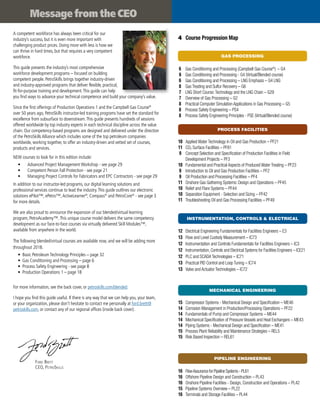
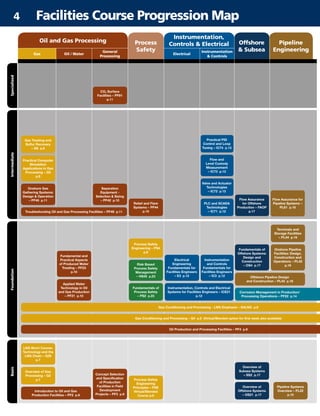
4	 Course Progression Map
6	 Gas Conditioning and Processing (Campbell Gas Course®
) – G4
6	 Gas Conditioning and Processing - G4 (Virtual/Blended course)
6	 Gas Conditioning and Processing – LNG Emphasis – G4 LNG
8	 Gas Treating and Sulfur Recovery – G6
7	 LNG Short Course:Technology and the LNG Chain – G29
7	 Overview of Gas Processing – G2
8	 Practical Computer Simulation Applications in Gas Processing – G5
8	 Process Safety Engineering – PS4
8	 Process Safety Engineering Principles - PSE (Virtual/Blended course)
GAS PROCESSING
10	 Applied Water Technology in Oil and Gas Production – PF21
11	CO2 Surface Facilities – PF81
9	 Concept Selection and Specification of Production Facilities in Field
	 Development Projects – PF3
10	 Fundamental and Practical Aspects of Produced Water Treating – PF23
9	 Introduction to Oil and Gas Production Facilities – PF2
9	 Oil Production and Processing Facilities – PF4
11	 Onshore Gas Gathering Systems: Design and Operations – PF45
10	 Relief and Flare Systems – PF44
10	 Separation Equipment - Selection and Sizing – PF42
11	 Troubleshooting Oil and Gas Processing Facilities – PF49
PROCESS FACILITIES
15	 Compressor Systems - Mechanical Design and Specification – ME46
14	 Corrosion Management in Production/Processing Operations – PF22
14	 Fundamentals of Pump and Compressor Systems – ME44
14	 Mechanical Specification of Pressure Vessels and Heat Exchangers – ME43
14	 Piping Systems - Mechanical Design and Specification – ME41
15	 Process Plant Reliability and Maintenance Strategies – REL5
15	 Risk Based Inspection – REL61
MECHANICAL ENGINEERING
12	 Electrical Engineering Fundamentals for Facilities Engineers – E3
13	 Flow and Level Custody Measurement – IC73
12	 Instrumentation and Controls Fundamentals for Facilities Engineers – IC3
12	 Instrumentation, Controls and Electrical Systems for Facilities Engineers – ICE21
12	 PLC and SCADA Technologies – IC71
13	 Practical PID Control and Loop Tuning – IC74
13	 Valve and Actuator Technologies – IC72
INSTRUMENTATION, CONTROLS  ELECTRICAL
PIPELINE ENGINEERING
A competent workforce has always been critical for our
industry’s success, but it is even more important with
challenging product prices. Doing more with less is how we
can thrive in hard times, but that requires a very competent
workforce.
This guide presents the industry’s most comprehensive
workforce development programs – focused on building
competent people. PetroSkills brings together industry-driven
and industry-approved programs that deliver flexible, practical,
fit-for-purpose training and development.This guide can help
you find ways to advance your technical competence and build your company’s value.
Since the first offerings of Production Operations 1 and the Campbell Gas Course®
over 50 years ago, PetroSkills instructor-led training programs have set the standard for
excellence from subsurface to downstream.This guide presents hundreds of sessions
offered worldwide by top industry experts in each technical discipline across the value
chain. Our competency-based programs are designed and delivered under the direction
of the PetroSkills Alliance which includes some of the top petroleum companies
worldwide, working together, to offer an industry-driven and vetted set of courses,
products and services.
NEW courses to look for in this edition include:
•	 Advanced Project Management Workshop - see page 29
•	 Competent Person Fall Protection - see page 21
•	 Managing Project Controls for Fabricators and EPC Contractors - see page 29
In addition to our instructor-led programs, our digital learning solutions and
professional services continue to lead the industry.This guide outlines our electronic
solutions ePilot™, ePetro™,ActiveLearner®
, Compass®
and PetroCore®
- see page 3
for more details.
We are also proud to announce the expansion of our blended/virtual learning
program, PetroAcademy™.This unique course model delivers the same competency
development as our face-to-face courses via virtually delivered Skill Modules™,
available from anywhere in the world.
The following blended/virtual courses are available now, and we will be adding more
throughout 2018.
• Basic Petroleum Technology Principles – page 32
• Gas Conditioning and Processing – page 6
• Process Safety Engineering - see page 8
• Production Operations 1 – page 18
For more information, see the back cover, or petroskills.com/blended.
I hope you find this guide useful. If there is any way that we can help you, your team,
or your organization, please don’t hesitate to contact me personally at ford.brett@
petroskills.com, or contact any of our regional offices (inside back cover).
	 	 Ford Brett
	 	 CEO, PetroSkills
Any course is available inhouse at your location. Contact us today. +1.918.828.2500 | petroskills.com | +1.800.821.5933 (toll free North America)
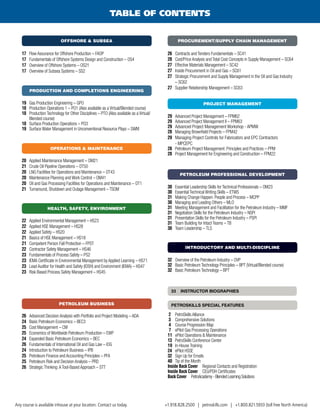
26	 Contracts and Tenders Fundamentals – SC41
28	 Cost/Price Analysis and Total Cost Concepts in Supply Management – SC64
27	 Effective Materials Management – SC42
27	 Inside Procurement in Oil and Gas – SC61
27	Strategic Procurement and Supply Management in the Oil and Gas Industry
– SC62
27	 Supplier Relationship Management – SC63
2	 PetroSkills Alliance
3 	 Comprehensive Solutions
4	 Course Progression Map
7	 ePilot Gas Processing Operations
11	 ePilot Operations  Maintenance
13	 PetroSkills Conference Center
19	 In-House Training
24	 ePilot HSSE
32	 Sign Up for Emails
40	 Tip of the Month
Inside Back Cover Regional Contacts and Registration
Inside Back Cover CEU/PDH Certificates
Back Cover PetroAcademy - Blended Learning Solutions
29	 Advanced Project Management – FPM62
29	 Advanced Project Management II – FPM63
29	 Advanced Project Management Workshop - APMW
28	 Managing Brownfield Projects – FPM42
29 	 Managing Project Controls for Fabricators and EPC Contractors
	 - MPCEPC
28	 Petroleum Project Management: Principles and Practices – PPM
28	Project Management for Engineering and Construction – FPM22
32	 Overview of the Petroleum Industry – OVP
32	 Basic Petroleum Technology Principles – BPT (Virtual/Blended course)
32	 Basic Petroleum Technology – BPT
17	 Flow Assurance for Offshore Production – FAOP
17	 Fundamentals of Offshore Systems Design and Construction – OS4
17	 Overview of Offshore Systems – OS21
17	 Overview of Subsea Systems – SS2
OFFSHORE  SUBSEA
19	 Gas Production Engineering – GPO
18	 Production Operations 1 – PO1 (Also available as a Virtual/Blended course)
18	 Production Technology for Other Disciplines – PTO (Also available as a Virtual/
	 Blended course)
18	Surface Production Operations – PO3
19	 Surface Water Management in Unconventional Resource Plays – SWM
PRODUCTION AND COMPLETIONS ENGINEERING
20	 Applied Maintenance Management – OM21
21	 Crude Oil Pipeline Operations – OT50
20	 LNG Facilities for Operations and Maintenance – OT43
20	 Maintenance Planning and Work Control – OM41
20	 Oil and Gas Processing Facilities for Operations and Maintenance – OT1
21	 Turnaround, Shutdown and Outage Management – TSOM
OPERATIONS  MAINTENANCE
22	 Applied Environmental Management – HS23
22	 Applied HSE Management – HS28
22	 Applied Safety – HS20
21	 Basics of HSE Management – HS18
21	 Competent Person Fall Protection – FPST
22	 Contractor Safety Management – HS46
23	 Fundamentals of Process Safety – PS2
23	 IEMA Certificate in Environmental Management by Applied Learning – HS71
23	 Lead Auditor for Health and Safety (IOSH) and Environment (IEMA) – HS47
23	 Risk Based Process Safety Management – HS45
HEALTH, SAFETY, ENVIRONMENT
26	 Advanced Decision Analysis with Portfolio and Project Modeling – ADA
24	 Basic Petroleum Economics – BEC3
25	 Cost Management – CM
25	 Economics of Worldwide Petroleum Production – EWP
24	 Expanded Basic Petroleum Economics – BEC
26	 Fundamentals of International Oil and Gas Law – IOG
24	 Introduction to Petroleum Business – IPB
25	 Petroleum Finance and Accounting Principles – PFA
25	 Petroleum Risk and Decision Analysis – PRD
26	 Strategic Thinking:A Tool-Based Approach – STT
PETROLEUM BUSINESS
PROCUREMENT/SUPPLY CHAIN MANAGEMENT
PROJECT MANAGEMENT
30	 Essential Leadership Skills for Technical Professionals – OM23
30	 Essential Technical Writing Skills – ETWS
31	 Making Change Happen: People and Process – MCPP
30	 Managing and Leading Others – MLO
31	 Meeting Management and Facilitation for the Petroleum Industry – MMF
31	 Negotiation Skills for the Petroleum Industry – NSPI
31	 Presentation Skills for the Petroleum Industry – PSPI
31	 Team Building for Intact Teams – TB
30	 Team Leadership – TLS
PETROLEUM PROFESSIONAL DEVELOPMENT
INTRODUCTORY AND MULTI-DISCIPLINE
33 INSTRUCTOR BIOGRAPHIES
PETROSKILLS SPECIAL FEATURES
TABLE OF CONTENTS
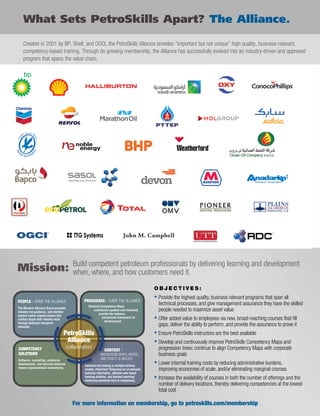
Mission: Build competent petroleum professionals by delivering learning and development 	
when, where, and how customers need it.
PEOPLE - DRIVE THE ALLIANCE
The Member Advisory Board provides
industry-led guidance, and member
subject matter experts ensure that
content aligns with industry need
through technical discipline
networks.
COMPETENCY
SOLUTIONS
Software, consulting, workforce
development, and tailored solutions
ensure organizational competency.
PROCESSES - GUIDE THE ALLIANCE
Detailed Competency Maps,
continually updated and reviewed,
provide the industry-
benchmark framework for
development.
CONTENT -
KNOWLEDGE WHEN, WHERE,
AND HOW IT IS NEEDED
PetroSkills
Alliance
(collaboration)
O B J E C T I V E S :
• Provide the highest quality, business relevant programs that span all
technical processes, and give management assurance they have the skilled
people needed to maximize asset value
• Offer added value to employees via new, broad-reaching courses that fill
gaps, deliver the ability to perform, and provide the assurance to prove it
• Ensure PetroSkills instructors are the best available
• Develop and continuously improve PetroSkills Competency Maps and
progression trees; continue to align Competency Maps with corporate
business goals
• Lower internal training costs by reducing administrative burdens,
improving economies of scale, and/or eliminating marginal courses
• Increase the availability of courses in both the number of offerings and the
number of delivery locations, thereby delivering competencies at the lowest
total cost
Instructor-led training in multiple delivery
models, PetroCore®
Reference for on-demand
technical information, effective web-based
learning modules, and blended coaching/
mentoring accelerate time to competency.
What Sets PetroSkills Apart? The Alliance.
Created in 2001 by BP, Shell, and OGCI, the PetroSkills Alliance provides “important but not unique” high quality, business-relevant,
competency-based training. Through its growing membership, the Alliance has successfully evolved into an industry-driven and approved
program that spans the value chain.
®
For more information on membership, go to petroskills.com/membership
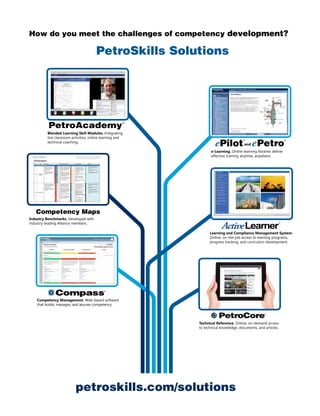
PetroAcademy
TM
petroskills.com/solutions
PetroCore
Learning and Compliance Management System.
Online, on-the-job access to learning programs,
progress tracking, and curriculum development.
Technical Reference. Online, on-demand access
to technical knowledge, documents, and articles.
Industry Benchmarks. Developed with
industry-leading Alliance members.
Competency Management. Web-based software
that builds, manages, and assures competency.
Blended Learning Skill Modules. Integrating
live classroom activities, online learning and
technical coaching.
PetroSkills Solutions
How do you meet the challenges of competency development?
e-Learning. Online learning libraries deliver
effective training anytime, anywhere.
Competency Maps
Pilotand
Compass
Process
Safety
Gas Oil / Water
General
Processing
Oil and Gas Processing
Electrical
Instrumentation
 Controls
Instrumentation,
Controls  Electrical Offshore
 Subsea
Pipeline
Engineering
FoundationBasicIntermediateSpecialized
Introduction to Oil and Gas
Production Facilities – PF2 p.9
Concept Selection
and Specification
of Production
Facilities in Field
Development
Projects – PF3 p.9
LNG Short Course:
Technology and the
LNG Chain – G29
p.7
Overview of Gas
Processing – G2
p.7
CO2 Surface
Facilities – PF81
p.11
Troubleshooting Oil and Gas Processing Facilities – PF49 p.11
Separation
Equipment -
Selection  Sizing
– PF42 p.10
Relief and Flare
Systems – PF44
p.10
Onshore Gas
Gathering Systems:
Design  Operation
– PF45 p.11
Practical Computer
Simulation
Applications in Gas
Processing – G5
p.8
Gas Treating and
Sulfur Recovery
– G6 p.8
Risk Based
Process Safety
Management
– HS45 p.23
Fundamentals of
Process Safety
– PS2 p.23
Applied Water
Technology in Oil
and Gas Production
– PF21 p.10
Fundamental and
Practical Aspects
of Produced Water
Treating – PF23
p.10
Practical PID
Control and Loop
Tuning – IC74 p.13
Flow and
Level Custody
Measurement
– IC73 p.13
Valve and Actuator
Technologies
– IC72 p.13
PLC and SCADA
Technologies
– IC71 p.12
Instrumentation
and Controls
Fundamentals for
Facilities Engineers
– IC3 p.12
Electrical
Engineering
Fundamentals for
Facilities Engineers
– E3 p.12
Instrumentation, Controls and Electrical
Systems for Facilities Engineers – ICE21
p.12
Overview of
Offshore Systems
– OS21 p.17
Overview of
Subsea Systems
– SS2 p.17
Pipeline Systems
Overview – PL22
p.15
Flow Assurance
for Offshore
Production – FAOP
p.17
Offshore Pipeline Design
and Construction – PL43 p.16
Onshore Pipeline
Facilities: Design,
Construction and
Operations – PL42
p.16
Terminals and
Storage Facilities
– PL44 p.16
Fundamentals of
Offshore Systems:
Design and
Construction
– OS4 p.17
Process Safety
Engineering
Principles – PSE
Virtual/Blended
Course p.8
Oil Production and Processing Facilities – PF4 p.9
Gas Conditioning and Processing – G4 p.6 (Virtual/Blended option for first week also available)
Gas Conditioning and Processing - LNG Emphasis – G4LNG p.6
Corrosion Management in Production/
Processing Operations – PF22 p.14
Process Safety
Engineering – PS4
p.8
Flow Assurance for
Pipeline Systems –
PL61 p.16
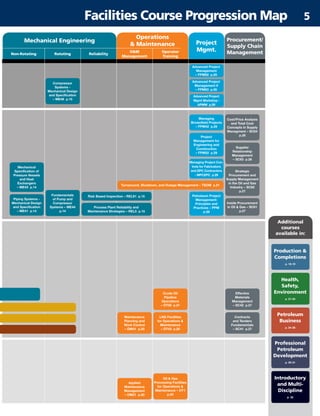
4 Facilities Course Progression Map
Project
Mgmt.
Procurement/
Supply Chain
ManagementNon-Rotating Rotating Reliability
Mechanical Engineering
OM
Management
Operator
Training
Operations
 Maintenance
Production 
Completions
p. 18-19
Health,
Safety,
Environment
p. 21-24
Petroleum
Business
p. 24-26
Professional
Petroleum
Development
p. 30-31
Introductory
and Multi-
Discipline
p. 32
Additional
courses
available in:
Compressor
Systems -
Mechanical Design
and Specification
– ME46 p.15
Fundamentals
of Pump and
Compressor
Systems – ME44
p.14
Mechanical
Specification of
Pressure Vessels
and Heat
Exchangers
– ME43 p.14
Piping Systems -
Mechanical Design
and Specification
– ME41 p.14
Oil  Gas
Processing Facilities
for Operations 
Maintenance – OT1
p.20
LNG Facilities
for Operations 
Maintenance
– OT43 p.20
Applied
Maintenance
Management
– OM21 p.20
Maintenance
Planning and
Work Control
– OM41 p.20
Contracts
and Tenders
Fundamentals
– SC41 p.27
Effective
Materials
Management
– SC42 p.27
Inside Procurement
in Oil  Gas – SC61
p.27
Strategic
Procurement and
Supply Management
in the Oil and Gas
Industry – SC62
p.27
Supplier
Relationship
Management
– SC63 p.28
Cost/Price Analysis
and Total Cost
Concepts in Supply
Managment – SC64
p.28
Petroleum Project
Management:
Principles and
Practices – PPM
p.28
Project
Management for
Engineering and
Construction
– FPM22 p.29
Managing
Brownfield Projects
– FPM42 p.29
Advanced Project
Management
– FPM62 p.29
Advanced Project
Management II
– FPM63 p.29
Process Plant Reliability and
Maintenance Strategies – REL5 p.15
Risk Based Inspection – REL61 p.15
Turnaround, Shutdown, and Outage Management – TSOM p.21
Crude Oil
Pipeline
Operations
– OT50 p.21
Advanced Project
Mgmt Workshop -
APMW p.29
Managing Project Con-
trols for Fabricators
and EPC Contractors
- MPCEPC p.29
Facilities Course Progression Map 5
This is the LNG-industry version of our popular
G4 course, with expanded coverage of
refrigeration and LNG technologies. The course
includes in-depth information on basic LNG gas
conditioning and processing. In addition,
instructors will explain the LNG supply chain that
consists of four main links - natural gas
exploration and production, liquefaction,
shipping, receiving, and distribution. The course
covers relevant details of both the mixed
refrigerant (APCI) and cascade (ConocoPhillips)
processes in LNG liquefaction. New liquefaction
processes are addressed, such as mixed fluid
cascade and dual nitrogen refrigeration cycles.
Versions of this course have been taught in many
of the world’s base-load and peak-shaving LNG
plants, such as Australia, Indonesia, Malaysia,
Norway, Qatar, UK, and West Indies.
DESIGNED FOR
Personnel involved with natural gas processing
and LNG production, as well as anyone
interested in a solid technical understanding of
the principles of an LNG plant.
YOU WILL LEARN
•	The basics of LNG gas conditioning and
processing
•	Selection and evaluation processes used
to dehydrate natural gas, remove heavy
components and other contaminants, and
extract NGLs for LNG plants
•	Physical/thermodynamic property correlations
and principles, including heating values, etc.
as applied to gas processing facilities and
LNG plants
•	Fundamentals of propane, propane-precooled,
mixed refrigerants, and cascade systems used
in LNG plants
•	Key points in other LNG liquefaction
technologies
•	How to perform and review equipment sizing
for major process equipment
•	Solutions to operating problems and control
issues in LNG and gas processing facilities
COURSE CONTENT
Basic gas technology principles • Terminology
and nomenclature • Physical properties of
hydrocarbons • Qualitative phase behavior •
Vapor-liquid equilibrium • Water-hydrocarbon
system behavior, hydrates, etc. •
Thermodynamics of LNG processes •
Separation equipment • Gas treatment, CO2, and
H2S removal • Dehydration of natural gas (TEG
and Molecular Sieve) • Heat transfer and
exchangers • Pumps and compressors •
Refrigeration systems • LNG liquefaction
technologies • Fractionation • Other facilities
topics relevant to LNG • Course summary and
overview
Gas Conditioning and
Processing – LNG
Emphasis – G4 LNG
FOUNDATION	10-DAY
2018 Schedule and Tuition (USD)
HOUSTON, US	 14-25 MAY 	 $8760
PERTH,AUSTRALIA	 9-20 APR 	 $9800+GST
GAS PROCESSING6
The Campbell Gas Course®
is now available as a
blended program. The first half of the material will be
delivered virtually through PetroAcademy self-paced
e-Learning. The second half will be delivered in the
classroom during the five day face-to-face portion of
the course. Participants must complete the e-Learning
portion of the course before the classroom session
begins.
The G4 blended course provides both core and foun-
dation competencies in the areas of gas conditioning
and processing. It provides a review of both onshore
and offshore operations, and takes a systems approach
to walk through engineering fundamentals and gas
processing unit and equipment operations. Both
hands-on methods and computer-aided analysis are
applied to examine sensitivities of technical decisions.
The approaches used are applicable to both new
designs, and to troubleshooting current facilities
operations.
How does the course schedule work?
13 Online Skill Modules +
1 Week Instructor-Led Classroom Training =
Complete G4 course
After registration, participants will be given access to
the e-Learning course content, approximately 52 total
hours of self-paced activity organized in 13 modules:
•	Hydrocarbon Components and Physical Properties
•	Introduction to Production and Gas Processing Facilities
•	Qualitative Phase Behavior and Vapor Liquid Equilibrium
•	Water/Hydrocarbon Phase Behavior
•	Thermodynamics and Application of Energy Balances
•	Fluid Flow
•	Relief and Flare Systems
•	Separation
•	Heat Transfer Equipment Overview
•	Pumps and Compressors Overview
•	Refrigeration, NGL Extraction and Fractionation
•	Contaminant Removal - Gas Dehydration
•	Contaminant Removal - Acid Gas and Mercury Removal
In the classroom, participants will cover:
•	Vapor Liquid Equilibrium
•	Hydrate Inhibition
•	Multiphase Flow
•	Hydrate Inhibitor
•	Separation
•	Heat Transfer
•	Fluid Flow
•	Refrigeration
•	Fractionation
•	Pumps and Compression
•	Dehydration
•	NGL Extraction
•	Contaminant Removal and Protection
PetroAcademy
TM
The Campbell Gas Course®
has been the standard of the industry for more than 47 years.
Over 36,600 engineers have attended our G4 program, considered by many to be the most
practical and comprehensive course in the oil and gas industry.
The Campbell Gas Course®
textbooks, Volumes 1 and 2, are routinely updated to reflect
evolving technologies in this broad industry.
Both hand-methods and computer-aided analysis are used to examine sensitivities of
technical decisions. To enhance the learning process, about 30 problems will be assigned,
reviewed, and discussed throughout the course. Problems will be solved individually and in
teams.
DESIGNED FOR
Production and processing personnel involved with natural gas and associated liquids, to
acquaint or reacquaint themselves with gas conditioning and processing unit operations.
This course is for facilities engineers, process engineers, senior operations personnel, field
supervisors, and engineers who select, design, install, evaluate, or operate gas processing
plants and related facilities. A broad approach is taken with the topics.
YOU WILL LEARN HOW TO
•	Application of gas engineering and technology in facilities and gas plants
•	Important specifications for gas, NGL, and condensate
•	About the selection and evaluation of processes used to dehydrate natural gas, meet
hydrocarbon dewpoint specifications, and extract NGLs
•	How to apply physical/thermodynamic property correlations and principles to the
operation, design, and evaluation of gas processing facilities
•	Practical equipment sizing methods for major process equipment
•	To evaluate technical validity of discussions related to gas processing
•	To recognize and develop solutions for operating problem examples and control issues in
gas processing facilities
COURSE CONTENT
•	Gas processing systems
•	Physical properties of hydrocarbons
•	Terminology and nomenclature
•	Qualitative phase behavior
•	Vapor-liquid equilibrium
•	Water-hydrocarbon phase behavior, hydrates, etc.
•	Basic thermodynamics and application of energy balances
•	Process control and instrumentation
•	Relief and flare systems
•	Fluid hydraulics; two-phase flow
•	Separation equipment
•	Heat transfer equipment
•	Pumps
•	Compressors and drivers
•	Refrigeration in gas conditioning and NGL extraction facilities
•	Fractionation
•	Glycol dehydration; TEG
•	Adsorption dehydration and hydrocarbon removal
•	Gas treating and sulfur recovery
Gas Conditioning and Processing – G4
The Campbell Gas Course®
FOUNDATION	10-Day
2018 Schedule and Tuition (USD)
ABERDEEN, UK 12-23 MAR 	 $9620+VAT
	 3-14 SEP 	 $9620+VAT
BRISBANE,AUSTRALIA	 3-14 DEC 	 $9800+GST
DENVER, US	 4-15 JUN 	 $8770
DUBAI, UAE	 4-15 NOV 	 $9620
HOUSTON, US	 2-13 APR 	 $8760
	 9-20 JUL 	 $8760
	 3-14 DEC 	 $8760
KUALA LUMPUR, MYS	 6-17 AUG 	 $9720
	 10-21 DEC 	 $9720
LONDON, UK	 12-23 FEB 	 $9620+VAT
	 18-29 JUN 	 $9620+VAT
	 1-12 OCT 	 $9620+VAT
PERTH,AUSTRALIA	 23 JUL-3 AUG 	 $9800+GST
	 22 OCT-2 NOV 	 $9800+GST
STAVANGER, NORWAY	 26 NOV-7 DEC 	 $9620
Gas Conditioning
and Processing
– G4 - Blended Delivery
2018 Schedule and Tuition (USD)
HOUSTON, US	 14-18 MAY 	 $8220
KUALA LUMPUR	 2-6 JUL 	 $9200
LONDON	 23-27 APR 	 $8950
PITTSBURGH	 24-28 SEP 	 $8200
THE HAGUE
NETHERLANDS	 20-24 AUG 	 $8950
FOR MORE INFORMATION,VISIT
PETROSKILLS.COM/G4BLENDED
Any course is available inhouse at your location. Contact us today. +1.918.828.2500 | petroskills.com | +1.800.821.5933 (toll free North America)
PetroSkills e-Learning
Eliminate travel expenses and
accelerate learning!
Designed for the Global Oil and Gas Industry
Pre-tests and Post-tests
Customization for Site Specifics
Gap Identification and Remediation
AICC/SCORM Compliant
Pilot
Online Learning for
Gas Processing Operations
This e-learning library provides the
fundamentals and in-depth coverage
of all topics related to gas processing
to help develop a highly qualified
workforce to maintain operating
efficiency and a safe working facility.
Topics include:
• Introduction to Gas Processing
for Operations
• Hydrocarbon Phase Behavior and
Vapor-Liquid Equilibrium
• Gas Processing Thermodynamics
• Turboexpander
• Fractionation in Gas Processing
• Solid Bed Adsorption and TEG
Dehydration
• Amine Sweetening Process
• Gas Processing Hazards
www.petroskills.com/elearning
GAS PROCESSING 7
G2 is a versatile overview of the gas conditioning
and processing industry. This course is designed
for a broad audience and is participative and
interactive, utilizing basic technical exercises and
terminology to communicate key learning points.
This course does not cover the technology and
engineering principles in depth, and is only
recommended for those needing an overview of
the industry and common processes and
equipment used.
DESIGNED FOR
As a wide ranging overview, it is suitable for
interested parties, such as geologists, reservoir
engineers, line managers, and sales or business
development staff; related specialists like
environmental staff, operational staff, and shift
foremen; those new to the industry, such as
entry-level (1-2 year) engineers; or anyone
interested in a general, technically-oriented
overview of the gas processing industry.
YOU WILL LEARN
•	An overview of natural gas and world energy
trends
•	Natural gas sources, makeup, properties,
specifications, and related oil and gas
terminology
•	Markets and uses for NGL, LPG, ethane,
propane, and butane
•	Summary of gas processing costs, and
commercial and contract issues in liquids
extraction
•	How gas is transported and sold
•	Overview of the common equipment used
in the oil and gas industry, including heat
exchangers, pumps, and compressors
•	Options for various basic gas conditioning
and processing steps, including acid gas
removal, dehydration, liquid extraction,
product fractionation, LNG overview,
pipelines, sulfur recovery, and acid gas
injection
COURSE CONTENT
Natural gas and world energy trends •
Hydrocarbon components and physical
properties • The role of gas processing in the
natural gas value chain • Heat transfer
equipment • Pumps and compressors • Acid
gas removal • Gas dehydration • NGL
extraction • Fractionation and stabilization •
LNG • Pipelines and storage • Sulfur recovery
and acid gas injection
Overview of Gas
Processing – G2
BASIC	3-DAY
2018 Schedule and Tuition (USD)
HOUSTON, US	 21-23 AUG 	 $3105
KUALA LUMPUR, MYS	 23-25 APR 	 $4020
LONDON, UK	 26-28 MAR 	 $3595+VAT
This LNG Short Course is designed for
participants requiring moderate technical
coverage, coupled with information on LNG
commerce and all parts of the LNG Value Chain.
Over 5-days, the course covers technical LNG
basics and facility operation topics, plus
technical, design, and commercial issues.
Selected exercises and syndicates are used to
reinforce the main topics of LNG trade and
technology. In-house versions are available with
either increased technical and operational
emphasis or increased project and development
emphasis. More in-depth coverage for technical,
production, and processing personnel is
available in our 10-day course, G4 LNG, Gas
Conditioning and Processing - LNG emphasis.
DESIGNED FOR
Commercial and managerial staff looking for a
concise overview; engineers new to the LNG
industry; operations supervision staff and senior
plant personnel; specialists looking to broaden
their general knowledge of LNG; and staff
involved in LNG commerce and interested in
LNG technical fundamentals.
YOU WILL LEARN
•	What is LNG, why it is produced, and what is
the current status of the industry
•	LNG facilities world-wide
•	The LNG chain and impact of contractual
issues on LNG plant design and operation;
LNG pricing
•	A survey of commercial and contractual issues
•	Project costs, feasibility, development, and issues
•	Some technical fundamentals of gas
processing, such as molecular weight, heating
value, Wobbe Index, vapor pressure, multi-
component mixtures, thermodynamics
•	Refrigeration: single and multi-component
refrigeration cycles
•	Technologies used in the production of LNG
for base-load and small scale production,
issues relating to technology selection, and
operation
•	Equipment used in the production of LNG:
heat exchangers, compressors and drivers
used for LNG, pumps, and turbo expanders
•	To apply knowledge of LNG gas pretreatment,
drying, and refrigeration
•	About LNG storage, shipping, and terminals,
sizing basis, and small scale tanks
•	Types of LNG carriers, marine management
issues, and LNG transfer
•	LNG importing, regasification of LNG and
distribution to consumers, basis for sizing,
technology selection, and energy integration
•	New developments: development of off-
shore LNG operations to regasification and
liquefaction; coal seam gas project issues
•	Site selection and HSSE considerations
COURSE CONTENT
What LNG is and where it comes from •
Physical properties of LNG • Vapor-liquid
equilibrium behavior of LNG and refrigerants •
Gas pre-treatment • Heat exchangers •
Refrigeration • Rotating machinery •
Liquefaction processes • LNG storage • LNG
shipping • LNG importing
LNG Short Course:
Technology and the
LNG Chain – G29
BASIC	5-DAY
2018 Schedule and Tuition (USD)
HOUSTON, US	 27-31 AUG 	 $4140
KUALA LUMPUR, MYS	 29 OCT-2 NOV 	 $5360
LONDON, UK	 23-27 APR 	 $4790+VAT
PERTH,AUSTRALIA	 13-17 AUG 	 $5500+GST
This full 5-day course covers sweet gas
processing and NGL extraction, using a
commercial simulator to perform calculations. A
basic working knowledge of the commercial
process simulation package used (generally
UNISIM) is suggested to achieve the course
learning objectives. Volumes 1 and 2 of the John
M. Campbell textbooks, Gas Conditioning and
Processing, are the basis for the material
presented, coupled with a ‘red thread’
comprehensive exercise based on a typical gas
processing facility (can be applied to onshore or
offshore facilities). The exercise is developed in
stages as the material is covered. Participants
will develop a comprehensive process
simulation that includes a dew point control
process, a mechanical refrigeration process with
economizers, hydrate inhibition using MEG, and
NGL liquid product stabilization with recycle.
NOTE: The individual exercises include
condensed gas processing fundamentals drawn
from the internationally famous Campbell Gas
Books Vols. 1  2.
DESIGNED FOR
Engineers that require practical in-depth training
on natural gas processing and NGL recovery
processes, with emphasis on the use and
benefits of a simulation package.
YOU WILL LEARN
•	To determine the water content and hydrate
formation conditions for gas streams using
both a commercial process simulator and
hand calculation methods
•	Techniques to inhibit hydrate formation,
including injection of equilibrium inhibitors
such as methanol and MEG
•	Preliminary design and evaluation of TEG
dehydration processes using quick hand
calculations
•	Process design used to control the
hydrocarbon dew point of sales gas streams
by removing NGLs using mechanical
refrigeration processes
•	Various techniques to optimize mechanical
refrigeration systems
•	How to use the process simulator to evaluate
the impact that pressure and temperature
changes have on the sizing of process
equipment and levels of NGL recovery
•	How to use short-cut distillation calculations
to provide input to rigorous distillation
simulations in order to obtain faster
convergence
•	Which thermodynamic property correlations
are appropriate for various gas processing
systems
•	Limitations associated with commercial
simulation packages and how the results can
be quickly checked for relative accuracy
COURSE CONTENT
Physical properties of hydrocarbons •
Qualitative phase behavior • Vapor-liquid
equilibrium • Water-hydrocarbon equilibrium •
Basic thermodynamic concepts • Separation
equipment • Heat transfer • Pumps •
Compressors • Refrigeration • Fractionation/
distillation • Glycol dehydration • Adsorption
dehydration
Practical Computer
Simulation Applications
in Gas Processing – G5
INTERMEDIATE	5-DAY
2018 Schedule and Tuition (USD)
DUBAI, UAE	 28 OCT-1 NOV 	 $5490
HOUSTON, US	 7-11 MAY 	 $4700
*plus computer charge
This course emphasizes process selection,
practical operating issues, technical
fundamentals, and integration of the sweetening
facilities into the overall scheme of gas
processing. Sulfur recovery and tail gas
processes are also covered, including standard
Claus configurations, SuperClaus, EuroClaus,
SCOT, etc. Special design and operation topics,
such as trace sulfur compound handling and the
importance of H2S:CO2 ratio, are covered as well.
Related topics reviewed during the course
include liquid product treating, corrosion,
materials selection, and NACE requirements.
DESIGNED FOR
Production and processing personnel involved
with natural gas treating and sulfur recovery,
requiring an understanding of the principles of
these process operations. This course is for
facilities engineers, process engineers,
operations personnel, and field supervisors, as
well as others who select, design, install,
evaluate, or operate gas sweetening and sulfur
recovery facilities.
YOU WILL LEARN
•	Evaluation and selection of processes to
remove acid gases (H2S, CO2, COS, CS2,
mercaptans, etc.) from gas and NGLs
•	The advantages and disadvantages of available
gas treating technology and processes
•	How to estimate solvent circulation rates,
energy requirements, and equipment sizes
•	To recognize and evaluate solutions to
common operating and technical problems
•	Sulfur recovery technologies, including an
overview of the Claus Sulfur process
•	How to select among the proper sulfur
recovery process given differing process
conditions
•	Tail gas cleanup
COURSE CONTENT
Fundamentals of sour gas processing,
sweetening, etc. • Overview of gas treating and
sulfur recovery, terminology • Gas specifications
and process selection criteria • Generic and
specialty amine treating • Common operating
and technical problems • Proprietary amine
solvents, such as Sulfinol and Flexsorb •
Carbonate processes • Physical absorption
processes, e.g. Selexol • Metallurgical issues
(corrosion) • Other technologies and new
developments • Selective treating, acid gas
enrichment • Solid bed and non-regenerable
treating; scavengers • Liquid product treating •
Sulfur recovery processes • Tail gas clean-up
(SCOT-type, CBA, and others) • Acid gas
injection • Membranes • Emerging and new
technologies • Course workshop and summary
Gas Treating and Sulfur
Recovery – G6
INTERMEDIATE	5-DAY
2018 Schedule and Tuition (USD)
HOUSTON, US	 15-19 OCT 	 $4460
LONDON, UK	 1-5 OCT 	 $5150+VAT
GAS PROCESSING8
This course provides an overview of process
safety engineering fundamentals for hydrocarbon
processing facilities, with emphasis on the
upstream oil and gas sector. The focus of this
course is on the engineering/design aspects of
Process Safety Management. Frequent reference
will be made to historical incidents and recurring
problem areas. Techniques for analyzing and
mitigating process safety hazards applicable to
oil and gas processing will also be reviewed.
Integration of the concepts covered to achieve a
measured approach to Process Safety
Engineering is a key aim of this course as well.
Exercises and group projects will be utilized to
emphasize the key learning points.
DESIGNED FOR
Facilities, process, and design engineers, as well
as new safety/loss prevention engineers who
require an overview of Process Safety
Engineering.
YOU WILL LEARN
•	Types of equipment and process systems
that have historically been problematic in the
Upstream and Midstream oil and gas industry
•	Basics of risk analysis
•	Thinking in terms of Inherently Safer Design
•	Most common process hazard analysis
methods and where they are used
•	Layers of Protection concept - what the
different layers are and how they are applied
•	Detection and mitigation methods for different
types of hazards
COURSE CONTENT
Historical incidents and problem areas • Risk
analysis basics • Process hazards analysis
techniques - overview • Layers of protection •
Inherently safer design • Hazards associated
with process fluids • Leakage and dispersion of
hydrocarbon releases • Combustion behavior of
hydrocarbons • Sources of ignition • Hazards
associated with specific plant systems • Plant
layout and equipment spacing • Pressure relief
and disposal systems • Corrosion and materials
selection • Process monitoring and control •
Safety instrumented systems • Fire protection
principles • Explosion protection
Process Safety
Engineering – PS4
FOUNDATION	5-DAY
2018 Schedule and Tuition (USD)
BRISBANE,AUSTRALIA	 6-10 AUG	 $6350+GST
DUBAI, UAE	 16-20 DEC	 $5490
HOUSTON, US	 10-14 SEP	 $4350
KUALA LUMPUR, MYS	 26-30 MAR	 $5780
LONDON, UK	 16-20 APR	 $5060+VAT
	 10-14 DEC	 $5060+VAT
PERTH,AUSTRALIA	 19-23 MAR	 $6350+GST
8-12 OCT $6350+GST
BLENDED LEARNING
Process Safety
Engineering
Principles – PSE
BASIC	 40 HOURS
PetroAcademy
TM
This course will be delivered virtually through
PetroAcademy providing participants with the
knowledge they need at their convenience.
This Process Safety Engineering Principles
Blended Program provides an overview of
process safety engineering fundamentals for
hydrocarbon processing facilities. The focus of
this course is on the engineering/design
aspects of Process Safety Management.
Frequent reference is made to historical
incidents and recurring problem areas.
Techniques for analyzing and mitigating
process safety hazards applicable to oil and gas
processing will also be reviewed. This program
integrates the concepts covered to achieve a
measured approach to Process Safety
Engineering.
DESIGNED FOR
Anyone who has to deal with concepts of
process safety engineering, including facilities
engineers, process engineers, design
engineers, new safety/loss engineers, project
engineers, operations supervisors,
maintenance supervisors, and representatives
from insurance companies or regulatory
agencies.
YOU WILL LEARN
•	How to analyze and assess different types of
risk analyses
•	How to utilize models that are associated
with risk management
•	The importance of building safety into
processes
•	How Inherently Safer Design can be applied
•	and more...
COURSE CONTENT
Process Safety Risk Analysis and Inherently
Safer Design • Process Hazards Analysis and
Layers of Protection analysis techniques •
Leakage and dispersion of hydrocarbons •
Combustion behavior of hydrocarbons •
Sources of ignition and hazardous area
classification • Specific plant systems and
equipment • Relief and flare systems •
Historical incident databases, plant layout and
equipment spacing • Fire protection systems
• SIS, monitoring and control
FOR MORE INFORMATION,VISIT
PETROSKILLS.COM/PROCESS-SAFETY-BLENDED
2018 Schedule and Tuition (USD)
AVAILABLE ON-DEMAND 	 $4130
Any course is available inhouse at your location. Contact us today. +1.918.828.2500 | petroskills.com | +1.800.821.5933 (toll free North America)
The scope of the discussion ranges from an
overview of the oil and gas industry,
hydrocarbon phase behavior characteristics, and
different reservoir types, to product
specifications and the processes used to meet
these. Other facilities considerations are
addressed, such as process safety and
downstream processing that may impact the
production facility selection and operation.
DESIGNED FOR
Those interested in an overview of production
facilities, including subsurface professionals,
line managers, sales or business development
staff, environmental personnel, operational staff,
and those new to the industry.
YOU WILL LEARN
•	How the reservoir type, drive mechanism,
fluid properties, location, and product
specifications influence the selection and
design of the production facilities
•	How to do quick ‘back of the envelope’
calculations to better understand equipment
sizing and capacity
•	Parameters that affect the design and
specification of oil stabilization and
dehydration equipment
•	Awareness of the parameters that determine
flowline/gathering system capacity
•	The purpose of separators in a production
facility and familiarity with the typical
configurations
•	Typical design parameters, operating
envelopes, common operating problems of
oil and gas production equipment, and the
effect of changing feed conditions over the
life of a field
•	To describe oil dehydration/desalting process
options and equipment
•	Produced water treating options and the
dependence on surface vs. subsurface,
offshore vs. onshore disposal
•	Compressor performance characteristics and
how they affect production rates and facility
throughput
•	Gas dehydration process options, with a
particular emphasis on glycol dehydration
•	The principles of asset integrity and inherently
safe design given the rate, composition,
temperature, and pressure of the production
stream
•	About midstream facilities required
downstream of the primary production facility
to deliver saleable products to the market, and
how these facilities are affected by production
rates, composition, and production facility
performance
COURSE CONTENT
Overview of oil and gas industry • Qualitative
phase behavior and reservoirs • Hydrocarbon
properties and terminology • Typical sales/
disposal specifications • Flowlines, piping and
gathering systems • Production separation •
Oil processing • Water injection systems
(including pumps) • Gas handling -
compression, dehydration • Measurement and
storage • Other facilities considerations -
utilities, process safety • Midstream facilities
- gas processing, pipelines, LNG
Introduction to Oil
and Gas Production
Facilities – PF2
BASIC	3-DAY
2018 Schedule and Tuition (USD)
HOUSTON, US	 1-3 OCT 	 $3105
This course is similar to Introduction to Oil and
Gas Production Facilities (PF-2), but is
presented in the context of concept selection and
front-end field development planning.
DESIGNED FOR
This course is intended for those working on
field development teams, as well as those who
need to better understand how surface facilities
are selected and how subsurface characteristics
affect facility design and specification.
YOU WILL LEARN
•	How to develop the project framework and
decision making strategy
•	How the specification of production/
processing facilities is influenced by reservoir
type, drive mechanism, fluid properties,
location, and contractual obligations
•	Operating conditions that affect the
specification of the production facilities from
the wellhead through initial separation
•	Parameters that affect the design and
specification of oil stabilization and
dehydration equipment
•	The design and specification of produced
water systems appropriate for the rate and
composition of the produced water to meet
the required environmental regulations and/or
injection well capacity
•	The design and specification of gas handling
facilities, including compression dehydration
and sweetening
•	The impact of artificial lift systems and
secondary/tertiary production projects on
facilities selection and design
•	The principles of asset integrity and inherently
safe design given the rate, composition,
temperature, and pressure of the production
stream
•	About midstream facilities required
downstream of the primary production facility
to deliver saleable products to the market, and
how these facilities are affected by production
rates, composition, and production facility
performance
COURSE CONTENT
Reservoir types, fluid properties, and typical
product specifications • Flowlines, gathering
systems, flow assurance, and production
separation • Oil dehydration and stabilization •
Produced water treating and water injection
systems • Gas handling, including
compression, dehydration, and sweetening •
The effect of artificial lift systems, and secondary
and tertiary recovery projects • Midstream
facilities - gas processing, pipelines, product
storage, and LNG • Other facility considerations
- utility systems, process safety and asset
integrity, and environmental regulations
Concept Selection and
Specification of Production
Facilities in Field
Development Projects – PF3
BASIC	5-DAY
2018 Schedule and Tuition (USD)
HOUSTON, US	 23-27 APR 	 $4140
PROCESS FACILITIES 9
The emphasis of this course is on oil production facilities - from the wellhead, to the
delivery of a specification crude oil product, to the refinery. Both onshore and offshore
facilities are discussed. Produced water treating and water injection systems are also
covered. Solution gas handling processes and equipment will be discussed at a
relatively high level. In addition to the engineering aspects of oil production facilities,
practical operating problems will also be covered, including emulsion treatment, sand
handling, dealing with wax and asphaltenes, etc. Exercises requiring calculations are
utilized throughout the course. The course intended to complement the G-4 Gas
Conditioning and Processing course, focused on the gas handling side of the upstream
oil and gas facilities area.
DESIGNED FOR
Process/facilities engineers and senior operating personnel involved with the design and
operation of oil and produced water processing facilities.
YOU WILL LEARN
•	Well inflow performance and its impact on production/processing facilities
•	About oil, gas, and water compositions and properties needed for equipment selection
and sizing
•	How to select and evaluate processes and equipment used to meet sales or disposal
specifications
•	To apply physical and thermodynamic property correlations and principles to the
design and evaluation of oil production and processing facilities
•	How to perform equipment sizing calculations for major production facility separation
equipment
•	To evaluate processing configurations for different applications
•	How to recognize and develop solutions to operating problems in oil/water
processing facilities
COURSE CONTENT
•	Reservoir traps, rocks, and drive mechanisms
•	Phase envelopes and reservoir fluid classification
•	Well inflow performance
•	Artificial lift
•	Gas, oil, and water - composition and properties
•	Oil gathering systems
•	Gas-liquid separation
•	Emulsions
•	Oil-water separation
•	Oil treating
•	Desalting
•	Oil stabilization and sweetening
•	Oil storage and vapor recovery
•	Sand, wax, asphaltenes, and scale
•	Transportation of crude oil
•	Produced water treatment
•	Water injection systems
•	Solution gas handling
Oil Production and Processing
Facilities – PF4
FOUNDATION	10-DAY
2018 Schedule and Tuition (USD)
BAKERSFIELD, US	 2-13 APR 2	 $8670
DENVER, US	 18-29 JUN 	 $8770
DUBAI, UAE	 9-20 DEC 	 $9340
HOUSTON, US	 12-23 FEB 	 $8760
	 26 NOV-7 DEC 	 $8760
KUALA LUMPUR, MYS	 16-27 JUL 	 $9550
LONDON, UK	 5-16 NOV 	 $8760+VAT
+1.918.828.2500 | petroskills.com | +1.800.821.5933 (toll free North America) Any course is available inhouse at your location. Contact us today.
PROCESS FACILITIES10
This course covers the different types of
separation equipment typically encountered in
oil and gas production facilities. Fractionation
equipment and produced water treating
equipment are not covered in this course. You
will learn where the different types of separation
equipment are used based on operating
conditions and separation performance
requirements. Frequent references will be made
to real production facility process flow diagrams
(PFDs). Typical operational problems and their
solutions will also be discussed. Exercises
requiring calculations are utilized throughout the
course as well.
Please be aware that due to overlap in content, it
is not necessary to take the PF-42 course if you
have already taken the PF-4 Oil Production and
Processing Facilities course.
DESIGNED FOR
Process/Facilities engineers who need skills for
design and troubleshooting of separators.
YOU WILL LEARN
•	Different types of separation equipment
utilized in the oil and gas industry and where
they are used
•	Separation performance capabilities of the
different types of equipment
•	How to size the different types of separation
equipment
•	How to troubleshoot and debottleneck
separation equipment
•	How to calculate the wall thickness and
estimate the weight of separators
•	Instrumentation and controls used on
separation equipment
COURSE CONTENT
Fluid properties and phase behavior • Phase
separation processes • Gas-liquid separation
equipment: slug catchers, conventional
separators (horizontal and vertical), scrubbers,
compact separators, filter separators/coalescing
filters • Separator internals: inlet devices, mist
extractors, baffles, weirs, etc. • Emulsions •
Oil-water separation equipment: conventional
3-phase separators and freewater knockouts,
wash tanks • Oil treating and desalting
equipment: mainly electrostatic coalescers •
Liquid-liquid coalescing filters • Mechanical
design aspects: pressure vessel codes, wall
thickness and vessel weight estimation, material
selection, relief requirements • Operational
problems
Separation Equipment -
Selection and Sizing
– PF42
INTERMEDIATE	5-DAY
2018 Schedule and Tuition (USD)
HOUSTON, US	 8-12 OCT 	 $4340
This intensive course provides a comprehensive
overview of relief and flare systems for oil and
gas processing facilities. The course begins with
the need for pressure control/overpressure
protection, continues with the key engineering
and design aspects including code
considerations, and concludes with selecting
and defining the components of a relief and flare
system. The material of the course is applicable
to onshore field production facilities, pipelines,
gas plants, terminals, and offshore production
facilities.
DESIGNED FOR
Engineers and senior operating personnel
responsible for designing, operating, and
maintaining relief and flare systems in oil and
gas facilities.
YOU WILL LEARN
•	Purposes of relief and flare systems and their
importance in safe operations
•	Causes of overpressure and the ways to
control/mitigate
•	Defining the possible relief scenarios
•	Commonly used pressure relieving devices,
selection and sizing
•	Determining set/relieving pressures to meet
operational, safety, and code requirements
•	Operational considerations of maintenance,
testing, certification, and disposal of fluids
•	Designing and operating relief and
flare header systems considering fluid
characteristics, service conditions, volumes,
gas dispersion, and radiation
•	Selection and sizing other key components of
a relief/flare system
COURSE CONTENT
Overview of typical relief and flare systems and
key components • Codes and standards as well
as good practices typical in oil and gas facilities
• Safety implications and causes of
overpressure • Overpressure protection
philosophy including source isolation and relief
• Determination of relief requirements and
defining set point pressures • Types,
applications, and sizing of common relief
devices • Blow-down/depressurizing - purpose
and design/operational considerations • Design
and specification considerations for relief valves
and header systems, including fluid
characteristics, services conditions, material
selection, and header sizing • Environmental
considerations • Radiation calculations and the
impact of flare tip design • Selection and sizing
of key components: knockout and seal drums,
vent/flare stack, vent/flare tips, and flare ignition
systems • Defining need and quantity of purge
gas • Flare gas recovery, smokeless flaring, and
purge gas conservation • Operational and
troubleshooting tips
Relief and Flare
Systems – PF44
INTERMEDIATE	5-DAY
2018 Schedule and Tuition (USD)
HOUSTON, US	 24-28 SEP 	 $4340
KUALA LUMPUR, MYS	 12-16 NOV 	 $5560
LONDON	 10-14 SEP 	 $4990+VAT
PERTH,AUSTRALIA	 6-10 AUG 	 $5700+GST
This course covers topics related to Produced
Water Treatment in upstream oil and gas
operations. Produced water composition and
physical properties are covered. Water quality
requirements for various disposal methods are
addressed, including onshore surface discharge,
offshore discharge to sea, and reinjection for
disposal or waterflood. Regulatory requirements
and analytical methods used to monitor and
ensure regulatory compliance are discussed.
Treatment technology is presented along with
practical considerations for selecting and
operating typical water treatment equipment.
Representative process flow diagrams illustrate
equipment selection, design features, layout, and
processes. Chemical treatment options are also
considered.
DESIGNED FOR
Managers, engineers, chemists, and senior
operations personnel responsible for designing,
operating, and maintaining facilities that process
and manage produced water. This course will
provide participants with an understanding of the
technical aspects required to select, design,
maintain, and troubleshoot produced water
equipment.
YOU WILL LEARN
•	How produced water compositions affect water
treatment system design and performance
•	How to interpret produced water analytical
data and calculate common Scale Indices
•	How emulsions form and contribute to water
treatment challenges
•	How Total Suspended Solids (TSS) affects
water quality and what to do about it
•	What water quality is required for surface or
overboard disposal, for injection disposal, or
for beneficial use
•	The regulatory requirements for offshore water
disposal and what is in an NPDES Permit
•	What analytical methods actually measure and
how to select an appropriate method
•	How separators, clarifier tanks, CPIs,
hydrocyclones, flotation cells, and bed
filtration work and how to improve their
performance
•	The most common causes of water treating
problems and how to diagnose and resolve
them
•	Typical PFDs used to illustrate operational
issues
COURSE CONTENT
Introduction to water treatment technology and
issues • Produced water chemistry and
characterization • Defining and characterizing
emulsions that impact water quality and
treatment • Water quality requirements for
injection or surface disposal, NPDES permits,
analytical methods • Primary water treatment
technologies - separators, hydrocyclones, and
CPIs • Secondary water treatment - induced gas
flotation • Tertiary water treatment technologies
- media and membrane filtration • Chemicals
and chemical treatment • Diagnostic testing and
in-field observations • Diagnosing and
resolving water treatment issues based on actual
field experiences
Fundamental and
Practical Aspects
of Produced Water
Treating – PF23
FOUNDATION	5-DAY
2018 Schedule and Tuition (USD)
HOUSTON, US	 21-25 MAY 	 $4240
This course provides an overview of the main
water handling systems typically encountered in
upstream (EP) production operations, both
onshore and offshore. The chemistry of the main
water-related problems of mineral scales,
corrosion, bacteria, and oily water will be
reviewed both from the theoretical and practical
aspects. Produced water treatment equipment
and typical water quality specifications will also
be reviewed, as well as water injection and
disposal systems. An exercise will be given to
identify typical system problems and to apply the
knowledge you gained to propose solutions.
Emphasis will be placed on understanding and
resolving operational problems in process
equipment.
DESIGNED FOR
Managers, engineers, chemists, and operators
needing to understand water-related problems in
oil and gas production and their solutions.
YOU WILL LEARN
•	The basics of oilfield water chemistry
•	How to monitor and control corrosion, scale,
and bacterial growth in produced water and
water injection/disposal systems
•	How to implement system surveillance
programs to detect potential problems before
system damage occurs
•	Produced (oily) water treatment options and
related treatment equipment
•	How to use the knowledge gained to identify
typical system problems and be able to
propose solutions
COURSE CONTENT
Water chemistry fundamentals • Water sampling
and analysis • Water formed scales • Corrosion
control • Water treatment microbiology •
Produced water discharge/disposal and
treatment principles • Produced water treating
equipment - theory of operation, advantages and
disadvantages, and the importance of oil droplet
size • Water injection and disposal systems -
theory of operation, corrosion, scale, and
biological control • Case study
Applied Water
Technology in Oil and
Gas Production – PF21
FOUNDATION	5-DAY
2018 Schedule and Tuition (USD)
HOUSTON, US	 20-24 AUG 	 $4240
LONDON, UK	 5-9 MAR 	 $4890+VAT
Any course is available inhouse at your location. Contact us today. +1.918.828.2500 | petroskills.com | +1.800.821.5933 (toll free North America)
Gain knowledge
when and where
you need it
Designed for the Global
Oil and Gas Industry
Pre- and Post-Testing
Customization for Site
Specifics
Gap Identification and
Remediation
AICC/SCORM Compliant
Pilot
Online Learning for
Operations  Maintenance
ePilot™ is more than 1,300
hours of technical skills and
safety training used at more
than 500 sites worldwide.
Topics include:
Core Competency
Electrical
Gas Processing
Health, Environmental,
Safety,  Security
Instrumentation
Mechanical Maintenance
Pipeline Fundamentals
Process Operations
Production Operations
Refinery Operations
Refinery Process Units
Rotating  Reciprocating
Equipment
Stationary Equipment
Turnaround Planning
For more information, visit:
petroskills.com/elearning
PROCESS FACILITIES 11
This course deals with the design, operation, and
optimization of onshore gas gathering systems
and their associated field facilities, from the
wellhead to the central gas processing facility.
From a design perspective, the main variables
that impact the flexibility and operational
characteristics of an onshore gas gathering
system will be discussed. Typical operating
problems are covered including hydrates,
multiphase flow issues, corrosion, declining well
deliverability, etc. Exercises will be utilized
throughout the course to emphasize the key
learning points.
DESIGNED FOR
Production and facilities department engineers/
senior operating personnel responsible for the
design, operation and optimization of onshore
gas gathering systems and their associated field
facilities.
YOU WILL LEARN
•	The impact of gathering system pressure on
gas well deliverability
•	The impact of produced fluids composition on
gathering system design and operation
•	How to evaluate field facility and gathering
system configurations for different
applications
•	To recognize and develop solutions to
operating problems with existing gas
gathering systems
COURSE CONTENT
Gas well inflow performance and deliverability •
Overview of gas well deliquification methods for
low-rate, low pressure gas wells • Effect of
gathering system/abandonment pressure on
reserves recovery • Impact of produced fluids
composition • Sweet/sour • CO2 content •
Rich/lean • Produced water • Hydrates and
hydrate prevention • Dehydration • Heating •
Chemical inhibition • Multiphase flow basics •
Corrosion/materials selection • Gathering
system layout • Wellsite/field facilities options
• Provisions for future compression
Onshore Gas Gathering
Systems: Design and
Operations – PF45
INTERMEDIATE	5-DAY
2018 Schedule and Tuition (USD)
DUBAI, UAE	 21-25 OCT 	 $5440
HOUSTON, US	 10-14 SEP 	 $4340
PITTSBURGH, US	 14-18 MAY	 $4340
This course will cover how to establish and apply
a general troubleshooting methodology as well
as how to conduct process/equipment specific
troubleshooting. Definitions of good/normal
performance will be discussed for each process/
equipment type covered. Data gathering,
validation and utilization procedures will be
discussed. Criteria to use when evaluating
possible problem solutions will also be covered.
Real-world exercises will be utilized throughout
the class to reinforce the learning objectives.
Both onshore and offshore facilities will be
discussed. It is assumed that course participants
have a solid understanding of how typical oil and
gas production and processing facilities work,
including the commonly used processes and
equipment involved.
DESIGNED FOR
Process/Facilities engineers with 5-10 years of
experience, facilities engineering team leaders/
supervisors, and senior facilities operational
personnel.
YOU WILL LEARN
•	The difference between troubleshooting,
optimization, and debottlenecking
•	How to recognize trouble when it is occurring
•	How to develop a methodical approach to
troubleshooting
•	To recognize how different components of
a facility interact with each other, and the
significance of these interactions
•	How to gather, validate, and utilize the data
needed for troubleshooting
•	The criteria to be considered for identifying the
best solution when several feasible solutions
are available
•	Typical causes of problems, and their
solutions, for the main types of processes and
equipment used in the upstream-midstream
oil and gas industry
COURSE CONTENT
Troubleshooting methodology fundamentals and
data reconciliation • Gas - Liquid separators •
Reciprocating compressors • Amine gas
sweetening • Glycol dehydration units •
3-phase separators • Centrifugal pumps • Oil
treating • Produced water treating systems •
Shell and tube heat exchangers • Centrifugal
compressors • Molecular sieve dehydration
units • NGL recovery processes
Troubleshooting Oil
and Gas Processing
Facilities – PF49
INTERMEDIATE	5-DAY
2018 Schedule and Tuition (USD)
DALLAS, US	 27-31 AUG 	 $4290
HOUSTON, US	 2-6 APR 	 $4340
KUALA LUMPUR, MYS	 15-19 OCT 	 $5560
LONDON, UK	 13-17 AUG 	 $4990+VAT
This course emphasizes the effect of carbon
dioxide on the selection and operation of
equipment (separators, compressors, and
dehydrators), as well as sweetening process
equipment. This program, first introduced in
1985, assists those working with carbon dioxide
or high carbon dioxide content natural gas. This
course is particularly applicable to those persons
who operate and/or design enhanced oil
recovery (EOR) facilities using CO2 as a miscible
agent. Physical and thermodynamic property
data for carbon dioxide/natural gas mixtures are
discussed. Calculations are performed to
illustrate principles and techniques. Midland is a
four-day session including a CO2 plant tour on
Thursday, contingent on plant availability.
DESIGNED FOR
Engineers and senior operating personnel
involved with carbon dioxide/natural gas/CO2
EOR systems.
YOU WILL LEARN
•	What to expect over the life of a CO2 EOR
system
•	Impact of CO2 on the design and operation of
oil production equipment
•	Physical and thermodynamic properties
of pure CO2, and the impact of CO2 in
hydrocarbon mixtures
•	Dehydrate high CO2-content gases
•	Best practices to deal with Dense Phase
pipelines, metering, flaring etc.
•	How to pump and compress CO2
•	Using purification processes: membranes,
Ryan-Holmes, amines, hot carbonate, etc.
COURSE CONTENT
Overview of CO2 injection and process facilities
• Heavy emphasis on CO2 for enhanced oil
recovery • Physical and thermodynamic
properties of CO2 and high CO2 mixtures •
Materials selection and design consideration in
CO2 systems • Process vessel specification •
Pumps and compressors • Fluid flow and
special pipeline design considerations such as
the control of ductile fractures • Dehydration of
CO2 and CO2-rich gases • General overview of
processes to treat/recover CO2
CO2 Surface Facilities
– PF81
SPECIALIZED	4-DAY
2018 Schedule and Tuition (USD)
MIDLAND, US† 	 12-15 NOV 	 $4095
† includes field trip
FIELD TRIP
+1.918.828.2500 | petroskills.com | +1.800.821.5933 (toll free North America) Any course is available inhouse at your location. Contact us today.
12
This course applies fundamental instrumentation
and control engineering principles to oil and gas
facilities design and operation, and is designed
to accelerate the development of new Facilities
Instrumentation and Control Engineers. Through
the use of individual and group problem solving,
attendees will learn about field measurement
devices, final elements and actuators, pressure
relief and regulation, documentation,
programmable logic controllers, power supplies,
SCADA, DCS, SIS, hazardous areas, and
installation methods. This course is a more in-
depth version of the content of ICE-21 and ICE21
is not a prerequisite for taking this course.
DESIGNED FOR
Facilities and Project Engineers as well as newly
graduated Electrical, Controls and Instrument
Engineers (0-5 yrs.) with a need to improve basic
understanding of instrumentation and control
systems within oil and gas facilities.
YOU WILL LEARN
•	Operating principals and specification criteria
for field measurement devices including level,
pressure, temperature, and flow
•	Final elements and actuators including control
loops, control valves, shutdown valves,
actuators, and transducers
•	PID symbols and instrument tags, loop and
logic diagrams, pitfalls and best practices,
ISA symbology, and creation of instrument
and I/O lists
•	Signal types and wiring requirements for
analog/discrete inputs and outputs as well
as other signals such as thermocouple, RTD,
pulse, and digital communications
•	Typical control system functions, limitations,
and architectures for PLC and DCS systems
including programming methods such as
ladder logic and function block
•	Process control basics with an emphasis
on control loops, types, and configurations
for common oil and gas process equipment
such as separators, pumps, distillation
towers, filters, contactors, compressors, heat
exchangers, and fired heaters
•	Understanding of the PID algorithm, loop
tuning, and advanced process control
techniques such as feed forward, cascade,
selective, and ratio control
•	Supervisory Control and Data Acquisition
(SCADA) Systems to include telemetry, RTUs,
internet, and web based communications
•	Common networking systems including
Ethernet, Modbus, and Fieldbus
•	Risk mitigation, technologies, and architecture
of Safety Instrumented Systems (SIS)
•	The concepts, terminology, and application
of hazardous area classificaton standards,
equipment protection methods, and
installation requirements for NEC and IEC
projects
COURSE CONTENT
Fundamentals of control signals and wiring •
Control system basics • and more...
Instrumentation and
Controls Fundamentals
for Facilities Engineers
– IC3
FOUNDATION	5-DAY
2018 Schedule and Tuition (USD)
DENVER, US	 16-20 JUL 	 $4240
HOUSTON, US	 19-23 FEB 	 $4240
	 12-16 NOV 	 $4240
LONDON, UK	 10-14 SEP 	 $4890+VAT
TEXAS CITY, US	 21-25 MAY 	 $4240
This course applies fundamental electrical
engineering principles to oil and gas facilities.
The course is designed for Facilities Engineers
who interface with electrical systems, and
provides practical insight and development of
new Facilities Electrical Engineers. Through the
use of individual and group problem solving,
attendees will learn about power transformers,
motors, generators, one-line diagram
interpretation, protection and coordination of
electrical equipment, site and standby
generation, electrical safety, and hazardous areas
identification. Participants will gain a better
understanding of electrical power systems in oil
and gas facilities. This course is a more in-depth
version of the content of ICE21 and ICE21 is not
a prerequisite for taking this course.
DESIGNED FOR
Those facilities personnel who interface with
facility electrical power systems, including
project engineers, operation leads,
instrumentation, controls personnel, and
electrical engineers who are new to electrical
power systems within oil and gas facilities.
YOU WILL LEARN
•	Fundamental concepts of electricity including
voltage, current, resistance, power, inductance,
capacitance, and power factor
•	The key components of facilities electric
power distribution, which include circuit
arrangements, low and medium voltage
switchgear, and single-phase and three phase
schemes
•	Transformer operation, components, turns and
voltage ratios, losses, efficiency, rating, and
connections
•	The difference between direct current,
induction and synchronous current motors,
motor enclosures, and how to select, start,
protect, and control motors
•	The principles of protecting electrical
equipment, including time current curves,
fuses, circuit breakers, and coordination
•	The purposes and sizing criteria for backup
power, including generators and UPS power
systems
•	The considerations and sizing criteria for on-
site power generation, which includes standby,
prime, peak, and co-generation
•	What grounding and bonding systems are,
with an overview of ignition sources, shock
protection, separately derived systems, and
substation grounding
•	The concepts, terminology and application
of hazardous area classification standards,
equipment protection methods, and
installation requirements for NEC and IEC
projects
COURSE CONTENT
Fundamentals of insulation and conduction •
Direct current, alternating current • Transformers
power and instrument • Motors induction and
synchronous • Power distribution • System
protection and coordination • Standby power
systems • Power generation • Variable speed
drive principles • Grounding, bonding, and
electrical safety • Hazardous area identification
Electrical Engineering
Fundamentals for
Facilities Engineers – E3
FOUNDATION	5-DAY
2018 Schedule and Tuition (USD)
HOUSTON, US	 12-16 FEB 	 $4240
ORLANDO, US	 22-26 OCT 	 $4290
This foundation-level course provides an
introduction and overview of electrical systems,
instrumentation, process control, and control/
safety systems typically encountered in oil and
gas facilities. The focus is to understand
terminology, concepts, typical equipment
configurations, and common pitfalls in order to
improve communication with electrical and IC
professionals. This course covers similar content
to our E3 and IC3 courses, but at a more
conceptual level. This course is not a
prerequisite for taking E3 or IC3, but rather a
replacement for those that are not able to take
both E3 and IC3.
DESIGNED FOR
Process, chemical, and mechanical engineers,
(i.e. non-instrumentation and non-electrical
disciplines), as well as other technical and non-
technical professionals with little or no
background in ICE systems. Electrical and
Instrumentation Engineers should consider E3
and IC3 for more in-depth coverage.
YOU WILL LEARN
•	Fundamentals of electricity, such as voltage,
current, resistance, power factor, and single/
three phase power systems
•	Electrical specifications, such as voltage
selection, load lists, and power
•	How to read one-line diagrams and
understand the function of the components
of power distribution, including transformers,
switchgear, MCCs, VFDs, and power
distribution
•	The function and considerations of
infrastructure components, such as cable,
conduit, cable tray, and duct banks
•	Awareness of the concepts behind
classification of hazardous locations and
equipment specifications
•	Safety risks and mitigation strategies for
power systems, including short circuit and
overcurrent protection, ground faults, shock
hazards, and arc flash
•	Fundamentals of control systems, sensors,
controllers, and final elements
•	Key requirements for instrument specifications
such as accuracy, signal selection, process
conditions, material compatibility, installation
considerations, capabilities and limits, and
relative cost
•	Basics of specification of shutdown and
control valves
•	Control system functions, limitations, and
architectures, including PLC, DCS, SIS, RTU,
and SCADA; common networking systems,
including Ethernet, Modbus and Fieldbus
•	Exposure to the typical documentation
and drawings necessary for the design,
specification, installation, operation and
maintenance of electrical, instrumentation and
control systems
COURSE CONTENT
Fundamentals of electricity • Power distribution
and motor control systems for oil and gas
applications • Emergency power systems •
Hazardous area classification for oil and gas
applications • and more...
Instrumentation,
Controls and Electrical
Systems for Facilities
Engineers – ICE21
FOUNDATION	5-DAY
2018 Schedule and Tuition (USD)
HOUSTON, US	 24-28 SEP 	 $4240
3-7 DEC $4240
KUALA LUMPUR, MYS	 30 JUL-3 AUG 	 $5460
LONDON, UK	 2-6 JUL 	 $4890+VAT
This workshop provides engineers and
technicians with the basic theoretical and
practical understanding of PLC and SCADA
systems. It traces the evolution of the PLC as an
intelligent ‘black box’ replacement for the relay
panel and how, with the advent of modern
communications architectures, it may be
combined with Supervisory Control and Data
Acquisition (SCADA) systems to allow stand-
alone control systems to be configured.
Throughout the workshop, participants will learn
through active participation using exercises,
questionnaires, and practical PC-based
simulation (LogixPro), covering: basic ladder
logic programming; hardware diagnostics; and
implementation of various communication
strategies. Participants will also examine the
basic requirements of a safety PLC and the
various voting system architectures required to
meet different Safety Integrity Levels (SILs).
DESIGNED FOR
This workshop is specifically tailored for any
personnel who are responsible for designing,
selecting, sizing, specifying, installing, testing,
operating, and maintaining programmable logic
controllers (PLCs) and supervisory (SCADA)
systems. This could include facilities, process,
chemical, electrical, instrumentation,
maintenance, and mechanical engineers and
technicians.
YOU WILL LEARN HOW TO
•	Describe the fundamental principles of the
PLC
•	Identify the basic components
•	Write a ladder logic program
•	Explain the basics of advanced programming
according to IEC 61131-3
•	Compare different methods of analog
processing
•	Apply common-sense installation practices
•	Examine the different components of a SCADA
system
•	Describe the basic principles of serial
communications
•	Evaluate the requirements for PLC-to-SCADA
communications
•	Distinguish the specific requirements of the
PLC in safety-related applications
COURSE CONTENT
Introduction to control systems • SCADA versus
DCS • PLC environmental enclosures •
Processing and scanning • Digital processing •
Analog processing • Installation practices •
Interference or noise reduction • Cable spacing
and routing • Earthing and grounding • Binary
and hexadecimal numbering systems • The IEC
61131-3 standard • Ladder logic diagrams •
Functional block diagrams • Derived function
blocks • Structured text • Instruction lists •
Sequential function chart • SCADA basics •
SCADA set-up and simulation • System
architecture • Communication strategies •
Asynchronous transmission • Coding • The RS
232 standard • The RS 485 standard • Modbus
• Safety PLCs • Voting system architectures
PLC and SCADA
Technologies – IC71
INTERMEDIATE	5-DAY
2018 Schedule and Tuition (USD)
HOUSTON, US	 2-6 APR 	 $4340
INSTRUMENTATION, CONTROLS  ELECTRICAL
Any course is available inhouse at your location. Contact us today. +1.918.828.2500 | petroskills.com | +1.800.821.5933 (toll free North America)
PLANNING A
MEETING?
You plan the agenda
We’ll handle the rest
PETROSKILLS
CONFERENCE
CENTER
25403 KATY MILLS PARKWAY
KATY, TEXAS 77494
+1.832.426.1200
petroskills.com/pcc
Located in the Houston area, we are
available to host your next meeting, in
addition to the many PetroSkills training
sessions we hold here each year.
Conference Center Amenities:
• 10 classrooms
• 2 rooms with virtual accessibility
• Concierge and support staff
• State-of-the-art audio-visual
• High-speed wireless internet
• On-site technical support
• Break area and courtyard
• Complimentary parking
Conveniently located near:
• Quality hotels and accommodations
• Shopping, restaurants and entertainment
• Medical facilities
INSTRUMENTATION, CONTROLS  ELECTRICAL 13
This workshop provides a total in-depth insight
into valve and actuator technology, covering:
control valves, check valves, shut-off valves,
solenoid valves, and pressure relief valves. A
methodology is presented to ensure the optimum
selection of size, choice of body and trim
materials, components, and ancillaries. Whilst
studying both liquid and gas valve sizing,
delegates will also learn the correct procedures
for calculating the spring ‘wind-up’ or ‘bench set’.
Maintenance issues also include: testing for
dead-band/hysteresis, stick-slip, and non-
linearity; on-line diagnostics; and signature
analysis. Throughout the workshop, participants
will learn through active participation using
exercises, questionnaires, and practical sessions
covering: systems choice; basic sizing
calculations; computer-based sizing; and
maintenance diagnostics.
DESIGNED FOR
Facilities, chemical, electrical, instrumentation,
maintenance, and mechanical engineers and
technicians involved in designing, selecting,
sizing, specifying, installing, testing, operating
and maintaining shutoff, pressure relief, and
control valves.
YOU WILL LEARN HOW TO
•	Compare the major technologies used in the
final control element
•	Calculate the valve flow coefficient Cv
•	Perform flow and system pressure head loss
calculations
•	Contrast the different types of control, shut-
off, and check valves
•	Describe the principles of cavitation control
and noise reduction
•	Select optimum materials of construction to
avoid corrosion and erosion
•	Identify the correct requirements for trim
selection
•	Differentiate between inherent and installed
characteristics
•	Identify ANSI/DN pipe sizes and pressure
ratings
•	Explain the control valve seat leakage
classifications
•	Evaluate the optimum valve-actuator
combination
•	Apply on-line valve testing and diagnostics
for deadband and hysteresis, stick-slip, and
non-linearity
•	Examine the principles of preventive
maintenance through the application of
signature analysis
•	Perform a bench set and calculate actuator
spring wind-up
•	Pick the correct positioner using our set of
guidelines
COURSE CONTENT
Choked flow • Pressure recovery • Flashing
and cavitation • Seat leakage • Sizing for
liquids and gases • Valve construction •
Cavitation control and noise reduction • Valve
types • Valve trim and characterization • Valve
selection • Actuators and positioners • Valve
testing and diagnostics • Maintenance and
repair
Valve and Actuator
Technologies – IC72
INTERMEDIATE	5-DAY
2018 Schedule and Tuition (USD)
HOUSTON, US	 9-13 APR 	 $4340
This course is designed to acquaint users with
the problems and solutions for high accuracy
transfer of liquid and gas petroleum products
from supplier to customer. These needs have
been brought about by major changes in
manufacturing processes and because of several
dramatic circumstantial changes such as: the
increase in the cost of fuel and raw materials; the
need to minimize pollution; and the increasing
pressures being brought to bear to adhere to the
requirements for health and safety.
DESIGNED FOR
This workshop is specifically tailored for any
personnel who are, or will be, responsible for
designing, selecting, sizing, specifying,
installing, testing, operating, and maintaining
instrumentation related to the field of custody
level and flow transfer measurement. This could
include facilities, process, chemical, electrical,
instrumentation, maintenance, and mechanical
engineers and technicians.
YOU WILL LEARN HOW TO
•	Recall the basics of fluid mechanics
•	Identify the fundamental problems related to
uncertainty
•	Compare the different methods of measuring
flow in the oil and gas industries
•	Describe the various methods of level
measurement
•	Compare the different methods used to derive
strapping tables
•	Evaluate the different custody transfer
standards in use today
•	Contrast the methods used in flow calibration
•	Identify the different types of prover systems
•	Explain the methodology used in truck
custody transfer
•	Examine the challenges regarding pipelines
•	Describe the basics of leak detection
•	Analyze the methodology for monitoring and
controlling production losses
•	Evaluate and compare the problems and
solutions associated with the measurement of
NGL, LPG, and LNG
COURSE CONTENT
Fluid mechanics • Flowmeter classification •
Uncertainty analysis • Flow measurement •
Turbine • Positive displacement • Ultrasonic
flowmeters • Coriolis mass flowmeters • Level
measurement • Buoyancy tape systems •
Hydrostatic pressure • Ultrasonic measurement
• Radar measurement • Flow calibration •
Terminal custody transfer • Tank management
systems • Lease automatic custody transfer •
Truck and rail custody transfer • Pipeline
considerations • Fugitive emissions • Leak
detection • Real time transient model • Loss
control systems • Custody transfer sampling •
Monitoring and controlling production losses •
Physical leaks • Meter prover performance •
API standards • Measuring the suspended SW
content • Calculating net volume • Flowmeter
selection and costs • Initial considerations •
Meter selection • Properties and measurement
of NGL, LPG, and LNG
Flow and Level Custody
Measurement – IC73
INTERMEDIATE	5-DAY
2018 Schedule and Tuition (USD)
HOUSTON, US	 26-30 NOV 	 $4340
This workshop provides instrumentation,
automation, and process engineers and
technicians with the basic theoretical and
practical understanding of regulatory control
systems and how this can be applied to optimize
process control in terms of quality, safety,
flexibility, and costs. Centered on the ISA-
recommended PC-Control LAB simulator,
participants will learn through active participation
using exercises, questionnaires, and a series of
16 practical simulation sessions covering:
process reaction; tuning methods; diagnostic
tools; effect of different algorithms; surge tank
level control; analysis of such problems as valve
hysteresis, stiction and non-linearities and the
impact on controllability; and integral windup.
DESIGNED FOR
Instrumentation, automation, and process
engineers and technicians involved in specifying,
installing, testing, tuning, operating, and
maintaining regulatory PID control systems.
YOU WILL LEARN HOW TO
•	Describe such terms as process lag,
capacitance, and resistance
•	Explain the significance of the process
reaction curve
•	Identify the effects of filtering on loop
performance
•	Distinguish the effect of span on the system
performance
•	Analyze such problems as valve hysteresis,
stiction, and non-linearities
•	Evaluate the effects of proportional, integral,
and derivative control
•	Correctly apply both open and closed Loop
Tuning according to Ziegler-Nichols
•	Apply “as found” tuning
•	Estimate the effects on loop tuning using a
software-based loop analysis program
•	Describe both cascade and feedforward
control
•	Explain split range control
•	Identify and correct problems due to process
dead time
•	Discuss the top 20 mistakes made in the field
of process control
COURSE CONTENT
Basic process considerations • Process lag,
capacitance, and resistance • Process reaction
curve • 1st and 2nd order reactions •
Instrumentation cabling • Filtering • Aliasing •
Reaction masking • Sensor placement • Correct
PV • Effect of span • Inherent and installed
valve characteristics • Actuators • Valve
positioners • Testing procedures and analysis •
ON/OFF control • Proportional control •
Proportional offset • Reset • Integral action and
windup • Stability • Derivative action • PID
control • Control algorithms • Load
disturbances and offset • Speed, stability, and
robustness • Open loop reaction curve tuning
method (Ziegler-Nichols) • Default and typical
settings • Closed loop continuous cycling
tuning method (Ziegler-Nichols) • Fine tuning •
“As found” tuning • Surge tank level control •
Split/parallel range control • Cascade systems
• Feed-forward and combined systems • Ratio
control • System integration
Practical PID Control
and Loop Tuning – IC74
INTERMEDIATE	5-DAY
2018 Schedule and Tuition (USD)
HOUSTON, US	 3-7 DEC 	 $4340
*plus computer charge
+1.918.828.2500 | petroskills.com | +1.800.821.5933 (toll free North America) Any course is available inhouse at your location. Contact us today.
This is an intensive 5-day course providing a
comprehensive overview of pumps and
compressor systems. The focus is on equipment
selection; type, unit, and station configuration;
and integration of these units in the process
scheme and control strategy in upstream and
midstream oil and gas facilities. The material of
the course is applicable to field production
facilities, pipelines, gas plants, and offshore
systems.
DESIGNED FOR
Engineers, senior technicians, and system
operators designing, operating, and maintaining
pump and compressor systems in oil and gas
facilities.
YOU WILL LEARN
•	Selecting the appropriate integrated pump
and compressors units (drivers, pumps,
compressors, and auxiliary systems)
•	Integrating the pump or compressor units
with the upstream and downstream piping and
process equipment
•	Evaluating pump and compressor units and
their drivers in multiple train configurations,
parallel and series
•	Identifying the key local and remote control
elements of pumps and compressors as well
as their drivers
•	Defining the major life-cycle events, such
as changes in flows, fluid composition, and
operating conditions that can affect equipment
selection and operating strategies
•	Assessing the key pump hydraulics and
compressor thermodynamics, and their effect
on selection and operations
•	Identifying significant operating conditioning
monitoring parameters and troubleshooting
techniques
COURSE CONTENT
Types of pumps, compressors, and drivers, and
their common applications and range of
operations • Evaluation and selection of pumps
and compressors, and their drivers for long-term
efficient operations • Unit and station
configuration including multiple trains in series
and/or parallel operations • Integration with
upstream and downstream process equipment,
local and remote control systems, and facilities
utilities • Key auxiliary systems including
monitoring equipment, heat exchangers, lube
and seal systems, and fuel/power systems •
Major design, installation, operating,
troubleshooting, and maintenance
considerations
Fundamentals of
Pump and Compressor
Systems – ME44
INTERMEDIATE	5-DAY
2018 Schedule and Tuition (USD)
DENVER, US	 23-27 JUL 	 $4340
DUBAI, UAE	 11-15 NOV 	 $5440
HOUSTON, US	 5-9 MAR 	 $4340
KUALA LUMPUR, MYS	 10-14 DEC 	 $5560
LONDON, UK	 30 JUL-3 AUG 	 $4990+VAT
MIDLAND, US	 3-7 DEC 	 $4290
PITTSBURGH, US	 23-27 APR 	 $4340
TEXAS CITY, US	 1-5 OCT 	 $4340
This 5-day, intermediate level course for facility
engineers and project engineers reviews the key
areas associated with the mechanical design of
pressure vessels and heat exchangers for oil and
gas facilities. The course is focused on vessels,
heat exchangers built in accordance to ASME
VIII Div 1, considering material selection, key
design calculations, and manufacturing
processes. The course is not aimed at process
engineers sizing equipment (PF-42 covers these
elements), although a brief review of the sizing
correlations is included. The course is delivered
from the perspective of a vessel fabricator to
better understand the dos and don’ts of ideal
mechanical specification of pressurized
equipment by owner/operators, in order to
optimize material utilization and minimize
construction costs. The Houston session
features an afternoon field trip to a large pressure
vessel fabricator.
DESIGNED FOR
Mechanical, facilities, construction, or project
engineers and plant piping/vessel designers who
are involved in the specification and purchasing
of pressure vessels, heat exchangers, and other
pressure-containing equipment for oil and gas
facilities.
YOU WILL LEARN
•	About ASME BPV code and the commonly
used sections relevant to oil and gas
equipment
•	To specify correct and commonly used
materials according to ASME II
•	How to design vessel shells, heads, nozzles,
and heat exchanger details
•	How to provide accurate equipment
specification documents and review
documentation for code compliance
•	Key fabrication processes used in the
workshop and how to simplify construction
through correct vessel specification
•	About welding processes and inspection
requirements per ASME IX
COURSE CONTENT
Vessel codes and standards (ASME BPV Code,
TEMA, API) • Vessel material selection,
corrosion mechanisms, heat treatment, and
basic metallurgy • Essential design calculations
for vessels and heat exchangers • Welding
process overview and inspection requirements •
Constructability and operability considerations
• Vessel integrity, evaluation, and re-purposing
of pressure-containing equipment according to
API/ASME
Mechanical
Specification of
Pressure Vessels and
Heat Exchangers – ME43
INTERMEDIATE	5-DAY
2018 Schedule and Tuition (USD)
HOUSTON, US †	 27-31 AUG 	 $4515
† includes field trip
This 5-day, intermediate level course for
engineers and piping system designers reviews
the key areas associated with the design of
piping systems for oil and gas facilities. The
course is focused on four areas: codes and
standards, pipe materials and manufacture,
piping components, and piping layout and
design. Applicable piping codes for oil and gas
facilities (ISO, B31.3, B31.4, B31.8, etc.), pipe
sizing calculations, pipe installation, and
materials selection are an integral part of the
course. The emphasis is on proper material
selection and specification of piping systems.
DESIGNED FOR
This PetroSkills training course is ideal for
mechanical, facilities, plant, or pipeline
engineers and piping system designers who are
involved in the design of in-plant piping systems
for oil and gas facilities.
YOU WILL LEARN
•	To apply piping system codes and standards
•	About line sizing and layout of piping systems
in various types of facilities
•	How to specify proper components for
process and utility applications
•	To compare alternative materials of
construction
•	The process of steelmaking, pipe
manufacturing, and material specifications
•	Joining methods and inspection techniques
•	Key considerations for flare and vent systems,
including PSV sizing
COURSE CONTENT
Piping codes and standards (ANSI/ASME, API,
ISO) • Pipe materials and manufacturing •
Basic pipe stress analysis methods • Valves and
actuators • Welding and non-destructive testing
• Line sizing basics (single-phase and
multiphase flow) • Pipe and valve material
selection • Piping layout and design •
Manifolds, headers, and flare/vent systems •
Non-metallic piping systems • Operations and
maintenance considerations of facilities and
pipelines
Piping Systems -
Mechanical Design and
Specification – ME41
INTERMEDIATE	5-DAY
2018 Schedule and Tuition (USD)
BRISBANE,AUSTRALIA	 3-7 DEC 	 $5700+GST
DENVER, US	 16-20 JUL 	 $4340
DUBAI, UAE	 4-8 NOV 	 $5440
HOUSTON, US	 26 FEB-2 MAR 	 $4340
	 10-14 DEC 	 $4340
LONDON, UK	 23-27 JUL 	 $4990+VAT
MIDLAND, US	 20-24 AUG 	 $4290
FIELD TRIP
MECHANICAL ENGINEERING14
This course will cover the main causes of
corrosion in upstream oil and gas operations, as
well as monitoring and mitigation methods. The
various corrosion mechanisms give rise to a
number of different forms of corrosion damage,
which will all be considered. Participants will
estimate the corrosivity of a given environment
through analysis of the chemical and physical
characteristics of the system; review approaches
to selecting materials and coatings for corrosion
resistance for different conditions and
applications (including the use of NACE
MR0175/ISO 15156); and be introduced to
cathodic protection (CP) surveys, selecting the
CP system type, estimating current requirements,
and the design principles of simple cathodic
protection systems. The participant will learn
how to select and utilize corrosion inhibitors for
different systems, and how to select and apply
corrosion monitoring techniques to create an
integrated monitoring program. The course
content is based on a field facilities engineering
point of view, as opposed to a more narrowly-
specialized corrosion engineering or chemistry
viewpoint. It provides an appropriate balance of
necessary theory and practical applications to
solve/mitigate corrosion-related problems.
DESIGNED FOR
Managers, engineers, chemists, and operators
who need to understand corrosion and its control
management in oil and gas production and
processing.
YOU WILL LEARN
•	The basics of corrosion chemistry
•	The main corrosion mechanisms occurring in
oil and gas production/processing systems
•	The different types of damage caused by
corrosion
•	Materials selection for corrosion prevention
•	Some methods for conducting cathodic
protection (CP) surveys
•	Items to consider in corrosion inhibitor
selection
•	Key advantages and disadvantages of the
various corrosion monitoring methods
•	Where the main locations of corrosion
concern occur within oil production systems,
gas processing facilities (including amine
units), and water injection systems
COURSE CONTENT
Fundamentals of corrosion theory • Major
causes of corrosion (O2, CO2, H2S,
microbiologically influenced corrosion) • Forms
of corrosion damage • Materials selection •
Protective coatings and linings • Cathodic
protection • Corrosion inhibitors • Corrosion
monitoring and inspection • Corrosion in gas
processing facilities • Corrosion in water
injection systems • Corrosion management
strategy and life-cycle costs
Corrosion Management
in Production/
Processing Operations
– PF22
FOUNDATION	5-DAY
2018 Schedule and Tuition (USD)
HOUSTON, US	 9-13 APR 	 $4240
	 27-31 AUG 	 $4240
KUALA LUMPUR, MYS	 29 OCT-2 NOV 	 $5460
LONDON, UK	 12-16 MAR 	 $4890+VAT
MIDLAND, US	 6-10 AUG 	 $4190
THE HAGUE,
NETHERLANDS	 3-7 DEC 	 $4890
Any course is available inhouse at your location. Contact us today. +1.918.828.2500 | petroskills.com | +1.800.821.5933 (toll free North America)
MECHANICAL ENGINEERING 15
This 5-day, specialized level course is for facility
design engineers, operations engineers, and
technicians seeking an in-depth understanding
of centrifugal, reciprocating, and screw
compressors. This course provides basic
knowledge of compressor types and associated
auxiliary systems, mechanical design of
equipment, operating and performance
characteristics, control and monitoring systems,
maintenance practices, and codes and standards.
DESIGNED FOR
Mechanical, facilities, plant, or pipeline
engineers and technicians needing an in-depth
understanding of the different types of
compressors.
YOU WILL LEARN
•	How to apply thermodynamics to compressor
performance and operating characteristics
•	How to size, specify, and select compressors
•	Compressor auxiliary systems
•	Series and parallel application of compressors
•	How to integrate compressor systems into
process facilities used in the oil and gas
industry
•	How to use state-of-the-art monitor and
control devices in the operation, maintenance,
and troubleshooting of compression systems
•	How to apply maintenance practices to
improve compressor reliability
•	Shop and field performance testing
•	Compressor economics including OPEX vs.
CAPEX considerations
COURSE CONTENT
Types and application of compressors •
Selection criteria of dynamic and positive
displacement compressors • Compressor
thermodynamics and operating characteristics •
Performance curves and off-design evaluations
• Key compressor components and other
auxiliary systems • Equipment specifications •
Compressor controls and monitoring devices •
Driver and gear involvement • Installation,
operation, maintenance practices, and
troubleshooting • Economic considerations
Compressor Systems -
Mechanical Design and
Specification – ME46
SPECIALIZED	5-DAY
2018 Schedule and Tuition (USD)
HOUSTON, US	 10-14 SEP 	 $4440
This course is designed to teach reliability
engineering skills as they apply to improving
process system reliability and developing
maintenance strategies. You will use modern
software and analysis methods to perform
statistical analysis of failures and model system
performance, plus develop maintenance and
reengineering strategies to improve overall
performance.
DESIGNED FOR
Maintenance, engineering, and operations
personnel involved in improving reliability,
availability, condition monitoring, and
maintainability of process equipment and
systems. Participants should have foundation
skills in statistical analysis and reliability
techniques for equipment.
YOU WILL LEARN
•	Improving reliability in new facilities/systems
•	Reliability design for maintainability
•	Developing initial maintenance strategies
•	Virtual equipment walk-down; criticality using
simulation and modeling; developing baseline
condition monitoring programs; developing
lubrication programs; and developing
process-specific maintenance strategies with
reliability-centered maintenance (RCM)
•	Improving reliability in existing facilities/
systems
•	Analyzing process reliability plots to
determine the amount of opportunity
•	Continuous improvement through failure
reporting, analysis, and corrective action
systems (FRACAS)
•	Developing policies and procedures;
developing failure reporting codes; statistical
analysis of failures using Weibull; and
developing root cause analysis (RCA)
programs (triggers for RCA and analyzing
recommendations)
•	Developing maintenance strategies with
condition monitoring
•	Identifying applicable condition monitoring
methods; using criticality to determine level
of condition monitoring application; and
reporting asset health
•	Developing maintenance strategies with RCM
•	Developing policies and procedures;
identifying systems for analysis; analyzing
recommendations with simulation
and modeling; and implementing
recommendations
•	Monitoring results
•	Understanding the true purpose of key
performance indicators (KPIs)
•	Developing appropriate reliability and
maintainability KPIs
COURSE CONTENT
Criticality analysis • Availability simulation and
modeling • Statistical analysis of failures using
Weibull • Maintenance strategy development;
condition monitoring; reliability-centered
maintenance; and essential care • Process
reliability analysis • Root cause analysis •
Failure reporting, analysis, and corrective action
systems • Key performance indicators •
Reliability definitions
Process Plant
Reliability and
Maintenance Strategies
– REL5
INTERMEDIATE	5-DAY
2018 Schedule and Tuition (USD)
HOUSTON, US	 7-11 MAY 	 $4340
The risk-based approach requires a systematic
and integrated use of expertise from the different
disciplines that impact plant integrity. These
include design, materials selection, operating
parameters and scenarios, and understanding of
the current and future degradation mechanisms
and risks involved. Risk-based methodologies
enable the assessment of the likelihood and
potential consequences of equipment failures.
Risk-Based Inspection (RBI) provides companies
the opportunity to prioritize their equipment for
inspection; optimize inspection methods,
frequencies, and resources; and develop specific
equipment inspection plans. This results in
improved safety, lower failure risk, fewer forced
shutdowns, and reduced operational costs.
DESIGNED FOR
Inspection maintenance, production, and other
plant engineers and technicians responsible for
the safe on-going operation of pressure-
containing equipment in oil and gas facilities.
YOU WILL LEARN
•	To apply fundamental principles of risk
analysis, using practical application through
case histories and a step-by-step evaluation
process for each type of damage mechanism
•	To quantitatively determine probability
of failure of pressure equipment, analyze
consequences of failure, and develop an
appropriate inspection plan
•	About the fundamental principles of
component integrity, application of the API
rules, material properties of strength and
toughness, and the introduction to stress and
fracture mechanics
•	How to assess the integrity of equipment and
make projections about remaining useful life
•	Assessment of existing static equipment to
increase the equipment capacity and to extend
service life; API 579-1/ASME FFS-1
•	To apply and use API RP 580 and API RP
581 recommended practices; for pressurized
components (e.g. pressure vessels and
piping), these assessments can be used
to determine optimum inspection intervals
through the considered application of ASME
section V NDE techniques
COURSE CONTENT
RBI philosophy based on API RP 580 • Risk-
based decision making fundamentals and tools
• Technical integrity and mechanical properties
of pressure equipment • Understanding and
managing risk • Fires, vapor cloud explosions
(VCE), and boiling liquid expanding vapor
explosions (BLEVE) • API risk-based inspection
methodology • Damage mechanisms affecting
pressure equipment in the oil and gas industry •
Non-destructive examination techniques (NDE
and NDT) • API RP 581 Part 1, Part 2, and Part
3 • Fitness for service assessments using API
579-1/ASME FFS-1 • Inspection plan
development and implementation • RBI rollout
and management
Risk Based
Inspection – REL61
INTERMEDIATE	5-DAY
See website for dates and locations
This course that provides awareness level
training for engineers new to the hazardous
liquid and gas pipeline industry. The topics
include the technical and economic basis for
pipeline systems; the key facilities that connect
pipelines to the other elements of the
hydrocarbon value chain; regulatory and
environmental compliance issues; key
considerations for public and governmental
interaction; project development and
construction challenges; and the strategies for
safe and efficient pipeline system operations,
maintenance, and asset integrity. Case studies
are an integral part of this course.
DESIGNED FOR
Recent graduate engineers involved in mid-
stream activities of pipeline and terminal design,
construction, and operations. It also provides
effective grounding for upstream and
downstream managers, business development,
legal, human resources, finance, land
acquisition, and public relations professionals,
as well as independent investors interested in a
general technically oriented overview of pipeline
systems. For pipeline and terminal engineering,
and operations supervision and management
personnel with 1-3 years of direct experience
interested in taking the next step in advancing
their breadth of the knowledge, we refer you to
PL42, Onshore Pipelines and/or PL44, Terminal
Design, Construction and Operations.
YOU WILL LEARN
•	Pipeline history
•	Basic concepts of liquid and gas pipelines
economics
•	Pipeline design overview
•	Construction methods and challenges
•	Essential operations
•	Asset integrity management
•	Regulatory and code compliance requirements
COURSE CONTENT
The business model and value-added premise of
pipelines and their role in the overall energy
value chain • The advantages and limitation of
pipelines, and the scope and general structure of
the industry • The key components and facilities
that are integrated into pipeline systems • How
to recognize regulatory codes and industry
guidelines (API and others) that control the
permitting, design, construction, operations, and
maintenance of pipeline facilities • The steps
from concept to operating system to
abandonment - design, permitting, land
acquisition, construction, and startup - with each
tied to the key issues for project and operations
management • The strategic operational and
maintenance needs and options for pipeline
systems, including system monitoring and
control, leak detection, measurement and quality
control, asset integrity management, efficient and
safe operations, and emergency response
capability
Pipeline Systems
Overview – PL22
BASIC	5-DAY
See website for dates and locations
+1.918.828.2500 | petroskills.com | +1.800.821.5933 (toll free North America) Any course is available inhouse at your location. Contact us today.
PIPELINE ENGINEERING
This 5-day, foundation level course reviews key
issues associated with development, design,
construction, and operation of terminals and
storage facilities for liquid hydrocarbons and
NGLs. The course focuses on six areas: 1)
terminal codes and siting constraints, 2) terminal
design and equipment layout, 3) types of storage
and selection criteria, 4) design considerations
for loading racks, fire protection, vapor recovery,
blending equipment, and water treatment, 5)
detailed design of storage tanks, vessels, and
caverns, and 6) operations and maintenance.
Safety, quality control, system reliability,
availability, and regulatory compliance are
integrated throughout the course. Case studies
and team exercises are used to reinforce key
points.
DESIGNED FOR
Project managers, engineers, operations and
maintenance supervisors, and regulatory
compliance personnel with 1-3 years of
experience in planning, engineering,
constructing and/or operating terminals and
storage facilities for hydrocarbon liquids, NGLs,
and petrochemical feedstocks. This course is for
participants needing a foundation level
understanding of the planning, engineering,
construction, operations, and maintenance of
storage and terminals connected to pipelines,
rail, barges/tankers and/or truck loading
facilities.
YOU WILL LEARN
•	Storage and terminals basics for hydrocarbon
liquids, NGLs, and petrochemical feedstocks
•	Design and operation of atmospheric storage
tanks and pressurized bullets and spheres
•	Fundamentals of underground storage (salt
and rock caverns)
•	Safety, product quality, and reliability/
availability concerns
COURSE CONTENT
Sizing criteria and economics for storage and
terminal facilities • Various storage types
(atmospheric storage tanks, pressure vessels,
salt or rock caverns) and appropriate
applications • Terminal and tank farm layout
constraints • Details of industry codes and
standards, plus regulatory and environmental
compliance • Selection of equipment for
delivery and receipt to/from pipelines, barges
and ships, trucks, and rail, including metering
options, loading arms, pumps, and control
systems • Blending options and equipment,
VRU/VCU, water treating, and fire protection •
Key factors affecting safety, product quality,
system reliability, and profitability in design,
construction, and operations • Atmospheric
storage tank design, layout, construction,
corrosion prevention, and operations covering
API 650 and API 653 • Overview of pressure
vessel and sphere design and construction •
Design, development, and operation of
underground cavern storage facilities
Terminals and Storage
Facilities – PL44
FOUNDATION	5-DAY
2018 Schedule and Tuition (USD)
DUBAI, UAE	 14-18 OCT 	 $5340
HOUSTON, US		27-31 AUG 	 $4240
16
This intensive five-day foundation level course
covers the principal aspects of design,
construction, and operations of offshore pipeline
systems. The course focuses on pipeline
mechanical, strength, and stability design, and
construction. Special challenges, such as
shoreline crossings, foreign pipeline crossings,
repair methods, flow assurance, corrosion
control and cathodic protection are an integral
part of this course. Participants will acquire the
essential knowledge and skills to design,
construct, and operate pipelines. Design
problems and team projects are part of this
course.
DESIGNED FOR
Engineers, designers and operators who are
actively involved in the design, specification,
construction, and operation of offshore pipeline
systems.
YOU WILL LEARN HOW TO
•	Apply mechanical, strength, and physical
principles to pipeline design, material
selection, construction, and operation
•	Describe the key construction methods
•	Define the importance of environmental
conditions, construction methods, and
pipeline system hydraulics in design,
installation, and operations of offshore
pipeline systems
•	Identify special design and construction
challenges of offshore pipeline systems
•	Incorporate construction methods into the
design of a pipeline system
•	Identify the principal interfaces of pipeline
facilities, such as platforms, floating
production systems, sub-sea wellheads, and
SPMs on design, construction, and operations
of offshore pipeline systems
•	Identify offshore safety and environmental
practices and their effect on design,
construction, and operations
COURSE CONTENT
Overview of oil and gas transportation systems •
Review pipeline hydraulics, focusing on those
aspects that affect design, construction, and
operations • Pipeline systems definition, survey,
and route selection • Safety, environmental, and
regulatory considerations, focusing on Codes
and Standards related to pipelines • Pipeline
conceptual and mechanical design for strength,
stability, and constructibility • Pipeline materials
and components selection including line pipe,
corrosion and cathodic protection, and coatings
• Specialized equipment and materials for
integrating with subsea wellhead/manifold
systems, side taps, insulation, and pipe-in-pipe
will be reviewed • Special design and
construction considerations for risers and
umbilicals, foreign pipeline crossings, single
point moorings, and shore approaches •
Introduction to flow assurance considerations
and pipeline integrity aspects including in-line
inspection, leak detection and emergency
planning considerations • Pipeline operations,
maintenance and repair considerations and their
impact on design and material selection
Offshore Pipeline
Design and
Construction – PL43
FOUNDATION	5-DAY
2018 Schedule and Tuition (USD)
HOUSTON, US	 6-10 AUG 	 $4240
KUALA LUMPUR, MYS	 22-26 OCT 	 $5460
Successful onshore pipeline businesses require
personnel competent in fully integrated
approaches to evaluation, planning, design,
construction, operations, and asset integrity
management. This intensive, 5-day foundation
level course explores best practices for
developing and maintaining pipeline systems
that maximize life cycle reliability; employee,
public, and environmental safety; and cost
effectiveness. Design and team exercises are an
integral part of this course.
DESIGNED FOR
Pipeline project managers and engineers,
operations and maintenance supervisors,
regulatory compliance personnel, and other
technical professionals with 1-3 years of
experience in natural gas, crude oil, refined
petroleum products, LPGs, NGL, chemical,
carbon dioxide pipeline engineering,
construction, operations, or maintenance. This
course is intended for participants needing a
broad understanding of the planning,
development, construction, start-up, and
operating and asset integrity management of
onshore pipelines.
YOU WILL LEARN HOW TO
•	Apply regulatory codes, standards, and
industry guidelines (API and others) that
control and guide the permitting, design,
construction, operation, and maintenance of
pipeline facilities
•	Apply mechanical and physical principles
to pipeline design, hydraulics, and material
selection
•	Apply mechanical and physical principles to
pump and compressor selection
•	Describe the important factors in station
design
•	Describe the importance of route selection and
hydraulics for long term profitability, reliability,
and safety
•	Identify special design and construction
challenges of onshore pipeline systems
•	Describe methods of river and road crossings,
HDD crossings, bores
•	Identify the principle interfaces and potential
interrelationships of pipeline facilities, such as
pump stations and terminals, on design and
operations
•	Apply operational and maintenance tools and
procedures, including system monitoring
and control, leak detection, corrosion control,
custody measurement and quality control,
asset integrity management, and emergency
response planning
COURSE CONTENT
Regulations and code compliance requirements
• Pipeline survey and routing • Mechanical and
hydraulic design • Proper system sizing and
design • Equipment selection criteria •
Facilities sites and design concerns •
Construction methods and contracting
approaches • Operations and asset integrity
management
Onshore Pipeline
Facilities - Design,
Construction and
Operations – PL42
FOUNDATION	5-DAY
2018 Schedule and Tuition (USD)
DUBAI, UAE	 7-11 OCT 	 $5340
HOUSTON, US	 23-27 APR 	 $4240
This course will provide an understanding of
flow phenomena that can help the participant
avoid problems such as hydrate formation,
pressure (surge) waves, or high viscosity liquid
flow failure. This intensive, five-day intermediate
level course addresses several critical problems
in achieving pipeline flow assurance. The focus
of this course is on potential challenges to
pipeline operations including: surge, corrosion,
hydrate formation, wax deposition, multiphase
fluids, and slugging. The causes for these
problems, design solutions, and operational
responses will be an integral part of the course.
DESIGNED FOR
Technical professionals engaged in pipeline flow
assurance offshore and onshore including:
project managers, pipeline engineers, facilities
engineers, design engineers, and engineering
contractors.
YOU WILL LEARN
•	Identifying and applying fluid characteristics
and behavior in the design and operations of
pipeline systems
•	Assess the physical behavior of the key flow
assurance and integrity challenges: corrosion,
hydrate formation, transient behavior and wax
deposition
•	Evaluate mechanical integrity of the pipeline
•	How to evaluate the effectiveness of pigging
operations and leak detection systems
•	Define the roles and uses of Supervisory
Control And Data Acquisition Systems
(SCADA) in flow assurance
COURSE CONTENT
Introduction to oil and gas fluid transport
properties • Fluid property data and phase
determination • Fluid flow analysis - single and
multiphase • Slug formation and prediction •
Surge analysis • Corrosion - internal and
external • Hydrate formation and prevention •
Wax formation and deposition, including
prevention and remediation • Asphaltene
prediction, scale precipitation and sand
production • Pigging operations • Leak
detection methods and SCADA • Startup/
shutdown issues
Flow Assurance for
Pipeline Systems – PL61
INTERMEDIATE	5-DAY
2018 Schedule and Tuition (USD)
KUALA LUMPUR, MYS	 3-7 SEP 	 $5560
Any course is available inhouse at your location. Contact us today. +1.918.828.2500 | petroskills.com | +1.800.821.5933 (toll free North America)
OFFSHORE  SUBSEA 17
This five-day course will accelerate the learning
and productivity of individuals with little to no
experience working in the offshore oil and gas
industry. The course provides an overview of
field development concepts and explains how
offshore structures and facilities function as
integrated systems. The content includes the full
range of water depths from shallow water to
ultra-deepwater. All major components required
for offshore developments such as fixed and
floating platforms, drilling and workover rigs,
pipelines, risers, process and utilities and
construction equipment are discussed. The
importance of life-cycle considerations during
development planning is emphasized. Individual
and group exercises, including a case study, are
used throughout the course. The course
instructors are experienced offshore managers.
DESIGNED FOR
Technical staff, business professionals,
technicians, analysts and other non-technical
staff who are involved but have limited
experience, or will be involved, with offshore oil
and gas facilities. The course provides a basic
understanding of offshore systems in all water
depths, from shallow to ultra-deepwater,
including design, construction, and operations.
YOU WILL LEARN HOW TO
•	Identify the key steps in the development
of offshore fields from discovery through
decommissioning
•	Understand the elements of field architecture
to define a workable field development
•	Recognize key stakeholder issues
•	Recognize offshore production facilities and
structures, fixed and floating.
•	Understand the impact of the ocean
environment on facilities design and
operations
•	Identify major design, construction, and
operational issues and interfaces of offshore
systems
•	Recognize important forces on offshore
structures and their influence on design and
cost
•	Understand strategic options for well drilling
(construction) and servicing
•	Appreciate the basic processes and equipment
involved in the topsides design and operation
•	Understand fluid transportation options and
equipment
•	Recognize the marine equipment used in the
construction of offshore facilities
•	Understand basic issues in life-cycle and
decommissioning decisions
•	Appreciate advances in offshore technology
COURSE CONTENT
Field development concepts, fixed and floating •
Subsea systems • Wells, construction and
servicing • Topsides facilities; processing;
utilities • Oil and gas transportation systems,
design and installation • Production operations
• Offshore construction; equipment •
Fabrication; transportation; integration;
installation project management • Life-cycle
considerations, including decommissioning
Overview of Offshore
Systems – OS21
BASIC	5-DAY
2018 Schedule and Tuition (USD)
HOUSTON, US	 30 JUL-3 AUG 	 $4140
LONDON, UK	 18-22 JUN 	 $4790+VAT
An overview of subsea components and how
they are integrated into field architecture is
provided during this five-day course. Individuals
will develop a basic understanding of the various
subsea components used in all water depths,
from relatively shallow to ultra-deepwater. The
participants will all learn how the components
are integrated into subsea field developments,
which will accelerate learning and productivity.
Installation and flow assurance are emphasized
as key drivers in subsea design. The course
emphasizes a systems approach to design.
Individual and group exercises are used
throughout the course, including a case study to
develop field architecture recommendations,
basic component selection, and high level
project execution plans for a subsea
development. Course instructors are experienced
offshore managers.
DESIGNED FOR
Technical staff who are beginning or transitioning
into the design, construction, and operation of
subsea systems. Non-technical staff working
with a subsea development team will benefit by
developing an awareness of subsea systems.
YOU WILL LEARN HOW TO
•	Recognize the integrated nature of field
architecture, system design, and component
selection
•	Identify appropriate applications for subsea
systems
•	Identify the main subsea components,
their functions, strengths, weaknesses, and
interfaces from the well to the production
facility
•	Understand key design, construction, and
installation issues
•	Describe basic operating and maintenance
considerations
•	Understand the key steps, from drilling
through startup, for the design, fabrication,
testing, installation, and operation
•	Understand the importance of an integrated
approach to design, flow assurance,
installation, and life-cycle considerations
COURSE CONTENT
Applications for subsea systems • Flow
assurance considerations in system design and
configuration • Field architecture considerations
• Subsea component descriptions and functions
• Fabrication, testing, installation,
commissioning, and operational issues •
Production, maintenance, and repair
considerations
Overview of Subsea
Systems – SS2
BASIC	5-DAY
2018 Schedule and Tuition (USD)
HOUSTON, US	 2-6 APR 	 $4140
	 27-31 AUG 	 $4140
LONDON, UK	 10-14 DEC 	 $4790+VAT
SINGAPORE	 13-17 AUG 	 $5360
This 10-day course provides a fundamental
understanding of the technology and work
processes used for the design and construction
of all types of offshore systems, including
consideration of asset development, surveillance,
and management. The content includes the full
range of water depths from shallow water to
ultra-deepwater and will also address life-cycle
considerations in all phases of offshore field
development and operation. All major
components required for offshore developments,
such as fixed and floating platforms, drilling rigs,
workover equipment, pipelines, risers, process,
and utilities and construction equipment are
discussed. Emphasis is placed on the multi-
discipline team approach needed to manage the
myriad interfaces of offshore facility design,
construction, and operations. Individual and
group exercises are used throughout the course.
A case study for an offshore project development
is included.
DESIGNED FOR
Individuals with a basic awareness of or
experience in offshore engineering and
operations. Technical staff, project engineers,
engineering discipline leads, engineering
specialists, and operating staff find this course
accelerates their capability to contribute on
offshore field development planning, design, and
construction projects and field operations.
YOU WILL LEARN HOW TO
•	Identify the key facilities parameters that must
be evaluated for field development
•	Recognize the best applications and
characteristics of each type of offshore fixed
and floating structure
•	Account for the effects of the ocean
environment on facilities design, construction,
and operations
•	Identify the impact space, loads and forces
have on the structural design and global
performance of offshore structures and how
they influence their cost
•	Describe the impact topside facilities (drilling,
well servicing, processing, and utilities) affect
the structural design and how the topside
design process is done
•	Recognize and manage key design and
operational interfaces between the major
components of offshore facilities systems
•	Understand and apply the key design,
construction, and installation issues
associated with fixed and floating platforms
to your work
COURSE CONTENT
Offshore systems overview and field architecture
selection • Well construction and servicing
equipment and operation • Flow assurance •
Topside facilities • Oil and gas transportation
facilities • Riser systems • Subsea systems •
Production operations • Infrastructure impact on
design and operations • Effects of the ocean
environment • Introduction to naval architecture
• Structural design processes and tools •
Construction plans and execution • Project
management lessons learned • Life-cycle and
decommissioning considerations
Fundamentals of
Offshore Systems
Design and
Construction – OS4
FOUNDATION	10-DAY
2018 Schedule and Tuition (USD)
HOUSTON, US	 9-20 JUL 	 $7445
LONDON, UK	 1-12 OCT 	 $8580+VAT
SINGAPORE	 16-27 APR 	 $9580
Flow assurance is a critical component in the
design and operation of offshore production
facilities. This is particularly true as the industry
goes to deeper water, longer tiebacks, deeper
wells, and higher temperature and pressure
reservoirs. Although gas hydrate issues
dominate the thermohydraulic design, waxes,
asphaltenes, emulsions, scale, corrosion,
erosion, solids transport, slugging, and
operability are all important issues which require
considerable effort. The participant will be
presented with sufficient theory/correlation
information to be able to understand the basis for
the applications. This intensive five-day course
has considerable time devoted to application and
design exercises to ensure the practical
applications are learned.
DESIGNED FOR
Engineers, operators, and technical managers
who are responsible for offshore completions,
production, and development; technical staff
needing a foundation in principals, challenges,
and solutions for offshore flow assurance. The
course is also appropriate for persons involved
in produced fluids flow in onshore production
operations.
YOU WILL LEARN HOW TO
•	Identify the components of a complete flow
assurance study and understand how they
relate to the production system design and
operation
•	Interpret and use sampling and laboratory
testing results of reservoir fluids relative to
flow assurance
•	Understand the basic properties of reservoir
fluids and how they are modeled for the
production flowline system
•	Understand the thermohydraulic modeling of
steady state and transient multiphase flow in
offshore production systems
•	Evaluate and compare mitigation and
remediation techniques for: gas hydrates,
paraffin (waxes), asphaltenes, emulsions,
scale, corrosion, erosion and solids transport,
and slugging
•	Understand the elements of an operability
report for subsea production facilities,
flowlines, and export flowlines
COURSE CONTENT
Overview of flow assurance • PVT analysis and
fluid properties • Steady state and transient
multiphase flow modeling • Hydrate, paraffin,
and asphaltene control • Basics of scale,
corrosion, erosion, and sand control • Fluid
property and phase behavior modeling •
Equations of state • Fugacity and equilibrium •
Viscosities of oils • Thermal modeling •
Multiphase pressure boosting • Slugging:
hydrodynamic, terrain induced, and ramp up •
Commissioning, start-up, and shutdown
operations
Flow Assurance for
Offshore Production
– FAOP
INTERMEDIATE	5-DAY
2018 Schedule and Tuition (USD)
ABERDEEN, UK	 6-10 AUG 	 $4990+VAT
HOUSTON, US	 19-23 MAR 	 $4340
KUALA LUMPUR, MYS	 3-7 DEC 	 $5170
LONDON, UK	 14-18 MAY 	 $4990+VAT
*plus computer charge
PTO is an asset team course, as it introduces a
broad array of important daily Production
Technology practices. Terminologies,
expressions, axioms, and basic calculations
regularly utilized by production techs are
covered. Emphasis is upon proven technology
required to effectively develop and operate an
asset in a multidiscipline development
environment. Practical application of technology
is emphasized. Nodal analysis examples to
assess well performance are set up. Well
completion equipment and tools are viewed and
discussed. Exercises include, basic artificial lift
designs, acidizing programs, gravel pack
designs, and fracturing programs. Shale gas and
oil development challenges are thoroughly
explained. Horizontal and multilateral technology
is presented.
DESIGNED FOR
Exploration and production technical
professionals, asset team members, team
leaders, line managers, IT department staff who
work with data and support production
applications, data technicians, executive
management, and all support staff who require a
more extensive knowledge of production
technology and engineering.
YOU WILL LEARN HOW TO
•	Apply and integrate production technology
principles for oilfield project development
•	Choose basic well completion equipment
configurations
•	Perform system analyses (Nodal Analysis) to
optimize well tubing design and selection
•	Perform basic artificial lift designs
•	Apply the latest shale gas and oil extraction
technologies
•	Understand the chemistry and execution of
sandstone and carbonate acid jobs
•	Design sand control gravel pack completions
•	Evaluate well candidate selection to conduct a
hydraulic fracturing campaign
•	Apply new production technology advances
for smart well completions
•	Maximize asset team interaction and
understand the dynamics between production
technology and other disciplines
COURSE CONTENT
Role and tasks of production technology •
Completion design • Inflow and outflow
performance • Artificial lift well completion systems
(beam pump, gas-lift, ESP, PCP, plunger lift) •
Formation damage and well acidizing • and more...
ALSO AVAILABLE AS A
VIRTUAL COURSE 2018
26 MAR-15 JUN $4200
23 JUL-19 OCT $4200
27 AUG-7 DEC $4200
PETROSKILLS.COM/VIRTUAL-PTO
PetroAcademy
TM
Production Technology
for Other Disciplines
– PTO
FOUNDATION	5-DAY
2018 Schedule and Tuition (USD)
HOUSTON, US	 23-27 JUL 	 $4265
KUALA LUMPUR, MYS	 10-14 DEC 	 $5095
THE HAGUE,
NETHERLANDS	 5-9 NOV 	 $4915
*plus computer charge
This course presents a basic overview of all
typical oilfield treating and processing
equipment. Participants should learn not only
the purpose of each piece of equipment but how
each works. Emphasis is on gaining a basic
understanding of the purpose and internal
workings of all types of surface facilities and
treating equipment. A major goal of this course
is to improve communication among all
disciplines, the field, and the office. Better
communication should enhance operational
efficiencies, lower costs and improve production
economics. Example step-by-step exercises are
worked together with the instructor to drive home
the important points. Daily sessions include
formal presentation interspersed with many short
directed questions, discussion and problem
solving.
DESIGNED FOR
All field, service, support, and supervisory
personnel having interaction with Facilities
Engineers and desiring to gain an awareness
level understanding of the field processing of
production fluids. This course is excellent for
cross-training and delivers an understanding of
all the fundamental field treating facilities.
YOU WILL LEARN
•	A practical understanding of all the
fundamental field treating facilities: what they
are, why they are needed, how they work
•	The properties and behavior of crude oil and
natural gas that govern production operations
•	Field processes for treating and conditioning
full wellstream production for sales or final
disposition
•	The basics of oilfield corrosion prevention,
detection, and treatment
•	Internal workings of separators, pumps,
compressors, valves, dehydrators, acid gas
treatment towers, and other treating equipment
•	A wide range of produced fluid measurement
and metering devices
•	A description of treating equipment whether
located on the surface, offshore platform, or
sea floor
COURSE CONTENT
Properties of fluids at surface • Flowlines,
piping, gathering systems; solids and liquid
limits • Oil - water- gas - solids - contaminants
• Separation and treatment • 2-3 phase
separators, free water knockouts, centrifugal,
filter • Storage tanks, gun barrels, pressure/
vacuum relief, flame arrestors • Stabilizers •
Foams, emulsions, paraffins, asphaltenes,
hydrates, salts • Dehydrators • Water treaters:
SP packs, plate interceptors, gas floatation,
coalescers, hydrocyclones, membranes • Acid
gas treatment: coatings, closed system,
chemicals, solvents, conversion; stress cracking
• Valves: all types; regulators • Pumps/
Compressors: centrifugal, positive displacement,
rotary, reciprocating, ejectors • Metering: orifice,
head, turbine, and others • Corrosion/Scales:
inhibition and treatment
Surface Production
Operations – PO3
BASIC	5-DAY
2018 Schedule and Tuition (USD)
DUBAI, UAE	 16-20 DEC 	 $5240
HOUSTON, US	 5-9 NOV 	 $4140
KUALA LUMPUR, MYS	 7-11 MAY	 $4970
LONDON, UK	 25-29 JUN 	 $4790+VAT
MIDLAND, US	 1-5 OCT 	 $4090
SAN ANTONIO, US	 16-20 JUL	 $4090
18 PRODUCTION AND COMPLETIONS ENGINEERING
PO1 represents the core foundation course of PetroSkills’ production engineering curriculum and is
the basis for future oilfield operations studies. Course participants will become familiar with both
proven historical production practices as well as current technological advances to maximize oil and
gas production and overall resource recovery. The course structure and pace apply a logical approach
to learn safe, least cost, integrated analytical skills to successfully define and manage oil and gas
operations. Applied skills guide the participant with a framework to make careful, prudent, technical oil
and gas business decisions. Currently emerging practices in the exploitation of unconventional
resources including shale gas and oil, and heavy oil and bitumen complement broad, specific coverage
of conventional resource extraction.
DESIGNED FOR
Petroleum engineers, production operations staff, reservoir engineers, facilities staff, drilling and
completion engineers, geologists, field supervisors and managers, field technicians, service
company engineers and managers, and especially engineers starting a work assignment in
production engineering and operations or other engineers seeking a well-rounded foundation in
production engineering.
YOU WILL LEARN HOW TO
•	Recognize geological models to identify conventional and unconventional (shale oil and gas and
heavy oil) hydrocarbon accumulations
•	Understand key principles and parameters of well inflow and outflow
•	Build accurate nodal analysis models for tubing size selection and problem well review
•	Design and select well completion tubing, packer, and other downhole equipment tools
•	Plan advanced well completion types such as multilateral, extended length, and intelligent wells
•	Design both conventional and unconventional multi stage fractured horizontal wells
•	Apply successful primary casing cementing and remedial repair techniques
•	Select equipment and apply practices for perforating operations
•	Plan well intervention jobs using wireline, snubbing, and coiled tubing methods
•	Manage corrosion, erosion, soluble and insoluble scales, and produced water handling
challenges
•	Apply well completion and workover fluid specifications for solids control and filtration
•	Employ the five main types of artificial lift systems
•	Identify formation damage and apply remedial procedures
•	Design and execute successful carbonate and sandstone reservoir acidizing programs
•	Understand the causes of sand production and how to select sand control options
•	Understand the proper use of oilfield surfactants and related production chemistry
•	Identify and successfully manage organic paraffin and asphaltene deposits
•	Choose cased hole production logging tools and interpret logging results
•	Understand modern conventional fracture stimulation practices
•	Understand multistage, horizontal well shale gas and shale oil massive frac job design and
operations
•	Review heavy oil development and extraction including mining operations and current modern
thermal processes
COURSE CONTENT
Importance of the geological model • Reservoir engineering fundamentals in production operations •
Understanding inflow and outflow and applied system analysis • Well testing methods applicable to
production operations • Well completion design and related equipment • Primary and remedial
cementing operations • Perforating design and applications • Completion and workover well fluids •
Well intervention: wireline, hydraulic workover units, and coiled tubing • Production logging • Artificial
lift completions: rod pump, gas lift, ESP, PCP, plunger lift, and others • Problem well analysis •
Formation damage • Acidizing • Corrosion control • Scale deposition, removal, and prevention •
Surfactants • Paraffin and asphaltenes • Sand control • Hydraulic fracturing • Unconventional
resources: shale gas and oil, heavy oil and bitumen
Production Operations 1 – PO1
FOUNDATION	10-DAY
2018 Schedule and Tuition (USD)
CALGARY, CANADA	 28 MAY-8 JUN 	 $7385+GST
DUBAI, UAE	 4-15 NOV 	 $9395
HOUSTON, US	 23 APR-4 MAY 	 $7470
	 6-17 AUG 	 $7470
	 22 OCT-2 NOV 	 $7470
KUALA LUMPUR, MYS	 1-12 OCT 	 $8915
LONDON, UK	 3-14 DEC 	 $8605+VAT
*plus computer charge
PetroAcademy
TM
PETROSKILLS.COM/PO1-BLENDED
22 JAN - 13 APR 	 $6990
9 APR - 6 JUL 	 $6990
6 AUG - 2 NOV 	 $6990
10 SEP - 21 DEC 	 $6990
Virtual Course 2018 Schedule and Tuition (USD)
Learn the latest methods for calculating gas well
performance from reservoir to sales. Reservoir
performance covers the fundamentals of
reservoir gas flow and details the best methods
for testing wells, according to the time and
money available. Reserve calculations and
diagnostic testing from production data are
covered. The importance of flow regime and
non-Darcy flow on test design and interpretation
is emphasized for new wells and for the
possibility of improving the performance of older
wells. Also discussed are performances of tight
formations, horizontal wells, fractured wells, and
methods for estimating gas reserves. Participants
will learn to calculate and determine the effect of
each system component on total well
performance, which permits optimum sizing of
tubing, flowlines, separators, and compressors.
Problem-solving sessions allow participants to
evaluate field problems. Participants receive
complimentary software at the end of the course.
DESIGNED FOR
Production, reservoir and facilities engineers,
and others involved in gas production,
transportation, and storage including field
supervisors.
YOU WILL LEARN HOW TO
•	Apply proven techniques to field problems
which increase profitability
•	Calculate gas well performance from the
reservoir to the sales line
•	Optimize gas well production
•	Relate reservoir and well performance to time
•	Predict when a well will die due to liquid
loading
COURSE CONTENT
Gas properties: real gas behavior equations of
state, impurities, mixtures, phase behavior dew
point, retrograde behavior, flash calculations;
classifying gas reservoirs • Reservoir
performance: gas well testing flow after flow,
isochronal, stabilized inflow performance;
turbulence and skin effects; perforation effects;
tight well analysis; horizontal wells; hydraulically
fractured wells • Reserve calculations: P/Z plots,
energy plots, water influx, abnormal pressure
effects; diagnostic testing based on production
data • Flow in pipes and restrictions: pressure
loss tubing, flowlines, chokes, safety valves;
effects of liquids-liquid loading, liquid removal
methods, multiphase flow correlations; erosional
velocity • Compression: types of compressors;
compressor selection reciprocating and
centrifugal; effects of variables; capacity and
horsepower • Total system analysis: tubing and
flowline size effects; perforating effects; relating
deliverability to time; evaluating compressor
installations; analyzing injection wells • Flow
measuring: orifice metering design, accuracy,
troubleshooting; other metering methods •
Condensate reservoirs: reservoir types - wet gas,
retrograde; reserve estimates, laboratory
simulation; gas cycling • Field operations
problems: interpreting P/Z plots; hydrate
formation
Gas Production
Engineering – GPO
INTERMEDIATE	5-DAY
2018 Schedule and Tuition (USD)
CALGARY, CANADA	 19-23 NOV 	 $4315+GST
HOUSTON, US	 10-14 SEP 	 $4365
KUALA LUMPUR, MYS	 6-10 AUG 	 $5195
LONDON, UK	 4-8 JUN 	 $5015+VAT
OKLAHOMA CITY, US	 9-13 JUL 	 $4315
*plus computer charge
Water management in unconventional resource
plays has become a critical topic to the oil and
gas industry in the last decade. In order to
establish and implement an optimized water
management plan for hydraulic fracturing
operations, operators and service companies
need an understanding of a broad array of
subjects, including water chemistry, systems
modeling, water treatment technology, the
regulatory landscape, and best practices for field
operations. This course first establishes a
foundation of knowledge regarding water
awareness, water chemistry, fluid dynamics, and
water analysis tools. Upon this foundation the
course will build a model for optimizing water
management in support of hydraulic fracturing
operations, providing reviews of best practices
and the latest industry technology, while always
considering key stakeholders. This course is
designed for the practitioner; for the people who
will design and implement all or part of a water
management plan in unconventional resource
plays.
DESIGNED FOR
Production, completion, operations, and surface
facilities engineers; operations managers,
logistics coordinators, field superintendents; any
personnel involved in establishing, improving,
or supervising the implementation of an
organization’s water management plan; personnel
in service organizations seeking a more
thorough understanding of the water system in
unconventional resource plays.
YOU WILL LEARN HOW TO
•	Design and implement a water management
plan for an unconventional resource play
•	Assess the regional hydrological cycle in the
operational area
•	Adopt emerging best practices regarding water
management?
•	Establish a water sampling and analysis
program
•	Design and run a water treatment technology
pilot test
•	Find the lowest cost solution for sourcing fluid
for hydraulic fracturing operations
•	Select a water treatment technology for a
project
•	Manage the primary service/equipment
providers critical to water management
•	Establish basic water quality requirements
necessary for frac fluid
•	Build a water management plan that complies
with regulations
•	Build a water management cost model to use
as a tool to optimize a water management plan
COURSE CONTENT
Global water awareness and the oil and gas
industry’s impact • Flowback and produced fluid
• Basic water chemistry focused on oilfield
concerns • Water quality considerations for
hydraulic fracturing operations • Water
sampling and analysis, in the field and in the lab
• Water treatment for reuse and recycling
programs • Acquisition, storage, transportation,
disposal, and treatment of water • Holistic field
water management • Regulations applicable to
water management • Water management system
cost modeling
Surface Water
Management in
Unconventional
Resource Plays – SWM
INTERMEDIATE	3-DAY
2018 Schedule and Tuition (USD)
HOUSTON, US	 5-7 NOV 	 $3225
PITTSBURGH, US	 10-12 SEP 	 $3220
PRODUCTION AND COMPLETIONS ENGINEERING 19
+1.918.828.2500 | petroskills.com | +1.800.821.5933 (toll free North America) Any course is available inhouse at your location. Contact us today.
No matter what the price of oil is, safe facilities
operations require effective maintenance work
control. ISO 55000 (PAS 55) is the asset
management standard everyone is moving
towards. This course is designed to build
competency in Work Control as a primary skill
set required to achieve these new standards. It
will focus on the six phases of work
management: work identification, planning,
prioritization, scheduling, execution, and history
capture. These essential skills are the key
components of integrity management, safety,
efficient resource utilization, and reliable
operation. A pre and post self-assessment will
be used to measure competency improvement. In
order to improve facility asset management, each
participant will develop an action plan to help
their organizations in the long-term effort to
become more efficient and safe.
DESIGNED FOR
Maintenance managers, superintendents,
supervisors, team leaders, and planners engaged
in work management, planning, and scheduling.
YOU WILL LEARN
•	To develop world class planning and work
control
•	To employ business process analysis
techniques in work control
•	How to use a gap analysis on your work
management system
•	Step-by-step work control from identification
through using work history
•	Optimization of preventive and condition-
monitoring activities
•	Techniques: critical equipment analysis,
critical spares control, and emergency
response work
COURSE CONTENT
Work identification • Planning prioritization •
Scheduling execution • History records •
Optimizing preventive maintenance • Predictive
maintenance planning • Critical equipment
focus • Emergency response
Maintenance Planning
and Work Control
– OM41
FOUNDATION	5-DAY
2018 Schedule and Tuition (USD)
DUBAI, UAE	 21-25 OCT 	 $4970
HOUSTON, US	 2-6 APR 	 $3940
No matter the price of oil, safe, efficient
operations require well managed, integrated
asset management. Effective, well organized
maintenance management is the key. In this
course, participants will receive a sound,
integrated, basic knowledge of the maintenance
function and how to progress towards world-
class performance. Individual action plans will
carry course learning into the work environment.
A pre and post seminar self-assessment will be
given to indicate delegates’ competency
improvements. The assessment is taken from the
PetroSkills industry standard competency map
for Maintenance Management.
DESIGNED FOR
Maintenance supervisors, team leaders, or
managers needing to improve their maintenance
programs. This course is a broad survey of
essential aspects of maintaining a safe, efficient,
and reliable facility asset.
YOU WILL LEARN
•	World class maintenance standards and how
to apply them
•	Key performance indicators for your
dashboard
•	Essential elements of work planning and
scheduling
•	Optimization of preventive and predictive
maintenance
•	To focus your resources on critical equipment
•	How to work with contractors more effectively
•	Development of organizational competence
COURSE CONTENT
World class standards • Maintenance strategies
• Planning and scheduling • Optimizing
preventative and predictive maintenance •
Identifying critical equipment • Developing
organizational competence • Presenting your
action plan
Applied Maintenance
Management – OM21
BASIC	5-DAY
2018 Schedule and Tuition (USD)
DUBAI, UAE	 14-18 OCT 	 $4870
HOUSTON, US	 10-14 SEP 	 $3840
20 OPERATIONS  MAINTENANCE
NEW
Operations 
Maintenance
Courses
This is a 5-day, LNG-industry version of our
popular OT-1 Gas Production/Processing for
Operations and Maintenance course, with
expanded coverage on refrigeration, liquefaction,
and utilities. The course includes in-depth
information on basic LNG mixed refrigerant
processing. Instructors will explain contaminant
removal processes employed in LNG processes.
Relevant details of the APCI LNG liquefaction
processes are described. Class exercises/
problems focus on application of theory to
operational trends, so operators can understand
their processes and become proficient at
identifying issues and troubleshooting problems
before production suffers. Course content is
customizable to client needs.
DESIGNED FOR
LNG facility operators who require a working
knowledge of the various processes used in
production fluid conditioning and processing,
including the common operational difficulties
that may arise and operational tactics used to
resolve them. Also suitable for maintenance
technicians, supervisors, and managers, as well
as other non-engineering personnel who would
benefit from an understanding of gas processing
techniques that can be applied in their daily work
activities.
YOU WILL LEARN
•	Basic chemistry and physical principles
related to hydrocarbons
•	Fundamentals of gas processing and
conditioning for the LNG industry
•	Important specifications for gas, LNG, NGLs,
and condensate
•	Phase behavior fundamentals
•	Practical thermodynamics: mass and energy
balances
•	Important topics of H2S and CO2 removal
before liquefaction
•	Processes used to sweeten and dehydrate
produced fluids
•	Mechanical refrigeration principles
•	Other contaminants in LNG feed-gas
•	NGL stabilization and fractionation
•	Introduction to APCI LNG process
COURSE CONTENT
Basic chemistry and physical principles related
to hydrocarbons • Introduction to LNG facilities
• Phase behavior fundamentals • Mechanical
refrigeration • Production separators and oil
dehydration • Mass transfer operations • Amine
sweetening • Water-hydrocarbon behavior •
Solid bed adsorbers • Gas expansion NGL
recovery • Fractionation fundamentals • Basic
LNG mixed refrigerant process
LNG Facilities for
Operations and
Maintenance – OT43
FOUNDATION	5-DAY
2018 Schedule and Tuition (USD)
HOUSTON, US	 12-16 NOV 	 $3940
This course will provide the basic knowledge
required for understanding processes and
operating issues common to gas processing
facilities. Course content is customizable to
client needs.
DESIGNED FOR
Facility operators who require a working
knowledge of the various processes used in
production fluid conditioning and processing,
including the common operational difficulties
that may arise and operational tactics used to
resolve them. Also suitable for maintenance
technicians, supervisors, and managers, as well
as other non-engineering personnel who would
benefit in an understanding of gas processing
techniques that can be applied in their daily work
activities.
YOU WILL LEARN
•	About the effects of produced fluid (OGW)
compositions on facility design and operation
•	About various separation and conditioning
processes for meeting specifications on oil,
gas, and produced water streams
•	Refrigeration 4-cycle process and application
of economizers to the refrigeration process
•	To understand how to operate facilities so as
to minimize processing costs
•	How to apply course material to
troubleshooting gas conditioning and process
anomalies
COURSE CONTENT
Basic chemistry and physical principles related
to hydrocarbons • Quick overview of gas
processing • Phase behavior fundamentals •
Mass transfer operations • Amine gas
sweetening • Water-hydrocarbon behavior,
including hydrate formation • TEG gas
dehydration • Solid bed adsorbers •
Mechanical refrigeration • Gas expansion NGL
recovery (turbo expanders and Joule-Thompson
effect) • NGL stabilization and fractionation •
Claus sulfur recovery • Specific to Geographical
Regions: Stavanger/Aberdeen - Typical North
Sea oil and gas producing operations, produced
water treating, seawater treating, and other
offshore topics of general interest • Brisbane -
Gas processing and introduction to liquefied
natural gas (LNG) processes • Midland - Gas
conditioning and processing, sour gas treating,
and sulfur recovery • Pittsburgh - Mechanical
refrigeration principles and equipment, NGL
fractionation, and cryogenic NGL recovery
Oil and Gas Processing
Facilities for Operations
and Maintenance – OT1
BASIC	5-DAY
2018 Schedule and Tuition (USD)
MIDLAND, US	 5-9 NOV 	 $3790
Any course is available inhouse at your location. Contact us today. +1.918.828.2500 | petroskills.com | +1.800.821.5933 (toll free North America)
HSE 21
Recognition and effective management of HSE
risks/impacts is a fundamental requirement of
companies operating in our sector. This course
provides participants with the underpinning
knowledge on how to specify and implement an
effective HSE management system at the
technical level. The course is based upon a
common HSE management system which
explains the elements and their interaction. A
variety of exercises and case studies based on
our Petros Barola on and off-shore case studies,
as well as readings and videos will be used to
develop understanding and practice the skills.
The course is designed for the oil, gas and
petrochemical industries around the PetroSkills
competence maps for HSE Management at the
Awareness level. This class can be taken alone,
or together with our Basics of Safety (HS10). It
provides the underpinning knowledge for
participants seeking a career first-step
qualification - the NEBOSH International General
Certificate in Occupational Health and Safety
(IGC). For holders of the NGC gained within the
last five years, this class provides for conversion
to the IGC (upon request).
DESIGNED FOR
All workers requiring basic awareness and/or a
qualification in HSE management. These may
include field/operations staff, office workers,
engineers, supervisors, project managers, and
aspiring HSE professionals. It is ideal for anyone
with no prior HSE management knowledge.
YOU WILL LEARN
•	The principle elements of an HSE
management system, and how these interact
to promote performance improvement
•	How to use ISO 14001, OHSAS 18001/ISO
45001, HSG65, and ILO OSH-2001
•	Key tools for assessing risks, risk control, and
active/reactive monitoring
•	The roles and responsibilities of individuals
within the management system and how these
can affect the safety culture of the organization
•	Examination techniques for the NEBOSH IGC1
exam (if required)
COURSE CONTENT
Leadership, policy, objectives • Legislation and
regulation of HSE • Responsibilities, resources
and competence • Risk assessment and control
• Planning, safe systems of work • Contractor
controls • Emergency preparedness and
response • Incident reporting and investigation
• Inspections and audits • Management review
Basics of HSE
Management – HS18
BASIC	5-DAY
2018 Schedule and Tuition (USD)
LONDON, UK	 20-24 AUG 	 $4790+VAT
Petros
Barola
Case
Study
This course addresses TSOM principles and
practices as they relate to activity planning,
execution and closeout activities for midstream,
petrochemical and refining facilities in the
petroleum industry. The specific training received
in TSO management and the proper use of
scarce resources (time, people and materials)
will help the TSO or Project Manager improve
cost, schedule and operability results. Upon
completion of this course, the participant will
know what the critical success factors for a TSO
are and be able to utilize best practices in TSO
planning, execution and closeout. Participants
will understand how maintenance, operations
and contractor resources relate to one another
and what tools are available for the TSO team to
ensure properly-managed interfaces among key
stakeholders. The course is taught using a
combination of instruction, facilitated
discussion, and hands-on exercises using real-
world TSO examples. The exercises will include
both individual and group activities that will
provide each participant with a hands-on
application of the principles and practices
discussed throughout the course.
DESIGNED FOR
Maintenance superintendents and supervisors,
project managers and project engineers,
maintenance engineers, planner/schedulers,
operations representatives, HSE representatives,
and procurement professionals who plan,
manage, or participate in turnarounds,
shutdowns and outage management. Special
emphasis will be placed on best practices and
future trends in TSO management.
YOU WILL LEARN HOW TO
•	Understand what a day in the life of a TSO
Manager during a shutdown is like
•	Establish business strategies and objectives
for a TSO to ensure support from all facility
stakeholders
•	Develop a robust TSO resource plan and get
the resources you need
•	Develop and validate work scopes for both
maintenance and project activities
•	Establish criteria early in the planning cycle
for TSO work scope selection
•	Select a computerized maintenance
management system, including those features
needed for TSO management
•	Integrate capital projects and maintenance
work during a TSO
•	Identify and address key TSO constraints and
operations interfaces
•	Develop a robust contracting plan for the TSO
to align work scope
•	Prepare a TSO execution plan
•	Utilize fit-for-purpose progress measurement
and control techniques
COURSE CONTENT
Six-phase TSO management process • TSO
issues and challenges • TSO quality plan • TSO
safety planning • CMMS benefits, selection and
implementation • Developing an integrated TSO
plan • Managing TSO stakeholders and
resources • Monitoring progress and controlling
change • Procurement and contracting for a
TSO
Turnaround,
Shutdown and Outage
Management – TSOM
INTERMEDIATE	3-DAY
2018 Schedule and Tuition (USD)
PITTSBURGH, US	 20-22 AUG 	 $3220
SAN ANTONIO, US	 4-6 JUNE 	 $3190
This course utilizes case studies and industry
best practices for operating and maintaining
onshore crude oil and liquid pipeline systems
that maximize life cycle reliability; employee,
public, and environmental safety; and operational
cost effectiveness. It focuses on open
discussions and troubleshooting techniques that
may be applied to crude, HVL (High Volatility
Liquids) and refined product pipelines and their
associated infrastructure. The course aims to
improve the operation profitability and
communication with management and
engineering staff.
DESIGNED FOR
Pipeline operations personnel who require a
working knowledge of onshore liquid pipeline
and terminal systems, including the common
operational difficulties that may arise and
operational tactics used to resolve them. Also
suitable for maintenance personnel, metering
technicians, lead supervisors, area managers,
and engineering staff that need a working
knowledge of field pipeline operations.
YOU WILL LEARN HOW TO
•	Apply regulatory codes, standards, and
industry guidelines (PHSMA 195, ASME
B31.4, API-1173 and others) that control
and guide the operation and maintenance of
pipeline facilities
•	Explain fluid properties and behavior of crude
oils, wax behavior, temperature relationships
and use of DRA in crude oil pipelines
•	Explain pipeline hydraulics, pipeline pressure
gradients and predict capacity on the system
•	Identify pipeline MOP, surge and causes of
overpressure and mitigation measures
•	Explain pipeline facilities; pump stations,
filtration, metering and LACT units, sampling
and testing, pigging equipment, tank terminals
and truck/rail loading facilities
•	Explain liquid pipeline operations;
commissioning and purging/filling, startup,
stopping, pigging and pig receiver operations,
measurement and sampling activities
•	Identify principle causes of loss of
containment and mitigating measures;
corrosion, environmental cracking,
overpressure, 3rd party damage and error
•	Review regulatory compliance requirements
for CFR 49, Part 195, to be better prepared in
the case of compliance audits
•	Explore emergency response measures to
spills and loss of containment
COURSE CONTENT
Crude oil transportation systems • Industry
codes and regulations, scope and applicability •
Crude oils, waxes and DRA, fluid properties and
behavior • Hydraulic analysis of pipelines and
gradients • Pipeline pumps – components,
operation, seal systems and seal leak detection
• Pipeline surge and overpressure protection
systems • Pipeline facilities – filtration, pressure
controls, pigging equipment • Terminal facilities
– tanks, truck/rail loading, metering, sampling
and proving • Pigging goals, processes and
activities • Pipeline repairs and maintenance •
Corrosion overview and prevention • Leak
detection methods • CFR 49, Part 195 review of
documentation requirements and terminology
Crude Oil Pipeline
Operations – OT50
FOUNDATION	5-DAY
See website for dates and locations
This comprehensive training program is for
anyone who develops or impacts fall protection
policy, as well as those involved with design
practices, facility or production modifications
and equipment procurement.The goal of
training is to provide participants with the
knowledge to solve fall protection issues before
they arise.Attendees will acquire the tools
required to become certified OSHA competent
persons and the skills to develop and implement
a comprehensive, cost effective and attainable
fall hazard control system.The course provides
interactive instruction, multimedia resources,
and knowledge check that have been developed
to train attendees to the competent person level.
DESIGNED FOR
This course is intended for safety directors,
safety professionals, fall protection program
administrators, managers, facility engineers,
production supervisors, and maintenance
supervisors.
YOU WILL LEARN
•	To recognize myths and facts surrounding fall
protection
•	To describe how fall protection fits into the
core elements of your safety program
•	To determine the key resources for identifying
fall hazards
•	To rank abatement options using objective
criteria
•	Regulatory requirements for access, surfaces,
and edge protection
•	About lift equipment including requirements
for vacating or entering an aerial lift
•	The regulations and standards for scaffolding
including supported scaffolds and suspension
scaffolds
•	How to minimize the dangers of falling objects
•	About the initial ANSI fall protection standards
and the new ones within the Z359 family
•	The difference between certified and non-
certified anchorages
•	How to recognize how ANSI applies to various
equipment components
•	How to inspect fall hazard equipment
•	About typical roof fall hazards
•	About fall clearances including sample fall
clearance calculations
•	To identify the elements of a horizontal lifeline
system and recognize the pitfalls
•	The importance of preplanning a fall
protection rescue as a part of a pre-task plan
•	To develop a rescue procedure for a specific
personal fall arrest system
COURSE CONTENT
Fall protection program overview • Fall hazard
risk assessment • Fall hazard abatement •
Engineering controls • Lift equipment •
Scaffolding • OSHA requirements and ANSI
standards • Equipment inspection • Roof fall
protection • Fall clearances • Anchorages •
Horizontal lifelines • Rescue
Competent Person Fall
Protection – FPST
BASIC	5-Day
2018 Schedule and Tuition (USD)
BAKERSFIELD, US	 10-14 DEC 	 $4090
HOUSTON, US	 9-13 APR 	 $4140
	 22-26 OCT 	 $4140
LONDON, UK	 4-8 JUN 	 $4790+VAT
	 12-16 NOV 	 $4790+VAT
PITTSBURGH, US	 7-11 MAY 	 $4140
NEW
+1.918.828.2500 | petroskills.com | +1.800.821.5933 (toll free North America) Any course is available inhouse at your location. Contact us today.
HEALTH, SAFETY, ENVIRONMENT
In just five days, learn how to develop and use an
HSE management system to drive improvement
and learning into your organization! This course
is about understanding and applying common
HSE management systems in oil, gas and
petrochemical industries. It includes a rich blend
of knowledge development sessions, individual
and team exercises, problem-solving, and sector
case studies. These come together to challenge
participants in a realistic but fictional case study
facility, Petros Barola Limited.
Course content is built around the PetroSkills
competence maps at the Fundamental
Application level. The course may be taken either
independently or in conjunction with our Applied
Safety, Applied Health, and/or Applied
Environment courses. This course also provides
practical learning for participants seeking
professional accreditation through Distance
Learning Vocational Diploma in Occupational
Safety and Health or Accredited Environmental
Practitioner programs (to MIEMA and CEnv) -
HS70 and HS71 respectively.
DESIGNED FOR
Functional specialists seeking to improve their
knowledge and application of HSE management
systems, including operations supervisors,
engineers, contract managers, project managers,
and all staff who have the responsibility for
designing, implementing, or supporting HSE
management. Some prior knowledge of HSE
management related topics is desirable but not
essential.
YOU WILL LEARN HOW TO
•	Successfully apply the principle elements
of an HSE management system aligned
to the international standards ISO 14001
(environment) and OHSAS 18001 / ISO 45001
(occupational health and safety), and how to
relate these to company management systems
•	Explain responsibilities for HSE management
and the characteristics of successful
leadership and management styles
•	Use key tools associated with HSE
management including HazID, risk
assessment, JHA, JSA, PTW, LOTO, and active
(leading) and reactive (lagging) monitoring
•	Shape and initiate improvement in the safety
culture of their own organizations
COURSE CONTENT
Leadership and commitment • HSE policy and
strategic objectives • Legislation and regulation
• Organization, responsibilities, and resources
• Professional training and behaviors • Risk
assessment and hierarchy of control • Planning
and procedures • Contractor controls • Security
• Emergency preparedness and response •
Performance management • Incident reporting
and investigation • Auditing • Management
review and improvement
Applied HSE
Management – HS28
FOUNDATION	5-DAY
2018 Schedule and Tuition (USD)
HOUSTON, US	 9-13 JUL 	 $4240
LONDON, UK	 17-21 SEP 	 $4890+VAT
Petros
Barola
Case
Study
This course teaches participants about a
selection of advanced safety tools and facilitates
practice use of these in a case study setting.
During just five days, we learn about safety
techniques for the oil, gas, and petrochemical
industries including the HSE case, Bowtie, JHA/
JSA, HAZOP, fault, and event tree analysis. We
use a rich blend of exercises, problem-solving,
videos, and case studies to support the learning
in realistic situations. These come together to
challenge participants in our case study scenario
Petros Barola.
The class concludes with participants defending
the company before the HSE regulator explaining
why the company should retain its operating
license following a serious incident. The course
content is built around the PetroSkills
competence maps at the Fundamental
Application level. It may be taken either
independently or in conjunction with other
Foundation level courses - Applied HSE
Management, Applied Occupational Health and
Industrial Hygiene (OHIH), and/or Applied
Environmental Management.
DESIGNED FOR
HSE specialists as well as operations engineers,
supervisors and project managers, and other
staff with responsibility for designing,
implementing, or supporting safety techniques in
their respective positions. Some prior knowledge
of safety science is desirable but not essential.
YOU WILL LEARN HOW TO
•	Design and use a common set of safety
techniques (as listed above)
•	Apply factors relating to people, equipment,
materials, and the working environment to the
establishment of safe working environments
•	Identify common asset safety hazards and
design and implement systems to control and
subsequently monitor these
•	Conduct a fire risk assessment for their own
facility
•	Implement a motor vehicle safety program
COURSE CONTENT
Safety techniques for hazard and effect
management • Safety culture and maturity;
errors and violations, Stroop test • Creating safe
work environments - hard and soft controls •
Chemical handling / HAZCOM / product
stewardship • Fire safety • Electrical safety •
Confined space safety • Lockout and tagout
(LOTO) • Logistics and motor vehicle safety •
Measuring and improving safety performance
Applied Safety – HS20
FOUNDATION	5-DAY
2018 Schedule and Tuition (USD)
HOUSTON, US	 5-9 NOV 	 $4240
LONDON, UK	 23-27 JUL 	 $4890+VAT
Petros
Barola
Case
Study
In many companies, contractors work 50%+ of
the hours in the field. That is why it is important
to prequalify, select, mobilize, execute,
demobilize, and close out contracted activities to
a high standard. An effective relationship
between clients and contractors at all stages of
the supply chain is essential for competently
managing health and safety in a facility or
project.
In just five-days, you will learn the processes for
developing and managing a contractor safety
management system based on recognized
management systems, such as API
Recommended Practice 2220 ‘Contractor Safety
Performance Process’ and OGP ‘Guidelines for
Working together in Contracting Environment.’
The course includes knowledge development
sessions, practical exercises and problem-
solving set in a case study setting. The course
concludes with a contractor pre-qualification,
selection, and justification exercise.
DESIGNED FOR
Project, procurement, and supply chain
managers, HSE specialists, auditors, engineers,
and supervisors who want to know how to
manage contractors.
YOU WILL LEARN HOW TO
•	Implement a contracting supply chain strategy
based on the risks and benefits of outsourcing
high risk, low risk, and specialist activities
•	Develop a contracting strategy based on pre-
qualification
•	Prepare a program to initiate the use
of competent contractors based on bid
documents covering HSE and other relevant
criteria
•	Communicate effectively with contractors,
including reporting requirements for incidents
and emergency preparedness
•	Identify the barriers that could prevent
successful implementation of a contractor
safety program, and how to overcome them
•	Develop a program for supply chain
performance monitoring
•	Perform an effective contractor selection
interview
•	Provide feedback likely to initiate improvement
in contractors’ performance
•	Use sector contractor management systems
such as OGP 6.64/291, API standard 2220;
and HSE management systems such as ISO
14001, OHSAS 18001, ISO 45001 and HSG65
as methods for initiating and maintaining
improvements in contractor performance
COURSE CONTENT
Supply chain strategies • Management systems
- API 2220, OGP guidelines, and others • Pre-
qualification - bidding, evaluation criteria,
appointment • Contractor selection •
Mobilization, execution and demobilization •
Supply chain performance monitoring and
auditing • Final evaluation and close out
Contractor Safety
Management – HS46
FOUNDATION	5-DAY
2018 Schedule and Tuition (USD)
HOUSTON, US	 30 JUL-3 AUG 	 $4240
LONDON, UK	 10-14 SEP 	 $4890+VAT
Petros
Barola
Case
Study
This course provides hands-on opportunities to
learn and apply tools, techniques, and systems
of environmental management in oil, gas, and
petrochemical industries. Participants work as a
member of a team to develop and improve the
environmental management system (EMS) and
environmental performance of company Petros, a
fictitious but highly-realistic case study.
Application of the learned techniques is practiced
at the upstream Caspian Explorer platform and
the downstream Orkney Depot.
The course is designed to introduce participants
to solutions to environmental challenges and to
become an agent for change in their own
organization. The course is recommended for
those developing a career in environmental
management and/or planning to progress
towards Full or Associate membership of the
Institute of Environmental Management and
Assessment (IEMA) using our IEMA Certificate
in Environmental Management course (HS71).
DESIGNED FOR
Environmental professionals, HS practitioners
wishing to broaden their skills, operational
managers, engineers, supervisors, project
managers, and other staff who have delegated
responsibilities for implementing environmental
improvement(s).
YOU WILL LEARN HOW TO
•	Apply environmental management systems
and environmental controls which bring
enhanced legal, financial, and reputational
improvement
•	Communicate effectively with management
and staff at all levels of the organization on
environmental improvement
•	Incorporate EMS into strategic plans,
operational activities, products, and services
•	Identify environmental aspects, and how to
assess the environmental impacts of activities,
products, and services in normal, abnormal,
and emergency situations
•	Use an EMS to confirm legal compliance
•	Plan and implement improvements in
environmental performance
•	Develop monitoring procedures and
environmental performance indicators
•	Develop and implement an environmental
audit program
•	Engage in environmental reporting, including
use of recognized methods and formats for
presenting reports internally and externally
COURSE CONTENT
Effective use of an EMS • Identifying aspects
and assessing impact • Environmental
improvement programs, including pollution
abatement and control techniques • Emergency
preparedness and response • Environmental
communication • Environmental performance
monitoring • Environmental auditing and
reporting • Management review
Applied Environmental
Management – HS23
FOUNDATION	5-DAY
2018 Schedule and Tuition (USD)
HOUSTON, US	 1-5 OCT 	 $4240
Petros
Barola
Case
Study
22
Any course is available inhouse at your location. Contact us today. +1.918.828.2500 | petroskills.com | +1.800.821.5933 (toll free North America)
HEALTH, SAFETY, ENVIRONMENT 23
Petros
Barola
Case
Study
This auditor training course is uniquely approved
by IEMA and IOSH for developing integrated
management systems auditors for ISO 14001
and OHSAS 18001/ISO 45001. It is recognized
by IEMA (and others) for accreditation as a lead
auditor, after suitable practical experience.
Participants work in teams of internal auditors to
appraise the HSE-MS of Petros Barola Ltd, a
fictitious but highly-realistic case study based on
the distribution department of an integrated oil
company located on the island of Barola. Each
audit team is led by an experienced lead auditor,
through each stage of a 5-day audit in real time.
The audit includes an opening meeting, live
interviews, corporate documents and test results.
The class concludes with a presentation of the
audit report to senior management. The class is
firmly based in the principles of corporate
responsibility for risk management and business
control, and the theory and practice of modern
risk-based auditing. The book ‘HSEQ Audits - A
Risk-based Approach’ by Stephen Asbury is
included for all participants.
DESIGNED FOR
HSE professionals, line managers and
supervisors; aspiring and experienced auditors.
The class has proven extremely beneficial for
those preparing for secondment to an audit team.
YOU WILL LEARN HOW TO
•	Lead/participate effectively in an audit or
review in line with the standards of the
auditing profession, including ISO 19011
•	Relate audit to the essential principles of
corporate governance, risk management,
business control and management system
standards
•	Add value for senior management from the
auditing process
•	Apply the skills necessary to conduct an
effective HS/E audit, including:
•	Familiarizing with the auditee’s business
environment and objectives
•	Developing a risk-based work plan
•	Effective interviewing, reviewing and testing
techniques
•	Recording, analyzing and assessing audit
findings
•	Evaluating the auditee’s HS/E-MS
•	Summarizing, presenting and reporting at
high level the audit results to management
COURSE CONTENT
Risk management and business control •
Principles of auditing (ISO 19011) • Initiating
and planning any audit • Reviewing and testing
effectiveness • Effective interviewing • Legal
and ethical aspects relevant to auditing •
Developing audit findings and writing business-
focused recommendations
Lead Auditor for Health
and Safety (IOSH) and
Environment (IEMA)
– HS47
INTERMEDIATE	5-DAY
2018 Schedule and Tuition (USD)
LONDON, UK	 22-26 OCT 	 $4990+VAT
This course introduces process safety
management in the oil and gas industry, the
elements and benefits of process safety
management systems, and tools for
implementing and managing a system. In this
course the participant will learn to use tools and
techniques for managing process safety. The
Center for Chemical Process Safety’s (CCPS)
book titled “Guidelines for Risk Based Process
Safety” or “RBPS Guidelines” will be the text for
this course. Participant centered exercises and
selected case studies will be used to build on the
concepts that CCPS advocates for risk based
process safety.
Throughout the course, participants will be
challenged to think how their process safety
management system can be enhanced and
modified to meet the concepts of risk-based
decision making. An individual action plan will
be developed to apply the information from the
course to the workplace.
DESIGNED FOR
HSE professionals, operations and maintenance
technicians, engineers, supervisors and project
managers requiring a basic foundation in
developing and managing process safety. The
more technical aspects of process safety
engineering are covered in PS4, Process Safety
Engineering.
YOU WILL LEARN HOW TO
•	ntify processes applicable to Process Safety
Management (PSM) and describe relevant
terms used
•	Identify which standards are to be applied for
managing process hazards
•	Apply programs and tools for managing a
PSM system
•	Choose appropriate decision making methods
and tools to identify process hazards
•	Describe and use techniques available for
control of hazards associated with process
designs
•	Describe the criteria and methods of selecting
equipment and safe guarding controls
•	Research and apply the performance
parameters for the safety systems in
operations
•	Explain the role of all disciplines and their
contribution to the management of potential
HSE hazards
COURSE CONTENT
Process safety culture and competency •
Compliance with standards • Understand
hazards and risk • Operating procedures and
safe work practices • Asset integrity and
reliability • Management of change • Conduct
of operations • Incident investigation
(associated with plant failures) • Measurement
and metrics • Management review and
continuous improvement
Risk Based Process
Safety Management
– HS45
FOUNDATION	5-DAY
2018 Schedule and Tuition (USD)
DUBAI, UAE	 7-11 OCT 	 $5340
HOUSTON, US	 9-13 APR 	 $4240
LONDON, UK	 30 JUL-3 AUG 	 $4890+VAT
The course will cover the fundamentals of
Process Safety for all staff levels of processing
facilities in the upstream and downstream oil,
gas, and petro chemical industry. To identify how
different disciplines and roles can have an
impact on Process Safety performance, there is a
rolling case study (Project COLEX) throughout
the course that involves the installation of a
separator vessel, and the Process Safety
considerations and implications are explored
and discussed at the various stages, from design
to full operation.
DESIGNED FOR
The course will benefit all staff associated with
the operation, maintenance, and governance in
production and processing facilities and is
relevant to roles, including senior management,
project and engineering support teams, HSE
support, supervisors, and operator and
maintenance technicians. It provides an
understanding of the design basis and essentials
for safe operations, without addressing the more
detailed calculation aspects covered in Process
Safety Engineering PS4.
YOU WILL LEARN HOW TO
•	Identify the systems and processes required
to create process safety in a high hazard
installation
•	Identify and choose appropriate techniques
and tools to qualitatively assess process
hazards
•	Determine appropriate risk reduction
strategies and identify effective risk reduction
measures to prevent, control, and mitigate
process safety risk
•	Recognize and develop systems to manage
Process Safety in operations through
operating procedures and operating limits,
ensuring plant integrity through maintenance
and inspection
•	Use a management of change process to
minimize risk of change
•	Identify and monitor key performance
measures and verifications to maintain and
improve safety performance
COURSE CONTENT
Business context for Process Safety • Risk
assessment [hazard identification, hazard
scenarios, consequence and likelihood analysis,
and risk analysis and tools and techniques] •
Risk reduction measures (barriers) [types and
hierarchy of risk reduction measures (barriers)]
• Management of process safety in operations
[operating procedures, design and operating
limits, human factors, inspection and
maintenance, and emergency response] •
Management of change • Learning from
previous incidents and near misses • Self-
verification and measurement • Process safety
key performance indicators • Management
review and auditing • Process safety leadership
[governance and culture]
Fundamentals of
Process Safety – PS2
FOUNDATION	5-DAY
2018 Schedule and Tuition (USD)
HOUSTON, US	 8-12 OCT 	 $4240
LONDON, UK	 26-30 NOV 	 $4890+VAT
This advanced level course has been developed
to provide learners with detailed environmental
and sustainability knowledge as well as being
able to apply environmental management/
assessment tools and skills that are needed to be
an effective environment/sustainability
practitioner. Practitioner membership of IEMA
(PIEMA) is a recently introduced membership
level for the working experts who are driving
change. Many environmental roles will require
PIEMA status as a prerequisite. The course is
based on an applied learning model. Via an
evidence based portfolio, you are required to
demonstrate not only your understanding of all
the PIEMA membership criteria, but also an
ability to apply your skills in a work-based
setting. The applied learning approach focuses
on the application of the core environmental
knowledge to your own organization and is
designed to appeal to those with a practical
learning style, based on the concept of learning
by doing. Applied learning ensures you
understand the relevance of a topic to a real-
world situation, helping you to comprehend and
retain the information. It also allows you to work
at your own pace, around work commitments,
whilst still achieving a high-level qualification. It
avoids the need for any examinations, but it does
require effort and determination. It incorporates
the competency assessment to IEMA Practitioner
membership, meaning you don’t have to submit
an additional competency claim to IEMA, and on
successful completion of the full course, and
payment of appropriate fees, learners can use the
suffix PIEMA.
DESIGNED FOR
Learners who are working within environmental
management and require detailed knowledge of
environmental/sustainable principles,
management tools and skills to effectively deliver
postive change. Learners are expected to have a
foundation level of environmental/sustainability
knowledge gained through work experience or a
relevant course, for example the IEMA
Foundation Certificate in Environmental
Management, or equivalent.
YOU WILL LEARN
•	Participants will be supported by a personal
mentor to build a structured portfolio of
work-based evidence, demonstrating skilled
application of environmental management
techniques, which collectively meet IEMA
requirements
•	To prepare reports
•	To close any knowledge gaps through directed
reading
•	Through assessment and internal verification
of submitted materials
•	By registering you with IEMA as a member for
one year (included in your fee)
IEMA Certificate in
Environmental Management
by Applied Learning
(Leading to PIEMA) – HS71
You can start the program at any time, as it is fully
flexible. The program fee is US $5,250+VAT and
includes 12 months’ Affiliate membership of IEMA.
There will be no refund issued after registration
is confirmed. To register or for more information,
please email training@petroskills.com or call
+1.918.828.2500 or toll free in North America
+1.800.821.5933.
SPECIALIZED
+1.918.828.2500 | petroskills.com | +1.800.821.5933 (toll free North America) Any course is available inhouse at your location. Contact us today.
PETROLEUM BUSINESS24
Could you answer the following three questions
for your next project? What will it cost? What is it
worth? Will it earn sufficient profit? Before
undertaking any project, these questions should
be answered, and this course will provide the
fundamentals necessary to enable you to do so.
Contractual arrangements, which also
significantly impact the economic viability of a
project, are covered. Participants practice cash
flow techniques for economic evaluations and
investigate frequently encountered situations.
Each participant will receive Economics of
Worldwide Petroleum Production, written
specifically for PetroSkills courses.
DESIGNED FOR
Managers, engineers, explorationists, field
accounting supervisors and other personnel who
need to develop or improve their skill and
understanding of basic economic analysis and
profitability of petroleum exploration and
production.
YOU WILL LEARN
•	How to evaluate the economic viability of a
project
•	Cash flow techniques applicable in economic
evaluations
•	How to use economic criteria to choose
investments
•	Models to weigh risk and uncertainty
COURSE CONTENT
Forecasting oil production • Defining:
“reserves”, operating expenses, capital
expenditures, inflation, factors effecting oil and
gas prices • Cash flow techniques • Economic
criteria: interest, hurdle rate, time value of
money, selection, ranking criteria • Risk,
uncertainty: types of risk, mathematical
techniques, probabilistic models, uncertainty in
economic analysis • Tips on economic factors
in computer spreadsheet analysis • Ethics in
economic analyses
Basic Petroleum
Economics – BEC3
BASIC	 3-DAY
2018 Schedule and Tuition (USD)
HOUSTON, US	 12-14 FEB 	 $3105
	 7-9 MAY 	 $3105
	 16-18 JUL 	 $3105
	 15-17 OCT 	 $3105
KUALA LUMPUR, MYS	 13-15 AUG 	 $3730
LONDON, UK	 3-5 SEP 	 $3595+VAT
SAN FRANCISCO, US	 12-14 NOV 	 $3070
Could you answer the following three questions
for your next project? What will it cost? What is it
worth? Will it earn sufficient profit? Before
undertaking any project, these questions should
be answered. This course will provide the
fundamentals necessary to enable you to do so.
Budgeting and financing, accounting, and
contractual arrangements, which also
significantly impact the economic viability of a
project, are covered. Participants practice cash
flow techniques for economic evaluations and
investigate frequently encountered situations.
Participants are invited to submit their own
economic problems (in advance), if appropriate.
Each participant will receive Economics of
Worldwide Petroleum Production, written
specifically for PetroSkills courses.
DESIGNED FOR
Managers, engineers, explorationists, field
accounting supervisors and other personnel who
need to develop or improve their skill and
understanding of basic economic analysis and
profitability of petroleum exploration and
production.
YOU WILL LEARN
•	How to evaluate the economic viability of a
project
•	Cash flow techniques applicable in economic
evaluations
•	Models to weigh risk and uncertainty
•	Techniques to determine expected value
•	The effect finance, budgeting, and contractual
agreements have on a project
•	The basic principles of accounting
COURSE CONTENT
Forecasting oil production • Defining: reserves,
operating expenses, capital expenditures,
inflation, factors effecting oil and gas prices •
Cash flow techniques • Economic criteria:
interest, hurdle rate, time value of money,
selection, ranking criteria • Risk, uncertainty:
types of risk, mathematical techniques,
probabilistic models, uncertainty in economic
analysis • Financing, ownership in the oil and
gas industry: business arrangements between
operators, between mineral owners •
Accounting versus cash flow: accounting
principles and definitions, differences between
accounting cash numbers, depreciation,
depletion, amortization • Budgeting: types,
processes, selecting of projects for the budget •
Economic analysis of operations • Computer
economics software • Tips on economic factors
in computer spreadsheet analysis • Ethics in
economic analyses
Expanded Basic
Petroleum Economics
– BEC
BASIC	 5-DAY
2018 Schedule and Tuition (USD)
HOUSTON, US	 12-16 FEB 	 $4140
	 7-11 MAY 	 $4140
	 16-20 JUL 	 $4140
	 15-19 OCT 	 $4140
KUALA LUMPUR, MYS	 13-17 AUG 	 $4970
LONDON, UK	 3-7 SEP 	 $4790+VAT
SAN FRANCISCO, US	 12-16 NOV 	 $4090
Introduction to
Petroleum Business – IPB
BASIC	 3-DAY
Creation of shareholder value should be at the
heart of every business decision. This course is
designed for technical professionals in the
petroleum industry who want to understand the
nature of the petroleum business and how you
will contribute to the financial success of your
company. The course will introduce delegates to
the structure of the petroleum business including
supply and demand, how oil companies are
organized and financed and what it takes to be
financially successful. Success will be explored
through an understanding of how we calculate
long-term shareholder value both at the
corporate and project level as well as the
valuation of competitive advantage and
incorporation of risk assessment in our models.
Delegates will be introduced to the primary
accounting financial statements and what they
tell us about a company. Common accounting
and economic terms and metrics will be
reviewed. Participants should bring a PC with
excel software to complete exercises.
DESIGNED FOR
Engineers, geologists, geophysicists, landmen,
HR and other non-finance and accounting
professionals who need an introduction to the
business aspects of the petroleum industry
including the interplay of finance and economic
evaluation in the creation of long-term
shareholder value.
YOU WILL LEARN
•	How the petroleum business is structured and
capital is raised
•	What is shareholder value and how it is
created
•	The critical importance of seeking competitive
advantage
•	Economic and accounting terminology
•	How to make an economic valuation of
an investment and assess its competitive
advantage
•	How value creation impacts share price
•	How shareholder value is measured
•	What is risk and how is it assessed in
economic evaluations
COURSE CONTENT
The importance of creating value for
shareholders • History and characteristics of the
oil and gas business • Introduction to Economic
Evaluation including Net Present Value, Internal
Rate of Return, and risk • Introduction to the key
accounting financial statements and terms • The
need for competitive advantage and how it is
measured • How to develop spreadsheets to
conduct economic evaluations
2018 Schedule and Tuition (USD)
HOUSTON, US	 10-12 SEP 	 $3105
*plus computer charge
Pilot
For more information, go to
petroskills.com/elearning
ONLINE HSSE LIBRARY
PetroSkills ePilot™ HSSE
Library can help you:
• Identify	knowledge
gaps quickly and
generate pathways to
proficiency
• Achieve	compliance
goals with compliance-
focused management
and reporting
• Reduce	time-to-
proficiency, enable
refresher training, and
improve on-boarding
• Reduce	expenses of
classroom scheduling,
travel
How can you
reduce health,
safety, security and
environment risks?
e-learning
Types of Respirators
Any course is available inhouse at your location. Contact us today. +1.918.828.2500 | petroskills.com | +1.800.821.5933 (toll free North America)
Few problems threaten the petroleum businesses
more than uncontrolled costs. Economic realities
have made it necessary for most companies to
operate with a “lean and mean” philosophy. As
the price of our products fluctuates widely, the
most vulnerable companies are those that are
ineffective in understanding and managing their
costs. The ability to properly manage costs is
now paramount in a company’s success and
even their ultimate survival. As the energy
industry goes through its most monumental
changes since the 1970s, the companies that can
identify efficiencies and inefficiencies will be able
to react to the challenges of the global market
place, thus generating higher profits. This
seminar is an introduction to Practical Cost
Management techniques designed to help the
participant better understand the underlying
dynamics of cost using recent events and trends,
using relevant exercises, timely case studies and
role-playing techniques.
DESIGNED FOR
Operating managers, field personnel, project
managers, technology managers, budget
managers, or anyone wanting to manage costs
more efficiently and effectively. A familiarity with
finance is helpful but not required.
YOU WILL LEARN HOW TO
•	Understand the different cost classifications
and cost drivers
•	Determine and monitor the behavior of costs
•	Build your own activity dictionary
•	Design management control system that
works
•	Understand the principles of Activity
Based Cost Management (ABCM) and its
development and implementation
•	Analyze capital projects using the proper tools
and techniques
•	Manage and not mismanage costs
•	Develop tools to use for managing costs
Evaluate costs for effectiveness
COURSE CONTENT
Defining costs, classifications and terminology
for an EP company • Determining cost
objects, cost drivers and their behaviors •
Analyzing different types of cost management
systems • Using Activities Based Management
(ABM) to monitor costs and processes Building
and using an activity dictionary • Using value
added costs versus non value-added costs for
improvement Distinguishing between cost
effectiveness and cost efficiencies • Developing
productivity measurements that work •
Operating Cost Management using the budgets
efficiently and effectively Using GAP analysis in
measuring productivity of costs • Support
departments cost allocations Transfer pricing •
Determining the break-even cost and volumes •
Using variance analysis budget for monitoring
performance • Optimizing the supply chain •
Developing and analyzing capital investment
projects Replace versus maintain • Life Cycle
Costing • Using different scenarios to more
effectively manage costs Performance •
Measurement using capacity management
techniques
Cost Management – CM
FOUNDATION	 5-DAY
2018 Schedule and Tuition (USD)
HOUSTON, US	 10-14 DEC 	 $4240
LONDON, UK	 15-19 OCT 	 $4890+VAT
PETROLEUM BUSINESS 25
In the area of corporate and international
petroleum production, do you know how to
choose the best investments? Can you properly
evaluate investment opportunities? Do you know
what investment criteria really mean and which
criteria to use for best results? Answers to these
questions will greatly improve your ability to
make profitable decisions. Techniques for
predicting profit, production, operating costs,
and cash flow enable the analyst to evaluate
decision alternatives for optimum results.
Understanding cost of capital, financial structure,
risk and uncertainty, present worth, rate of return,
and other economic yardsticks enhances the
quality and the value of economic analysis.
Discussion of real-life examples with participants
from many different countries enhances the value
of the course.
DESIGNED FOR
Managers, supervisors, and operating personnel
concerned with costs, profitability, budgets, the
company bottom line and other aspects of
economic analysis of petroleum production on a
project, corporate, and worldwide basis, who
have had some previous experience in this area.
Due to similarity in content, PetroSkills
recommends that participants take this course if
they have some previous experience in this field
as the course content is more advanced than
Expanded Basic Petroleum Economics. Take one
or the other, but not both courses.
YOU WILL LEARN HOW TO
•	Use cash flow techniques in economic
evaluations
•	Evaluate and choose investment opportunities
•	Use models to weigh risk and uncertainty
•	Evaluate decision alternatives using predictive
techniques
•	Evaluate how projects effect the corporation
COURSE CONTENT
Pricing: natural gas, marker crudes, OPEC, spot
and futures markets, transportation • Production
rate: mathematical models • Cash flow: revenue,
capital and operating costs, spreadsheet
exercises • Economic evaluation: present value
concepts, sensitivity and risk analysis, decision
trees, royalty, sources of capital, incremental
economics, sunk costs, inflation • Budgeting:
examples and exercises, long-range planning •
Cash versus write-off decision: depreciation,
depletion, and amortization • How to read an
annual report: statements, financial ratios, what
is and is not included, reading between the lines
• Worldwide business operations: concessions,
licenses, production sharing contracts, joint
ventures, cost of capital, sources of funding, debt
and equity • Performance appraisal: buy/sell
assessments • Computer economics software •
Tips on format and inclusion of economic factors
in computer spreadsheet analysis • Ethics in
economic analyses
Economics of
Worldwide Petroleum
Production – EWP
FOUNDATION	 5-DAY
2018 Schedule and Tuition (USD)
HOUSTON, US	 4-8 JUN 	 $4240
LONDON, UK	 17-21 SEP 	 $4890+VAT
Making the most efficient use of your resources
is critical to the success of any company.
Finance and accounting comprise the universal
business language and help you manage those
resources effectively. Planning and decision
making that occur in an informal financial
context permit better application of resources
and promote competitive advantage. The aim of
this course is to improve delegates’ job
performance by enhancing their understanding
of current international practices in finance and
accounting within the EP industry. The latest
issues are discussed.
DESIGNED FOR
Personnel new to the oil and gas accounting
industry - accounting, finance, or economists,
others desiring to understand or refresh their
knowledge of basic petroleum accounting
concepts, financial personnel needing to
understand unique issues as they relate to the
petroleum industry, and technical or asset team
members looking for the basic concepts of
accounting and finance. Participants are
encouraged to bring their company’s financial
reports. This course may qualify for up to 34
hours of CPE for US CPAs.
YOU WILL LEARN HOW TO
•	Understand financial reporting requirements
for oil and gas companies under IFRS and
U.S. GAAP
•	Apply basic concepts and terminology for
accounting and finance in oil and gas
•	Create accounting statements, including a
cash flow statement from data accumulation to
audited financial statements
•	Distinguish between the different financial
statements and their roles
•	Distinguish between financial, managerial, and
contract (joint operations) accounting
•	Recognize the different oil and gas accounting
methods
•	Determine the difference between profits and
cash flow
•	Apply capitalization rules and depreciation
methods
•	Recognize accounting treatments of joint
ventures such as Production Sharing
Agreements
•	Evaluate capitalized assets using a ceiling-test
•	Read and understand those confusing footnotes
•	Prepare, read, and use the disclosures for oil
and gas companies
•	Recognize how accounting decisions can affect
earnings, cash flows, and operational decisions
•	Calculate, understand, and analyze financial
reports and basic oil and gas ratios
COURSE CONTENT
Getting started: financial terms and definitions,
the language of business; accounting rules,
standards, and policies • Constructing the basic
financial statements • Classifying revenues,
assets, liabilities, and equity • Comparing
different accounting elements • Accounting for
joint operations • Accounting and reporting
Petroleum Finance and
Accounting Principles
– PFA
FOUNDATION	 5-DAY
2018 Schedule and Tuition (USD)
HOUSTON, US	 18-22 JUN 	 $4240
LONDON, UK	 8-12 OCT 	 $4890+VAT
Good technical and business decisions are
based on competent analysis of project costs,
benefits and risks. Participants learn the decision
analysis process and foundation concepts so
they can actively participate in multi-discipline
evaluation teams. The focus is on designing and
solving decision models. About half the
problems relate to exploration. The methods
apply to RD, risk management, and all capital
investment decisions. Probability distributions
express professional judgments about risks and
uncertainties and are carried through the
calculations. Decision tree and influence
diagrams provide clear communications and the
basis for valuing each alternative. The
complementary Monte Carlo simulation
technique is experienced in detail in a hand-
calculation exercise. Project modeling
fundamentals and basic probability concepts
provide the foundation for the calculations. The
mathematics is straightforward and mostly
involves only common algebra. This is a fast-
paced course and recommended for those with
strong English listening skills. This course is
intended as the prerequisite for the Advanced
Decision Analysis with Portfolio and Project
Modeling course.
DESIGNED FOR
Geologists, engineers, geophysicists, managers,
team leaders, economists, and planners.
YOU WILL LEARN HOW TO
•	Describe the elements of the decision
analysis process and the respective roles of
management and the analysis team
•	Express and interpret judgments about risks
and uncertainties as probability distributions
and popular statistics
•	Represent discrete risk events in Venn
diagrams, probability trees, and joint
probability tables
•	Solve for expected values with decision trees,
payoff tables, and Monte Carlo simulation
(hand calculations)
•	Craft and solve decision models
•	Evaluate investment and design alternatives
with decision tree analysis
•	Develop and solve decision trees for value of
information (VOI) problems
COURSE CONTENT
Decision Tree Analysis: decision models, value
of information (a key problem type emphasized
in the course), flexibility and control, project
threats and opportunities • Monte Carlo
Simulation: Latin hypercube sampling, portfolio
problems, optimization, advantages and
limitations • Decision Criteria and Policy: value
measures, multiple objectives, HSE, capital
constraint, risk aversion • Modeling the
Decision: influence diagrams, sensitivity
analysis, modeling correlations • Basic
Probability and Statistics: four fundamental rules
including Bayes’ rule (the easy way), calibration
and eliciting judgments, choosing distribution
types, common misconceptions about
probability • and more . . .
Petroleum Risk and
Decision Analysis – PRD
FOUNDATION	 5-DAY
2018 Schedule and Tuition (USD)
HOUSTON, US	 4-8 JUN 	 $4240
	 3-7 DEC 	 $4240
KUALA LUMPUR, MYS	 6-10 AUG 	 $5070
LONDON, UK	 8-12 OCT 	 $4890+VAT
TULSA, US	 10-14 SEP 	 $4190
+1.918.828.2500 | petroskills.com | +1.800.821.5933 (toll free North America) Any course is available inhouse at your location. Contact us today.
PETROLEUM BUSINESS26
This course is a hands-on case-based course
focused on enhancing strategic thinking
capabilities of decision makers in the oil and gas
industry including those responsible for building
and sustaining successful strategic plans.
Participants are presented with several strategic
tools for analyzing different aspects of the
petroleum business from both a macro and
micro perspective. There is a major emphasis on
understanding how the petroleum industry has
developed over the last 150 years including both
successful and unsuccessful strategies that were
used. This provides a basis for evaluating game
changers that are now transforming the industry
and positioning our businesses to maximize
shareholder value. Case studies during this
course provide opportunities for individualized
and team-based learning. Teaching approach
follows an iterative process of interactive
discussions, application of materials, discussion
of results, and re-application of materials to new
contexts.
DESIGNED FOR
Geologists, geophysicists, engineers, managers,
and executives responsible for defining,
assessing, and developing business alternatives
and strategy in the petroleum industry.
YOU WILL LEARN HOW TO
•	Summarize, present, and discuss strategic
management topics and issues
•	Determine the factors that influence
organizations to change their level of strategic
thinking
•	Identify, understand, analyze, and evaluate
the strategies of their own units/divisions
and other businesses in light of current and
potential game changers
•	Describe, apply, draw, and defend conclusions
from strategic analysis tools
COURSE CONTENT
Review of the history of strategic thinking •
Assessment of the petroleum industry from a
strategic perspective as a supplier of energy •
Understanding of how the industry responded
strategically to historical events and what are the
game changers that are now framing its future •
STEEPLE framework • Michael Porter’s value
chain analysis • Competitive Advantage: defined
theoretically and quantitatively • SWOT
(strengths, weaknesses, opportunities, threats)
analysis • Strategic thinking as a craft •
Scenario analysis and planning • Six sigma •
Boston Consulting Group (BCG) growth share
matrix • Personal application of strategic
thinking
Strategic Thinking:
A Tool-Based Approach
– STT
SPECIALIZED	 3-DAY
2018 Schedule and Tuition (USD)
HOUSTON, US	 12-14 NOV 	 $3335
This three-day course is designed to help
companies award the right contracts to the best
providers. Contracting involves many roles that
must work together to negotiate, document, and
ensure a reliable supply of goods and services
for capital projects and ongoing operations.
Everyone involved in contracting with suppliers
and service providers must understand the entire
process, the keys to success, and what is
required of their role if contracts are to be
effective in managing supply risks. Materials and
exercises in this course are specifically built
around oil and gas industry issues.
DESIGNED FOR
Individuals involved in any aspect of sourcing,
tendering, selecting, forming, and executing
contracts with suppliers of goods and services to
the oil and gas industry. Included are project
technical roles such as facilities engineers,
drilling engineers, project engineers,
commissioning engineers, contracts engineers,
and planning engineers.
YOU WILL LEARN
•	How to better manage project and legal risks
with the contracting process
•	How to successfully manage disputes and
contract performance issues
•	What is required in a successful tender
package
•	How to identify the appropriate contract
price strategy to minimize financial risks and
contract costs
•	The difference between cost and price analysis
and how to use each technique to evaluate a
proposal
•	Appropriate commercial and legal contract
terms and conditions
COURSE CONTENT
Overview of the contracting process • Key
issues in forming a contract in the oil and gas
industry • Establishing risk management
priorities throughout the contracting process •
The legal environment and best use of legal
counsel in contracting • Avoiding and managing
contract disputes in a challenging industry •
The tendering process and key documents in the
tender package • Buyer and seller pricing
objectives to consider when tendering • Tools
used in tendering to address financial key risks
• Types of contracts and examples of industry
applications • Using economic price adjustment
clauses in lump sum agreements • Bid
evaluation and award considerations including
price/cost analysis • Using a formal contract
change control process
Contracts and Tenders
Fundamentals – SC41
FOUNDATION	 3-DAY
2018 Schedule and Tuition (USD)
HOUSTON, US	 13-15 NOV 	 $2790
Quality forecasts and evaluations depend upon
well-designed project and portfolio models that
are based upon clear decision policy, sound
professional judgments, and a good decision
process. In this course participants learn to build
good models. We use the familiar Microsoft
Excel spreadsheet as the platform for project and
risk assessment models. Add-in software
provides Monte Carlo and decision tree
capabilities. The course emphasis is on the
evaluation concepts and techniques, rather than
particular software programs.
DESIGNED FOR
Evaluation engineers, analysts, managers,
planners, and economists. This course is intended
for professionals involved with developing project
evaluation, portfolio, and other forecasting and
assessment models. Prior background in decision
analysis is expected. Before registering, please
visit http://www.decisionapplications.com/ada-
pre-read/ to review a course prerequisites list and
to take a short self-assessment quiz. You may
login using ‘ada’ (no quotes) as the password.
YOU WILL LEARN HOW TO
•	Frame, build, and evaluate decision models
and extract key insights
•	Apply the exponential utility function for
risk policy
•	Design investment portfolio optimization
models that include constraints,
requirements, and typical interrelationships
between projects
•	Use decision tree software for value of
imperfect information analysis
•	Use Monte Carlo simulation software with
optimization
•	Develop quality Excel models for projects
and portfolios
COURSE CONTENT
Decision Modeling: application of DA process
for modeling; influence diagrams; judgements
and biases; sampling error bias; sensitivity
analysis; documentation and good modeling
practices; real options overview • Monte Carlo
Simulation: multi-pay prospect risking (similar
to play analysis); calculating probabilities and
distributions with simulation; modeling and
optimizing investment portfolios; valuing added
control and flexibility; stopping rules; ways to
model correlation • Decision Tree Analysis:
value of information review; sensitivity analysis;
solving with utility for risk aversion • Decision
Policy: portfolio optimization to maximize
economic value; efficient frontiers; multi-criteria
decisions; risk policy as a utility function;
calculating expected utility and certain
equivalent; insurance and hedging; optimizing
working interests • Implementation: eliciting a
decision maker’s or organization’s preferences for
trade-offs among objectives, time value, and risk
attitude; decision analysis presentation agendas
and formats; special topics from the instructor’s
own research and experience
Advanced Decision
Analysis with Portfolio
and Project Modeling
– ADA
SPECIALIZED	 5-DAY
2018 Schedule and Tuition (USD)
HOUSTON, US	 11-15 JUN 	 $4440
	 10-14 DEC 	 $4440
LONDON, UK	 15-19 OCT 	 $5090+VAT
*plus computer charge
International petroleum transactions occur within
a complex legal environment that limits what
petroleum companies, host governments and
service companies can do, and interprets and
enforces many of their promises. Petroleum
professionals often lack the broad understanding
of what makes up this legal environment and
how it can have an impact on their work. This
course is designed to give participants a basic
understanding of the legal fundamentals that
make their international transactions work,
including the principles that apply to interpreting
and enforcing their agreements, the procedures
for resolving their disputes, addressing
interpretational issues posed by common
contract provisions, and avoiding liability under
environmental and bribery laws. The course will
teach participants to confidently identify potential
legal problems, address them before they
become serious, and facilitate the smooth
interaction between oil and gas professionals,
host government representatives, and their
lawyers.
DESIGNED FOR
Petroleum managers who deal with international
oil and gas legal matters in the course of their
business, and legal professionals with little
formal, specialized training in oil and gas law,
but expect to deal with international oil and gas
law matters.
YOU WILL LEARN HOW TO
•	Recognize differences between international
legal systems and transactions
•	Understand legal fundamentals behind
international transactions
COURSE CONTENT
Law governing international petroleum
transactions (including significant differences
between various national legal systems, and the
sources, principles, and limits of international
law as applied to petroleum transactions) •
Interpretation and enforcement of treaties and
private contracts • Effects of international trade
(and producing country) agreements such as the
E.U., NAFTA, Mercosur, and OPEC • Dispute
resolution approaches, including litigation and
arbitration • Procedures under and enforcement
of common arbitration provisions • Legal
defenses available to foreign companies, states,
and state-owned or connected entities, and
recognition and enforcement of judgments and
arbitration awards • Basic legal concepts of
ownership of mineral rights (onshore, offshore,
and deep sea bed) • Expropriation and
compensation issues • State-owned entities and
privatization • Laws bearing on development
rights • Legal interpretational issues of common
contract provisions Interpretational issues for
service contracts • Transfer and protection of
technology and confidential business
information • Operating agreements and
unitized operations • Environmental protection
laws • Criminal and civil liability for oil spills •
Indemnification and guaranty issues • Bribery
laws • Marketing and transportation •
Petroleum futures
Fundamentals of
International Oil and
Gas Law – IOG
FOUNDATION	 5-DAY
2018 Schedule and Tuition (USD)
HOUSTON, US	 30 APR-4 MAY 	 $4240
Any course is available inhouse at your location. Contact us today. +1.918.828.2500 | petroskills.com | +1.800.821.5933 (toll free North America)
PROCUREMENT/SUPPLY CHAIN MANAGEMENT 27
This course will expand the industry
understanding of supply chain professionals and
increase their value-added in a global, fast
changing environment. Participants will learn
what each industry segment requires from
procurement and be given insights to maximize
value delivery and increase their contribution.
The course includes an online, interactive forum
with the instructor, and pre-read materials
designed to familiarize course attendees with
relevant issues. Attendees will leave better
prepared to create and support procurement
strategies that meet stakeholder needs, whether
for projects or operations support.
DESIGNED FOR
Supply chain professionals with 2-7 years’
experience either inside or outside the oil and
gas industry. The course is for anyone who
needs a better understanding of procurement
value creation in the oil and gas industry and
includes buyers, procurement specialists,
logistics specialists, business analysts, team
leaders, project managers, commodity
managers, materials managers, and new
sourcing specialists or category managers.
YOU WILL LEARN
•	How industry is structured, including host
country and strategic relationships
•	Business drivers and interface issues to be
supported by procurement
•	The role of industry economics in dictating
procurement good practices in cost
management
•	Industry global compliance needs and how
procurement can add value
•	How the industry is modeled in the EP
(upstream), midstream, and downstream
value chains
•	The EP Asset Management Cycle and Total
Cost of Ownership concepts
•	Characteristics of supply markets to oil and
gas and the emphasis on market intelligence
practices and managing supply risks
•	What constitutes effective procurement/supply
chain metrics for performance improvement
•	Procurement challenges unique to the
industry
COURSE CONTENT
Industry overview for procurement including
host country and strategic relationships • Key
business drivers and interface issues between
projects (CAPEX) and operations (OPEX) •
Procurement’s role in oil and gas value chain
management - upstream, midstream, and
downstream • EP asset management cycle and
total cost of ownership • Economics of oil and
gas that drive procurement value creation •
Industry regulatory and contractor safety
compliance issues • Industry market intelligence
practices in procurement • Industry spend
analysis characteristics and strategies • Creating
industry category management (sector)
strategies • Key procurement and supplier
performance metrics • Trends in global sourcing
and local content requirements • Oil and gas
law and global contracting risks • Influence of
eCommerce and eProcurement initiatives in oil
and gas
Inside Procurement in
Oil and Gas – SC61
INTERMEDIATE	 3-DAY
2018 Schedule and Tuition (USD)
HOUSTON, US	 27-29 AUG 	 $2890
The development and implementation of
carefully crafted strategies for the procurement of
all goods, equipment, materials, and services
has become a critical issue for all those in the oil
and gas industry wishing to reduce operating
cost while improving quality and productivity.
This program explores key concepts forming the
basis of strategic supply management, and
moves today’s supply management organization
from its typical tactical focus to the strategic
focus needed to successfully implement the
processes and methods needed to reach world-
class performance.
DESIGNED FOR
Managers and professionals in supply
management, procurement, purchasing,
contracts, materials, inventory control, projects,
maintenance, operations, finance, as well as all
other professionals interested in lowering total
cost and increasing productivity and profit
contributions from better supply management
operations.
YOU WILL LEARN
•	Stages to world class supply management
•	Skill sets in supply management
•	Organizing the spend profile
•	Greater abilities in leading continuous
improvement programs
•	Ways in dealing with economic uncertainties
•	Questions for internal surveys to enhance
purchasing performance
•	How to develop a “Purchasing Coding
System”
•	Steps in the development of a Composite
Purchase Price Index
•	How to get more time to work on strategic
issues
•	Negotiation planning and strategies
•	To understand the elements of cost that make
up a supplier’s price
•	Categories in a purchased materials/services
strategic plan outline
COURSE CONTENT
Stages to world class supply management •
Change and becoming more strategic • Supply
management skill sets • Defining supply
management • Examples of job descriptions for
supply management • Developing the spend
profile • Creating time to be strategic • The
ABC (Pareto) analysis and what to do with it •
Material/services purchasing code development
• Elements of cost that make up the price •
Developing “should cost” • Producer price
indexes • Requesting supplier’s cost and pricing
data • Dealing with economic uncertainties,
when, where, and how to use “Economic Price
Adjustment” clauses • Internal surveys to
improve purchasing performance • Total cost of
ownership concepts • Cost containment
methods • Cost reductions and cost avoidance
• Savings reporting procedure • Developing
purchased materials/services strategic plans •
Developing the purchase price index for your
organization • Negotiation skill sets • Steps in
negotiation preparation • Positional negotiations
• Final points before the negotiation
Strategic Procurement
and Supply
Management in the Oil
and Gas Industry – SC62
INTERMEDIATE	 3-DAY
2018 Schedule and Tuition (USD)
HOUSTON, US	 8-10 OCT 	 $2890
This three-day course covers practical
considerations essential to achieve major
improvements in planning, buying, storing, and
disposing of the vast array of materials and spare
parts needed in the oil and gas industry. Evolving
best practices by major oil and gas companies
are explored under three inter-related modules -
inventory management, warehousing, and
investment recovery.
DESIGNED FOR
Professional and management personnel who
have responsibility for materials, spare parts, and
supplies needed to support any refinery, gas
plant, onshore/offshore production, or other
industry operations.
YOU WILL LEARN
•	How to provide better customer service for
long lead or critical materials and spare parts
essential to the success of any well field
operation, offshore platform, refinery, gas
plant, or chemical processing facility
•	How to establish the best methods of
inventory analysis and create performance
measures for min/max and order point
systems
•	How to use supplier stocking programs,
consigned inventory, and integrated supply
agreements
•	How inventory systems use forecasting
techniques and what can be done to improve
them
•	How to improve warehousing efficiency,
layout, and space utilization for better
inventory management
•	How to improve inventory record accuracy
and physical control of materials to lower
inventory levels and increase space utilization
•	Best practices used to manage surplus or
inactive assets and increase investment
recovery dollars
COURSE CONTENT
Setting comprehensive inventory goals and
objectives • Understanding carrying costs and
economic order quantity theory • Improving
material identification and coding • Segmenting
inventory for analysis • Using formal
procedures for making the decision to stock •
Determining safety stock levels and order points
• Improving min/max systems and settings •
Understanding and using material forecasts •
Establishing a warehouse scorecard • Creating
best practices in the physical control of materials
• Measuring record accuracy and improving
cycle counting systems • Increasing the use of
warehouse technologies • Improving warehouse
safety and security • Preventing and reducing
surplus materials • Understanding investment
recovery techniques • Using the disposition
value chain for investment recovery
Effective Materials
Management – SC42
FOUNDATION	 3-DAY
2018 Schedule and Tuition (USD)
HOUSTON, US	 5-7 NOV 	 $2790
Continuous improvement in all aspects of the
supply chain is necessary to remain competitive
in today’s global economy. The traditional
adversarial relationship and transactional focus
of buyers and suppliers cannot meet this
demand for continuous improvement in lead-
time, quality, and overall supplier performance.
As a result, significant changes are occurring in
the philosophies and approaches that define the
relationship between purchasers and sellers in
world-class organizations. Simply put, Supplier
Relationship Management (SRM) and
collaboration provide an organizational focus on
communicating with suppliers on the many steps
of the Supply Management process. This focus
reduces the lead-time and total cost of
acquisition, transportation, administration, and
possession of goods and services for the benefit
of both the buyer and seller, and as a result,
provides a competitive advantage and improved
profits.
DESIGNED FOR
Managers and professionals involved in
purchasing, projects, contracts, supply
management, operations, maintenance,
engineering, quality, and other activities that
expose them to dealings with suppliers for
goods, equipment, and services in the oil and
gas industry.
YOU WILL LEARN
•	The Supplier Relationship Management
Maturity Model
•	Importance of SRM in continuous
improvement
•	Critical steps in developing trust with
suppliers
•	Supplier segmentation models
•	8 Step Strategic Alliance Development
•	The difference between SRM and collaboration
•	Best practices in managing supplier relations
•	Key elements in improving the supplier
relationship
•	Best practices in supplier qualification,
measurement, and recognition
•	The importance of reengineering in SRM
•	Supplier risk management process
COURSE CONTENT
The organizational challenge • Defining the
supply management mission and vision •
Critical supply strategies • Defining Supplier
Relationship Management (SRM) • The SRM
Maturity Model • Major components of SRM •
Defining levels of the organization’s SRM
Maturity • Critical ABC analysis • Commodity
and service coding • Segmentation of the
supplier base • Defining the alliance • The
alliance process • Success factors and barriers
to alliances • Focusing on high value activities
• Reengineering • Detailed mapping of
processes • Developing the skills and defining
the organization’s mission in building supplier
relationship • Best practices for managing
supplier relations • A survey for letting the
supplier rate you • Maintaining good supplier
performance • Who and what to measure •
Monitoring supplier performance • Developing
and maintaining a supplier performance index •
Supplier recognition and expectations • Supply
Risk and trends leading to greater risk • Typical
risk management process
Supplier Relationship
Management – SC63
INTERMEDIATE	 2-DAY
See website for dates and locations
+1.918.828.2500 | petroskills.com | +1.800.821.5933 (toll free North America) Any course is available inhouse at your location. Contact us today.
28
Running a successful petroleum operation
requires a blend of technology, business savvy,
and people skills. If you already have a firm
grasp of exploration or production technology,
learn to amplify its effectiveness with applied
project management techniques. This course is
aimed at helping technical personnel make the
best business decisions, decisions that lead to
lowest project cost while still meeting all
production or exploration goals. Petroleum
Project Management covers the principles and
application of project management to the
upstream oil and gas business. Participants may
choose a case study from a number of real-life
exploration, production, facilities, and general
management situations, or they may bring the
details of one of their own current projects.
Because of this experience with practical
situations, participants can use these project
management principles their first day back on
the job.
DESIGNED FOR
Exploration, production, and management
personnel interested in applying project
management techniques to their operations. If
you are a facilities engineer, we refer you to our
Project Management for Engineering and
Construction (FPM22) and Project Management
for Upstream Field Development (FPM2)
courses.
YOU WILL LEARN HOW TO
•	Properly define a project’s scope
•	Use project management tools to create a
project schedule to meet goals, deliverables,
and resource constraints
•	Use practical tools to identify and manage a
project’s risks
•	Manage a project team
•	Organize your project to capture lessons
learned
COURSE CONTENT
The project management process • Scope
definition • Scheduling tools • Manpower
resources • Project risk management •
Learning, continuous improvement, and quality
management in projects • Project team
management • Case studies and exercises
Petroleum Project
Management: Principles
and Practices – PPM
INTERMEDIATE	 5-DAY
2018 Schedule and Tuition (USD)
HOUSTON, US	 5-9 NOV 	 $4340
KUALA LUMPUR, MYS	 1-5 OCT 	 $5170
LONDON, UK	 3-7 SEP 	 $4990+VAT
*plus computer charge
Managing and reducing cost continues to be one
of the primary focal points of PSCM in oil and
gas today. In many organizations, more than half
of the total revenue is spent on goods and
services, everything from raw material to
overnight mail. Maintaining a competitive
position and even survival will depend on the
organization’s ability to use all of the continuous
improvement strategies that have been
developed to reduce cost across the entire
supply chain for the life of the product or service.
Fundamental to developing and implementing
these strategies is knowledge of cost/price
analysis, value analysis, and total cost of
ownership concepts. This course provides the
concepts that are essential skill sets in
developing and implementing the strategies
required to achieve the high levels of cost
reductions possible from the supply chain. SC64
is also available as a 5-day in-house course with
expanded content.
DESIGNED FOR
Managers and professionals in purchasing,
procurement, and contracts as well as those
involved in operations, engineering,
maintenance, quality, projects, and other
company activities that expose them to suppliers
and buying activities for production,
maintenance, equipment, MRO, services, and
other outside purchased requirements.
YOU WILL LEARN
•	Importance of price/cost analysis in
continuous improvement programs
•	The difference between price and cost analysis
•	Methods of price analysis
•	How to manage volatile markets
•	Use of Producer Price Indexes
•	Methods of cost analysis
•	Development of “Should Cost”
•	Types of TCO models
COURSE CONTENT
Use of price indexes • Cost/price analysis •
Total cost of ownership • RFQ/tendering as a
price analysis tool • Cost estimating
relationships • Purchasing savings impact on
the bottom line • Developing the spend profile
• Sources of spend data • How to perform the
ABC analysis • Examples of using pivot tables
in Excel for data mining • Continuous
improvement skill sets • Difference between
cost and price analysis • Selection tool •
Methods of price analysis • Historical analysis
• Developing company purchase price • Index
methods of cost analysis • Major elements of
cost • Requesting supplier cost info • Sources
of cost information • What and how important
are supplier overheads • How much profit
should the supplier make economic • Price
adjustment clauses • Total costs of ownership
models • How to combine price and
performance to obtain TCO
Cost/Price Analysis and
Total Cost Concepts in
Supply Management
– SC64
INTERMEDIATE	 3-DAY
2018 Schedule and Tuition (USD)
HOUSTON, US	 24-26 SEP 	 $2890
This course is designed to teach the skills
necessary to effectively plan and manage
Brownfield projects or those in existing facilities.
This includes due diligence of existing
infrastructure, framing the project, concept
selection techniques, managing stakeholders,
and integration with Operations led projects. The
course focuses on the unique challenges of
Brownfield projects and how project leaders can
effectively work in this Operations-centric project
environment. Exercises, the case study, and
discussions make the sessions challenging and
insightful.
DESIGNED FOR
This course is designed for project managers,
project engineers, operations staff, and all
disciplines that work on integrated project teams
for Brownfield onshore and offshore projects that
are installed in existing facilities. This course
addresses the unique aspects of a Brownfield
project and why it must be managed differently
than a Greenfield project. Case studies include
modification to offshore structures as well as
onshore projects.
YOU WILL LEARN HOW TO
•	Plan and deliver a Brownfield project
•	Effectively management Brownfield project
challenges
•	Apply the unique stage elements of a
Brownfield project
•	Utilize methods for conducting facility due
diligence and why this is critical to project
success
•	Establish a project oversight board to ensure
alignment among all stakeholders
•	Skills to develop, gain stakeholder alignment,
and control a Brownfield scope of work
•	Develop a contracting strategy for a Brownfield
project
•	Address the unique constructability issues
associated with a Brownfield project
•	Ensure that operations staff align with project
objectives
COURSE CONTENT
Brownfield stage gate system • Brownfield
project challenges • Staffing the Brownfield
project team • Communications management •
Stakeholder management • Concept selection
and Brownfield projects • Key value improving
practices for Brownfield projects • The
importance of due diligence on the existing
facility • Quality management in engineering,
procurement, and construction • Brownfield
projects and risk • Change management •
Contract strategy and contractor selection •
Procurement, logistics, and material
management • Construction management and
HSE • Managing cost/schedule stakeholder
expectations for a Brownfield project •
Performance reporting • Commissioning and
startup • Roles and qualities of successful
project managers
Managing Brownfield
Projects – FPM42
INTERMEDIATE	 5-DAY
2018 Schedule and Tuition (USD)
HOUSTON, US	 30 JUL-3 AUG 	 $4340
LONDON, UK	 5-9 NOV 	 $4990+VAT
This course provides a comprehensive
discussion of modern project management
principles and practices as they relate to
project concept selection, development
planning, and engineering design;
procurement; and construction activities for
facilities in the oil and gas industry. The
specific training received in schedule and cost
management, risk management, and the proper
use of scarce resources (people and materials)
will help the project manager make the best
decisions possible. Upon completion of this
course, the participant will know what the six
project management phases entail and be able
to employ key project management knowledge
areas and project control. Participants will
understand how project management process
groups relate to one another, how execution
plans are used to integrate the work effort, what
tools are available for the project manager to
use, what information will be generated, and
what that information means. The course is
taught using a combination of instruction,
facilitated discussion, and hands-on exercises
using real-world project examples related to
facilities design, procurement, and
construction. The exercises will include both
individual and group activities that will provide
each participant with a visual application of the
principles and practices discussed throughout
the course.
DESIGNED FOR
Project managers, project engineers, facility
engineers, operations engineers, and
purchasing personnel including team leaders
and managers who plan, manage, or
participate on multi-discipline project teams.
YOU WILL LEARN HOW TO
•	Define project phases and execute them
skillfully
•	Develop scopes of work and execution plans
•	Utilize control techniques and earned value
analysis
•	Develop checklists to ensure project
deliverables for each phase are addressed
•	Apply project management skills to your
current projects
•	Guide projects through technical reviews
and secure management approvals
•	Develop sustainable, repeatable knowledge
management for projects
COURSE CONTENT
Introduction to project management systems
for the oil and gas industry • Six phases of a
project system • Key project management
knowledge areas • Leadership • Project types
• Contracting • Execution planning • HSE
management • Risk management • Interface
management organization and staffing project
controls • Work breakdown structure •
Planning and scheduling • Progress
measurement • Cost estimating • Earned
value • Change management • Reviews and
approvals
Project Management
for Engineering and
Construction – FPM22
INTERMEDIATE	 5-DAY
2018 Schedule and Tuition (USD)
HOUSTON, US	 21-25 MAY $4340
8-12 OCT $4340
PROJECT MANAGEMENT
Any course is available inhouse at your location. Contact us today. +1.918.828.2500 | petroskills.com | +1.800.821.5933 (toll free North America)
PROJECT MANAGEMENT 29
This five-day, specialized level course is for
project managers, asset managers, project
control managers, and project engineers seeking
an in-depth understanding of key topics
associated with large domestic and international
projects. This course provides advanced
knowledge in contract strategy, project
governance, engineering and technology
management, stakeholder management, joint
venture and non-operated projects, interface
management, risk management, reviews and
approvals, and management information
systems.
DESIGNED FOR
Project managers, asset managers, project
control managers, and project engineers that are
involved in the engineering, procurement, and
construction of surface facilities and pipelines for
large onshore and offshore projects.
YOU WILL LEARN HOW TO
•	Assess project governance structures for both
domestic and international projects and create
a plan to facilitate decision making
•	Develop a project work breakdown, assess
key market drivers, and compose a contract
strategy plan that minimizes project risk and
effectively utilizes resources
•	Identify and evaluate risks associated with
technology selection and engineering
development and prepare an engineering
management plan
•	Identify internal and external stakeholders and
create a strategy to address their needs
•	Establish a program to identify and manage
project interfaces
•	Evaluate the effects of major project risks and
mitigate their impact on cost, schedule, and
operability
•	Create a decision support package and
successfully navigate the reviews and
approvals process associated with funding
gates
COURSE CONTENT
Key aspects of a stage-gate process • Influence
of markets and regional practices on contract
strategy development • Governance structure
influence on decision making • Technology
selection and engineering management in a
limited resource environment • Stakeholder
identification and influence planning for large,
complex projects • How to influence the
outcome of joint venture and non-operated
projects • Critical factors in successful interface
management • Risk identification and mitigation
methodologies essential to preserve project
value • Managing expectations associated with
peer reviews, technical assists, and gate
approvals
Advanced Project
Management – FPM62
SPECIALIZED	 5-DAY
2018 Schedule and Tuition (USD)
HOUSTON, US	 7-11 MAY 	 $4440
$
This five-day, advanced level course for
experienced project management professionals
addresses the fundamental principles and
techniques of project management and how to
apply them on large international projects. This
course will cover all the project phases, with
hands-on content directly supported by practical
case studies.
DESIGNED FOR
Experienced project managers, project engineers,
project controls managers, and construction
managers who are working on large international
projects or about to start new assignments on
international projects. Practical case studies will
cover the entire spectrum of a large international
project and will include offshore and onshore
capital investment.
YOU WILL LEARN
•	Why international projects fail and the early
warning signs to look for
•	The principles of project management that
ensure project success
•	How to build a strong and effective Project
Management Team (PMT)
•	How to identify and manage project
stakeholders
•	How to conduct business and yourself in the
international arena
•	How to select an effective contracting strategy
and the appropriate negotiation style
•	The practical approach for global engineering,
procurement, logistics, fabrication,
construction, and commissioning
•	How to conduct project risk management
throughout the entire project lifecycle
•	How to apply effective leadership and strategy
on your international project
COURSE CONTENT
Why projects fail • Project Management
principles (PMT, scope, cost, schedule, safety,
and quality) • Stakeholders management on
international projects • Host country - business
and culture contracting • Strategies and
negotiations • Global engineering - from
concept through detailed design procurement
and logistics • Fabrication, construction and
commissioning • International project risk
management • Leadership and strategy
Advanced Project
Management II – FPM63
SPECIALIZED	 5-DAY
See website for dates and locations
This course addresses project controls principles
and practices as they relate to fabrication as well
as engineering, procurement, and construction
contractors. The focus of the course is using
project controls effectively to work with the
client, maintain project profitability, make
schedule, and deliver a quality and safe project.
Upon completion of this course, the participant
will understand the critical success factors for
cost estimating, scheduling, and progress
measurement and be able to utilize these best
practices to resolve issues and challenges
experienced by EPC contractors on their
projects. Participants will understand all the
steps necessary to develop an effective EPC
project controls plan and staff it to increase the
likelihood of success. The course focuses on
completing contract requirements during the
detailed engineering, procurement and
construction phases of project development.
How to use project controls for effective decision
making and client management is also
addressed. The course is taught using a
combination of 30% instruction and 70%
facilitated workshop sessions that address real-
world issues and challenges. The workshop
sessions include both individual and group
activities that will provide each participant with a
hands-on application of the principles and
practices discussed throughout the course.
DESIGNED FOR
This course addresses the special requirements
associated with project controls for EPC
contractor or fabricator professionals. It is
intended for EPC project managers, project
engineers, project team members, project
controls professionals, planner/schedulers, and
project discipline team leads.
YOU WILL LEARN HOW TO
•	Understand the critical role that project
controls plays in developing a well-planned
and executable EPC proposal for both cost
and schedule
•	Set progress measurement metrics so that
the client, contractor management and team
members understand the potential to meet
project cost and schedule
•	Support a successful outcome from Front End
Engineering Design through execution with
necessary project controls activities (cost,
schedule, and earned value management)
•	Develop a robust EPC Project Controls
Plan and associated staff with roles and
responsibilities to support the plan
•	Manage project changes when requested by
the client
•	Forecast the final project cost and the final
project completion date using progress
measurement or earned value
•	Use Monte Carlo simulation to reveal
problems with a proposal’s cost and schedule
COURSE CONTENT
In the context of Project Controls, a case study
will address: • Supporting project execution •
Cost estimating • How to realize when you have
under-bid the project • How to schedule when
owner is causing delays • and more...
Managing Project
Controls for Fabricators
and EPC Contractors -
MPCEPC
INTERMEDIATE	3-Day
See website for dates and locations
This course will not follow the traditional lecture-
style format, instead it will be an interactive
hands-on workshop where the participants will
work on several case studies directly related to
the selected topics. This workshop will take an
EPC contractor perspective while also
highlighting how Owner companies (NOCs 
IOCs) interact with their EPC contractors to
develop and execute their projects. The
workshop material covers both onshore and
offshore projects. The main objective of this
workshop is to present several real-life scenarios
of different types of project issues encountered
by contractors and work through these issues to
show how they should be addressed to arrive at
an optimum resolution. This workshop will focus
more on practice and less on theory. In addition
to the case studies created and provided by
PetroSkills, it is recommended that attendees
provide a few scenarios from their current or past
projects to be used in the workshop as case
studies.
DESIGNED FOR
This course is designed for senior project
management staff of EPC contractors working on
large international projects in the energy industry
with a focus on the Middle East Region. It is
recommended for experienced project managers,
project engineers, project controls managers,
construction managers and discipline leads.
YOU WILL LEARN HOW TO
•	Allocate contract risk between owner and
contractor
•	Address terms and conditions at bidding stage
•	Handle owner-provided FEED as basis of bid
•	Finalize terms and conditions before contract
signing, contract administration, and records
keeping
•	Understand and negotiate liquidated damages
applied to project milestones
•	Handle change orders, suspension of work by
owner or contractor, and contract termination
for cause or convenience
•	Prepare for dispute resolution and claim by
contractor
•	Determine when negotiation, mediation,
arbitration, and litigation are necessary
•	Identify governing laws in the contract
•	Determine cost of claims and who is
responsible for payment
•	Protect yourself from claims by owner against
contractor
•	Prevent claims where possible
•	Identify project risks and determine their
impact during engineering, procurement and
construction phases
•	Apply risk management on a project at the
right time
•	Identify, assess, and mitigate project risks
•	and much more...
COURSE CONTENT
Why projects fail • EPC contracts • Dispute
resolution and claims • EPC risk management
• Scope changes • Cost and schedule
management • Project planning and execution
• Working with owner (client) and their PMC
Advanced Project
Management Workshop
– APMW
SPECIALIZED	4-Day
See website for dates and locations
NEW
NEW
+1.918.828.2500 | petroskills.com | +1.800.821.5933 (toll free North America) Any course is available inhouse at your location. Contact us today.
In the oil and gas industry, skillful and competent
leadership is extremely important for safety,
productivity, and asset management. The 21st
century brings new emphasis on leaders, new
communication technologies, increased focus on
safety, information overload, workforce
dynamics, asset integrity, and many other
concerns which challenge even the most
proficient leader/manager. How do we blend
these new challenges with tried and true wisdom
of success? There are skills to learn that will help
you be more effective, with less stress. In this
seminar/workshop you will explore your internal
drivers and learn how to combine them with new
skills for greater effectiveness. This seminar/
workshop will include self-assessment,
discussion, lecture, readings, role-playing,
games, video examples, and creation of
participant action plans. This course will help
you unleash natural motivation in your team.
Your stress level can be lowered by working
more efficiently and effectively by tapping the
emotional intelligence of your team and
co-workers.
DESIGNED FOR
Anyone who has new responsibilities to lead a
team. Supervisors, team leads, managers, and
others interested in becoming a better leader and
a contributing team member will greatly benefit
from this one-week experience. Many may want
to take this seminar/workshop more than once
for continuous improvement.
YOU WILL LEARN HOW TO
•	Become a more effective leader by overcoming
the “tyranny of the urgent” with better time
management
•	Make better decisions by assessing when to
make what kind of decisions
•	Help others develop themselves by unleashing
their career motivation
•	Have more effective communications with
technical and non-technical teams by
developing the patience to let the team do
its work
•	Recognize and resolve conflicts before
they get out of control by early detection of
conflicts, when they’re simpler and have less
impact
•	Develop the ability to lead an empowered team
of technical professionals by more effective
delegation
•	Reduce your own stress level by teaching
yourself how to lower your stress with clearer
thinking
•	Learn assessment techniques for yours and
other’s people skills by raising the competency
levels of yourself and your team
•	Walk your talk by getting buy-in for your ideas
and vision
•	Leading by example
COURSE CONTENT
The nature of teams • Leadership vs.
management • Self-centering and tangential
leadership • Listening • Motivation • Group
dynamics • Conflict management • Team-
building • Critical thinking and taking action
Essential Leadership
Skills for Technical
Professionals – OM23
BASIC	 5-DAY
2018 Schedule and Tuition (USD)
HOUSTON, US	 23-27 APR 	 $4140
ORLANDO, US	 3-7 DEC 	 $4190
Writing for work-related purposes ought to be
brief, clear, informative and, above all, readable.
In this practical hands-on course, you gain a
solid foundation in technical writing skills. The
primary theme for the course is that a writer must
“think constantly about their readers.” Examples
and exercises provide hands-on experience. You
may choose to bring a sample of your writing for
one-on-one feedback.
DESIGNED FOR
All engineers, managers, IT/computer support
staff, team leaders, supervisors, and individuals
responsible for writing letters, memos, reports,
procedures, test results, and proposals that are
clear, concise, and professional.
YOU WILL LEARN HOW TO
•	To focus on the reader as the receiver of the
information
•	To develop quality writing that will:
•	 Improve business relationships and
communication
•	 Enable you to write better and faster
•	 Make your writing more credible
•	 Make you more confident in your writing
COURSE CONTENT
Develop essential technical writing skills to
convey a convincing message • Compose clear
messages using a structured writing approach •
Adapt your writing style to your audience’s needs
• Edit at the word level to improve
persuasiveness and impact • Write precise and
concise memos, letters, summaries, and reports
• How to best display visual information •
Create informative content using lists, bullets,
and short paragraphs as the primary writing
mode
Essential Technical
Writing Skills – ETWS
BASIC	3-DAY
2018 Schedule and Tuition (USD)
HOUSTON, US	 20-22 AUG 	 $3105
This program will develop and refine the skills
essential for leading a high performance team.
Emphasis is placed on the leader’s role in
effectively enhancing total team functionality and
maximum team productivity. Individual
communication styles will be assessed and
examined to identify the most appropriate
communication style to use with your team. This
will be an active experience. In addition to
receiving individual assessment information,
participants will be exposed to team concepts,
theories, and skill development through the use
of lectures, videos, readings, role plays, case
studies, and discussions. This course has been
constructed to maximize opportunity to improve
both knowledge and practical skills in leading a
team and being a team player. (This is a great
course to attend immediately following
PetroSkills’ course titled: Leading and Managing
Others.) In addition to this program designed
specifically for Team Leaders, PetroSkills has a
2-day course titled: Team Building for Intact
teams.
DESIGNED FOR
Team leaders, supervisors, managers, and others
responsible for leading a team and interested in
establishing and/or being a part of a highly
productive team.
YOU WILL LEARN HOW TO
•	Characterize high performance teams
•	Gain clarity of goal and worthiness
•	Develop a team charter
•	Gain commitment
•	Build team collaboration and trust
•	Establish operational norms
•	Recognize stages of team development
•	Define team roles and relationships
•	Understand system influences
•	Promote conditions for effective team building
•	Conduct individual and team assessments
•	Improve team communications
•	Improve group dynamics
•	Develop personal plans to improve team
effectiveness
•	Foster team leadership
•	Monitor team progress
COURSE CONTENT
Definition and purpose of teams •
Characteristics of a high performance team •
Gaining clarity of goal and worthiness •
Developing a team charter • Gaining
commitment • Team collaboration and trust •
Establishing operational norms • Stages of team
development • Team roles and relationships •
System influences • Conditions for effective
team building • Individual and team
assessments • Team communications • Group
dynamics • Developing a personal team
leadership plan • Monitoring team progress •
Developing a team leadership action plan
Team Leadership – TLS
FOUNDATION	 2-DAY
2018 Schedule and Tuition (USD)
DENVER, US	 9-10 AUG 	 $2515
DUBAI, UAE	 31 OCT-1 NOV 	 $3185
HOUSTON, US	 17-18 MAY 	 $2525
LONDON, UK	 8-9 NOV 	 $2915+VAT
Why would any company expend hundreds of
thousands of dollars to seek, recruit, and hire the
best employees then leave their development and
performance to lucky chance through ineffective
leadership and management practices?
Unfortunately, that chance occurs every time an
employee is promoted to a leadership,
supervisory or management position without
training in the techniques and practices of
effective leadership and management. Managers
and supervisors, regardless of technical
expertise, can make an error setting off an
uncontrolled and disastrous chain reaction
unless he/she has command of principles and
practices leading to employee effectiveness,
productivity, and teamwork. The first-line and
mid-level supervisor has more direct effect on
employees and the productivity of a work group
than any other single entity in the organization.
This course increases the confidence and
productivity of leaders, supervisors and
managers who may be scientific or technical
specialists, but have minimal training in the
science and art of leading others. Skills in
human relations, communication, motivation,
and leadership are essential tools for the
supervisor and manager. This interactive learning
program will assist you in expanding your
options for leading others. You will explore
different concepts of management and leadership
and how to apply your new skills in real world
applications.
DESIGNED FOR
Anyone responsible for leading others in the
daily performance of a work, including soon to
be leaders, front-line leaders, new and
experienced supervisors and managers, team
leaders, coaches, and mentors.
YOU WILL LEARN HOW TO
•	Apply concepts of leadership and
management to real work situations
•	Coach and supervise a diverse and dispersed
workforce
•	Set appropriate goals and manage
performance and change to ensure these goals
are reached
•	Empower your workforce to exceed
expectations
•	Develop effective communication skills
COURSE CONTENT
The role and function of the leader, supervisor,
and manager • Understanding and applying
essential behavioral management concepts •
Understanding and increasing employee
motivation • Understanding and applying
leadership concepts • Effectively supervising a
diverse workforce • Basic skills in interpersonal
communications • Performance management •
Coaching • Working with difficult employees •
Goal setting • Empowering subordinates •
Creating positive and functional thinking about
work • Making ongoing change for growth and
improvement • Taking personal responsibility •
Developing personal plans to improve team
effectiveness
Managing and Leading
Others – MLO
FOUNDATION	3-DAY
2018 Schedule and Tuition (USD)
DENVER, US	 6-8 AUG 	 $3160
DUBAI, UAE	 28-30 OCT 	 $3990
HOUSTON, US	 14-16 MAY 	 $3165
LONDON, UK	 5-7 NOV 	 $3655+VAT
30 PETROLEUM PROFESSIONAL DEVELOPMENT
Any course is available inhouse at your location. Contact us today. +1.918.828.2500 | petroskills.com | +1.800.821.5933 (toll free North America)
This course helps you to develop strong
interpersonal skills in the art and science of
negotiation. You will learn to apply these skills to
complex organizational issues and individual
needs. The course includes a Negotiating Style
Profile self-assessment to determine your
preferred negotiation style(s). Various tools and
techniques are used to negotiate differences and
disagreements to produce positive results. A
group workshop conducting a collaborative
negotiation, allows attendees to engage in,
comment on, and improve their competencies in
negotiation skills.
DESIGNED FOR
Petroleum industry personnel who are
responsible for negotiating the best possible
terms of an agreement in public and private
sectors and those negotiating resources and
deliverables in projects and programs.
YOU WILL LEARN HOW TO
•	Follow a step-by-step method to the structure,
techniques, and approaches available to
positively influence an effective negotiation
•	Adapt negotiation at each stage of the
negotiation
•	Leverage the power of Best Alternative To
a Negotiated Agreement (BATNA), Worst
Alternative To a Negotiated Agreement
(WATNA), Zone of Possible Agreement
(ZOPA), and Walk Away Price (WAP)
•	Modify your communication style to achieve
desired results
•	Respond to tough negotiators
•	Select a strategy for your negotiation
•	Use the Agree, Bargain, Control or Delay
(ABCD) method
•	Practice your negotiation skills in real world
practice sessions
•	Apply what you’ve learned to plan a
negotiation back on the job using the
Strengths, Weaknesses, Opportunities, and
Threats (SWOT) model
COURSE CONTENT
Learn a step-by-step method to the structure,
techniques, and approaches available to
positively influence an effective negotiation •
Know what behavior to adapt at each stage of the
negotiation • Leverage the power of Best
Alternative To a Negotiated Agreement (BATNA),
Worst Alternative To a Negotiated Agreement
(WATNA), and Walk Away Price (WAP) • Adjust
your communication style to achieve desired
results • Deal with tough negotiators • Craft a
strategy for your negotiation • Use the Agree,
Bargain, Control or Delay (ABCD) method •
Practice your negotiation skills in real world
activities • Apply what you’ve learned to plan a
negotiation back on the job
Negotiation Skills for
the Petroleum Industry
– NSPI
BASIC	3-DAY
2018 Schedule and Tuition (USD)
HOUSTON, US	 13-15 AUG 	 $3105
This workshop is most effective when attended
by an entire team. Team members will develop
and refine the skills essential for high
performance teams. Emphasis is placed on
learning more effective ways to enhance total
team functionality and maximum team
productivity. Individual communication styles
will be assessed and examined to identify the
most appropriate uses of team strengths. This
will be an active experience. In addition to
receiving individual assessment information,
participants will be exposed to team concepts,
theories, and skill development through the use
of a variety of learning techniques. This course
has been constructed to maximize opportunity
for intact teams to strengthen team performance
and team productivity.
DESIGNED FOR
Any intact team interested in becoming a
stronger and more productive team, such as
project teams, leadership teams, cross-functional
teams, production teams, quality improvement
teams, etc.
YOU WILL LEARN HOW TO
•	Characterize high performance teams
•	Ensure that your team has clarity of goal and
worthiness
•	Jointly develop a team charter
•	Gain commitment of all members
•	Build team collaboration and trust
•	Establish and follow group operational norms
•	Work through the stages of team development
•	Define team roles and relationships
•	Understand system influences
•	Promote conditions for effective team building
•	Conduct individual and team assessments
•	Improve team communications
•	Improve group dynamics
•	Problem solve in teams
•	Develop a team plan to improve team
effectiveness
•	Lead when necessary
•	Monitor team progress
COURSE CONTENT
Purpose of teams • Characteristics of a high
performance team • Gaining clarity of goal and
worthiness • Developing a team charter •
Gaining commitment • Team collaboration and
trust • Establishing group operational norms •
Working through the stages of team development
• Effective team roles and relationships •
Dealing with system influences • Conditions for
effective team building • Individual and team
assessments • Team communications • Group
dynamics • Problem solving in teams •
Developing personal plans to improve team
effectiveness • Taking the lead • Effective team
meetings • Monitoring team progress
Team Building for
Intact Teams – TB
FOUNDATION	2-DAY
2018 Schedule and Tuition (USD)
HOUSTON, US	 21-22 MAY 	 $2525
PETROLEUM PROFESSIONAL DEVELOPMENT 31
One of the prime requisites for oil and gas
professionals is to be able to deliver
presentations in as clear, concise, and well-
designed a way as possible. Some industry
technical professionals are naturally gifted
designer/speaker/presenters, others are not.
However, with the proper training and practice
any oil and gas professional can learn to make a
convincing and persuasive presentation, and do
so in a confident, assured, comfortable, and
relaxed manner. This course is for individuals
who are required, as part of their jobs, to deliver
presentations in-house or in public, and who
wish to perfect the art and craft of dynamic
presentation-making in order to do so.
Participants will participate in a full array of
hands-on class exercises to improve
presentation-making skills, vocal techniques,
social interaction skills, visual aid preparation,
etc. Attendees will deliver two presentations in
class, both of which will be videotaped to
measure improvement, and will discuss their
performances in one-on-one private
conversations with the instructor at the end of the
course. Participants’ progress will also be
charted to quantifiably show areas in which
actual improvement has taken place.
DESIGNED FOR
Industry personnel who wish to acquire the skills
and techniques needed to design and deliver
technical material clearly, confidently, and
convincingly either face-to face or online.
YOU WILL LEARN HOW TO
•	Design and deliver a presentation both in
person and on-line
•	Keep an audience engaged through use of
various delivery methods
•	Appropriately use technology and visual aids
•	Speak confidently in front of groups
COURSE CONTENT
Communication and the role it plays in
presentation-making • Overcoming fears • The
similarities and differences between face-to-face
and on-line presentations • The four
fundamental basics to effective presentation-
making Presence/demeanor/appearance:
posture, movement, and physical comfort •
Delivery: the voice, gestures/facial expressions,
skill in using silence, rhythm, and language •
Production: flow/rhythm, skill in using visual
aids/technology, skill in using time, skill in
listening/observing/questioning, skill in using
the venue, connectivity, eye contact, knowledge
of audience, and skill in handling audience/
situation • Construction and organization:
design (presentation), design (PowerPoint
slides/other visuals), and integration
(presentation with visuals)
Presentation Skills for
the Petroleum Industry
– PSPI
FOUNDATION	3-DAY
2018 Schedule and Tuition (USD)
HOUSTON, US	 23-25 JUL 	 $3165
Attendees will work in teams to overcome the
problems encountered when making changes in
their organizations. You will also learn how to
develop the ability to effectively handle
organizational changes by examining the eight-
step change process and understanding your
own, and others, needs and responses to each
step in the change process. A group workshop
allows attendees to engage in, comment on, and
improve their competencies in managing
change.
YOU WILL LEARN HOW TO
•	Profile individual and group behavior
exhibited during change
•	Improve individual and team dynamics for
high performance
•	Apply the GROW model to coach and sustain
individuals undergoing organizational change
•	Design a practical framework for positive
engagement with organizational change
COURSE CONTENT
Explore the characteristics of change • Build an
integrated change strategy • Embrace change
positively using the power of vision • Use people
and process to make change happen • Craft an
effective measurement process to evaluate change
• Facilitate change and overcome resistance
through effective communication
Making Change
Happen: People and
Process – MCPP
INTERMEDIATE	2-DAY
2018 Schedule and Tuition (USD)
HOUSTON, US	 16-17 AUG 2018	 $2565
Properly planned and managed, meetings are
extremely positive and dynamic ways to
exchange ideas, shape policy, resolve problems,
effect change, etc. However, when poorly
designed and implemented, meetings become
virtual breeding grounds for confusion, tension,
frustration, boredom, and negativity. During this
interactive session, participants will learn how to
perfect meeting facilitation skills; master meeting
agenda design skills; and polish meeting
communication skills so that they’ll be able to
run meetings efficiently, effectively, and
smoothly.
YOU WILL LEARN HOW TO
•	Run efficient face-to-face and online meetings
•	Prepare and implement meeting agendas
•	Incorporate meeting facilitation techniques
and tools
•	Understand meeting roles and responsibilities
•	Use meeting facilitation tools
•	Master meeting management skills, i.e., use
time wisely, avoid topic confusion, handle
personal attack, avoid traffic problems, deal
with individual and group communication,
and maintain topic (agenda) focus
•	Recognize and understand the various roles
that a facilitator plays during the course of a
meeting
Meeting Management
and Facilitation for the
Petroleum Industry
– MMF
FOUNDATION	2-DAY
2018 Schedule and Tuition (USD)
HOUSTON, US	 26-27 JUL 	 $2525
Technical
Resources
Available toYou
Keep current and
ensure you always
have the latest
information by
joining our email
list.
You Will Receive:
• Complimentary learning and
	 development resources
• Information on new courses and
	instructors
• Additional public course locations 		
	 and dates
• Invitations for PetroSkills events
	 and conferences
Simply go to
petroskills.com/emailsignup
Signup
toreceive
valuablecontent
OVP presents an overview of the Petroleum
Industry from the point of view of the Asset Life
Cycle. Participants will gain an understanding of
Exploration, Appraisal, Development and
Production phases with particular emphasis
being placed on actions they can personally take
within each phase to support value creation.
Through use of lecture, multimedia and class
interactive exercises, a breadth of upstream
business acumen will be delivered covering
economic, business, geoscience and
engineering topics. Discussions will include
topics related to all types of resource plays
including deepwater, shale oil/gas and enhanced
oil recovery technologies.
DESIGNED FOR
Both technical and business oriented
professionals who are either new to the upstream
oil and gas industry or experienced in one part,
but could benefit from a wider point of view. OVP
will likewise deliver for non-industry personnel a
broad, basic knowledge set of multiple EP
topics. Legal, Financial, Accounting,
Management, and Service Company team
members will certainly benefit.
YOU WILL LEARN
•	The critical importance the industry plays
on the world’s economic stage, including
discussions of pricing, global reserves and
key short/long-term energy trends.
•	Business and exploration elements critical
to the success of organizations in search of
new reserves
•	Methods by which new field prospects are
evaluated and risk factors assessed (Geology,
Geophysics, Petrophysics)
•	How exploration rights are acquired (Land
themes, International Concessions)
•	The basic process for drilling and evaluating
an exploration well (Drilling, Petrophysics,
Testing)
•	Major steps required to appraise a new
discovery and estimate its commerciality
(Reservoir Engineering)
•	Strategies to maximize the value of an oil or
gas field asset
•	How geology and reservoir management plans
are used to guide new field development
•	Major steps in the design, construction, and
commissioning of facilities
•	Basic technical and operational steps required
to produce an oil or gas field (Production
Engineering)
•	Types of opportunities to optimize older fields
and increase production
COURSE CONTENT
The business of EP • Hydrocarbon origin •
Exploration - acquisition of exploration/
development rights • Exploration - prospect
generation and evaluation • Appraisal - asset
characterization and reserve quantification •
Development - drilling, completion, and facilities
• Produce Asset - recovery optimization
strategies
Overview of the
Petroleum Industry
– OVP
BASIC	2-DAY
2018 Schedule and Tuition (USD)
HOUSTON, US	 17-18 SEP 	 $2485
INTRODUCTORY AND MULTI-DISCIPLINE
This course provides the participant with an
understanding of basic petroleum technology in
the context of the Petroleum Value Chain and
Asset Management, from exploration to
abandonment. Unconventional shale (tight oil and
gas) and conventional oil and gas are covered.
The participant will understand how and when
geoscience and engineering professionals use
technology to determine and then optimize the
economic value of an oil and gas field. This
enables the participant to maximize their
professional and administrative contribution in
their organization. Participants first learn and
understand why various global oil and gas
production types and plays (unconventional and
conventional) have different value. The participant
learns which technologies are used by the
geoscience and engineering departments during
each stage of the asset life cycle and WHY! This
EP lifecycle context accelerates an
understanding of basic petroleum technologies
and the oil industry. This learning is achieved
through guided discussions, videos, animations,
and progressive team exercises utilizing ‘Our
Reservoir’ and ‘Our Well’ as working models.
DESIGNED FOR
This course is appropriate for those who need to
achieve a context and understanding of EP
technologies in conventional and unconventional
fields, and/or the role of technical departments in
oil and gas operations, and/or be able to
understand and use the language of the oilfield.
YOU WILL LEARN
•	The EP Process and how it differs in
conventional vs unconventional plays, the role
of each technical department and specialist,
and the technologies used
•	The economic value and properties of
reservoir fluids
•	Petroleum geology for exploration and
production
•	About oil and gas reservoirs, both
conventional and unconventional, and
understand the key differences
•	Exploration and appraisal technologies
•	Drilling operations for exploration,
development and production
•	Production - well completions and production
technology
•	Reservoir recovery mechanisms through
primary, secondary, and tertiary recovery
•	Surface processing of produced fluids
COURSE CONTENT
World hydrocarbon production and consumption
review including reserves, benchmarks, and the
impact of shale resources • Reservoir fluid
properties • Petroleum geology • The
petroleum reservoir, conventional and
unconventional • Exploration technologies for
conventional and unconventional reservoirs
including initial reserve estimates and
consequent field development • Drilling and
operations • Well completions and workovers •
Production operations • Reservoir recovery
mechanisms • Surface processing
Basic Petroleum
Technology – BPT
BASIC	5-DAY
2018 Schedule and Tuition (USD)
HOUSTON, US	 5-9 MAR 	 $4140
	 9-13 JUL 	 $4140
	 8-12 OCT 	 $4140
KUALA LUMPUR, MYS	 3-7 DEC 	 $4970
LONDON, UK	 14-18 MAY 	 $4790+VAT
	 5-9 NOV 	 $4790+VAT
32
BLENDED LEARNING
Basic Petroleum 	
Technology
Principles – BPT
BASIC	 20 HOURS
PetroAcademy
TM
This course will be delivered virtually through
PetroAcademy providing participants with the
knowledge they need at their convenience.
This course provides the participant with an
understanding of basic petroleum technology
in the context of the Petroleum Value Chain,
from exploration to abandonment. The
participant will understand how and when
geoscience and engineering professionals use
technology to find, then determine and optimize
the economic value of an oil and gas field. This
enables the participant to maximize their
professional and administrative contribution in
their organization.
DESIGNED FOR
Those who need to achieve a context and
understanding of EP technologies, and the
role of technical departments in oil and gas
operations. An understanding and use of
oilfield terminology is developed.
YOU WILL LEARN
•	Historical petroleum occurrences and usage
•	The objectives and processes of the
exploration phase of the EP asset life cycle
•	The objectives, processes, and economic
metrics of the appraisal phase of the EP
assest life cycle
•	Basic reserves and production value
concepts
•	The Earth's structure, continental drift, and
plate tectonics role in oil and gas exploration
•	Rock types and classification in an oil and
gas context
•	The relationship between depositional
environments and geological settings
•	Exploration concepts
•	Elements of a successful petroleum system
•	Key differences between unconventional and
conventional petroleum systems
•	Features of structural contour and isopach
maps
•	The basic reservoir rock properties and the
significance of core samples
•	The roles involved in exploration
•	Rig type classification and selection for
onshore and offshore drilling
•	and more...
COURSE CONTENT
EP industry and asset life cycle • Petroleum
geology • Hydrocarbon reservoirs • Rock and
fluid properties • Surface/subsurface
exploration • Drilling operations and well
completions • Production operations
FOR MORE INFORMATION,VISIT
PETROSKILLS.COM/VIRTUALBPT
2018 Schedule and Tuition (USD)
AVAILABLE ON-DEMAND 	 $2940
Our Instructors 33
MR. STEPHEN ASBURY is the author of six internationally
published books on safety and risk management, and a highly experienced
HSE practitioner and instructor. He is a Chartered Safety and Health
Practitioner (CFIOSH), a Chartered Environmentalist (CEnv, FIEMA), and a
Professional Member Emeritus of the American Society of Safety Engineers.
Awarded the IOSH President’s Distinguished Service award in 2010, Stephen
is an experienced instructor (2007-present) on our safety and HSE
management programs. He has over 30 years’ risk management experience
gained working in leading organizations, in consultancy, and in the London
insurance market, where together, he has worked in over 70 countries on six
continents. Stephen is a former member of the IOSH Council of Management
(1998-2013), and three-times chair of its Professional Committee. Outside
of PetroSkills, he is a director of AllSafe Group Limited, a leading
international HSE consulting company. In addition to his books, Stephen is
the author of 40 technical papers and journal articles. He was awarded an
MBA with Distinction (Leicester, 1995), and is presently completing a PhD
(London). His first qualification was in law. HSE
DR. FRANK ASHFORD hasover50years’experienceinoilandgas
reservoir engineering, downhole and surface design and operations, as well as
oil and gas conditioning and producing facilities. He has been with PetroSkills
since 1988 and has worked extensively in most energy producing countries.
HeprovidesinstructionfluentlyinEnglish,Spanish,orPortuguese.Heworked
with Gulf Research (GRDC) in Houston, Texas where he developed many
reservoirengineeringlaboratorytechniquesforthedeterminationofapplicable
oil/gas/water relative permeability correlations, and choke performance
prediction techniques still in application today. Dr. Ashford was a Professor of
Petroleum and Natural Gas Engineering at the Central University of Venezuela
in Caracas, where he taught various courses in natural gas engineering
technology. He was a founder of the Petroleum Engineering Department in
INTEVEP, the research Institute for PDVSA (Venezuela). He was a participant in
the initial gas lift optimization operations held in Venezuela, and developed
many field, and numerical techniques and correlations for downhole, and
surface choke performance with Otis Engineering (US, and Venezuela), and
Compania Shell de Venezuela (CSV). He has authored technical articles
published in World Oil, JPT, SPE, Intevep Pub., PDVSA, Pacific Oil World,
AAPG, SPELAC, and GPA. He holds a BS (1961) and MS (1963) in Petroleum
Engineering and a PhD in Engineering Sciences (1970) from the University of
Oklahoma. He was one of Dr. John M. Campbell’s graduate students from
1962-1968, and participated in the initial data collection and organization for
the original John M. Campbell technical textbooks Gas Conditioning and
Processing, Volumes I and II. GP PF PL
DR. OMAR BARKAT is a registered and licensed Professional
Engineer and the Executive Director for Upstream Operations with
PetroProTech. He has been a training specialist and technical consultant for
OGCI-PetroSkillssince1997.Hehasover28yearsofcombinedindustrialand
academic experience in the USA, North Africa and Europe. He has been an
active international oil and gas consulting engineer since 1993 involved in
projects related to surface production operations, upstream facilities, field
development, oil and gas production systems performance optimization,
equipment selection, petroleum fluids treating and processing and fluids
disposal management. From 1980 to 95, he worked on several oil and gas
production technical issues and led research and development projects in
areas such as: cement slurries, hydraulic fracturing fluids, proppant transport,
emulsions, drilling muds, formation damage, cutting transport, H2S/CO2
corrosion, fluid flow and rheology, drag and pour point reducing agents and
petroleum processing. He has successfully designed and delivered several
short courses, seminars and lectures in a variety of oil and gas topics
throughout the world. He is a former tenured university full professor in
Louisiana and Oklahoma, a current member of several international societies
including SPE, AIChE, ACS and ASEE, and a member of the US National
Engineering Honor Society Tau Beta Pi. He is an invited Adjunct Professor of
Petroleum Engineering at the University of Tulsa and a member of its Industrial
Advisory Board. He is the author of numerous technical publications, the
recipient of several professorship, research, teaching and merit awards and
listed in the Who’s Who in Science and Engineering. He received a Chemical
Engineering State Diploma from the National Polytechnique School of Algiers,
an MS and a PhD from the University of Tulsa. INT PC
MR. PAUL M. BARRY is a petroleum engineering consultant
specializing in production technology, production operations, and project
evaluations. Mr. Barry has over 42 years of international and domestic USA
upstream oil and gas production and reservoir engineering and management
experience in conventional and unconventional reservoir development.
Assignments include working and residing in South America, SE Asia, the
Middle East, the North Sea region, and the USA. Earlier industry experience
was as field production engineer and field production engineering manager of
an onshore oilfield re-development project for PDVSA and partners in
Venezuela which required a combination of new development well and well
re-completion designs for gas lift, submersible pump, and rod pump artificial
lift technology, and frac pack and gravel pack sand control well completions.
PreviousIndonesiaexperiencewasinthedesignandcompletionofdualstring,
multiple selective, underbalanced, tubing conveyed perforated high pressure
gas wells, exploration well testing and evaluation for Pertamina and Atlantic
Richfield, Huffco, Virginia Indonesia, and joint venture contract partners for
both oil operations and Bontang LNG gas supply operations. As district
reservoir engineer for Pertamina and Arco partners in Indonesia, Mr. Barry was
responsible for the plan of development and reserves determination and
certification for a 1.3 TCF offshore gas field. He has also worked as field
engineer in Saudi Arabia, responsible for a 1.2 MMBWD reservoir pressure
supportinjectionwellsystem,injectionwaterqualityassurance,producingwell
gravel pack completions, internal and external well and flowline corrosion
control systems, and, as Mobil Oil facilities engineer in the Arabian American
OilCompany(Aramco)GasProjectsdepartment.Hehasrepresentedcompany
technical and commercial interests in both UK and Norwegian North Sea
sectors oil and gas producing fields. Mr. Barry has served as an officer in the
Jakarta and Dubai SPE sections. He holds a BSCE from the University of Notre
DameandanMSCEfromMarquetteUniversity,andisaregisteredProfessional
Engineer in Colorado, USA. PC
MR. DON BEESLEY hasover38yearsofmanagement,engineering,
and operations experience in the oil and gas industry - virtually all on Gulf of
Mexico projects, including subsea systems, floating systems and fixed
platforms. He has worked for operators Eni, Shell and Texaco, and has held
management positions including Project Development Manager and
Production Manager. Mr. Beesley has been a member of industry groups Deep
Water Repair Underwater Pipeline Emergencies (DW RUPE) and Subsea
Tieback Forum (SSTB). He earned his B.S. in Civil Engineering from Auburn
University, and he is a registered professional engineer in the states of Texas
and Louisiana. OS
MR. ROBI BENDORF, CPSM, MCIPS, CPM, M.Ed., has over 35
yearsofpurchasingandsalesexperience,involvingdomesticandinternational
activities, for a broad range of manufacturing and service businesses. He has
extensive experience in consulting and training in purchasing, contracts,
reengineering the supply management process, the management of
procurement functions, global sourcing of materials and components,
reducingcostofpurchasedmaterialsandservices,andnegotiationofcomplex
transactionsandcontracts.Hehasheldpurchasingandcontractsmanagement
positions in high volume manufacturing, subcontract, job shop, and service
operations, involving gas turbine manufacturing, power generation, nuclear
and fossil power plants, electrical distribution and control, air conditioning
equipment and global sourcing services. He served as Manager of Customer
and Supplier Development for the Westinghouse Trading Company. He has
givenpresentationsonnumerouspurchasingandcontractmanagementtopics
to the Institute for Supply Management (ISM/NAPM), major universities, and
numerous in-house seminars for industrial and services clients in the US and
over 170 public seminars internationally. He was selected to present seminars
at the last 17 Institute for Supply Management International Conferences and
is the contributor of numerous articles published in Purchasing Today and
Inside Supply Management. Robi was selected as ISM’s National Person of
the Year in both Global Resources and in Education/Learning. Robi is a
lifetime CPM, and has received ISM’s new certification, the CPSM, and also
holds the MCIPS Certification as awarded by CIPS. He has an undergraduate
degree from the University of Texas, and a Master’s Degree from Penn State
University. His energetic and enthusiastic style, combined with extensive
functional experience, makes him an excellent consultant, trainer, and
facilitator of change. SC
MR. JAN BLUM is a seasoned Asset Management professional with
33 years’ experience in the oil, gas, and downstream business sectors. At the
moment he is based in Suriname working as Technical Service Manager for a
national oil refinery. He worked 30 years with Shell and fulfilled roles as
Inspection, Shutdown, and Asset Manager and for 10 years was Training
Director for the group Asset Management. He has developed and delivered
training all over the world and has broad consultancy experience. Mr. Blum is
aCharteredMechanicalEngineerandpostgraduateininspectionandwelding.
He has worked and lived in several countries including Saudi Arabia, New
Zealand and Suriname. GP
MR. ROBERT BOMBARDIERI has almost 30 years in the oil
and gas industry. His expertise is the use of process engineering to optimize
operatingfacilitieseconomicsviaaddressingavailability,productrecoveryand
bottleneck issues. As such, Robert has tested, identified, designed, project
managed and lead implementation of numerous molecular sieve, NGL
recovery, sulfur recovery and debottleneck projects in several countries. He
also has had roles in operations, business development and management. Mr.
Bombardieri co-authored a paper on molecular sieve dehydration that was
selected ‘Best Paper Award’ at the 2008 Gas Processor’s Association annual
convention and was published in the Oil and Gas Journal. He has a B.Sc. in
ChemicalEngineeringfromtheUniversityofAlbertaandanM.B.A.fromTulane
University. GP PF
MR. RICHARD BOOTHMAN is an Associate Lecturer with The
Open University, an Environmental Trainer and a Practitioner of the Institute
of Environmental Management and Assessment. He has 14 years’ experience
in environmental education and training. Richard began his working life as a
soil and water engineer, designing and installing large-scale hose reel
irrigation systems on UK farms. He then moved into insurance loss adjusting
where he gained a great deal of experience in a variety of businesses as he
helped clients overcome the after-effects of adverse incidents of varying size.
Richard has helped a number of businesses to eliminate or minimize their
environmental impact. He has devised and developed both on-line and face
to face training courses to help new entrepreneurs recognize the opportunities
in the environmental sector and to help existing businesses identify and
manage their environmental impact. He has worked in the private sector and
also with the third sector, helping a local climate change charity to engage
with the business community. Richard is a registered trainer for National
Examining Board for Occupational Safety and Health (NEBOSH), alongside
his work in higher education. He has been working with undergraduate and
post graduate students at The Open University for 14 years and has
experience teaching modules in international environmental policy, energy
systems, sustainable energy, and managing for sustainability. Richard
received a BSc (Honors) from The Open University in 2004. HSE
MR. MARK BOTHAMLEY has experience that covers the areas
of design, operation, troubleshooting and optimization of offshore and
onshore oil and gas production and treating facilities. Prior to joining
PetroSkills he was with BP/Amoco for 24 years, in several locations around
the world. Mr. Bothamley is a past chairman of the SPE Facilities
Subcommittee and a former member of the GPSA Data Book Editorial Review
Board. Mr. Bothamley holds a BS in Chemical Engineering from Lakehead
University in Thunder Bay, Ontario, Canada, and a Diploma in Natural Gas
and Petroleum Technology from the British Columbia Institute of Technology
in Vancouver, BC Canada. GP PF PL
MR. JOHN C. BOURDON has more than 29 years’ experience in
hydrocarbon processing and specializes in sulfur recovery processes for the
petroleumrefiningindustry.Mr.Bourdonhasbeeninvolvedinthedevelopment
of several sulfur-related technologies and mechanical innovations, has
authoredseveralpapersandmadepresentationsworldwide.Hehasexperience
with several EC firms including extensive start-up and troubleshooting
activities. He consults for both North American and international clients. He is
a registered professional engineer and member of Chi Epsilon Sigma Honor
Society. Mr. Bourdon is fluent in English and Spanish. Mr. Bourdon has a BS
in Chemical Engineering from the Georgia Institute of Technology and
advanced degrees in other fields. GP PF PL
PPD
GP
PF
PL PM
ICE
ME
SC
INTPC
HSE
OM
OS
PB
GAS PROCESSING
PROCESS FACILITIES
MECHANICAL ENGINEERING
INSTRUMENTATION, CONTROLS  ELECTRICAL
PIPELINE ENGINEERING
OFFSHORE  SUBSEA
PROCUREMENT/SUPPLY CHAIN MANAGEMENT
PROJECT MANAGEMENT
PETROLEUM PROFESSIONAL DEVELOPMENT
PRODUCTION AND COMPLETIONS ENGINEERING
OPERATIONS  MAINTENANCE
HEALTH, SAFETY, ENVIRONMENT
PETROLEUM BUSINESS
INTRODUCTORY AND MULTI-DISCIPLINE
Discipline icon legend on page 33
Our Instructors34
MR. MARK BOWERS is the Head of Training for Corporate Risk
Systems Ltd and is a Chartered Health and Safety practitioner with over 30
years of occupational health, safety and environmental experience. His early
careerwasengagedintheRoyalAirForcetraininginbothaircraftengineering
and environmental health and safety, where he was engaged in operations
worldwide including the Falkland Islands, Northern Ireland, the Balkans and
in the Gulf. Mark has operated as a senior health and safety practitioner and
trainer within safety critical industries including the railways, power supply
industry and petrochemicals. He has also applied his health and safety
knowledge and expertise in a diverse blend of industries and business across
the United Kingdom as well as internationally. Mark is a registered trainer and
examiner for National Examining Board for Occupational Safety and Health
(NEBOSH), Institution of Occupational Safety and Health (IOSH) and
CharteredInstituteofEnvironmentalHealth(CIEH).Hehassetuptrainingand
consultancy businesses in the universities sector developing a department
teaching safety at University College London (UCL) along with a specialist
asbestosskillstrainingbusinessandabehavioralsafetyconsultancy.Heisan
active member of the East Midlands IOSH Branch and provides a national
travel agency with advice in safety for international travelers. HSE
MR. ROBERT E. BOYD, CPA, MBA, CGMA is the Founder and
President of Boston Street Advisors, Inc. an investment banking and financial
advisory firm in Tulsa, Oklahoma. He is also the founder of Boston Street
Capital, a private equity investment firm, and a co-founder and Managing
Member of Boston Street Capital Partners, LLC, a capital management
company. Mr. Boyd has over thirty years of experience in the fields of capital
formation, international finance, investment and portfolio management and
investment banking. Prior to forming his own firm, he worked in the
accountingdepartmentforWarrenPetroleumCompany,adivisionofGulfOil,
and at Reading  Bates Corporation where he was supervisor of corporate
accounting and a senior financial analyst. He has also held positions as Chief
Financial Officer - Treasurer and Manager of Treasury in the manufacturing
sector and senior financial analyst for a major international energy company.
Mr. Boyd’s international experience includes engagements in Europe, Asia,
Canada, South America, and the Middle East. Mr. Boyd has been involved in
over 30 corporate ventures and has successfully negotiated several business
transactions including the planning and restructuring of over $500 million of
corporate debt for a major multi-national energy concern, and has served as
exclusive financial advisor for the financing and sale of several mid-market
companies across a variety of industries. He has also played key roles in
establishing a sales and distribution office in Germany and has advised major
energy and service companies in the areas of shareholder value and
performance measurement. Since founding his own firm, Mr. Boyd has
advised management and shareholders on capital acquisition, business
development, transaction structuring, valuation services and strategic
business planning for mid-market companies. He currently serves on the
National Advisory Council of the US Small Business Administration and
serves on several corporate and civic boards including the Tulsa University
Friends of Finance and the University of Tulsa Student Investment Fund. He
has served as chairman of the Capital Exchange Committee of the Wharton
Club of New York where he founded the Wharton Investor Resources
Exchange, a network of capital investors and companies headed by Wharton
Alumni and is a past president of the Graduate Business Association of the
University of Tulsa. He has been an adjunct professor of Finance for the
University of Tulsa. Mr. Boyd holds a BS in Business Administration from
Phillips University with majors in Finance and Accounting and a Master of
BusinessAdministrationfromtheUniversityofTulsa,graduatingwithhonors.
He graduated from the Wharton Advanced Management Program of the
Wharton School of the University of Pennsylvania and is a Fellow of the
Wharton School. Mr. Boyd is a member of Beta Gamma Sigma, the honor
society for collegiate business schools and is a Certified Public Accountant in
the state of Oklahoma and a Certified Global Management Accountant. He
holds a series 65 securities license. PB
MR. FORD BRETT is recognized worldwide as a leader in the area
of Petroleum Project and Process Management. A registered Professional
Engineer and a certified Project Management Professional, Mr. Brett has
consulted in over 32 countries on five continents. Formerly, Mr. Brett worked
with Amoco Production Company where he specialized in drilling projects in
the Bering Sea, North Slope of Alaska, Gulf of Mexico, offshore Trinidad and
Wyoming. He has received many honors, including the 2000 Crosby
Medallion for Global Competitiveness by the American Society for
Competitiveness for its work in ‘global competitiveness through quality in
knowledgemanagement,bestpracticestransfer,andoperationsimprovement.’
For his work on improved drilling techniques he was also honored in 1996
with anominationfortheNationalMedalofTechnology,theUSGovernment’s
highest technology award. In 2010, he advised the US Department of Interior
as one of seven reviewers of the 30 Day Study immediately following the BP
GulfofMexicoTragedy,andin2011-2012heservedontheNationalAcademy
Committee to advise the US Bureau of Safety and Environmental Enforcement
(BSEE),chargedwithevaluatingtheEffectivenessofSafetyandEnvironmental
ManagementSystemsforOuterContinentalShelfOilandGasOperations.Mr.
Brett has authored or co-authored over 30 technical publications, and has
been granted over 30 US and International patents - including several patents
relating to elimination of ‘Drill Bit Whirl’ (which the Oil and Gas Journal Listed
as one of the 100 most significant developments in the history of the
petroleumindustry).In1999theSocietyofPetroleumEngineershonoredhim
as a Distinguished Lecturer. He served on the SPE International Board of
Directors 2007 to 2010 where he served as Drilling and Completions
Technical Director. Mr. Brett holds a BS in mechanical engineering and
physics from Duke University as well as an MS in Engineering from Stanford
University and an MBA from Oklahoma State University. PM
MR. PAUL CARMODY has more than 34 years of experience in
the petroleum industry. During his 32 years with Hess Corporation and its
predecessor, Amerada Hess Corporation, Mr. Carmody has been involved
in nearly all aspects of oil and gas engineering from the reservoir sand face
through the outlet of gas plants. He is a registered Professional Engineer in
North Dakota where his experience includes Bakken oil development,
production engineering, pipelines, and compressor station installations.
West Texas experience includes CO2 EOR flood gas gathering, CO2
pipelines, and gas plant engineering. His gas plant experience includes
three expansions of a CO2 Gas plant, cryogenic gas plants, and lean oil
plant processes where he has supplies process and design engineering
services. He has served as a board member of the CO2 Conference in
Midland. Mr. Carmody graduated from the University of Connecticut with a
degree in Mechanical Engineering. PF PL
MR. AJEY CHANDRA isaprincipalintheHoustonofficeofPurvin
 Gertz. He joined the firm in 1998 after working for Amoco for 12 years in
gas processing and gas transportation. Prior to joining Purvin  Gertz, Ajey
wasresponsibleforallfacetsofa2.4BcfdgasprocessingfacilityintheUnited
Kingdom. Since joining Purvin  Gertz, Ajey has worked on a variety of
assignments in the areas of market analysis, forecasting, gas processing and
transportation costs. He holds a BS degree in Chemical Engineering from
Texas AM University and an MBA from the University of Houston. GP
MR. STEWART CLARKE is an occupational health and safety
practitioner employed with Corporate Risk Systems Limited. He has over
twenty years’ experience in training, personnel development and mentoring at
all levels within a wide range of organizations. He is a Chartered Member
(CMIOSH) of the Institution of Occupational Safety and Health with a
background in engineering and teaching. Stewart was formerly a principal
tutor at the Centre for Occupational and Environmental Health in the Division
of Epidemiology and Health Sciences in the School of Medicine at The
University of Manchester. Stewart’s technical expertise includes mentoring
and assessing NVQ OSH Diploma candidates (PetroSkills mentored
program HS70), investigating loss events, and providing instruction on
NEBOSH, IOSH and CIEH externally-certified courses. HSE
MR. JIMMY CLARY has managed performance based training
projects, provided instructor services, coordinated and trained operator
training (OT) instructor groups, and performed field service work for major
refineries, and production platforms throughout North and South America,
Europe, Asia, the Middle East, and Africa. A combination of education and
twenty-seven years’ experience has enabled him to add value to efforts at
ADGAS (UAE), Anadarko, BHP, BP, CDB (Chevron China), ConocoPhillips,
COTCO (Cameroon), Ecopetrol (Columbia), ExxonMobil, Exxon Chemical,
Equilon, Genentech, Hovensa, Kraft Foods, IMCO (Oman), Maersk Oil
(Denmark and Qatar), Pemex, TengizChevroil (Kazakhstan), Shell, Sunoco,
andValeroEnergy. Mr.ClaryhasaBSinPhysicsandaBAinMath,bothfrom
the University of Oklahoma. OM
MR. MICK CRABTREE has spent the last eight years running
industrial workshops throughout the world in the fields of: Process Control
and Instrumentation; Data Communications; Fieldbus; Emergency Shutdown
Systems; Project Management; On-Line Analysis; and Technical Writing and
Communications. He has trained over 5,000 engineers, technicians and
scientists.Mr.Crabtreeformerlytrainedinaircraftinstrumentationandguided
missilesintheRoyalAirForce,havingcompletedhisservicecareerseconded
to the Ministry of Defense and he was responsible for ensuring the reliability,
maintainability and functional usefulness of specific equipment entering the
RAF. He is the former editor and managing editor of Pulse magazine, South
Africa’s leading monthly journal dedicated to the general electronic and
process control instrumentation industries. He has written and published six
technical handbooks on industrial process control. Mr. Crabtree holds a MSc
(Research) in Industrial Flow Measurement and an HNC in Electrical
Engineering (with distinctions). ICE
MR. JOHN CURRY is a recognized authority on the ASME Boiler
andPressureVesselCode,pressurevesseldesign,fabricationandmetallurgy.
HefoundedandwasPresidentofGulfex,Inc.formorethan37years.Thisfirm
is a major producer of pressure vessels for the refining, natural gas, oil
production and petrochemical industries. Since 2003, he has been a lecturer
on Section VIII, Div.1 of the Code teaching engineers worldwide on pressure
vessels. He consults in the field of upgrading and rerating existing pressure
vessels for new service. He continues to be a volunteer for the Boy Scouts of
America promoting high adventure programs for older scouts. He has been
teaching Biblical History for over 25 years. After completing his mechanical
engineering training, he completed an MBA from the University of Texas at
Austin. He spent two years in night school studying metallurgy at Rice
University. ME
DR. ISKANDER DIYASHEV is a director and a co-founder of
Petroleum and Energy Technology Advisors, Inc., an engineering and
consulting firm based in Houston, Texas, focused on drilling, completion and
stimulation (www.1penta.com). Prior to that Dr. Diyashev was an officer and a
board member with Independent Resource Development Corporation, based
in Moscow with operations in Western Siberia Russia. Dr. Diyashev was
responsible for the planning of field development, reserves evaluation and
addition, planning of exploration activities, as well as engineering and
technology.In2001-2006Dr.DiyashevservedasaChiefEngineerforSibneft,
one of the largest integrated oil companies in Russia with a daily production
of700,000BOPD.Duringhiscareer,Dr.DiyashevworkedinRD,consulting,
and the service and production sides of the business both in Russia and
internationally. Prior to his work with Sibneft, Dr. Diyashev was one of the key
Schlumberger specialists to start the horizontal drilling project in Noyabrsk
Western Siberia. He holds a PhD in Petroleum Engineering from Texas AM
University, and advanced degrees in Physics and Mathematics from Moscow
Institute of Physics and Technology. He has authored 30 technical papers. Dr.
Diyashev is a member of the Russian Academy of Natural Sciences, and
served on the Board of Directors of the Society of Petroleum Engineers (SPE
International), and on the boards of various private EP, service and
engineering firms in the petroleum industry. Twice in his career Dr. Diyashev
was elected to serve as a Distinguished Lecturer of the SPE, in 2005-06, and
in 2017-18. PC INT
MR. WILLIAM (BILL) DOKIANOS has over 35 years’
experience in engineering, production and pipeline. He is a Professional
Engineer in the states of Louisiana and New Mexico, and holds a General
and Commercial Contractor License in the State of New Mexico. Over the
last 7 years he has been instructing for PetroSkills | John M. Campbell. He
instructs the PF4 course, ‘Oil Production and Processing Facilities’. He has
actively consulted over the past 10 years with ExxonMobil, Shell Exploration
and Production, Sandridge Energy, Repsol and Chevron. Mr. Dokianos’
onshore consulting has focused on optimizing production utilizing casing
gas systems, vessel and battery design, revising gun barrel design for better
separation, production optimization and production troubleshooting (bad
oil and or bad water). His offshore experiences include analyzing and
solving poor platform up time at GB 128, GC 65 and other offshore
locations. Activities included process control changes due to stacked
separator vessels, revising safe charts, operating settings and
reconfiguration of pipeline export pumps. He managed a subsea tieback
project in which the platform modifications included high pressure vessel
redesign, dehydrator expansion, adding a second vapor recovery unit,
restaging high pressure and intermediate gas compressors and modifying
bulk oil process design. He has been responsible for DOT compliance
activities and reporting. This compliance responsibility has included
development and implantation of federal risk programs and smart pigging.
Mr. Dokianos holds a Bachelor of Science in Electrical Engineering from
Wayne State University in Detroit, Michigan. GP PF
MR. CHRISTOPHER DOUGHERTY spent over 20 years
in the British Royal Navy, where his primary job was marine engineering
with an equally important secondary role involved with ship safety and
firefighting. Since then, his career has been spent learning how to apply
his health and safety knowledge and expertise in a variety of industries
and businesses, with recent clients including RasGas, Baker Hughes and
Chevron. Chris holds a Level 6 Diploma in Occupational Safety and
Health, and has worked with PetroSkills since 2008 delivering many of
our health and safety courses worldwide. He is a registered trainer for
NEBOSH, IOSH (Institution of Occupational Safety and Health) and CIEH
(Chartered Institute of Environmental Health). More recently, he has
become an active member of the Humberside, UK ‘Business Hive’ group
and a volunteer Health and Safety Advisor for the Lincolnshire region of
the National Wildlife Trust. Altogether, Chris has over 40 years’ experience
working with occupational health safety. HSE
MR. PHILLIP DUCKETT has a background in construction and
engineering. He has held senior management positions in plant and
machineryinstallationbusinesses.Hehasovertenyears’experienceinhealth
and safety and is a Chartered Member of IOSH. Phillip has HSE experience
from working in the oil and gas, pharmaceutical, automotive, food and
beverage, military supply, aircraft manufacture and general engineering
sectors in Europe, North and South America and North Africa. He prides
himself on helping and encouraging clients to achieve a high standard of
health and safety in their organizations. Phillip supports his eldest son in a
lacrosse team and is an active participant in a karate club. HSE
MS. KERRY EDWARDS is a lead instructor for the PetroSkills
Health classes, with over twenty years’ HSE experience. She is a Chartered
Safety and Health Practitioner and a Member of the International Institute of
Risk and Safety Management. Ms. Edward’s prior career was spent in
paramedic nursing, specialising in intensive care and major trauma. In 1992,
she joined an international manufacturing group as Health and Safety
Manager. In 1997, she was awarded a Recognition Award for her
achievements. After five years, she moved into accident research and
investigation, where she used her biomechanics and medical knowledge to
aid research into vehicle safety and future vehicle design. She presented her
Discipline icon legend on page 33
Our Instructors 35
research into Pedestrian Biomechanics and Lower Limb Injury Inter-
relationships at the IRCOBI Conference in Barcelona in 1999. Ms. Edwards
was awarded BSc in Occupational Health and Safety by Wolverhampton
University and Birmingham University Medical Institute. Latterly, she has
worked as an OHS consultant and accredited trainer with Corporate Risk
Systems Limited. She has worked with PetroSkills members in Europe and
the USA. She is a Lead Auditor for OSHAS 18001, a NEBOSH instructor and
examiner, as well as providing vocational mentoring and assessment to
individual professionals. HSE
MR. ROBERT FANNING has held various Process
Engineering and Management positions in his 26 years with Mobil. Mr.
Fanning’s background includes general oilfield facilities, water flood facilities,
CO2 flood facilities, NGL recovery, and LNG. Mr. Fanning was on the Board of
thePermianBasinChapteroftheGPAforseveralyearsandisapastPresident
of the chapter. He received his B.S. in Chemical Engineering from the
University of Wyoming and is a Registered Professional Engineer in the state
of Texas. GP
MR. WOLFGANG FOERG has over 20 years’ experience in plant
system design, control system design and selection, procurement,
engineering management, and installation and commissioning of vendor
proprietary equipment. His experience includes assignments as project
engineer, rotating equipment specialist, lead engineer for major EPC
contractors, as well as experience in construction, module design,
commissioning and startup of plants. The types of plants include air
separation plants, gas plants, gas storage facilities, power generation, MTBE
plants, refinery wastewater treatment facilities, phenol plants, polypropylene
plants, crude oil treating facilities and crude oil pipelines, LNG/NGL
liquefaction plants, and LNG receiving terminals. Specific equipment
experience includes gas turbines, steam turbines, cryogenic expanders,
centrifugal compressors, reciprocating compressors, centrifugal pumps,
positivedisplacementpumps,polymerextruders,refrigerationsystems,diesel
engines, motors, generators, dryers, chemical injection systems, cooling
towers, boilers, and loading arms. Mr. Foerg holds a MS, Mechanical
Engineering from Stevens Institute of Technology and a BS, Mechanical
EngineeringfromCornellUniversity.HeisaRegisteredProfessionalEngineer
in Wyoming, Colorado, Alberta, and Texas and is a CCHEST Safety Trained
Supervisor (STS). ME
MR. ERIC A. FOSTER is a Geoscience Technical Advisor with
PetroSkills-OGCI based in Houston. He has 40 years of operations and
management experience in the oil and gas industry. Prior to joining
PetroSkills, he was with Landmark and responsible for managing
geoscience and engineering consultants, representing geological,
geophysical and petrophysical software applications and services for global
operations. Starting as a geologist in field operations in the US, South
America, North Sea, Trinidad and Mexico, he then worked as a training
instructor and coordinator for worldwide operations at Core Laboratories in
Dallas and subsequently moved to Calgary as Manager, Geological
Operations. His background has included all aspects of formation
evaluation and the application of software to geological and drilling
engineering data acquisition and interpretation. He has acted as a technical
advisor/consultant on projects throughout the world; and has extensive
experience in the design and delivery of training programs. He was an
instructor of petroleum technology at Mount Royal College and SAIT in
Calgary and in-house for Amoco. He was nominated for the Distinguished
Lecturer award. Mr. Foster graduated with a BSc (Honors) in Geology, from
the University of London; he is a registered Professional Geologist and is a
member of APEGGA, AAPG, SPE, HGS and SPWLA. He served as
Publications Chairman and on symposium committees for the CWLS; he
co-authored a paper on computer data formats (LAS) and has compiled
numerous technical papers and training materials; he is a certified tutor for
online learning. INT
DR. THEODORE (TED) FRANKIEWICZ hasover30years
of experience in the oil industry with Occidental Petroleum, Unocal Corp.,
Natco Group (now Cameron), and currently, SPEC Services, Inc. He has a
Ph.D.inPhysicalChemistryfromtheUniversityofChicago,holds15patents,
and has authored over 25 professional publications. At Unocal, he was
responsible for developing the water treatment systems, which were installed
in the Gulf of Thailand to remove mercury and arsenic as well as residual oil
from the produced water. At Natco Group he developed an effective vertical
column flotation vessel design and used CFD to diagnose problems with
existing water treatment equipment as well as to design new equipment. He
wasanSPEDistinguishedLectureronProducedWaterTreatmentin2009-10,
and serves on the SPE Steering Committee for their Global Workshop Series
on Water Treatment. His field/operational experience in oilfield chemistry,
design of process equipment, and the development of process systems has
provided him with unique insights into the issues that challenge operators as
their water production and water treatment complexity and cost escalates over
time. PF
MR. RONALD FREND is a registered engineer, and has extensive
experience in the oil and gas sector. He rose to a senior position in Shell
International (Middle East) before opening a worldwide engineering
consultancy based in England and a senior position in a global training
enterprise. His entire career has been concerned with practical applications of
maintenance and engineering from a solid business foundation. Ron is
experienced in a variety of maintenance analytical techniques as well as
possessing management skills suitable to a large multi-national corporation
working in the oil and gas industry. Ron has also undergone specialized
training on the following topics: management techniques, non-destructive
testing, oil tanker cargo operations, instrumentation and control, resistance
and gas welding, vibration analysis, infrared thermography, and ultrasonics.
He is a Registered Engineer with an MSc from Huddersfield University in
England as well as being a certified Chief Engineer Officer (marine).
PF ME PL
MR. RICHARD (RICK) GENTGES has over 36 years’
experience in the design, construction, and operation of underground
natural gas storage facilities. His experience includes assignments in
operations, technical support, engineering management, and project
management. Most recently (2010-2012) he served as Senior Project
Manager for Cook Inlet Natural Gas Storage Alaska, LLC, and was
responsible for overall construction of the first commercial underground
gas storage facility in Alaska. From 1982-2010 he worked for ANR Pipeline
Company where he held various technical and managerial positions
involving gas storage assets. His technical experience includes performing
and analyzing well tests, reservoir performance analysis, reservoir
simulation, and overall storage facility optimization. During his career he
managed construction projects that involved enhancements to existing gas
storage facilities and construction of new gas storage facilities. The scope
of construction included the drilling and completion of vertical and
horizontal wells, upgrades to gathering systems, new compression, and gas
processing equipment. Mr. Gentges is a past Chairman of the Underground
Gas Storage Committee of the American Gas Association (1994). He also
served as Chairman of the Underground Gas Storage Research Committee
for the Pipeline Research Council International (1998-2003), and served on
the National Petroleum Council Gas Storage Team (2003-2004). Mr. Gentes
holds a BSc in Chemical Engineering from the University of Michigan
(1981). PF
MR. DAN GIBSON is a consulting engineer with over 35 years of
experience in production, completions, and well integrity issues from oil and
gas fields all over the world. After working as a roughneck and roustabout
throughcollege,hestartedhisprofessionallifeasafacilityengineerinAlaska.
Hehasworkedhiswaythroughthevaluestreamfromfacilitiestocompletions
with jobs in Anchorage, Denver, Houston, Gabon, Congo, Egypt, Scotland,
Russia, and Australia. He is currently a consulting engineer, working on
completionsandwellintegrityproblemsforawiderangeofindependentsand
majors. He has worked as a Wells Technical Authority for a large international
independent with a varied portfolio of offshore oil and gas wells. He was the
first Senior Completion Advisor for a super major. As part of this role, he
worked with teams on both major technical incidents and on planning and
assurance of high profile projects around the world. These experiences have
given him a unique viewpoint of how fields are developed; how wells are
designed, constructed, and produced; how things can go wrong with a well
during construction and production; and how best to mitigate and manage
wellproblems.Hehasauthoredandco-authoredanumberofpapers,ranging
frompolymerfloodmanagementtoicemechanicsandmostrecentlyadesign
ofaninnovativeICDsystemforahighratewaterinjectionwell.Dangraduated
from Oklahoma State University, Stillwater and Studied Arctic Engineering at
the University of Alaska, Anchorage. His teaching style focuses on first
principlesanddevelopinganunderstandingofwhythingshappenwhichthen
dictates an appropriate response. PC
MR. JOSH GILAD, P.E., has 40 years of domestic and
international experience in the engineering, analysis, inspection,
troubleshooting, forensic investigation and expert witness for marine
liquid bulk terminals for oil (crude, products) and gas (LNG, LPG), cargo
handling and storage facilities, prime movers, piping and pipelines. His
experience includes pipeline flow and hydraulic transient analysis, pipe
stress analysis, pipeline on-bottom stability, pipeline integrity  fitness
for service assessment. Throughout his years with Brown  Root (now
KBR), Han-Padron Associates (now CH2M-Hill), and as an independent
consultant, Mr. Gilad has been involved in the design and installation of
numerous single point mooring (SPM) systems and other offshore
petroleum terminals, fixed-berth and offshore cargo transfer systems, oil
and gas pipelines, Pipeline End Manifolds (PLEMs), pig launching/
receiving and oil storage facilities. Mr. Gilad holds a BS and MS in
mechanical engineering from the Technion, Haifa and is a registered
Professional Engineer in the States of TX, NY and CA. He is one of the
original authors of the California State MOTEMS, and presently a member
of PIANC working group, WG153, that is developing recommendations
for the design of marine oil terminals. GP ME PL
MR. MARTYN GRANT is an experienced health, safety and
environment subject matter expert with a history of military service in both
the Royal Marines and Royal Electrical Mechanical Engineers. During his
service, he was promoted to Warrant Officer Class 1 and then received the
Queen’s commission, retiring as a Major. On leaving the military, he worked
for two police forces as their Health, Safety and Environment Manager.
Since 2013, he has been Head of Distance Learning at Corporate Risk
Systems Limited. Martyn is a Chartered Fellow of IOSH (CFIOSH), and an
Associate of IEMA (AIEMA). He is experienced in all aspects of people
management especially mentoring, training design, development and
delivery. HSE
MR. GERALD GUIDROZ started out as a vibration test engineer
for the space shuttle main engines. He then moved into the oil and gas
industryontheNorthSlopeontheproductionsideofthebusiness.Heworked
as a rotating equipment engineer for several years as well as getting involved
with projects involving well pads, pipelines, waterflood, and gas injection
beforemovingovertothepipelinesideofthebusiness.Hewasabletotransfer
some of his vibration experience into solving complex piping and equipment
problems. Mr. Guidroz worked with the Trans-Alaska pipeline on pipeline and
tank corrosion monitoring and repairs and worked as a construction engineer
at the Valdez Marine terminal. He then transferred to the refinery side of the
business working for multiple clients as an engineering consultant. He has
been involved with major refinery upgrades, multiple turnarounds and
greenfield projects. He has acted as owner’s engineer on projects including a
new spill response barge for drilling in the arctic. Mr. Guidroz has been
involved with all phases of projects from FEL1/Conceptual Design to Detailed
Design on through construction. His areas of expertise are in piping
specification and design, welding, pressure vessels, heat exchangers, fired
heaters, pumps, compressors, drivers, valves, pipelines, and stress analysis.
Mr.Guidrozhasabroadknowledgebasefromover twenty 28 of experience in
the oil and gas business. ME
MR. ROGER HADDAD, P.E., PMP, is a practicing project manager
with Occidental Petroleum and has over 25 years of design and project
experience in the Oil and Gas and Chemical Industries. He started his career
asastructuralengineerandprogressedfromdesigntoconstructiontoproject
management.Hegainedhisprojectmanagementskillswhileworkingonfast-
trackprojectsinNorthAmericawhereheheldvariouspositionsinprojectand
portfolio management. For the last 10 years, Roger has been managing large
offshore and onshore oil and gas projects in the Middle East. With his
extensive experience in design, construction, risk management and project
controls, he has been managing large project teams and contractors and
working with JV partners as well as national oil companies. Roger earned a
MS in Structural Engineering and a BS in Civil Engineering from the
University of Buffalo, New York. He is currently based in Abu Dhabi, United
Arab Emirates. PM
MR. GERARD HAGEMAN is based in The Hague (The
Netherlands), where he settled after 33 years in the downstream oil and
gas business (including LNG). He is equipped with thorough knowledge
and experience in LNG, gas and refinery operations, start-up, design,
process technology, teamwork, change processes, and competency
assessment. He started his career with the Gulf Oil refinery in The
Netherlands as a process engineer, followed by a job as economic analyst
for Gulf Oil Chemicals in London, after which he joined Shell for 29 years.
During his career with Shell, Mr. Hageman has worked in numerous
countries including Malaysia, Thailand, Saudi Arabia, Oman, United Arab
Emirates, United Kingdom, Denmark and, of course, The Netherlands. He
has been responsible for Process Engineering, Design, Operation,
Start-up, Process Safety (Integrity), Interface Management, Change
Processes, Competency Assurance and Training. He holds an MS in
Chemical Engineering from Twente University in The Netherlands. He is
a member of KIVI, i.e. The Royal Dutch Institute of Engineers. Mr.
Hageman joined PetroSkills | John M. Campbell in 2012. GP PF
DR. JAMES L. HANER istheheadofUltimateBusinessResources
(UBR) Consulting, specializing in “Building Better Businesses.” UBR is an
independent firm offering business consulting and project management
services to Fortune 500 companies in the US, Europe, Africa, and China.
James has more than 30 years of experience in business and IT. His
responsibilities have included establishing a corporate web presence for a
Fortune 500 company, creating a successful organization-wide employee
developmentplan,anddevelopingtheITinfrastructureforastart-upcompany
inbothprojectmanagementandleadershiproles.HecompletedhisPhDwork
at the University of Idaho and Corillins University. He earned an MA degree in
Management/Leadership from the Claremont Graduate School and took
classes with Peter F. Drucker, “the father of modern management.” James is a
contributing author of 140 Project Management Tips in 140 Words or Less,
2010; Making Sense of Sustainability in Project Management, 2011; and
Program Management: A Lifecycle Approach (2012). PPD
Discipline icon legend on page 33
Our Instructors36
MR. MALCOLM HARRISON graduated in Chemical
Engineering in 1981 and completed an MBA in 1995. He has worked mostly
intheareasofoilandgas,cryogenicsandgasmonetization.Mr.Harrisonhas
worked for BP, BOC, Foster Wheeler and BG. He was Director of Process
Engineering for Foster Wheeler and, most recently, was BG’s Chief Process
Engineer.Hehastravelledalot,workedonallthecontinentsexceptAntarctica,
visited more countries and encountered more cultures than he can remember.
While his foundations are in process engineering, the MBA sparked an
interest in corporate strategy, in changing organizations and building high
performing teams. GP
MR. RON HINN is the EVP for Sales and Member Engagement for
PetroSkills. He is a people oriented manager, possessing strong leadership
and communication skills. A registered professional engineer, Ron’s 39-year
career has spanned numerous roles including staff engineering, engineering
supervision, corporate knowledge management and professional staffing and
competency development. Ron is an active supporter of global engineering
accreditation activities, having served in multiple roles for ABET up to and
including Executive Committee of the ABET Board. Ron received a BS degree
from the University of Tulsa in petroleum engineering. INT
DR. FRANK HOPF has 35 years of experience in engineering and
management of energy transportation and distribution facilities for crude oil,
refined products, petrochemicals and LNG. He also has seven years
pursuing a PhD in geography where he conducted research in engineering
geomorphology, GIS and remote sensing, hazard analysis, and the
relationship of science and public policy development. During his 31 years
with Shell Oil Company and affiliated companies, he managed engineering,
construction and operations for pipelines and terminals in the Gulf of
Mexico, Texas, Wyoming, Montana, California, New Mexico, Mississippi,
Louisiana and Washington. He also served on the board of directors of
several major joint interest pipeline systems. Mr. Hopf concluded his career
with Shell in the implementation of an SAP based supply chain management
system for the pipeline organization. He accepted a graduate assistantship
to pursue a PhD in geography, completing his dissertation on the risk of
levee failures in the Sacramento-San Joaquin River Delta and the impacts
of the assessment of risk on public policy formation. He also studied
engineering geomorphology, fluvial and coastal geomorphology, and GIS/
remote sensing applications to the energy transportation and distribution
industries. He has taught large courses (excess of 300 students) at Texas
AM University. Mr. Hopf was awarded his PhD in December of 2011. He
is a registered Civil Engineer in Texas. PL
MR. AARON HORN is the founder of Eos Resources, a training
company aimed at providing leadership and technical training to multiple
industries. He consults to CAP Resources, a company that provides
business development services, primarily in the oil and gas industry, to
startup technology companies assisting clients with market strategy,
mergers and acquisitions, and strategic operational planning. He also
provides technical support to the senior management of Hydrozonix, a water
treatment service provider in the oil and gas industry. His background
includes Operations Engineering experience in both completions and
production areas. Aaron served in the military rising to the rank of Captain
after receiving a BS degree in Systems Engineering from the United States
Military Academy at West Point. PC
MR. ROBERT (BOB) HUBBARD is based in Norman,
Oklahoma with over 42 years’ experience in oil and gas facilities, worldwide.
Mr. Hubbard is currently Sr. Technical Advisor-Facilities and Process
Engineering for PetroSkills. He previously served as President of John M.
Campbell  Co. until December 2012 when the company was acquired by
PetroSkills. In 2009 he retired from the University of Oklahoma where he
served as a visiting professor and directed a master’s program in Natural Gas
Engineering and Management in the Petroleum and Geological Engineering
Dept.In2002heretiredfromJohnM.CampbellCompanywhereheworked
for23yearsprovidingtrainingandconsultingservicestoseveralinternational
oil and gas companies. He served in several capacities at JMC including
chairman, a position he held when he retired in 2002. He also worked for
Texacofrom1972-1980,whereheheldvariousengineeringandmanagement
positions. Mr. Hubbard is a member of SPE and GPSA; he has chaired the
SPEFacilityEngineeringCommitteeandhasheldseveralleadershippositions
in the Oklahoma City SPE Section including the section chairperson in 2011-
2012. He has published several papers in the area of gas processing and
facilities design. He was the distinguished author in the August 2009 Journal
of Petroleum Technology with an article titled ‘The Role of Gas Processing in
the Natural Gas Value Chain’. Mr. Hubbard holds a BS in Chemical
Engineering from Kansas State University (1971), and an MBA from Tulane
University (1978). GP PF ME PL
MR. WILLIAM E. HUGHES is a practicing lawyer in Tulsa,
Oklahoma, who has handled a wide variety of cases involving oil and gas
related matters. He has studied in France and lived in Morocco and received
a Fulbright scholarship to teach US and comparative law at the University of
Tunis during the 2000-2001 academic year. He teaches courses at the
University of Tulsa, including courses in comparative and international law,
European Union law, banking law, US Constitutional law, and an introduction
totheUSlawandlegalsystemfornon-USlawyersandgraduatestudents.Mr.
Hughes is the author of ‘Fundamentals of International Oil and Gas Law’
published by PennWell. He is a graduate of Harvard University Law School.
PB
MS. SELMA (SALLY) A. JABALEY is a Senior Engineering
Manager with expertise in management of engineering departments. She
specializes in engineering, procurement and construction of oil and gas
facilities projects, evaluation and due diligence of oil and gas projects for
participation and implementation, and optimization of mature oil and gas
fields. She is currently the Owner and Principal of Jabaley Consulting LLC, a
company that does consultant work for Shell, as well as companies in Africa,
the Middle East, and other locations around the globe. She is an SPE Gulf
CoastSection,Projects,Facilities,andConstructionstudygroupmemberand
past Chairman, and was awarded their Distinguished Contributions to
Projects, Facilities, and Construction award in 2008. She has earned a
Bachelor of Civil Engineering from Georgia Institute of Technology. In 2008,
Ms. Jabaley was inducted into the Georgia Tech Academy of Distinguished
Engineering Alumni, and now serves as an advisory board member for the
Georgia Tech Civil and Environmental Engineering department. PM
DR. RODNEY JACOBS isrecognizedasaworldwideleaderinthe
field of Instrumentation, Automation and Process Control. He has been
involved in instrumentation for the last 35 years, and has presented a great
deal of workshops in many countries around the world (with most of them
being in countries that have an interest in the oil and gas industries). Apart
from in-house and public workshops, he has also presented hundreds of
internet-based (e-learning) sessions, primarily related to process control and
safety. His main area of focus includes PLCs, SCADA, DCS, loop tuning,
instrumentation and other areas related to the control of processes. Although
his primary focus has always been instrumentation, he does have
qualifications in electrical heavy current aspects, and has lectured this at
university level. In addition to presenting international seminars, he is also
activelyinvolvedasaconsultingengineer,inhisareaofexpertise.Heisapast
recipient of the NZ award, which is one of the highest awards, in the field of
instrumentation, in South Africa. Apart from a Doctorate in Electrical
Engineering, Light Current, he also has an Honors degree in Psychology, and
is internationally certified in training and assessment. ICE
MR. FRANK JARRETT hasover40yearsofexperience,primarily
in the natural gas processing industry. Responsibilities have included project
design team supervision, conceptual and detailed process design, extensive
use of computer simulation tools, computer program development and
testing, process and mechanical flow sheet development, equipment sizing
and specification, hazards analysis, facilities checkout, start-up,
debottlenecking and teaching. His background covers natural gas liquids
recovery, natural gas liquefaction, nitrogen rejection and recovery of helium
from natural gas, acid gas removal, product distillation, dehydration, relief
system design and evaluation, CO2 pipeline and compression, plant utilities
and support systems. He is a registered professional Engineer in the state of
Colorado and has served on the Board of Directors of the Rocky Mountain
Chapter of the Gas Processors Association. Mr. Jarrett received a BS in
Chemical and Petroleum Refining Engineering from the Colorado School of
Mines. GP PL
MR. ALFRED R. JENNINGS, JR. is a well stimulation
consultant with Enhanced Well Stimulation, Inc., located in Tyler, Texas. He
actively provides well stimulation consulting services throughout the world.
Prior to establishing Enhanced Well Stimulation, Inc., he worked for Mobil
RD Corporation/Mobil EP Services, Inc. where he was involved in various
applications of well stimulation throughout Mobil’s worldwide operations.
Prior to Mobil, he worked 15 years for Halliburton Services in all aspects of
hydraulic fracturing research and field applications. He is a registered
Professional Engineer and has authored or co-authored 95 US patents
pertaining to applications and techniques for well stimulation. He is widely
published and has served on numerous SPE Committees. He received a BS
Degree in Chemistry and an MS Degree in Petroleum Engineering from the
University of Oklahoma. PC
MR. ROBIN JENTZ has 38 years of oil and gas processing
experience. His work has included most process areas of oil and gas
production, including design and testing of low dewpoint glycol dehydration
units, analysis of flare and relief systems using dynamic simulation
programs, retrofitting gas/liquid separators to increase capacity and
eliminate entrainment, and upgrading oil dehydrators. Mr. Jentz has worked
for both operating and engineering contracting companies. He is a
Registered Professional Engineer in Alaska and Washington. Mr. Jentz
received his BS in Chemical Engineering from California State University
Long Beach in 1974. PF
MR. STEPHEN JEWELLisanindependentoilandgasconsultant
and advisor with 30 years’ experience in the upstream sector. He was
previously the Managing Director and co-founder of Xodus Subsurface Ltd,
the Wells and Subsurface company within the Xodus Group of technical
consultants. He was also Chief Operating Officer and a founding shareholder
of Composite Energy Limited, a European Unconventional Gas company,
growing the company from seed capital of $500k to an ultimate sale value of
over $60 million in 5 years. He has over 16 years’ experience with Amerada
Hess starting as petroleum engineer and progressing to Acting General
Manager of its North Sea Operations Base. He received a BEng (Honors)
degree in Electronic Engineering from the University of Sheffield and speaks
Norwegian and French. INT
DR. SATISH K. KALRA is a petroleum engineer with over 25
years of management, operations, teaching, research, and consulting
experiencewithnationalandprivateoilcompanies.AsanAssociateProfessor
of Petroleum Engineering, he taught graduate and undergraduate students at
the University of Southwestern Louisiana, Lafayette. He also worked for the
University of Texas at Austin. His career includes assignments with ONGC
(National Oil Company of India), ARCO Offshore (now BP), BJ Services, Agio
Oil and Gas, Schlumberger / Holditch, Miller and Lents and SKAL-TEX
Corporation. He is widely published in technical literature and was the
Chairman of the National SPE Committee on Monographs. His technical
expertise includes the design and supervision of production and well
completion operations, formation damage and sand control, reservoir
management, technology transfer and contract negotiations. He actively
participated in several technology transfer agreements with various Indian,
Chinese,andRussiancompanies.HeisfluentinEnglish,Russianandseveral
Indian languages. Recently he was nominated as a member of the Russian
Academy of Natural Sciences US Section. He received an M.S. and Ph.D. in
petroleum engineering from the Gubkin Oil Institute, Moscow, Russia and a
degree in law from Gujarat University, India. PC INT
DR. MOHAN G. KELKAR isaprofessorofpetroleumengineering
at the University of Tulsa in Tulsa, Oklahoma. His main research interests
include reservoir characterization, production optimization, and risk analysis.
He is involved in several research projects, which are partially funded by
various national and international oil companies, the US Department of
Energy, and Oklahoma Center for Advancement of Science and Technology.
He has taught various short courses for many oil companies in Canada,
Indonesia, Singapore, Nigeria, Kuwait, Abu Dhabi, Scotland, India, Denmark
andacrosstheUnitedStates.Hehasbeenaconsultanttomanyoilcompanies,
as well as to the United Nations. He received a B.S. in Chemical Engineering
fromtheUniversityofBombay,anM.S.inPetroleumEngineeringandaPh.D.
inChemicalEngineeringfromtheUniversityofPittsburgh,andaJ.D.fromthe
University of Tulsa. PC
MR. BILL KEMP has 40 years of oil and gas industry experience in
engineering, operations, product development and commercialization,
business development, sales, and marketing. He is currently Strategic
Account Manager with PetroSkills, having joined in 2013. Bill is responsible
for strategic member/client interaction in workforce development, consulting
and software solutions in the upstream, midstream and downstream
segments. Previously, Bill was manager, sales and marketing, for the Oilfield
Technology Group of Hexion in Houston, beginning in 2004. At Hexion Bill
was responsible for new stimulation technology commercialization as well as
managing strategic relationships with customers and industry organizations.
He began his career with Halliburton in 1977 as an engineer-in-training. He
had numerous field engineering, sales, product marketing and business
development positions at Halliburton. As global marketing manager for
stimulation in the late 1990s, he led the introduction of various innovative
acidizing and fracturing technologies. He left Halliburton in 2000 to start a
consulting company specializing in oilfield market research and new
technology commercialization. Bill has been active in SPE and served
numerous roles at both the local and national level. Bill has a BSEE from the
University of Texas at Austin. INT
MR. THOM KRAMER isasafetyconsultantandstructuralengineer
with 22 years of experience. As a dually registered professional engineer and
certified safety professional, he has spent much of his career consulting with
clientstoreduceriskforworkersatheights. Hespecializesintheassessment
and design of fall protection systems, as well as fall protection program
development. Mr. Kramer is Vice Chair of the ANSI Z359 Committee and
chairs two subcommittees (ANSI Z359.1 and .17). He also serves as the
president of the International Society for Fall Protection. He is widely
considered as a thought leader in the fall protection industry, having given
more than 100 technical sessions and workshops on the topic. For his
contributions to the safety profession, he received the Edgar Monsanto
Queeny Safety Professional of the Year award in 2016. HSE
MR. DALE KRAUS has over 30 years of progressive responsibility
fromstafftomanagementpositionswithintheUpstreamOilandGasIndustry.
Mr.KraushasobtainedasoundbasisinFacility/ProcessingEngineeringwith
an emphasis on Plant and Field Operations in Oil and Gas Production, both
sweet and sour. He is also the President of D. Kraus Oil  Gas Consulting
Corp., a member of APPEGA and holds a BS in Chemical Engineering from
the University of Saskatchewan. He currently resides by the lake in Wakaw,
Saskatchewan. GP PF
MR. JAMES LANGER is a registered professional chemical
engineer in Texas and California. Jim worked for Hess as a Senior Process
Engineering Advisor for 8 years. He is retired from Shell having worked 28
years as a Senior Staff Process Engineer, and Principal Technical Expert for
Shell / Shell Global Solutions. He has had a global job for the past 20 years
Discipline icon legend on page 33
Our Instructors 37
andhadexperienceinoffshore/onshore,shallowwater/deepwater,heavyoil
/ light oil, water treating, and natural gas processing. He has been a project
manager working field development projects through all the phase gates and
stages. He frequently travels the globe assisting operations with process
issues, and showing them how to unlock additional barrels through the
application of production optimization. This has delivered over $2 billion in
value to sponsors. Jim installed Shell’s smallest, most expensive gas plant.
The project took 8 years and is located on Pacific Coast Highway in
Huntington Beach California. Jim graduated with a BS in Chemical
Engineering from UCLA and has an MBA from Pepperdine. GP PF
MR. PERRY LOVELACE, CMRP, specializes in Maintenance and
Project Management, Leadership and Competency-based Training and has
over 25 years’ experience in industrial training and consulting. His work in
competency-based workforce development is known worldwide. In addition
to MO, his participative leadership seminars have provided team-building
skills to hundreds of supervisors and team leaders. He has dedicated his
career to providing high quality learning experiences, keeping in tune with the
changing economic and technological environment, especially as applied to
long-term facilities management and organizational development. He has
assisted many organizations through on-site consultation and training.
Clients include industrial and utility organizations of different types and sizes
around the world. A certified Maintenance and Reliability Professional
(CMRP) by the Society for Maintenance and Reliability Professionals and a
member of the Society of Petroleum Engineers, Mr. Lovelace also holds a BS
in Science Education and an MS in Botany from the University of Oklahoma,
with pre-doctoral studies in Plant Ecology at the University of California.
OM PPD
MR. PETE LUAN has over 25 years of international upstream project
management experience. He has also consulted for the past 10 years helping
energy companies improve their management of capital projects. He has an
extensivetrackrecordofhelpingEPcompaniesimprovetheircapitalproject
performance. He has been particularly successful with those clients who are
faced with large capital projects and require a step-change in organizational
capabilities. Pete is a facilitator and advisor to top management, many of
whom continue to seek his advice even after the development of their project
organizations has been completed. He has worked with numerous strategy,
project execution plan development, risk management, Lessons Learned,
stakeholder alignment, etc. Pete worked for Amoco Production Co. managing
major capital projects in Azerbaijan, the Middle East, and Latin America. He
holds a BS and an MS in Mechanical Engineering with higher honors from
Rice University and has completed management training at Harvard Business
School. He is PMP certified. PM
MR. KEN LUNSFORD is the Project Management Discipline
Manager for PetroSkills. He has more than 38 years’ experience in
engineering and management of oil, gas, chemicals and plastics
development. During his 32 years with ConocoPhillips, he led development
teams on projects in the United States, Norway, Qatar, and United Arab
Emirates. His diverse engineering and project management background
includes sour gas plants, oil, gas and petrochemical pipelines, engineered
plastics processes and materials handling, batch sulfur chemical processes,
liquefied natural gas projects and pilot plants. Additionally, he was
corporate project controls manager for Phillips Petroleum with
responsibility for developing business processes and training for asset
development, value improving practices, project controls, contracting
strategy, risk management, reviews and assists and joint venture non-
operated project assurance. He received his BS and MS degrees in
Mechanical Engineering from the University of Missouri-Columbia. He is a
registered professional engineer in the State of Texas. ME PM
MR. JUAN C. MALAVE isanaccomplishedmultilingualexecutive
with a proven track record in program/project management, contracts
management and business development for major EPC capital projects and
operations providing leadership and direction for more than (thirty) 30 years
in the oil, gas, LNG, and petrochemical industry. He has expertise developing
and implementing strategic direction and management for large projects
(typically more than $500MM). Mr. Malave has proven success optimizing
project front end development, engineering, planning, project controls and
project execution and hands on experience in general management, human
resources,productslineresponsibility,serviceoperationsandfinance.Hehas
had major roles opening and growing successful operations in several
countries. His experience includes deployment, implementation and
enforcement of company corporate policies and procedures in all areas
including, HSSEQ guidelines and working with local subsidiaries to oversee
and control operations of business development budgets and sales forecasts,
which resulted in an increase in the number of clients, contract awards and
revenues. He has extensive knowledge of IOCs and NOCs and multinational
oil and gas service providers worldwide. Mr. Malave has experience working
with projects and operations teams and leading international management
teams with diverse cultural backgrounds working in different contracting
environments. Mr. Malave has a BS in physical metallurgy from the Material
Science and Engineering Dept. of Washington State University. PM
MR. HARVEY MALINO is an Instructor/Consultant for
PetroSkills | John M. Campbell. He has more than 40 years’ experience
in the chemical and hydrocarbon processing industries. During his 28
years with Union Carbide Corporation/UOP, he held both technical and
commercial positions. These included: Molecular Sieve Technical
Manager- Design and Field Service; Licensing Manager for the Ethylene
Oxide business; Area Sales and Marketing Manager for Southeast Asia;
Business Manager for the Gas Processing Business Group; and, World
Wide Sales Manager for the Gas Processing Business Group. Mr. Malino
has lived and worked in New Hampshire, Maine, New York, Singapore
and Chicago. He is currently based in Sullivans Island, South Carolina
where he is President of his own consulting business. Mr. Malino is a
registered Professional Engineer in the State of New Hampshire. He is a
Senior Member of the Advisory Board of the Laurance Reid Gas
Conditioning Conference in Norman, OK. Mr. Malino earned a BS in
Chemical Engineering from the City College of New York; and, an MBA
from Pace University in New York. GP
DR. ANDREA MANGIAVACCHI is currently involved in
international deep-water offshore projects on behalf of major oil and gas
operators. He is also an active member of work groups involved in the
development of US and international standards for offshore structures. After
an early academic career with the University of Rome, Italy and with Rice
University in Houston, Andrea joined Brown  Root (today KBR), where over
the next 25 years he was involved in a number of major international offshore
oil and gas projects (Gulf of Mexico, North Sea, South America, West Africa,
Asia-Pacific).Healsoheldanumberofcorporatepositionsintheareaofdeep
water technology, fixed and floating offshore structures, and engineering
systems. Andrea has extensive experience in conceptual field development
projects, structural analysis and design, hydrodynamics, naval architecture,
Computer Aided Engineering and Design. Andrea holds a MSc in Nuclear
Engineering and a PhD in Aerospace Engineering, both from the University of
Rome. He has authored or co-authored over 30 technical papers, and holds
two patents. PL OS
DR. HOWARD L. MCKINZIE is a petroleum consultant from
Sugar Land, Texas. His prior experience includes 21 years with Texaco, Inc.
and Getty Oil Company in areas of production and completions engineering.
Specialties include sand control, downhole oil/water separation, compact
surface oil/water separation, artificial lift with progressive cavity pumps,
formationdamage,watershutoff,dragreductiontechniquesforfluidflow,and
well stimulation by acidizing and fracturing. He worked in the area of surface
well logging, and was one of the co-developers of QGM (Qualitative Gas
Measurement) and QFT (Qualitative Fluorescence Technique). Prior to Getty,
he was employed by GTE Labs in Waltham, Massachusetts, where he worked
primarilyintheareasofcatalystdevelopmentresearchanddevelopingphoto-
catalytic techniques. He was the Chairman of the Completion Engineering
Association in 1991-1992, after being Vice Chairman in 1989-1990. He was
amemberoftheresearchteamthatreceivedtheSpecialMeritoriousAwardfor
Engineering Innovation from Petroleum Engineer International in 1999. He
was a member of the team that received the Hearst Newspapers Energy Award
forTechnologyin1998.HehastwicereceivedTexaco’sCorporateTechnology
Innovation Award and holds numerous patents. He held a post-doctoral
appointment in Chemistry at Brown University, and subsequently taught
engineering there for several more years. He received a BS in Chemistry and
Mathematics from Central Oklahoma University, and a PhD in Physical
Chemistry from Arizona State University. PC
MR. YUV MEHRA, an inventor (31 US Patents) and a licensed
professional engineer (California and Texas), has over 40 years of practical,
hands-on process engineering experience related to the processing of
hydrocarbons from the standpoints of major owner/operating, as well as EC
companies.HeretiredfromSaudiAramcoinDecember2011asGasandLight-
ends Process Engineering Consultant. During 2003-2004, Mr. Mehra was
Saudi Aramco’s General Supervisor for the Upstream Process Engineering
Division. He is an Alumnus of the Saudi Aramco Leadership Forum. He
focusesonidentifyingvalue-orientedopportunities,effectivelycommunicating
and following through assignments to conclusion. He has demonstrated his
vast process engineering knowledge of the entire hydrocarbon value chain
through process optimization, front-end engineering, project evaluations,
troubleshooting, development of engineering standards, expert witnessing,
assessmentandcommercializationofintellectualproperty,andofferingtopical
courses.HechairedthedevelopmentofSection14-RefrigerationfortheGPSA
Engineering Data Book. Mr. Mehra holds a BE from IIT Roorkee and an MS
from UCLA, both in Chemical Engineering. GP PF
MR. JOHN MORGAN is based in Denver, Colorado, and Chairman
EmeritusofPetroSkillswithover40years’experienceinthedesign,startupand
troubleshooting of oil and gas facilities. He has published extensively on sour
gas treating, sulfur recovery, CO2 treating, materials of construction, LNG
training, and cryogenic gas processing. He consults for both North American
and international clients in the gas processing industry. He performs training
in LNG facilities, oil and gas production facilities, and gas plants around the
world. Mr. Morgan served as an SPE Distinguished Lecturer in 2005/06,
2008/09 and 2014/15. He is very active in the industry including the Program
Advisory Committee of the Laurance Reid Gas Conditioning Conference;
BrimstoneSulfurSymposium;InternationalCommitteeofGPA/GPSA,andhad
served as Adjunct Professor of Petroleum Engineering at Colorado School of
Mines. Formorethan30yearshewasamemberoftheEditorialReviewBoard
of the Gas Processors Supplier’s Association. Mr. Morgan has many years of
experiencetrainingnon-nativeEnglishspeakers. HeholdsaB.Sc.(Honors)in
Chemical Engineering from London University; and an M.E. in Chemical 
Refinery Engineering from Colorado School of Mines, USA. GP
DR. MAHMOOD MOSHFEGHIAN is a Senior Technical
Advisor and Senior Instructor for PetroSkills. He is the author of most Tips of
the Month and develops technical software for PetroSkills. He has 40 years’
teaching experience in universities as well as for oil and gas industries. Dr.
Moshfeghian joined John M. Campbell  Co. in 1990 as a part time
consultant and then as full time instructor/consultant in 2005. Dr.
Moshfeghian was Professor of Chemical Engineering at Shiraz University. Dr.
Moshfeghian is a senior member of AIChE and has published more than 125
technical papers on thermodynamic properties and process engineering. Dr.
Moshfeghian has presented invited papers at international conferences. He is
a member of the Editorial Board for the International Journal of Oil, Gas, and
CoalTechnology.HeholdsaBS(74),anMS(75)andaPhD(78)inChemical
Engineering, all from Oklahoma State University. GP PF ME
MR. MANICKAVASAKAN (MANICKAM) S. NADAR
isaconsultantPrincipalPetroleumengineerwith27yearsofexperienceinthe
upstream oil and gas industry and 6 years in petrochemical process
operations. With a strong background in Production Technology, Well
Operations, Well Completions  Workovers, Artificial Lift, Asset Modeling
and Optimization, he has specialized in artificial lift technologies, well and
system designs, analysis, trouble-shooting, reliability improvement and
productionenhancement.Hehasmadesignificantcontributionintheartificial
liftselection,design,operation,surveillanceandoptimization of large volume
gas lifted and ESP wells for many operators. Mr. Nadar has worked for major
international operating companies and handled various responsibilities in
production engineering operations and artificial lift systems, onshore and
offshore. In the service sector, he has delivered many challenging well and
network modeling and optimization projects that helped clients achieve
substantial increase in production, operation efficiency and cost savings.
Recently he has helped companies to implement real-time surveillance and
optimization systems that allows operators use collaborative work
environments for achieving their KPIs. A university topper and gold medalist,
Mr. Nadar holds a BSc degree in Chemistry from Madurai University, India
and a degree in Chemical Engineering from Institution of Engineers (India).
With several SPE papers and text book publications to his credit, he has
conductedmanyworkshops,trainingseminarsandshortcoursesforSPEand
other organizations. PC
MR. ANDREW NEWBOROUGH is a Chartered Member of the
Institution of Occupational Safety and Health (CMIOSH), the International
Institute of Risk and Safety Managers (MIIRSSM) and the Institution of Fire
Engineers (MIFireE). He is a pragmatic occupational health and safety
practitioner, auditor and fire safety technician, utilizing line management
experience gained from a career in public and private sector organizations
including the police, local government, education, food, general and leisure
retailing, healthcare and residential care, agricultural processing, facilities
management and food manufacturing. Andrew is a specialist occupational
safety and health instructor with over twenty years’ experience with
Corporate Risk Systems Limited. He holds a Masters’ Degree in
Occupational Safety and Health from the Scarman Centre, Leicester
University (MSc, 2004). HSE
MR. JOHN ROBERT (BOB) NICHOL is President of the
recently founded Petrobob Consulting Limited, located in Sherwood Park,
Alberta, Canada. He provides Petroleum Engineering consulting services to
the Government of Alberta, Department of Energy and is a sessional lecturer
in Petroleum Engineering at the University of Alberta at Edmonton. He has
over30years’experienceinabroadspectrumofPetroleum Engineering roles
including field operations, reservoir engineering and engineering research.
Bob received a BSc degree in Electrical Engineering and an MEng degree in
Mineral Engineering both from the University of Alberta. PC
MR. TIM NIEMAN is President of Decision Applications, Inc., a San
Francisco area based decision analysis consulting firm. His professional
experience includes 20 years in leading and consulting projects of various
sizes and scopes involving the application of decision and risk analysis
methodologies in the energy and environmental sectors, and 10 years as a
practicingpetroleumgeophysicist. Hisbackgroundincludesworkindecision
analysis, risk analysis, business modeling, financial forecasting, strategic
planning, RD portfolio management, software development, geology, and
geophysics. Mr. Nieman was formerly Senior Decision Analyst for Geomatrix
Consultants,anOaklandbasedgeologicalandenvironmentalconsultingfirm.
Prior to that, he was Director of Operations for Lumina Decision Systems, a
decision analysis consulting and software firm. And prior to that, he spent 15
yearswithAmocoasageophysicist,economist,andriskandportfolioanalyst.
He has a BS in geology and an MS in geophysics from Michigan State
University, and an MBA from Rice University. PB
MR. RONNIE NORVELL wasDirectorofInstructionalDesignand
Quality at PetroSkills 2009-2012. Prior to joining PetroSkills, Ronnie served
as a Sr. Consultant and frequent appointments as Director of Continuing
Excellence with the Saudi Aramco EP Continuing Excellence Department.
Prior to joining Saudi Aramco in 1998, Ronnie Norvell was the President and
Managing Partner of Management Paradigms, a U.S. based consulting firm
Discipline icon legend on page 33
Our Instructors38
specializing in management and leadership development. Over the past forty
years he has provided senior management consulting to a large spectrum of
U.S. and foreign industries, managed the training functions of two major
corporations,andservedasacollegeadministratorandinstructor.Ronniehas
servedontheBoardofDirectorsofthreeinternationalorganizationsincluding
the American Society for Training and Development and PetroSkills. He has
also served on the continuing education faculty of the University of Texas at
DallasandontheadjunctfacultyofAmberUniversity’sMBAprogram.Ronnie
has authored numerous publications, designed and conducted a variety of
programs targeted at enhancing management and employee productivity. He
co-authored The Internal Outplacement Handbook and A Trainer’s Guide to
Performance Appraisal. His peers have recognized him on numerous
occasions. The American Society for Training and Development recognized
Ronnie in 1997 for his contributions to the profession by awarding him with
one of their highest honors, the “Torch” award. The Dallas Chapter of ASTD
recognized him as the “Professional of the Year” in 1989 and his alma mater;
Texas AM University at Commerce, selected him as a “Distinguished
Alumni” in 1990. PPD
DR. PHIL NOTZ isanoffshoreindustryconsultantforflowassurance
issues. He worked as a chemical engineer for DuPont from 1968 to 1971, a
research scientist and reservoir engineer for Getty Oil Company/Texaco/
Chevron from 1978 to 2002. He worked for offshore engineering and
construction firms, Doris Inc. (2002-2004) and Technip USA (2004-2008) as
flow assurance manager. While at Getty/Texaco, Dr. Notz taught courses in
surfactant polymer flooding, reservoir engineering, carbon dioxide flooding,
reservoir fluid properties and flow assurance to operations in the US, UK,
Ecuador and Saudi Arabia. He was Texaco’s representative on the GPA
researchcommittee,theColoradoSchoolofMinesGasHydratesConsortium
and the DeepStar Flow Assurance Committee. Dr. Notz has a BS from the
University of Wisconsin in Chemistry (Chemical Engineering minor) and a
PhD from Michigan State University in Analytical Chemistry. OS
MR. WILLIAM K. OTT is an independent petroleum consultant
and is the founder of Well Completion Technology, an international
engineering consulting and petroleum industry training firm established
in 1986. Before consulting and teaching, he was division engineer for
Halliburton’s Far East region based in Singapore and a research field
coordinator for Halliburton in Oklahoma. He works regularly with and on
wells requiring various well completions techniques, principally in East
Asia. He has conducted technical petroleum industry courses worldwide
and written numerous technical papers relating to well completion and
workover operations. He is a registered professional engineer in Texas,
and a 25-year member of SPE. He received a B.S. in Chemical Engineering
from the University of Missouri. PC
DR. CARLOS PALACIOS is a National Association of
Engineers (NACE) certified Chemical Treatment Corrosion Specialist and
Internal Corrosion Specialist, and is the author of numerous technical
publications on the subject of corrosion. He has a BS, an MSc, and a PhD
in Mechanical Engineering, and Post-Doctoral studies in Erosion/
Corrosion from the University of Tulsa. His 30 years of experience in the
oil and gas industry have resulted in his becoming a subject matter expert
on internal corrosion, erosion, chemical treatment, material selection,
water treatment, oil treatment, and corrosion monitoring in fields in
Colombia, Bolivia, Peru, Ecuador, Mexico, Argentina, Venezuela, Kuwait,
and the US. Dr. Palacios has been an instructor for about 20 years and
has extensive experience in leading seminars, and developing and
teaching industry courses in: Saudi Arabia, Malaysia, Turkey, USA,
Mexico, Colombia, Spain, UAE, Vietnam, Venezuela, and India. He has
served as a professor for both undergraduate and graduate courses at the
University of Tulsa and various universities in South America. Dr.
Palacios holds a US. Patent # 7,942,200 for a Downhole Chemical
Dispersion Device. He leads technical committees in NACE International
to develop Standard Practices. He is a recipient of the NACE Distinguished
Service Award in March 2013. He was International Director for the NACE
Foundation from 2005 to 2013. PF ME
DR. DAVID PELTON has been a professional communicator for
over 35 years and has performed for and spoken to audiences in the
United States, Central and Western Europe, Armenia, Azerbaijan, Russia,
The Ukraine, Africa, The Middle East, and Southeast Asia. He has taught
at major colleges and universities and has been an active seminar/
workshop facilitator for petroleum and non-petroleum businesses in
California, Colorado, Illinois, Louisiana, Massachusetts, New York,
Rhode Island, Texas, Virginia and in Canada, England, Holland, Ireland,
Wales, the Czech and Slovak Republics, Benin, Nigeria, The United Arab
Emirates, Malaysia, and Singapore. Today he is a member of numerous
training institutes and societies and enjoys a national and international
reputation as a communications consultant, lecturer, trainer, and coach.
He received degrees from Cornell University, The New England
Conservatory of Music and the University of Cincinnati. PPD
MR. DENNIS PERRY has been working in the automation,
electrical and instrumentation design business for many years. His work
experience includes working in the aerospace industry as an analog
circuit designer, working in the electronic instrument manufacturing
business as production engineering manager, and working for a major oil
and gas company as a division automation supervisor and later as a staff
engineer in the central, Upstream Technology group. He has also worked
for an instrument manufacturer as service manager and for an engineering
construction company as an instrument/electrical engineer. Mr. Perry
published a paper on Multiphase measurement fall 1998 SPE, co-
authored a paper for ASME/ETCE 2000 on value of well test accuracy,
presented at the Acadiana Flow measurement workshop, and co-authored
a paper on heavy oil multiphase measurement with Intevep of Venezuela.
Mr. Perry graduated from Louisiana Tech with a BS degree in Electrical
Engineering. ICE
MR. JASON PINGENOT has over 21 years of experience in
planning, design, engineering, management, and commissioning for a
wide range of natural gas installations including wellhead controls,
gathering systems, compressor stations, processing plants, metering
facilities, and truck loading stations for projects around the globe. In the
course of his career he has served the industry as a drafting instructor,
engineering consultant, and led an EIC technical team at Encana Oil 
Gas (USA) to execute capital projects and develop technical and safety
standards. Recently, Mr. Pingenot was the Vice President of Engineering
and EIC Manager at GWD Design  Engineering based in Denver,
Colorado, with a field services office in North Dakota. STV Energy
Services has since acquired GWD Engineering and Mr. Pingenot
continues to perform a similar function as ICE Engineering Chief and
Senior Associate. Mr. Pingenot is a registered professional engineer in
the states of Colorado, New Mexico, Utah, North Dakota, Wyoming and
Texas. He has a high level of operational skills including advanced use of
AutoCAD and related software for the generation of design documents,
understanding of NEC, IEC, API, NFPA, ISA, IEEE and OSHA codes,
guidelines and practices pertaining to common natural gas facility
equipment and installations, advanced use of Excel and creation of time
saving tools, use and development of functional specifications for Access
databases to improve productivity, and various specialized software for
completion of engineering tasks. He has a bachelor’s degree in Electrical
Engineering from the University of Colorado. ICE
MR. WILLIAM (BILL) E. POWELL is an oil and gas
professional with over 30 years of experience in field operations, technical
sales, marketing, and management with autonomous operations and
profit and loss responsibility. Prior to entering the oil and gas industry
with Schlumberger, he served as a commissioned officer in the US Marine
Corps. Bill holds BS and MS degrees in Physics. He is a member of the
SPE, AAPG, SEG, and EAGE. Over the course of his career, Bill has taught
short courses and seminars on a variety of technical topics. Bill served as
Vice President Marketing for S.A. Holditch  Associates Inc., a well-
known petroleum consultancy where he played a key role in building the
brand equity that was the basis of their successful acquisition and
integration into Schlumberger. His most recent assignment with
Schlumberger was as North America Business Development Manager for
Data  Consulting Services where he maintained close relationships with
numerous major and independent oil and gas companies. Bill currently
performs the role of PetroSkills Integrated Disciplines Manager for
Unconventional Resources. INT
DR. JAY RAJANI worked in Amsterdam, The Hague and London for
Royal Dutch Shell Group of Companies for 33 years. He started his career in
the Shell Research Laboratories in Amsterdam where he was involved in the
development of refinery burners/furnaces. He later moved to Separation
Technology. He worked on the development of conventional as well as
membranebasedgas-liquidandliquid-liquidseparators.From1987to2005,
he worked in the Gas/Liquid Treating and Sulphur Processes department as
Principal Technologist, providing technical and operational excellence to all
gas plants and LNG plants that were operated or advised by Shell. His last
position (2005 to 2010) was as a Lead Process Engineer with Qatargas 34
LNG Project (first with EPC contractor in Japan and then in Ras Laffan in
Qatar). The last three years of the project involvement was in the construction,
commissioning and start-up of the 7.8 mtpy LNG trains. From 2011 to 2014
Jay worked with SBM Offshore in the Netherlands on the development of gas
treating modules for FPSO and FLNG. Jay is now an independent consultant
and an instructor with PetroSkills | John M. Campbell. He holds BS and PhD
degreesfromtheUniversityofLondonandaDiplomainManagementStudies
from the University of Coventry. GP PF
DR. CLIFF REDUS is an independent petroleum engineering
consultantwhospecializesinproductionsystemoptimizationandsubseaflow
assurance. Prior to starting his consulting business, he was an Associate
ProfessorofPetroleumEngineeringattheUniversityofTulsa.Hehas35years
of petroleum industry experience, both in production research and field
operations in the area of multiphase flow. His primary areas of interest are
multiphase flow in well bores, flow lines and production equipment,
multiphase meters and pumps, computational fluid mechanics, advance
separation technology and paraffin and hydrate deposition in production flow
lines and wells. He was in a supervisory capacity in production related
industrial research for the last 10 years with Texaco’s Upstream Technology
Department in Houston Texas, with the last four years as Director of Texaco’s
live oil multiphase flows loop in Humble Texas. At Tulsa University, he was
actively engaged in teaching, research in multiphase flow, and as executive
director of Tulsa University Fluid Flow Projects. He received a B.S. in
Mechanical engineering from Texas AM University in Kingsville, Texas, an
MS. and Ph.D., from the University of Houston, both in Mechanical
Engineering. PC
MR. GEORGE REYNOLDS is a Safety Training Specialist with
more than 17 years of experience in talent management, training and
organizational development. He has delivered training and professional
development courses to varying client types throughout his career, and he has
a proven track record in achieving results and positively impacting business
issues. Mr. Reynolds is a facilitator for LJB University, which is authorized by
theInternationalAssociationforContinuingEducationandTrainingtoprovide
continuing education credits for staff and clients. Mr. Reynolds has a master’s
degree in Human Relations from the University of Oklahoma, and a bachelor’s
degree in Business Management from McKendree University. He also has a
DACUM Certification from the Ohio State University and a Mediation
CertificationfromNorthwesternUniversityKelloggSchoolofManagement. He
has instructor certifications from DDI, Achieve Global, and ELI. Mr. Reynolds
also has 21 years of distinguished military service. HSE
DR. GEORGE RODENBUSCH has more than 32 years of
experience in the engineering and management of deepwater offshore oil and
gas developments. He started his career working in RD where he developed
tools for the estimation of loads on offshore platforms induced by wind, wave
and current during severe storms. He then joined a Marine Systems
Engineering group, which was formed to develop concepts for the
development of deepwater fields in the Gulf of Mexico. He has led the global
analysis group supporting the design of the Auger Tension Leg Platform that
would move the record water depth for offshore production from 410m to
870m. In addition to design activities, he spent several years working on
various technical problems involving hydrodynamic and hydroelastic design
of offshore platforms. He has provided development planning support to
operating companies around the globe in selecting systems for the
development of deepwater offshore fields. He spent several years as an
Engineering Manager supervising a group responsible for the design of
floating systems, risers, mooring systems and foundations for deepwater
developmentsystemsworldwide.HewasactiveintheAPIOffshoreStructures
subcommittee, which established and maintained key standards for offshore
engineering, chairing that group for several years. He was appointed as a
Global Technical Expert in Offshore Structure Engineering in recognition of
technical expertise and global contribution and was later named the Global
Discipline Head for Offshore Engineering. He holds a BS and MME in
Mechanical Engineering from Rice University and a PhD in Oceanographic
Engineering from Massachusetts Institute of Technology  Woods Hole
OceanographicInstitution.HeisaLicensedProfessionalEngineerintheState
of Texas and is a member of ASME. OS
MR. GERRY H. ROSS has more than 39 years’ formation
evaluation and rock based Petrophysics experience. He has participated in
global oil and gas operations from exploration through production. From
2002 until 2016, while at PetroSkills, he was an executive VP with
responsibility for Alliance membership growth and engagement. He is
course director for Basic Petroleum Technology and the online ePetro
industry overview program. While with Core Lab, he provided training to
both majors and independents on a worldwide basis. During this time, he
was the instructor and co-coordinator of an extensive internal Petrophysics
applications program. This multi-year program focused on the applications
of rock and fluid data in log analysis, formation evaluation, reservoir
engineering and production. He also worked with major research centers
and universities globally to provide reservoir conditions instrumentation for
reservoir engineering, reservoir description, and formation damage
research. His international oil and gas knowledge was developed through
extended assignments in South America, Asia, the North Sea and the US.
He is a member of the SPE, SPWLA, PESGB, SEAPEX and a past president
of the Aberdeen Chapter of the SPWLA. He received a BSc in Geology from
Bedford College, London University. INT
DR. KENT SAUGIER is a hands-on scientific, technology and
business professional with 25 years’ experience in upstream oil and gas,
offshoretechnology,economics,economicmodeling,internationalpetroleum
contracts, project management, software applications and technology
including design, licensing and commercialization. He has domestic and
international experience, excellent presentation skills and strong customer
awareness. He received both a B.A. and a Ph.D. in Chemistry from the
University of California. OS PB INT
MR. RICHARD H. SCHROEDER is founder and President
of RHS Management, specializing in technical and management
consulting for the petroleum industry. He has more than 45 years of
experience in engineering, international operations, management and
teaching experience in all phases of exploration, production, research and
corporate development. He specializes in reservoir management,
production optimization, drilling, operations, completion and workover
capabilities, personnel development, communications and multi-
discipline team building. His professional experience includes: 9 years in
engineering, research and supervision with Exxon; 8 years as Senior Vice
Discipline icon legend on page 33
Our Instructors 39
President with May Petroleum, an independent drilling fund company; 8
years as President of Rosewood Resources, a privately-owned
international integrated oil company; and 7 years as President/Vice
Chairman/Consultant of Harken Energy Corp., an international
exploration company. He has authored articles and manuals on various
phases of petroleum engineering and personnel management. He is a
member of API, SPE, IPAA, and TIPRO, is a Tau Beta Pi Fellow, and has
various outstanding lecturer awards. He received a BS in Engineering
Science and an MS in Petroleum Engineering from the University of Texas
at Austin. PC
MR. JOHN SCHUYLER, CAM, CCE, CMA, CMC, CPIM, PMP
and PE, is a decision analyst, evaluation engineer, and investor. He
founded his consulting practice, Decision Precision, in 1988. He has over
37 years of experience in analysis, consulting, training and management,
primarily in the energy industry. His focus has been in feasibility analysis,
appraisals, corporate planning, and evaluation software. He has presented
over 290 courses in 34 countries since 1989. He was vice president and
petroleum engineer with Security Pacific National Bank, planning and
evaluation analyst at Cities Service Oil Co., manager of business systems
for Cities Service’s Petrochemicals Division, and senior management
consultant with a national accounting firm. He is a member of eight
professional organizations and is an author and speaker on modern
analysis practices. He is the revision author of Decision Analysis for
Petroleum Exploration, 2nd Ed., author of Risk and Decision Analysis in
Projects, 2nd Ed., and has written over 40 articles, papers and handbook
chapters. He received BS and MS degrees in mineral-engineering physics
from the Colorado School of Mines and an MBA from the University of
Colorado. His website is www.maxvalue.com. PB
MR. JOHN C. SCRUTON-WILSON is a founding faculty
member of the BP Financial University responsible for developing and
delivering finance and economic evaluation training throughout the BP
organization. His leadership in negotiation was displayed by developing
a consensus position with ExxonMobil and ConocoPhillips in
agreements for the Alaska Gas Pipeline as well as shaping $20 billion
of Federal Loan guarantees and tax benefits for the pipeline. He is
experienced in project finance having completed agreements with the
International Finance Corporation to finance a chemical plant expansion
in Brazil and with Citibank to provide loans for gasoline retailers. He
has established himself as a leader in the oil and gas industry by
holding various management/leadership positions during his career. He
has an MA in Theology from Fuller Theological Seminary, an MS in
Agricultural Economics (major in Marketing) from Cornell University
and an MBA in Finance and International Studies from the University of
Chicago. PB
MRS. KINDRA SNOW-MCGREGOR is the Technical
Director of Oil and Gas Processing with PetroSkills | John M Campbell.
She has a master’s and bachelor’s degree in Chemical Engineering and
Petroleum Refining from the Colorado School of Mines, and over 20
years of experience in the oil and gas industry. She has been with the
company for over 9 years, and has served in several positions including
manager of consulting, senior staff engineer and instructor, and
discipline manager for the Oil and Gas Processing Discipline. Prior to
joining John M Campbell  Company in 2008, she served in technical
manager, process engineering manager, and lead process engineering
roles in the oil and gas engineering, procurement and construction
business. She has served as the technical lead on several significant
projects in the industry for clients such as BP, ExxonMobil,
ConocoPhillips, Occidental, QatarGas, and XTO. Mrs. Snow-McGregor
has been active in the gas processing / midstream industry for many
years, and is on the Board of Directors for the GPSA. In addition, she
serves on the GPSA Engineering Data Book Editorial Review Board, and
prior to this role, served on the GPA Technical Research Committee,
Sub-Group 2, for over 11 years. She has published seven technical
papers at international conferences, served as project coordinator for
GPA research report 221, and is a coinventor on two technology patents
in the gas processing industry. GP
MR. KENNETH (KEN) SOURISSEAU has 34 years’
experience with Shell. Assignments have been in front end development,
process design, project engineering, operations technical support, and
operations management primarily in the areas of sour gas and in situ
heavy oil recovery. Mr. Sourisseau has worked throughout Alberta, in
Abu Dhabi, and the Netherlands. He has authored a number of technical
papers for international conferences, provided training for Shell in
numerous countries, and has taught Gas Processing at the University
of Calgary. He earned BSc and MSc degrees in Chemical Engineering
from the Universities of Saskatchewan (76) and Minnesota (78)
respectively. He is a registered professional engineer in Alberta. GP
PF
MR. DAVID TENHOOR, CPIM, has been consulting and
teaching APICS (The Association for Operations Management) CPIM
certification courses since 2005. He has taught in many different
industries from chemical processing to discrete manufacturing.
Companies include BASF, National Oilwell Varco, Halliburton,
ExxonMobil Chemical and Cameron. David brings a well-rounded
package of industry experience to PetroSkills/JMC. He has held
positions in Inventory Control, Manufacturing Management, Strategic
Sourcing and Transportation/Distribution Management. He also has
experience in Finance and Product Development. David received his
undergraduate degree in Geology from Hope College in Holland,
Michigan and an MBA in Supply Chain Management from Michigan
State University. He is a member of the Houston Chapter of APICS and
served two terms on the Board of Directors as Treasurer. SC
MR. BUCK TITSWORTH has over 40 years’ experience with
major international operating and service companies in worldwide oil
and gas production/process engineering, project execution, and
business planning. Specific experience includes upstream projects
(Middle East - Saudi Arabia, Egypt, Kuwait); oil  gas pipeline and
production facilities projects (South America, the Far East, FSU,
Austral-Asia); FPSO/mobile system development projects (Canada,
Asia-Pacific, West Africa); refining projects (USA and eastern Europe);
and global business/strategic planning for the engineering and
construction industry. Assignments have included establishing joint
ventures and/or new offices in Vietnam, Pakistan, Nigeria, Australia,
Canada, and Holland. Mr. Titsworth has a BS in Chemical Engineering
from the University of Houston, and is a registered professional
engineer in four states. OM
MR. KYLE TRAVIS is a Petroleum Engineer with 32 years of
diversified experience in the oil and gas industry. He has a proven track
record of effectively building oil and gas companies from infancy to
significance. His experience includes managing oil and gas companies
from the initial formulation of a business plan and establishment of
goals through the execution of such. He has built and supervised a staff
of experienced oil and gas professionals, evaluated drilling prospects,
acquired producing properties, managed the operations of drilling and
the production of oil and gas properties. He is experienced in all phases
of petroleum engineering including economics, drilling, log analysis,
completion, production and reservoir. He has a BS degree in Petroleum
Engineering from the University of Oklahoma. PC
MR. RONNIE TUCKER is a seasoned Irish business
executive and financial and economic consultant with extensive
practical experience. He has worked as a corporate business process
reengineering Project Director in Helsinki, as a CFO/COO in New York,
as a Director of Corporate Risk Management in Brussels and as a
Financial Analyst in Silicon Valley. He has been a board member in
Belgium, France, Ireland, Italy, Netherlands, UK and USA and has sat
on a number of board audit, finance and governance sub-committees.
Since 2012 he is a Divisional Director with Indecon Consultants. Since
1997 he has trained more than 4,000 non-financial managers in
finance, economics and accounting for multinationals, governments
and management institutes. He also taught management at the National
University of Ireland and has spoken on governance for the Institute of
Chartered Accountants in Ireland. Ronnie has a particular interest in the
petroleum industry. In 2012 he taught MPs and civil servants from the
Ministries of Finance and Natural Resources in Kurdistan, Iraq on
production sharing contracts. He also recently trained government
officials from Myanmar in energy project economics and finance. His
long client list includes ExxonMobil and Schlumberger. He conducted
cost-benefit appraisals of infrastructure projects for the Office of the
Prime Minister of Malta. This also involved knowledge transfer to the
Prime Minister’s staff.Ronnie has a Bachelor’s degree in business and
economics from Trinity College, Dublin (1978) and an MBA from
Stanford University (1985). PB
MR. DANNY VAN SCHIE is a versatile, multilingual, and
results-driven chemical engineer (Fellow with the IChemE) with 22
years’ successful background in the oil, gas and chemical industry. As
responsible manager for the monetization of three offshore oil and gas
developments in West Africa, his work entailed management of
engineering contractors for wellheads, platforms and flow assurance.
He was also responsible for development/selection/design of a deep
water FPSO and for the technical content and input to project
economics. His core technical proficiencies include LNG (FLNG/FSRU),
LPG and synthesis gas applications (ammonia, methanol, GTL, and
sour gas processing) from concept stage to completion and operations.
Mr. van Schie was responsible for technical and commercial analysis of
LNG opportunities and reporting directly to the head of LNG trading in
Geneva. The role involved technical, operational, commercial due
diligence on LNG project solutions including logistics and economics,
and the conceptualization and engineering of LNG regas and
liquefaction projects as part of tender rounds and in-house projects.
Project sizes were from 50 to 500 MMSCFD in a global geography. He
developed excellent contacts with OEMs, process licensors, shipping
companies/ owners, and EPCM contractors. OM
MR. PAUL VERRILL has over 25 years’ experience working in
the chemicals, petrochemicals, hydrocarbon processing and power
sectors. He has held a number of technical and senior management
positions including Mechanical and Piping Designer, Machinery
Engineer, Project Manager, Engineering and Maintenance Manager and
other Senior Plant and Business Management roles. He has worked for
a number of international operating and engineering companies
including ICI, Rolls Royce and Enron E  C. His experience includes
piping and mechanical equipment design, rotating equipment
engineering, project management, gas processing project development
including FEED study management and operations and turnaround
management. For the previous 3 years Mr. Verrill has been working in
the senior management team of an 800mmscfd gas processing facility
which has been developing the onshore assets for a new UK gas field.
In 2011 Mr. Verrill started working with JM Campbell as an Instructor
in addition to providing project development and asset management
services through his own consultancy company. Mr. Verrill is based in
Yorkshire, England and graduated with a BEng degree in Mechanical
Engineering from Newcastle University and he is a Chartered Member
of the Institute of Mechanical Engineers. GP ME
MS. NAOMI WARR has 15 years’ environmental management
experience. Starting her career in a research laboratory, she moved into
infrastructure where she held various environmental management roles
in major construction groups dealing with roads construction, utilities,
ME, building, rail, gas, sewage treatment, waste and quarrying. In
2009 Naomi, stepped into consulting and training; at the same time
expanding her work into other business sectors such as manufacturing,
distribution and food. As well as advisory and auditing assignments,
she also implemented environmental management systems(EMS) for
several businesses. In her spare time, Naomi competes in endurance
triathlons and helps with the construction and development of her
family home - of course, incorporating environmental and sustainable
technologies where practicable. HSE
MR. COLIN WATSON has over 36 years’ broad experience in
petrochemicals, primarily in engineering support and process safety
management. He joined PetroSkills as an instructor in 2014. His
experience includes assignments in technical support, operations,
turnarounds, project execution and HSE and engineering management.
From 2006 he has worked as an independent Engineering and Process
Safety Consultant working with oil and gas clients. He has worked
primarily with BP to design, develop and facilitate their global Process
Safety training and awareness programs both for engineering and
operations teams. In a varied 28-year career in BP he latterly worked to
develop strategic structures and governance systems to manage
Process Safety and Integrity Management for the BP Grangemouth
Complex and the European BP Chemicals Sites. His operations
experience providing technical support and engineering management
extends across a variety of petrochemical and refining processes. He
holds a BSc in Engineering Science (Mechanical) from Edinburgh
University (1978) and is a Chartered Engineer with the Institute of
Mechanical Engineers. HSE
MR. STUART WATSON has over 18 years of experience in
oil and gas processing. His experience has taken him to facilities
around the world in regions including Australia, Africa, the Middle East
and the US. Mr. Watson graduated with honors in 1995 from Curtin
University, Perth, Australia, with a BS in Mechanical Engineering. After
graduating he worked in Perth, Australia supporting Woodside’s
offshore facilities. In January 2000, Stuart accepted a position with
Pearl Development Company of Colorado where he worked over the
next eight years at many of the gas production and processing facilities
in the western US. His work included expansions for Unocal Alaska,
facilities engineering at the El Paso Field Service’s 650MMscfd Chaco
Plant and various other projects in Colorado and Wyoming. In 2008, he
oversaw and commissioned a 92MMscfd amine sweetening and
cryogenic NGL train for the Government of Ras Al Khaimah (UAE).
Thereafter, he started his own engineering consultancy supporting both
mechanical and process disciplines. In 2009 he started instructing part
time for John M. Campbell and Co. in mechanical engineering and
operator training. Currently, Mr. Watson supports PetroSkills in a full
time role to ensure technical and quality assurance in ICE, Pipeline,
Mechanical and Offshore engineering. ME PL OM
MR. DAVID WHITELEGG graduated with a BSc (Hons) in
Environment Management from Cranfield University in the UK. He is a
Chartered Environmentalist (CEnv) with the Society for the Environment,
a Chartered Waste Manager with Chartered Institution for Wastes
Management (CIWM), and a full member (MIEMA) of IEMA (Institute of
Environmental Management and Assessment). He is also a Graduate
Member (GradIOSH) of IOSH. David is a member of the Professional
Standards Committee at IEMA. He comes from a background in landfill
and waste sites’ operations management, and is an experienced
environmental and OHS instructor with considerable international
experience. HSE
Discipline icon legend on page 33
Our Instructors40
MR. PETER WILLIAMS has over 35 years of industrial
experience, most of which were in oil and gas processing. His
experience includes plant process engineering, operations supervision,
project development and business case definition, project technical
support, plant engineering management, and internal consulting,
primarily with Saudi Aramco. Canadian experience includes plant
engineering in phosphorus production, heavy water, and bitumen
upgrading, and project engineering. He also has experience with
benchmarking, implementation of a safety management system, and
the application of lean Six Sigma methods to engineering management.
He has Masters’ degrees in Chemical Engineering and in Economics,
is a Professional Engineer in Alberta and is a certified Six Sigma Black
Belt. GP PF
MR. RONN WILLIAMSON, CFPIM, CPM, has provided
education programs and consulting globally in supply management for
the oil and gas industry through PetroSkills and John M. Campbell 
Co for the past eleven years. Most recently, he was the Technical
Training Director for John M. Campbell  Co. Working with major oil
companies, he created the PetroSkills discipline competency maps for
strategic supply chain management and led the supply chain discipline
network for several years. Ronn has almost 40 years of supply chain
management experience, with 18 years of operational management
experience and 21 years of consulting and training around the globe.
As a consultant, Ronn has designed and managed projects for more
than fifty organizations in numerous industries to deliver improved
organizational policies and procedures, increased leverage of
purchasing power, reduced inventories, and improved resource
utilization in the supply chain. Ronn gained his supply management
expertise in the first half of his career through ever-increasing
operational and executive management roles at Thermo King
Corporation, a billion-dollar global manufacturing subsidiary of
Westinghouse Electric Corporation. Ronn received a BS in Physics
from St. John’s University and a BME in Engineering and an MBA from
the University of Minnesota. He has been a member and past chapter
president, of the American Production and Inventory Control Society
(APICS). He has been a member of the National Association of
Purchasing Management-Twin Cities (NAPM-TC), the Manufacturers
Alliance and the International Association for Commercial Contracts
Management (IACCM). Ronn is certified at the Fellow Level by APICS
and has a lifetime purchasing certification by the Institute of Supply
Management (ISM). SC
MR. WES WRIGHT has 32 years’ experience in oil and gas
producing facilities. Mr. Wright began teaching with PetroSkills in
2004 where he has been delivering courses in CO2 Surface Facilities,
Oil and Gas Processing and Operator Training world-wide. Previously,
Mr. Wright was the lead on-site engineer at the Weyburn CO2 Miscible
flood where he was closely involved in the development, design,
construction, start-up and operations. Through the 1980’s, Mr. Wright
performed contract research at the University of Calgary in Enhanced
Oil Recovery and was a consultant on a wide range of sweet and sour
oil and gas projects throughout Western Canada. Mr. Wright graduated
in 1983 with a BSc in Engineering from the University of Calgary. He
is a Professional Engineer in Alberta, Canada and is a member of the
SPE. He has been published in the ASME-OMAE, CSCE, IAHR, and in
Carbon Sequestration and Related Technologies (Wiley, 2011). PF
MR. CLYDE YOUNG has over 30 years of diverse experience
in operations and maintenance of production and processing facilities.
This includes significant experience in operations and development of
management systems for gas processing and water/wastewater
treatment facilities. This includes operating procedure development,
training program development, compliance auditing, vulnerability
assessment, emergency planning and mechanical integrity program
development. Mr. Young provides many of our clients with PHA
services, compliance audits and Hazards Reviews. Mr. Young has
presented at the Mary K. O’Connor Process Safety Symposium and
written several papers that have been published in various industry
publications. Mr. Young holds a BS in Social Sciences from the
University of Wyoming- Laramie Wyoming. HSE
Tip of the Month
Valuable Technical Content
Delivered to you Monthly
Download our Best Tips of the Month!
at petroskills.com/besttips
This 150+ page searchable pdf
contains our most popular tips.
Download our Best Tips of the Month!
at petroskills.com/besttips
This 150+ page searchable pdf
contains our most popular tips.
Check out full articles at
petroskills.com/totm
Recent Editions
We discuss feed gas flow rate, pressure, and temperature effect(s)
on the following: Mass of desiccant, bed diameter, bed height,
regeneration gas rate, regeneration heating load, regeneration
cooling load, and regeneration gas heater load.
What is the Impact of Feed Gas Conditions
on the Adsorption Dehydration System?
What is the Impact of Feed Gas Conditions
on the Adsorption Dehydration System?
Gas-Liquid Separators Sizing ParameterGas-Liquid Separators Sizing Parameter
We focus on the application of Souders-Brown equation constant,
KS (the so-called sizing parameter). We consider both vertical
and horizontal gas-liquid separators.
We study the effect of relative density (Specific Gravity, SG) on the
saturated water content of sweet natural gases. The results of this
study include the water content of sweet natural gases as a
function of relative density in the range of 0.60 to 0.80.
What is the Impact of Feed Effect Gas Conditions
on the Adsorption Dehydration System?
What is the Impact of Feed Effect Gas Conditions
on the Adsorption Dehydration System?
PetroAcademy
TM
Discipline icon legend on page 33
REGISTRATION AND PAYMENT
In a worldwide teaching operation, sufficient lead time is needed for course logistics. For this reason, PetroSkills
would appreciate receiving registrations at least one month before the course. However, we accept paid
registrations for a viable session through the day before the course begins. Registrations can be made online at
petroskills.com or by contacting customerservice@petroskills.com for a Registration Form.
Registrations are confirmed upon receipt of payment. In the meantime, an Acknowledgment of Reservations will be
issued via email. Once payment is received, an email will be issued confirming the registrant’s seat in the course.
Please note we do not arrange hotel accommodations for participants. When possible, we reserve a block of rooms
at the suggested hotel(s). Participants should contact the suggested hotel directly for room rates and availability at
least three weeks before the course begins. Remember to mention that you are attending a PetroSkills course to
receive a discounted rate, if applicable. Please note if a course venue changes for whatever reason, the participant
or their representative will be contacted via email.
PetroSkills reserves the right, without payment, of consideration to videotape, film, photograph, and/or record course
sessions and course participants in any media type and to alter or edit these images for use in its publications, including
website entries.
PetroSkills complies with all U.S., European, and other international laws relating to trade and economic sanctions.
PetroSkills reserves the right to refuse or cancel an enrollment if PetroSkills, in its sole discretion, determines that
providing course materials or allowing an enrollee to attend could constitute a violation of law.
PetroSkills may use participant contact information (mail, email, telephone, or fax) for the following limited
purposes: (i) to provide updated class information and other information related to professional development in
the petroleum industry, (ii) to request help in evaluating PetroSkills courses and materials, and (iii) to provide
information concerning future course offerings.
The use of any recording device (audio or video) by participants during a PetroSkills course is strictly prohibited.
The unauthorized use of a recording device during a PetroSkills course presentation shall be grounds to remove the
participant and confiscate or destroy the related recording. No portion of any PetroSkills course may be recorded
digitally, on film, video tape, audio tape or other recording device, or be reproduced photographically or by any sight
or sound device without the explicit written permission of PetroSkills. All PetroSkills course presentations are the sole
property of PetroSkills. We are the exclusive owner of the copyright of all course materials.
TUITION FEES
Tuition fees are due and payable in US dollars upon receiving the corresponding invoice. Again, a registration will
not be confirmed until payment has been received.
Tuition fees do not include living costs, but do include tuition, purchase price of course materials, daily
refreshments, and a $100.00(USD) non-refundable registration fee, per five days of training or less. Tuition
must be paid prior to the first day of the course. If payment has not been made prior to the course start date, the
registrant or their representative should contact the Customer Service Department to make payment arrangements.
Note: Where applicable due to government regulations, Goods and Services Tax (GST) or Value Added Tax (VAT)
will be added to the total tuition fees. Pricing subject to change. See website for current pricing and availability.
TRANSFERS, SUBSTITUTIONS, CANCELLATIONS, AND REFUNDS
Transfers may be accepted if received 30 days or more before the course begins. There is not a transfer fee, but
tuition will be due based on the registered course. PetroSkills may allow a registrant to transfer to a subsequent
course after the 30-day cut off period providing the tuition fees have been paid and the requested course is open
for enrollment. If a transfer is made and the subsequent course is not attended, no money will be refunded. Only
one transfer per initial registration is allowed.
Substitutions may be made at any time without penalty.
If it is necessary to cancel an enrollment, full paid tuition, less the non-refundable registration fee of $100.00(USD)
per five days of training or less, will be refunded providing the cancellation is received in our office 30 days or more
prior to the course start date. If tuition is not paid at the time of the cancellation, the $100.00(USD) registration fee
per five days of training or less is due, providing the 30-day notice was received. For cancellations received less
than 30 days prior to the course, the full tuition fee is due. Please contact the Customer Service Department if you
wish to cancel or transfer your enrollment. Enrollments are not automatically cancelled if tuition payment is not
received by the start of the course.
Transfers and cancellations will not be honored and tuition is forfeited and non-transferable for courses that have
reached maximum participation regardless of the amount of notice given.
We reserve the right to cancel any course session at any time. This decision is usually made approximately two
weeks before the course begins. If we cancel a course, enrollees will be given the opportunity to transfer to another
course or receive a full refund, provided the enrollment was not transferred into the cancelled course late. Keep our
cancellation policy in mind when making travel arrangements (airline tickets, hotel reservations, etc.), as we cannot
be responsible for any fees charged for canceling or changing your travel arrangements. We reserve the right to
substitute course instructors as necessary.
TERMS AND CONDITIONS
Contact and Registration
To register for a course, or for
questions on inhouse training or any
of our other solutions, contact our
Customer Service Department at
+1.918.828.2500 or
training@petroskills.com.
CUSTOMER SERVICE
Tulsa.................... +1.918.828.2500
Toll-free................+1.800.821.5933
training@petroskills.com
PETROSKILLS
CONFERENCE CENTER
Houston............... +1.832.426.1200
CERTIFICATES,
PROFESSIONAL
DEVELOPMENT HOURS
(PDH), AND CONTINUING
EDUCATION UNITS (CEU)
–––––––––––––––––––––––––––
A Certificate of Completion is awarded
to each participant who satisfactorily
completes the course and will be
awarded by the instructor(s) on the
final day.
PetroSkills course hours can be used
to satisfy PDHs for licensed
engineers in most US states. In many
instances, course hours can be used
for international CEU credit also. Every
course certificate tells the number of
CEUs earned and also can be used
to submit to your licensing board or
accrediting body for approval.
2930 South Yale Avenue
Tulsa, OK 74114 USA
CHANGE SERVICE REQUESTED
FOR INQUIRIES:
+1 918.828.2500
+1 800.821.5933 (toll free North America)
training@petroskills.com
petroskills.com
PetroAcademy
TM
For more information, please visit
petroskills.com/blended
Put Blended Learning to Work!
Reduced time to competency
Eliminated travel expense
Flexibility—less time away from work
Learning applied at point of need
PetroSkills Blended Learning kill odules combine
industry knowledge, expertise, content, and technology to
develop workforce competency with the added benefit of:
collaboration
technology
content
point of work
Learn more:
• Applied Reservoir Engineering
• Basic Drilling, Completion, and Workover
Operations
• Basic Geophysics
• Basic Petroleum Technology Principles
• Basic Reservoir Engineering
• Casing Design Workshop
• Completions and Workovers
• Foundations of Petrophysics
• Gas Conditioning and Processing
• NODAL Analysis Workshop
• Process Safety Engineering
• Production Operations 1
• Production Technology for Other Disciplines
• Scale Identification, Remediation and
Prevention Workshop

2018 PetroSkills Facilities Training Guide

  • 1.
    2018 Oil andGas Facilities and Midstream Training and Development Guide NEW in 2018 • Advanced Project Management Workshop (pg 29) • Competent Person Fall Protection (pg 21) • Managing Project Controls for Fabricators and EPC Contractors (pg 29) • More Virtual/Blended Learning Options Through PetroAcademy, including: -- Basic Petroleum Technology Principles (pg 32) -- Gas Conditioning and Processing (pg 6) -- Process Safety Engineering Principles (pg 8) -- Production Operations 1 (pg 18) -- Production Technology for Other Disciplines (pg 18)
  • 2.
    Message from theCEO 16 FlowAssurance for Pipeline Systems - PL61 16 Offshore Pipeline Design and Construction – PL43 16 Onshore Pipeline Facilities - Design, Construction and Operations – PL42 15 Pipeline Systems Overview – PL22 16 Terminals and Storage Facilities – PL44 4 Course Progression Map 6 Gas Conditioning and Processing (Campbell Gas Course® ) – G4 6 Gas Conditioning and Processing - G4 (Virtual/Blended course) 6 Gas Conditioning and Processing – LNG Emphasis – G4 LNG 8 Gas Treating and Sulfur Recovery – G6 7 LNG Short Course:Technology and the LNG Chain – G29 7 Overview of Gas Processing – G2 8 Practical Computer Simulation Applications in Gas Processing – G5 8 Process Safety Engineering – PS4 8 Process Safety Engineering Principles - PSE (Virtual/Blended course) GAS PROCESSING 10 Applied Water Technology in Oil and Gas Production – PF21 11 CO2 Surface Facilities – PF81 9 Concept Selection and Specification of Production Facilities in Field Development Projects – PF3 10 Fundamental and Practical Aspects of Produced Water Treating – PF23 9 Introduction to Oil and Gas Production Facilities – PF2 9 Oil Production and Processing Facilities – PF4 11 Onshore Gas Gathering Systems: Design and Operations – PF45 10 Relief and Flare Systems – PF44 10 Separation Equipment - Selection and Sizing – PF42 11 Troubleshooting Oil and Gas Processing Facilities – PF49 PROCESS FACILITIES 15 Compressor Systems - Mechanical Design and Specification – ME46 14 Corrosion Management in Production/Processing Operations – PF22 14 Fundamentals of Pump and Compressor Systems – ME44 14 Mechanical Specification of Pressure Vessels and Heat Exchangers – ME43 14 Piping Systems - Mechanical Design and Specification – ME41 15 Process Plant Reliability and Maintenance Strategies – REL5 15 Risk Based Inspection – REL61 MECHANICAL ENGINEERING 12 Electrical Engineering Fundamentals for Facilities Engineers – E3 13 Flow and Level Custody Measurement – IC73 12 Instrumentation and Controls Fundamentals for Facilities Engineers – IC3 12 Instrumentation, Controls and Electrical Systems for Facilities Engineers – ICE21 12 PLC and SCADA Technologies – IC71 13 Practical PID Control and Loop Tuning – IC74 13 Valve and Actuator Technologies – IC72 INSTRUMENTATION, CONTROLS ELECTRICAL PIPELINE ENGINEERING A competent workforce has always been critical for our industry’s success, but it is even more important with challenging product prices. Doing more with less is how we can thrive in hard times, but that requires a very competent workforce. This guide presents the industry’s most comprehensive workforce development programs – focused on building competent people. PetroSkills brings together industry-driven and industry-approved programs that deliver flexible, practical, fit-for-purpose training and development.This guide can help you find ways to advance your technical competence and build your company’s value. Since the first offerings of Production Operations 1 and the Campbell Gas Course® over 50 years ago, PetroSkills instructor-led training programs have set the standard for excellence from subsurface to downstream.This guide presents hundreds of sessions offered worldwide by top industry experts in each technical discipline across the value chain. Our competency-based programs are designed and delivered under the direction of the PetroSkills Alliance which includes some of the top petroleum companies worldwide, working together, to offer an industry-driven and vetted set of courses, products and services. NEW courses to look for in this edition include: • Advanced Project Management Workshop - see page 29 • Competent Person Fall Protection - see page 21 • Managing Project Controls for Fabricators and EPC Contractors - see page 29 In addition to our instructor-led programs, our digital learning solutions and professional services continue to lead the industry.This guide outlines our electronic solutions ePilot™, ePetro™,ActiveLearner® , Compass® and PetroCore® - see page 3 for more details. We are also proud to announce the expansion of our blended/virtual learning program, PetroAcademy™.This unique course model delivers the same competency development as our face-to-face courses via virtually delivered Skill Modules™, available from anywhere in the world. The following blended/virtual courses are available now, and we will be adding more throughout 2018. • Basic Petroleum Technology Principles – page 32 • Gas Conditioning and Processing – page 6 • Process Safety Engineering - see page 8 • Production Operations 1 – page 18 For more information, see the back cover, or petroskills.com/blended. I hope you find this guide useful. If there is any way that we can help you, your team, or your organization, please don’t hesitate to contact me personally at ford.brett@ petroskills.com, or contact any of our regional offices (inside back cover). Ford Brett CEO, PetroSkills
  • 3.
    Any course isavailable inhouse at your location. Contact us today. +1.918.828.2500 | petroskills.com | +1.800.821.5933 (toll free North America) 26 Contracts and Tenders Fundamentals – SC41 28 Cost/Price Analysis and Total Cost Concepts in Supply Management – SC64 27 Effective Materials Management – SC42 27 Inside Procurement in Oil and Gas – SC61 27 Strategic Procurement and Supply Management in the Oil and Gas Industry – SC62 27 Supplier Relationship Management – SC63 2 PetroSkills Alliance 3 Comprehensive Solutions 4 Course Progression Map 7 ePilot Gas Processing Operations 11 ePilot Operations Maintenance 13 PetroSkills Conference Center 19 In-House Training 24 ePilot HSSE 32 Sign Up for Emails 40 Tip of the Month Inside Back Cover Regional Contacts and Registration Inside Back Cover CEU/PDH Certificates Back Cover PetroAcademy - Blended Learning Solutions 29 Advanced Project Management – FPM62 29 Advanced Project Management II – FPM63 29 Advanced Project Management Workshop - APMW 28 Managing Brownfield Projects – FPM42 29 Managing Project Controls for Fabricators and EPC Contractors - MPCEPC 28 Petroleum Project Management: Principles and Practices – PPM 28 Project Management for Engineering and Construction – FPM22 32 Overview of the Petroleum Industry – OVP 32 Basic Petroleum Technology Principles – BPT (Virtual/Blended course) 32 Basic Petroleum Technology – BPT 17 Flow Assurance for Offshore Production – FAOP 17 Fundamentals of Offshore Systems Design and Construction – OS4 17 Overview of Offshore Systems – OS21 17 Overview of Subsea Systems – SS2 OFFSHORE SUBSEA 19 Gas Production Engineering – GPO 18 Production Operations 1 – PO1 (Also available as a Virtual/Blended course) 18 Production Technology for Other Disciplines – PTO (Also available as a Virtual/ Blended course) 18 Surface Production Operations – PO3 19 Surface Water Management in Unconventional Resource Plays – SWM PRODUCTION AND COMPLETIONS ENGINEERING 20 Applied Maintenance Management – OM21 21 Crude Oil Pipeline Operations – OT50 20 LNG Facilities for Operations and Maintenance – OT43 20 Maintenance Planning and Work Control – OM41 20 Oil and Gas Processing Facilities for Operations and Maintenance – OT1 21 Turnaround, Shutdown and Outage Management – TSOM OPERATIONS MAINTENANCE 22 Applied Environmental Management – HS23 22 Applied HSE Management – HS28 22 Applied Safety – HS20 21 Basics of HSE Management – HS18 21 Competent Person Fall Protection – FPST 22 Contractor Safety Management – HS46 23 Fundamentals of Process Safety – PS2 23 IEMA Certificate in Environmental Management by Applied Learning – HS71 23 Lead Auditor for Health and Safety (IOSH) and Environment (IEMA) – HS47 23 Risk Based Process Safety Management – HS45 HEALTH, SAFETY, ENVIRONMENT 26 Advanced Decision Analysis with Portfolio and Project Modeling – ADA 24 Basic Petroleum Economics – BEC3 25 Cost Management – CM 25 Economics of Worldwide Petroleum Production – EWP 24 Expanded Basic Petroleum Economics – BEC 26 Fundamentals of International Oil and Gas Law – IOG 24 Introduction to Petroleum Business – IPB 25 Petroleum Finance and Accounting Principles – PFA 25 Petroleum Risk and Decision Analysis – PRD 26 Strategic Thinking:A Tool-Based Approach – STT PETROLEUM BUSINESS PROCUREMENT/SUPPLY CHAIN MANAGEMENT PROJECT MANAGEMENT 30 Essential Leadership Skills for Technical Professionals – OM23 30 Essential Technical Writing Skills – ETWS 31 Making Change Happen: People and Process – MCPP 30 Managing and Leading Others – MLO 31 Meeting Management and Facilitation for the Petroleum Industry – MMF 31 Negotiation Skills for the Petroleum Industry – NSPI 31 Presentation Skills for the Petroleum Industry – PSPI 31 Team Building for Intact Teams – TB 30 Team Leadership – TLS PETROLEUM PROFESSIONAL DEVELOPMENT INTRODUCTORY AND MULTI-DISCIPLINE 33 INSTRUCTOR BIOGRAPHIES PETROSKILLS SPECIAL FEATURES TABLE OF CONTENTS
  • 4.
    Mission: Build competentpetroleum professionals by delivering learning and development when, where, and how customers need it. PEOPLE - DRIVE THE ALLIANCE The Member Advisory Board provides industry-led guidance, and member subject matter experts ensure that content aligns with industry need through technical discipline networks. COMPETENCY SOLUTIONS Software, consulting, workforce development, and tailored solutions ensure organizational competency. PROCESSES - GUIDE THE ALLIANCE Detailed Competency Maps, continually updated and reviewed, provide the industry- benchmark framework for development. CONTENT - KNOWLEDGE WHEN, WHERE, AND HOW IT IS NEEDED PetroSkills Alliance (collaboration) O B J E C T I V E S : • Provide the highest quality, business relevant programs that span all technical processes, and give management assurance they have the skilled people needed to maximize asset value • Offer added value to employees via new, broad-reaching courses that fill gaps, deliver the ability to perform, and provide the assurance to prove it • Ensure PetroSkills instructors are the best available • Develop and continuously improve PetroSkills Competency Maps and progression trees; continue to align Competency Maps with corporate business goals • Lower internal training costs by reducing administrative burdens, improving economies of scale, and/or eliminating marginal courses • Increase the availability of courses in both the number of offerings and the number of delivery locations, thereby delivering competencies at the lowest total cost Instructor-led training in multiple delivery models, PetroCore® Reference for on-demand technical information, effective web-based learning modules, and blended coaching/ mentoring accelerate time to competency. What Sets PetroSkills Apart? The Alliance. Created in 2001 by BP, Shell, and OGCI, the PetroSkills Alliance provides “important but not unique” high quality, business-relevant, competency-based training. Through its growing membership, the Alliance has successfully evolved into an industry-driven and approved program that spans the value chain. ® For more information on membership, go to petroskills.com/membership
  • 5.
    PetroAcademy TM petroskills.com/solutions PetroCore Learning and ComplianceManagement System. Online, on-the-job access to learning programs, progress tracking, and curriculum development. Technical Reference. Online, on-demand access to technical knowledge, documents, and articles. Industry Benchmarks. Developed with industry-leading Alliance members. Competency Management. Web-based software that builds, manages, and assures competency. Blended Learning Skill Modules. Integrating live classroom activities, online learning and technical coaching. PetroSkills Solutions How do you meet the challenges of competency development? e-Learning. Online learning libraries deliver effective training anytime, anywhere. Competency Maps Pilotand Compass
  • 6.
    Process Safety Gas Oil /Water General Processing Oil and Gas Processing Electrical Instrumentation Controls Instrumentation, Controls Electrical Offshore Subsea Pipeline Engineering FoundationBasicIntermediateSpecialized Introduction to Oil and Gas Production Facilities – PF2 p.9 Concept Selection and Specification of Production Facilities in Field Development Projects – PF3 p.9 LNG Short Course: Technology and the LNG Chain – G29 p.7 Overview of Gas Processing – G2 p.7 CO2 Surface Facilities – PF81 p.11 Troubleshooting Oil and Gas Processing Facilities – PF49 p.11 Separation Equipment - Selection Sizing – PF42 p.10 Relief and Flare Systems – PF44 p.10 Onshore Gas Gathering Systems: Design Operation – PF45 p.11 Practical Computer Simulation Applications in Gas Processing – G5 p.8 Gas Treating and Sulfur Recovery – G6 p.8 Risk Based Process Safety Management – HS45 p.23 Fundamentals of Process Safety – PS2 p.23 Applied Water Technology in Oil and Gas Production – PF21 p.10 Fundamental and Practical Aspects of Produced Water Treating – PF23 p.10 Practical PID Control and Loop Tuning – IC74 p.13 Flow and Level Custody Measurement – IC73 p.13 Valve and Actuator Technologies – IC72 p.13 PLC and SCADA Technologies – IC71 p.12 Instrumentation and Controls Fundamentals for Facilities Engineers – IC3 p.12 Electrical Engineering Fundamentals for Facilities Engineers – E3 p.12 Instrumentation, Controls and Electrical Systems for Facilities Engineers – ICE21 p.12 Overview of Offshore Systems – OS21 p.17 Overview of Subsea Systems – SS2 p.17 Pipeline Systems Overview – PL22 p.15 Flow Assurance for Offshore Production – FAOP p.17 Offshore Pipeline Design and Construction – PL43 p.16 Onshore Pipeline Facilities: Design, Construction and Operations – PL42 p.16 Terminals and Storage Facilities – PL44 p.16 Fundamentals of Offshore Systems: Design and Construction – OS4 p.17 Process Safety Engineering Principles – PSE Virtual/Blended Course p.8 Oil Production and Processing Facilities – PF4 p.9 Gas Conditioning and Processing – G4 p.6 (Virtual/Blended option for first week also available) Gas Conditioning and Processing - LNG Emphasis – G4LNG p.6 Corrosion Management in Production/ Processing Operations – PF22 p.14 Process Safety Engineering – PS4 p.8 Flow Assurance for Pipeline Systems – PL61 p.16 4 Facilities Course Progression Map
  • 7.
    Project Mgmt. Procurement/ Supply Chain ManagementNon-Rotating RotatingReliability Mechanical Engineering OM Management Operator Training Operations Maintenance Production Completions p. 18-19 Health, Safety, Environment p. 21-24 Petroleum Business p. 24-26 Professional Petroleum Development p. 30-31 Introductory and Multi- Discipline p. 32 Additional courses available in: Compressor Systems - Mechanical Design and Specification – ME46 p.15 Fundamentals of Pump and Compressor Systems – ME44 p.14 Mechanical Specification of Pressure Vessels and Heat Exchangers – ME43 p.14 Piping Systems - Mechanical Design and Specification – ME41 p.14 Oil Gas Processing Facilities for Operations Maintenance – OT1 p.20 LNG Facilities for Operations Maintenance – OT43 p.20 Applied Maintenance Management – OM21 p.20 Maintenance Planning and Work Control – OM41 p.20 Contracts and Tenders Fundamentals – SC41 p.27 Effective Materials Management – SC42 p.27 Inside Procurement in Oil Gas – SC61 p.27 Strategic Procurement and Supply Management in the Oil and Gas Industry – SC62 p.27 Supplier Relationship Management – SC63 p.28 Cost/Price Analysis and Total Cost Concepts in Supply Managment – SC64 p.28 Petroleum Project Management: Principles and Practices – PPM p.28 Project Management for Engineering and Construction – FPM22 p.29 Managing Brownfield Projects – FPM42 p.29 Advanced Project Management – FPM62 p.29 Advanced Project Management II – FPM63 p.29 Process Plant Reliability and Maintenance Strategies – REL5 p.15 Risk Based Inspection – REL61 p.15 Turnaround, Shutdown, and Outage Management – TSOM p.21 Crude Oil Pipeline Operations – OT50 p.21 Advanced Project Mgmt Workshop - APMW p.29 Managing Project Con- trols for Fabricators and EPC Contractors - MPCEPC p.29 Facilities Course Progression Map 5
  • 8.
    This is theLNG-industry version of our popular G4 course, with expanded coverage of refrigeration and LNG technologies. The course includes in-depth information on basic LNG gas conditioning and processing. In addition, instructors will explain the LNG supply chain that consists of four main links - natural gas exploration and production, liquefaction, shipping, receiving, and distribution. The course covers relevant details of both the mixed refrigerant (APCI) and cascade (ConocoPhillips) processes in LNG liquefaction. New liquefaction processes are addressed, such as mixed fluid cascade and dual nitrogen refrigeration cycles. Versions of this course have been taught in many of the world’s base-load and peak-shaving LNG plants, such as Australia, Indonesia, Malaysia, Norway, Qatar, UK, and West Indies. DESIGNED FOR Personnel involved with natural gas processing and LNG production, as well as anyone interested in a solid technical understanding of the principles of an LNG plant. YOU WILL LEARN • The basics of LNG gas conditioning and processing • Selection and evaluation processes used to dehydrate natural gas, remove heavy components and other contaminants, and extract NGLs for LNG plants • Physical/thermodynamic property correlations and principles, including heating values, etc. as applied to gas processing facilities and LNG plants • Fundamentals of propane, propane-precooled, mixed refrigerants, and cascade systems used in LNG plants • Key points in other LNG liquefaction technologies • How to perform and review equipment sizing for major process equipment • Solutions to operating problems and control issues in LNG and gas processing facilities COURSE CONTENT Basic gas technology principles • Terminology and nomenclature • Physical properties of hydrocarbons • Qualitative phase behavior • Vapor-liquid equilibrium • Water-hydrocarbon system behavior, hydrates, etc. • Thermodynamics of LNG processes • Separation equipment • Gas treatment, CO2, and H2S removal • Dehydration of natural gas (TEG and Molecular Sieve) • Heat transfer and exchangers • Pumps and compressors • Refrigeration systems • LNG liquefaction technologies • Fractionation • Other facilities topics relevant to LNG • Course summary and overview Gas Conditioning and Processing – LNG Emphasis – G4 LNG FOUNDATION 10-DAY 2018 Schedule and Tuition (USD) HOUSTON, US 14-25 MAY $8760 PERTH,AUSTRALIA 9-20 APR $9800+GST GAS PROCESSING6 The Campbell Gas Course® is now available as a blended program. The first half of the material will be delivered virtually through PetroAcademy self-paced e-Learning. The second half will be delivered in the classroom during the five day face-to-face portion of the course. Participants must complete the e-Learning portion of the course before the classroom session begins. The G4 blended course provides both core and foun- dation competencies in the areas of gas conditioning and processing. It provides a review of both onshore and offshore operations, and takes a systems approach to walk through engineering fundamentals and gas processing unit and equipment operations. Both hands-on methods and computer-aided analysis are applied to examine sensitivities of technical decisions. The approaches used are applicable to both new designs, and to troubleshooting current facilities operations. How does the course schedule work? 13 Online Skill Modules + 1 Week Instructor-Led Classroom Training = Complete G4 course After registration, participants will be given access to the e-Learning course content, approximately 52 total hours of self-paced activity organized in 13 modules: • Hydrocarbon Components and Physical Properties • Introduction to Production and Gas Processing Facilities • Qualitative Phase Behavior and Vapor Liquid Equilibrium • Water/Hydrocarbon Phase Behavior • Thermodynamics and Application of Energy Balances • Fluid Flow • Relief and Flare Systems • Separation • Heat Transfer Equipment Overview • Pumps and Compressors Overview • Refrigeration, NGL Extraction and Fractionation • Contaminant Removal - Gas Dehydration • Contaminant Removal - Acid Gas and Mercury Removal In the classroom, participants will cover: • Vapor Liquid Equilibrium • Hydrate Inhibition • Multiphase Flow • Hydrate Inhibitor • Separation • Heat Transfer • Fluid Flow • Refrigeration • Fractionation • Pumps and Compression • Dehydration • NGL Extraction • Contaminant Removal and Protection PetroAcademy TM The Campbell Gas Course® has been the standard of the industry for more than 47 years. Over 36,600 engineers have attended our G4 program, considered by many to be the most practical and comprehensive course in the oil and gas industry. The Campbell Gas Course® textbooks, Volumes 1 and 2, are routinely updated to reflect evolving technologies in this broad industry. Both hand-methods and computer-aided analysis are used to examine sensitivities of technical decisions. To enhance the learning process, about 30 problems will be assigned, reviewed, and discussed throughout the course. Problems will be solved individually and in teams. DESIGNED FOR Production and processing personnel involved with natural gas and associated liquids, to acquaint or reacquaint themselves with gas conditioning and processing unit operations. This course is for facilities engineers, process engineers, senior operations personnel, field supervisors, and engineers who select, design, install, evaluate, or operate gas processing plants and related facilities. A broad approach is taken with the topics. YOU WILL LEARN HOW TO • Application of gas engineering and technology in facilities and gas plants • Important specifications for gas, NGL, and condensate • About the selection and evaluation of processes used to dehydrate natural gas, meet hydrocarbon dewpoint specifications, and extract NGLs • How to apply physical/thermodynamic property correlations and principles to the operation, design, and evaluation of gas processing facilities • Practical equipment sizing methods for major process equipment • To evaluate technical validity of discussions related to gas processing • To recognize and develop solutions for operating problem examples and control issues in gas processing facilities COURSE CONTENT • Gas processing systems • Physical properties of hydrocarbons • Terminology and nomenclature • Qualitative phase behavior • Vapor-liquid equilibrium • Water-hydrocarbon phase behavior, hydrates, etc. • Basic thermodynamics and application of energy balances • Process control and instrumentation • Relief and flare systems • Fluid hydraulics; two-phase flow • Separation equipment • Heat transfer equipment • Pumps • Compressors and drivers • Refrigeration in gas conditioning and NGL extraction facilities • Fractionation • Glycol dehydration; TEG • Adsorption dehydration and hydrocarbon removal • Gas treating and sulfur recovery Gas Conditioning and Processing – G4 The Campbell Gas Course® FOUNDATION 10-Day 2018 Schedule and Tuition (USD) ABERDEEN, UK 12-23 MAR $9620+VAT 3-14 SEP $9620+VAT BRISBANE,AUSTRALIA 3-14 DEC $9800+GST DENVER, US 4-15 JUN $8770 DUBAI, UAE 4-15 NOV $9620 HOUSTON, US 2-13 APR $8760 9-20 JUL $8760 3-14 DEC $8760 KUALA LUMPUR, MYS 6-17 AUG $9720 10-21 DEC $9720 LONDON, UK 12-23 FEB $9620+VAT 18-29 JUN $9620+VAT 1-12 OCT $9620+VAT PERTH,AUSTRALIA 23 JUL-3 AUG $9800+GST 22 OCT-2 NOV $9800+GST STAVANGER, NORWAY 26 NOV-7 DEC $9620 Gas Conditioning and Processing – G4 - Blended Delivery 2018 Schedule and Tuition (USD) HOUSTON, US 14-18 MAY $8220 KUALA LUMPUR 2-6 JUL $9200 LONDON 23-27 APR $8950 PITTSBURGH 24-28 SEP $8200 THE HAGUE NETHERLANDS 20-24 AUG $8950 FOR MORE INFORMATION,VISIT PETROSKILLS.COM/G4BLENDED
  • 9.
    Any course isavailable inhouse at your location. Contact us today. +1.918.828.2500 | petroskills.com | +1.800.821.5933 (toll free North America) PetroSkills e-Learning Eliminate travel expenses and accelerate learning! Designed for the Global Oil and Gas Industry Pre-tests and Post-tests Customization for Site Specifics Gap Identification and Remediation AICC/SCORM Compliant Pilot Online Learning for Gas Processing Operations This e-learning library provides the fundamentals and in-depth coverage of all topics related to gas processing to help develop a highly qualified workforce to maintain operating efficiency and a safe working facility. Topics include: • Introduction to Gas Processing for Operations • Hydrocarbon Phase Behavior and Vapor-Liquid Equilibrium • Gas Processing Thermodynamics • Turboexpander • Fractionation in Gas Processing • Solid Bed Adsorption and TEG Dehydration • Amine Sweetening Process • Gas Processing Hazards www.petroskills.com/elearning GAS PROCESSING 7 G2 is a versatile overview of the gas conditioning and processing industry. This course is designed for a broad audience and is participative and interactive, utilizing basic technical exercises and terminology to communicate key learning points. This course does not cover the technology and engineering principles in depth, and is only recommended for those needing an overview of the industry and common processes and equipment used. DESIGNED FOR As a wide ranging overview, it is suitable for interested parties, such as geologists, reservoir engineers, line managers, and sales or business development staff; related specialists like environmental staff, operational staff, and shift foremen; those new to the industry, such as entry-level (1-2 year) engineers; or anyone interested in a general, technically-oriented overview of the gas processing industry. YOU WILL LEARN • An overview of natural gas and world energy trends • Natural gas sources, makeup, properties, specifications, and related oil and gas terminology • Markets and uses for NGL, LPG, ethane, propane, and butane • Summary of gas processing costs, and commercial and contract issues in liquids extraction • How gas is transported and sold • Overview of the common equipment used in the oil and gas industry, including heat exchangers, pumps, and compressors • Options for various basic gas conditioning and processing steps, including acid gas removal, dehydration, liquid extraction, product fractionation, LNG overview, pipelines, sulfur recovery, and acid gas injection COURSE CONTENT Natural gas and world energy trends • Hydrocarbon components and physical properties • The role of gas processing in the natural gas value chain • Heat transfer equipment • Pumps and compressors • Acid gas removal • Gas dehydration • NGL extraction • Fractionation and stabilization • LNG • Pipelines and storage • Sulfur recovery and acid gas injection Overview of Gas Processing – G2 BASIC 3-DAY 2018 Schedule and Tuition (USD) HOUSTON, US 21-23 AUG $3105 KUALA LUMPUR, MYS 23-25 APR $4020 LONDON, UK 26-28 MAR $3595+VAT This LNG Short Course is designed for participants requiring moderate technical coverage, coupled with information on LNG commerce and all parts of the LNG Value Chain. Over 5-days, the course covers technical LNG basics and facility operation topics, plus technical, design, and commercial issues. Selected exercises and syndicates are used to reinforce the main topics of LNG trade and technology. In-house versions are available with either increased technical and operational emphasis or increased project and development emphasis. More in-depth coverage for technical, production, and processing personnel is available in our 10-day course, G4 LNG, Gas Conditioning and Processing - LNG emphasis. DESIGNED FOR Commercial and managerial staff looking for a concise overview; engineers new to the LNG industry; operations supervision staff and senior plant personnel; specialists looking to broaden their general knowledge of LNG; and staff involved in LNG commerce and interested in LNG technical fundamentals. YOU WILL LEARN • What is LNG, why it is produced, and what is the current status of the industry • LNG facilities world-wide • The LNG chain and impact of contractual issues on LNG plant design and operation; LNG pricing • A survey of commercial and contractual issues • Project costs, feasibility, development, and issues • Some technical fundamentals of gas processing, such as molecular weight, heating value, Wobbe Index, vapor pressure, multi- component mixtures, thermodynamics • Refrigeration: single and multi-component refrigeration cycles • Technologies used in the production of LNG for base-load and small scale production, issues relating to technology selection, and operation • Equipment used in the production of LNG: heat exchangers, compressors and drivers used for LNG, pumps, and turbo expanders • To apply knowledge of LNG gas pretreatment, drying, and refrigeration • About LNG storage, shipping, and terminals, sizing basis, and small scale tanks • Types of LNG carriers, marine management issues, and LNG transfer • LNG importing, regasification of LNG and distribution to consumers, basis for sizing, technology selection, and energy integration • New developments: development of off- shore LNG operations to regasification and liquefaction; coal seam gas project issues • Site selection and HSSE considerations COURSE CONTENT What LNG is and where it comes from • Physical properties of LNG • Vapor-liquid equilibrium behavior of LNG and refrigerants • Gas pre-treatment • Heat exchangers • Refrigeration • Rotating machinery • Liquefaction processes • LNG storage • LNG shipping • LNG importing LNG Short Course: Technology and the LNG Chain – G29 BASIC 5-DAY 2018 Schedule and Tuition (USD) HOUSTON, US 27-31 AUG $4140 KUALA LUMPUR, MYS 29 OCT-2 NOV $5360 LONDON, UK 23-27 APR $4790+VAT PERTH,AUSTRALIA 13-17 AUG $5500+GST
  • 10.
    This full 5-daycourse covers sweet gas processing and NGL extraction, using a commercial simulator to perform calculations. A basic working knowledge of the commercial process simulation package used (generally UNISIM) is suggested to achieve the course learning objectives. Volumes 1 and 2 of the John M. Campbell textbooks, Gas Conditioning and Processing, are the basis for the material presented, coupled with a ‘red thread’ comprehensive exercise based on a typical gas processing facility (can be applied to onshore or offshore facilities). The exercise is developed in stages as the material is covered. Participants will develop a comprehensive process simulation that includes a dew point control process, a mechanical refrigeration process with economizers, hydrate inhibition using MEG, and NGL liquid product stabilization with recycle. NOTE: The individual exercises include condensed gas processing fundamentals drawn from the internationally famous Campbell Gas Books Vols. 1 2. DESIGNED FOR Engineers that require practical in-depth training on natural gas processing and NGL recovery processes, with emphasis on the use and benefits of a simulation package. YOU WILL LEARN • To determine the water content and hydrate formation conditions for gas streams using both a commercial process simulator and hand calculation methods • Techniques to inhibit hydrate formation, including injection of equilibrium inhibitors such as methanol and MEG • Preliminary design and evaluation of TEG dehydration processes using quick hand calculations • Process design used to control the hydrocarbon dew point of sales gas streams by removing NGLs using mechanical refrigeration processes • Various techniques to optimize mechanical refrigeration systems • How to use the process simulator to evaluate the impact that pressure and temperature changes have on the sizing of process equipment and levels of NGL recovery • How to use short-cut distillation calculations to provide input to rigorous distillation simulations in order to obtain faster convergence • Which thermodynamic property correlations are appropriate for various gas processing systems • Limitations associated with commercial simulation packages and how the results can be quickly checked for relative accuracy COURSE CONTENT Physical properties of hydrocarbons • Qualitative phase behavior • Vapor-liquid equilibrium • Water-hydrocarbon equilibrium • Basic thermodynamic concepts • Separation equipment • Heat transfer • Pumps • Compressors • Refrigeration • Fractionation/ distillation • Glycol dehydration • Adsorption dehydration Practical Computer Simulation Applications in Gas Processing – G5 INTERMEDIATE 5-DAY 2018 Schedule and Tuition (USD) DUBAI, UAE 28 OCT-1 NOV $5490 HOUSTON, US 7-11 MAY $4700 *plus computer charge This course emphasizes process selection, practical operating issues, technical fundamentals, and integration of the sweetening facilities into the overall scheme of gas processing. Sulfur recovery and tail gas processes are also covered, including standard Claus configurations, SuperClaus, EuroClaus, SCOT, etc. Special design and operation topics, such as trace sulfur compound handling and the importance of H2S:CO2 ratio, are covered as well. Related topics reviewed during the course include liquid product treating, corrosion, materials selection, and NACE requirements. DESIGNED FOR Production and processing personnel involved with natural gas treating and sulfur recovery, requiring an understanding of the principles of these process operations. This course is for facilities engineers, process engineers, operations personnel, and field supervisors, as well as others who select, design, install, evaluate, or operate gas sweetening and sulfur recovery facilities. YOU WILL LEARN • Evaluation and selection of processes to remove acid gases (H2S, CO2, COS, CS2, mercaptans, etc.) from gas and NGLs • The advantages and disadvantages of available gas treating technology and processes • How to estimate solvent circulation rates, energy requirements, and equipment sizes • To recognize and evaluate solutions to common operating and technical problems • Sulfur recovery technologies, including an overview of the Claus Sulfur process • How to select among the proper sulfur recovery process given differing process conditions • Tail gas cleanup COURSE CONTENT Fundamentals of sour gas processing, sweetening, etc. • Overview of gas treating and sulfur recovery, terminology • Gas specifications and process selection criteria • Generic and specialty amine treating • Common operating and technical problems • Proprietary amine solvents, such as Sulfinol and Flexsorb • Carbonate processes • Physical absorption processes, e.g. Selexol • Metallurgical issues (corrosion) • Other technologies and new developments • Selective treating, acid gas enrichment • Solid bed and non-regenerable treating; scavengers • Liquid product treating • Sulfur recovery processes • Tail gas clean-up (SCOT-type, CBA, and others) • Acid gas injection • Membranes • Emerging and new technologies • Course workshop and summary Gas Treating and Sulfur Recovery – G6 INTERMEDIATE 5-DAY 2018 Schedule and Tuition (USD) HOUSTON, US 15-19 OCT $4460 LONDON, UK 1-5 OCT $5150+VAT GAS PROCESSING8 This course provides an overview of process safety engineering fundamentals for hydrocarbon processing facilities, with emphasis on the upstream oil and gas sector. The focus of this course is on the engineering/design aspects of Process Safety Management. Frequent reference will be made to historical incidents and recurring problem areas. Techniques for analyzing and mitigating process safety hazards applicable to oil and gas processing will also be reviewed. Integration of the concepts covered to achieve a measured approach to Process Safety Engineering is a key aim of this course as well. Exercises and group projects will be utilized to emphasize the key learning points. DESIGNED FOR Facilities, process, and design engineers, as well as new safety/loss prevention engineers who require an overview of Process Safety Engineering. YOU WILL LEARN • Types of equipment and process systems that have historically been problematic in the Upstream and Midstream oil and gas industry • Basics of risk analysis • Thinking in terms of Inherently Safer Design • Most common process hazard analysis methods and where they are used • Layers of Protection concept - what the different layers are and how they are applied • Detection and mitigation methods for different types of hazards COURSE CONTENT Historical incidents and problem areas • Risk analysis basics • Process hazards analysis techniques - overview • Layers of protection • Inherently safer design • Hazards associated with process fluids • Leakage and dispersion of hydrocarbon releases • Combustion behavior of hydrocarbons • Sources of ignition • Hazards associated with specific plant systems • Plant layout and equipment spacing • Pressure relief and disposal systems • Corrosion and materials selection • Process monitoring and control • Safety instrumented systems • Fire protection principles • Explosion protection Process Safety Engineering – PS4 FOUNDATION 5-DAY 2018 Schedule and Tuition (USD) BRISBANE,AUSTRALIA 6-10 AUG $6350+GST DUBAI, UAE 16-20 DEC $5490 HOUSTON, US 10-14 SEP $4350 KUALA LUMPUR, MYS 26-30 MAR $5780 LONDON, UK 16-20 APR $5060+VAT 10-14 DEC $5060+VAT PERTH,AUSTRALIA 19-23 MAR $6350+GST 8-12 OCT $6350+GST BLENDED LEARNING Process Safety Engineering Principles – PSE BASIC 40 HOURS PetroAcademy TM This course will be delivered virtually through PetroAcademy providing participants with the knowledge they need at their convenience. This Process Safety Engineering Principles Blended Program provides an overview of process safety engineering fundamentals for hydrocarbon processing facilities. The focus of this course is on the engineering/design aspects of Process Safety Management. Frequent reference is made to historical incidents and recurring problem areas. Techniques for analyzing and mitigating process safety hazards applicable to oil and gas processing will also be reviewed. This program integrates the concepts covered to achieve a measured approach to Process Safety Engineering. DESIGNED FOR Anyone who has to deal with concepts of process safety engineering, including facilities engineers, process engineers, design engineers, new safety/loss engineers, project engineers, operations supervisors, maintenance supervisors, and representatives from insurance companies or regulatory agencies. YOU WILL LEARN • How to analyze and assess different types of risk analyses • How to utilize models that are associated with risk management • The importance of building safety into processes • How Inherently Safer Design can be applied • and more... COURSE CONTENT Process Safety Risk Analysis and Inherently Safer Design • Process Hazards Analysis and Layers of Protection analysis techniques • Leakage and dispersion of hydrocarbons • Combustion behavior of hydrocarbons • Sources of ignition and hazardous area classification • Specific plant systems and equipment • Relief and flare systems • Historical incident databases, plant layout and equipment spacing • Fire protection systems • SIS, monitoring and control FOR MORE INFORMATION,VISIT PETROSKILLS.COM/PROCESS-SAFETY-BLENDED 2018 Schedule and Tuition (USD) AVAILABLE ON-DEMAND $4130
  • 11.
    Any course isavailable inhouse at your location. Contact us today. +1.918.828.2500 | petroskills.com | +1.800.821.5933 (toll free North America) The scope of the discussion ranges from an overview of the oil and gas industry, hydrocarbon phase behavior characteristics, and different reservoir types, to product specifications and the processes used to meet these. Other facilities considerations are addressed, such as process safety and downstream processing that may impact the production facility selection and operation. DESIGNED FOR Those interested in an overview of production facilities, including subsurface professionals, line managers, sales or business development staff, environmental personnel, operational staff, and those new to the industry. YOU WILL LEARN • How the reservoir type, drive mechanism, fluid properties, location, and product specifications influence the selection and design of the production facilities • How to do quick ‘back of the envelope’ calculations to better understand equipment sizing and capacity • Parameters that affect the design and specification of oil stabilization and dehydration equipment • Awareness of the parameters that determine flowline/gathering system capacity • The purpose of separators in a production facility and familiarity with the typical configurations • Typical design parameters, operating envelopes, common operating problems of oil and gas production equipment, and the effect of changing feed conditions over the life of a field • To describe oil dehydration/desalting process options and equipment • Produced water treating options and the dependence on surface vs. subsurface, offshore vs. onshore disposal • Compressor performance characteristics and how they affect production rates and facility throughput • Gas dehydration process options, with a particular emphasis on glycol dehydration • The principles of asset integrity and inherently safe design given the rate, composition, temperature, and pressure of the production stream • About midstream facilities required downstream of the primary production facility to deliver saleable products to the market, and how these facilities are affected by production rates, composition, and production facility performance COURSE CONTENT Overview of oil and gas industry • Qualitative phase behavior and reservoirs • Hydrocarbon properties and terminology • Typical sales/ disposal specifications • Flowlines, piping and gathering systems • Production separation • Oil processing • Water injection systems (including pumps) • Gas handling - compression, dehydration • Measurement and storage • Other facilities considerations - utilities, process safety • Midstream facilities - gas processing, pipelines, LNG Introduction to Oil and Gas Production Facilities – PF2 BASIC 3-DAY 2018 Schedule and Tuition (USD) HOUSTON, US 1-3 OCT $3105 This course is similar to Introduction to Oil and Gas Production Facilities (PF-2), but is presented in the context of concept selection and front-end field development planning. DESIGNED FOR This course is intended for those working on field development teams, as well as those who need to better understand how surface facilities are selected and how subsurface characteristics affect facility design and specification. YOU WILL LEARN • How to develop the project framework and decision making strategy • How the specification of production/ processing facilities is influenced by reservoir type, drive mechanism, fluid properties, location, and contractual obligations • Operating conditions that affect the specification of the production facilities from the wellhead through initial separation • Parameters that affect the design and specification of oil stabilization and dehydration equipment • The design and specification of produced water systems appropriate for the rate and composition of the produced water to meet the required environmental regulations and/or injection well capacity • The design and specification of gas handling facilities, including compression dehydration and sweetening • The impact of artificial lift systems and secondary/tertiary production projects on facilities selection and design • The principles of asset integrity and inherently safe design given the rate, composition, temperature, and pressure of the production stream • About midstream facilities required downstream of the primary production facility to deliver saleable products to the market, and how these facilities are affected by production rates, composition, and production facility performance COURSE CONTENT Reservoir types, fluid properties, and typical product specifications • Flowlines, gathering systems, flow assurance, and production separation • Oil dehydration and stabilization • Produced water treating and water injection systems • Gas handling, including compression, dehydration, and sweetening • The effect of artificial lift systems, and secondary and tertiary recovery projects • Midstream facilities - gas processing, pipelines, product storage, and LNG • Other facility considerations - utility systems, process safety and asset integrity, and environmental regulations Concept Selection and Specification of Production Facilities in Field Development Projects – PF3 BASIC 5-DAY 2018 Schedule and Tuition (USD) HOUSTON, US 23-27 APR $4140 PROCESS FACILITIES 9 The emphasis of this course is on oil production facilities - from the wellhead, to the delivery of a specification crude oil product, to the refinery. Both onshore and offshore facilities are discussed. Produced water treating and water injection systems are also covered. Solution gas handling processes and equipment will be discussed at a relatively high level. In addition to the engineering aspects of oil production facilities, practical operating problems will also be covered, including emulsion treatment, sand handling, dealing with wax and asphaltenes, etc. Exercises requiring calculations are utilized throughout the course. The course intended to complement the G-4 Gas Conditioning and Processing course, focused on the gas handling side of the upstream oil and gas facilities area. DESIGNED FOR Process/facilities engineers and senior operating personnel involved with the design and operation of oil and produced water processing facilities. YOU WILL LEARN • Well inflow performance and its impact on production/processing facilities • About oil, gas, and water compositions and properties needed for equipment selection and sizing • How to select and evaluate processes and equipment used to meet sales or disposal specifications • To apply physical and thermodynamic property correlations and principles to the design and evaluation of oil production and processing facilities • How to perform equipment sizing calculations for major production facility separation equipment • To evaluate processing configurations for different applications • How to recognize and develop solutions to operating problems in oil/water processing facilities COURSE CONTENT • Reservoir traps, rocks, and drive mechanisms • Phase envelopes and reservoir fluid classification • Well inflow performance • Artificial lift • Gas, oil, and water - composition and properties • Oil gathering systems • Gas-liquid separation • Emulsions • Oil-water separation • Oil treating • Desalting • Oil stabilization and sweetening • Oil storage and vapor recovery • Sand, wax, asphaltenes, and scale • Transportation of crude oil • Produced water treatment • Water injection systems • Solution gas handling Oil Production and Processing Facilities – PF4 FOUNDATION 10-DAY 2018 Schedule and Tuition (USD) BAKERSFIELD, US 2-13 APR 2 $8670 DENVER, US 18-29 JUN $8770 DUBAI, UAE 9-20 DEC $9340 HOUSTON, US 12-23 FEB $8760 26 NOV-7 DEC $8760 KUALA LUMPUR, MYS 16-27 JUL $9550 LONDON, UK 5-16 NOV $8760+VAT
  • 12.
    +1.918.828.2500 | petroskills.com| +1.800.821.5933 (toll free North America) Any course is available inhouse at your location. Contact us today. PROCESS FACILITIES10 This course covers the different types of separation equipment typically encountered in oil and gas production facilities. Fractionation equipment and produced water treating equipment are not covered in this course. You will learn where the different types of separation equipment are used based on operating conditions and separation performance requirements. Frequent references will be made to real production facility process flow diagrams (PFDs). Typical operational problems and their solutions will also be discussed. Exercises requiring calculations are utilized throughout the course as well. Please be aware that due to overlap in content, it is not necessary to take the PF-42 course if you have already taken the PF-4 Oil Production and Processing Facilities course. DESIGNED FOR Process/Facilities engineers who need skills for design and troubleshooting of separators. YOU WILL LEARN • Different types of separation equipment utilized in the oil and gas industry and where they are used • Separation performance capabilities of the different types of equipment • How to size the different types of separation equipment • How to troubleshoot and debottleneck separation equipment • How to calculate the wall thickness and estimate the weight of separators • Instrumentation and controls used on separation equipment COURSE CONTENT Fluid properties and phase behavior • Phase separation processes • Gas-liquid separation equipment: slug catchers, conventional separators (horizontal and vertical), scrubbers, compact separators, filter separators/coalescing filters • Separator internals: inlet devices, mist extractors, baffles, weirs, etc. • Emulsions • Oil-water separation equipment: conventional 3-phase separators and freewater knockouts, wash tanks • Oil treating and desalting equipment: mainly electrostatic coalescers • Liquid-liquid coalescing filters • Mechanical design aspects: pressure vessel codes, wall thickness and vessel weight estimation, material selection, relief requirements • Operational problems Separation Equipment - Selection and Sizing – PF42 INTERMEDIATE 5-DAY 2018 Schedule and Tuition (USD) HOUSTON, US 8-12 OCT $4340 This intensive course provides a comprehensive overview of relief and flare systems for oil and gas processing facilities. The course begins with the need for pressure control/overpressure protection, continues with the key engineering and design aspects including code considerations, and concludes with selecting and defining the components of a relief and flare system. The material of the course is applicable to onshore field production facilities, pipelines, gas plants, terminals, and offshore production facilities. DESIGNED FOR Engineers and senior operating personnel responsible for designing, operating, and maintaining relief and flare systems in oil and gas facilities. YOU WILL LEARN • Purposes of relief and flare systems and their importance in safe operations • Causes of overpressure and the ways to control/mitigate • Defining the possible relief scenarios • Commonly used pressure relieving devices, selection and sizing • Determining set/relieving pressures to meet operational, safety, and code requirements • Operational considerations of maintenance, testing, certification, and disposal of fluids • Designing and operating relief and flare header systems considering fluid characteristics, service conditions, volumes, gas dispersion, and radiation • Selection and sizing other key components of a relief/flare system COURSE CONTENT Overview of typical relief and flare systems and key components • Codes and standards as well as good practices typical in oil and gas facilities • Safety implications and causes of overpressure • Overpressure protection philosophy including source isolation and relief • Determination of relief requirements and defining set point pressures • Types, applications, and sizing of common relief devices • Blow-down/depressurizing - purpose and design/operational considerations • Design and specification considerations for relief valves and header systems, including fluid characteristics, services conditions, material selection, and header sizing • Environmental considerations • Radiation calculations and the impact of flare tip design • Selection and sizing of key components: knockout and seal drums, vent/flare stack, vent/flare tips, and flare ignition systems • Defining need and quantity of purge gas • Flare gas recovery, smokeless flaring, and purge gas conservation • Operational and troubleshooting tips Relief and Flare Systems – PF44 INTERMEDIATE 5-DAY 2018 Schedule and Tuition (USD) HOUSTON, US 24-28 SEP $4340 KUALA LUMPUR, MYS 12-16 NOV $5560 LONDON 10-14 SEP $4990+VAT PERTH,AUSTRALIA 6-10 AUG $5700+GST This course covers topics related to Produced Water Treatment in upstream oil and gas operations. Produced water composition and physical properties are covered. Water quality requirements for various disposal methods are addressed, including onshore surface discharge, offshore discharge to sea, and reinjection for disposal or waterflood. Regulatory requirements and analytical methods used to monitor and ensure regulatory compliance are discussed. Treatment technology is presented along with practical considerations for selecting and operating typical water treatment equipment. Representative process flow diagrams illustrate equipment selection, design features, layout, and processes. Chemical treatment options are also considered. DESIGNED FOR Managers, engineers, chemists, and senior operations personnel responsible for designing, operating, and maintaining facilities that process and manage produced water. This course will provide participants with an understanding of the technical aspects required to select, design, maintain, and troubleshoot produced water equipment. YOU WILL LEARN • How produced water compositions affect water treatment system design and performance • How to interpret produced water analytical data and calculate common Scale Indices • How emulsions form and contribute to water treatment challenges • How Total Suspended Solids (TSS) affects water quality and what to do about it • What water quality is required for surface or overboard disposal, for injection disposal, or for beneficial use • The regulatory requirements for offshore water disposal and what is in an NPDES Permit • What analytical methods actually measure and how to select an appropriate method • How separators, clarifier tanks, CPIs, hydrocyclones, flotation cells, and bed filtration work and how to improve their performance • The most common causes of water treating problems and how to diagnose and resolve them • Typical PFDs used to illustrate operational issues COURSE CONTENT Introduction to water treatment technology and issues • Produced water chemistry and characterization • Defining and characterizing emulsions that impact water quality and treatment • Water quality requirements for injection or surface disposal, NPDES permits, analytical methods • Primary water treatment technologies - separators, hydrocyclones, and CPIs • Secondary water treatment - induced gas flotation • Tertiary water treatment technologies - media and membrane filtration • Chemicals and chemical treatment • Diagnostic testing and in-field observations • Diagnosing and resolving water treatment issues based on actual field experiences Fundamental and Practical Aspects of Produced Water Treating – PF23 FOUNDATION 5-DAY 2018 Schedule and Tuition (USD) HOUSTON, US 21-25 MAY $4240 This course provides an overview of the main water handling systems typically encountered in upstream (EP) production operations, both onshore and offshore. The chemistry of the main water-related problems of mineral scales, corrosion, bacteria, and oily water will be reviewed both from the theoretical and practical aspects. Produced water treatment equipment and typical water quality specifications will also be reviewed, as well as water injection and disposal systems. An exercise will be given to identify typical system problems and to apply the knowledge you gained to propose solutions. Emphasis will be placed on understanding and resolving operational problems in process equipment. DESIGNED FOR Managers, engineers, chemists, and operators needing to understand water-related problems in oil and gas production and their solutions. YOU WILL LEARN • The basics of oilfield water chemistry • How to monitor and control corrosion, scale, and bacterial growth in produced water and water injection/disposal systems • How to implement system surveillance programs to detect potential problems before system damage occurs • Produced (oily) water treatment options and related treatment equipment • How to use the knowledge gained to identify typical system problems and be able to propose solutions COURSE CONTENT Water chemistry fundamentals • Water sampling and analysis • Water formed scales • Corrosion control • Water treatment microbiology • Produced water discharge/disposal and treatment principles • Produced water treating equipment - theory of operation, advantages and disadvantages, and the importance of oil droplet size • Water injection and disposal systems - theory of operation, corrosion, scale, and biological control • Case study Applied Water Technology in Oil and Gas Production – PF21 FOUNDATION 5-DAY 2018 Schedule and Tuition (USD) HOUSTON, US 20-24 AUG $4240 LONDON, UK 5-9 MAR $4890+VAT
  • 13.
    Any course isavailable inhouse at your location. Contact us today. +1.918.828.2500 | petroskills.com | +1.800.821.5933 (toll free North America) Gain knowledge when and where you need it Designed for the Global Oil and Gas Industry Pre- and Post-Testing Customization for Site Specifics Gap Identification and Remediation AICC/SCORM Compliant Pilot Online Learning for Operations Maintenance ePilot™ is more than 1,300 hours of technical skills and safety training used at more than 500 sites worldwide. Topics include: Core Competency Electrical Gas Processing Health, Environmental, Safety, Security Instrumentation Mechanical Maintenance Pipeline Fundamentals Process Operations Production Operations Refinery Operations Refinery Process Units Rotating Reciprocating Equipment Stationary Equipment Turnaround Planning For more information, visit: petroskills.com/elearning PROCESS FACILITIES 11 This course deals with the design, operation, and optimization of onshore gas gathering systems and their associated field facilities, from the wellhead to the central gas processing facility. From a design perspective, the main variables that impact the flexibility and operational characteristics of an onshore gas gathering system will be discussed. Typical operating problems are covered including hydrates, multiphase flow issues, corrosion, declining well deliverability, etc. Exercises will be utilized throughout the course to emphasize the key learning points. DESIGNED FOR Production and facilities department engineers/ senior operating personnel responsible for the design, operation and optimization of onshore gas gathering systems and their associated field facilities. YOU WILL LEARN • The impact of gathering system pressure on gas well deliverability • The impact of produced fluids composition on gathering system design and operation • How to evaluate field facility and gathering system configurations for different applications • To recognize and develop solutions to operating problems with existing gas gathering systems COURSE CONTENT Gas well inflow performance and deliverability • Overview of gas well deliquification methods for low-rate, low pressure gas wells • Effect of gathering system/abandonment pressure on reserves recovery • Impact of produced fluids composition • Sweet/sour • CO2 content • Rich/lean • Produced water • Hydrates and hydrate prevention • Dehydration • Heating • Chemical inhibition • Multiphase flow basics • Corrosion/materials selection • Gathering system layout • Wellsite/field facilities options • Provisions for future compression Onshore Gas Gathering Systems: Design and Operations – PF45 INTERMEDIATE 5-DAY 2018 Schedule and Tuition (USD) DUBAI, UAE 21-25 OCT $5440 HOUSTON, US 10-14 SEP $4340 PITTSBURGH, US 14-18 MAY $4340 This course will cover how to establish and apply a general troubleshooting methodology as well as how to conduct process/equipment specific troubleshooting. Definitions of good/normal performance will be discussed for each process/ equipment type covered. Data gathering, validation and utilization procedures will be discussed. Criteria to use when evaluating possible problem solutions will also be covered. Real-world exercises will be utilized throughout the class to reinforce the learning objectives. Both onshore and offshore facilities will be discussed. It is assumed that course participants have a solid understanding of how typical oil and gas production and processing facilities work, including the commonly used processes and equipment involved. DESIGNED FOR Process/Facilities engineers with 5-10 years of experience, facilities engineering team leaders/ supervisors, and senior facilities operational personnel. YOU WILL LEARN • The difference between troubleshooting, optimization, and debottlenecking • How to recognize trouble when it is occurring • How to develop a methodical approach to troubleshooting • To recognize how different components of a facility interact with each other, and the significance of these interactions • How to gather, validate, and utilize the data needed for troubleshooting • The criteria to be considered for identifying the best solution when several feasible solutions are available • Typical causes of problems, and their solutions, for the main types of processes and equipment used in the upstream-midstream oil and gas industry COURSE CONTENT Troubleshooting methodology fundamentals and data reconciliation • Gas - Liquid separators • Reciprocating compressors • Amine gas sweetening • Glycol dehydration units • 3-phase separators • Centrifugal pumps • Oil treating • Produced water treating systems • Shell and tube heat exchangers • Centrifugal compressors • Molecular sieve dehydration units • NGL recovery processes Troubleshooting Oil and Gas Processing Facilities – PF49 INTERMEDIATE 5-DAY 2018 Schedule and Tuition (USD) DALLAS, US 27-31 AUG $4290 HOUSTON, US 2-6 APR $4340 KUALA LUMPUR, MYS 15-19 OCT $5560 LONDON, UK 13-17 AUG $4990+VAT This course emphasizes the effect of carbon dioxide on the selection and operation of equipment (separators, compressors, and dehydrators), as well as sweetening process equipment. This program, first introduced in 1985, assists those working with carbon dioxide or high carbon dioxide content natural gas. This course is particularly applicable to those persons who operate and/or design enhanced oil recovery (EOR) facilities using CO2 as a miscible agent. Physical and thermodynamic property data for carbon dioxide/natural gas mixtures are discussed. Calculations are performed to illustrate principles and techniques. Midland is a four-day session including a CO2 plant tour on Thursday, contingent on plant availability. DESIGNED FOR Engineers and senior operating personnel involved with carbon dioxide/natural gas/CO2 EOR systems. YOU WILL LEARN • What to expect over the life of a CO2 EOR system • Impact of CO2 on the design and operation of oil production equipment • Physical and thermodynamic properties of pure CO2, and the impact of CO2 in hydrocarbon mixtures • Dehydrate high CO2-content gases • Best practices to deal with Dense Phase pipelines, metering, flaring etc. • How to pump and compress CO2 • Using purification processes: membranes, Ryan-Holmes, amines, hot carbonate, etc. COURSE CONTENT Overview of CO2 injection and process facilities • Heavy emphasis on CO2 for enhanced oil recovery • Physical and thermodynamic properties of CO2 and high CO2 mixtures • Materials selection and design consideration in CO2 systems • Process vessel specification • Pumps and compressors • Fluid flow and special pipeline design considerations such as the control of ductile fractures • Dehydration of CO2 and CO2-rich gases • General overview of processes to treat/recover CO2 CO2 Surface Facilities – PF81 SPECIALIZED 4-DAY 2018 Schedule and Tuition (USD) MIDLAND, US† 12-15 NOV $4095 † includes field trip FIELD TRIP
  • 14.
    +1.918.828.2500 | petroskills.com| +1.800.821.5933 (toll free North America) Any course is available inhouse at your location. Contact us today. 12 This course applies fundamental instrumentation and control engineering principles to oil and gas facilities design and operation, and is designed to accelerate the development of new Facilities Instrumentation and Control Engineers. Through the use of individual and group problem solving, attendees will learn about field measurement devices, final elements and actuators, pressure relief and regulation, documentation, programmable logic controllers, power supplies, SCADA, DCS, SIS, hazardous areas, and installation methods. This course is a more in- depth version of the content of ICE-21 and ICE21 is not a prerequisite for taking this course. DESIGNED FOR Facilities and Project Engineers as well as newly graduated Electrical, Controls and Instrument Engineers (0-5 yrs.) with a need to improve basic understanding of instrumentation and control systems within oil and gas facilities. YOU WILL LEARN • Operating principals and specification criteria for field measurement devices including level, pressure, temperature, and flow • Final elements and actuators including control loops, control valves, shutdown valves, actuators, and transducers • PID symbols and instrument tags, loop and logic diagrams, pitfalls and best practices, ISA symbology, and creation of instrument and I/O lists • Signal types and wiring requirements for analog/discrete inputs and outputs as well as other signals such as thermocouple, RTD, pulse, and digital communications • Typical control system functions, limitations, and architectures for PLC and DCS systems including programming methods such as ladder logic and function block • Process control basics with an emphasis on control loops, types, and configurations for common oil and gas process equipment such as separators, pumps, distillation towers, filters, contactors, compressors, heat exchangers, and fired heaters • Understanding of the PID algorithm, loop tuning, and advanced process control techniques such as feed forward, cascade, selective, and ratio control • Supervisory Control and Data Acquisition (SCADA) Systems to include telemetry, RTUs, internet, and web based communications • Common networking systems including Ethernet, Modbus, and Fieldbus • Risk mitigation, technologies, and architecture of Safety Instrumented Systems (SIS) • The concepts, terminology, and application of hazardous area classificaton standards, equipment protection methods, and installation requirements for NEC and IEC projects COURSE CONTENT Fundamentals of control signals and wiring • Control system basics • and more... Instrumentation and Controls Fundamentals for Facilities Engineers – IC3 FOUNDATION 5-DAY 2018 Schedule and Tuition (USD) DENVER, US 16-20 JUL $4240 HOUSTON, US 19-23 FEB $4240 12-16 NOV $4240 LONDON, UK 10-14 SEP $4890+VAT TEXAS CITY, US 21-25 MAY $4240 This course applies fundamental electrical engineering principles to oil and gas facilities. The course is designed for Facilities Engineers who interface with electrical systems, and provides practical insight and development of new Facilities Electrical Engineers. Through the use of individual and group problem solving, attendees will learn about power transformers, motors, generators, one-line diagram interpretation, protection and coordination of electrical equipment, site and standby generation, electrical safety, and hazardous areas identification. Participants will gain a better understanding of electrical power systems in oil and gas facilities. This course is a more in-depth version of the content of ICE21 and ICE21 is not a prerequisite for taking this course. DESIGNED FOR Those facilities personnel who interface with facility electrical power systems, including project engineers, operation leads, instrumentation, controls personnel, and electrical engineers who are new to electrical power systems within oil and gas facilities. YOU WILL LEARN • Fundamental concepts of electricity including voltage, current, resistance, power, inductance, capacitance, and power factor • The key components of facilities electric power distribution, which include circuit arrangements, low and medium voltage switchgear, and single-phase and three phase schemes • Transformer operation, components, turns and voltage ratios, losses, efficiency, rating, and connections • The difference between direct current, induction and synchronous current motors, motor enclosures, and how to select, start, protect, and control motors • The principles of protecting electrical equipment, including time current curves, fuses, circuit breakers, and coordination • The purposes and sizing criteria for backup power, including generators and UPS power systems • The considerations and sizing criteria for on- site power generation, which includes standby, prime, peak, and co-generation • What grounding and bonding systems are, with an overview of ignition sources, shock protection, separately derived systems, and substation grounding • The concepts, terminology and application of hazardous area classification standards, equipment protection methods, and installation requirements for NEC and IEC projects COURSE CONTENT Fundamentals of insulation and conduction • Direct current, alternating current • Transformers power and instrument • Motors induction and synchronous • Power distribution • System protection and coordination • Standby power systems • Power generation • Variable speed drive principles • Grounding, bonding, and electrical safety • Hazardous area identification Electrical Engineering Fundamentals for Facilities Engineers – E3 FOUNDATION 5-DAY 2018 Schedule and Tuition (USD) HOUSTON, US 12-16 FEB $4240 ORLANDO, US 22-26 OCT $4290 This foundation-level course provides an introduction and overview of electrical systems, instrumentation, process control, and control/ safety systems typically encountered in oil and gas facilities. The focus is to understand terminology, concepts, typical equipment configurations, and common pitfalls in order to improve communication with electrical and IC professionals. This course covers similar content to our E3 and IC3 courses, but at a more conceptual level. This course is not a prerequisite for taking E3 or IC3, but rather a replacement for those that are not able to take both E3 and IC3. DESIGNED FOR Process, chemical, and mechanical engineers, (i.e. non-instrumentation and non-electrical disciplines), as well as other technical and non- technical professionals with little or no background in ICE systems. Electrical and Instrumentation Engineers should consider E3 and IC3 for more in-depth coverage. YOU WILL LEARN • Fundamentals of electricity, such as voltage, current, resistance, power factor, and single/ three phase power systems • Electrical specifications, such as voltage selection, load lists, and power • How to read one-line diagrams and understand the function of the components of power distribution, including transformers, switchgear, MCCs, VFDs, and power distribution • The function and considerations of infrastructure components, such as cable, conduit, cable tray, and duct banks • Awareness of the concepts behind classification of hazardous locations and equipment specifications • Safety risks and mitigation strategies for power systems, including short circuit and overcurrent protection, ground faults, shock hazards, and arc flash • Fundamentals of control systems, sensors, controllers, and final elements • Key requirements for instrument specifications such as accuracy, signal selection, process conditions, material compatibility, installation considerations, capabilities and limits, and relative cost • Basics of specification of shutdown and control valves • Control system functions, limitations, and architectures, including PLC, DCS, SIS, RTU, and SCADA; common networking systems, including Ethernet, Modbus and Fieldbus • Exposure to the typical documentation and drawings necessary for the design, specification, installation, operation and maintenance of electrical, instrumentation and control systems COURSE CONTENT Fundamentals of electricity • Power distribution and motor control systems for oil and gas applications • Emergency power systems • Hazardous area classification for oil and gas applications • and more... Instrumentation, Controls and Electrical Systems for Facilities Engineers – ICE21 FOUNDATION 5-DAY 2018 Schedule and Tuition (USD) HOUSTON, US 24-28 SEP $4240 3-7 DEC $4240 KUALA LUMPUR, MYS 30 JUL-3 AUG $5460 LONDON, UK 2-6 JUL $4890+VAT This workshop provides engineers and technicians with the basic theoretical and practical understanding of PLC and SCADA systems. It traces the evolution of the PLC as an intelligent ‘black box’ replacement for the relay panel and how, with the advent of modern communications architectures, it may be combined with Supervisory Control and Data Acquisition (SCADA) systems to allow stand- alone control systems to be configured. Throughout the workshop, participants will learn through active participation using exercises, questionnaires, and practical PC-based simulation (LogixPro), covering: basic ladder logic programming; hardware diagnostics; and implementation of various communication strategies. Participants will also examine the basic requirements of a safety PLC and the various voting system architectures required to meet different Safety Integrity Levels (SILs). DESIGNED FOR This workshop is specifically tailored for any personnel who are responsible for designing, selecting, sizing, specifying, installing, testing, operating, and maintaining programmable logic controllers (PLCs) and supervisory (SCADA) systems. This could include facilities, process, chemical, electrical, instrumentation, maintenance, and mechanical engineers and technicians. YOU WILL LEARN HOW TO • Describe the fundamental principles of the PLC • Identify the basic components • Write a ladder logic program • Explain the basics of advanced programming according to IEC 61131-3 • Compare different methods of analog processing • Apply common-sense installation practices • Examine the different components of a SCADA system • Describe the basic principles of serial communications • Evaluate the requirements for PLC-to-SCADA communications • Distinguish the specific requirements of the PLC in safety-related applications COURSE CONTENT Introduction to control systems • SCADA versus DCS • PLC environmental enclosures • Processing and scanning • Digital processing • Analog processing • Installation practices • Interference or noise reduction • Cable spacing and routing • Earthing and grounding • Binary and hexadecimal numbering systems • The IEC 61131-3 standard • Ladder logic diagrams • Functional block diagrams • Derived function blocks • Structured text • Instruction lists • Sequential function chart • SCADA basics • SCADA set-up and simulation • System architecture • Communication strategies • Asynchronous transmission • Coding • The RS 232 standard • The RS 485 standard • Modbus • Safety PLCs • Voting system architectures PLC and SCADA Technologies – IC71 INTERMEDIATE 5-DAY 2018 Schedule and Tuition (USD) HOUSTON, US 2-6 APR $4340 INSTRUMENTATION, CONTROLS ELECTRICAL
  • 15.
    Any course isavailable inhouse at your location. Contact us today. +1.918.828.2500 | petroskills.com | +1.800.821.5933 (toll free North America) PLANNING A MEETING? You plan the agenda We’ll handle the rest PETROSKILLS CONFERENCE CENTER 25403 KATY MILLS PARKWAY KATY, TEXAS 77494 +1.832.426.1200 petroskills.com/pcc Located in the Houston area, we are available to host your next meeting, in addition to the many PetroSkills training sessions we hold here each year. Conference Center Amenities: • 10 classrooms • 2 rooms with virtual accessibility • Concierge and support staff • State-of-the-art audio-visual • High-speed wireless internet • On-site technical support • Break area and courtyard • Complimentary parking Conveniently located near: • Quality hotels and accommodations • Shopping, restaurants and entertainment • Medical facilities INSTRUMENTATION, CONTROLS ELECTRICAL 13 This workshop provides a total in-depth insight into valve and actuator technology, covering: control valves, check valves, shut-off valves, solenoid valves, and pressure relief valves. A methodology is presented to ensure the optimum selection of size, choice of body and trim materials, components, and ancillaries. Whilst studying both liquid and gas valve sizing, delegates will also learn the correct procedures for calculating the spring ‘wind-up’ or ‘bench set’. Maintenance issues also include: testing for dead-band/hysteresis, stick-slip, and non- linearity; on-line diagnostics; and signature analysis. Throughout the workshop, participants will learn through active participation using exercises, questionnaires, and practical sessions covering: systems choice; basic sizing calculations; computer-based sizing; and maintenance diagnostics. DESIGNED FOR Facilities, chemical, electrical, instrumentation, maintenance, and mechanical engineers and technicians involved in designing, selecting, sizing, specifying, installing, testing, operating and maintaining shutoff, pressure relief, and control valves. YOU WILL LEARN HOW TO • Compare the major technologies used in the final control element • Calculate the valve flow coefficient Cv • Perform flow and system pressure head loss calculations • Contrast the different types of control, shut- off, and check valves • Describe the principles of cavitation control and noise reduction • Select optimum materials of construction to avoid corrosion and erosion • Identify the correct requirements for trim selection • Differentiate between inherent and installed characteristics • Identify ANSI/DN pipe sizes and pressure ratings • Explain the control valve seat leakage classifications • Evaluate the optimum valve-actuator combination • Apply on-line valve testing and diagnostics for deadband and hysteresis, stick-slip, and non-linearity • Examine the principles of preventive maintenance through the application of signature analysis • Perform a bench set and calculate actuator spring wind-up • Pick the correct positioner using our set of guidelines COURSE CONTENT Choked flow • Pressure recovery • Flashing and cavitation • Seat leakage • Sizing for liquids and gases • Valve construction • Cavitation control and noise reduction • Valve types • Valve trim and characterization • Valve selection • Actuators and positioners • Valve testing and diagnostics • Maintenance and repair Valve and Actuator Technologies – IC72 INTERMEDIATE 5-DAY 2018 Schedule and Tuition (USD) HOUSTON, US 9-13 APR $4340 This course is designed to acquaint users with the problems and solutions for high accuracy transfer of liquid and gas petroleum products from supplier to customer. These needs have been brought about by major changes in manufacturing processes and because of several dramatic circumstantial changes such as: the increase in the cost of fuel and raw materials; the need to minimize pollution; and the increasing pressures being brought to bear to adhere to the requirements for health and safety. DESIGNED FOR This workshop is specifically tailored for any personnel who are, or will be, responsible for designing, selecting, sizing, specifying, installing, testing, operating, and maintaining instrumentation related to the field of custody level and flow transfer measurement. This could include facilities, process, chemical, electrical, instrumentation, maintenance, and mechanical engineers and technicians. YOU WILL LEARN HOW TO • Recall the basics of fluid mechanics • Identify the fundamental problems related to uncertainty • Compare the different methods of measuring flow in the oil and gas industries • Describe the various methods of level measurement • Compare the different methods used to derive strapping tables • Evaluate the different custody transfer standards in use today • Contrast the methods used in flow calibration • Identify the different types of prover systems • Explain the methodology used in truck custody transfer • Examine the challenges regarding pipelines • Describe the basics of leak detection • Analyze the methodology for monitoring and controlling production losses • Evaluate and compare the problems and solutions associated with the measurement of NGL, LPG, and LNG COURSE CONTENT Fluid mechanics • Flowmeter classification • Uncertainty analysis • Flow measurement • Turbine • Positive displacement • Ultrasonic flowmeters • Coriolis mass flowmeters • Level measurement • Buoyancy tape systems • Hydrostatic pressure • Ultrasonic measurement • Radar measurement • Flow calibration • Terminal custody transfer • Tank management systems • Lease automatic custody transfer • Truck and rail custody transfer • Pipeline considerations • Fugitive emissions • Leak detection • Real time transient model • Loss control systems • Custody transfer sampling • Monitoring and controlling production losses • Physical leaks • Meter prover performance • API standards • Measuring the suspended SW content • Calculating net volume • Flowmeter selection and costs • Initial considerations • Meter selection • Properties and measurement of NGL, LPG, and LNG Flow and Level Custody Measurement – IC73 INTERMEDIATE 5-DAY 2018 Schedule and Tuition (USD) HOUSTON, US 26-30 NOV $4340 This workshop provides instrumentation, automation, and process engineers and technicians with the basic theoretical and practical understanding of regulatory control systems and how this can be applied to optimize process control in terms of quality, safety, flexibility, and costs. Centered on the ISA- recommended PC-Control LAB simulator, participants will learn through active participation using exercises, questionnaires, and a series of 16 practical simulation sessions covering: process reaction; tuning methods; diagnostic tools; effect of different algorithms; surge tank level control; analysis of such problems as valve hysteresis, stiction and non-linearities and the impact on controllability; and integral windup. DESIGNED FOR Instrumentation, automation, and process engineers and technicians involved in specifying, installing, testing, tuning, operating, and maintaining regulatory PID control systems. YOU WILL LEARN HOW TO • Describe such terms as process lag, capacitance, and resistance • Explain the significance of the process reaction curve • Identify the effects of filtering on loop performance • Distinguish the effect of span on the system performance • Analyze such problems as valve hysteresis, stiction, and non-linearities • Evaluate the effects of proportional, integral, and derivative control • Correctly apply both open and closed Loop Tuning according to Ziegler-Nichols • Apply “as found” tuning • Estimate the effects on loop tuning using a software-based loop analysis program • Describe both cascade and feedforward control • Explain split range control • Identify and correct problems due to process dead time • Discuss the top 20 mistakes made in the field of process control COURSE CONTENT Basic process considerations • Process lag, capacitance, and resistance • Process reaction curve • 1st and 2nd order reactions • Instrumentation cabling • Filtering • Aliasing • Reaction masking • Sensor placement • Correct PV • Effect of span • Inherent and installed valve characteristics • Actuators • Valve positioners • Testing procedures and analysis • ON/OFF control • Proportional control • Proportional offset • Reset • Integral action and windup • Stability • Derivative action • PID control • Control algorithms • Load disturbances and offset • Speed, stability, and robustness • Open loop reaction curve tuning method (Ziegler-Nichols) • Default and typical settings • Closed loop continuous cycling tuning method (Ziegler-Nichols) • Fine tuning • “As found” tuning • Surge tank level control • Split/parallel range control • Cascade systems • Feed-forward and combined systems • Ratio control • System integration Practical PID Control and Loop Tuning – IC74 INTERMEDIATE 5-DAY 2018 Schedule and Tuition (USD) HOUSTON, US 3-7 DEC $4340 *plus computer charge
  • 16.
    +1.918.828.2500 | petroskills.com| +1.800.821.5933 (toll free North America) Any course is available inhouse at your location. Contact us today. This is an intensive 5-day course providing a comprehensive overview of pumps and compressor systems. The focus is on equipment selection; type, unit, and station configuration; and integration of these units in the process scheme and control strategy in upstream and midstream oil and gas facilities. The material of the course is applicable to field production facilities, pipelines, gas plants, and offshore systems. DESIGNED FOR Engineers, senior technicians, and system operators designing, operating, and maintaining pump and compressor systems in oil and gas facilities. YOU WILL LEARN • Selecting the appropriate integrated pump and compressors units (drivers, pumps, compressors, and auxiliary systems) • Integrating the pump or compressor units with the upstream and downstream piping and process equipment • Evaluating pump and compressor units and their drivers in multiple train configurations, parallel and series • Identifying the key local and remote control elements of pumps and compressors as well as their drivers • Defining the major life-cycle events, such as changes in flows, fluid composition, and operating conditions that can affect equipment selection and operating strategies • Assessing the key pump hydraulics and compressor thermodynamics, and their effect on selection and operations • Identifying significant operating conditioning monitoring parameters and troubleshooting techniques COURSE CONTENT Types of pumps, compressors, and drivers, and their common applications and range of operations • Evaluation and selection of pumps and compressors, and their drivers for long-term efficient operations • Unit and station configuration including multiple trains in series and/or parallel operations • Integration with upstream and downstream process equipment, local and remote control systems, and facilities utilities • Key auxiliary systems including monitoring equipment, heat exchangers, lube and seal systems, and fuel/power systems • Major design, installation, operating, troubleshooting, and maintenance considerations Fundamentals of Pump and Compressor Systems – ME44 INTERMEDIATE 5-DAY 2018 Schedule and Tuition (USD) DENVER, US 23-27 JUL $4340 DUBAI, UAE 11-15 NOV $5440 HOUSTON, US 5-9 MAR $4340 KUALA LUMPUR, MYS 10-14 DEC $5560 LONDON, UK 30 JUL-3 AUG $4990+VAT MIDLAND, US 3-7 DEC $4290 PITTSBURGH, US 23-27 APR $4340 TEXAS CITY, US 1-5 OCT $4340 This 5-day, intermediate level course for facility engineers and project engineers reviews the key areas associated with the mechanical design of pressure vessels and heat exchangers for oil and gas facilities. The course is focused on vessels, heat exchangers built in accordance to ASME VIII Div 1, considering material selection, key design calculations, and manufacturing processes. The course is not aimed at process engineers sizing equipment (PF-42 covers these elements), although a brief review of the sizing correlations is included. The course is delivered from the perspective of a vessel fabricator to better understand the dos and don’ts of ideal mechanical specification of pressurized equipment by owner/operators, in order to optimize material utilization and minimize construction costs. The Houston session features an afternoon field trip to a large pressure vessel fabricator. DESIGNED FOR Mechanical, facilities, construction, or project engineers and plant piping/vessel designers who are involved in the specification and purchasing of pressure vessels, heat exchangers, and other pressure-containing equipment for oil and gas facilities. YOU WILL LEARN • About ASME BPV code and the commonly used sections relevant to oil and gas equipment • To specify correct and commonly used materials according to ASME II • How to design vessel shells, heads, nozzles, and heat exchanger details • How to provide accurate equipment specification documents and review documentation for code compliance • Key fabrication processes used in the workshop and how to simplify construction through correct vessel specification • About welding processes and inspection requirements per ASME IX COURSE CONTENT Vessel codes and standards (ASME BPV Code, TEMA, API) • Vessel material selection, corrosion mechanisms, heat treatment, and basic metallurgy • Essential design calculations for vessels and heat exchangers • Welding process overview and inspection requirements • Constructability and operability considerations • Vessel integrity, evaluation, and re-purposing of pressure-containing equipment according to API/ASME Mechanical Specification of Pressure Vessels and Heat Exchangers – ME43 INTERMEDIATE 5-DAY 2018 Schedule and Tuition (USD) HOUSTON, US † 27-31 AUG $4515 † includes field trip This 5-day, intermediate level course for engineers and piping system designers reviews the key areas associated with the design of piping systems for oil and gas facilities. The course is focused on four areas: codes and standards, pipe materials and manufacture, piping components, and piping layout and design. Applicable piping codes for oil and gas facilities (ISO, B31.3, B31.4, B31.8, etc.), pipe sizing calculations, pipe installation, and materials selection are an integral part of the course. The emphasis is on proper material selection and specification of piping systems. DESIGNED FOR This PetroSkills training course is ideal for mechanical, facilities, plant, or pipeline engineers and piping system designers who are involved in the design of in-plant piping systems for oil and gas facilities. YOU WILL LEARN • To apply piping system codes and standards • About line sizing and layout of piping systems in various types of facilities • How to specify proper components for process and utility applications • To compare alternative materials of construction • The process of steelmaking, pipe manufacturing, and material specifications • Joining methods and inspection techniques • Key considerations for flare and vent systems, including PSV sizing COURSE CONTENT Piping codes and standards (ANSI/ASME, API, ISO) • Pipe materials and manufacturing • Basic pipe stress analysis methods • Valves and actuators • Welding and non-destructive testing • Line sizing basics (single-phase and multiphase flow) • Pipe and valve material selection • Piping layout and design • Manifolds, headers, and flare/vent systems • Non-metallic piping systems • Operations and maintenance considerations of facilities and pipelines Piping Systems - Mechanical Design and Specification – ME41 INTERMEDIATE 5-DAY 2018 Schedule and Tuition (USD) BRISBANE,AUSTRALIA 3-7 DEC $5700+GST DENVER, US 16-20 JUL $4340 DUBAI, UAE 4-8 NOV $5440 HOUSTON, US 26 FEB-2 MAR $4340 10-14 DEC $4340 LONDON, UK 23-27 JUL $4990+VAT MIDLAND, US 20-24 AUG $4290 FIELD TRIP MECHANICAL ENGINEERING14 This course will cover the main causes of corrosion in upstream oil and gas operations, as well as monitoring and mitigation methods. The various corrosion mechanisms give rise to a number of different forms of corrosion damage, which will all be considered. Participants will estimate the corrosivity of a given environment through analysis of the chemical and physical characteristics of the system; review approaches to selecting materials and coatings for corrosion resistance for different conditions and applications (including the use of NACE MR0175/ISO 15156); and be introduced to cathodic protection (CP) surveys, selecting the CP system type, estimating current requirements, and the design principles of simple cathodic protection systems. The participant will learn how to select and utilize corrosion inhibitors for different systems, and how to select and apply corrosion monitoring techniques to create an integrated monitoring program. The course content is based on a field facilities engineering point of view, as opposed to a more narrowly- specialized corrosion engineering or chemistry viewpoint. It provides an appropriate balance of necessary theory and practical applications to solve/mitigate corrosion-related problems. DESIGNED FOR Managers, engineers, chemists, and operators who need to understand corrosion and its control management in oil and gas production and processing. YOU WILL LEARN • The basics of corrosion chemistry • The main corrosion mechanisms occurring in oil and gas production/processing systems • The different types of damage caused by corrosion • Materials selection for corrosion prevention • Some methods for conducting cathodic protection (CP) surveys • Items to consider in corrosion inhibitor selection • Key advantages and disadvantages of the various corrosion monitoring methods • Where the main locations of corrosion concern occur within oil production systems, gas processing facilities (including amine units), and water injection systems COURSE CONTENT Fundamentals of corrosion theory • Major causes of corrosion (O2, CO2, H2S, microbiologically influenced corrosion) • Forms of corrosion damage • Materials selection • Protective coatings and linings • Cathodic protection • Corrosion inhibitors • Corrosion monitoring and inspection • Corrosion in gas processing facilities • Corrosion in water injection systems • Corrosion management strategy and life-cycle costs Corrosion Management in Production/ Processing Operations – PF22 FOUNDATION 5-DAY 2018 Schedule and Tuition (USD) HOUSTON, US 9-13 APR $4240 27-31 AUG $4240 KUALA LUMPUR, MYS 29 OCT-2 NOV $5460 LONDON, UK 12-16 MAR $4890+VAT MIDLAND, US 6-10 AUG $4190 THE HAGUE, NETHERLANDS 3-7 DEC $4890
  • 17.
    Any course isavailable inhouse at your location. Contact us today. +1.918.828.2500 | petroskills.com | +1.800.821.5933 (toll free North America) MECHANICAL ENGINEERING 15 This 5-day, specialized level course is for facility design engineers, operations engineers, and technicians seeking an in-depth understanding of centrifugal, reciprocating, and screw compressors. This course provides basic knowledge of compressor types and associated auxiliary systems, mechanical design of equipment, operating and performance characteristics, control and monitoring systems, maintenance practices, and codes and standards. DESIGNED FOR Mechanical, facilities, plant, or pipeline engineers and technicians needing an in-depth understanding of the different types of compressors. YOU WILL LEARN • How to apply thermodynamics to compressor performance and operating characteristics • How to size, specify, and select compressors • Compressor auxiliary systems • Series and parallel application of compressors • How to integrate compressor systems into process facilities used in the oil and gas industry • How to use state-of-the-art monitor and control devices in the operation, maintenance, and troubleshooting of compression systems • How to apply maintenance practices to improve compressor reliability • Shop and field performance testing • Compressor economics including OPEX vs. CAPEX considerations COURSE CONTENT Types and application of compressors • Selection criteria of dynamic and positive displacement compressors • Compressor thermodynamics and operating characteristics • Performance curves and off-design evaluations • Key compressor components and other auxiliary systems • Equipment specifications • Compressor controls and monitoring devices • Driver and gear involvement • Installation, operation, maintenance practices, and troubleshooting • Economic considerations Compressor Systems - Mechanical Design and Specification – ME46 SPECIALIZED 5-DAY 2018 Schedule and Tuition (USD) HOUSTON, US 10-14 SEP $4440 This course is designed to teach reliability engineering skills as they apply to improving process system reliability and developing maintenance strategies. You will use modern software and analysis methods to perform statistical analysis of failures and model system performance, plus develop maintenance and reengineering strategies to improve overall performance. DESIGNED FOR Maintenance, engineering, and operations personnel involved in improving reliability, availability, condition monitoring, and maintainability of process equipment and systems. Participants should have foundation skills in statistical analysis and reliability techniques for equipment. YOU WILL LEARN • Improving reliability in new facilities/systems • Reliability design for maintainability • Developing initial maintenance strategies • Virtual equipment walk-down; criticality using simulation and modeling; developing baseline condition monitoring programs; developing lubrication programs; and developing process-specific maintenance strategies with reliability-centered maintenance (RCM) • Improving reliability in existing facilities/ systems • Analyzing process reliability plots to determine the amount of opportunity • Continuous improvement through failure reporting, analysis, and corrective action systems (FRACAS) • Developing policies and procedures; developing failure reporting codes; statistical analysis of failures using Weibull; and developing root cause analysis (RCA) programs (triggers for RCA and analyzing recommendations) • Developing maintenance strategies with condition monitoring • Identifying applicable condition monitoring methods; using criticality to determine level of condition monitoring application; and reporting asset health • Developing maintenance strategies with RCM • Developing policies and procedures; identifying systems for analysis; analyzing recommendations with simulation and modeling; and implementing recommendations • Monitoring results • Understanding the true purpose of key performance indicators (KPIs) • Developing appropriate reliability and maintainability KPIs COURSE CONTENT Criticality analysis • Availability simulation and modeling • Statistical analysis of failures using Weibull • Maintenance strategy development; condition monitoring; reliability-centered maintenance; and essential care • Process reliability analysis • Root cause analysis • Failure reporting, analysis, and corrective action systems • Key performance indicators • Reliability definitions Process Plant Reliability and Maintenance Strategies – REL5 INTERMEDIATE 5-DAY 2018 Schedule and Tuition (USD) HOUSTON, US 7-11 MAY $4340 The risk-based approach requires a systematic and integrated use of expertise from the different disciplines that impact plant integrity. These include design, materials selection, operating parameters and scenarios, and understanding of the current and future degradation mechanisms and risks involved. Risk-based methodologies enable the assessment of the likelihood and potential consequences of equipment failures. Risk-Based Inspection (RBI) provides companies the opportunity to prioritize their equipment for inspection; optimize inspection methods, frequencies, and resources; and develop specific equipment inspection plans. This results in improved safety, lower failure risk, fewer forced shutdowns, and reduced operational costs. DESIGNED FOR Inspection maintenance, production, and other plant engineers and technicians responsible for the safe on-going operation of pressure- containing equipment in oil and gas facilities. YOU WILL LEARN • To apply fundamental principles of risk analysis, using practical application through case histories and a step-by-step evaluation process for each type of damage mechanism • To quantitatively determine probability of failure of pressure equipment, analyze consequences of failure, and develop an appropriate inspection plan • About the fundamental principles of component integrity, application of the API rules, material properties of strength and toughness, and the introduction to stress and fracture mechanics • How to assess the integrity of equipment and make projections about remaining useful life • Assessment of existing static equipment to increase the equipment capacity and to extend service life; API 579-1/ASME FFS-1 • To apply and use API RP 580 and API RP 581 recommended practices; for pressurized components (e.g. pressure vessels and piping), these assessments can be used to determine optimum inspection intervals through the considered application of ASME section V NDE techniques COURSE CONTENT RBI philosophy based on API RP 580 • Risk- based decision making fundamentals and tools • Technical integrity and mechanical properties of pressure equipment • Understanding and managing risk • Fires, vapor cloud explosions (VCE), and boiling liquid expanding vapor explosions (BLEVE) • API risk-based inspection methodology • Damage mechanisms affecting pressure equipment in the oil and gas industry • Non-destructive examination techniques (NDE and NDT) • API RP 581 Part 1, Part 2, and Part 3 • Fitness for service assessments using API 579-1/ASME FFS-1 • Inspection plan development and implementation • RBI rollout and management Risk Based Inspection – REL61 INTERMEDIATE 5-DAY See website for dates and locations This course that provides awareness level training for engineers new to the hazardous liquid and gas pipeline industry. The topics include the technical and economic basis for pipeline systems; the key facilities that connect pipelines to the other elements of the hydrocarbon value chain; regulatory and environmental compliance issues; key considerations for public and governmental interaction; project development and construction challenges; and the strategies for safe and efficient pipeline system operations, maintenance, and asset integrity. Case studies are an integral part of this course. DESIGNED FOR Recent graduate engineers involved in mid- stream activities of pipeline and terminal design, construction, and operations. It also provides effective grounding for upstream and downstream managers, business development, legal, human resources, finance, land acquisition, and public relations professionals, as well as independent investors interested in a general technically oriented overview of pipeline systems. For pipeline and terminal engineering, and operations supervision and management personnel with 1-3 years of direct experience interested in taking the next step in advancing their breadth of the knowledge, we refer you to PL42, Onshore Pipelines and/or PL44, Terminal Design, Construction and Operations. YOU WILL LEARN • Pipeline history • Basic concepts of liquid and gas pipelines economics • Pipeline design overview • Construction methods and challenges • Essential operations • Asset integrity management • Regulatory and code compliance requirements COURSE CONTENT The business model and value-added premise of pipelines and their role in the overall energy value chain • The advantages and limitation of pipelines, and the scope and general structure of the industry • The key components and facilities that are integrated into pipeline systems • How to recognize regulatory codes and industry guidelines (API and others) that control the permitting, design, construction, operations, and maintenance of pipeline facilities • The steps from concept to operating system to abandonment - design, permitting, land acquisition, construction, and startup - with each tied to the key issues for project and operations management • The strategic operational and maintenance needs and options for pipeline systems, including system monitoring and control, leak detection, measurement and quality control, asset integrity management, efficient and safe operations, and emergency response capability Pipeline Systems Overview – PL22 BASIC 5-DAY See website for dates and locations
  • 18.
    +1.918.828.2500 | petroskills.com| +1.800.821.5933 (toll free North America) Any course is available inhouse at your location. Contact us today. PIPELINE ENGINEERING This 5-day, foundation level course reviews key issues associated with development, design, construction, and operation of terminals and storage facilities for liquid hydrocarbons and NGLs. The course focuses on six areas: 1) terminal codes and siting constraints, 2) terminal design and equipment layout, 3) types of storage and selection criteria, 4) design considerations for loading racks, fire protection, vapor recovery, blending equipment, and water treatment, 5) detailed design of storage tanks, vessels, and caverns, and 6) operations and maintenance. Safety, quality control, system reliability, availability, and regulatory compliance are integrated throughout the course. Case studies and team exercises are used to reinforce key points. DESIGNED FOR Project managers, engineers, operations and maintenance supervisors, and regulatory compliance personnel with 1-3 years of experience in planning, engineering, constructing and/or operating terminals and storage facilities for hydrocarbon liquids, NGLs, and petrochemical feedstocks. This course is for participants needing a foundation level understanding of the planning, engineering, construction, operations, and maintenance of storage and terminals connected to pipelines, rail, barges/tankers and/or truck loading facilities. YOU WILL LEARN • Storage and terminals basics for hydrocarbon liquids, NGLs, and petrochemical feedstocks • Design and operation of atmospheric storage tanks and pressurized bullets and spheres • Fundamentals of underground storage (salt and rock caverns) • Safety, product quality, and reliability/ availability concerns COURSE CONTENT Sizing criteria and economics for storage and terminal facilities • Various storage types (atmospheric storage tanks, pressure vessels, salt or rock caverns) and appropriate applications • Terminal and tank farm layout constraints • Details of industry codes and standards, plus regulatory and environmental compliance • Selection of equipment for delivery and receipt to/from pipelines, barges and ships, trucks, and rail, including metering options, loading arms, pumps, and control systems • Blending options and equipment, VRU/VCU, water treating, and fire protection • Key factors affecting safety, product quality, system reliability, and profitability in design, construction, and operations • Atmospheric storage tank design, layout, construction, corrosion prevention, and operations covering API 650 and API 653 • Overview of pressure vessel and sphere design and construction • Design, development, and operation of underground cavern storage facilities Terminals and Storage Facilities – PL44 FOUNDATION 5-DAY 2018 Schedule and Tuition (USD) DUBAI, UAE 14-18 OCT $5340 HOUSTON, US 27-31 AUG $4240 16 This intensive five-day foundation level course covers the principal aspects of design, construction, and operations of offshore pipeline systems. The course focuses on pipeline mechanical, strength, and stability design, and construction. Special challenges, such as shoreline crossings, foreign pipeline crossings, repair methods, flow assurance, corrosion control and cathodic protection are an integral part of this course. Participants will acquire the essential knowledge and skills to design, construct, and operate pipelines. Design problems and team projects are part of this course. DESIGNED FOR Engineers, designers and operators who are actively involved in the design, specification, construction, and operation of offshore pipeline systems. YOU WILL LEARN HOW TO • Apply mechanical, strength, and physical principles to pipeline design, material selection, construction, and operation • Describe the key construction methods • Define the importance of environmental conditions, construction methods, and pipeline system hydraulics in design, installation, and operations of offshore pipeline systems • Identify special design and construction challenges of offshore pipeline systems • Incorporate construction methods into the design of a pipeline system • Identify the principal interfaces of pipeline facilities, such as platforms, floating production systems, sub-sea wellheads, and SPMs on design, construction, and operations of offshore pipeline systems • Identify offshore safety and environmental practices and their effect on design, construction, and operations COURSE CONTENT Overview of oil and gas transportation systems • Review pipeline hydraulics, focusing on those aspects that affect design, construction, and operations • Pipeline systems definition, survey, and route selection • Safety, environmental, and regulatory considerations, focusing on Codes and Standards related to pipelines • Pipeline conceptual and mechanical design for strength, stability, and constructibility • Pipeline materials and components selection including line pipe, corrosion and cathodic protection, and coatings • Specialized equipment and materials for integrating with subsea wellhead/manifold systems, side taps, insulation, and pipe-in-pipe will be reviewed • Special design and construction considerations for risers and umbilicals, foreign pipeline crossings, single point moorings, and shore approaches • Introduction to flow assurance considerations and pipeline integrity aspects including in-line inspection, leak detection and emergency planning considerations • Pipeline operations, maintenance and repair considerations and their impact on design and material selection Offshore Pipeline Design and Construction – PL43 FOUNDATION 5-DAY 2018 Schedule and Tuition (USD) HOUSTON, US 6-10 AUG $4240 KUALA LUMPUR, MYS 22-26 OCT $5460 Successful onshore pipeline businesses require personnel competent in fully integrated approaches to evaluation, planning, design, construction, operations, and asset integrity management. This intensive, 5-day foundation level course explores best practices for developing and maintaining pipeline systems that maximize life cycle reliability; employee, public, and environmental safety; and cost effectiveness. Design and team exercises are an integral part of this course. DESIGNED FOR Pipeline project managers and engineers, operations and maintenance supervisors, regulatory compliance personnel, and other technical professionals with 1-3 years of experience in natural gas, crude oil, refined petroleum products, LPGs, NGL, chemical, carbon dioxide pipeline engineering, construction, operations, or maintenance. This course is intended for participants needing a broad understanding of the planning, development, construction, start-up, and operating and asset integrity management of onshore pipelines. YOU WILL LEARN HOW TO • Apply regulatory codes, standards, and industry guidelines (API and others) that control and guide the permitting, design, construction, operation, and maintenance of pipeline facilities • Apply mechanical and physical principles to pipeline design, hydraulics, and material selection • Apply mechanical and physical principles to pump and compressor selection • Describe the important factors in station design • Describe the importance of route selection and hydraulics for long term profitability, reliability, and safety • Identify special design and construction challenges of onshore pipeline systems • Describe methods of river and road crossings, HDD crossings, bores • Identify the principle interfaces and potential interrelationships of pipeline facilities, such as pump stations and terminals, on design and operations • Apply operational and maintenance tools and procedures, including system monitoring and control, leak detection, corrosion control, custody measurement and quality control, asset integrity management, and emergency response planning COURSE CONTENT Regulations and code compliance requirements • Pipeline survey and routing • Mechanical and hydraulic design • Proper system sizing and design • Equipment selection criteria • Facilities sites and design concerns • Construction methods and contracting approaches • Operations and asset integrity management Onshore Pipeline Facilities - Design, Construction and Operations – PL42 FOUNDATION 5-DAY 2018 Schedule and Tuition (USD) DUBAI, UAE 7-11 OCT $5340 HOUSTON, US 23-27 APR $4240 This course will provide an understanding of flow phenomena that can help the participant avoid problems such as hydrate formation, pressure (surge) waves, or high viscosity liquid flow failure. This intensive, five-day intermediate level course addresses several critical problems in achieving pipeline flow assurance. The focus of this course is on potential challenges to pipeline operations including: surge, corrosion, hydrate formation, wax deposition, multiphase fluids, and slugging. The causes for these problems, design solutions, and operational responses will be an integral part of the course. DESIGNED FOR Technical professionals engaged in pipeline flow assurance offshore and onshore including: project managers, pipeline engineers, facilities engineers, design engineers, and engineering contractors. YOU WILL LEARN • Identifying and applying fluid characteristics and behavior in the design and operations of pipeline systems • Assess the physical behavior of the key flow assurance and integrity challenges: corrosion, hydrate formation, transient behavior and wax deposition • Evaluate mechanical integrity of the pipeline • How to evaluate the effectiveness of pigging operations and leak detection systems • Define the roles and uses of Supervisory Control And Data Acquisition Systems (SCADA) in flow assurance COURSE CONTENT Introduction to oil and gas fluid transport properties • Fluid property data and phase determination • Fluid flow analysis - single and multiphase • Slug formation and prediction • Surge analysis • Corrosion - internal and external • Hydrate formation and prevention • Wax formation and deposition, including prevention and remediation • Asphaltene prediction, scale precipitation and sand production • Pigging operations • Leak detection methods and SCADA • Startup/ shutdown issues Flow Assurance for Pipeline Systems – PL61 INTERMEDIATE 5-DAY 2018 Schedule and Tuition (USD) KUALA LUMPUR, MYS 3-7 SEP $5560
  • 19.
    Any course isavailable inhouse at your location. Contact us today. +1.918.828.2500 | petroskills.com | +1.800.821.5933 (toll free North America) OFFSHORE SUBSEA 17 This five-day course will accelerate the learning and productivity of individuals with little to no experience working in the offshore oil and gas industry. The course provides an overview of field development concepts and explains how offshore structures and facilities function as integrated systems. The content includes the full range of water depths from shallow water to ultra-deepwater. All major components required for offshore developments such as fixed and floating platforms, drilling and workover rigs, pipelines, risers, process and utilities and construction equipment are discussed. The importance of life-cycle considerations during development planning is emphasized. Individual and group exercises, including a case study, are used throughout the course. The course instructors are experienced offshore managers. DESIGNED FOR Technical staff, business professionals, technicians, analysts and other non-technical staff who are involved but have limited experience, or will be involved, with offshore oil and gas facilities. The course provides a basic understanding of offshore systems in all water depths, from shallow to ultra-deepwater, including design, construction, and operations. YOU WILL LEARN HOW TO • Identify the key steps in the development of offshore fields from discovery through decommissioning • Understand the elements of field architecture to define a workable field development • Recognize key stakeholder issues • Recognize offshore production facilities and structures, fixed and floating. • Understand the impact of the ocean environment on facilities design and operations • Identify major design, construction, and operational issues and interfaces of offshore systems • Recognize important forces on offshore structures and their influence on design and cost • Understand strategic options for well drilling (construction) and servicing • Appreciate the basic processes and equipment involved in the topsides design and operation • Understand fluid transportation options and equipment • Recognize the marine equipment used in the construction of offshore facilities • Understand basic issues in life-cycle and decommissioning decisions • Appreciate advances in offshore technology COURSE CONTENT Field development concepts, fixed and floating • Subsea systems • Wells, construction and servicing • Topsides facilities; processing; utilities • Oil and gas transportation systems, design and installation • Production operations • Offshore construction; equipment • Fabrication; transportation; integration; installation project management • Life-cycle considerations, including decommissioning Overview of Offshore Systems – OS21 BASIC 5-DAY 2018 Schedule and Tuition (USD) HOUSTON, US 30 JUL-3 AUG $4140 LONDON, UK 18-22 JUN $4790+VAT An overview of subsea components and how they are integrated into field architecture is provided during this five-day course. Individuals will develop a basic understanding of the various subsea components used in all water depths, from relatively shallow to ultra-deepwater. The participants will all learn how the components are integrated into subsea field developments, which will accelerate learning and productivity. Installation and flow assurance are emphasized as key drivers in subsea design. The course emphasizes a systems approach to design. Individual and group exercises are used throughout the course, including a case study to develop field architecture recommendations, basic component selection, and high level project execution plans for a subsea development. Course instructors are experienced offshore managers. DESIGNED FOR Technical staff who are beginning or transitioning into the design, construction, and operation of subsea systems. Non-technical staff working with a subsea development team will benefit by developing an awareness of subsea systems. YOU WILL LEARN HOW TO • Recognize the integrated nature of field architecture, system design, and component selection • Identify appropriate applications for subsea systems • Identify the main subsea components, their functions, strengths, weaknesses, and interfaces from the well to the production facility • Understand key design, construction, and installation issues • Describe basic operating and maintenance considerations • Understand the key steps, from drilling through startup, for the design, fabrication, testing, installation, and operation • Understand the importance of an integrated approach to design, flow assurance, installation, and life-cycle considerations COURSE CONTENT Applications for subsea systems • Flow assurance considerations in system design and configuration • Field architecture considerations • Subsea component descriptions and functions • Fabrication, testing, installation, commissioning, and operational issues • Production, maintenance, and repair considerations Overview of Subsea Systems – SS2 BASIC 5-DAY 2018 Schedule and Tuition (USD) HOUSTON, US 2-6 APR $4140 27-31 AUG $4140 LONDON, UK 10-14 DEC $4790+VAT SINGAPORE 13-17 AUG $5360 This 10-day course provides a fundamental understanding of the technology and work processes used for the design and construction of all types of offshore systems, including consideration of asset development, surveillance, and management. The content includes the full range of water depths from shallow water to ultra-deepwater and will also address life-cycle considerations in all phases of offshore field development and operation. All major components required for offshore developments, such as fixed and floating platforms, drilling rigs, workover equipment, pipelines, risers, process, and utilities and construction equipment are discussed. Emphasis is placed on the multi- discipline team approach needed to manage the myriad interfaces of offshore facility design, construction, and operations. Individual and group exercises are used throughout the course. A case study for an offshore project development is included. DESIGNED FOR Individuals with a basic awareness of or experience in offshore engineering and operations. Technical staff, project engineers, engineering discipline leads, engineering specialists, and operating staff find this course accelerates their capability to contribute on offshore field development planning, design, and construction projects and field operations. YOU WILL LEARN HOW TO • Identify the key facilities parameters that must be evaluated for field development • Recognize the best applications and characteristics of each type of offshore fixed and floating structure • Account for the effects of the ocean environment on facilities design, construction, and operations • Identify the impact space, loads and forces have on the structural design and global performance of offshore structures and how they influence their cost • Describe the impact topside facilities (drilling, well servicing, processing, and utilities) affect the structural design and how the topside design process is done • Recognize and manage key design and operational interfaces between the major components of offshore facilities systems • Understand and apply the key design, construction, and installation issues associated with fixed and floating platforms to your work COURSE CONTENT Offshore systems overview and field architecture selection • Well construction and servicing equipment and operation • Flow assurance • Topside facilities • Oil and gas transportation facilities • Riser systems • Subsea systems • Production operations • Infrastructure impact on design and operations • Effects of the ocean environment • Introduction to naval architecture • Structural design processes and tools • Construction plans and execution • Project management lessons learned • Life-cycle and decommissioning considerations Fundamentals of Offshore Systems Design and Construction – OS4 FOUNDATION 10-DAY 2018 Schedule and Tuition (USD) HOUSTON, US 9-20 JUL $7445 LONDON, UK 1-12 OCT $8580+VAT SINGAPORE 16-27 APR $9580 Flow assurance is a critical component in the design and operation of offshore production facilities. This is particularly true as the industry goes to deeper water, longer tiebacks, deeper wells, and higher temperature and pressure reservoirs. Although gas hydrate issues dominate the thermohydraulic design, waxes, asphaltenes, emulsions, scale, corrosion, erosion, solids transport, slugging, and operability are all important issues which require considerable effort. The participant will be presented with sufficient theory/correlation information to be able to understand the basis for the applications. This intensive five-day course has considerable time devoted to application and design exercises to ensure the practical applications are learned. DESIGNED FOR Engineers, operators, and technical managers who are responsible for offshore completions, production, and development; technical staff needing a foundation in principals, challenges, and solutions for offshore flow assurance. The course is also appropriate for persons involved in produced fluids flow in onshore production operations. YOU WILL LEARN HOW TO • Identify the components of a complete flow assurance study and understand how they relate to the production system design and operation • Interpret and use sampling and laboratory testing results of reservoir fluids relative to flow assurance • Understand the basic properties of reservoir fluids and how they are modeled for the production flowline system • Understand the thermohydraulic modeling of steady state and transient multiphase flow in offshore production systems • Evaluate and compare mitigation and remediation techniques for: gas hydrates, paraffin (waxes), asphaltenes, emulsions, scale, corrosion, erosion and solids transport, and slugging • Understand the elements of an operability report for subsea production facilities, flowlines, and export flowlines COURSE CONTENT Overview of flow assurance • PVT analysis and fluid properties • Steady state and transient multiphase flow modeling • Hydrate, paraffin, and asphaltene control • Basics of scale, corrosion, erosion, and sand control • Fluid property and phase behavior modeling • Equations of state • Fugacity and equilibrium • Viscosities of oils • Thermal modeling • Multiphase pressure boosting • Slugging: hydrodynamic, terrain induced, and ramp up • Commissioning, start-up, and shutdown operations Flow Assurance for Offshore Production – FAOP INTERMEDIATE 5-DAY 2018 Schedule and Tuition (USD) ABERDEEN, UK 6-10 AUG $4990+VAT HOUSTON, US 19-23 MAR $4340 KUALA LUMPUR, MYS 3-7 DEC $5170 LONDON, UK 14-18 MAY $4990+VAT *plus computer charge
  • 20.
    PTO is anasset team course, as it introduces a broad array of important daily Production Technology practices. Terminologies, expressions, axioms, and basic calculations regularly utilized by production techs are covered. Emphasis is upon proven technology required to effectively develop and operate an asset in a multidiscipline development environment. Practical application of technology is emphasized. Nodal analysis examples to assess well performance are set up. Well completion equipment and tools are viewed and discussed. Exercises include, basic artificial lift designs, acidizing programs, gravel pack designs, and fracturing programs. Shale gas and oil development challenges are thoroughly explained. Horizontal and multilateral technology is presented. DESIGNED FOR Exploration and production technical professionals, asset team members, team leaders, line managers, IT department staff who work with data and support production applications, data technicians, executive management, and all support staff who require a more extensive knowledge of production technology and engineering. YOU WILL LEARN HOW TO • Apply and integrate production technology principles for oilfield project development • Choose basic well completion equipment configurations • Perform system analyses (Nodal Analysis) to optimize well tubing design and selection • Perform basic artificial lift designs • Apply the latest shale gas and oil extraction technologies • Understand the chemistry and execution of sandstone and carbonate acid jobs • Design sand control gravel pack completions • Evaluate well candidate selection to conduct a hydraulic fracturing campaign • Apply new production technology advances for smart well completions • Maximize asset team interaction and understand the dynamics between production technology and other disciplines COURSE CONTENT Role and tasks of production technology • Completion design • Inflow and outflow performance • Artificial lift well completion systems (beam pump, gas-lift, ESP, PCP, plunger lift) • Formation damage and well acidizing • and more... ALSO AVAILABLE AS A VIRTUAL COURSE 2018 26 MAR-15 JUN $4200 23 JUL-19 OCT $4200 27 AUG-7 DEC $4200 PETROSKILLS.COM/VIRTUAL-PTO PetroAcademy TM Production Technology for Other Disciplines – PTO FOUNDATION 5-DAY 2018 Schedule and Tuition (USD) HOUSTON, US 23-27 JUL $4265 KUALA LUMPUR, MYS 10-14 DEC $5095 THE HAGUE, NETHERLANDS 5-9 NOV $4915 *plus computer charge This course presents a basic overview of all typical oilfield treating and processing equipment. Participants should learn not only the purpose of each piece of equipment but how each works. Emphasis is on gaining a basic understanding of the purpose and internal workings of all types of surface facilities and treating equipment. A major goal of this course is to improve communication among all disciplines, the field, and the office. Better communication should enhance operational efficiencies, lower costs and improve production economics. Example step-by-step exercises are worked together with the instructor to drive home the important points. Daily sessions include formal presentation interspersed with many short directed questions, discussion and problem solving. DESIGNED FOR All field, service, support, and supervisory personnel having interaction with Facilities Engineers and desiring to gain an awareness level understanding of the field processing of production fluids. This course is excellent for cross-training and delivers an understanding of all the fundamental field treating facilities. YOU WILL LEARN • A practical understanding of all the fundamental field treating facilities: what they are, why they are needed, how they work • The properties and behavior of crude oil and natural gas that govern production operations • Field processes for treating and conditioning full wellstream production for sales or final disposition • The basics of oilfield corrosion prevention, detection, and treatment • Internal workings of separators, pumps, compressors, valves, dehydrators, acid gas treatment towers, and other treating equipment • A wide range of produced fluid measurement and metering devices • A description of treating equipment whether located on the surface, offshore platform, or sea floor COURSE CONTENT Properties of fluids at surface • Flowlines, piping, gathering systems; solids and liquid limits • Oil - water- gas - solids - contaminants • Separation and treatment • 2-3 phase separators, free water knockouts, centrifugal, filter • Storage tanks, gun barrels, pressure/ vacuum relief, flame arrestors • Stabilizers • Foams, emulsions, paraffins, asphaltenes, hydrates, salts • Dehydrators • Water treaters: SP packs, plate interceptors, gas floatation, coalescers, hydrocyclones, membranes • Acid gas treatment: coatings, closed system, chemicals, solvents, conversion; stress cracking • Valves: all types; regulators • Pumps/ Compressors: centrifugal, positive displacement, rotary, reciprocating, ejectors • Metering: orifice, head, turbine, and others • Corrosion/Scales: inhibition and treatment Surface Production Operations – PO3 BASIC 5-DAY 2018 Schedule and Tuition (USD) DUBAI, UAE 16-20 DEC $5240 HOUSTON, US 5-9 NOV $4140 KUALA LUMPUR, MYS 7-11 MAY $4970 LONDON, UK 25-29 JUN $4790+VAT MIDLAND, US 1-5 OCT $4090 SAN ANTONIO, US 16-20 JUL $4090 18 PRODUCTION AND COMPLETIONS ENGINEERING PO1 represents the core foundation course of PetroSkills’ production engineering curriculum and is the basis for future oilfield operations studies. Course participants will become familiar with both proven historical production practices as well as current technological advances to maximize oil and gas production and overall resource recovery. The course structure and pace apply a logical approach to learn safe, least cost, integrated analytical skills to successfully define and manage oil and gas operations. Applied skills guide the participant with a framework to make careful, prudent, technical oil and gas business decisions. Currently emerging practices in the exploitation of unconventional resources including shale gas and oil, and heavy oil and bitumen complement broad, specific coverage of conventional resource extraction. DESIGNED FOR Petroleum engineers, production operations staff, reservoir engineers, facilities staff, drilling and completion engineers, geologists, field supervisors and managers, field technicians, service company engineers and managers, and especially engineers starting a work assignment in production engineering and operations or other engineers seeking a well-rounded foundation in production engineering. YOU WILL LEARN HOW TO • Recognize geological models to identify conventional and unconventional (shale oil and gas and heavy oil) hydrocarbon accumulations • Understand key principles and parameters of well inflow and outflow • Build accurate nodal analysis models for tubing size selection and problem well review • Design and select well completion tubing, packer, and other downhole equipment tools • Plan advanced well completion types such as multilateral, extended length, and intelligent wells • Design both conventional and unconventional multi stage fractured horizontal wells • Apply successful primary casing cementing and remedial repair techniques • Select equipment and apply practices for perforating operations • Plan well intervention jobs using wireline, snubbing, and coiled tubing methods • Manage corrosion, erosion, soluble and insoluble scales, and produced water handling challenges • Apply well completion and workover fluid specifications for solids control and filtration • Employ the five main types of artificial lift systems • Identify formation damage and apply remedial procedures • Design and execute successful carbonate and sandstone reservoir acidizing programs • Understand the causes of sand production and how to select sand control options • Understand the proper use of oilfield surfactants and related production chemistry • Identify and successfully manage organic paraffin and asphaltene deposits • Choose cased hole production logging tools and interpret logging results • Understand modern conventional fracture stimulation practices • Understand multistage, horizontal well shale gas and shale oil massive frac job design and operations • Review heavy oil development and extraction including mining operations and current modern thermal processes COURSE CONTENT Importance of the geological model • Reservoir engineering fundamentals in production operations • Understanding inflow and outflow and applied system analysis • Well testing methods applicable to production operations • Well completion design and related equipment • Primary and remedial cementing operations • Perforating design and applications • Completion and workover well fluids • Well intervention: wireline, hydraulic workover units, and coiled tubing • Production logging • Artificial lift completions: rod pump, gas lift, ESP, PCP, plunger lift, and others • Problem well analysis • Formation damage • Acidizing • Corrosion control • Scale deposition, removal, and prevention • Surfactants • Paraffin and asphaltenes • Sand control • Hydraulic fracturing • Unconventional resources: shale gas and oil, heavy oil and bitumen Production Operations 1 – PO1 FOUNDATION 10-DAY 2018 Schedule and Tuition (USD) CALGARY, CANADA 28 MAY-8 JUN $7385+GST DUBAI, UAE 4-15 NOV $9395 HOUSTON, US 23 APR-4 MAY $7470 6-17 AUG $7470 22 OCT-2 NOV $7470 KUALA LUMPUR, MYS 1-12 OCT $8915 LONDON, UK 3-14 DEC $8605+VAT *plus computer charge PetroAcademy TM PETROSKILLS.COM/PO1-BLENDED 22 JAN - 13 APR $6990 9 APR - 6 JUL $6990 6 AUG - 2 NOV $6990 10 SEP - 21 DEC $6990 Virtual Course 2018 Schedule and Tuition (USD)
  • 21.
    Learn the latestmethods for calculating gas well performance from reservoir to sales. Reservoir performance covers the fundamentals of reservoir gas flow and details the best methods for testing wells, according to the time and money available. Reserve calculations and diagnostic testing from production data are covered. The importance of flow regime and non-Darcy flow on test design and interpretation is emphasized for new wells and for the possibility of improving the performance of older wells. Also discussed are performances of tight formations, horizontal wells, fractured wells, and methods for estimating gas reserves. Participants will learn to calculate and determine the effect of each system component on total well performance, which permits optimum sizing of tubing, flowlines, separators, and compressors. Problem-solving sessions allow participants to evaluate field problems. Participants receive complimentary software at the end of the course. DESIGNED FOR Production, reservoir and facilities engineers, and others involved in gas production, transportation, and storage including field supervisors. YOU WILL LEARN HOW TO • Apply proven techniques to field problems which increase profitability • Calculate gas well performance from the reservoir to the sales line • Optimize gas well production • Relate reservoir and well performance to time • Predict when a well will die due to liquid loading COURSE CONTENT Gas properties: real gas behavior equations of state, impurities, mixtures, phase behavior dew point, retrograde behavior, flash calculations; classifying gas reservoirs • Reservoir performance: gas well testing flow after flow, isochronal, stabilized inflow performance; turbulence and skin effects; perforation effects; tight well analysis; horizontal wells; hydraulically fractured wells • Reserve calculations: P/Z plots, energy plots, water influx, abnormal pressure effects; diagnostic testing based on production data • Flow in pipes and restrictions: pressure loss tubing, flowlines, chokes, safety valves; effects of liquids-liquid loading, liquid removal methods, multiphase flow correlations; erosional velocity • Compression: types of compressors; compressor selection reciprocating and centrifugal; effects of variables; capacity and horsepower • Total system analysis: tubing and flowline size effects; perforating effects; relating deliverability to time; evaluating compressor installations; analyzing injection wells • Flow measuring: orifice metering design, accuracy, troubleshooting; other metering methods • Condensate reservoirs: reservoir types - wet gas, retrograde; reserve estimates, laboratory simulation; gas cycling • Field operations problems: interpreting P/Z plots; hydrate formation Gas Production Engineering – GPO INTERMEDIATE 5-DAY 2018 Schedule and Tuition (USD) CALGARY, CANADA 19-23 NOV $4315+GST HOUSTON, US 10-14 SEP $4365 KUALA LUMPUR, MYS 6-10 AUG $5195 LONDON, UK 4-8 JUN $5015+VAT OKLAHOMA CITY, US 9-13 JUL $4315 *plus computer charge Water management in unconventional resource plays has become a critical topic to the oil and gas industry in the last decade. In order to establish and implement an optimized water management plan for hydraulic fracturing operations, operators and service companies need an understanding of a broad array of subjects, including water chemistry, systems modeling, water treatment technology, the regulatory landscape, and best practices for field operations. This course first establishes a foundation of knowledge regarding water awareness, water chemistry, fluid dynamics, and water analysis tools. Upon this foundation the course will build a model for optimizing water management in support of hydraulic fracturing operations, providing reviews of best practices and the latest industry technology, while always considering key stakeholders. This course is designed for the practitioner; for the people who will design and implement all or part of a water management plan in unconventional resource plays. DESIGNED FOR Production, completion, operations, and surface facilities engineers; operations managers, logistics coordinators, field superintendents; any personnel involved in establishing, improving, or supervising the implementation of an organization’s water management plan; personnel in service organizations seeking a more thorough understanding of the water system in unconventional resource plays. YOU WILL LEARN HOW TO • Design and implement a water management plan for an unconventional resource play • Assess the regional hydrological cycle in the operational area • Adopt emerging best practices regarding water management? • Establish a water sampling and analysis program • Design and run a water treatment technology pilot test • Find the lowest cost solution for sourcing fluid for hydraulic fracturing operations • Select a water treatment technology for a project • Manage the primary service/equipment providers critical to water management • Establish basic water quality requirements necessary for frac fluid • Build a water management plan that complies with regulations • Build a water management cost model to use as a tool to optimize a water management plan COURSE CONTENT Global water awareness and the oil and gas industry’s impact • Flowback and produced fluid • Basic water chemistry focused on oilfield concerns • Water quality considerations for hydraulic fracturing operations • Water sampling and analysis, in the field and in the lab • Water treatment for reuse and recycling programs • Acquisition, storage, transportation, disposal, and treatment of water • Holistic field water management • Regulations applicable to water management • Water management system cost modeling Surface Water Management in Unconventional Resource Plays – SWM INTERMEDIATE 3-DAY 2018 Schedule and Tuition (USD) HOUSTON, US 5-7 NOV $3225 PITTSBURGH, US 10-12 SEP $3220 PRODUCTION AND COMPLETIONS ENGINEERING 19
  • 22.
    +1.918.828.2500 | petroskills.com| +1.800.821.5933 (toll free North America) Any course is available inhouse at your location. Contact us today. No matter what the price of oil is, safe facilities operations require effective maintenance work control. ISO 55000 (PAS 55) is the asset management standard everyone is moving towards. This course is designed to build competency in Work Control as a primary skill set required to achieve these new standards. It will focus on the six phases of work management: work identification, planning, prioritization, scheduling, execution, and history capture. These essential skills are the key components of integrity management, safety, efficient resource utilization, and reliable operation. A pre and post self-assessment will be used to measure competency improvement. In order to improve facility asset management, each participant will develop an action plan to help their organizations in the long-term effort to become more efficient and safe. DESIGNED FOR Maintenance managers, superintendents, supervisors, team leaders, and planners engaged in work management, planning, and scheduling. YOU WILL LEARN • To develop world class planning and work control • To employ business process analysis techniques in work control • How to use a gap analysis on your work management system • Step-by-step work control from identification through using work history • Optimization of preventive and condition- monitoring activities • Techniques: critical equipment analysis, critical spares control, and emergency response work COURSE CONTENT Work identification • Planning prioritization • Scheduling execution • History records • Optimizing preventive maintenance • Predictive maintenance planning • Critical equipment focus • Emergency response Maintenance Planning and Work Control – OM41 FOUNDATION 5-DAY 2018 Schedule and Tuition (USD) DUBAI, UAE 21-25 OCT $4970 HOUSTON, US 2-6 APR $3940 No matter the price of oil, safe, efficient operations require well managed, integrated asset management. Effective, well organized maintenance management is the key. In this course, participants will receive a sound, integrated, basic knowledge of the maintenance function and how to progress towards world- class performance. Individual action plans will carry course learning into the work environment. A pre and post seminar self-assessment will be given to indicate delegates’ competency improvements. The assessment is taken from the PetroSkills industry standard competency map for Maintenance Management. DESIGNED FOR Maintenance supervisors, team leaders, or managers needing to improve their maintenance programs. This course is a broad survey of essential aspects of maintaining a safe, efficient, and reliable facility asset. YOU WILL LEARN • World class maintenance standards and how to apply them • Key performance indicators for your dashboard • Essential elements of work planning and scheduling • Optimization of preventive and predictive maintenance • To focus your resources on critical equipment • How to work with contractors more effectively • Development of organizational competence COURSE CONTENT World class standards • Maintenance strategies • Planning and scheduling • Optimizing preventative and predictive maintenance • Identifying critical equipment • Developing organizational competence • Presenting your action plan Applied Maintenance Management – OM21 BASIC 5-DAY 2018 Schedule and Tuition (USD) DUBAI, UAE 14-18 OCT $4870 HOUSTON, US 10-14 SEP $3840 20 OPERATIONS MAINTENANCE NEW Operations Maintenance Courses This is a 5-day, LNG-industry version of our popular OT-1 Gas Production/Processing for Operations and Maintenance course, with expanded coverage on refrigeration, liquefaction, and utilities. The course includes in-depth information on basic LNG mixed refrigerant processing. Instructors will explain contaminant removal processes employed in LNG processes. Relevant details of the APCI LNG liquefaction processes are described. Class exercises/ problems focus on application of theory to operational trends, so operators can understand their processes and become proficient at identifying issues and troubleshooting problems before production suffers. Course content is customizable to client needs. DESIGNED FOR LNG facility operators who require a working knowledge of the various processes used in production fluid conditioning and processing, including the common operational difficulties that may arise and operational tactics used to resolve them. Also suitable for maintenance technicians, supervisors, and managers, as well as other non-engineering personnel who would benefit from an understanding of gas processing techniques that can be applied in their daily work activities. YOU WILL LEARN • Basic chemistry and physical principles related to hydrocarbons • Fundamentals of gas processing and conditioning for the LNG industry • Important specifications for gas, LNG, NGLs, and condensate • Phase behavior fundamentals • Practical thermodynamics: mass and energy balances • Important topics of H2S and CO2 removal before liquefaction • Processes used to sweeten and dehydrate produced fluids • Mechanical refrigeration principles • Other contaminants in LNG feed-gas • NGL stabilization and fractionation • Introduction to APCI LNG process COURSE CONTENT Basic chemistry and physical principles related to hydrocarbons • Introduction to LNG facilities • Phase behavior fundamentals • Mechanical refrigeration • Production separators and oil dehydration • Mass transfer operations • Amine sweetening • Water-hydrocarbon behavior • Solid bed adsorbers • Gas expansion NGL recovery • Fractionation fundamentals • Basic LNG mixed refrigerant process LNG Facilities for Operations and Maintenance – OT43 FOUNDATION 5-DAY 2018 Schedule and Tuition (USD) HOUSTON, US 12-16 NOV $3940 This course will provide the basic knowledge required for understanding processes and operating issues common to gas processing facilities. Course content is customizable to client needs. DESIGNED FOR Facility operators who require a working knowledge of the various processes used in production fluid conditioning and processing, including the common operational difficulties that may arise and operational tactics used to resolve them. Also suitable for maintenance technicians, supervisors, and managers, as well as other non-engineering personnel who would benefit in an understanding of gas processing techniques that can be applied in their daily work activities. YOU WILL LEARN • About the effects of produced fluid (OGW) compositions on facility design and operation • About various separation and conditioning processes for meeting specifications on oil, gas, and produced water streams • Refrigeration 4-cycle process and application of economizers to the refrigeration process • To understand how to operate facilities so as to minimize processing costs • How to apply course material to troubleshooting gas conditioning and process anomalies COURSE CONTENT Basic chemistry and physical principles related to hydrocarbons • Quick overview of gas processing • Phase behavior fundamentals • Mass transfer operations • Amine gas sweetening • Water-hydrocarbon behavior, including hydrate formation • TEG gas dehydration • Solid bed adsorbers • Mechanical refrigeration • Gas expansion NGL recovery (turbo expanders and Joule-Thompson effect) • NGL stabilization and fractionation • Claus sulfur recovery • Specific to Geographical Regions: Stavanger/Aberdeen - Typical North Sea oil and gas producing operations, produced water treating, seawater treating, and other offshore topics of general interest • Brisbane - Gas processing and introduction to liquefied natural gas (LNG) processes • Midland - Gas conditioning and processing, sour gas treating, and sulfur recovery • Pittsburgh - Mechanical refrigeration principles and equipment, NGL fractionation, and cryogenic NGL recovery Oil and Gas Processing Facilities for Operations and Maintenance – OT1 BASIC 5-DAY 2018 Schedule and Tuition (USD) MIDLAND, US 5-9 NOV $3790
  • 23.
    Any course isavailable inhouse at your location. Contact us today. +1.918.828.2500 | petroskills.com | +1.800.821.5933 (toll free North America) HSE 21 Recognition and effective management of HSE risks/impacts is a fundamental requirement of companies operating in our sector. This course provides participants with the underpinning knowledge on how to specify and implement an effective HSE management system at the technical level. The course is based upon a common HSE management system which explains the elements and their interaction. A variety of exercises and case studies based on our Petros Barola on and off-shore case studies, as well as readings and videos will be used to develop understanding and practice the skills. The course is designed for the oil, gas and petrochemical industries around the PetroSkills competence maps for HSE Management at the Awareness level. This class can be taken alone, or together with our Basics of Safety (HS10). It provides the underpinning knowledge for participants seeking a career first-step qualification - the NEBOSH International General Certificate in Occupational Health and Safety (IGC). For holders of the NGC gained within the last five years, this class provides for conversion to the IGC (upon request). DESIGNED FOR All workers requiring basic awareness and/or a qualification in HSE management. These may include field/operations staff, office workers, engineers, supervisors, project managers, and aspiring HSE professionals. It is ideal for anyone with no prior HSE management knowledge. YOU WILL LEARN • The principle elements of an HSE management system, and how these interact to promote performance improvement • How to use ISO 14001, OHSAS 18001/ISO 45001, HSG65, and ILO OSH-2001 • Key tools for assessing risks, risk control, and active/reactive monitoring • The roles and responsibilities of individuals within the management system and how these can affect the safety culture of the organization • Examination techniques for the NEBOSH IGC1 exam (if required) COURSE CONTENT Leadership, policy, objectives • Legislation and regulation of HSE • Responsibilities, resources and competence • Risk assessment and control • Planning, safe systems of work • Contractor controls • Emergency preparedness and response • Incident reporting and investigation • Inspections and audits • Management review Basics of HSE Management – HS18 BASIC 5-DAY 2018 Schedule and Tuition (USD) LONDON, UK 20-24 AUG $4790+VAT Petros Barola Case Study This course addresses TSOM principles and practices as they relate to activity planning, execution and closeout activities for midstream, petrochemical and refining facilities in the petroleum industry. The specific training received in TSO management and the proper use of scarce resources (time, people and materials) will help the TSO or Project Manager improve cost, schedule and operability results. Upon completion of this course, the participant will know what the critical success factors for a TSO are and be able to utilize best practices in TSO planning, execution and closeout. Participants will understand how maintenance, operations and contractor resources relate to one another and what tools are available for the TSO team to ensure properly-managed interfaces among key stakeholders. The course is taught using a combination of instruction, facilitated discussion, and hands-on exercises using real- world TSO examples. The exercises will include both individual and group activities that will provide each participant with a hands-on application of the principles and practices discussed throughout the course. DESIGNED FOR Maintenance superintendents and supervisors, project managers and project engineers, maintenance engineers, planner/schedulers, operations representatives, HSE representatives, and procurement professionals who plan, manage, or participate in turnarounds, shutdowns and outage management. Special emphasis will be placed on best practices and future trends in TSO management. YOU WILL LEARN HOW TO • Understand what a day in the life of a TSO Manager during a shutdown is like • Establish business strategies and objectives for a TSO to ensure support from all facility stakeholders • Develop a robust TSO resource plan and get the resources you need • Develop and validate work scopes for both maintenance and project activities • Establish criteria early in the planning cycle for TSO work scope selection • Select a computerized maintenance management system, including those features needed for TSO management • Integrate capital projects and maintenance work during a TSO • Identify and address key TSO constraints and operations interfaces • Develop a robust contracting plan for the TSO to align work scope • Prepare a TSO execution plan • Utilize fit-for-purpose progress measurement and control techniques COURSE CONTENT Six-phase TSO management process • TSO issues and challenges • TSO quality plan • TSO safety planning • CMMS benefits, selection and implementation • Developing an integrated TSO plan • Managing TSO stakeholders and resources • Monitoring progress and controlling change • Procurement and contracting for a TSO Turnaround, Shutdown and Outage Management – TSOM INTERMEDIATE 3-DAY 2018 Schedule and Tuition (USD) PITTSBURGH, US 20-22 AUG $3220 SAN ANTONIO, US 4-6 JUNE $3190 This course utilizes case studies and industry best practices for operating and maintaining onshore crude oil and liquid pipeline systems that maximize life cycle reliability; employee, public, and environmental safety; and operational cost effectiveness. It focuses on open discussions and troubleshooting techniques that may be applied to crude, HVL (High Volatility Liquids) and refined product pipelines and their associated infrastructure. The course aims to improve the operation profitability and communication with management and engineering staff. DESIGNED FOR Pipeline operations personnel who require a working knowledge of onshore liquid pipeline and terminal systems, including the common operational difficulties that may arise and operational tactics used to resolve them. Also suitable for maintenance personnel, metering technicians, lead supervisors, area managers, and engineering staff that need a working knowledge of field pipeline operations. YOU WILL LEARN HOW TO • Apply regulatory codes, standards, and industry guidelines (PHSMA 195, ASME B31.4, API-1173 and others) that control and guide the operation and maintenance of pipeline facilities • Explain fluid properties and behavior of crude oils, wax behavior, temperature relationships and use of DRA in crude oil pipelines • Explain pipeline hydraulics, pipeline pressure gradients and predict capacity on the system • Identify pipeline MOP, surge and causes of overpressure and mitigation measures • Explain pipeline facilities; pump stations, filtration, metering and LACT units, sampling and testing, pigging equipment, tank terminals and truck/rail loading facilities • Explain liquid pipeline operations; commissioning and purging/filling, startup, stopping, pigging and pig receiver operations, measurement and sampling activities • Identify principle causes of loss of containment and mitigating measures; corrosion, environmental cracking, overpressure, 3rd party damage and error • Review regulatory compliance requirements for CFR 49, Part 195, to be better prepared in the case of compliance audits • Explore emergency response measures to spills and loss of containment COURSE CONTENT Crude oil transportation systems • Industry codes and regulations, scope and applicability • Crude oils, waxes and DRA, fluid properties and behavior • Hydraulic analysis of pipelines and gradients • Pipeline pumps – components, operation, seal systems and seal leak detection • Pipeline surge and overpressure protection systems • Pipeline facilities – filtration, pressure controls, pigging equipment • Terminal facilities – tanks, truck/rail loading, metering, sampling and proving • Pigging goals, processes and activities • Pipeline repairs and maintenance • Corrosion overview and prevention • Leak detection methods • CFR 49, Part 195 review of documentation requirements and terminology Crude Oil Pipeline Operations – OT50 FOUNDATION 5-DAY See website for dates and locations This comprehensive training program is for anyone who develops or impacts fall protection policy, as well as those involved with design practices, facility or production modifications and equipment procurement.The goal of training is to provide participants with the knowledge to solve fall protection issues before they arise.Attendees will acquire the tools required to become certified OSHA competent persons and the skills to develop and implement a comprehensive, cost effective and attainable fall hazard control system.The course provides interactive instruction, multimedia resources, and knowledge check that have been developed to train attendees to the competent person level. DESIGNED FOR This course is intended for safety directors, safety professionals, fall protection program administrators, managers, facility engineers, production supervisors, and maintenance supervisors. YOU WILL LEARN • To recognize myths and facts surrounding fall protection • To describe how fall protection fits into the core elements of your safety program • To determine the key resources for identifying fall hazards • To rank abatement options using objective criteria • Regulatory requirements for access, surfaces, and edge protection • About lift equipment including requirements for vacating or entering an aerial lift • The regulations and standards for scaffolding including supported scaffolds and suspension scaffolds • How to minimize the dangers of falling objects • About the initial ANSI fall protection standards and the new ones within the Z359 family • The difference between certified and non- certified anchorages • How to recognize how ANSI applies to various equipment components • How to inspect fall hazard equipment • About typical roof fall hazards • About fall clearances including sample fall clearance calculations • To identify the elements of a horizontal lifeline system and recognize the pitfalls • The importance of preplanning a fall protection rescue as a part of a pre-task plan • To develop a rescue procedure for a specific personal fall arrest system COURSE CONTENT Fall protection program overview • Fall hazard risk assessment • Fall hazard abatement • Engineering controls • Lift equipment • Scaffolding • OSHA requirements and ANSI standards • Equipment inspection • Roof fall protection • Fall clearances • Anchorages • Horizontal lifelines • Rescue Competent Person Fall Protection – FPST BASIC 5-Day 2018 Schedule and Tuition (USD) BAKERSFIELD, US 10-14 DEC $4090 HOUSTON, US 9-13 APR $4140 22-26 OCT $4140 LONDON, UK 4-8 JUN $4790+VAT 12-16 NOV $4790+VAT PITTSBURGH, US 7-11 MAY $4140 NEW
  • 24.
    +1.918.828.2500 | petroskills.com| +1.800.821.5933 (toll free North America) Any course is available inhouse at your location. Contact us today. HEALTH, SAFETY, ENVIRONMENT In just five days, learn how to develop and use an HSE management system to drive improvement and learning into your organization! This course is about understanding and applying common HSE management systems in oil, gas and petrochemical industries. It includes a rich blend of knowledge development sessions, individual and team exercises, problem-solving, and sector case studies. These come together to challenge participants in a realistic but fictional case study facility, Petros Barola Limited. Course content is built around the PetroSkills competence maps at the Fundamental Application level. The course may be taken either independently or in conjunction with our Applied Safety, Applied Health, and/or Applied Environment courses. This course also provides practical learning for participants seeking professional accreditation through Distance Learning Vocational Diploma in Occupational Safety and Health or Accredited Environmental Practitioner programs (to MIEMA and CEnv) - HS70 and HS71 respectively. DESIGNED FOR Functional specialists seeking to improve their knowledge and application of HSE management systems, including operations supervisors, engineers, contract managers, project managers, and all staff who have the responsibility for designing, implementing, or supporting HSE management. Some prior knowledge of HSE management related topics is desirable but not essential. YOU WILL LEARN HOW TO • Successfully apply the principle elements of an HSE management system aligned to the international standards ISO 14001 (environment) and OHSAS 18001 / ISO 45001 (occupational health and safety), and how to relate these to company management systems • Explain responsibilities for HSE management and the characteristics of successful leadership and management styles • Use key tools associated with HSE management including HazID, risk assessment, JHA, JSA, PTW, LOTO, and active (leading) and reactive (lagging) monitoring • Shape and initiate improvement in the safety culture of their own organizations COURSE CONTENT Leadership and commitment • HSE policy and strategic objectives • Legislation and regulation • Organization, responsibilities, and resources • Professional training and behaviors • Risk assessment and hierarchy of control • Planning and procedures • Contractor controls • Security • Emergency preparedness and response • Performance management • Incident reporting and investigation • Auditing • Management review and improvement Applied HSE Management – HS28 FOUNDATION 5-DAY 2018 Schedule and Tuition (USD) HOUSTON, US 9-13 JUL $4240 LONDON, UK 17-21 SEP $4890+VAT Petros Barola Case Study This course teaches participants about a selection of advanced safety tools and facilitates practice use of these in a case study setting. During just five days, we learn about safety techniques for the oil, gas, and petrochemical industries including the HSE case, Bowtie, JHA/ JSA, HAZOP, fault, and event tree analysis. We use a rich blend of exercises, problem-solving, videos, and case studies to support the learning in realistic situations. These come together to challenge participants in our case study scenario Petros Barola. The class concludes with participants defending the company before the HSE regulator explaining why the company should retain its operating license following a serious incident. The course content is built around the PetroSkills competence maps at the Fundamental Application level. It may be taken either independently or in conjunction with other Foundation level courses - Applied HSE Management, Applied Occupational Health and Industrial Hygiene (OHIH), and/or Applied Environmental Management. DESIGNED FOR HSE specialists as well as operations engineers, supervisors and project managers, and other staff with responsibility for designing, implementing, or supporting safety techniques in their respective positions. Some prior knowledge of safety science is desirable but not essential. YOU WILL LEARN HOW TO • Design and use a common set of safety techniques (as listed above) • Apply factors relating to people, equipment, materials, and the working environment to the establishment of safe working environments • Identify common asset safety hazards and design and implement systems to control and subsequently monitor these • Conduct a fire risk assessment for their own facility • Implement a motor vehicle safety program COURSE CONTENT Safety techniques for hazard and effect management • Safety culture and maturity; errors and violations, Stroop test • Creating safe work environments - hard and soft controls • Chemical handling / HAZCOM / product stewardship • Fire safety • Electrical safety • Confined space safety • Lockout and tagout (LOTO) • Logistics and motor vehicle safety • Measuring and improving safety performance Applied Safety – HS20 FOUNDATION 5-DAY 2018 Schedule and Tuition (USD) HOUSTON, US 5-9 NOV $4240 LONDON, UK 23-27 JUL $4890+VAT Petros Barola Case Study In many companies, contractors work 50%+ of the hours in the field. That is why it is important to prequalify, select, mobilize, execute, demobilize, and close out contracted activities to a high standard. An effective relationship between clients and contractors at all stages of the supply chain is essential for competently managing health and safety in a facility or project. In just five-days, you will learn the processes for developing and managing a contractor safety management system based on recognized management systems, such as API Recommended Practice 2220 ‘Contractor Safety Performance Process’ and OGP ‘Guidelines for Working together in Contracting Environment.’ The course includes knowledge development sessions, practical exercises and problem- solving set in a case study setting. The course concludes with a contractor pre-qualification, selection, and justification exercise. DESIGNED FOR Project, procurement, and supply chain managers, HSE specialists, auditors, engineers, and supervisors who want to know how to manage contractors. YOU WILL LEARN HOW TO • Implement a contracting supply chain strategy based on the risks and benefits of outsourcing high risk, low risk, and specialist activities • Develop a contracting strategy based on pre- qualification • Prepare a program to initiate the use of competent contractors based on bid documents covering HSE and other relevant criteria • Communicate effectively with contractors, including reporting requirements for incidents and emergency preparedness • Identify the barriers that could prevent successful implementation of a contractor safety program, and how to overcome them • Develop a program for supply chain performance monitoring • Perform an effective contractor selection interview • Provide feedback likely to initiate improvement in contractors’ performance • Use sector contractor management systems such as OGP 6.64/291, API standard 2220; and HSE management systems such as ISO 14001, OHSAS 18001, ISO 45001 and HSG65 as methods for initiating and maintaining improvements in contractor performance COURSE CONTENT Supply chain strategies • Management systems - API 2220, OGP guidelines, and others • Pre- qualification - bidding, evaluation criteria, appointment • Contractor selection • Mobilization, execution and demobilization • Supply chain performance monitoring and auditing • Final evaluation and close out Contractor Safety Management – HS46 FOUNDATION 5-DAY 2018 Schedule and Tuition (USD) HOUSTON, US 30 JUL-3 AUG $4240 LONDON, UK 10-14 SEP $4890+VAT Petros Barola Case Study This course provides hands-on opportunities to learn and apply tools, techniques, and systems of environmental management in oil, gas, and petrochemical industries. Participants work as a member of a team to develop and improve the environmental management system (EMS) and environmental performance of company Petros, a fictitious but highly-realistic case study. Application of the learned techniques is practiced at the upstream Caspian Explorer platform and the downstream Orkney Depot. The course is designed to introduce participants to solutions to environmental challenges and to become an agent for change in their own organization. The course is recommended for those developing a career in environmental management and/or planning to progress towards Full or Associate membership of the Institute of Environmental Management and Assessment (IEMA) using our IEMA Certificate in Environmental Management course (HS71). DESIGNED FOR Environmental professionals, HS practitioners wishing to broaden their skills, operational managers, engineers, supervisors, project managers, and other staff who have delegated responsibilities for implementing environmental improvement(s). YOU WILL LEARN HOW TO • Apply environmental management systems and environmental controls which bring enhanced legal, financial, and reputational improvement • Communicate effectively with management and staff at all levels of the organization on environmental improvement • Incorporate EMS into strategic plans, operational activities, products, and services • Identify environmental aspects, and how to assess the environmental impacts of activities, products, and services in normal, abnormal, and emergency situations • Use an EMS to confirm legal compliance • Plan and implement improvements in environmental performance • Develop monitoring procedures and environmental performance indicators • Develop and implement an environmental audit program • Engage in environmental reporting, including use of recognized methods and formats for presenting reports internally and externally COURSE CONTENT Effective use of an EMS • Identifying aspects and assessing impact • Environmental improvement programs, including pollution abatement and control techniques • Emergency preparedness and response • Environmental communication • Environmental performance monitoring • Environmental auditing and reporting • Management review Applied Environmental Management – HS23 FOUNDATION 5-DAY 2018 Schedule and Tuition (USD) HOUSTON, US 1-5 OCT $4240 Petros Barola Case Study 22
  • 25.
    Any course isavailable inhouse at your location. Contact us today. +1.918.828.2500 | petroskills.com | +1.800.821.5933 (toll free North America) HEALTH, SAFETY, ENVIRONMENT 23 Petros Barola Case Study This auditor training course is uniquely approved by IEMA and IOSH for developing integrated management systems auditors for ISO 14001 and OHSAS 18001/ISO 45001. It is recognized by IEMA (and others) for accreditation as a lead auditor, after suitable practical experience. Participants work in teams of internal auditors to appraise the HSE-MS of Petros Barola Ltd, a fictitious but highly-realistic case study based on the distribution department of an integrated oil company located on the island of Barola. Each audit team is led by an experienced lead auditor, through each stage of a 5-day audit in real time. The audit includes an opening meeting, live interviews, corporate documents and test results. The class concludes with a presentation of the audit report to senior management. The class is firmly based in the principles of corporate responsibility for risk management and business control, and the theory and practice of modern risk-based auditing. The book ‘HSEQ Audits - A Risk-based Approach’ by Stephen Asbury is included for all participants. DESIGNED FOR HSE professionals, line managers and supervisors; aspiring and experienced auditors. The class has proven extremely beneficial for those preparing for secondment to an audit team. YOU WILL LEARN HOW TO • Lead/participate effectively in an audit or review in line with the standards of the auditing profession, including ISO 19011 • Relate audit to the essential principles of corporate governance, risk management, business control and management system standards • Add value for senior management from the auditing process • Apply the skills necessary to conduct an effective HS/E audit, including: • Familiarizing with the auditee’s business environment and objectives • Developing a risk-based work plan • Effective interviewing, reviewing and testing techniques • Recording, analyzing and assessing audit findings • Evaluating the auditee’s HS/E-MS • Summarizing, presenting and reporting at high level the audit results to management COURSE CONTENT Risk management and business control • Principles of auditing (ISO 19011) • Initiating and planning any audit • Reviewing and testing effectiveness • Effective interviewing • Legal and ethical aspects relevant to auditing • Developing audit findings and writing business- focused recommendations Lead Auditor for Health and Safety (IOSH) and Environment (IEMA) – HS47 INTERMEDIATE 5-DAY 2018 Schedule and Tuition (USD) LONDON, UK 22-26 OCT $4990+VAT This course introduces process safety management in the oil and gas industry, the elements and benefits of process safety management systems, and tools for implementing and managing a system. In this course the participant will learn to use tools and techniques for managing process safety. The Center for Chemical Process Safety’s (CCPS) book titled “Guidelines for Risk Based Process Safety” or “RBPS Guidelines” will be the text for this course. Participant centered exercises and selected case studies will be used to build on the concepts that CCPS advocates for risk based process safety. Throughout the course, participants will be challenged to think how their process safety management system can be enhanced and modified to meet the concepts of risk-based decision making. An individual action plan will be developed to apply the information from the course to the workplace. DESIGNED FOR HSE professionals, operations and maintenance technicians, engineers, supervisors and project managers requiring a basic foundation in developing and managing process safety. The more technical aspects of process safety engineering are covered in PS4, Process Safety Engineering. YOU WILL LEARN HOW TO • ntify processes applicable to Process Safety Management (PSM) and describe relevant terms used • Identify which standards are to be applied for managing process hazards • Apply programs and tools for managing a PSM system • Choose appropriate decision making methods and tools to identify process hazards • Describe and use techniques available for control of hazards associated with process designs • Describe the criteria and methods of selecting equipment and safe guarding controls • Research and apply the performance parameters for the safety systems in operations • Explain the role of all disciplines and their contribution to the management of potential HSE hazards COURSE CONTENT Process safety culture and competency • Compliance with standards • Understand hazards and risk • Operating procedures and safe work practices • Asset integrity and reliability • Management of change • Conduct of operations • Incident investigation (associated with plant failures) • Measurement and metrics • Management review and continuous improvement Risk Based Process Safety Management – HS45 FOUNDATION 5-DAY 2018 Schedule and Tuition (USD) DUBAI, UAE 7-11 OCT $5340 HOUSTON, US 9-13 APR $4240 LONDON, UK 30 JUL-3 AUG $4890+VAT The course will cover the fundamentals of Process Safety for all staff levels of processing facilities in the upstream and downstream oil, gas, and petro chemical industry. To identify how different disciplines and roles can have an impact on Process Safety performance, there is a rolling case study (Project COLEX) throughout the course that involves the installation of a separator vessel, and the Process Safety considerations and implications are explored and discussed at the various stages, from design to full operation. DESIGNED FOR The course will benefit all staff associated with the operation, maintenance, and governance in production and processing facilities and is relevant to roles, including senior management, project and engineering support teams, HSE support, supervisors, and operator and maintenance technicians. It provides an understanding of the design basis and essentials for safe operations, without addressing the more detailed calculation aspects covered in Process Safety Engineering PS4. YOU WILL LEARN HOW TO • Identify the systems and processes required to create process safety in a high hazard installation • Identify and choose appropriate techniques and tools to qualitatively assess process hazards • Determine appropriate risk reduction strategies and identify effective risk reduction measures to prevent, control, and mitigate process safety risk • Recognize and develop systems to manage Process Safety in operations through operating procedures and operating limits, ensuring plant integrity through maintenance and inspection • Use a management of change process to minimize risk of change • Identify and monitor key performance measures and verifications to maintain and improve safety performance COURSE CONTENT Business context for Process Safety • Risk assessment [hazard identification, hazard scenarios, consequence and likelihood analysis, and risk analysis and tools and techniques] • Risk reduction measures (barriers) [types and hierarchy of risk reduction measures (barriers)] • Management of process safety in operations [operating procedures, design and operating limits, human factors, inspection and maintenance, and emergency response] • Management of change • Learning from previous incidents and near misses • Self- verification and measurement • Process safety key performance indicators • Management review and auditing • Process safety leadership [governance and culture] Fundamentals of Process Safety – PS2 FOUNDATION 5-DAY 2018 Schedule and Tuition (USD) HOUSTON, US 8-12 OCT $4240 LONDON, UK 26-30 NOV $4890+VAT This advanced level course has been developed to provide learners with detailed environmental and sustainability knowledge as well as being able to apply environmental management/ assessment tools and skills that are needed to be an effective environment/sustainability practitioner. Practitioner membership of IEMA (PIEMA) is a recently introduced membership level for the working experts who are driving change. Many environmental roles will require PIEMA status as a prerequisite. The course is based on an applied learning model. Via an evidence based portfolio, you are required to demonstrate not only your understanding of all the PIEMA membership criteria, but also an ability to apply your skills in a work-based setting. The applied learning approach focuses on the application of the core environmental knowledge to your own organization and is designed to appeal to those with a practical learning style, based on the concept of learning by doing. Applied learning ensures you understand the relevance of a topic to a real- world situation, helping you to comprehend and retain the information. It also allows you to work at your own pace, around work commitments, whilst still achieving a high-level qualification. It avoids the need for any examinations, but it does require effort and determination. It incorporates the competency assessment to IEMA Practitioner membership, meaning you don’t have to submit an additional competency claim to IEMA, and on successful completion of the full course, and payment of appropriate fees, learners can use the suffix PIEMA. DESIGNED FOR Learners who are working within environmental management and require detailed knowledge of environmental/sustainable principles, management tools and skills to effectively deliver postive change. Learners are expected to have a foundation level of environmental/sustainability knowledge gained through work experience or a relevant course, for example the IEMA Foundation Certificate in Environmental Management, or equivalent. YOU WILL LEARN • Participants will be supported by a personal mentor to build a structured portfolio of work-based evidence, demonstrating skilled application of environmental management techniques, which collectively meet IEMA requirements • To prepare reports • To close any knowledge gaps through directed reading • Through assessment and internal verification of submitted materials • By registering you with IEMA as a member for one year (included in your fee) IEMA Certificate in Environmental Management by Applied Learning (Leading to PIEMA) – HS71 You can start the program at any time, as it is fully flexible. The program fee is US $5,250+VAT and includes 12 months’ Affiliate membership of IEMA. There will be no refund issued after registration is confirmed. To register or for more information, please email training@petroskills.com or call +1.918.828.2500 or toll free in North America +1.800.821.5933. SPECIALIZED
  • 26.
    +1.918.828.2500 | petroskills.com| +1.800.821.5933 (toll free North America) Any course is available inhouse at your location. Contact us today. PETROLEUM BUSINESS24 Could you answer the following three questions for your next project? What will it cost? What is it worth? Will it earn sufficient profit? Before undertaking any project, these questions should be answered, and this course will provide the fundamentals necessary to enable you to do so. Contractual arrangements, which also significantly impact the economic viability of a project, are covered. Participants practice cash flow techniques for economic evaluations and investigate frequently encountered situations. Each participant will receive Economics of Worldwide Petroleum Production, written specifically for PetroSkills courses. DESIGNED FOR Managers, engineers, explorationists, field accounting supervisors and other personnel who need to develop or improve their skill and understanding of basic economic analysis and profitability of petroleum exploration and production. YOU WILL LEARN • How to evaluate the economic viability of a project • Cash flow techniques applicable in economic evaluations • How to use economic criteria to choose investments • Models to weigh risk and uncertainty COURSE CONTENT Forecasting oil production • Defining: “reserves”, operating expenses, capital expenditures, inflation, factors effecting oil and gas prices • Cash flow techniques • Economic criteria: interest, hurdle rate, time value of money, selection, ranking criteria • Risk, uncertainty: types of risk, mathematical techniques, probabilistic models, uncertainty in economic analysis • Tips on economic factors in computer spreadsheet analysis • Ethics in economic analyses Basic Petroleum Economics – BEC3 BASIC 3-DAY 2018 Schedule and Tuition (USD) HOUSTON, US 12-14 FEB $3105 7-9 MAY $3105 16-18 JUL $3105 15-17 OCT $3105 KUALA LUMPUR, MYS 13-15 AUG $3730 LONDON, UK 3-5 SEP $3595+VAT SAN FRANCISCO, US 12-14 NOV $3070 Could you answer the following three questions for your next project? What will it cost? What is it worth? Will it earn sufficient profit? Before undertaking any project, these questions should be answered. This course will provide the fundamentals necessary to enable you to do so. Budgeting and financing, accounting, and contractual arrangements, which also significantly impact the economic viability of a project, are covered. Participants practice cash flow techniques for economic evaluations and investigate frequently encountered situations. Participants are invited to submit their own economic problems (in advance), if appropriate. Each participant will receive Economics of Worldwide Petroleum Production, written specifically for PetroSkills courses. DESIGNED FOR Managers, engineers, explorationists, field accounting supervisors and other personnel who need to develop or improve their skill and understanding of basic economic analysis and profitability of petroleum exploration and production. YOU WILL LEARN • How to evaluate the economic viability of a project • Cash flow techniques applicable in economic evaluations • Models to weigh risk and uncertainty • Techniques to determine expected value • The effect finance, budgeting, and contractual agreements have on a project • The basic principles of accounting COURSE CONTENT Forecasting oil production • Defining: reserves, operating expenses, capital expenditures, inflation, factors effecting oil and gas prices • Cash flow techniques • Economic criteria: interest, hurdle rate, time value of money, selection, ranking criteria • Risk, uncertainty: types of risk, mathematical techniques, probabilistic models, uncertainty in economic analysis • Financing, ownership in the oil and gas industry: business arrangements between operators, between mineral owners • Accounting versus cash flow: accounting principles and definitions, differences between accounting cash numbers, depreciation, depletion, amortization • Budgeting: types, processes, selecting of projects for the budget • Economic analysis of operations • Computer economics software • Tips on economic factors in computer spreadsheet analysis • Ethics in economic analyses Expanded Basic Petroleum Economics – BEC BASIC 5-DAY 2018 Schedule and Tuition (USD) HOUSTON, US 12-16 FEB $4140 7-11 MAY $4140 16-20 JUL $4140 15-19 OCT $4140 KUALA LUMPUR, MYS 13-17 AUG $4970 LONDON, UK 3-7 SEP $4790+VAT SAN FRANCISCO, US 12-16 NOV $4090 Introduction to Petroleum Business – IPB BASIC 3-DAY Creation of shareholder value should be at the heart of every business decision. This course is designed for technical professionals in the petroleum industry who want to understand the nature of the petroleum business and how you will contribute to the financial success of your company. The course will introduce delegates to the structure of the petroleum business including supply and demand, how oil companies are organized and financed and what it takes to be financially successful. Success will be explored through an understanding of how we calculate long-term shareholder value both at the corporate and project level as well as the valuation of competitive advantage and incorporation of risk assessment in our models. Delegates will be introduced to the primary accounting financial statements and what they tell us about a company. Common accounting and economic terms and metrics will be reviewed. Participants should bring a PC with excel software to complete exercises. DESIGNED FOR Engineers, geologists, geophysicists, landmen, HR and other non-finance and accounting professionals who need an introduction to the business aspects of the petroleum industry including the interplay of finance and economic evaluation in the creation of long-term shareholder value. YOU WILL LEARN • How the petroleum business is structured and capital is raised • What is shareholder value and how it is created • The critical importance of seeking competitive advantage • Economic and accounting terminology • How to make an economic valuation of an investment and assess its competitive advantage • How value creation impacts share price • How shareholder value is measured • What is risk and how is it assessed in economic evaluations COURSE CONTENT The importance of creating value for shareholders • History and characteristics of the oil and gas business • Introduction to Economic Evaluation including Net Present Value, Internal Rate of Return, and risk • Introduction to the key accounting financial statements and terms • The need for competitive advantage and how it is measured • How to develop spreadsheets to conduct economic evaluations 2018 Schedule and Tuition (USD) HOUSTON, US 10-12 SEP $3105 *plus computer charge Pilot For more information, go to petroskills.com/elearning ONLINE HSSE LIBRARY PetroSkills ePilot™ HSSE Library can help you: • Identify knowledge gaps quickly and generate pathways to proficiency • Achieve compliance goals with compliance- focused management and reporting • Reduce time-to- proficiency, enable refresher training, and improve on-boarding • Reduce expenses of classroom scheduling, travel How can you reduce health, safety, security and environment risks? e-learning Types of Respirators
  • 27.
    Any course isavailable inhouse at your location. Contact us today. +1.918.828.2500 | petroskills.com | +1.800.821.5933 (toll free North America) Few problems threaten the petroleum businesses more than uncontrolled costs. Economic realities have made it necessary for most companies to operate with a “lean and mean” philosophy. As the price of our products fluctuates widely, the most vulnerable companies are those that are ineffective in understanding and managing their costs. The ability to properly manage costs is now paramount in a company’s success and even their ultimate survival. As the energy industry goes through its most monumental changes since the 1970s, the companies that can identify efficiencies and inefficiencies will be able to react to the challenges of the global market place, thus generating higher profits. This seminar is an introduction to Practical Cost Management techniques designed to help the participant better understand the underlying dynamics of cost using recent events and trends, using relevant exercises, timely case studies and role-playing techniques. DESIGNED FOR Operating managers, field personnel, project managers, technology managers, budget managers, or anyone wanting to manage costs more efficiently and effectively. A familiarity with finance is helpful but not required. YOU WILL LEARN HOW TO • Understand the different cost classifications and cost drivers • Determine and monitor the behavior of costs • Build your own activity dictionary • Design management control system that works • Understand the principles of Activity Based Cost Management (ABCM) and its development and implementation • Analyze capital projects using the proper tools and techniques • Manage and not mismanage costs • Develop tools to use for managing costs Evaluate costs for effectiveness COURSE CONTENT Defining costs, classifications and terminology for an EP company • Determining cost objects, cost drivers and their behaviors • Analyzing different types of cost management systems • Using Activities Based Management (ABM) to monitor costs and processes Building and using an activity dictionary • Using value added costs versus non value-added costs for improvement Distinguishing between cost effectiveness and cost efficiencies • Developing productivity measurements that work • Operating Cost Management using the budgets efficiently and effectively Using GAP analysis in measuring productivity of costs • Support departments cost allocations Transfer pricing • Determining the break-even cost and volumes • Using variance analysis budget for monitoring performance • Optimizing the supply chain • Developing and analyzing capital investment projects Replace versus maintain • Life Cycle Costing • Using different scenarios to more effectively manage costs Performance • Measurement using capacity management techniques Cost Management – CM FOUNDATION 5-DAY 2018 Schedule and Tuition (USD) HOUSTON, US 10-14 DEC $4240 LONDON, UK 15-19 OCT $4890+VAT PETROLEUM BUSINESS 25 In the area of corporate and international petroleum production, do you know how to choose the best investments? Can you properly evaluate investment opportunities? Do you know what investment criteria really mean and which criteria to use for best results? Answers to these questions will greatly improve your ability to make profitable decisions. Techniques for predicting profit, production, operating costs, and cash flow enable the analyst to evaluate decision alternatives for optimum results. Understanding cost of capital, financial structure, risk and uncertainty, present worth, rate of return, and other economic yardsticks enhances the quality and the value of economic analysis. Discussion of real-life examples with participants from many different countries enhances the value of the course. DESIGNED FOR Managers, supervisors, and operating personnel concerned with costs, profitability, budgets, the company bottom line and other aspects of economic analysis of petroleum production on a project, corporate, and worldwide basis, who have had some previous experience in this area. Due to similarity in content, PetroSkills recommends that participants take this course if they have some previous experience in this field as the course content is more advanced than Expanded Basic Petroleum Economics. Take one or the other, but not both courses. YOU WILL LEARN HOW TO • Use cash flow techniques in economic evaluations • Evaluate and choose investment opportunities • Use models to weigh risk and uncertainty • Evaluate decision alternatives using predictive techniques • Evaluate how projects effect the corporation COURSE CONTENT Pricing: natural gas, marker crudes, OPEC, spot and futures markets, transportation • Production rate: mathematical models • Cash flow: revenue, capital and operating costs, spreadsheet exercises • Economic evaluation: present value concepts, sensitivity and risk analysis, decision trees, royalty, sources of capital, incremental economics, sunk costs, inflation • Budgeting: examples and exercises, long-range planning • Cash versus write-off decision: depreciation, depletion, and amortization • How to read an annual report: statements, financial ratios, what is and is not included, reading between the lines • Worldwide business operations: concessions, licenses, production sharing contracts, joint ventures, cost of capital, sources of funding, debt and equity • Performance appraisal: buy/sell assessments • Computer economics software • Tips on format and inclusion of economic factors in computer spreadsheet analysis • Ethics in economic analyses Economics of Worldwide Petroleum Production – EWP FOUNDATION 5-DAY 2018 Schedule and Tuition (USD) HOUSTON, US 4-8 JUN $4240 LONDON, UK 17-21 SEP $4890+VAT Making the most efficient use of your resources is critical to the success of any company. Finance and accounting comprise the universal business language and help you manage those resources effectively. Planning and decision making that occur in an informal financial context permit better application of resources and promote competitive advantage. The aim of this course is to improve delegates’ job performance by enhancing their understanding of current international practices in finance and accounting within the EP industry. The latest issues are discussed. DESIGNED FOR Personnel new to the oil and gas accounting industry - accounting, finance, or economists, others desiring to understand or refresh their knowledge of basic petroleum accounting concepts, financial personnel needing to understand unique issues as they relate to the petroleum industry, and technical or asset team members looking for the basic concepts of accounting and finance. Participants are encouraged to bring their company’s financial reports. This course may qualify for up to 34 hours of CPE for US CPAs. YOU WILL LEARN HOW TO • Understand financial reporting requirements for oil and gas companies under IFRS and U.S. GAAP • Apply basic concepts and terminology for accounting and finance in oil and gas • Create accounting statements, including a cash flow statement from data accumulation to audited financial statements • Distinguish between the different financial statements and their roles • Distinguish between financial, managerial, and contract (joint operations) accounting • Recognize the different oil and gas accounting methods • Determine the difference between profits and cash flow • Apply capitalization rules and depreciation methods • Recognize accounting treatments of joint ventures such as Production Sharing Agreements • Evaluate capitalized assets using a ceiling-test • Read and understand those confusing footnotes • Prepare, read, and use the disclosures for oil and gas companies • Recognize how accounting decisions can affect earnings, cash flows, and operational decisions • Calculate, understand, and analyze financial reports and basic oil and gas ratios COURSE CONTENT Getting started: financial terms and definitions, the language of business; accounting rules, standards, and policies • Constructing the basic financial statements • Classifying revenues, assets, liabilities, and equity • Comparing different accounting elements • Accounting for joint operations • Accounting and reporting Petroleum Finance and Accounting Principles – PFA FOUNDATION 5-DAY 2018 Schedule and Tuition (USD) HOUSTON, US 18-22 JUN $4240 LONDON, UK 8-12 OCT $4890+VAT Good technical and business decisions are based on competent analysis of project costs, benefits and risks. Participants learn the decision analysis process and foundation concepts so they can actively participate in multi-discipline evaluation teams. The focus is on designing and solving decision models. About half the problems relate to exploration. The methods apply to RD, risk management, and all capital investment decisions. Probability distributions express professional judgments about risks and uncertainties and are carried through the calculations. Decision tree and influence diagrams provide clear communications and the basis for valuing each alternative. The complementary Monte Carlo simulation technique is experienced in detail in a hand- calculation exercise. Project modeling fundamentals and basic probability concepts provide the foundation for the calculations. The mathematics is straightforward and mostly involves only common algebra. This is a fast- paced course and recommended for those with strong English listening skills. This course is intended as the prerequisite for the Advanced Decision Analysis with Portfolio and Project Modeling course. DESIGNED FOR Geologists, engineers, geophysicists, managers, team leaders, economists, and planners. YOU WILL LEARN HOW TO • Describe the elements of the decision analysis process and the respective roles of management and the analysis team • Express and interpret judgments about risks and uncertainties as probability distributions and popular statistics • Represent discrete risk events in Venn diagrams, probability trees, and joint probability tables • Solve for expected values with decision trees, payoff tables, and Monte Carlo simulation (hand calculations) • Craft and solve decision models • Evaluate investment and design alternatives with decision tree analysis • Develop and solve decision trees for value of information (VOI) problems COURSE CONTENT Decision Tree Analysis: decision models, value of information (a key problem type emphasized in the course), flexibility and control, project threats and opportunities • Monte Carlo Simulation: Latin hypercube sampling, portfolio problems, optimization, advantages and limitations • Decision Criteria and Policy: value measures, multiple objectives, HSE, capital constraint, risk aversion • Modeling the Decision: influence diagrams, sensitivity analysis, modeling correlations • Basic Probability and Statistics: four fundamental rules including Bayes’ rule (the easy way), calibration and eliciting judgments, choosing distribution types, common misconceptions about probability • and more . . . Petroleum Risk and Decision Analysis – PRD FOUNDATION 5-DAY 2018 Schedule and Tuition (USD) HOUSTON, US 4-8 JUN $4240 3-7 DEC $4240 KUALA LUMPUR, MYS 6-10 AUG $5070 LONDON, UK 8-12 OCT $4890+VAT TULSA, US 10-14 SEP $4190
  • 28.
    +1.918.828.2500 | petroskills.com| +1.800.821.5933 (toll free North America) Any course is available inhouse at your location. Contact us today. PETROLEUM BUSINESS26 This course is a hands-on case-based course focused on enhancing strategic thinking capabilities of decision makers in the oil and gas industry including those responsible for building and sustaining successful strategic plans. Participants are presented with several strategic tools for analyzing different aspects of the petroleum business from both a macro and micro perspective. There is a major emphasis on understanding how the petroleum industry has developed over the last 150 years including both successful and unsuccessful strategies that were used. This provides a basis for evaluating game changers that are now transforming the industry and positioning our businesses to maximize shareholder value. Case studies during this course provide opportunities for individualized and team-based learning. Teaching approach follows an iterative process of interactive discussions, application of materials, discussion of results, and re-application of materials to new contexts. DESIGNED FOR Geologists, geophysicists, engineers, managers, and executives responsible for defining, assessing, and developing business alternatives and strategy in the petroleum industry. YOU WILL LEARN HOW TO • Summarize, present, and discuss strategic management topics and issues • Determine the factors that influence organizations to change their level of strategic thinking • Identify, understand, analyze, and evaluate the strategies of their own units/divisions and other businesses in light of current and potential game changers • Describe, apply, draw, and defend conclusions from strategic analysis tools COURSE CONTENT Review of the history of strategic thinking • Assessment of the petroleum industry from a strategic perspective as a supplier of energy • Understanding of how the industry responded strategically to historical events and what are the game changers that are now framing its future • STEEPLE framework • Michael Porter’s value chain analysis • Competitive Advantage: defined theoretically and quantitatively • SWOT (strengths, weaknesses, opportunities, threats) analysis • Strategic thinking as a craft • Scenario analysis and planning • Six sigma • Boston Consulting Group (BCG) growth share matrix • Personal application of strategic thinking Strategic Thinking: A Tool-Based Approach – STT SPECIALIZED 3-DAY 2018 Schedule and Tuition (USD) HOUSTON, US 12-14 NOV $3335 This three-day course is designed to help companies award the right contracts to the best providers. Contracting involves many roles that must work together to negotiate, document, and ensure a reliable supply of goods and services for capital projects and ongoing operations. Everyone involved in contracting with suppliers and service providers must understand the entire process, the keys to success, and what is required of their role if contracts are to be effective in managing supply risks. Materials and exercises in this course are specifically built around oil and gas industry issues. DESIGNED FOR Individuals involved in any aspect of sourcing, tendering, selecting, forming, and executing contracts with suppliers of goods and services to the oil and gas industry. Included are project technical roles such as facilities engineers, drilling engineers, project engineers, commissioning engineers, contracts engineers, and planning engineers. YOU WILL LEARN • How to better manage project and legal risks with the contracting process • How to successfully manage disputes and contract performance issues • What is required in a successful tender package • How to identify the appropriate contract price strategy to minimize financial risks and contract costs • The difference between cost and price analysis and how to use each technique to evaluate a proposal • Appropriate commercial and legal contract terms and conditions COURSE CONTENT Overview of the contracting process • Key issues in forming a contract in the oil and gas industry • Establishing risk management priorities throughout the contracting process • The legal environment and best use of legal counsel in contracting • Avoiding and managing contract disputes in a challenging industry • The tendering process and key documents in the tender package • Buyer and seller pricing objectives to consider when tendering • Tools used in tendering to address financial key risks • Types of contracts and examples of industry applications • Using economic price adjustment clauses in lump sum agreements • Bid evaluation and award considerations including price/cost analysis • Using a formal contract change control process Contracts and Tenders Fundamentals – SC41 FOUNDATION 3-DAY 2018 Schedule and Tuition (USD) HOUSTON, US 13-15 NOV $2790 Quality forecasts and evaluations depend upon well-designed project and portfolio models that are based upon clear decision policy, sound professional judgments, and a good decision process. In this course participants learn to build good models. We use the familiar Microsoft Excel spreadsheet as the platform for project and risk assessment models. Add-in software provides Monte Carlo and decision tree capabilities. The course emphasis is on the evaluation concepts and techniques, rather than particular software programs. DESIGNED FOR Evaluation engineers, analysts, managers, planners, and economists. This course is intended for professionals involved with developing project evaluation, portfolio, and other forecasting and assessment models. Prior background in decision analysis is expected. Before registering, please visit http://www.decisionapplications.com/ada- pre-read/ to review a course prerequisites list and to take a short self-assessment quiz. You may login using ‘ada’ (no quotes) as the password. YOU WILL LEARN HOW TO • Frame, build, and evaluate decision models and extract key insights • Apply the exponential utility function for risk policy • Design investment portfolio optimization models that include constraints, requirements, and typical interrelationships between projects • Use decision tree software for value of imperfect information analysis • Use Monte Carlo simulation software with optimization • Develop quality Excel models for projects and portfolios COURSE CONTENT Decision Modeling: application of DA process for modeling; influence diagrams; judgements and biases; sampling error bias; sensitivity analysis; documentation and good modeling practices; real options overview • Monte Carlo Simulation: multi-pay prospect risking (similar to play analysis); calculating probabilities and distributions with simulation; modeling and optimizing investment portfolios; valuing added control and flexibility; stopping rules; ways to model correlation • Decision Tree Analysis: value of information review; sensitivity analysis; solving with utility for risk aversion • Decision Policy: portfolio optimization to maximize economic value; efficient frontiers; multi-criteria decisions; risk policy as a utility function; calculating expected utility and certain equivalent; insurance and hedging; optimizing working interests • Implementation: eliciting a decision maker’s or organization’s preferences for trade-offs among objectives, time value, and risk attitude; decision analysis presentation agendas and formats; special topics from the instructor’s own research and experience Advanced Decision Analysis with Portfolio and Project Modeling – ADA SPECIALIZED 5-DAY 2018 Schedule and Tuition (USD) HOUSTON, US 11-15 JUN $4440 10-14 DEC $4440 LONDON, UK 15-19 OCT $5090+VAT *plus computer charge International petroleum transactions occur within a complex legal environment that limits what petroleum companies, host governments and service companies can do, and interprets and enforces many of their promises. Petroleum professionals often lack the broad understanding of what makes up this legal environment and how it can have an impact on their work. This course is designed to give participants a basic understanding of the legal fundamentals that make their international transactions work, including the principles that apply to interpreting and enforcing their agreements, the procedures for resolving their disputes, addressing interpretational issues posed by common contract provisions, and avoiding liability under environmental and bribery laws. The course will teach participants to confidently identify potential legal problems, address them before they become serious, and facilitate the smooth interaction between oil and gas professionals, host government representatives, and their lawyers. DESIGNED FOR Petroleum managers who deal with international oil and gas legal matters in the course of their business, and legal professionals with little formal, specialized training in oil and gas law, but expect to deal with international oil and gas law matters. YOU WILL LEARN HOW TO • Recognize differences between international legal systems and transactions • Understand legal fundamentals behind international transactions COURSE CONTENT Law governing international petroleum transactions (including significant differences between various national legal systems, and the sources, principles, and limits of international law as applied to petroleum transactions) • Interpretation and enforcement of treaties and private contracts • Effects of international trade (and producing country) agreements such as the E.U., NAFTA, Mercosur, and OPEC • Dispute resolution approaches, including litigation and arbitration • Procedures under and enforcement of common arbitration provisions • Legal defenses available to foreign companies, states, and state-owned or connected entities, and recognition and enforcement of judgments and arbitration awards • Basic legal concepts of ownership of mineral rights (onshore, offshore, and deep sea bed) • Expropriation and compensation issues • State-owned entities and privatization • Laws bearing on development rights • Legal interpretational issues of common contract provisions Interpretational issues for service contracts • Transfer and protection of technology and confidential business information • Operating agreements and unitized operations • Environmental protection laws • Criminal and civil liability for oil spills • Indemnification and guaranty issues • Bribery laws • Marketing and transportation • Petroleum futures Fundamentals of International Oil and Gas Law – IOG FOUNDATION 5-DAY 2018 Schedule and Tuition (USD) HOUSTON, US 30 APR-4 MAY $4240
  • 29.
    Any course isavailable inhouse at your location. Contact us today. +1.918.828.2500 | petroskills.com | +1.800.821.5933 (toll free North America) PROCUREMENT/SUPPLY CHAIN MANAGEMENT 27 This course will expand the industry understanding of supply chain professionals and increase their value-added in a global, fast changing environment. Participants will learn what each industry segment requires from procurement and be given insights to maximize value delivery and increase their contribution. The course includes an online, interactive forum with the instructor, and pre-read materials designed to familiarize course attendees with relevant issues. Attendees will leave better prepared to create and support procurement strategies that meet stakeholder needs, whether for projects or operations support. DESIGNED FOR Supply chain professionals with 2-7 years’ experience either inside or outside the oil and gas industry. The course is for anyone who needs a better understanding of procurement value creation in the oil and gas industry and includes buyers, procurement specialists, logistics specialists, business analysts, team leaders, project managers, commodity managers, materials managers, and new sourcing specialists or category managers. YOU WILL LEARN • How industry is structured, including host country and strategic relationships • Business drivers and interface issues to be supported by procurement • The role of industry economics in dictating procurement good practices in cost management • Industry global compliance needs and how procurement can add value • How the industry is modeled in the EP (upstream), midstream, and downstream value chains • The EP Asset Management Cycle and Total Cost of Ownership concepts • Characteristics of supply markets to oil and gas and the emphasis on market intelligence practices and managing supply risks • What constitutes effective procurement/supply chain metrics for performance improvement • Procurement challenges unique to the industry COURSE CONTENT Industry overview for procurement including host country and strategic relationships • Key business drivers and interface issues between projects (CAPEX) and operations (OPEX) • Procurement’s role in oil and gas value chain management - upstream, midstream, and downstream • EP asset management cycle and total cost of ownership • Economics of oil and gas that drive procurement value creation • Industry regulatory and contractor safety compliance issues • Industry market intelligence practices in procurement • Industry spend analysis characteristics and strategies • Creating industry category management (sector) strategies • Key procurement and supplier performance metrics • Trends in global sourcing and local content requirements • Oil and gas law and global contracting risks • Influence of eCommerce and eProcurement initiatives in oil and gas Inside Procurement in Oil and Gas – SC61 INTERMEDIATE 3-DAY 2018 Schedule and Tuition (USD) HOUSTON, US 27-29 AUG $2890 The development and implementation of carefully crafted strategies for the procurement of all goods, equipment, materials, and services has become a critical issue for all those in the oil and gas industry wishing to reduce operating cost while improving quality and productivity. This program explores key concepts forming the basis of strategic supply management, and moves today’s supply management organization from its typical tactical focus to the strategic focus needed to successfully implement the processes and methods needed to reach world- class performance. DESIGNED FOR Managers and professionals in supply management, procurement, purchasing, contracts, materials, inventory control, projects, maintenance, operations, finance, as well as all other professionals interested in lowering total cost and increasing productivity and profit contributions from better supply management operations. YOU WILL LEARN • Stages to world class supply management • Skill sets in supply management • Organizing the spend profile • Greater abilities in leading continuous improvement programs • Ways in dealing with economic uncertainties • Questions for internal surveys to enhance purchasing performance • How to develop a “Purchasing Coding System” • Steps in the development of a Composite Purchase Price Index • How to get more time to work on strategic issues • Negotiation planning and strategies • To understand the elements of cost that make up a supplier’s price • Categories in a purchased materials/services strategic plan outline COURSE CONTENT Stages to world class supply management • Change and becoming more strategic • Supply management skill sets • Defining supply management • Examples of job descriptions for supply management • Developing the spend profile • Creating time to be strategic • The ABC (Pareto) analysis and what to do with it • Material/services purchasing code development • Elements of cost that make up the price • Developing “should cost” • Producer price indexes • Requesting supplier’s cost and pricing data • Dealing with economic uncertainties, when, where, and how to use “Economic Price Adjustment” clauses • Internal surveys to improve purchasing performance • Total cost of ownership concepts • Cost containment methods • Cost reductions and cost avoidance • Savings reporting procedure • Developing purchased materials/services strategic plans • Developing the purchase price index for your organization • Negotiation skill sets • Steps in negotiation preparation • Positional negotiations • Final points before the negotiation Strategic Procurement and Supply Management in the Oil and Gas Industry – SC62 INTERMEDIATE 3-DAY 2018 Schedule and Tuition (USD) HOUSTON, US 8-10 OCT $2890 This three-day course covers practical considerations essential to achieve major improvements in planning, buying, storing, and disposing of the vast array of materials and spare parts needed in the oil and gas industry. Evolving best practices by major oil and gas companies are explored under three inter-related modules - inventory management, warehousing, and investment recovery. DESIGNED FOR Professional and management personnel who have responsibility for materials, spare parts, and supplies needed to support any refinery, gas plant, onshore/offshore production, or other industry operations. YOU WILL LEARN • How to provide better customer service for long lead or critical materials and spare parts essential to the success of any well field operation, offshore platform, refinery, gas plant, or chemical processing facility • How to establish the best methods of inventory analysis and create performance measures for min/max and order point systems • How to use supplier stocking programs, consigned inventory, and integrated supply agreements • How inventory systems use forecasting techniques and what can be done to improve them • How to improve warehousing efficiency, layout, and space utilization for better inventory management • How to improve inventory record accuracy and physical control of materials to lower inventory levels and increase space utilization • Best practices used to manage surplus or inactive assets and increase investment recovery dollars COURSE CONTENT Setting comprehensive inventory goals and objectives • Understanding carrying costs and economic order quantity theory • Improving material identification and coding • Segmenting inventory for analysis • Using formal procedures for making the decision to stock • Determining safety stock levels and order points • Improving min/max systems and settings • Understanding and using material forecasts • Establishing a warehouse scorecard • Creating best practices in the physical control of materials • Measuring record accuracy and improving cycle counting systems • Increasing the use of warehouse technologies • Improving warehouse safety and security • Preventing and reducing surplus materials • Understanding investment recovery techniques • Using the disposition value chain for investment recovery Effective Materials Management – SC42 FOUNDATION 3-DAY 2018 Schedule and Tuition (USD) HOUSTON, US 5-7 NOV $2790 Continuous improvement in all aspects of the supply chain is necessary to remain competitive in today’s global economy. The traditional adversarial relationship and transactional focus of buyers and suppliers cannot meet this demand for continuous improvement in lead- time, quality, and overall supplier performance. As a result, significant changes are occurring in the philosophies and approaches that define the relationship between purchasers and sellers in world-class organizations. Simply put, Supplier Relationship Management (SRM) and collaboration provide an organizational focus on communicating with suppliers on the many steps of the Supply Management process. This focus reduces the lead-time and total cost of acquisition, transportation, administration, and possession of goods and services for the benefit of both the buyer and seller, and as a result, provides a competitive advantage and improved profits. DESIGNED FOR Managers and professionals involved in purchasing, projects, contracts, supply management, operations, maintenance, engineering, quality, and other activities that expose them to dealings with suppliers for goods, equipment, and services in the oil and gas industry. YOU WILL LEARN • The Supplier Relationship Management Maturity Model • Importance of SRM in continuous improvement • Critical steps in developing trust with suppliers • Supplier segmentation models • 8 Step Strategic Alliance Development • The difference between SRM and collaboration • Best practices in managing supplier relations • Key elements in improving the supplier relationship • Best practices in supplier qualification, measurement, and recognition • The importance of reengineering in SRM • Supplier risk management process COURSE CONTENT The organizational challenge • Defining the supply management mission and vision • Critical supply strategies • Defining Supplier Relationship Management (SRM) • The SRM Maturity Model • Major components of SRM • Defining levels of the organization’s SRM Maturity • Critical ABC analysis • Commodity and service coding • Segmentation of the supplier base • Defining the alliance • The alliance process • Success factors and barriers to alliances • Focusing on high value activities • Reengineering • Detailed mapping of processes • Developing the skills and defining the organization’s mission in building supplier relationship • Best practices for managing supplier relations • A survey for letting the supplier rate you • Maintaining good supplier performance • Who and what to measure • Monitoring supplier performance • Developing and maintaining a supplier performance index • Supplier recognition and expectations • Supply Risk and trends leading to greater risk • Typical risk management process Supplier Relationship Management – SC63 INTERMEDIATE 2-DAY See website for dates and locations
  • 30.
    +1.918.828.2500 | petroskills.com| +1.800.821.5933 (toll free North America) Any course is available inhouse at your location. Contact us today. 28 Running a successful petroleum operation requires a blend of technology, business savvy, and people skills. If you already have a firm grasp of exploration or production technology, learn to amplify its effectiveness with applied project management techniques. This course is aimed at helping technical personnel make the best business decisions, decisions that lead to lowest project cost while still meeting all production or exploration goals. Petroleum Project Management covers the principles and application of project management to the upstream oil and gas business. Participants may choose a case study from a number of real-life exploration, production, facilities, and general management situations, or they may bring the details of one of their own current projects. Because of this experience with practical situations, participants can use these project management principles their first day back on the job. DESIGNED FOR Exploration, production, and management personnel interested in applying project management techniques to their operations. If you are a facilities engineer, we refer you to our Project Management for Engineering and Construction (FPM22) and Project Management for Upstream Field Development (FPM2) courses. YOU WILL LEARN HOW TO • Properly define a project’s scope • Use project management tools to create a project schedule to meet goals, deliverables, and resource constraints • Use practical tools to identify and manage a project’s risks • Manage a project team • Organize your project to capture lessons learned COURSE CONTENT The project management process • Scope definition • Scheduling tools • Manpower resources • Project risk management • Learning, continuous improvement, and quality management in projects • Project team management • Case studies and exercises Petroleum Project Management: Principles and Practices – PPM INTERMEDIATE 5-DAY 2018 Schedule and Tuition (USD) HOUSTON, US 5-9 NOV $4340 KUALA LUMPUR, MYS 1-5 OCT $5170 LONDON, UK 3-7 SEP $4990+VAT *plus computer charge Managing and reducing cost continues to be one of the primary focal points of PSCM in oil and gas today. In many organizations, more than half of the total revenue is spent on goods and services, everything from raw material to overnight mail. Maintaining a competitive position and even survival will depend on the organization’s ability to use all of the continuous improvement strategies that have been developed to reduce cost across the entire supply chain for the life of the product or service. Fundamental to developing and implementing these strategies is knowledge of cost/price analysis, value analysis, and total cost of ownership concepts. This course provides the concepts that are essential skill sets in developing and implementing the strategies required to achieve the high levels of cost reductions possible from the supply chain. SC64 is also available as a 5-day in-house course with expanded content. DESIGNED FOR Managers and professionals in purchasing, procurement, and contracts as well as those involved in operations, engineering, maintenance, quality, projects, and other company activities that expose them to suppliers and buying activities for production, maintenance, equipment, MRO, services, and other outside purchased requirements. YOU WILL LEARN • Importance of price/cost analysis in continuous improvement programs • The difference between price and cost analysis • Methods of price analysis • How to manage volatile markets • Use of Producer Price Indexes • Methods of cost analysis • Development of “Should Cost” • Types of TCO models COURSE CONTENT Use of price indexes • Cost/price analysis • Total cost of ownership • RFQ/tendering as a price analysis tool • Cost estimating relationships • Purchasing savings impact on the bottom line • Developing the spend profile • Sources of spend data • How to perform the ABC analysis • Examples of using pivot tables in Excel for data mining • Continuous improvement skill sets • Difference between cost and price analysis • Selection tool • Methods of price analysis • Historical analysis • Developing company purchase price • Index methods of cost analysis • Major elements of cost • Requesting supplier cost info • Sources of cost information • What and how important are supplier overheads • How much profit should the supplier make economic • Price adjustment clauses • Total costs of ownership models • How to combine price and performance to obtain TCO Cost/Price Analysis and Total Cost Concepts in Supply Management – SC64 INTERMEDIATE 3-DAY 2018 Schedule and Tuition (USD) HOUSTON, US 24-26 SEP $2890 This course is designed to teach the skills necessary to effectively plan and manage Brownfield projects or those in existing facilities. This includes due diligence of existing infrastructure, framing the project, concept selection techniques, managing stakeholders, and integration with Operations led projects. The course focuses on the unique challenges of Brownfield projects and how project leaders can effectively work in this Operations-centric project environment. Exercises, the case study, and discussions make the sessions challenging and insightful. DESIGNED FOR This course is designed for project managers, project engineers, operations staff, and all disciplines that work on integrated project teams for Brownfield onshore and offshore projects that are installed in existing facilities. This course addresses the unique aspects of a Brownfield project and why it must be managed differently than a Greenfield project. Case studies include modification to offshore structures as well as onshore projects. YOU WILL LEARN HOW TO • Plan and deliver a Brownfield project • Effectively management Brownfield project challenges • Apply the unique stage elements of a Brownfield project • Utilize methods for conducting facility due diligence and why this is critical to project success • Establish a project oversight board to ensure alignment among all stakeholders • Skills to develop, gain stakeholder alignment, and control a Brownfield scope of work • Develop a contracting strategy for a Brownfield project • Address the unique constructability issues associated with a Brownfield project • Ensure that operations staff align with project objectives COURSE CONTENT Brownfield stage gate system • Brownfield project challenges • Staffing the Brownfield project team • Communications management • Stakeholder management • Concept selection and Brownfield projects • Key value improving practices for Brownfield projects • The importance of due diligence on the existing facility • Quality management in engineering, procurement, and construction • Brownfield projects and risk • Change management • Contract strategy and contractor selection • Procurement, logistics, and material management • Construction management and HSE • Managing cost/schedule stakeholder expectations for a Brownfield project • Performance reporting • Commissioning and startup • Roles and qualities of successful project managers Managing Brownfield Projects – FPM42 INTERMEDIATE 5-DAY 2018 Schedule and Tuition (USD) HOUSTON, US 30 JUL-3 AUG $4340 LONDON, UK 5-9 NOV $4990+VAT This course provides a comprehensive discussion of modern project management principles and practices as they relate to project concept selection, development planning, and engineering design; procurement; and construction activities for facilities in the oil and gas industry. The specific training received in schedule and cost management, risk management, and the proper use of scarce resources (people and materials) will help the project manager make the best decisions possible. Upon completion of this course, the participant will know what the six project management phases entail and be able to employ key project management knowledge areas and project control. Participants will understand how project management process groups relate to one another, how execution plans are used to integrate the work effort, what tools are available for the project manager to use, what information will be generated, and what that information means. The course is taught using a combination of instruction, facilitated discussion, and hands-on exercises using real-world project examples related to facilities design, procurement, and construction. The exercises will include both individual and group activities that will provide each participant with a visual application of the principles and practices discussed throughout the course. DESIGNED FOR Project managers, project engineers, facility engineers, operations engineers, and purchasing personnel including team leaders and managers who plan, manage, or participate on multi-discipline project teams. YOU WILL LEARN HOW TO • Define project phases and execute them skillfully • Develop scopes of work and execution plans • Utilize control techniques and earned value analysis • Develop checklists to ensure project deliverables for each phase are addressed • Apply project management skills to your current projects • Guide projects through technical reviews and secure management approvals • Develop sustainable, repeatable knowledge management for projects COURSE CONTENT Introduction to project management systems for the oil and gas industry • Six phases of a project system • Key project management knowledge areas • Leadership • Project types • Contracting • Execution planning • HSE management • Risk management • Interface management organization and staffing project controls • Work breakdown structure • Planning and scheduling • Progress measurement • Cost estimating • Earned value • Change management • Reviews and approvals Project Management for Engineering and Construction – FPM22 INTERMEDIATE 5-DAY 2018 Schedule and Tuition (USD) HOUSTON, US 21-25 MAY $4340 8-12 OCT $4340 PROJECT MANAGEMENT
  • 31.
    Any course isavailable inhouse at your location. Contact us today. +1.918.828.2500 | petroskills.com | +1.800.821.5933 (toll free North America) PROJECT MANAGEMENT 29 This five-day, specialized level course is for project managers, asset managers, project control managers, and project engineers seeking an in-depth understanding of key topics associated with large domestic and international projects. This course provides advanced knowledge in contract strategy, project governance, engineering and technology management, stakeholder management, joint venture and non-operated projects, interface management, risk management, reviews and approvals, and management information systems. DESIGNED FOR Project managers, asset managers, project control managers, and project engineers that are involved in the engineering, procurement, and construction of surface facilities and pipelines for large onshore and offshore projects. YOU WILL LEARN HOW TO • Assess project governance structures for both domestic and international projects and create a plan to facilitate decision making • Develop a project work breakdown, assess key market drivers, and compose a contract strategy plan that minimizes project risk and effectively utilizes resources • Identify and evaluate risks associated with technology selection and engineering development and prepare an engineering management plan • Identify internal and external stakeholders and create a strategy to address their needs • Establish a program to identify and manage project interfaces • Evaluate the effects of major project risks and mitigate their impact on cost, schedule, and operability • Create a decision support package and successfully navigate the reviews and approvals process associated with funding gates COURSE CONTENT Key aspects of a stage-gate process • Influence of markets and regional practices on contract strategy development • Governance structure influence on decision making • Technology selection and engineering management in a limited resource environment • Stakeholder identification and influence planning for large, complex projects • How to influence the outcome of joint venture and non-operated projects • Critical factors in successful interface management • Risk identification and mitigation methodologies essential to preserve project value • Managing expectations associated with peer reviews, technical assists, and gate approvals Advanced Project Management – FPM62 SPECIALIZED 5-DAY 2018 Schedule and Tuition (USD) HOUSTON, US 7-11 MAY $4440 $ This five-day, advanced level course for experienced project management professionals addresses the fundamental principles and techniques of project management and how to apply them on large international projects. This course will cover all the project phases, with hands-on content directly supported by practical case studies. DESIGNED FOR Experienced project managers, project engineers, project controls managers, and construction managers who are working on large international projects or about to start new assignments on international projects. Practical case studies will cover the entire spectrum of a large international project and will include offshore and onshore capital investment. YOU WILL LEARN • Why international projects fail and the early warning signs to look for • The principles of project management that ensure project success • How to build a strong and effective Project Management Team (PMT) • How to identify and manage project stakeholders • How to conduct business and yourself in the international arena • How to select an effective contracting strategy and the appropriate negotiation style • The practical approach for global engineering, procurement, logistics, fabrication, construction, and commissioning • How to conduct project risk management throughout the entire project lifecycle • How to apply effective leadership and strategy on your international project COURSE CONTENT Why projects fail • Project Management principles (PMT, scope, cost, schedule, safety, and quality) • Stakeholders management on international projects • Host country - business and culture contracting • Strategies and negotiations • Global engineering - from concept through detailed design procurement and logistics • Fabrication, construction and commissioning • International project risk management • Leadership and strategy Advanced Project Management II – FPM63 SPECIALIZED 5-DAY See website for dates and locations This course addresses project controls principles and practices as they relate to fabrication as well as engineering, procurement, and construction contractors. The focus of the course is using project controls effectively to work with the client, maintain project profitability, make schedule, and deliver a quality and safe project. Upon completion of this course, the participant will understand the critical success factors for cost estimating, scheduling, and progress measurement and be able to utilize these best practices to resolve issues and challenges experienced by EPC contractors on their projects. Participants will understand all the steps necessary to develop an effective EPC project controls plan and staff it to increase the likelihood of success. The course focuses on completing contract requirements during the detailed engineering, procurement and construction phases of project development. How to use project controls for effective decision making and client management is also addressed. The course is taught using a combination of 30% instruction and 70% facilitated workshop sessions that address real- world issues and challenges. The workshop sessions include both individual and group activities that will provide each participant with a hands-on application of the principles and practices discussed throughout the course. DESIGNED FOR This course addresses the special requirements associated with project controls for EPC contractor or fabricator professionals. It is intended for EPC project managers, project engineers, project team members, project controls professionals, planner/schedulers, and project discipline team leads. YOU WILL LEARN HOW TO • Understand the critical role that project controls plays in developing a well-planned and executable EPC proposal for both cost and schedule • Set progress measurement metrics so that the client, contractor management and team members understand the potential to meet project cost and schedule • Support a successful outcome from Front End Engineering Design through execution with necessary project controls activities (cost, schedule, and earned value management) • Develop a robust EPC Project Controls Plan and associated staff with roles and responsibilities to support the plan • Manage project changes when requested by the client • Forecast the final project cost and the final project completion date using progress measurement or earned value • Use Monte Carlo simulation to reveal problems with a proposal’s cost and schedule COURSE CONTENT In the context of Project Controls, a case study will address: • Supporting project execution • Cost estimating • How to realize when you have under-bid the project • How to schedule when owner is causing delays • and more... Managing Project Controls for Fabricators and EPC Contractors - MPCEPC INTERMEDIATE 3-Day See website for dates and locations This course will not follow the traditional lecture- style format, instead it will be an interactive hands-on workshop where the participants will work on several case studies directly related to the selected topics. This workshop will take an EPC contractor perspective while also highlighting how Owner companies (NOCs IOCs) interact with their EPC contractors to develop and execute their projects. The workshop material covers both onshore and offshore projects. The main objective of this workshop is to present several real-life scenarios of different types of project issues encountered by contractors and work through these issues to show how they should be addressed to arrive at an optimum resolution. This workshop will focus more on practice and less on theory. In addition to the case studies created and provided by PetroSkills, it is recommended that attendees provide a few scenarios from their current or past projects to be used in the workshop as case studies. DESIGNED FOR This course is designed for senior project management staff of EPC contractors working on large international projects in the energy industry with a focus on the Middle East Region. It is recommended for experienced project managers, project engineers, project controls managers, construction managers and discipline leads. YOU WILL LEARN HOW TO • Allocate contract risk between owner and contractor • Address terms and conditions at bidding stage • Handle owner-provided FEED as basis of bid • Finalize terms and conditions before contract signing, contract administration, and records keeping • Understand and negotiate liquidated damages applied to project milestones • Handle change orders, suspension of work by owner or contractor, and contract termination for cause or convenience • Prepare for dispute resolution and claim by contractor • Determine when negotiation, mediation, arbitration, and litigation are necessary • Identify governing laws in the contract • Determine cost of claims and who is responsible for payment • Protect yourself from claims by owner against contractor • Prevent claims where possible • Identify project risks and determine their impact during engineering, procurement and construction phases • Apply risk management on a project at the right time • Identify, assess, and mitigate project risks • and much more... COURSE CONTENT Why projects fail • EPC contracts • Dispute resolution and claims • EPC risk management • Scope changes • Cost and schedule management • Project planning and execution • Working with owner (client) and their PMC Advanced Project Management Workshop – APMW SPECIALIZED 4-Day See website for dates and locations NEW NEW
  • 32.
    +1.918.828.2500 | petroskills.com| +1.800.821.5933 (toll free North America) Any course is available inhouse at your location. Contact us today. In the oil and gas industry, skillful and competent leadership is extremely important for safety, productivity, and asset management. The 21st century brings new emphasis on leaders, new communication technologies, increased focus on safety, information overload, workforce dynamics, asset integrity, and many other concerns which challenge even the most proficient leader/manager. How do we blend these new challenges with tried and true wisdom of success? There are skills to learn that will help you be more effective, with less stress. In this seminar/workshop you will explore your internal drivers and learn how to combine them with new skills for greater effectiveness. This seminar/ workshop will include self-assessment, discussion, lecture, readings, role-playing, games, video examples, and creation of participant action plans. This course will help you unleash natural motivation in your team. Your stress level can be lowered by working more efficiently and effectively by tapping the emotional intelligence of your team and co-workers. DESIGNED FOR Anyone who has new responsibilities to lead a team. Supervisors, team leads, managers, and others interested in becoming a better leader and a contributing team member will greatly benefit from this one-week experience. Many may want to take this seminar/workshop more than once for continuous improvement. YOU WILL LEARN HOW TO • Become a more effective leader by overcoming the “tyranny of the urgent” with better time management • Make better decisions by assessing when to make what kind of decisions • Help others develop themselves by unleashing their career motivation • Have more effective communications with technical and non-technical teams by developing the patience to let the team do its work • Recognize and resolve conflicts before they get out of control by early detection of conflicts, when they’re simpler and have less impact • Develop the ability to lead an empowered team of technical professionals by more effective delegation • Reduce your own stress level by teaching yourself how to lower your stress with clearer thinking • Learn assessment techniques for yours and other’s people skills by raising the competency levels of yourself and your team • Walk your talk by getting buy-in for your ideas and vision • Leading by example COURSE CONTENT The nature of teams • Leadership vs. management • Self-centering and tangential leadership • Listening • Motivation • Group dynamics • Conflict management • Team- building • Critical thinking and taking action Essential Leadership Skills for Technical Professionals – OM23 BASIC 5-DAY 2018 Schedule and Tuition (USD) HOUSTON, US 23-27 APR $4140 ORLANDO, US 3-7 DEC $4190 Writing for work-related purposes ought to be brief, clear, informative and, above all, readable. In this practical hands-on course, you gain a solid foundation in technical writing skills. The primary theme for the course is that a writer must “think constantly about their readers.” Examples and exercises provide hands-on experience. You may choose to bring a sample of your writing for one-on-one feedback. DESIGNED FOR All engineers, managers, IT/computer support staff, team leaders, supervisors, and individuals responsible for writing letters, memos, reports, procedures, test results, and proposals that are clear, concise, and professional. YOU WILL LEARN HOW TO • To focus on the reader as the receiver of the information • To develop quality writing that will: • Improve business relationships and communication • Enable you to write better and faster • Make your writing more credible • Make you more confident in your writing COURSE CONTENT Develop essential technical writing skills to convey a convincing message • Compose clear messages using a structured writing approach • Adapt your writing style to your audience’s needs • Edit at the word level to improve persuasiveness and impact • Write precise and concise memos, letters, summaries, and reports • How to best display visual information • Create informative content using lists, bullets, and short paragraphs as the primary writing mode Essential Technical Writing Skills – ETWS BASIC 3-DAY 2018 Schedule and Tuition (USD) HOUSTON, US 20-22 AUG $3105 This program will develop and refine the skills essential for leading a high performance team. Emphasis is placed on the leader’s role in effectively enhancing total team functionality and maximum team productivity. Individual communication styles will be assessed and examined to identify the most appropriate communication style to use with your team. This will be an active experience. In addition to receiving individual assessment information, participants will be exposed to team concepts, theories, and skill development through the use of lectures, videos, readings, role plays, case studies, and discussions. This course has been constructed to maximize opportunity to improve both knowledge and practical skills in leading a team and being a team player. (This is a great course to attend immediately following PetroSkills’ course titled: Leading and Managing Others.) In addition to this program designed specifically for Team Leaders, PetroSkills has a 2-day course titled: Team Building for Intact teams. DESIGNED FOR Team leaders, supervisors, managers, and others responsible for leading a team and interested in establishing and/or being a part of a highly productive team. YOU WILL LEARN HOW TO • Characterize high performance teams • Gain clarity of goal and worthiness • Develop a team charter • Gain commitment • Build team collaboration and trust • Establish operational norms • Recognize stages of team development • Define team roles and relationships • Understand system influences • Promote conditions for effective team building • Conduct individual and team assessments • Improve team communications • Improve group dynamics • Develop personal plans to improve team effectiveness • Foster team leadership • Monitor team progress COURSE CONTENT Definition and purpose of teams • Characteristics of a high performance team • Gaining clarity of goal and worthiness • Developing a team charter • Gaining commitment • Team collaboration and trust • Establishing operational norms • Stages of team development • Team roles and relationships • System influences • Conditions for effective team building • Individual and team assessments • Team communications • Group dynamics • Developing a personal team leadership plan • Monitoring team progress • Developing a team leadership action plan Team Leadership – TLS FOUNDATION 2-DAY 2018 Schedule and Tuition (USD) DENVER, US 9-10 AUG $2515 DUBAI, UAE 31 OCT-1 NOV $3185 HOUSTON, US 17-18 MAY $2525 LONDON, UK 8-9 NOV $2915+VAT Why would any company expend hundreds of thousands of dollars to seek, recruit, and hire the best employees then leave their development and performance to lucky chance through ineffective leadership and management practices? Unfortunately, that chance occurs every time an employee is promoted to a leadership, supervisory or management position without training in the techniques and practices of effective leadership and management. Managers and supervisors, regardless of technical expertise, can make an error setting off an uncontrolled and disastrous chain reaction unless he/she has command of principles and practices leading to employee effectiveness, productivity, and teamwork. The first-line and mid-level supervisor has more direct effect on employees and the productivity of a work group than any other single entity in the organization. This course increases the confidence and productivity of leaders, supervisors and managers who may be scientific or technical specialists, but have minimal training in the science and art of leading others. Skills in human relations, communication, motivation, and leadership are essential tools for the supervisor and manager. This interactive learning program will assist you in expanding your options for leading others. You will explore different concepts of management and leadership and how to apply your new skills in real world applications. DESIGNED FOR Anyone responsible for leading others in the daily performance of a work, including soon to be leaders, front-line leaders, new and experienced supervisors and managers, team leaders, coaches, and mentors. YOU WILL LEARN HOW TO • Apply concepts of leadership and management to real work situations • Coach and supervise a diverse and dispersed workforce • Set appropriate goals and manage performance and change to ensure these goals are reached • Empower your workforce to exceed expectations • Develop effective communication skills COURSE CONTENT The role and function of the leader, supervisor, and manager • Understanding and applying essential behavioral management concepts • Understanding and increasing employee motivation • Understanding and applying leadership concepts • Effectively supervising a diverse workforce • Basic skills in interpersonal communications • Performance management • Coaching • Working with difficult employees • Goal setting • Empowering subordinates • Creating positive and functional thinking about work • Making ongoing change for growth and improvement • Taking personal responsibility • Developing personal plans to improve team effectiveness Managing and Leading Others – MLO FOUNDATION 3-DAY 2018 Schedule and Tuition (USD) DENVER, US 6-8 AUG $3160 DUBAI, UAE 28-30 OCT $3990 HOUSTON, US 14-16 MAY $3165 LONDON, UK 5-7 NOV $3655+VAT 30 PETROLEUM PROFESSIONAL DEVELOPMENT
  • 33.
    Any course isavailable inhouse at your location. Contact us today. +1.918.828.2500 | petroskills.com | +1.800.821.5933 (toll free North America) This course helps you to develop strong interpersonal skills in the art and science of negotiation. You will learn to apply these skills to complex organizational issues and individual needs. The course includes a Negotiating Style Profile self-assessment to determine your preferred negotiation style(s). Various tools and techniques are used to negotiate differences and disagreements to produce positive results. A group workshop conducting a collaborative negotiation, allows attendees to engage in, comment on, and improve their competencies in negotiation skills. DESIGNED FOR Petroleum industry personnel who are responsible for negotiating the best possible terms of an agreement in public and private sectors and those negotiating resources and deliverables in projects and programs. YOU WILL LEARN HOW TO • Follow a step-by-step method to the structure, techniques, and approaches available to positively influence an effective negotiation • Adapt negotiation at each stage of the negotiation • Leverage the power of Best Alternative To a Negotiated Agreement (BATNA), Worst Alternative To a Negotiated Agreement (WATNA), Zone of Possible Agreement (ZOPA), and Walk Away Price (WAP) • Modify your communication style to achieve desired results • Respond to tough negotiators • Select a strategy for your negotiation • Use the Agree, Bargain, Control or Delay (ABCD) method • Practice your negotiation skills in real world practice sessions • Apply what you’ve learned to plan a negotiation back on the job using the Strengths, Weaknesses, Opportunities, and Threats (SWOT) model COURSE CONTENT Learn a step-by-step method to the structure, techniques, and approaches available to positively influence an effective negotiation • Know what behavior to adapt at each stage of the negotiation • Leverage the power of Best Alternative To a Negotiated Agreement (BATNA), Worst Alternative To a Negotiated Agreement (WATNA), and Walk Away Price (WAP) • Adjust your communication style to achieve desired results • Deal with tough negotiators • Craft a strategy for your negotiation • Use the Agree, Bargain, Control or Delay (ABCD) method • Practice your negotiation skills in real world activities • Apply what you’ve learned to plan a negotiation back on the job Negotiation Skills for the Petroleum Industry – NSPI BASIC 3-DAY 2018 Schedule and Tuition (USD) HOUSTON, US 13-15 AUG $3105 This workshop is most effective when attended by an entire team. Team members will develop and refine the skills essential for high performance teams. Emphasis is placed on learning more effective ways to enhance total team functionality and maximum team productivity. Individual communication styles will be assessed and examined to identify the most appropriate uses of team strengths. This will be an active experience. In addition to receiving individual assessment information, participants will be exposed to team concepts, theories, and skill development through the use of a variety of learning techniques. This course has been constructed to maximize opportunity for intact teams to strengthen team performance and team productivity. DESIGNED FOR Any intact team interested in becoming a stronger and more productive team, such as project teams, leadership teams, cross-functional teams, production teams, quality improvement teams, etc. YOU WILL LEARN HOW TO • Characterize high performance teams • Ensure that your team has clarity of goal and worthiness • Jointly develop a team charter • Gain commitment of all members • Build team collaboration and trust • Establish and follow group operational norms • Work through the stages of team development • Define team roles and relationships • Understand system influences • Promote conditions for effective team building • Conduct individual and team assessments • Improve team communications • Improve group dynamics • Problem solve in teams • Develop a team plan to improve team effectiveness • Lead when necessary • Monitor team progress COURSE CONTENT Purpose of teams • Characteristics of a high performance team • Gaining clarity of goal and worthiness • Developing a team charter • Gaining commitment • Team collaboration and trust • Establishing group operational norms • Working through the stages of team development • Effective team roles and relationships • Dealing with system influences • Conditions for effective team building • Individual and team assessments • Team communications • Group dynamics • Problem solving in teams • Developing personal plans to improve team effectiveness • Taking the lead • Effective team meetings • Monitoring team progress Team Building for Intact Teams – TB FOUNDATION 2-DAY 2018 Schedule and Tuition (USD) HOUSTON, US 21-22 MAY $2525 PETROLEUM PROFESSIONAL DEVELOPMENT 31 One of the prime requisites for oil and gas professionals is to be able to deliver presentations in as clear, concise, and well- designed a way as possible. Some industry technical professionals are naturally gifted designer/speaker/presenters, others are not. However, with the proper training and practice any oil and gas professional can learn to make a convincing and persuasive presentation, and do so in a confident, assured, comfortable, and relaxed manner. This course is for individuals who are required, as part of their jobs, to deliver presentations in-house or in public, and who wish to perfect the art and craft of dynamic presentation-making in order to do so. Participants will participate in a full array of hands-on class exercises to improve presentation-making skills, vocal techniques, social interaction skills, visual aid preparation, etc. Attendees will deliver two presentations in class, both of which will be videotaped to measure improvement, and will discuss their performances in one-on-one private conversations with the instructor at the end of the course. Participants’ progress will also be charted to quantifiably show areas in which actual improvement has taken place. DESIGNED FOR Industry personnel who wish to acquire the skills and techniques needed to design and deliver technical material clearly, confidently, and convincingly either face-to face or online. YOU WILL LEARN HOW TO • Design and deliver a presentation both in person and on-line • Keep an audience engaged through use of various delivery methods • Appropriately use technology and visual aids • Speak confidently in front of groups COURSE CONTENT Communication and the role it plays in presentation-making • Overcoming fears • The similarities and differences between face-to-face and on-line presentations • The four fundamental basics to effective presentation- making Presence/demeanor/appearance: posture, movement, and physical comfort • Delivery: the voice, gestures/facial expressions, skill in using silence, rhythm, and language • Production: flow/rhythm, skill in using visual aids/technology, skill in using time, skill in listening/observing/questioning, skill in using the venue, connectivity, eye contact, knowledge of audience, and skill in handling audience/ situation • Construction and organization: design (presentation), design (PowerPoint slides/other visuals), and integration (presentation with visuals) Presentation Skills for the Petroleum Industry – PSPI FOUNDATION 3-DAY 2018 Schedule and Tuition (USD) HOUSTON, US 23-25 JUL $3165 Attendees will work in teams to overcome the problems encountered when making changes in their organizations. You will also learn how to develop the ability to effectively handle organizational changes by examining the eight- step change process and understanding your own, and others, needs and responses to each step in the change process. A group workshop allows attendees to engage in, comment on, and improve their competencies in managing change. YOU WILL LEARN HOW TO • Profile individual and group behavior exhibited during change • Improve individual and team dynamics for high performance • Apply the GROW model to coach and sustain individuals undergoing organizational change • Design a practical framework for positive engagement with organizational change COURSE CONTENT Explore the characteristics of change • Build an integrated change strategy • Embrace change positively using the power of vision • Use people and process to make change happen • Craft an effective measurement process to evaluate change • Facilitate change and overcome resistance through effective communication Making Change Happen: People and Process – MCPP INTERMEDIATE 2-DAY 2018 Schedule and Tuition (USD) HOUSTON, US 16-17 AUG 2018 $2565 Properly planned and managed, meetings are extremely positive and dynamic ways to exchange ideas, shape policy, resolve problems, effect change, etc. However, when poorly designed and implemented, meetings become virtual breeding grounds for confusion, tension, frustration, boredom, and negativity. During this interactive session, participants will learn how to perfect meeting facilitation skills; master meeting agenda design skills; and polish meeting communication skills so that they’ll be able to run meetings efficiently, effectively, and smoothly. YOU WILL LEARN HOW TO • Run efficient face-to-face and online meetings • Prepare and implement meeting agendas • Incorporate meeting facilitation techniques and tools • Understand meeting roles and responsibilities • Use meeting facilitation tools • Master meeting management skills, i.e., use time wisely, avoid topic confusion, handle personal attack, avoid traffic problems, deal with individual and group communication, and maintain topic (agenda) focus • Recognize and understand the various roles that a facilitator plays during the course of a meeting Meeting Management and Facilitation for the Petroleum Industry – MMF FOUNDATION 2-DAY 2018 Schedule and Tuition (USD) HOUSTON, US 26-27 JUL $2525
  • 34.
    Technical Resources Available toYou Keep currentand ensure you always have the latest information by joining our email list. You Will Receive: • Complimentary learning and development resources • Information on new courses and instructors • Additional public course locations and dates • Invitations for PetroSkills events and conferences Simply go to petroskills.com/emailsignup Signup toreceive valuablecontent OVP presents an overview of the Petroleum Industry from the point of view of the Asset Life Cycle. Participants will gain an understanding of Exploration, Appraisal, Development and Production phases with particular emphasis being placed on actions they can personally take within each phase to support value creation. Through use of lecture, multimedia and class interactive exercises, a breadth of upstream business acumen will be delivered covering economic, business, geoscience and engineering topics. Discussions will include topics related to all types of resource plays including deepwater, shale oil/gas and enhanced oil recovery technologies. DESIGNED FOR Both technical and business oriented professionals who are either new to the upstream oil and gas industry or experienced in one part, but could benefit from a wider point of view. OVP will likewise deliver for non-industry personnel a broad, basic knowledge set of multiple EP topics. Legal, Financial, Accounting, Management, and Service Company team members will certainly benefit. YOU WILL LEARN • The critical importance the industry plays on the world’s economic stage, including discussions of pricing, global reserves and key short/long-term energy trends. • Business and exploration elements critical to the success of organizations in search of new reserves • Methods by which new field prospects are evaluated and risk factors assessed (Geology, Geophysics, Petrophysics) • How exploration rights are acquired (Land themes, International Concessions) • The basic process for drilling and evaluating an exploration well (Drilling, Petrophysics, Testing) • Major steps required to appraise a new discovery and estimate its commerciality (Reservoir Engineering) • Strategies to maximize the value of an oil or gas field asset • How geology and reservoir management plans are used to guide new field development • Major steps in the design, construction, and commissioning of facilities • Basic technical and operational steps required to produce an oil or gas field (Production Engineering) • Types of opportunities to optimize older fields and increase production COURSE CONTENT The business of EP • Hydrocarbon origin • Exploration - acquisition of exploration/ development rights • Exploration - prospect generation and evaluation • Appraisal - asset characterization and reserve quantification • Development - drilling, completion, and facilities • Produce Asset - recovery optimization strategies Overview of the Petroleum Industry – OVP BASIC 2-DAY 2018 Schedule and Tuition (USD) HOUSTON, US 17-18 SEP $2485 INTRODUCTORY AND MULTI-DISCIPLINE This course provides the participant with an understanding of basic petroleum technology in the context of the Petroleum Value Chain and Asset Management, from exploration to abandonment. Unconventional shale (tight oil and gas) and conventional oil and gas are covered. The participant will understand how and when geoscience and engineering professionals use technology to determine and then optimize the economic value of an oil and gas field. This enables the participant to maximize their professional and administrative contribution in their organization. Participants first learn and understand why various global oil and gas production types and plays (unconventional and conventional) have different value. The participant learns which technologies are used by the geoscience and engineering departments during each stage of the asset life cycle and WHY! This EP lifecycle context accelerates an understanding of basic petroleum technologies and the oil industry. This learning is achieved through guided discussions, videos, animations, and progressive team exercises utilizing ‘Our Reservoir’ and ‘Our Well’ as working models. DESIGNED FOR This course is appropriate for those who need to achieve a context and understanding of EP technologies in conventional and unconventional fields, and/or the role of technical departments in oil and gas operations, and/or be able to understand and use the language of the oilfield. YOU WILL LEARN • The EP Process and how it differs in conventional vs unconventional plays, the role of each technical department and specialist, and the technologies used • The economic value and properties of reservoir fluids • Petroleum geology for exploration and production • About oil and gas reservoirs, both conventional and unconventional, and understand the key differences • Exploration and appraisal technologies • Drilling operations for exploration, development and production • Production - well completions and production technology • Reservoir recovery mechanisms through primary, secondary, and tertiary recovery • Surface processing of produced fluids COURSE CONTENT World hydrocarbon production and consumption review including reserves, benchmarks, and the impact of shale resources • Reservoir fluid properties • Petroleum geology • The petroleum reservoir, conventional and unconventional • Exploration technologies for conventional and unconventional reservoirs including initial reserve estimates and consequent field development • Drilling and operations • Well completions and workovers • Production operations • Reservoir recovery mechanisms • Surface processing Basic Petroleum Technology – BPT BASIC 5-DAY 2018 Schedule and Tuition (USD) HOUSTON, US 5-9 MAR $4140 9-13 JUL $4140 8-12 OCT $4140 KUALA LUMPUR, MYS 3-7 DEC $4970 LONDON, UK 14-18 MAY $4790+VAT 5-9 NOV $4790+VAT 32 BLENDED LEARNING Basic Petroleum Technology Principles – BPT BASIC 20 HOURS PetroAcademy TM This course will be delivered virtually through PetroAcademy providing participants with the knowledge they need at their convenience. This course provides the participant with an understanding of basic petroleum technology in the context of the Petroleum Value Chain, from exploration to abandonment. The participant will understand how and when geoscience and engineering professionals use technology to find, then determine and optimize the economic value of an oil and gas field. This enables the participant to maximize their professional and administrative contribution in their organization. DESIGNED FOR Those who need to achieve a context and understanding of EP technologies, and the role of technical departments in oil and gas operations. An understanding and use of oilfield terminology is developed. YOU WILL LEARN • Historical petroleum occurrences and usage • The objectives and processes of the exploration phase of the EP asset life cycle • The objectives, processes, and economic metrics of the appraisal phase of the EP assest life cycle • Basic reserves and production value concepts • The Earth's structure, continental drift, and plate tectonics role in oil and gas exploration • Rock types and classification in an oil and gas context • The relationship between depositional environments and geological settings • Exploration concepts • Elements of a successful petroleum system • Key differences between unconventional and conventional petroleum systems • Features of structural contour and isopach maps • The basic reservoir rock properties and the significance of core samples • The roles involved in exploration • Rig type classification and selection for onshore and offshore drilling • and more... COURSE CONTENT EP industry and asset life cycle • Petroleum geology • Hydrocarbon reservoirs • Rock and fluid properties • Surface/subsurface exploration • Drilling operations and well completions • Production operations FOR MORE INFORMATION,VISIT PETROSKILLS.COM/VIRTUALBPT 2018 Schedule and Tuition (USD) AVAILABLE ON-DEMAND $2940
  • 35.
    Our Instructors 33 MR.STEPHEN ASBURY is the author of six internationally published books on safety and risk management, and a highly experienced HSE practitioner and instructor. He is a Chartered Safety and Health Practitioner (CFIOSH), a Chartered Environmentalist (CEnv, FIEMA), and a Professional Member Emeritus of the American Society of Safety Engineers. Awarded the IOSH President’s Distinguished Service award in 2010, Stephen is an experienced instructor (2007-present) on our safety and HSE management programs. He has over 30 years’ risk management experience gained working in leading organizations, in consultancy, and in the London insurance market, where together, he has worked in over 70 countries on six continents. Stephen is a former member of the IOSH Council of Management (1998-2013), and three-times chair of its Professional Committee. Outside of PetroSkills, he is a director of AllSafe Group Limited, a leading international HSE consulting company. In addition to his books, Stephen is the author of 40 technical papers and journal articles. He was awarded an MBA with Distinction (Leicester, 1995), and is presently completing a PhD (London). His first qualification was in law. HSE DR. FRANK ASHFORD hasover50years’experienceinoilandgas reservoir engineering, downhole and surface design and operations, as well as oil and gas conditioning and producing facilities. He has been with PetroSkills since 1988 and has worked extensively in most energy producing countries. HeprovidesinstructionfluentlyinEnglish,Spanish,orPortuguese.Heworked with Gulf Research (GRDC) in Houston, Texas where he developed many reservoirengineeringlaboratorytechniquesforthedeterminationofapplicable oil/gas/water relative permeability correlations, and choke performance prediction techniques still in application today. Dr. Ashford was a Professor of Petroleum and Natural Gas Engineering at the Central University of Venezuela in Caracas, where he taught various courses in natural gas engineering technology. He was a founder of the Petroleum Engineering Department in INTEVEP, the research Institute for PDVSA (Venezuela). He was a participant in the initial gas lift optimization operations held in Venezuela, and developed many field, and numerical techniques and correlations for downhole, and surface choke performance with Otis Engineering (US, and Venezuela), and Compania Shell de Venezuela (CSV). He has authored technical articles published in World Oil, JPT, SPE, Intevep Pub., PDVSA, Pacific Oil World, AAPG, SPELAC, and GPA. He holds a BS (1961) and MS (1963) in Petroleum Engineering and a PhD in Engineering Sciences (1970) from the University of Oklahoma. He was one of Dr. John M. Campbell’s graduate students from 1962-1968, and participated in the initial data collection and organization for the original John M. Campbell technical textbooks Gas Conditioning and Processing, Volumes I and II. GP PF PL DR. OMAR BARKAT is a registered and licensed Professional Engineer and the Executive Director for Upstream Operations with PetroProTech. He has been a training specialist and technical consultant for OGCI-PetroSkillssince1997.Hehasover28yearsofcombinedindustrialand academic experience in the USA, North Africa and Europe. He has been an active international oil and gas consulting engineer since 1993 involved in projects related to surface production operations, upstream facilities, field development, oil and gas production systems performance optimization, equipment selection, petroleum fluids treating and processing and fluids disposal management. From 1980 to 95, he worked on several oil and gas production technical issues and led research and development projects in areas such as: cement slurries, hydraulic fracturing fluids, proppant transport, emulsions, drilling muds, formation damage, cutting transport, H2S/CO2 corrosion, fluid flow and rheology, drag and pour point reducing agents and petroleum processing. He has successfully designed and delivered several short courses, seminars and lectures in a variety of oil and gas topics throughout the world. He is a former tenured university full professor in Louisiana and Oklahoma, a current member of several international societies including SPE, AIChE, ACS and ASEE, and a member of the US National Engineering Honor Society Tau Beta Pi. He is an invited Adjunct Professor of Petroleum Engineering at the University of Tulsa and a member of its Industrial Advisory Board. He is the author of numerous technical publications, the recipient of several professorship, research, teaching and merit awards and listed in the Who’s Who in Science and Engineering. He received a Chemical Engineering State Diploma from the National Polytechnique School of Algiers, an MS and a PhD from the University of Tulsa. INT PC MR. PAUL M. BARRY is a petroleum engineering consultant specializing in production technology, production operations, and project evaluations. Mr. Barry has over 42 years of international and domestic USA upstream oil and gas production and reservoir engineering and management experience in conventional and unconventional reservoir development. Assignments include working and residing in South America, SE Asia, the Middle East, the North Sea region, and the USA. Earlier industry experience was as field production engineer and field production engineering manager of an onshore oilfield re-development project for PDVSA and partners in Venezuela which required a combination of new development well and well re-completion designs for gas lift, submersible pump, and rod pump artificial lift technology, and frac pack and gravel pack sand control well completions. PreviousIndonesiaexperiencewasinthedesignandcompletionofdualstring, multiple selective, underbalanced, tubing conveyed perforated high pressure gas wells, exploration well testing and evaluation for Pertamina and Atlantic Richfield, Huffco, Virginia Indonesia, and joint venture contract partners for both oil operations and Bontang LNG gas supply operations. As district reservoir engineer for Pertamina and Arco partners in Indonesia, Mr. Barry was responsible for the plan of development and reserves determination and certification for a 1.3 TCF offshore gas field. He has also worked as field engineer in Saudi Arabia, responsible for a 1.2 MMBWD reservoir pressure supportinjectionwellsystem,injectionwaterqualityassurance,producingwell gravel pack completions, internal and external well and flowline corrosion control systems, and, as Mobil Oil facilities engineer in the Arabian American OilCompany(Aramco)GasProjectsdepartment.Hehasrepresentedcompany technical and commercial interests in both UK and Norwegian North Sea sectors oil and gas producing fields. Mr. Barry has served as an officer in the Jakarta and Dubai SPE sections. He holds a BSCE from the University of Notre DameandanMSCEfromMarquetteUniversity,andisaregisteredProfessional Engineer in Colorado, USA. PC MR. DON BEESLEY hasover38yearsofmanagement,engineering, and operations experience in the oil and gas industry - virtually all on Gulf of Mexico projects, including subsea systems, floating systems and fixed platforms. He has worked for operators Eni, Shell and Texaco, and has held management positions including Project Development Manager and Production Manager. Mr. Beesley has been a member of industry groups Deep Water Repair Underwater Pipeline Emergencies (DW RUPE) and Subsea Tieback Forum (SSTB). He earned his B.S. in Civil Engineering from Auburn University, and he is a registered professional engineer in the states of Texas and Louisiana. OS MR. ROBI BENDORF, CPSM, MCIPS, CPM, M.Ed., has over 35 yearsofpurchasingandsalesexperience,involvingdomesticandinternational activities, for a broad range of manufacturing and service businesses. He has extensive experience in consulting and training in purchasing, contracts, reengineering the supply management process, the management of procurement functions, global sourcing of materials and components, reducingcostofpurchasedmaterialsandservices,andnegotiationofcomplex transactionsandcontracts.Hehasheldpurchasingandcontractsmanagement positions in high volume manufacturing, subcontract, job shop, and service operations, involving gas turbine manufacturing, power generation, nuclear and fossil power plants, electrical distribution and control, air conditioning equipment and global sourcing services. He served as Manager of Customer and Supplier Development for the Westinghouse Trading Company. He has givenpresentationsonnumerouspurchasingandcontractmanagementtopics to the Institute for Supply Management (ISM/NAPM), major universities, and numerous in-house seminars for industrial and services clients in the US and over 170 public seminars internationally. He was selected to present seminars at the last 17 Institute for Supply Management International Conferences and is the contributor of numerous articles published in Purchasing Today and Inside Supply Management. Robi was selected as ISM’s National Person of the Year in both Global Resources and in Education/Learning. Robi is a lifetime CPM, and has received ISM’s new certification, the CPSM, and also holds the MCIPS Certification as awarded by CIPS. He has an undergraduate degree from the University of Texas, and a Master’s Degree from Penn State University. His energetic and enthusiastic style, combined with extensive functional experience, makes him an excellent consultant, trainer, and facilitator of change. SC MR. JAN BLUM is a seasoned Asset Management professional with 33 years’ experience in the oil, gas, and downstream business sectors. At the moment he is based in Suriname working as Technical Service Manager for a national oil refinery. He worked 30 years with Shell and fulfilled roles as Inspection, Shutdown, and Asset Manager and for 10 years was Training Director for the group Asset Management. He has developed and delivered training all over the world and has broad consultancy experience. Mr. Blum is aCharteredMechanicalEngineerandpostgraduateininspectionandwelding. He has worked and lived in several countries including Saudi Arabia, New Zealand and Suriname. GP MR. ROBERT BOMBARDIERI has almost 30 years in the oil and gas industry. His expertise is the use of process engineering to optimize operatingfacilitieseconomicsviaaddressingavailability,productrecoveryand bottleneck issues. As such, Robert has tested, identified, designed, project managed and lead implementation of numerous molecular sieve, NGL recovery, sulfur recovery and debottleneck projects in several countries. He also has had roles in operations, business development and management. Mr. Bombardieri co-authored a paper on molecular sieve dehydration that was selected ‘Best Paper Award’ at the 2008 Gas Processor’s Association annual convention and was published in the Oil and Gas Journal. He has a B.Sc. in ChemicalEngineeringfromtheUniversityofAlbertaandanM.B.A.fromTulane University. GP PF MR. RICHARD BOOTHMAN is an Associate Lecturer with The Open University, an Environmental Trainer and a Practitioner of the Institute of Environmental Management and Assessment. He has 14 years’ experience in environmental education and training. Richard began his working life as a soil and water engineer, designing and installing large-scale hose reel irrigation systems on UK farms. He then moved into insurance loss adjusting where he gained a great deal of experience in a variety of businesses as he helped clients overcome the after-effects of adverse incidents of varying size. Richard has helped a number of businesses to eliminate or minimize their environmental impact. He has devised and developed both on-line and face to face training courses to help new entrepreneurs recognize the opportunities in the environmental sector and to help existing businesses identify and manage their environmental impact. He has worked in the private sector and also with the third sector, helping a local climate change charity to engage with the business community. Richard is a registered trainer for National Examining Board for Occupational Safety and Health (NEBOSH), alongside his work in higher education. He has been working with undergraduate and post graduate students at The Open University for 14 years and has experience teaching modules in international environmental policy, energy systems, sustainable energy, and managing for sustainability. Richard received a BSc (Honors) from The Open University in 2004. HSE MR. MARK BOTHAMLEY has experience that covers the areas of design, operation, troubleshooting and optimization of offshore and onshore oil and gas production and treating facilities. Prior to joining PetroSkills he was with BP/Amoco for 24 years, in several locations around the world. Mr. Bothamley is a past chairman of the SPE Facilities Subcommittee and a former member of the GPSA Data Book Editorial Review Board. Mr. Bothamley holds a BS in Chemical Engineering from Lakehead University in Thunder Bay, Ontario, Canada, and a Diploma in Natural Gas and Petroleum Technology from the British Columbia Institute of Technology in Vancouver, BC Canada. GP PF PL MR. JOHN C. BOURDON has more than 29 years’ experience in hydrocarbon processing and specializes in sulfur recovery processes for the petroleumrefiningindustry.Mr.Bourdonhasbeeninvolvedinthedevelopment of several sulfur-related technologies and mechanical innovations, has authoredseveralpapersandmadepresentationsworldwide.Hehasexperience with several EC firms including extensive start-up and troubleshooting activities. He consults for both North American and international clients. He is a registered professional engineer and member of Chi Epsilon Sigma Honor Society. Mr. Bourdon is fluent in English and Spanish. Mr. Bourdon has a BS in Chemical Engineering from the Georgia Institute of Technology and advanced degrees in other fields. GP PF PL PPD GP PF PL PM ICE ME SC INTPC HSE OM OS PB GAS PROCESSING PROCESS FACILITIES MECHANICAL ENGINEERING INSTRUMENTATION, CONTROLS ELECTRICAL PIPELINE ENGINEERING OFFSHORE SUBSEA PROCUREMENT/SUPPLY CHAIN MANAGEMENT PROJECT MANAGEMENT PETROLEUM PROFESSIONAL DEVELOPMENT PRODUCTION AND COMPLETIONS ENGINEERING OPERATIONS MAINTENANCE HEALTH, SAFETY, ENVIRONMENT PETROLEUM BUSINESS INTRODUCTORY AND MULTI-DISCIPLINE Discipline icon legend on page 33
  • 36.
    Our Instructors34 MR. MARKBOWERS is the Head of Training for Corporate Risk Systems Ltd and is a Chartered Health and Safety practitioner with over 30 years of occupational health, safety and environmental experience. His early careerwasengagedintheRoyalAirForcetraininginbothaircraftengineering and environmental health and safety, where he was engaged in operations worldwide including the Falkland Islands, Northern Ireland, the Balkans and in the Gulf. Mark has operated as a senior health and safety practitioner and trainer within safety critical industries including the railways, power supply industry and petrochemicals. He has also applied his health and safety knowledge and expertise in a diverse blend of industries and business across the United Kingdom as well as internationally. Mark is a registered trainer and examiner for National Examining Board for Occupational Safety and Health (NEBOSH), Institution of Occupational Safety and Health (IOSH) and CharteredInstituteofEnvironmentalHealth(CIEH).Hehassetuptrainingand consultancy businesses in the universities sector developing a department teaching safety at University College London (UCL) along with a specialist asbestosskillstrainingbusinessandabehavioralsafetyconsultancy.Heisan active member of the East Midlands IOSH Branch and provides a national travel agency with advice in safety for international travelers. HSE MR. ROBERT E. BOYD, CPA, MBA, CGMA is the Founder and President of Boston Street Advisors, Inc. an investment banking and financial advisory firm in Tulsa, Oklahoma. He is also the founder of Boston Street Capital, a private equity investment firm, and a co-founder and Managing Member of Boston Street Capital Partners, LLC, a capital management company. Mr. Boyd has over thirty years of experience in the fields of capital formation, international finance, investment and portfolio management and investment banking. Prior to forming his own firm, he worked in the accountingdepartmentforWarrenPetroleumCompany,adivisionofGulfOil, and at Reading Bates Corporation where he was supervisor of corporate accounting and a senior financial analyst. He has also held positions as Chief Financial Officer - Treasurer and Manager of Treasury in the manufacturing sector and senior financial analyst for a major international energy company. Mr. Boyd’s international experience includes engagements in Europe, Asia, Canada, South America, and the Middle East. Mr. Boyd has been involved in over 30 corporate ventures and has successfully negotiated several business transactions including the planning and restructuring of over $500 million of corporate debt for a major multi-national energy concern, and has served as exclusive financial advisor for the financing and sale of several mid-market companies across a variety of industries. He has also played key roles in establishing a sales and distribution office in Germany and has advised major energy and service companies in the areas of shareholder value and performance measurement. Since founding his own firm, Mr. Boyd has advised management and shareholders on capital acquisition, business development, transaction structuring, valuation services and strategic business planning for mid-market companies. He currently serves on the National Advisory Council of the US Small Business Administration and serves on several corporate and civic boards including the Tulsa University Friends of Finance and the University of Tulsa Student Investment Fund. He has served as chairman of the Capital Exchange Committee of the Wharton Club of New York where he founded the Wharton Investor Resources Exchange, a network of capital investors and companies headed by Wharton Alumni and is a past president of the Graduate Business Association of the University of Tulsa. He has been an adjunct professor of Finance for the University of Tulsa. Mr. Boyd holds a BS in Business Administration from Phillips University with majors in Finance and Accounting and a Master of BusinessAdministrationfromtheUniversityofTulsa,graduatingwithhonors. He graduated from the Wharton Advanced Management Program of the Wharton School of the University of Pennsylvania and is a Fellow of the Wharton School. Mr. Boyd is a member of Beta Gamma Sigma, the honor society for collegiate business schools and is a Certified Public Accountant in the state of Oklahoma and a Certified Global Management Accountant. He holds a series 65 securities license. PB MR. FORD BRETT is recognized worldwide as a leader in the area of Petroleum Project and Process Management. A registered Professional Engineer and a certified Project Management Professional, Mr. Brett has consulted in over 32 countries on five continents. Formerly, Mr. Brett worked with Amoco Production Company where he specialized in drilling projects in the Bering Sea, North Slope of Alaska, Gulf of Mexico, offshore Trinidad and Wyoming. He has received many honors, including the 2000 Crosby Medallion for Global Competitiveness by the American Society for Competitiveness for its work in ‘global competitiveness through quality in knowledgemanagement,bestpracticestransfer,andoperationsimprovement.’ For his work on improved drilling techniques he was also honored in 1996 with anominationfortheNationalMedalofTechnology,theUSGovernment’s highest technology award. In 2010, he advised the US Department of Interior as one of seven reviewers of the 30 Day Study immediately following the BP GulfofMexicoTragedy,andin2011-2012heservedontheNationalAcademy Committee to advise the US Bureau of Safety and Environmental Enforcement (BSEE),chargedwithevaluatingtheEffectivenessofSafetyandEnvironmental ManagementSystemsforOuterContinentalShelfOilandGasOperations.Mr. Brett has authored or co-authored over 30 technical publications, and has been granted over 30 US and International patents - including several patents relating to elimination of ‘Drill Bit Whirl’ (which the Oil and Gas Journal Listed as one of the 100 most significant developments in the history of the petroleumindustry).In1999theSocietyofPetroleumEngineershonoredhim as a Distinguished Lecturer. He served on the SPE International Board of Directors 2007 to 2010 where he served as Drilling and Completions Technical Director. Mr. Brett holds a BS in mechanical engineering and physics from Duke University as well as an MS in Engineering from Stanford University and an MBA from Oklahoma State University. PM MR. PAUL CARMODY has more than 34 years of experience in the petroleum industry. During his 32 years with Hess Corporation and its predecessor, Amerada Hess Corporation, Mr. Carmody has been involved in nearly all aspects of oil and gas engineering from the reservoir sand face through the outlet of gas plants. He is a registered Professional Engineer in North Dakota where his experience includes Bakken oil development, production engineering, pipelines, and compressor station installations. West Texas experience includes CO2 EOR flood gas gathering, CO2 pipelines, and gas plant engineering. His gas plant experience includes three expansions of a CO2 Gas plant, cryogenic gas plants, and lean oil plant processes where he has supplies process and design engineering services. He has served as a board member of the CO2 Conference in Midland. Mr. Carmody graduated from the University of Connecticut with a degree in Mechanical Engineering. PF PL MR. AJEY CHANDRA isaprincipalintheHoustonofficeofPurvin Gertz. He joined the firm in 1998 after working for Amoco for 12 years in gas processing and gas transportation. Prior to joining Purvin Gertz, Ajey wasresponsibleforallfacetsofa2.4BcfdgasprocessingfacilityintheUnited Kingdom. Since joining Purvin Gertz, Ajey has worked on a variety of assignments in the areas of market analysis, forecasting, gas processing and transportation costs. He holds a BS degree in Chemical Engineering from Texas AM University and an MBA from the University of Houston. GP MR. STEWART CLARKE is an occupational health and safety practitioner employed with Corporate Risk Systems Limited. He has over twenty years’ experience in training, personnel development and mentoring at all levels within a wide range of organizations. He is a Chartered Member (CMIOSH) of the Institution of Occupational Safety and Health with a background in engineering and teaching. Stewart was formerly a principal tutor at the Centre for Occupational and Environmental Health in the Division of Epidemiology and Health Sciences in the School of Medicine at The University of Manchester. Stewart’s technical expertise includes mentoring and assessing NVQ OSH Diploma candidates (PetroSkills mentored program HS70), investigating loss events, and providing instruction on NEBOSH, IOSH and CIEH externally-certified courses. HSE MR. JIMMY CLARY has managed performance based training projects, provided instructor services, coordinated and trained operator training (OT) instructor groups, and performed field service work for major refineries, and production platforms throughout North and South America, Europe, Asia, the Middle East, and Africa. A combination of education and twenty-seven years’ experience has enabled him to add value to efforts at ADGAS (UAE), Anadarko, BHP, BP, CDB (Chevron China), ConocoPhillips, COTCO (Cameroon), Ecopetrol (Columbia), ExxonMobil, Exxon Chemical, Equilon, Genentech, Hovensa, Kraft Foods, IMCO (Oman), Maersk Oil (Denmark and Qatar), Pemex, TengizChevroil (Kazakhstan), Shell, Sunoco, andValeroEnergy. Mr.ClaryhasaBSinPhysicsandaBAinMath,bothfrom the University of Oklahoma. OM MR. MICK CRABTREE has spent the last eight years running industrial workshops throughout the world in the fields of: Process Control and Instrumentation; Data Communications; Fieldbus; Emergency Shutdown Systems; Project Management; On-Line Analysis; and Technical Writing and Communications. He has trained over 5,000 engineers, technicians and scientists.Mr.Crabtreeformerlytrainedinaircraftinstrumentationandguided missilesintheRoyalAirForce,havingcompletedhisservicecareerseconded to the Ministry of Defense and he was responsible for ensuring the reliability, maintainability and functional usefulness of specific equipment entering the RAF. He is the former editor and managing editor of Pulse magazine, South Africa’s leading monthly journal dedicated to the general electronic and process control instrumentation industries. He has written and published six technical handbooks on industrial process control. Mr. Crabtree holds a MSc (Research) in Industrial Flow Measurement and an HNC in Electrical Engineering (with distinctions). ICE MR. JOHN CURRY is a recognized authority on the ASME Boiler andPressureVesselCode,pressurevesseldesign,fabricationandmetallurgy. HefoundedandwasPresidentofGulfex,Inc.formorethan37years.Thisfirm is a major producer of pressure vessels for the refining, natural gas, oil production and petrochemical industries. Since 2003, he has been a lecturer on Section VIII, Div.1 of the Code teaching engineers worldwide on pressure vessels. He consults in the field of upgrading and rerating existing pressure vessels for new service. He continues to be a volunteer for the Boy Scouts of America promoting high adventure programs for older scouts. He has been teaching Biblical History for over 25 years. After completing his mechanical engineering training, he completed an MBA from the University of Texas at Austin. He spent two years in night school studying metallurgy at Rice University. ME DR. ISKANDER DIYASHEV is a director and a co-founder of Petroleum and Energy Technology Advisors, Inc., an engineering and consulting firm based in Houston, Texas, focused on drilling, completion and stimulation (www.1penta.com). Prior to that Dr. Diyashev was an officer and a board member with Independent Resource Development Corporation, based in Moscow with operations in Western Siberia Russia. Dr. Diyashev was responsible for the planning of field development, reserves evaluation and addition, planning of exploration activities, as well as engineering and technology.In2001-2006Dr.DiyashevservedasaChiefEngineerforSibneft, one of the largest integrated oil companies in Russia with a daily production of700,000BOPD.Duringhiscareer,Dr.DiyashevworkedinRD,consulting, and the service and production sides of the business both in Russia and internationally. Prior to his work with Sibneft, Dr. Diyashev was one of the key Schlumberger specialists to start the horizontal drilling project in Noyabrsk Western Siberia. He holds a PhD in Petroleum Engineering from Texas AM University, and advanced degrees in Physics and Mathematics from Moscow Institute of Physics and Technology. He has authored 30 technical papers. Dr. Diyashev is a member of the Russian Academy of Natural Sciences, and served on the Board of Directors of the Society of Petroleum Engineers (SPE International), and on the boards of various private EP, service and engineering firms in the petroleum industry. Twice in his career Dr. Diyashev was elected to serve as a Distinguished Lecturer of the SPE, in 2005-06, and in 2017-18. PC INT MR. WILLIAM (BILL) DOKIANOS has over 35 years’ experience in engineering, production and pipeline. He is a Professional Engineer in the states of Louisiana and New Mexico, and holds a General and Commercial Contractor License in the State of New Mexico. Over the last 7 years he has been instructing for PetroSkills | John M. Campbell. He instructs the PF4 course, ‘Oil Production and Processing Facilities’. He has actively consulted over the past 10 years with ExxonMobil, Shell Exploration and Production, Sandridge Energy, Repsol and Chevron. Mr. Dokianos’ onshore consulting has focused on optimizing production utilizing casing gas systems, vessel and battery design, revising gun barrel design for better separation, production optimization and production troubleshooting (bad oil and or bad water). His offshore experiences include analyzing and solving poor platform up time at GB 128, GC 65 and other offshore locations. Activities included process control changes due to stacked separator vessels, revising safe charts, operating settings and reconfiguration of pipeline export pumps. He managed a subsea tieback project in which the platform modifications included high pressure vessel redesign, dehydrator expansion, adding a second vapor recovery unit, restaging high pressure and intermediate gas compressors and modifying bulk oil process design. He has been responsible for DOT compliance activities and reporting. This compliance responsibility has included development and implantation of federal risk programs and smart pigging. Mr. Dokianos holds a Bachelor of Science in Electrical Engineering from Wayne State University in Detroit, Michigan. GP PF MR. CHRISTOPHER DOUGHERTY spent over 20 years in the British Royal Navy, where his primary job was marine engineering with an equally important secondary role involved with ship safety and firefighting. Since then, his career has been spent learning how to apply his health and safety knowledge and expertise in a variety of industries and businesses, with recent clients including RasGas, Baker Hughes and Chevron. Chris holds a Level 6 Diploma in Occupational Safety and Health, and has worked with PetroSkills since 2008 delivering many of our health and safety courses worldwide. He is a registered trainer for NEBOSH, IOSH (Institution of Occupational Safety and Health) and CIEH (Chartered Institute of Environmental Health). More recently, he has become an active member of the Humberside, UK ‘Business Hive’ group and a volunteer Health and Safety Advisor for the Lincolnshire region of the National Wildlife Trust. Altogether, Chris has over 40 years’ experience working with occupational health safety. HSE MR. PHILLIP DUCKETT has a background in construction and engineering. He has held senior management positions in plant and machineryinstallationbusinesses.Hehasovertenyears’experienceinhealth and safety and is a Chartered Member of IOSH. Phillip has HSE experience from working in the oil and gas, pharmaceutical, automotive, food and beverage, military supply, aircraft manufacture and general engineering sectors in Europe, North and South America and North Africa. He prides himself on helping and encouraging clients to achieve a high standard of health and safety in their organizations. Phillip supports his eldest son in a lacrosse team and is an active participant in a karate club. HSE MS. KERRY EDWARDS is a lead instructor for the PetroSkills Health classes, with over twenty years’ HSE experience. She is a Chartered Safety and Health Practitioner and a Member of the International Institute of Risk and Safety Management. Ms. Edward’s prior career was spent in paramedic nursing, specialising in intensive care and major trauma. In 1992, she joined an international manufacturing group as Health and Safety Manager. In 1997, she was awarded a Recognition Award for her achievements. After five years, she moved into accident research and investigation, where she used her biomechanics and medical knowledge to aid research into vehicle safety and future vehicle design. She presented her Discipline icon legend on page 33
  • 37.
    Our Instructors 35 researchinto Pedestrian Biomechanics and Lower Limb Injury Inter- relationships at the IRCOBI Conference in Barcelona in 1999. Ms. Edwards was awarded BSc in Occupational Health and Safety by Wolverhampton University and Birmingham University Medical Institute. Latterly, she has worked as an OHS consultant and accredited trainer with Corporate Risk Systems Limited. She has worked with PetroSkills members in Europe and the USA. She is a Lead Auditor for OSHAS 18001, a NEBOSH instructor and examiner, as well as providing vocational mentoring and assessment to individual professionals. HSE MR. ROBERT FANNING has held various Process Engineering and Management positions in his 26 years with Mobil. Mr. Fanning’s background includes general oilfield facilities, water flood facilities, CO2 flood facilities, NGL recovery, and LNG. Mr. Fanning was on the Board of thePermianBasinChapteroftheGPAforseveralyearsandisapastPresident of the chapter. He received his B.S. in Chemical Engineering from the University of Wyoming and is a Registered Professional Engineer in the state of Texas. GP MR. WOLFGANG FOERG has over 20 years’ experience in plant system design, control system design and selection, procurement, engineering management, and installation and commissioning of vendor proprietary equipment. His experience includes assignments as project engineer, rotating equipment specialist, lead engineer for major EPC contractors, as well as experience in construction, module design, commissioning and startup of plants. The types of plants include air separation plants, gas plants, gas storage facilities, power generation, MTBE plants, refinery wastewater treatment facilities, phenol plants, polypropylene plants, crude oil treating facilities and crude oil pipelines, LNG/NGL liquefaction plants, and LNG receiving terminals. Specific equipment experience includes gas turbines, steam turbines, cryogenic expanders, centrifugal compressors, reciprocating compressors, centrifugal pumps, positivedisplacementpumps,polymerextruders,refrigerationsystems,diesel engines, motors, generators, dryers, chemical injection systems, cooling towers, boilers, and loading arms. Mr. Foerg holds a MS, Mechanical Engineering from Stevens Institute of Technology and a BS, Mechanical EngineeringfromCornellUniversity.HeisaRegisteredProfessionalEngineer in Wyoming, Colorado, Alberta, and Texas and is a CCHEST Safety Trained Supervisor (STS). ME MR. ERIC A. FOSTER is a Geoscience Technical Advisor with PetroSkills-OGCI based in Houston. He has 40 years of operations and management experience in the oil and gas industry. Prior to joining PetroSkills, he was with Landmark and responsible for managing geoscience and engineering consultants, representing geological, geophysical and petrophysical software applications and services for global operations. Starting as a geologist in field operations in the US, South America, North Sea, Trinidad and Mexico, he then worked as a training instructor and coordinator for worldwide operations at Core Laboratories in Dallas and subsequently moved to Calgary as Manager, Geological Operations. His background has included all aspects of formation evaluation and the application of software to geological and drilling engineering data acquisition and interpretation. He has acted as a technical advisor/consultant on projects throughout the world; and has extensive experience in the design and delivery of training programs. He was an instructor of petroleum technology at Mount Royal College and SAIT in Calgary and in-house for Amoco. He was nominated for the Distinguished Lecturer award. Mr. Foster graduated with a BSc (Honors) in Geology, from the University of London; he is a registered Professional Geologist and is a member of APEGGA, AAPG, SPE, HGS and SPWLA. He served as Publications Chairman and on symposium committees for the CWLS; he co-authored a paper on computer data formats (LAS) and has compiled numerous technical papers and training materials; he is a certified tutor for online learning. INT DR. THEODORE (TED) FRANKIEWICZ hasover30years of experience in the oil industry with Occidental Petroleum, Unocal Corp., Natco Group (now Cameron), and currently, SPEC Services, Inc. He has a Ph.D.inPhysicalChemistryfromtheUniversityofChicago,holds15patents, and has authored over 25 professional publications. At Unocal, he was responsible for developing the water treatment systems, which were installed in the Gulf of Thailand to remove mercury and arsenic as well as residual oil from the produced water. At Natco Group he developed an effective vertical column flotation vessel design and used CFD to diagnose problems with existing water treatment equipment as well as to design new equipment. He wasanSPEDistinguishedLectureronProducedWaterTreatmentin2009-10, and serves on the SPE Steering Committee for their Global Workshop Series on Water Treatment. His field/operational experience in oilfield chemistry, design of process equipment, and the development of process systems has provided him with unique insights into the issues that challenge operators as their water production and water treatment complexity and cost escalates over time. PF MR. RONALD FREND is a registered engineer, and has extensive experience in the oil and gas sector. He rose to a senior position in Shell International (Middle East) before opening a worldwide engineering consultancy based in England and a senior position in a global training enterprise. His entire career has been concerned with practical applications of maintenance and engineering from a solid business foundation. Ron is experienced in a variety of maintenance analytical techniques as well as possessing management skills suitable to a large multi-national corporation working in the oil and gas industry. Ron has also undergone specialized training on the following topics: management techniques, non-destructive testing, oil tanker cargo operations, instrumentation and control, resistance and gas welding, vibration analysis, infrared thermography, and ultrasonics. He is a Registered Engineer with an MSc from Huddersfield University in England as well as being a certified Chief Engineer Officer (marine). PF ME PL MR. RICHARD (RICK) GENTGES has over 36 years’ experience in the design, construction, and operation of underground natural gas storage facilities. His experience includes assignments in operations, technical support, engineering management, and project management. Most recently (2010-2012) he served as Senior Project Manager for Cook Inlet Natural Gas Storage Alaska, LLC, and was responsible for overall construction of the first commercial underground gas storage facility in Alaska. From 1982-2010 he worked for ANR Pipeline Company where he held various technical and managerial positions involving gas storage assets. His technical experience includes performing and analyzing well tests, reservoir performance analysis, reservoir simulation, and overall storage facility optimization. During his career he managed construction projects that involved enhancements to existing gas storage facilities and construction of new gas storage facilities. The scope of construction included the drilling and completion of vertical and horizontal wells, upgrades to gathering systems, new compression, and gas processing equipment. Mr. Gentges is a past Chairman of the Underground Gas Storage Committee of the American Gas Association (1994). He also served as Chairman of the Underground Gas Storage Research Committee for the Pipeline Research Council International (1998-2003), and served on the National Petroleum Council Gas Storage Team (2003-2004). Mr. Gentes holds a BSc in Chemical Engineering from the University of Michigan (1981). PF MR. DAN GIBSON is a consulting engineer with over 35 years of experience in production, completions, and well integrity issues from oil and gas fields all over the world. After working as a roughneck and roustabout throughcollege,hestartedhisprofessionallifeasafacilityengineerinAlaska. Hehasworkedhiswaythroughthevaluestreamfromfacilitiestocompletions with jobs in Anchorage, Denver, Houston, Gabon, Congo, Egypt, Scotland, Russia, and Australia. He is currently a consulting engineer, working on completionsandwellintegrityproblemsforawiderangeofindependentsand majors. He has worked as a Wells Technical Authority for a large international independent with a varied portfolio of offshore oil and gas wells. He was the first Senior Completion Advisor for a super major. As part of this role, he worked with teams on both major technical incidents and on planning and assurance of high profile projects around the world. These experiences have given him a unique viewpoint of how fields are developed; how wells are designed, constructed, and produced; how things can go wrong with a well during construction and production; and how best to mitigate and manage wellproblems.Hehasauthoredandco-authoredanumberofpapers,ranging frompolymerfloodmanagementtoicemechanicsandmostrecentlyadesign ofaninnovativeICDsystemforahighratewaterinjectionwell.Dangraduated from Oklahoma State University, Stillwater and Studied Arctic Engineering at the University of Alaska, Anchorage. His teaching style focuses on first principlesanddevelopinganunderstandingofwhythingshappenwhichthen dictates an appropriate response. PC MR. JOSH GILAD, P.E., has 40 years of domestic and international experience in the engineering, analysis, inspection, troubleshooting, forensic investigation and expert witness for marine liquid bulk terminals for oil (crude, products) and gas (LNG, LPG), cargo handling and storage facilities, prime movers, piping and pipelines. His experience includes pipeline flow and hydraulic transient analysis, pipe stress analysis, pipeline on-bottom stability, pipeline integrity fitness for service assessment. Throughout his years with Brown Root (now KBR), Han-Padron Associates (now CH2M-Hill), and as an independent consultant, Mr. Gilad has been involved in the design and installation of numerous single point mooring (SPM) systems and other offshore petroleum terminals, fixed-berth and offshore cargo transfer systems, oil and gas pipelines, Pipeline End Manifolds (PLEMs), pig launching/ receiving and oil storage facilities. Mr. Gilad holds a BS and MS in mechanical engineering from the Technion, Haifa and is a registered Professional Engineer in the States of TX, NY and CA. He is one of the original authors of the California State MOTEMS, and presently a member of PIANC working group, WG153, that is developing recommendations for the design of marine oil terminals. GP ME PL MR. MARTYN GRANT is an experienced health, safety and environment subject matter expert with a history of military service in both the Royal Marines and Royal Electrical Mechanical Engineers. During his service, he was promoted to Warrant Officer Class 1 and then received the Queen’s commission, retiring as a Major. On leaving the military, he worked for two police forces as their Health, Safety and Environment Manager. Since 2013, he has been Head of Distance Learning at Corporate Risk Systems Limited. Martyn is a Chartered Fellow of IOSH (CFIOSH), and an Associate of IEMA (AIEMA). He is experienced in all aspects of people management especially mentoring, training design, development and delivery. HSE MR. GERALD GUIDROZ started out as a vibration test engineer for the space shuttle main engines. He then moved into the oil and gas industryontheNorthSlopeontheproductionsideofthebusiness.Heworked as a rotating equipment engineer for several years as well as getting involved with projects involving well pads, pipelines, waterflood, and gas injection beforemovingovertothepipelinesideofthebusiness.Hewasabletotransfer some of his vibration experience into solving complex piping and equipment problems. Mr. Guidroz worked with the Trans-Alaska pipeline on pipeline and tank corrosion monitoring and repairs and worked as a construction engineer at the Valdez Marine terminal. He then transferred to the refinery side of the business working for multiple clients as an engineering consultant. He has been involved with major refinery upgrades, multiple turnarounds and greenfield projects. He has acted as owner’s engineer on projects including a new spill response barge for drilling in the arctic. Mr. Guidroz has been involved with all phases of projects from FEL1/Conceptual Design to Detailed Design on through construction. His areas of expertise are in piping specification and design, welding, pressure vessels, heat exchangers, fired heaters, pumps, compressors, drivers, valves, pipelines, and stress analysis. Mr.Guidrozhasabroadknowledgebasefromover twenty 28 of experience in the oil and gas business. ME MR. ROGER HADDAD, P.E., PMP, is a practicing project manager with Occidental Petroleum and has over 25 years of design and project experience in the Oil and Gas and Chemical Industries. He started his career asastructuralengineerandprogressedfromdesigntoconstructiontoproject management.Hegainedhisprojectmanagementskillswhileworkingonfast- trackprojectsinNorthAmericawhereheheldvariouspositionsinprojectand portfolio management. For the last 10 years, Roger has been managing large offshore and onshore oil and gas projects in the Middle East. With his extensive experience in design, construction, risk management and project controls, he has been managing large project teams and contractors and working with JV partners as well as national oil companies. Roger earned a MS in Structural Engineering and a BS in Civil Engineering from the University of Buffalo, New York. He is currently based in Abu Dhabi, United Arab Emirates. PM MR. GERARD HAGEMAN is based in The Hague (The Netherlands), where he settled after 33 years in the downstream oil and gas business (including LNG). He is equipped with thorough knowledge and experience in LNG, gas and refinery operations, start-up, design, process technology, teamwork, change processes, and competency assessment. He started his career with the Gulf Oil refinery in The Netherlands as a process engineer, followed by a job as economic analyst for Gulf Oil Chemicals in London, after which he joined Shell for 29 years. During his career with Shell, Mr. Hageman has worked in numerous countries including Malaysia, Thailand, Saudi Arabia, Oman, United Arab Emirates, United Kingdom, Denmark and, of course, The Netherlands. He has been responsible for Process Engineering, Design, Operation, Start-up, Process Safety (Integrity), Interface Management, Change Processes, Competency Assurance and Training. He holds an MS in Chemical Engineering from Twente University in The Netherlands. He is a member of KIVI, i.e. The Royal Dutch Institute of Engineers. Mr. Hageman joined PetroSkills | John M. Campbell in 2012. GP PF DR. JAMES L. HANER istheheadofUltimateBusinessResources (UBR) Consulting, specializing in “Building Better Businesses.” UBR is an independent firm offering business consulting and project management services to Fortune 500 companies in the US, Europe, Africa, and China. James has more than 30 years of experience in business and IT. His responsibilities have included establishing a corporate web presence for a Fortune 500 company, creating a successful organization-wide employee developmentplan,anddevelopingtheITinfrastructureforastart-upcompany inbothprojectmanagementandleadershiproles.HecompletedhisPhDwork at the University of Idaho and Corillins University. He earned an MA degree in Management/Leadership from the Claremont Graduate School and took classes with Peter F. Drucker, “the father of modern management.” James is a contributing author of 140 Project Management Tips in 140 Words or Less, 2010; Making Sense of Sustainability in Project Management, 2011; and Program Management: A Lifecycle Approach (2012). PPD Discipline icon legend on page 33
  • 38.
    Our Instructors36 MR. MALCOLMHARRISON graduated in Chemical Engineering in 1981 and completed an MBA in 1995. He has worked mostly intheareasofoilandgas,cryogenicsandgasmonetization.Mr.Harrisonhas worked for BP, BOC, Foster Wheeler and BG. He was Director of Process Engineering for Foster Wheeler and, most recently, was BG’s Chief Process Engineer.Hehastravelledalot,workedonallthecontinentsexceptAntarctica, visited more countries and encountered more cultures than he can remember. While his foundations are in process engineering, the MBA sparked an interest in corporate strategy, in changing organizations and building high performing teams. GP MR. RON HINN is the EVP for Sales and Member Engagement for PetroSkills. He is a people oriented manager, possessing strong leadership and communication skills. A registered professional engineer, Ron’s 39-year career has spanned numerous roles including staff engineering, engineering supervision, corporate knowledge management and professional staffing and competency development. Ron is an active supporter of global engineering accreditation activities, having served in multiple roles for ABET up to and including Executive Committee of the ABET Board. Ron received a BS degree from the University of Tulsa in petroleum engineering. INT DR. FRANK HOPF has 35 years of experience in engineering and management of energy transportation and distribution facilities for crude oil, refined products, petrochemicals and LNG. He also has seven years pursuing a PhD in geography where he conducted research in engineering geomorphology, GIS and remote sensing, hazard analysis, and the relationship of science and public policy development. During his 31 years with Shell Oil Company and affiliated companies, he managed engineering, construction and operations for pipelines and terminals in the Gulf of Mexico, Texas, Wyoming, Montana, California, New Mexico, Mississippi, Louisiana and Washington. He also served on the board of directors of several major joint interest pipeline systems. Mr. Hopf concluded his career with Shell in the implementation of an SAP based supply chain management system for the pipeline organization. He accepted a graduate assistantship to pursue a PhD in geography, completing his dissertation on the risk of levee failures in the Sacramento-San Joaquin River Delta and the impacts of the assessment of risk on public policy formation. He also studied engineering geomorphology, fluvial and coastal geomorphology, and GIS/ remote sensing applications to the energy transportation and distribution industries. He has taught large courses (excess of 300 students) at Texas AM University. Mr. Hopf was awarded his PhD in December of 2011. He is a registered Civil Engineer in Texas. PL MR. AARON HORN is the founder of Eos Resources, a training company aimed at providing leadership and technical training to multiple industries. He consults to CAP Resources, a company that provides business development services, primarily in the oil and gas industry, to startup technology companies assisting clients with market strategy, mergers and acquisitions, and strategic operational planning. He also provides technical support to the senior management of Hydrozonix, a water treatment service provider in the oil and gas industry. His background includes Operations Engineering experience in both completions and production areas. Aaron served in the military rising to the rank of Captain after receiving a BS degree in Systems Engineering from the United States Military Academy at West Point. PC MR. ROBERT (BOB) HUBBARD is based in Norman, Oklahoma with over 42 years’ experience in oil and gas facilities, worldwide. Mr. Hubbard is currently Sr. Technical Advisor-Facilities and Process Engineering for PetroSkills. He previously served as President of John M. Campbell Co. until December 2012 when the company was acquired by PetroSkills. In 2009 he retired from the University of Oklahoma where he served as a visiting professor and directed a master’s program in Natural Gas Engineering and Management in the Petroleum and Geological Engineering Dept.In2002heretiredfromJohnM.CampbellCompanywhereheworked for23yearsprovidingtrainingandconsultingservicestoseveralinternational oil and gas companies. He served in several capacities at JMC including chairman, a position he held when he retired in 2002. He also worked for Texacofrom1972-1980,whereheheldvariousengineeringandmanagement positions. Mr. Hubbard is a member of SPE and GPSA; he has chaired the SPEFacilityEngineeringCommitteeandhasheldseveralleadershippositions in the Oklahoma City SPE Section including the section chairperson in 2011- 2012. He has published several papers in the area of gas processing and facilities design. He was the distinguished author in the August 2009 Journal of Petroleum Technology with an article titled ‘The Role of Gas Processing in the Natural Gas Value Chain’. Mr. Hubbard holds a BS in Chemical Engineering from Kansas State University (1971), and an MBA from Tulane University (1978). GP PF ME PL MR. WILLIAM E. HUGHES is a practicing lawyer in Tulsa, Oklahoma, who has handled a wide variety of cases involving oil and gas related matters. He has studied in France and lived in Morocco and received a Fulbright scholarship to teach US and comparative law at the University of Tunis during the 2000-2001 academic year. He teaches courses at the University of Tulsa, including courses in comparative and international law, European Union law, banking law, US Constitutional law, and an introduction totheUSlawandlegalsystemfornon-USlawyersandgraduatestudents.Mr. Hughes is the author of ‘Fundamentals of International Oil and Gas Law’ published by PennWell. He is a graduate of Harvard University Law School. PB MS. SELMA (SALLY) A. JABALEY is a Senior Engineering Manager with expertise in management of engineering departments. She specializes in engineering, procurement and construction of oil and gas facilities projects, evaluation and due diligence of oil and gas projects for participation and implementation, and optimization of mature oil and gas fields. She is currently the Owner and Principal of Jabaley Consulting LLC, a company that does consultant work for Shell, as well as companies in Africa, the Middle East, and other locations around the globe. She is an SPE Gulf CoastSection,Projects,Facilities,andConstructionstudygroupmemberand past Chairman, and was awarded their Distinguished Contributions to Projects, Facilities, and Construction award in 2008. She has earned a Bachelor of Civil Engineering from Georgia Institute of Technology. In 2008, Ms. Jabaley was inducted into the Georgia Tech Academy of Distinguished Engineering Alumni, and now serves as an advisory board member for the Georgia Tech Civil and Environmental Engineering department. PM DR. RODNEY JACOBS isrecognizedasaworldwideleaderinthe field of Instrumentation, Automation and Process Control. He has been involved in instrumentation for the last 35 years, and has presented a great deal of workshops in many countries around the world (with most of them being in countries that have an interest in the oil and gas industries). Apart from in-house and public workshops, he has also presented hundreds of internet-based (e-learning) sessions, primarily related to process control and safety. His main area of focus includes PLCs, SCADA, DCS, loop tuning, instrumentation and other areas related to the control of processes. Although his primary focus has always been instrumentation, he does have qualifications in electrical heavy current aspects, and has lectured this at university level. In addition to presenting international seminars, he is also activelyinvolvedasaconsultingengineer,inhisareaofexpertise.Heisapast recipient of the NZ award, which is one of the highest awards, in the field of instrumentation, in South Africa. Apart from a Doctorate in Electrical Engineering, Light Current, he also has an Honors degree in Psychology, and is internationally certified in training and assessment. ICE MR. FRANK JARRETT hasover40yearsofexperience,primarily in the natural gas processing industry. Responsibilities have included project design team supervision, conceptual and detailed process design, extensive use of computer simulation tools, computer program development and testing, process and mechanical flow sheet development, equipment sizing and specification, hazards analysis, facilities checkout, start-up, debottlenecking and teaching. His background covers natural gas liquids recovery, natural gas liquefaction, nitrogen rejection and recovery of helium from natural gas, acid gas removal, product distillation, dehydration, relief system design and evaluation, CO2 pipeline and compression, plant utilities and support systems. He is a registered professional Engineer in the state of Colorado and has served on the Board of Directors of the Rocky Mountain Chapter of the Gas Processors Association. Mr. Jarrett received a BS in Chemical and Petroleum Refining Engineering from the Colorado School of Mines. GP PL MR. ALFRED R. JENNINGS, JR. is a well stimulation consultant with Enhanced Well Stimulation, Inc., located in Tyler, Texas. He actively provides well stimulation consulting services throughout the world. Prior to establishing Enhanced Well Stimulation, Inc., he worked for Mobil RD Corporation/Mobil EP Services, Inc. where he was involved in various applications of well stimulation throughout Mobil’s worldwide operations. Prior to Mobil, he worked 15 years for Halliburton Services in all aspects of hydraulic fracturing research and field applications. He is a registered Professional Engineer and has authored or co-authored 95 US patents pertaining to applications and techniques for well stimulation. He is widely published and has served on numerous SPE Committees. He received a BS Degree in Chemistry and an MS Degree in Petroleum Engineering from the University of Oklahoma. PC MR. ROBIN JENTZ has 38 years of oil and gas processing experience. His work has included most process areas of oil and gas production, including design and testing of low dewpoint glycol dehydration units, analysis of flare and relief systems using dynamic simulation programs, retrofitting gas/liquid separators to increase capacity and eliminate entrainment, and upgrading oil dehydrators. Mr. Jentz has worked for both operating and engineering contracting companies. He is a Registered Professional Engineer in Alaska and Washington. Mr. Jentz received his BS in Chemical Engineering from California State University Long Beach in 1974. PF MR. STEPHEN JEWELLisanindependentoilandgasconsultant and advisor with 30 years’ experience in the upstream sector. He was previously the Managing Director and co-founder of Xodus Subsurface Ltd, the Wells and Subsurface company within the Xodus Group of technical consultants. He was also Chief Operating Officer and a founding shareholder of Composite Energy Limited, a European Unconventional Gas company, growing the company from seed capital of $500k to an ultimate sale value of over $60 million in 5 years. He has over 16 years’ experience with Amerada Hess starting as petroleum engineer and progressing to Acting General Manager of its North Sea Operations Base. He received a BEng (Honors) degree in Electronic Engineering from the University of Sheffield and speaks Norwegian and French. INT DR. SATISH K. KALRA is a petroleum engineer with over 25 years of management, operations, teaching, research, and consulting experiencewithnationalandprivateoilcompanies.AsanAssociateProfessor of Petroleum Engineering, he taught graduate and undergraduate students at the University of Southwestern Louisiana, Lafayette. He also worked for the University of Texas at Austin. His career includes assignments with ONGC (National Oil Company of India), ARCO Offshore (now BP), BJ Services, Agio Oil and Gas, Schlumberger / Holditch, Miller and Lents and SKAL-TEX Corporation. He is widely published in technical literature and was the Chairman of the National SPE Committee on Monographs. His technical expertise includes the design and supervision of production and well completion operations, formation damage and sand control, reservoir management, technology transfer and contract negotiations. He actively participated in several technology transfer agreements with various Indian, Chinese,andRussiancompanies.HeisfluentinEnglish,Russianandseveral Indian languages. Recently he was nominated as a member of the Russian Academy of Natural Sciences US Section. He received an M.S. and Ph.D. in petroleum engineering from the Gubkin Oil Institute, Moscow, Russia and a degree in law from Gujarat University, India. PC INT DR. MOHAN G. KELKAR isaprofessorofpetroleumengineering at the University of Tulsa in Tulsa, Oklahoma. His main research interests include reservoir characterization, production optimization, and risk analysis. He is involved in several research projects, which are partially funded by various national and international oil companies, the US Department of Energy, and Oklahoma Center for Advancement of Science and Technology. He has taught various short courses for many oil companies in Canada, Indonesia, Singapore, Nigeria, Kuwait, Abu Dhabi, Scotland, India, Denmark andacrosstheUnitedStates.Hehasbeenaconsultanttomanyoilcompanies, as well as to the United Nations. He received a B.S. in Chemical Engineering fromtheUniversityofBombay,anM.S.inPetroleumEngineeringandaPh.D. inChemicalEngineeringfromtheUniversityofPittsburgh,andaJ.D.fromthe University of Tulsa. PC MR. BILL KEMP has 40 years of oil and gas industry experience in engineering, operations, product development and commercialization, business development, sales, and marketing. He is currently Strategic Account Manager with PetroSkills, having joined in 2013. Bill is responsible for strategic member/client interaction in workforce development, consulting and software solutions in the upstream, midstream and downstream segments. Previously, Bill was manager, sales and marketing, for the Oilfield Technology Group of Hexion in Houston, beginning in 2004. At Hexion Bill was responsible for new stimulation technology commercialization as well as managing strategic relationships with customers and industry organizations. He began his career with Halliburton in 1977 as an engineer-in-training. He had numerous field engineering, sales, product marketing and business development positions at Halliburton. As global marketing manager for stimulation in the late 1990s, he led the introduction of various innovative acidizing and fracturing technologies. He left Halliburton in 2000 to start a consulting company specializing in oilfield market research and new technology commercialization. Bill has been active in SPE and served numerous roles at both the local and national level. Bill has a BSEE from the University of Texas at Austin. INT MR. THOM KRAMER isasafetyconsultantandstructuralengineer with 22 years of experience. As a dually registered professional engineer and certified safety professional, he has spent much of his career consulting with clientstoreduceriskforworkersatheights. Hespecializesintheassessment and design of fall protection systems, as well as fall protection program development. Mr. Kramer is Vice Chair of the ANSI Z359 Committee and chairs two subcommittees (ANSI Z359.1 and .17). He also serves as the president of the International Society for Fall Protection. He is widely considered as a thought leader in the fall protection industry, having given more than 100 technical sessions and workshops on the topic. For his contributions to the safety profession, he received the Edgar Monsanto Queeny Safety Professional of the Year award in 2016. HSE MR. DALE KRAUS has over 30 years of progressive responsibility fromstafftomanagementpositionswithintheUpstreamOilandGasIndustry. Mr.KraushasobtainedasoundbasisinFacility/ProcessingEngineeringwith an emphasis on Plant and Field Operations in Oil and Gas Production, both sweet and sour. He is also the President of D. Kraus Oil Gas Consulting Corp., a member of APPEGA and holds a BS in Chemical Engineering from the University of Saskatchewan. He currently resides by the lake in Wakaw, Saskatchewan. GP PF MR. JAMES LANGER is a registered professional chemical engineer in Texas and California. Jim worked for Hess as a Senior Process Engineering Advisor for 8 years. He is retired from Shell having worked 28 years as a Senior Staff Process Engineer, and Principal Technical Expert for Shell / Shell Global Solutions. He has had a global job for the past 20 years Discipline icon legend on page 33
  • 39.
    Our Instructors 37 andhadexperienceinoffshore/onshore,shallowwater/deepwater,heavyoil /light oil, water treating, and natural gas processing. He has been a project manager working field development projects through all the phase gates and stages. He frequently travels the globe assisting operations with process issues, and showing them how to unlock additional barrels through the application of production optimization. This has delivered over $2 billion in value to sponsors. Jim installed Shell’s smallest, most expensive gas plant. The project took 8 years and is located on Pacific Coast Highway in Huntington Beach California. Jim graduated with a BS in Chemical Engineering from UCLA and has an MBA from Pepperdine. GP PF MR. PERRY LOVELACE, CMRP, specializes in Maintenance and Project Management, Leadership and Competency-based Training and has over 25 years’ experience in industrial training and consulting. His work in competency-based workforce development is known worldwide. In addition to MO, his participative leadership seminars have provided team-building skills to hundreds of supervisors and team leaders. He has dedicated his career to providing high quality learning experiences, keeping in tune with the changing economic and technological environment, especially as applied to long-term facilities management and organizational development. He has assisted many organizations through on-site consultation and training. Clients include industrial and utility organizations of different types and sizes around the world. A certified Maintenance and Reliability Professional (CMRP) by the Society for Maintenance and Reliability Professionals and a member of the Society of Petroleum Engineers, Mr. Lovelace also holds a BS in Science Education and an MS in Botany from the University of Oklahoma, with pre-doctoral studies in Plant Ecology at the University of California. OM PPD MR. PETE LUAN has over 25 years of international upstream project management experience. He has also consulted for the past 10 years helping energy companies improve their management of capital projects. He has an extensivetrackrecordofhelpingEPcompaniesimprovetheircapitalproject performance. He has been particularly successful with those clients who are faced with large capital projects and require a step-change in organizational capabilities. Pete is a facilitator and advisor to top management, many of whom continue to seek his advice even after the development of their project organizations has been completed. He has worked with numerous strategy, project execution plan development, risk management, Lessons Learned, stakeholder alignment, etc. Pete worked for Amoco Production Co. managing major capital projects in Azerbaijan, the Middle East, and Latin America. He holds a BS and an MS in Mechanical Engineering with higher honors from Rice University and has completed management training at Harvard Business School. He is PMP certified. PM MR. KEN LUNSFORD is the Project Management Discipline Manager for PetroSkills. He has more than 38 years’ experience in engineering and management of oil, gas, chemicals and plastics development. During his 32 years with ConocoPhillips, he led development teams on projects in the United States, Norway, Qatar, and United Arab Emirates. His diverse engineering and project management background includes sour gas plants, oil, gas and petrochemical pipelines, engineered plastics processes and materials handling, batch sulfur chemical processes, liquefied natural gas projects and pilot plants. Additionally, he was corporate project controls manager for Phillips Petroleum with responsibility for developing business processes and training for asset development, value improving practices, project controls, contracting strategy, risk management, reviews and assists and joint venture non- operated project assurance. He received his BS and MS degrees in Mechanical Engineering from the University of Missouri-Columbia. He is a registered professional engineer in the State of Texas. ME PM MR. JUAN C. MALAVE isanaccomplishedmultilingualexecutive with a proven track record in program/project management, contracts management and business development for major EPC capital projects and operations providing leadership and direction for more than (thirty) 30 years in the oil, gas, LNG, and petrochemical industry. He has expertise developing and implementing strategic direction and management for large projects (typically more than $500MM). Mr. Malave has proven success optimizing project front end development, engineering, planning, project controls and project execution and hands on experience in general management, human resources,productslineresponsibility,serviceoperationsandfinance.Hehas had major roles opening and growing successful operations in several countries. His experience includes deployment, implementation and enforcement of company corporate policies and procedures in all areas including, HSSEQ guidelines and working with local subsidiaries to oversee and control operations of business development budgets and sales forecasts, which resulted in an increase in the number of clients, contract awards and revenues. He has extensive knowledge of IOCs and NOCs and multinational oil and gas service providers worldwide. Mr. Malave has experience working with projects and operations teams and leading international management teams with diverse cultural backgrounds working in different contracting environments. Mr. Malave has a BS in physical metallurgy from the Material Science and Engineering Dept. of Washington State University. PM MR. HARVEY MALINO is an Instructor/Consultant for PetroSkills | John M. Campbell. He has more than 40 years’ experience in the chemical and hydrocarbon processing industries. During his 28 years with Union Carbide Corporation/UOP, he held both technical and commercial positions. These included: Molecular Sieve Technical Manager- Design and Field Service; Licensing Manager for the Ethylene Oxide business; Area Sales and Marketing Manager for Southeast Asia; Business Manager for the Gas Processing Business Group; and, World Wide Sales Manager for the Gas Processing Business Group. Mr. Malino has lived and worked in New Hampshire, Maine, New York, Singapore and Chicago. He is currently based in Sullivans Island, South Carolina where he is President of his own consulting business. Mr. Malino is a registered Professional Engineer in the State of New Hampshire. He is a Senior Member of the Advisory Board of the Laurance Reid Gas Conditioning Conference in Norman, OK. Mr. Malino earned a BS in Chemical Engineering from the City College of New York; and, an MBA from Pace University in New York. GP DR. ANDREA MANGIAVACCHI is currently involved in international deep-water offshore projects on behalf of major oil and gas operators. He is also an active member of work groups involved in the development of US and international standards for offshore structures. After an early academic career with the University of Rome, Italy and with Rice University in Houston, Andrea joined Brown Root (today KBR), where over the next 25 years he was involved in a number of major international offshore oil and gas projects (Gulf of Mexico, North Sea, South America, West Africa, Asia-Pacific).Healsoheldanumberofcorporatepositionsintheareaofdeep water technology, fixed and floating offshore structures, and engineering systems. Andrea has extensive experience in conceptual field development projects, structural analysis and design, hydrodynamics, naval architecture, Computer Aided Engineering and Design. Andrea holds a MSc in Nuclear Engineering and a PhD in Aerospace Engineering, both from the University of Rome. He has authored or co-authored over 30 technical papers, and holds two patents. PL OS DR. HOWARD L. MCKINZIE is a petroleum consultant from Sugar Land, Texas. His prior experience includes 21 years with Texaco, Inc. and Getty Oil Company in areas of production and completions engineering. Specialties include sand control, downhole oil/water separation, compact surface oil/water separation, artificial lift with progressive cavity pumps, formationdamage,watershutoff,dragreductiontechniquesforfluidflow,and well stimulation by acidizing and fracturing. He worked in the area of surface well logging, and was one of the co-developers of QGM (Qualitative Gas Measurement) and QFT (Qualitative Fluorescence Technique). Prior to Getty, he was employed by GTE Labs in Waltham, Massachusetts, where he worked primarilyintheareasofcatalystdevelopmentresearchanddevelopingphoto- catalytic techniques. He was the Chairman of the Completion Engineering Association in 1991-1992, after being Vice Chairman in 1989-1990. He was amemberoftheresearchteamthatreceivedtheSpecialMeritoriousAwardfor Engineering Innovation from Petroleum Engineer International in 1999. He was a member of the team that received the Hearst Newspapers Energy Award forTechnologyin1998.HehastwicereceivedTexaco’sCorporateTechnology Innovation Award and holds numerous patents. He held a post-doctoral appointment in Chemistry at Brown University, and subsequently taught engineering there for several more years. He received a BS in Chemistry and Mathematics from Central Oklahoma University, and a PhD in Physical Chemistry from Arizona State University. PC MR. YUV MEHRA, an inventor (31 US Patents) and a licensed professional engineer (California and Texas), has over 40 years of practical, hands-on process engineering experience related to the processing of hydrocarbons from the standpoints of major owner/operating, as well as EC companies.HeretiredfromSaudiAramcoinDecember2011asGasandLight- ends Process Engineering Consultant. During 2003-2004, Mr. Mehra was Saudi Aramco’s General Supervisor for the Upstream Process Engineering Division. He is an Alumnus of the Saudi Aramco Leadership Forum. He focusesonidentifyingvalue-orientedopportunities,effectivelycommunicating and following through assignments to conclusion. He has demonstrated his vast process engineering knowledge of the entire hydrocarbon value chain through process optimization, front-end engineering, project evaluations, troubleshooting, development of engineering standards, expert witnessing, assessmentandcommercializationofintellectualproperty,andofferingtopical courses.HechairedthedevelopmentofSection14-RefrigerationfortheGPSA Engineering Data Book. Mr. Mehra holds a BE from IIT Roorkee and an MS from UCLA, both in Chemical Engineering. GP PF MR. JOHN MORGAN is based in Denver, Colorado, and Chairman EmeritusofPetroSkillswithover40years’experienceinthedesign,startupand troubleshooting of oil and gas facilities. He has published extensively on sour gas treating, sulfur recovery, CO2 treating, materials of construction, LNG training, and cryogenic gas processing. He consults for both North American and international clients in the gas processing industry. He performs training in LNG facilities, oil and gas production facilities, and gas plants around the world. Mr. Morgan served as an SPE Distinguished Lecturer in 2005/06, 2008/09 and 2014/15. He is very active in the industry including the Program Advisory Committee of the Laurance Reid Gas Conditioning Conference; BrimstoneSulfurSymposium;InternationalCommitteeofGPA/GPSA,andhad served as Adjunct Professor of Petroleum Engineering at Colorado School of Mines. Formorethan30yearshewasamemberoftheEditorialReviewBoard of the Gas Processors Supplier’s Association. Mr. Morgan has many years of experiencetrainingnon-nativeEnglishspeakers. HeholdsaB.Sc.(Honors)in Chemical Engineering from London University; and an M.E. in Chemical Refinery Engineering from Colorado School of Mines, USA. GP DR. MAHMOOD MOSHFEGHIAN is a Senior Technical Advisor and Senior Instructor for PetroSkills. He is the author of most Tips of the Month and develops technical software for PetroSkills. He has 40 years’ teaching experience in universities as well as for oil and gas industries. Dr. Moshfeghian joined John M. Campbell Co. in 1990 as a part time consultant and then as full time instructor/consultant in 2005. Dr. Moshfeghian was Professor of Chemical Engineering at Shiraz University. Dr. Moshfeghian is a senior member of AIChE and has published more than 125 technical papers on thermodynamic properties and process engineering. Dr. Moshfeghian has presented invited papers at international conferences. He is a member of the Editorial Board for the International Journal of Oil, Gas, and CoalTechnology.HeholdsaBS(74),anMS(75)andaPhD(78)inChemical Engineering, all from Oklahoma State University. GP PF ME MR. MANICKAVASAKAN (MANICKAM) S. NADAR isaconsultantPrincipalPetroleumengineerwith27yearsofexperienceinthe upstream oil and gas industry and 6 years in petrochemical process operations. With a strong background in Production Technology, Well Operations, Well Completions Workovers, Artificial Lift, Asset Modeling and Optimization, he has specialized in artificial lift technologies, well and system designs, analysis, trouble-shooting, reliability improvement and productionenhancement.Hehasmadesignificantcontributionintheartificial liftselection,design,operation,surveillanceandoptimization of large volume gas lifted and ESP wells for many operators. Mr. Nadar has worked for major international operating companies and handled various responsibilities in production engineering operations and artificial lift systems, onshore and offshore. In the service sector, he has delivered many challenging well and network modeling and optimization projects that helped clients achieve substantial increase in production, operation efficiency and cost savings. Recently he has helped companies to implement real-time surveillance and optimization systems that allows operators use collaborative work environments for achieving their KPIs. A university topper and gold medalist, Mr. Nadar holds a BSc degree in Chemistry from Madurai University, India and a degree in Chemical Engineering from Institution of Engineers (India). With several SPE papers and text book publications to his credit, he has conductedmanyworkshops,trainingseminarsandshortcoursesforSPEand other organizations. PC MR. ANDREW NEWBOROUGH is a Chartered Member of the Institution of Occupational Safety and Health (CMIOSH), the International Institute of Risk and Safety Managers (MIIRSSM) and the Institution of Fire Engineers (MIFireE). He is a pragmatic occupational health and safety practitioner, auditor and fire safety technician, utilizing line management experience gained from a career in public and private sector organizations including the police, local government, education, food, general and leisure retailing, healthcare and residential care, agricultural processing, facilities management and food manufacturing. Andrew is a specialist occupational safety and health instructor with over twenty years’ experience with Corporate Risk Systems Limited. He holds a Masters’ Degree in Occupational Safety and Health from the Scarman Centre, Leicester University (MSc, 2004). HSE MR. JOHN ROBERT (BOB) NICHOL is President of the recently founded Petrobob Consulting Limited, located in Sherwood Park, Alberta, Canada. He provides Petroleum Engineering consulting services to the Government of Alberta, Department of Energy and is a sessional lecturer in Petroleum Engineering at the University of Alberta at Edmonton. He has over30years’experienceinabroadspectrumofPetroleum Engineering roles including field operations, reservoir engineering and engineering research. Bob received a BSc degree in Electrical Engineering and an MEng degree in Mineral Engineering both from the University of Alberta. PC MR. TIM NIEMAN is President of Decision Applications, Inc., a San Francisco area based decision analysis consulting firm. His professional experience includes 20 years in leading and consulting projects of various sizes and scopes involving the application of decision and risk analysis methodologies in the energy and environmental sectors, and 10 years as a practicingpetroleumgeophysicist. Hisbackgroundincludesworkindecision analysis, risk analysis, business modeling, financial forecasting, strategic planning, RD portfolio management, software development, geology, and geophysics. Mr. Nieman was formerly Senior Decision Analyst for Geomatrix Consultants,anOaklandbasedgeologicalandenvironmentalconsultingfirm. Prior to that, he was Director of Operations for Lumina Decision Systems, a decision analysis consulting and software firm. And prior to that, he spent 15 yearswithAmocoasageophysicist,economist,andriskandportfolioanalyst. He has a BS in geology and an MS in geophysics from Michigan State University, and an MBA from Rice University. PB MR. RONNIE NORVELL wasDirectorofInstructionalDesignand Quality at PetroSkills 2009-2012. Prior to joining PetroSkills, Ronnie served as a Sr. Consultant and frequent appointments as Director of Continuing Excellence with the Saudi Aramco EP Continuing Excellence Department. Prior to joining Saudi Aramco in 1998, Ronnie Norvell was the President and Managing Partner of Management Paradigms, a U.S. based consulting firm Discipline icon legend on page 33
  • 40.
    Our Instructors38 specializing inmanagement and leadership development. Over the past forty years he has provided senior management consulting to a large spectrum of U.S. and foreign industries, managed the training functions of two major corporations,andservedasacollegeadministratorandinstructor.Ronniehas servedontheBoardofDirectorsofthreeinternationalorganizationsincluding the American Society for Training and Development and PetroSkills. He has also served on the continuing education faculty of the University of Texas at DallasandontheadjunctfacultyofAmberUniversity’sMBAprogram.Ronnie has authored numerous publications, designed and conducted a variety of programs targeted at enhancing management and employee productivity. He co-authored The Internal Outplacement Handbook and A Trainer’s Guide to Performance Appraisal. His peers have recognized him on numerous occasions. The American Society for Training and Development recognized Ronnie in 1997 for his contributions to the profession by awarding him with one of their highest honors, the “Torch” award. The Dallas Chapter of ASTD recognized him as the “Professional of the Year” in 1989 and his alma mater; Texas AM University at Commerce, selected him as a “Distinguished Alumni” in 1990. PPD DR. PHIL NOTZ isanoffshoreindustryconsultantforflowassurance issues. He worked as a chemical engineer for DuPont from 1968 to 1971, a research scientist and reservoir engineer for Getty Oil Company/Texaco/ Chevron from 1978 to 2002. He worked for offshore engineering and construction firms, Doris Inc. (2002-2004) and Technip USA (2004-2008) as flow assurance manager. While at Getty/Texaco, Dr. Notz taught courses in surfactant polymer flooding, reservoir engineering, carbon dioxide flooding, reservoir fluid properties and flow assurance to operations in the US, UK, Ecuador and Saudi Arabia. He was Texaco’s representative on the GPA researchcommittee,theColoradoSchoolofMinesGasHydratesConsortium and the DeepStar Flow Assurance Committee. Dr. Notz has a BS from the University of Wisconsin in Chemistry (Chemical Engineering minor) and a PhD from Michigan State University in Analytical Chemistry. OS MR. WILLIAM K. OTT is an independent petroleum consultant and is the founder of Well Completion Technology, an international engineering consulting and petroleum industry training firm established in 1986. Before consulting and teaching, he was division engineer for Halliburton’s Far East region based in Singapore and a research field coordinator for Halliburton in Oklahoma. He works regularly with and on wells requiring various well completions techniques, principally in East Asia. He has conducted technical petroleum industry courses worldwide and written numerous technical papers relating to well completion and workover operations. He is a registered professional engineer in Texas, and a 25-year member of SPE. He received a B.S. in Chemical Engineering from the University of Missouri. PC DR. CARLOS PALACIOS is a National Association of Engineers (NACE) certified Chemical Treatment Corrosion Specialist and Internal Corrosion Specialist, and is the author of numerous technical publications on the subject of corrosion. He has a BS, an MSc, and a PhD in Mechanical Engineering, and Post-Doctoral studies in Erosion/ Corrosion from the University of Tulsa. His 30 years of experience in the oil and gas industry have resulted in his becoming a subject matter expert on internal corrosion, erosion, chemical treatment, material selection, water treatment, oil treatment, and corrosion monitoring in fields in Colombia, Bolivia, Peru, Ecuador, Mexico, Argentina, Venezuela, Kuwait, and the US. Dr. Palacios has been an instructor for about 20 years and has extensive experience in leading seminars, and developing and teaching industry courses in: Saudi Arabia, Malaysia, Turkey, USA, Mexico, Colombia, Spain, UAE, Vietnam, Venezuela, and India. He has served as a professor for both undergraduate and graduate courses at the University of Tulsa and various universities in South America. Dr. Palacios holds a US. Patent # 7,942,200 for a Downhole Chemical Dispersion Device. He leads technical committees in NACE International to develop Standard Practices. He is a recipient of the NACE Distinguished Service Award in March 2013. He was International Director for the NACE Foundation from 2005 to 2013. PF ME DR. DAVID PELTON has been a professional communicator for over 35 years and has performed for and spoken to audiences in the United States, Central and Western Europe, Armenia, Azerbaijan, Russia, The Ukraine, Africa, The Middle East, and Southeast Asia. He has taught at major colleges and universities and has been an active seminar/ workshop facilitator for petroleum and non-petroleum businesses in California, Colorado, Illinois, Louisiana, Massachusetts, New York, Rhode Island, Texas, Virginia and in Canada, England, Holland, Ireland, Wales, the Czech and Slovak Republics, Benin, Nigeria, The United Arab Emirates, Malaysia, and Singapore. Today he is a member of numerous training institutes and societies and enjoys a national and international reputation as a communications consultant, lecturer, trainer, and coach. He received degrees from Cornell University, The New England Conservatory of Music and the University of Cincinnati. PPD MR. DENNIS PERRY has been working in the automation, electrical and instrumentation design business for many years. His work experience includes working in the aerospace industry as an analog circuit designer, working in the electronic instrument manufacturing business as production engineering manager, and working for a major oil and gas company as a division automation supervisor and later as a staff engineer in the central, Upstream Technology group. He has also worked for an instrument manufacturer as service manager and for an engineering construction company as an instrument/electrical engineer. Mr. Perry published a paper on Multiphase measurement fall 1998 SPE, co- authored a paper for ASME/ETCE 2000 on value of well test accuracy, presented at the Acadiana Flow measurement workshop, and co-authored a paper on heavy oil multiphase measurement with Intevep of Venezuela. Mr. Perry graduated from Louisiana Tech with a BS degree in Electrical Engineering. ICE MR. JASON PINGENOT has over 21 years of experience in planning, design, engineering, management, and commissioning for a wide range of natural gas installations including wellhead controls, gathering systems, compressor stations, processing plants, metering facilities, and truck loading stations for projects around the globe. In the course of his career he has served the industry as a drafting instructor, engineering consultant, and led an EIC technical team at Encana Oil Gas (USA) to execute capital projects and develop technical and safety standards. Recently, Mr. Pingenot was the Vice President of Engineering and EIC Manager at GWD Design Engineering based in Denver, Colorado, with a field services office in North Dakota. STV Energy Services has since acquired GWD Engineering and Mr. Pingenot continues to perform a similar function as ICE Engineering Chief and Senior Associate. Mr. Pingenot is a registered professional engineer in the states of Colorado, New Mexico, Utah, North Dakota, Wyoming and Texas. He has a high level of operational skills including advanced use of AutoCAD and related software for the generation of design documents, understanding of NEC, IEC, API, NFPA, ISA, IEEE and OSHA codes, guidelines and practices pertaining to common natural gas facility equipment and installations, advanced use of Excel and creation of time saving tools, use and development of functional specifications for Access databases to improve productivity, and various specialized software for completion of engineering tasks. He has a bachelor’s degree in Electrical Engineering from the University of Colorado. ICE MR. WILLIAM (BILL) E. POWELL is an oil and gas professional with over 30 years of experience in field operations, technical sales, marketing, and management with autonomous operations and profit and loss responsibility. Prior to entering the oil and gas industry with Schlumberger, he served as a commissioned officer in the US Marine Corps. Bill holds BS and MS degrees in Physics. He is a member of the SPE, AAPG, SEG, and EAGE. Over the course of his career, Bill has taught short courses and seminars on a variety of technical topics. Bill served as Vice President Marketing for S.A. Holditch Associates Inc., a well- known petroleum consultancy where he played a key role in building the brand equity that was the basis of their successful acquisition and integration into Schlumberger. His most recent assignment with Schlumberger was as North America Business Development Manager for Data Consulting Services where he maintained close relationships with numerous major and independent oil and gas companies. Bill currently performs the role of PetroSkills Integrated Disciplines Manager for Unconventional Resources. INT DR. JAY RAJANI worked in Amsterdam, The Hague and London for Royal Dutch Shell Group of Companies for 33 years. He started his career in the Shell Research Laboratories in Amsterdam where he was involved in the development of refinery burners/furnaces. He later moved to Separation Technology. He worked on the development of conventional as well as membranebasedgas-liquidandliquid-liquidseparators.From1987to2005, he worked in the Gas/Liquid Treating and Sulphur Processes department as Principal Technologist, providing technical and operational excellence to all gas plants and LNG plants that were operated or advised by Shell. His last position (2005 to 2010) was as a Lead Process Engineer with Qatargas 34 LNG Project (first with EPC contractor in Japan and then in Ras Laffan in Qatar). The last three years of the project involvement was in the construction, commissioning and start-up of the 7.8 mtpy LNG trains. From 2011 to 2014 Jay worked with SBM Offshore in the Netherlands on the development of gas treating modules for FPSO and FLNG. Jay is now an independent consultant and an instructor with PetroSkills | John M. Campbell. He holds BS and PhD degreesfromtheUniversityofLondonandaDiplomainManagementStudies from the University of Coventry. GP PF DR. CLIFF REDUS is an independent petroleum engineering consultantwhospecializesinproductionsystemoptimizationandsubseaflow assurance. Prior to starting his consulting business, he was an Associate ProfessorofPetroleumEngineeringattheUniversityofTulsa.Hehas35years of petroleum industry experience, both in production research and field operations in the area of multiphase flow. His primary areas of interest are multiphase flow in well bores, flow lines and production equipment, multiphase meters and pumps, computational fluid mechanics, advance separation technology and paraffin and hydrate deposition in production flow lines and wells. He was in a supervisory capacity in production related industrial research for the last 10 years with Texaco’s Upstream Technology Department in Houston Texas, with the last four years as Director of Texaco’s live oil multiphase flows loop in Humble Texas. At Tulsa University, he was actively engaged in teaching, research in multiphase flow, and as executive director of Tulsa University Fluid Flow Projects. He received a B.S. in Mechanical engineering from Texas AM University in Kingsville, Texas, an MS. and Ph.D., from the University of Houston, both in Mechanical Engineering. PC MR. GEORGE REYNOLDS is a Safety Training Specialist with more than 17 years of experience in talent management, training and organizational development. He has delivered training and professional development courses to varying client types throughout his career, and he has a proven track record in achieving results and positively impacting business issues. Mr. Reynolds is a facilitator for LJB University, which is authorized by theInternationalAssociationforContinuingEducationandTrainingtoprovide continuing education credits for staff and clients. Mr. Reynolds has a master’s degree in Human Relations from the University of Oklahoma, and a bachelor’s degree in Business Management from McKendree University. He also has a DACUM Certification from the Ohio State University and a Mediation CertificationfromNorthwesternUniversityKelloggSchoolofManagement. He has instructor certifications from DDI, Achieve Global, and ELI. Mr. Reynolds also has 21 years of distinguished military service. HSE DR. GEORGE RODENBUSCH has more than 32 years of experience in the engineering and management of deepwater offshore oil and gas developments. He started his career working in RD where he developed tools for the estimation of loads on offshore platforms induced by wind, wave and current during severe storms. He then joined a Marine Systems Engineering group, which was formed to develop concepts for the development of deepwater fields in the Gulf of Mexico. He has led the global analysis group supporting the design of the Auger Tension Leg Platform that would move the record water depth for offshore production from 410m to 870m. In addition to design activities, he spent several years working on various technical problems involving hydrodynamic and hydroelastic design of offshore platforms. He has provided development planning support to operating companies around the globe in selecting systems for the development of deepwater offshore fields. He spent several years as an Engineering Manager supervising a group responsible for the design of floating systems, risers, mooring systems and foundations for deepwater developmentsystemsworldwide.HewasactiveintheAPIOffshoreStructures subcommittee, which established and maintained key standards for offshore engineering, chairing that group for several years. He was appointed as a Global Technical Expert in Offshore Structure Engineering in recognition of technical expertise and global contribution and was later named the Global Discipline Head for Offshore Engineering. He holds a BS and MME in Mechanical Engineering from Rice University and a PhD in Oceanographic Engineering from Massachusetts Institute of Technology Woods Hole OceanographicInstitution.HeisaLicensedProfessionalEngineerintheState of Texas and is a member of ASME. OS MR. GERRY H. ROSS has more than 39 years’ formation evaluation and rock based Petrophysics experience. He has participated in global oil and gas operations from exploration through production. From 2002 until 2016, while at PetroSkills, he was an executive VP with responsibility for Alliance membership growth and engagement. He is course director for Basic Petroleum Technology and the online ePetro industry overview program. While with Core Lab, he provided training to both majors and independents on a worldwide basis. During this time, he was the instructor and co-coordinator of an extensive internal Petrophysics applications program. This multi-year program focused on the applications of rock and fluid data in log analysis, formation evaluation, reservoir engineering and production. He also worked with major research centers and universities globally to provide reservoir conditions instrumentation for reservoir engineering, reservoir description, and formation damage research. His international oil and gas knowledge was developed through extended assignments in South America, Asia, the North Sea and the US. He is a member of the SPE, SPWLA, PESGB, SEAPEX and a past president of the Aberdeen Chapter of the SPWLA. He received a BSc in Geology from Bedford College, London University. INT DR. KENT SAUGIER is a hands-on scientific, technology and business professional with 25 years’ experience in upstream oil and gas, offshoretechnology,economics,economicmodeling,internationalpetroleum contracts, project management, software applications and technology including design, licensing and commercialization. He has domestic and international experience, excellent presentation skills and strong customer awareness. He received both a B.A. and a Ph.D. in Chemistry from the University of California. OS PB INT MR. RICHARD H. SCHROEDER is founder and President of RHS Management, specializing in technical and management consulting for the petroleum industry. He has more than 45 years of experience in engineering, international operations, management and teaching experience in all phases of exploration, production, research and corporate development. He specializes in reservoir management, production optimization, drilling, operations, completion and workover capabilities, personnel development, communications and multi- discipline team building. His professional experience includes: 9 years in engineering, research and supervision with Exxon; 8 years as Senior Vice Discipline icon legend on page 33
  • 41.
    Our Instructors 39 Presidentwith May Petroleum, an independent drilling fund company; 8 years as President of Rosewood Resources, a privately-owned international integrated oil company; and 7 years as President/Vice Chairman/Consultant of Harken Energy Corp., an international exploration company. He has authored articles and manuals on various phases of petroleum engineering and personnel management. He is a member of API, SPE, IPAA, and TIPRO, is a Tau Beta Pi Fellow, and has various outstanding lecturer awards. He received a BS in Engineering Science and an MS in Petroleum Engineering from the University of Texas at Austin. PC MR. JOHN SCHUYLER, CAM, CCE, CMA, CMC, CPIM, PMP and PE, is a decision analyst, evaluation engineer, and investor. He founded his consulting practice, Decision Precision, in 1988. He has over 37 years of experience in analysis, consulting, training and management, primarily in the energy industry. His focus has been in feasibility analysis, appraisals, corporate planning, and evaluation software. He has presented over 290 courses in 34 countries since 1989. He was vice president and petroleum engineer with Security Pacific National Bank, planning and evaluation analyst at Cities Service Oil Co., manager of business systems for Cities Service’s Petrochemicals Division, and senior management consultant with a national accounting firm. He is a member of eight professional organizations and is an author and speaker on modern analysis practices. He is the revision author of Decision Analysis for Petroleum Exploration, 2nd Ed., author of Risk and Decision Analysis in Projects, 2nd Ed., and has written over 40 articles, papers and handbook chapters. He received BS and MS degrees in mineral-engineering physics from the Colorado School of Mines and an MBA from the University of Colorado. His website is www.maxvalue.com. PB MR. JOHN C. SCRUTON-WILSON is a founding faculty member of the BP Financial University responsible for developing and delivering finance and economic evaluation training throughout the BP organization. His leadership in negotiation was displayed by developing a consensus position with ExxonMobil and ConocoPhillips in agreements for the Alaska Gas Pipeline as well as shaping $20 billion of Federal Loan guarantees and tax benefits for the pipeline. He is experienced in project finance having completed agreements with the International Finance Corporation to finance a chemical plant expansion in Brazil and with Citibank to provide loans for gasoline retailers. He has established himself as a leader in the oil and gas industry by holding various management/leadership positions during his career. He has an MA in Theology from Fuller Theological Seminary, an MS in Agricultural Economics (major in Marketing) from Cornell University and an MBA in Finance and International Studies from the University of Chicago. PB MRS. KINDRA SNOW-MCGREGOR is the Technical Director of Oil and Gas Processing with PetroSkills | John M Campbell. She has a master’s and bachelor’s degree in Chemical Engineering and Petroleum Refining from the Colorado School of Mines, and over 20 years of experience in the oil and gas industry. She has been with the company for over 9 years, and has served in several positions including manager of consulting, senior staff engineer and instructor, and discipline manager for the Oil and Gas Processing Discipline. Prior to joining John M Campbell Company in 2008, she served in technical manager, process engineering manager, and lead process engineering roles in the oil and gas engineering, procurement and construction business. She has served as the technical lead on several significant projects in the industry for clients such as BP, ExxonMobil, ConocoPhillips, Occidental, QatarGas, and XTO. Mrs. Snow-McGregor has been active in the gas processing / midstream industry for many years, and is on the Board of Directors for the GPSA. In addition, she serves on the GPSA Engineering Data Book Editorial Review Board, and prior to this role, served on the GPA Technical Research Committee, Sub-Group 2, for over 11 years. She has published seven technical papers at international conferences, served as project coordinator for GPA research report 221, and is a coinventor on two technology patents in the gas processing industry. GP MR. KENNETH (KEN) SOURISSEAU has 34 years’ experience with Shell. Assignments have been in front end development, process design, project engineering, operations technical support, and operations management primarily in the areas of sour gas and in situ heavy oil recovery. Mr. Sourisseau has worked throughout Alberta, in Abu Dhabi, and the Netherlands. He has authored a number of technical papers for international conferences, provided training for Shell in numerous countries, and has taught Gas Processing at the University of Calgary. He earned BSc and MSc degrees in Chemical Engineering from the Universities of Saskatchewan (76) and Minnesota (78) respectively. He is a registered professional engineer in Alberta. GP PF MR. DAVID TENHOOR, CPIM, has been consulting and teaching APICS (The Association for Operations Management) CPIM certification courses since 2005. He has taught in many different industries from chemical processing to discrete manufacturing. Companies include BASF, National Oilwell Varco, Halliburton, ExxonMobil Chemical and Cameron. David brings a well-rounded package of industry experience to PetroSkills/JMC. He has held positions in Inventory Control, Manufacturing Management, Strategic Sourcing and Transportation/Distribution Management. He also has experience in Finance and Product Development. David received his undergraduate degree in Geology from Hope College in Holland, Michigan and an MBA in Supply Chain Management from Michigan State University. He is a member of the Houston Chapter of APICS and served two terms on the Board of Directors as Treasurer. SC MR. BUCK TITSWORTH has over 40 years’ experience with major international operating and service companies in worldwide oil and gas production/process engineering, project execution, and business planning. Specific experience includes upstream projects (Middle East - Saudi Arabia, Egypt, Kuwait); oil gas pipeline and production facilities projects (South America, the Far East, FSU, Austral-Asia); FPSO/mobile system development projects (Canada, Asia-Pacific, West Africa); refining projects (USA and eastern Europe); and global business/strategic planning for the engineering and construction industry. Assignments have included establishing joint ventures and/or new offices in Vietnam, Pakistan, Nigeria, Australia, Canada, and Holland. Mr. Titsworth has a BS in Chemical Engineering from the University of Houston, and is a registered professional engineer in four states. OM MR. KYLE TRAVIS is a Petroleum Engineer with 32 years of diversified experience in the oil and gas industry. He has a proven track record of effectively building oil and gas companies from infancy to significance. His experience includes managing oil and gas companies from the initial formulation of a business plan and establishment of goals through the execution of such. He has built and supervised a staff of experienced oil and gas professionals, evaluated drilling prospects, acquired producing properties, managed the operations of drilling and the production of oil and gas properties. He is experienced in all phases of petroleum engineering including economics, drilling, log analysis, completion, production and reservoir. He has a BS degree in Petroleum Engineering from the University of Oklahoma. PC MR. RONNIE TUCKER is a seasoned Irish business executive and financial and economic consultant with extensive practical experience. He has worked as a corporate business process reengineering Project Director in Helsinki, as a CFO/COO in New York, as a Director of Corporate Risk Management in Brussels and as a Financial Analyst in Silicon Valley. He has been a board member in Belgium, France, Ireland, Italy, Netherlands, UK and USA and has sat on a number of board audit, finance and governance sub-committees. Since 2012 he is a Divisional Director with Indecon Consultants. Since 1997 he has trained more than 4,000 non-financial managers in finance, economics and accounting for multinationals, governments and management institutes. He also taught management at the National University of Ireland and has spoken on governance for the Institute of Chartered Accountants in Ireland. Ronnie has a particular interest in the petroleum industry. In 2012 he taught MPs and civil servants from the Ministries of Finance and Natural Resources in Kurdistan, Iraq on production sharing contracts. He also recently trained government officials from Myanmar in energy project economics and finance. His long client list includes ExxonMobil and Schlumberger. He conducted cost-benefit appraisals of infrastructure projects for the Office of the Prime Minister of Malta. This also involved knowledge transfer to the Prime Minister’s staff.Ronnie has a Bachelor’s degree in business and economics from Trinity College, Dublin (1978) and an MBA from Stanford University (1985). PB MR. DANNY VAN SCHIE is a versatile, multilingual, and results-driven chemical engineer (Fellow with the IChemE) with 22 years’ successful background in the oil, gas and chemical industry. As responsible manager for the monetization of three offshore oil and gas developments in West Africa, his work entailed management of engineering contractors for wellheads, platforms and flow assurance. He was also responsible for development/selection/design of a deep water FPSO and for the technical content and input to project economics. His core technical proficiencies include LNG (FLNG/FSRU), LPG and synthesis gas applications (ammonia, methanol, GTL, and sour gas processing) from concept stage to completion and operations. Mr. van Schie was responsible for technical and commercial analysis of LNG opportunities and reporting directly to the head of LNG trading in Geneva. The role involved technical, operational, commercial due diligence on LNG project solutions including logistics and economics, and the conceptualization and engineering of LNG regas and liquefaction projects as part of tender rounds and in-house projects. Project sizes were from 50 to 500 MMSCFD in a global geography. He developed excellent contacts with OEMs, process licensors, shipping companies/ owners, and EPCM contractors. OM MR. PAUL VERRILL has over 25 years’ experience working in the chemicals, petrochemicals, hydrocarbon processing and power sectors. He has held a number of technical and senior management positions including Mechanical and Piping Designer, Machinery Engineer, Project Manager, Engineering and Maintenance Manager and other Senior Plant and Business Management roles. He has worked for a number of international operating and engineering companies including ICI, Rolls Royce and Enron E C. His experience includes piping and mechanical equipment design, rotating equipment engineering, project management, gas processing project development including FEED study management and operations and turnaround management. For the previous 3 years Mr. Verrill has been working in the senior management team of an 800mmscfd gas processing facility which has been developing the onshore assets for a new UK gas field. In 2011 Mr. Verrill started working with JM Campbell as an Instructor in addition to providing project development and asset management services through his own consultancy company. Mr. Verrill is based in Yorkshire, England and graduated with a BEng degree in Mechanical Engineering from Newcastle University and he is a Chartered Member of the Institute of Mechanical Engineers. GP ME MS. NAOMI WARR has 15 years’ environmental management experience. Starting her career in a research laboratory, she moved into infrastructure where she held various environmental management roles in major construction groups dealing with roads construction, utilities, ME, building, rail, gas, sewage treatment, waste and quarrying. In 2009 Naomi, stepped into consulting and training; at the same time expanding her work into other business sectors such as manufacturing, distribution and food. As well as advisory and auditing assignments, she also implemented environmental management systems(EMS) for several businesses. In her spare time, Naomi competes in endurance triathlons and helps with the construction and development of her family home - of course, incorporating environmental and sustainable technologies where practicable. HSE MR. COLIN WATSON has over 36 years’ broad experience in petrochemicals, primarily in engineering support and process safety management. He joined PetroSkills as an instructor in 2014. His experience includes assignments in technical support, operations, turnarounds, project execution and HSE and engineering management. From 2006 he has worked as an independent Engineering and Process Safety Consultant working with oil and gas clients. He has worked primarily with BP to design, develop and facilitate their global Process Safety training and awareness programs both for engineering and operations teams. In a varied 28-year career in BP he latterly worked to develop strategic structures and governance systems to manage Process Safety and Integrity Management for the BP Grangemouth Complex and the European BP Chemicals Sites. His operations experience providing technical support and engineering management extends across a variety of petrochemical and refining processes. He holds a BSc in Engineering Science (Mechanical) from Edinburgh University (1978) and is a Chartered Engineer with the Institute of Mechanical Engineers. HSE MR. STUART WATSON has over 18 years of experience in oil and gas processing. His experience has taken him to facilities around the world in regions including Australia, Africa, the Middle East and the US. Mr. Watson graduated with honors in 1995 from Curtin University, Perth, Australia, with a BS in Mechanical Engineering. After graduating he worked in Perth, Australia supporting Woodside’s offshore facilities. In January 2000, Stuart accepted a position with Pearl Development Company of Colorado where he worked over the next eight years at many of the gas production and processing facilities in the western US. His work included expansions for Unocal Alaska, facilities engineering at the El Paso Field Service’s 650MMscfd Chaco Plant and various other projects in Colorado and Wyoming. In 2008, he oversaw and commissioned a 92MMscfd amine sweetening and cryogenic NGL train for the Government of Ras Al Khaimah (UAE). Thereafter, he started his own engineering consultancy supporting both mechanical and process disciplines. In 2009 he started instructing part time for John M. Campbell and Co. in mechanical engineering and operator training. Currently, Mr. Watson supports PetroSkills in a full time role to ensure technical and quality assurance in ICE, Pipeline, Mechanical and Offshore engineering. ME PL OM MR. DAVID WHITELEGG graduated with a BSc (Hons) in Environment Management from Cranfield University in the UK. He is a Chartered Environmentalist (CEnv) with the Society for the Environment, a Chartered Waste Manager with Chartered Institution for Wastes Management (CIWM), and a full member (MIEMA) of IEMA (Institute of Environmental Management and Assessment). He is also a Graduate Member (GradIOSH) of IOSH. David is a member of the Professional Standards Committee at IEMA. He comes from a background in landfill and waste sites’ operations management, and is an experienced environmental and OHS instructor with considerable international experience. HSE Discipline icon legend on page 33
  • 42.
    Our Instructors40 MR. PETERWILLIAMS has over 35 years of industrial experience, most of which were in oil and gas processing. His experience includes plant process engineering, operations supervision, project development and business case definition, project technical support, plant engineering management, and internal consulting, primarily with Saudi Aramco. Canadian experience includes plant engineering in phosphorus production, heavy water, and bitumen upgrading, and project engineering. He also has experience with benchmarking, implementation of a safety management system, and the application of lean Six Sigma methods to engineering management. He has Masters’ degrees in Chemical Engineering and in Economics, is a Professional Engineer in Alberta and is a certified Six Sigma Black Belt. GP PF MR. RONN WILLIAMSON, CFPIM, CPM, has provided education programs and consulting globally in supply management for the oil and gas industry through PetroSkills and John M. Campbell Co for the past eleven years. Most recently, he was the Technical Training Director for John M. Campbell Co. Working with major oil companies, he created the PetroSkills discipline competency maps for strategic supply chain management and led the supply chain discipline network for several years. Ronn has almost 40 years of supply chain management experience, with 18 years of operational management experience and 21 years of consulting and training around the globe. As a consultant, Ronn has designed and managed projects for more than fifty organizations in numerous industries to deliver improved organizational policies and procedures, increased leverage of purchasing power, reduced inventories, and improved resource utilization in the supply chain. Ronn gained his supply management expertise in the first half of his career through ever-increasing operational and executive management roles at Thermo King Corporation, a billion-dollar global manufacturing subsidiary of Westinghouse Electric Corporation. Ronn received a BS in Physics from St. John’s University and a BME in Engineering and an MBA from the University of Minnesota. He has been a member and past chapter president, of the American Production and Inventory Control Society (APICS). He has been a member of the National Association of Purchasing Management-Twin Cities (NAPM-TC), the Manufacturers Alliance and the International Association for Commercial Contracts Management (IACCM). Ronn is certified at the Fellow Level by APICS and has a lifetime purchasing certification by the Institute of Supply Management (ISM). SC MR. WES WRIGHT has 32 years’ experience in oil and gas producing facilities. Mr. Wright began teaching with PetroSkills in 2004 where he has been delivering courses in CO2 Surface Facilities, Oil and Gas Processing and Operator Training world-wide. Previously, Mr. Wright was the lead on-site engineer at the Weyburn CO2 Miscible flood where he was closely involved in the development, design, construction, start-up and operations. Through the 1980’s, Mr. Wright performed contract research at the University of Calgary in Enhanced Oil Recovery and was a consultant on a wide range of sweet and sour oil and gas projects throughout Western Canada. Mr. Wright graduated in 1983 with a BSc in Engineering from the University of Calgary. He is a Professional Engineer in Alberta, Canada and is a member of the SPE. He has been published in the ASME-OMAE, CSCE, IAHR, and in Carbon Sequestration and Related Technologies (Wiley, 2011). PF MR. CLYDE YOUNG has over 30 years of diverse experience in operations and maintenance of production and processing facilities. This includes significant experience in operations and development of management systems for gas processing and water/wastewater treatment facilities. This includes operating procedure development, training program development, compliance auditing, vulnerability assessment, emergency planning and mechanical integrity program development. Mr. Young provides many of our clients with PHA services, compliance audits and Hazards Reviews. Mr. Young has presented at the Mary K. O’Connor Process Safety Symposium and written several papers that have been published in various industry publications. Mr. Young holds a BS in Social Sciences from the University of Wyoming- Laramie Wyoming. HSE Tip of the Month Valuable Technical Content Delivered to you Monthly Download our Best Tips of the Month! at petroskills.com/besttips This 150+ page searchable pdf contains our most popular tips. Download our Best Tips of the Month! at petroskills.com/besttips This 150+ page searchable pdf contains our most popular tips. Check out full articles at petroskills.com/totm Recent Editions We discuss feed gas flow rate, pressure, and temperature effect(s) on the following: Mass of desiccant, bed diameter, bed height, regeneration gas rate, regeneration heating load, regeneration cooling load, and regeneration gas heater load. What is the Impact of Feed Gas Conditions on the Adsorption Dehydration System? What is the Impact of Feed Gas Conditions on the Adsorption Dehydration System? Gas-Liquid Separators Sizing ParameterGas-Liquid Separators Sizing Parameter We focus on the application of Souders-Brown equation constant, KS (the so-called sizing parameter). We consider both vertical and horizontal gas-liquid separators. We study the effect of relative density (Specific Gravity, SG) on the saturated water content of sweet natural gases. The results of this study include the water content of sweet natural gases as a function of relative density in the range of 0.60 to 0.80. What is the Impact of Feed Effect Gas Conditions on the Adsorption Dehydration System? What is the Impact of Feed Effect Gas Conditions on the Adsorption Dehydration System? PetroAcademy TM
  • 43.
    Discipline icon legendon page 33 REGISTRATION AND PAYMENT In a worldwide teaching operation, sufficient lead time is needed for course logistics. For this reason, PetroSkills would appreciate receiving registrations at least one month before the course. However, we accept paid registrations for a viable session through the day before the course begins. Registrations can be made online at petroskills.com or by contacting customerservice@petroskills.com for a Registration Form. Registrations are confirmed upon receipt of payment. In the meantime, an Acknowledgment of Reservations will be issued via email. Once payment is received, an email will be issued confirming the registrant’s seat in the course. Please note we do not arrange hotel accommodations for participants. When possible, we reserve a block of rooms at the suggested hotel(s). Participants should contact the suggested hotel directly for room rates and availability at least three weeks before the course begins. Remember to mention that you are attending a PetroSkills course to receive a discounted rate, if applicable. Please note if a course venue changes for whatever reason, the participant or their representative will be contacted via email. PetroSkills reserves the right, without payment, of consideration to videotape, film, photograph, and/or record course sessions and course participants in any media type and to alter or edit these images for use in its publications, including website entries. PetroSkills complies with all U.S., European, and other international laws relating to trade and economic sanctions. PetroSkills reserves the right to refuse or cancel an enrollment if PetroSkills, in its sole discretion, determines that providing course materials or allowing an enrollee to attend could constitute a violation of law. PetroSkills may use participant contact information (mail, email, telephone, or fax) for the following limited purposes: (i) to provide updated class information and other information related to professional development in the petroleum industry, (ii) to request help in evaluating PetroSkills courses and materials, and (iii) to provide information concerning future course offerings. The use of any recording device (audio or video) by participants during a PetroSkills course is strictly prohibited. The unauthorized use of a recording device during a PetroSkills course presentation shall be grounds to remove the participant and confiscate or destroy the related recording. No portion of any PetroSkills course may be recorded digitally, on film, video tape, audio tape or other recording device, or be reproduced photographically or by any sight or sound device without the explicit written permission of PetroSkills. All PetroSkills course presentations are the sole property of PetroSkills. We are the exclusive owner of the copyright of all course materials. TUITION FEES Tuition fees are due and payable in US dollars upon receiving the corresponding invoice. Again, a registration will not be confirmed until payment has been received. Tuition fees do not include living costs, but do include tuition, purchase price of course materials, daily refreshments, and a $100.00(USD) non-refundable registration fee, per five days of training or less. Tuition must be paid prior to the first day of the course. If payment has not been made prior to the course start date, the registrant or their representative should contact the Customer Service Department to make payment arrangements. Note: Where applicable due to government regulations, Goods and Services Tax (GST) or Value Added Tax (VAT) will be added to the total tuition fees. Pricing subject to change. See website for current pricing and availability. TRANSFERS, SUBSTITUTIONS, CANCELLATIONS, AND REFUNDS Transfers may be accepted if received 30 days or more before the course begins. There is not a transfer fee, but tuition will be due based on the registered course. PetroSkills may allow a registrant to transfer to a subsequent course after the 30-day cut off period providing the tuition fees have been paid and the requested course is open for enrollment. If a transfer is made and the subsequent course is not attended, no money will be refunded. Only one transfer per initial registration is allowed. Substitutions may be made at any time without penalty. If it is necessary to cancel an enrollment, full paid tuition, less the non-refundable registration fee of $100.00(USD) per five days of training or less, will be refunded providing the cancellation is received in our office 30 days or more prior to the course start date. If tuition is not paid at the time of the cancellation, the $100.00(USD) registration fee per five days of training or less is due, providing the 30-day notice was received. For cancellations received less than 30 days prior to the course, the full tuition fee is due. Please contact the Customer Service Department if you wish to cancel or transfer your enrollment. Enrollments are not automatically cancelled if tuition payment is not received by the start of the course. Transfers and cancellations will not be honored and tuition is forfeited and non-transferable for courses that have reached maximum participation regardless of the amount of notice given. We reserve the right to cancel any course session at any time. This decision is usually made approximately two weeks before the course begins. If we cancel a course, enrollees will be given the opportunity to transfer to another course or receive a full refund, provided the enrollment was not transferred into the cancelled course late. Keep our cancellation policy in mind when making travel arrangements (airline tickets, hotel reservations, etc.), as we cannot be responsible for any fees charged for canceling or changing your travel arrangements. We reserve the right to substitute course instructors as necessary. TERMS AND CONDITIONS Contact and Registration To register for a course, or for questions on inhouse training or any of our other solutions, contact our Customer Service Department at +1.918.828.2500 or training@petroskills.com. CUSTOMER SERVICE Tulsa.................... +1.918.828.2500 Toll-free................+1.800.821.5933 training@petroskills.com PETROSKILLS CONFERENCE CENTER Houston............... +1.832.426.1200 CERTIFICATES, PROFESSIONAL DEVELOPMENT HOURS (PDH), AND CONTINUING EDUCATION UNITS (CEU) ––––––––––––––––––––––––––– A Certificate of Completion is awarded to each participant who satisfactorily completes the course and will be awarded by the instructor(s) on the final day. PetroSkills course hours can be used to satisfy PDHs for licensed engineers in most US states. In many instances, course hours can be used for international CEU credit also. Every course certificate tells the number of CEUs earned and also can be used to submit to your licensing board or accrediting body for approval.
  • 44.
    2930 South YaleAvenue Tulsa, OK 74114 USA CHANGE SERVICE REQUESTED FOR INQUIRIES: +1 918.828.2500 +1 800.821.5933 (toll free North America) training@petroskills.com petroskills.com PetroAcademy TM For more information, please visit petroskills.com/blended Put Blended Learning to Work! Reduced time to competency Eliminated travel expense Flexibility—less time away from work Learning applied at point of need PetroSkills Blended Learning kill odules combine industry knowledge, expertise, content, and technology to develop workforce competency with the added benefit of: collaboration technology content point of work Learn more: • Applied Reservoir Engineering • Basic Drilling, Completion, and Workover Operations • Basic Geophysics • Basic Petroleum Technology Principles • Basic Reservoir Engineering • Casing Design Workshop • Completions and Workovers • Foundations of Petrophysics • Gas Conditioning and Processing • NODAL Analysis Workshop • Process Safety Engineering • Production Operations 1 • Production Technology for Other Disciplines • Scale Identification, Remediation and Prevention Workshop