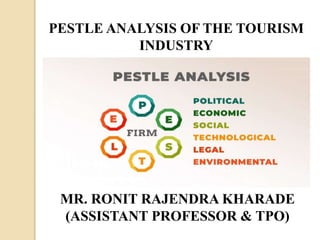
PESTLE ANALYSIS OF THE TOURISM
INDUSTRY
MR. RONIT RAJENDRA KHARADE
(ASSISTANT PROFESSOR & TPO)
Political
Here are the Political factors affecting the tourism industry:
Open borders
Thanks to many governments’ decisions to open up borders to foreigners,
it’s easier than ever to travel to new countries. While some countries are
still difficult to access (often for political reasons), the vast majority of
destinations can now be visited by tourists from all around the world. In
many cases a visa of some sort is necessary; however, the process of
applying for a visa has been expedited in many countries, in part thanks to
the use of technology.
Government stability
Political stability is a major factor in the success of tourist destinations.
Travelers are naturally curious to visit all corners of the world, and they
can only really be swayed by the threat of danger. Most popular tourist
destinations are considered safe. However, there are a number of
culturally-rich destinations that would be popular tourist spots if not for
political instability.
Tax incentives
Another Political factor impacting the tourism industry across the world is
that of tax incentives. In many countries, tourists are able to claim a tax
refund on products purchased during their trip upon departure. It’s rarely
the case that these tax incentives are the only reason for a tourist to visit,
but there is no doubt that they are an “incentive” for all tourists!
Economic
Here are the Economic factors affecting the tourism industry:
Rising disposable incomes
Across the world, incomes are rising. As the world economy grows,
individuals are able to earn more and more. With living expenses growing
nowhere near as quickly, many of the world’s citizens have more money to
spend than ever before. This has lead to an increase in the use of electronic
goods (which are increasingly accessible also thanks to lower product
costs), but also results in more individuals being able to travel. This is
clearly a positive factor for the tourism industry.
Sharing economy
The sharing economy is the name given to the business trend whereby
individuals exchange goods and services directly with one another using
facilitating services such as Uber and Airbnb. As you may have noticed
from those two examples, the rise of the sharing economy is changing the
way we travel. With services like Uber offering a reliable way for tourists
to catch rides around the world, and Airbnb offering a cheaper alternative
to traditional travel accommodation (mainly hotels and hostels), the sharing
economy is making travel more accessible, but hurting some of the
industry’s corporate providers.
Sociocultural
Here are the Sociocultural factors affecting the tourism industry:
Social pressures
There’s no doubt about it: travel is fashionable. With the rise of social
media, individuals now have a constant, online presence, and they want to
use that to impress. The social popularity of travel is causing individuals
to travel when they might have otherwise stayed home. Of course, this
movement is a positive one for the tourism industry, but may not see
sustainable growth if society moves away from the use of social media.
Racial acceptance
Another positive Sociocultural factor for the tourism industry is that of
racial acceptance. Individuals from around the world are increasingly
accepting of those of other races and religions. This makes travelling a
much more comfortable experience, since tourists don’t need to worry
about being profiled or targeted as a result of their skin color, faith, or
whatever other personal traits they may have.
Technological
Here are the Technological factors affecting the tourism industry:
Better transport
One of the biggest Technological factors influencing the tourism industry
is the development of transport. Not only do travellers have more
transportation options than ever before — especially with the advent of
airplanes — but they are cheaper (and faster!) than ever before. Buses,
trains, and planes are also more comfortable than previously, and feature
new amenities such as WiFi connectivity or charging ports.
Legal
Legal factors affecting the tourism industry.
Environmental
Here are the Environmental factors affecting the tourism industry:
Transport pollution
Perhaps the biggest environmental factor influencing the tourism industry is
the pollution created by transportation mediums such as buses, trains, and
— more so than others — airplanes. As these modes of transport are used
more often, their impact on the planet increases. All three result in the
creation of large amounts of pollutants (such as carbon dioxide) which
contribute to global warming and other environmental phenomena.
Tourist negligence
In addition to pollution on a global level, tourism can cause pollution on a
local level. In some cases, tourists may be less respectful of a destination
than of their hometown, causing them to litter and/or contaminate. Whether
it’s discarding of bottles in the countryside or using regular shampoo in
lakes, this is an unfortunate side effect of the tourism industry.
PESTLE ANALYSIS

PESTLE ANALYSIS

  • 1.
    PESTLE ANALYSIS OFTHE TOURISM INDUSTRY MR. RONIT RAJENDRA KHARADE (ASSISTANT PROFESSOR & TPO)
  • 2.
    Political Here are thePolitical factors affecting the tourism industry: Open borders Thanks to many governments’ decisions to open up borders to foreigners, it’s easier than ever to travel to new countries. While some countries are still difficult to access (often for political reasons), the vast majority of destinations can now be visited by tourists from all around the world. In many cases a visa of some sort is necessary; however, the process of applying for a visa has been expedited in many countries, in part thanks to the use of technology.
  • 3.
    Government stability Political stabilityis a major factor in the success of tourist destinations. Travelers are naturally curious to visit all corners of the world, and they can only really be swayed by the threat of danger. Most popular tourist destinations are considered safe. However, there are a number of culturally-rich destinations that would be popular tourist spots if not for political instability.
  • 4.
    Tax incentives Another Politicalfactor impacting the tourism industry across the world is that of tax incentives. In many countries, tourists are able to claim a tax refund on products purchased during their trip upon departure. It’s rarely the case that these tax incentives are the only reason for a tourist to visit, but there is no doubt that they are an “incentive” for all tourists!
  • 5.
    Economic Here are theEconomic factors affecting the tourism industry: Rising disposable incomes Across the world, incomes are rising. As the world economy grows, individuals are able to earn more and more. With living expenses growing nowhere near as quickly, many of the world’s citizens have more money to spend than ever before. This has lead to an increase in the use of electronic goods (which are increasingly accessible also thanks to lower product costs), but also results in more individuals being able to travel. This is clearly a positive factor for the tourism industry.
  • 6.
    Sharing economy The sharingeconomy is the name given to the business trend whereby individuals exchange goods and services directly with one another using facilitating services such as Uber and Airbnb. As you may have noticed from those two examples, the rise of the sharing economy is changing the way we travel. With services like Uber offering a reliable way for tourists to catch rides around the world, and Airbnb offering a cheaper alternative to traditional travel accommodation (mainly hotels and hostels), the sharing economy is making travel more accessible, but hurting some of the industry’s corporate providers.
  • 7.
    Sociocultural Here are theSociocultural factors affecting the tourism industry: Social pressures There’s no doubt about it: travel is fashionable. With the rise of social media, individuals now have a constant, online presence, and they want to use that to impress. The social popularity of travel is causing individuals to travel when they might have otherwise stayed home. Of course, this movement is a positive one for the tourism industry, but may not see sustainable growth if society moves away from the use of social media.
  • 8.
    Racial acceptance Another positiveSociocultural factor for the tourism industry is that of racial acceptance. Individuals from around the world are increasingly accepting of those of other races and religions. This makes travelling a much more comfortable experience, since tourists don’t need to worry about being profiled or targeted as a result of their skin color, faith, or whatever other personal traits they may have.
  • 9.
    Technological Here are theTechnological factors affecting the tourism industry: Better transport One of the biggest Technological factors influencing the tourism industry is the development of transport. Not only do travellers have more transportation options than ever before — especially with the advent of airplanes — but they are cheaper (and faster!) than ever before. Buses, trains, and planes are also more comfortable than previously, and feature new amenities such as WiFi connectivity or charging ports.
  • 10.
    Legal Legal factors affectingthe tourism industry. Environmental Here are the Environmental factors affecting the tourism industry: Transport pollution Perhaps the biggest environmental factor influencing the tourism industry is the pollution created by transportation mediums such as buses, trains, and — more so than others — airplanes. As these modes of transport are used more often, their impact on the planet increases. All three result in the creation of large amounts of pollutants (such as carbon dioxide) which contribute to global warming and other environmental phenomena.
  • 11.
    Tourist negligence In additionto pollution on a global level, tourism can cause pollution on a local level. In some cases, tourists may be less respectful of a destination than of their hometown, causing them to litter and/or contaminate. Whether it’s discarding of bottles in the countryside or using regular shampoo in lakes, this is an unfortunate side effect of the tourism industry.