Introduction to Personality
• Personality refers to the unique set of
characteristics, behaviors, and
thoughts that define an individual.
• It influences how we interact with the
world and respond to different
situations.
Definition & Meaning of Personality
• Definition: Personality is the
combination of emotional, attitudinal,
and behavioral response patterns of an
individual.
• Meaning: It is the way a person thinks,
feels, and behaves, making them
unique from others.
Nature of Personality
 Personality is dynamic and can change over time.
 It is influenced by genetics, environment, experiences,
and culture.
 It includes both conscious and unconscious behaviors.
 Self-consciousness.
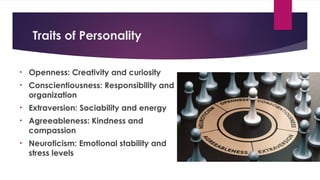
Traits of Personality
• Openness: Creativity and curiosity
• Conscientiousness: Responsibility and
organization
• Extraversion: Sociability and energy
• Agreeableness: Kindness and
compassion
• Neuroticism: Emotional stability and
stress levels
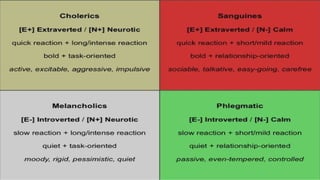
Theories of Personality
 A Greek physician known as “Father of Medicine”
based on the individual’s temperaments, human beings
are classified into
Hans Eysenck’s Classification (1967):
 Distinct types in his theory of personality are introversion,
extraversion, neuroticism and psychoticism.
 Based on psychological traits, these are of two types.
 Type A personality :
 The personality type prone for psychopathology
 Competitive drive
 Restlessness
 Honesty
 Sense of urgency
Conti…
 Impatience
 Hard driving
 Living under constant pressure
 Seeks recognition & advancement
 Multiple activities with deadlines to meet
 Cope up more constructively with stressors might be
useful
Conti…
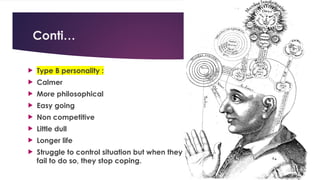
 Type B personality :
 Calmer
 More philosophical
 Easy going
 Non competitive
 Little dull
 Longer life
 Struggle to control situation but when they
fail to do so, they stop coping.
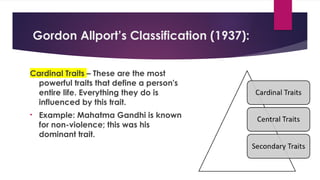
Gordon Allport’s Classification (1937):
Cardinal Traits – These are the most
powerful traits that define a person's
entire life. Everything they do is
influenced by this trait.
• Example: Mahatma Gandhi is known
for non-violence; this was his
dominant trait.
Conti…
 Central Traits – These are general characteristics found in
everyone. They shape our daily behavior and personality.
 Example: Being kind, honest, or hardworking are central
traits that many people have.
 Secondary Traits – These are situational traits that appear only
in certain conditions.
 Example: A person might be shy at work but fun and
outgoing with friends.
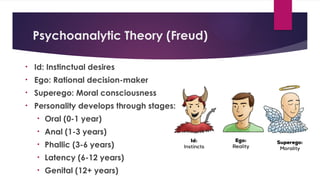
Psychoanalytic Theory (Freud)
• Id: Instinctual desires
• Ego: Rational decision-maker
• Superego: Moral consciousness
• Personality develops through stages:
• Oral (0-1 year)
• Anal (1-3 years)
• Phallic (3-6 years)
• Latency (6-12 years)
• Genital (12+ years)
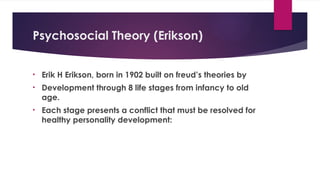
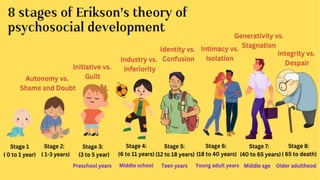
Psychosocial Theory (Erikson)
• Erik H Erikson, born in 1902 built on freud’s theories by
• Development through 8 life stages from infancy to old
age.
• Each stage presents a conflict that must be resolved for
healthy personality development:
Assessments of Personality
• Personality assessment is a systematic and
comprehensive study of an individual's
characteristic ways of thinking, feeling, and
behaving.
• To understand what makes a person unique –
their habits, feelings, reactions, and behavior
patterns.
Common Methods:
• Observation: Watching behavior in real situations.
• Interviews: Asking questions (structured or casual).
• Questionnaires & Inventories: Self-report tools like:
• MMPI (Minnesota Multiphasic Personality Inventory): A questionnaire
that helps understand personality and check for emotional or
psychological problems.
• Big Five Personality Traits: Measures personality in 5 main areas:
Openness, Conscientiousness, Extraversion, Agreeableness, and
Neuroticism.
• Projective Tests: Open-ended tests like inkblot or story-based pictures
(e.g., Rorschach, TAT).
Development of Personality Across
Age Groups
• Childhood: Basic traits and behaviors develop.
• Adolescence: Identity and self-awareness evolve.
• Adulthood: Stable personality traits form.
• Old Age: Reflection on experiences and wisdom
growth.
Importance of Personality Knowledge
for Nurses
• Helps in understanding patient behavior.
• Improves communication and empathy.
• Aids in mental health assessment and counseling.
• Enhances teamwork and professional relationships.
Understanding Personality: Concepts, Types & Theories

Understanding Personality: Concepts, Types & Theories

  • 2.
    Introduction to Personality •Personality refers to the unique set of characteristics, behaviors, and thoughts that define an individual. • It influences how we interact with the world and respond to different situations.
  • 3.
    Definition & Meaningof Personality • Definition: Personality is the combination of emotional, attitudinal, and behavioral response patterns of an individual. • Meaning: It is the way a person thinks, feels, and behaves, making them unique from others.
  • 4.
    Nature of Personality Personality is dynamic and can change over time.  It is influenced by genetics, environment, experiences, and culture.  It includes both conscious and unconscious behaviors.  Self-consciousness.
  • 5.
    Traits of Personality •Openness: Creativity and curiosity • Conscientiousness: Responsibility and organization • Extraversion: Sociability and energy • Agreeableness: Kindness and compassion • Neuroticism: Emotional stability and stress levels
  • 6.
    Theories of Personality A Greek physician known as “Father of Medicine” based on the individual’s temperaments, human beings are classified into
  • 8.
    Hans Eysenck’s Classification(1967):  Distinct types in his theory of personality are introversion, extraversion, neuroticism and psychoticism.  Based on psychological traits, these are of two types.  Type A personality :  The personality type prone for psychopathology  Competitive drive  Restlessness  Honesty  Sense of urgency
  • 9.
    Conti…  Impatience  Harddriving  Living under constant pressure  Seeks recognition & advancement  Multiple activities with deadlines to meet  Cope up more constructively with stressors might be useful
  • 10.
    Conti…  Type Bpersonality :  Calmer  More philosophical  Easy going  Non competitive  Little dull  Longer life  Struggle to control situation but when they fail to do so, they stop coping.
  • 11.
    Gordon Allport’s Classification(1937): Cardinal Traits – These are the most powerful traits that define a person's entire life. Everything they do is influenced by this trait. • Example: Mahatma Gandhi is known for non-violence; this was his dominant trait.
  • 12.
    Conti…  Central Traits– These are general characteristics found in everyone. They shape our daily behavior and personality.  Example: Being kind, honest, or hardworking are central traits that many people have.  Secondary Traits – These are situational traits that appear only in certain conditions.  Example: A person might be shy at work but fun and outgoing with friends.
  • 13.
    Psychoanalytic Theory (Freud) •Id: Instinctual desires • Ego: Rational decision-maker • Superego: Moral consciousness • Personality develops through stages: • Oral (0-1 year) • Anal (1-3 years) • Phallic (3-6 years) • Latency (6-12 years) • Genital (12+ years)
  • 14.
    Psychosocial Theory (Erikson) •Erik H Erikson, born in 1902 built on freud’s theories by • Development through 8 life stages from infancy to old age. • Each stage presents a conflict that must be resolved for healthy personality development:
  • 16.
    Assessments of Personality •Personality assessment is a systematic and comprehensive study of an individual's characteristic ways of thinking, feeling, and behaving. • To understand what makes a person unique – their habits, feelings, reactions, and behavior patterns.
  • 17.
    Common Methods: • Observation:Watching behavior in real situations. • Interviews: Asking questions (structured or casual). • Questionnaires & Inventories: Self-report tools like: • MMPI (Minnesota Multiphasic Personality Inventory): A questionnaire that helps understand personality and check for emotional or psychological problems. • Big Five Personality Traits: Measures personality in 5 main areas: Openness, Conscientiousness, Extraversion, Agreeableness, and Neuroticism. • Projective Tests: Open-ended tests like inkblot or story-based pictures (e.g., Rorschach, TAT).
  • 18.
    Development of PersonalityAcross Age Groups • Childhood: Basic traits and behaviors develop. • Adolescence: Identity and self-awareness evolve. • Adulthood: Stable personality traits form. • Old Age: Reflection on experiences and wisdom growth.
  • 19.
    Importance of PersonalityKnowledge for Nurses • Helps in understanding patient behavior. • Improves communication and empathy. • Aids in mental health assessment and counseling. • Enhances teamwork and professional relationships.