PERSONALITY
DISORDERS
Personality Disorders
 Personality disorders
 Heterogeneous group of disorders
 Longstanding, pervasive, and inflexible patterns of behavior and inner
experience
 Deviate from the expectations of a person’s culture
 Impair social and occupational functioning
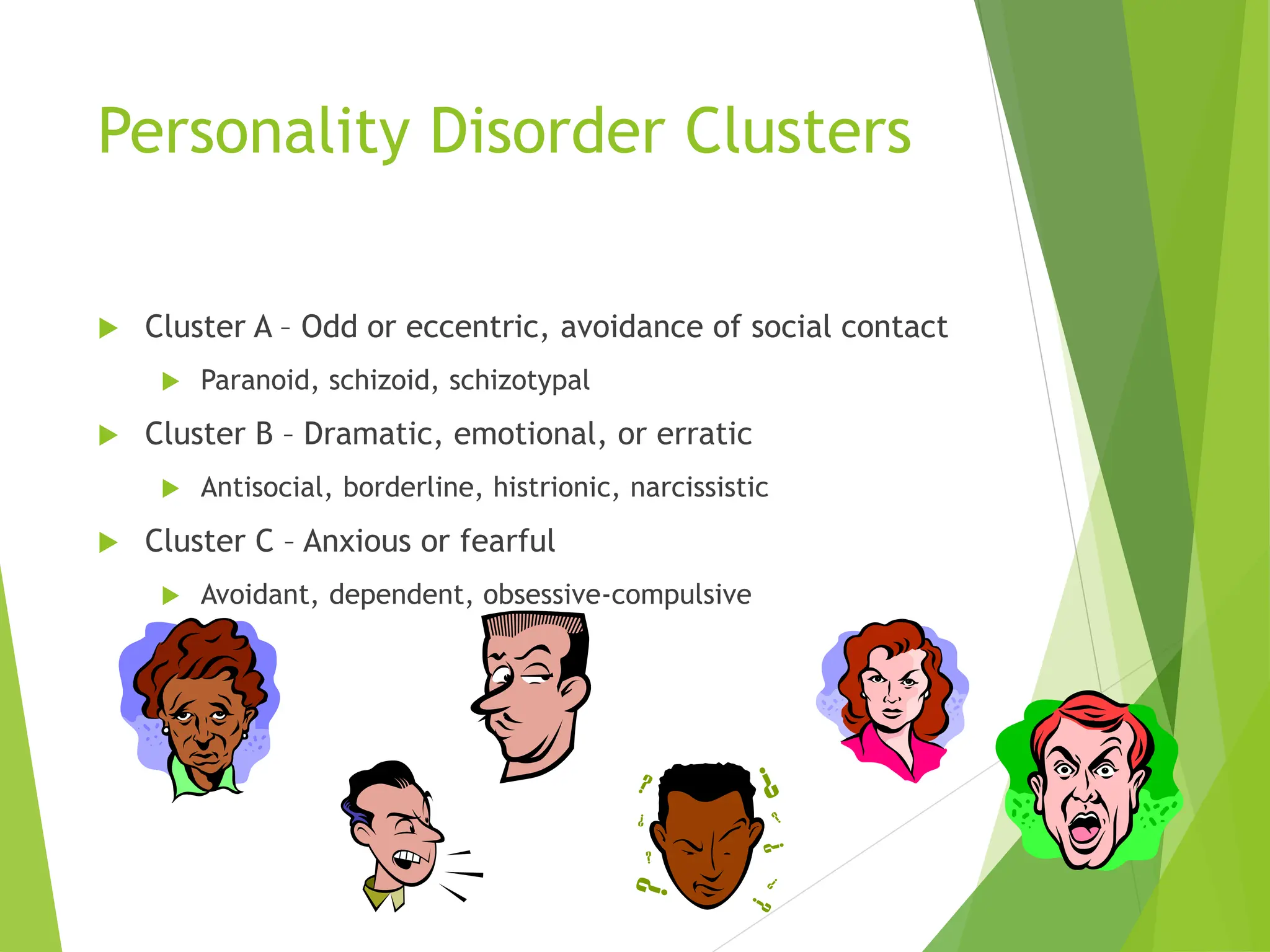
Personality Disorder Clusters
 Cluster A – Odd or eccentric, avoidance of social contact
 Paranoid, schizoid, schizotypal
 Cluster B – Dramatic, emotional, or erratic
 Antisocial, borderline, histrionic, narcissistic
 Cluster C – Anxious or fearful
 Avoidant, dependent, obsessive-compulsive
Odd/Eccentric Cluster
 Paranoid personality disorder (PPD)
 Suspicious of others
 Schizoid personality disorder
 Does not desire or enjoy social relationships
 Schizotypal personality disorder
 Odd beliefs or magical thinking
Odd/Eccentric Cluster
 Paranoid personality disorder (PD) involves suspicion of others, hostility,
jealousy
 No hallucinations and no full-blown delusions are present in paranoid PD
The thoughts, feelings and experiences associated with paranoia may cause you to:
find it hard to confide in people, even your friends and family
find it very difficult to trust other people, believing they will use you or take
advantage of you
have difficulty relaxing
read threats and danger (which others don’t see) into everyday situations,
innocent remarks or casual looks from others.
 Paranoid PD occurs more frequently in men than in women
 Prevalence is about 2 percent
Paranoid Personality Disorder
 Individuals with this Cluster A Personality
Disorder distrust others and are suspicious of
their motives.
Odd/Eccentric Cluster
 Schizoid personality disorder (PD) involves
 Many people with schizoid personality disorder are able to function fairly
well.
 Reduced social relations and few friends
 Reduced sexual desire and few pleasurable activities
 Indifference to praise or criticism
 Lonely life style
 find difficulty forming close relationships with other people
 have little interest in sex or intimacy
 have difficulty relating to or are emotionally cold towards others.
 Prevalence of schizoid PD is less than 2 percent and occurs more commonly
in men than women
Schizoid Personality
Disorder
 Individuals with this Cluster A Personality
Disorder express only a limited range of
emotion in social interactions and form few if
any close relationships with others.
Odd/Eccentric Cluster
 Schizotypal personality disorder (PD) involves
 An attenuated form of schizophrenia
 Odd beliefs and magical thinking
 Recurrent illusions (things not present)
 Ideas of reference (hidden meaning)
 Behavior and appearance is eccentric
 Prevalence of schizotypal PD is about less than 1
percent and occurs slightly more commonly in men
than women
Schizotypal Personality
Disorder
 Individuals with this Cluster A Personality
Disorder, like individuals with schizoid
personalities have little capacity for close
relationships but they are also eccentric in
their behaviors, perceptions, and thinking.
Cont…
 Unlike in schizophrenia, you usually would not
experience psychosis. However, you may:
 experience distorted thoughts or perceptions
 find making close relationships extremely difficult
 think and express yourself in ways that others find
'odd', using unusual words or
 phrases, making relating to others difficult
 believe that you can read minds or that you have
special powers such as a ‘sixth
 sense’
 feel anxious and tense with others who do not share
these beliefs
 feel very anxious and paranoid in social situations,
finding it hard to relate to
 others
Etiology of the Odd/Eccentric Cluster
 These disorders are linked to schizophrenia and may represent a less severe
form of the disorder
 Schizophrenia has clear genetic determinants
 Family studies reveal that relatives of schizophrenic patients are at increased risk
for developing schizotypal PD as well as paranoid PD
 No clear pattern for schizoid PD
Dramatic/Erratic Cluster
 Antisocial personality disorder
 Pattern of disregard for, and violation of, the rights of others
 Borderline personality disorder (BPD)
 Pattern of instability in interpersonal relationships, self-image, and
affects, and marked impulsivity
Dramatic/Erratic Cluster
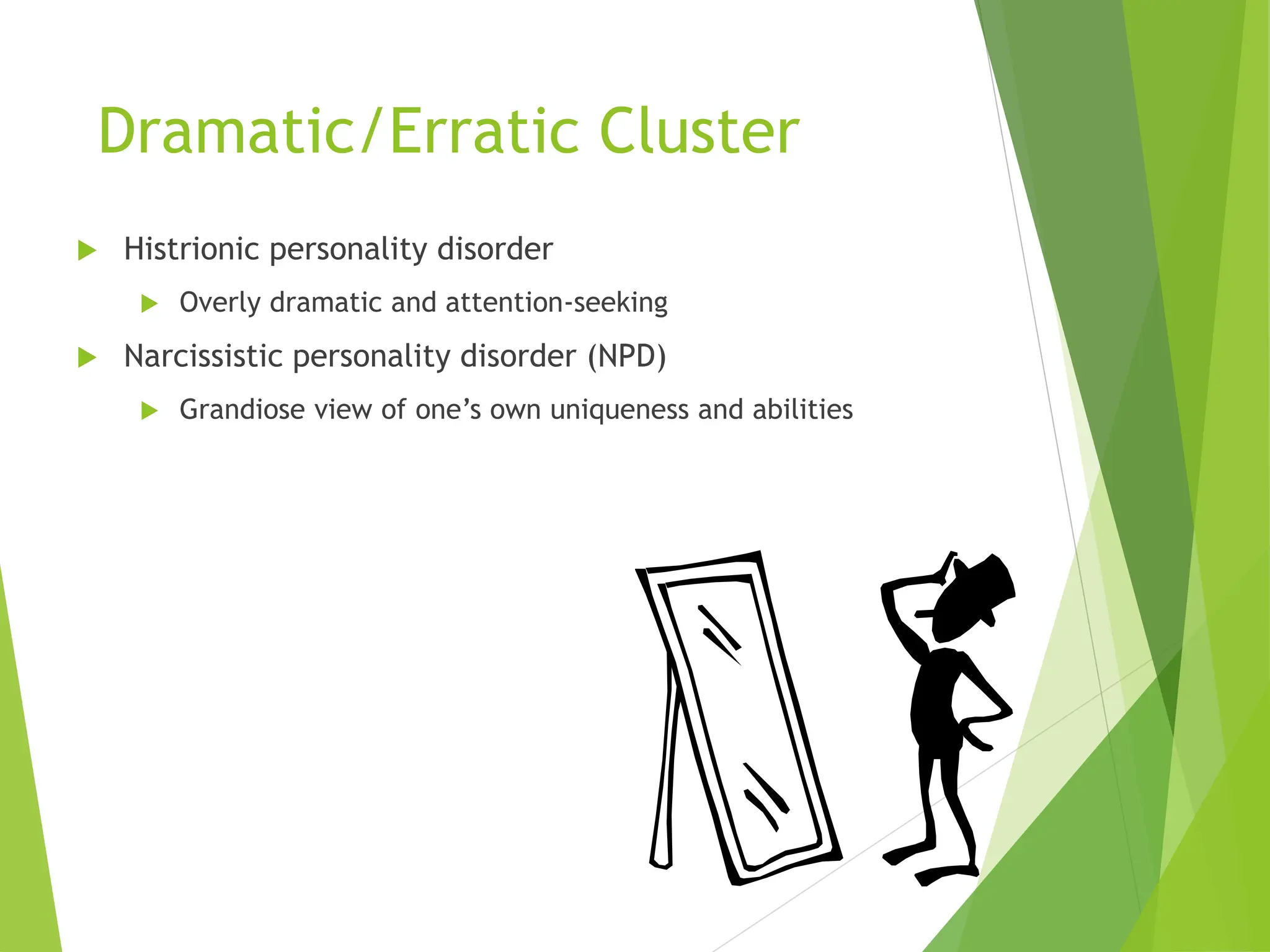
 Histrionic personality disorder
 Overly dramatic and attention-seeking
 Narcissistic personality disorder (NPD)
 Grandiose view of one’s own uniqueness and abilities
Dramatic/Erratic Cluster
 Antisocial personality disorder (APD) involves
 The presence of conduct disorder before the age of fifteen
 Conduct disorder includes truancy, lying, theft, arson, running
away from home and destruction of property
 The continuation of these behaviors into adulthood
 Prevalence of antisocial PD is about 3% of men
and 1 % of women
Antisocial Personality
Disorder
 Individuals with this Cluster B Personality
Disorder in their actions regularly disregard and
violate the rights of others. These behaviors
may be aggressive or destructive and may
involve breaking laws or rules, deceit or theft.
Cont…
 You may:
 put yourself in dangerous or risky situations, often without thinking about the
 consequences for yourself or other people
 behave dangerously and sometimes illegally (you may have a criminal record)
 behave in ways that are unpleasant for others
 feel very easily bored and act on impulse – for example, you may find it difficult
to
 hold down a job for long
 behave aggressively and get into fights easily
 do things even though they may hurt people – to get what you want, putting your
 needs and desires above other people's
 have problems with empathy – for example, you may not feel or show any sense
 of guilt if you have mistreated others
 have had a diagnosis of conduct disorder before the age of 15.
Cont…
 B. The individual is at least age 18 years.
 C. There is evidence of Conduct Disorder with onset
before age 15 years.
 D. The occurrence of antisocial behavior is not
exclusively during the course of Schizophrenia or a
Manic Episode.
Dramatic/Erratic Cluster
 Antisocial personality disorder (APD)
 Presence of conduct disorder before age 15
 Continuation into adulthood
 Emphasis is on behavior
 Psychopathy
 Poverty of emotions
 Emphasis is on thoughts and feelings
Dramatic/Erratic Cluster
 Research and theory on the etiology of antisocial personality disorder
 Role of the family
 Lack of affection
 Severe parental rejection
 Parents’ inconsistencies in disciplining their children and teaching them
responsibility toward others
 Physical abuse
 Parental loss
 Fathers of psychopaths likely to be antisocial in their behavior
Dramatic/Erratic Cluster
 Genetic correlates of APD
 Criminality and antisocial PD have heritable components
 Emotion and psychopathy
 Inability to profit from experience or even from punishment
 Difficulty controlling impulses
 Response modulation, impulsivity, and psychopathy
 Key feature of psychopathy is impulsivity supported by studies showing impaired
performance on neuropsychological tests of frontal functioning and reduced gray
matter in the frontal lobes
Dramatic/Erratic Cluster
 Borderline personality disorder (BPD)
 Impulsivity (gambling, spending, sexual sprees)
 And instability in relationships, mood and self-image
 Borderline PD persons are argumentative and difficult to
live with
 Prevalence of Borderline PD is
about 1 percent and occurs more
commonly in women than men
Borderline Personality
Disorder
 Individuals with this Cluster B Personality
Disorder behave impulsively and their
relationships, self-image, and emotions are
unstable.
Borderline Personality
Disorder
 We can all experience difficulties with our relationships, self-image and
emotions. But you might get a diagnosis of BPD/EUPD if these feel
consistently unstable or intense and cause you significant problems in
daily life.
 You may:
 feel very worried about people abandoning you, and either do anything
to stop that happening or push them away
 have very intense emotions that can change quickly (for example, from
feeling
 very happy and confident in the morning to feeling low and sad in the
afternoon)
 not have a strong sense of who you are or what you want from life, with
your ideas about this changing significantly depending on who you're with
 find it very hard to make and keep stable relationships or friendships
 act impulsively and do things that could harm you (such as binge
eating, using drugs or driving dangerously)
 have suicidal thoughts
 self-harm
 feel empty and lonely a lot of the time
 get very angry, and struggle to control your anger
 struggle to trust other people
 experience other mental health problems alongside BPD,
 including anxiety, depression, eating problems and post-traumatic stress
disorder.
Cont…
 When very stressed, sometimes you might:
 feel paranoid
 have psychotic experiences, such as seeing or hearing things that other
people don't
 feel numb or 'checked out' and not remember things very well after
they've happened (known as dissociation)
Dramatic/Erratic Cluster
 Histrionic personality disorder involves
 People who are overly dramatic and attention seeking
 People who exhibit emotional displays but are emotionally shallow
 People who are self-centered and overly concerned about physical attractiveness
 Prevalence of histrionic PD is about 2 percent
and occurs slightly more commonly in women
than men
Histrionic Personality
Disorder
 Individuals with this Cluster B Personality
Disorder exaggerate their emotions and go to
excessive lengths to seek attention.
Histrionic Personality Disorder
 Most people enjoy being given compliments or positive feedback about their
actions. But if you depend very heavily on being noticed, or are seeking
approval so much that this affects your day-to-day living, you might get a
diagnosis of histrionic personality disorder.
 You may:
 feel very uncomfortable if you are not the centre of attention
 feel that you have to entertain people
 constantly seek, or feel dependent on, the approval of others
 make rash decisions
 flirt or behave/dress provocatively to ensure that you remain the centre of
 attention
 get a reputation for being dramatic and overemotional
 be easily influenced by others
Dramatic/Erratic Cluster
 Narcissistic personality disorder involves
 A grandiose view of the person’s own importance
 A strong sense of entitlement
 A lack of empathy for others
 Prevalence of narcissistic PD is less than 1
percent and this disorder co-occurs with
borderline PD
Narcissistic Personality
Disorder
 Individuals with this Cluster B Personality
Disorder have an excessive sense of how
important they are. They demand and expect
to be admired and praised by others and are
limited in their capacity to appreciate others'
perspectives.
Diagnostic criteria for 301.81
Narcissistic Personality Disorder
 You may:
 believe that there are special reasons that make you different,
better or more deserving than others
 have fragile self-esteem, so that you rely on others to recognise your
worth and your needs
 feel upset if others ignore you and don’t give you what you feel you
deserve
 resent other people’s successes
 put your own needs above other people’s, and demand they do too
 be seen as selfish and dismissive or unaware of other people's needs
Dramatic/Erratic Cluster
 Etiology of Narcissistic PD
 On the surface the person with this disorder has a
remarkable sense of self importance, complete self-
absorption, and fantasies of limitless success – mask a very
fragile self - esteem
Anxiety/Fearful Cluster
 Avoidant personality disorder
 Sensitive to possibility of criticism, rejection, or disapproval
 Reluctant to enter into relationships unless they are sure they will be liked
 Dependent personality disorder (DPD)
 Lack of self-confidence and sense of autonomy
Anxiety/Fearful Cluster
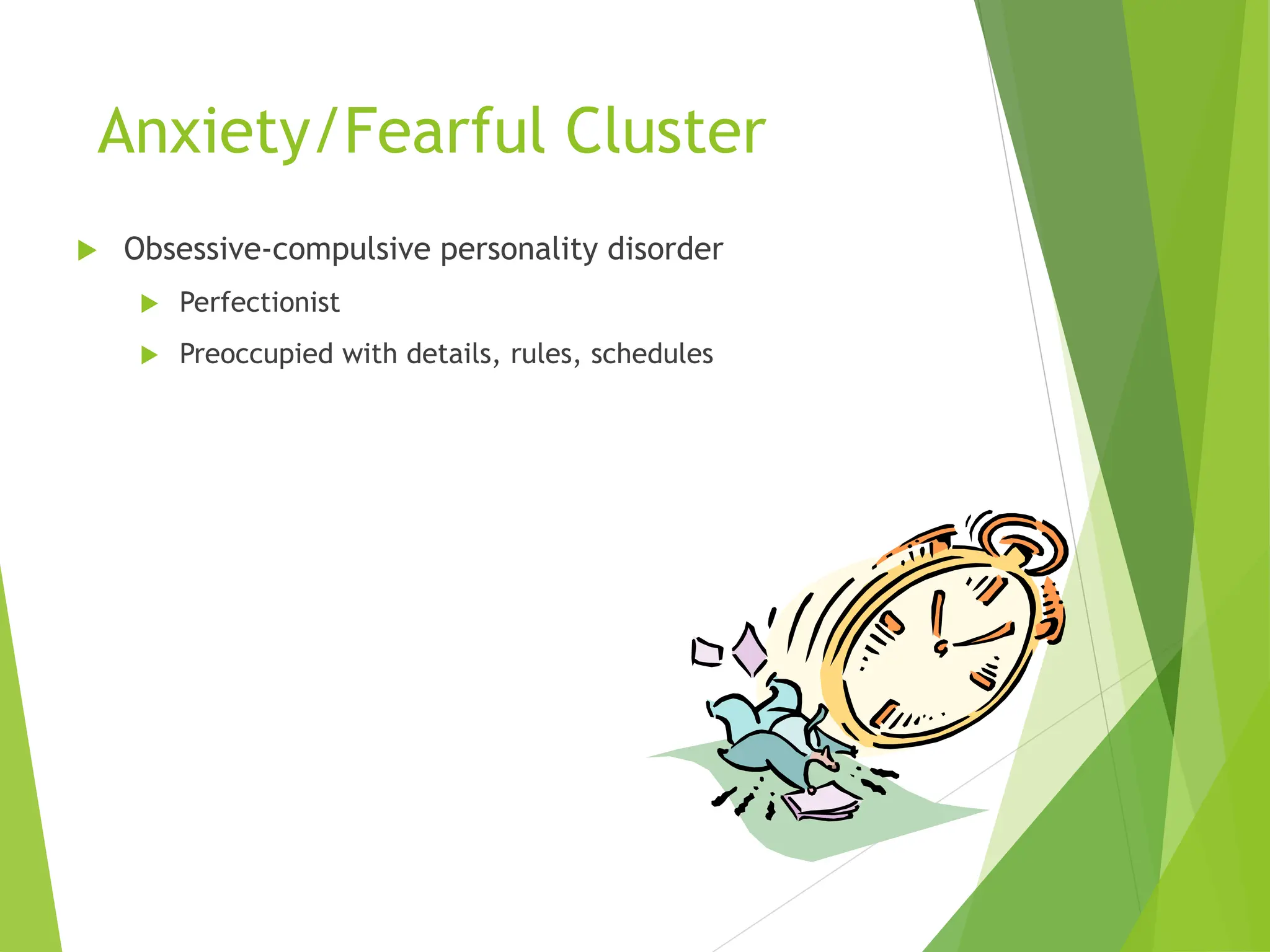
 Obsessive-compulsive personality disorder
 Perfectionist
 Preoccupied with details, rules, schedules
Anxious/Fearful Cluster
 Avoidant personality disorder involves
 People who are fearful in social situations
 People who are keenly sensitive to criticism, rejection or disapproval
 People whose lives and job are restricted by their fear of negative interactions
 Prevalence of Avoidant PD is about 5 percent and
this disorder is co-morbid with dependent PD and
borderline PD
Avoidant Personality
Disorder
 Individuals with this Cluster C Personality
Disorder are socially inhibited, usually feel
inadequate and are overly sensitive to
criticism.
Diagnostic criteria for 301.82
Avoidant Personality Disorder
 We all have things, places or people we don't like, or which make us anxious. But if
these
 things cause so much anxiety that you struggle to maintain relationships in your life,
you
 may get a diagnosis of avoidant personality disorder (sometimes also called anxious
 personality disorder).
 You may:
 avoid work or social activities that mean you must be with others
 expect disapproval and criticism and be very sensitive to it
 worry constantly about being ‘found out’ and rejected
 worry about being ridiculed or shamed by others
 avoid relationships, friendships and intimacy because you fear rejection
 feel lonely and isolated, and inferior to others
 be reluctant to try new activities in case you embarrass yourself.
Anxious/Fearful Cluster
 Dependent personality disorder involves
 A lack of self confidence
 A lack of a sense of autonomy
 A view that others are powerful while they are weak
 Prevalence of Dependent PD is about 1.5
percent and occurs slightly more commonly in
women than men
Dependent Personality
Disorder
 Individuals with this Cluster C Personality
Disorder use their submissive and clinging
behavior toward others to elicit care,
depending on them for initiative, reassurance,
decision making, and advice.
Diagnostic criteria for 301.6
Dependent Personality Disorder
 It is natural to need other people to care for us or give us reassurance sometimes. A
 healthy balance involves being able to both depend on others as well as being
 independent from others sometimes. However, if feelings and thoughts about needing
 others become so overwhelming that they impact your daily life and relationships, you
 may get a diagnosis of dependent personality disorder.
 You may:
 feel needy, 'weak' and unable to make decisions or function day-to-day without
 help or support from others
 allow or require others to assume responsibility for many areas of your life
 agree to things you feel are wrong or you dislike to avoid being alone or losing
 someone's support
 be very afraid of being left to fend for yourself
 have low self-confidence
 see other people as being much more capable than you are.
Anxious/Fearful Cluster
 Obsessive-Compulsive personality disorder
involves a person who
 Is a perfectionist, but who does not complete projects
 Is a ‘control freak” who must have their own way
 Prevalence of Obsessive-Compulsive PD is about
2 percent and this disorder is co-morbid with
avoidant PD
Obsessive-Compulsive
Personality Disorder
 Individuals with this Cluster C Personality
Disorder sacrifice openness, spontaneity, and
flexibility to pursue orderliness, control, and
perfectionism.
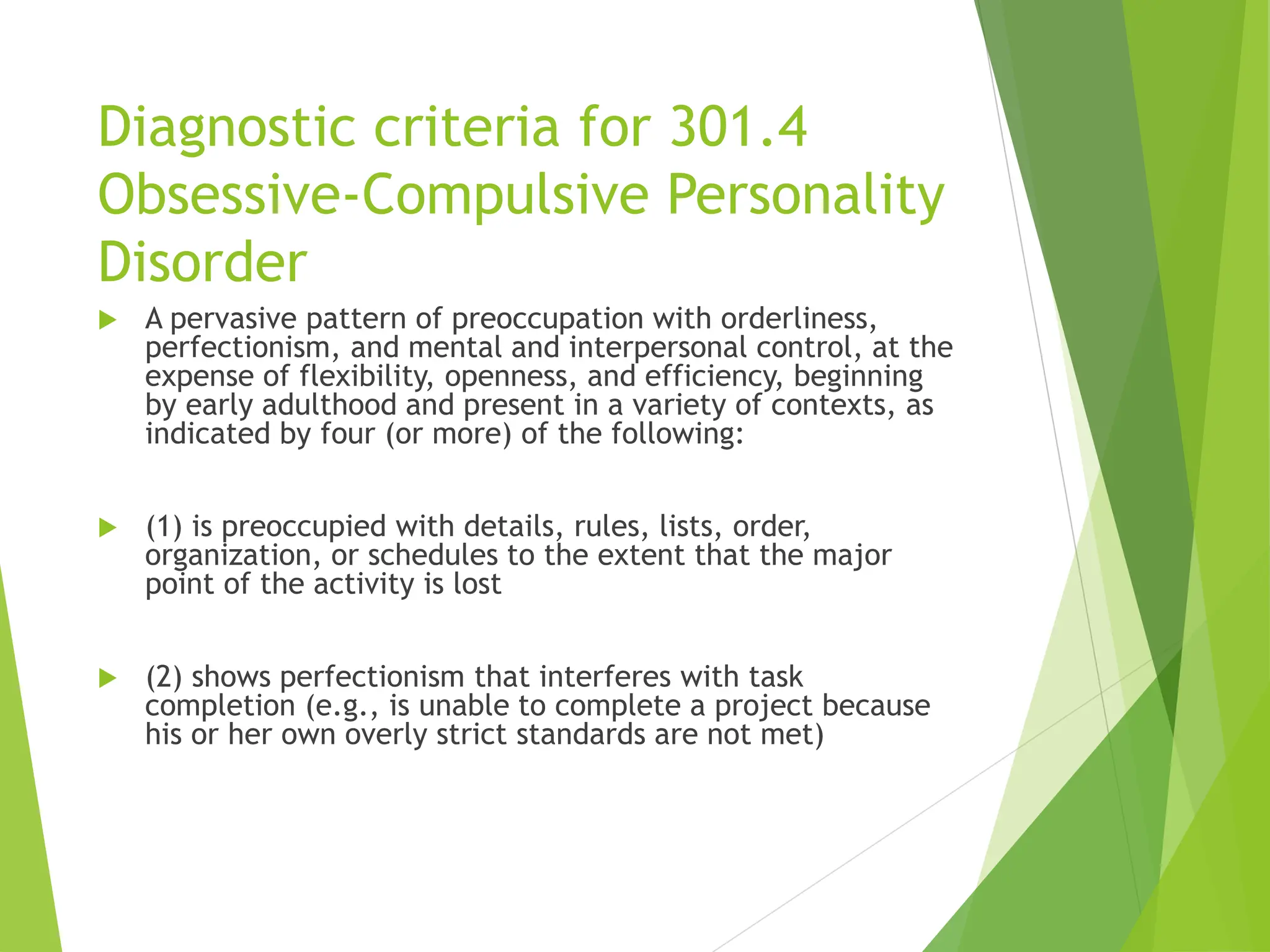
Diagnostic criteria for 301.4
Obsessive-Compulsive Personality
Disorder
 A pervasive pattern of preoccupation with orderliness,
perfectionism, and mental and interpersonal control, at the
expense of flexibility, openness, and efficiency, beginning
by early adulthood and present in a variety of contexts, as
indicated by four (or more) of the following:
 (1) is preoccupied with details, rules, lists, order,
organization, or schedules to the extent that the major
point of the activity is lost
 (2) shows perfectionism that interferes with task
completion (e.g., is unable to complete a project because
his or her own overly strict standards are not met)
Cont…
 (3) is excessively devoted to work and productivity to
the exclusion of leisure activities and friendships (not
accounted for by obvious economic necessity)
 (4) is overconscientious, scrupulous, and inflexible
about matters of morality, ethics, or values (not
accounted for by cultural or religious identification)
 (5) is unable to discard worn-out or worthless objects
even when they have no sentimental value
Cont…
 (6) is reluctant to delegate tasks or to work with others
unless they submit to exactly his or her way of doing
things
 (7) adopts a miserly spending style toward both self and
others; money is viewed as something to be hoarded for
future catastrophes
 (8) shows rigidity and stubbornness
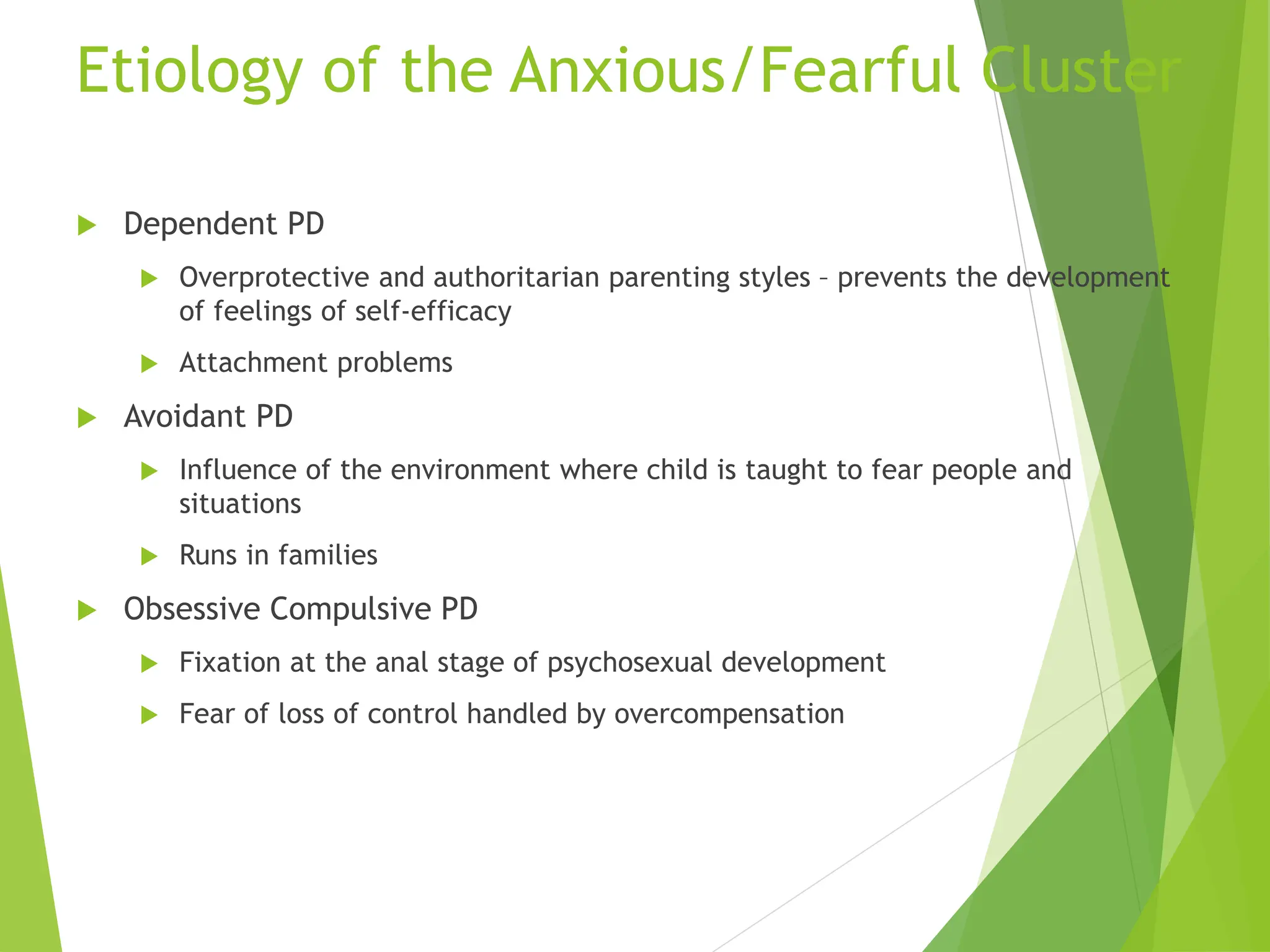
Etiology of the Anxious/Fearful Cluster
 Dependent PD
 Overprotective and authoritarian parenting styles – prevents the development
of feelings of self-efficacy
 Attachment problems
 Avoidant PD
 Influence of the environment where child is taught to fear people and
situations
 Runs in families
 Obsessive Compulsive PD
 Fixation at the anal stage of psychosexual development
 Fear of loss of control handled by overcompensation

PERSONALITY DISORDERS and its etiology.ppt

  • 1.
  • 2.
    Personality Disorders  Personalitydisorders  Heterogeneous group of disorders  Longstanding, pervasive, and inflexible patterns of behavior and inner experience  Deviate from the expectations of a person’s culture  Impair social and occupational functioning
  • 3.
    Personality Disorder Clusters Cluster A – Odd or eccentric, avoidance of social contact  Paranoid, schizoid, schizotypal  Cluster B – Dramatic, emotional, or erratic  Antisocial, borderline, histrionic, narcissistic  Cluster C – Anxious or fearful  Avoidant, dependent, obsessive-compulsive
  • 4.
    Odd/Eccentric Cluster  Paranoidpersonality disorder (PPD)  Suspicious of others  Schizoid personality disorder  Does not desire or enjoy social relationships  Schizotypal personality disorder  Odd beliefs or magical thinking
  • 5.
    Odd/Eccentric Cluster  Paranoidpersonality disorder (PD) involves suspicion of others, hostility, jealousy  No hallucinations and no full-blown delusions are present in paranoid PD The thoughts, feelings and experiences associated with paranoia may cause you to: find it hard to confide in people, even your friends and family find it very difficult to trust other people, believing they will use you or take advantage of you have difficulty relaxing read threats and danger (which others don’t see) into everyday situations, innocent remarks or casual looks from others.  Paranoid PD occurs more frequently in men than in women  Prevalence is about 2 percent
  • 6.
    Paranoid Personality Disorder Individuals with this Cluster A Personality Disorder distrust others and are suspicious of their motives.
  • 7.
    Odd/Eccentric Cluster  Schizoidpersonality disorder (PD) involves  Many people with schizoid personality disorder are able to function fairly well.  Reduced social relations and few friends  Reduced sexual desire and few pleasurable activities  Indifference to praise or criticism  Lonely life style  find difficulty forming close relationships with other people  have little interest in sex or intimacy  have difficulty relating to or are emotionally cold towards others.  Prevalence of schizoid PD is less than 2 percent and occurs more commonly in men than women
  • 8.
    Schizoid Personality Disorder  Individualswith this Cluster A Personality Disorder express only a limited range of emotion in social interactions and form few if any close relationships with others.
  • 9.
    Odd/Eccentric Cluster  Schizotypalpersonality disorder (PD) involves  An attenuated form of schizophrenia  Odd beliefs and magical thinking  Recurrent illusions (things not present)  Ideas of reference (hidden meaning)  Behavior and appearance is eccentric  Prevalence of schizotypal PD is about less than 1 percent and occurs slightly more commonly in men than women
  • 10.
    Schizotypal Personality Disorder  Individualswith this Cluster A Personality Disorder, like individuals with schizoid personalities have little capacity for close relationships but they are also eccentric in their behaviors, perceptions, and thinking.
  • 11.
    Cont…  Unlike inschizophrenia, you usually would not experience psychosis. However, you may:  experience distorted thoughts or perceptions  find making close relationships extremely difficult  think and express yourself in ways that others find 'odd', using unusual words or  phrases, making relating to others difficult  believe that you can read minds or that you have special powers such as a ‘sixth  sense’  feel anxious and tense with others who do not share these beliefs  feel very anxious and paranoid in social situations, finding it hard to relate to  others
  • 12.
    Etiology of theOdd/Eccentric Cluster  These disorders are linked to schizophrenia and may represent a less severe form of the disorder  Schizophrenia has clear genetic determinants  Family studies reveal that relatives of schizophrenic patients are at increased risk for developing schizotypal PD as well as paranoid PD  No clear pattern for schizoid PD
  • 13.
    Dramatic/Erratic Cluster  Antisocialpersonality disorder  Pattern of disregard for, and violation of, the rights of others  Borderline personality disorder (BPD)  Pattern of instability in interpersonal relationships, self-image, and affects, and marked impulsivity
  • 14.
    Dramatic/Erratic Cluster  Histrionicpersonality disorder  Overly dramatic and attention-seeking  Narcissistic personality disorder (NPD)  Grandiose view of one’s own uniqueness and abilities
  • 15.
    Dramatic/Erratic Cluster  Antisocialpersonality disorder (APD) involves  The presence of conduct disorder before the age of fifteen  Conduct disorder includes truancy, lying, theft, arson, running away from home and destruction of property  The continuation of these behaviors into adulthood  Prevalence of antisocial PD is about 3% of men and 1 % of women
  • 16.
    Antisocial Personality Disorder  Individualswith this Cluster B Personality Disorder in their actions regularly disregard and violate the rights of others. These behaviors may be aggressive or destructive and may involve breaking laws or rules, deceit or theft.
  • 17.
    Cont…  You may: put yourself in dangerous or risky situations, often without thinking about the  consequences for yourself or other people  behave dangerously and sometimes illegally (you may have a criminal record)  behave in ways that are unpleasant for others  feel very easily bored and act on impulse – for example, you may find it difficult to  hold down a job for long  behave aggressively and get into fights easily  do things even though they may hurt people – to get what you want, putting your  needs and desires above other people's  have problems with empathy – for example, you may not feel or show any sense  of guilt if you have mistreated others  have had a diagnosis of conduct disorder before the age of 15.
  • 18.
    Cont…  B. Theindividual is at least age 18 years.  C. There is evidence of Conduct Disorder with onset before age 15 years.  D. The occurrence of antisocial behavior is not exclusively during the course of Schizophrenia or a Manic Episode.
  • 19.
    Dramatic/Erratic Cluster  Antisocialpersonality disorder (APD)  Presence of conduct disorder before age 15  Continuation into adulthood  Emphasis is on behavior  Psychopathy  Poverty of emotions  Emphasis is on thoughts and feelings
  • 20.
    Dramatic/Erratic Cluster  Researchand theory on the etiology of antisocial personality disorder  Role of the family  Lack of affection  Severe parental rejection  Parents’ inconsistencies in disciplining their children and teaching them responsibility toward others  Physical abuse  Parental loss  Fathers of psychopaths likely to be antisocial in their behavior
  • 21.
    Dramatic/Erratic Cluster  Geneticcorrelates of APD  Criminality and antisocial PD have heritable components  Emotion and psychopathy  Inability to profit from experience or even from punishment  Difficulty controlling impulses  Response modulation, impulsivity, and psychopathy  Key feature of psychopathy is impulsivity supported by studies showing impaired performance on neuropsychological tests of frontal functioning and reduced gray matter in the frontal lobes
  • 22.
    Dramatic/Erratic Cluster  Borderlinepersonality disorder (BPD)  Impulsivity (gambling, spending, sexual sprees)  And instability in relationships, mood and self-image  Borderline PD persons are argumentative and difficult to live with  Prevalence of Borderline PD is about 1 percent and occurs more commonly in women than men
  • 23.
    Borderline Personality Disorder  Individualswith this Cluster B Personality Disorder behave impulsively and their relationships, self-image, and emotions are unstable.
  • 24.
    Borderline Personality Disorder  Wecan all experience difficulties with our relationships, self-image and emotions. But you might get a diagnosis of BPD/EUPD if these feel consistently unstable or intense and cause you significant problems in daily life.  You may:  feel very worried about people abandoning you, and either do anything to stop that happening or push them away  have very intense emotions that can change quickly (for example, from feeling  very happy and confident in the morning to feeling low and sad in the afternoon)  not have a strong sense of who you are or what you want from life, with your ideas about this changing significantly depending on who you're with
  • 25.
     find itvery hard to make and keep stable relationships or friendships  act impulsively and do things that could harm you (such as binge eating, using drugs or driving dangerously)  have suicidal thoughts  self-harm  feel empty and lonely a lot of the time  get very angry, and struggle to control your anger  struggle to trust other people  experience other mental health problems alongside BPD,  including anxiety, depression, eating problems and post-traumatic stress disorder.
  • 26.
    Cont…  When verystressed, sometimes you might:  feel paranoid  have psychotic experiences, such as seeing or hearing things that other people don't  feel numb or 'checked out' and not remember things very well after they've happened (known as dissociation)
  • 27.
    Dramatic/Erratic Cluster  Histrionicpersonality disorder involves  People who are overly dramatic and attention seeking  People who exhibit emotional displays but are emotionally shallow  People who are self-centered and overly concerned about physical attractiveness  Prevalence of histrionic PD is about 2 percent and occurs slightly more commonly in women than men
  • 28.
    Histrionic Personality Disorder  Individualswith this Cluster B Personality Disorder exaggerate their emotions and go to excessive lengths to seek attention.
  • 29.
    Histrionic Personality Disorder Most people enjoy being given compliments or positive feedback about their actions. But if you depend very heavily on being noticed, or are seeking approval so much that this affects your day-to-day living, you might get a diagnosis of histrionic personality disorder.  You may:  feel very uncomfortable if you are not the centre of attention  feel that you have to entertain people  constantly seek, or feel dependent on, the approval of others  make rash decisions  flirt or behave/dress provocatively to ensure that you remain the centre of  attention  get a reputation for being dramatic and overemotional  be easily influenced by others
  • 30.
    Dramatic/Erratic Cluster  Narcissisticpersonality disorder involves  A grandiose view of the person’s own importance  A strong sense of entitlement  A lack of empathy for others  Prevalence of narcissistic PD is less than 1 percent and this disorder co-occurs with borderline PD
  • 31.
    Narcissistic Personality Disorder  Individualswith this Cluster B Personality Disorder have an excessive sense of how important they are. They demand and expect to be admired and praised by others and are limited in their capacity to appreciate others' perspectives.
  • 32.
    Diagnostic criteria for301.81 Narcissistic Personality Disorder  You may:  believe that there are special reasons that make you different, better or more deserving than others  have fragile self-esteem, so that you rely on others to recognise your worth and your needs  feel upset if others ignore you and don’t give you what you feel you deserve  resent other people’s successes  put your own needs above other people’s, and demand they do too  be seen as selfish and dismissive or unaware of other people's needs
  • 33.
    Dramatic/Erratic Cluster  Etiologyof Narcissistic PD  On the surface the person with this disorder has a remarkable sense of self importance, complete self- absorption, and fantasies of limitless success – mask a very fragile self - esteem
  • 34.
    Anxiety/Fearful Cluster  Avoidantpersonality disorder  Sensitive to possibility of criticism, rejection, or disapproval  Reluctant to enter into relationships unless they are sure they will be liked  Dependent personality disorder (DPD)  Lack of self-confidence and sense of autonomy
  • 35.
    Anxiety/Fearful Cluster  Obsessive-compulsivepersonality disorder  Perfectionist  Preoccupied with details, rules, schedules
  • 36.
    Anxious/Fearful Cluster  Avoidantpersonality disorder involves  People who are fearful in social situations  People who are keenly sensitive to criticism, rejection or disapproval  People whose lives and job are restricted by their fear of negative interactions  Prevalence of Avoidant PD is about 5 percent and this disorder is co-morbid with dependent PD and borderline PD
  • 37.
    Avoidant Personality Disorder  Individualswith this Cluster C Personality Disorder are socially inhibited, usually feel inadequate and are overly sensitive to criticism.
  • 38.
    Diagnostic criteria for301.82 Avoidant Personality Disorder  We all have things, places or people we don't like, or which make us anxious. But if these  things cause so much anxiety that you struggle to maintain relationships in your life, you  may get a diagnosis of avoidant personality disorder (sometimes also called anxious  personality disorder).  You may:  avoid work or social activities that mean you must be with others  expect disapproval and criticism and be very sensitive to it  worry constantly about being ‘found out’ and rejected  worry about being ridiculed or shamed by others  avoid relationships, friendships and intimacy because you fear rejection  feel lonely and isolated, and inferior to others  be reluctant to try new activities in case you embarrass yourself.
  • 39.
    Anxious/Fearful Cluster  Dependentpersonality disorder involves  A lack of self confidence  A lack of a sense of autonomy  A view that others are powerful while they are weak  Prevalence of Dependent PD is about 1.5 percent and occurs slightly more commonly in women than men
  • 40.
    Dependent Personality Disorder  Individualswith this Cluster C Personality Disorder use their submissive and clinging behavior toward others to elicit care, depending on them for initiative, reassurance, decision making, and advice.
  • 41.
    Diagnostic criteria for301.6 Dependent Personality Disorder  It is natural to need other people to care for us or give us reassurance sometimes. A  healthy balance involves being able to both depend on others as well as being  independent from others sometimes. However, if feelings and thoughts about needing  others become so overwhelming that they impact your daily life and relationships, you  may get a diagnosis of dependent personality disorder.  You may:  feel needy, 'weak' and unable to make decisions or function day-to-day without  help or support from others  allow or require others to assume responsibility for many areas of your life  agree to things you feel are wrong or you dislike to avoid being alone or losing  someone's support  be very afraid of being left to fend for yourself  have low self-confidence  see other people as being much more capable than you are.
  • 42.
    Anxious/Fearful Cluster  Obsessive-Compulsivepersonality disorder involves a person who  Is a perfectionist, but who does not complete projects  Is a ‘control freak” who must have their own way  Prevalence of Obsessive-Compulsive PD is about 2 percent and this disorder is co-morbid with avoidant PD
  • 43.
    Obsessive-Compulsive Personality Disorder  Individualswith this Cluster C Personality Disorder sacrifice openness, spontaneity, and flexibility to pursue orderliness, control, and perfectionism.
  • 44.
    Diagnostic criteria for301.4 Obsessive-Compulsive Personality Disorder  A pervasive pattern of preoccupation with orderliness, perfectionism, and mental and interpersonal control, at the expense of flexibility, openness, and efficiency, beginning by early adulthood and present in a variety of contexts, as indicated by four (or more) of the following:  (1) is preoccupied with details, rules, lists, order, organization, or schedules to the extent that the major point of the activity is lost  (2) shows perfectionism that interferes with task completion (e.g., is unable to complete a project because his or her own overly strict standards are not met)
  • 45.
    Cont…  (3) isexcessively devoted to work and productivity to the exclusion of leisure activities and friendships (not accounted for by obvious economic necessity)  (4) is overconscientious, scrupulous, and inflexible about matters of morality, ethics, or values (not accounted for by cultural or religious identification)  (5) is unable to discard worn-out or worthless objects even when they have no sentimental value
  • 46.
    Cont…  (6) isreluctant to delegate tasks or to work with others unless they submit to exactly his or her way of doing things  (7) adopts a miserly spending style toward both self and others; money is viewed as something to be hoarded for future catastrophes  (8) shows rigidity and stubbornness
  • 47.
    Etiology of theAnxious/Fearful Cluster  Dependent PD  Overprotective and authoritarian parenting styles – prevents the development of feelings of self-efficacy  Attachment problems  Avoidant PD  Influence of the environment where child is taught to fear people and situations  Runs in families  Obsessive Compulsive PD  Fixation at the anal stage of psychosexual development  Fear of loss of control handled by overcompensation