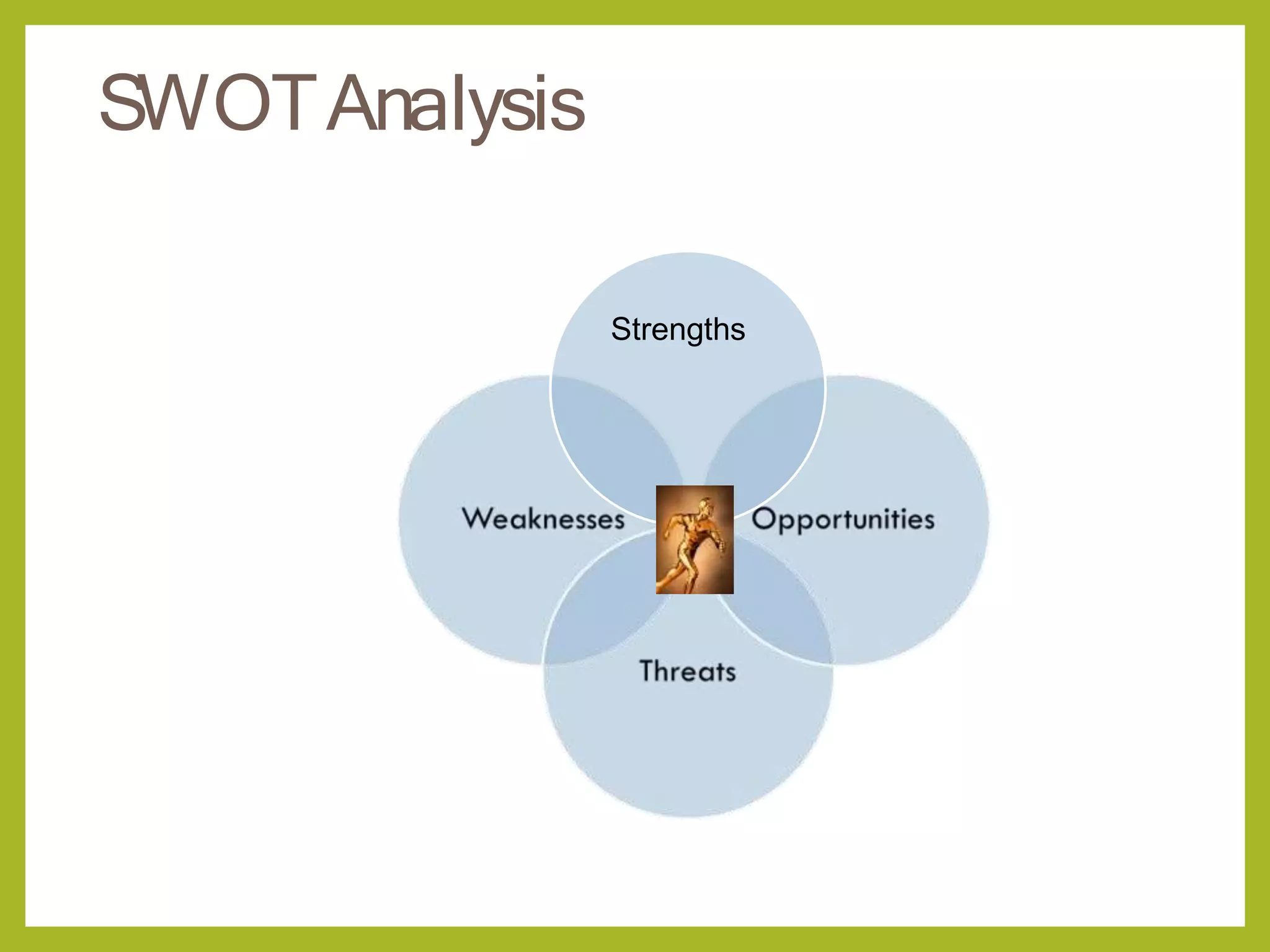
SWOTAnalysis
Strengths
The P
ower of S
.W.O.T
.
Weaknesses
 What makes SWOTespecially powerful isthat, with
a little thought, it can help you uncover
opportunities that you would not otherwise have
spotted. And by understanding your weaknesses,
you can manage and eliminate threats that might
otherwise hurt your ability to move forward.
ViewYourself throughS.W.O.T.
 If you look at yourself using the SWOT
framework, you can start to separate yourself from
your peers, and further develop the specialized
talents and abilities you need to advance your
career!
Weaknesses
Strengths
 What advantages do you have that others don’t have
(skills, certifications, education, connections)?
 What do you do better than anyone else?
 What personal resources can you access?
 What do other people (and your boss, in particular) see as
your strengths?
 Which of your achievements are you most proud?
 What values do you believe in that others fail to exhibit?
 Are you part of a network that no one else is involved in? If
so, what connections do you have with influential people?
Y
our P
erspective
 Consider this from your own perspective, and from
thepoint of view of thepeople around you.And
don't be modestor shy– be asobjective asyou
can.
 And if you have any difficulty with this, write down
a list of your personal characteristics. Some of
these will hopefully be strengths!
ConsideryourStrengths
 Thinkabout your strengthsinrelation to thepeople
around you.
 Forexample,if you're a great mathematicianand
the people around you are also great at math, then
this is not likely to be a strength in your current role
– it may be a necessity.
Weaknesses
 What tasks do you usually avoid because you don't feel
confident doing them?
What will the people around you see asyour weaknesses?
Are you completely confident in your education and skills
training? If not, where are you weakest?
What are your negative work habits (for example, are you
often late, are you disorganized, do you have a short temper,
or are you poor at handling stress?
Do you have personality traitsthat hold you back in your field?
For instance, if youhaveto conduct meetings on a regular
basis, a fear of public speaking would be a major weakness.




Opportunities
 What new technology can help you?Or can you get
help from others or from people via the Internet?
 Isyour industry growing?If so, how can you take
advantage of the current market?
 Do you have a network of strategic contactsto help
you, or offer good advice?
 What trends (management or otherwise) do you see
in your company, and how can you take advantage
of them?
PotentialOpportunities
 Networking events, educational classes, or
conferences.
 A colleague going on an extended leave. Could
you take on some of this person's projects to gain
experience?
 A new role or project that forces you to learn new
skills, like public speaking or international relations.
 A company expansion or acquisition. Do you have
specific skills(like a secondlanguage) that could
help with the process?
L
OOK!
 Look at your strengths, and ask yourself whether
these open up any opportunities –
 Look at your weaknesses, and ask yourself whether
youcouldopenup opportunities by eliminating
those weaknesses.
Threats
 What obstaclesdo youcurrently face
at work?
 Are any of your colleagues competing with youfor
projects or roles?
 Isyour job (or thedemandfor the thingsyoudo)
changing?
 Doeschangingtechnology threaten your position?
 Could any of your weaknesseslead to threats?
Analyze
 Performingthisanalysis will often provide key
information – it can point out what needs to be
done and put problems into perspective.
Key P
oints
 A SWOTmatrix isa framework for analyzing your
strengthsand weaknessesaswell asthe
opportunities and threats you face.
 Helpsyou focuson strengths.
 Helps minimize your weaknesses.
 Assists in taking the greatest possible advantage of
opportunities available to you.
Personal SWOT analysis.pptx

Personal SWOT analysis.pptx

  • 1.
  • 2.
    The P ower ofS .W.O.T . Weaknesses  What makes SWOTespecially powerful isthat, with a little thought, it can help you uncover opportunities that you would not otherwise have spotted. And by understanding your weaknesses, you can manage and eliminate threats that might otherwise hurt your ability to move forward.
  • 3.
    ViewYourself throughS.W.O.T.  Ifyou look at yourself using the SWOT framework, you can start to separate yourself from your peers, and further develop the specialized talents and abilities you need to advance your career! Weaknesses
  • 4.
    Strengths  What advantagesdo you have that others don’t have (skills, certifications, education, connections)?  What do you do better than anyone else?  What personal resources can you access?  What do other people (and your boss, in particular) see as your strengths?  Which of your achievements are you most proud?  What values do you believe in that others fail to exhibit?  Are you part of a network that no one else is involved in? If so, what connections do you have with influential people?
  • 5.
    Y our P erspective  Considerthis from your own perspective, and from thepoint of view of thepeople around you.And don't be modestor shy– be asobjective asyou can.  And if you have any difficulty with this, write down a list of your personal characteristics. Some of these will hopefully be strengths!
  • 6.
    ConsideryourStrengths  Thinkabout yourstrengthsinrelation to thepeople around you.  Forexample,if you're a great mathematicianand the people around you are also great at math, then this is not likely to be a strength in your current role – it may be a necessity.
  • 7.
    Weaknesses  What tasksdo you usually avoid because you don't feel confident doing them? What will the people around you see asyour weaknesses? Are you completely confident in your education and skills training? If not, where are you weakest? What are your negative work habits (for example, are you often late, are you disorganized, do you have a short temper, or are you poor at handling stress? Do you have personality traitsthat hold you back in your field? For instance, if youhaveto conduct meetings on a regular basis, a fear of public speaking would be a major weakness.    
  • 8.
    Opportunities  What newtechnology can help you?Or can you get help from others or from people via the Internet?  Isyour industry growing?If so, how can you take advantage of the current market?  Do you have a network of strategic contactsto help you, or offer good advice?  What trends (management or otherwise) do you see in your company, and how can you take advantage of them?
  • 9.
    PotentialOpportunities  Networking events,educational classes, or conferences.  A colleague going on an extended leave. Could you take on some of this person's projects to gain experience?  A new role or project that forces you to learn new skills, like public speaking or international relations.  A company expansion or acquisition. Do you have specific skills(like a secondlanguage) that could help with the process?
  • 10.
    L OOK!  Look atyour strengths, and ask yourself whether these open up any opportunities –  Look at your weaknesses, and ask yourself whether youcouldopenup opportunities by eliminating those weaknesses.
  • 11.
    Threats  What obstaclesdoyoucurrently face at work?  Are any of your colleagues competing with youfor projects or roles?  Isyour job (or thedemandfor the thingsyoudo) changing?  Doeschangingtechnology threaten your position?  Could any of your weaknesseslead to threats?
  • 12.
    Analyze  Performingthisanalysis willoften provide key information – it can point out what needs to be done and put problems into perspective.
  • 13.
    Key P oints  ASWOTmatrix isa framework for analyzing your strengthsand weaknessesaswell asthe opportunities and threats you face.  Helpsyou focuson strengths.  Helps minimize your weaknesses.  Assists in taking the greatest possible advantage of opportunities available to you.