1
CAN DO
@The University of North Texas
November 15, 2019
Humanizing online learning:
why the user experience matters
2
Media Coverage
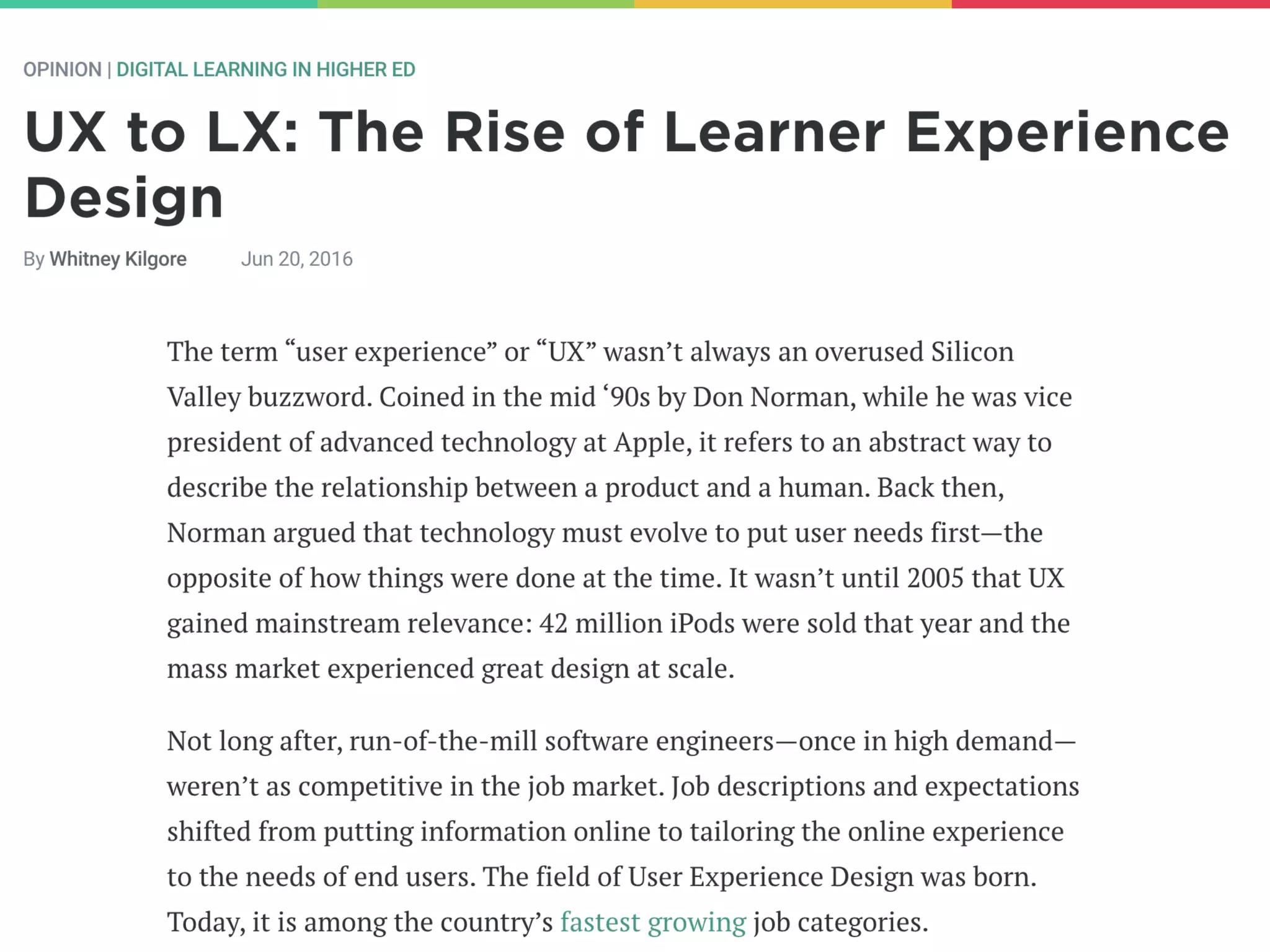
UX to LX: The Rise of
Learner Experience Design
Instructure Launches LMS
‘Genius Bar’
A Novel Way to Launch an
Online Program
The Quest for Great
Instructional Designers
Competing Models Among
OPM Providers
Five Myths About Online
Program Management
idesignedu.org/news
3
4
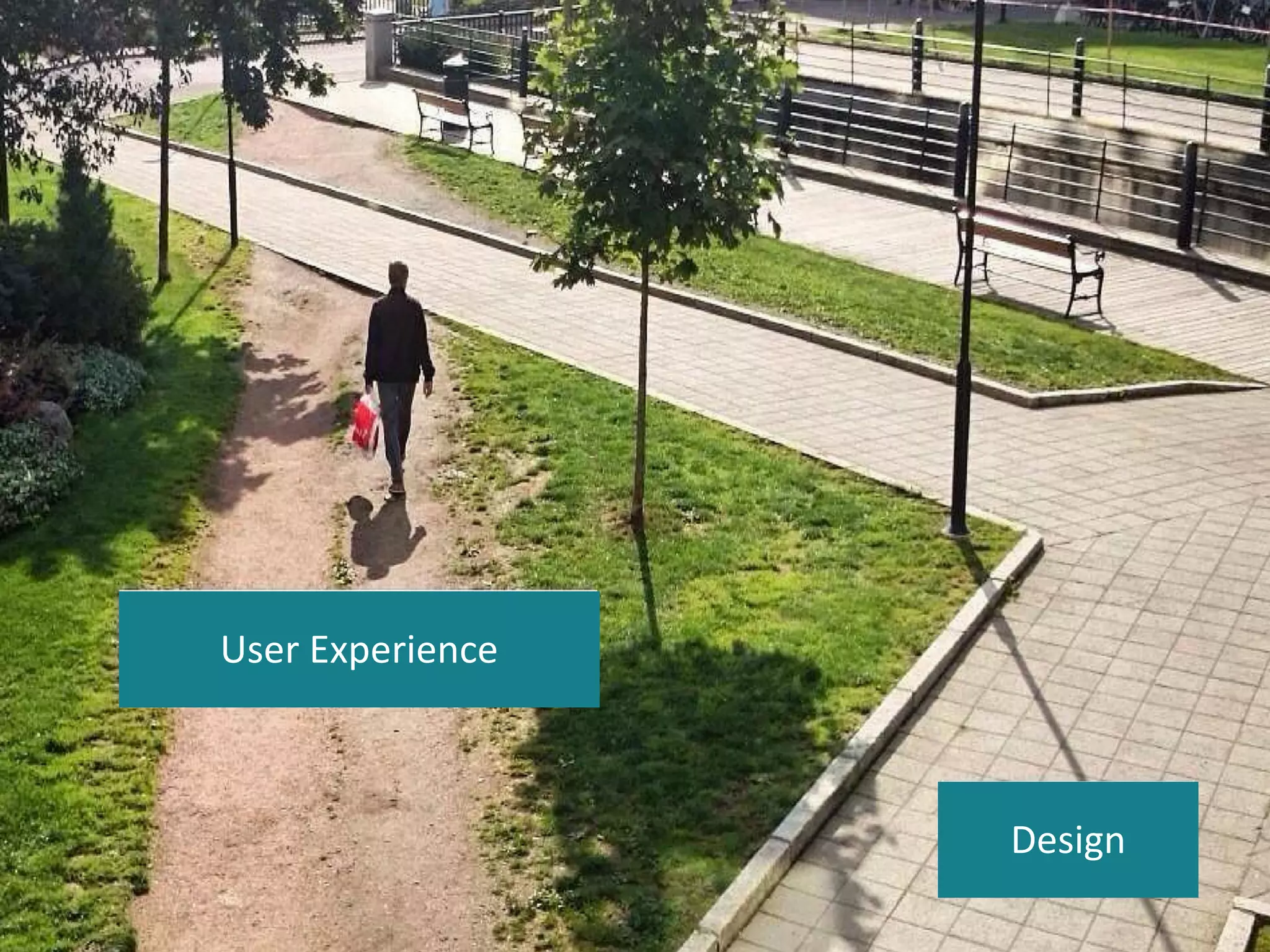
User Experience
Design
5
6
7
8
9
Partnered together to
study EDUCAUSE’s
digital transformation of
their Institutes and their
effect on professional
career pathways.
10
11
12
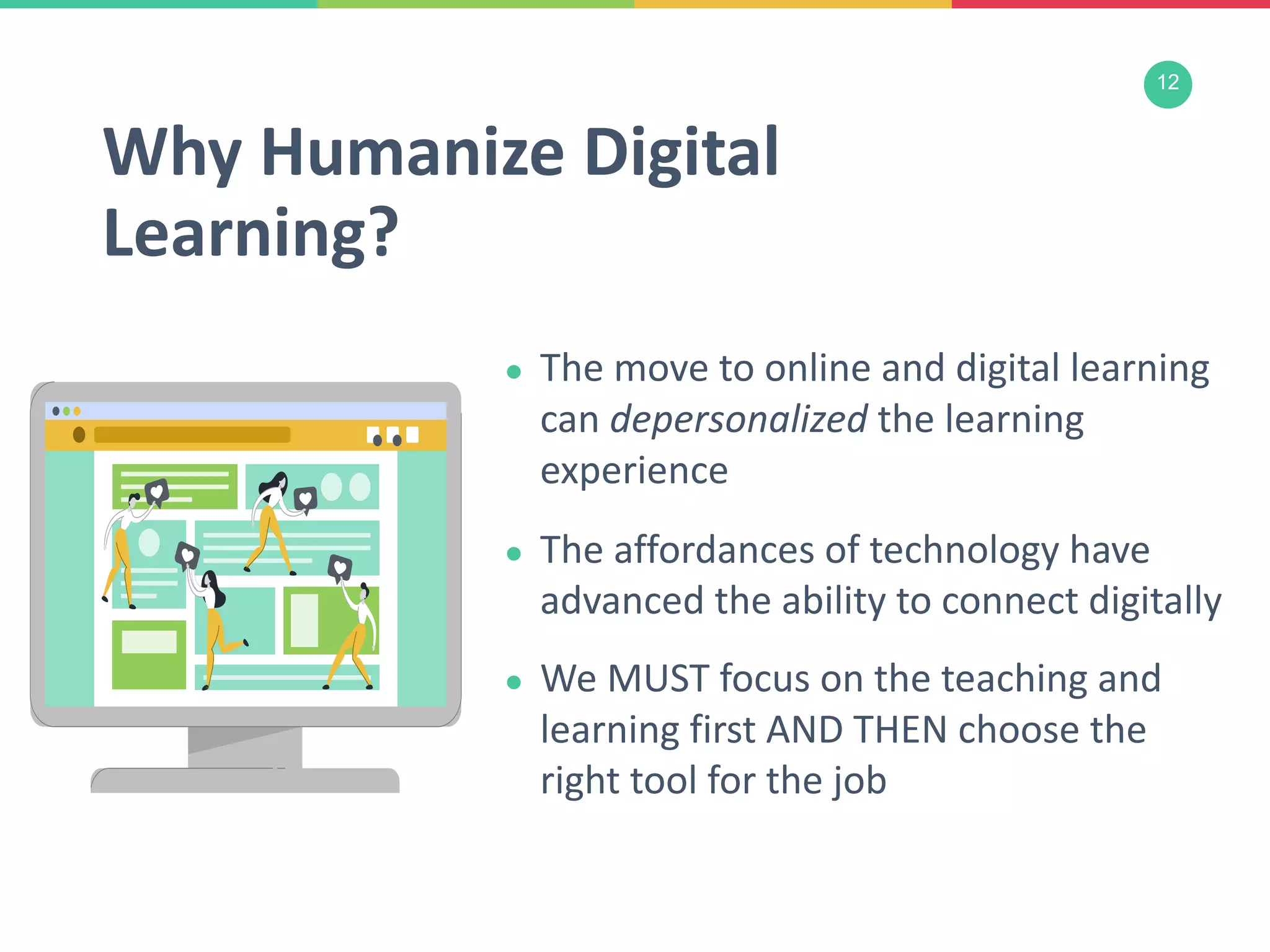
● The move to online and digital learning
can depersonalized the learning
experience
● The affordances of technology have
advanced the ability to connect digitally
● We MUST focus on the teaching and
learning first AND THEN choose the
right tool for the job
Why Humanize Digital
Learning?
13
14
2800+ enrolled
Faculty, Instructional
Designers, Directors of
Online Programs, Provosts
& Staff
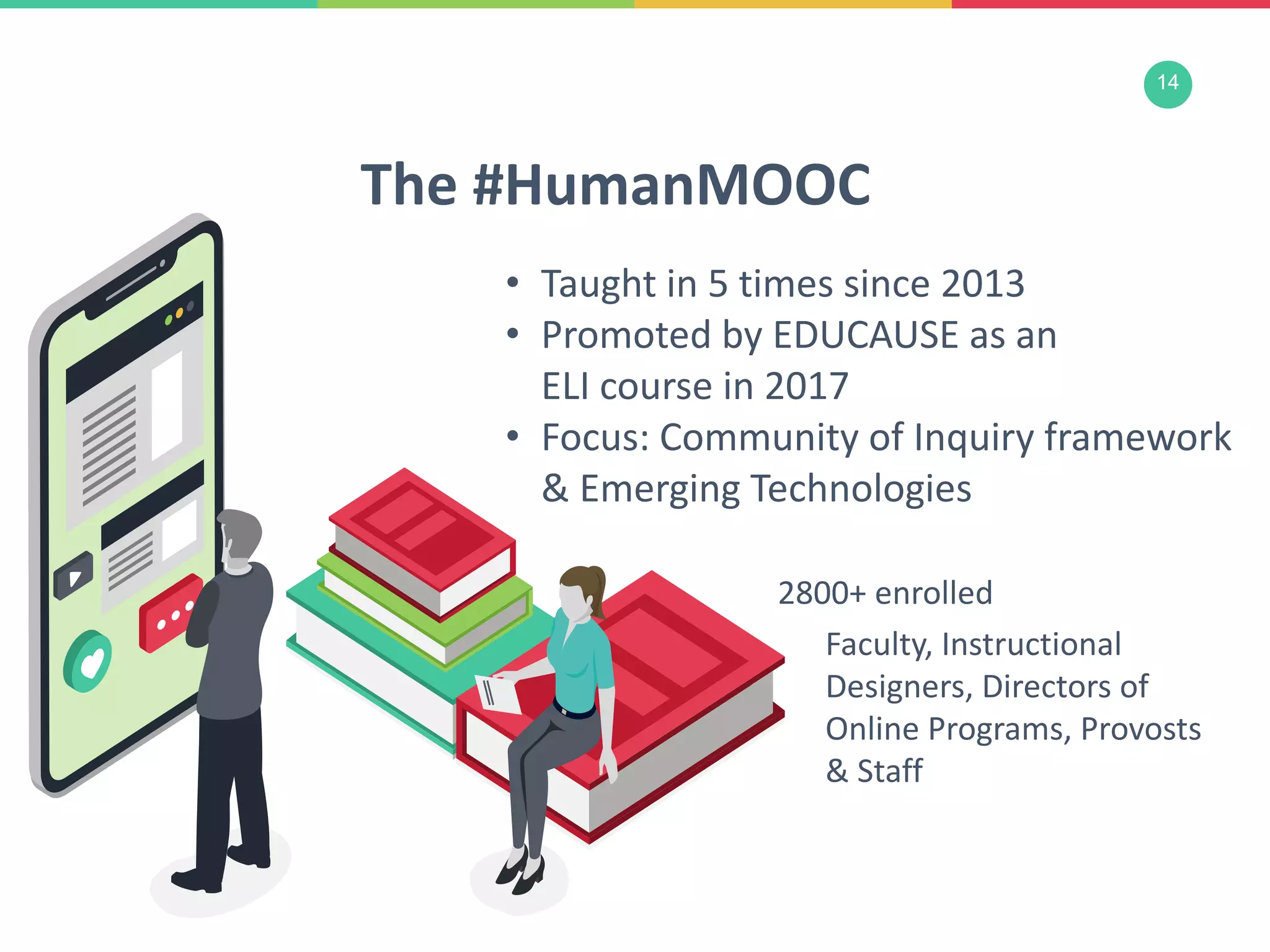
The #HumanMOOC
• Taught in 5 times since 2013
• Promoted by EDUCAUSE as an
ELI course in 2017
• Focus: Community of Inquiry framework
& Emerging Technologies
15
16
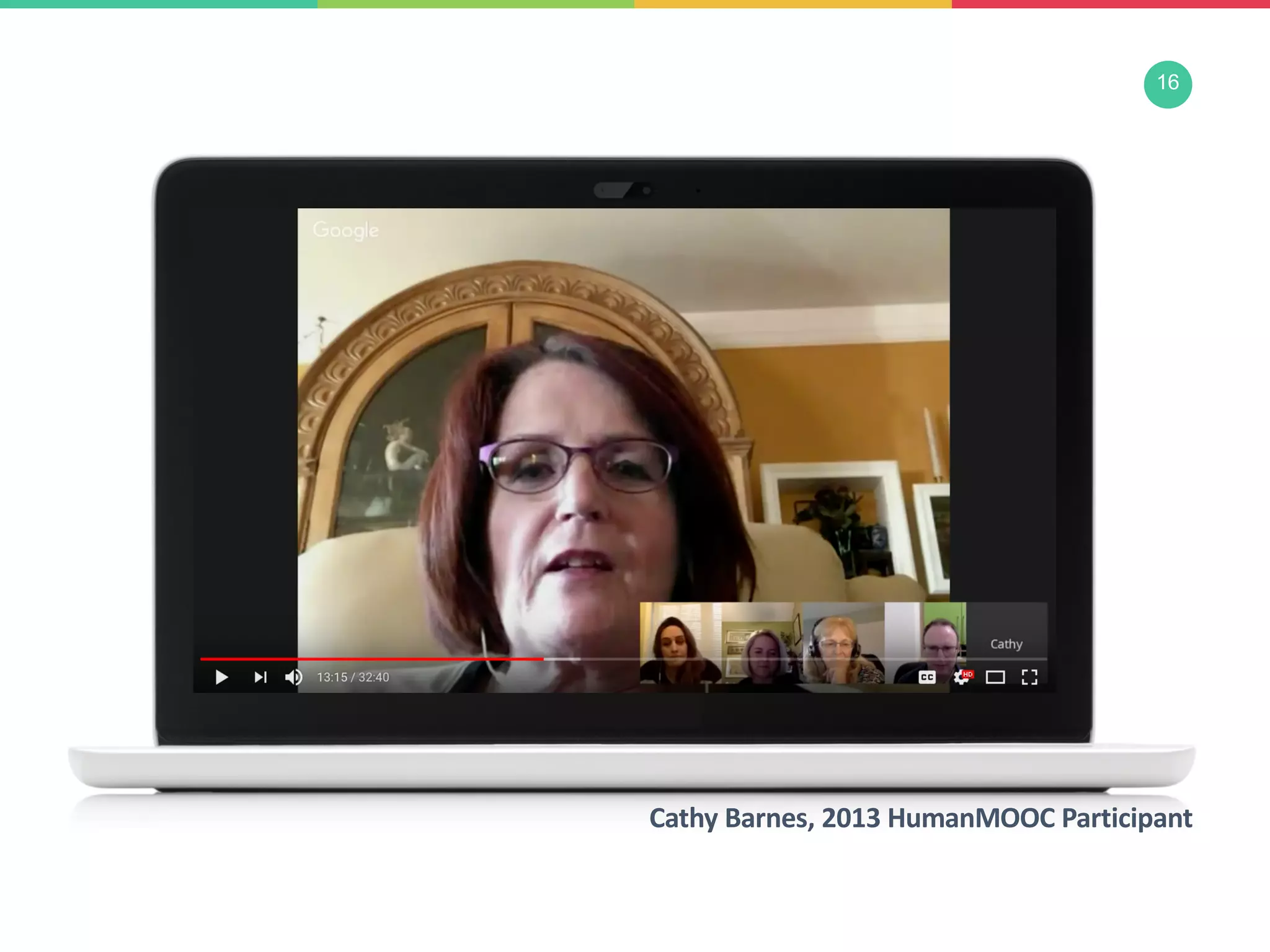
Cathy Barnes, 2013 HumanMOOC Participant
17
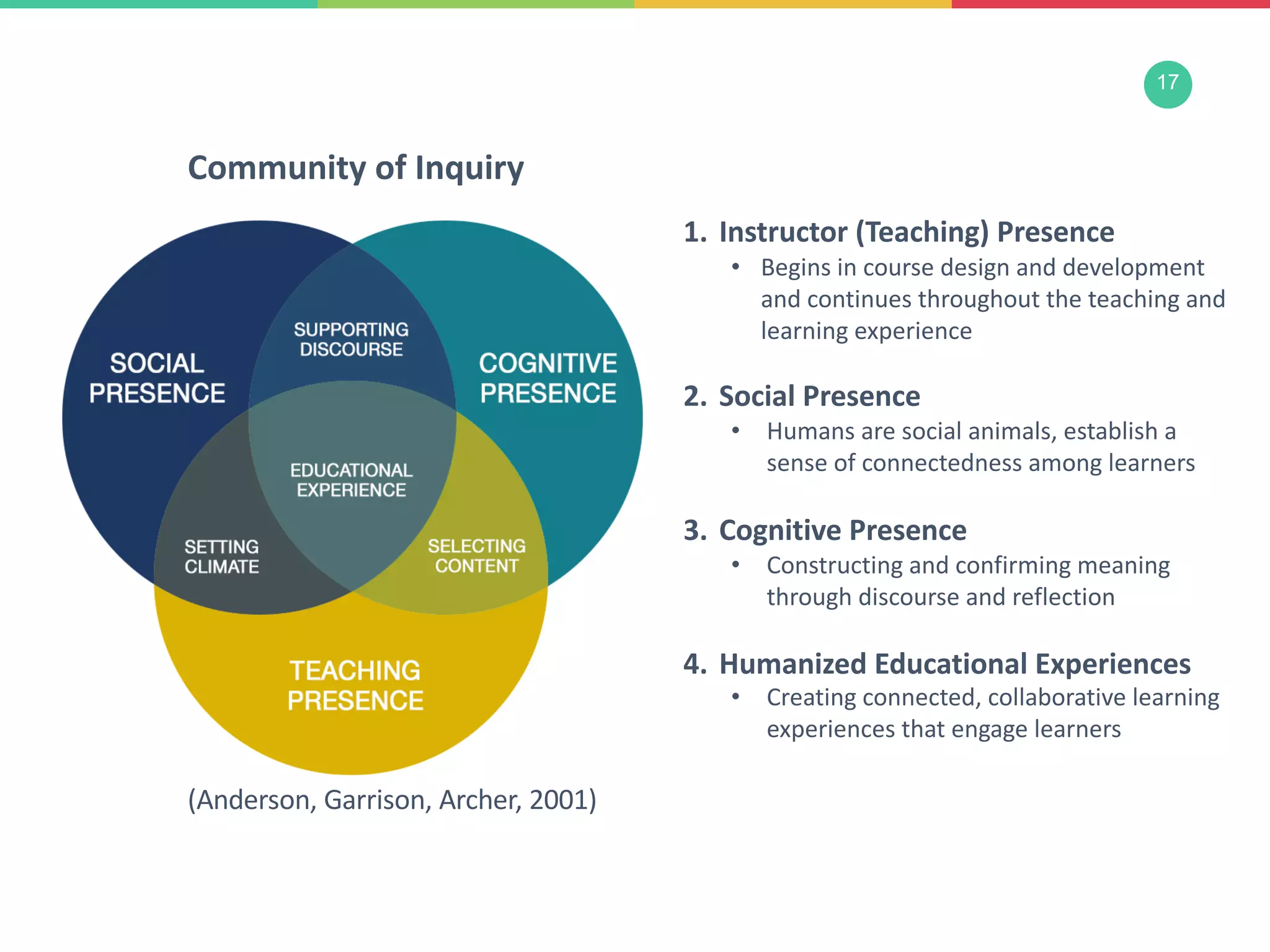
1. Instructor (Teaching) Presence
• Begins in course design and development
and continues throughout the teaching and
learning experience
2. Social Presence
• Humans are social animals, establish a
sense of connectedness among learners
3. Cognitive Presence
• Constructing and confirming meaning
through discourse and reflection
4. Humanized Educational Experiences
• Creating connected, collaborative learning
experiences that engage learners
Community of Inquiry
(Anderson, Garrison, Archer, 2001)
18
“When you categorize the learning as
instructor, cognitive, & social presence,
just putting those into those very
simplistic categories really made me think
areas where my own online courses were
really lacking.
And then trying to figure out realistic
ways to improve them maybe with some
small steps so that I could have more
instructor presence, so that I could
engage ... Get my students to engage with
each other more socially.”
19
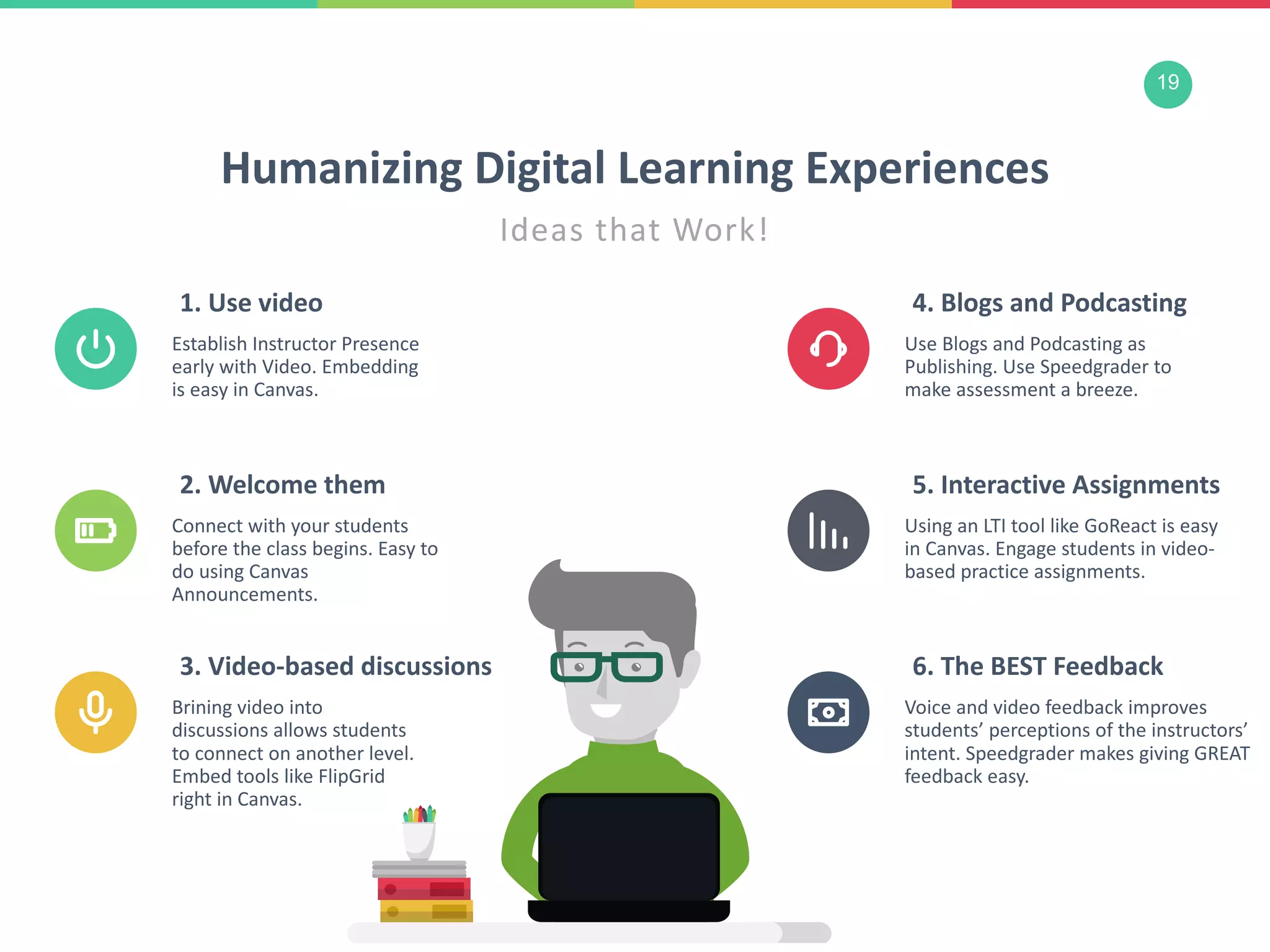
Humanizing Digital Learning Experiences
Ideas that Work!
3. Video-based discussions
Brining video into
discussions allows students
to connect on another level.
Embed tools like FlipGrid
right in Canvas.
1. Use video
Establish Instructor Presence
early with Video. Embedding
is easy in Canvas.
2. Welcome them
Connect with your students
before the class begins. Easy to
do using Canvas
Announcements.
6. The BEST Feedback
Voice and video feedback improves
students’ perceptions of the instructors’
intent. Speedgrader makes giving GREAT
feedback easy.
4. Blogs and Podcasting
Use Blogs and Podcasting as
Publishing. Use Speedgrader to
make assessment a breeze.
5. Interactive Assignments
Using an LTI tool like GoReact is easy
in Canvas. Engage students in video-
based practice assignments.
20
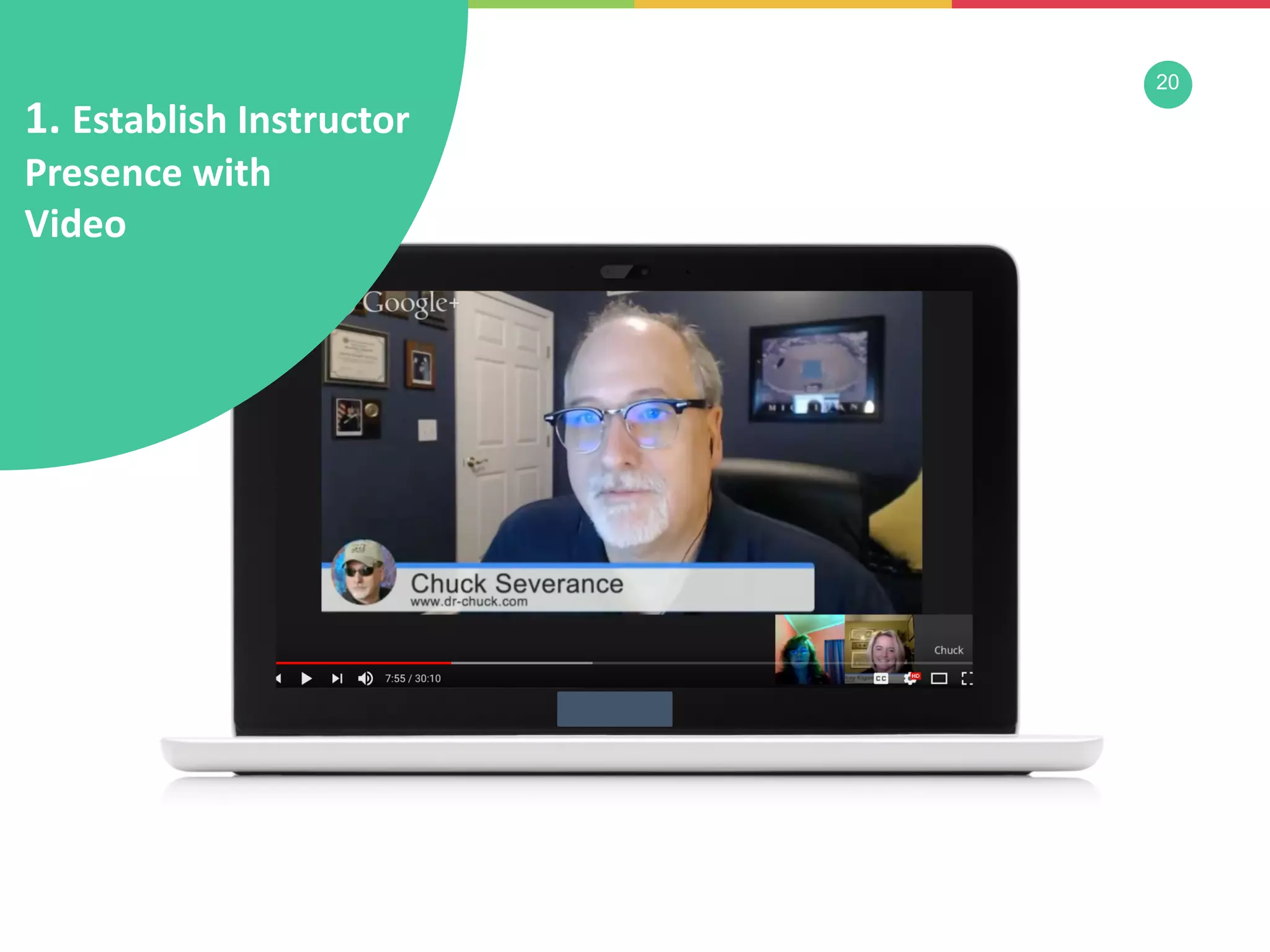
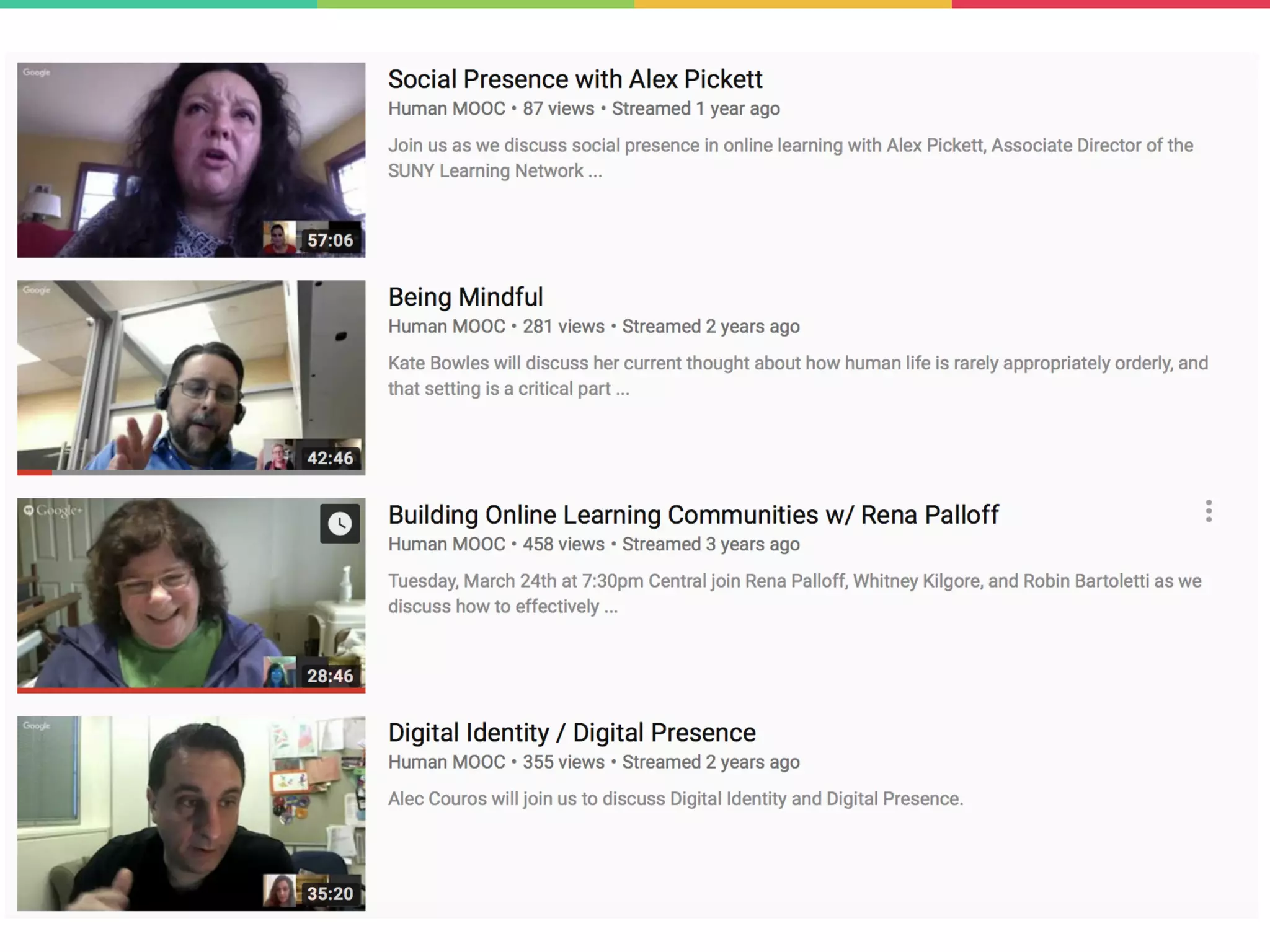
1. Establish Instructor
Presence with
Video
21
22
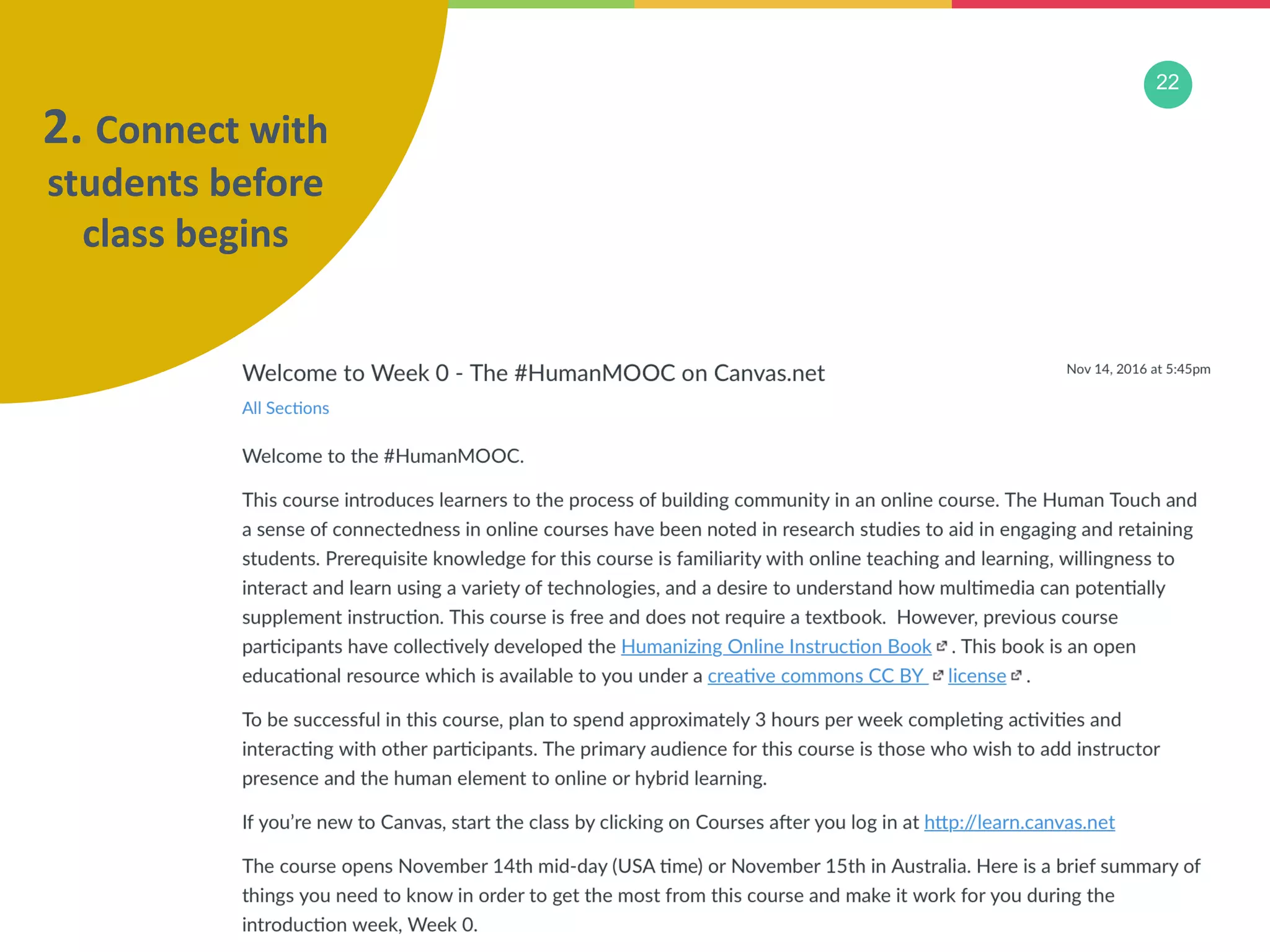
2. Connect with
students before
class begins
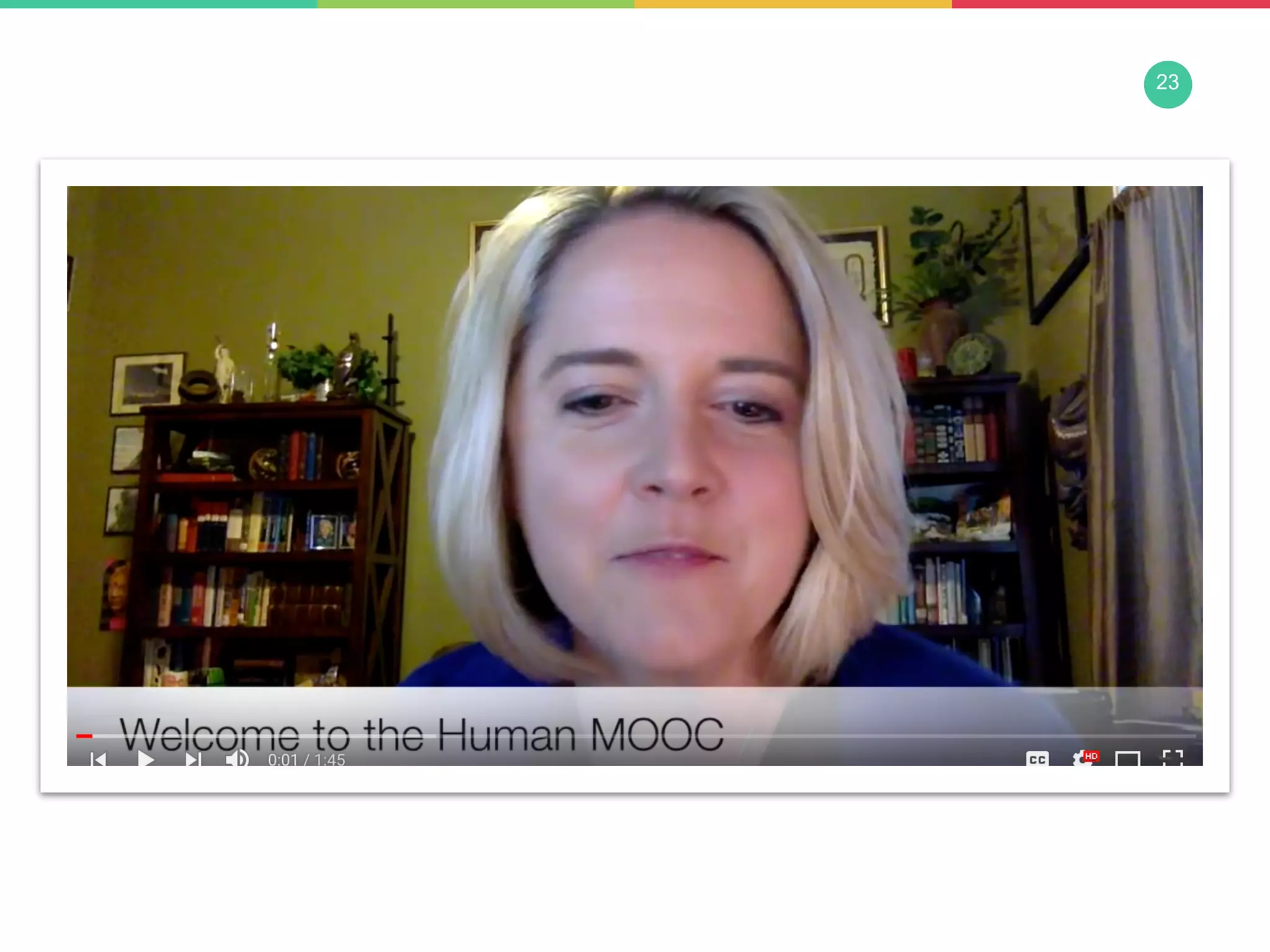
23
24
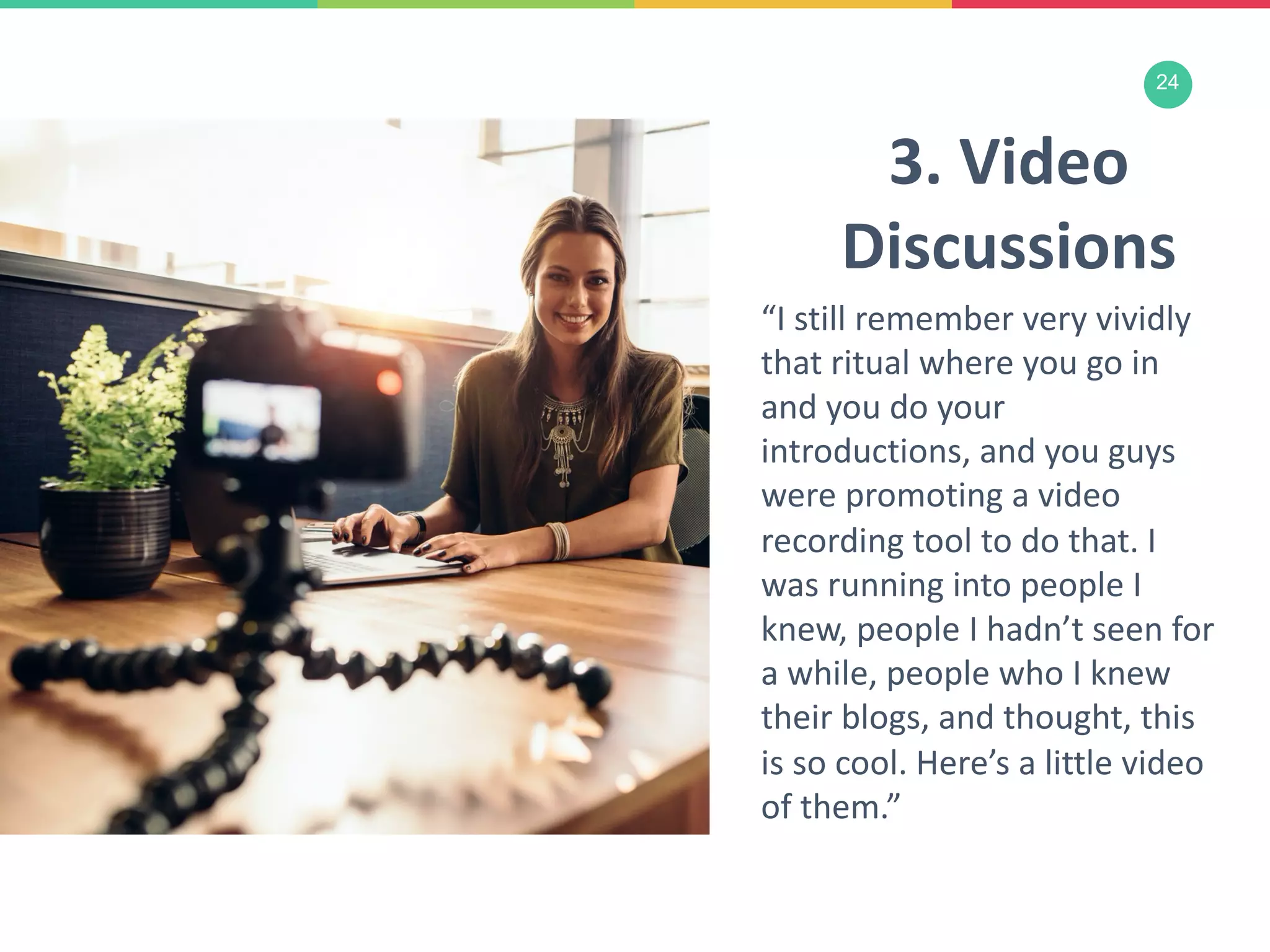
3. Video
Discussions
“I still remember very vividly
that ritual where you go in
and you do your
introductions, and you guys
were promoting a video
recording tool to do that. I
was running into people I
knew, people I hadn’t seen for
a while, people who I knew
their blogs, and thought, this
is so cool. Here’s a little video
of them.”
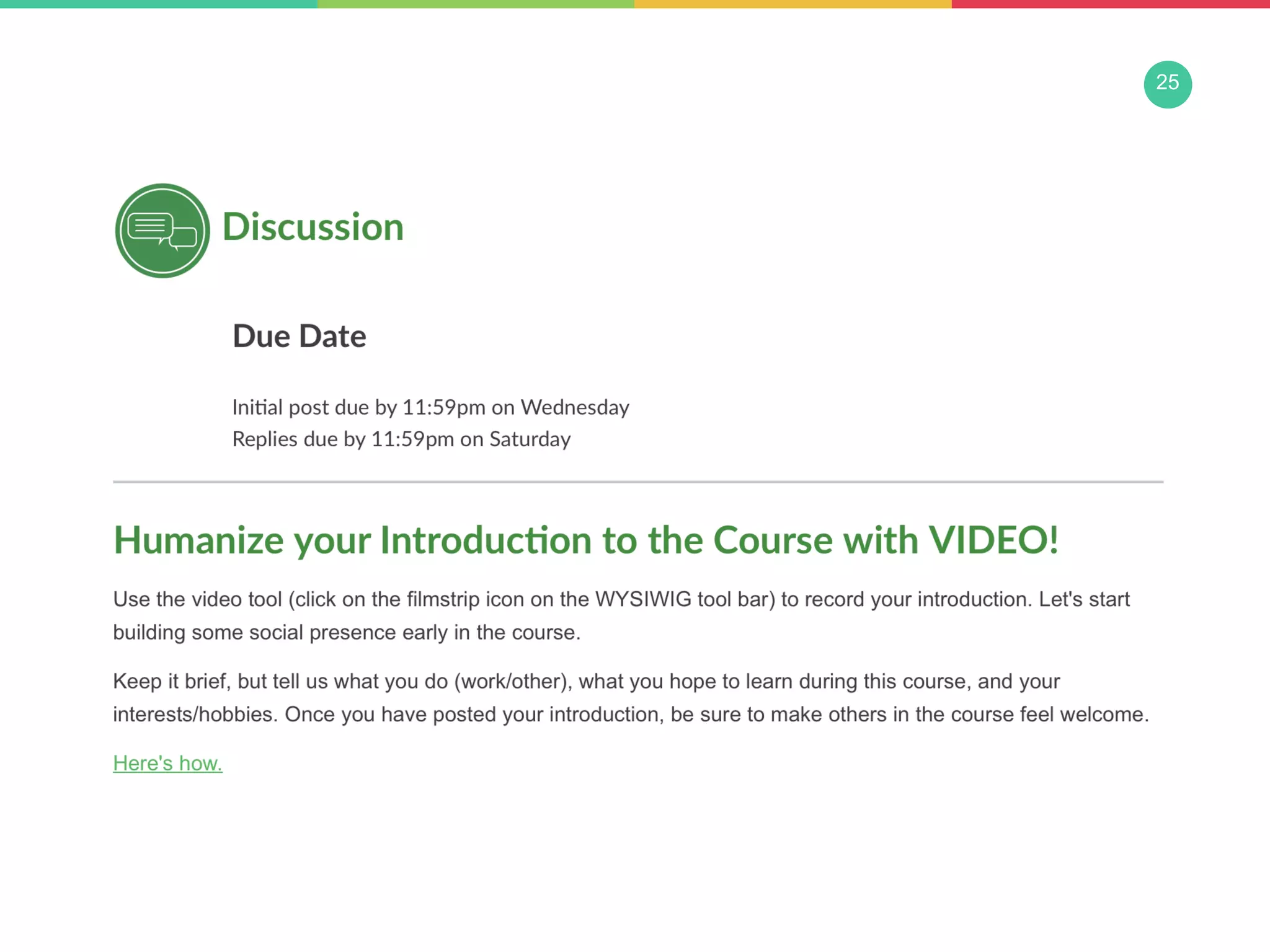
25
26
27
28
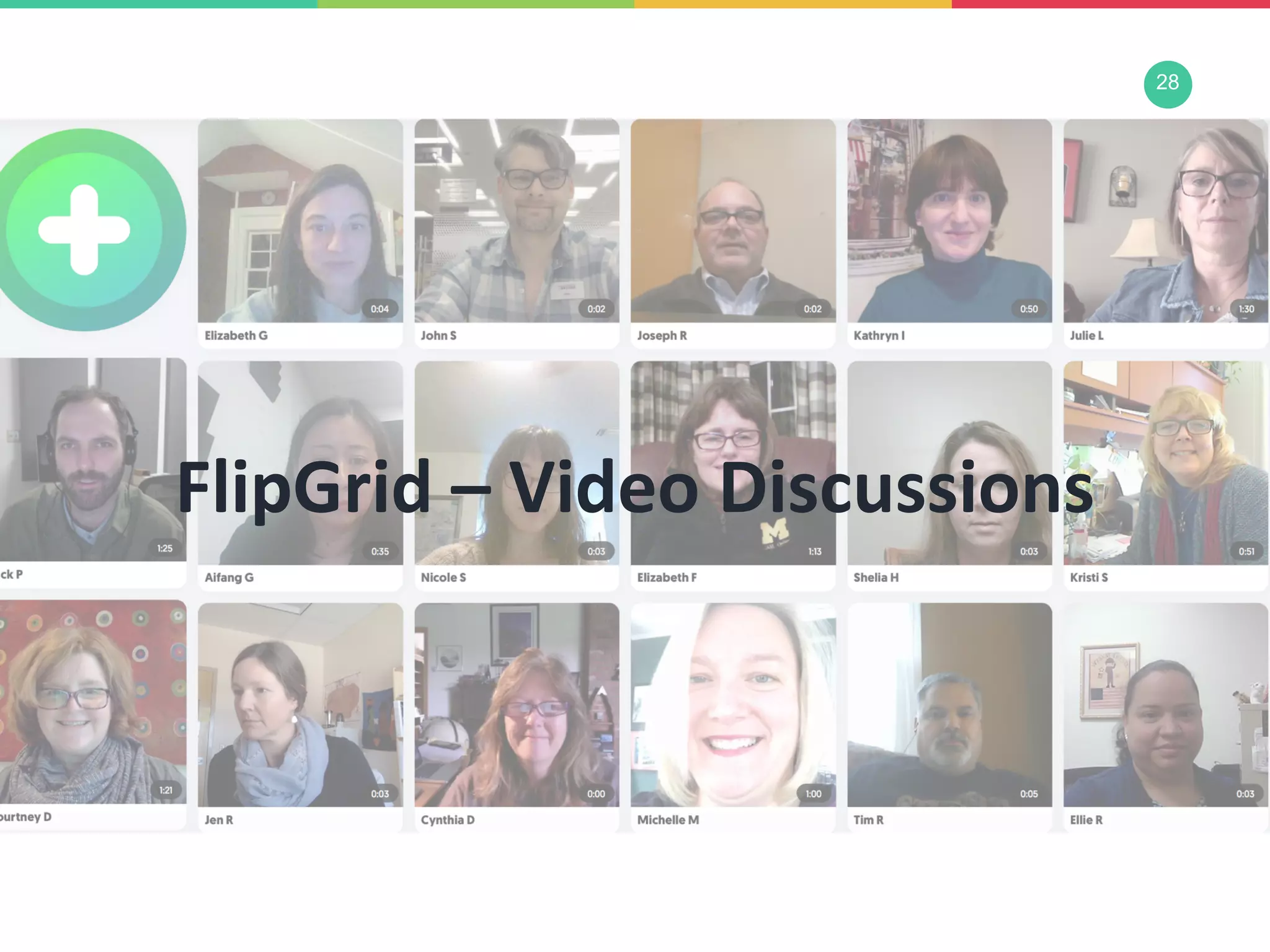
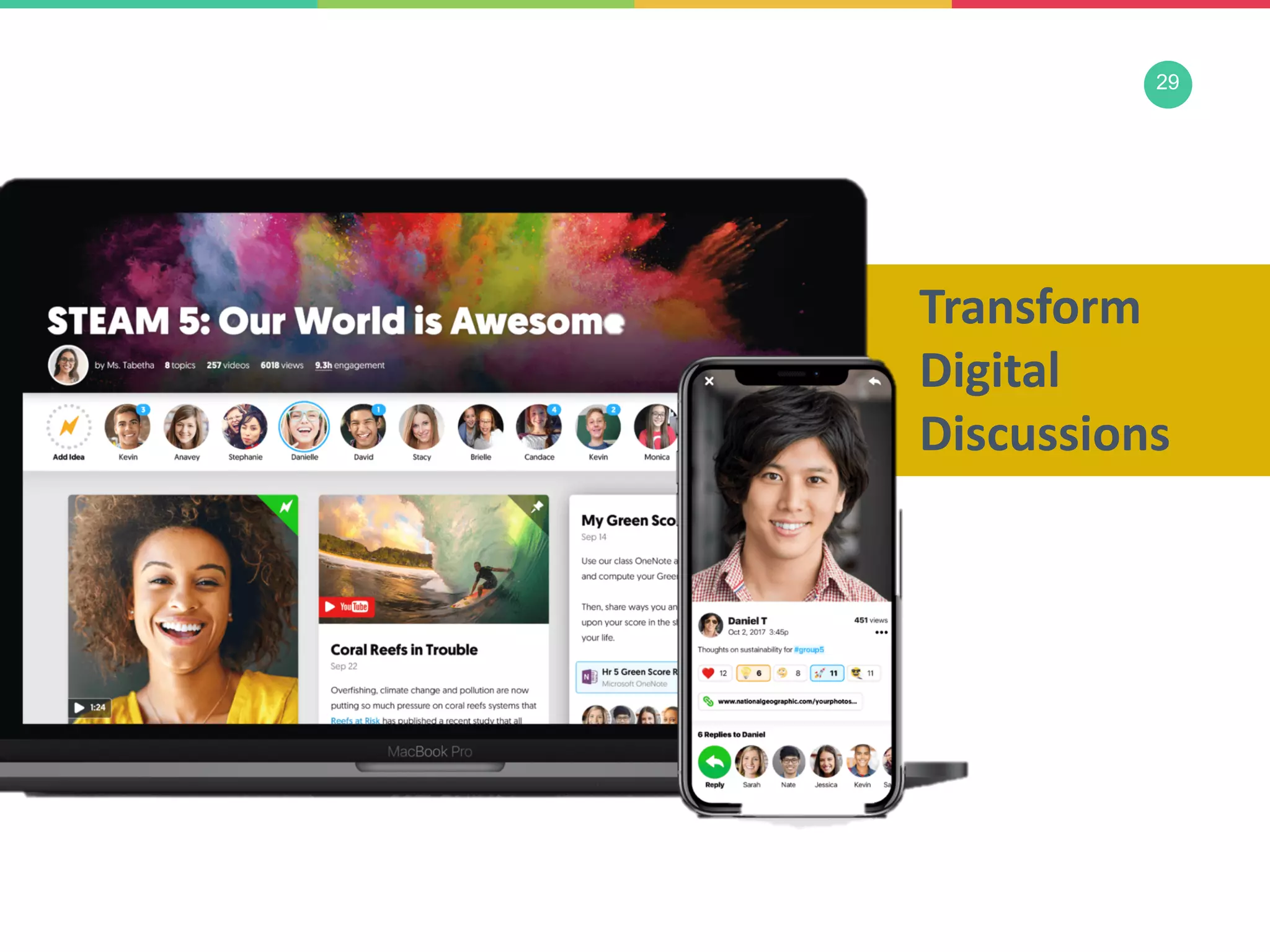
FlipGrid – Video Discussions
29
Transform
Digital
Discussions
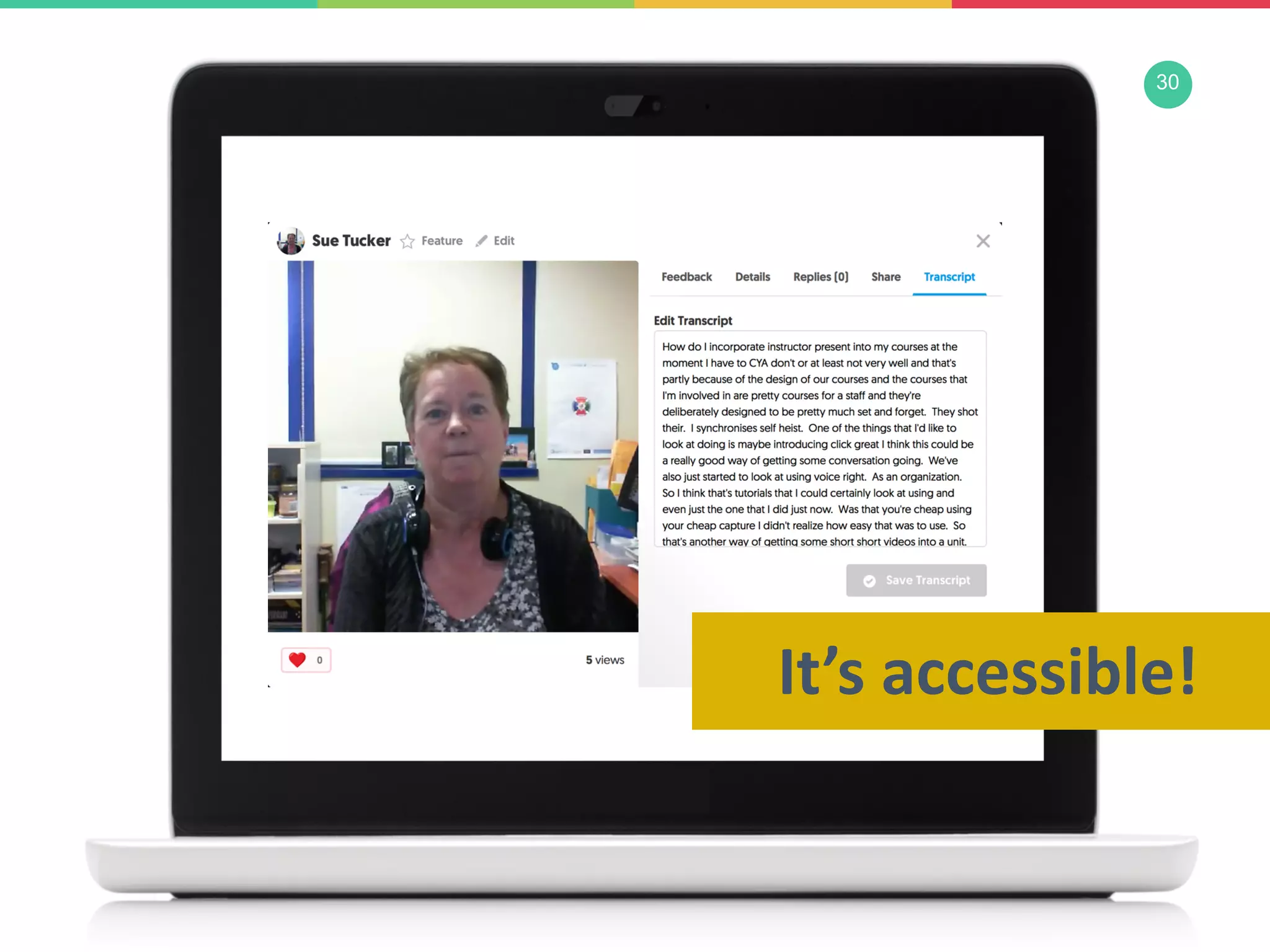
30
It’s accessible!
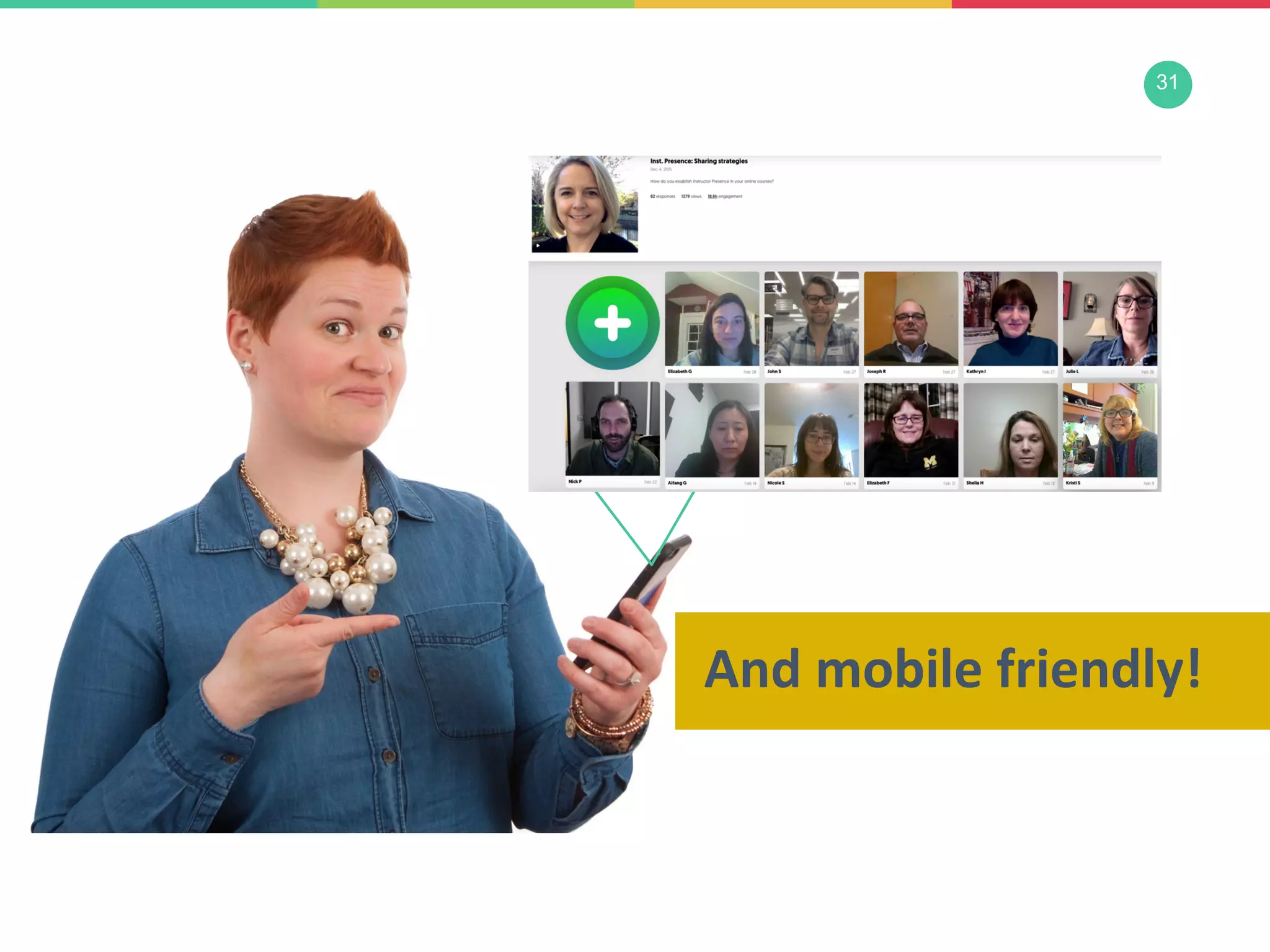
31
And mobile friendly!
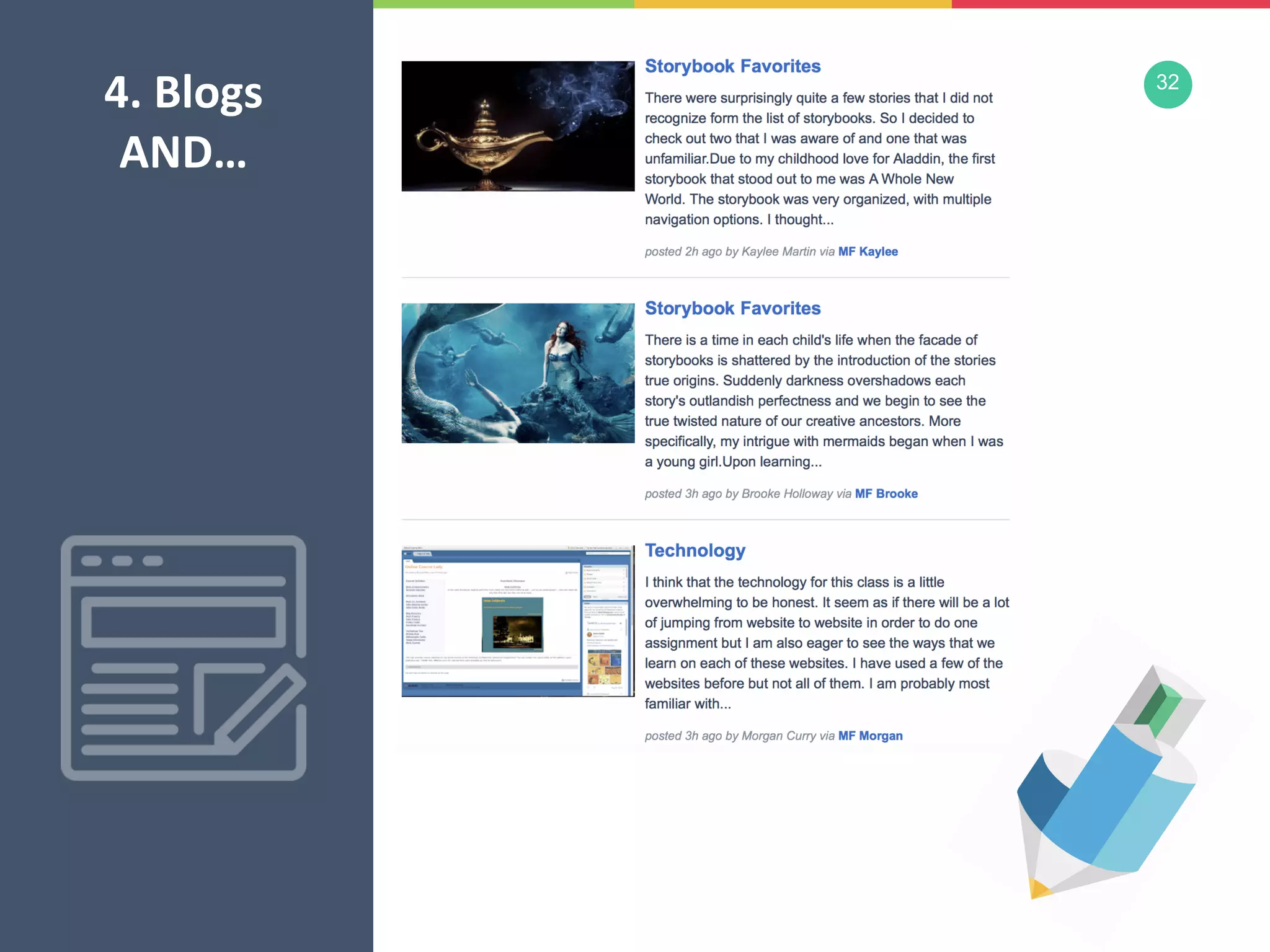
32
4. Blogs
AND…
33
https://www.inoreader.com
34
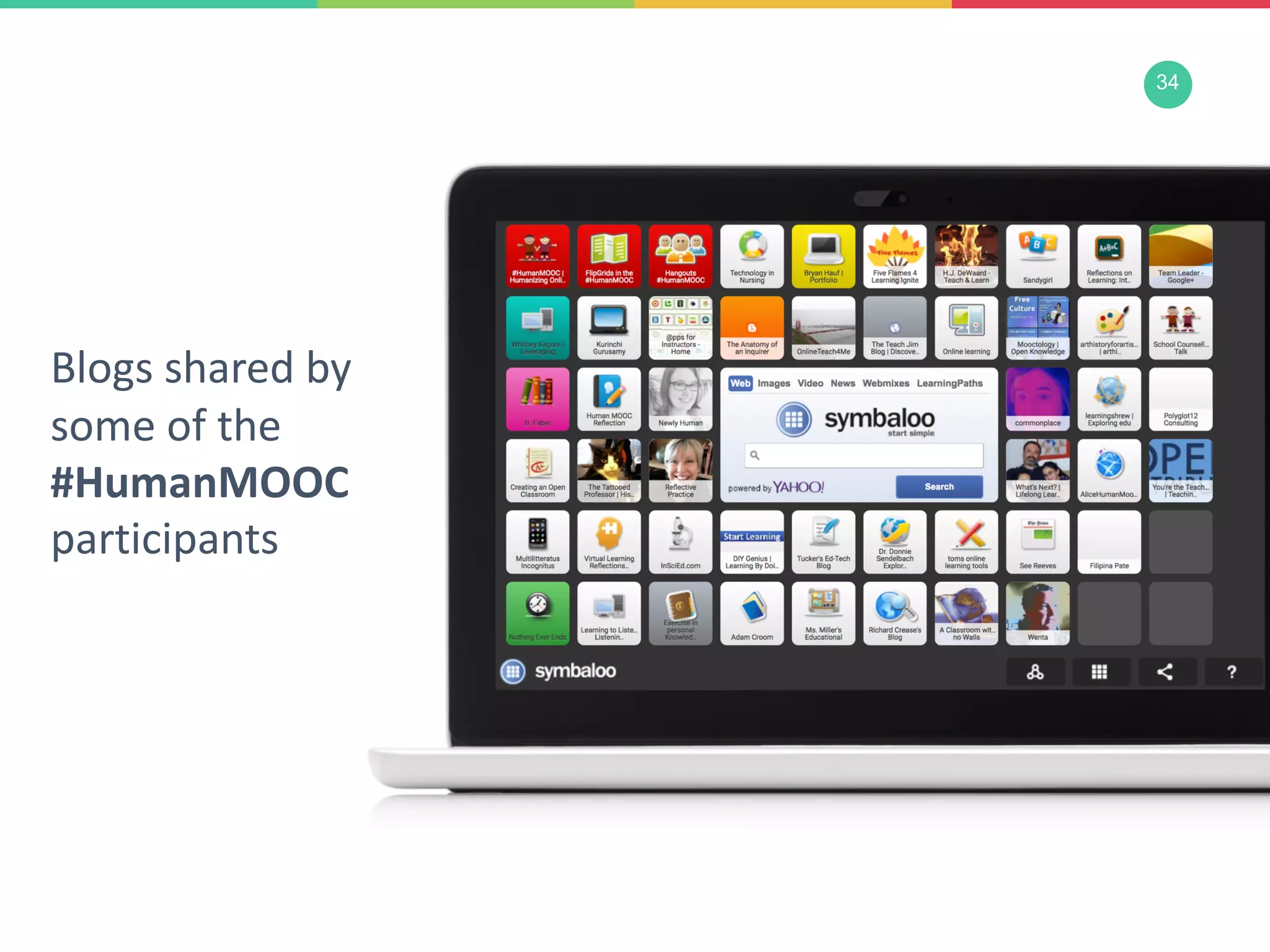
Blogs shared by
some of the
#HumanMOOC
participants
35
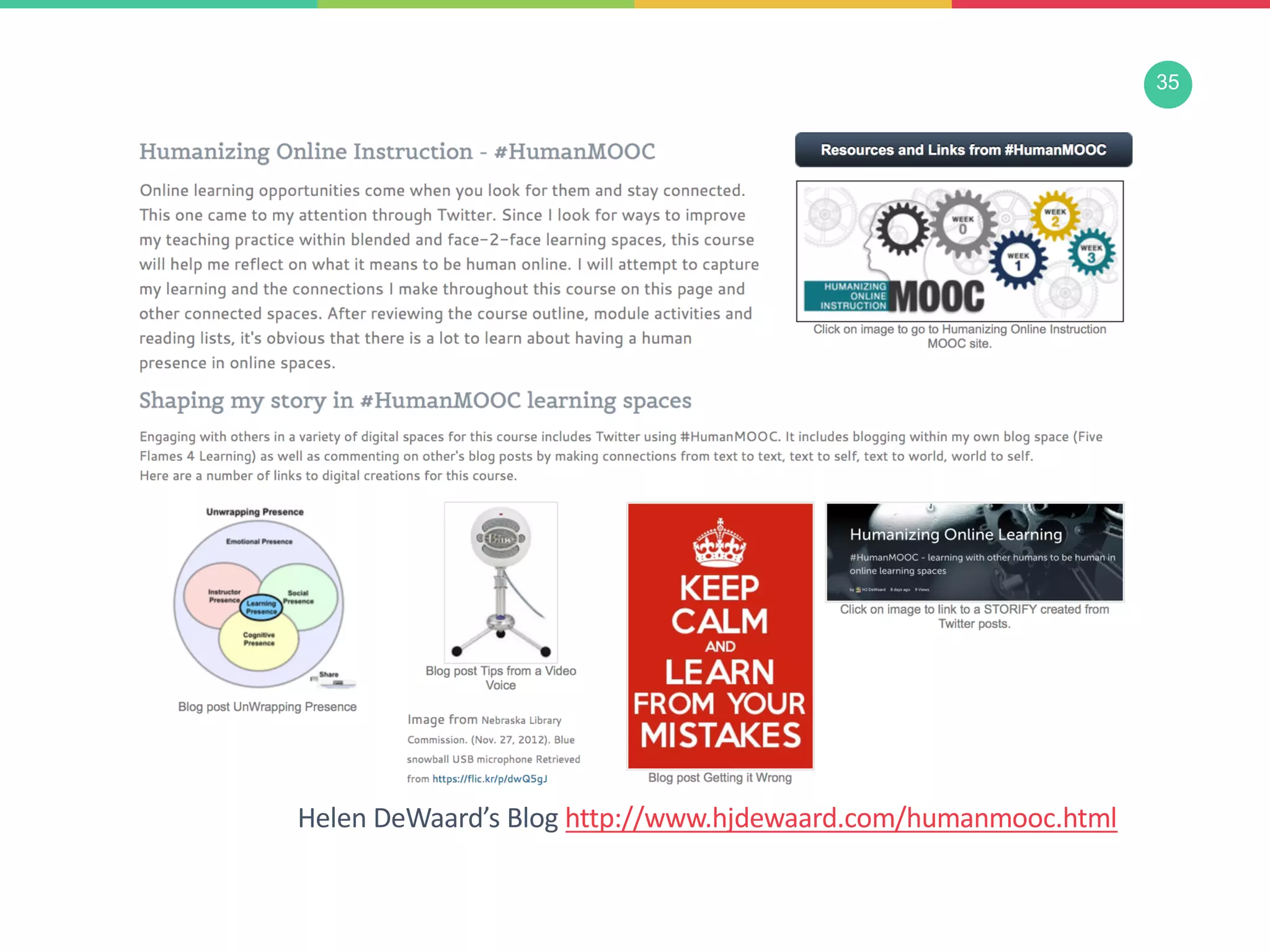
Helen DeWaard’s Blog http://www.hjdewaard.com/humanmooc.html
36
37
Podcasting
Vodcasting
Vlogging
38
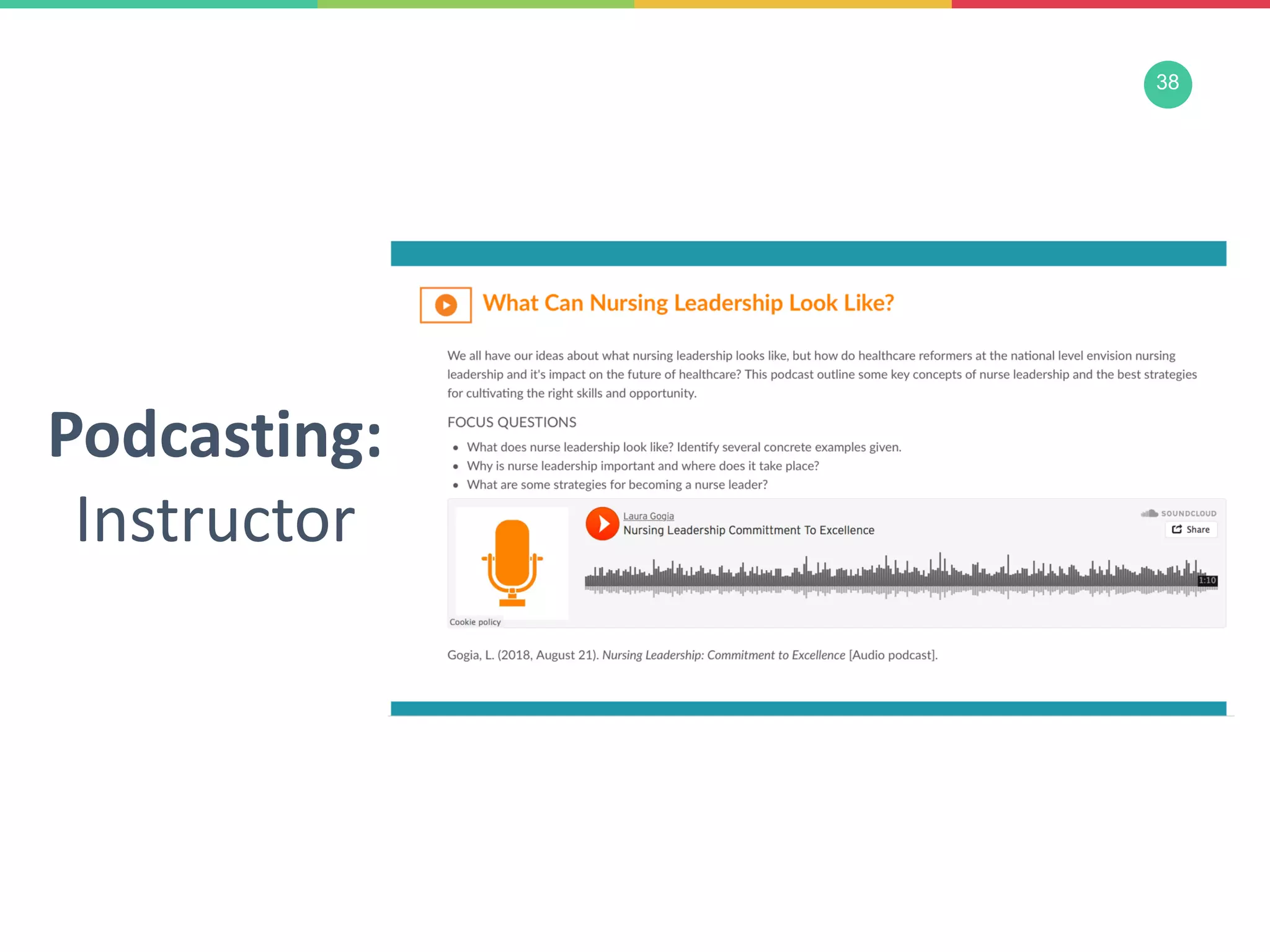
Podcasting:
Instructor
39
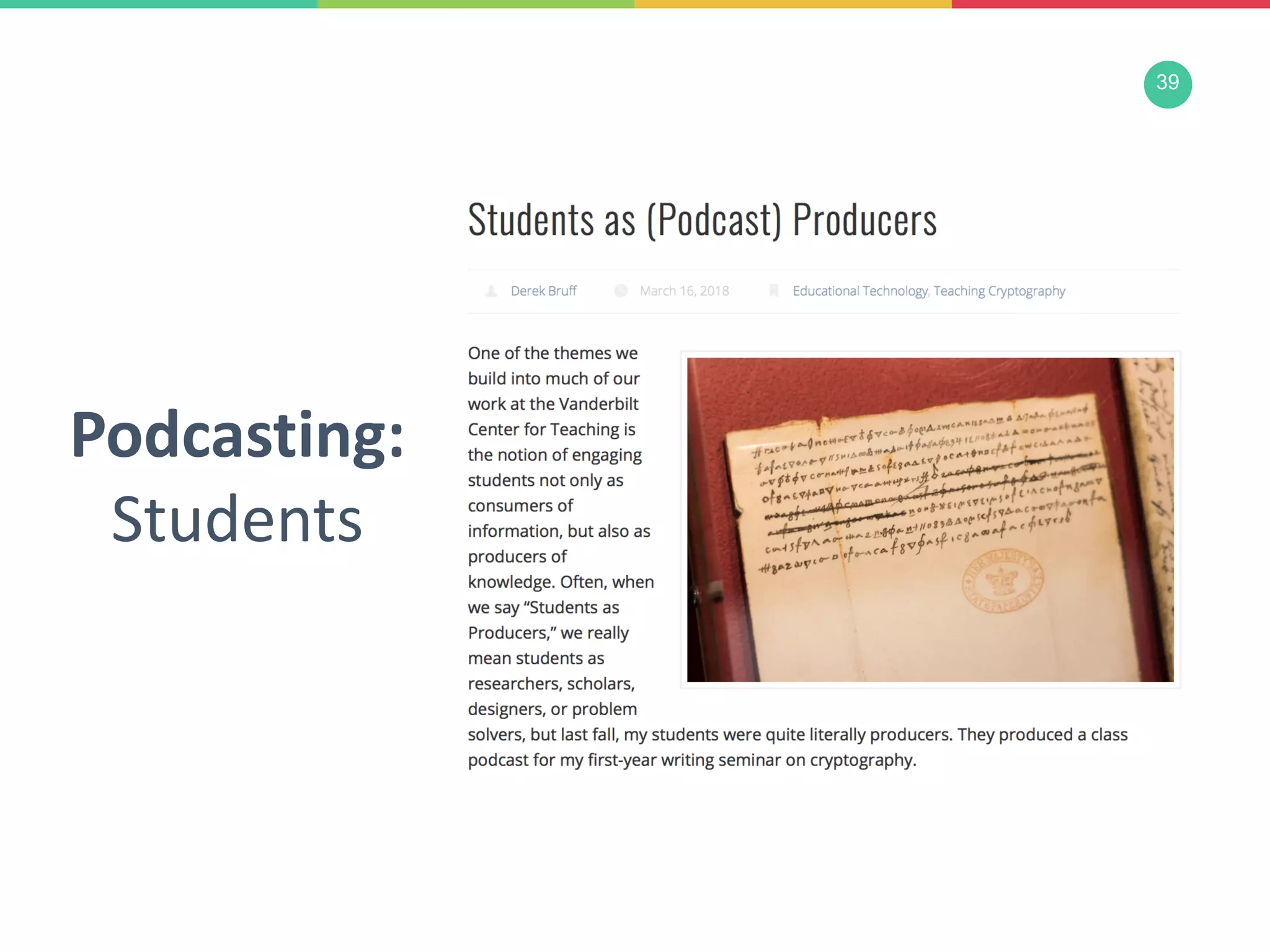
Podcasting:
Students
40
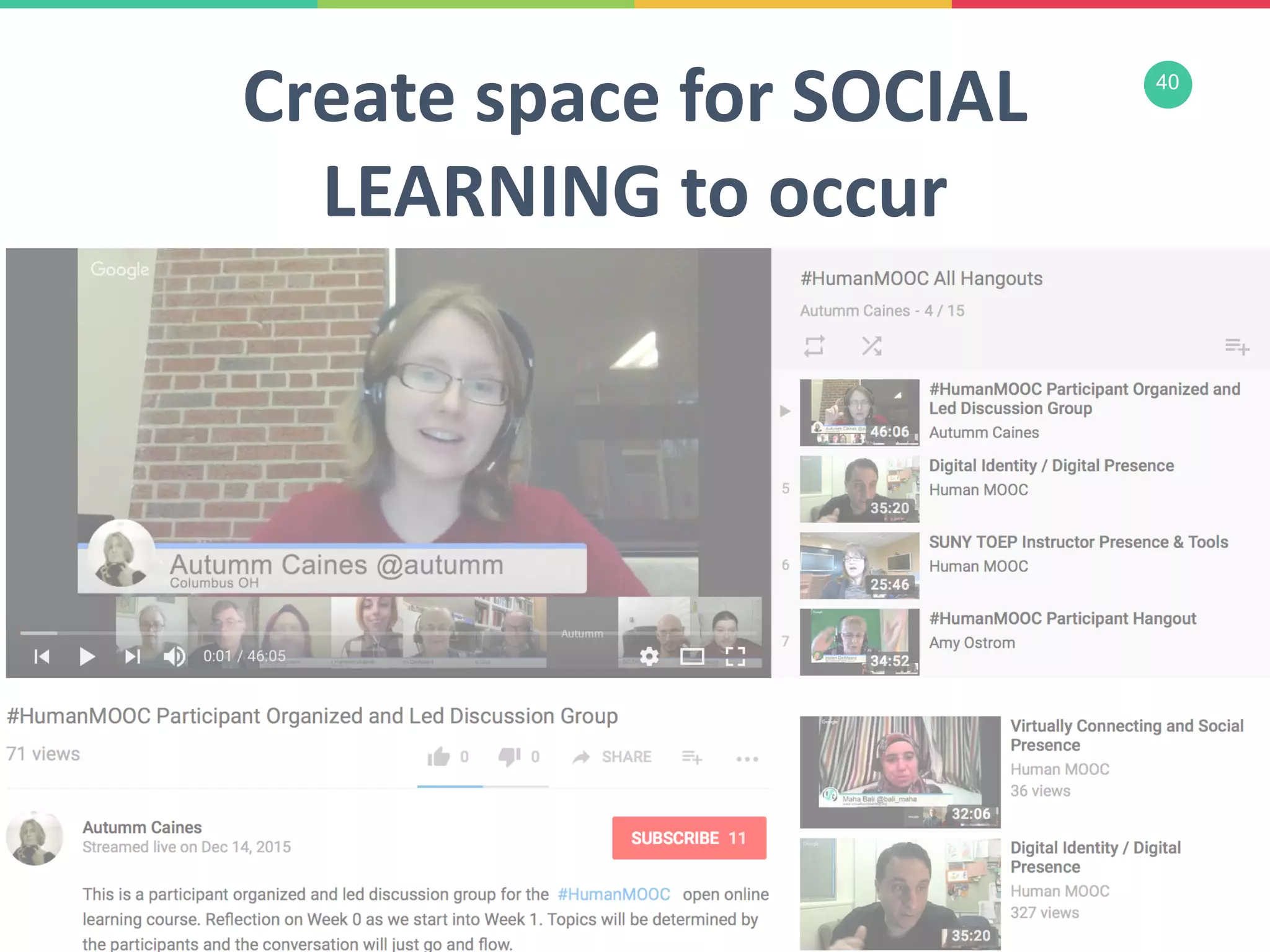
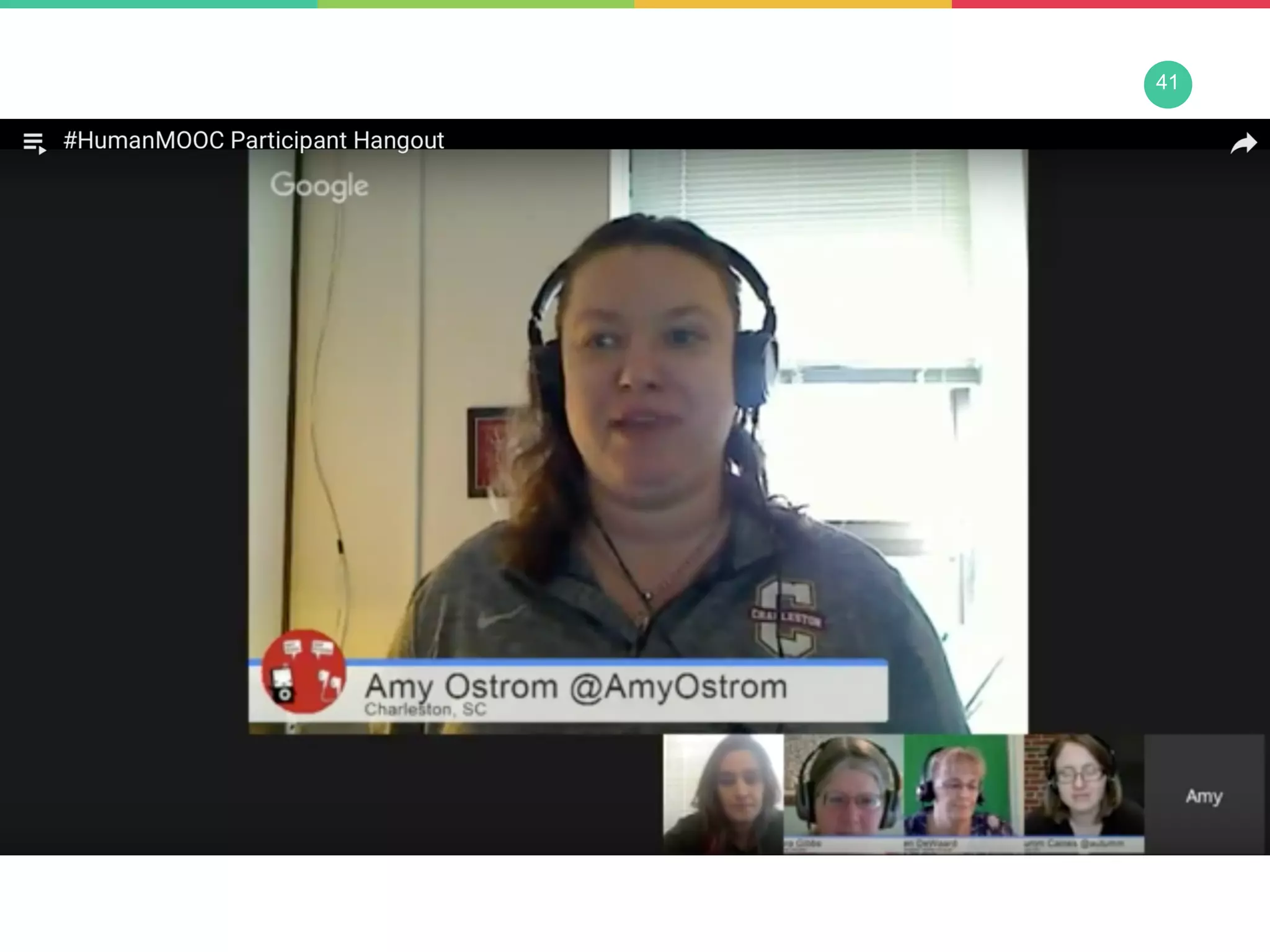
Create space for SOCIAL
LEARNING to occur
41
42
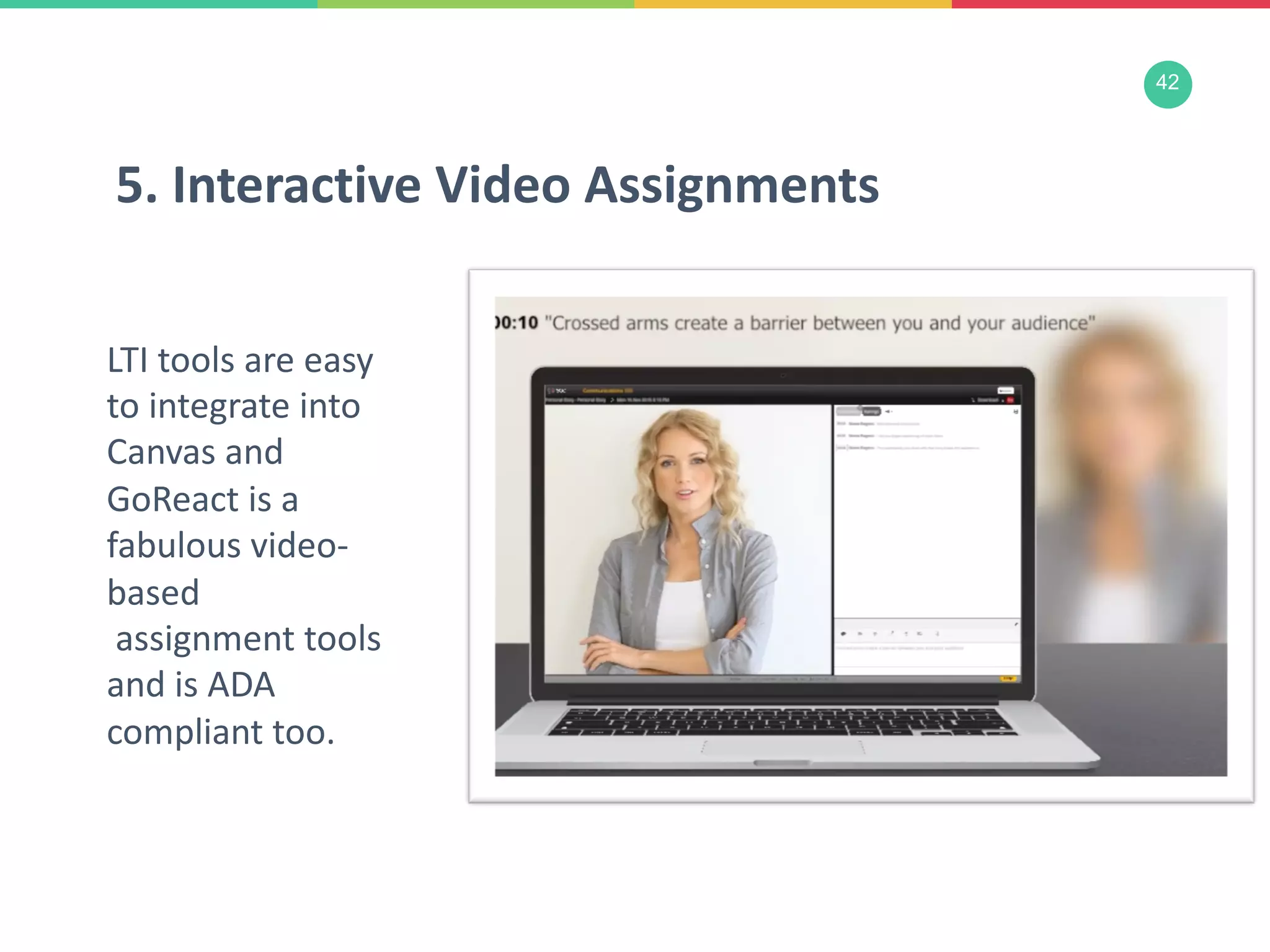
LTI tools are easy
to integrate into
Canvas and
GoReact is a
fabulous video-
based
assignment tools
and is ADA
compliant too.
5. Interactive Video Assignments
43
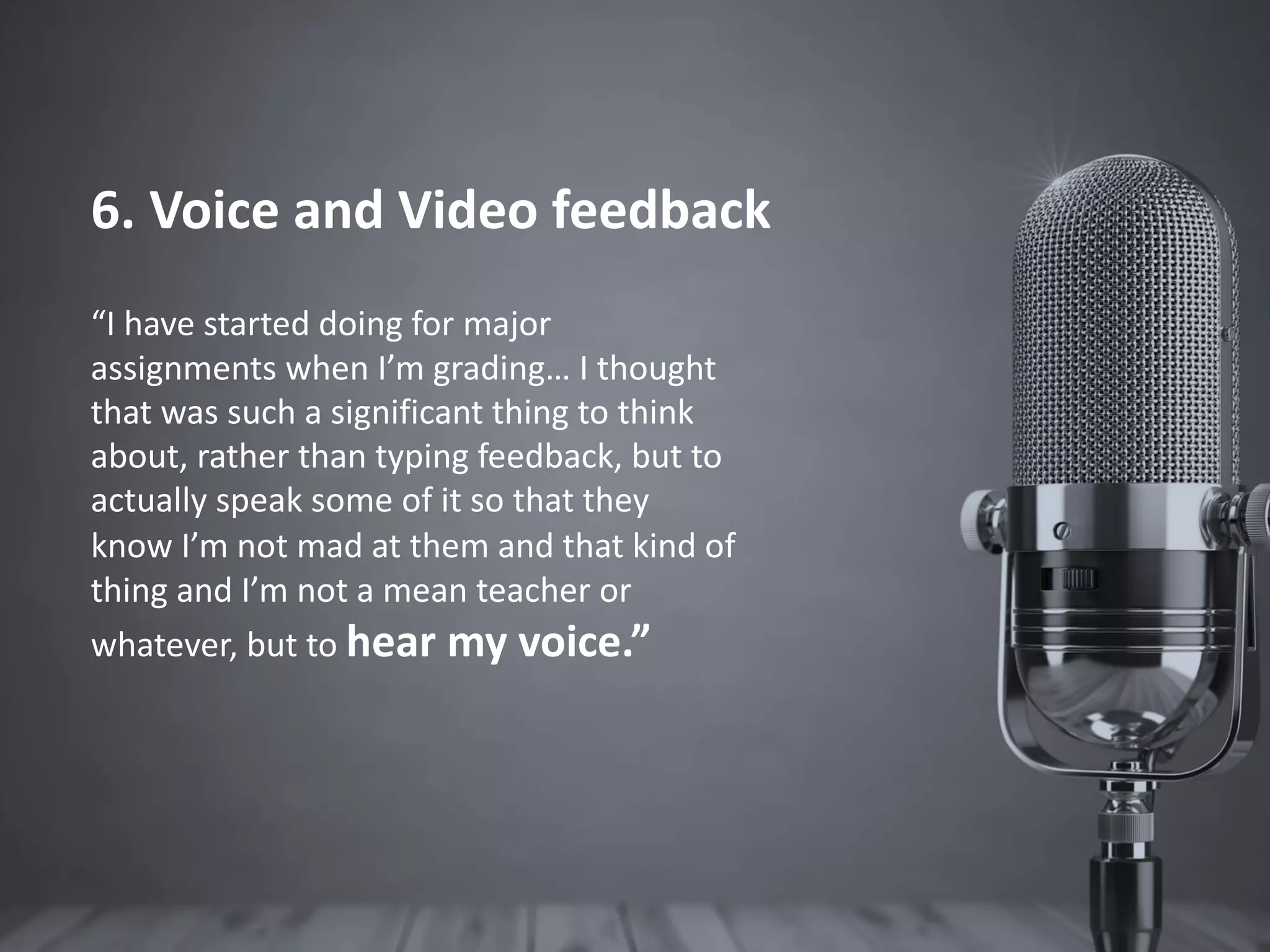
6. Voice and Video feedback
“I have started doing for major
assignments when I’m grading… I thought
that was such a significant thing to think
about, rather than typing feedback, but to
actually speak some of it so that they
know I’m not mad at them and that kind of
thing and I’m not a mean teacher or
whatever, but to hear my voice.”
44
“It’s much more challenging to
get meaningful feedback in the
online environment about who
can hear you, who can’t. Who’s
engaging, who’s getting what
they need.”
-HumanMOOC Participant
45
ImpacttoPracticeStory!
46
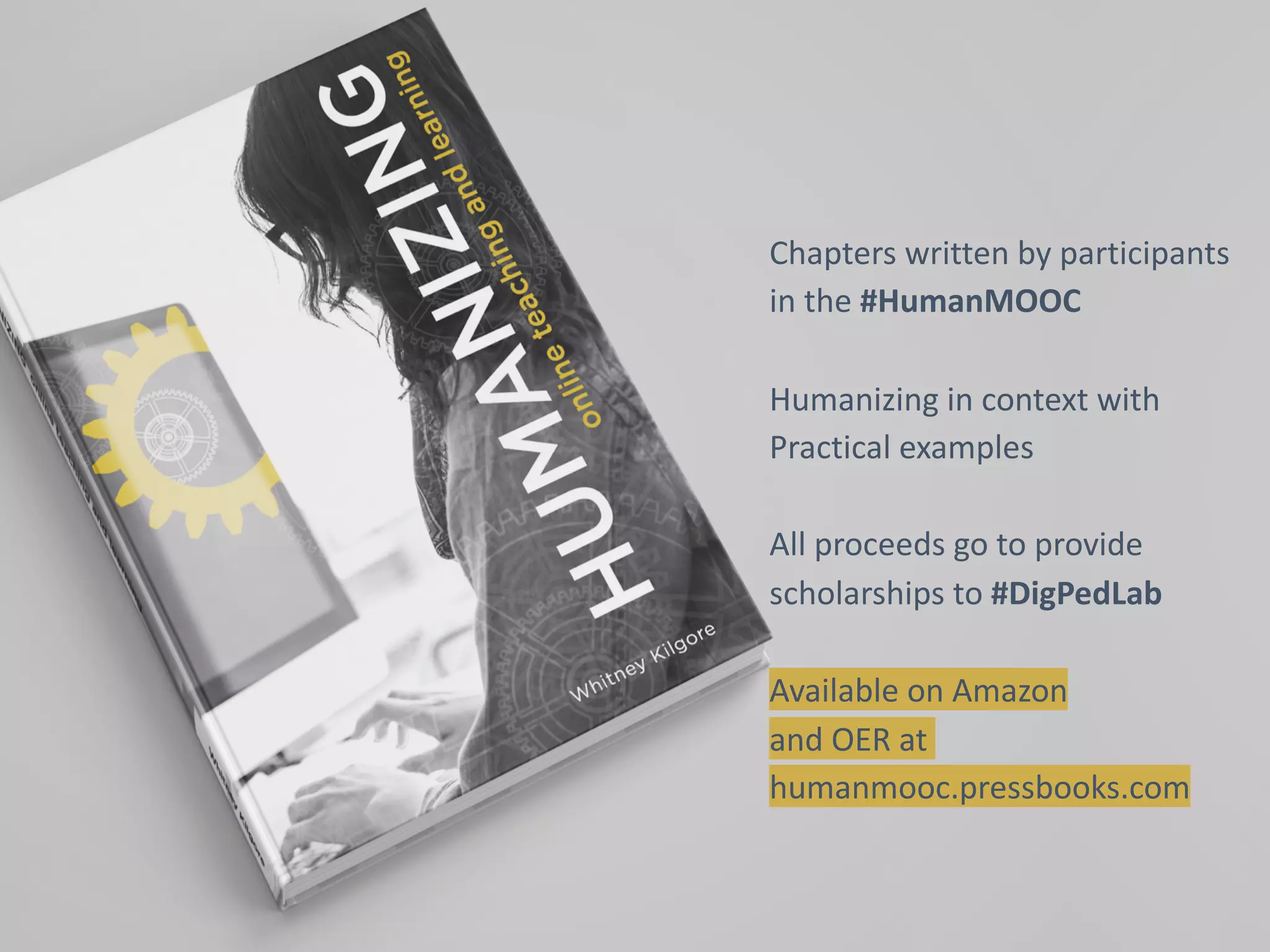
Chapters written by participants
in the #HumanMOOC
Humanizing in context with
Practical examples
All proceeds go to provide
scholarships to #DigPedLab
Available on Amazon
and OER at
humanmooc.pressbooks.com
47
#ScholarshipNOTSwag
@iDesignEDU
48
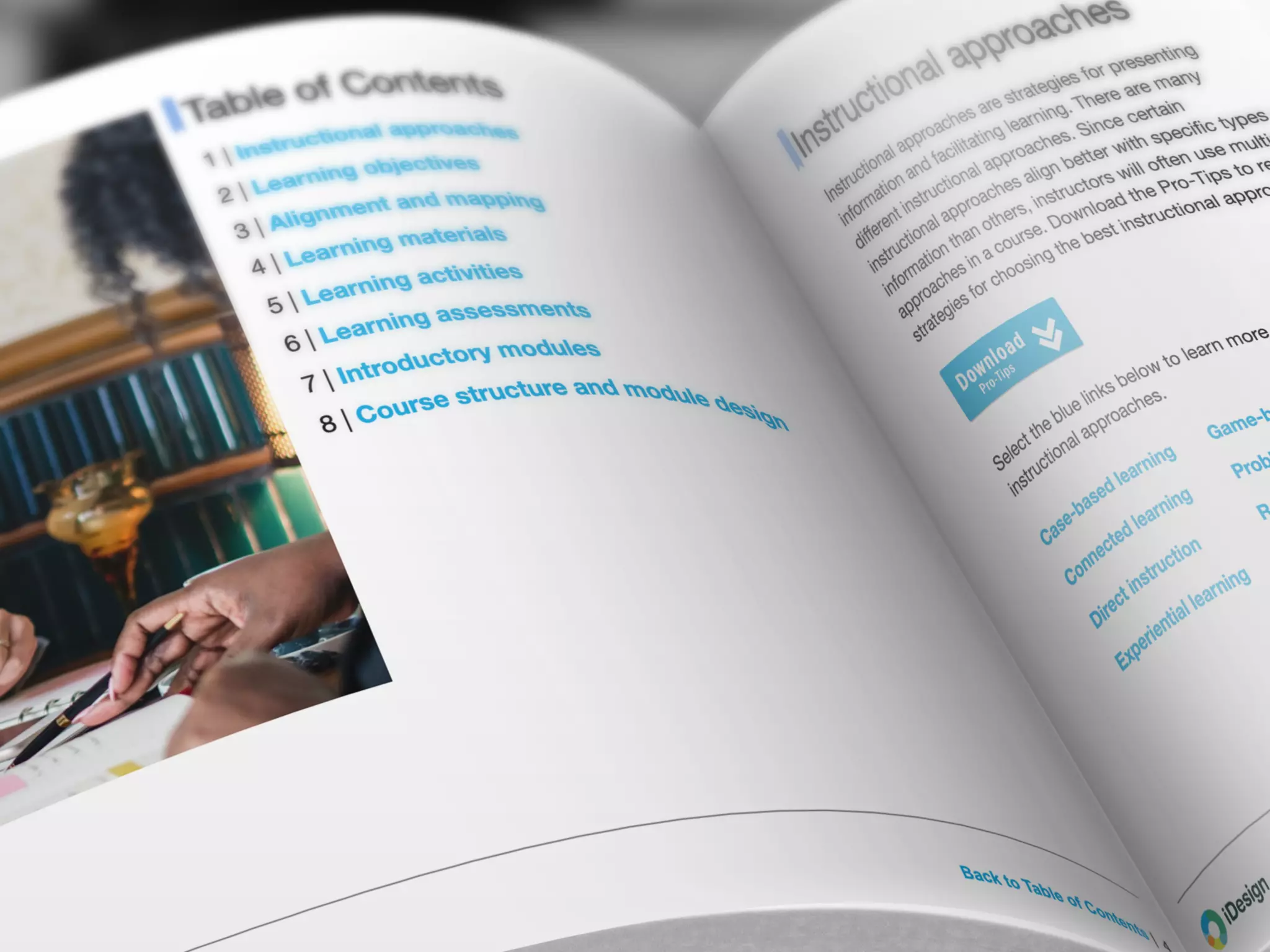
idesignedu.org/idea-book
49
50
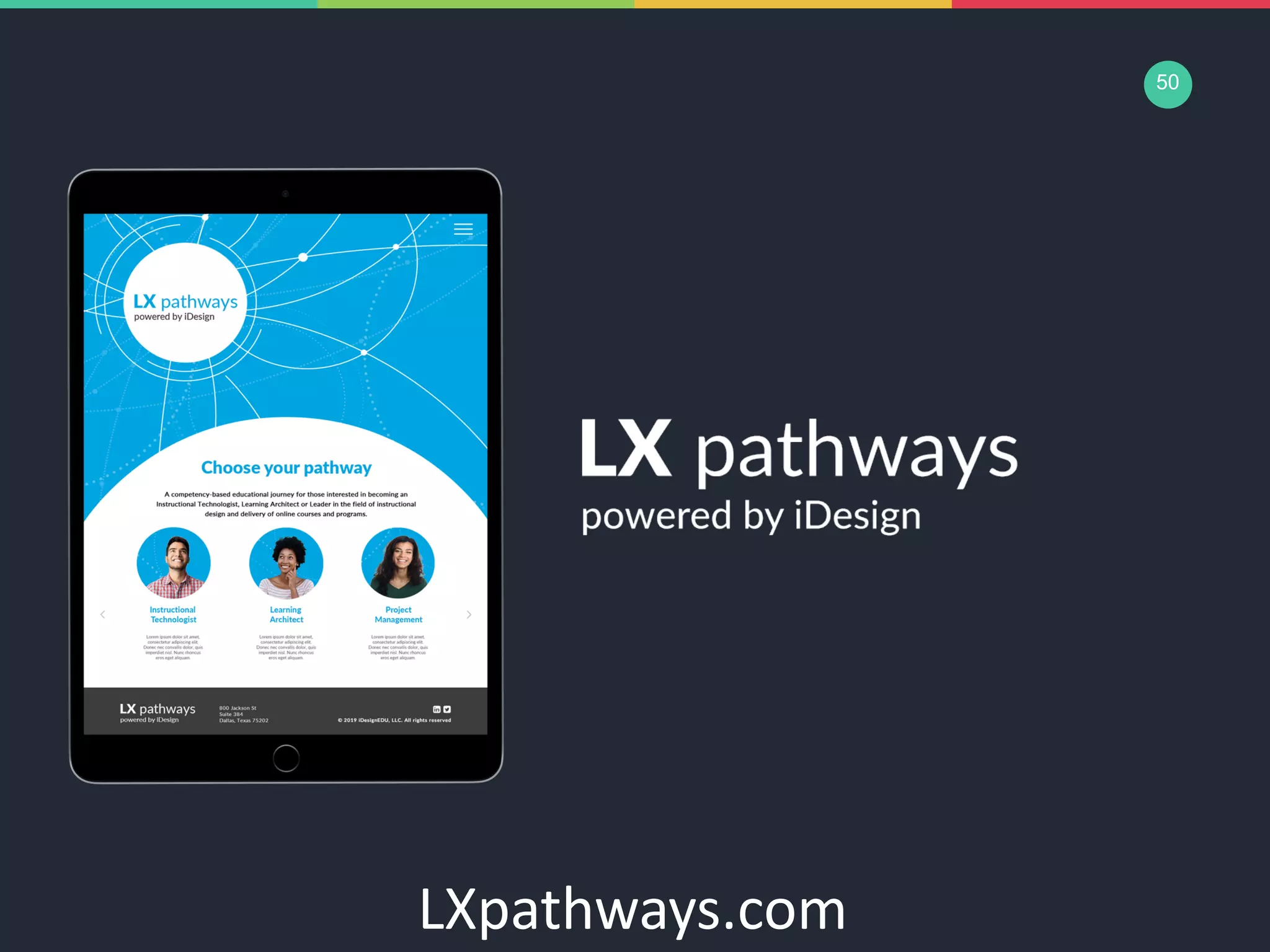
LXpathways.com
51
Research and Dissemination
Robinson, H. A., Al-Freih, M., Kilgore, W., & Prusko, P. T. (May 2019). Findings on modeling as impact to
practice from the HumanMOOC. Elearn Magazine. Retrieved
from https://elearnmag.acm.org/archive.cfm?aid=3313875#
Kilgore, W., Prusko, P. T., Robinson, H., & Al-Freih, M. (2019). HumanMOOC: A reflective look at impact to
practice. Paper Presented at OER19, National University of Ireland, Galway, Ireland, April 10-11.
Kilgore, W., & Al-Freih, M.(2016). MOOCs as an innovative pedagogical design laboratory. International Journal
on Innovation in Online Education, 1(1). Retrieved from https://onlineinnovationsjournal.com/streams/the-
influence-of-social-media-on-online-education/4b9873d96241a56b.html
Prusko, T. P., Kilgore, W., & Al-Freih, M. (October 2017). The Role of Specific Human Constructs Such as
Imagination, Joy, and Amazement in MOOCs: Tools for Collaboration, Feedback, Testing, and Content
Delivery. Lightning talk/poster session presented at the Learning With MOOCs 2017 (LWMOOC2017)
conference, University of Texas, Austin, TX, October 8-10.
Kilgore, W., & Al-Freih, M. (2016). MOOCs as an innovative pedagogical design laboratory. International Journal
on Innovation in Online Education, 1(1). Retrieved from https://onlineinnovationsjournal.com/streams/the-
influence-of-social-media-on-online-education/4b9873d96241a56b.html
Al-Freih, M., Kilgore, W., & Bradford, K. (2016). Big data, little data: A story behind the numbers.Paper
presented at the 13th Annual Open Education Conference, Richmond, VA, November 2-4.
And… dissertations by Matt Crosslin and Maha Al-Freih
52
Research and Dissemination
Kilgore, W., Bartoletti, R., Al-Freih, M., (2015). Design Intent and Iteration of the #HumanMOOC. In proceedings of the European MOOC
Stakeholders Conference 2015, (pp. 7 – 12) Mons, Belgium.
Kilgore, W., & Lowenthal, P. R. (2015). The Human Element MOOC: An experiment in social presence. In R. D. Wright (Ed.), Student-
teacher interaction in online learning environments (pp. 373-391). Hershey, PA: IGI Global.
Al-Freih, M., Dabbagh, N., Kilgore, W., & Bartoletti, R. (June 2015). The role of learning theories in MOOC design and research. Paper
presented at the 2015 Enterprise Learning Conference (ELC), Manassas, Virginia.
Al Freih, M. & Kilgore, W. (2015) The HumanMOOC: A Community of Inquiry for Online Instructors. Presented at the Digital Learning
Research Network Conference at Stanford University, CA.
Kilgore, W. (2015) Humanizing Online Instruction. Presented at InstructureCon, Park City, UT.
Duque, S. & Kilgore, W. (2014). The Human Element: A MOOC on the Community of Inquiry, Sloan Consortium Emerging Technologies for
Online Learning Conference, Dallas, TX.

Humanizing online learning: why the user experience matters

  • 1.
    1 CAN DO @The Universityof North Texas November 15, 2019 Humanizing online learning: why the user experience matters
  • 2.
    2 Media Coverage UX toLX: The Rise of Learner Experience Design Instructure Launches LMS ‘Genius Bar’ A Novel Way to Launch an Online Program The Quest for Great Instructional Designers Competing Models Among OPM Providers Five Myths About Online Program Management idesignedu.org/news
  • 3.
  • 4.
  • 5.
  • 6.
  • 7.
  • 8.
  • 9.
    9 Partnered together to studyEDUCAUSE’s digital transformation of their Institutes and their effect on professional career pathways.
  • 10.
  • 11.
  • 12.
    12 ● The moveto online and digital learning can depersonalized the learning experience ● The affordances of technology have advanced the ability to connect digitally ● We MUST focus on the teaching and learning first AND THEN choose the right tool for the job Why Humanize Digital Learning?
  • 13.
  • 14.
    14 2800+ enrolled Faculty, Instructional Designers,Directors of Online Programs, Provosts & Staff The #HumanMOOC • Taught in 5 times since 2013 • Promoted by EDUCAUSE as an ELI course in 2017 • Focus: Community of Inquiry framework & Emerging Technologies
  • 15.
  • 16.
    16 Cathy Barnes, 2013HumanMOOC Participant
  • 17.
    17 1. Instructor (Teaching)Presence • Begins in course design and development and continues throughout the teaching and learning experience 2. Social Presence • Humans are social animals, establish a sense of connectedness among learners 3. Cognitive Presence • Constructing and confirming meaning through discourse and reflection 4. Humanized Educational Experiences • Creating connected, collaborative learning experiences that engage learners Community of Inquiry (Anderson, Garrison, Archer, 2001)
  • 18.
    18 “When you categorizethe learning as instructor, cognitive, & social presence, just putting those into those very simplistic categories really made me think areas where my own online courses were really lacking. And then trying to figure out realistic ways to improve them maybe with some small steps so that I could have more instructor presence, so that I could engage ... Get my students to engage with each other more socially.”
  • 19.
    19 Humanizing Digital LearningExperiences Ideas that Work! 3. Video-based discussions Brining video into discussions allows students to connect on another level. Embed tools like FlipGrid right in Canvas. 1. Use video Establish Instructor Presence early with Video. Embedding is easy in Canvas. 2. Welcome them Connect with your students before the class begins. Easy to do using Canvas Announcements. 6. The BEST Feedback Voice and video feedback improves students’ perceptions of the instructors’ intent. Speedgrader makes giving GREAT feedback easy. 4. Blogs and Podcasting Use Blogs and Podcasting as Publishing. Use Speedgrader to make assessment a breeze. 5. Interactive Assignments Using an LTI tool like GoReact is easy in Canvas. Engage students in video- based practice assignments.
  • 20.
  • 21.
  • 22.
    22 2. Connect with studentsbefore class begins
  • 23.
  • 24.
    24 3. Video Discussions “I stillremember very vividly that ritual where you go in and you do your introductions, and you guys were promoting a video recording tool to do that. I was running into people I knew, people I hadn’t seen for a while, people who I knew their blogs, and thought, this is so cool. Here’s a little video of them.”
  • 25.
  • 26.
  • 27.
  • 28.
  • 29.
  • 30.
  • 31.
  • 32.
  • 33.
  • 34.
    34 Blogs shared by someof the #HumanMOOC participants
  • 35.
    35 Helen DeWaard’s Bloghttp://www.hjdewaard.com/humanmooc.html
  • 36.
  • 37.
  • 38.
  • 39.
  • 40.
    40 Create space forSOCIAL LEARNING to occur
  • 41.
  • 42.
    42 LTI tools areeasy to integrate into Canvas and GoReact is a fabulous video- based assignment tools and is ADA compliant too. 5. Interactive Video Assignments
  • 43.
    43 6. Voice andVideo feedback “I have started doing for major assignments when I’m grading… I thought that was such a significant thing to think about, rather than typing feedback, but to actually speak some of it so that they know I’m not mad at them and that kind of thing and I’m not a mean teacher or whatever, but to hear my voice.”
  • 44.
    44 “It’s much morechallenging to get meaningful feedback in the online environment about who can hear you, who can’t. Who’s engaging, who’s getting what they need.” -HumanMOOC Participant
  • 45.
  • 46.
    46 Chapters written byparticipants in the #HumanMOOC Humanizing in context with Practical examples All proceeds go to provide scholarships to #DigPedLab Available on Amazon and OER at humanmooc.pressbooks.com
  • 47.
  • 48.
  • 49.
  • 50.
  • 51.
    51 Research and Dissemination Robinson,H. A., Al-Freih, M., Kilgore, W., & Prusko, P. T. (May 2019). Findings on modeling as impact to practice from the HumanMOOC. Elearn Magazine. Retrieved from https://elearnmag.acm.org/archive.cfm?aid=3313875# Kilgore, W., Prusko, P. T., Robinson, H., & Al-Freih, M. (2019). HumanMOOC: A reflective look at impact to practice. Paper Presented at OER19, National University of Ireland, Galway, Ireland, April 10-11. Kilgore, W., & Al-Freih, M.(2016). MOOCs as an innovative pedagogical design laboratory. International Journal on Innovation in Online Education, 1(1). Retrieved from https://onlineinnovationsjournal.com/streams/the- influence-of-social-media-on-online-education/4b9873d96241a56b.html Prusko, T. P., Kilgore, W., & Al-Freih, M. (October 2017). The Role of Specific Human Constructs Such as Imagination, Joy, and Amazement in MOOCs: Tools for Collaboration, Feedback, Testing, and Content Delivery. Lightning talk/poster session presented at the Learning With MOOCs 2017 (LWMOOC2017) conference, University of Texas, Austin, TX, October 8-10. Kilgore, W., & Al-Freih, M. (2016). MOOCs as an innovative pedagogical design laboratory. International Journal on Innovation in Online Education, 1(1). Retrieved from https://onlineinnovationsjournal.com/streams/the- influence-of-social-media-on-online-education/4b9873d96241a56b.html Al-Freih, M., Kilgore, W., & Bradford, K. (2016). Big data, little data: A story behind the numbers.Paper presented at the 13th Annual Open Education Conference, Richmond, VA, November 2-4. And… dissertations by Matt Crosslin and Maha Al-Freih
  • 52.
    52 Research and Dissemination Kilgore,W., Bartoletti, R., Al-Freih, M., (2015). Design Intent and Iteration of the #HumanMOOC. In proceedings of the European MOOC Stakeholders Conference 2015, (pp. 7 – 12) Mons, Belgium. Kilgore, W., & Lowenthal, P. R. (2015). The Human Element MOOC: An experiment in social presence. In R. D. Wright (Ed.), Student- teacher interaction in online learning environments (pp. 373-391). Hershey, PA: IGI Global. Al-Freih, M., Dabbagh, N., Kilgore, W., & Bartoletti, R. (June 2015). The role of learning theories in MOOC design and research. Paper presented at the 2015 Enterprise Learning Conference (ELC), Manassas, Virginia. Al Freih, M. & Kilgore, W. (2015) The HumanMOOC: A Community of Inquiry for Online Instructors. Presented at the Digital Learning Research Network Conference at Stanford University, CA. Kilgore, W. (2015) Humanizing Online Instruction. Presented at InstructureCon, Park City, UT. Duque, S. & Kilgore, W. (2014). The Human Element: A MOOC on the Community of Inquiry, Sloan Consortium Emerging Technologies for Online Learning Conference, Dallas, TX.