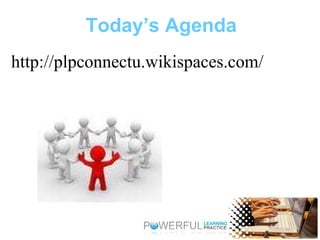
Today’s Agenda http://plpconnectu.wikispaces.com/
Welcome to the human network
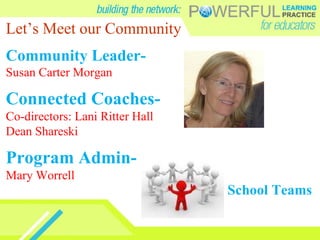
Let’s Meet our Community Community Leader-  Susan Carter Morgan Connected Coaches- Co-directors: Lani Ritter Hall  Dean Shareski Program Admin- Mary Worrell School Teams
How will education be different tomorrow because of our meeting today?  How will you contextualize and mobilize what you learn? How will you leverage, how will you enable your faculty or students to leverage- collective intelligence?
Native American Proverb “ He who learns from one who is learning, drinks from a flowing river.” . Sarah Brown Wessling, 2010 National Teacher of the Year Describes her classroom as a place where the teacher is the “lead learner” and “the classroom walls are boundless.” Lead Learners
Define Community Define Networks
A Definition of Community Communities are quite simply, collections of individuals who are bound together by natural will and a set of shared ideas and ideals.   “ A system in which people can enter into relations that are determined by problems or shared ambitions rather than by rules or structure.” (Heckscher, 1994, p. 24).   The process of social learning that occurs when people who have a common interest in some subject or problem collaborate over an extended period to share ideas, find solutions, and build innovations. (Wikipedia)
Virtual Community A virtual space supported by computer-based information technology, centered upon  communication and interaction of participants  to  generate member-driven content , resulting in  relationships being built up.  (Lee & Vogel, 2003)
A Definition of Networks From Wikipedia, the free encyclopedia Networks are created through publishing and sharing ideas and connecting with others who share passions around those ideas who learn from each other.   Networked learning is a process of developing and maintaining connections with people and information, and communicating in such a way so as to support one another's learning . Connectivism (theory of learning in networks) is the use of a network with nodes and connections as a central metaphor for learning.  In this metaphor, a node is anything that can be connected to another node: information, data, feelings, images. Learning is the process of creating connections and developing a network.
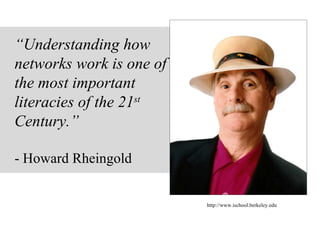
“ Understanding how networks work is one of the most important literacies of the 21 st  Century.” - Howard Rheingold http://www.ischool.berkeley.edu
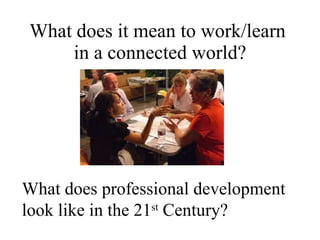
What does it mean to work/learn  in a connected world? What does professional development look like in the 21 st  Century?
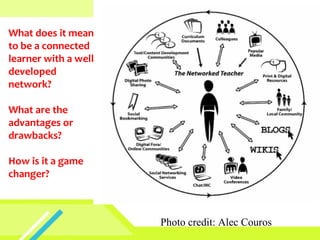
Photo credit: Alec Couros What does it mean to be a connected learner with a well developed network? What are the advantages or  drawbacks? How is it a game changer?
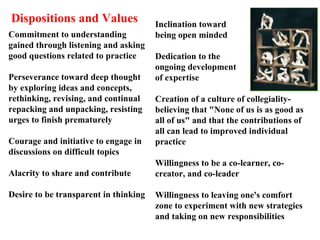
Inclination toward  being open minded Dedication to the  ongoing development  of expertise Creation of a culture of collegiality- believing that "None of us is as good as all of us" and that the contributions of all can lead to improved individual practice Willingness to be a co-learner, co-creator, and co-leader  Willingness to leaving one's comfort zone to experiment with new strategies and taking on new responsibilities Dispositions and Values Commitment to understanding gained through listening and asking good questions related to practice Perseverance toward deep thought by exploring ideas and concepts, rethinking, revising, and continual repacking and unpacking, resisting  urges to finish prematurely Courage and initiative to engage in discussions on difficult topics  Alacrity to share and contribute Desire to be transparent in thinking
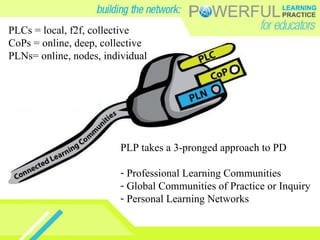
PLP takes a 3-pronged approach to PD Professional Learning Communities Global Communities of Practice or Inquiry Personal Learning Networks PLCs = local, f2f, collective CoPs = online, deep, collective PLNs= online, nodes, individual
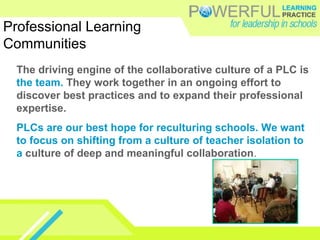
The driving engine of the collaborative culture of a PLC is  the team.  They work together in an ongoing effort to discover best practices and to expand their professional expertise.  PLCs are our best hope for reculturing schools. We want to focus on shifting from a culture of teacher isolation to a  culture of deep and meaningful collaboration . Professional Learning Communities
Communities of Practice
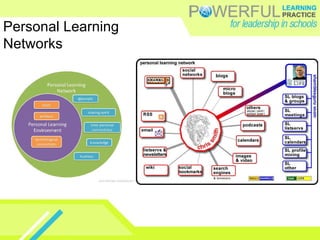
Personal Learning Networks
Community  is the New Professional Development  Cochran-Smith and Lytle (1999a) describe three ways of knowing and constructing knowledge that align closely with PLP's philosophy and are worth mentioning here.  Knowledge  for  Practice  is often reflected in traditional PD efforts when a trainer shares with teachers information produced by educational researchers. This knowledge presumes a commonly accepted degree of correctness about what is being shared . The learner is typically passive in this kind of "sit and get" experience.  This kind of knowledge is difficult for teachers to transfer to classrooms without support and follow through. After a workshop, much of what was useful gets lost in the daily grind, pressures and isolation of teaching.  Knowledge  in  Practice  recognizes the importance of teacher experience and practical knowledge in improving classroom practice.  As a teacher tests out new strategies and assimilates them into teaching routines they construct knowledge in practice .  They learn by doing.  This  knowledge is strengthened when teachers reflect and share with one another lessons learned during specific teaching sessions and describe the tacit knowledge embedded in their experiences. 
Community  is the New Professional Development  Knowledge  of  Practice  believes that  systematic inquiry  where teachers create knowledge as they focus on raising questions about and  systematically studying their own classroom teaching practices collaboratively,  allows educators to construct knowledge of practice  in ways that move beyond the basics of classroom practice to a more systemic view of learning. We believe that by attending to the development of knowledge for, in and of practice, we can enhance professional growth that leads to real change.  Cochran-Smith, M., & Lytle, S.L. (1999a). Relationships of knowledge and practice: Teaching learning in communities.  Review of Research in Education,  24, 249-305.  Passive, active, and reflective knowledge building in local (PLC), global (CoP) and contextual (PLN) learning spaces.
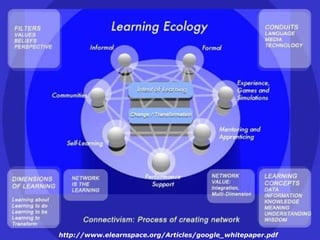
http://www.elearnspace.org/Articles/google_whitepaper.pdf
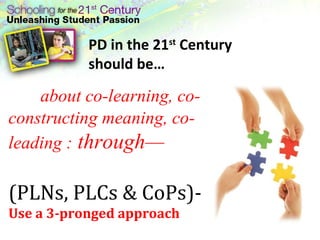
about co-learning, co-constructing meaning, co-leading :  through— (PLNs, PLCs & CoPs)-  Use a 3-pronged approach PD in the 21 st  Century should be…
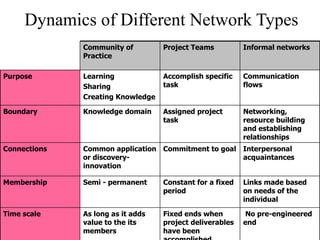
Dynamics of Different Network Types Community of Practice Project Teams Informal networks Purpose Learning  Sharing Creating Knowledge Accomplish specific task Communication flows Boundary Knowledge domain Assigned project task Networking, resource building and establishing relationships Connections Common application or discovery- innovation Commitment to goal Interpersonal  acquaintances Membership Semi - permanent Constant for a fixed period Links made based on needs of the individual Time scale As long as it adds value to the its members Fixed ends when project deliverables have been accomplished No pre-engineered end
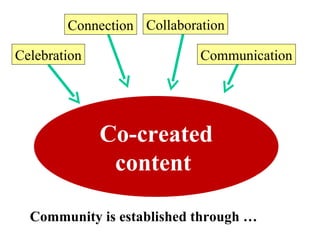
Co-created content  Celebration Connection Communication Collaboration Community is established through …
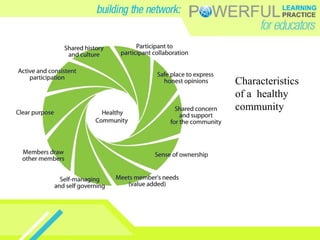
Characteristics of a  healthy community
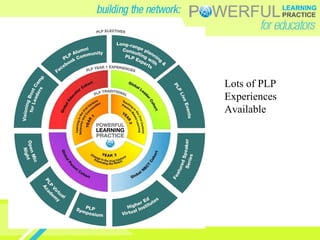
Lots of PLP Experiences Available
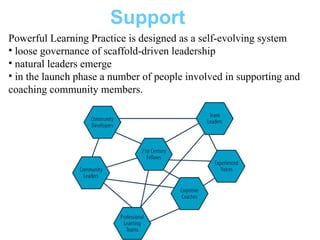
Support Powerful Learning Practice is designed as a self-evolving system loose governance of scaffold-driven leadership  natural leaders emerge  in the launch phase a number of people involved in supporting and coaching community members.
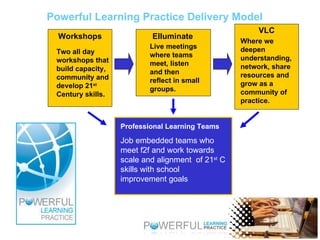
Two all day workshops that build capacity, community and develop 21 st  Century skills. Workshops Live meetings where teams meet, listen and then reflect in small groups. Elluminate Where we deepen understanding, network, share resources and grow as a community of practice. VLC Professional Learning Teams Job embedded teams who meet f2f and work towards scale and alignment  of 21 st  C skills with school improvement goals Powerful Learning Practice Delivery Model
Collaborative Tools Wikispaces Delicious or Diigo Twitter Elluminate NING (our VLC) “ Collaboration with others in my district and learning new tools was the best part of PLP. Connecting with other teachers in my district for new ideas and connecting with other schools for new ideas made PLP the best PD ever!”  - Science teacher in WNY
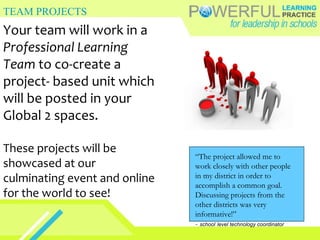
TEAM PROJECTS Your team will work in a  Professional Learning Team  to co-create a project- based unit which will be posted in your Global 2 spaces. These projects will be showcased at our culminating event and online for the world to see! “ The project allowed me to work closely with other people in my district in order to accomplish a common goal. Discussing projects from the other districts was very informative!” -  school   level technology coordinator
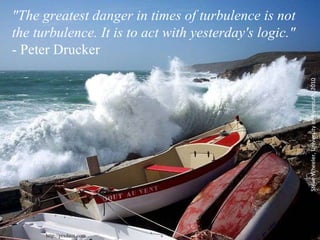
"The greatest danger in times of turbulence is not the turbulence. It is to act with yesterday's logic."  - Peter Drucker  http://pixdaus.com Steve Wheeler, University of Plymouth, 2010
Powerful Learning Practice Team Building Activity Individually-  Write at least 3-5 assumptions on (gasp) paper that you have about how your team will operate as a 21 st  Century Learning team and any team learning goals you have . 5 min. Place all the ideas in the center of the table: Stack and shuffle.  In turn, each person  picks an idea to read aloud to the table. Engage in dialogue and discussion about the assumptions. 15 min. Someone needs to share these assumptions on the wiki or later in NING.
PLP Community Activity Do a round-robin style introducing yourself and then answer the following prompt. 1 :  What about the world and society has changed since you  went to school? 2: What about students has changed since you  went to school? 3: What about schools has changed since you went to school? 4. What should School 2.0 look like in order to meet the needs of the 21st Century learner?  In light of the changes that have taken place in our society in the last twenty years, what will it mean to be an educated adult in the twenty-first century? What do graduates need to know and be able to do to be well-prepared for college, careers, and citizenship?

Plpko connectu

  • 1.
  • 2.
  • 3.
    Welcome to thehuman network
  • 4.
    Let’s Meet ourCommunity Community Leader- Susan Carter Morgan Connected Coaches- Co-directors: Lani Ritter Hall Dean Shareski Program Admin- Mary Worrell School Teams
  • 5.
    How will educationbe different tomorrow because of our meeting today? How will you contextualize and mobilize what you learn? How will you leverage, how will you enable your faculty or students to leverage- collective intelligence?
  • 6.
    Native American Proverb“ He who learns from one who is learning, drinks from a flowing river.” . Sarah Brown Wessling, 2010 National Teacher of the Year Describes her classroom as a place where the teacher is the “lead learner” and “the classroom walls are boundless.” Lead Learners
  • 7.
  • 8.
    A Definition ofCommunity Communities are quite simply, collections of individuals who are bound together by natural will and a set of shared ideas and ideals. “ A system in which people can enter into relations that are determined by problems or shared ambitions rather than by rules or structure.” (Heckscher, 1994, p. 24). The process of social learning that occurs when people who have a common interest in some subject or problem collaborate over an extended period to share ideas, find solutions, and build innovations. (Wikipedia)
  • 9.
    Virtual Community Avirtual space supported by computer-based information technology, centered upon communication and interaction of participants to generate member-driven content , resulting in relationships being built up. (Lee & Vogel, 2003)
  • 10.
    A Definition ofNetworks From Wikipedia, the free encyclopedia Networks are created through publishing and sharing ideas and connecting with others who share passions around those ideas who learn from each other. Networked learning is a process of developing and maintaining connections with people and information, and communicating in such a way so as to support one another's learning . Connectivism (theory of learning in networks) is the use of a network with nodes and connections as a central metaphor for learning. In this metaphor, a node is anything that can be connected to another node: information, data, feelings, images. Learning is the process of creating connections and developing a network.
  • 11.
    “ Understanding hownetworks work is one of the most important literacies of the 21 st Century.” - Howard Rheingold http://www.ischool.berkeley.edu
  • 12.
    What does itmean to work/learn in a connected world? What does professional development look like in the 21 st Century?
  • 13.
    Photo credit: AlecCouros What does it mean to be a connected learner with a well developed network? What are the advantages or drawbacks? How is it a game changer?
  • 14.
    Inclination toward being open minded Dedication to the ongoing development of expertise Creation of a culture of collegiality- believing that "None of us is as good as all of us" and that the contributions of all can lead to improved individual practice Willingness to be a co-learner, co-creator, and co-leader Willingness to leaving one's comfort zone to experiment with new strategies and taking on new responsibilities Dispositions and Values Commitment to understanding gained through listening and asking good questions related to practice Perseverance toward deep thought by exploring ideas and concepts, rethinking, revising, and continual repacking and unpacking, resisting urges to finish prematurely Courage and initiative to engage in discussions on difficult topics Alacrity to share and contribute Desire to be transparent in thinking
  • 15.
    PLP takes a3-pronged approach to PD Professional Learning Communities Global Communities of Practice or Inquiry Personal Learning Networks PLCs = local, f2f, collective CoPs = online, deep, collective PLNs= online, nodes, individual
  • 16.
    The driving engineof the collaborative culture of a PLC is the team. They work together in an ongoing effort to discover best practices and to expand their professional expertise. PLCs are our best hope for reculturing schools. We want to focus on shifting from a culture of teacher isolation to a culture of deep and meaningful collaboration . Professional Learning Communities
  • 17.
  • 18.
  • 19.
    Community isthe New Professional Development Cochran-Smith and Lytle (1999a) describe three ways of knowing and constructing knowledge that align closely with PLP's philosophy and are worth mentioning here. Knowledge for Practice is often reflected in traditional PD efforts when a trainer shares with teachers information produced by educational researchers. This knowledge presumes a commonly accepted degree of correctness about what is being shared . The learner is typically passive in this kind of "sit and get" experience. This kind of knowledge is difficult for teachers to transfer to classrooms without support and follow through. After a workshop, much of what was useful gets lost in the daily grind, pressures and isolation of teaching. Knowledge in Practice recognizes the importance of teacher experience and practical knowledge in improving classroom practice. As a teacher tests out new strategies and assimilates them into teaching routines they construct knowledge in practice . They learn by doing. This knowledge is strengthened when teachers reflect and share with one another lessons learned during specific teaching sessions and describe the tacit knowledge embedded in their experiences. 
  • 20.
    Community isthe New Professional Development Knowledge of Practice believes that systematic inquiry where teachers create knowledge as they focus on raising questions about and systematically studying their own classroom teaching practices collaboratively, allows educators to construct knowledge of practice in ways that move beyond the basics of classroom practice to a more systemic view of learning. We believe that by attending to the development of knowledge for, in and of practice, we can enhance professional growth that leads to real change. Cochran-Smith, M., & Lytle, S.L. (1999a). Relationships of knowledge and practice: Teaching learning in communities. Review of Research in Education, 24, 249-305. Passive, active, and reflective knowledge building in local (PLC), global (CoP) and contextual (PLN) learning spaces.
  • 21.
  • 22.
    about co-learning, co-constructingmeaning, co-leading : through— (PLNs, PLCs & CoPs)- Use a 3-pronged approach PD in the 21 st Century should be…
  • 23.
    Dynamics of DifferentNetwork Types Community of Practice Project Teams Informal networks Purpose Learning Sharing Creating Knowledge Accomplish specific task Communication flows Boundary Knowledge domain Assigned project task Networking, resource building and establishing relationships Connections Common application or discovery- innovation Commitment to goal Interpersonal acquaintances Membership Semi - permanent Constant for a fixed period Links made based on needs of the individual Time scale As long as it adds value to the its members Fixed ends when project deliverables have been accomplished No pre-engineered end
  • 24.
    Co-created content Celebration Connection Communication Collaboration Community is established through …
  • 25.
    Characteristics of a healthy community
  • 26.
    Lots of PLPExperiences Available
  • 27.
    Support Powerful LearningPractice is designed as a self-evolving system loose governance of scaffold-driven leadership natural leaders emerge in the launch phase a number of people involved in supporting and coaching community members.
  • 28.
    Two all dayworkshops that build capacity, community and develop 21 st Century skills. Workshops Live meetings where teams meet, listen and then reflect in small groups. Elluminate Where we deepen understanding, network, share resources and grow as a community of practice. VLC Professional Learning Teams Job embedded teams who meet f2f and work towards scale and alignment of 21 st C skills with school improvement goals Powerful Learning Practice Delivery Model
  • 29.
    Collaborative Tools WikispacesDelicious or Diigo Twitter Elluminate NING (our VLC) “ Collaboration with others in my district and learning new tools was the best part of PLP. Connecting with other teachers in my district for new ideas and connecting with other schools for new ideas made PLP the best PD ever!” - Science teacher in WNY
  • 30.
    TEAM PROJECTS Yourteam will work in a Professional Learning Team to co-create a project- based unit which will be posted in your Global 2 spaces. These projects will be showcased at our culminating event and online for the world to see! “ The project allowed me to work closely with other people in my district in order to accomplish a common goal. Discussing projects from the other districts was very informative!” - school level technology coordinator
  • 31.
    "The greatest dangerin times of turbulence is not the turbulence. It is to act with yesterday's logic." - Peter Drucker http://pixdaus.com Steve Wheeler, University of Plymouth, 2010
  • 32.
    Powerful Learning PracticeTeam Building Activity Individually- Write at least 3-5 assumptions on (gasp) paper that you have about how your team will operate as a 21 st Century Learning team and any team learning goals you have . 5 min. Place all the ideas in the center of the table: Stack and shuffle. In turn, each person picks an idea to read aloud to the table. Engage in dialogue and discussion about the assumptions. 15 min. Someone needs to share these assumptions on the wiki or later in NING.
  • 33.
    PLP Community ActivityDo a round-robin style introducing yourself and then answer the following prompt. 1 : What about the world and society has changed since you went to school? 2: What about students has changed since you went to school? 3: What about schools has changed since you went to school? 4. What should School 2.0 look like in order to meet the needs of the 21st Century learner? In light of the changes that have taken place in our society in the last twenty years, what will it mean to be an educated adult in the twenty-first century? What do graduates need to know and be able to do to be well-prepared for college, careers, and citizenship?