ELSE11, Bucharest, April 2015 @fredgarnett
Bilbao Bordeaux Lewisham Lisboa Pula
Emergent Learning Model
ELSE11, Bucharest, April 2015 @fredgarnett
• Background
• Open Context Model of Learning
• Development Frameworks
• Emergent Learning as development framework
• Emergent Learning & Bologna Process
• Elements of Emergent Learning
• Conclusions 1 - 4
Emergent Learning Model
ELSE11, Bucharest, April 2015 @fredgarnett
• Background…
• Emergent Learning Model an attempt to
apply Web2.0 participatory tools to learning
• Open Context Model of Learning is a
conceptual framework of pedagogies
• Learning as self-developed and self-managed
• Open up education systems to serendipities
of self-directed learning in various contexts
both within and beyond the classroom
Emergent Learning Model
ELSE11, Bucharest, April 2015 @fredgarnett
• Background…
• Bernie Dodge WebQuests 1994
• Q. “Is surfing learning?”
• A. New process; start point, end-point, rubric of
assessment, allowing learning serendipities
• Open context model interested in the
learning serendipities of Open Education,
OERs, Open Learn (OU)
Emergent Learning Model
ELSE11, Bucharest, April 2015 @fredgarnett
• Development Frameworks…
• However we realised that for innovation in
education to take advantage of the
potentials of emergence, interactivity and
resource abundance that are on offer in a
Web 2.0 world of learning, then we needed
to create a “development framework” to
help the design of education innovations
• Suggesting potential new practice…
Emergent Learning Model
ELSE11, Bucharest, April 2015 @fredgarnett
• Example of a Development Framework
• We designed EMFFE E-Maturity Framework
for FE (colleges)
• Supporting moves from known to unknown
• 5-stage model combining existing practice,
new practice, network affordances using e-
maturity levels
• Enabling “future design of educational
institutions based on strategic values”
Emergent Learning Model
ELSE11, Bucharest, April 2015 @fredgarnett
• ELM as a Development Framework…
• A key distinction of learning post web2.0 is
that we are now in an age of learning resource
abundance
• How do we design new educational practices
for a world of resource abundance?
• ELM helps with designing new educational
practice in new & traditional learning contexts
• Designing both for education & for learning
Emergent Learning Model
ELSE11, Bucharest, April 2015 @fredgarnett
• ELM and the Bologna Process
• Post-Bologna EU wanted to integrate formal
non-formal and formal learning
• However the EU made it sector-based
• We decided to make it learning-based
• Because our observation was post-Web2.0
informal learning drives formal learning!
Emergent Learning Model
ELSE11, Bucharest, April 2015 @fredgarnett
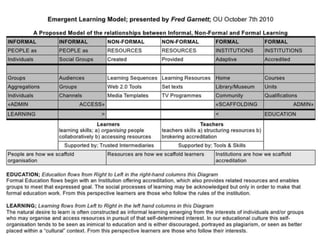
• Elements of Emergent Learning …
• Rethinking Informal Learning
• Focus on the social process that support
learning; i.e. role of People
• Not institutions or sector or policy
• “Informal Learning is the social processes
that support learning in any context”
Emergent Learning Model
ELSE11, Bucharest, April 2015 @fredgarnett
• Elements of Emergent Learning …
• Rethinking Non-formal Learning (Resources)
• Focus on the content that supports learning
(design for appropriation) OR
• Content-creation (or curation) that reflects
learning (Learner or User-generated)
• “Non-formal Learning is structured learning
resources without formal learning outcomes”
Emergent Learning Model
ELSE11, Bucharest, April 2015 @fredgarnett
• Elements of Emergent Learning …
• Rethinking Formal Learning
• Traditional focus on the institution with
little concern on what happened within;
concerned with Estates Management
• OR “it’s where the money is”
• “Formal Education (!) is the administration
& quality assurance of accreditation”
Conclusions 1 - 4
Bilbao Bordeaux Lewisham Lisboa Pula
Emergent Learning Model
ELSE11, Bucharest, April 2015 @fredgarnett
• Conclusions 1
• Although learning is emergent - that is it
reveals non-linear dynamic processes - ELM
does allow for the integration of informal
and formal approaches to learning
• ELM is really useful in designing informal yet
dynamic learning eco-systems
Emergent Learning Model
ELSE11, Bucharest, April 2015 @fredgarnett
• Conclusions 2
• In large-scale and dynamic projects, like
Ambient Learning City, it was found that ELM
was extremely useful in the planning stage of
learning design
• BUT! Implementation problems emerge which
require further development of original
techniques & processes, e.g. new metaphors &
new models (Aggregate then Curate)
Emergent Learning Model
ELSE11, Bucharest, April 2015 @fredgarnett
• Conclusions 3
• In small-scale and learner-centric projects, like
WikiQuals, ELM was also useful in the planning
stage but implementation problems developed
• As WikiQuals was small-scale & focussed around
people then it was important to establish an
(agreed) “set of social practices” (Serbu 2013)
around which it could be organised.
Emergent Learning Model
ELSE11, Bucharest, April 2015 @fredgarnett
• Conclusions 4
• Emergent Learning Model is a tool for the
design of learning which allows for emergent
properties to reveal themselves
• However there must always be a secondary
design phase to solve the new problems which
emerge in developing non-institutionalised
learning systems...
Emergent Learning Model
ELSE11, Bucharest, April 2015 Emergent Learning Model full paper
• Resources Used;
• What is Web 2.0?
• Bernie Dodge WebQuests
• Open Context Model of Learning
• Architecture of Participation (Development Frameworks)
• Emergent Learning Model (table)
• Emergent Learning Model (blog post)
• Ambient Learning City
• Aggregate then Curate paper
• WikiQuals / CROS Social Media Learning Models
ELSE11, Bucharest, April 2015 @fredgarnett
Bilbao Bordeaux Lewisham Lisboa Pula
Emergent Learning Model

Emergent Learning Model

  • 1.
    ELSE11, Bucharest, April2015 @fredgarnett Bilbao Bordeaux Lewisham Lisboa Pula Emergent Learning Model
  • 2.
    Emergent Learning Model ELSE11,Bucharest, April 2015 @fredgarnett • Background • Open Context Model of Learning • Development Frameworks • Emergent Learning as development framework • Emergent Learning & Bologna Process • Elements of Emergent Learning • Conclusions 1 - 4
  • 3.
    Emergent Learning Model ELSE11,Bucharest, April 2015 @fredgarnett • Background… • Emergent Learning Model an attempt to apply Web2.0 participatory tools to learning • Open Context Model of Learning is a conceptual framework of pedagogies • Learning as self-developed and self-managed • Open up education systems to serendipities of self-directed learning in various contexts both within and beyond the classroom
  • 4.
    Emergent Learning Model ELSE11,Bucharest, April 2015 @fredgarnett • Background… • Bernie Dodge WebQuests 1994 • Q. “Is surfing learning?” • A. New process; start point, end-point, rubric of assessment, allowing learning serendipities • Open context model interested in the learning serendipities of Open Education, OERs, Open Learn (OU)
  • 5.
    Emergent Learning Model ELSE11,Bucharest, April 2015 @fredgarnett • Development Frameworks… • However we realised that for innovation in education to take advantage of the potentials of emergence, interactivity and resource abundance that are on offer in a Web 2.0 world of learning, then we needed to create a “development framework” to help the design of education innovations • Suggesting potential new practice…
  • 6.
    Emergent Learning Model ELSE11,Bucharest, April 2015 @fredgarnett • Example of a Development Framework • We designed EMFFE E-Maturity Framework for FE (colleges) • Supporting moves from known to unknown • 5-stage model combining existing practice, new practice, network affordances using e- maturity levels • Enabling “future design of educational institutions based on strategic values”
  • 7.
    Emergent Learning Model ELSE11,Bucharest, April 2015 @fredgarnett • ELM as a Development Framework… • A key distinction of learning post web2.0 is that we are now in an age of learning resource abundance • How do we design new educational practices for a world of resource abundance? • ELM helps with designing new educational practice in new & traditional learning contexts • Designing both for education & for learning
  • 8.
    Emergent Learning Model ELSE11,Bucharest, April 2015 @fredgarnett • ELM and the Bologna Process • Post-Bologna EU wanted to integrate formal non-formal and formal learning • However the EU made it sector-based • We decided to make it learning-based • Because our observation was post-Web2.0 informal learning drives formal learning!
  • 10.
    Emergent Learning Model ELSE11,Bucharest, April 2015 @fredgarnett • Elements of Emergent Learning … • Rethinking Informal Learning • Focus on the social process that support learning; i.e. role of People • Not institutions or sector or policy • “Informal Learning is the social processes that support learning in any context”
  • 11.
    Emergent Learning Model ELSE11,Bucharest, April 2015 @fredgarnett • Elements of Emergent Learning … • Rethinking Non-formal Learning (Resources) • Focus on the content that supports learning (design for appropriation) OR • Content-creation (or curation) that reflects learning (Learner or User-generated) • “Non-formal Learning is structured learning resources without formal learning outcomes”
  • 12.
    Emergent Learning Model ELSE11,Bucharest, April 2015 @fredgarnett • Elements of Emergent Learning … • Rethinking Formal Learning • Traditional focus on the institution with little concern on what happened within; concerned with Estates Management • OR “it’s where the money is” • “Formal Education (!) is the administration & quality assurance of accreditation”
  • 13.
    Conclusions 1 -4 Bilbao Bordeaux Lewisham Lisboa Pula Emergent Learning Model
  • 14.
    Emergent Learning Model ELSE11,Bucharest, April 2015 @fredgarnett • Conclusions 1 • Although learning is emergent - that is it reveals non-linear dynamic processes - ELM does allow for the integration of informal and formal approaches to learning • ELM is really useful in designing informal yet dynamic learning eco-systems
  • 15.
    Emergent Learning Model ELSE11,Bucharest, April 2015 @fredgarnett • Conclusions 2 • In large-scale and dynamic projects, like Ambient Learning City, it was found that ELM was extremely useful in the planning stage of learning design • BUT! Implementation problems emerge which require further development of original techniques & processes, e.g. new metaphors & new models (Aggregate then Curate)
  • 16.
    Emergent Learning Model ELSE11,Bucharest, April 2015 @fredgarnett • Conclusions 3 • In small-scale and learner-centric projects, like WikiQuals, ELM was also useful in the planning stage but implementation problems developed • As WikiQuals was small-scale & focussed around people then it was important to establish an (agreed) “set of social practices” (Serbu 2013) around which it could be organised.
  • 17.
    Emergent Learning Model ELSE11,Bucharest, April 2015 @fredgarnett • Conclusions 4 • Emergent Learning Model is a tool for the design of learning which allows for emergent properties to reveal themselves • However there must always be a secondary design phase to solve the new problems which emerge in developing non-institutionalised learning systems...
  • 18.
    Emergent Learning Model ELSE11,Bucharest, April 2015 Emergent Learning Model full paper • Resources Used; • What is Web 2.0? • Bernie Dodge WebQuests • Open Context Model of Learning • Architecture of Participation (Development Frameworks) • Emergent Learning Model (table) • Emergent Learning Model (blog post) • Ambient Learning City • Aggregate then Curate paper • WikiQuals / CROS Social Media Learning Models
  • 19.
    ELSE11, Bucharest, April2015 @fredgarnett Bilbao Bordeaux Lewisham Lisboa Pula Emergent Learning Model