INTRODUCTION TO
PERMANENT IMPLANT
BRACHYTHERAPY
Dr. V. Lokesh M.D.
Professor & Head of the Department
Department of Radiation Oncology
Kidwai Memorial Institute of Oncology, Bangalore
August 2022
Introduction
⦿ Brachytherapy (Curietherapy) is defined as a
short-distance treatment of malignant
disease with radiation emanating from small
sealed (encapsulated) sources.
⦿ The sources are placed directly into the
treatment volume or near the treatment
volume
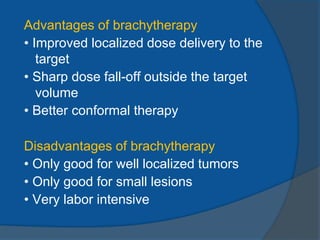
Advantages of brachytherapy
• Improved localized dose delivery to the
target
• Sharp dose fall-off outside the target
volume
• Better conformal therapy
Disadvantages of brachytherapy
• Only good for well localized tumors
• Only good for small lesions
• Very labor intensive
Importance of History & Origin of
various Brachytherapy techniques in
different continents
History :
Tribute to
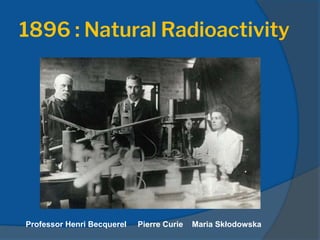
1896 : Natural Radioactivity
Professor Henri Becquerel Pierre Curie Maria Skłodowska
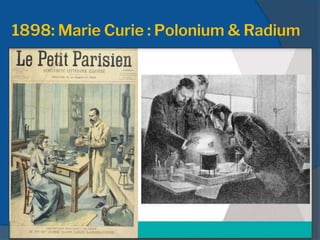
1898: Marie Curie : Polonium & Radium
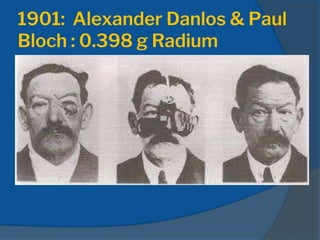
1901: Alexander Danlos & Paul
Bloch : 0.398 g Radium
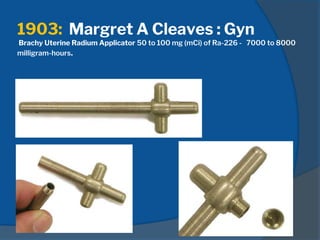
1903: Margret A Cleaves : Gyn
Brachy Uterine Radium Applicator 50 to 100 mg (mCi) of Ra-226 - 7000 to 8000
milligram-hours.
⦿ 1909: Wikhalm & Degrais: Radium therpay Book
⦿ 1909: Marie Cure - Institute of Radium : Paris
⦿ 1910: Gosta Forssell – Radiumhemmet Stockholm
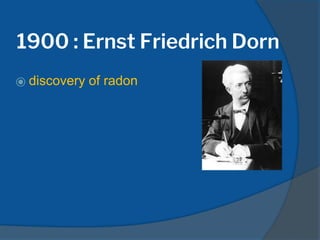
1900 : Ernst Friedrich Dorn
⦿ discovery of radon
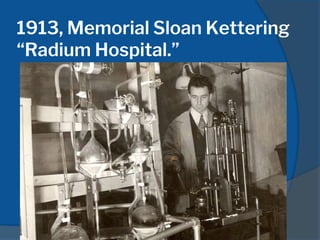
1913, Memorial Sloan Kettering
“Radium Hospital.”
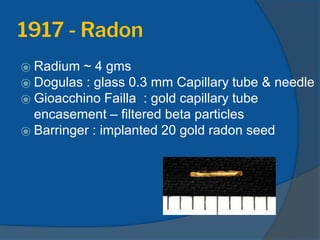
1917 - Radon
⦿ Radium ~ 4 gms
⦿ Dogulas : glass 0.3 mm Capillary tube & needle
⦿ Gioacchino Failla : gold capillary tube
encasement – filtered beta particles
⦿ Barringer : implanted 20 gold radon seed
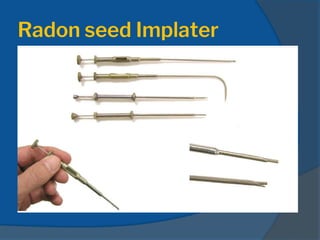
Radon seed Implater
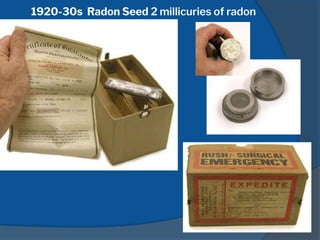
1920-30s Radon Seed 2 millicuries of radon
The Newton of the Atom
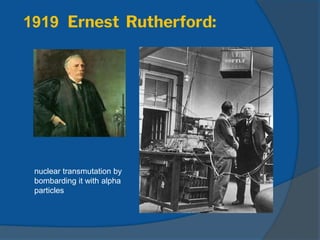
1919 Ernest Rutherford:
nuclear transmutation by
bombarding it with alpha
particles
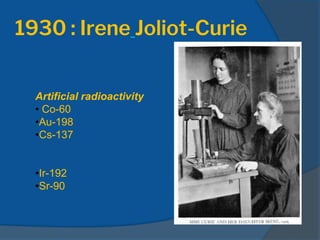
1930 : Irene Joliot-Curie
Artificial radioactivity
• Co-60
•Au-198
•Cs-137
•Ir-192
•Sr-90
⦿ " revolutionizing the field of radiation
therapy and improving the quality of life "
of thousands of cancer patients
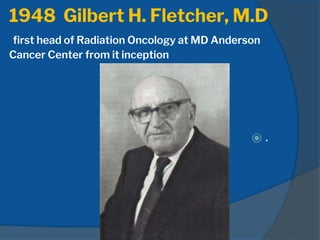
1948 Gilbert H. Fletcher, M.D
first head of Radiation Oncology at MD Anderson
Cancer Center from it inception
⦿ .
Era of low energy sources
1960
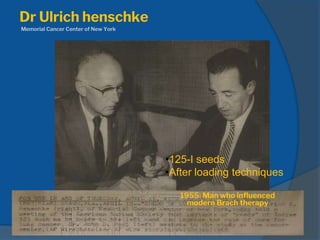
Dr Ulrich henschke
Memorial Cancer Center of New York
•125-I seeds
•After loading techniques
1955: Man who influenced
modern Brach therapy
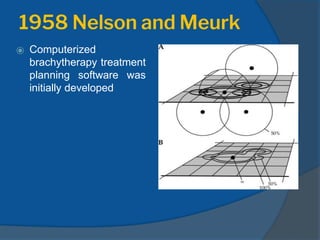
1958 Nelson and Meurk
⦿ Computerized
brachytherapy treatment
planning software was
initially developed
Low energy radionuclides -
⦿ radium & radon
⚫ Very expensive
⚫ Scarce
⚫ Professional concerns
○ Harmful effects of radium exposure –
⚫ Doctors
⚫ Nursing staff
⚫ Visitors
⚫ Fedral regulations
○ Technical difficulties
⚫ Source construction
⚫ Radium dose calculation
⚫ α emitter
⚫ ~ 10 dys of hospitalization after implant
⦿ Impetus for introduction of Iodine-125
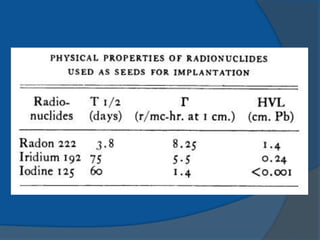
⚫ Longer half life
⚫ 27 to 35 keV
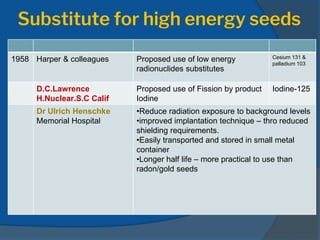
Substitute for high energy seeds
1958 Harper & colleagues Proposed use of low energy
radionuclides substitutes
Cesium 131 &
palladium 103
D.C.Lawrence
H.Nuclear.S.C Calif
Proposed use of Fission by product
Iodine
Iodine-125
Dr Ulrich Henschke
Memorial Hospital
•Reduce radiation exposure to background levels
•improved implantation technique – thro reduced
shielding requirements.
•Easily transported and stored in small metal
container
•Longer half life – more practical to use than
radon/gold seeds
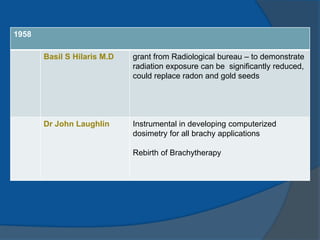
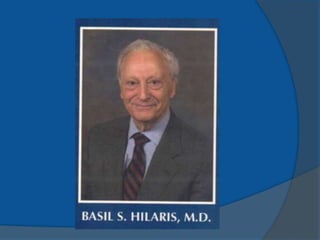
1958
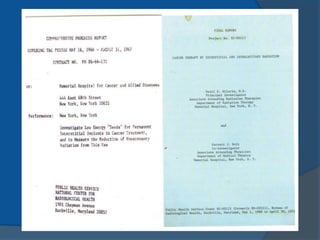
Basil S Hilaris M.D grant from Radiological bureau – to demonstrate
radiation exposure can be significantly reduced,
could replace radon and gold seeds
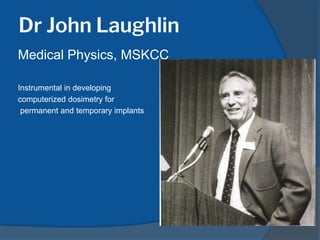
Dr John Laughlin Instrumental in developing computerized
dosimetry for all brachy applications
Rebirth of Brachytherapy
Dr John Laughlin
Medical Physics, MSKCC
Instrumental in developing
computerized dosimetry for
permanent and temporary implants
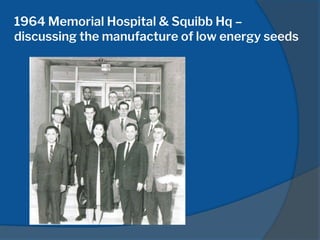
1964 Memorial Hospital & Squibb Hq –
discussing the manufacture of low energy seeds
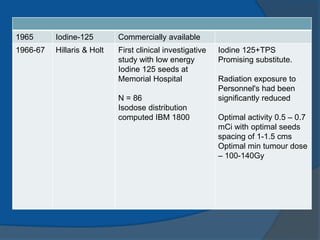
1965 Iodine-125 Commercially available
1966-67 Hillaris & Holt First clinical investigative
study with low energy
Iodine 125 seeds at
Memorial Hospital
N = 86
Isodose distribution
computed IBM 1800
Iodine 125+TPS
Promising substitute.
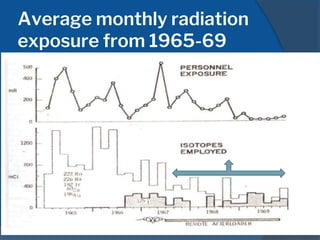
Radiation exposure to
Personnel's had been
significantly reduced
Optimal activity 0.5 – 0.7
mCi with optimal seeds
spacing of 1-1.5 cms
Optimal min tumour dose
– 100-140Gy
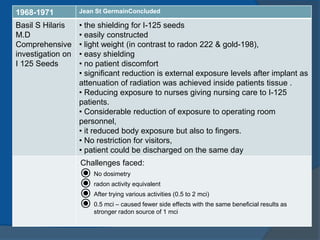
1968-1971 Jean St GermainConcluded
Basil S Hilaris
M.D
Comprehensive
investigation on
I 125 Seeds
• the shielding for I-125 seeds
• easily constructed
• light weight (in contrast to radon 222 & gold-198),
• easy shielding
• no patient discomfort
• significant reduction is external exposure levels after implant as
attenuation of radiation was achieved inside patients tissue .
• Reducing exposure to nurses giving nursing care to I-125
patients.
• Considerable reduction of exposure to operating room
personnel,
• it reduced body exposure but also to fingers.
• No restriction for visitors,
• patient could be discharged on the same day
Challenges faced:
⦿ No dosimetry
⦿ radon activity equivalent
⦿ After trying various activities (0.5 to 2 mci)
⦿ 0.5 mci – caused fewer side effects with the same beneficial results as
stronger radon source of 1 mci
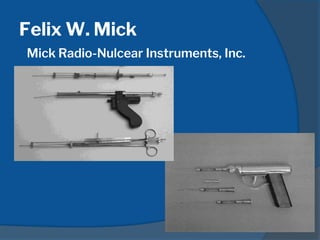
Felix W. Mick
Mick Radio-Nulcear Instruments, Inc.
Garrett Holt – 2nd report
⦿ After considerable experimentation
⦿ Titanium for encapsulation
⦿ Absolute calibration of I-125 established
⦿ Dosimetry of interstitial implant with I -125 great
challenge – low energy absorption
⦿ Conventional methods did not readily apply
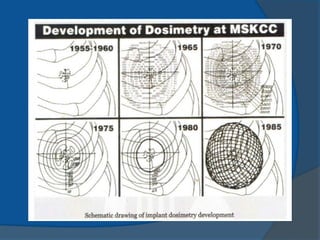
⦿ Computerized system of dosimetry – developed
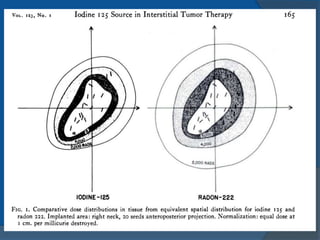
⦿ Investigations – compute dose distribution
around the implant
⦿ Out side implanted zone – marked falloff in
radiation dose with I-125 seeds observed.
Average monthly radiation
exposure from 1965-69
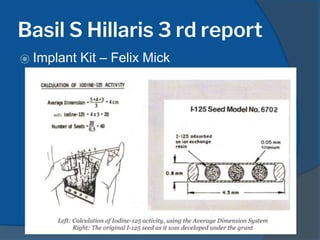
Basil S Hillaris 3 rd report
⦿ Implant Kit – Felix Mick
1968 B S Hillaris
Usage of low energy I-125
seeds
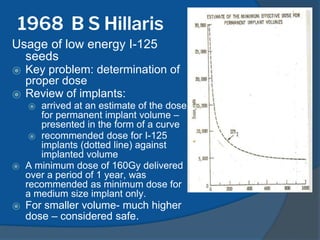
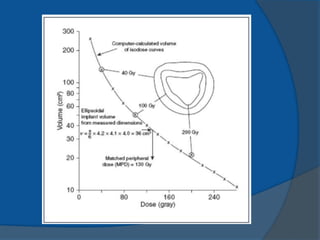
⦿ Key problem: determination of
proper dose
⦿ Review of implants:
⦿ arrived at an estimate of the dose
for permanent implant volume –
presented in the form of a curve
⦿ recommended dose for I-125
implants (dotted line) against
implanted volume
⦿ A minimum dose of 160Gy delivered
over a period of 1 year, was
recommended as minimum dose for
a medium size implant only.
⦿ For smaller volume- much higher
dose – considered safe.
Henschke
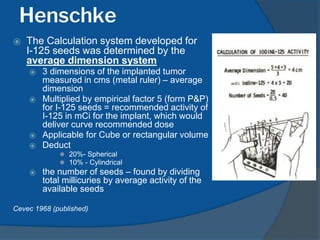
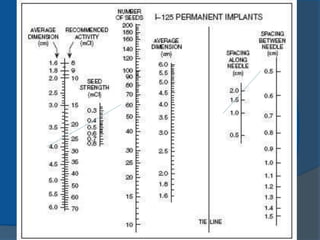
⦿ The Calculation system developed for
I-125 seeds was determined by the
average dimension system
⦿ 3 dimensions of the implanted tumor
measured in cms (metal ruler) – average
dimension
⦿ Multiplied by empirical factor 5 (form P&P)
for I-125 seeds = recommended activity of
I-125 in mCi for the implant, which would
deliver curve recommended dose
⦿ Applicable for Cube or rectangular volume
⦿ Deduct
⚫ 20%- Spherical
⚫ 10% - Cylindrical
⦿ the number of seeds – found by dividing
total millicuries by average activity of the
available seeds
Cevec 1968 (published)
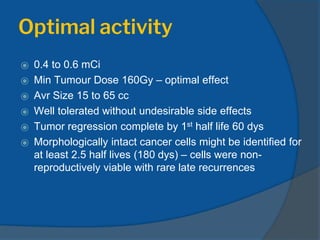
Optimal activity
⦿ 0.4 to 0.6 mCi
⦿ Min Tumour Dose 160Gy – optimal effect
⦿ Avr Size 15 to 65 cc
⦿ Well tolerated without undesirable side effects
⦿ Tumor regression complete by 1st half life 60 dys
⦿ Morphologically intact cancer cells might be identified for
at least 2.5 half lives (180 dys) – cells were non-
reproductively viable with rare late recurrences
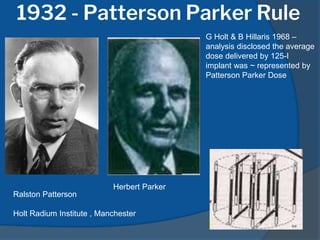
1932 - Patterson Parker Rule
Ralston Patterson
Holt Radium Institute , Manchester
Herbert Parker
G Holt & B Hillaris 1968 –
analysis disclosed the average
dose delivered by 125-I
implant was ~ represented by
Patterson Parker Dose
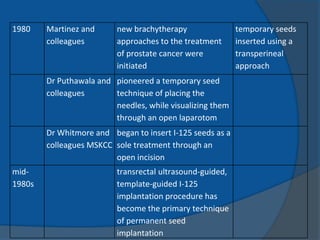
1980 Martinez and
colleagues
new brachytherapy
approaches to the treatment
of prostate cancer were
initiated
temporary seeds
inserted using a
transperineal
approach
Dr Puthawala and
colleagues
pioneered a temporary seed
technique of placing the
needles, while visualizing them
through an open laparotom
Dr Whitmore and
colleagues MSKCC
began to insert I-125 seeds as a
sole treatment through an
open incision
mid-
1980s
transrectal ultrasound-guided,
template-guided I-125
implantation procedure has
become the primary technique
of permanent seed
implantation
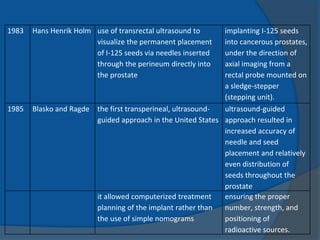
1983 Hans Henrik Holm use of transrectal ultrasound to
visualize the permanent placement
of I-125 seeds via needles inserted
through the perineum directly into
the prostate
implanting I-125 seeds
into cancerous prostates,
under the direction of
axial imaging from a
rectal probe mounted on
a sledge-stepper
(stepping unit).
1985 Blasko and Ragde the first transperineal, ultrasound-
guided approach in the United States
ultrasound-guided
approach resulted in
increased accuracy of
needle and seed
placement and relatively
even distribution of
seeds throughout the
prostate
it allowed computerized treatment
planning of the implant rather than
the use of simple nomograms
ensuring the proper
number, strength, and
positioning of
radioactive sources.
2019 KMIO
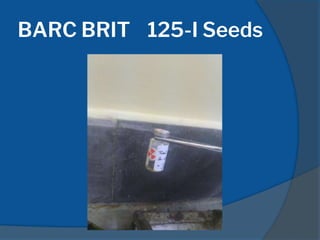
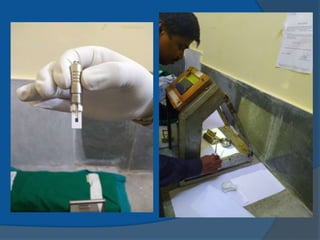
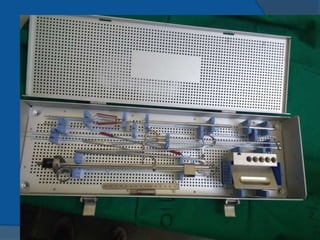
BARC BRIT 125-I Seeds
Future Directions
Thank You

Permanent implant Brachytherapy

  • 1.
    INTRODUCTION TO PERMANENT IMPLANT BRACHYTHERAPY Dr.V. Lokesh M.D. Professor & Head of the Department Department of Radiation Oncology Kidwai Memorial Institute of Oncology, Bangalore August 2022
  • 2.
    Introduction ⦿ Brachytherapy (Curietherapy)is defined as a short-distance treatment of malignant disease with radiation emanating from small sealed (encapsulated) sources. ⦿ The sources are placed directly into the treatment volume or near the treatment volume
  • 3.
    Advantages of brachytherapy •Improved localized dose delivery to the target • Sharp dose fall-off outside the target volume • Better conformal therapy Disadvantages of brachytherapy • Only good for well localized tumors • Only good for small lesions • Very labor intensive
  • 5.
    Importance of History& Origin of various Brachytherapy techniques in different continents
  • 6.
  • 7.
    1896 : NaturalRadioactivity Professor Henri Becquerel Pierre Curie Maria Skłodowska
  • 8.
    1898: Marie Curie: Polonium & Radium
  • 9.
    1901: Alexander Danlos& Paul Bloch : 0.398 g Radium
  • 10.
    1903: Margret ACleaves : Gyn Brachy Uterine Radium Applicator 50 to 100 mg (mCi) of Ra-226 - 7000 to 8000 milligram-hours.
  • 11.
    ⦿ 1909: Wikhalm& Degrais: Radium therpay Book ⦿ 1909: Marie Cure - Institute of Radium : Paris ⦿ 1910: Gosta Forssell – Radiumhemmet Stockholm
  • 12.
    1900 : ErnstFriedrich Dorn ⦿ discovery of radon
  • 13.
    1913, Memorial SloanKettering “Radium Hospital.”
  • 14.
    1917 - Radon ⦿Radium ~ 4 gms ⦿ Dogulas : glass 0.3 mm Capillary tube & needle ⦿ Gioacchino Failla : gold capillary tube encasement – filtered beta particles ⦿ Barringer : implanted 20 gold radon seed
  • 15.
  • 16.
    1920-30s Radon Seed2 millicuries of radon
  • 17.
    The Newton ofthe Atom
  • 18.
    1919 Ernest Rutherford: nucleartransmutation by bombarding it with alpha particles
  • 19.
    1930 : IreneJoliot-Curie Artificial radioactivity • Co-60 •Au-198 •Cs-137 •Ir-192 •Sr-90
  • 20.
    ⦿ " revolutionizingthe field of radiation therapy and improving the quality of life " of thousands of cancer patients
  • 21.
    1948 Gilbert H.Fletcher, M.D first head of Radiation Oncology at MD Anderson Cancer Center from it inception ⦿ .
  • 22.
    Era of lowenergy sources 1960
  • 23.
    Dr Ulrich henschke MemorialCancer Center of New York •125-I seeds •After loading techniques 1955: Man who influenced modern Brach therapy
  • 25.
    1958 Nelson andMeurk ⦿ Computerized brachytherapy treatment planning software was initially developed
  • 26.
    Low energy radionuclides- ⦿ radium & radon ⚫ Very expensive ⚫ Scarce ⚫ Professional concerns ○ Harmful effects of radium exposure – ⚫ Doctors ⚫ Nursing staff ⚫ Visitors ⚫ Fedral regulations ○ Technical difficulties ⚫ Source construction ⚫ Radium dose calculation ⚫ α emitter ⚫ ~ 10 dys of hospitalization after implant ⦿ Impetus for introduction of Iodine-125 ⚫ Longer half life ⚫ 27 to 35 keV
  • 27.
    Substitute for highenergy seeds 1958 Harper & colleagues Proposed use of low energy radionuclides substitutes Cesium 131 & palladium 103 D.C.Lawrence H.Nuclear.S.C Calif Proposed use of Fission by product Iodine Iodine-125 Dr Ulrich Henschke Memorial Hospital •Reduce radiation exposure to background levels •improved implantation technique – thro reduced shielding requirements. •Easily transported and stored in small metal container •Longer half life – more practical to use than radon/gold seeds
  • 28.
    1958 Basil S HilarisM.D grant from Radiological bureau – to demonstrate radiation exposure can be significantly reduced, could replace radon and gold seeds Dr John Laughlin Instrumental in developing computerized dosimetry for all brachy applications Rebirth of Brachytherapy
  • 30.
    Dr John Laughlin MedicalPhysics, MSKCC Instrumental in developing computerized dosimetry for permanent and temporary implants
  • 31.
    1964 Memorial Hospital& Squibb Hq – discussing the manufacture of low energy seeds
  • 32.
    1965 Iodine-125 Commerciallyavailable 1966-67 Hillaris & Holt First clinical investigative study with low energy Iodine 125 seeds at Memorial Hospital N = 86 Isodose distribution computed IBM 1800 Iodine 125+TPS Promising substitute. Radiation exposure to Personnel's had been significantly reduced Optimal activity 0.5 – 0.7 mCi with optimal seeds spacing of 1-1.5 cms Optimal min tumour dose – 100-140Gy
  • 33.
    1968-1971 Jean StGermainConcluded Basil S Hilaris M.D Comprehensive investigation on I 125 Seeds • the shielding for I-125 seeds • easily constructed • light weight (in contrast to radon 222 & gold-198), • easy shielding • no patient discomfort • significant reduction is external exposure levels after implant as attenuation of radiation was achieved inside patients tissue . • Reducing exposure to nurses giving nursing care to I-125 patients. • Considerable reduction of exposure to operating room personnel, • it reduced body exposure but also to fingers. • No restriction for visitors, • patient could be discharged on the same day Challenges faced: ⦿ No dosimetry ⦿ radon activity equivalent ⦿ After trying various activities (0.5 to 2 mci) ⦿ 0.5 mci – caused fewer side effects with the same beneficial results as stronger radon source of 1 mci
  • 34.
    Felix W. Mick MickRadio-Nulcear Instruments, Inc.
  • 35.
    Garrett Holt –2nd report ⦿ After considerable experimentation ⦿ Titanium for encapsulation ⦿ Absolute calibration of I-125 established ⦿ Dosimetry of interstitial implant with I -125 great challenge – low energy absorption ⦿ Conventional methods did not readily apply ⦿ Computerized system of dosimetry – developed ⦿ Investigations – compute dose distribution around the implant ⦿ Out side implanted zone – marked falloff in radiation dose with I-125 seeds observed.
  • 38.
  • 39.
    Basil S Hillaris3 rd report ⦿ Implant Kit – Felix Mick
  • 40.
    1968 B SHillaris Usage of low energy I-125 seeds ⦿ Key problem: determination of proper dose ⦿ Review of implants: ⦿ arrived at an estimate of the dose for permanent implant volume – presented in the form of a curve ⦿ recommended dose for I-125 implants (dotted line) against implanted volume ⦿ A minimum dose of 160Gy delivered over a period of 1 year, was recommended as minimum dose for a medium size implant only. ⦿ For smaller volume- much higher dose – considered safe.
  • 41.
    Henschke ⦿ The Calculationsystem developed for I-125 seeds was determined by the average dimension system ⦿ 3 dimensions of the implanted tumor measured in cms (metal ruler) – average dimension ⦿ Multiplied by empirical factor 5 (form P&P) for I-125 seeds = recommended activity of I-125 in mCi for the implant, which would deliver curve recommended dose ⦿ Applicable for Cube or rectangular volume ⦿ Deduct ⚫ 20%- Spherical ⚫ 10% - Cylindrical ⦿ the number of seeds – found by dividing total millicuries by average activity of the available seeds Cevec 1968 (published)
  • 42.
    Optimal activity ⦿ 0.4to 0.6 mCi ⦿ Min Tumour Dose 160Gy – optimal effect ⦿ Avr Size 15 to 65 cc ⦿ Well tolerated without undesirable side effects ⦿ Tumor regression complete by 1st half life 60 dys ⦿ Morphologically intact cancer cells might be identified for at least 2.5 half lives (180 dys) – cells were non- reproductively viable with rare late recurrences
  • 43.
    1932 - PattersonParker Rule Ralston Patterson Holt Radium Institute , Manchester Herbert Parker G Holt & B Hillaris 1968 – analysis disclosed the average dose delivered by 125-I implant was ~ represented by Patterson Parker Dose
  • 48.
    1980 Martinez and colleagues newbrachytherapy approaches to the treatment of prostate cancer were initiated temporary seeds inserted using a transperineal approach Dr Puthawala and colleagues pioneered a temporary seed technique of placing the needles, while visualizing them through an open laparotom Dr Whitmore and colleagues MSKCC began to insert I-125 seeds as a sole treatment through an open incision mid- 1980s transrectal ultrasound-guided, template-guided I-125 implantation procedure has become the primary technique of permanent seed implantation
  • 49.
    1983 Hans HenrikHolm use of transrectal ultrasound to visualize the permanent placement of I-125 seeds via needles inserted through the perineum directly into the prostate implanting I-125 seeds into cancerous prostates, under the direction of axial imaging from a rectal probe mounted on a sledge-stepper (stepping unit). 1985 Blasko and Ragde the first transperineal, ultrasound- guided approach in the United States ultrasound-guided approach resulted in increased accuracy of needle and seed placement and relatively even distribution of seeds throughout the prostate it allowed computerized treatment planning of the implant rather than the use of simple nomograms ensuring the proper number, strength, and positioning of radioactive sources.
  • 50.
  • 51.
  • 61.
  • 70.