MD. MOTIUR RAHMAN (MITHU)
Chief Medical Physicist & Assistant Project Director
TMSS Cancer Center
Rangpur Road, Bogura
email: motiur,delta@gmail.com
RADIATION DOSIMETRY
Slab Phantom
3D Water Phantom 1D Water Phantom
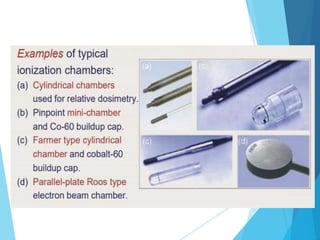
Electrometer Farmer Type Ion Chamber Roos Ion Chamber
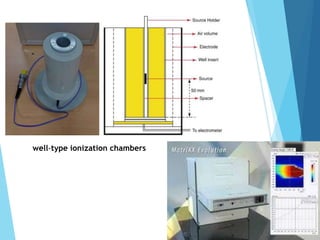
well-type ionization chambers
1925: First International Congress for Radiology in London. Foundation of
"International Commission on Radiation Units and Measurement"
(ICRU)
1928: Second International Congress for Radiology in Stockholm.
Definition of the unit “Roentgen” to identify the intensity of radiation
by the number of ion pairs formed in air.
1937: Fifth International Congress for Radiology in Chicago.
New definition of Roentgen as the unit of the
quantity "Exposure".
4
Historical Development of Dosimetry:
Some highlights
1950: Definition of the dosimetric quantity
absorbed dose
as absorbed energy per mass.
The rad is the special unit of absorbed dose:
1 rad = 0.01 J/kg
1975: Definition of the new SI-Unit Gray (Gy) for the quantity absorbed dose:
1 Gy = 1 J/kg = 100 rad
5
Historical Development of Dosimetry
What is Dosimetry ?
Radiation Dosimetry is a study in physics which deals with
the measurement of radiation which may include Exposure,
Absorbed dose etc.,
Why is it Important for Cancer Treatment?
Ionizing radiation, which can be used to treat cancer by
destroying harmful cells but is completely undetectable
by human senses, requires the highest care in ensuring it
is accurately measured. Otherwise, too little or too much
radiation can be harmful to the cancer patient that is
being treated.
How do we measure medical radiation?
During treatment, cancer patients are given very specific and
targeted amounts of radiation in order to destroy cancer cells.
To measure the doses, an instrument is placed in a radiation beam,
which produces an electrical charge inside the instrument.
Depending on the size of the electric charge or current, scientists
can determine the corresponding amount of deposited energy the
instrument received.
The next step is to ’convert’ the electrical quantity into a radiation
dose by applying a calibration coefficient, a number that signifies an
amount of radiation based on the corresponding electrical quantity.
the measurement of the electrical quantity can differ depending on
the type of radiation beam (photons, electrons, etc.), the material the
instrument is made out of, or the environmental conditions at the
time of the experiment.
How do we make sure the right “amount” of radiation is
delivered to cancer patients?
Because the determination of an absorbed dose is complex and
depends on many external and internal factors, the dosimetry
community—which includes the International Atomic Energy
Agency, the International Commission of Radiation Units and
Measurements (ICRU), as well as several medical physics
professional societies—decided in the late sixties to standardize
the procedures by creating ‘dosimetry protocols” or “codes of
practices” These include details on the types of instruments to be
used, measurement conditions and calculation procedures.
What is Absolute dosimetry?
Absolute dosimetry is a direct measure of ionization or
absorbed dose under standard conditions, which are
things like calorimetry [measure energy deposited
which eventually appears as heat], electrons released
(in an ionization chamber where electronic charge is
measured), or ion formation where the number of
valence changes in a known amount of ions is directly
related to the number of electrons (chemical
dosimeter).
What is relative dosimetry?
A relative radiation dosimetry system is defined as a
system whose response to ionizing radiation must be
calibrated in a known radiation field before its radiation
induced (dosimetric) signal can be used to provide
absorbed dose or dose rate in the dosimeter chamber
cavity
Ionization chambers
Three types of ionization chamber may be used in reference
dosimetry as absolute dosimeter:
• Standard free air ionization chamber
• Cavity ionization chamber
• Extrapolation chamber
The “absoluteness” of dose determination with ionization
chambers depends on the accurate knowledge of (Wair/e)
the mean energy required to produce an ion pair in air.
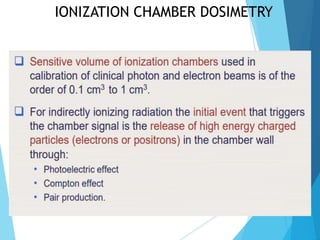
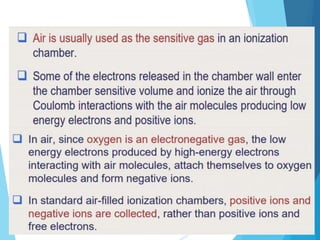
IONIZATION CHAMBER DOSIMETRY
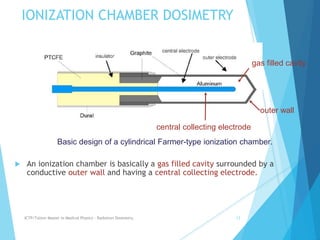
 An ionization chamber is basically a gas filled cavity surrounded by a
conductive outer wall and having a central collecting electrode.
ICTP/TsUniv Master in Medical Physics - Radiation Dosimetry 12
Basic design of a cylindrical Farmer-type ionization chamber.
central collecting electrode
gas filled cavity
outer wall
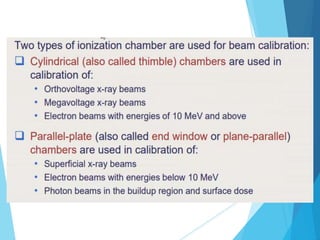
IONIZATION CHAMBER DOSIMETRY Cylindrical
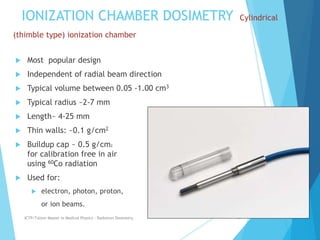
(thimble type) ionization chamber
 Most popular design
 Independent of radial beam direction
 Typical volume between 0.05 -1.00 cm3
 Typical radius ~2-7 mm
 Length~ 4-25 mm
 Thin walls: ~0.1 g/cm2
 Buildup cap ~ 0.5 g/cm2
for calibration free in air
using 60Co radiation
 Used for:
 electron, photon, proton,
or ion beams.
ICTP/TsUniv Master in Medical Physics - Radiation Dosimetry 13
IONIZATION CHAMBER DOSIMETRY
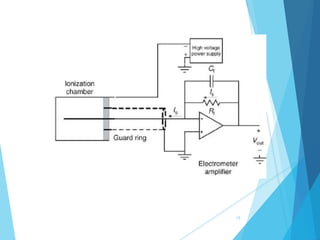
Chambers and electrometers
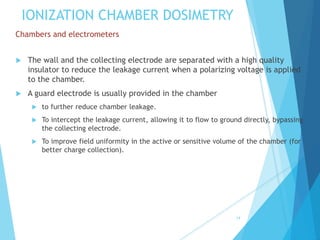
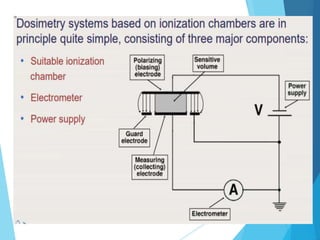
 The wall and the collecting electrode are separated with a high quality
insulator to reduce the leakage current when a polarizing voltage is applied
to the chamber.
 A guard electrode is usually provided in the chamber
 to further reduce chamber leakage.
 To intercept the leakage current, allowing it to flow to ground directly, bypassing
the collecting electrode.
 To improve field uniformity in the active or sensitive volume of the chamber (for
better charge collection).
14
IONIZATION CHAMBER DOSIMETRY
19
 A dosimeter is a device that measures directly or indirectly
 exposure
 kerma
 absorbed dose
 equivalent dose
 or other related quantities.
 The dosimeter along with its reader is referred to as a dosimetry system.
22
General Requirements for Dosimeters
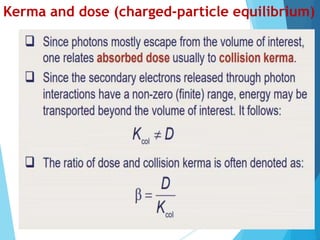
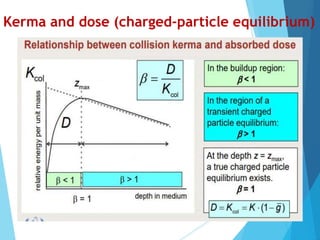
Kerma and dose (charged-particle equilibrium)
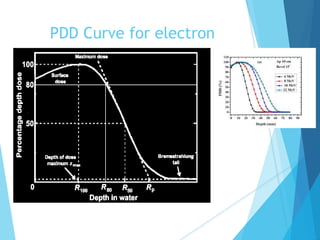
PDD Curve for electron
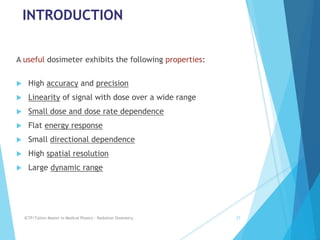
INTRODUCTION
A useful dosimeter exhibits the following properties:
 High accuracy and precision
 Linearity of signal with dose over a wide range
 Small dose and dose rate dependence
 Flat energy response
 Small directional dependence
 High spatial resolution
 Large dynamic range
ICTP/TsUniv Master in Medical Physics - Radiation Dosimetry 27
PROPERTIES OF DOSIMETERS
Accuracy and precision
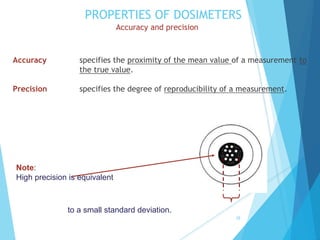
Accuracy specifies the proximity of the mean value of a measurement to
the true value.
Precision specifies the degree of reproducibility of a measurement.
28
Note:
High precision is equivalent
to a small standard deviation.
PROPERTIES OF DOSIMETERS
Accuracy and precision
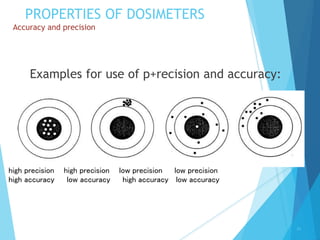
Examples for use of p+recision and accuracy:
high precision high precision low precision low precision
high accuracy low accuracy high accuracy low accuracy
29
PROPERTIES OF DOSIMETERS
Accuracy and precision
Note: The accuracy and precision associated with a
measurement is often expressed in terms of its
uncertainty.
30
PROPERTIES OF DOSIMETERS
Accuracy and precision
 This new guide serves as a clear procedure for characterizing the quality of a
measurement
 It is easily understood and generally accepted
 It defines uncertainty as a quantifiable attribute
31
New Concept by the
International Organization for Standardization (ISO):
"Guide to the expression of uncertainty in measurement"
PROPERTIES OF DOSIMETERS
Accuracy and precision
 Standard uncertainty:
is the uncertainty of a result expressed as standard deviation
 Type A standard uncertainty
is evaluated by a statistical analysis of a series of observations.
 Type B standard uncertainty
is evaluated by means other than the statistical analysis.
32
This classification is for convenience of discussion only.
It is not meant to indicate that there is a difference in the nature of
the uncertainty such as random or systematic.
3.2 PROPERTIES OF DOSIMETERS
3.2.1 Accuracy and precision
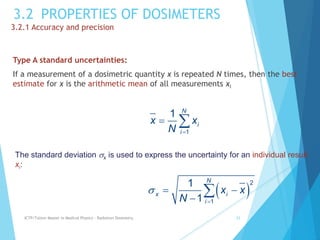
Type A standard uncertainties:
If a measurement of a dosimetric quantity x is repeated N times, then the best
estimate for x is the arithmetic mean of all measurements xi
ICTP/TsUniv Master in Medical Physics - Radiation Dosimetry 33
1
1 N
i
i
x x
N 
 
The standard deviation x is used to express the uncertainty for an individual result
xi:
 
2
1
1
1
N
x i
i
x x
N


 


PROPERTIES OF DOSIMETERS
Accuracy and precision
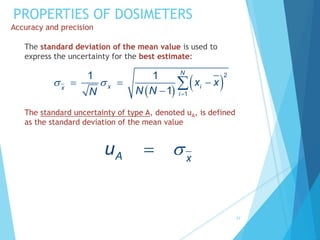
The standard deviation of the mean value is used to
express the uncertainty for the best estimate:
The standard uncertainty of type A, denoted uA, is defined
as the standard deviation of the mean value
34
 
 
2
1
1 1
1
N
x i
x
i
x x
N N
N
 

  


A x
u 

PROPERTIES OF DOSIMETERS
Accuracy and precision
Type B standard uncertainties:
 If the uncertainty of an input component cannot be estimated by repeated
measurements, the determination must be based on other methods such as
intelligent guesses or scientific judgments.
 Such uncertainties are called type B uncertainties
and denoted as uB.
 Type B uncertainties may be involved in
 influence factors on the measuring process
 the application of correction factors
 physical data taken from the literature
35
PROPERTIES OF DOSIMETERS
Accuracy and precision
Example for type B evaluation:
 Consider the case where a measured temperature T of 293.25 K is used as
input quantity for the air density correction factor and little information is
available on the accuracy of the temperature determination.
 All one can do is to suppose that there is a symmetric lower and upper bound
(T-, T+), and that any value between this interval has an equal
probability.
36
PROPERTIES OF DOSIMETERS
Accuracy and precision
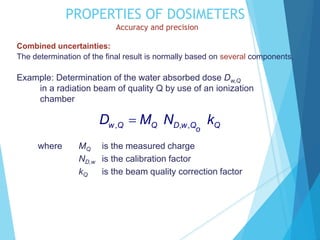

, , ,
w Q Q D w Q Q
o
D M N k
Combined uncertainties:
The determination of the final result is normally based on several components.
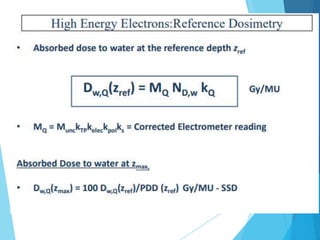
Example: Determination of the water absorbed dose Dw,Q
in a radiation beam of quality Q by use of an ionization
chamber
where MQ is the measured charge
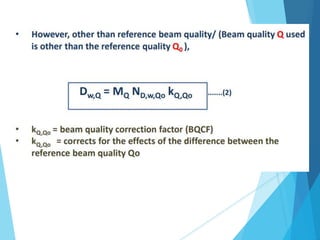
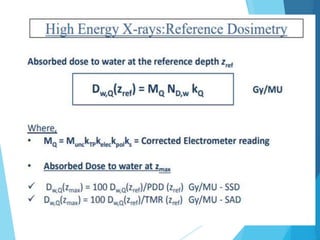
ND,w is the calibration factor
kQ is the beam quality correction factor
PROPERTIES OF DOSIMETERS
Accuracy and precision
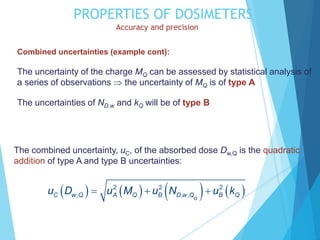
Combined uncertainties (example cont):
The uncertainty of the charge MQ can be assessed by statistical analysis of
a series of observations  the uncertainty of MQ is of type A
The uncertainties of ND,w and kQ will be of type B
The combined uncertainty, uC, of the absorbed dose Dw,Q is the quadratic
addition of type A and type B uncertainties:
       
2 2 2
, , ,
C w Q A Q B D w Q B Q
o
u D u M u N u k
  
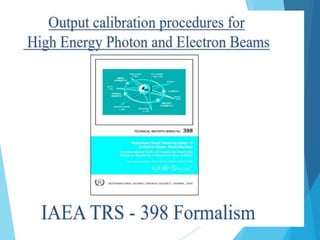
IAEA TRS-398
• In 2000
• IAEA published another International Code of Practice. •
“Absorbed Dose Determination in External Beam Radiotherapy”
(Technical Report Series No. 398)
• Recommending procedures to obtain the absorbed dose in
water from measurements made with an ionization chamber in
external beam radiotherapy (EBRT).
PROPERTIES OF DOSIMETERS
Accuracy and precision
C
U k u
 
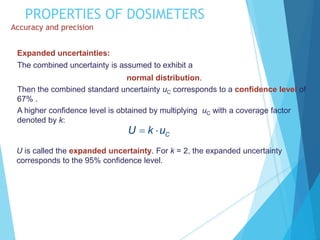
Expanded uncertainties:
The combined uncertainty is assumed to exhibit a
normal distribution.
Then the combined standard uncertainty uC corresponds to a confidence level of
67% .
A higher confidence level is obtained by multiplying uC with a coverage factor
denoted by k:
U is called the expanded uncertainty. For k = 2, the expanded uncertainty
corresponds to the 95% confidence level.
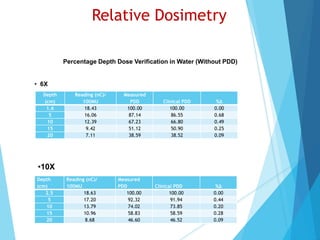
Relative Dosimetry
Depth
(cm)
Reading (nC)/
100MU
Measured
PDD Clinical PDD %∆
1.6 18.43 100.00 100.00 0.00
5 16.06 87.14 86.55 0.68
10 12.39 67.23 66.80 0.49
15 9.42 51.12 50.90 0.25
20 7.11 38.59 38.52 0.09
Depth
(cm)
Reading (nC)/
100MU
Measured
PDD Clinical PDD %∆
2.5 18.63 100.00 100.00 0.00
5 17.20 92.32 91.94 0.44
10 13.79 74.02 73.85 0.20
15 10.96 58.83 58.59 0.28
20 8.68 46.60 46.52 0.09
Percentage Depth Dose Verification in Water (Without PDD)
• 6X
•10X
52
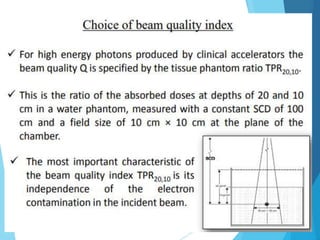
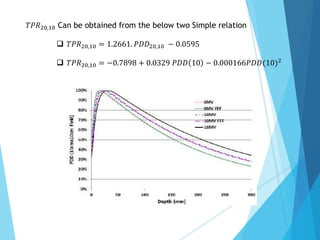
 𝑇𝑃𝑅20,10 = 1.2661. 𝑃𝐷𝐷20,10 − 0.0595
𝑇𝑃𝑅20,10 Can be obtained from the below two Simple relation
 𝑇𝑃𝑅20,10 = −0.7898 + 0.0329 𝑃𝐷𝐷 10 − 0.000166𝑃𝐷𝐷(10)2
Dosimetry
Dosimetry
Dosimetry
Dosimetry
Dosimetry
Dosimetry
Dosimetry
Dosimetry
Dosimetry
Dosimetry
Dosimetry
Dosimetry

Dosimetry

  • 1.
    MD. MOTIUR RAHMAN(MITHU) Chief Medical Physicist & Assistant Project Director TMSS Cancer Center Rangpur Road, Bogura email: motiur,delta@gmail.com
  • 2.
    RADIATION DOSIMETRY Slab Phantom 3DWater Phantom 1D Water Phantom Electrometer Farmer Type Ion Chamber Roos Ion Chamber
  • 3.
  • 4.
    1925: First InternationalCongress for Radiology in London. Foundation of "International Commission on Radiation Units and Measurement" (ICRU) 1928: Second International Congress for Radiology in Stockholm. Definition of the unit “Roentgen” to identify the intensity of radiation by the number of ion pairs formed in air. 1937: Fifth International Congress for Radiology in Chicago. New definition of Roentgen as the unit of the quantity "Exposure". 4 Historical Development of Dosimetry: Some highlights
  • 5.
    1950: Definition ofthe dosimetric quantity absorbed dose as absorbed energy per mass. The rad is the special unit of absorbed dose: 1 rad = 0.01 J/kg 1975: Definition of the new SI-Unit Gray (Gy) for the quantity absorbed dose: 1 Gy = 1 J/kg = 100 rad 5 Historical Development of Dosimetry
  • 6.
    What is Dosimetry? Radiation Dosimetry is a study in physics which deals with the measurement of radiation which may include Exposure, Absorbed dose etc., Why is it Important for Cancer Treatment? Ionizing radiation, which can be used to treat cancer by destroying harmful cells but is completely undetectable by human senses, requires the highest care in ensuring it is accurately measured. Otherwise, too little or too much radiation can be harmful to the cancer patient that is being treated.
  • 7.
    How do wemeasure medical radiation? During treatment, cancer patients are given very specific and targeted amounts of radiation in order to destroy cancer cells. To measure the doses, an instrument is placed in a radiation beam, which produces an electrical charge inside the instrument. Depending on the size of the electric charge or current, scientists can determine the corresponding amount of deposited energy the instrument received. The next step is to ’convert’ the electrical quantity into a radiation dose by applying a calibration coefficient, a number that signifies an amount of radiation based on the corresponding electrical quantity. the measurement of the electrical quantity can differ depending on the type of radiation beam (photons, electrons, etc.), the material the instrument is made out of, or the environmental conditions at the time of the experiment.
  • 8.
    How do wemake sure the right “amount” of radiation is delivered to cancer patients? Because the determination of an absorbed dose is complex and depends on many external and internal factors, the dosimetry community—which includes the International Atomic Energy Agency, the International Commission of Radiation Units and Measurements (ICRU), as well as several medical physics professional societies—decided in the late sixties to standardize the procedures by creating ‘dosimetry protocols” or “codes of practices” These include details on the types of instruments to be used, measurement conditions and calculation procedures.
  • 9.
    What is Absolutedosimetry? Absolute dosimetry is a direct measure of ionization or absorbed dose under standard conditions, which are things like calorimetry [measure energy deposited which eventually appears as heat], electrons released (in an ionization chamber where electronic charge is measured), or ion formation where the number of valence changes in a known amount of ions is directly related to the number of electrons (chemical dosimeter).
  • 10.
    What is relativedosimetry? A relative radiation dosimetry system is defined as a system whose response to ionizing radiation must be calibrated in a known radiation field before its radiation induced (dosimetric) signal can be used to provide absorbed dose or dose rate in the dosimeter chamber cavity
  • 11.
    Ionization chambers Three typesof ionization chamber may be used in reference dosimetry as absolute dosimeter: • Standard free air ionization chamber • Cavity ionization chamber • Extrapolation chamber The “absoluteness” of dose determination with ionization chambers depends on the accurate knowledge of (Wair/e) the mean energy required to produce an ion pair in air.
  • 12.
    IONIZATION CHAMBER DOSIMETRY An ionization chamber is basically a gas filled cavity surrounded by a conductive outer wall and having a central collecting electrode. ICTP/TsUniv Master in Medical Physics - Radiation Dosimetry 12 Basic design of a cylindrical Farmer-type ionization chamber. central collecting electrode gas filled cavity outer wall
  • 13.
    IONIZATION CHAMBER DOSIMETRYCylindrical (thimble type) ionization chamber  Most popular design  Independent of radial beam direction  Typical volume between 0.05 -1.00 cm3  Typical radius ~2-7 mm  Length~ 4-25 mm  Thin walls: ~0.1 g/cm2  Buildup cap ~ 0.5 g/cm2 for calibration free in air using 60Co radiation  Used for:  electron, photon, proton, or ion beams. ICTP/TsUniv Master in Medical Physics - Radiation Dosimetry 13
  • 14.
    IONIZATION CHAMBER DOSIMETRY Chambersand electrometers  The wall and the collecting electrode are separated with a high quality insulator to reduce the leakage current when a polarizing voltage is applied to the chamber.  A guard electrode is usually provided in the chamber  to further reduce chamber leakage.  To intercept the leakage current, allowing it to flow to ground directly, bypassing the collecting electrode.  To improve field uniformity in the active or sensitive volume of the chamber (for better charge collection). 14
  • 16.
  • 19.
  • 22.
     A dosimeteris a device that measures directly or indirectly  exposure  kerma  absorbed dose  equivalent dose  or other related quantities.  The dosimeter along with its reader is referred to as a dosimetry system. 22 General Requirements for Dosimeters
  • 23.
    Kerma and dose(charged-particle equilibrium)
  • 24.
    Kerma and dose(charged-particle equilibrium)
  • 26.
    PDD Curve forelectron
  • 27.
    INTRODUCTION A useful dosimeterexhibits the following properties:  High accuracy and precision  Linearity of signal with dose over a wide range  Small dose and dose rate dependence  Flat energy response  Small directional dependence  High spatial resolution  Large dynamic range ICTP/TsUniv Master in Medical Physics - Radiation Dosimetry 27
  • 28.
    PROPERTIES OF DOSIMETERS Accuracyand precision Accuracy specifies the proximity of the mean value of a measurement to the true value. Precision specifies the degree of reproducibility of a measurement. 28 Note: High precision is equivalent to a small standard deviation.
  • 29.
    PROPERTIES OF DOSIMETERS Accuracyand precision Examples for use of p+recision and accuracy: high precision high precision low precision low precision high accuracy low accuracy high accuracy low accuracy 29
  • 30.
    PROPERTIES OF DOSIMETERS Accuracyand precision Note: The accuracy and precision associated with a measurement is often expressed in terms of its uncertainty. 30
  • 31.
    PROPERTIES OF DOSIMETERS Accuracyand precision  This new guide serves as a clear procedure for characterizing the quality of a measurement  It is easily understood and generally accepted  It defines uncertainty as a quantifiable attribute 31 New Concept by the International Organization for Standardization (ISO): "Guide to the expression of uncertainty in measurement"
  • 32.
    PROPERTIES OF DOSIMETERS Accuracyand precision  Standard uncertainty: is the uncertainty of a result expressed as standard deviation  Type A standard uncertainty is evaluated by a statistical analysis of a series of observations.  Type B standard uncertainty is evaluated by means other than the statistical analysis. 32 This classification is for convenience of discussion only. It is not meant to indicate that there is a difference in the nature of the uncertainty such as random or systematic.
  • 33.
    3.2 PROPERTIES OFDOSIMETERS 3.2.1 Accuracy and precision Type A standard uncertainties: If a measurement of a dosimetric quantity x is repeated N times, then the best estimate for x is the arithmetic mean of all measurements xi ICTP/TsUniv Master in Medical Physics - Radiation Dosimetry 33 1 1 N i i x x N    The standard deviation x is used to express the uncertainty for an individual result xi:   2 1 1 1 N x i i x x N      
  • 34.
    PROPERTIES OF DOSIMETERS Accuracyand precision The standard deviation of the mean value is used to express the uncertainty for the best estimate: The standard uncertainty of type A, denoted uA, is defined as the standard deviation of the mean value 34     2 1 1 1 1 N x i x i x x N N N         A x u  
  • 35.
    PROPERTIES OF DOSIMETERS Accuracyand precision Type B standard uncertainties:  If the uncertainty of an input component cannot be estimated by repeated measurements, the determination must be based on other methods such as intelligent guesses or scientific judgments.  Such uncertainties are called type B uncertainties and denoted as uB.  Type B uncertainties may be involved in  influence factors on the measuring process  the application of correction factors  physical data taken from the literature 35
  • 36.
    PROPERTIES OF DOSIMETERS Accuracyand precision Example for type B evaluation:  Consider the case where a measured temperature T of 293.25 K is used as input quantity for the air density correction factor and little information is available on the accuracy of the temperature determination.  All one can do is to suppose that there is a symmetric lower and upper bound (T-, T+), and that any value between this interval has an equal probability. 36
  • 37.
    PROPERTIES OF DOSIMETERS Accuracyand precision  , , , w Q Q D w Q Q o D M N k Combined uncertainties: The determination of the final result is normally based on several components. Example: Determination of the water absorbed dose Dw,Q in a radiation beam of quality Q by use of an ionization chamber where MQ is the measured charge ND,w is the calibration factor kQ is the beam quality correction factor
  • 38.
    PROPERTIES OF DOSIMETERS Accuracyand precision Combined uncertainties (example cont): The uncertainty of the charge MQ can be assessed by statistical analysis of a series of observations  the uncertainty of MQ is of type A The uncertainties of ND,w and kQ will be of type B The combined uncertainty, uC, of the absorbed dose Dw,Q is the quadratic addition of type A and type B uncertainties:         2 2 2 , , , C w Q A Q B D w Q B Q o u D u M u N u k   
  • 39.
    IAEA TRS-398 • In2000 • IAEA published another International Code of Practice. • “Absorbed Dose Determination in External Beam Radiotherapy” (Technical Report Series No. 398) • Recommending procedures to obtain the absorbed dose in water from measurements made with an ionization chamber in external beam radiotherapy (EBRT).
  • 40.
    PROPERTIES OF DOSIMETERS Accuracyand precision C U k u   Expanded uncertainties: The combined uncertainty is assumed to exhibit a normal distribution. Then the combined standard uncertainty uC corresponds to a confidence level of 67% . A higher confidence level is obtained by multiplying uC with a coverage factor denoted by k: U is called the expanded uncertainty. For k = 2, the expanded uncertainty corresponds to the 95% confidence level.
  • 41.
    Relative Dosimetry Depth (cm) Reading (nC)/ 100MU Measured PDDClinical PDD %∆ 1.6 18.43 100.00 100.00 0.00 5 16.06 87.14 86.55 0.68 10 12.39 67.23 66.80 0.49 15 9.42 51.12 50.90 0.25 20 7.11 38.59 38.52 0.09 Depth (cm) Reading (nC)/ 100MU Measured PDD Clinical PDD %∆ 2.5 18.63 100.00 100.00 0.00 5 17.20 92.32 91.94 0.44 10 13.79 74.02 73.85 0.20 15 10.96 58.83 58.59 0.28 20 8.68 46.60 46.52 0.09 Percentage Depth Dose Verification in Water (Without PDD) • 6X •10X
  • 52.
  • 59.
     𝑇𝑃𝑅20,10 =1.2661. 𝑃𝐷𝐷20,10 − 0.0595 𝑇𝑃𝑅20,10 Can be obtained from the below two Simple relation  𝑇𝑃𝑅20,10 = −0.7898 + 0.0329 𝑃𝐷𝐷 10 − 0.000166𝑃𝐷𝐷(10)2