Download free for 30 days
Sign in
Upload
Language (EN)
Support
Business
Mobile
Social Media
Marketing
Technology
Art & Photos
Career
Design
Education
Presentations & Public Speaking
Government & Nonprofit
Healthcare
Internet
Law
Leadership & Management
Automotive
Engineering
Software
Recruiting & HR
Retail
Sales
Services
Science
Small Business & Entrepreneurship
Food
Environment
Economy & Finance
Data & Analytics
Investor Relations
Sports
Spiritual
News & Politics
Travel
Self Improvement
Real Estate
Entertainment & Humor
Health & Medicine
Devices & Hardware
Lifestyle
Change Language
Language
English
Español
Português
Français
Deutsche
Cancel
Save
Submit search
EN
Uploaded by
BasitShafi6
PPTX, PDF
24 views
A presentation on Dialysis procedure..pptx
A presentation on Dialysis procedure.
Science
◦
Read more
0
Save
Share
Embed
Embed presentation
Download
Download to read offline
1
/ 27
2
/ 27
3
/ 27
4
/ 27
5
/ 27
6
/ 27
7
/ 27
8
/ 27
9
/ 27
10
/ 27
11
/ 27
12
/ 27
13
/ 27
14
/ 27
15
/ 27
16
/ 27
17
/ 27
18
/ 27
19
/ 27
20
/ 27
21
/ 27
22
/ 27
23
/ 27
24
/ 27
25
/ 27
26
/ 27
27
/ 27
More Related Content
PPTX
14 peritoneal dialysis
by
yogesh tiwari
PPTX
Peritoneal dialysis by Dr. Basil Tumaini
by
Basil Tumaini
PPTX
NURSING MANAGEMENT OF PERITONEAL DIAYLSIS
by
cobbinaalfred4
PPTX
Renal system management
by
Dipali Dumbre
PPSX
Medical Surgical Nursing PERITONEAL DIALYSIS 2024.ppsx
by
Salah Nazar
PPTX
Peritoneal dialysis msn
by
Salah Nazar
PPTX
INTRODUCTION dialysis chapter types .pptx
by
Wesam Taher Almagharbeh
PPTX
Renal replacement therapy
by
Dr. Nitish kumar
14 peritoneal dialysis
by
yogesh tiwari
Peritoneal dialysis by Dr. Basil Tumaini
by
Basil Tumaini
NURSING MANAGEMENT OF PERITONEAL DIAYLSIS
by
cobbinaalfred4
Renal system management
by
Dipali Dumbre
Medical Surgical Nursing PERITONEAL DIALYSIS 2024.ppsx
by
Salah Nazar
Peritoneal dialysis msn
by
Salah Nazar
INTRODUCTION dialysis chapter types .pptx
by
Wesam Taher Almagharbeh
Renal replacement therapy
by
Dr. Nitish kumar
Similar to A presentation on Dialysis procedure..pptx
PPT
11 Peritoneal Dialysis
by
Dang Thanh Tuan
PPTX
Pd intervention-1
by
FarragBahbah
PPTX
Peritoneal dialysis
by
Jinumol Jacob
PPTX
Dialysis
by
Asifa Bhutto
PPTX
Peritoneal Dialysis
by
Amit Jha
PPTX
Peritoneal Dialysis
by
amit jha
PPT
CME: Dialysis & Transplantation
by
Stanley Medical College, Department of Medicine
DOCX
Peritoneal dialysis
by
THANUJA MATHEW
PPTX
Renal Replacement Therapies.pptx
by
ssuser3f0e35
PPT
1 ra clase
by
Dr.Jose Luis Rodriguez Lopez
PPTX
peritoneal dialysis, management of chronic renal failure
by
Sapana Shrestha
PPTX
DIALYSIS2 Hemodialysis peritoneal d.pptx
by
Zellanienhd
PPTX
Chetan dialysis ppt
by
Harshal Shrote
PPTX
Peritoneal dialysis
by
Libby Harry
PPTX
Peritoneal dialysis
by
Mahesh Sivaji
PPTX
PD prescription
by
ปิติ นิยมศิริวนิช
PPTX
A presentation on Dialysis and dialyser 1.pptx
by
BasitShafi6
PPT
Apd
by
FarragBahbah
PDF
Renal transplant esrd & rrt
by
GovtRoyapettahHospit
PPTX
Peritonial dialyser
by
Dinesh Ponnusamy
11 Peritoneal Dialysis
by
Dang Thanh Tuan
Pd intervention-1
by
FarragBahbah
Peritoneal dialysis
by
Jinumol Jacob
Dialysis
by
Asifa Bhutto
Peritoneal Dialysis
by
Amit Jha
Peritoneal Dialysis
by
amit jha
CME: Dialysis & Transplantation
by
Stanley Medical College, Department of Medicine
Peritoneal dialysis
by
THANUJA MATHEW
Renal Replacement Therapies.pptx
by
ssuser3f0e35
1 ra clase
by
Dr.Jose Luis Rodriguez Lopez
peritoneal dialysis, management of chronic renal failure
by
Sapana Shrestha
DIALYSIS2 Hemodialysis peritoneal d.pptx
by
Zellanienhd
Chetan dialysis ppt
by
Harshal Shrote
Peritoneal dialysis
by
Libby Harry
Peritoneal dialysis
by
Mahesh Sivaji
PD prescription
by
ปิติ นิยมศิริวนิช
A presentation on Dialysis and dialyser 1.pptx
by
BasitShafi6
Apd
by
FarragBahbah
Renal transplant esrd & rrt
by
GovtRoyapettahHospit
Peritonial dialyser
by
Dinesh Ponnusamy
More from BasitShafi6
PPTX
A presentation on patient medication historyh2.pptx
by
BasitShafi6
PPTX
A presentation on CONSTIPATION and DiarrheaH1.pptx
by
BasitShafi6
PPTX
Presentation on understanding serotonin syndrome h2.pptx
by
BasitShafi6
PPTX
A presentation on serotonin Syndrome h1.pptx
by
BasitShafi6
PPTX
2. A presentation on Medication history.pptx
by
BasitShafi6
PPTX
A presentation on CONSTIPATION and Diarrhea 1.pptx
by
BasitShafi6
PPTX
9_A presentation on CONSTIPATION AND DIARRHOEA_.pptx
by
BasitShafi6
PPTX
9.1 .1. 1 therapeutic drug monitoring..pptx
by
BasitShafi6
PPTX
8.1 .1. 1 A presentation therapeutic drug monitoring..pptx
by
BasitShafi6
PPTX
8.1 .A presentation on the concept of TDM.pptx
by
BasitShafi6
PPTX
8.1 A presentation on Drug Therapy monitoring.pptx
by
BasitShafi6
PPTX
1.1 presentation on medication history.pptx
by
BasitShafi6
PPTX
_CONSTIPATION AND DIARRHOEA_ by Mithun_.pptx
by
BasitShafi6
PPTX
A presentation on - repetitive dosage .pptx
by
BasitShafi6
PPTX
A presentation on the TOXICOKINETICS NEW.pptx
by
BasitShafi6
PPTX
A presentation on the clinical symptoms Pneumonia.pptx
by
BasitShafi6
PPTX
Presentation on multi dosage regime slidesaver.app_jzcqnj.pptx
by
BasitShafi6
PPTX
A presentation on the pharmacotherapy Pneumonia.pptx
by
BasitShafi6
PPTX
A presentation on PH PARTITION THEORY final.pptx
by
BasitShafi6
PPTX
A presentation on membranes barriers.pptx
by
BasitShafi6
A presentation on patient medication historyh2.pptx
by
BasitShafi6
A presentation on CONSTIPATION and DiarrheaH1.pptx
by
BasitShafi6
Presentation on understanding serotonin syndrome h2.pptx
by
BasitShafi6
A presentation on serotonin Syndrome h1.pptx
by
BasitShafi6
2. A presentation on Medication history.pptx
by
BasitShafi6
A presentation on CONSTIPATION and Diarrhea 1.pptx
by
BasitShafi6
9_A presentation on CONSTIPATION AND DIARRHOEA_.pptx
by
BasitShafi6
9.1 .1. 1 therapeutic drug monitoring..pptx
by
BasitShafi6
8.1 .1. 1 A presentation therapeutic drug monitoring..pptx
by
BasitShafi6
8.1 .A presentation on the concept of TDM.pptx
by
BasitShafi6
8.1 A presentation on Drug Therapy monitoring.pptx
by
BasitShafi6
1.1 presentation on medication history.pptx
by
BasitShafi6
_CONSTIPATION AND DIARRHOEA_ by Mithun_.pptx
by
BasitShafi6
A presentation on - repetitive dosage .pptx
by
BasitShafi6
A presentation on the TOXICOKINETICS NEW.pptx
by
BasitShafi6
A presentation on the clinical symptoms Pneumonia.pptx
by
BasitShafi6
Presentation on multi dosage regime slidesaver.app_jzcqnj.pptx
by
BasitShafi6
A presentation on the pharmacotherapy Pneumonia.pptx
by
BasitShafi6
A presentation on PH PARTITION THEORY final.pptx
by
BasitShafi6
A presentation on membranes barriers.pptx
by
BasitShafi6
Recently uploaded
PPTX
Polarity - Polar and non-polar, electronegativity and molecular geometry
by
JovenAlvarado
PPTX
SCIENCE Quiz Bee 2025-School - Based.pptx
by
MaryJean78
PPTX
PRE NATAL GROWTH OF MAXILLA in orthodontics.pptx
by
haranip03
PDF
ME 2101 Fall Basic Thermodynamics L1.pdf
by
arifrahat33
PPT
Lesson_Presentation_Adding_and_Subtracting_Polynomials (1).ppt
by
engabdelaziz1993
PDF
Sciences of Europe No 180 (2025)
by
Sciences of Europe
PPTX
Preventive health care.pptx Social Pharmacy
by
potdarvrushali
PPTX
Photosynthesis (Light dependent reaction and Calvin cycle).pptx
by
RashmiMG2
PDF
HND Networking and Cloud Computing (NCC).pdf
by
ssuser8dcccc
PPTX
Travis Hills of Minnesota Championing a Greener Future Through AI-Driven Pyro...
by
Travis Hills MN
PPTX
PPt Fisheries and Aquaculture.pptx course
by
tigistafework
PDF
12th biology Notes PDF Download 100% Irfanullah Mehar (2).pdf Irfanullah Mehar
by
World of Wisdom
PPTX
interstitial nephritis,acute and chronic
by
doniagad
PDF
12th Bio NCERT Important Questions @irfanullah_ mehar.pdf
by
World of Wisdom
PPTX
LAB SAFETY (2LAB SAFETY (2LAB SAFETY (2).pptx
by
AmgadHassanein1
PPTX
ALLOSTERIC INHIBITION : ITS CHARACTERISTICS, STRUCTURE AND MECHANISMS
by
aubrey02judd
PPTX
production of glucose from starch.enz.pptx
by
xenonfluxz
PDF
20251030 Jonh Kemp Energy system transformations and energy security
by
ddaher1
PPTX
Ianalumab_ITP_Journal_Presentation_FULL.pptx
by
sandiponroy342
PDF
GENE THERAPY ENHANCING NEUROPLASTICITY FOR BIPOLAR DISORDER
by
PrajaktaPanda
Polarity - Polar and non-polar, electronegativity and molecular geometry
by
JovenAlvarado
SCIENCE Quiz Bee 2025-School - Based.pptx
by
MaryJean78
PRE NATAL GROWTH OF MAXILLA in orthodontics.pptx
by
haranip03
ME 2101 Fall Basic Thermodynamics L1.pdf
by
arifrahat33
Lesson_Presentation_Adding_and_Subtracting_Polynomials (1).ppt
by
engabdelaziz1993
Sciences of Europe No 180 (2025)
by
Sciences of Europe
Preventive health care.pptx Social Pharmacy
by
potdarvrushali
Photosynthesis (Light dependent reaction and Calvin cycle).pptx
by
RashmiMG2
HND Networking and Cloud Computing (NCC).pdf
by
ssuser8dcccc
Travis Hills of Minnesota Championing a Greener Future Through AI-Driven Pyro...
by
Travis Hills MN
PPt Fisheries and Aquaculture.pptx course
by
tigistafework
12th biology Notes PDF Download 100% Irfanullah Mehar (2).pdf Irfanullah Mehar
by
World of Wisdom
interstitial nephritis,acute and chronic
by
doniagad
12th Bio NCERT Important Questions @irfanullah_ mehar.pdf
by
World of Wisdom
LAB SAFETY (2LAB SAFETY (2LAB SAFETY (2).pptx
by
AmgadHassanein1
ALLOSTERIC INHIBITION : ITS CHARACTERISTICS, STRUCTURE AND MECHANISMS
by
aubrey02judd
production of glucose from starch.enz.pptx
by
xenonfluxz
20251030 Jonh Kemp Energy system transformations and energy security
by
ddaher1
Ianalumab_ITP_Journal_Presentation_FULL.pptx
by
sandiponroy342
GENE THERAPY ENHANCING NEUROPLASTICITY FOR BIPOLAR DISORDER
by
PrajaktaPanda
A presentation on Dialysis procedure..pptx
1.
© Ramaiah University
of Applied Sciences 1 Faculty of Pharmacy Lecture- 33 Lecture Title Dialysis Lecture speaker
2.
© Ramaiah University
of Applied Sciences 2 Faculty of Pharmacy Objectives At the end of this lecture, student will be able to: Explain different complications of dialysis Identify suitable lifestyle modification required for management of dialysis Explain management of complications associated with dialysis Explain about peritoneal dialysis
3.
© Ramaiah University
of Applied Sciences 3 Faculty of Pharmacy Management of complication
4.
© Ramaiah University
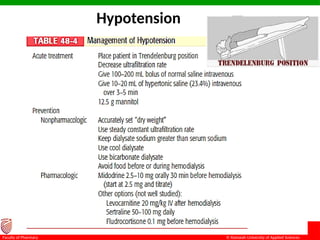
of Applied Sciences 4 Faculty of Pharmacy Hypotension
5.
© Ramaiah University
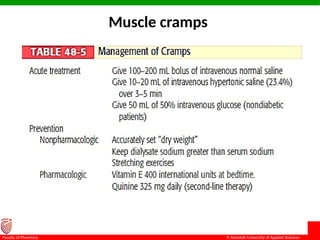
of Applied Sciences 5 Faculty of Pharmacy Muscle cramps
6.
© Ramaiah University
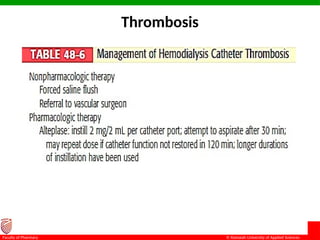
of Applied Sciences 6 Faculty of Pharmacy Thrombosis
7.
© Ramaiah University
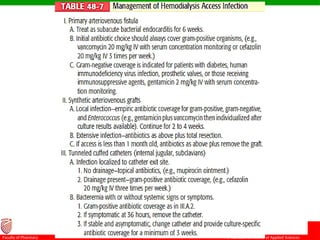
of Applied Sciences 7 Faculty of Pharmacy Infection
8.
© Ramaiah University
of Applied Sciences 8 Faculty of Pharmacy Peritoneal Dialysis
9.
© Ramaiah University
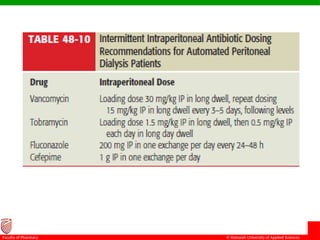
of Applied Sciences 9 Faculty of Pharmacy Peritoneal dialysis • Peritoneal dialysis (PD) is a treatment for patients with severe chronic kidney disease • The process uses the patient's peritoneum in the abdomen as a membrane across which fluids and dissolved substances (electrolytes, urea, glucose, albumin and other small molecules) are exchanged from the blood • Fluid is introduced through a permanent tube in the abdomen and flushed out – either every night while the patient sleeps (automatic peritoneal dialysis) or – via regular exchanges throughout the day (continuous ambulatory peritoneal dialysis) • PD is used as an alternative to hemodialysis
10.
© Ramaiah University
of Applied Sciences 10 Faculty of Pharmacy Who need PD • With more hemodynamic instability • With significant residual kidney function (RRF) • Who desire to maintain a significant degree of self-care
11.
© Ramaiah University
of Applied Sciences 11 Faculty of Pharmacy Principles of peritoneal dialysis • The three basic components of HD – A blood-filled compartment – Separated from a dialysate-filled compartment – By a semipermeable membrane • In PD, the dialysate-filled compartment is the peritoneal cavity, into which dialysate is instilled via a permanent peritoneal catheter that pass through the abdominal wall • The contiguous peritoneal membrane surrounds the peritoneal cavity • The cavity, which normally contains about 100mL of lipid-rich lubricating fluid, can expand to a capacity of several liters
12.
© Ramaiah University
of Applied Sciences 12 Faculty of Pharmacy Semipermeable membrane • The peritoneal membrane that lines the cavity functions as the semipermeable membrane, across which diffusion and ultrafiltration occur • The membrane is classically described as a monocellular layer of peritoneal mesothelial cells • The dialyzing membrane is also comprised of the basement membrane and underlying connective and interstitial tissue • The peritoneal membrane has a total area that approximates body surface area (approximately 1 to 2 m2). • Blood vessels supplying and draining the abdominal viscera, musculature and mesentery constitute the blood-filled compartment
13.
© Ramaiah University
of Applied Sciences 13 Faculty of Pharmacy PD vs HD • The blood is not in intimate contact with the dialysis membrane as it is in HD, metabolic waste products must travel a considerable distance to the dialysate-filled compartment. • There is no easy method to regulate blood flow to the surface of the peritoneal membrane • There is no a countercurrent flow of blood and dialysate to increase diffusion and ultrafiltration via changes in hydrostatic pressure. • For these reasons, PD is a much-less-efficient process per unit time as compared with HD • Continuous procedure to achieve acceptable goals for clearance of metabolic waste products
14.
© Ramaiah University
of Applied Sciences 14 Faculty of Pharmacy Peritoneal dialysis access • Access to the peritoneal cavity is via the placement of an indwelling catheter • Most catheters are manufactured from silastic, which is soft, flexible, and biocompatible • A typical adult catheter is approximately 40 to 45cm long, 20 to 22 cm of which are inside the peritoneal cavity
15.
© Ramaiah University
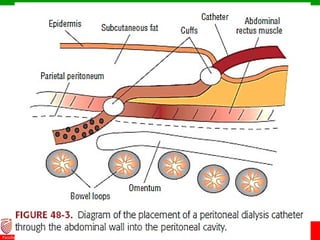
of Applied Sciences 15 Faculty of Pharmacy Peritoneal dialysis access • Placement of the catheter is such that the distal end lies low in a pelvic gutter • The center section of the catheter has one or two cuffs made of a porous material • This section is tunneled inside the anterior abdominal wall • The cuffs provide mechanical support and stability to the catheter • The cuffs are placed at different sites surrounding the abdominal rectus muscle • The remainder of the central section of the catheter is tunneled subcutaneously before exiting the abdominal surface, usually a few centimeters below and to one side of the umbilicus
16.
© Ramaiah University
of Applied Sciences 16 Faculty of Pharmacy
17.
© Ramaiah University
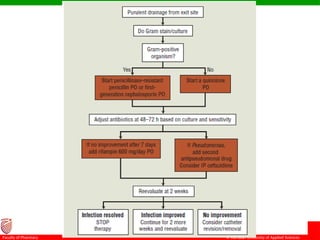
of Applied Sciences 17 Faculty of Pharmacy Peritoneal dialysis access • The placement of the catheter exit site is one of the factors related to the development or prevention of exit-site infections and peritonitis. • The external section of most peritoneal catheters ends with a Luer-Lok connector, which can be connected to a variety of administration sets. • These catheters can be used immediately if necessary, provided small initial volumes are instilled • A maturation period of 2 to 6 weeks is preferred.
18.
© Ramaiah University
of Applied Sciences 18 Faculty of Pharmacy Peritoneal dialysis procedure • The prescribed dose of PD may be altered by – changing the number of exchanges per day – altering the volume of each exchange – altering the strength of dextrose in the dialysate for some or all exchanges • Increasing any one of these variables increases the effective osmotic gradient across the peritoneum, leading to increased ultrafiltration and diffusion • If the dwell time is extended, equilibrium may be reached, after which time there will be no further water or solute removal • After a critical period, reverse water movement may occur.
19.
© Ramaiah University
of Applied Sciences 19 Faculty of Pharmacy Peritoneal dialysis solutions • Commercial PD solutions include varying concentrations of electrolytes, such as • Sodium (132 mEq/L) • Chloride (96 to 102mEq/L) • Calcium (0 to 3.5 mEq/L) • Magnesium (0.5 mEq/L) • Lactate (35 to 40 mEq/L) • Dialysate pH is maintained at 5.2 • May contain 1.5%, 2.5%, 3.86%, or 4.25% dextrose or icodextrin (a glucose polymer) at a concentration of 7.5%. • The dextrose solutions are hyperosmolar and induce ultrafiltration (removal of free water) by crystalline osmosis
20.
© Ramaiah University
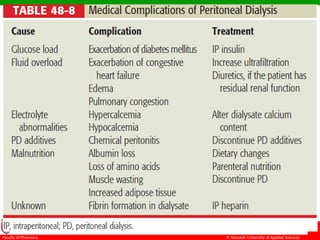
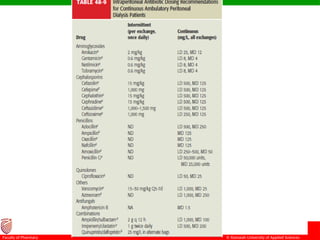
of Applied Sciences 20 Faculty of Pharmacy Additives • Insulin • Heparin
21.
© Ramaiah University
of Applied Sciences 21 Faculty of Pharmacy
22.
© Ramaiah University
of Applied Sciences 22 Faculty of Pharmacy
23.
© Ramaiah University
of Applied Sciences 23 Faculty of Pharmacy
24.
© Ramaiah University
of Applied Sciences 24 Faculty of Pharmacy
25.
© Ramaiah University
of Applied Sciences 25 Faculty of Pharmacy
26.
© Ramaiah University
of Applied Sciences 26 Faculty of Pharmacy
27.
© Ramaiah University
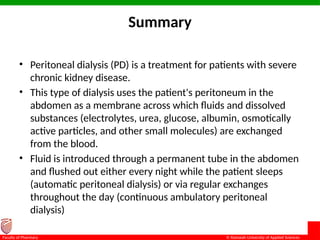
of Applied Sciences 27 Faculty of Pharmacy Summary • Peritoneal dialysis (PD) is a treatment for patients with severe chronic kidney disease. • This type of dialysis uses the patient's peritoneum in the abdomen as a membrane across which fluids and dissolved substances (electrolytes, urea, glucose, albumin, osmotically active particles, and other small molecules) are exchanged from the blood. • Fluid is introduced through a permanent tube in the abdomen and flushed out either every night while the patient sleeps (automatic peritoneal dialysis) or via regular exchanges throughout the day (continuous ambulatory peritoneal dialysis)
Download