PERIODONTAL MICROSURGERY
CONTENTS
INTRODUCTION AND HISTORY
 PRINCIPLES OF MICROSURGERY
 MICROSURGICAL TRIAD
 TYPES & PRINCIPLES OF MAGNIFICATION SYSTEM
 MICROSURGICAL INSTRUMENTS
 INDICATIONS OF PERIODONTAL MICROSURGERY
 FUTURE PERSPECTIVES OF MICROSURGERY
 CONCLUSION
Introduction
• In 1979, Daniel defined microsurgery in broad terms as
surgery performed under magnification by the
microscope.
• Periodontal microsurgery is the refinement of basic
surgical techniques made possible by the improvement in
visual acuity gained with the use of the surgical
microscope.
----Leonard S. Tibbetts, Dennis Shanelec. INT J MICRODENT .2009;1:13–24
History
• In 1694, Amsterdam merchant Anton van Leeuwenhook constructed the first
compound-lens microscope.
• Magnification for microsurgical procedures was introduced to medicine during the
late 1800s
• In 1921, Carl Nylen, who is considered the father of microsurgery, first used the
binocular microscope for ear surgery .
• Apotheker & Jako first introduced the microscope to dentistry in 1978
• During 1992, Carr published an article outlining the use of the surgical microscope
during endodontic procedures.
• In 1993, Shanelec & Tibbetts presented a continuing education course on
periodontal microsurgery at the annual meeting of the American Academy of
Periodontology.
• Belcher wrote an article in 2001 summarizing the benefits and potential usages of
the surgical microscope in periodontal therapy.
Periodontal Microsurgery James Belcher , Practical Periodontal Plastic Surgery, Second
Edition.2017
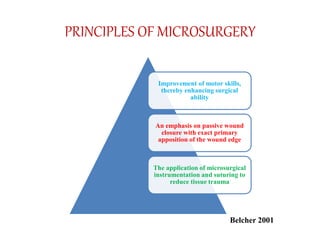
PRINCIPLES OF MICROSURGERY
Improvement of motor skills,
thereby enhancing surgical
ability
An emphasis on passive wound
closure with exact primary
apposition of the wound edge
The application of microsurgical
instrumentation and suturing to
reduce tissue trauma
Belcher 2001
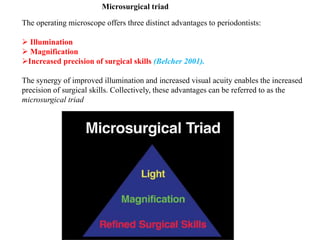
The operating microscope offers three distinct advantages to periodontists:
 Illumination
 Magnification
Increased precision of surgical skills (Belcher 2001).
The synergy of improved illumination and increased visual acuity enables the increased
precision of surgical skills. Collectively, these advantages can be referred to as the
microsurgical triad
Microsurgical triad
Illumination achieved through fiberoptic technology, has improved the
methods of focusing light on specific areas and is a standard feature of surgical
operating microscopes.
- J.M. Belcher 2001
A)Illumination
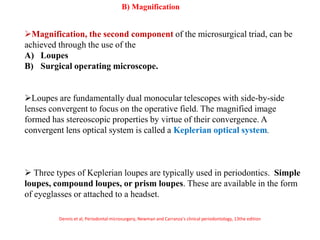
Magnification, the second component of the microsurgical triad, can be
achieved through the use of the
A) Loupes
B) Surgical operating microscope.
Loupes are fundamentally dual monocular telescopes with side-by-side
lenses convergent to focus on the operative field. The magnified image
formed has stereoscopic properties by virtue of their convergence. A
convergent lens optical system is called a Keplerian optical system.
 Three types of Keplerian loupes are typically used in periodontics. Simple
loupes, compound loupes, or prism loupes. These are available in the form
of eyeglasses or attached to a headset.
.
B) Magnification
Dennis et al, Periodontal microsurgery, Newman and Carranza’s clinical periodontology, 13the edition
 Compound and prism designs produce superior magnification and are
commonly used in dentistry today.
 70%–80% of the typical periodontal microsurgeries can be done at a
magnification of ×10–×20 with the surgical operating microscope.
 The remaining procedures can be performed with loupes under ×6–×8
using enhanced motor skills acquired during microsurgery training sessions
with a surgical microscope.
C)Increased precision in delivery of surgical skills, the third component of
microsurgical triad, is the synergistic result of illumination and magnification
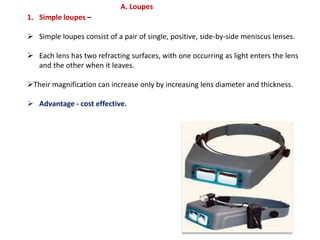
1. Simple loupes –
 Simple loupes consist of a pair of single, positive, side-by-side meniscus lenses.
 Each lens has two refracting surfaces, with one occurring as light enters the lens
and the other when it leaves.
Their magnification can increase only by increasing lens diameter and thickness.
 Advantage - cost effective.
A. Loupes
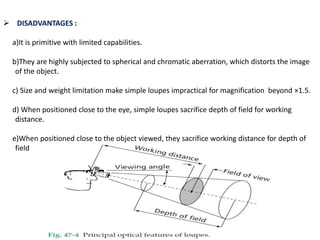
 DISADVANTAGES :
a)It is primitive with limited capabilities.
b)They are highly subjected to spherical and chromatic aberration, which distorts the image
of the object.
c) Size and weight limitation make simple loupes impractical for magnification beyond ×1.5.
d) When positioned close to the eye, simple loupes sacrifice depth of field for working
distance.
e)When positioned close to the object viewed, they sacrifice working distance for depth of
field
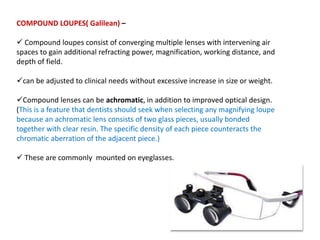
COMPOUND LOUPES( Galilean) –
 Compound loupes consist of converging multiple lenses with intervening air
spaces to gain additional refracting power, magnification, working distance, and
depth of field.
can be adjusted to clinical needs without excessive increase in size or weight.
Compound lenses can be achromatic, in addition to improved optical design.
(This is a feature that dentists should seek when selecting any magnifying loupe
because an achromatic lens consists of two glass pieces, usually bonded
together with clear resin. The specific density of each piece counteracts the
chromatic aberration of the adjacent piece.)
 These are commonly mounted on eyeglasses.
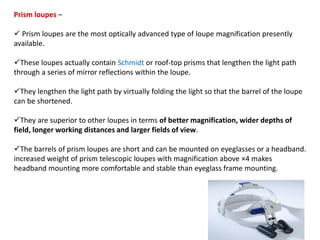
Prism loupes –
 Prism loupes are the most optically advanced type of loupe magnification presently
available.
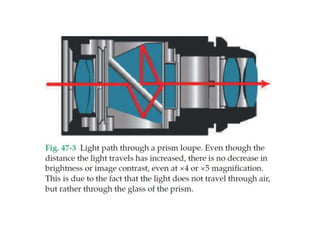
These loupes actually contain Schmidt or roof-top prisms that lengthen the light path
through a series of mirror reflections within the loupe.
They lengthen the light path by virtually folding the light so that the barrel of the loupe
can be shortened.
They are superior to other loupes in terms of better magnification, wider depths of
field, longer working distances and larger fields of view.
The barrels of prism loupes are short and can be mounted on eyeglasses or a headband.
increased weight of prism telescopic loupes with magnification above ×4 makes
headband mounting more comfortable and stable than eyeglass frame mounting.
Loupe Magnification -
Wide ranges of magnifications are available in loupes, ranging from 1.5X to 10X.
 Loupes with less than 2X magnifications, are usually inadequate for the visual
acuity necessary for microsurgery.
 For most periodontal procedures in which magnification is needed, loupes of
4X to 5X provide an effective combination of magnification, field size, and depth
of focus. (Tibbetts & Shanelec 1998)
Advantages of loupes
 Less expensive and initially easier to use.
 Loupes also tend to be less cumbersome in the operating field.
Disadvantage of loops-
 Lack of variable magnification, and that an individual light source may be
required, particularly for magnification in the range of or greater than 4x .
 With loupes, each surface refraction in a lens results in a 4% loss in transmitted
light because of reflection, unless antireflective coatings are in place to
counteract this by allowing the lens to transmit light more effectively.
 Discomfort from the heavy weight which has to be borne by the surgeon’s nose
bridge. Many surgeons find the heavier instruments difficult to wear for a long
period of time.
 Higher power magnification often influences posture negatively if the focal
length of the magnifiers does not allow the clinician to sit in a normal posture.
-Christensen 2003
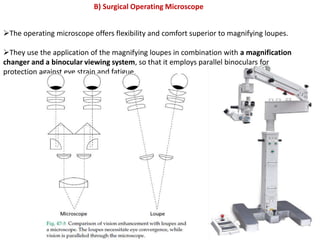
The operating microscope offers flexibility and comfort superior to magnifying loupes.
They use the application of the magnifying loupes in combination with a magnification
changer and a binocular viewing system, so that it employs parallel binoculars for
protection against eye strain and fatigue.
B) Surgical Operating Microscope
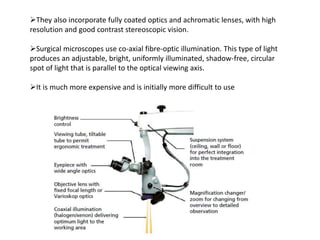
They also incorporate fully coated optics and achromatic lenses, with high
resolution and good contrast stereoscopic vision.
Surgical microscopes use co-axial fibre-optic illumination. This type of light
produces an adjustable, bright, uniformly illuminated, shadow-free, circular
spot of light that is parallel to the optical viewing axis.
It is much more expensive and is initially more difficult to use
Advantages of operating microscope –
 Greater operator eye comfort because of the parallel viewing optics as well as
the range of variable magnification.
 Excellent coaxial fiberoptic illumination.
 Countless accessories such as still and video cameras for case documentation.
Limitations of operating microscope-
 Restricted area of vision and loss of depth.
 Loss of visual reference points.
 A steep learning curve.
 Expensive
Ergonomics in microsurgery-
 To accomplish precise controlled movements of fingers, the ulnar surface of the
forearm and wrist should be supported by resting on a flat surface, angled in a
dorsiflexion position at approximately 20° to reduce muscle tremor originating from
both the unintentional and intentional actions of the body.
The operating surgeon must be seated upright (back straight and head erect) with
both feet flat on floor so that thighs are parallel to the floor. All movements should be
efficient enough to produce purposeful, deliberate motions.
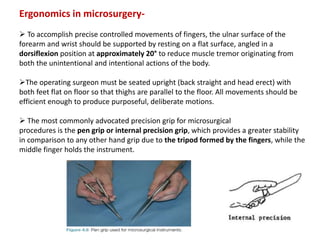
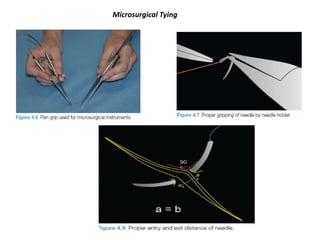
 The most commonly advocated precision grip for microsurgical
procedures is the pen grip or internal precision grip, which provides a greater stability
in comparison to any other hand grip due to the tripod formed by the fingers, while the
middle finger holds the instrument.
 It is best to start with the pen grip until basic manipulations are mastered and more
freehand positions can be initiated.
 Ergonomic benefits in the form of diminished shoulder, neck, and back problems,
improved vision, and reduced eye fatigue have been reported from the findings of
qualitative research at Vancouver Community College in British Columbia. (Sunell &
Maschak 1996).
MICROSURGICAL INSTRUMENTS
Although the variety of microsurgical instrumentation designed for periodontal therapy
is vast, the instrumentation can be divided into the following subgroups:
knives, retractors, scissors, needle holders, tying forceps, and others.
The knives most commonly used in periodontal microsurgery are those used in
ophthalmic surgery: blade breaker, crescent, minicrescent, spoon, lamella, and
scleral knives .
The common characteristics of these knives are their extreme sharpness and small
size. This enables precise incisions and maneuvers in small areas .
Microsurgical instrumentation can be made with titanium or surgical
stainless steel. Titanium instruments---- lighter, but are more prone to
deformation and are usually more expensive.
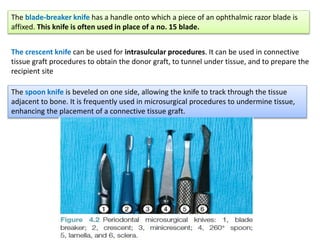
The blade-breaker knife has a handle onto which a piece of an ophthalmic razor blade is
affixed. This knife is often used in place of a no. 15 blade.
The crescent knife can be used for intrasulcular procedures. It can be used in connective
tissue graft procedures to obtain the donor graft, to tunnel under tissue, and to prepare the
recipient site
The spoon knife is beveled on one side, allowing the knife to track through the tissue
adjacent to bone. It is frequently used in microsurgical procedures to undermine tissue,
enhancing the placement of a connective tissue graft.
Microscissors:
 These are used for the dissection of tissues, blood vessels, and nerves.
The most commonly used microscissors are 14 cm and 18 cm long.
To manage the delicate part of the tissues, 9 cm microscissors are preferable.
Straight scissors cut sutures and trim the adventitia of vessels or nerve
endings. Curved scissors dissect vessels and nerves.
Microforceps:
 They are used to handle minute tissues without damaging them and to hold fine
sutures while tying knots.
Jeweler forceps are commonly used and can even be used to separate minute vessels
and nerves.
 Micro Needle Holder:
It is used to grasp the needle, pull it through the tissues, and tie knots.
The needle should be held between its middle and lower thirds at its distal tip.
A titanium needle holder is the best choice.
Belcher, 2001
Needlesand Sutures
Needles:
 In order to minimize tissue trauma in microsurgery, the sharpest needles, reverse
cutting needles with precision tips or spatula needle with micro tips are preferred.
For periodontal microsurgery, the 3/8” circular needle generally ensures optimum
results.
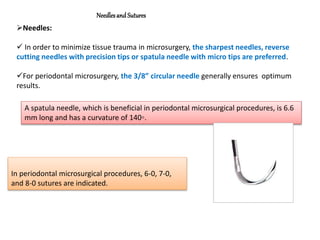
A spatula needle, which is beneficial in periodontal microsurgical procedures, is 6.6
mm long and has a curvature of 140◦.
In periodontal microsurgical procedures, 6-0, 7-0,
and 8-0 sutures are indicated.
Microsurgical Tying
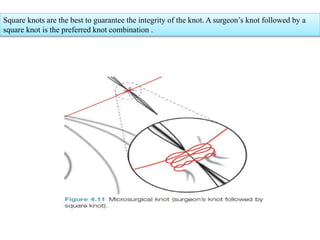
Square knots are the best to guarantee the integrity of the knot. A surgeon’s knot followed by a
square knot is the preferred knot combination .
Microsurgical Indications In Periodontal Surgery
 Scaling and Root Planing
Periodontal Plastic Surgery
Periodontal regeneration
implants
Microscopes in Scaling and Root Planing:
 It is observed that to treat periodontal disease effective plaque and calculus removal
from the root surface is a determining factor for the success of the treatment and the
control of the disease.
 Fleischer et al 1989 reported that regardless of the experience level of the operator,
calculus free roots were obtained more often with surgical access.
 Watchtel et al 2003 stated that the amount of residual calculus on root surfaces
treated by scaling and root preparation showed less residual calculus on those treated
with surgical access.
 Peter Kotschy 2010 used microscope with a magnification power of 15× to 20×
combined with kinetic glass bead blasting for the treatment of inflammatory periodontal
conditions which gave excellent results.
 Currently, no studies indicate whether magnification can enhance the effectiveness of
periodontal calculus removal.
Microscope in Periodontal Plastic Surgery:
 Correcting Gingival Recession-
 Periodontal plastic microsurgical reconstruction of gingival tissue over denuded roots can be
routine and predictable using subepithelial connective tissue grafting.
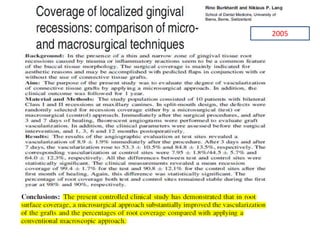
 Francetti et al (2005) conducted a controlled clinical study for microsurgical treatment of
gingival recession and concluded that the application of magnification in mucogingival
surgery accomplished better results compared to conventional techniques.
 Patrýcia F. Andrade et al 2010 compared the macro and microsurgery techniques for
root coverage using a coronally positioned flap associated with enamel matrix derivative and
observed a statistically significant increase of width and thickness of keratinized tissue in
test group.
 Establishing an Esthetic Smile Line:
 An abnormal smile line may result from a number of causes, including gingival
recession, abnormal eruptive patterns, incisal wear, and excessive tissue growth of
various etiologies.
The creation of an ideal esthetic smile with harmonious gingival
contours involves symmetry, lip position, and relative gingival levels of adjacent teeth.
 W. Peter Nordland(2002) discussed the Role of Periodontal Plastic Microsurgery in
Facial Esthetics and stated that Periodontal plastic microsurgery may play a significant
role in facial esthetics.
Periodontal regeneration
Several authors have proposed the use of microsurgical approach for the treatment of
isolated[Wachtel H et al., 2003, Cortellini P et al., 2007, Jepsen S et al., 2008, Cortellini P
et al., 2009] or multiple intrabony defects. (Harrel SK et al.,2005, Cortellini P et al 2008.)
The advantages of microsurgical approach in regenerative therapy relate to improved
illumination and magnification of the surgical field that permits proper access to and
debridement of the intrabony defect with an increased accuracy and minimal trauma.
Cortellini P, Tonetti MS., 2007
Microscopes & implants-
 All phases of implant treatment may be performed using a microscope. Increased visual
acuity, improved ergonomics, and body posture are closely related to these improvements.
 No studies establish that microsurgery reduces postoperative pain
following extraction or implant placement, there is strong theoretical rationale to suggest that
less surgical trauma results in less pain and faster healing, and that microsurgery leads to
those ends.
Shanelec DA 2005 discussed a case series of 100 consecutive patients in private practice
requiring extraction of maxillary central incisors, lateral incisors, or cuspids and showed that
microsurgery can be utilized for implant placement in extraction sockets with a high degree of
clinical success.
Advantages and disadvantages of microsurgery-
 Advantages-
1. Less tissue trauma
2. Less patient anxiety
3. Atraumatic tissue management
4. Accurate primary wound closure.
5. Increased diagnostic skills.
6. Minimally invasive
7. Improved cosmetic results
8. Increased surgical quality
9.Increased effectiveness of root debridement results in greater predictability of:
a) Regeneration procedures,
b) Cosmetic procedures.
10. Improved documentation e.g. digital.
Disadvantages-
1. Educational requirements
A) Surgical technique
B) Understanding of optics
2. Long adjustment period for clinical proficiency
3. High patient cost
4. Limited surgical access
Wound healing in periodontal microsurgery:
Microsurgery encourages repair through primary healing, which is rapid and
requires less formation of granulation or scar tissue.
Wound healing studies show anastomosis of microsurgical wounds occurs within
48 hours.
Because surgical trauma is minimized during microsurgery, less cell
damage and necrosis occurs, resulting in less inflammation and reduced pain.
2005
Future Perspectives: Robotic Microsurgery-
 Robotic microsurgery is taking over minimally invasive techniques in surgery.
 The delicate steps of operation are performed with the system that control
instruments from 10 feet away, inserted through small incisions.
The surgeon manipulates the tele robot and watches the operation through a three
dimensional video and is able to witness the precision that it delivers.
Future research in this field is required to incorporate this technique in dentistry.
-Saraf 2006
The techniques used in periodontal plastic surgery, guided tissue regeneration,
cosmetic restorative crown lengthening, gingival augmentation procedures, soft and
hard tissue ridge augmentation, osseous resection, and dental implant placement
demand clinical expertise beyond the range of normal visual acuity.
 Microsurgery represents an amplification of universally recognized surgical principles
in which gentle handling of soft and hard tissues and extremely accurate wound closure
are made possible through magnification, allowing for well-planned and precisely
executed surgical procedures.
CONCLUSION
THANK YOU

Periodontal microsurgery

  • 1.
  • 2.
    CONTENTS INTRODUCTION AND HISTORY PRINCIPLES OF MICROSURGERY  MICROSURGICAL TRIAD  TYPES & PRINCIPLES OF MAGNIFICATION SYSTEM  MICROSURGICAL INSTRUMENTS  INDICATIONS OF PERIODONTAL MICROSURGERY  FUTURE PERSPECTIVES OF MICROSURGERY  CONCLUSION
  • 3.
    Introduction • In 1979,Daniel defined microsurgery in broad terms as surgery performed under magnification by the microscope. • Periodontal microsurgery is the refinement of basic surgical techniques made possible by the improvement in visual acuity gained with the use of the surgical microscope. ----Leonard S. Tibbetts, Dennis Shanelec. INT J MICRODENT .2009;1:13–24
  • 4.
    History • In 1694,Amsterdam merchant Anton van Leeuwenhook constructed the first compound-lens microscope. • Magnification for microsurgical procedures was introduced to medicine during the late 1800s • In 1921, Carl Nylen, who is considered the father of microsurgery, first used the binocular microscope for ear surgery . • Apotheker & Jako first introduced the microscope to dentistry in 1978 • During 1992, Carr published an article outlining the use of the surgical microscope during endodontic procedures. • In 1993, Shanelec & Tibbetts presented a continuing education course on periodontal microsurgery at the annual meeting of the American Academy of Periodontology. • Belcher wrote an article in 2001 summarizing the benefits and potential usages of the surgical microscope in periodontal therapy. Periodontal Microsurgery James Belcher , Practical Periodontal Plastic Surgery, Second Edition.2017
  • 5.
    PRINCIPLES OF MICROSURGERY Improvementof motor skills, thereby enhancing surgical ability An emphasis on passive wound closure with exact primary apposition of the wound edge The application of microsurgical instrumentation and suturing to reduce tissue trauma Belcher 2001
  • 6.
    The operating microscopeoffers three distinct advantages to periodontists:  Illumination  Magnification Increased precision of surgical skills (Belcher 2001). The synergy of improved illumination and increased visual acuity enables the increased precision of surgical skills. Collectively, these advantages can be referred to as the microsurgical triad Microsurgical triad
  • 7.
    Illumination achieved throughfiberoptic technology, has improved the methods of focusing light on specific areas and is a standard feature of surgical operating microscopes. - J.M. Belcher 2001 A)Illumination
  • 8.
    Magnification, the secondcomponent of the microsurgical triad, can be achieved through the use of the A) Loupes B) Surgical operating microscope. Loupes are fundamentally dual monocular telescopes with side-by-side lenses convergent to focus on the operative field. The magnified image formed has stereoscopic properties by virtue of their convergence. A convergent lens optical system is called a Keplerian optical system.  Three types of Keplerian loupes are typically used in periodontics. Simple loupes, compound loupes, or prism loupes. These are available in the form of eyeglasses or attached to a headset. . B) Magnification Dennis et al, Periodontal microsurgery, Newman and Carranza’s clinical periodontology, 13the edition
  • 9.
     Compound andprism designs produce superior magnification and are commonly used in dentistry today.  70%–80% of the typical periodontal microsurgeries can be done at a magnification of ×10–×20 with the surgical operating microscope.  The remaining procedures can be performed with loupes under ×6–×8 using enhanced motor skills acquired during microsurgery training sessions with a surgical microscope. C)Increased precision in delivery of surgical skills, the third component of microsurgical triad, is the synergistic result of illumination and magnification
  • 10.
    1. Simple loupes–  Simple loupes consist of a pair of single, positive, side-by-side meniscus lenses.  Each lens has two refracting surfaces, with one occurring as light enters the lens and the other when it leaves. Their magnification can increase only by increasing lens diameter and thickness.  Advantage - cost effective. A. Loupes
  • 11.
     DISADVANTAGES : a)Itis primitive with limited capabilities. b)They are highly subjected to spherical and chromatic aberration, which distorts the image of the object. c) Size and weight limitation make simple loupes impractical for magnification beyond ×1.5. d) When positioned close to the eye, simple loupes sacrifice depth of field for working distance. e)When positioned close to the object viewed, they sacrifice working distance for depth of field
  • 12.
    COMPOUND LOUPES( Galilean)–  Compound loupes consist of converging multiple lenses with intervening air spaces to gain additional refracting power, magnification, working distance, and depth of field. can be adjusted to clinical needs without excessive increase in size or weight. Compound lenses can be achromatic, in addition to improved optical design. (This is a feature that dentists should seek when selecting any magnifying loupe because an achromatic lens consists of two glass pieces, usually bonded together with clear resin. The specific density of each piece counteracts the chromatic aberration of the adjacent piece.)  These are commonly mounted on eyeglasses.
  • 13.
    Prism loupes – Prism loupes are the most optically advanced type of loupe magnification presently available. These loupes actually contain Schmidt or roof-top prisms that lengthen the light path through a series of mirror reflections within the loupe. They lengthen the light path by virtually folding the light so that the barrel of the loupe can be shortened. They are superior to other loupes in terms of better magnification, wider depths of field, longer working distances and larger fields of view. The barrels of prism loupes are short and can be mounted on eyeglasses or a headband. increased weight of prism telescopic loupes with magnification above ×4 makes headband mounting more comfortable and stable than eyeglass frame mounting.
  • 15.
    Loupe Magnification - Wideranges of magnifications are available in loupes, ranging from 1.5X to 10X.  Loupes with less than 2X magnifications, are usually inadequate for the visual acuity necessary for microsurgery.  For most periodontal procedures in which magnification is needed, loupes of 4X to 5X provide an effective combination of magnification, field size, and depth of focus. (Tibbetts & Shanelec 1998) Advantages of loupes  Less expensive and initially easier to use.  Loupes also tend to be less cumbersome in the operating field.
  • 16.
    Disadvantage of loops- Lack of variable magnification, and that an individual light source may be required, particularly for magnification in the range of or greater than 4x .  With loupes, each surface refraction in a lens results in a 4% loss in transmitted light because of reflection, unless antireflective coatings are in place to counteract this by allowing the lens to transmit light more effectively.  Discomfort from the heavy weight which has to be borne by the surgeon’s nose bridge. Many surgeons find the heavier instruments difficult to wear for a long period of time.  Higher power magnification often influences posture negatively if the focal length of the magnifiers does not allow the clinician to sit in a normal posture. -Christensen 2003
  • 17.
    The operating microscopeoffers flexibility and comfort superior to magnifying loupes. They use the application of the magnifying loupes in combination with a magnification changer and a binocular viewing system, so that it employs parallel binoculars for protection against eye strain and fatigue. B) Surgical Operating Microscope
  • 18.
    They also incorporatefully coated optics and achromatic lenses, with high resolution and good contrast stereoscopic vision. Surgical microscopes use co-axial fibre-optic illumination. This type of light produces an adjustable, bright, uniformly illuminated, shadow-free, circular spot of light that is parallel to the optical viewing axis. It is much more expensive and is initially more difficult to use
  • 19.
    Advantages of operatingmicroscope –  Greater operator eye comfort because of the parallel viewing optics as well as the range of variable magnification.  Excellent coaxial fiberoptic illumination.  Countless accessories such as still and video cameras for case documentation. Limitations of operating microscope-  Restricted area of vision and loss of depth.  Loss of visual reference points.  A steep learning curve.  Expensive
  • 20.
    Ergonomics in microsurgery- To accomplish precise controlled movements of fingers, the ulnar surface of the forearm and wrist should be supported by resting on a flat surface, angled in a dorsiflexion position at approximately 20° to reduce muscle tremor originating from both the unintentional and intentional actions of the body. The operating surgeon must be seated upright (back straight and head erect) with both feet flat on floor so that thighs are parallel to the floor. All movements should be efficient enough to produce purposeful, deliberate motions.  The most commonly advocated precision grip for microsurgical procedures is the pen grip or internal precision grip, which provides a greater stability in comparison to any other hand grip due to the tripod formed by the fingers, while the middle finger holds the instrument.
  • 21.
     It isbest to start with the pen grip until basic manipulations are mastered and more freehand positions can be initiated.  Ergonomic benefits in the form of diminished shoulder, neck, and back problems, improved vision, and reduced eye fatigue have been reported from the findings of qualitative research at Vancouver Community College in British Columbia. (Sunell & Maschak 1996).
  • 22.
    MICROSURGICAL INSTRUMENTS Although thevariety of microsurgical instrumentation designed for periodontal therapy is vast, the instrumentation can be divided into the following subgroups: knives, retractors, scissors, needle holders, tying forceps, and others. The knives most commonly used in periodontal microsurgery are those used in ophthalmic surgery: blade breaker, crescent, minicrescent, spoon, lamella, and scleral knives . The common characteristics of these knives are their extreme sharpness and small size. This enables precise incisions and maneuvers in small areas . Microsurgical instrumentation can be made with titanium or surgical stainless steel. Titanium instruments---- lighter, but are more prone to deformation and are usually more expensive.
  • 23.
    The blade-breaker knifehas a handle onto which a piece of an ophthalmic razor blade is affixed. This knife is often used in place of a no. 15 blade. The crescent knife can be used for intrasulcular procedures. It can be used in connective tissue graft procedures to obtain the donor graft, to tunnel under tissue, and to prepare the recipient site The spoon knife is beveled on one side, allowing the knife to track through the tissue adjacent to bone. It is frequently used in microsurgical procedures to undermine tissue, enhancing the placement of a connective tissue graft.
  • 24.
    Microscissors:  These areused for the dissection of tissues, blood vessels, and nerves. The most commonly used microscissors are 14 cm and 18 cm long. To manage the delicate part of the tissues, 9 cm microscissors are preferable. Straight scissors cut sutures and trim the adventitia of vessels or nerve endings. Curved scissors dissect vessels and nerves.
  • 25.
    Microforceps:  They areused to handle minute tissues without damaging them and to hold fine sutures while tying knots. Jeweler forceps are commonly used and can even be used to separate minute vessels and nerves.  Micro Needle Holder: It is used to grasp the needle, pull it through the tissues, and tie knots. The needle should be held between its middle and lower thirds at its distal tip. A titanium needle holder is the best choice. Belcher, 2001
  • 26.
    Needlesand Sutures Needles:  Inorder to minimize tissue trauma in microsurgery, the sharpest needles, reverse cutting needles with precision tips or spatula needle with micro tips are preferred. For periodontal microsurgery, the 3/8” circular needle generally ensures optimum results. A spatula needle, which is beneficial in periodontal microsurgical procedures, is 6.6 mm long and has a curvature of 140◦. In periodontal microsurgical procedures, 6-0, 7-0, and 8-0 sutures are indicated.
  • 27.
  • 28.
    Square knots arethe best to guarantee the integrity of the knot. A surgeon’s knot followed by a square knot is the preferred knot combination .
  • 29.
    Microsurgical Indications InPeriodontal Surgery  Scaling and Root Planing Periodontal Plastic Surgery Periodontal regeneration implants
  • 30.
    Microscopes in Scalingand Root Planing:  It is observed that to treat periodontal disease effective plaque and calculus removal from the root surface is a determining factor for the success of the treatment and the control of the disease.  Fleischer et al 1989 reported that regardless of the experience level of the operator, calculus free roots were obtained more often with surgical access.  Watchtel et al 2003 stated that the amount of residual calculus on root surfaces treated by scaling and root preparation showed less residual calculus on those treated with surgical access.  Peter Kotschy 2010 used microscope with a magnification power of 15× to 20× combined with kinetic glass bead blasting for the treatment of inflammatory periodontal conditions which gave excellent results.  Currently, no studies indicate whether magnification can enhance the effectiveness of periodontal calculus removal.
  • 31.
    Microscope in PeriodontalPlastic Surgery:  Correcting Gingival Recession-  Periodontal plastic microsurgical reconstruction of gingival tissue over denuded roots can be routine and predictable using subepithelial connective tissue grafting.  Francetti et al (2005) conducted a controlled clinical study for microsurgical treatment of gingival recession and concluded that the application of magnification in mucogingival surgery accomplished better results compared to conventional techniques.  Patrýcia F. Andrade et al 2010 compared the macro and microsurgery techniques for root coverage using a coronally positioned flap associated with enamel matrix derivative and observed a statistically significant increase of width and thickness of keratinized tissue in test group.
  • 32.
     Establishing anEsthetic Smile Line:  An abnormal smile line may result from a number of causes, including gingival recession, abnormal eruptive patterns, incisal wear, and excessive tissue growth of various etiologies. The creation of an ideal esthetic smile with harmonious gingival contours involves symmetry, lip position, and relative gingival levels of adjacent teeth.  W. Peter Nordland(2002) discussed the Role of Periodontal Plastic Microsurgery in Facial Esthetics and stated that Periodontal plastic microsurgery may play a significant role in facial esthetics.
  • 33.
    Periodontal regeneration Several authorshave proposed the use of microsurgical approach for the treatment of isolated[Wachtel H et al., 2003, Cortellini P et al., 2007, Jepsen S et al., 2008, Cortellini P et al., 2009] or multiple intrabony defects. (Harrel SK et al.,2005, Cortellini P et al 2008.) The advantages of microsurgical approach in regenerative therapy relate to improved illumination and magnification of the surgical field that permits proper access to and debridement of the intrabony defect with an increased accuracy and minimal trauma. Cortellini P, Tonetti MS., 2007
  • 34.
    Microscopes & implants- All phases of implant treatment may be performed using a microscope. Increased visual acuity, improved ergonomics, and body posture are closely related to these improvements.  No studies establish that microsurgery reduces postoperative pain following extraction or implant placement, there is strong theoretical rationale to suggest that less surgical trauma results in less pain and faster healing, and that microsurgery leads to those ends. Shanelec DA 2005 discussed a case series of 100 consecutive patients in private practice requiring extraction of maxillary central incisors, lateral incisors, or cuspids and showed that microsurgery can be utilized for implant placement in extraction sockets with a high degree of clinical success.
  • 35.
    Advantages and disadvantagesof microsurgery-  Advantages- 1. Less tissue trauma 2. Less patient anxiety 3. Atraumatic tissue management 4. Accurate primary wound closure. 5. Increased diagnostic skills. 6. Minimally invasive 7. Improved cosmetic results 8. Increased surgical quality 9.Increased effectiveness of root debridement results in greater predictability of: a) Regeneration procedures, b) Cosmetic procedures. 10. Improved documentation e.g. digital.
  • 36.
    Disadvantages- 1. Educational requirements A)Surgical technique B) Understanding of optics 2. Long adjustment period for clinical proficiency 3. High patient cost 4. Limited surgical access
  • 37.
    Wound healing inperiodontal microsurgery: Microsurgery encourages repair through primary healing, which is rapid and requires less formation of granulation or scar tissue. Wound healing studies show anastomosis of microsurgical wounds occurs within 48 hours. Because surgical trauma is minimized during microsurgery, less cell damage and necrosis occurs, resulting in less inflammation and reduced pain.
  • 38.
  • 39.
    Future Perspectives: RoboticMicrosurgery-  Robotic microsurgery is taking over minimally invasive techniques in surgery.  The delicate steps of operation are performed with the system that control instruments from 10 feet away, inserted through small incisions. The surgeon manipulates the tele robot and watches the operation through a three dimensional video and is able to witness the precision that it delivers. Future research in this field is required to incorporate this technique in dentistry. -Saraf 2006
  • 40.
    The techniques usedin periodontal plastic surgery, guided tissue regeneration, cosmetic restorative crown lengthening, gingival augmentation procedures, soft and hard tissue ridge augmentation, osseous resection, and dental implant placement demand clinical expertise beyond the range of normal visual acuity.  Microsurgery represents an amplification of universally recognized surgical principles in which gentle handling of soft and hard tissues and extremely accurate wound closure are made possible through magnification, allowing for well-planned and precisely executed surgical procedures. CONCLUSION
  • 41.