PERIODONTAL
DRESSING
PRESENTED BY,
DR.ANJU MATHEW.K
DEPT.PERIODONTICS AND ORAL IMPLATOLOGY
INTRODUCTION
 Wounds in the oral cavity feature extremely good self healing characteristics. However some
situations require the isolation of the oral wound from the oral milieu.
 Wound healing is a compound and active process of re-establishing normal cellular biology.
 This process can be divided into
 Hemostasis
 Inflammation
 Proliferative
 Remodelling
 Periodontal dressings were first introduced by Zentler in 1918 in the form of iodoform
gauze.
 The use of dressings preceding periodontal surgery was first put forth by Dr. A. W.
Ward in 1923, which laid path for widespread use of dressings preceding an assortment
of procedures by periodontists
 The American academy of periodontology in 1986 advocated the term periodontal
dressing and defined it as a surgical dressing applied over and protecting the surgical
wounds produced by periodontal surgical procedure
 A surgical dressing allows for unremitting healing to occur and also aids in fortification
of the surgical area and inhibition of wound damage and infection.
 Numerous periodontists commend that a shielding is to be provided over surgically
treated tissue to form a safeguarding from further insult. Such safeguarding is rendered
by periodontal dressings or packs to overcome any sort of post-operative complications
HISTORY OF PERIODONTAL PACKS
1942 – BOX AND HAM
 Use of zno eugenol dressing to perform chemical curettage in treatment of NUG
 Tannic acid -haemostasis and astringency
 Thymol - astringent
1943 – ORBAN
 Zno eugenol + paraformaldehyde to perform gingivectomy by chemosurgery.
 This dressing caused extensive necrosis of the gingival and bone and was left to
promote abscess formation by blockage of exudate.
1947 – BERNIER AND KAPLAN
 For wound protections
1962 - BLANQUIE
 Control post operative bleeding
 Splint loose teeth
 Prevent re-establishment of pocket
 Desensitize cementum
1964 – GOLD
 Splint teeth, as it was cement dressing that set hard
1964 - WEINREB AND SHAPIRO
 Zno eugenol impregnated cords into periodontal pockets ,but found to be less effective than gingevectomy.
1969 - BAER ET AL
 Stated that primary purpose of a dressing patient comfort, protect wound from further injury during healing
,hold flap in position.
 They pointed that the dressing should not be used to control post-operative bleeding, nor to splint teeth
USES OF PERIODONTAL DRESSING
1. Provide mechanical protection for the surgical wound and therefore facilitate healing .
2. Enchancement of patient comfort .
3. Prevents post operative bleeding by maintaining the initial clot in place.
4. Maintainance of debris free area.
5. Control of bleeding
6. Supports mobile teeth during healing
7. Helps in shaping or molding the newly formed tissue
8. Provide patient comfort by isolating area from external irritations or injuries
9. Retention of apically positioned flap and semilunar flaps preventing undesireable movement
10. Stabilization of free gingival grafts
11. Protects denuded bone from further injury
12. Acts as a template,prevent excess granulation tissue formation
13. Facilitate retention of drug delivered locally in the subgingival sites
14. Protect the graft site,prevent flap displacement and loss of graft material in periodontal regeneration
IDEAL REQUISITES OF PERIODONTAL DRESSINGS
 Soft, but still have enough plasticity and flexibility to facilitate its placement in the
operated area and to allow proper adaptation.
 Set within a reasonable time.
 Sufficient rigidity to prevent fracture and dislocation.
 Smooth surface after setting to prevent irritation to the cheeks and lips.
 Bactericidal properties to prevent excessive plaque formation.
 Not interfere with healing.
 Dimensional stability to prevent salivary leakage.
 Not induce possible systemic detrimental effects and allergic reactions.
 Acceptable taste.
 Economical and easily available.
 Good shelf life
TYPES OF PERIODONTAL DRESSINGS
 Periodontal dressings are generally grouped into 3categories:
1. Zinc oxide and eugenol containing
2. Zinc oxide without eugenol containing
3. Neither zinc oxide nor eugenol containing
THOSE CONTAINING ZINC OXIDE AND
EUGENOL
EUGENOL DRESSINGS
 First dressings introduced that contained eugenol was Wondrpak.
 It is constituted of
 Liquid
 Clove peanut oils
 Isopropyl alcohol 10%,
 Pine oil & resin,
 Camphor
 Colouring materials
 Powder
 Zinc oxide,
 Talc,
 Powdered pine resin
 Asbestos
KIRKLAND MODIFICATION
 A modified form of a eugenol dressing was introduced by Kirkland, called the Kirkland formula.
Zinc Acetate, Olive Oil, Zinc Oxide, Eugenol, Tannic Acid, And Resin.
.
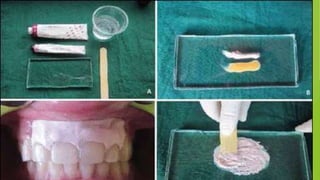
MIXING
Zinc oxide and eugenol dressings are provided in liquid and powder or aqueous
mixture.
 Both are mixed on a waxed paper pad using a spatula. The powder or paste is
steadily integrated into the liquid until it reaches a dough like uniformity.
 The dressing may be used instantly or enveloped in aluminium foil and
refrigerated for use up to 1 week.
 Eugenol plays an essential role in obtunding surgical sites
ROLE OF EUGENOL
 Eugenol-based dressings were formerly popular, especially following
gingivectomy , due to their property of obtunding pain and rendering sites less
sensitive.
 Waer haugand löe in 1957 commented that zinc oxide– eugenol dressings
seemed to prevent or retard bacterial growth based on their antiseptic properties.
 Eugenol was found to
 Irritate oral mucosal tissues
 Induce allergic reactions and cause tissue necrosis, particularly of bone, which
led to delay in healing
 Presents difficulties in manipulation and has a rough surface after setting.
 Histological evidence has also shown that eugenol-containing dressings produce
greater tissue destruction, with more inflammatory cell infiltration and connective
tissue response
THOSE CONTAINING ZINC OXIDE
WITHOUT EUGENOL
COE-PAK
 Coe-Pak is the most commonly used periodontal dressing
 It is of 2 paste system
 Base Paste (zinc oxide, added oils, gums & lorothido)
 Catalyst Paste (unsaturated fatty acids & chlorothymol).
Mixing
Application of the dressing can be done by dispensing equal amounts of pastes and mixed using a spatula till
thick, uniform consistency is achieved. The setting time of the material can be altered by immersing in cold or
hot water to accelerate or decelerate the setting time. The mechanical interlocking of the material is a key point
to maintain the retention of the material.
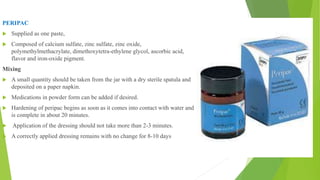
PERIPAC
 Supplied as one paste,
 Composed of calcium sulfate, zinc sulfate, zinc oxide,
polymethylmethacrylate, dimethoxytetra-ethylene glycol, ascorbic acid,
flavor and iron-oxide pigment.
Mixing
 A small quantity should be taken from the jar with a dry sterile spatula and
deposited on a paper napkin.
 Medications in powder form can be added if desired.
 Hardening of peripac begins as soon as it comes into contact with water and
is complete in about 20 minutes.
 Application of the dressing should not take more than 2-3 minutes.
 A correctly applied dressing remains with no change for 8-10 days
Peripac is indicated as a dressing following
 Gingivectomies
 Papillectomies
 Deep curettage
 Reattachment surgery
 Gingival repositioning.
It can also be used in treatment of
 Necrotic gingivitis and ulcers
 Protection of nonspecific lesions or sutured margins
 Fixation of desensitizing medicaments to cervical areas
 Temporary rebasing of immediate dentures in periodontal surgery
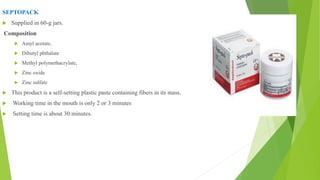
SEPTOPACK
 Supplied in 60-g jars.
Composition
 Amyl acetate,
 Dibutyl phthalate
 Methyl polymethacrylate,
 Zinc oxide
 Zinc sulfate
 This product is a self-setting plastic paste containing fibers in its mass.
 Working time in the mouth is only 2 or 3 minutes
 Setting time is about 30 minutes.
Disadvantages
 This product contains di butyl phthalate which is very toxic to
aquatic organisms.
 This product may harm the eyes in an unborn child and has
possible risk of impaired fertility. Therefore, protective clothing,
gloves and respiratory equipment are mandatory.
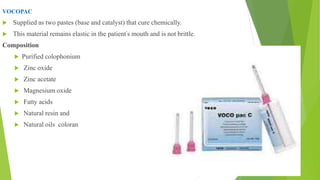
VOCOPAC
 Supplied as two pastes (base and catalyst) that cure chemically.
 This material remains elastic in the patient’s mouth and is not brittle.
Composition
 Purified colophonium
 Zinc oxide
 Zinc acetate
 Magnesium oxide
 Fatty acids
 Natural resin and
 Natural oils coloran
Contraindications
 Patients who are allergic to these ingredients
 Contact with the bone should be avoided as well.
 Slight discoloration of synthetic materials may also occur.
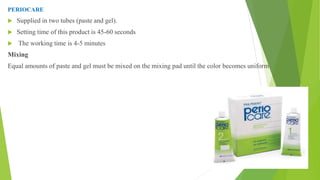
PERIOCARE
 Supplied in two tubes (paste and gel).
 Setting time of this product is 45-60 seconds
 The working time is 4-5 minutes
Mixing
Equal amounts of paste and gel must be mixed on the mixing pad until the color becomes uniform
PERIO PUTTY
 Is a non-eugenol dressing
 Containing methylparabens and propylparabens for their efficient fungicidal properties
 Benzocaine as a topical anesthetic
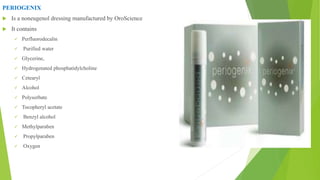
PERIOGENIX
 Is a noneugenol dressing manufactured by OroScience
 It contains
 Perfluorodecalin
 Purified water
 Glycerine,
 Hydrogenated phosphatidylcholine
 Cetearyl
 Alcohol
 Polysorbate
 Tocopheryl acetate
 Benzyl alcohol
 Methylparaben
 Propylparaben
 Oxygen
 It has been said that this dressing accelerates healing of postoperative surgical wounds.
 It was also observed that wounds treated with PeriogenixTM demonstrated an up-regulation of vascular
endothelial growth factors, collagens I and III, and matrixmetalloproteinase levels.
 PeriogenixTM allows for the exchange of oxygen and carbon dioxide into and out of injured tissues. This
property has been shown to promote wound healing by stimulating several processes including
 Neovascularization
 Collagen production,
 Epithelization,
 Phagocytosis neutrophil-mediated oxidative microbial killing,
 And degradation of necrotic wound tissue
Benefits Of Non-eugenol Dressings Are
 Minimal irritation of the mucous membrane
 Agreeable odour
 Neutral taste
 Ease of handling,
 Malleability which facilitates easy removal from undercut areas
 Elimination of the objectionable taste of eugenol.
 Less irritating
 Form closely adapted adhesive barrier to saliva and oral bacteria.
Those Containing Neither Zinc Oxide Nor
Eugenol
Cyanoacrylate
 The cyanoacrylate alkyls were obtained for the first time in 1949 by A. E. Ardis
 As a dressing it has been evaluated clinically and histologically following procedures
such as gingivectomy, mucoperiosteal flaps, excisional biopsies, free mucosal grafts,
frenectomies and for oral mucosal ul cers.
 It is useful because it provides rapid hemostasis in the presence of moisture due to
polymerization.
 It accelerates initial healing by acting as a protective barrier maintaining precise
positioning of a flap or free gingival graft and also possesses antimicrobial properties
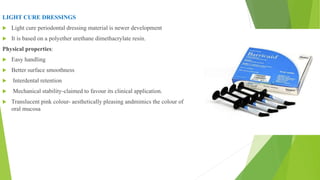
LIGHT CURE DRESSINGS
 Light cure periodontal dressing material is newer development
 It is based on a polyether urethane dimethacrylate resin.
Physical properties:
 Easy handling
 Better surface smoothness
 Interdental retention
 Mechanical stability-claimed to favour its clinical application.
 Translucent pink colour- aesthetically pleasing andmimics the colour of
oral mucosa
CELLULOSE PERIODONTAL DRESSINGS
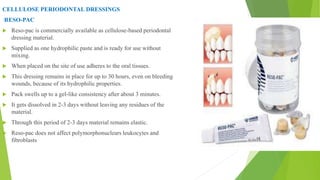
RESO-PAC
 Reso-pac is commercially available as cellulose-based periodontal
dressing material.
 Supplied as one hydrophilic paste and is ready for use without
mixing.
 When placed on the site of use adheres to the oral tissues.
 This dressing remains in place for up to 30 hours, even on bleeding
wounds, because of its hydrophilic properties.
 Pack swells up to a gel-like consistency after about 3 minutes.
 It gets dissolved in 2-3 days without leaving any residues of the
material.
 Through this period of 2-3 days material remains elastic.
 Reso-pac does not affect polymorphonuclears leukocytes and
fibroblasts
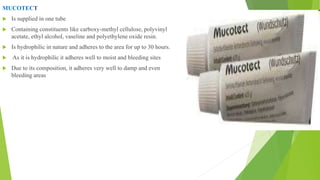
MUCOTECT
 Is supplied in one tube
 Containing constituents like carboxy-methyl cellulose, polyvinyl
acetate, ethyl alcohol, vaseline and polyethylene oxide resin.
 Is hydrophilic in nature and adheres to the area for up to 30 hours.
 As it is hydrophilic it adheres well to moist and bleeding sites
 Due to its composition, it adheres very well to damp and even
bleeding areas
COLLAGEN DRESSINGS
 are biological dressings which create a physiologic interface between the wound and
the environment and encourage healing by deposition and organization of the fibers in
granulation tissues formed freshly in the wound bed
 The gains of collagen dressings over other materials available are
 Ease of application
 Nonimmunogenic
 Nonpyrogenic
 Hypoallergenic properties.
 An inherent property of native collagen is the ability to promote hemostasis by
facilitating aggregation of platelets and subsequently, the coagulation cascade
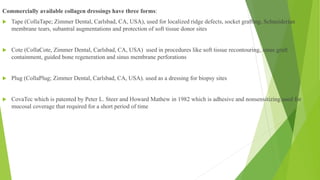
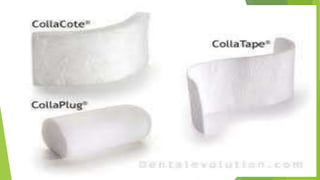
Commercially available collagen dressings have three forms:
 Tape (CollaTape; Zimmer Dental, Carlsbad, CA, USA), used for localized ridge defects, socket grafting, Schneiderian
membrane tears, subantral augmentations and protection of soft tissue donor sites
 Cote (CollaCote, Zimmer Dental, Carlsbad, CA, USA) used in procedures like soft tissue recontouring, sinus graft
containment, guided bone regeneration and sinus membrane perforations
 Plug (CollaPlug; Zimmer Dental, Carlsbad, CA, USA). used as a dressing for biopsy sites
 CovaTec which is patented by Peter L. Steer and Howard Mathew in 1982 which is adhesive and nonsensitizing.used for
mucosal coverage that required for a short period of time
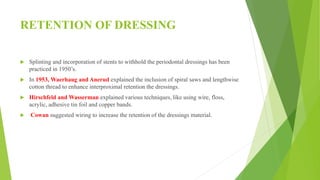
PHYSICAL PROPERTIES OF
DRESSING
 The dressing should be soft but have enough plasticity and flexibility to facilitate its
placement in operated area and to allow proper adaptation.
 The dressing should set within a reasonable time
 After setting it should have sufficient rigidity
 Smooth surface
 Bacteriocidal property
 Should not interfere with healing
 Dimensional stability
 Should not induce reaction
 Acceptable taste.
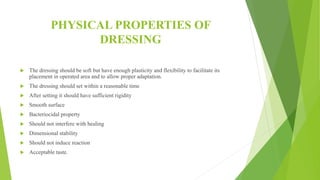
RETENTION OF DRESSING
 Splinting and incorporation of stents to withhold the periodontal dressings has been
practiced in 1950’s.
 In 1953, Waerhaug and Anerud explained the inclusion of spiral saws and lengthwise
cotton thread to enhance interproximal retention the dressings.
 Hirschfeld and Wasserman explained various techniques, like using wire, floss,
acrylic, adhesive tin foil and copper bands.
 Cowan suggested wiring to increase the retention of the dressings material.
 Retention of dressing over palatal wounds is important as the wounds are more prone to
postoperative morbidity when left open.
 Ferguson (1992) explained a technique to enhance the retention for palatal wounds
 By employing light-cured periodontal dressing – i.e., Barricaid in combination with the
surgical involved maxillary canines
REMOVAL OF DRESSING
 A sturdy, blunt instrument, such as a surgical hoe, plastic instrument, or curret, is
inserted under the edge of the dressing with a smooth surface against the tissue.
 Gentle lateral pressure is applied, and the pack is carefully loosened.
 Sutures that may have become incorporated into the dressing material must be detected
and cut before each piece of pack can be removed.
 Remove the dressing pieces with forceps, being careful not to scratch the sensitive
tissues.
 After the dressing has been removed, the teeth and tissues are swabbed gently with
diluted disinfectant mouthwash or hydrogen peroxide on a cotton-tipped applicator to
loosen food and bacterial debris.
 The area is then rinsed with warm water. This may need to be repeated to debride the
area
REPACKING
 The pack is removed when A low pain threshold who are particularly uncomfortable
 Unusually extensive periodontal involvement, or slow healing
THERAPEUTIC EFFECT OF DRESSINGS
 Ward backed the idea of using a periodontal dressing to evade pain, infection and root sensitivity and to
prevent the accumulation of debris.
 Orban observed that use a eugenol dressing has better healing following gingivectomy if the dressing was
changed every 2 to 4 days for a span of 10 to 14 days also mentioned that if dressing left more than 12 days
leads to delayed healing
 Bernier and Kaplan described that the use of a dressing assists in the healing process by functioning as a
external barricade and benefit in primary healing.
.
 Loe and Silness described that unprotected tissue will heal regardless of the provision
of a dressing
 Linsky et al. supposed that when wound was closed with dressing the inflammatory
response formed would be suggestively less than that of open wounds.
 Eaglstein stated that dermal wounds that have been provided with a
dressing heal considerably earlier. To the wounds that are not dressed.
BIOLOGICAL PROPERTIES
 Eugenol-based dressings may cause less growth inhibition of long-lasting cells and
primary human leukocytes than non-eugenol products.
 Eugenol-based dressings were found to constrain fibroblast proliferation to a greater
degree than non-eugenol dressings.
 Light-cured periodontal dressings showed no cytotoxicity on different cell types.
 Collagen-based dressings, had superior clinical and histological outcomes on palatal
wound healing.
 Smeeken et al, (1992) in an animal study, proposed that eugenol containing materials
elicit more inflammatory reactions, although this increase was not substantial in other
studies
 B. Alpar et al., have reported that cell culture medium extracts of Coe-pak, Voco pac,
Peripac, and Barricaid ,results have shown barricade is cytocompatible
CARE AFTER PERIODONTAL PACK
 A periodontal pack placed over your gums to protect them from irritation. The pack
prevents pain, aids healing, and enables you to carry on most of your usual activities in
comfort.
 The pack will harden in a few hours, after which it can withstand most of the forces of
chewing without breaking off
 The pack should remain in place as long as possible. For the first 3 hours after the
operation avoid hot foods in order to permit the pack to harden
 Do not brush over the pack.
 After the pack is removed the gums most likely will bleed more than they did before the
surgery. This is perfectly normal in the early stage of healing
CONTRAVERSIES WITH THE USE OF
PERIODONTAL DRESSING
Effect on wound healing
 Studies have shown that eugenol dressings are more irritating than non-eugenol
dressings
 Dressings may contribute to postoperative pain and swelling
Effect on cell culture
 Studies shown that both eugenol and non eugenol containing materials can be cytotoxic when tested against
fibroblasts,polymorphonuclear leukocytes
 Eugenol dressings found to inhibit fibroblast proliferation to a greater extent
MODIFICATIONS OF PERIODONTAL
DRESSINGS
CHLORHEXIDINE IN PERIODONTAL DRESSINGS
 Chlorhexidine is an antibacterial agent.
 Othman et al established a statement that surgical dressing containing antimicrobial agents are advantageous
to other material due to their high retention and slow releasing property of the chlorhexidine.
 Zyskind et al., reported that application of a varnish that contains chlorhexidine aids in less plaque formation
in comparison to not coated teeth.
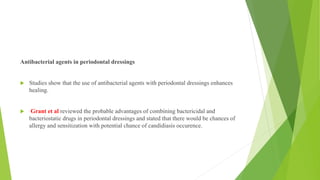
Antibacterial agents in periodontal dressings
 Studies show that the use of antibacterial agents with periodontal dressings enhances
healing.
 Grant et al reviewed the probable advantages of combining bactericidal and
bacteriostatic drugs in periodontal dressings and stated that there would be chances of
allergy and sensitization with potential chance of candidiasis occurence.
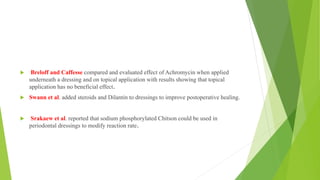
 Breloff and Caffesse compared and evaluated effect of Achromycin when applied
underneath a dressing and on topical application with results showing that topical
application has no beneficial effect.
 Swann et al. added steroids and Dilantin to dressings to improve postoperative healing.
 Srakaew et al. reported that sodium phosphorylated Chitson could be used in
periodontal dressings to modify reaction rate.
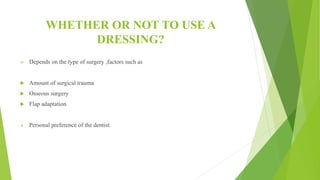
WHETHER OR NOT TO USE A
DRESSING?
 Depends on the type of surgery ,factors such as
 Amount of surgical trauma
 Osseous surgery
 Flap adaptation
 Personal preference of the dentist
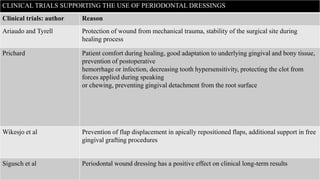
CLINICAL TRIALS SUPPORTING THE USE OF PERIODONTAL DRESSINGS
Clinical trials: author Reason
Ariaudo and Tyrell Protection of wound from mechanical trauma, stability of the surgical site during
healing process
Prichard Patient comfort during healing, good adaptation to underlying gingival and bony tissue,
prevention of postoperative
hemorrhage or infection, decreasing tooth hypersensitivity, protecting the clot from
forces applied during speaking
or chewing, preventing gingival detachment from the root surface
Wikesjo et al Prevention of flap displacement in apically repositioned flaps, additional support in free
gingival grafting procedures
Sigusch et al Periodontal wound dressing has a positive effect on clinical long-term results
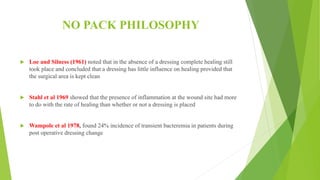
NO PACK PHILOSOPHY
 Loe and Silness (1961) noted that in the absence of a dressing complete healing still
took place and concluded that a dressing has little influence on healing provided that
the surgical area is kept clean
 Stahl et al 1969 showed that the presence of inflammation at the wound site had more
to do with the rate of healing than whether or not a dressing is placed
 Wampole et al 1978, found 24% incidence of transient bacteremia in patients during
post operative dressing change
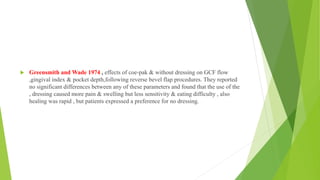
 Greensmith and Wade 1974 , effects of coe-pak & without dressing on GCF flow
,gingival index & pocket depth,following reverse bevel flap procedures. They reported
no significant differences between any of these parameters and found that the use of the
, dressing caused more pain & swelling but less sensitivity & eating difficulty , also
healing was rapid , but patients expressed a preference for no dressing.
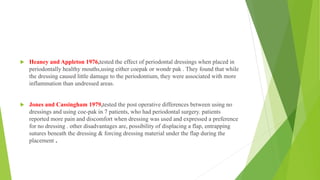
 Heaney and Appleton 1976,tested the effect of periodontal dressings when placed in
periodontally healthy mouths,using either coepak or wondr pak . They found that while
the dressing caused little damage to the periodontium, they were associated with more
inflammation than undressed areas.
 Jones and Cassingham 1979,tested the post operative differences between using no
dressings and using coe-pak in 7 patients, who had periodontal surgery. patients
reported more pain and discomfort when dressing was used and expressed a preference
for no dressing . other disadvantages are, possibility of displacing a flap, entrapping
sutures beneath the dressing & forcing dressing material under the flap during the
placement .
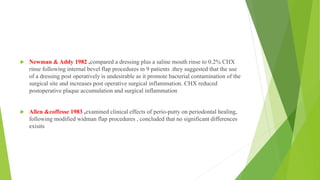
 Newman & Addy 1982 ,compared a dressing plus a saline mouth rinse to 0.2% CHX
rinse following internal bevel flap procedures in 9 patients .they suggested that the use
of a dressing post operatively is undesirable as it promote bacterial contamination of the
surgical site and increases post operative surgical inflammation. CHX reduced
postoperative plaque accumulation and surgical inflammation
 Allen &coffesse 1983 ,examined clinical effects of perio-putty on periodontal healing,
following modified widman flap procedures , concluded that no significant differences
exisits
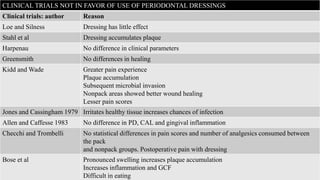
CLINICAL TRIALS NOT IN FAVOR OF USE OF PERIODONTAL DRESSINGS
Clinical trials: author Reason
Loe and Silness Dressing has little effect
Stahl et al Dressing accumulates plaque
Harpenau No difference in clinical parameters
Greensmith No differences in healing
Kidd and Wade Greater pain experience
Plaque accumulation
Subsequent microbial invasion
Nonpack areas showed better wound healing
Lesser pain scores
Jones and Cassingham 1979 Irritates healthy tissue increases chances of infection
Allen and Caffesse 1983 No difference in PD, CAL and gingival inflammation
Checchi and Trombelli No statistical differences in pain scores and number of analgesics consumed between
the pack
and nonpack groups. Postoperative pain with dressing
Bose et al Pronounced swelling increases plaque accumulation
Increases inflammation and GCF
Difficult in eating
REFERENCES
 Periodontal dressing ,JIDENT ISSUE 1 VOLUME 1 August 2012
 K. David,Shetty Neetha J.& Pralhad Swati. Periodontal Dressings: An Informed View
.Journal of pharmaceutical and biomedical sciences (J Pharm Biomed Sci.) 2013,
January; 26(26); 269-272
 Zahra Baghani,Mahdi Kadkhodazadeh J Dent Res Dent Clin Dent Prospect 2013
 Triveni Kale, Nitin Dani,Tejas Patange Periodontal Dressing IOSR Journal of Dental
and Medical Sciences Volume 13, Issue 3 Ver. IV. (Mar. 2014)
 Rahul Kathariya, Hansa Jain, Tanya Jadhav, To pack or not to pack: the current status of
periodontal dressings, J Appl Biomater Funct Mater 2015; 13(2)
 Bezawada NR, Bali S, Aggarwal P, Arora S. Periodontal dressings: A review. Santosh
Univ J Health Sci 2020;6(1):5-9.

Periodontal dressing

  • 1.
  • 2.
    INTRODUCTION  Wounds inthe oral cavity feature extremely good self healing characteristics. However some situations require the isolation of the oral wound from the oral milieu.  Wound healing is a compound and active process of re-establishing normal cellular biology.  This process can be divided into  Hemostasis  Inflammation  Proliferative  Remodelling
  • 3.
     Periodontal dressingswere first introduced by Zentler in 1918 in the form of iodoform gauze.  The use of dressings preceding periodontal surgery was first put forth by Dr. A. W. Ward in 1923, which laid path for widespread use of dressings preceding an assortment of procedures by periodontists  The American academy of periodontology in 1986 advocated the term periodontal dressing and defined it as a surgical dressing applied over and protecting the surgical wounds produced by periodontal surgical procedure
  • 4.
     A surgicaldressing allows for unremitting healing to occur and also aids in fortification of the surgical area and inhibition of wound damage and infection.  Numerous periodontists commend that a shielding is to be provided over surgically treated tissue to form a safeguarding from further insult. Such safeguarding is rendered by periodontal dressings or packs to overcome any sort of post-operative complications
  • 5.
    HISTORY OF PERIODONTALPACKS 1942 – BOX AND HAM  Use of zno eugenol dressing to perform chemical curettage in treatment of NUG  Tannic acid -haemostasis and astringency  Thymol - astringent 1943 – ORBAN  Zno eugenol + paraformaldehyde to perform gingivectomy by chemosurgery.  This dressing caused extensive necrosis of the gingival and bone and was left to promote abscess formation by blockage of exudate.
  • 6.
    1947 – BERNIERAND KAPLAN  For wound protections 1962 - BLANQUIE  Control post operative bleeding  Splint loose teeth  Prevent re-establishment of pocket  Desensitize cementum 1964 – GOLD  Splint teeth, as it was cement dressing that set hard
  • 7.
    1964 - WEINREBAND SHAPIRO  Zno eugenol impregnated cords into periodontal pockets ,but found to be less effective than gingevectomy. 1969 - BAER ET AL  Stated that primary purpose of a dressing patient comfort, protect wound from further injury during healing ,hold flap in position.  They pointed that the dressing should not be used to control post-operative bleeding, nor to splint teeth
  • 8.
    USES OF PERIODONTALDRESSING 1. Provide mechanical protection for the surgical wound and therefore facilitate healing . 2. Enchancement of patient comfort . 3. Prevents post operative bleeding by maintaining the initial clot in place. 4. Maintainance of debris free area. 5. Control of bleeding 6. Supports mobile teeth during healing 7. Helps in shaping or molding the newly formed tissue 8. Provide patient comfort by isolating area from external irritations or injuries 9. Retention of apically positioned flap and semilunar flaps preventing undesireable movement 10. Stabilization of free gingival grafts 11. Protects denuded bone from further injury 12. Acts as a template,prevent excess granulation tissue formation 13. Facilitate retention of drug delivered locally in the subgingival sites 14. Protect the graft site,prevent flap displacement and loss of graft material in periodontal regeneration
  • 9.
    IDEAL REQUISITES OFPERIODONTAL DRESSINGS  Soft, but still have enough plasticity and flexibility to facilitate its placement in the operated area and to allow proper adaptation.  Set within a reasonable time.  Sufficient rigidity to prevent fracture and dislocation.  Smooth surface after setting to prevent irritation to the cheeks and lips.  Bactericidal properties to prevent excessive plaque formation.
  • 10.
     Not interferewith healing.  Dimensional stability to prevent salivary leakage.  Not induce possible systemic detrimental effects and allergic reactions.  Acceptable taste.  Economical and easily available.  Good shelf life
  • 11.
    TYPES OF PERIODONTALDRESSINGS  Periodontal dressings are generally grouped into 3categories: 1. Zinc oxide and eugenol containing 2. Zinc oxide without eugenol containing 3. Neither zinc oxide nor eugenol containing
  • 12.
    THOSE CONTAINING ZINCOXIDE AND EUGENOL EUGENOL DRESSINGS  First dressings introduced that contained eugenol was Wondrpak.  It is constituted of  Liquid  Clove peanut oils  Isopropyl alcohol 10%,  Pine oil & resin,  Camphor  Colouring materials  Powder  Zinc oxide,  Talc,  Powdered pine resin  Asbestos
  • 13.
    KIRKLAND MODIFICATION  Amodified form of a eugenol dressing was introduced by Kirkland, called the Kirkland formula. Zinc Acetate, Olive Oil, Zinc Oxide, Eugenol, Tannic Acid, And Resin. .
  • 14.
    MIXING Zinc oxide andeugenol dressings are provided in liquid and powder or aqueous mixture.  Both are mixed on a waxed paper pad using a spatula. The powder or paste is steadily integrated into the liquid until it reaches a dough like uniformity.  The dressing may be used instantly or enveloped in aluminium foil and refrigerated for use up to 1 week.  Eugenol plays an essential role in obtunding surgical sites
  • 15.
    ROLE OF EUGENOL Eugenol-based dressings were formerly popular, especially following gingivectomy , due to their property of obtunding pain and rendering sites less sensitive.  Waer haugand löe in 1957 commented that zinc oxide– eugenol dressings seemed to prevent or retard bacterial growth based on their antiseptic properties.  Eugenol was found to  Irritate oral mucosal tissues  Induce allergic reactions and cause tissue necrosis, particularly of bone, which led to delay in healing  Presents difficulties in manipulation and has a rough surface after setting.  Histological evidence has also shown that eugenol-containing dressings produce greater tissue destruction, with more inflammatory cell infiltration and connective tissue response
  • 16.
    THOSE CONTAINING ZINCOXIDE WITHOUT EUGENOL COE-PAK  Coe-Pak is the most commonly used periodontal dressing  It is of 2 paste system  Base Paste (zinc oxide, added oils, gums & lorothido)  Catalyst Paste (unsaturated fatty acids & chlorothymol). Mixing Application of the dressing can be done by dispensing equal amounts of pastes and mixed using a spatula till thick, uniform consistency is achieved. The setting time of the material can be altered by immersing in cold or hot water to accelerate or decelerate the setting time. The mechanical interlocking of the material is a key point to maintain the retention of the material.
  • 18.
    PERIPAC  Supplied asone paste,  Composed of calcium sulfate, zinc sulfate, zinc oxide, polymethylmethacrylate, dimethoxytetra-ethylene glycol, ascorbic acid, flavor and iron-oxide pigment. Mixing  A small quantity should be taken from the jar with a dry sterile spatula and deposited on a paper napkin.  Medications in powder form can be added if desired.  Hardening of peripac begins as soon as it comes into contact with water and is complete in about 20 minutes.  Application of the dressing should not take more than 2-3 minutes.  A correctly applied dressing remains with no change for 8-10 days
  • 19.
    Peripac is indicatedas a dressing following  Gingivectomies  Papillectomies  Deep curettage  Reattachment surgery  Gingival repositioning. It can also be used in treatment of  Necrotic gingivitis and ulcers  Protection of nonspecific lesions or sutured margins  Fixation of desensitizing medicaments to cervical areas  Temporary rebasing of immediate dentures in periodontal surgery
  • 20.
    SEPTOPACK  Supplied in60-g jars. Composition  Amyl acetate,  Dibutyl phthalate  Methyl polymethacrylate,  Zinc oxide  Zinc sulfate  This product is a self-setting plastic paste containing fibers in its mass.  Working time in the mouth is only 2 or 3 minutes  Setting time is about 30 minutes.
  • 21.
    Disadvantages  This productcontains di butyl phthalate which is very toxic to aquatic organisms.  This product may harm the eyes in an unborn child and has possible risk of impaired fertility. Therefore, protective clothing, gloves and respiratory equipment are mandatory.
  • 22.
    VOCOPAC  Supplied astwo pastes (base and catalyst) that cure chemically.  This material remains elastic in the patient’s mouth and is not brittle. Composition  Purified colophonium  Zinc oxide  Zinc acetate  Magnesium oxide  Fatty acids  Natural resin and  Natural oils coloran
  • 23.
    Contraindications  Patients whoare allergic to these ingredients  Contact with the bone should be avoided as well.  Slight discoloration of synthetic materials may also occur.
  • 24.
    PERIOCARE  Supplied intwo tubes (paste and gel).  Setting time of this product is 45-60 seconds  The working time is 4-5 minutes Mixing Equal amounts of paste and gel must be mixed on the mixing pad until the color becomes uniform
  • 25.
    PERIO PUTTY  Isa non-eugenol dressing  Containing methylparabens and propylparabens for their efficient fungicidal properties  Benzocaine as a topical anesthetic
  • 26.
    PERIOGENIX  Is anoneugenol dressing manufactured by OroScience  It contains  Perfluorodecalin  Purified water  Glycerine,  Hydrogenated phosphatidylcholine  Cetearyl  Alcohol  Polysorbate  Tocopheryl acetate  Benzyl alcohol  Methylparaben  Propylparaben  Oxygen
  • 27.
     It hasbeen said that this dressing accelerates healing of postoperative surgical wounds.  It was also observed that wounds treated with PeriogenixTM demonstrated an up-regulation of vascular endothelial growth factors, collagens I and III, and matrixmetalloproteinase levels.  PeriogenixTM allows for the exchange of oxygen and carbon dioxide into and out of injured tissues. This property has been shown to promote wound healing by stimulating several processes including  Neovascularization  Collagen production,  Epithelization,  Phagocytosis neutrophil-mediated oxidative microbial killing,  And degradation of necrotic wound tissue
  • 28.
    Benefits Of Non-eugenolDressings Are  Minimal irritation of the mucous membrane  Agreeable odour  Neutral taste  Ease of handling,  Malleability which facilitates easy removal from undercut areas  Elimination of the objectionable taste of eugenol.  Less irritating  Form closely adapted adhesive barrier to saliva and oral bacteria.
  • 29.
    Those Containing NeitherZinc Oxide Nor Eugenol Cyanoacrylate  The cyanoacrylate alkyls were obtained for the first time in 1949 by A. E. Ardis  As a dressing it has been evaluated clinically and histologically following procedures such as gingivectomy, mucoperiosteal flaps, excisional biopsies, free mucosal grafts, frenectomies and for oral mucosal ul cers.  It is useful because it provides rapid hemostasis in the presence of moisture due to polymerization.  It accelerates initial healing by acting as a protective barrier maintaining precise positioning of a flap or free gingival graft and also possesses antimicrobial properties
  • 30.
    LIGHT CURE DRESSINGS Light cure periodontal dressing material is newer development  It is based on a polyether urethane dimethacrylate resin. Physical properties:  Easy handling  Better surface smoothness  Interdental retention  Mechanical stability-claimed to favour its clinical application.  Translucent pink colour- aesthetically pleasing andmimics the colour of oral mucosa
  • 31.
    CELLULOSE PERIODONTAL DRESSINGS RESO-PAC Reso-pac is commercially available as cellulose-based periodontal dressing material.  Supplied as one hydrophilic paste and is ready for use without mixing.  When placed on the site of use adheres to the oral tissues.  This dressing remains in place for up to 30 hours, even on bleeding wounds, because of its hydrophilic properties.  Pack swells up to a gel-like consistency after about 3 minutes.  It gets dissolved in 2-3 days without leaving any residues of the material.  Through this period of 2-3 days material remains elastic.  Reso-pac does not affect polymorphonuclears leukocytes and fibroblasts
  • 32.
    MUCOTECT  Is suppliedin one tube  Containing constituents like carboxy-methyl cellulose, polyvinyl acetate, ethyl alcohol, vaseline and polyethylene oxide resin.  Is hydrophilic in nature and adheres to the area for up to 30 hours.  As it is hydrophilic it adheres well to moist and bleeding sites  Due to its composition, it adheres very well to damp and even bleeding areas
  • 33.
    COLLAGEN DRESSINGS  arebiological dressings which create a physiologic interface between the wound and the environment and encourage healing by deposition and organization of the fibers in granulation tissues formed freshly in the wound bed  The gains of collagen dressings over other materials available are  Ease of application  Nonimmunogenic  Nonpyrogenic  Hypoallergenic properties.  An inherent property of native collagen is the ability to promote hemostasis by facilitating aggregation of platelets and subsequently, the coagulation cascade
  • 34.
    Commercially available collagendressings have three forms:  Tape (CollaTape; Zimmer Dental, Carlsbad, CA, USA), used for localized ridge defects, socket grafting, Schneiderian membrane tears, subantral augmentations and protection of soft tissue donor sites  Cote (CollaCote, Zimmer Dental, Carlsbad, CA, USA) used in procedures like soft tissue recontouring, sinus graft containment, guided bone regeneration and sinus membrane perforations  Plug (CollaPlug; Zimmer Dental, Carlsbad, CA, USA). used as a dressing for biopsy sites  CovaTec which is patented by Peter L. Steer and Howard Mathew in 1982 which is adhesive and nonsensitizing.used for mucosal coverage that required for a short period of time
  • 36.
    PHYSICAL PROPERTIES OF DRESSING The dressing should be soft but have enough plasticity and flexibility to facilitate its placement in operated area and to allow proper adaptation.  The dressing should set within a reasonable time  After setting it should have sufficient rigidity  Smooth surface  Bacteriocidal property  Should not interfere with healing  Dimensional stability  Should not induce reaction  Acceptable taste.
  • 37.
    RETENTION OF DRESSING Splinting and incorporation of stents to withhold the periodontal dressings has been practiced in 1950’s.  In 1953, Waerhaug and Anerud explained the inclusion of spiral saws and lengthwise cotton thread to enhance interproximal retention the dressings.  Hirschfeld and Wasserman explained various techniques, like using wire, floss, acrylic, adhesive tin foil and copper bands.  Cowan suggested wiring to increase the retention of the dressings material.
  • 38.
     Retention ofdressing over palatal wounds is important as the wounds are more prone to postoperative morbidity when left open.  Ferguson (1992) explained a technique to enhance the retention for palatal wounds  By employing light-cured periodontal dressing – i.e., Barricaid in combination with the surgical involved maxillary canines
  • 39.
    REMOVAL OF DRESSING A sturdy, blunt instrument, such as a surgical hoe, plastic instrument, or curret, is inserted under the edge of the dressing with a smooth surface against the tissue.  Gentle lateral pressure is applied, and the pack is carefully loosened.  Sutures that may have become incorporated into the dressing material must be detected and cut before each piece of pack can be removed.  Remove the dressing pieces with forceps, being careful not to scratch the sensitive tissues.
  • 40.
     After thedressing has been removed, the teeth and tissues are swabbed gently with diluted disinfectant mouthwash or hydrogen peroxide on a cotton-tipped applicator to loosen food and bacterial debris.  The area is then rinsed with warm water. This may need to be repeated to debride the area
  • 41.
    REPACKING  The packis removed when A low pain threshold who are particularly uncomfortable  Unusually extensive periodontal involvement, or slow healing
  • 42.
    THERAPEUTIC EFFECT OFDRESSINGS  Ward backed the idea of using a periodontal dressing to evade pain, infection and root sensitivity and to prevent the accumulation of debris.  Orban observed that use a eugenol dressing has better healing following gingivectomy if the dressing was changed every 2 to 4 days for a span of 10 to 14 days also mentioned that if dressing left more than 12 days leads to delayed healing  Bernier and Kaplan described that the use of a dressing assists in the healing process by functioning as a external barricade and benefit in primary healing. .
  • 43.
     Loe andSilness described that unprotected tissue will heal regardless of the provision of a dressing  Linsky et al. supposed that when wound was closed with dressing the inflammatory response formed would be suggestively less than that of open wounds.  Eaglstein stated that dermal wounds that have been provided with a dressing heal considerably earlier. To the wounds that are not dressed.
  • 44.
    BIOLOGICAL PROPERTIES  Eugenol-baseddressings may cause less growth inhibition of long-lasting cells and primary human leukocytes than non-eugenol products.  Eugenol-based dressings were found to constrain fibroblast proliferation to a greater degree than non-eugenol dressings.  Light-cured periodontal dressings showed no cytotoxicity on different cell types.
  • 45.
     Collagen-based dressings,had superior clinical and histological outcomes on palatal wound healing.  Smeeken et al, (1992) in an animal study, proposed that eugenol containing materials elicit more inflammatory reactions, although this increase was not substantial in other studies  B. Alpar et al., have reported that cell culture medium extracts of Coe-pak, Voco pac, Peripac, and Barricaid ,results have shown barricade is cytocompatible
  • 46.
    CARE AFTER PERIODONTALPACK  A periodontal pack placed over your gums to protect them from irritation. The pack prevents pain, aids healing, and enables you to carry on most of your usual activities in comfort.  The pack will harden in a few hours, after which it can withstand most of the forces of chewing without breaking off  The pack should remain in place as long as possible. For the first 3 hours after the operation avoid hot foods in order to permit the pack to harden
  • 47.
     Do notbrush over the pack.  After the pack is removed the gums most likely will bleed more than they did before the surgery. This is perfectly normal in the early stage of healing
  • 48.
    CONTRAVERSIES WITH THEUSE OF PERIODONTAL DRESSING Effect on wound healing  Studies have shown that eugenol dressings are more irritating than non-eugenol dressings  Dressings may contribute to postoperative pain and swelling
  • 49.
    Effect on cellculture  Studies shown that both eugenol and non eugenol containing materials can be cytotoxic when tested against fibroblasts,polymorphonuclear leukocytes  Eugenol dressings found to inhibit fibroblast proliferation to a greater extent
  • 50.
    MODIFICATIONS OF PERIODONTAL DRESSINGS CHLORHEXIDINEIN PERIODONTAL DRESSINGS  Chlorhexidine is an antibacterial agent.  Othman et al established a statement that surgical dressing containing antimicrobial agents are advantageous to other material due to their high retention and slow releasing property of the chlorhexidine.  Zyskind et al., reported that application of a varnish that contains chlorhexidine aids in less plaque formation in comparison to not coated teeth.
  • 51.
    Antibacterial agents inperiodontal dressings  Studies show that the use of antibacterial agents with periodontal dressings enhances healing.  Grant et al reviewed the probable advantages of combining bactericidal and bacteriostatic drugs in periodontal dressings and stated that there would be chances of allergy and sensitization with potential chance of candidiasis occurence.
  • 52.
     Breloff andCaffesse compared and evaluated effect of Achromycin when applied underneath a dressing and on topical application with results showing that topical application has no beneficial effect.  Swann et al. added steroids and Dilantin to dressings to improve postoperative healing.  Srakaew et al. reported that sodium phosphorylated Chitson could be used in periodontal dressings to modify reaction rate.
  • 53.
    WHETHER OR NOTTO USE A DRESSING?  Depends on the type of surgery ,factors such as  Amount of surgical trauma  Osseous surgery  Flap adaptation  Personal preference of the dentist
  • 54.
    CLINICAL TRIALS SUPPORTINGTHE USE OF PERIODONTAL DRESSINGS Clinical trials: author Reason Ariaudo and Tyrell Protection of wound from mechanical trauma, stability of the surgical site during healing process Prichard Patient comfort during healing, good adaptation to underlying gingival and bony tissue, prevention of postoperative hemorrhage or infection, decreasing tooth hypersensitivity, protecting the clot from forces applied during speaking or chewing, preventing gingival detachment from the root surface Wikesjo et al Prevention of flap displacement in apically repositioned flaps, additional support in free gingival grafting procedures Sigusch et al Periodontal wound dressing has a positive effect on clinical long-term results
  • 55.
    NO PACK PHILOSOPHY Loe and Silness (1961) noted that in the absence of a dressing complete healing still took place and concluded that a dressing has little influence on healing provided that the surgical area is kept clean  Stahl et al 1969 showed that the presence of inflammation at the wound site had more to do with the rate of healing than whether or not a dressing is placed  Wampole et al 1978, found 24% incidence of transient bacteremia in patients during post operative dressing change
  • 56.
     Greensmith andWade 1974 , effects of coe-pak & without dressing on GCF flow ,gingival index & pocket depth,following reverse bevel flap procedures. They reported no significant differences between any of these parameters and found that the use of the , dressing caused more pain & swelling but less sensitivity & eating difficulty , also healing was rapid , but patients expressed a preference for no dressing.
  • 57.
     Heaney andAppleton 1976,tested the effect of periodontal dressings when placed in periodontally healthy mouths,using either coepak or wondr pak . They found that while the dressing caused little damage to the periodontium, they were associated with more inflammation than undressed areas.  Jones and Cassingham 1979,tested the post operative differences between using no dressings and using coe-pak in 7 patients, who had periodontal surgery. patients reported more pain and discomfort when dressing was used and expressed a preference for no dressing . other disadvantages are, possibility of displacing a flap, entrapping sutures beneath the dressing & forcing dressing material under the flap during the placement .
  • 58.
     Newman &Addy 1982 ,compared a dressing plus a saline mouth rinse to 0.2% CHX rinse following internal bevel flap procedures in 9 patients .they suggested that the use of a dressing post operatively is undesirable as it promote bacterial contamination of the surgical site and increases post operative surgical inflammation. CHX reduced postoperative plaque accumulation and surgical inflammation  Allen &coffesse 1983 ,examined clinical effects of perio-putty on periodontal healing, following modified widman flap procedures , concluded that no significant differences exisits
  • 59.
    CLINICAL TRIALS NOTIN FAVOR OF USE OF PERIODONTAL DRESSINGS Clinical trials: author Reason Loe and Silness Dressing has little effect Stahl et al Dressing accumulates plaque Harpenau No difference in clinical parameters Greensmith No differences in healing Kidd and Wade Greater pain experience Plaque accumulation Subsequent microbial invasion Nonpack areas showed better wound healing Lesser pain scores Jones and Cassingham 1979 Irritates healthy tissue increases chances of infection Allen and Caffesse 1983 No difference in PD, CAL and gingival inflammation Checchi and Trombelli No statistical differences in pain scores and number of analgesics consumed between the pack and nonpack groups. Postoperative pain with dressing Bose et al Pronounced swelling increases plaque accumulation Increases inflammation and GCF Difficult in eating
  • 60.
    REFERENCES  Periodontal dressing,JIDENT ISSUE 1 VOLUME 1 August 2012  K. David,Shetty Neetha J.& Pralhad Swati. Periodontal Dressings: An Informed View .Journal of pharmaceutical and biomedical sciences (J Pharm Biomed Sci.) 2013, January; 26(26); 269-272  Zahra Baghani,Mahdi Kadkhodazadeh J Dent Res Dent Clin Dent Prospect 2013  Triveni Kale, Nitin Dani,Tejas Patange Periodontal Dressing IOSR Journal of Dental and Medical Sciences Volume 13, Issue 3 Ver. IV. (Mar. 2014)  Rahul Kathariya, Hansa Jain, Tanya Jadhav, To pack or not to pack: the current status of periodontal dressings, J Appl Biomater Funct Mater 2015; 13(2)  Bezawada NR, Bali S, Aggarwal P, Arora S. Periodontal dressings: A review. Santosh Univ J Health Sci 2020;6(1):5-9.