Speech acousticsObjectives: Describe relative frequency and intensity of phonemes by voice, manner, and formant frequency.Describe various phonemic cues.Describe speech constraints.
Average speech intensity~65 dB SPL (~45 dB HL)30 dB rangeAny vowel has more power than any consonant
Average speech frequency~50 – 10,000 HzMost energy below 1000 HzFundamental frequencyMen: 100 HzWomen: 200 HzChildren: 300 HzCrying babies: 500 HzCues for talker identity
Average speech durationVowels: 130 – 360 msecConsonants: 20 – 150 msecRate: ~5 syllables/second; ~12 phonemes/second
Vowel formantsLow F1Low F2Low F1High F2High F1Low F2High F1High F2
Vowel formants
Consonants: place, manner, voicingw
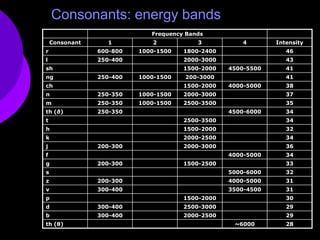
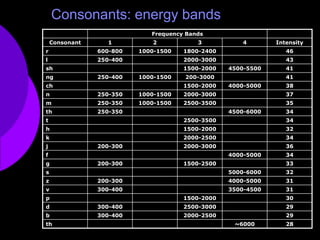
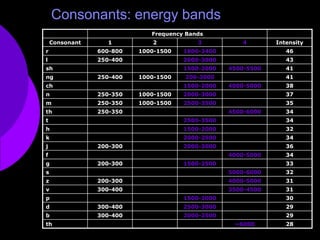
Consonants: energy bands
Phonemic cues - StopsClosureVoiceless stops – silent periodVoiced stops – low level energyBurstWide-band energy ~40 msecGreater intensity for voiceless stopsFrequency depends on placeFormant transitionFirst formant always risingSecond formant transition depends on place
Phonemic cues - StopsVoice easier to detect than placeFor voiced stopsVoice-onset time is earlierEnergy present at fundamental frequencyBurst energy is lower in amplitude Vowels are longer in duration before voiced final stops (“eyes” v. “ice”)
Phonemic cues - NasalsAlways voicedContinuantNasal resonancehighest for /m/lowest for /n/Second formant (frequency and transition) gives place information
Phonemic cues - FricativesHissing qualityVoiced fricativesPeriodicLower frequencyLower amplitudeGreater overall energy (from fundamental)Sibilants (s, z, sh, zh)Higher amplitude than other fricatives
   -f-		-θ-	      -s-		  -S-
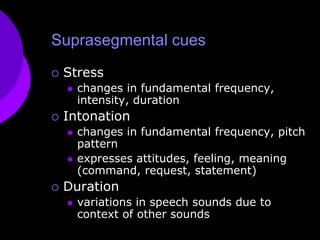
Suprasegmental cuesStresschanges in fundamental frequency, intensity, durationIntonationchanges in fundamental frequency, pitch patternexpresses attitudes, feeling, meaning (command, request, statement)Durationvariations in speech sounds due to context of other sounds
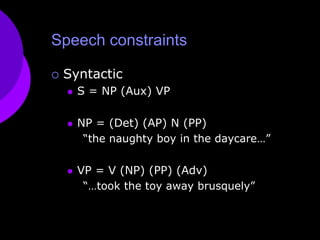
Speech constraintsSyntacticS = NP (Aux) VPNP = (Det) (AP) N (PP) “the naughty boy in the daycare…”VP = V (NP) (PP) (Adv) “…took the toy away brusquely”
Speech constraintsSyntacticS = NP (Aux) VPNP = (Det) (AP) N (PP)“the naughty boy in the daycare…”VP = V (NP) (PP) (Adv)“…took the toy away brusquely”
Speech constraintsSyntacticThe question “What should you eat”Answer is a noun phraseThe question “How should you eat”Answer is an adverbial phrase
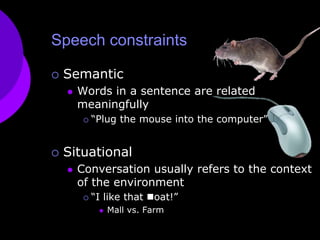
Speech constraintsSemanticWords in a sentence are related meaningfully“Plug the mouse into the computer”SituationalConversation usually refers to the context of the environment“I like that oat!”Mall vs. Farm
Overlapping cues help protect the signal from noiseSpeech predictability helps protect the signal from noiseNoise can come fromthe speaker (poor intelligibility, etc)the environment (distractions, etc)the listener (ESL, etc)
Effects of hearing loss on speech perceptionObjectives: Describe speech characteristics that are lost and that are preserved for hearing losses of various degree, type and configuration.
Auditory Response Area
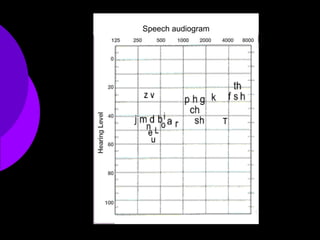
Speech audiogram
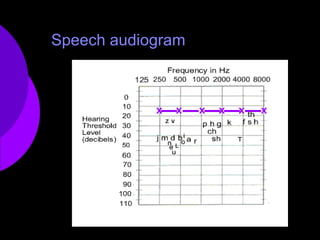
Speech audiogramX     X	    X     X     X      X
Speech audiogram
Consonants: energy bands
Speech audiogram
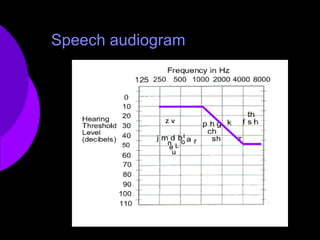
Speech audiogram
34 dots
Correlating SII to speechAdult values (children would be worse)Digits easyWords hard
X      X	     X      X      X      X
Correlating SII to speech
DeafnessNo access to average speech
SevereAccess to only loudest components of speechSpeech productionHigh airflow rateSpeech initiation at low lung volumesPoor velar control (nasality)High fundamental frequencySlow speech rate
ModerateAccess to louder half of speech, or to loud speechSpeech productionSubstitutions and distortionsErrors in affricate, fricatives and blends
Slight to MildAccess to all but the quietest components of speechSpeech productionFewer distortions/substitutionsGood intelligibility
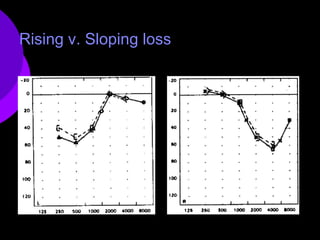
Rising v. Sloping loss
Rising v. Sloping lossSII = 64SII = 45

Speech acoustics

Editor's Notes

  • #43 Start worse, get better.
  • #47 SII = 64; SII = 45
  • #48 SII = 64; SII = 45