Guided By:
Dr. Swagat Mahanta
HOD Of Public Health Dentistry
Presenter:
Manila Upreti
B.D.S Final Year
Phase I
It is the procedure based on removing
carious tooth tissue using hand
instruments alone and restoring the
cavity with adhesive restorative
materials.
 It was first evaluated in Tanzania in the mid
1980s.
 ART was introduced in south Africa by its
Dutch Inventor , Prof. Jo Frencken in 1996
Based on modern principle of:
Minimal intervention
Minimal invasion
Minimal cavity preparation
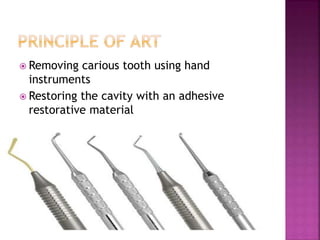
 Removing carious tooth using hand
instruments
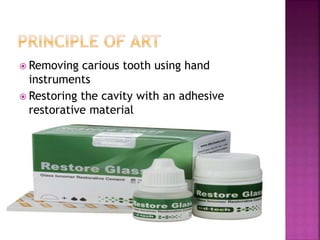
 Restoring the cavity with an adhesive
restorative material
 Removing carious tooth using hand
instruments
 Restoring the cavity with an adhesive
restorative material
 Use of biological approach which requires
minimal cavity preparation that conserves
sound teeth
 Cost effective
 Limitation of pain that reduces the need for
local anesthesia
 Infection control
Bonds chemically to enamel and dentin
Release of flouride – Anticariogenic
Similar to hard tissue and non irritating
to oral soft tissue
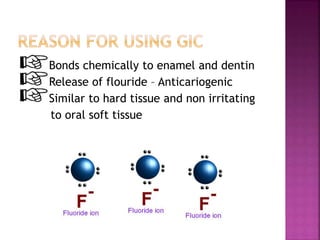
Bonds chemically to enamel and dentin
Release of flouride – Anticariogenic
Similar to hard tissue and non irritating
to oral soft tissue
Bonds chemically to enamel and dentin
Release of flouride – Anticariogenic
Similar to hard tissue and non irritating
to oral soft tissue
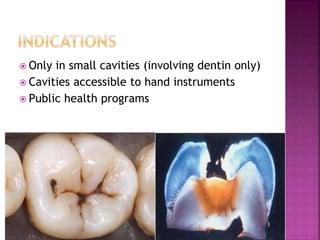
 Only in small cavities (involving dentin only)
 Cavities accessible to hand instruments
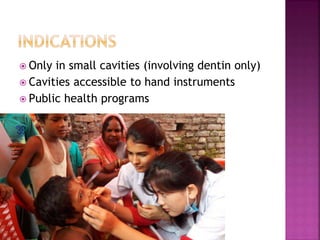
 Public health programs
 Only in small cavities (involving dentin only)
 Cavities accessible to hand instruments
 Public health programs
 Only in small cavities (involving dentin only)
 Cavities accessible to hand instruments
 Public health programs
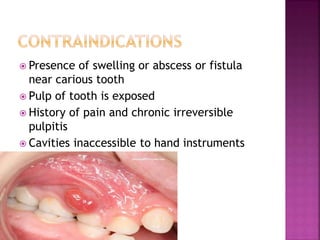
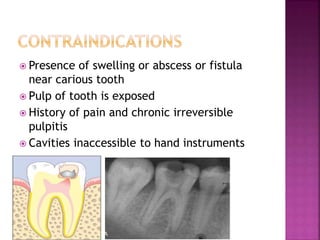
 Presence of swelling or abscess or fistula
near carious tooth
 Pulp of tooth is exposed
 History of pain and chronic irreversible
pulpitis
 Cavities inaccessible to hand instruments
 Presence of swelling or abscess or fistula
near carious tooth
 Pulp of tooth is exposed
 History of pain and chronic irreversible
pulpitis
 Cavities inaccessible to hand instruments
 Presence of swelling or abscess or fistula
near carious tooth
 Pulp of tooth is exposed
 History of pain and chronic irreversible
pulpitis
 Cavities inaccessible to hand instruments
 Presence of swelling or abscess or fistula
near carious tooth
 Pulp of tooth is exposed
 History of pain and chronic irreversible
pulpitis
 Cavities inaccessible to hand instruments
 Biological approach that requires minimal
cavity preparation that conserve sound teeth
 Painless
 Infection control
 Cost effective
 Easy to operate
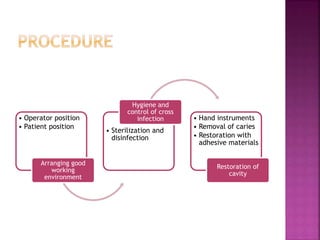
• Operator position
• Patient position
Arranging good
working
environment
• Sterilization and
disinfection
Hygiene and
control of cross
infection • Hand instruments
• Removal of caries
• Restoration with
adhesive materials
Restoration of
cavity
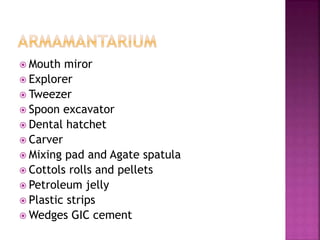
 Mouth miror
 Explorer
 Tweezer
 Spoon excavator
 Dental hatchet
 Carver
 Mixing pad and Agate spatula
 Cottols rolls and pellets
 Petroleum jelly
 Plastic strips
 Wedges GIC cement
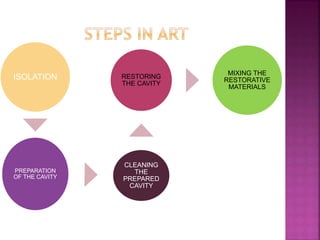
ISOLATION
PREPARATION
OF THE CAVITY
CLEANING
THE
PREPARED
CAVITY
RESTORING
THE CAVITY
MIXING THE
RESTORATIVE
MATERIALS
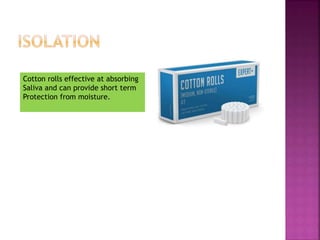
Cotton rolls effective at absorbing
Saliva and can provide short term
Protection from moisture.
 To improve the chemical bonding of GIC to
tooth tooth structure
 Dentin conditioner espicially development
for this purpose (liquid is supplied with GIC)
10%
Polyacrylic
acid
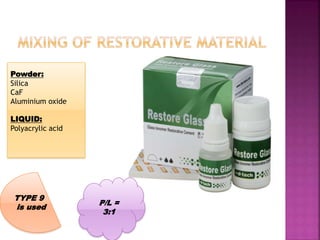
Powder:
Silica
CaF
Aluminium oxide
LIQUID:
Polyacrylic acid
TYPE 9
is used
P/L =
3:1
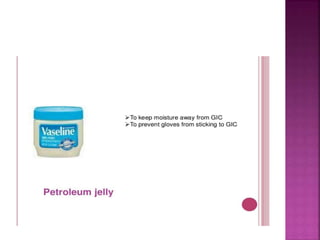
 Rub a small amount of petroleum jelly on the
gloved index finger
 Press the soft restorative material firmly into the
cavity and fissure
 Then slide the finger smoothly across the
occlusal surface of teeth so that the GIC will get
deposited in the remaining of fissure
 Excess material is removed with carver
 Cover the ART with petroleum jelley
 Patient is not allowed to eat for at least 1
hour
Restoration is completely missing
Part of restoration has broken away
Restoration has fractured
Restoration has worn away
Caries has developed in the adjacent
fissure of surface
Atraumatic restorative-treatment-(art)

Atraumatic restorative-treatment-(art)

  • 1.
    Guided By: Dr. SwagatMahanta HOD Of Public Health Dentistry Presenter: Manila Upreti B.D.S Final Year Phase I
  • 2.
    It is theprocedure based on removing carious tooth tissue using hand instruments alone and restoring the cavity with adhesive restorative materials.
  • 3.
     It wasfirst evaluated in Tanzania in the mid 1980s.  ART was introduced in south Africa by its Dutch Inventor , Prof. Jo Frencken in 1996
  • 4.
    Based on modernprinciple of: Minimal intervention Minimal invasion Minimal cavity preparation
  • 5.
     Removing carioustooth using hand instruments  Restoring the cavity with an adhesive restorative material
  • 6.
     Removing carioustooth using hand instruments  Restoring the cavity with an adhesive restorative material
  • 7.
     Use ofbiological approach which requires minimal cavity preparation that conserves sound teeth  Cost effective  Limitation of pain that reduces the need for local anesthesia  Infection control
  • 8.
    Bonds chemically toenamel and dentin Release of flouride – Anticariogenic Similar to hard tissue and non irritating to oral soft tissue
  • 9.
    Bonds chemically toenamel and dentin Release of flouride – Anticariogenic Similar to hard tissue and non irritating to oral soft tissue
  • 10.
    Bonds chemically toenamel and dentin Release of flouride – Anticariogenic Similar to hard tissue and non irritating to oral soft tissue
  • 11.
     Only insmall cavities (involving dentin only)  Cavities accessible to hand instruments  Public health programs
  • 12.
     Only insmall cavities (involving dentin only)  Cavities accessible to hand instruments  Public health programs
  • 13.
     Only insmall cavities (involving dentin only)  Cavities accessible to hand instruments  Public health programs
  • 14.
     Presence ofswelling or abscess or fistula near carious tooth  Pulp of tooth is exposed  History of pain and chronic irreversible pulpitis  Cavities inaccessible to hand instruments
  • 15.
     Presence ofswelling or abscess or fistula near carious tooth  Pulp of tooth is exposed  History of pain and chronic irreversible pulpitis  Cavities inaccessible to hand instruments
  • 16.
     Presence ofswelling or abscess or fistula near carious tooth  Pulp of tooth is exposed  History of pain and chronic irreversible pulpitis  Cavities inaccessible to hand instruments
  • 17.
     Presence ofswelling or abscess or fistula near carious tooth  Pulp of tooth is exposed  History of pain and chronic irreversible pulpitis  Cavities inaccessible to hand instruments
  • 18.
     Biological approachthat requires minimal cavity preparation that conserve sound teeth  Painless  Infection control  Cost effective  Easy to operate
  • 19.
    • Operator position •Patient position Arranging good working environment • Sterilization and disinfection Hygiene and control of cross infection • Hand instruments • Removal of caries • Restoration with adhesive materials Restoration of cavity
  • 20.
     Mouth miror Explorer  Tweezer  Spoon excavator  Dental hatchet  Carver  Mixing pad and Agate spatula  Cottols rolls and pellets  Petroleum jelly  Plastic strips  Wedges GIC cement
  • 21.
  • 22.
    Cotton rolls effectiveat absorbing Saliva and can provide short term Protection from moisture.
  • 23.
     To improvethe chemical bonding of GIC to tooth tooth structure  Dentin conditioner espicially development for this purpose (liquid is supplied with GIC) 10% Polyacrylic acid
  • 24.
  • 25.
     Rub asmall amount of petroleum jelly on the gloved index finger  Press the soft restorative material firmly into the cavity and fissure  Then slide the finger smoothly across the occlusal surface of teeth so that the GIC will get deposited in the remaining of fissure
  • 26.
     Excess materialis removed with carver  Cover the ART with petroleum jelley  Patient is not allowed to eat for at least 1 hour
  • 28.
    Restoration is completelymissing Part of restoration has broken away Restoration has fractured Restoration has worn away Caries has developed in the adjacent fissure of surface