Navneet Singh
Peri Implant Anatomy, Function and
Biology
Contents
 Implant introduction
 Implant classification
 Implant geometry ( Macro design)
 Endosseous implants
 Subperiosteal implants
 Transmandibular implants
 Implant surface characteristics ( micro design)
 Additive processes
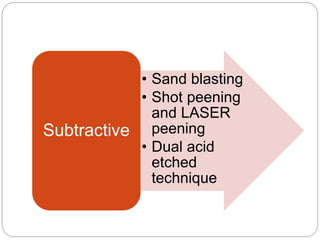
 Subtractive processes
 Hard tissue interface
 Stages of bone healing and osseointegration
 Soft tissue interface
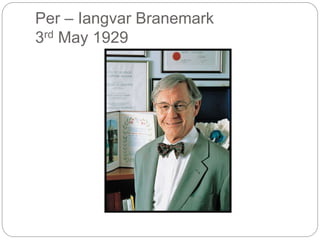
Per – Iangvar Branemark
3rd May 1929
Introduction
Implant :- Any object or material , such as an alloplastic
substance or other tissue, which is partially or
completely inserted or grafted into the body for
therapeutic , diagnostic, prosthetic or experimental
purposes.
Dental implant :- A cylindrical and/or tapered post
usually made of titanium, that serves as a subsitute
for the tooth root and provides a strong and sturdy
foundation for one or more replacement teeth
CLASSIFICATION OF DENTAL
IMPLANTS
1.Based on position with in the bone
2.Based on attachment mechanism
3.Based on macroscopic body design
4.Based on the surface of the implant
5.Based on the type of the material
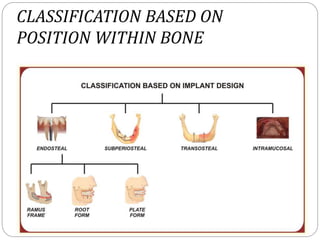
CLASSIFICATION BASED ON
POSITION WITHIN BONE
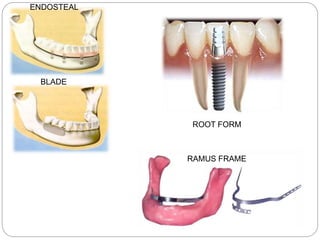
ENDOSTEAL
BLADE
RAMUS FRAME
ROOT FORM
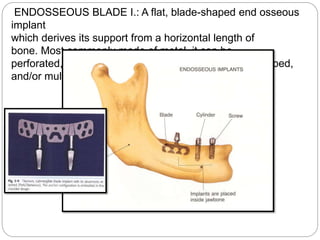
ENDOSSEOUS BLADE I.: A flat, blade-shaped end osseous
implant
which derives its support from a horizontal length of
bone. Most commonly made of metal, it can be
perforated, smooth, fluted, textured, coated, wedge shaped,
and/or multi-headed.
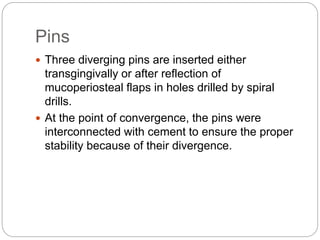
Pins
 Three diverging pins are inserted either
transgingivally or after reflection of
mucoperiosteal flaps in holes drilled by spiral
drills.
 At the point of convergence, the pins were
interconnected with cement to ensure the proper
stability because of their divergence.
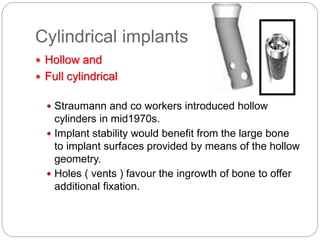
Cylindrical implants
 Hollow and
 Full cylindrical
 Straumann and co workers introduced hollow
cylinders in mid1970s.
 Implant stability would benefit from the large bone
to implant surfaces provided by means of the hollow
geometry.
 Holes ( vents ) favour the ingrowth of bone to offer
additional fixation.
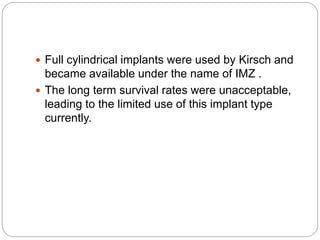
 Full cylindrical implants were used by Kirsch and
became available under the name of IMZ .
 The long term survival rates were unacceptable,
leading to the limited use of this implant type
currently.
Screw shaped ( tapered )
implants
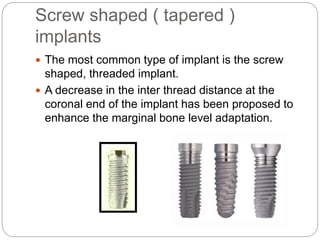
 The most common type of implant is the screw
shaped, threaded implant.
 A decrease in the inter thread distance at the
coronal end of the implant has been proposed to
enhance the marginal bone level adaptation.
Tapered implant design
1. Minimize apical bone fenestration
2. Allow for implant placement in narrow
apical sites
3. Amenable to immediate placement into
anterior extraction socket
Subperiosteal implants
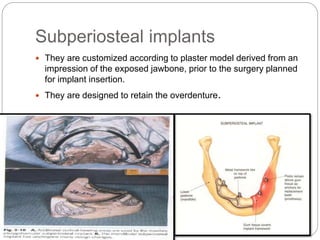
 They are customized according to plaster model derived from an
impression of the exposed jawbone, prior to the surgery planned
for implant insertion.
 They are designed to retain the overdenture.
Transmandibular implants
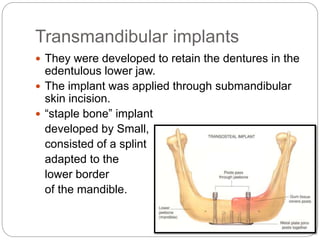
 They were developed to retain the dentures in the
edentulous lower jaw.
 The implant was applied through submandibular
skin incision.
 “staple bone” implant
developed by Small,
consisted of a splint
adapted to the
lower border
of the mandible.
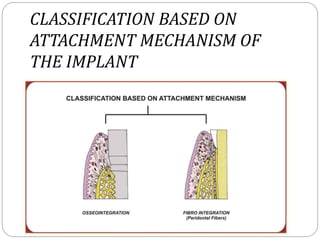
CLASSIFICATION BASED ON
ATTACHMENT MECHANISM OF
THE IMPLANT
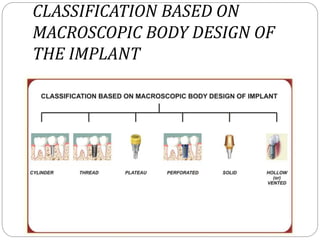
CLASSIFICATION BASED ON
MACROSCOPIC BODY DESIGN OF
THE IMPLANT
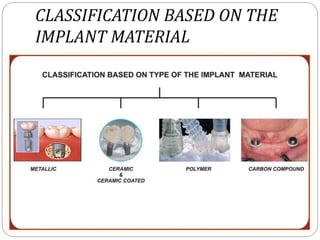
CLASSIFICATION BASED ON THE
IMPLANT MATERIAL
Implant surface characteristics
micro design
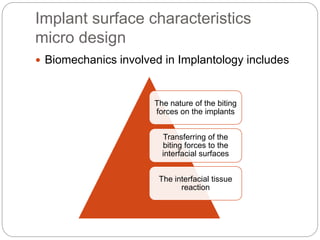
 Biomechanics involved in Implantology includes
The nature of the biting
forces on the implants
Transferring of the
biting forces to the
interfacial surfaces
The interfacial tissue
reaction
Success Criteria
 A successfully osseointegrated implant provides a
direct and relatively rigid connection of the
implant to the bone.
 A critical aspect affecting the success or failure of
an implant is the manner in which mechanical
stresses are transferred from the implant to bone
smoothly.
 Surface plays an important role in biological
interactions.
 Surface modifications have been applied to
metallic biomaterials in order to improve the
 Mechanical
 Chemical
 Physical
 such as
 Wear resistance
 Corrosion resistance
 Biocompatibility and surface energy, etc.
 Micro rough surfaces
 Better bone apposition
 Higher percentage of bone in contact with the
implant
 Influence the mechanical properties of the interface
 Stress distribution
 Bone remodelling
 Smooth surfaces
 Bone resorption
 Fibrous connective tissue layer
Implant surface characteristics
micro design
• Surface coatings
• Carbon, glass, ceramic
coating
• Hydroxyapatite coating
• Ca –P coating
• Composite coating
• Titanium Nitride coating
• Titanium plasma spray
coating
• Titania film coating
Additive
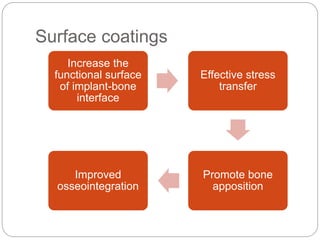
Surface coatings
Increase the
functional surface
of implant-bone
interface
Effective stress
transfer
Promote bone
apposition
Improved
osseointegration
Carbon, Glass and ceramic coatings
 The surface of titanium has been modified by ion
beam mixing a thin carbon film.
 The corrosion resistance and other surface and
biological properties were enhanced using carbon
plasma immersion ion implantation and deposition.
 The coating withstands, without any damage , an
externally generated tensile stress of 47MPa,and
was adequate for load bearing applications.
Hydroxy apatite coating
 Enhancement of the Osteoconductivity of Ti
implants is potentially beneficial to patients since
it
 shortens the treatment time and
 Increases the initial stability of the implant
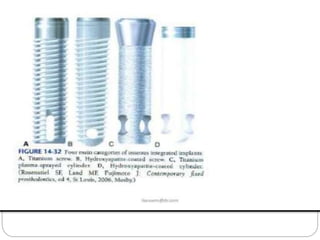
Hydroxyapatite
Tri calcium phosphate
Ca-P coating
 Ca-P coatings are applied to
 To combine the strength of the metals with the
bioactivity of Ca-P.
 Accelerates the bone formation around the implant
and effectively the osseointegration rate
 Various technique
 Electrochemical deposition
 Plasma spraying
Composite coating
 BioActive Ca-P
 Phosphate based glass
 Hydroxy apatite
 TCP – tri calcium phosphate
 CPP – calcium pyrophosphate
 The cells on the coatings expressed higher
alkaline phosphatase activity than pure Ti.
 Suggesting the stimulation of the osteoblastic
activity on the coatings.
Titanium nitride coatings
 Titanium nitride is known for its high surface
hardness and mechanical strength.
 Increasing the corrosion resistance &surface
hardness of the implant surfaces exposed
 Titanium nitriding - various methods
 Gas nitriding
 Plasma nitriding by plasma diffusion treatment
Titanium plasma spraying coating
 Favour the osseointegration of the bone because
of the inherent roughness of such coating
Titania (titanium dioxide) film coating
 An ion beam assisted sputtering deposition
technique has been used to deposit thick and
dense TiO2 films on titanium surfaces which are
not easily breached and hence improved
corrosion protection.
• Sand blasting
• Shot peening
and LASER
peening
• Dual acid
etched
technique
Subtractive
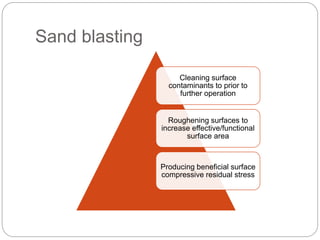
Sand blasting
Cleaning surface
contaminants to prior to
further operation
Roughening surfaces to
increase effective/functional
surface area
Producing beneficial surface
compressive residual stress
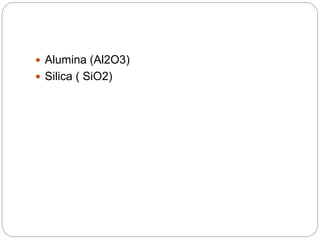
 Alumina (Al2O3)
 Silica ( SiO2)
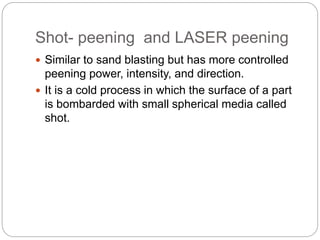
Shot- peening and LASER peening
 Similar to sand blasting but has more controlled
peening power, intensity, and direction.
 It is a cold process in which the surface of a part
is bombarded with small spherical media called
shot.
 High intensity (5 -15GW/cm2) LASER light beam
striking the ablative layer generates a short lived
plasma wave which causes a shock wave to travel
into the implant.
 The shock waves induces the compressive residual
stress that penetrates beneath the surface and
strengthens the implant, resulting in improvement in
fatigue life and retarding the stress corrosion and
cracking occurrence.
Chemical and electrochemical
modifications
 Dual acid etched technique
 To produce microtexture rather than macrotexture
 Enhance the osteoconductive process through the
attachment of fibrin and osteogenic cells, resulting
in bone formation directly on the surface of the
implant.
 Higher adhesion and expression of platelet and
extracellular genes, which help in colonization of
osteoblasts at the site and promote
osseointegration.
Hard tissue interface
Stages of bone healing and osseointegration
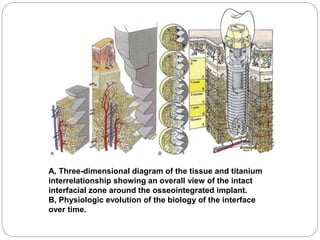
A, Three-dimensional diagram of the tissue and titanium
interrelationship showing an overall view of the intact
interfacial zone around the osseointegrated implant.
B, Physiologic evolution of the biology of the interface
over time.
Osseointegration
 The term Osseointegration was first used by Prof
I-P Branemark. since then it has been used to
describe the procedure of bone attachment with
titanium. Though lately, the Glossary of Prosthetic
Terms (Sixth Edition) lists the terms
Osseointegration and osteointegration but
recommends the use of the term osseous
integration.
Osseointegration
 Osseointegration was originally defined as, a direct
structural and functional connection between ordered
living bone and the surface of a load-carrying
implant.
 Branemark in 1985
 Clinically,As asymptomatic rigid fixation of an
alloplastic material with bone with ability to withstand
occlusal forces
 Albrektsson in 1981
 A bony attachment with resistance to shear and
tensile forces.
 Steinemann in 1986
Osseointegration
 Branemark in 1990, then gave a modified
definition of his own –
 “A continuing structural and functional coexistence,
possibly in a symbolic manner, between
differentiated, adequately remodeling, biologic
tissues and strictly defined and controlled synthetic
components providing lasting specific clinical
functions without initiating rejection mechanism.”
Osseointegration
 Compared to as direct fracture healing, in which
the fragment ends become united by bone,
without intermediate fibrous tissue or
fibrocartilage formation.
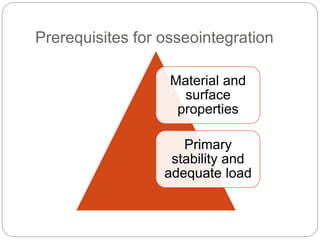
Prerequisites for osseointegration
Material and
surface
properties
Primary
stability and
adequate load
 Material and surface properties
 Bio inert materials
 Titanium
 Rough surfaces
 Improve adhesive strength
 Favors bone deposition
 Degree of mechanical interlock
 Primary stability and adequate load
 Requires perfect stability
 Exact adaptation and compression of the fragments
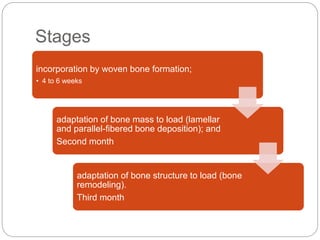
Stages
incorporation by woven bone formation;
• 4 to 6 weeks
adaptation of bone mass to load (lamellar
and parallel-fibered bone deposition); and
Second month
adaptation of bone structure to load (bone
remodeling).
Third month
Formation of woven bone
 The first bone tissue formed is woven bone.
 characterized by a random, felt-like orientation of
its collagen fibrils, numerous, irregularly shaped
osteocytes and, at the beginning, a relatively low
mineral density.
 it grows by forming a scaffold of rods and plates
and thus is able to spread out into the
surrounding tissue at a relatively rapid rate
Adaptation of bone mass to load
 (deposition of parallel-fibered and lamellar bone)
 lamellar bone, or towards an equally important
but less known modification called parallel-
fibered bone
 Three surfaces qualified for deposition of fibered
and lamellar bone
 Woven bone formed in the first period of OG
 Pre-existing or pristine bone surface
 The implant surface
 Woven bone
 Deposition of more mature bone on the initially formed
scaffold results in reinforcement and often concentrates
on the areas where major forces are transferred from the
implant to the surrounding original bone.
 Pre – existing or pristine bone
 The trabeculae become necrotic due to the temporary
interruption of the blood supply at surgery.
Reinforcement by a coating with new, viable bone
compensates for the loss in bone quality (fatigue), and
again may reflect the preferential strain pattern resulting
from functional load.
 The implant surface
 Bone deposition in this site increases the bone-
impIant interface and thus enlarges the load-
transmitting surface. Extension of the bone-implant
interface and reinforcement of pre-existing and
initially formed bone compartments are considered
to represent an adaptation of the bone mass to
load.
Adaptation of bone structure to load
 (bone remodeling and modeling)
 Last stage of OG
 It starts around the third month and, after several
weeks of increasingly high activity, slows down
again, but continues for the rest of life.
 Remodeling starts with osteoclastic resorption,
followed by lamellar bone deposition. Resorption
and formation are coupled in space and time.
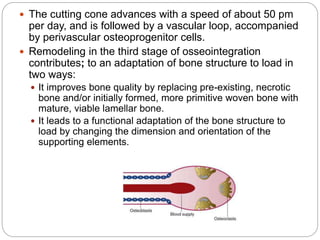
 The cutting cone advances with a speed of about 50 pm
per day, and is followed by a vascular loop, accompanied
by perivascular osteoprogenitor cells.
 Remodeling in the third stage of osseointegration
contributes; to an adaptation of bone structure to load in
two ways:
 It improves bone quality by replacing pre-existing, necrotic
bone and/or initially formed, more primitive woven bone with
mature, viable lamellar bone.
 It leads to a functional adaptation of the bone structure to
load by changing the dimension and orientation of the
supporting elements.
six key factors for successful osseointegration:
 implant material;
 implant design;
 surface quality;
 prosthetic load;
 surgical technique;
 bone health.
Soft tissue interfaces
Vs
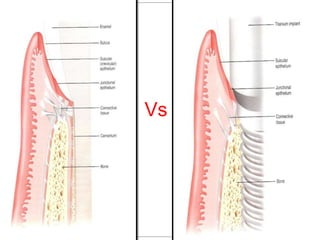
 The healthy soft, keratinized tissues facing teeth
and implants frequently have a pink color and a
firm consistency. The two tissues have several
microscopic features in common. The gingiva as
well as the keratinized, peri-implant mucosa is
lined by a well-keratinized oral epithelium that is
continuous with a junctional epithelium that is
about 2 mm long.
 The interface between epithelial cells and the
titanium surface is characterized by the presence
of hemi desmosomes and a basal lamina.
 Capillary loops in the C/T under the junctional and
sulcular epithelium around implant appear normal
 The thickness of the epithelium is 0.5mm
 The average direction of the collagen fiber
bundles of the gingiva is parallel with the implant.
 Even if perpendicular then they are never
embedded as in the case of dentogingival and
dentoperiosteal fibers around the teeth.
 The fiber bundles also have cuff like orientation –
soft tissue seal around the implant.
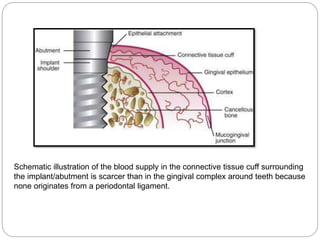
 The vascular supply of the peri implant gingival or
oral alveolar mucosa is more limited than that
around natural teeth.
a
Schematic illustration of the blood supply in the connective tissue cuff surrounding
the implant/abutment is scarcer than in the gingival complex around teeth because
none originates from a periodontal ligament.
References
 Newman, Takei, Klokkevold, Carranza.
Carranza’s Clinical Periodontology, 10th Edition
and 11th Edition
 Lindhe, Lang, Karring. Clinical Periodontology &
Implant Dentistry, 5th Edition.
 Carle E. Misch. Contemporary Implant Dentistry.
3rd edition.
 PHILLIP’S – SCIENCE OF DENTAL MATERIALS –
Kenneth J. Anusavice , Phd ,DMD
 Robert K, Schenk & Daniel Buser. Osseointegration: A
reality. Perio 2000. Vol 17, 1998, 22-35.
Robert

Peri Implant Anatomy, Function and Biology

  • 1.
    Navneet Singh Peri ImplantAnatomy, Function and Biology
  • 2.
    Contents  Implant introduction Implant classification  Implant geometry ( Macro design)  Endosseous implants  Subperiosteal implants  Transmandibular implants  Implant surface characteristics ( micro design)  Additive processes  Subtractive processes  Hard tissue interface  Stages of bone healing and osseointegration  Soft tissue interface
  • 3.
    Per – IangvarBranemark 3rd May 1929
  • 4.
    Introduction Implant :- Anyobject or material , such as an alloplastic substance or other tissue, which is partially or completely inserted or grafted into the body for therapeutic , diagnostic, prosthetic or experimental purposes. Dental implant :- A cylindrical and/or tapered post usually made of titanium, that serves as a subsitute for the tooth root and provides a strong and sturdy foundation for one or more replacement teeth
  • 5.
    CLASSIFICATION OF DENTAL IMPLANTS 1.Basedon position with in the bone 2.Based on attachment mechanism 3.Based on macroscopic body design 4.Based on the surface of the implant 5.Based on the type of the material
  • 6.
  • 7.
  • 8.
    ENDOSSEOUS BLADE I.:A flat, blade-shaped end osseous implant which derives its support from a horizontal length of bone. Most commonly made of metal, it can be perforated, smooth, fluted, textured, coated, wedge shaped, and/or multi-headed.
  • 9.
    Pins  Three divergingpins are inserted either transgingivally or after reflection of mucoperiosteal flaps in holes drilled by spiral drills.  At the point of convergence, the pins were interconnected with cement to ensure the proper stability because of their divergence.
  • 10.
    Cylindrical implants  Hollowand  Full cylindrical  Straumann and co workers introduced hollow cylinders in mid1970s.  Implant stability would benefit from the large bone to implant surfaces provided by means of the hollow geometry.  Holes ( vents ) favour the ingrowth of bone to offer additional fixation.
  • 11.
     Full cylindricalimplants were used by Kirsch and became available under the name of IMZ .  The long term survival rates were unacceptable, leading to the limited use of this implant type currently.
  • 12.
    Screw shaped (tapered ) implants  The most common type of implant is the screw shaped, threaded implant.  A decrease in the inter thread distance at the coronal end of the implant has been proposed to enhance the marginal bone level adaptation.
  • 13.
    Tapered implant design 1.Minimize apical bone fenestration 2. Allow for implant placement in narrow apical sites 3. Amenable to immediate placement into anterior extraction socket
  • 14.
    Subperiosteal implants  Theyare customized according to plaster model derived from an impression of the exposed jawbone, prior to the surgery planned for implant insertion.  They are designed to retain the overdenture.
  • 15.
    Transmandibular implants  Theywere developed to retain the dentures in the edentulous lower jaw.  The implant was applied through submandibular skin incision.  “staple bone” implant developed by Small, consisted of a splint adapted to the lower border of the mandible.
  • 16.
    CLASSIFICATION BASED ON ATTACHMENTMECHANISM OF THE IMPLANT
  • 17.
    CLASSIFICATION BASED ON MACROSCOPICBODY DESIGN OF THE IMPLANT
  • 18.
    CLASSIFICATION BASED ONTHE IMPLANT MATERIAL
  • 19.
    Implant surface characteristics microdesign  Biomechanics involved in Implantology includes The nature of the biting forces on the implants Transferring of the biting forces to the interfacial surfaces The interfacial tissue reaction
  • 20.
    Success Criteria  Asuccessfully osseointegrated implant provides a direct and relatively rigid connection of the implant to the bone.  A critical aspect affecting the success or failure of an implant is the manner in which mechanical stresses are transferred from the implant to bone smoothly.
  • 21.
     Surface playsan important role in biological interactions.  Surface modifications have been applied to metallic biomaterials in order to improve the  Mechanical  Chemical  Physical  such as  Wear resistance  Corrosion resistance  Biocompatibility and surface energy, etc.
  • 22.
     Micro roughsurfaces  Better bone apposition  Higher percentage of bone in contact with the implant  Influence the mechanical properties of the interface  Stress distribution  Bone remodelling  Smooth surfaces  Bone resorption  Fibrous connective tissue layer
  • 23.
    Implant surface characteristics microdesign • Surface coatings • Carbon, glass, ceramic coating • Hydroxyapatite coating • Ca –P coating • Composite coating • Titanium Nitride coating • Titanium plasma spray coating • Titania film coating Additive
  • 24.
    Surface coatings Increase the functionalsurface of implant-bone interface Effective stress transfer Promote bone apposition Improved osseointegration
  • 25.
    Carbon, Glass andceramic coatings  The surface of titanium has been modified by ion beam mixing a thin carbon film.  The corrosion resistance and other surface and biological properties were enhanced using carbon plasma immersion ion implantation and deposition.  The coating withstands, without any damage , an externally generated tensile stress of 47MPa,and was adequate for load bearing applications.
  • 26.
    Hydroxy apatite coating Enhancement of the Osteoconductivity of Ti implants is potentially beneficial to patients since it  shortens the treatment time and  Increases the initial stability of the implant Hydroxyapatite Tri calcium phosphate
  • 27.
    Ca-P coating  Ca-Pcoatings are applied to  To combine the strength of the metals with the bioactivity of Ca-P.  Accelerates the bone formation around the implant and effectively the osseointegration rate  Various technique  Electrochemical deposition  Plasma spraying
  • 28.
    Composite coating  BioActiveCa-P  Phosphate based glass  Hydroxy apatite  TCP – tri calcium phosphate  CPP – calcium pyrophosphate  The cells on the coatings expressed higher alkaline phosphatase activity than pure Ti.  Suggesting the stimulation of the osteoblastic activity on the coatings.
  • 29.
    Titanium nitride coatings Titanium nitride is known for its high surface hardness and mechanical strength.  Increasing the corrosion resistance &surface hardness of the implant surfaces exposed  Titanium nitriding - various methods  Gas nitriding  Plasma nitriding by plasma diffusion treatment
  • 30.
    Titanium plasma sprayingcoating  Favour the osseointegration of the bone because of the inherent roughness of such coating
  • 31.
    Titania (titanium dioxide)film coating  An ion beam assisted sputtering deposition technique has been used to deposit thick and dense TiO2 films on titanium surfaces which are not easily breached and hence improved corrosion protection.
  • 32.
    • Sand blasting •Shot peening and LASER peening • Dual acid etched technique Subtractive
  • 33.
    Sand blasting Cleaning surface contaminantsto prior to further operation Roughening surfaces to increase effective/functional surface area Producing beneficial surface compressive residual stress
  • 34.
  • 35.
    Shot- peening andLASER peening  Similar to sand blasting but has more controlled peening power, intensity, and direction.  It is a cold process in which the surface of a part is bombarded with small spherical media called shot.
  • 36.
     High intensity(5 -15GW/cm2) LASER light beam striking the ablative layer generates a short lived plasma wave which causes a shock wave to travel into the implant.  The shock waves induces the compressive residual stress that penetrates beneath the surface and strengthens the implant, resulting in improvement in fatigue life and retarding the stress corrosion and cracking occurrence.
  • 37.
    Chemical and electrochemical modifications Dual acid etched technique  To produce microtexture rather than macrotexture  Enhance the osteoconductive process through the attachment of fibrin and osteogenic cells, resulting in bone formation directly on the surface of the implant.  Higher adhesion and expression of platelet and extracellular genes, which help in colonization of osteoblasts at the site and promote osseointegration.
  • 39.
    Hard tissue interface Stagesof bone healing and osseointegration
  • 40.
    A, Three-dimensional diagramof the tissue and titanium interrelationship showing an overall view of the intact interfacial zone around the osseointegrated implant. B, Physiologic evolution of the biology of the interface over time.
  • 41.
    Osseointegration  The termOsseointegration was first used by Prof I-P Branemark. since then it has been used to describe the procedure of bone attachment with titanium. Though lately, the Glossary of Prosthetic Terms (Sixth Edition) lists the terms Osseointegration and osteointegration but recommends the use of the term osseous integration.
  • 42.
    Osseointegration  Osseointegration wasoriginally defined as, a direct structural and functional connection between ordered living bone and the surface of a load-carrying implant.  Branemark in 1985  Clinically,As asymptomatic rigid fixation of an alloplastic material with bone with ability to withstand occlusal forces  Albrektsson in 1981  A bony attachment with resistance to shear and tensile forces.  Steinemann in 1986
  • 43.
    Osseointegration  Branemark in1990, then gave a modified definition of his own –  “A continuing structural and functional coexistence, possibly in a symbolic manner, between differentiated, adequately remodeling, biologic tissues and strictly defined and controlled synthetic components providing lasting specific clinical functions without initiating rejection mechanism.”
  • 44.
    Osseointegration  Compared toas direct fracture healing, in which the fragment ends become united by bone, without intermediate fibrous tissue or fibrocartilage formation.
  • 45.
    Prerequisites for osseointegration Materialand surface properties Primary stability and adequate load
  • 46.
     Material andsurface properties  Bio inert materials  Titanium  Rough surfaces  Improve adhesive strength  Favors bone deposition  Degree of mechanical interlock  Primary stability and adequate load  Requires perfect stability  Exact adaptation and compression of the fragments
  • 47.
    Stages incorporation by wovenbone formation; • 4 to 6 weeks adaptation of bone mass to load (lamellar and parallel-fibered bone deposition); and Second month adaptation of bone structure to load (bone remodeling). Third month
  • 48.
    Formation of wovenbone  The first bone tissue formed is woven bone.  characterized by a random, felt-like orientation of its collagen fibrils, numerous, irregularly shaped osteocytes and, at the beginning, a relatively low mineral density.  it grows by forming a scaffold of rods and plates and thus is able to spread out into the surrounding tissue at a relatively rapid rate
  • 49.
    Adaptation of bonemass to load  (deposition of parallel-fibered and lamellar bone)  lamellar bone, or towards an equally important but less known modification called parallel- fibered bone  Three surfaces qualified for deposition of fibered and lamellar bone  Woven bone formed in the first period of OG  Pre-existing or pristine bone surface  The implant surface
  • 50.
     Woven bone Deposition of more mature bone on the initially formed scaffold results in reinforcement and often concentrates on the areas where major forces are transferred from the implant to the surrounding original bone.  Pre – existing or pristine bone  The trabeculae become necrotic due to the temporary interruption of the blood supply at surgery. Reinforcement by a coating with new, viable bone compensates for the loss in bone quality (fatigue), and again may reflect the preferential strain pattern resulting from functional load.
  • 51.
     The implantsurface  Bone deposition in this site increases the bone- impIant interface and thus enlarges the load- transmitting surface. Extension of the bone-implant interface and reinforcement of pre-existing and initially formed bone compartments are considered to represent an adaptation of the bone mass to load.
  • 52.
    Adaptation of bonestructure to load  (bone remodeling and modeling)  Last stage of OG  It starts around the third month and, after several weeks of increasingly high activity, slows down again, but continues for the rest of life.  Remodeling starts with osteoclastic resorption, followed by lamellar bone deposition. Resorption and formation are coupled in space and time.
  • 53.
     The cuttingcone advances with a speed of about 50 pm per day, and is followed by a vascular loop, accompanied by perivascular osteoprogenitor cells.  Remodeling in the third stage of osseointegration contributes; to an adaptation of bone structure to load in two ways:  It improves bone quality by replacing pre-existing, necrotic bone and/or initially formed, more primitive woven bone with mature, viable lamellar bone.  It leads to a functional adaptation of the bone structure to load by changing the dimension and orientation of the supporting elements.
  • 54.
    six key factorsfor successful osseointegration:  implant material;  implant design;  surface quality;  prosthetic load;  surgical technique;  bone health.
  • 55.
  • 56.
  • 57.
     The healthysoft, keratinized tissues facing teeth and implants frequently have a pink color and a firm consistency. The two tissues have several microscopic features in common. The gingiva as well as the keratinized, peri-implant mucosa is lined by a well-keratinized oral epithelium that is continuous with a junctional epithelium that is about 2 mm long.
  • 58.
     The interfacebetween epithelial cells and the titanium surface is characterized by the presence of hemi desmosomes and a basal lamina.  Capillary loops in the C/T under the junctional and sulcular epithelium around implant appear normal  The thickness of the epithelium is 0.5mm
  • 59.
     The averagedirection of the collagen fiber bundles of the gingiva is parallel with the implant.  Even if perpendicular then they are never embedded as in the case of dentogingival and dentoperiosteal fibers around the teeth.  The fiber bundles also have cuff like orientation – soft tissue seal around the implant.
  • 60.
     The vascularsupply of the peri implant gingival or oral alveolar mucosa is more limited than that around natural teeth.
  • 61.
    a Schematic illustration ofthe blood supply in the connective tissue cuff surrounding the implant/abutment is scarcer than in the gingival complex around teeth because none originates from a periodontal ligament.
  • 62.
    References  Newman, Takei,Klokkevold, Carranza. Carranza’s Clinical Periodontology, 10th Edition and 11th Edition  Lindhe, Lang, Karring. Clinical Periodontology & Implant Dentistry, 5th Edition.  Carle E. Misch. Contemporary Implant Dentistry. 3rd edition.  PHILLIP’S – SCIENCE OF DENTAL MATERIALS – Kenneth J. Anusavice , Phd ,DMD  Robert K, Schenk & Daniel Buser. Osseointegration: A reality. Perio 2000. Vol 17, 1998, 22-35.
  • 63.