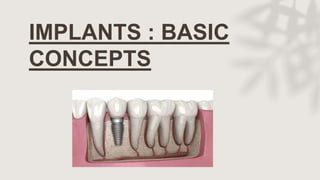
IMPLANTS : BASIC
CONCEPTS
CONTENTS :
Implant introduction
Implant classification
Implant geometry ( Macro design)
◦ Endosseous implants
◦ Subperiosteal implants
◦ Trans mandibular implants
Implant surface characteristics ( micro design)
◦ Additive processes
◦ Subtractive processes
Hard tissue interface
◦ Stages of bone healing and osseointegration
Soft tissue interface
INTRODUCTION :
•Implant :- Any object or material , such as an alloplastic substance
or other tissue, which is partially or completely inserted or grafted
into the body for therapeutic , diagnostic, prosthetic or experimental
purposes.
•Dental implant :- A prosthetic device of alloplastic material
Implanted into the oral the oral tissues beneath the mucosa,
periosteal layer and or within the bone to provide retention and
support for a removal or fixed prosthesis.
Implantology :- The study or science of placing and restoring
dental implants.
Implant surgery :- The phase of implant dentistry concerning
the selection, planning, and placement of the implant body and
abutment.
Implant prosthodontics :- The phase of prosthodontics
concerning the replacement of missing teeth and/or associated
structures by restorations that are attached to dental implants
TERMINOLOGIES:
• Following are the terminologies related to implants :
• Body: The body is that portion of the implant designed to be
surgically placed into the bone.
• Cover screw: In two-stage implant, the first-stage cover screw is
positioned on the top of the implant.
Healing abutment/per mucosal extension:
In two-stage implant, a second surgical procedure is conducted to expose
implant and provide attachment to a transepithelial portion. This
transepithelial portion is called per mucosal extension.
Abutment:
The abutment is the implant’s part that help to support and/or retain the
prosthesis or implant superstructure in position.
INDICATIONS :
‰Edentulous patient: One of the first indications for dental implant
treatment is to treat complete edentulism.
‰Partially edentulous patient.
‰Single tooth loss: Implant maintains bone volume after tooth
extraction.
‰Anchorage for the maxillofacial prosthesis: Patients with
maxillofacial deformities uses implant for the maxillofacial prosthesis.
‰For rehabilitation of congenital and developmental
defects like cleft palate, ectodermal dysplasia, etc.
‰For orthodontic anchorage.
CONTRAINDICATIONS :
‰Immunologically compromised patients: Systemic diseases such as developing
cancer and AIDS.
‰Cardiac diseases: Implant surgery should be carefully considered in patients with
heart valve replacements and should not be performed on patients having suffered from
recent infarcts, i.e. within the latest 6 months period.
‰Deficient hemostasis and blood dyscrasias.
‰Certain psychiatric disorders: Patients with psychological disorders
have difficulties in cooperating and maintaining sufficient oral hygiene.
‰Uncontrolled acute infections, as in the respiratory tract, may
negatively influence the surgical procedure or may affect the
treatment result and are thus, a contraindication for surgical
treatment.
‰Anticoagulant medications
‰Recent history of orofacial irradiation: Irradiation of the jaw may
be another potential risk factor for implant treatment, specifically if the jaw
has been exposed to irradiation over the level of 50 Gy.
‰Heavy smoking and alcohol abuse.
‰Various intraoral contraindications are :
Xerostomia
Macroglossia
Unfavorable intermaxillary occlusal relationship.
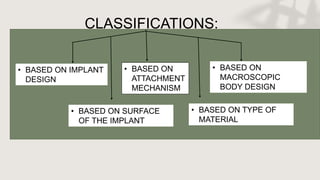
CLASSIFICATIONS:
• BASED ON IMPLANT
DESIGN
• BASED ON
ATTACHMENT
MECHANISM
• BASED ON
MACROSCOPIC
BODY DESIGN
• BASED ON SURFACE
OF THE IMPLANT
• BASED ON TYPE OF
MATERIAL
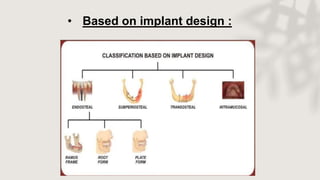
• Based on implant design :
Implants geometry (macro design)
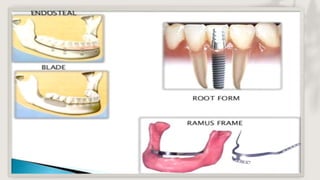
Endosseous implants
◦ blade like
◦ Pins
◦ Cylindrical (hollow and solid)
◦ Disklike
◦ Screw shaped
◦ Tapered and screw shaped
Subperiosteal frame like implants
Trans mandibular implants
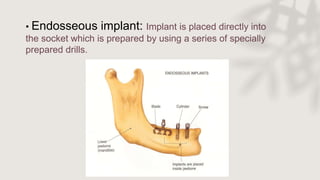
• Endosseous implant: Implant is placed directly into
the socket which is prepared by using a series of specially
prepared drills.
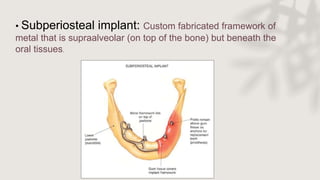
• Subperiosteal implant: Custom fabricated framework of
metal that is supraalveolar (on top of the bone) but beneath the
oral tissues.
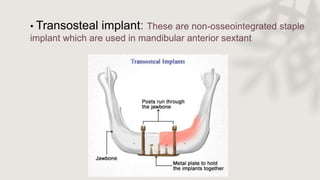
• Transosteal implant: These are non-osseointegrated staple
implant which are used in mandibular anterior sextant
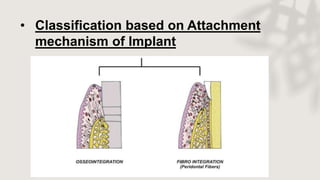
• Classification based on Attachment
mechanism of Implant
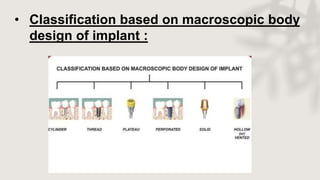
• Classification based on macroscopic body
design of implant :
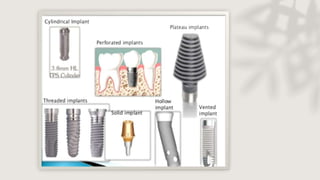
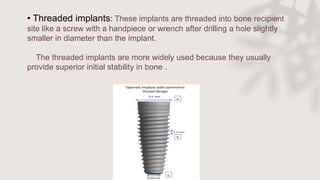
• Threaded implants: These implants are threaded into bone recipient
site like a screw with a handpiece or wrench after drilling a hole slightly
smaller in diameter than the implant.
The threaded implants are more widely used because they usually
provide superior initial stability in bone .
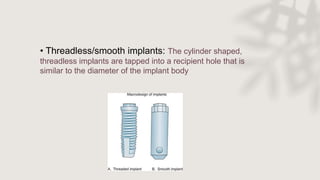
• Threadless/smooth implants: The cylinder shaped,
threadless implants are tapped into a recipient hole that is
similar to the diameter of the implant body
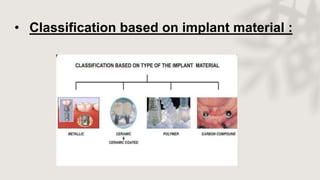
• Classification based on implant material :
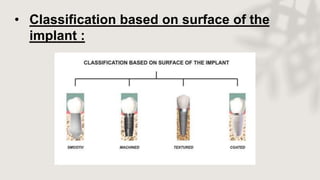
• Classification based on surface of the
implant :
‰IMPLANT surface characteristics
(micro design):
• Additive surface treatment:
– Titanium plasma spraying (TPS).
– Hydroxyapatite (HA) coated surface.
• Subtractive surface treatment:
– Blasting with titanium oxide/aluminium oxide.
– Acid-etched surface.
• Modified surface treatment:
– Laser induced roughened surfaces.
– Ion implantation.
– Oxidized surface treatment.
Titanium plasma spray:
The TPS surface has been reported to increase the surface area of the bone
— implant interface
It acts similarly to a three dimensional surface, which may stimulate adhesion
osteogenesis.
TPS—porous or rough titanium surfaces have been fabricated by plasma
spraying a powder form of molten droplets at high temperatures.
Hydroxyapatite coatings:
Hydroxyapatite coatings are available with same
roughness and increased functional surface area as TPS.
Blasted surface:
The surface is blasted with titanium dioxide (TiO2 ) particles or aluminium oxide (Al2
O3 ) particles.
Blasting technique is used to enhance implant surface topography with micro to
macroscopic hills, valleys and indentations.
Acid-etched surfaces:
Acid-etching is performed by bathing titanium base in hydrochloric acid (HCl),
sulfuric acid (H2 SO4 ), hydrogen fluoride (HF) and nitric acid (HNO3 ) in
different combinations.
The roughness before etching, the acid mixture, the bath temperature and the
etching time all affect the acid-etching process
Sandblasted and acid-etched surfaces:
Implants are blasted with 250–500 μm corundum grit followed by acid-
etching in a hot solution of HCl and H2 SO4 .
Sandblasting produces macroroughness onto which acid-etching
superimposes microroughness.
Laser:
Laser ablation is a technique that can be used to produce a surface
with predetermined reproducible characteristics.
Implants are modified to produce a controlled, micron-sized surface,
with topographical features on the flanks of the threads.
Excimer laser is used to create roughness over the implant surface
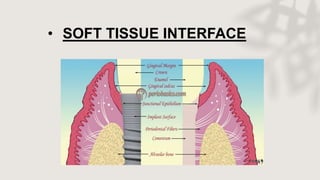
• SOFT TISSUE INTERFACE
• Clinical features of peri-implant mucosa: The clinically
healthy gingiva and peri-implant mucosa has a pink color
and a firm consistency.
• Radiographic features of peri-implant mucosa:
The alveolar bone crest is usually located about 1 mm apical to a line
connecting the cemento-enamel junction of neighboring teeth.
The marginal termination of the bone crest is usually close to the junction
between the abutment and fixture part of the implant system.
Histological features of peri-implant mucosa:
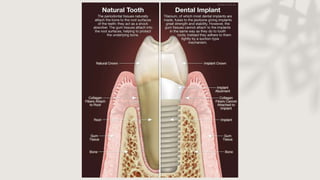
• The mucosal tissues around intraosseous implants form a tightly
adherent band.
• This band is primarily composed of a dense collagenous lamina propria
covered by stratified squamous keratinizing epithelium.
• The junctional and barrier epithelia are about 2 mm long and the zones
of supra-alveolar connective tissues are between 1 mm and 1.5 mm
high.
• Both epithelia are via hemidesmosomes attached to the implant
surface.
• The main attachment fibers (the principal fibers) invest in the root
cementum of the tooth, but at the implant site the corresponding
collagen fibers are nonattached and run parallel to the implant
surface, owing to the lack of cementum.
• The sulcus around an implant is lined with sulcular epithelium that
is continuous apically with the junctional epithelium
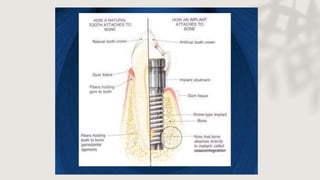
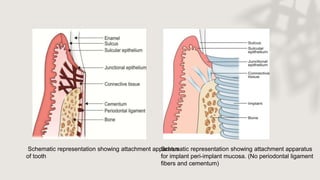
Schematic representation showing attachment apparatus
for implant peri-implant mucosa. (No periodontal ligament
fibers and cementum)
Schematic representation showing attachment apparatus
of tooth
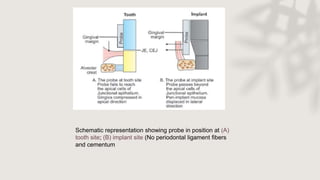
Schematic representation showing probe in position at (A)
tooth site; (B) implant site (No periodontal ligament fibers
and cementum
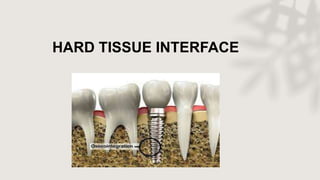
HARD TISSUE INTERFACE
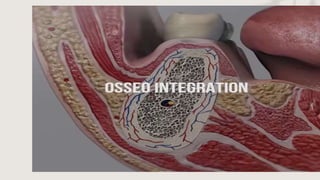
Histologically, osseointegration is defined as the direct structural
and functional connection between ordered, living bone and the
surface of a load-bearing implant without intervening soft tissues
Osseointegration
Clinically, osseointegration is the asymptomatic rigid fixation of an
alloplastic material (implant) in bone with the ability to withstand
occlusal forces. The hard tissue interface is a fundamental requirement
for and an essential component of implant success.
Branemark in 1990, then gave a modified definition
of his own –
◦ “A continuing structural and functional coexistence,
possibly in a symbolic manner, between differentiated,
adequately remodeling, biologic tissues and strictly
defined and controlled synthetic components providing
lasting specific clinical functions without initiating
rejection mechanism.”
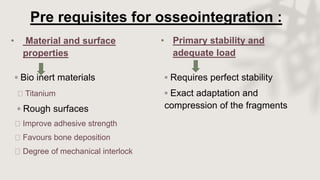
Pre requisites for osseointegration :
• Material and surface
properties
◦ Bio inert materials
Titanium
◦ Rough surfaces
Improve adhesive strength
Favours bone deposition
Degree of mechanical interlock
• Primary stability and
adequate load
◦ Requires perfect stability
◦ Exact adaptation and
compression of the fragments
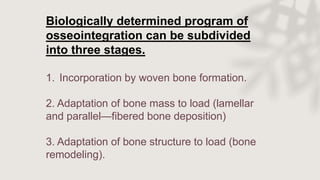
Biologically determined program of
osseointegration can be subdivided
into three stages.
1. Incorporation by woven bone formation.
2. Adaptation of bone mass to load (lamellar
and parallel—fibered bone deposition)
3. Adaptation of bone structure to load (bone
remodeling).
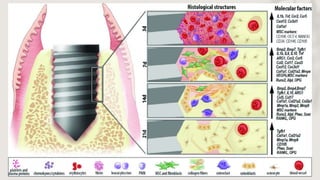
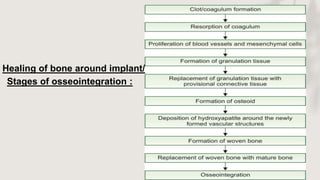
Stages of osseointegration :
Healing of bone around implant/
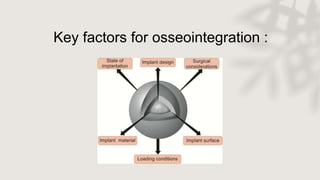
Key factors for osseointegration :
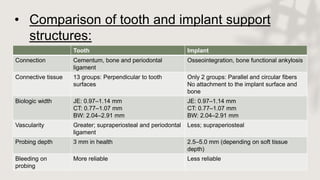
• Comparison of tooth and implant support
structures:
Tooth Implant
Connection Cementum, bone and periodontal
ligament
Osseointegration, bone functional ankylosis
Connective tissue 13 groups: Perpendicular to tooth
surfaces
Only 2 groups: Parallel and circular fibers
No attachment to the implant surface and
bone
Biologic width JE: 0.97–1.14 mm
CT: 0.77–1.07 mm
BW: 2.04–2.91 mm
JE: 0.97–1.14 mm
CT: 0.77–1.07 mm
BW: 2.04–2.91 mm
Vascularity Greater; supraperiosteal and periodontal
ligament
Less; supraperiosteal
Probing depth 3 mm in health 2.5–5.0 mm (depending on soft tissue
depth)
Bleeding on
probing
More reliable Less reliable
• Newman, Takei, Klokkevold, Carranza. Carranza’s Clinical
Periodontology, 10th Edition and 11th Ed.
• PHILLIP’S – SCIENCE OF DENTAL MATERIALS – Kenneth J.
Anusavice , PhD ,DMD
• Textbook of periodontics , Shalu batla
References :
THANKYOU

IMPLANTS

  • 1.
  • 2.
    CONTENTS : Implant introduction Implantclassification Implant geometry ( Macro design) ◦ Endosseous implants ◦ Subperiosteal implants ◦ Trans mandibular implants Implant surface characteristics ( micro design) ◦ Additive processes ◦ Subtractive processes Hard tissue interface ◦ Stages of bone healing and osseointegration Soft tissue interface
  • 3.
    INTRODUCTION : •Implant :-Any object or material , such as an alloplastic substance or other tissue, which is partially or completely inserted or grafted into the body for therapeutic , diagnostic, prosthetic or experimental purposes. •Dental implant :- A prosthetic device of alloplastic material Implanted into the oral the oral tissues beneath the mucosa, periosteal layer and or within the bone to provide retention and support for a removal or fixed prosthesis.
  • 4.
    Implantology :- Thestudy or science of placing and restoring dental implants. Implant surgery :- The phase of implant dentistry concerning the selection, planning, and placement of the implant body and abutment. Implant prosthodontics :- The phase of prosthodontics concerning the replacement of missing teeth and/or associated structures by restorations that are attached to dental implants
  • 6.
    TERMINOLOGIES: • Following arethe terminologies related to implants : • Body: The body is that portion of the implant designed to be surgically placed into the bone. • Cover screw: In two-stage implant, the first-stage cover screw is positioned on the top of the implant.
  • 7.
    Healing abutment/per mucosalextension: In two-stage implant, a second surgical procedure is conducted to expose implant and provide attachment to a transepithelial portion. This transepithelial portion is called per mucosal extension. Abutment: The abutment is the implant’s part that help to support and/or retain the prosthesis or implant superstructure in position.
  • 8.
    INDICATIONS : ‰Edentulous patient:One of the first indications for dental implant treatment is to treat complete edentulism. ‰Partially edentulous patient. ‰Single tooth loss: Implant maintains bone volume after tooth extraction. ‰Anchorage for the maxillofacial prosthesis: Patients with maxillofacial deformities uses implant for the maxillofacial prosthesis.
  • 9.
    ‰For rehabilitation ofcongenital and developmental defects like cleft palate, ectodermal dysplasia, etc. ‰For orthodontic anchorage.
  • 11.
    CONTRAINDICATIONS : ‰Immunologically compromisedpatients: Systemic diseases such as developing cancer and AIDS. ‰Cardiac diseases: Implant surgery should be carefully considered in patients with heart valve replacements and should not be performed on patients having suffered from recent infarcts, i.e. within the latest 6 months period. ‰Deficient hemostasis and blood dyscrasias.
  • 12.
    ‰Certain psychiatric disorders:Patients with psychological disorders have difficulties in cooperating and maintaining sufficient oral hygiene. ‰Uncontrolled acute infections, as in the respiratory tract, may negatively influence the surgical procedure or may affect the treatment result and are thus, a contraindication for surgical treatment. ‰Anticoagulant medications
  • 13.
    ‰Recent history oforofacial irradiation: Irradiation of the jaw may be another potential risk factor for implant treatment, specifically if the jaw has been exposed to irradiation over the level of 50 Gy. ‰Heavy smoking and alcohol abuse. ‰Various intraoral contraindications are : Xerostomia Macroglossia Unfavorable intermaxillary occlusal relationship.
  • 14.
    CLASSIFICATIONS: • BASED ONIMPLANT DESIGN • BASED ON ATTACHMENT MECHANISM • BASED ON MACROSCOPIC BODY DESIGN • BASED ON SURFACE OF THE IMPLANT • BASED ON TYPE OF MATERIAL
  • 15.
    • Based onimplant design :
  • 16.
    Implants geometry (macrodesign) Endosseous implants ◦ blade like ◦ Pins ◦ Cylindrical (hollow and solid) ◦ Disklike ◦ Screw shaped ◦ Tapered and screw shaped Subperiosteal frame like implants Trans mandibular implants
  • 17.
    • Endosseous implant:Implant is placed directly into the socket which is prepared by using a series of specially prepared drills.
  • 19.
    • Subperiosteal implant:Custom fabricated framework of metal that is supraalveolar (on top of the bone) but beneath the oral tissues.
  • 20.
    • Transosteal implant:These are non-osseointegrated staple implant which are used in mandibular anterior sextant
  • 21.
    • Classification basedon Attachment mechanism of Implant
  • 22.
    • Classification basedon macroscopic body design of implant :
  • 24.
    • Threaded implants:These implants are threaded into bone recipient site like a screw with a handpiece or wrench after drilling a hole slightly smaller in diameter than the implant. The threaded implants are more widely used because they usually provide superior initial stability in bone .
  • 25.
    • Threadless/smooth implants:The cylinder shaped, threadless implants are tapped into a recipient hole that is similar to the diameter of the implant body
  • 26.
    • Classification basedon implant material :
  • 27.
    • Classification basedon surface of the implant :
  • 28.
    ‰IMPLANT surface characteristics (microdesign): • Additive surface treatment: – Titanium plasma spraying (TPS). – Hydroxyapatite (HA) coated surface. • Subtractive surface treatment: – Blasting with titanium oxide/aluminium oxide. – Acid-etched surface. • Modified surface treatment: – Laser induced roughened surfaces. – Ion implantation. – Oxidized surface treatment.
  • 29.
    Titanium plasma spray: TheTPS surface has been reported to increase the surface area of the bone — implant interface It acts similarly to a three dimensional surface, which may stimulate adhesion osteogenesis. TPS—porous or rough titanium surfaces have been fabricated by plasma spraying a powder form of molten droplets at high temperatures.
  • 30.
    Hydroxyapatite coatings: Hydroxyapatite coatingsare available with same roughness and increased functional surface area as TPS.
  • 31.
    Blasted surface: The surfaceis blasted with titanium dioxide (TiO2 ) particles or aluminium oxide (Al2 O3 ) particles. Blasting technique is used to enhance implant surface topography with micro to macroscopic hills, valleys and indentations.
  • 32.
    Acid-etched surfaces: Acid-etching isperformed by bathing titanium base in hydrochloric acid (HCl), sulfuric acid (H2 SO4 ), hydrogen fluoride (HF) and nitric acid (HNO3 ) in different combinations. The roughness before etching, the acid mixture, the bath temperature and the etching time all affect the acid-etching process
  • 33.
    Sandblasted and acid-etchedsurfaces: Implants are blasted with 250–500 μm corundum grit followed by acid- etching in a hot solution of HCl and H2 SO4 . Sandblasting produces macroroughness onto which acid-etching superimposes microroughness.
  • 34.
    Laser: Laser ablation isa technique that can be used to produce a surface with predetermined reproducible characteristics. Implants are modified to produce a controlled, micron-sized surface, with topographical features on the flanks of the threads. Excimer laser is used to create roughness over the implant surface
  • 35.
    • SOFT TISSUEINTERFACE
  • 36.
    • Clinical featuresof peri-implant mucosa: The clinically healthy gingiva and peri-implant mucosa has a pink color and a firm consistency. • Radiographic features of peri-implant mucosa: The alveolar bone crest is usually located about 1 mm apical to a line connecting the cemento-enamel junction of neighboring teeth. The marginal termination of the bone crest is usually close to the junction between the abutment and fixture part of the implant system.
  • 38.
    Histological features ofperi-implant mucosa: • The mucosal tissues around intraosseous implants form a tightly adherent band. • This band is primarily composed of a dense collagenous lamina propria covered by stratified squamous keratinizing epithelium. • The junctional and barrier epithelia are about 2 mm long and the zones of supra-alveolar connective tissues are between 1 mm and 1.5 mm high. • Both epithelia are via hemidesmosomes attached to the implant surface.
  • 39.
    • The mainattachment fibers (the principal fibers) invest in the root cementum of the tooth, but at the implant site the corresponding collagen fibers are nonattached and run parallel to the implant surface, owing to the lack of cementum. • The sulcus around an implant is lined with sulcular epithelium that is continuous apically with the junctional epithelium
  • 40.
    Schematic representation showingattachment apparatus for implant peri-implant mucosa. (No periodontal ligament fibers and cementum) Schematic representation showing attachment apparatus of tooth
  • 41.
    Schematic representation showingprobe in position at (A) tooth site; (B) implant site (No periodontal ligament fibers and cementum
  • 42.
  • 44.
    Histologically, osseointegration isdefined as the direct structural and functional connection between ordered, living bone and the surface of a load-bearing implant without intervening soft tissues Osseointegration Clinically, osseointegration is the asymptomatic rigid fixation of an alloplastic material (implant) in bone with the ability to withstand occlusal forces. The hard tissue interface is a fundamental requirement for and an essential component of implant success.
  • 45.
    Branemark in 1990,then gave a modified definition of his own – ◦ “A continuing structural and functional coexistence, possibly in a symbolic manner, between differentiated, adequately remodeling, biologic tissues and strictly defined and controlled synthetic components providing lasting specific clinical functions without initiating rejection mechanism.”
  • 47.
    Pre requisites forosseointegration : • Material and surface properties ◦ Bio inert materials Titanium ◦ Rough surfaces Improve adhesive strength Favours bone deposition Degree of mechanical interlock • Primary stability and adequate load ◦ Requires perfect stability ◦ Exact adaptation and compression of the fragments
  • 48.
    Biologically determined programof osseointegration can be subdivided into three stages. 1. Incorporation by woven bone formation. 2. Adaptation of bone mass to load (lamellar and parallel—fibered bone deposition) 3. Adaptation of bone structure to load (bone remodeling).
  • 49.
    Stages of osseointegration: Healing of bone around implant/
  • 50.
    Key factors forosseointegration :
  • 51.
    • Comparison oftooth and implant support structures: Tooth Implant Connection Cementum, bone and periodontal ligament Osseointegration, bone functional ankylosis Connective tissue 13 groups: Perpendicular to tooth surfaces Only 2 groups: Parallel and circular fibers No attachment to the implant surface and bone Biologic width JE: 0.97–1.14 mm CT: 0.77–1.07 mm BW: 2.04–2.91 mm JE: 0.97–1.14 mm CT: 0.77–1.07 mm BW: 2.04–2.91 mm Vascularity Greater; supraperiosteal and periodontal ligament Less; supraperiosteal Probing depth 3 mm in health 2.5–5.0 mm (depending on soft tissue depth) Bleeding on probing More reliable Less reliable
  • 53.
    • Newman, Takei,Klokkevold, Carranza. Carranza’s Clinical Periodontology, 10th Edition and 11th Ed. • PHILLIP’S – SCIENCE OF DENTAL MATERIALS – Kenneth J. Anusavice , PhD ,DMD • Textbook of periodontics , Shalu batla References :
  • 54.