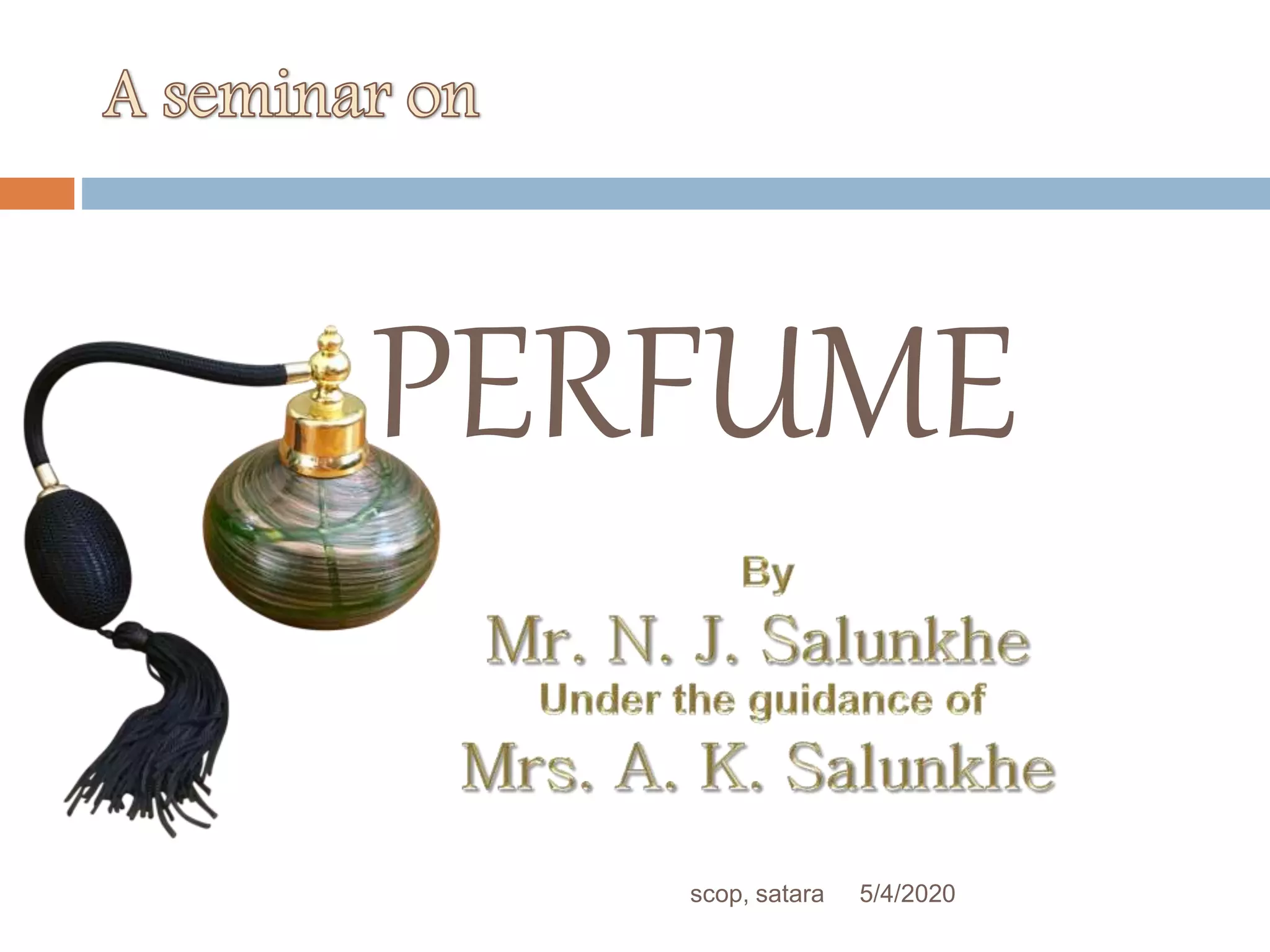
PERFUME
5/4/2020scop, satara
WHAT IS PERFUME
• Perfume is a mixture of fragrant essential oils or aromatic
compounds and solvents used to give the human body,
animal, food objects and living spacies a pleasant scent.
• It has been used for centuries by mankind.
• Perfumes are supposed to release a continuous pleasant
fragrance that will provide a long lasting feeling of freshness.
• Initially it was only used for religious purpose but now it has
become an ornament(to decorate) of sophistication for both
men and women.
5/4/2020scop, satara
HISTORY OF PERFUME
• The Egyptians were the first who used perfume for
personal enjoyment, but the production of perfume was
reserved for the priests and they used it in religious
purpose.
• The Greek used an extraordinary amount of perfume and
for each part of the body they used a different fragrance
for hygiene and cult of the body.
• The Romans used perfume as a part of luxury.
5/4/2020scop, satara
HISTORY OF PERFUME
• The oldest perfumery was discovered on the Island of Cyprus
4,000 years ago indicating that perfume manufacturing was on
an industrial scale.
• The Hungarians introduced the first modern perfume, made of
scented oils blended in an alcohol solution at the command of
Queen Elizabeth of Hungary.
• France is the birthplace of modern perfumery. France provided
to grow aromatic plants for perfume industry with raw materials.
Even today, France remains the centre of the European perfume
design and trade.
• England and Germany also contributed a lot in
modernization of perfumery.
5/4/2020scop, satara
NOTES IN PERFUME
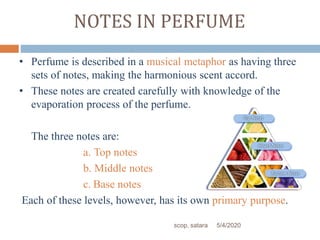
• Perfume is described in a musical metaphor as having three
sets of notes, making the harmonious scent accord.
• These notes are created carefully with knowledge of the
evaporation process of the perfume.
The three notes are:
a. Top notes
b. Middle notes
c. Base notes
Each of these levels, however, has its own primary purpose.
5/4/2020scop, satara
NOTES IN PERFUME
a) Top notes:
They are generally the lightest of all notes and recognized
immediately after application. Top notes consist of small, light
molecules with high volatility that evaporate quickly.
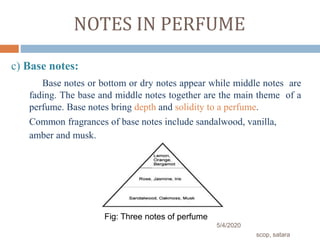
Common fragrances of top notes include citrus (lemon, orange zest), light
fruits (grape, berries) and herbs (clary sage, lavender).
b) Middle Notes:
The middle notes or the heart notes, make an appearance once the top
notes evaporate. The middle note compounds form the "heart" or main
body of a perfume and act to mask the often unpleasant initial impression
of base notes, which become more pleasant with time.
Common fragrances of middle notes includes rose, lemon, lavender,
nutmeg and jasmine.
5/4/2020scop, satara
NOTES IN PERFUME
c) Base notes:
Base notes or bottom or dry notes appear while middle notes are
fading. The base and middle notes together are the main theme of a
perfume. Base notes bring depth and solidity to a perfume.
Common fragrances of base notes include sandalwood, vanilla,
amber and musk.
Fig: Three notes of perfume
5/4/2020
scop, satara
CLASSIFICATION OF PERFUMES
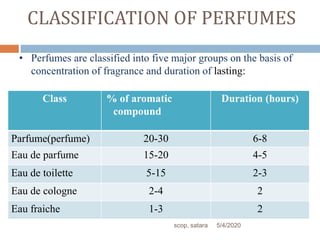
• Perfumes are classified into five major groups on the basis of
concentration of fragrance and duration of lasting:
Class % of aromatic
compound
Duration (hours)
Parfume(perfume) 20-30 6-8
Eau de parfume 15-20 4-5
Eau de toilette 5-15 2-3
Eau de cologne 2-4 2
Eau fraiche 1-3 2
5/4/2020scop, satara
CLASSIFICATION OF PERFUMES
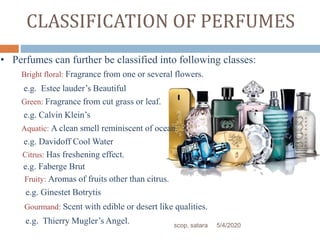
• Perfumes can further be classified into following classes:
Bright floral: Fragrance from one or several flowers.
e.g. Estee lauder’s Beautiful
Green: Fragrance from cut grass or leaf.
e.g. Calvin Klein’s
Aquatic: A clean smell reminiscent of ocean.
e.g. Davidoff Cool Water
Citrus: Has freshening effect.
e.g. Faberge Brut
Fruity: Aromas of fruits other than citrus.
e.g. Ginestet Botrytis
Gourmand: Scent with edible or desert like qualities.
e.g. Thierry Mugler’s Angel. 5/4/2020scop, satara
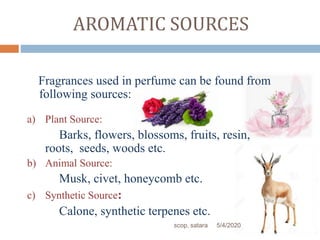
AROMATIC SOURCES
Fragrances used in perfume can be found from
following sources:
a) Plant Source:
Barks, flowers, blossoms, fruits, resin,
roots, seeds, woods etc.
b) Animal Source:
Musk, civet, honeycomb etc.
c) Synthetic Source:
Calone, synthetic terpenes etc.
5/4/2020scop, satara
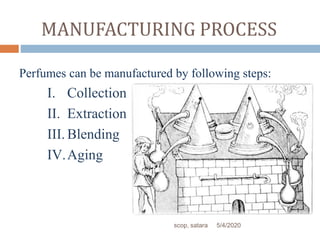
MANUFACTURING PROCESS
Perfumes can be manufactured by following steps:
I. Collection
II. Extraction
III. Blending
IV.Aging
5/4/2020scop, satara
MANUFACTURE OF PERFUME
I. Collection:
Before manufacturing process begins the sources of
suitable fragrances are collected in the manufacturing
centre.
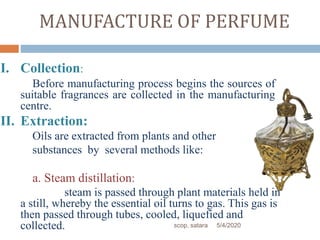
II. Extraction:
Oils are extracted from plants and other
substances by several methods like:
a. Steam distillation:
steam is passed through plant materials held in
a still, whereby the essential oil turns to gas. This gas is
then passed through tubes, cooled, liquefied and
collected. 5/4/2020scop, satara
MANUFACTURE OF PERFUME
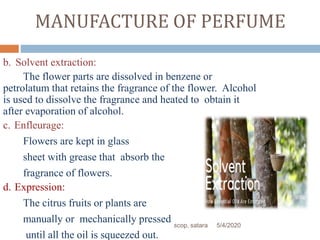
b. Solvent extraction:
The flower parts are dissolved in benzene or
petrolatum that retains the fragrance of the flower. Alcohol
is used to dissolve the fragrance and heated to obtain it
after evaporation of alcohol.
c. Enfleurage:
Flowers are kept in glass
sheet with grease that absorb the
fragrance of flowers.
d. Expression:
The citrus fruits or plants are
manually or mechanically pressed
until all the oil is squeezed out.
5/4/2020scop, satara
MANUFACTURE OF PERFUME
III. Blending:
Once the perfume oils are collected, they are ready
to be blended together according to a formula
determined by a master in the field, known as a "nose.”
After the scent has been created, it is mixed with alcohol.
Most full perfumes are made of about 10-20% perfume oils
dissolved in alcohol and a trace of water.
IV. Aging:
Fine perfume is often aged for several months or
even years after blending to ensure that the correct scent
has been achieved.
5/4/2020scop, satara
COMPOSITION OF PERFUME
Perfumes are mainly composed of –
1. Essential oils:
Derived from natural aromatic plant extracts and/or synthetic
aromatic chemicals. E.g. limonene, linalool, geraniol, citral etc.
2. Fixatives:
Natural or synthetic substances used to reduce the
evaporation rate. E.g. benzyl benzoate, benzyl alcohol etc.
3. Solvents:
The liquid in which the perfume oil is dissolved in
is usually 98% ethanol and 2% water.
Alcohol allows fragrance to spread along with it and does not
permit microbial growth in the perfume.
5/4/2020scop, satara
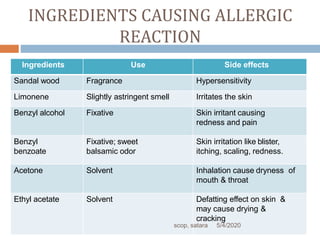
INGREDIENTS CAUSING ALLERGIC
REACTION
Ingredients Use Side effects
Sandal wood Fragrance Hypersensitivity
Limonene Slightly astringent smell Irritates the skin
Benzyl alcohol Fixative Skin irritant causing
redness and pain
Benzyl
benzoate
Fixative; sweet
balsamic odor
Skin irritation like blister,
itching, scaling, redness.
Acetone Solvent Inhalation cause dryness of
mouth & throat
Ethyl acetate Solvent Defatting effect on skin &
may cause drying &
cracking
5/4/2020scop, satara
PSYCHOLOGY OF USING PERFUME
• When we inhale the odorant molecules of a perfume, it not
only creates the sensation of odor but also creates emotions
and experiences associated with it. For instance, we focus
on the pleasant childhood memories associated with the
smell of vanilla.
• Stimulation of hippocampus causes secretion of growth
hormone, sex hormone and neurotransmitters.
• Another reason behind perfume use is to increase ones
attractiveness in the eyes of other people.
• We wear a perfume which best expresses our individuality,
our tastes and our character.
• Perfume using may become a habit and without it a person
may feel incomplete.
5/4/2020scop, satara
LEADING PERFUME BRANDS
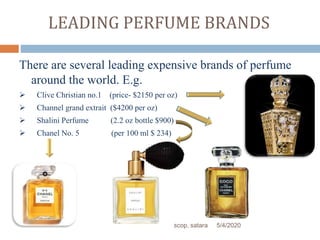
There are several leading expensive brands of perfume
around the world. E.g.
 Clive Christian no.1 (price- $2150 per oz)
 Channel grand extrait ($4200 per oz)
 Shalini Perfume (2.2 oz bottle $900)
 Chanel No. 5 (per 100 ml $ 234)
5/4/2020scop, satara
Thank You
5/4/2020scop, satara

Perfume m pharmacy notes scop satara

  • 1.
  • 2.
    WHAT IS PERFUME •Perfume is a mixture of fragrant essential oils or aromatic compounds and solvents used to give the human body, animal, food objects and living spacies a pleasant scent. • It has been used for centuries by mankind. • Perfumes are supposed to release a continuous pleasant fragrance that will provide a long lasting feeling of freshness. • Initially it was only used for religious purpose but now it has become an ornament(to decorate) of sophistication for both men and women. 5/4/2020scop, satara
  • 3.
    HISTORY OF PERFUME •The Egyptians were the first who used perfume for personal enjoyment, but the production of perfume was reserved for the priests and they used it in religious purpose. • The Greek used an extraordinary amount of perfume and for each part of the body they used a different fragrance for hygiene and cult of the body. • The Romans used perfume as a part of luxury. 5/4/2020scop, satara
  • 4.
    HISTORY OF PERFUME •The oldest perfumery was discovered on the Island of Cyprus 4,000 years ago indicating that perfume manufacturing was on an industrial scale. • The Hungarians introduced the first modern perfume, made of scented oils blended in an alcohol solution at the command of Queen Elizabeth of Hungary. • France is the birthplace of modern perfumery. France provided to grow aromatic plants for perfume industry with raw materials. Even today, France remains the centre of the European perfume design and trade. • England and Germany also contributed a lot in modernization of perfumery. 5/4/2020scop, satara
  • 5.
    NOTES IN PERFUME •Perfume is described in a musical metaphor as having three sets of notes, making the harmonious scent accord. • These notes are created carefully with knowledge of the evaporation process of the perfume. The three notes are: a. Top notes b. Middle notes c. Base notes Each of these levels, however, has its own primary purpose. 5/4/2020scop, satara
  • 6.
    NOTES IN PERFUME a)Top notes: They are generally the lightest of all notes and recognized immediately after application. Top notes consist of small, light molecules with high volatility that evaporate quickly. Common fragrances of top notes include citrus (lemon, orange zest), light fruits (grape, berries) and herbs (clary sage, lavender). b) Middle Notes: The middle notes or the heart notes, make an appearance once the top notes evaporate. The middle note compounds form the "heart" or main body of a perfume and act to mask the often unpleasant initial impression of base notes, which become more pleasant with time. Common fragrances of middle notes includes rose, lemon, lavender, nutmeg and jasmine. 5/4/2020scop, satara
  • 7.
    NOTES IN PERFUME c)Base notes: Base notes or bottom or dry notes appear while middle notes are fading. The base and middle notes together are the main theme of a perfume. Base notes bring depth and solidity to a perfume. Common fragrances of base notes include sandalwood, vanilla, amber and musk. Fig: Three notes of perfume 5/4/2020 scop, satara
  • 8.
    CLASSIFICATION OF PERFUMES •Perfumes are classified into five major groups on the basis of concentration of fragrance and duration of lasting: Class % of aromatic compound Duration (hours) Parfume(perfume) 20-30 6-8 Eau de parfume 15-20 4-5 Eau de toilette 5-15 2-3 Eau de cologne 2-4 2 Eau fraiche 1-3 2 5/4/2020scop, satara
  • 9.
    CLASSIFICATION OF PERFUMES •Perfumes can further be classified into following classes: Bright floral: Fragrance from one or several flowers. e.g. Estee lauder’s Beautiful Green: Fragrance from cut grass or leaf. e.g. Calvin Klein’s Aquatic: A clean smell reminiscent of ocean. e.g. Davidoff Cool Water Citrus: Has freshening effect. e.g. Faberge Brut Fruity: Aromas of fruits other than citrus. e.g. Ginestet Botrytis Gourmand: Scent with edible or desert like qualities. e.g. Thierry Mugler’s Angel. 5/4/2020scop, satara
  • 10.
    AROMATIC SOURCES Fragrances usedin perfume can be found from following sources: a) Plant Source: Barks, flowers, blossoms, fruits, resin, roots, seeds, woods etc. b) Animal Source: Musk, civet, honeycomb etc. c) Synthetic Source: Calone, synthetic terpenes etc. 5/4/2020scop, satara
  • 11.
    MANUFACTURING PROCESS Perfumes canbe manufactured by following steps: I. Collection II. Extraction III. Blending IV.Aging 5/4/2020scop, satara
  • 12.
    MANUFACTURE OF PERFUME I.Collection: Before manufacturing process begins the sources of suitable fragrances are collected in the manufacturing centre. II. Extraction: Oils are extracted from plants and other substances by several methods like: a. Steam distillation: steam is passed through plant materials held in a still, whereby the essential oil turns to gas. This gas is then passed through tubes, cooled, liquefied and collected. 5/4/2020scop, satara
  • 13.
    MANUFACTURE OF PERFUME b.Solvent extraction: The flower parts are dissolved in benzene or petrolatum that retains the fragrance of the flower. Alcohol is used to dissolve the fragrance and heated to obtain it after evaporation of alcohol. c. Enfleurage: Flowers are kept in glass sheet with grease that absorb the fragrance of flowers. d. Expression: The citrus fruits or plants are manually or mechanically pressed until all the oil is squeezed out. 5/4/2020scop, satara
  • 14.
    MANUFACTURE OF PERFUME III.Blending: Once the perfume oils are collected, they are ready to be blended together according to a formula determined by a master in the field, known as a "nose.” After the scent has been created, it is mixed with alcohol. Most full perfumes are made of about 10-20% perfume oils dissolved in alcohol and a trace of water. IV. Aging: Fine perfume is often aged for several months or even years after blending to ensure that the correct scent has been achieved. 5/4/2020scop, satara
  • 15.
    COMPOSITION OF PERFUME Perfumesare mainly composed of – 1. Essential oils: Derived from natural aromatic plant extracts and/or synthetic aromatic chemicals. E.g. limonene, linalool, geraniol, citral etc. 2. Fixatives: Natural or synthetic substances used to reduce the evaporation rate. E.g. benzyl benzoate, benzyl alcohol etc. 3. Solvents: The liquid in which the perfume oil is dissolved in is usually 98% ethanol and 2% water. Alcohol allows fragrance to spread along with it and does not permit microbial growth in the perfume. 5/4/2020scop, satara
  • 16.
    INGREDIENTS CAUSING ALLERGIC REACTION IngredientsUse Side effects Sandal wood Fragrance Hypersensitivity Limonene Slightly astringent smell Irritates the skin Benzyl alcohol Fixative Skin irritant causing redness and pain Benzyl benzoate Fixative; sweet balsamic odor Skin irritation like blister, itching, scaling, redness. Acetone Solvent Inhalation cause dryness of mouth & throat Ethyl acetate Solvent Defatting effect on skin & may cause drying & cracking 5/4/2020scop, satara
  • 17.
    PSYCHOLOGY OF USINGPERFUME • When we inhale the odorant molecules of a perfume, it not only creates the sensation of odor but also creates emotions and experiences associated with it. For instance, we focus on the pleasant childhood memories associated with the smell of vanilla. • Stimulation of hippocampus causes secretion of growth hormone, sex hormone and neurotransmitters. • Another reason behind perfume use is to increase ones attractiveness in the eyes of other people. • We wear a perfume which best expresses our individuality, our tastes and our character. • Perfume using may become a habit and without it a person may feel incomplete. 5/4/2020scop, satara
  • 18.
    LEADING PERFUME BRANDS Thereare several leading expensive brands of perfume around the world. E.g.  Clive Christian no.1 (price- $2150 per oz)  Channel grand extrait ($4200 per oz)  Shalini Perfume (2.2 oz bottle $900)  Chanel No. 5 (per 100 ml $ 234) 5/4/2020scop, satara
  • 19.