PERFUMES
Presented by:
SARANSH S JAIN.
M.PHARM(PHARMACEUTICS)
1st YEAR
CONTENT:
 INTRODUCTION
 HISTORY
 CLASSIFICATION
 MANUFACTURING PROCESS
 REFRENCES
WHAT IS PERFUME
 Perfume is mixture of fragrant essential oils or aromatic compound,fixative
and solvents used to give the human body,animal,food objects and living
space a pleasant scent.
 Perfumes are supposed to release a continuous pleasant fragrance that will
provide a long lasting feeling of freshness.
 Initially it was only used for religious purpose but now it has become an
ornament of sophistication for both men and women.
HISTORY OF PERFUME
 The Egyptians were the first who used perfume for personal enjoyment,but the production of
perfume was reserved for the priests and they used it in religious purpose.
 The Greek used an extraordinary amount of perfume and for each part of the body they used a
different fragrance for hygiene of the body.
 The Romans used perfume as a part of luxury.
 The oldest perfumery was discovered on the island of cyprus 4000 years ago indicating that
perfume manufacturing was on an industrial scale.
 England and Germany also contributed a lot in modernization of perfume.
CLASSIFICATION OF PERFUME
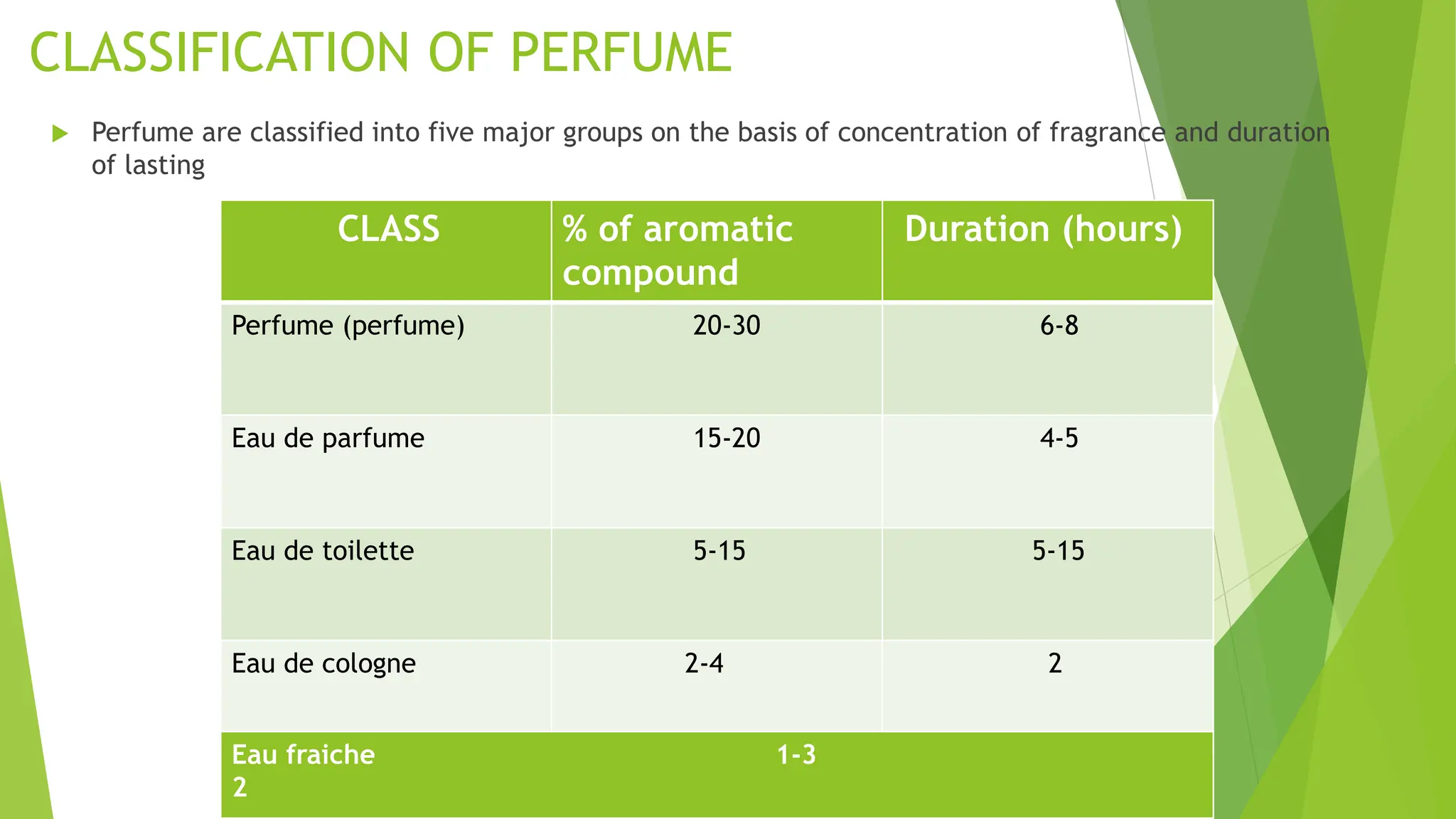
 Perfume are classified into five major groups on the basis of concentration of fragrance and duration
of lasting
CLASS % of aromatic
compound
Duration (hours)
Perfume (perfume) 20-30 6-8
Eau de parfume 15-20 4-5
Eau de toilette 5-15 5-15
Eau de cologne 2-4 2
Eau fraiche 1-3
2
Perfumes can further be classified into
following clasess: (1 Modern )
1) Bright floral: Fragrance from one or several flowers.
2) Green: Fragrance from cut grass or leaf eg. Calvin
3) Aquatic: A clean smell reminiscent of ocean eg. Cool water
4) Citrus: Has freshening effect. eg. Fabergy Brut
5) Fruity: Aromas of fruit other than citrus.
6) Gourmand: Scent with edible or desert like qualities.
(Traditional Class)
1) Single floral: Fragrance that are dominated by a scent from one particular
flower, in French called soliflore
2) Floral bouquet: Containing the fragrance of several flowers in a scent.
eg. Amber, Wood leather,Chypre
MANUFACTURING PROCESS
 Perfumes can be manufactured by following steps:
 Collection
 Extraction
 Blending
 Aging
1. Collection :
Before manufacturing process begins the sources of suitable fragrances are collected in the
manufacturing centre.
2. Extraction:
Oils are extracted from plants and other substances by several method like:
 Steam distillation
 Solvent extraction
 Enfleurage
 Expression
3. Blending:
Once the perfume oils are collected, they are ready to be blended together according to a
formula determined by a master in the field, known as a “nose”
After the scent has been created, it is mixed with alcohol. Most perfumes are made of about
10-20% perfume oils dissolved in alcohol and traces of water
4. Aging:
Fine perfume is often aged for several months or even years after blending to ensure that the
correct scent has been achieved.
ADVANTAGES:
 Enjoy the wafting fragrance of a well-perfumed person passing by side.
 Smell more pleasing
 Freshness filling
DISADVANTAGES:
 Chemicals may irritate others,especially in tight spaces.
 Contact dermatitis, an allergic reaction in the skin occur.
 Some VOCs,such as formaldehyde,ethanol,and d-limonene,cause eye,nose,and throat irritation,
difficulty in breathing,allergy symptoms and headches.
REFRENCES:
 POUCHER’S Perfumes,Cosmetic and Soaps book Volume 1 by W.A.Poucher Edited and
revised by A.J.Jouhar
 POUCHER’S Perfumes,Cosmetics and Soaps book Volume 2 by W.A.Poucher Ninth
Edition
PERFUME Cosmetic ppt For Mpharm 1st year

PERFUME Cosmetic ppt For Mpharm 1st year

  • 1.
    PERFUMES Presented by: SARANSH SJAIN. M.PHARM(PHARMACEUTICS) 1st YEAR
  • 2.
    CONTENT:  INTRODUCTION  HISTORY CLASSIFICATION  MANUFACTURING PROCESS  REFRENCES
  • 3.
    WHAT IS PERFUME Perfume is mixture of fragrant essential oils or aromatic compound,fixative and solvents used to give the human body,animal,food objects and living space a pleasant scent.  Perfumes are supposed to release a continuous pleasant fragrance that will provide a long lasting feeling of freshness.  Initially it was only used for religious purpose but now it has become an ornament of sophistication for both men and women.
  • 4.
    HISTORY OF PERFUME The Egyptians were the first who used perfume for personal enjoyment,but the production of perfume was reserved for the priests and they used it in religious purpose.  The Greek used an extraordinary amount of perfume and for each part of the body they used a different fragrance for hygiene of the body.  The Romans used perfume as a part of luxury.  The oldest perfumery was discovered on the island of cyprus 4000 years ago indicating that perfume manufacturing was on an industrial scale.  England and Germany also contributed a lot in modernization of perfume.
  • 5.
    CLASSIFICATION OF PERFUME Perfume are classified into five major groups on the basis of concentration of fragrance and duration of lasting CLASS % of aromatic compound Duration (hours) Perfume (perfume) 20-30 6-8 Eau de parfume 15-20 4-5 Eau de toilette 5-15 5-15 Eau de cologne 2-4 2 Eau fraiche 1-3 2
  • 6.
    Perfumes can furtherbe classified into following clasess: (1 Modern ) 1) Bright floral: Fragrance from one or several flowers. 2) Green: Fragrance from cut grass or leaf eg. Calvin 3) Aquatic: A clean smell reminiscent of ocean eg. Cool water 4) Citrus: Has freshening effect. eg. Fabergy Brut 5) Fruity: Aromas of fruit other than citrus. 6) Gourmand: Scent with edible or desert like qualities.
  • 7.
    (Traditional Class) 1) Singlefloral: Fragrance that are dominated by a scent from one particular flower, in French called soliflore 2) Floral bouquet: Containing the fragrance of several flowers in a scent. eg. Amber, Wood leather,Chypre
  • 8.
    MANUFACTURING PROCESS  Perfumescan be manufactured by following steps:  Collection  Extraction  Blending  Aging
  • 9.
    1. Collection : Beforemanufacturing process begins the sources of suitable fragrances are collected in the manufacturing centre. 2. Extraction: Oils are extracted from plants and other substances by several method like:  Steam distillation  Solvent extraction  Enfleurage  Expression
  • 10.
    3. Blending: Once theperfume oils are collected, they are ready to be blended together according to a formula determined by a master in the field, known as a “nose” After the scent has been created, it is mixed with alcohol. Most perfumes are made of about 10-20% perfume oils dissolved in alcohol and traces of water 4. Aging: Fine perfume is often aged for several months or even years after blending to ensure that the correct scent has been achieved.
  • 11.
    ADVANTAGES:  Enjoy thewafting fragrance of a well-perfumed person passing by side.  Smell more pleasing  Freshness filling DISADVANTAGES:  Chemicals may irritate others,especially in tight spaces.  Contact dermatitis, an allergic reaction in the skin occur.  Some VOCs,such as formaldehyde,ethanol,and d-limonene,cause eye,nose,and throat irritation, difficulty in breathing,allergy symptoms and headches.
  • 12.
    REFRENCES:  POUCHER’S Perfumes,Cosmeticand Soaps book Volume 1 by W.A.Poucher Edited and revised by A.J.Jouhar  POUCHER’S Perfumes,Cosmetics and Soaps book Volume 2 by W.A.Poucher Ninth Edition